INTONATION TIPS – Chris’ Escuela de Idiomas Ellie Burke
INTONATION
Falling Intonation for Declarative Statements and Information Questions
We use falling intonation on declarative statements and information questions.
Declarative statements are normal, neutral sentences that we use all the time.
Information questions are those that request details and start with words like “who,” “what,”
“where,” “when,” “why,” “how,” and all the variations.
Let’s look at how falling intonation works.
Falling intonation is a rise followed by a steep fall in pitch from the stressed syllable of your focus
word.
In other words, your pitch rises to its highest level on the most important word of the sentence
and then falls to the end.
Depending on which syllable or which word is stressed, this rise,and fall may happen within the
same syllable, or you may have a little more time to step down to the end.
Remember that the stressed syllable of the most important word will also be held the longest,
so you have a little extra time to do all those fancy tricks with your pitch.
Let’s look at a few examples:
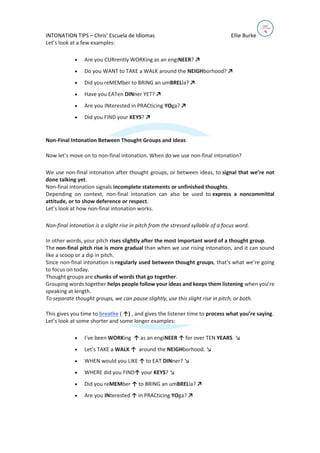
• I’ve been WORKing as an engiNEER for over TEN YEARS. ↘
• Let’s TAKE a WALK around the NEIGHborhood. ↘
• ReMEMber to BRING an umBRELla. ↘
• WHEN would you LIKE to EAT DINner? ↘
• How LONG have you been PRACticing YOga? ↘
• WHERE did you FIND your KEYS? ↘
Rising Intonation for Yes/No Questions
Now let’s move on to rising intonation. When do we use rising intonation?
We use rising intonation on yes/no questions, or questions that can be answered with a simple
yes or no.
Rising intonation is a versatile intonation pattern, as it can also be used in these situations:
• when asking a statement as a question,
• when asking for clarification or confirmation, or
• when expressing uncertainty or doubt.
But let’s take it one step at a time and focus on how rising intonation works.
Rising intonation is a steep rise in pitch from the stressed syllable of your focus word.
In other words, your pitch rises to its highest level on the most important word of the sentence
and continues to climb.
Depending on which syllable or which word is stressed, this steep rise can happen within the
same syllable, or you may have a little more time to climb up to the end.
INTONATION TIPS – Chris’ Escuela de Idiomas Ellie Burke
Let’s look at a few examples:
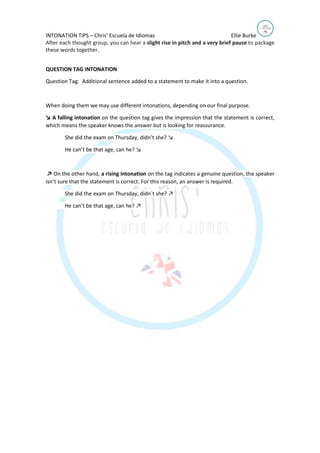
• Are you CURrently WORKing as an engiNEER? ↗
• Do you WANT to TAKE a WALK around the NEIGHborhood? ↗
• Did you reMEMber to BRING an umBRELla? ↗
• Have you EATen DINner YET? ↗
• Are you INterested in PRACticing YOga? ↗
• Did you FIND your KEYS? ↗
Non-Final Intonation Between Thought Groups and Ideas
Now let’s move on to non-final intonation. When do we use non-final intonation?
We use non-final intonation after thought groups, or between ideas, to signal that we’re not
done talking yet.
Non-final intonation signals incomplete statements or unfinished thoughts.
Depending on context, non-final intonation can also be used to express a noncommittal
attitude, or to show deference or respect.
Let’s look at how non-final intonation works.
Non-final intonation is a slight rise in pitch from the stressed syllable of a focus word.
In other words, your pitch rises slightly after the most important word of a thought group.
The non-final pitch rise is more gradual than when we use rising intonation, and it can sound
like a scoop or a dip in pitch.
Since non-final intonation is regularly used between thought groups, that’s what we’re going
to focus on today.
Thought groups are chunks of words that go together.
Grouping words together helps people follow your ideas and keeps them listening when you’re
speaking at length.
To separate thought groups, we can pause slightly, use this slight rise in pitch, or both.
This gives you time to breathe ( ↑) , and gives the listener time to process what you’re saying.
Let’s look at some shorter and some longer examples:
• I’ve been WORKing ↑ as an engiNEER ↑ for over TEN YEARS. ↘
• Let’s TAKE a WALK ↑ around the NEIGHborhood. ↘
• WHEN would you LIKE ↑ to EAT DINner? ↘
• WHERE did you FIND↑ your KEYS? ↘
• Did you reMEMber ↑ to BRING an umBRELla? ↗
• Are you INterested ↑ in PRACticing YOga? ↗
INTONATION TIPS – Chris’ Escuela de Idiomas Ellie Burke
After each thought group, you can hear a slight rise in pitch and a very brief pause to package
these words together.
QUESTION TAG INTONATION
Question Tag: Additional sentence added to a statement to make it into a question.
When doing them we may use different intonations, depending on our final purpose.
↘ A falling intonation on the question tag gives the impression that the statement is correct,
which means the speaker knows the answer but is looking for reassurance.
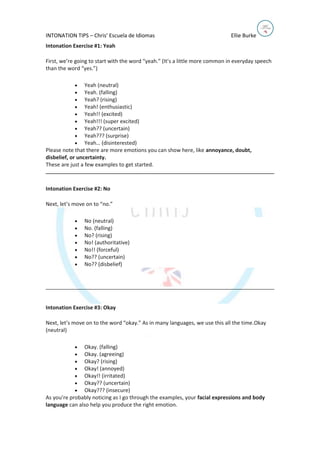
She did the exam on Thursday, didn’t she? ↘
He can’t be that age, can he? ↘
↗ On the other hand, a rising intonation on the tag indicates a genuine question, the speaker
isn’t sure that the statement is correct. For this reason, an answer is required.
She did the exam on Thursday, didn´t she? ↗
He can’t be that age, can he? ↗
INTONATION TIPS – Chris’ Escuela de Idiomas Ellie Burke
Intonation Exercise #1: Yeah
First, we’re going to start with the word “yeah.” (It’s a little more common in everyday speech
than the word “yes.”)
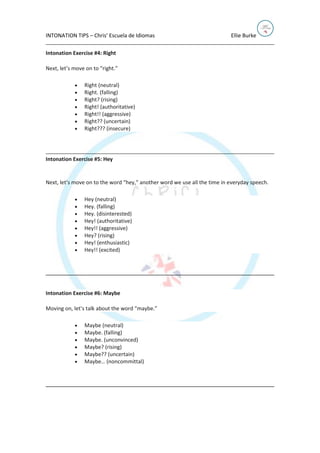
• Yeah (neutral)
• Yeah. (falling)
• Yeah? (rising)
• Yeah! (enthusiastic)
• Yeah!! (excited)
• Yeah!!! (super excited)
• Yeah?? (uncertain)
• Yeah??? (surprise)
• Yeah… (disinterested)
Please note that there are more emotions you can show here, like annoyance, doubt,
disbelief, or uncertainty.
These are just a few examples to get started.
Intonation Exercise #2: No
Next, let’s move on to “no.”
• No (neutral)
• No. (falling)
• No? (rising)
• No! (authoritative)
• No!! (forceful)
• No?? (uncertain)
• No?? (disbelief)
Intonation Exercise #3: Okay
Next, let’s move on to the word “okay.” As in many languages, we use this all the time.Okay
(neutral)
• Okay. (falling)
• Okay. (agreeing)
• Okay? (rising)
• Okay! (annoyed)
• Okay!! (irritated)
• Okay?? (uncertain)
• Okay??? (insecure)
As you’re probably noticing as I go through the examples, your facial expressions and body
language can also help you produce the right emotion.
INTONATION TIPS – Chris’ Escuela de Idiomas Ellie Burke
Intonation Exercise #4: Right
Next, let’s move on to “right.”
• Right (neutral)
• Right. (falling)
• Right? (rising)
• Right! (authoritative)
• Right!! (aggressive)
• Right?? (uncertain)
• Right??? (insecure)
Intonation Exercise #5: Hey
Next, let’s move on to the word “hey,” another word we use all the time in everyday speech.
• Hey (neutral)
• Hey. (falling)
• Hey. (disinterested)
• Hey! (authoritative)
• Hey!! (aggressive)
• Hey? (rising)
• Hey! (enthusiastic)
• Hey!! (excited)
Intonation Exercise #6: Maybe
Moving on, let’s talk about the word “maybe.”
• Maybe (neutral)
• Maybe. (falling)
• Maybe. (unconvinced)
• Maybe? (rising)
• Maybe?? (uncertain)
• Maybe… (noncommittal)
INTONATION TIPS – Chris’ Escuela de Idiomas Ellie Burke
Intonation Exercise #7: Please
Last but not least, let’s talk about the word “please.”
• Please (neutral)
• Please. (falling)
• Please! (authoritative)
• Please!! (forceful)
• Please? (rising)
• Please?? (pleading)
• Please??? (begging)

INTONATION TIPS.pdf

  • 1.
    INTONATION TIPS –Chris’ Escuela de Idiomas Ellie Burke INTONATION Falling Intonation for Declarative Statements and Information Questions We use falling intonation on declarative statements and information questions. Declarative statements are normal, neutral sentences that we use all the time. Information questions are those that request details and start with words like “who,” “what,” “where,” “when,” “why,” “how,” and all the variations. Let’s look at how falling intonation works. Falling intonation is a rise followed by a steep fall in pitch from the stressed syllable of your focus word. In other words, your pitch rises to its highest level on the most important word of the sentence and then falls to the end. Depending on which syllable or which word is stressed, this rise,and fall may happen within the same syllable, or you may have a little more time to step down to the end. Remember that the stressed syllable of the most important word will also be held the longest, so you have a little extra time to do all those fancy tricks with your pitch. Let’s look at a few examples: • I’ve been WORKing as an engiNEER for over TEN YEARS. ↘ • Let’s TAKE a WALK around the NEIGHborhood. ↘ • ReMEMber to BRING an umBRELla. ↘ • WHEN would you LIKE to EAT DINner? ↘ • How LONG have you been PRACticing YOga? ↘ • WHERE did you FIND your KEYS? ↘ Rising Intonation for Yes/No Questions Now let’s move on to rising intonation. When do we use rising intonation? We use rising intonation on yes/no questions, or questions that can be answered with a simple yes or no. Rising intonation is a versatile intonation pattern, as it can also be used in these situations: • when asking a statement as a question, • when asking for clarification or confirmation, or • when expressing uncertainty or doubt. But let’s take it one step at a time and focus on how rising intonation works. Rising intonation is a steep rise in pitch from the stressed syllable of your focus word. In other words, your pitch rises to its highest level on the most important word of the sentence and continues to climb. Depending on which syllable or which word is stressed, this steep rise can happen within the same syllable, or you may have a little more time to climb up to the end.
  • 2.
    INTONATION TIPS –Chris’ Escuela de Idiomas Ellie Burke Let’s look at a few examples: • Are you CURrently WORKing as an engiNEER? ↗ • Do you WANT to TAKE a WALK around the NEIGHborhood? ↗ • Did you reMEMber to BRING an umBRELla? ↗ • Have you EATen DINner YET? ↗ • Are you INterested in PRACticing YOga? ↗ • Did you FIND your KEYS? ↗ Non-Final Intonation Between Thought Groups and Ideas Now let’s move on to non-final intonation. When do we use non-final intonation? We use non-final intonation after thought groups, or between ideas, to signal that we’re not done talking yet. Non-final intonation signals incomplete statements or unfinished thoughts. Depending on context, non-final intonation can also be used to express a noncommittal attitude, or to show deference or respect. Let’s look at how non-final intonation works. Non-final intonation is a slight rise in pitch from the stressed syllable of a focus word. In other words, your pitch rises slightly after the most important word of a thought group. The non-final pitch rise is more gradual than when we use rising intonation, and it can sound like a scoop or a dip in pitch. Since non-final intonation is regularly used between thought groups, that’s what we’re going to focus on today. Thought groups are chunks of words that go together. Grouping words together helps people follow your ideas and keeps them listening when you’re speaking at length. To separate thought groups, we can pause slightly, use this slight rise in pitch, or both. This gives you time to breathe ( ↑) , and gives the listener time to process what you’re saying. Let’s look at some shorter and some longer examples: • I’ve been WORKing ↑ as an engiNEER ↑ for over TEN YEARS. ↘ • Let’s TAKE a WALK ↑ around the NEIGHborhood. ↘ • WHEN would you LIKE ↑ to EAT DINner? ↘ • WHERE did you FIND↑ your KEYS? ↘ • Did you reMEMber ↑ to BRING an umBRELla? ↗ • Are you INterested ↑ in PRACticing YOga? ↗
  • 3.
    INTONATION TIPS –Chris’ Escuela de Idiomas Ellie Burke After each thought group, you can hear a slight rise in pitch and a very brief pause to package these words together. QUESTION TAG INTONATION Question Tag: Additional sentence added to a statement to make it into a question. When doing them we may use different intonations, depending on our final purpose. ↘ A falling intonation on the question tag gives the impression that the statement is correct, which means the speaker knows the answer but is looking for reassurance. She did the exam on Thursday, didn’t she? ↘ He can’t be that age, can he? ↘ ↗ On the other hand, a rising intonation on the tag indicates a genuine question, the speaker isn’t sure that the statement is correct. For this reason, an answer is required. She did the exam on Thursday, didn´t she? ↗ He can’t be that age, can he? ↗
  • 4.
    INTONATION TIPS –Chris’ Escuela de Idiomas Ellie Burke Intonation Exercise #1: Yeah First, we’re going to start with the word “yeah.” (It’s a little more common in everyday speech than the word “yes.”) • Yeah (neutral) • Yeah. (falling) • Yeah? (rising) • Yeah! (enthusiastic) • Yeah!! (excited) • Yeah!!! (super excited) • Yeah?? (uncertain) • Yeah??? (surprise) • Yeah… (disinterested) Please note that there are more emotions you can show here, like annoyance, doubt, disbelief, or uncertainty. These are just a few examples to get started. Intonation Exercise #2: No Next, let’s move on to “no.” • No (neutral) • No. (falling) • No? (rising) • No! (authoritative) • No!! (forceful) • No?? (uncertain) • No?? (disbelief) Intonation Exercise #3: Okay Next, let’s move on to the word “okay.” As in many languages, we use this all the time.Okay (neutral) • Okay. (falling) • Okay. (agreeing) • Okay? (rising) • Okay! (annoyed) • Okay!! (irritated) • Okay?? (uncertain) • Okay??? (insecure) As you’re probably noticing as I go through the examples, your facial expressions and body language can also help you produce the right emotion.
  • 5.
    INTONATION TIPS –Chris’ Escuela de Idiomas Ellie Burke Intonation Exercise #4: Right Next, let’s move on to “right.” • Right (neutral) • Right. (falling) • Right? (rising) • Right! (authoritative) • Right!! (aggressive) • Right?? (uncertain) • Right??? (insecure) Intonation Exercise #5: Hey Next, let’s move on to the word “hey,” another word we use all the time in everyday speech. • Hey (neutral) • Hey. (falling) • Hey. (disinterested) • Hey! (authoritative) • Hey!! (aggressive) • Hey? (rising) • Hey! (enthusiastic) • Hey!! (excited) Intonation Exercise #6: Maybe Moving on, let’s talk about the word “maybe.” • Maybe (neutral) • Maybe. (falling) • Maybe. (unconvinced) • Maybe? (rising) • Maybe?? (uncertain) • Maybe… (noncommittal)
  • 6.
    INTONATION TIPS –Chris’ Escuela de Idiomas Ellie Burke Intonation Exercise #7: Please Last but not least, let’s talk about the word “please.” • Please (neutral) • Please. (falling) • Please! (authoritative) • Please!! (forceful) • Please? (rising) • Please?? (pleading) • Please??? (begging)