Importance of Teaching
Intonation Pattern at
Secondary Level
Objectives
The main objectives of this study are to know the opinion
of English Language teachers about:
The importance of teaching intonation patterns at
secondary level
To discuss the functions of Intonation
To investigate the effective ways to teach intonation
patterns to our teachers.
Intonation
• A pattern of changing pitch during an utterance (a
phrase, clause, sentence) to convey linguistic
information. The variations taking place in the pitch
of the voice in connected speech.
• The pattern of changing pitch is perceived as the
melody - falling or rising intonation.
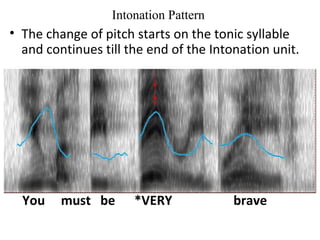
Intonation Pattern
• The change of pitch starts on the tonic syllable
and continues till the end of the Intonation unit.
You must be *VERY brave
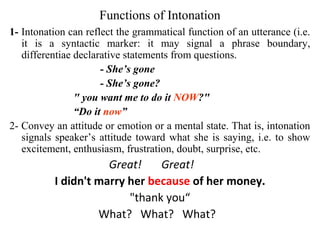
Functions of Intonation
1- Intonation can reflect the grammatical function of an utterance (i.e.
it is a syntactic marker: it may signal a phrase boundary,
differentiae declarative statements from questions.
- She’s gone
- She’s gone?
" you want me to do it NOW?"
“Do it now”
2- Convey an attitude or emotion or a mental state. That is, intonation
signals speaker’s attitude toward what she is saying, i.e. to show
excitement, enthusiasm, frustration, doubt, surprise, etc.
Great! Great!
I didn't marry her because of her money.
"thank you“
What? What? What?
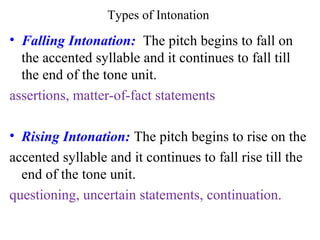
Types of Intonation
• Falling Intonation: The pitch begins to fall on
the accented syllable and it continues to fall till
the end of the tone unit.
assertions, matter-of-fact statements
• Rising Intonation: The pitch begins to rise on the
accented syllable and it continues to fall rise till the
end of the tone unit.
questioning, uncertain statements, continuation.
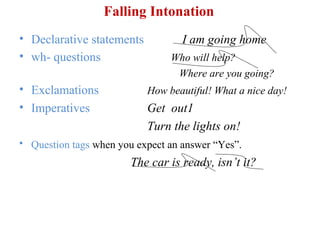
Falling Intonation
• Declarative statements I am going home
• wh- questions Who will help?
Where are you going?
• Exclamations How beautiful! What a nice day!
• Imperatives Get out1
Turn the lights on!
• Question tags when you expect an answer “Yes”.
The car is ready, isn’t it?
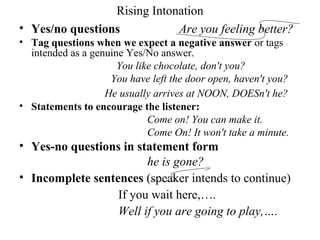
Rising Intonation
• Yes/no questions Are you feeling better?
• Tag questions when we expect a negative answer or tags
intended as a genuine Yes/No answer.
You like chocolate, don't you?
You have left the door open, haven't you?
He usually arrives at NOON, DOESn't he?
• Statements to encourage the listener:
Come on! You can make it.
Come On! It won't take a minute.
• Yes-no questions in statement form
he is gone?
• Incomplete sentences (speaker intends to continue)
If you wait here,….
Well if you are going to play,….
Suggestions for Teaching Intonation
1. T. must make sure that their students understand the
stress patterns and weak forms.
2. T. must show learners the relationships between
grammatical patterns and intonation (questions,
statements), e.g. falling intonation for affirmative or
WH. questions; Rising intonation for yes –no
questions
3. Attitudinal intonation should be introduced
contextually so that the learner can associate
between the type of intonation and the spoken
attitude.
4. It is necessary to produce intonation after native
speakers model, tape recorder, computer and radio.
Suggestions for Teaching Intonation
1. T. must make sure that their students understand the
stress patterns and weak forms.
2. T. must show learners the relationships between
grammatical patterns and intonation (questions,
statements), e.g. falling intonation for affirmative or
WH. questions; Rising intonation for yes –no
questions
3. Attitudinal intonation should be introduced
contextually so that the learner can associate
between the type of intonation and the spoken
attitude.
4. It is necessary to produce intonation after native
speakers model, tape recorder, computer and radio.

Teaching Intonation Pattern

  • 1.
    Importance of Teaching IntonationPattern at Secondary Level
  • 2.
    Objectives The main objectivesof this study are to know the opinion of English Language teachers about: The importance of teaching intonation patterns at secondary level To discuss the functions of Intonation To investigate the effective ways to teach intonation patterns to our teachers.
  • 3.
    Intonation • A patternof changing pitch during an utterance (a phrase, clause, sentence) to convey linguistic information. The variations taking place in the pitch of the voice in connected speech. • The pattern of changing pitch is perceived as the melody - falling or rising intonation.
  • 4.
    Intonation Pattern • Thechange of pitch starts on the tonic syllable and continues till the end of the Intonation unit. You must be *VERY brave
  • 5.
    Functions of Intonation 1-Intonation can reflect the grammatical function of an utterance (i.e. it is a syntactic marker: it may signal a phrase boundary, differentiae declarative statements from questions. - She’s gone - She’s gone? " you want me to do it NOW?" “Do it now” 2- Convey an attitude or emotion or a mental state. That is, intonation signals speaker’s attitude toward what she is saying, i.e. to show excitement, enthusiasm, frustration, doubt, surprise, etc. Great! Great! I didn't marry her because of her money. "thank you“ What? What? What?
  • 6.
    Types of Intonation •Falling Intonation: The pitch begins to fall on the accented syllable and it continues to fall till the end of the tone unit. assertions, matter-of-fact statements • Rising Intonation: The pitch begins to rise on the accented syllable and it continues to fall rise till the end of the tone unit. questioning, uncertain statements, continuation.
  • 7.
    Falling Intonation • Declarativestatements I am going home • wh- questions Who will help? Where are you going? • Exclamations How beautiful! What a nice day! • Imperatives Get out1 Turn the lights on! • Question tags when you expect an answer “Yes”. The car is ready, isn’t it?
  • 8.
    Rising Intonation • Yes/noquestions Are you feeling better? • Tag questions when we expect a negative answer or tags intended as a genuine Yes/No answer. You like chocolate, don't you? You have left the door open, haven't you? He usually arrives at NOON, DOESn't he? • Statements to encourage the listener: Come on! You can make it. Come On! It won't take a minute. • Yes-no questions in statement form he is gone? • Incomplete sentences (speaker intends to continue) If you wait here,…. Well if you are going to play,….
  • 9.
    Suggestions for TeachingIntonation 1. T. must make sure that their students understand the stress patterns and weak forms. 2. T. must show learners the relationships between grammatical patterns and intonation (questions, statements), e.g. falling intonation for affirmative or WH. questions; Rising intonation for yes –no questions 3. Attitudinal intonation should be introduced contextually so that the learner can associate between the type of intonation and the spoken attitude. 4. It is necessary to produce intonation after native speakers model, tape recorder, computer and radio.
  • 10.
    Suggestions for TeachingIntonation 1. T. must make sure that their students understand the stress patterns and weak forms. 2. T. must show learners the relationships between grammatical patterns and intonation (questions, statements), e.g. falling intonation for affirmative or WH. questions; Rising intonation for yes –no questions 3. Attitudinal intonation should be introduced contextually so that the learner can associate between the type of intonation and the spoken attitude. 4. It is necessary to produce intonation after native speakers model, tape recorder, computer and radio.

Editor's Notes

  • #6 If a rising pitch and extra stress on "because", the sentence means that I married her but this was not related to the fact that she has money. However, if the word "because" is not stressed, the sentence means that I didn't marry her, and the reason for this is because of her money.