Grammatical Gender
Grammatical Gender Russian has 3 grammatical genders: Masculine
Feminine
Neuter
Masculine
Feminine
Neuter
Grammatical Gender Sometimes grammatical gender relates to actual gender.
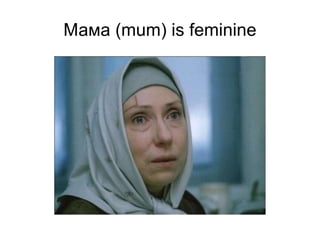
Мама (mum) is feminine
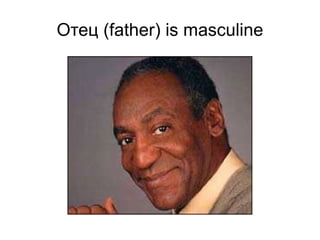
Отец (father) is masculine
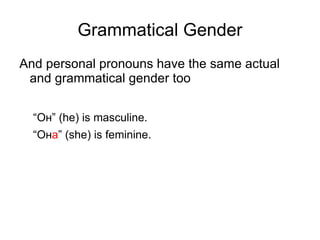
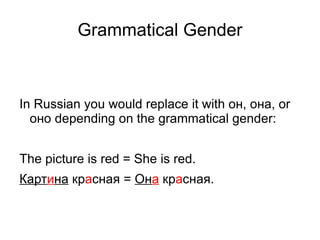
Grammatical Gender And personal pronouns have the same actual and grammatical gender too “Он” (he) is masculine.
“Он а ”  (she) is feminine.
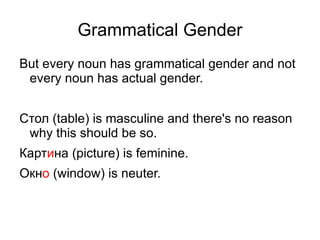
Grammatical Gender But every noun has grammatical gender and not every noun has actual gender.  Стол (table) is masculine and there's no reason why this should be so.
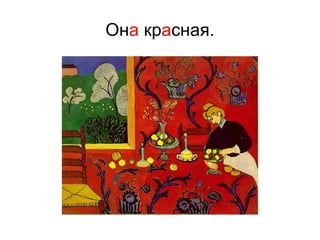
Карт и на  (picture) is feminine.
Окн о  (window) is neuter.
So then why have it? Well, it's a very convenient way to divide nouns into three groups. Nouns of each gender are going to decline in a similar pattern for each case. (See “Nominative Case”)
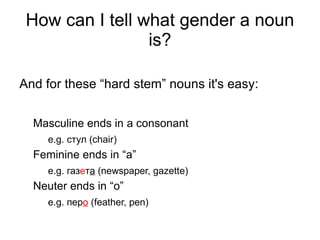
How can I tell what gender a noun is? Well, the nouns you know so far are all “hard stem.” This means they either end (in the nominative case of course) in a hard consonant or hard vowel. And...
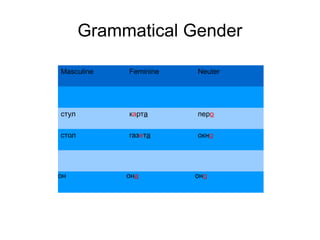
How can I tell what gender a noun is? And for these “hard stem” nouns it's easy: Masculine ends in a consonant  e.g. cтул (chair) Feminine ends in “а”  e.g. газ е т а  (newspaper, gazette) Neuter ends in “o” e.g. пер о  (feather, pen)
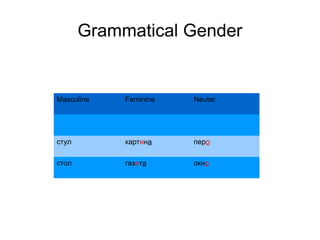
Grammatical Gender Masculine Feminine Neuter стул карт и н а пер о стол газ е т а окн о
One more thing...

Grammatical gender