Between the Wars
      The Age of Anxiety

      1920s and 1930s
England, France, Germany, Italy,
           and Spain
After the War to End All Wars…these are the
      attempts to make sure it ended all wars…
•   Kellogg-Briand Pact
     – “renounced war as an act of instrument of national policy”
     – Aka…it outlawed war
     – Nearly every nation in the world signs it – even the Soviet Union
     – Problem? Can’t be enforced…
•   League of Nations
     – Not successful
     – Wide variety of membership
     – Collective Security
          • If any member state were attacked, others would provide financial
            aid
          • Violates US isolationist policies/tendencies
     – No enforcement power
          • But would issue disapproval for acts of aggression
     – Germany and Japan frustrated that League is strictly pro-allies
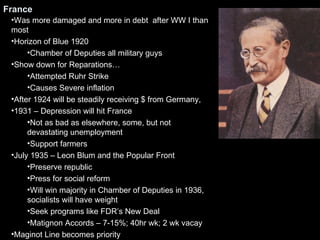
France
 •Was more damaged and more in debt after WW I than
 most
 •Horizon of Blue 1920
      •Chamber of Deputies all military guys
 •Show down for Reparations…
      •Attempted Ruhr Strike
      •Causes Severe inflation
 •After 1924 will be steadily receiving $ from Germany,
 •1931 – Depression will hit France
      •Not as bad as elsewhere, some, but not
      devastating unemployment
      •Support farmers
 •July 1935 – Leon Blum and the Popular Front
      •Preserve republic
      •Press for social reform
      •Will win majority in Chamber of Deputies in 1936,
      socialists will have weight
      •Seek programs like FDR’s New Deal
      •Matignon Accords – 7-15%; 40hr wk; 2 wk vacay
 •Maginot Line becomes priority
Left in Shambles
•   British cities suffered from German air raids
•   Economically struggling
•   1920’s Labour v. Liberal party
     – Lloyd George (C); 1922 Bonar Law (C)
     – Stanley Baldwin 1923 (C)
     – Labour party – Ramsey MacDonald
     – Standley Baldwin
          • Conservatives return govt to gold standard
          • Makes conversion rate too high, raises price of British goods
            to foreign countries
          • Management needs to lower expenses, cuts wages
          • Coal miners strike
          • Other workers inspired to strike
          • Miners and unions have to capitulate to keep their jobs
            because of high unemployment
          • Conservative gov’t does grant some housing and welfare
            reform
• Status Check on British Empire
• National Government – 1931
   – Coalition of Liberal, Labour, and Conservative Parties
   – Raises taxes
   – Cut ins benefits to unemployed and elderly
   – Lower govt salaries
   – Argue that falling prices in Britain mean salaries
     haven’t “really” changed b/c cost of living is lower too
   – Went off the gold standard
   – Value of pound falls by 30%
   – 10%tariff on all imports except from within empire
• Civil War erupts
• Secret negotiations – 1921 treaty that produces a status
  similar to Canada, Australia, New Zealand, and Northern
  Ireland
• Civil War between Irish diehards v. Irish moderates
   – Diehards want totally independent republic with no
      oath to the Br monarch
• Da Valera resigns as President, organizes resistance to
  the treaty
• Reelected in 1932, abolishes oath to monarchy
• Ireland = fully independent in 1949
Mussolini
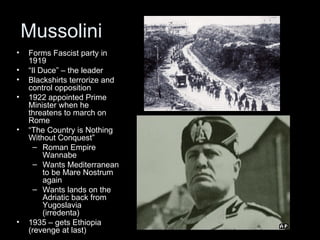
•   Forms Fascist party in
    1919
•   “Il Duce” – the leader
•   Blackshirts terrorize and
    control opposition
•   1922 appointed Prime
    Minister when he
    threatens to march on
    Rome
•   “The Country is Nothing
    Without Conquest”
      – Roman Empire
         Wannabe
      – Wants Mediterranean
         to be Mare Nostrum
         again
      – Wants lands on the
         Adriatic back from
         Yugoslavia
         (irredenta)
•   1935 – gets Ethiopia
    (revenge at last)
Il Duce’s Italy
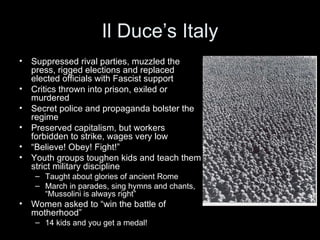
•   Suppressed rival parties, muzzled the
    press, rigged elections and replaced
    elected officials with Fascist support
•   Critics thrown into prison, exiled or
    murdered
•   Secret police and propaganda bolster the
    regime
•   Preserved capitalism, but workers
    forbidden to strike, wages very low
•   “Believe! Obey! Fight!”
•   Youth groups toughen kids and teach them
    strict military discipline
    – Taught about glories of ancient Rome
    – March in parades, sing hymns and chants,
      “Mussolini is always right”
•   Women asked to “win the battle of
    motherhood”
    – 14 kids and you get a medal!
Fascism
• An authoritarian (non-communism) government that
  emphasizes extreme nationalism and glorifies violence,
  discipline and blind loyalty to the state
• Bundle of sticks around an axe - “fasces”
• Antidemocratic – democracy leads to corruption and
  weakness, allows individual or class interests to rise
  above national goals
• Aggressive foreign expansion
   – “survival of the fittest”, dominance and war are necessary for
     survival
• Sworn enemies of communists
   – Fascism – support comes from business leaders, wealthy
     landowners, and lower middle class
   – Communism – support comes from urban and agricultural
     workers
Appeal of fascism?
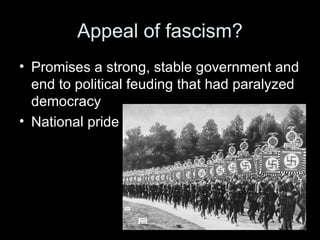
• Promises a strong, stable government and
  end to political feuding that had paralyzed
  democracy
• National pride
Totalitarian Rule


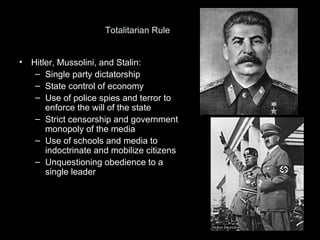
•   Hitler, Mussolini, and Stalin:
     – Single party dictatorship
     – State control of economy
     – Use of police spies and terror to
        enforce the will of the state
     – Strict censorship and government
        monopoly of the media
     – Use of schools and media to
        indoctrinate and mobilize citizens
     – Unquestioning obedience to a
        single leader
AP Euro Bellringer
• Turn work in
• Please pick up the article on Hyperinflation
  and begin reading
• This is a class set, so you may want to
  take a few notes from this article for your
  notebook
Weimar Republic
• By the end of WW I People feel very betrayed by
  the government
   – They were winning WW I until they were
     suddenly not
   – Kiel Mutiny
• Weimar Republic – established in 1919
   – Constitution being debated as the Social
     Democrats in power have to accept the
     condemning Treaty of Versailles
   – Nationalists and military figures will blame the
     republic and socialists for Germany’s
     problems
• Weimar Constitution
  – “quite enlightened”
  – Civil liberties, universal manhood election of Reichstag
    and President
      • Complicated system of proportional representation
      • Makes it easy for small parties to gain seats
  – President appointed and removed the Chancellor
  – Article 48 – president to rule by decree in time of crisis
  – Many Germans (political figures, teachers, civil
    servants, military officers) tend to favor a constitutional
    monarchy
  – Early years of Weimar only make people want to revise
    the TofVersailles and the Weimar Repub.
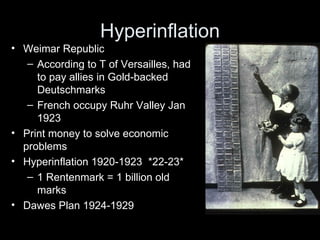
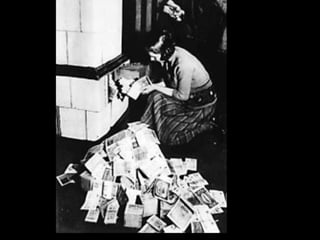
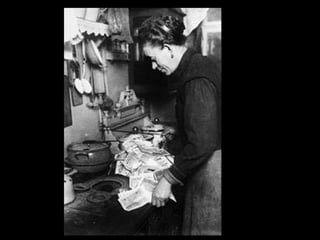
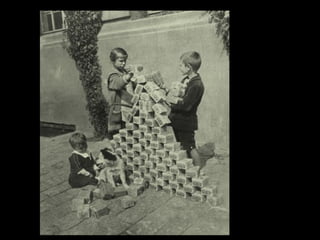
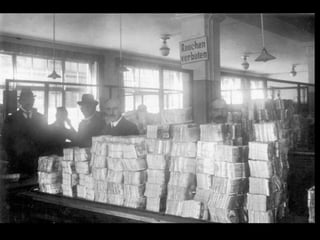
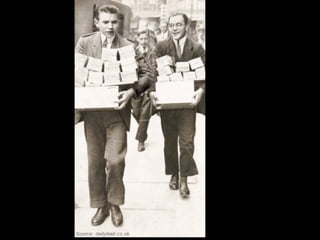
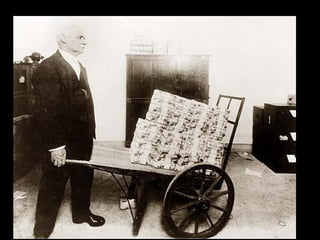
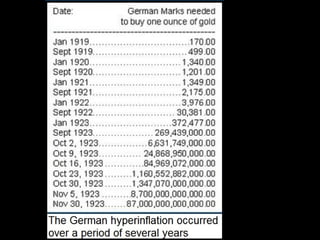
Hyperinflation
• Weimar Republic
   – According to T of Versailles, had
     to pay allies in Gold-backed
     Deutschmarks
   – French occupy Ruhr Valley Jan
     1923
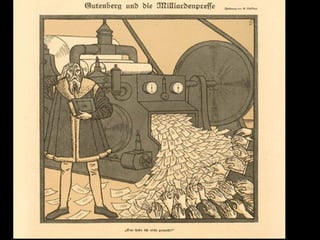
• Print money to solve economic
  problems
• Hyperinflation 1920-1923 *22-23*
   – 1 Rentenmark = 1 billion old
     marks
• Dawes Plan 1924-1929
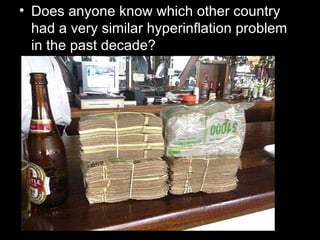
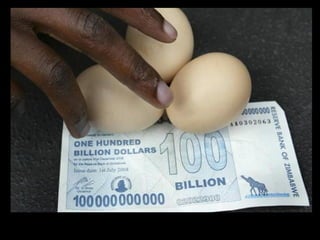
• Does anyone know which other country
  had a very similar hyperinflation problem
  in the past decade?
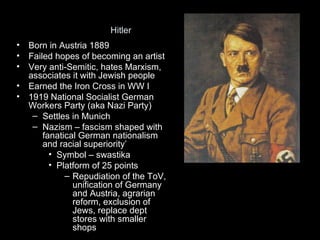
Hitler
•   Born in Austria 1889
•   Failed hopes of becoming an artist
•   Very anti-Semitic, hates Marxism,
    associates it with Jewish people
•   Earned the Iron Cross in WW I
•   1919 National Socialist German
    Workers Party (aka Nazi Party)
     – Settles in Munich
     – Nazism – fascism shaped with
        fanatical German nationalism
        and racial superiority’
          • Symbol – swastika
          • Platform of 25 points
              – Repudiation of the ToV,
                unification of Germany
                and Austria, agrarian
                reform, exclusion of
                Jews, replace dept
                stores with smaller
                shops
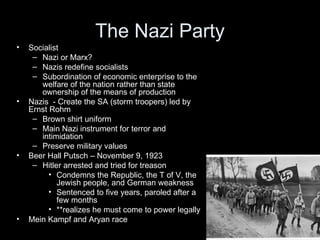
The Nazi Party
•   Socialist
     – Nazi or Marx?
     – Nazis redefine socialists
     – Subordination of economic enterprise to the
       welfare of the nation rather than state
       ownership of the means of production
•   Nazis - Create the SA (storm troopers) led by
    Ernst Rohm
     – Brown shirt uniform
     – Main Nazi instrument for terror and
       intimidation
     – Preserve military values
•   Beer Hall Putsch – November 9, 1923
     – Hitler arrested and tried for treason
          • Condemns the Republic, the T of V, the
            Jewish people, and German weakness
          • Sentenced to five years, paroled after a
            few months
          • **realizes he must come to power legally
•   Mein Kampf and Aryan race
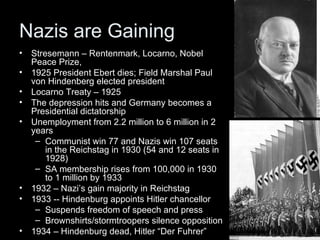
Nazis are Gaining
•   Stresemann – Rentenmark, Locarno, Nobel
    Peace Prize,
•   1925 President Ebert dies; Field Marshal Paul
    von Hindenberg elected president
•   Locarno Treaty – 1925
•   The depression hits and Germany becomes a
    Presidential dictatorship
•   Unemployment from 2.2 million to 6 million in 2
    years
     – Communist win 77 and Nazis win 107 seats
        in the Reichstag in 1930 (54 and 12 seats in
        1928)
     – SA membership rises from 100,000 in 1930
        to 1 million by 1933
•   1932 – Nazi’s gain majority in Reichstag
•   1933 -- Hindenburg appoints Hitler chancellor
     – Suspends freedom of speech and press
     – Brownshirts/stormtroopers silence opposition
•   1934 – Hindenburg dead, Hitler “Der Fuhrer”
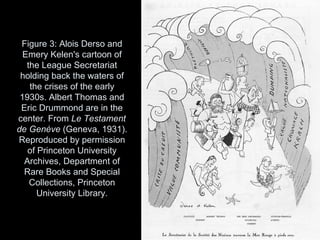
Figure 3: Alois Derso and
  Emery Kelen's cartoon of
   the League Secretariat
 holding back the waters of
    the crises of the early
 1930s. Albert Thomas and
 Eric Drummond are in the
center. From Le Testament
de Genève (Geneva, 1931).
Reproduced by permission
   of Princeton University
  Archives, Department of
  Rare Books and Special
    Collections, Princeton
      University Library.
The Depression Made the Nazis
•   The Depression made the Nazis
     – Public works
     – Blame everything on leftists, Jews, or TofV
     – Strikes = illegal
     – “strength through joy”
     – 4 year plan – Herman Goring leads economic vamp up for war
       starting in 1936
     – Private Property and Capitalism = okay
     – Significant enterprises and decisions are subordnate to the
       goals of the state
         • Price controls, restricted investments, and military production
           = top priority
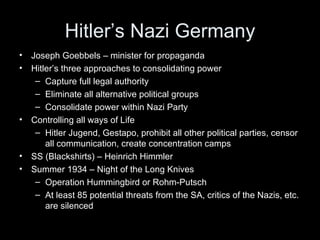
Hitler’s Nazi Germany
•   Joseph Goebbels – minister for propaganda
•   Hitler’s three approaches to consolidating power
     – Capture full legal authority
     – Eliminate all alternative political groups
     – Consolidate power within Nazi Party
•   Controlling all ways of Life
     – Hitler Jugend, Gestapo, prohibit all other political parties, censor
        all communication, create concentration camps
•   SS (Blackshirts) – Heinrich Himmler
•   Summer 1934 – Night of the Long Knives
     – Operation Hummingbird or Rohm-Putsch
     – At least 85 potential threats from the SA, critics of the Nazis, etc.
        are silenced
Der Fuhrer’s Acts of Aggression
• Begins rearming
• Hires unemployed workers for public works projects
    – Massive public buildings
    – Autobahn
•   1935 – Nuremberg Laws
•   1936 – Depression ends in Germany
•   1936 – The Olympics are held in Nazi Germany
•   Germany needs more living space – lebensraum
    – Militarize Rhineland in 1936
• 1936 - Axis powers agreed between Berlin and Rome
• 1938 Anschluss realigned (most Austrians welcome
  them) – Sound of Music!
• 1938 - Czechoslovakia, Chamberlain, and
  Appeasements “peace in our time!”
The rest of Europe
•   E Europe – self-determinism had created some nations here, but still a poor,
    rural nation
•   Hungary
     – Bolsheviks est socialist Bela Kun in 1919
     – Allies invade to remove the communist
     – Admiral Miklos Horthy est as “regent” til 1940
     – Defacto rulers – Count Stephen Bethlen and General Julius Gombos
        (anti-Semitic)
     – Hungary is bitter about WW I’s ending
•   Austria
     – Quite bitter – lost their empire, down to 8 million citizens (25% in
        Vienna)
     – Economy in shambles,
     – Political Parties – Christian Socialists and Social Democrats
     – Nazi coup in 1934 – Kurt von Schuschnigg – rules until Anschluss in
        1938
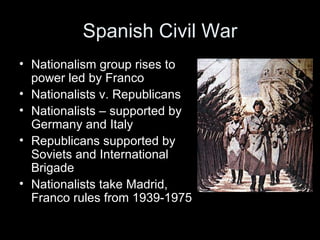
Spanish Civil War
• Nationalism group rises to
  power led by Franco
• Nationalists v. Republicans
• Nationalists – supported by
  Germany and Italy
• Republicans supported by
  Soviets and International
  Brigade
• Nationalists take Madrid,
  Franco rules from 1939-1975
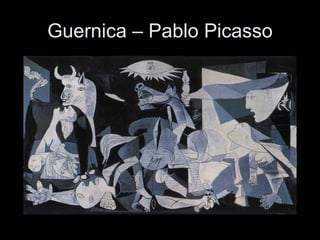
Guernica – Pablo Picasso
On to war!
• March 1939 – Br and Fr agree to help Poland if
  invaded
• Aug 1939 – Hitler and Stalin agree to a ten year
  Non-Aggression Pact (secret document attached
  about how to divide up E. Europe)
• Sept. 1, 1939, Germany invades Poland
  – Blitzkrieg, Poland down in a month, Holocaust begins
    in Poland
  – Stalin seizes E. half of Poland
• Sept. 3, 1939, Br and Fr declare war on
  Germany
• April 9, 1940 – Hitler takes Denmark and
  Norway
• May 10 – Netherlands, Belgium,
  Luxembourg, France to British Channel
• June 10 – Fr govt flees
• June 14 – Germans take over Paris
• Aug 1940 – Luftwaffe hits London hard
  – British Royal Airforce, Chamberlain – “Never
    in the field of human conflict was so much
    owed by so many to so few”

Between the wars

  • 1.
    Between the Wars The Age of Anxiety 1920s and 1930s England, France, Germany, Italy, and Spain
  • 2.
    After the Warto End All Wars…these are the attempts to make sure it ended all wars… • Kellogg-Briand Pact – “renounced war as an act of instrument of national policy” – Aka…it outlawed war – Nearly every nation in the world signs it – even the Soviet Union – Problem? Can’t be enforced… • League of Nations – Not successful – Wide variety of membership – Collective Security • If any member state were attacked, others would provide financial aid • Violates US isolationist policies/tendencies – No enforcement power • But would issue disapproval for acts of aggression – Germany and Japan frustrated that League is strictly pro-allies
  • 3.
    France •Was moredamaged and more in debt after WW I than most •Horizon of Blue 1920 •Chamber of Deputies all military guys •Show down for Reparations… •Attempted Ruhr Strike •Causes Severe inflation •After 1924 will be steadily receiving $ from Germany, •1931 – Depression will hit France •Not as bad as elsewhere, some, but not devastating unemployment •Support farmers •July 1935 – Leon Blum and the Popular Front •Preserve republic •Press for social reform •Will win majority in Chamber of Deputies in 1936, socialists will have weight •Seek programs like FDR’s New Deal •Matignon Accords – 7-15%; 40hr wk; 2 wk vacay •Maginot Line becomes priority
  • 4.
    Left in Shambles • British cities suffered from German air raids • Economically struggling • 1920’s Labour v. Liberal party – Lloyd George (C); 1922 Bonar Law (C) – Stanley Baldwin 1923 (C) – Labour party – Ramsey MacDonald – Standley Baldwin • Conservatives return govt to gold standard • Makes conversion rate too high, raises price of British goods to foreign countries • Management needs to lower expenses, cuts wages • Coal miners strike • Other workers inspired to strike • Miners and unions have to capitulate to keep their jobs because of high unemployment • Conservative gov’t does grant some housing and welfare reform
  • 5.
    • Status Checkon British Empire • National Government – 1931 – Coalition of Liberal, Labour, and Conservative Parties – Raises taxes – Cut ins benefits to unemployed and elderly – Lower govt salaries – Argue that falling prices in Britain mean salaries haven’t “really” changed b/c cost of living is lower too – Went off the gold standard – Value of pound falls by 30% – 10%tariff on all imports except from within empire
  • 7.
    • Civil Warerupts • Secret negotiations – 1921 treaty that produces a status similar to Canada, Australia, New Zealand, and Northern Ireland • Civil War between Irish diehards v. Irish moderates – Diehards want totally independent republic with no oath to the Br monarch • Da Valera resigns as President, organizes resistance to the treaty • Reelected in 1932, abolishes oath to monarchy • Ireland = fully independent in 1949
  • 8.
    Mussolini • Forms Fascist party in 1919 • “Il Duce” – the leader • Blackshirts terrorize and control opposition • 1922 appointed Prime Minister when he threatens to march on Rome • “The Country is Nothing Without Conquest” – Roman Empire Wannabe – Wants Mediterranean to be Mare Nostrum again – Wants lands on the Adriatic back from Yugoslavia (irredenta) • 1935 – gets Ethiopia (revenge at last)
  • 9.
    Il Duce’s Italy • Suppressed rival parties, muzzled the press, rigged elections and replaced elected officials with Fascist support • Critics thrown into prison, exiled or murdered • Secret police and propaganda bolster the regime • Preserved capitalism, but workers forbidden to strike, wages very low • “Believe! Obey! Fight!” • Youth groups toughen kids and teach them strict military discipline – Taught about glories of ancient Rome – March in parades, sing hymns and chants, “Mussolini is always right” • Women asked to “win the battle of motherhood” – 14 kids and you get a medal!
  • 10.
    Fascism • An authoritarian(non-communism) government that emphasizes extreme nationalism and glorifies violence, discipline and blind loyalty to the state • Bundle of sticks around an axe - “fasces” • Antidemocratic – democracy leads to corruption and weakness, allows individual or class interests to rise above national goals • Aggressive foreign expansion – “survival of the fittest”, dominance and war are necessary for survival • Sworn enemies of communists – Fascism – support comes from business leaders, wealthy landowners, and lower middle class – Communism – support comes from urban and agricultural workers
  • 11.
    Appeal of fascism? •Promises a strong, stable government and end to political feuding that had paralyzed democracy • National pride
  • 12.
    Totalitarian Rule • Hitler, Mussolini, and Stalin: – Single party dictatorship – State control of economy – Use of police spies and terror to enforce the will of the state – Strict censorship and government monopoly of the media – Use of schools and media to indoctrinate and mobilize citizens – Unquestioning obedience to a single leader
  • 13.
    AP Euro Bellringer •Turn work in • Please pick up the article on Hyperinflation and begin reading • This is a class set, so you may want to take a few notes from this article for your notebook
  • 14.
    Weimar Republic • Bythe end of WW I People feel very betrayed by the government – They were winning WW I until they were suddenly not – Kiel Mutiny • Weimar Republic – established in 1919 – Constitution being debated as the Social Democrats in power have to accept the condemning Treaty of Versailles – Nationalists and military figures will blame the republic and socialists for Germany’s problems
  • 15.
    • Weimar Constitution – “quite enlightened” – Civil liberties, universal manhood election of Reichstag and President • Complicated system of proportional representation • Makes it easy for small parties to gain seats – President appointed and removed the Chancellor – Article 48 – president to rule by decree in time of crisis – Many Germans (political figures, teachers, civil servants, military officers) tend to favor a constitutional monarchy – Early years of Weimar only make people want to revise the TofVersailles and the Weimar Repub.
  • 16.
    Hyperinflation • Weimar Republic – According to T of Versailles, had to pay allies in Gold-backed Deutschmarks – French occupy Ruhr Valley Jan 1923 • Print money to solve economic problems • Hyperinflation 1920-1923 *22-23* – 1 Rentenmark = 1 billion old marks • Dawes Plan 1924-1929
  • 25.
    • Does anyoneknow which other country had a very similar hyperinflation problem in the past decade?
  • 27.
    Hitler • Born in Austria 1889 • Failed hopes of becoming an artist • Very anti-Semitic, hates Marxism, associates it with Jewish people • Earned the Iron Cross in WW I • 1919 National Socialist German Workers Party (aka Nazi Party) – Settles in Munich – Nazism – fascism shaped with fanatical German nationalism and racial superiority’ • Symbol – swastika • Platform of 25 points – Repudiation of the ToV, unification of Germany and Austria, agrarian reform, exclusion of Jews, replace dept stores with smaller shops
  • 28.
    The Nazi Party • Socialist – Nazi or Marx? – Nazis redefine socialists – Subordination of economic enterprise to the welfare of the nation rather than state ownership of the means of production • Nazis - Create the SA (storm troopers) led by Ernst Rohm – Brown shirt uniform – Main Nazi instrument for terror and intimidation – Preserve military values • Beer Hall Putsch – November 9, 1923 – Hitler arrested and tried for treason • Condemns the Republic, the T of V, the Jewish people, and German weakness • Sentenced to five years, paroled after a few months • **realizes he must come to power legally • Mein Kampf and Aryan race
  • 29.
    Nazis are Gaining • Stresemann – Rentenmark, Locarno, Nobel Peace Prize, • 1925 President Ebert dies; Field Marshal Paul von Hindenberg elected president • Locarno Treaty – 1925 • The depression hits and Germany becomes a Presidential dictatorship • Unemployment from 2.2 million to 6 million in 2 years – Communist win 77 and Nazis win 107 seats in the Reichstag in 1930 (54 and 12 seats in 1928) – SA membership rises from 100,000 in 1930 to 1 million by 1933 • 1932 – Nazi’s gain majority in Reichstag • 1933 -- Hindenburg appoints Hitler chancellor – Suspends freedom of speech and press – Brownshirts/stormtroopers silence opposition • 1934 – Hindenburg dead, Hitler “Der Fuhrer”
  • 30.
    Figure 3: AloisDerso and Emery Kelen's cartoon of the League Secretariat holding back the waters of the crises of the early 1930s. Albert Thomas and Eric Drummond are in the center. From Le Testament de Genève (Geneva, 1931). Reproduced by permission of Princeton University Archives, Department of Rare Books and Special Collections, Princeton University Library.
  • 31.
    The Depression Madethe Nazis • The Depression made the Nazis – Public works – Blame everything on leftists, Jews, or TofV – Strikes = illegal – “strength through joy” – 4 year plan – Herman Goring leads economic vamp up for war starting in 1936 – Private Property and Capitalism = okay – Significant enterprises and decisions are subordnate to the goals of the state • Price controls, restricted investments, and military production = top priority
  • 32.
    Hitler’s Nazi Germany • Joseph Goebbels – minister for propaganda • Hitler’s three approaches to consolidating power – Capture full legal authority – Eliminate all alternative political groups – Consolidate power within Nazi Party • Controlling all ways of Life – Hitler Jugend, Gestapo, prohibit all other political parties, censor all communication, create concentration camps • SS (Blackshirts) – Heinrich Himmler • Summer 1934 – Night of the Long Knives – Operation Hummingbird or Rohm-Putsch – At least 85 potential threats from the SA, critics of the Nazis, etc. are silenced
  • 33.
    Der Fuhrer’s Actsof Aggression • Begins rearming • Hires unemployed workers for public works projects – Massive public buildings – Autobahn • 1935 – Nuremberg Laws • 1936 – Depression ends in Germany • 1936 – The Olympics are held in Nazi Germany • Germany needs more living space – lebensraum – Militarize Rhineland in 1936 • 1936 - Axis powers agreed between Berlin and Rome • 1938 Anschluss realigned (most Austrians welcome them) – Sound of Music! • 1938 - Czechoslovakia, Chamberlain, and Appeasements “peace in our time!”
  • 34.
    The rest ofEurope • E Europe – self-determinism had created some nations here, but still a poor, rural nation • Hungary – Bolsheviks est socialist Bela Kun in 1919 – Allies invade to remove the communist – Admiral Miklos Horthy est as “regent” til 1940 – Defacto rulers – Count Stephen Bethlen and General Julius Gombos (anti-Semitic) – Hungary is bitter about WW I’s ending • Austria – Quite bitter – lost their empire, down to 8 million citizens (25% in Vienna) – Economy in shambles, – Political Parties – Christian Socialists and Social Democrats – Nazi coup in 1934 – Kurt von Schuschnigg – rules until Anschluss in 1938
  • 35.
    Spanish Civil War •Nationalism group rises to power led by Franco • Nationalists v. Republicans • Nationalists – supported by Germany and Italy • Republicans supported by Soviets and International Brigade • Nationalists take Madrid, Franco rules from 1939-1975
  • 36.
  • 37.
    On to war! •March 1939 – Br and Fr agree to help Poland if invaded • Aug 1939 – Hitler and Stalin agree to a ten year Non-Aggression Pact (secret document attached about how to divide up E. Europe) • Sept. 1, 1939, Germany invades Poland – Blitzkrieg, Poland down in a month, Holocaust begins in Poland – Stalin seizes E. half of Poland • Sept. 3, 1939, Br and Fr declare war on Germany
  • 38.
    • April 9,1940 – Hitler takes Denmark and Norway • May 10 – Netherlands, Belgium, Luxembourg, France to British Channel • June 10 – Fr govt flees • June 14 – Germans take over Paris • Aug 1940 – Luftwaffe hits London hard – British Royal Airforce, Chamberlain – “Never in the field of human conflict was so much owed by so many to so few”