Interview Skills


                   Careers and
                   Employability Centre
Why interview candidates


Interviews are designed to find out :


 • Can you do the job – experience and skills
 • Will you do the job – motivation
 • Do you fit in – culture and team


Two main types of question – general and competency
Types of interview

Ask what sort of interview to expect!

First interview                         Second interview

Telephone interview                     1 to 1 or panel interview
CV or Application Form based            Competency based
Case study                              Academic or technical
Selection tests                         Assessment centre
Types of questions


General questions
• Tell me about yourself
• Tell us about your relevant experience
• What is greatest achievement or career highlight?
• What are your strengths and weaknesses?
• What do you know about our company/industry?
• What are your long term career goals?
General questions


• Give answers structure – don’t ramble

• Your chance to paint your own portrait

• Define the context

• Be prepared with specific answers

• Think about what they might ask you or what you have said
  already
Types of question


Competency based questions

• Use ‘past behaviour indicates future success’
• Objective way of comparing you to others
• Relate to skills and behaviour needed for the role
• Interviewers decide beforehand which type of answers score
  positive points
• They look for structure, cause and effect and pragmatism
• Use real scenarios
Competency questions


• Identify competencies for the job you are seeking
        •Company website
        •Advert
        •Job descriptions
•   Compare these against your background
•   Find your best example and prepare this in advance
•   Keep the answer concise
•   Avoid jargon
Some typical competencies


 • Analytical skills
 • Communication
 • Problem solving
 • Teamwork
 • Leadership
 • Creativity
 • Adaptability
 • Influencing
Examples of questions


General:
• Tell me about your weaknesses
• Why do you want to work here?


Competency:
• How would you deal with a team member who is
  underperforming
• Describe a time when you had to find a solution to a problem
Before the interview


Be prepared!

• Find out about the organisation and the interviewer
• Rehearse your answers to typical questions with examples
• Remember it’s a two way process:
       oWhat 10 (max) things do want them to take away?

       oDecide what are your unique selling points (USPs)
• Know your CV inside out
Initial impressions are critical


You make an impression as soon as you meet someone:
The impact you make


     •50% Body language


     •40% Voice


     •10% Words


     Delivery of your message is key
Initial impressions


•   Walk tall and straight
•   Be grounded before you speak
•   Make eye contact and smile
•   Shake hands
•   Say who you are clearly
•   Remember to breathe
During the interview
What you say:
Use examples
Be informative – 10 points you want to tell them
Boast modestly
Take time over difficult questions - ask for clarification if necessary

How you say it:
Think about the words you use
Talk about I rather than we
Register – including appropriate language and vocabulary
During the interview – what you say


     Situation:   give a context by describing the situation

     Task:        what was your goal?

     Action:      tell the interviewer your specific actions

     Result:      shows yourself in a good light, even if the
                  overall project was not a success
During the interview - behaviour


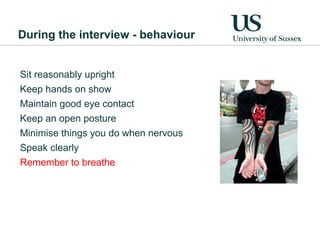
Sit reasonably upright
Keep hands on show
Maintain good eye contact
Keep an open posture
Minimise things you do when nervous
Speak clearly
Remember to breathe
Assessment Centres


 Employers use various techniques as well as interviews


 • Online and written tests
 • Exercises – individual and in groups
 • Social events
 • Presentations
During the Assessment Centre


Review your behaviour


Talk to people

Co-operate with everybody!
Careers and Employability Centre
Further help


Short interview with a careers adviser
10 – 5 Mon – Fri (plus Wed 5 –7)
Events
Website www.sussex.ac.uk/careers
Careers and Employability Centre
Examples of questions………


1. What has been your greatest achievement?
2. Describe a situation where you have dealt with confrontation
   (for example a difficult customer).
3. What do you look for in a job?
4. Why did you choose your university and degree subject?
5. Tell me about yourself.
6. Describe a situation in which you led a team?
7. Is a jaffa cake a cake or a biscuit?
Careers and Employability Centre
Your questions………
What would an average day be like?
How would my work be monitored and how often would I be
appraised?
What career paths have other graduates followed in this company?
Will I have any opportunity to use my foreign language skills?
Will I be working in a team? What is the make-up of these teams?
What are the company’s development plans and targets over the
next five years?
When am I likely to hear back from you?
Do you support study for external qualifications?

Interview Skills

  • 1.
    Interview Skills Careers and Employability Centre
  • 2.
    Why interview candidates Interviewsare designed to find out : • Can you do the job – experience and skills • Will you do the job – motivation • Do you fit in – culture and team Two main types of question – general and competency
  • 3.
    Types of interview Askwhat sort of interview to expect! First interview Second interview Telephone interview 1 to 1 or panel interview CV or Application Form based Competency based Case study Academic or technical Selection tests Assessment centre
  • 4.
    Types of questions Generalquestions • Tell me about yourself • Tell us about your relevant experience • What is greatest achievement or career highlight? • What are your strengths and weaknesses? • What do you know about our company/industry? • What are your long term career goals?
  • 5.
    General questions • Giveanswers structure – don’t ramble • Your chance to paint your own portrait • Define the context • Be prepared with specific answers • Think about what they might ask you or what you have said already
  • 6.
    Types of question Competencybased questions • Use ‘past behaviour indicates future success’ • Objective way of comparing you to others • Relate to skills and behaviour needed for the role • Interviewers decide beforehand which type of answers score positive points • They look for structure, cause and effect and pragmatism • Use real scenarios
  • 7.
    Competency questions • Identifycompetencies for the job you are seeking •Company website •Advert •Job descriptions • Compare these against your background • Find your best example and prepare this in advance • Keep the answer concise • Avoid jargon
  • 8.
    Some typical competencies • Analytical skills • Communication • Problem solving • Teamwork • Leadership • Creativity • Adaptability • Influencing
  • 9.
    Examples of questions General: •Tell me about your weaknesses • Why do you want to work here? Competency: • How would you deal with a team member who is underperforming • Describe a time when you had to find a solution to a problem
  • 10.
    Before the interview Beprepared! • Find out about the organisation and the interviewer • Rehearse your answers to typical questions with examples • Remember it’s a two way process: oWhat 10 (max) things do want them to take away? oDecide what are your unique selling points (USPs) • Know your CV inside out
  • 11.
    Initial impressions arecritical You make an impression as soon as you meet someone:
  • 12.
    The impact youmake •50% Body language •40% Voice •10% Words Delivery of your message is key
  • 13.
    Initial impressions • Walk tall and straight • Be grounded before you speak • Make eye contact and smile • Shake hands • Say who you are clearly • Remember to breathe
  • 14.
    During the interview Whatyou say: Use examples Be informative – 10 points you want to tell them Boast modestly Take time over difficult questions - ask for clarification if necessary How you say it: Think about the words you use Talk about I rather than we Register – including appropriate language and vocabulary
  • 15.
    During the interview– what you say Situation: give a context by describing the situation Task: what was your goal? Action: tell the interviewer your specific actions Result: shows yourself in a good light, even if the overall project was not a success
  • 16.
    During the interview- behaviour Sit reasonably upright Keep hands on show Maintain good eye contact Keep an open posture Minimise things you do when nervous Speak clearly Remember to breathe
  • 17.
    Assessment Centres Employersuse various techniques as well as interviews • Online and written tests • Exercises – individual and in groups • Social events • Presentations
  • 18.
    During the AssessmentCentre Review your behaviour Talk to people Co-operate with everybody!
  • 19.
    Careers and EmployabilityCentre Further help Short interview with a careers adviser 10 – 5 Mon – Fri (plus Wed 5 –7) Events Website www.sussex.ac.uk/careers
  • 20.
    Careers and EmployabilityCentre Examples of questions……… 1. What has been your greatest achievement? 2. Describe a situation where you have dealt with confrontation (for example a difficult customer). 3. What do you look for in a job? 4. Why did you choose your university and degree subject? 5. Tell me about yourself. 6. Describe a situation in which you led a team? 7. Is a jaffa cake a cake or a biscuit?
  • 21.
    Careers and EmployabilityCentre Your questions……… What would an average day be like? How would my work be monitored and how often would I be appraised? What career paths have other graduates followed in this company? Will I have any opportunity to use my foreign language skills? Will I be working in a team? What is the make-up of these teams? What are the company’s development plans and targets over the next five years? When am I likely to hear back from you? Do you support study for external qualifications?

Editor's Notes

  • #2 Ask group about experiences of interviews so far- any particular concerns? Good experiences? Bad experiences?
  • #3 Interviews are also a chance for you to decide if you want to work for the organisation & find out more about their culture. Its not a one way process. You might also experience good interviewers and bad interviewers!
  • #7 Examples of competency based Questions could include: Tell us about a time when you worked as part of a team- what was your role? Can you give us an example of when you demonstrated your communication skills- what did you do?
  • #10 The weakness question- key to answering this is to keep your example positive and end on a positive note.
  • #11 Look at your application form again, read the person specification & job description- research the employers website Think about a range of examples from the range of your experience
  • #14 Be grounded- be balanced!
  • #15 Avoid ‘you know’ ‘like’
  • #16 Avoid ‘you know’ ‘like’