PEOPLE PRAXIS
SOLUTIONS
TRAINING | EXECUTIVE SEARCH | CONSULTING
Successful Interviews
Making the most of the interview
Overview
• Preparing for interviews
• The interview experience
• Questions to expect and to ask
• Different types of interview
Interviews
• Employer’s objective is to find the best person for the job
• Employer: reviews candidate’s experience and abilities
• Can you do the job? (skills, abilities, qualifications)
• Will you do the job? (interest, attitude & motivation)
• How will you fit into the organisation? (personality)
• You: impress employer and assess position on offer
• What does this position offer me?
• How does it fit with my career plans?
• Congratulations - you have passed the first hurdle
• You must prove that you are the most suitable candidate for this position
Preparation is the key to success
• Review own skills, experiences and qualities
• Check CV
• Anticipate questions and identify relevant
examples
• Prepare key selling points
• Research organisation
• Websites, reports, articles, company literature, etc
• Contacts with knowledge of organisation or sector
• Relevant articles in the press
• Personal visit or telephone call
• Research job and occupational area
• Job description – or similar
• Current issues
• Prepare your questions
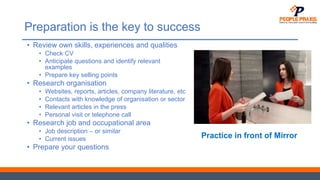
Practice in front of Mirror
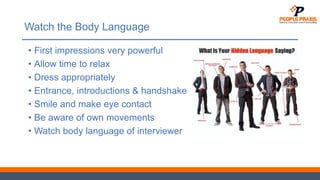
Watch the Body Language
• First impressions very powerful
• Allow time to relax
• Dress appropriately
• Entrance, introductions & handshake
• Smile and make eye contact
• Be aware of own movements
• Watch body language of interviewer
Typical Questions-About You
• About you
• Tell me about yourself - Bring me up to date with your CV?
• Why did you choose that particular degree programme?
• What experience have you had that is relevant to this post?
• What would you consider your major achievements to date?
• General knowledge
• Any question on Current Affair etc., candidates are advised
to read 2-3 Newspaper daily as a habit, so keep abreast of
current affairs
• What’s your opinion on Electric Vehicles coming to India ?
Typical Questions-About the Job
• About the job
• What interests you about this job?
• What do you know about this organisation?
• What other options are you considering?
• How do you see your career developing – 5 years?
• If you were Head of Department, what would be your priorities?
Other Type of Questions
• “What if” Questions
• No experience - how are you likely to respond to a situation
• Probing Questions
• How exactly did you deal with the situation?
• How did you know it worked?
• How did you feel about the outcome?
• Could you have handled it differently?
Your Answers
• Listen carefully, seek clarification
• Illustrate answers with real examples and evidence
• Be positive – constructive criticism
• Keep answers specific and succinct
• Take time to respond
• Be alert to interviewer’s body language
• Speak clearly, smile and show enthusiasm
• Know what you want to say, and find the opportunity
Qualities Employers Seek
• Good all-round intelligence
• Enthusiasm, commitment and motivation
• Good communication skills
• Team work ability
• Ability to solve problems
• Capacity to work hard
• Initiative and self-reliance
• Balanced personality
Your Questions
• Training programmes
• Career development opportunities
• Types of projects & responsibilities
• Reporting structure
• Performance appraisal
• Profile of staff
• Questions about topics raised in interview
• What happens next?
What creates a bad impression
• Poor personal appearance
• Negative attitude – evasive, using excuses
• Lack of interest and enthusiasm
• Lack of preparation
• Poor knowledge of role
• Failure to give concrete examples of skills
• Over emphasis on money/rewards
• Lack of career plan
After the Interview
Review own performance
What went well
What went badly
What you wished you had said
Prepare for next stage
Invitation to second / final round interviews
Assessment centre
Psychometric testing
Panel interview
Rejection letter / email
If you can request feedback - use it
Telephone Interviews
• Prepare as thoroughly as for ‘real’ interview
• Select comfortable, private, quiet place
• Have copy of CV and company information
• Have pen and paper at hand
• Prepare for usual interview questions
• Practice on phone
• Record answers
• Try standing
• Smile and use gestures
• Avoid monotones
• Be yourself
Other Types Of Interviews
• Rotating
• Like one-to-one with different interviewers
• Group
• 6-8 candidates
• Group observed while discussing topic
• Be aware of group interaction
• Panel
• 2-5 interviewers, or as many as 13!!
• Try to identify different roles
• Respond to interviewer, include others through eye contact
• May involve presentation
Assessment Centres
• Company premises or neutral venue
• Includes social or informal events
• Meeting with recent graduates or managers
• Activities include:
• Group exercises
• Practical tasks and exercises
• Report writing
• Oral Presentations
• Psychometric assessments
• Interviews
• Simulates real work environment
Psychometric Tests
• Aptitude Tests - measure skills relevant to position
• Verbal comprehension - evaluate logic of text
• Numerical reasoning - interpret statistical data
• Diagrammatic reasoning - recognise patterns
• Watch timing – complete as many as possible
• Personality Questionnaires
• Look at personality style
• No right or wrong answers
• Be spontaneous, don’t try to second-guess
• Tests include built-in checks
• Employers may be looking for different personality profiles
• Practice using online tests on www.ul.ie/careers
Thank You
Feel free to write for any feedback/training sessions zubair.khan@peoplepraxis.in

Interview techniques

  • 1.
    PEOPLE PRAXIS SOLUTIONS TRAINING |EXECUTIVE SEARCH | CONSULTING
  • 2.
    Successful Interviews Making themost of the interview
  • 3.
    Overview • Preparing forinterviews • The interview experience • Questions to expect and to ask • Different types of interview
  • 4.
    Interviews • Employer’s objectiveis to find the best person for the job • Employer: reviews candidate’s experience and abilities • Can you do the job? (skills, abilities, qualifications) • Will you do the job? (interest, attitude & motivation) • How will you fit into the organisation? (personality) • You: impress employer and assess position on offer • What does this position offer me? • How does it fit with my career plans? • Congratulations - you have passed the first hurdle • You must prove that you are the most suitable candidate for this position
  • 5.
    Preparation is thekey to success • Review own skills, experiences and qualities • Check CV • Anticipate questions and identify relevant examples • Prepare key selling points • Research organisation • Websites, reports, articles, company literature, etc • Contacts with knowledge of organisation or sector • Relevant articles in the press • Personal visit or telephone call • Research job and occupational area • Job description – or similar • Current issues • Prepare your questions Practice in front of Mirror
  • 6.
    Watch the BodyLanguage • First impressions very powerful • Allow time to relax • Dress appropriately • Entrance, introductions & handshake • Smile and make eye contact • Be aware of own movements • Watch body language of interviewer
  • 7.
    Typical Questions-About You •About you • Tell me about yourself - Bring me up to date with your CV? • Why did you choose that particular degree programme? • What experience have you had that is relevant to this post? • What would you consider your major achievements to date? • General knowledge • Any question on Current Affair etc., candidates are advised to read 2-3 Newspaper daily as a habit, so keep abreast of current affairs • What’s your opinion on Electric Vehicles coming to India ?
  • 8.
    Typical Questions-About theJob • About the job • What interests you about this job? • What do you know about this organisation? • What other options are you considering? • How do you see your career developing – 5 years? • If you were Head of Department, what would be your priorities?
  • 9.
    Other Type ofQuestions • “What if” Questions • No experience - how are you likely to respond to a situation • Probing Questions • How exactly did you deal with the situation? • How did you know it worked? • How did you feel about the outcome? • Could you have handled it differently?
  • 10.
    Your Answers • Listencarefully, seek clarification • Illustrate answers with real examples and evidence • Be positive – constructive criticism • Keep answers specific and succinct • Take time to respond • Be alert to interviewer’s body language • Speak clearly, smile and show enthusiasm • Know what you want to say, and find the opportunity
  • 11.
    Qualities Employers Seek •Good all-round intelligence • Enthusiasm, commitment and motivation • Good communication skills • Team work ability • Ability to solve problems • Capacity to work hard • Initiative and self-reliance • Balanced personality
  • 12.
    Your Questions • Trainingprogrammes • Career development opportunities • Types of projects & responsibilities • Reporting structure • Performance appraisal • Profile of staff • Questions about topics raised in interview • What happens next?
  • 13.
    What creates abad impression • Poor personal appearance • Negative attitude – evasive, using excuses • Lack of interest and enthusiasm • Lack of preparation • Poor knowledge of role • Failure to give concrete examples of skills • Over emphasis on money/rewards • Lack of career plan
  • 14.
    After the Interview Reviewown performance What went well What went badly What you wished you had said Prepare for next stage Invitation to second / final round interviews Assessment centre Psychometric testing Panel interview Rejection letter / email If you can request feedback - use it
  • 15.
    Telephone Interviews • Prepareas thoroughly as for ‘real’ interview • Select comfortable, private, quiet place • Have copy of CV and company information • Have pen and paper at hand • Prepare for usual interview questions • Practice on phone • Record answers • Try standing • Smile and use gestures • Avoid monotones • Be yourself
  • 16.
    Other Types OfInterviews • Rotating • Like one-to-one with different interviewers • Group • 6-8 candidates • Group observed while discussing topic • Be aware of group interaction • Panel • 2-5 interviewers, or as many as 13!! • Try to identify different roles • Respond to interviewer, include others through eye contact • May involve presentation
  • 17.
    Assessment Centres • Companypremises or neutral venue • Includes social or informal events • Meeting with recent graduates or managers • Activities include: • Group exercises • Practical tasks and exercises • Report writing • Oral Presentations • Psychometric assessments • Interviews • Simulates real work environment
  • 18.
    Psychometric Tests • AptitudeTests - measure skills relevant to position • Verbal comprehension - evaluate logic of text • Numerical reasoning - interpret statistical data • Diagrammatic reasoning - recognise patterns • Watch timing – complete as many as possible • Personality Questionnaires • Look at personality style • No right or wrong answers • Be spontaneous, don’t try to second-guess • Tests include built-in checks • Employers may be looking for different personality profiles • Practice using online tests on www.ul.ie/careers
  • 19.
    Thank You Feel freeto write for any feedback/training sessions zubair.khan@peoplepraxis.in