
Skills Academy 2015:
Interview Techniques Workshop
John McMenamin
Careers Consultant
Career Development Centre
Workshop Objectives
1. To outline principles and tips for successful
interviews
2. To explore employers’ expectations
3. To share previous interview experiences and
best practice
4. To assess your own levels of confidence
5. To practice creating and delivering answers to
common interview questions
Workshop Content
1. What you need to do before an interview
2. What is a job interview?
3. What are employers looking for?
4. Interview behaviour
5. Interview questions
6. Interview tips
Three things you need to do before
an interview
1. Preparation
2. Preparation
3. Preparation
1. Preparation
1. RESEARCH yourself
2. RESEARCH the job
3. RESEARCH the organisation
4. RESEARCH the sector
2. Preparation
Knowledge about yourself
– Re-read your application
– Strengths and weaknesses
– Why you want the job?
Knowledge about the job itself
– What skills do you need?
– How can you demonstrate these skills with examples from
University, work, outside interests?
Knowledge about the organisation & sector
– Why do you want to work for that organisation?
– What’s happening in the sector right now?
3. Preparation
– What will the interview format be?
– How will you get there?
– Rehearse your answers
(We can help you with this!)
– Questions for the interviewer – shows interest
and enthusiasm for the role + tells you more
about the job – take a notepad with you – jot
down questions as they occur to you
What is a job interview?
Typical Interview Format
– Introduction phase
– The formal interview
– Information about the organization
– Summing up / questions about the job
Every job interview is a ‘marketing’
exercise, so…
– Be clear about what you want to
communicate
– Support what you say with evidence
(more on this later)
What are looking for?
Employers: Three Questions
– Can you do the job?
Do you have the knowledge and skills?
– Do you want to do the job?
Do you have the motivation?
– Will you fit in?
Do you have relevant values and personal
qualities?
Employers’ Wish List
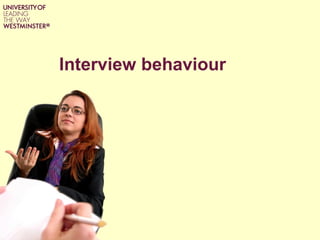
Interview behaviour
The Interview- First Impressions
Dress
– Appropriate business dress clean shoes!
What to take
– Certificates if needed, copies of CV/application
Arrive on time
– Plan the route
– Leave extra journey time for problems
Meeting the interviewers
– Relax, but remember you are being observed
Body language
– Handshake, eye contact
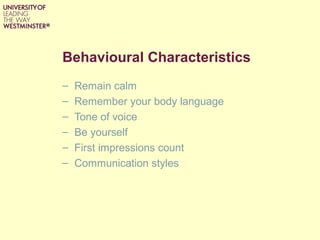
Behavioural Characteristics
– Remain calm
– Remember your body language
– Tone of voice
– Be yourself
– First impressions count
– Communication styles
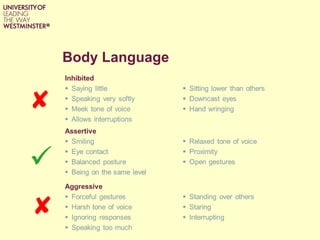
Body Language



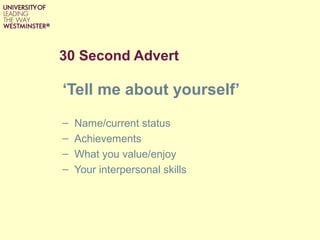
30 Second Advert
‘Tell me about yourself’
– Name/current status
– Achievements
– What you value/enjoy
– Your interpersonal skills
Interview questions
Types of Questions
1. Motivational Questions
2. Technical Questions
3. Competency Questions
Motivational Questions
Designed to test your motivation for the job
and the organisation
– Why do you want to work here?
– How much do you know about our organisation?
– Where do you see yourself in 5/10 years time?
Technical Questions
– These relate to your ability to use the technology you
have learnt from your course/work experience
– “What systems and software are you competent in?”
– “What do you know about working in a photographic
laboratory?”
– “What experience do you have of using the following… ?”
Competency Questions
– Questions based on the general
competencies all employers expect from
graduates (team skills, communication,
problem solving etc..)
– eg “Can you tell us about a time when
you...worked in a team/dealt with a difficult
customer/met a deadline?”
– Remember that the key is providing evidence
based responses based on the STAR formula
(Situation, Task, Action, Result)
Skills Based Examples
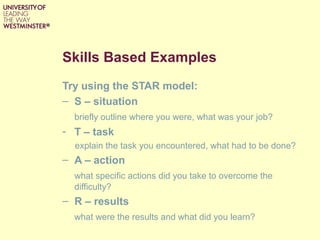
Try using the STAR model:
– S – situation
briefly outline where you were, what was your job?
- T – task
explain the task you encountered, what had to be done?
– A – action
what specific actions did you take to overcome the
difficulty?
– R – results
what were the results and what did you learn?
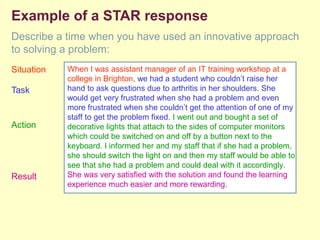
Example of a STAR response
Describe a time when you have used an innovative approach
to solving a problem:
Situation
Task
Action
Result
When I was assistant manager of an IT training workshop at a
college in Brighton, we had a student who couldn’t raise her
hand to ask questions due to arthritis in her shoulders. She
would get very frustrated when she had a problem and even
more frustrated when she couldn’t get the attention of one of my
staff to get the problem fixed. I went out and bought a set of
decorative lights that attach to the sides of computer monitors
which could be switched on and off by a button next to the
keyboard. I informed her and my staff that if she had a problem,
she should switch the light on and then my staff would be able to
see that she had a problem and could deal with it accordingly.
She was very satisfied with the solution and found the learning
experience much easier and more rewarding.
Your Toughest Interview Questions
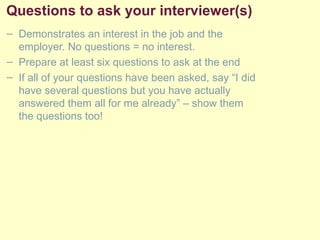
Questions to ask your interviewer(s)
– Demonstrates an interest in the job and the
employer. No questions = no interest.
– Prepare at least six questions to ask at the end
– If all of your questions have been asked, say “I did
have several questions but you have actually
answered them all for me already” – show them
the questions too!
Questions to ask your interviewer(s)
– Why has the position become available?
– What are the main objectives and responsibilities of the position?
– How does the company expect these objectives to be met?
– What are the measures used to judge how successful I am in the role?
– What obstacles are commonly encountered in reaching these objectives?
– What is the desired time frame for reaching the objectives?
– What can I expect from you in terms of development and support?
– What aspirations do you have for me at the company?
– Where will the job fit into the team structure?
– What is the main thing the organisation expects from its employees?
– How do you build good relationships within teams?
– What is the turnover of staff like throughout the company?
– Are there any plans for expansion?
– How would you describe the company culture and management style?
Interview Checklist
– Switch mobile off
– Look prepared
– Be prepared
– Eye contact
– Answer questions using STAR model
– Be prepared to ask questions yourself
– Take a copy of your application (CV or
application form)
10 Tips for a good interview
1. Assume the interview starts the moment you
enter the building
2. Listen to the question and answer it, ask for
clarification if unsure what they are asking
3. Engage all interviewers in eye contact
4. Always back up everything you are saying with
examples from your experience
5. Avoid taking notes in with you and certainly
never read from them if you do
10 Tips for a good interview
6. Always have questions ready for the end
7. Know what you’ve said in your application and
be prepared to discuss the details
8. If they don’t tell you, ask when you will hear
about the outcome of the interview
9. Thank the interviewer(s) by name
10. Smile! 
Interview practice
– Describe a time when you worked as part of an
effective team, what did you do and what was the
outcome?
– Describe a time when you solved a difficult
problem. What did you do and what was the
outcome?
– What is your biggest weakness?
– What factors have influenced your career choice?
Summary
Interview No-nos
– Lack of knowledge of company
– Lack of knowledge of field/industry
– Lack of enthusiasm
– Late to interview
– Over-confident / casual
– Discussing salary expectations / administrative questions
– Talking too much / not listening
– Fidgeting
– Lack of confidence
– Sweaty palms syndrome
– Being negative about anything
Preparation is the key to
success!
– Find out the selection criteria
– Know what you are offering
– Identify likely question areas
– Research some (original) things about the
organisation
– Rehearse responses to potential questions
– Practice and get feedback
Interview - but no job offer?
– Did I prepare thoroughly?
– Did I get feedback on my performance?
– Am I right for the job/organisation?
– Do I need advice?
Useful links
Engage
– Brand new careers and events portal.
– Search for jobs, book yourself in for appointments and events, search
through the growing bank of careers resources.
http://engage.westminster.ac.uk
Monster – Careers advice
– Features lots of advice, instructional videos and an interactive mock
interview
http://career-advice.monster.co.uk
Prospects
– The official UK graduate careers website, lots of information and advice –
ideal for researching salary expectations and job descriptions
http://www.prospects.ac.uk
Target Jobs – for sector-specific advice
http://targetjobs.co.uk/career-sectors
Further information and guidance
Career Development Centre services:
– 20-minute quick queries:
CV, covering letter, application form checks
– 45-minute individual guidance interviews:
detailed career guidance, mock interviews
– Book your appointments using the Engage system
Our resources:
– CV Guide – available to download as a resource on Engage
– Free sector-specific and general careers publications
Contact Career Development Centre
www.westminster.ac.uk/careers
engage.westminster.ac.uk
T: 020 7911 5184
E: careers@westminster.ac.uk
First floor, 101 New Cavendish Street
(next to Cav St campus)
Also at Harrow – Maria Hewlett building
Thank you
Any questions?

Interview techniques workshop 2015

  • 1.
    Skills Academy 2015: InterviewTechniques Workshop John McMenamin Careers Consultant Career Development Centre
  • 2.
    Workshop Objectives 1. Tooutline principles and tips for successful interviews 2. To explore employers’ expectations 3. To share previous interview experiences and best practice 4. To assess your own levels of confidence 5. To practice creating and delivering answers to common interview questions
  • 3.
    Workshop Content 1. Whatyou need to do before an interview 2. What is a job interview? 3. What are employers looking for? 4. Interview behaviour 5. Interview questions 6. Interview tips
  • 4.
    Three things youneed to do before an interview 1. Preparation 2. Preparation 3. Preparation
  • 5.
    1. Preparation 1. RESEARCHyourself 2. RESEARCH the job 3. RESEARCH the organisation 4. RESEARCH the sector
  • 6.
    2. Preparation Knowledge aboutyourself – Re-read your application – Strengths and weaknesses – Why you want the job? Knowledge about the job itself – What skills do you need? – How can you demonstrate these skills with examples from University, work, outside interests? Knowledge about the organisation & sector – Why do you want to work for that organisation? – What’s happening in the sector right now?
  • 7.
    3. Preparation – Whatwill the interview format be? – How will you get there? – Rehearse your answers (We can help you with this!) – Questions for the interviewer – shows interest and enthusiasm for the role + tells you more about the job – take a notepad with you – jot down questions as they occur to you
  • 8.
    What is ajob interview?
  • 9.
    Typical Interview Format –Introduction phase – The formal interview – Information about the organization – Summing up / questions about the job
  • 10.
    Every job interviewis a ‘marketing’ exercise, so… – Be clear about what you want to communicate – Support what you say with evidence (more on this later)
  • 11.
  • 12.
    Employers: Three Questions –Can you do the job? Do you have the knowledge and skills? – Do you want to do the job? Do you have the motivation? – Will you fit in? Do you have relevant values and personal qualities?
  • 13.
  • 14.
  • 15.
    The Interview- FirstImpressions Dress – Appropriate business dress clean shoes! What to take – Certificates if needed, copies of CV/application Arrive on time – Plan the route – Leave extra journey time for problems Meeting the interviewers – Relax, but remember you are being observed Body language – Handshake, eye contact
  • 17.
    Behavioural Characteristics – Remaincalm – Remember your body language – Tone of voice – Be yourself – First impressions count – Communication styles
  • 18.
  • 19.
    30 Second Advert ‘Tellme about yourself’ – Name/current status – Achievements – What you value/enjoy – Your interpersonal skills
  • 20.
  • 21.
    Types of Questions 1.Motivational Questions 2. Technical Questions 3. Competency Questions
  • 22.
    Motivational Questions Designed totest your motivation for the job and the organisation – Why do you want to work here? – How much do you know about our organisation? – Where do you see yourself in 5/10 years time?
  • 23.
    Technical Questions – Theserelate to your ability to use the technology you have learnt from your course/work experience – “What systems and software are you competent in?” – “What do you know about working in a photographic laboratory?” – “What experience do you have of using the following… ?”
  • 24.
    Competency Questions – Questionsbased on the general competencies all employers expect from graduates (team skills, communication, problem solving etc..) – eg “Can you tell us about a time when you...worked in a team/dealt with a difficult customer/met a deadline?” – Remember that the key is providing evidence based responses based on the STAR formula (Situation, Task, Action, Result)
  • 25.
    Skills Based Examples Tryusing the STAR model: – S – situation briefly outline where you were, what was your job? - T – task explain the task you encountered, what had to be done? – A – action what specific actions did you take to overcome the difficulty? – R – results what were the results and what did you learn?
  • 26.
    Example of aSTAR response Describe a time when you have used an innovative approach to solving a problem: Situation Task Action Result When I was assistant manager of an IT training workshop at a college in Brighton, we had a student who couldn’t raise her hand to ask questions due to arthritis in her shoulders. She would get very frustrated when she had a problem and even more frustrated when she couldn’t get the attention of one of my staff to get the problem fixed. I went out and bought a set of decorative lights that attach to the sides of computer monitors which could be switched on and off by a button next to the keyboard. I informed her and my staff that if she had a problem, she should switch the light on and then my staff would be able to see that she had a problem and could deal with it accordingly. She was very satisfied with the solution and found the learning experience much easier and more rewarding.
  • 27.
  • 28.
    Questions to askyour interviewer(s) – Demonstrates an interest in the job and the employer. No questions = no interest. – Prepare at least six questions to ask at the end – If all of your questions have been asked, say “I did have several questions but you have actually answered them all for me already” – show them the questions too!
  • 29.
    Questions to askyour interviewer(s) – Why has the position become available? – What are the main objectives and responsibilities of the position? – How does the company expect these objectives to be met? – What are the measures used to judge how successful I am in the role? – What obstacles are commonly encountered in reaching these objectives? – What is the desired time frame for reaching the objectives? – What can I expect from you in terms of development and support? – What aspirations do you have for me at the company? – Where will the job fit into the team structure? – What is the main thing the organisation expects from its employees? – How do you build good relationships within teams? – What is the turnover of staff like throughout the company? – Are there any plans for expansion? – How would you describe the company culture and management style?
  • 30.
    Interview Checklist – Switchmobile off – Look prepared – Be prepared – Eye contact – Answer questions using STAR model – Be prepared to ask questions yourself – Take a copy of your application (CV or application form)
  • 31.
    10 Tips fora good interview 1. Assume the interview starts the moment you enter the building 2. Listen to the question and answer it, ask for clarification if unsure what they are asking 3. Engage all interviewers in eye contact 4. Always back up everything you are saying with examples from your experience 5. Avoid taking notes in with you and certainly never read from them if you do
  • 32.
    10 Tips fora good interview 6. Always have questions ready for the end 7. Know what you’ve said in your application and be prepared to discuss the details 8. If they don’t tell you, ask when you will hear about the outcome of the interview 9. Thank the interviewer(s) by name 10. Smile! 
  • 33.
    Interview practice – Describea time when you worked as part of an effective team, what did you do and what was the outcome? – Describe a time when you solved a difficult problem. What did you do and what was the outcome? – What is your biggest weakness? – What factors have influenced your career choice?
  • 34.
  • 35.
    Interview No-nos – Lackof knowledge of company – Lack of knowledge of field/industry – Lack of enthusiasm – Late to interview – Over-confident / casual – Discussing salary expectations / administrative questions – Talking too much / not listening – Fidgeting – Lack of confidence – Sweaty palms syndrome – Being negative about anything
  • 36.
    Preparation is thekey to success! – Find out the selection criteria – Know what you are offering – Identify likely question areas – Research some (original) things about the organisation – Rehearse responses to potential questions – Practice and get feedback
  • 37.
    Interview - butno job offer? – Did I prepare thoroughly? – Did I get feedback on my performance? – Am I right for the job/organisation? – Do I need advice?
  • 38.
    Useful links Engage – Brandnew careers and events portal. – Search for jobs, book yourself in for appointments and events, search through the growing bank of careers resources. http://engage.westminster.ac.uk Monster – Careers advice – Features lots of advice, instructional videos and an interactive mock interview http://career-advice.monster.co.uk Prospects – The official UK graduate careers website, lots of information and advice – ideal for researching salary expectations and job descriptions http://www.prospects.ac.uk Target Jobs – for sector-specific advice http://targetjobs.co.uk/career-sectors
  • 39.
    Further information andguidance Career Development Centre services: – 20-minute quick queries: CV, covering letter, application form checks – 45-minute individual guidance interviews: detailed career guidance, mock interviews – Book your appointments using the Engage system Our resources: – CV Guide – available to download as a resource on Engage – Free sector-specific and general careers publications
  • 40.
    Contact Career DevelopmentCentre www.westminster.ac.uk/careers engage.westminster.ac.uk T: 020 7911 5184 E: careers@westminster.ac.uk First floor, 101 New Cavendish Street (next to Cav St campus) Also at Harrow – Maria Hewlett building
  • 41.