



VIPUL GUPTA
NEUROINTERVENTION SURGERY, MEDANTA THE MEDICITY
Objective:
Describe technique to achieve first pass reperfusion
and relevant literature.
Case study of a patient with terminal ICA occlusion
Single center experience with relevant technical
pearls
PUSH AND PUFF TECHNIQUE FOR MECHANICAL THROMBECTOMY
–
OUR EXPERIENCE
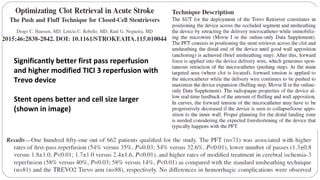
Significantly better first pass reperfusion
and higher modified TICI 3 reperfusion with
Trevo device
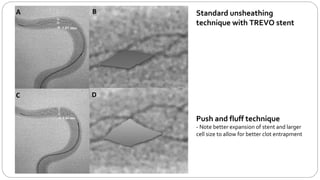
Stent opens better and cell size larger
(shown in image)
Standard unsheathing
technique with TREVO stent
Push and fluff technique
- Note better expansion of stent and larger
cell size to allow for better clot entrapment
Solitaire (Medtronic, MN) stent has been the most
common device used in the randomized trials
 The parametric design of the Solitaire device (Medtronic,
MN) allows for maintaining cell size regardless of the vessel
size. In addition, the folding design provides greater device -
clot interaction, particularly in the stage of delivery of stent.
One may wonder if the parameteric design and consequent
unfurling of stent may offer greater possibility of engaging the
clot if push and fluff techniques is employed.
Therefore, we utilized the ‘push and fluff’ technique with
Solitaire (Medtronic, MN) device
Case study:
65 year old female with a history of ST elevation MI
a week ago presented with left sided weakness that
started 2.5 hours ago. She had gaze deviation to the
right, left hemispatial neglect, left hemifield loss and
left hemiplegia (NIHSS – 18).
Patient underwent multimodal imaging that
revealed right terminal ICA occlusion, good
collaterals and a large penumbra.
In view of recent MI intravenous thrombolysis was
contraindicated and patient was shifted to angio
suite for mechanical thrombectomy
A B
C D
A, B – Noncontrast CT brain – ASPECTS of 10, no
early ischemia noted; C – CBV map, no infarct
core; D – MTT, prolonged MTT suggestive of a
large area of penumbra.
A B C D
E F G H
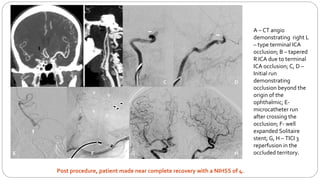
A – CT angio
demonstrating right L
– type terminal ICA
occlusion; B – tapered
R ICA due to terminal
ICA occlusion; C, D –
Initial run
demonstrating
occlusion beyond the
origin of the
ophthalmic; E-
microcatheter run
after crossing the
occlusion; F- well
expanded Solitaire
stent; G, H – TICI 3
reperfusion in the
occluded territory.
Post procedure, patient made near complete recovery with a NIHSS of 4.
Our experience of PUSH and FLUFF technique with Solitaire device:
7 consecutive patients (2016)
3 terminal ICA occlusion; 4 M1 MCA occlusion
First pass reperfusion – 7/ 7 (100%)
Modified TICI 3 reperfusion – (6/7)85%
Modified TICI 2b reperfusion – (1/7) 15%
Picture to Puncture time : 58 minutes (median)
Puncture to reperfusion: 18 minutes (median)
Clinical – mRS 0-2 in 6/7 (85%), one patient had heparin induced bleeding
Commonly encountered problems post stent retrieval –
•Spasm in M1 MCA (spontaneously resolves in most; otherwise resolves with a
small dose of Nimodipine )
•Thrombus at site of stent delivery – resolved with adequate heparinization
Conclusion
•Push and Puff technique appears to be a very promising method to
improve results of mechanical thrombectomy
•Our early experience with Solitaire stent-retriever are extremely
encouraging
For more information on:
STROKE & NEUROVASCULAR INTERVENTIONS:
URL:
www.sanif.co.in
Facebook:
https://www.facebook.com/strokeawarenessindia
https://www.facebook.com/vipul.gupta.35175
Twitter
https://twitter.com/drvipulgupta25
LinkedIN
https://in.linkedin.com/pub/dr-vipul-gupta/51/8a1/25a
YouTube
Channel: Stroke & Neurovascular Interventions
www.youtube.com/c/StrokeNeurovascularInterventionsfoundation
Dr Vipul Gupta
Thank You

Push and Puff Technique for Mechanical Thrombectomy

  • 1.
  • 2.
    Objective: Describe technique toachieve first pass reperfusion and relevant literature. Case study of a patient with terminal ICA occlusion Single center experience with relevant technical pearls PUSH AND PUFF TECHNIQUE FOR MECHANICAL THROMBECTOMY – OUR EXPERIENCE
  • 3.
    Significantly better firstpass reperfusion and higher modified TICI 3 reperfusion with Trevo device Stent opens better and cell size larger (shown in image)
  • 4.
    Standard unsheathing technique withTREVO stent Push and fluff technique - Note better expansion of stent and larger cell size to allow for better clot entrapment
  • 5.
    Solitaire (Medtronic, MN)stent has been the most common device used in the randomized trials  The parametric design of the Solitaire device (Medtronic, MN) allows for maintaining cell size regardless of the vessel size. In addition, the folding design provides greater device - clot interaction, particularly in the stage of delivery of stent. One may wonder if the parameteric design and consequent unfurling of stent may offer greater possibility of engaging the clot if push and fluff techniques is employed. Therefore, we utilized the ‘push and fluff’ technique with Solitaire (Medtronic, MN) device
  • 6.
    Case study: 65 yearold female with a history of ST elevation MI a week ago presented with left sided weakness that started 2.5 hours ago. She had gaze deviation to the right, left hemispatial neglect, left hemifield loss and left hemiplegia (NIHSS – 18). Patient underwent multimodal imaging that revealed right terminal ICA occlusion, good collaterals and a large penumbra. In view of recent MI intravenous thrombolysis was contraindicated and patient was shifted to angio suite for mechanical thrombectomy A B C D A, B – Noncontrast CT brain – ASPECTS of 10, no early ischemia noted; C – CBV map, no infarct core; D – MTT, prolonged MTT suggestive of a large area of penumbra.
  • 7.
    A B CD E F G H A – CT angio demonstrating right L – type terminal ICA occlusion; B – tapered R ICA due to terminal ICA occlusion; C, D – Initial run demonstrating occlusion beyond the origin of the ophthalmic; E- microcatheter run after crossing the occlusion; F- well expanded Solitaire stent; G, H – TICI 3 reperfusion in the occluded territory. Post procedure, patient made near complete recovery with a NIHSS of 4.
  • 8.
    Our experience ofPUSH and FLUFF technique with Solitaire device: 7 consecutive patients (2016) 3 terminal ICA occlusion; 4 M1 MCA occlusion First pass reperfusion – 7/ 7 (100%) Modified TICI 3 reperfusion – (6/7)85% Modified TICI 2b reperfusion – (1/7) 15% Picture to Puncture time : 58 minutes (median) Puncture to reperfusion: 18 minutes (median) Clinical – mRS 0-2 in 6/7 (85%), one patient had heparin induced bleeding Commonly encountered problems post stent retrieval – •Spasm in M1 MCA (spontaneously resolves in most; otherwise resolves with a small dose of Nimodipine ) •Thrombus at site of stent delivery – resolved with adequate heparinization
  • 9.
    Conclusion •Push and Pufftechnique appears to be a very promising method to improve results of mechanical thrombectomy •Our early experience with Solitaire stent-retriever are extremely encouraging
  • 10.
    For more informationon: STROKE & NEUROVASCULAR INTERVENTIONS: URL: www.sanif.co.in Facebook: https://www.facebook.com/strokeawarenessindia https://www.facebook.com/vipul.gupta.35175 Twitter https://twitter.com/drvipulgupta25 LinkedIN https://in.linkedin.com/pub/dr-vipul-gupta/51/8a1/25a YouTube Channel: Stroke & Neurovascular Interventions www.youtube.com/c/StrokeNeurovascularInterventionsfoundation Dr Vipul Gupta
  • 11.