By: Madhusudhan Goud Vemula,
Assistant Professor,
Department of Management Studies,
G.Pullaiah College of Engineering &Technology,
Kurnool
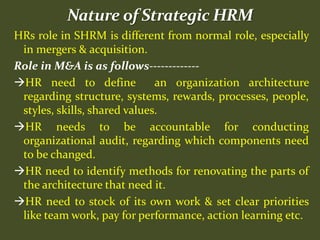
HRs role in SHRM is different from normal role, especially
in mergers & acquisition.
Role in M&A is as follows-------------
HR need to define an organization architecture
regarding structure, systems, rewards, processes, people,
styles, skills, shared values.
HR needs to be accountable for conducting
organizational audit, regarding which components need
to be changed.
HR need to identify methods for renovating the parts of
the architecture that need it.
HR need to stock of its own work & set clear priorities
like team work, pay for performance, action learning etc.
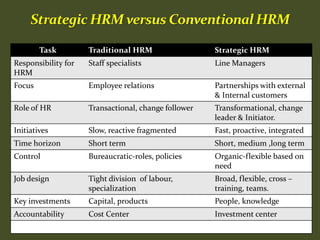
Task Traditional HRM Strategic HRM
Responsibility for
HRM
Staff specialists Line Managers
Focus Employee relations Partnerships with external
& Internal customers
Role of HR Transactional, change follower Transformational, change
leader & Initiator.
Initiatives Slow, reactive fragmented Fast, proactive, integrated
Time horizon Short term Short, medium ,long term
Control Bureaucratic-roles, policies Organic-flexible based on
need
Job design Tight division of labour,
specialization
Broad, flexible, cross –
training, teams.
Key investments Capital, products People, knowledge
Accountability Cost Center Investment center
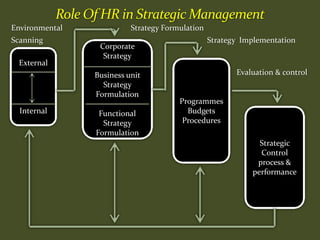
Environmental Strategy Formulation
Scanning Strategy Implementation
Evaluation & control
External
Internal
Corporate
Strategy
Business unit
Strategy
Formulation
Functional
Strategy
Formulation
Programmes
Budgets
Procedures
Strategic
Control
process &
performance
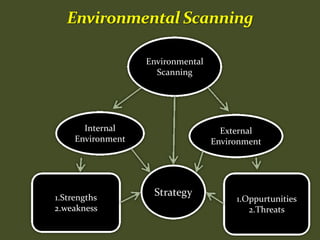
Environmental
Scanning
Internal
Environment
External
Environment
1.Strengths
2.weakness
1.Oppurtunities
2.Threats
Strategy
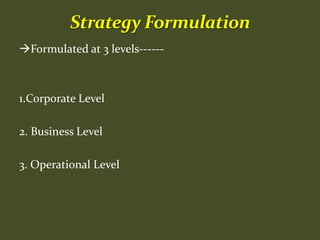
Formulated at 3 levels------
1.Corporate Level
2. Business Level
3. Operational Level
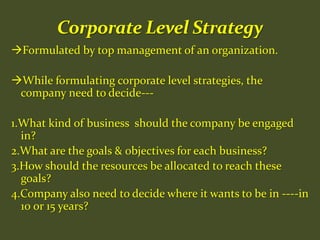
Formulated by top management of an organization.
While formulating corporate level strategies, the
company need to decide---
1.What kind of business should the company be engaged
in?
2.What are the goals & objectives for each business?
3.How should the resources be allocated to reach these
goals?
4.Company also need to decide where it wants to be in ----in
10 or 15 years?
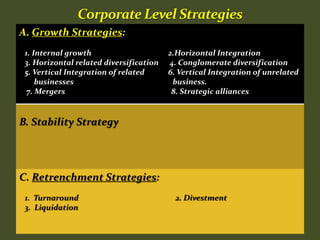
A. Growth Strategies:
1. Internal growth 2.Horizontal Integration
3. Horizontal related diversification 4. Conglomerate diversification
5. Vertical Integration of related 6. Vertical Integration of unrelated
businesses business.
7. Mergers 8. Strategic alliances
B. Stability Strategy
C. Retrenchment Strategies:
1. Turnaround 2. Divestment
3. Liquidation
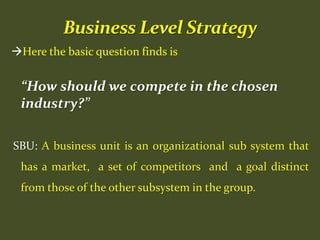
Here the basic question finds is
“How should we compete in the chosen
industry?”
SBU: A business unit is an organizational sub system that
has a market, a set of competitors and a goal distinct
from those of the other subsystem in the group.
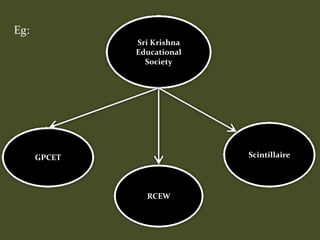
Eg:
Sri Krishna
Educational
Society
GPCET
RCEW
Scintillaire
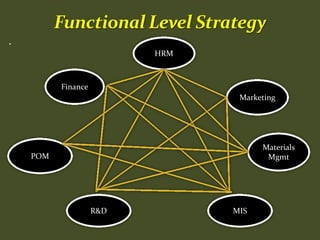
.
HRM
Finance
Marketing
POM
Materials
Mgmt
R&D MIS
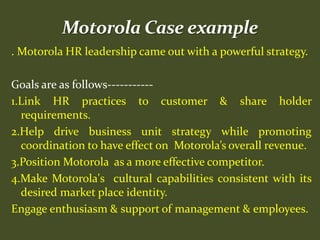
. Motorola HR leadership came out with a powerful strategy.
Goals are as follows-----------
1.Link HR practices to customer & share holder
requirements.
2.Help drive business unit strategy while promoting
coordination to have effect on Motorola’s overall revenue.
3.Position Motorola as a more effective competitor.
4.Make Motorola's cultural capabilities consistent with its
desired market place identity.
Engage enthusiasm & support of management & employees.
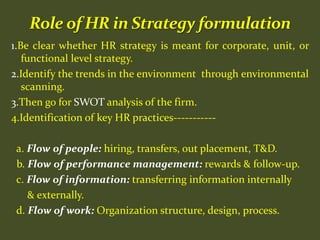
1.Be clear whether HR strategy is meant for corporate, unit, or
functional level strategy.
2.Identify the trends in the environment through environmental
scanning.
3.Then go for SWOT analysis of the firm.
4.Identification of key HR practices-----------
a. Flow of people: hiring, transfers, out placement, T&D.
b. Flow of performance management: rewards & follow-up.
c. Flow of information: transferring information internally
& externally.
d. Flow of work: Organization structure, design, process.
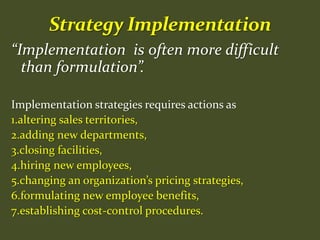
“Implementation is often more difficult
than formulation”.
Implementation strategies requires actions as
1.altering sales territories,
2.adding new departments,
3.closing facilities,
4.hiring new employees,
5.changing an organization’s pricing strategies,
6.formulating new employee benefits,
7.establishing cost-control procedures.
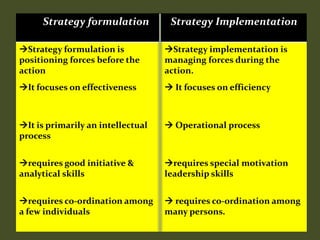
Strategy formulation Strategy Implementation
Strategy formulation is
positioning forces before the
action
Strategy implementation is
managing forces during the
action.
It focuses on effectiveness  It focuses on efficiency
It is primarily an intellectual
process
 Operational process
requires good initiative &
analytical skills
requires special motivation
leadership skills
requires co-ordination among
a few individuals
 requires co-ordination among
many persons.
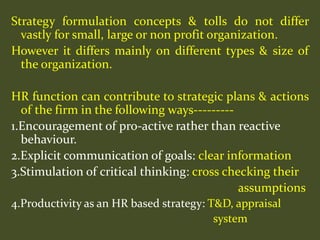
Strategy formulation concepts & tolls do not differ
vastly for small, large or non profit organization.
However it differs mainly on different types & size of
the organization.
HR function can contribute to strategic plans & actions
of the firm in the following ways---------
1.Encouragement of pro-active rather than reactive
behaviour.
2.Explicit communication of goals: clear information
3.Stimulation of critical thinking: cross checking their
assumptions
4.Productivity as an HR based strategy: T&D, appraisal
system
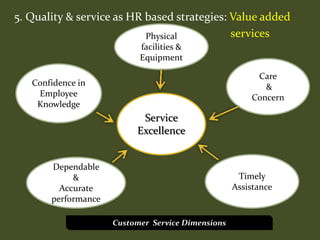
5. Quality & service as HR based strategies: Value added
services
Service
Excellence
Physical
facilities &
Equipment
Confidence in
Employee
Knowledge
Care
&
Concern
Dependable
&
Accurate
performance
Timely
Assistance
Customer Service Dimensions
6.Proficient Strategic Management:
Depends heavily on competent personnel with competent
abilities & effective internal organization.
Building a capable organization is always a top priority in
strategy execution .
Organization building are crucial for the
implementation.
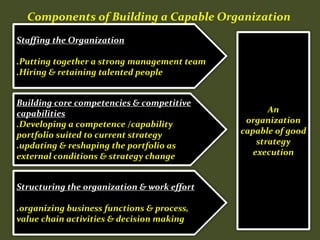
Components of Building a Capable Organization
Staffing the Organization
.Putting together a strong management team
.Hiring & retaining talented people
Building core competencies & competitive
capabilities
.Developing a competence /capability
portfolio suited to current strategy
.updating & reshaping the portfolio as
external conditions & strategy change
Structuring the organization & work effort
.organizing business functions & process,
value chain activities & decision making
An
organization
capable of good
strategy
execution
A well designed strategy can fail if sufficient attention is
not paid to the HR dimension.
Causes for failure are---------
1.Disruption of social & political structures.
2.Failure to match individuals' aptitudes with
implementation tasks
3.Inadequate top management support for implementation
activities.
Note: Strategy Implementation poses a threat to may
managers & employees in an organization because of
changes in policies (or) roles, power etc.
It helps to determine the extent to which the company’s
strategies are successful in attaining its objectives.
Strategic process yields best results if it is performed
properly or else it yields big blunders.
Basic activities involved in strategy evaluation are:
1.Establishing performance targets, standards & limits for
the objectives, strategies & implementation plans.
2.Measuring the performance in relation to the targets at a
given time.
3.Analyse deviations from acceptable tolerance limits.
4.Execute modifications where necessary & are feasible.
Strategic HR perspective, evaluation demands answers for
the following questions:
1.Are HR professionals present at M&A’s planning &
implementation?
2.Does HR provide an annual report on its ROI?
3.Is HR rated by firm’s customers?
4.Is there an ROI process to evaluate HR initiatives
connected to business strategy?
5.Is HR role leveraged in change initiatives such as system
implementations & reorganizations?
6.Do HR go beyond & enter marketing, finance, &
production domains?
Thank Q

Strategic hrm

  • 1.
    By: Madhusudhan GoudVemula, Assistant Professor, Department of Management Studies, G.Pullaiah College of Engineering &Technology, Kurnool
  • 2.
    HRs role inSHRM is different from normal role, especially in mergers & acquisition. Role in M&A is as follows------------- HR need to define an organization architecture regarding structure, systems, rewards, processes, people, styles, skills, shared values. HR needs to be accountable for conducting organizational audit, regarding which components need to be changed. HR need to identify methods for renovating the parts of the architecture that need it. HR need to stock of its own work & set clear priorities like team work, pay for performance, action learning etc.
  • 3.
    Task Traditional HRMStrategic HRM Responsibility for HRM Staff specialists Line Managers Focus Employee relations Partnerships with external & Internal customers Role of HR Transactional, change follower Transformational, change leader & Initiator. Initiatives Slow, reactive fragmented Fast, proactive, integrated Time horizon Short term Short, medium ,long term Control Bureaucratic-roles, policies Organic-flexible based on need Job design Tight division of labour, specialization Broad, flexible, cross – training, teams. Key investments Capital, products People, knowledge Accountability Cost Center Investment center
  • 4.
    Environmental Strategy Formulation ScanningStrategy Implementation Evaluation & control External Internal Corporate Strategy Business unit Strategy Formulation Functional Strategy Formulation Programmes Budgets Procedures Strategic Control process & performance
  • 5.
  • 6.
    Formulated at 3levels------ 1.Corporate Level 2. Business Level 3. Operational Level
  • 7.
    Formulated by topmanagement of an organization. While formulating corporate level strategies, the company need to decide--- 1.What kind of business should the company be engaged in? 2.What are the goals & objectives for each business? 3.How should the resources be allocated to reach these goals? 4.Company also need to decide where it wants to be in ----in 10 or 15 years?
  • 8.
    A. Growth Strategies: 1.Internal growth 2.Horizontal Integration 3. Horizontal related diversification 4. Conglomerate diversification 5. Vertical Integration of related 6. Vertical Integration of unrelated businesses business. 7. Mergers 8. Strategic alliances B. Stability Strategy C. Retrenchment Strategies: 1. Turnaround 2. Divestment 3. Liquidation
  • 9.
    Here the basicquestion finds is “How should we compete in the chosen industry?” SBU: A business unit is an organizational sub system that has a market, a set of competitors and a goal distinct from those of the other subsystem in the group.
  • 10.
  • 11.
  • 12.
    . Motorola HRleadership came out with a powerful strategy. Goals are as follows----------- 1.Link HR practices to customer & share holder requirements. 2.Help drive business unit strategy while promoting coordination to have effect on Motorola’s overall revenue. 3.Position Motorola as a more effective competitor. 4.Make Motorola's cultural capabilities consistent with its desired market place identity. Engage enthusiasm & support of management & employees.
  • 13.
    1.Be clear whetherHR strategy is meant for corporate, unit, or functional level strategy. 2.Identify the trends in the environment through environmental scanning. 3.Then go for SWOT analysis of the firm. 4.Identification of key HR practices----------- a. Flow of people: hiring, transfers, out placement, T&D. b. Flow of performance management: rewards & follow-up. c. Flow of information: transferring information internally & externally. d. Flow of work: Organization structure, design, process.
  • 14.
    “Implementation is oftenmore difficult than formulation”. Implementation strategies requires actions as 1.altering sales territories, 2.adding new departments, 3.closing facilities, 4.hiring new employees, 5.changing an organization’s pricing strategies, 6.formulating new employee benefits, 7.establishing cost-control procedures.
  • 15.
    Strategy formulation StrategyImplementation Strategy formulation is positioning forces before the action Strategy implementation is managing forces during the action. It focuses on effectiveness  It focuses on efficiency It is primarily an intellectual process  Operational process requires good initiative & analytical skills requires special motivation leadership skills requires co-ordination among a few individuals  requires co-ordination among many persons.
  • 16.
    Strategy formulation concepts& tolls do not differ vastly for small, large or non profit organization. However it differs mainly on different types & size of the organization. HR function can contribute to strategic plans & actions of the firm in the following ways--------- 1.Encouragement of pro-active rather than reactive behaviour. 2.Explicit communication of goals: clear information 3.Stimulation of critical thinking: cross checking their assumptions 4.Productivity as an HR based strategy: T&D, appraisal system
  • 17.
    5. Quality &service as HR based strategies: Value added services Service Excellence Physical facilities & Equipment Confidence in Employee Knowledge Care & Concern Dependable & Accurate performance Timely Assistance Customer Service Dimensions
  • 18.
    6.Proficient Strategic Management: Dependsheavily on competent personnel with competent abilities & effective internal organization. Building a capable organization is always a top priority in strategy execution . Organization building are crucial for the implementation.
  • 19.
    Components of Buildinga Capable Organization Staffing the Organization .Putting together a strong management team .Hiring & retaining talented people Building core competencies & competitive capabilities .Developing a competence /capability portfolio suited to current strategy .updating & reshaping the portfolio as external conditions & strategy change Structuring the organization & work effort .organizing business functions & process, value chain activities & decision making An organization capable of good strategy execution
  • 20.
    A well designedstrategy can fail if sufficient attention is not paid to the HR dimension. Causes for failure are--------- 1.Disruption of social & political structures. 2.Failure to match individuals' aptitudes with implementation tasks 3.Inadequate top management support for implementation activities. Note: Strategy Implementation poses a threat to may managers & employees in an organization because of changes in policies (or) roles, power etc.
  • 21.
    It helps todetermine the extent to which the company’s strategies are successful in attaining its objectives. Strategic process yields best results if it is performed properly or else it yields big blunders. Basic activities involved in strategy evaluation are: 1.Establishing performance targets, standards & limits for the objectives, strategies & implementation plans. 2.Measuring the performance in relation to the targets at a given time. 3.Analyse deviations from acceptable tolerance limits. 4.Execute modifications where necessary & are feasible.
  • 22.
    Strategic HR perspective,evaluation demands answers for the following questions: 1.Are HR professionals present at M&A’s planning & implementation? 2.Does HR provide an annual report on its ROI? 3.Is HR rated by firm’s customers? 4.Is there an ROI process to evaluate HR initiatives connected to business strategy? 5.Is HR role leveraged in change initiatives such as system implementations & reorganizations? 6.Do HR go beyond & enter marketing, finance, & production domains?
  • 23.