

Explainable AI
Peter W. Maynard, SVP Data &
Analytics, Equifax
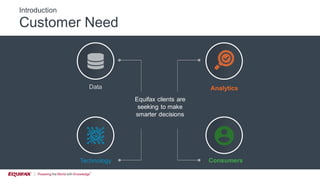
Equifax clients are
seeking to make
smarter decisions
Data
Technology
Analytics
Consumers
Introduction
Customer Need
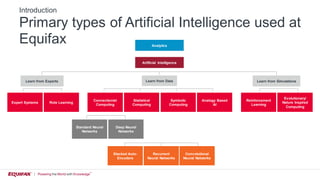
Stacked Auto-
Encoders
Recurrent
Neural Networks
Convolutional
Neural Networks
Artificial Intelligence
Learn from Experts Learn from SimulationsLearn from Data
Expert Systems Rote Learning
Connectionist
Computing
Analogy Based
AI
Symbolic
Computing
Statistical
Computing
Reinforcement
Learning
Evolutionary/
Nature Inspired
Computing
Standard Neural
Networks
Deep Neural
Networks
Analytics
Introduction
Primary types of Artificial Intelligence used at
Equifax
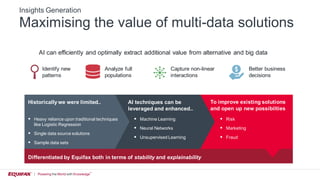
AI can efficiently and optimally extract additional value from alternative and big data
Identify new
patterns
Analyze full
populations
Capture non-linear
interactions
1.
Historically we were limited..
▪ Heavy reliance upon traditional techniques
like Logistic Regression
▪ Single data source solutions
▪ Sample data sets
AI techniques can be
leveraged and enhanced..
To improve existing solutions
and open up new possibilties
▪ Risk
▪ Marketing
▪ Fraud
▪ Machine Learning
▪ Neural Networks
▪ Unsupervised Learning
Differentiated by Equifax both in terms of stability and explainability
Better business
decisions
Insights Generation
Maximising the value of multi-data solutions
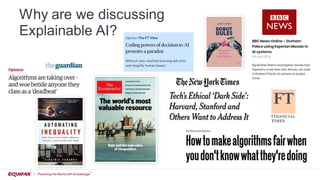
Why are we discussing
Explainable AI?
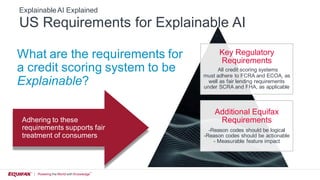
What are the requirements for
a credit scoring system to be
Explainable?
Key Regulatory
Requirements
All credit scoring systems
must adhere to FCRA and ECOA, as
well as fair lending requirements
under SCRA and FHA, as applicable
Additional Equifax
Requirements
-Reason codes should be logical
-Reason codes should be actionable
- Measurable feature impact
Adhering to these
requirements supports fair
treatment of consumers
ExplainableAI Explained
US Requirements for Explainable AI
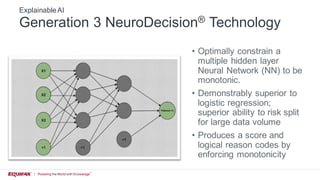
• Optimally constrain a
multiple hidden layer
Neural Network (NN) to be
monotonic.
• Demonstrably superior to
logistic regression;
superior ability to risk split
for large data volume
• Produces a score and
logical reason codes by
enforcing monotonicity
ExplainableAI
Generation 3 NeuroDecision® Technology
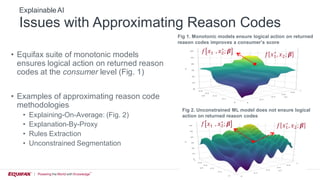
• Equifax suite of monotonic models
ensures logical action on returned reason
codes at the consumer level (Fig. 1)
• Examples of approximating reason code
methodologies
• Explaining-On-Average: (Fig. 2)
• Explanation-By-Proxy
• Rules Extraction
• Unconstrained Segmentation
𝑓 𝑥1 , 𝑥2
∗
; 𝜷
𝑓 𝑥1
∗
, 𝑥2; 𝜷
Fig 1. Monotonic models ensure logical action on returned
reason codes improves a consumer’s score
Fig 2. Unconstrained ML model does not ensure logical
action on returned reason codes
𝑓 𝑥1 , 𝑥2
∗
; 𝜷 𝑓 𝑥1
∗
, 𝑥2; 𝜷
ExplainableAI
Issues with Approximating Reason Codes
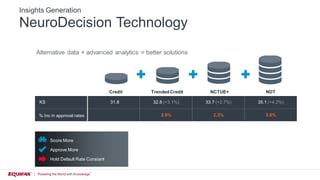
Alternative data + advanced analytics = better solutions
% Inc in approval rates
KS 35.1 (+4.2%)
3.6%
NDT
33.7 (+2.7%)
2.3%
NCTUE+
2.6%
32.8 (+3.1%)
Trended Credit
31.8
Credit
Score More
Approve More
Hold Default Rate Constant
Insights Generation
NeuroDecision Technology
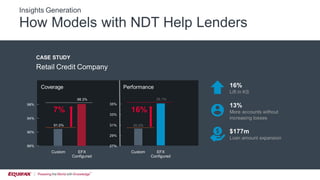
CASE STUDY
Retail Credit Company
16%
Lift in KS
13%
More accounts without
increasing losses
$177m
Loan amount expansion
Coverage
91.0%
98.3%
Custom EFX
Configured
7%
86%
98%
94%
90%
Performance
30.2%
35.1%
Custom EFX
Configured
16%
27%
35%
31%
29%
33%
Insights Generation
How Models with NDT Help Lenders
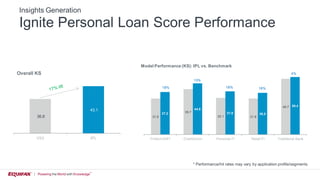
36.8
43.1
VS3 IPL
Overall KS
31.6
39.7
32.1 31.6
48.7
37.2
44.8
37.8 36.5
50.4
Fintech/AltFI CreditUnion Personal FI Retail FI Traditional Bank
Model Performance (KS): IPL vs. Benchmark
18%
13%
18% 16%
4%
* Performance/hit rates may vary by application profile/segments
Insights Generation
Ignite Personal Loan Score Performance
$-
$2,000
$4,000
$6,000
$8,000
$10,000
$12,000
$14,000
$16,000
$18,000
-60 -48 -36 -24 -12 0 12 24 36
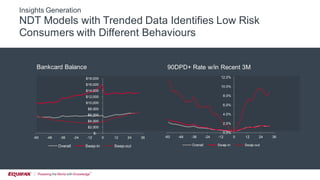
Bankcard Balance
Overall Swap-in Swap-out
0.0%
2.0%
4.0%
6.0%
8.0%
10.0%
12.0%
-60 -48 -36 -24 -12 0 12 24 36
90DPD+ Rate w/in Recent 3M
Overall Swap-in Swap-out
Insights Generation
NDT Models with Trended Data Identifies Low Risk
Consumers with Different Behaviours
-2.50%
-2.00%
-1.50%
-1.00%
-0.50%
0.00%
0.50%
1.00%
1.50%
2.00%
2.50%
Development 6 Month OOT*** 12 Month OOT***
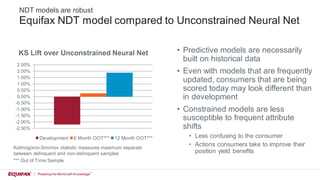
KS Lift over Unconstrained Neural Net
Kolmogorov-Smirnov statistic measures maximum separate
between delinquent and non-delinquent samples
*** Out of Time Sample
• Predictive models are necessarily
built on historical data
• Even with models that are frequently
updated, consumers that are being
scored today may look different than
in development
• Constrained models are less
susceptible to frequent attribute
shifts
• Less confusing to the consumer
• Actions consumers take to improve their
position yield benefits
NDT models are robust
Equifax NDT model compared to Unconstrained Neural Net
▪ Patent-pendingfor global monotonicity and
Explainable AI reason codes
▪ Implemented for Gradient Boosting Machine (GBM)
▪ Plus Classification and Regression Trees (CART)
and Random Forests (RF)
▪ Variable selectiondetect nonlinear effects and interactions
▪ Able to combine multiple data sets to improve coverage
Extends Explainable AI for tree based models: GBM, CART, and RF
Patent
Filed
Nov 2017
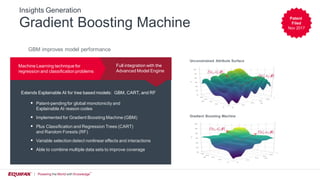
GBM improves model performance
Machine Learning technique for
regression and classificationproblems
Full integration with the
Advanced Model Engine
Gradient Boosting Machine
Unconstrained Attribute Surface
Insights Generation
Gradient Boosting Machine
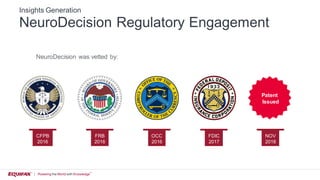
NeuroDecision was vetted by:
CFPB
2016
FRB
2016
OCC
2016
FDIC
2017
Patent
Issued
NOV
2018
Insights Generation
NeuroDecision Regulatory Engagement
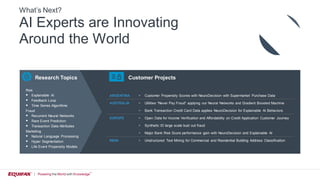
Customer Projects
ARGENTINA ▪ Customer Propensity Scores with NeuroDecision with Supermarket Purchase Data
AUSTRALIA ▪ Utilities “Never Pay Fraud” applying our Neural Networks and Gradient Boosted Machine
▪ Bank Transaction Credit Card Data applies NeuroDecision for Explainable AI Behaviors
EUROPE ▪ Open Data for Income Verification and Affordability on Credit Application Customer Journey
▪ Synthetic ID large scale bust out fraud
▪ Major Bank Risk Score performance gain with NeuroDecision and Explainable AI
INDIA ▪ Unstructured Text Mining for Commercial and Residential Building Address Classification
Research Topics
Risk
▪ Explainable AI
▪ Feedback Loop
▪ Time Series Algorithms
Fraud
▪ Recurrent Neural Networks
▪ Rare Event Prediction
▪ Transaction Data Attributes
Marketing
▪ Natural Language Processing
▪ Hyper Segmentation
▪ Life Event Propensity Models
What’s Next?
AI Experts are Innovating
Around the World
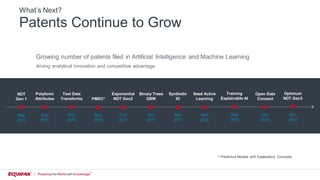
Growing number of patents filed in Artificial Intelligence and Machine Learning
driving analytical innovation and competitive advantage
Mar
2015
NDT
Gen 1
Sep
2016
Polytonic
Attributes
Nov
2016
Text Data
Transforms
Oct
2017
Exponential
NDT Gen2
Nov
2017
Synthetic
ID
Mar
2018
Seed Active
Learning
* Predictive Models with Explanatory Concepts
Nov
2017
Binary Trees
GBM
Oct
2018
Open Data
Consent
Nov
2016
PMEC*
May
2018
Training
Explainable AI
Oct
2018
Optimum
NDT Gen3
What’s Next?
Patents Continue to Grow
Thank You
peter.maynard@equifax.com

Explainable AI

  • 2.
    Explainable AI Peter W.Maynard, SVP Data & Analytics, Equifax
  • 3.
    Equifax clients are seekingto make smarter decisions Data Technology Analytics Consumers Introduction Customer Need
  • 4.
    Stacked Auto- Encoders Recurrent Neural Networks Convolutional NeuralNetworks Artificial Intelligence Learn from Experts Learn from SimulationsLearn from Data Expert Systems Rote Learning Connectionist Computing Analogy Based AI Symbolic Computing Statistical Computing Reinforcement Learning Evolutionary/ Nature Inspired Computing Standard Neural Networks Deep Neural Networks Analytics Introduction Primary types of Artificial Intelligence used at Equifax
  • 5.
    AI can efficientlyand optimally extract additional value from alternative and big data Identify new patterns Analyze full populations Capture non-linear interactions 1. Historically we were limited.. ▪ Heavy reliance upon traditional techniques like Logistic Regression ▪ Single data source solutions ▪ Sample data sets AI techniques can be leveraged and enhanced.. To improve existing solutions and open up new possibilties ▪ Risk ▪ Marketing ▪ Fraud ▪ Machine Learning ▪ Neural Networks ▪ Unsupervised Learning Differentiated by Equifax both in terms of stability and explainability Better business decisions Insights Generation Maximising the value of multi-data solutions
  • 6.
    Why are wediscussing Explainable AI?
  • 7.
    What are therequirements for a credit scoring system to be Explainable? Key Regulatory Requirements All credit scoring systems must adhere to FCRA and ECOA, as well as fair lending requirements under SCRA and FHA, as applicable Additional Equifax Requirements -Reason codes should be logical -Reason codes should be actionable - Measurable feature impact Adhering to these requirements supports fair treatment of consumers ExplainableAI Explained US Requirements for Explainable AI
  • 8.
    • Optimally constraina multiple hidden layer Neural Network (NN) to be monotonic. • Demonstrably superior to logistic regression; superior ability to risk split for large data volume • Produces a score and logical reason codes by enforcing monotonicity ExplainableAI Generation 3 NeuroDecision® Technology
  • 9.
    • Equifax suiteof monotonic models ensures logical action on returned reason codes at the consumer level (Fig. 1) • Examples of approximating reason code methodologies • Explaining-On-Average: (Fig. 2) • Explanation-By-Proxy • Rules Extraction • Unconstrained Segmentation 𝑓 𝑥1 , 𝑥2 ∗ ; 𝜷 𝑓 𝑥1 ∗ , 𝑥2; 𝜷 Fig 1. Monotonic models ensure logical action on returned reason codes improves a consumer’s score Fig 2. Unconstrained ML model does not ensure logical action on returned reason codes 𝑓 𝑥1 , 𝑥2 ∗ ; 𝜷 𝑓 𝑥1 ∗ , 𝑥2; 𝜷 ExplainableAI Issues with Approximating Reason Codes
  • 10.
    Alternative data +advanced analytics = better solutions % Inc in approval rates KS 35.1 (+4.2%) 3.6% NDT 33.7 (+2.7%) 2.3% NCTUE+ 2.6% 32.8 (+3.1%) Trended Credit 31.8 Credit Score More Approve More Hold Default Rate Constant Insights Generation NeuroDecision Technology
  • 11.
    CASE STUDY Retail CreditCompany 16% Lift in KS 13% More accounts without increasing losses $177m Loan amount expansion Coverage 91.0% 98.3% Custom EFX Configured 7% 86% 98% 94% 90% Performance 30.2% 35.1% Custom EFX Configured 16% 27% 35% 31% 29% 33% Insights Generation How Models with NDT Help Lenders
  • 12.
    36.8 43.1 VS3 IPL Overall KS 31.6 39.7 32.131.6 48.7 37.2 44.8 37.8 36.5 50.4 Fintech/AltFI CreditUnion Personal FI Retail FI Traditional Bank Model Performance (KS): IPL vs. Benchmark 18% 13% 18% 16% 4% * Performance/hit rates may vary by application profile/segments Insights Generation Ignite Personal Loan Score Performance
  • 13.
    $- $2,000 $4,000 $6,000 $8,000 $10,000 $12,000 $14,000 $16,000 $18,000 -60 -48 -36-24 -12 0 12 24 36 Bankcard Balance Overall Swap-in Swap-out 0.0% 2.0% 4.0% 6.0% 8.0% 10.0% 12.0% -60 -48 -36 -24 -12 0 12 24 36 90DPD+ Rate w/in Recent 3M Overall Swap-in Swap-out Insights Generation NDT Models with Trended Data Identifies Low Risk Consumers with Different Behaviours
  • 14.
    -2.50% -2.00% -1.50% -1.00% -0.50% 0.00% 0.50% 1.00% 1.50% 2.00% 2.50% Development 6 MonthOOT*** 12 Month OOT*** KS Lift over Unconstrained Neural Net Kolmogorov-Smirnov statistic measures maximum separate between delinquent and non-delinquent samples *** Out of Time Sample • Predictive models are necessarily built on historical data • Even with models that are frequently updated, consumers that are being scored today may look different than in development • Constrained models are less susceptible to frequent attribute shifts • Less confusing to the consumer • Actions consumers take to improve their position yield benefits NDT models are robust Equifax NDT model compared to Unconstrained Neural Net
  • 15.
    ▪ Patent-pendingfor globalmonotonicity and Explainable AI reason codes ▪ Implemented for Gradient Boosting Machine (GBM) ▪ Plus Classification and Regression Trees (CART) and Random Forests (RF) ▪ Variable selectiondetect nonlinear effects and interactions ▪ Able to combine multiple data sets to improve coverage Extends Explainable AI for tree based models: GBM, CART, and RF Patent Filed Nov 2017 GBM improves model performance Machine Learning technique for regression and classificationproblems Full integration with the Advanced Model Engine Gradient Boosting Machine Unconstrained Attribute Surface Insights Generation Gradient Boosting Machine
  • 16.
    NeuroDecision was vettedby: CFPB 2016 FRB 2016 OCC 2016 FDIC 2017 Patent Issued NOV 2018 Insights Generation NeuroDecision Regulatory Engagement
  • 17.
    Customer Projects ARGENTINA ▪Customer Propensity Scores with NeuroDecision with Supermarket Purchase Data AUSTRALIA ▪ Utilities “Never Pay Fraud” applying our Neural Networks and Gradient Boosted Machine ▪ Bank Transaction Credit Card Data applies NeuroDecision for Explainable AI Behaviors EUROPE ▪ Open Data for Income Verification and Affordability on Credit Application Customer Journey ▪ Synthetic ID large scale bust out fraud ▪ Major Bank Risk Score performance gain with NeuroDecision and Explainable AI INDIA ▪ Unstructured Text Mining for Commercial and Residential Building Address Classification Research Topics Risk ▪ Explainable AI ▪ Feedback Loop ▪ Time Series Algorithms Fraud ▪ Recurrent Neural Networks ▪ Rare Event Prediction ▪ Transaction Data Attributes Marketing ▪ Natural Language Processing ▪ Hyper Segmentation ▪ Life Event Propensity Models What’s Next? AI Experts are Innovating Around the World
  • 18.
    Growing number ofpatents filed in Artificial Intelligence and Machine Learning driving analytical innovation and competitive advantage Mar 2015 NDT Gen 1 Sep 2016 Polytonic Attributes Nov 2016 Text Data Transforms Oct 2017 Exponential NDT Gen2 Nov 2017 Synthetic ID Mar 2018 Seed Active Learning * Predictive Models with Explanatory Concepts Nov 2017 Binary Trees GBM Oct 2018 Open Data Consent Nov 2016 PMEC* May 2018 Training Explainable AI Oct 2018 Optimum NDT Gen3 What’s Next? Patents Continue to Grow
  • 19.