1. Introduction - Why do we need Model Interpretability?
2. Eli5 and Permutation Importance
3. LIME - Local Interpretable Model agnostic
Explanations
4. SHAP - Shapley Additive Explanation
5. Microsoft IntepretML
Agenda
Why interpretability is important
Data Science algortihms are used to make lot of cirtical decisions in
various
industries
• Credit Rating
• Disease diagnonsis
• Banks (Loan processing)
• Recommendations (Products , movies)
• Crime control
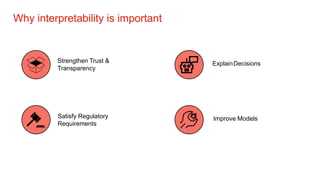
Why interpretability is important
ExplainDecisions
Improve Models
Strengthen Trust &
Transparency
Satisfy Regulatory
Requirements
Fairness & Transperability in ML Model
Example : Predicting Employees performance in big company
Input Data : Past perfromance reviews of the employees for the last 10
yrs
Caveat : What if company promotes more Men than Women ?
Output : Model will learn the bias and predict favourable result for Men
Models are Opinions Embedded in Mathematics — Cathy O’Neil
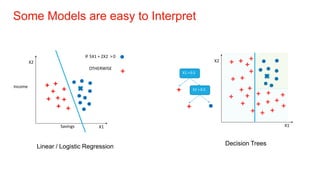
Some Models are easy to Interpret
X1
X2
IF 5X1 + 2X2 > 0
OTHERWISE
Savings
Income
X1
X2
X1 > 0.5
X2 > 0.5
Decision TreesLinear / Logistic Regression
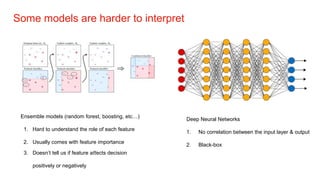
Some models are harder to interpret
Ensemble models (random forest, boosting, etc…)
1. Hard to understand the role of each feature
2. Usually comes with feature importance
3. Doesn’t tell us if feature affects decision
positively or negatively
Deep Neural Networks
1. No correlation between the input layer & output
2. Black-box
Should we use only simple model
• Use simple models like Linear or Logessitic regressions , so that you can
explain the results
• Use complex models & use interpredicbility techinques to explain the res
Types of Interpretations
● Local: Explain how and why a specific prediction was made
○ Why did our model predict certain outcome for given a given customer
● Global: Explain how our model works overall
○ What features are important for our model and how do they impact the prediction ?
○ Feature Importance provides amplitude , not direction of impact
ELI5 & Permutation Importance
• Can be used to interpret sklearn-like models
• Works for both Regression & Classification models
• Create nice visualisations for white-box models
o Can be used for local and global interpretation
• Implements Permutation Importance for black-box models
(boosting)
o Only global interpretation
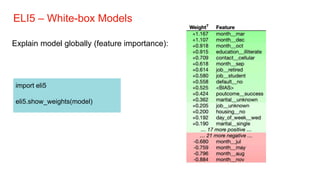
ELI5 – White-box Models
Explain model globally (feature importance):
import eli5
eli5.show_weights(model)
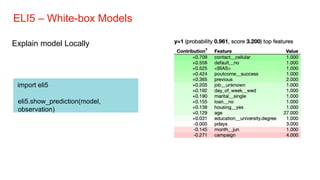
ELI5 – White-box Models
Explain model Locally
import eli5
eli5.show_prediction(model,
observation)
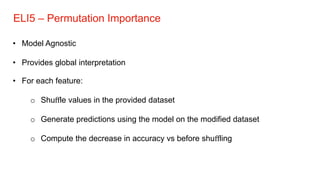
ELI5 – Permutation Importance
• Model Agnostic
• Provides global interpretation
• For each feature:
o Shuffle values in the provided dataset
o Generate predictions using the model on the modified dataset
o Compute the decrease in accuracy vs before shuffling
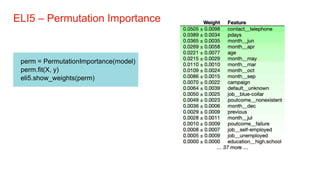
ELI5 – Permutation Importance
perm = PermutationImportance(model)
perm.fit(X, y)
eli5.show_weights(perm)
LIME - Local Interpretable Model-Agnostic
Explanations
Local: Explains why a single data point was classified as a
specific class
Model-agnostic: Treats the model as a black-box. Doesn’t need to
know how it makes predictions
Paper “Why should I trust you?” published in August 2016.
"Why Should I Trust You?": Explaining the Predictions of Any Classifier
Marco Tulio Ribeiro, Sameer Singh, Carlos Guestrin
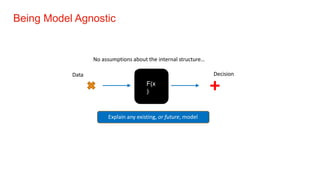
Being Model Agnostic
No assumptions about the internal structure…
X1 >0.5
f
Explain any existing, or future, model
Data Decision
F(x
)
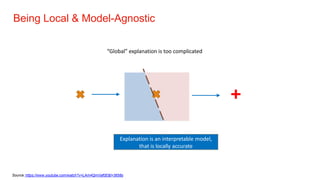
Being Local & Model-Agnostic
Source: https://www.youtube.com/watch?v=LAm4QmVaf0E&t=3658s
“Global” explanation is too complicated
Being Local & Model-Agnostic
Source: https://www.youtube.com/watch?v=LAm4QmVaf0E&t=3658s
“Global” explanation is too complicated
Being Local & Model-Agnostic
Source: https://www.youtube.com/watch?v=LAm4QmVaf0E&t=3658s
“Global” explanation is too complicated
Explanation is an interpretable model,
that is locally accurate
LIME - How does it work?
"Why Should I Trust You?": Explaining the Predictions of Any Classifier
Marco Tulio Ribeiro, Sameer Singh, Carlos Guestrin
How LIME Works
1. Permute data -Create new dataset around observation by sampling from
distribution learnt on training data (In the Perturbed dataset for Numerical
features are picked based on the distribution & categorical values based on the
occurrence)
2. Calculate distance between permutations and original observations
3. Use model to predict probability on new points, that’s our new y
4. Pick m features best describing the complex model outcome from the permuted
data
5. Fit a linear model on data in m dimensions weighted by similarity
● Central plot shows importance of the top features for this prediction
○ Value corresponds to the weight of the linear model
○ Direction corresponds to whether it pushes in one way or the
other
● Numerical features are discretized into bins
○ Easier to interpret: weight == contribution / sign of weight ==
direction
How LIME Works
"Why Should I Trust You?": Explaining the Predictions of Any Classifier
Marco Tulio Ribeiro, Sameer Singh, Carlos Guestrin
LIME - Canbe used on images
Lime supports many types of data:
● Tabular Explainer
● Recurrent Tabular Explainer
● Image Explainer
● Text Explainer
LIME Available Explainers
Shapley Additive Explanations(SHAP)
● Anexplanation model is a simpler model that is a good approximation of our
complex model.
● “Additive feature attribution methods”: the local explanation is a linear
combination of the features.
Dataset
Complex Model Prediction
Explainer Explanation
ShapleyAdditive Explanations(SHAP)
● For a given observation, we compute a SHAP value per feature, such that:
sum(SHAP_values_for_obs) = prediction_for_obs - model_expected_value
● Model’s expected value is the average prediction made by our model
How much has each feature contributed to the
prediction compared to the average prediction
House price
Prediction
400,000 €
Average house
price prediction
for all the
apartments
420,000 €
Delta in Price
-20,000 €
How much has each feature contributed to the
prediction compared to the average prediction
Park Contributed
+ 10k
Cats Contributed
-50k
Secure
Neighbourhood
Contributed
+ 30k
Paint Contributed
-10k
Shapley Additive Explanations(SHAP)
For the model agnostic explainer, SHAP leverages Shapley values from Game Theory.
To get the importance of feature X{i}:
● Get all subsets of features S that do not contain X{i}
● Compute the effect on our predictions of adding X{i} to all
those subsets
● Aggregate all contributions to compute marginal contribution
of the feature
Shapley Additive Explanations
(SHAP)
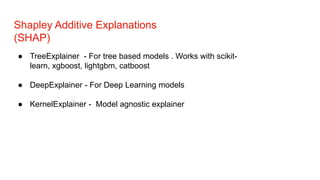
● TreeExplainer - For tree based models . Works with scikit-
learn, xgboost, lightgbm, catboost
● DeepExplainer - For Deep Learning models
● KernelExplainer - Model agnostic explainer
SHAP - Local Interpretation
● Base value is the expected value of your model
● Output value is what your model predicted for this observation
● In red are the positive SHAP values, the features that contribute positively to the
outcome
● In blue the negative SHAP values, features that contribute negatively to the
outcome
SHAP - Global Interpretation
Although SHAP values are local, by plotting all of them at once we can learn a
lot about our model globally
SHAP-TreeExplainerAPI
1. Create a new explainer, with our model as argument
explainer = TreeExplainer(my_tree_model)
2. Calculate shap_values from our model using some observations
shap_values = explainer.shap_values(observations)
3. Use SHAP visualisation functions with our shap_values
shap.force_plot(base_value, shap_values[0]) # local explanation
shap.summary_plot(shap_values) # Global features importance
Microsoft IntepretML
Glassbox -
Models
Blackbox
Explanations
Interpredibility Approaches
https://github.com/interpretml/interpret
Glassbox – Models
Models designed to be interpretable.
Lossesless explainablity .
Linear Regression
Decision Models
Rule Lists
Explainable Boosting Machines
(EBM)
……..
Explainable Boosting Machines (EBM)
1. EBM preserves interpredibulty of a linear
model
2. Matches Accuracy of powerfull blackbox
models – Xgboost , Random Forest
3. Light in deployment
4. Slow in fitting on data
from interpret.glassbox import *
from interpret import show
ebm =ExplainableBoostingClassifier()
ebm.fit(X_train, y_train)
ebm_global = ebm.explain_global() show(ebm_global)
ebm_local = ebm.explain_local(X_test[:5], y_test[:5],
show(ebm_local)
Blackbox – Explanations
Model
Perturb
Inputs
Analyse
Explanations
SHAP
LIME
Partial Dependence
Senstive Analysis
Questions. ?

Interpretable ML

  • 1.
    1. Introduction -Why do we need Model Interpretability? 2. Eli5 and Permutation Importance 3. LIME - Local Interpretable Model agnostic Explanations 4. SHAP - Shapley Additive Explanation 5. Microsoft IntepretML Agenda
  • 2.
    Why interpretability isimportant Data Science algortihms are used to make lot of cirtical decisions in various industries • Credit Rating • Disease diagnonsis • Banks (Loan processing) • Recommendations (Products , movies) • Crime control
  • 3.
    Why interpretability isimportant ExplainDecisions Improve Models Strengthen Trust & Transparency Satisfy Regulatory Requirements
  • 4.
    Fairness & Transperabilityin ML Model Example : Predicting Employees performance in big company Input Data : Past perfromance reviews of the employees for the last 10 yrs Caveat : What if company promotes more Men than Women ? Output : Model will learn the bias and predict favourable result for Men Models are Opinions Embedded in Mathematics — Cathy O’Neil
  • 6.
    Some Models areeasy to Interpret X1 X2 IF 5X1 + 2X2 > 0 OTHERWISE Savings Income X1 X2 X1 > 0.5 X2 > 0.5 Decision TreesLinear / Logistic Regression
  • 7.
    Some models areharder to interpret Ensemble models (random forest, boosting, etc…) 1. Hard to understand the role of each feature 2. Usually comes with feature importance 3. Doesn’t tell us if feature affects decision positively or negatively Deep Neural Networks 1. No correlation between the input layer & output 2. Black-box
  • 8.
    Should we useonly simple model • Use simple models like Linear or Logessitic regressions , so that you can explain the results • Use complex models & use interpredicbility techinques to explain the res
  • 9.
    Types of Interpretations ●Local: Explain how and why a specific prediction was made ○ Why did our model predict certain outcome for given a given customer ● Global: Explain how our model works overall ○ What features are important for our model and how do they impact the prediction ? ○ Feature Importance provides amplitude , not direction of impact
  • 10.
    ELI5 & PermutationImportance • Can be used to interpret sklearn-like models • Works for both Regression & Classification models • Create nice visualisations for white-box models o Can be used for local and global interpretation • Implements Permutation Importance for black-box models (boosting) o Only global interpretation
  • 11.
    ELI5 – White-boxModels Explain model globally (feature importance): import eli5 eli5.show_weights(model)
  • 12.
    ELI5 – White-boxModels Explain model Locally import eli5 eli5.show_prediction(model, observation)
  • 13.
    ELI5 – PermutationImportance • Model Agnostic • Provides global interpretation • For each feature: o Shuffle values in the provided dataset o Generate predictions using the model on the modified dataset o Compute the decrease in accuracy vs before shuffling
  • 14.
    ELI5 – PermutationImportance perm = PermutationImportance(model) perm.fit(X, y) eli5.show_weights(perm)
  • 15.
    LIME - LocalInterpretable Model-Agnostic Explanations Local: Explains why a single data point was classified as a specific class Model-agnostic: Treats the model as a black-box. Doesn’t need to know how it makes predictions Paper “Why should I trust you?” published in August 2016. "Why Should I Trust You?": Explaining the Predictions of Any Classifier Marco Tulio Ribeiro, Sameer Singh, Carlos Guestrin
  • 16.
    Being Model Agnostic Noassumptions about the internal structure… X1 >0.5 f Explain any existing, or future, model Data Decision F(x )
  • 17.
    Being Local &Model-Agnostic Source: https://www.youtube.com/watch?v=LAm4QmVaf0E&t=3658s “Global” explanation is too complicated
  • 18.
    Being Local &Model-Agnostic Source: https://www.youtube.com/watch?v=LAm4QmVaf0E&t=3658s “Global” explanation is too complicated
  • 19.
    Being Local &Model-Agnostic Source: https://www.youtube.com/watch?v=LAm4QmVaf0E&t=3658s “Global” explanation is too complicated Explanation is an interpretable model, that is locally accurate
  • 20.
    LIME - Howdoes it work? "Why Should I Trust You?": Explaining the Predictions of Any Classifier Marco Tulio Ribeiro, Sameer Singh, Carlos Guestrin
  • 21.
    How LIME Works 1.Permute data -Create new dataset around observation by sampling from distribution learnt on training data (In the Perturbed dataset for Numerical features are picked based on the distribution & categorical values based on the occurrence) 2. Calculate distance between permutations and original observations 3. Use model to predict probability on new points, that’s our new y 4. Pick m features best describing the complex model outcome from the permuted data 5. Fit a linear model on data in m dimensions weighted by similarity
  • 22.
    ● Central plotshows importance of the top features for this prediction ○ Value corresponds to the weight of the linear model ○ Direction corresponds to whether it pushes in one way or the other ● Numerical features are discretized into bins ○ Easier to interpret: weight == contribution / sign of weight == direction How LIME Works
  • 23.
    "Why Should ITrust You?": Explaining the Predictions of Any Classifier Marco Tulio Ribeiro, Sameer Singh, Carlos Guestrin LIME - Canbe used on images
  • 24.
    Lime supports manytypes of data: ● Tabular Explainer ● Recurrent Tabular Explainer ● Image Explainer ● Text Explainer LIME Available Explainers
  • 25.
    Shapley Additive Explanations(SHAP) ●Anexplanation model is a simpler model that is a good approximation of our complex model. ● “Additive feature attribution methods”: the local explanation is a linear combination of the features. Dataset Complex Model Prediction Explainer Explanation
  • 26.
    ShapleyAdditive Explanations(SHAP) ● Fora given observation, we compute a SHAP value per feature, such that: sum(SHAP_values_for_obs) = prediction_for_obs - model_expected_value ● Model’s expected value is the average prediction made by our model
  • 27.
    How much haseach feature contributed to the prediction compared to the average prediction House price Prediction 400,000 € Average house price prediction for all the apartments 420,000 € Delta in Price -20,000 €
  • 28.
    How much haseach feature contributed to the prediction compared to the average prediction Park Contributed + 10k Cats Contributed -50k Secure Neighbourhood Contributed + 30k Paint Contributed -10k
  • 29.
    Shapley Additive Explanations(SHAP) Forthe model agnostic explainer, SHAP leverages Shapley values from Game Theory. To get the importance of feature X{i}: ● Get all subsets of features S that do not contain X{i} ● Compute the effect on our predictions of adding X{i} to all those subsets ● Aggregate all contributions to compute marginal contribution of the feature
  • 30.
    Shapley Additive Explanations (SHAP) ●TreeExplainer - For tree based models . Works with scikit- learn, xgboost, lightgbm, catboost ● DeepExplainer - For Deep Learning models ● KernelExplainer - Model agnostic explainer
  • 31.
    SHAP - LocalInterpretation ● Base value is the expected value of your model ● Output value is what your model predicted for this observation ● In red are the positive SHAP values, the features that contribute positively to the outcome ● In blue the negative SHAP values, features that contribute negatively to the outcome
  • 32.
    SHAP - GlobalInterpretation Although SHAP values are local, by plotting all of them at once we can learn a lot about our model globally
  • 33.
    SHAP-TreeExplainerAPI 1. Create anew explainer, with our model as argument explainer = TreeExplainer(my_tree_model) 2. Calculate shap_values from our model using some observations shap_values = explainer.shap_values(observations) 3. Use SHAP visualisation functions with our shap_values shap.force_plot(base_value, shap_values[0]) # local explanation shap.summary_plot(shap_values) # Global features importance
  • 34.
    Microsoft IntepretML Glassbox - Models Blackbox Explanations InterpredibilityApproaches https://github.com/interpretml/interpret
  • 35.
    Glassbox – Models Modelsdesigned to be interpretable. Lossesless explainablity . Linear Regression Decision Models Rule Lists Explainable Boosting Machines (EBM) ……..
  • 36.
    Explainable Boosting Machines(EBM) 1. EBM preserves interpredibulty of a linear model 2. Matches Accuracy of powerfull blackbox models – Xgboost , Random Forest 3. Light in deployment 4. Slow in fitting on data from interpret.glassbox import * from interpret import show ebm =ExplainableBoostingClassifier() ebm.fit(X_train, y_train) ebm_global = ebm.explain_global() show(ebm_global) ebm_local = ebm.explain_local(X_test[:5], y_test[:5], show(ebm_local)
  • 37.
  • 38.