Background
• Nutrition section under Family Welfare Division is
responsible for national nutrition program for
improving the nutritional status of children,
pregnant women and adolescents
• Its goal is to achieve nutritional well-being of all
people to maintain a healthy life to contribute in
the socio-economic development of the country,
through improved nutrition program
implementation in collaboration with relevant
sectors.
21/22/2019
• Nutrition interventions are cost effective
investments for attaining many of the Sustainable
Development Goals
• Government of Nepal is committed to ensuring that
its citizens have adequate food, health and
nutrition
• The Constitution (2015) ensures the right to food,
health and nutrition to all citizens
3
Background….
1/22/2019
• Malnutrition in children and women is a major
public health problem in most of the developing
countries and Protein Energy Malnutrition (PEM) is
more common among under five year children.
• Nutrition is a globally recognized development
agenda. Since the year 2000, several global
movements have advocated nutrition for
development
4
Background….
1/22/2019
• The Scaling-Up-Nutrition (SUN) initiative calls for
multi-sectoral action for improved nutrition during
the first 1,000 days of life.
• The Government of Nepal as an early member of
SUN adopted the Multi-sector Nutrition Plan
(MSNP) in 2012 to reduce chronic nutrition.
Recently, the UN General Assembly declared the
2016–2025 period as the Decade of Action on
Nutrition.
5
Background….
1/22/2019
• The National Health Policy, 2071 highlights
improved nutrition via the use and promotion of
quality and nutritious foods generated locally to
fight malnutrition. The Nutrition Technical
Committee was established in CHD in 2011 to
support multi-sectoral coordination for developing
nutrition programmes.
6
Background….
1/22/2019
• According to new global estimates by UNICEF,
WHO, and The World Bank, 156 million children
under five were stunted in 2015
• In world, the prevalence of malnutrition in term of
underweight, stunting and wasting are 27%, 31%
and 10% respectively. ( UNICEF, 2004)
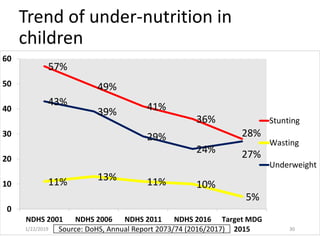
• At present, 36% of the children are stunted and
10% are wasted,( NDHS 2016)
7
Background….
1/22/2019
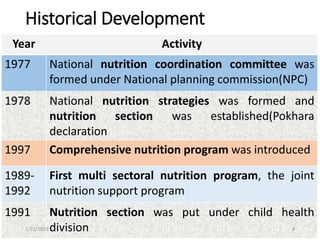
Historical Development
Year Activity
1977 National nutrition coordination committee was
formed under National planning commission(NPC)
1978 National nutrition strategies was formed and
nutrition section was established(Pokhara
declaration
1997 Comprehensive nutrition program was introduced
1989-
1992
First multi sectoral nutrition program, the joint
nutrition support program
1991 Nutrition section was put under child health
division 81/22/2019
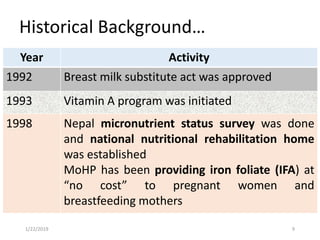
Historical Background…
Year Activity
1992 Breast milk substitute act was approved
1993 Vitamin A program was initiated
1998 Nepal micronutrient status survey was done
and national nutritional rehabilitation home
was established
MoHP has been providing iron foliate (IFA) at
“no cost” to pregnant women and
breastfeeding mothers
91/22/2019
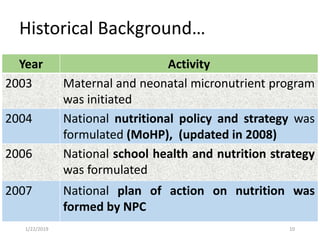
Historical Background…
Year Activity
2003 Maternal and neonatal micronutrient program
was initiated
2004 National nutritional policy and strategy was
formulated (MoHP), (updated in 2008)
2006 National school health and nutrition strategy
was formulated
2007 National plan of action on nutrition was
formed by NPC
101/22/2019
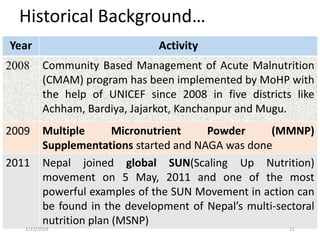
Historical Background…
Year Activity
2008 Community Based Management of Acute Malnutrition
(CMAM) program has been implemented by MoHP with
the help of UNICEF since 2008 in five districts like
Achham, Bardiya, Jajarkot, Kanchanpur and Mugu.
2009 Multiple Micronutrient Powder (MMNP)
Supplementations started and NAGA was done
2011 Nepal joined global SUN(Scaling Up Nutrition)
movement on 5 May, 2011 and one of the most
powerful examples of the SUN Movement in action can
be found in the development of Nepal’s multi-sectoral
nutrition plan (MSNP)
111/22/2019
Historical Background….
Year Activity
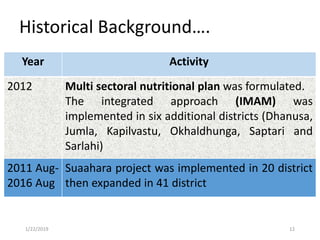
2012 Multi sectoral nutritional plan was formulated.
The integrated approach (IMAM) was
implemented in six additional districts (Dhanusa,
Jumla, Kapilvastu, Okhaldhunga, Saptari and
Sarlahi)
2011 Aug-
2016 Aug
Suaahara project was implemented in 20 district
then expanded in 41 district
121/22/2019
Objectives of Nutrition Program
General Objective:
• The overall objective of the national nutrition
programme undertaken by nutrition section is to
enhance nutritional well-being, reduce child and
maternal mortality and contribute to equitable
human development.
131/22/2019
Specific Objectives:
• To reduce protein-energy malnutrition in children
under 5 years of age and women of reproductive
age
• To improve maternal nutrition
• To reduce the prevalence of anemia among
adolescent girls, women and children
• To eliminate iodine deficiency disorders and
vitamin A deficiency and sustain elimination
• To reduce the infestation of intestinal worms
among children and pregnant women
141/22/2019
Specific objective…
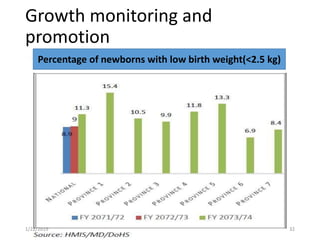
• To reduce the prevalence of low birth weight
• To improve household food security to ensure that
all people can have adequate access, availability
and use of food needed for a healthy life
• To promote the practice of good dietary habits to
improve the nutritional status of all people
• To prevent and control infectious diseases to
improve nutritional status and reduce child
mortality
151/22/2019
National Plan, Policies and
Strategy
• Anemia Control Plan, 2004
• Multi-Sectoral Nutrition Plan (MSNP) 2013-2017, MSNP
II(2018-2022)
• National Nutrition Policy and Strategy (MoHP), 2004
(updated in 2008)
• National School Health and Nutrition Strategy, 2006
• National Plan for Action on Nutrition, 2007
• National Emergency Nutrition Policy, 2008
• Maternal, Newborn and Child Health Communication
Strategy, 2011
161/22/2019
National Plan, Policies and
Strategy…
• Five-Year Plan of Action for the Control of Anemia among
Women and Children in Nepal, 2005
• Nepal Agriculture and Food Security Country Investment
Plan (CIP), 2010
• 2nd Plan of Action (2013‐2017) for Iodine Deficiency
Disorders
• A national guideline to address MAM
• A food based dietary guidelines
• National nutrition survey guideline
171/22/2019
Nutrition Relevant legislation
• The Breast Milk Substitute Act and Regulation, 1991
-Provisions for the implementation of the International
Code of Marketing of Breast Milk Substitutes fully
endorsed by law.
• Maternity/Paternity Leave Regulation, 1991
-Maternity leave of 52 days (7.5 weeks)
• Salt Iodization Act, 1998
• Mandatory Flour Fortification, 2011
181/22/2019
Nutrition programme implemented by
FWD's Nutrition Section(1993-2016)
National wide:
• Growth monitoring and counseling
• Prevention and control of iron deficiency anemia(IDA)
• Prevention, control and treatment of vitamin A
deficiency(VAD)
• Prevention of iodine deficiency disorders(IDD)
• Control of parasitic infestation by deworming
• Mandatory flour fortification in large roller mills
• Infant and young child feeding(IYCF)
191/22/2019
Scaling-up programmme
• Maternal, Infant and Young Children Nutrition
Programme(MIYCN)
• Integrated Management of Acute
Malnutrition(IMAM)
• Micronutrient Powder(MNP) distribution linked
Infant, young and child feedings(IYCF-MNP)
• School Health and Nutrition Programme (SHNP)
• Vitamin A supplementation to address the low
coverage in 6-11 months olds
• Multi-Sectoral Nutrition Plan(MSNP)
201/22/2019
New Initiatives in Nutrition Program
• National Micronutrient Status Survey
• Implementation of MIYCN action plan
• Implementation of basic package of SHN as designed
in new Joint Action Plan and updated guideline
• Adolescent Iron and Folic Acid (IFA) supplementation
• Revision/Updating of National Nutrition Policy and
Strategy in line with Health Policy 2071,NHSS and
MSNP
• Establishment of National Nutrition Centre (NNC)
211/22/2019
Current Global Nutrition Targets
• Sustainable Development Goal
• Goal 2 — End hunger, achieve food security and improved
nutrition and promote sustainable agriculture
• By 2030, end hunger and ensure access by all people, in
particular the poor and people in vulnerable situations
including infants to safe nutritious and sufficient food
all year round
• By 2030, end all forms of malnutrition, including
achieving by 2025, the internationally agreed targets on
stunting and wasting in children under 5 years of age,
and address the nutritional needs of adolescent girls,
pregnant and lactating women and older persons
221/22/2019
Current Global Nutrition Targets..
• By 2030, double the agricultural productivity and
incomes of small-scale food producers, in particular
women, indigenous peoples, family farmers,
pastoralists and fishers, including through secure
and equal access to land, other productive
resources and inputs, knowledge, financial services,
markets and opportunities for value addition and
non-farm employment
231/22/2019
Current Global Nutrition Targets…
b. Global Nutrition Target by 2025 (World Health
Assembly [WHA])
Reduce the global number of children under five who
are stunted by 40 percent
Reduce anaemia in women of reproductive age by 50
percent
Reduce low birth weight by 30 percent
No increase in childhood overweight
Increase the rate of exclusive breastfeeding in the first
six months up to at least 50 percent
Reduce and maintain childhood wasting to less than 5
percent
241/22/2019
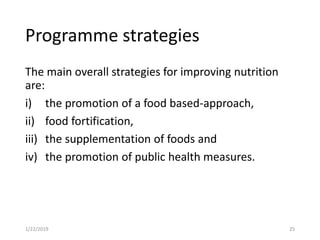
Programme strategies
The main overall strategies for improving nutrition
are:
i) the promotion of a food based-approach,
ii) food fortification,
iii) the supplementation of foods and
iv) the promotion of public health measures.
251/22/2019
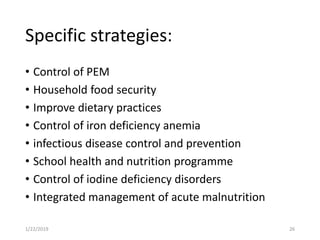
Specific strategies:
• Control of PEM
• Household food security
• Improve dietary practices
• Control of iron deficiency anemia
• infectious disease control and prevention
• School health and nutrition programme
• Control of iodine deficiency disorders
• Integrated management of acute malnutrition
261/22/2019
Specific strategies……
• Control of vitamin A deficiency
• Nutrition in emergencies
• Low birth weight
• Life style related disease
271/22/2019
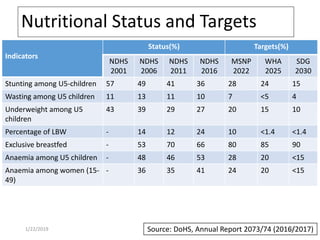
Nutritional Status and Targets
Indicators
Status(%) Targets(%)
NDHS
2001
NDHS
2006
NDHS
2011
NDHS
2016
MSNP
2022
WHA
2025
SDG
2030
Stunting among U5-children 57 49 41 36 28 24 15
Wasting among U5 children 11 13 11 10 7 <5 4
Underweight among U5
children
43 39 29 27 20 15 10
Percentage of LBW - 14 12 24 10 <1.4 <1.4
Exclusive breastfed - 53 70 66 80 85 90
Anaemia among U5 children - 48 46 53 28 20 <15
Anaemia among women (15-
49)
- 36 35 41 24 20 <15
Source: DoHS, Annual Report 2073/74 (2016/2017)281/22/2019
Major Achievements
291/22/2019
57%
49%
41%
36%
28%
11% 13% 11% 10%
5%
43%
39%
29%
24% 27%
0
10
20
30
40
50
60
NDHS 2001 NDHS 2006 NDHS 2011 NDHS 2016 Target MDG
2015
Stunting
Wasting
Underweight
30
Trend of under-nutrition in
children
Source: DoHS, Annual Report 2073/74 (2016/2017)1/22/2019
Trend of malnutrition in women
6.5
8.6
13.5
17
26.7
24.4
18.2
17
0
5
10
15
20
25
30
NDHS 2001 NDHS 2006 NDHS 2011 NDHS 2016
Maternal
overnutrition
Maternal
undernutritio
n
Source: DoHS, Annual Report 2073/74 (2016/2017)311/22/2019
Growth monitoring and
promotion
32
Percentage of newborns with low birth weight(<2.5 kg)
1/22/2019
33
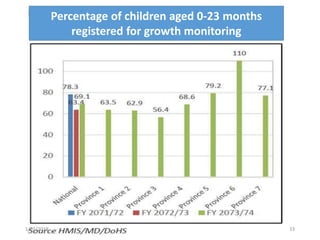
Percentage of children aged 0-23 months
registered for growth monitoring
1/22/2019
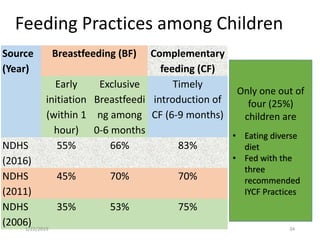
Feeding Practices among Children
Source
(Year)
Breastfeeding (BF) Complementary
feeding (CF)
Early
initiation
(within 1
hour)
Exclusive
Breastfeedi
ng among
0-6 months
Timely
introduction of
CF (6-9 months)
NDHS
(2016)
55% 66% 83%
NDHS
(2011)
45% 70% 70%
NDHS
(2006)
35% 53% 75%
Only one out of
four (25%)
children are
• Eating diverse
diet
• Fed with the
three
recommended
IYCF Practices
341/22/2019
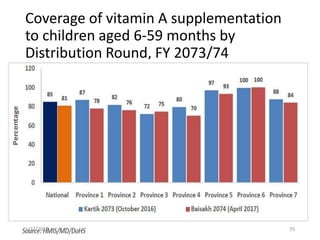
Coverage of vitamin A supplementation
to children aged 6-59 months by
Distribution Round, FY 2073/74
351/22/2019
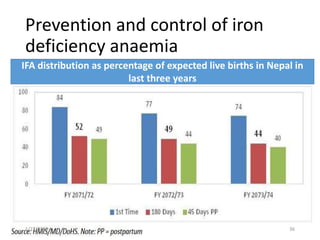
Prevention and control of iron
deficiency anaemia
IFA distribution as percentage of expected live births in Nepal in
last three years
361/22/2019
Integrated Infant and Young Child Feeding
and Micro-Nutrient Powder (IYCF‐MNP)
Community Promotion Program
• After the successful completion of the pilot
program, MoH implemented this
program in 16 districts of Nepal
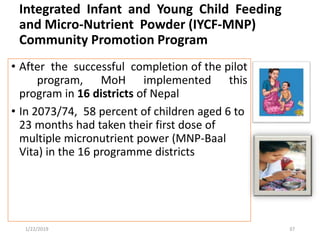
• In 2073/74, 58 percent of children aged 6 to
23 months had taken their first dose of
multiple micronutrient power (MNP-Baal
Vita) in the 16 programme districts
371/22/2019
Prevention and control of
iodine deficiency disorder
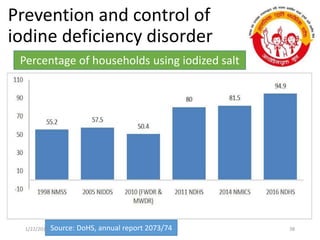
Percentage of households using iodized salt
Source: DoHS, annual report 2073/74 381/22/2019
Integrated Management of Acute
Malnutrition(IMAM)
• This programme was being implemented in 11
districts (Achham, Kanchanpur, Bardiya, Jajarkot,
Jumla, Mugu, Kapilbastu, Sarlahi, Dhanusha, Saptari
and Okhaldhunga) until last FY 2072/073 and was
scaled-up in 10 MSNP districts(Kalikot, Humla,
Dolpa, Dadeldhura, Bajhang, Bajura, Baitadi,
Panchthar, Khotang, and Parsa) in FY 2073/74
Source: DoHS, annual report 2073/74 391/22/2019
IMAM program……
• In FY 2073/74, total 15,633 children with SAM
admitted in outpatient’s therapeutic programme 21
districts
• Among them, 13,378 were discharged with
complete recovery.
• Among all discharged SAM cases, 80 percent were
recovered, less than 1 percent died and 10 percent
were defaulter
Source: DoHS, annual report 2073/74 401/22/2019
Nutritional Rehabilitation Homes
• The first Nutrition Rehabilitation Home was
established in 1998 in
Kathmandu and now there are 18 NRHs in
Nepal located in different Regional/Sub regional,
Zonal and districts hospital.
• In FY 2073/74, total 1261 children were provided
with nutritional care through 16 NRH; and among
them 745 were fully recovered
• In Kathmandu, around 72 percent of the admitted
cases were found with severe acute malnutrition
and almost all of them were managed successfully
Source: DoHS, annual report 2073/74 411/22/2019
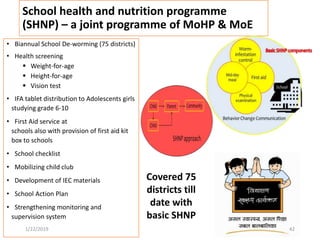
School health and nutrition programme
(SHNP) – a joint programme of MoHP & MoE
• Biannual School De-worming (75 districts)
• Health screening
 Weight-for-age
 Height-for-age
 Vision test
• IFA tablet distribution to Adolescents girls
studying grade 6-10
• First Aid service at
schools also with provision of first aid kit
box to schools
• School checklist
• Mobilizing child club
• Development of IEC materials
• School Action Plan
• Strengthening monitoring and
supervision system
Covered 75
districts till
date with
basic SHNP
421/22/2019
Major Nutrition Projects
implementing in Nepal
• SUAAHARA II/USAID: 41 districts
• UNICEF/MSNP II(2018-2022)
• Sunaula Hajar Din: 15 districts (CDR, EDR)
• Agricultural and Food Security Project: 19 districts (Hill
and Mountain districts of FWDR and MWDR)/FAO
• WFP/UN nutrition projects
• Sponsorship project/Save the children
431/22/2019
Planning
• Family Welfare Division are responsible to overall
planning of nutrition program at central level
• Aligning with the MSNP and current global
initiatives, FWD – nutrition section has developed
strategies and plans for improving maternal infant
and young child nutrition assisted by experts from
the Nutrition Technical Committee.
• NPC led the plan with the involvement of key
ministries: MOHP, MoFALD, MoE,
• Planning on nutrition from local, province and
federal also
441/22/2019
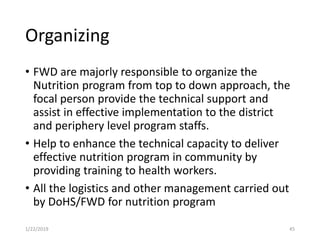
Organizing
• FWD are majorly responsible to organize the
Nutrition program from top to down approach, the
focal person provide the technical support and
assist in effective implementation to the district
and periphery level program staffs.
• Help to enhance the technical capacity to deliver
effective nutrition program in community by
providing training to health workers.
• All the logistics and other management carried out
by DoHS/FWD for nutrition program
451/22/2019
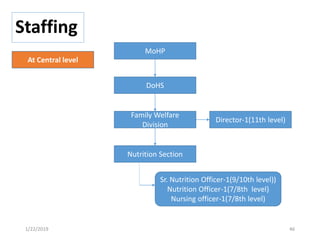
Staffing
46
MoHP
DoHS
Family Welfare
Division
Director-1(11th level)
Nutrition Section
Sr. Nutrition Officer-1(9/10th level))
Nutrition Officer-1(7/8th level)
Nursing officer-1(7/8th level)
At Central level
1/22/2019
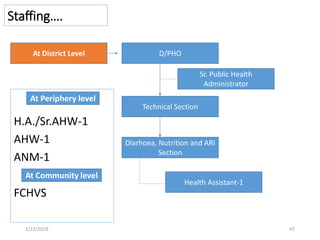
Staffing….
H.A./Sr.AHW-1
AHW-1
ANM-1
FCHVS
47
At Periphery level
D/PHO
Sr. Public Health
Administrator
At District Level
Health Assistant-1
Technical Section
Diarhoea, Nutrition and ARI
Section
At Community level
1/22/2019
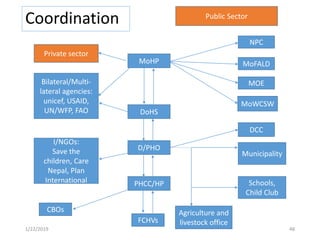
Coordination
481/22/2019
MoHP
NPC
MoFALD
MOE
MoWCSW
DoHS
Private sector
Public Sector
Bilateral/Multi-
lateral agencies:
unicef, USAID,
UN/WFP, FAO
I/NGOs:
Save the
children, Care
Nepal, Plan
International
D/PHO
PHCC/HP
DCC
Municipality
CBOs
Schools,
Child Club
Agriculture and
livestock officeFCHVs
Monitoring and evaluation
• Nutrition program indicator and progress monitoring
and supervision by DHGTF committee in district along
with DCC personnel
• D/PHO chief and program focal person also very much
responsible to provide the relevant technical support,
feedback and suggestion to health worker for improve
betterment of program and effective delivery of service
• Recently MQAWC members, health coordinator and
elected body and HFOMC should involve in program
supervision and monitoring and evaluation of program
491/22/2019
Recording and reporting
• HMIS is one of the major source of information and
recoding and reporting system in health
• Statistic officer and focal personnel responsible for
timely recording and reporting using national
system, now a day DHIS2 tool is using to reporting
online directly
501/22/2019
Budgeting
• Top down budgeting from NPC-MoHP-DoHS-
District-Peripheral level
• Urban municipality and rural municipal are
responsible for annual planning and budgeting on
health from unconditional budget and approval
from Municipal assembly annually.
511/22/2019
Major challenge/problem in
nutrition program in Nepal
• Slow scaling up of evidence based and cost
effective interventions of IYCF, IMAM, MSNP, IYCF-
MNP, SHNP due to resource gap
• Unclear and unstable organizational structure and
position of nutrition focal officer in after federal
government system in health
• Lack of proper guideline on nutrition and updated
strategies, policy in federal system
521/22/2019
Recommendation to overcome
• Clear guideline and revised policy on nutrition
• Clear and stable organizational structure of health
in federal context
• Clear position of nutrition officer and their role and
responsibility in federal system
• Strengthening system for better health
• Quality improvement of nutrition program and
service
• Regular supervision and monitoring of MSNP in
collaboration with multi-secter.
531/22/2019
Bibliography
• Central Bureau of Statistics, Nepal Multiple Indicator Cluster
Survey 2014: Key findings report, CBS and UNICEF,
Kathmandu, Nepal, 2014,
<http://unicef.org.np/uploads/files/44234273128039655-
nmics-5-key-findings.pdf>, accessed March 2018.
• Annual report 2073/74
• NDHS report 2016
• Multi Sectoral Nutrition Plan (MSNP 2013-2017)
• K. Park, Preventive and Social Medicine
• Nepal National Plan for Action on Nutrition, 2007
• Nepal Nutrition Assessment and Gap Analysis (NAGA, 2009)
• http://www.who.int/nutrition/topics/ida/en/
541/22/2019
551/22/2019

National nutrition program

  • 2.
    Background • Nutrition sectionunder Family Welfare Division is responsible for national nutrition program for improving the nutritional status of children, pregnant women and adolescents • Its goal is to achieve nutritional well-being of all people to maintain a healthy life to contribute in the socio-economic development of the country, through improved nutrition program implementation in collaboration with relevant sectors. 21/22/2019
  • 3.
    • Nutrition interventionsare cost effective investments for attaining many of the Sustainable Development Goals • Government of Nepal is committed to ensuring that its citizens have adequate food, health and nutrition • The Constitution (2015) ensures the right to food, health and nutrition to all citizens 3 Background…. 1/22/2019
  • 4.
    • Malnutrition inchildren and women is a major public health problem in most of the developing countries and Protein Energy Malnutrition (PEM) is more common among under five year children. • Nutrition is a globally recognized development agenda. Since the year 2000, several global movements have advocated nutrition for development 4 Background…. 1/22/2019
  • 5.
    • The Scaling-Up-Nutrition(SUN) initiative calls for multi-sectoral action for improved nutrition during the first 1,000 days of life. • The Government of Nepal as an early member of SUN adopted the Multi-sector Nutrition Plan (MSNP) in 2012 to reduce chronic nutrition. Recently, the UN General Assembly declared the 2016–2025 period as the Decade of Action on Nutrition. 5 Background…. 1/22/2019
  • 6.
    • The NationalHealth Policy, 2071 highlights improved nutrition via the use and promotion of quality and nutritious foods generated locally to fight malnutrition. The Nutrition Technical Committee was established in CHD in 2011 to support multi-sectoral coordination for developing nutrition programmes. 6 Background…. 1/22/2019
  • 7.
    • According tonew global estimates by UNICEF, WHO, and The World Bank, 156 million children under five were stunted in 2015 • In world, the prevalence of malnutrition in term of underweight, stunting and wasting are 27%, 31% and 10% respectively. ( UNICEF, 2004) • At present, 36% of the children are stunted and 10% are wasted,( NDHS 2016) 7 Background…. 1/22/2019
  • 8.
    Historical Development Year Activity 1977National nutrition coordination committee was formed under National planning commission(NPC) 1978 National nutrition strategies was formed and nutrition section was established(Pokhara declaration 1997 Comprehensive nutrition program was introduced 1989- 1992 First multi sectoral nutrition program, the joint nutrition support program 1991 Nutrition section was put under child health division 81/22/2019
  • 9.
    Historical Background… Year Activity 1992Breast milk substitute act was approved 1993 Vitamin A program was initiated 1998 Nepal micronutrient status survey was done and national nutritional rehabilitation home was established MoHP has been providing iron foliate (IFA) at “no cost” to pregnant women and breastfeeding mothers 91/22/2019
  • 10.
    Historical Background… Year Activity 2003Maternal and neonatal micronutrient program was initiated 2004 National nutritional policy and strategy was formulated (MoHP), (updated in 2008) 2006 National school health and nutrition strategy was formulated 2007 National plan of action on nutrition was formed by NPC 101/22/2019
  • 11.
    Historical Background… Year Activity 2008Community Based Management of Acute Malnutrition (CMAM) program has been implemented by MoHP with the help of UNICEF since 2008 in five districts like Achham, Bardiya, Jajarkot, Kanchanpur and Mugu. 2009 Multiple Micronutrient Powder (MMNP) Supplementations started and NAGA was done 2011 Nepal joined global SUN(Scaling Up Nutrition) movement on 5 May, 2011 and one of the most powerful examples of the SUN Movement in action can be found in the development of Nepal’s multi-sectoral nutrition plan (MSNP) 111/22/2019
  • 12.
    Historical Background…. Year Activity 2012Multi sectoral nutritional plan was formulated. The integrated approach (IMAM) was implemented in six additional districts (Dhanusa, Jumla, Kapilvastu, Okhaldhunga, Saptari and Sarlahi) 2011 Aug- 2016 Aug Suaahara project was implemented in 20 district then expanded in 41 district 121/22/2019
  • 13.
    Objectives of NutritionProgram General Objective: • The overall objective of the national nutrition programme undertaken by nutrition section is to enhance nutritional well-being, reduce child and maternal mortality and contribute to equitable human development. 131/22/2019
  • 14.
    Specific Objectives: • Toreduce protein-energy malnutrition in children under 5 years of age and women of reproductive age • To improve maternal nutrition • To reduce the prevalence of anemia among adolescent girls, women and children • To eliminate iodine deficiency disorders and vitamin A deficiency and sustain elimination • To reduce the infestation of intestinal worms among children and pregnant women 141/22/2019
  • 15.
    Specific objective… • Toreduce the prevalence of low birth weight • To improve household food security to ensure that all people can have adequate access, availability and use of food needed for a healthy life • To promote the practice of good dietary habits to improve the nutritional status of all people • To prevent and control infectious diseases to improve nutritional status and reduce child mortality 151/22/2019
  • 16.
    National Plan, Policiesand Strategy • Anemia Control Plan, 2004 • Multi-Sectoral Nutrition Plan (MSNP) 2013-2017, MSNP II(2018-2022) • National Nutrition Policy and Strategy (MoHP), 2004 (updated in 2008) • National School Health and Nutrition Strategy, 2006 • National Plan for Action on Nutrition, 2007 • National Emergency Nutrition Policy, 2008 • Maternal, Newborn and Child Health Communication Strategy, 2011 161/22/2019
  • 17.
    National Plan, Policiesand Strategy… • Five-Year Plan of Action for the Control of Anemia among Women and Children in Nepal, 2005 • Nepal Agriculture and Food Security Country Investment Plan (CIP), 2010 • 2nd Plan of Action (2013‐2017) for Iodine Deficiency Disorders • A national guideline to address MAM • A food based dietary guidelines • National nutrition survey guideline 171/22/2019
  • 18.
    Nutrition Relevant legislation •The Breast Milk Substitute Act and Regulation, 1991 -Provisions for the implementation of the International Code of Marketing of Breast Milk Substitutes fully endorsed by law. • Maternity/Paternity Leave Regulation, 1991 -Maternity leave of 52 days (7.5 weeks) • Salt Iodization Act, 1998 • Mandatory Flour Fortification, 2011 181/22/2019
  • 19.
    Nutrition programme implementedby FWD's Nutrition Section(1993-2016) National wide: • Growth monitoring and counseling • Prevention and control of iron deficiency anemia(IDA) • Prevention, control and treatment of vitamin A deficiency(VAD) • Prevention of iodine deficiency disorders(IDD) • Control of parasitic infestation by deworming • Mandatory flour fortification in large roller mills • Infant and young child feeding(IYCF) 191/22/2019
  • 20.
    Scaling-up programmme • Maternal,Infant and Young Children Nutrition Programme(MIYCN) • Integrated Management of Acute Malnutrition(IMAM) • Micronutrient Powder(MNP) distribution linked Infant, young and child feedings(IYCF-MNP) • School Health and Nutrition Programme (SHNP) • Vitamin A supplementation to address the low coverage in 6-11 months olds • Multi-Sectoral Nutrition Plan(MSNP) 201/22/2019
  • 21.
    New Initiatives inNutrition Program • National Micronutrient Status Survey • Implementation of MIYCN action plan • Implementation of basic package of SHN as designed in new Joint Action Plan and updated guideline • Adolescent Iron and Folic Acid (IFA) supplementation • Revision/Updating of National Nutrition Policy and Strategy in line with Health Policy 2071,NHSS and MSNP • Establishment of National Nutrition Centre (NNC) 211/22/2019
  • 22.
    Current Global NutritionTargets • Sustainable Development Goal • Goal 2 — End hunger, achieve food security and improved nutrition and promote sustainable agriculture • By 2030, end hunger and ensure access by all people, in particular the poor and people in vulnerable situations including infants to safe nutritious and sufficient food all year round • By 2030, end all forms of malnutrition, including achieving by 2025, the internationally agreed targets on stunting and wasting in children under 5 years of age, and address the nutritional needs of adolescent girls, pregnant and lactating women and older persons 221/22/2019
  • 23.
    Current Global NutritionTargets.. • By 2030, double the agricultural productivity and incomes of small-scale food producers, in particular women, indigenous peoples, family farmers, pastoralists and fishers, including through secure and equal access to land, other productive resources and inputs, knowledge, financial services, markets and opportunities for value addition and non-farm employment 231/22/2019
  • 24.
    Current Global NutritionTargets… b. Global Nutrition Target by 2025 (World Health Assembly [WHA]) Reduce the global number of children under five who are stunted by 40 percent Reduce anaemia in women of reproductive age by 50 percent Reduce low birth weight by 30 percent No increase in childhood overweight Increase the rate of exclusive breastfeeding in the first six months up to at least 50 percent Reduce and maintain childhood wasting to less than 5 percent 241/22/2019
  • 25.
    Programme strategies The mainoverall strategies for improving nutrition are: i) the promotion of a food based-approach, ii) food fortification, iii) the supplementation of foods and iv) the promotion of public health measures. 251/22/2019
  • 26.
    Specific strategies: • Controlof PEM • Household food security • Improve dietary practices • Control of iron deficiency anemia • infectious disease control and prevention • School health and nutrition programme • Control of iodine deficiency disorders • Integrated management of acute malnutrition 261/22/2019
  • 27.
    Specific strategies…… • Controlof vitamin A deficiency • Nutrition in emergencies • Low birth weight • Life style related disease 271/22/2019
  • 28.
    Nutritional Status andTargets Indicators Status(%) Targets(%) NDHS 2001 NDHS 2006 NDHS 2011 NDHS 2016 MSNP 2022 WHA 2025 SDG 2030 Stunting among U5-children 57 49 41 36 28 24 15 Wasting among U5 children 11 13 11 10 7 <5 4 Underweight among U5 children 43 39 29 27 20 15 10 Percentage of LBW - 14 12 24 10 <1.4 <1.4 Exclusive breastfed - 53 70 66 80 85 90 Anaemia among U5 children - 48 46 53 28 20 <15 Anaemia among women (15- 49) - 36 35 41 24 20 <15 Source: DoHS, Annual Report 2073/74 (2016/2017)281/22/2019
  • 29.
  • 30.
    57% 49% 41% 36% 28% 11% 13% 11%10% 5% 43% 39% 29% 24% 27% 0 10 20 30 40 50 60 NDHS 2001 NDHS 2006 NDHS 2011 NDHS 2016 Target MDG 2015 Stunting Wasting Underweight 30 Trend of under-nutrition in children Source: DoHS, Annual Report 2073/74 (2016/2017)1/22/2019
  • 31.
    Trend of malnutritionin women 6.5 8.6 13.5 17 26.7 24.4 18.2 17 0 5 10 15 20 25 30 NDHS 2001 NDHS 2006 NDHS 2011 NDHS 2016 Maternal overnutrition Maternal undernutritio n Source: DoHS, Annual Report 2073/74 (2016/2017)311/22/2019
  • 32.
    Growth monitoring and promotion 32 Percentageof newborns with low birth weight(<2.5 kg) 1/22/2019
  • 33.
    33 Percentage of childrenaged 0-23 months registered for growth monitoring 1/22/2019
  • 34.
    Feeding Practices amongChildren Source (Year) Breastfeeding (BF) Complementary feeding (CF) Early initiation (within 1 hour) Exclusive Breastfeedi ng among 0-6 months Timely introduction of CF (6-9 months) NDHS (2016) 55% 66% 83% NDHS (2011) 45% 70% 70% NDHS (2006) 35% 53% 75% Only one out of four (25%) children are • Eating diverse diet • Fed with the three recommended IYCF Practices 341/22/2019
  • 35.
    Coverage of vitaminA supplementation to children aged 6-59 months by Distribution Round, FY 2073/74 351/22/2019
  • 36.
    Prevention and controlof iron deficiency anaemia IFA distribution as percentage of expected live births in Nepal in last three years 361/22/2019
  • 37.
    Integrated Infant andYoung Child Feeding and Micro-Nutrient Powder (IYCF‐MNP) Community Promotion Program • After the successful completion of the pilot program, MoH implemented this program in 16 districts of Nepal • In 2073/74, 58 percent of children aged 6 to 23 months had taken their first dose of multiple micronutrient power (MNP-Baal Vita) in the 16 programme districts 371/22/2019
  • 38.
    Prevention and controlof iodine deficiency disorder Percentage of households using iodized salt Source: DoHS, annual report 2073/74 381/22/2019
  • 39.
    Integrated Management ofAcute Malnutrition(IMAM) • This programme was being implemented in 11 districts (Achham, Kanchanpur, Bardiya, Jajarkot, Jumla, Mugu, Kapilbastu, Sarlahi, Dhanusha, Saptari and Okhaldhunga) until last FY 2072/073 and was scaled-up in 10 MSNP districts(Kalikot, Humla, Dolpa, Dadeldhura, Bajhang, Bajura, Baitadi, Panchthar, Khotang, and Parsa) in FY 2073/74 Source: DoHS, annual report 2073/74 391/22/2019
  • 40.
    IMAM program…… • InFY 2073/74, total 15,633 children with SAM admitted in outpatient’s therapeutic programme 21 districts • Among them, 13,378 were discharged with complete recovery. • Among all discharged SAM cases, 80 percent were recovered, less than 1 percent died and 10 percent were defaulter Source: DoHS, annual report 2073/74 401/22/2019
  • 41.
    Nutritional Rehabilitation Homes •The first Nutrition Rehabilitation Home was established in 1998 in Kathmandu and now there are 18 NRHs in Nepal located in different Regional/Sub regional, Zonal and districts hospital. • In FY 2073/74, total 1261 children were provided with nutritional care through 16 NRH; and among them 745 were fully recovered • In Kathmandu, around 72 percent of the admitted cases were found with severe acute malnutrition and almost all of them were managed successfully Source: DoHS, annual report 2073/74 411/22/2019
  • 42.
    School health andnutrition programme (SHNP) – a joint programme of MoHP & MoE • Biannual School De-worming (75 districts) • Health screening  Weight-for-age  Height-for-age  Vision test • IFA tablet distribution to Adolescents girls studying grade 6-10 • First Aid service at schools also with provision of first aid kit box to schools • School checklist • Mobilizing child club • Development of IEC materials • School Action Plan • Strengthening monitoring and supervision system Covered 75 districts till date with basic SHNP 421/22/2019
  • 43.
    Major Nutrition Projects implementingin Nepal • SUAAHARA II/USAID: 41 districts • UNICEF/MSNP II(2018-2022) • Sunaula Hajar Din: 15 districts (CDR, EDR) • Agricultural and Food Security Project: 19 districts (Hill and Mountain districts of FWDR and MWDR)/FAO • WFP/UN nutrition projects • Sponsorship project/Save the children 431/22/2019
  • 44.
    Planning • Family WelfareDivision are responsible to overall planning of nutrition program at central level • Aligning with the MSNP and current global initiatives, FWD – nutrition section has developed strategies and plans for improving maternal infant and young child nutrition assisted by experts from the Nutrition Technical Committee. • NPC led the plan with the involvement of key ministries: MOHP, MoFALD, MoE, • Planning on nutrition from local, province and federal also 441/22/2019
  • 45.
    Organizing • FWD aremajorly responsible to organize the Nutrition program from top to down approach, the focal person provide the technical support and assist in effective implementation to the district and periphery level program staffs. • Help to enhance the technical capacity to deliver effective nutrition program in community by providing training to health workers. • All the logistics and other management carried out by DoHS/FWD for nutrition program 451/22/2019
  • 46.
    Staffing 46 MoHP DoHS Family Welfare Division Director-1(11th level) NutritionSection Sr. Nutrition Officer-1(9/10th level)) Nutrition Officer-1(7/8th level) Nursing officer-1(7/8th level) At Central level 1/22/2019
  • 47.
    Staffing…. H.A./Sr.AHW-1 AHW-1 ANM-1 FCHVS 47 At Periphery level D/PHO Sr.Public Health Administrator At District Level Health Assistant-1 Technical Section Diarhoea, Nutrition and ARI Section At Community level 1/22/2019
  • 48.
    Coordination 481/22/2019 MoHP NPC MoFALD MOE MoWCSW DoHS Private sector Public Sector Bilateral/Multi- lateralagencies: unicef, USAID, UN/WFP, FAO I/NGOs: Save the children, Care Nepal, Plan International D/PHO PHCC/HP DCC Municipality CBOs Schools, Child Club Agriculture and livestock officeFCHVs
  • 49.
    Monitoring and evaluation •Nutrition program indicator and progress monitoring and supervision by DHGTF committee in district along with DCC personnel • D/PHO chief and program focal person also very much responsible to provide the relevant technical support, feedback and suggestion to health worker for improve betterment of program and effective delivery of service • Recently MQAWC members, health coordinator and elected body and HFOMC should involve in program supervision and monitoring and evaluation of program 491/22/2019
  • 50.
    Recording and reporting •HMIS is one of the major source of information and recoding and reporting system in health • Statistic officer and focal personnel responsible for timely recording and reporting using national system, now a day DHIS2 tool is using to reporting online directly 501/22/2019
  • 51.
    Budgeting • Top downbudgeting from NPC-MoHP-DoHS- District-Peripheral level • Urban municipality and rural municipal are responsible for annual planning and budgeting on health from unconditional budget and approval from Municipal assembly annually. 511/22/2019
  • 52.
    Major challenge/problem in nutritionprogram in Nepal • Slow scaling up of evidence based and cost effective interventions of IYCF, IMAM, MSNP, IYCF- MNP, SHNP due to resource gap • Unclear and unstable organizational structure and position of nutrition focal officer in after federal government system in health • Lack of proper guideline on nutrition and updated strategies, policy in federal system 521/22/2019
  • 53.
    Recommendation to overcome •Clear guideline and revised policy on nutrition • Clear and stable organizational structure of health in federal context • Clear position of nutrition officer and their role and responsibility in federal system • Strengthening system for better health • Quality improvement of nutrition program and service • Regular supervision and monitoring of MSNP in collaboration with multi-secter. 531/22/2019
  • 54.
    Bibliography • Central Bureauof Statistics, Nepal Multiple Indicator Cluster Survey 2014: Key findings report, CBS and UNICEF, Kathmandu, Nepal, 2014, <http://unicef.org.np/uploads/files/44234273128039655- nmics-5-key-findings.pdf>, accessed March 2018. • Annual report 2073/74 • NDHS report 2016 • Multi Sectoral Nutrition Plan (MSNP 2013-2017) • K. Park, Preventive and Social Medicine • Nepal National Plan for Action on Nutrition, 2007 • Nepal Nutrition Assessment and Gap Analysis (NAGA, 2009) • http://www.who.int/nutrition/topics/ida/en/ 541/22/2019
  • 55.

Editor's Notes

  • #22 MIYCN: Maternal, infant and young children nutrition program MNSP:Multi sectoral nutrition plan,SHN: School health nutrition,NHSS: Nepal health sector strategy