By Shisira Bania GM A College SBP
Internetworking Overview
Chapter 1
By Shisira Bania GM A College SBP
Chapter Objectives
 Explain line configuration
 Explain different types of topologies
 Explain the types of networks
 Discuss the modes of transmission
 Discuss the hierarchical network model
 Discuss the OSI Layers
By Shisira Bania GM A College SBP
Point-to-Point Configuration
 A dedicated link exists between the two devices
By Shisira Bania GM A College SBP
Multipoint Configuration
 More than two devices share the same link
By Shisira Bania GM A College SBP
Physical Topology
 Represents the physical layout of devices on a
network
 It is the arrangement of the devices on the network
and the way they communicate with each other
Bus
Star
Ring
Tree
MeshPhysical Topology
By Shisira Bania GM A College SBP
Local Area Network (LAN)
 This is used in a small area, an office or organization
 The computers can be connected to
each other and other devices, printer
or a modem
 The rate at which the data is
transmitted is very fast
By Shisira Bania GM A College SBP
Metropolitan Area Network (MAN)
 This is used in a large geographical area, town or city
 Enables high speed connections using fiber optic
By Shisira Bania GM A College SBP
Wide Area Network (WAN)
 This is used in a larger area than MAN, countries or
cities
 Enables high speed connections using
public networks, telephone lines,
satellites, or leased lines
By Shisira Bania GM A College SBP
Simplex Mode of Transmission
 Only one device can transmit the data, whereas the
other can only receive the data
By Shisira Bania GM A College SBP
Half Duplex Transmission Mode
 Both devices can transmit and receive the data, but
not simultaneously
By Shisira Bania GM A College SBP
Full Duplex Mode of Transmission
 Both the devices can send and receive the data
simultaneously
By Shisira Bania GM A College SBP
OSI Model
By Shisira Bania GM A College SBP
Application Layer - I
 The topmost layer of the OSI model
 Link between the user and the presentation layer
By Shisira Bania GM A College SBP
Application Layer - II
 Functions include
 Authentication
 File access, transfer and management
 Directory Services
By Shisira Bania GM A College SBP
Presentation Layer
 Acts as a link between application and the session
layer
 Defines the forms of text, graphics, video or audio
information that is to be sent to the user
By Shisira Bania GM A College SBP
Session Layer
 Responsible to validate and establish a connection
between the users
 Each session is divided into sub sessions
 Functions include
 Session Management
 Synchronization
 Dialog Control
 Closing the session
By Shisira Bania GM A College SBP
Transport Layer
 Responsible for source-to-destination delivery of the entire
message
 divides each message into segments and assigns a sequence
number to each segment
 Functions include
 Service point addressing
 End-to-end message delivery
 Segmentation and reassembly
 Connection control
By Shisira Bania GM A College SBP
Flow Control using Three-Way
Handshake
 Three-Way handshake
helps to establish the
connection between the
two devices
By Shisira Bania GM A College SBP
Sliding Window
 This concept of deciding the window size without
sending an acknowledgement is termed as
Windowing
By Shisira Bania GM A College SBP
Window Resizing
By Shisira Bania GM A College SBP
Network Layer
 Responsible for routing and logical addressing
 Assigns IP addresses and routes the packets to the
destination
 Functions include
 Source-to-destination delivery
 Logical addressing
 Routing
 Address transformation
 Multiplexing
By Shisira Bania GM A College SBP
Data Link Layer
 Second layer of the OSI model
 Functions include
 Identifying the encapsulated data
 Framing
 Arbitration
 Physical addressing
 Error detection
By Shisira Bania GM A College SBP
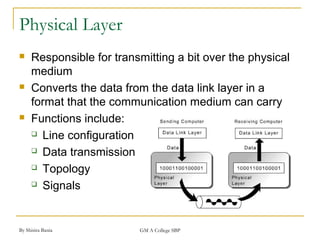
Physical Layer
 Responsible for transmitting a bit over the physical
medium
 Converts the data from the data link layer in a
format that the communication medium can carry
 Functions include:
 Line configuration
 Data transmission
 Topology
 Signals
By Shisira Bania GM A College SBP
Full and Half Duplex Ethernet
Half Duplex Full Duplex
One wire is used to connect the
networks and transmit the data
Two wires are used to connect the
networks and transmit the data
Chances of collision if client and
server transmit data
simultaneously
There are no chances of collision
It uses Carrier Sense Multiple
Access with Collision Detection
(CSMA/CD) protocol
CSMA/CD not required hence the
data transmission rate is 100
percent
By Shisira Bania GM A College SBP
Ethernet Frames
 Frames are used to transfer the packets
 They perform the data security check and ensure
that the data is not corrupted
By Shisira Bania GM A College SBP
Hierarchical Communications
 The benefits of Cisco hierarchical model include
 High performance
 Efficient management and troubleshooting
 Policy creation
 Scalability
 Behavior prediction
By Shisira Bania GM A College SBP
Core Layer
 Responsible for fast and reliable transportation of data
across a network
 Devices include
 Cisco Switches in the 7000, 7200, 7500 and 12000
series for connecting to the WAN devices
 Catalyst Switches in the 6000, 5000 and 4000 series
for connecting to the LAN devices
By Shisira Bania GM A College SBP
Distribution Layer
 Responsible for routing and managing network traffic
 Functions include
 Packet filtering
 Access layer aggregation point
 Control broadcast and multicast
 Application gateways
By Shisira Bania GM A College SBP
Access Layer
 Layer ensures that the packets are delivered to the
destination computers
 Functions include
 Address filtering
 Separate collisions domain
 Share bandwidth
 Handle switch bandwidth
By Shisira Bania GM A College SBP
Ethernet Physical Layer Specification
By Shisira Bania GM A College SBP
Straight Through Cable
By Shisira Bania GM A College SBP
Cross-Over Cable
By Shisira Bania GM A College SBP
Twisted Pair Cables
 Unshielded Twisted Pair (UTP)
 Shielded Twisted Pair (STP)
By Shisira Bania GM A College SBP
Summary - I
 Line configuration is the manner in which the devices are
attached to the communication links
 Topology is the way in which the devices are connected
together in the network
 Two types of line configuration are:
 Point-to-point
 Multipoint
 Five basic topologies include
 Bus
 Star
By Shisira Bania GM A College SBP
Summary - II
 Ring
 Tree
 Mesh
 The types of network are
 Local Area Network
 Metropolitan Area Network
 Wide Area Network
 Modes of transmission
 Simplex
 Half Duplex
 Full Duplex
By Shisira Bania GM A College SBP
Summary - III
 The hierarchical network model designed by Cisco
provides a reliable, scalable and cost effective way
to transfer information
 The three layers of the network model are:
 Core
 Distributional
 Access
 Core layer is responsible for fast and reliable
transportation of data on the network
By Shisira Bania GM A College SBP
Summary - IV
 Distribution layer is responsible for routing and it
manipulates the packets by queuing them
 Access layer ensures that the packets are delivered
to the destination computers
 The Open Systems Interconnection (OSI) is the
layered model for the network systems, which
enables computers in the network to communicate
with each other
 Application layer provides an interface for the user
to interact with the application
By Shisira Bania GM A College SBP
Summary - V
 The seven layers of the OSI model include:
 Application
 Presentation
 Session
 Transport
 Network
 Data Link
 Physical
By Shisira Bania GM A College SBP
Summary - VI
 Presentation layer is responsible for the delivery of
information
 Session layer controls the communication between
the applications on the hosts
 Transport layer is responsible for source-to-
destination delivery of the entire message
 Ethernet Frames are used by the Data Link layer to
transfer the packets of data from the Network layer
 Physical layer is responsible to transmit a bit over
the physical medium

Internetworking Overview

  • 1.
    By Shisira BaniaGM A College SBP Internetworking Overview Chapter 1
  • 2.
    By Shisira BaniaGM A College SBP Chapter Objectives  Explain line configuration  Explain different types of topologies  Explain the types of networks  Discuss the modes of transmission  Discuss the hierarchical network model  Discuss the OSI Layers
  • 3.
    By Shisira BaniaGM A College SBP Point-to-Point Configuration  A dedicated link exists between the two devices
  • 4.
    By Shisira BaniaGM A College SBP Multipoint Configuration  More than two devices share the same link
  • 5.
    By Shisira BaniaGM A College SBP Physical Topology  Represents the physical layout of devices on a network  It is the arrangement of the devices on the network and the way they communicate with each other Bus Star Ring Tree MeshPhysical Topology
  • 6.
    By Shisira BaniaGM A College SBP Local Area Network (LAN)  This is used in a small area, an office or organization  The computers can be connected to each other and other devices, printer or a modem  The rate at which the data is transmitted is very fast
  • 7.
    By Shisira BaniaGM A College SBP Metropolitan Area Network (MAN)  This is used in a large geographical area, town or city  Enables high speed connections using fiber optic
  • 8.
    By Shisira BaniaGM A College SBP Wide Area Network (WAN)  This is used in a larger area than MAN, countries or cities  Enables high speed connections using public networks, telephone lines, satellites, or leased lines
  • 9.
    By Shisira BaniaGM A College SBP Simplex Mode of Transmission  Only one device can transmit the data, whereas the other can only receive the data
  • 10.
    By Shisira BaniaGM A College SBP Half Duplex Transmission Mode  Both devices can transmit and receive the data, but not simultaneously
  • 11.
    By Shisira BaniaGM A College SBP Full Duplex Mode of Transmission  Both the devices can send and receive the data simultaneously
  • 12.
    By Shisira BaniaGM A College SBP OSI Model
  • 13.
    By Shisira BaniaGM A College SBP Application Layer - I  The topmost layer of the OSI model  Link between the user and the presentation layer
  • 14.
    By Shisira BaniaGM A College SBP Application Layer - II  Functions include  Authentication  File access, transfer and management  Directory Services
  • 15.
    By Shisira BaniaGM A College SBP Presentation Layer  Acts as a link between application and the session layer  Defines the forms of text, graphics, video or audio information that is to be sent to the user
  • 16.
    By Shisira BaniaGM A College SBP Session Layer  Responsible to validate and establish a connection between the users  Each session is divided into sub sessions  Functions include  Session Management  Synchronization  Dialog Control  Closing the session
  • 17.
    By Shisira BaniaGM A College SBP Transport Layer  Responsible for source-to-destination delivery of the entire message  divides each message into segments and assigns a sequence number to each segment  Functions include  Service point addressing  End-to-end message delivery  Segmentation and reassembly  Connection control
  • 18.
    By Shisira BaniaGM A College SBP Flow Control using Three-Way Handshake  Three-Way handshake helps to establish the connection between the two devices
  • 19.
    By Shisira BaniaGM A College SBP Sliding Window  This concept of deciding the window size without sending an acknowledgement is termed as Windowing
  • 20.
    By Shisira BaniaGM A College SBP Window Resizing
  • 21.
    By Shisira BaniaGM A College SBP Network Layer  Responsible for routing and logical addressing  Assigns IP addresses and routes the packets to the destination  Functions include  Source-to-destination delivery  Logical addressing  Routing  Address transformation  Multiplexing
  • 22.
    By Shisira BaniaGM A College SBP Data Link Layer  Second layer of the OSI model  Functions include  Identifying the encapsulated data  Framing  Arbitration  Physical addressing  Error detection
  • 23.
    By Shisira BaniaGM A College SBP Physical Layer  Responsible for transmitting a bit over the physical medium  Converts the data from the data link layer in a format that the communication medium can carry  Functions include:  Line configuration  Data transmission  Topology  Signals
  • 24.
    By Shisira BaniaGM A College SBP Full and Half Duplex Ethernet Half Duplex Full Duplex One wire is used to connect the networks and transmit the data Two wires are used to connect the networks and transmit the data Chances of collision if client and server transmit data simultaneously There are no chances of collision It uses Carrier Sense Multiple Access with Collision Detection (CSMA/CD) protocol CSMA/CD not required hence the data transmission rate is 100 percent
  • 25.
    By Shisira BaniaGM A College SBP Ethernet Frames  Frames are used to transfer the packets  They perform the data security check and ensure that the data is not corrupted
  • 26.
    By Shisira BaniaGM A College SBP Hierarchical Communications  The benefits of Cisco hierarchical model include  High performance  Efficient management and troubleshooting  Policy creation  Scalability  Behavior prediction
  • 27.
    By Shisira BaniaGM A College SBP Core Layer  Responsible for fast and reliable transportation of data across a network  Devices include  Cisco Switches in the 7000, 7200, 7500 and 12000 series for connecting to the WAN devices  Catalyst Switches in the 6000, 5000 and 4000 series for connecting to the LAN devices
  • 28.
    By Shisira BaniaGM A College SBP Distribution Layer  Responsible for routing and managing network traffic  Functions include  Packet filtering  Access layer aggregation point  Control broadcast and multicast  Application gateways
  • 29.
    By Shisira BaniaGM A College SBP Access Layer  Layer ensures that the packets are delivered to the destination computers  Functions include  Address filtering  Separate collisions domain  Share bandwidth  Handle switch bandwidth
  • 30.
    By Shisira BaniaGM A College SBP Ethernet Physical Layer Specification
  • 31.
    By Shisira BaniaGM A College SBP Straight Through Cable
  • 32.
    By Shisira BaniaGM A College SBP Cross-Over Cable
  • 33.
    By Shisira BaniaGM A College SBP Twisted Pair Cables  Unshielded Twisted Pair (UTP)  Shielded Twisted Pair (STP)
  • 34.
    By Shisira BaniaGM A College SBP Summary - I  Line configuration is the manner in which the devices are attached to the communication links  Topology is the way in which the devices are connected together in the network  Two types of line configuration are:  Point-to-point  Multipoint  Five basic topologies include  Bus  Star
  • 35.
    By Shisira BaniaGM A College SBP Summary - II  Ring  Tree  Mesh  The types of network are  Local Area Network  Metropolitan Area Network  Wide Area Network  Modes of transmission  Simplex  Half Duplex  Full Duplex
  • 36.
    By Shisira BaniaGM A College SBP Summary - III  The hierarchical network model designed by Cisco provides a reliable, scalable and cost effective way to transfer information  The three layers of the network model are:  Core  Distributional  Access  Core layer is responsible for fast and reliable transportation of data on the network
  • 37.
    By Shisira BaniaGM A College SBP Summary - IV  Distribution layer is responsible for routing and it manipulates the packets by queuing them  Access layer ensures that the packets are delivered to the destination computers  The Open Systems Interconnection (OSI) is the layered model for the network systems, which enables computers in the network to communicate with each other  Application layer provides an interface for the user to interact with the application
  • 38.
    By Shisira BaniaGM A College SBP Summary - V  The seven layers of the OSI model include:  Application  Presentation  Session  Transport  Network  Data Link  Physical
  • 39.
    By Shisira BaniaGM A College SBP Summary - VI  Presentation layer is responsible for the delivery of information  Session layer controls the communication between the applications on the hosts  Transport layer is responsible for source-to- destination delivery of the entire message  Ethernet Frames are used by the Data Link layer to transfer the packets of data from the Network layer  Physical layer is responsible to transmit a bit over the physical medium