Exploring the Network
Layer
MA
by Mehak Ashraf
Demo Class - Mehak Ashraf - K.C. College of Engineering & Man
agement Studies & Research
INTRODUCTION
Demo Class - Mehak Ashraf - K.C. College of Engineering & Man
agement Studies & Research
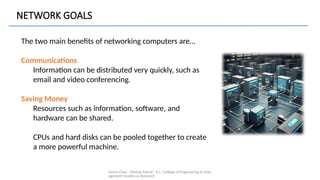
The two main benefits of networking computers are…
Communications
Information can be distributed very quickly, such as
email and video conferencing.
Saving Money
Resources such as information, software, and
hardware can be shared.
CPUs and hard disks can be pooled together to create
a more powerful machine.
NETWORK GOALS
Demo Class - Mehak Ashraf - K.C. College of Engineering & Man
agement Studies & Research
A lot of things we take for granted are the result of computer networks.
• Email
• Chat
• Web sites
• Sharing of documents and pictures
• Accessing a centralized database of information
• Mobile workers
APPLICATIONS
Demo Class - Mehak Ashraf - K.C. College of Engineering & Man
agement Studies & Research
Introduction- THE OSI MODEL
• Open Systems Interconnection Basic Reference Model (OSI Reference Model or OSI Model) is an
abstract description for layered communications and computer network protocol design. It was
developed as part of the Open Systems Interconnection (OSI) initiative. In its most basic form, it divides
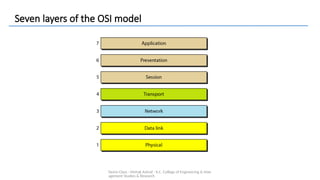
network architecture into seven layers which, from top to bottom, are the Application, Presentation,
Session, Transport, Network, Data-Link, and Physical Layers. It is therefore often referred to as the OSI
Seven Layer Model.
• Established in 1947, the International Standards Organization (ISO) is a multinational body dedicated to
worldwide agreement on international standards. An ISO standard that covers all aspects of network
communications is the Open Systems Interconnection (OSI) model. It was first introduced in the late
1970s.
Demo Class - Mehak Ashraf - K.C. College of Engineering & Man
agement Studies & Research
ISO is the organization.
OSI is the model.
Note
Demo Class - Mehak Ashraf - K.C. College of Engineering & Man
agement Studies & Research
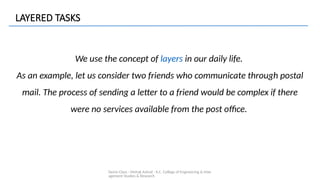
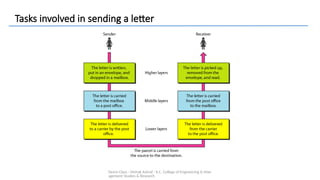
We use the concept of layers in our daily life.
As an example, let us consider two friends who communicate through postal
mail. The process of sending a letter to a friend would be complex if there
were no services available from the post office.
LAYERED TASKS
Demo Class - Mehak Ashraf - K.C. College of Engineering & Man
agement Studies & Research
Tasks involved in sending a letter
Demo Class - Mehak Ashraf - K.C. College of Engineering & Man
agement Studies & Research
Seven layers of the OSI model
Demo Class - Mehak Ashraf - K.C. College of Engineering & Man
agement Studies & Research
The Power of OSI Layers: General Functions
•Standardization & Interoperability: Enables diverse network components to work together.
•Modularity & Simplification: Breaks down complex networking into manageable parts.
•Abstraction: Hides underlying implementation details, simplifying development.
•Troubleshooting & Diagnosis: Pinpoints network issues to specific layers.
•Flexibility & Evolution: Allows for seamless integration of new technologies.
Demo Class - Mehak Ashraf - K.C. College of Engineering & Man
agement Studies & Research
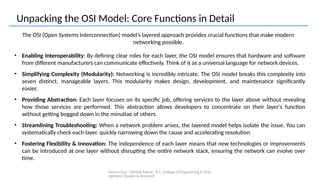
Unpacking the OSI Model: Core Functions in Detail
The OSI (Open Systems Interconnection) model’s layered approach provides crucial functions that make modern
networking possible.
• Enabling Interoperability: By defining clear roles for each layer, the OSI model ensures that hardware and software
from different manufacturers can communicate effectively. Think of it as a universal language for network devices.
• Simplifying Complexity (Modularity): Networking is incredibly intricate. The OSI model breaks this complexity into
seven distinct, manageable layers. This modularity makes design, development, and maintenance significantly
easier.
• Providing Abstraction: Each layer focuses on its specific job, offering services to the layer above without revealing
how those services are performed. This abstraction allows developers to concentrate on their layer's function
without getting bogged down in the minutiae of others.
• Streamlining Troubleshooting: When a network problem arises, the layered model helps isolate the issue. You can
systematically check each layer, quickly narrowing down the cause and accelerating resolution.
• Fostering Flexibility & Innovation: The independence of each layer means that new technologies or improvements
can be introduced at one layer without disrupting the entire network stack, ensuring the network can evolve over
time.
Demo Class - Mehak Ashraf - K.C. College of Engineering & Man
agement Studies & Research
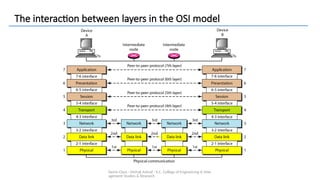
The interaction between layers in the OSI model
Demo Class - Mehak Ashraf - K.C. College of Engineering & Man
agement Studies & Research
7 Application
6 Presentation
5 Session
4 Transport
1 Physical
2 Data Link
3 Network
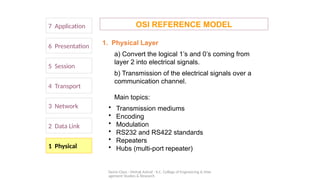
OSI REFERENCE MODEL
1. Physical Layer
a) Convert the logical 1’s and 0’s coming from
layer 2 into electrical signals.
b) Transmission of the electrical signals over a
communication channel.
Main topics:
• Transmission mediums
• Encoding
• Modulation
• RS232 and RS422 standards
• Repeaters
• Hubs (multi-port repeater)
Demo Class - Mehak Ashraf - K.C. College of Engineering & Man
agement Studies & Research
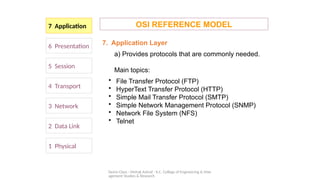
7 Application
6 Presentation
5 Session
4 Transport
1 Physical
2 Data Link
3 Network
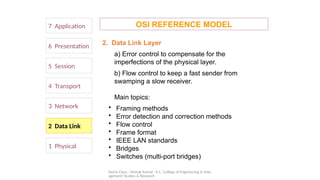
OSI REFERENCE MODEL
2. Data Link Layer
a) Error control to compensate for the
imperfections of the physical layer.
b) Flow control to keep a fast sender from
swamping a slow receiver.
Main topics:
• Framing methods
• Error detection and correction methods
• Flow control
• Frame format
• IEEE LAN standards
• Bridges
• Switches (multi-port bridges)
Demo Class - Mehak Ashraf - K.C. College of Engineering & Man
agement Studies & Research
7 Application
6 Presentation
5 Session
4 Transport
1 Physical
2 Data Link
3 Network
OSI REFERENCE MODEL
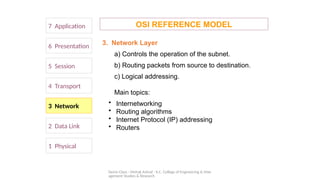
3. Network Layer
a) Controls the operation of the subnet.
b) Routing packets from source to destination.
c) Logical addressing.
Main topics:
• Internetworking
• Routing algorithms
• Internet Protocol (IP) addressing
• Routers
Demo Class - Mehak Ashraf - K.C. College of Engineering & Man
agement Studies & Research
7 Application
6 Presentation
5 Session
4 Transport
1 Physical
2 Data Link
3 Network
OSI REFERENCE MODEL
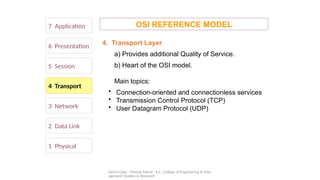
4. Transport Layer
a) Provides additional Quality of Service.
b) Heart of the OSI model.
Main topics:
• Connection-oriented and connectionless services
• Transmission Control Protocol (TCP)
• User Datagram Protocol (UDP)
Demo Class - Mehak Ashraf - K.C. College of Engineering & Man
agement Studies & Research
7 Application
6 Presentation
5 Session
4 Transport
1 Physical
2 Data Link
3 Network
OSI REFERENCE MODEL
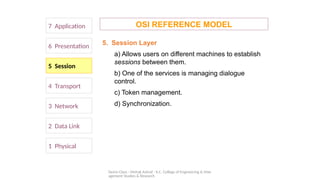
5. Session Layer
a) Allows users on different machines to establish
sessions between them.
b) One of the services is managing dialogue
control.
c) Token management.
d) Synchronization.
Demo Class - Mehak Ashraf - K.C. College of Engineering & Man
agement Studies & Research
7 Application
6 Presentation
5 Session
4 Transport
1 Physical
2 Data Link
3 Network
OSI REFERENCE MODEL
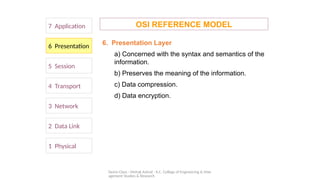
6. Presentation Layer
a) Concerned with the syntax and semantics of the
information.
b) Preserves the meaning of the information.
c) Data compression.
d) Data encryption.
Demo Class - Mehak Ashraf - K.C. College of Engineering & Man
agement Studies & Research
7 Application
6 Presentation
5 Session
4 Transport
1 Physical
2 Data Link
3 Network
OSI REFERENCE MODEL
7. Application Layer
a) Provides protocols that are commonly needed.
Main topics:
• File Transfer Protocol (FTP)
• HyperText Transfer Protocol (HTTP)
• Simple Mail Transfer Protocol (SMTP)
• Simple Network Management Protocol (SNMP)
• Network File System (NFS)
• Telnet
Demo Class - Mehak Ashraf - K.C. College of Engineering & Man
agement Studies & Research
Focus Topic: Network Layer
and
Transport Layer
Demo Class - Mehak Ashraf - K.C. College of Engineering & Man
agement Studies & Research
Network Layer (OSI Layer 3): The Router's Domain
The Network Layer is all about getting data from one host to another across different
networks – it handles the journey across the internet.
• Logical Addressing (IP Addressing): Assigns unique, network-wide addresses (like IP
addresses) to devices, letting them be identified globally.
• Routing: Determines the optimal path for data packets to travel across various
interconnected networks. This is where routers do their job.
• Packet Forwarding: Moves data packets from one router to the next along the chosen
path.
• Fragmentation: If a packet is too big for a particular network link, this layer breaks it
into smaller pieces and reassembles them at the destination (primarily for IPv4).
Demo Class - Mehak Ashraf - K.C. College of Engineering & Man
agement Studies & Research
Key Network Layer Protocols
• IP (Internet Protocol): The fundamental protocol for addressing and routing packets
across networks.
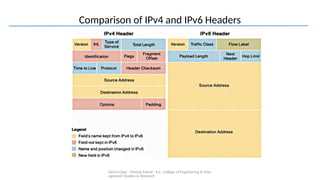
• IPv4: The widely used 32-bit addressing scheme, facing address depletion.
• IPv6: The next-generation 128-bit addressing scheme, solving address exhaustion and
offering enhancements.
• ICMP (Internet Control Message Protocol): Used for error reporting and network
diagnostics (e.g., ping).
• ARP (Address Resolution Protocol): Maps IP addresses to physical (MAC) addresses
within a local network segment.
Demo Class - Mehak Ashraf - K.C. College of Engineering & Man
agement Studies & Research
Comparison of IPv4 and IPv6 Headers
Demo Class - Mehak Ashraf - K.C. College of Engineering & Man
agement Studies & Research
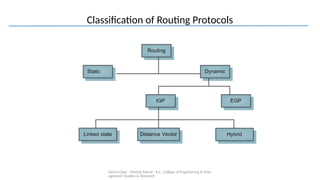
Classification of Routing Protocols
Demo Class - Mehak Ashraf - K.C. College of Engineering & Man
agement Studies & Research
Transport Layer (OSI Layer 4): Application-to-Application Delivery
The Transport Layer focuses on end-to-end communication between specific applications running on different devices,
ensuring data arrives completely and correctly.
• Service-Point Addressing (Port Addressing): Uses port numbers to direct data to the correct application on the
destination device (e.g., web browser vs. email client).
• Segmentation & Reassembly: Breaks application data into smaller segments for transmission and puts them back
together at the receiving end, ensuring the correct order.
• Connection Control: Manages communication sessions:
• TCP (Connection-Oriented): Establishes a reliable connection, guaranteeing delivery and managing flow.
• UDP (Connectionless): Offers faster, less reliable delivery without a prior connection.
• Error Control: Detects and corrects errors in segments to ensure accurate data delivery (especially with TCP).
• Flow Control: Prevents a fast sender from overwhelming a slower receiver, ensuring data can be processed.
Demo Class - Mehak Ashraf - K.C. College of Engineering & Man
agement Studies & Research
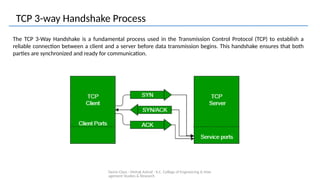
TCP 3-way Handshake Process
The TCP 3-Way Handshake is a fundamental process used in the Transmission Control Protocol (TCP) to establish a
reliable connection between a client and a server before data transmission begins. This handshake ensures that both
parties are synchronized and ready for communication.
Demo Class - Mehak Ashraf - K.C. College of Engineering & Man
agement Studies & Research
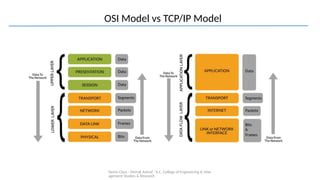
OSI Model vs TCP/IP Model
Demo Class - Mehak Ashraf - K.C. College of Engineering & Man
agement Studies & Research
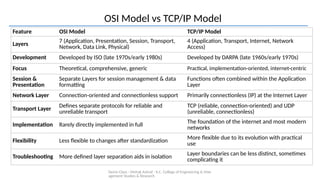
OSI Model vs TCP/IP Model
Feature OSI Model TCP/IP Model
Layers
7 (Application, Presentation, Session, Transport,
Network, Data Link, Physical)
4 (Application, Transport, Internet, Network
Access)
Development Developed by ISO (late 1970s/early 1980s) Developed by DARPA (late 1960s/early 1970s)
Focus Theoretical, comprehensive, generic Practical, implementation-oriented, internet-centric
Session &
Presentation
Separate Layers for session management & data
formatting
Functions often combined within the Application
Layer
Network Layer Connection-oriented and connectionless support Primarily connectionless (IP) at the Internet Layer
Transport Layer
Defines separate protocols for reliable and
unreliable transport
TCP (reliable, connection-oriented) and UDP
(unreliable, connectionless)
Implementation Rarely directly implemented in full The foundation of the internet and most modern
networks
Flexibility Less flexible to changes after standardization More flexible due to its evolution with practical
use
Troubleshooting More defined layer separation aids in isolation Layer boundaries can be less distinct, sometimes
complicating it
Demo Class - Mehak Ashraf - K.C. College of Engineering & Man
agement Studies & Research
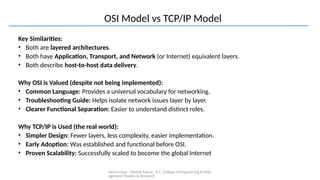
OSI Model vs TCP/IP Model
Key Similarities:
• Both are layered architectures.
• Both have Application, Transport, and Network (or Internet) equivalent layers.
• Both describe host-to-host data delivery.
Why OSI is Valued (despite not being implemented):
• Common Language: Provides a universal vocabulary for networking.
• Troubleshooting Guide: Helps isolate network issues layer by layer.
• Clearer Functional Separation: Easier to understand distinct roles.
Why TCP/IP is Used (the real world):
• Simpler Design: Fewer layers, less complexity, easier implementation.
• Early Adoption: Was established and functional before OSI.
• Proven Scalability: Successfully scaled to become the global Internet
Demo Class - Mehak Ashraf - K.C. College of Engineering & Man
agement Studies & Research
Thank you!
backup.pptxbackup.pptxbackup.pptbackup.pptxx

  • 1.
  • 2.
    Demo Class -Mehak Ashraf - K.C. College of Engineering & Man agement Studies & Research INTRODUCTION
  • 3.
    Demo Class -Mehak Ashraf - K.C. College of Engineering & Man agement Studies & Research The two main benefits of networking computers are… Communications Information can be distributed very quickly, such as email and video conferencing. Saving Money Resources such as information, software, and hardware can be shared. CPUs and hard disks can be pooled together to create a more powerful machine. NETWORK GOALS
  • 4.
    Demo Class -Mehak Ashraf - K.C. College of Engineering & Man agement Studies & Research A lot of things we take for granted are the result of computer networks. • Email • Chat • Web sites • Sharing of documents and pictures • Accessing a centralized database of information • Mobile workers APPLICATIONS
  • 5.
    Demo Class -Mehak Ashraf - K.C. College of Engineering & Man agement Studies & Research Introduction- THE OSI MODEL • Open Systems Interconnection Basic Reference Model (OSI Reference Model or OSI Model) is an abstract description for layered communications and computer network protocol design. It was developed as part of the Open Systems Interconnection (OSI) initiative. In its most basic form, it divides network architecture into seven layers which, from top to bottom, are the Application, Presentation, Session, Transport, Network, Data-Link, and Physical Layers. It is therefore often referred to as the OSI Seven Layer Model. • Established in 1947, the International Standards Organization (ISO) is a multinational body dedicated to worldwide agreement on international standards. An ISO standard that covers all aspects of network communications is the Open Systems Interconnection (OSI) model. It was first introduced in the late 1970s.
  • 6.
    Demo Class -Mehak Ashraf - K.C. College of Engineering & Man agement Studies & Research ISO is the organization. OSI is the model. Note
  • 7.
    Demo Class -Mehak Ashraf - K.C. College of Engineering & Man agement Studies & Research We use the concept of layers in our daily life. As an example, let us consider two friends who communicate through postal mail. The process of sending a letter to a friend would be complex if there were no services available from the post office. LAYERED TASKS
  • 8.
    Demo Class -Mehak Ashraf - K.C. College of Engineering & Man agement Studies & Research Tasks involved in sending a letter
  • 9.
    Demo Class -Mehak Ashraf - K.C. College of Engineering & Man agement Studies & Research Seven layers of the OSI model
  • 10.
    Demo Class -Mehak Ashraf - K.C. College of Engineering & Man agement Studies & Research The Power of OSI Layers: General Functions •Standardization & Interoperability: Enables diverse network components to work together. •Modularity & Simplification: Breaks down complex networking into manageable parts. •Abstraction: Hides underlying implementation details, simplifying development. •Troubleshooting & Diagnosis: Pinpoints network issues to specific layers. •Flexibility & Evolution: Allows for seamless integration of new technologies.
  • 11.
    Demo Class -Mehak Ashraf - K.C. College of Engineering & Man agement Studies & Research Unpacking the OSI Model: Core Functions in Detail The OSI (Open Systems Interconnection) model’s layered approach provides crucial functions that make modern networking possible. • Enabling Interoperability: By defining clear roles for each layer, the OSI model ensures that hardware and software from different manufacturers can communicate effectively. Think of it as a universal language for network devices. • Simplifying Complexity (Modularity): Networking is incredibly intricate. The OSI model breaks this complexity into seven distinct, manageable layers. This modularity makes design, development, and maintenance significantly easier. • Providing Abstraction: Each layer focuses on its specific job, offering services to the layer above without revealing how those services are performed. This abstraction allows developers to concentrate on their layer's function without getting bogged down in the minutiae of others. • Streamlining Troubleshooting: When a network problem arises, the layered model helps isolate the issue. You can systematically check each layer, quickly narrowing down the cause and accelerating resolution. • Fostering Flexibility & Innovation: The independence of each layer means that new technologies or improvements can be introduced at one layer without disrupting the entire network stack, ensuring the network can evolve over time.
  • 12.
    Demo Class -Mehak Ashraf - K.C. College of Engineering & Man agement Studies & Research The interaction between layers in the OSI model
  • 13.
    Demo Class -Mehak Ashraf - K.C. College of Engineering & Man agement Studies & Research 7 Application 6 Presentation 5 Session 4 Transport 1 Physical 2 Data Link 3 Network OSI REFERENCE MODEL 1. Physical Layer a) Convert the logical 1’s and 0’s coming from layer 2 into electrical signals. b) Transmission of the electrical signals over a communication channel. Main topics: • Transmission mediums • Encoding • Modulation • RS232 and RS422 standards • Repeaters • Hubs (multi-port repeater)
  • 14.
    Demo Class -Mehak Ashraf - K.C. College of Engineering & Man agement Studies & Research 7 Application 6 Presentation 5 Session 4 Transport 1 Physical 2 Data Link 3 Network OSI REFERENCE MODEL 2. Data Link Layer a) Error control to compensate for the imperfections of the physical layer. b) Flow control to keep a fast sender from swamping a slow receiver. Main topics: • Framing methods • Error detection and correction methods • Flow control • Frame format • IEEE LAN standards • Bridges • Switches (multi-port bridges)
  • 15.
    Demo Class -Mehak Ashraf - K.C. College of Engineering & Man agement Studies & Research 7 Application 6 Presentation 5 Session 4 Transport 1 Physical 2 Data Link 3 Network OSI REFERENCE MODEL 3. Network Layer a) Controls the operation of the subnet. b) Routing packets from source to destination. c) Logical addressing. Main topics: • Internetworking • Routing algorithms • Internet Protocol (IP) addressing • Routers
  • 16.
    Demo Class -Mehak Ashraf - K.C. College of Engineering & Man agement Studies & Research 7 Application 6 Presentation 5 Session 4 Transport 1 Physical 2 Data Link 3 Network OSI REFERENCE MODEL 4. Transport Layer a) Provides additional Quality of Service. b) Heart of the OSI model. Main topics: • Connection-oriented and connectionless services • Transmission Control Protocol (TCP) • User Datagram Protocol (UDP)
  • 17.
    Demo Class -Mehak Ashraf - K.C. College of Engineering & Man agement Studies & Research 7 Application 6 Presentation 5 Session 4 Transport 1 Physical 2 Data Link 3 Network OSI REFERENCE MODEL 5. Session Layer a) Allows users on different machines to establish sessions between them. b) One of the services is managing dialogue control. c) Token management. d) Synchronization.
  • 18.
    Demo Class -Mehak Ashraf - K.C. College of Engineering & Man agement Studies & Research 7 Application 6 Presentation 5 Session 4 Transport 1 Physical 2 Data Link 3 Network OSI REFERENCE MODEL 6. Presentation Layer a) Concerned with the syntax and semantics of the information. b) Preserves the meaning of the information. c) Data compression. d) Data encryption.
  • 19.
    Demo Class -Mehak Ashraf - K.C. College of Engineering & Man agement Studies & Research 7 Application 6 Presentation 5 Session 4 Transport 1 Physical 2 Data Link 3 Network OSI REFERENCE MODEL 7. Application Layer a) Provides protocols that are commonly needed. Main topics: • File Transfer Protocol (FTP) • HyperText Transfer Protocol (HTTP) • Simple Mail Transfer Protocol (SMTP) • Simple Network Management Protocol (SNMP) • Network File System (NFS) • Telnet
  • 20.
    Demo Class -Mehak Ashraf - K.C. College of Engineering & Man agement Studies & Research Focus Topic: Network Layer and Transport Layer
  • 21.
    Demo Class -Mehak Ashraf - K.C. College of Engineering & Man agement Studies & Research Network Layer (OSI Layer 3): The Router's Domain The Network Layer is all about getting data from one host to another across different networks – it handles the journey across the internet. • Logical Addressing (IP Addressing): Assigns unique, network-wide addresses (like IP addresses) to devices, letting them be identified globally. • Routing: Determines the optimal path for data packets to travel across various interconnected networks. This is where routers do their job. • Packet Forwarding: Moves data packets from one router to the next along the chosen path. • Fragmentation: If a packet is too big for a particular network link, this layer breaks it into smaller pieces and reassembles them at the destination (primarily for IPv4).
  • 22.
    Demo Class -Mehak Ashraf - K.C. College of Engineering & Man agement Studies & Research Key Network Layer Protocols • IP (Internet Protocol): The fundamental protocol for addressing and routing packets across networks. • IPv4: The widely used 32-bit addressing scheme, facing address depletion. • IPv6: The next-generation 128-bit addressing scheme, solving address exhaustion and offering enhancements. • ICMP (Internet Control Message Protocol): Used for error reporting and network diagnostics (e.g., ping). • ARP (Address Resolution Protocol): Maps IP addresses to physical (MAC) addresses within a local network segment.
  • 23.
    Demo Class -Mehak Ashraf - K.C. College of Engineering & Man agement Studies & Research Comparison of IPv4 and IPv6 Headers
  • 24.
    Demo Class -Mehak Ashraf - K.C. College of Engineering & Man agement Studies & Research Classification of Routing Protocols
  • 25.
    Demo Class -Mehak Ashraf - K.C. College of Engineering & Man agement Studies & Research Transport Layer (OSI Layer 4): Application-to-Application Delivery The Transport Layer focuses on end-to-end communication between specific applications running on different devices, ensuring data arrives completely and correctly. • Service-Point Addressing (Port Addressing): Uses port numbers to direct data to the correct application on the destination device (e.g., web browser vs. email client). • Segmentation & Reassembly: Breaks application data into smaller segments for transmission and puts them back together at the receiving end, ensuring the correct order. • Connection Control: Manages communication sessions: • TCP (Connection-Oriented): Establishes a reliable connection, guaranteeing delivery and managing flow. • UDP (Connectionless): Offers faster, less reliable delivery without a prior connection. • Error Control: Detects and corrects errors in segments to ensure accurate data delivery (especially with TCP). • Flow Control: Prevents a fast sender from overwhelming a slower receiver, ensuring data can be processed.
  • 26.
    Demo Class -Mehak Ashraf - K.C. College of Engineering & Man agement Studies & Research TCP 3-way Handshake Process The TCP 3-Way Handshake is a fundamental process used in the Transmission Control Protocol (TCP) to establish a reliable connection between a client and a server before data transmission begins. This handshake ensures that both parties are synchronized and ready for communication.
  • 27.
    Demo Class -Mehak Ashraf - K.C. College of Engineering & Man agement Studies & Research OSI Model vs TCP/IP Model
  • 28.
    Demo Class -Mehak Ashraf - K.C. College of Engineering & Man agement Studies & Research OSI Model vs TCP/IP Model Feature OSI Model TCP/IP Model Layers 7 (Application, Presentation, Session, Transport, Network, Data Link, Physical) 4 (Application, Transport, Internet, Network Access) Development Developed by ISO (late 1970s/early 1980s) Developed by DARPA (late 1960s/early 1970s) Focus Theoretical, comprehensive, generic Practical, implementation-oriented, internet-centric Session & Presentation Separate Layers for session management & data formatting Functions often combined within the Application Layer Network Layer Connection-oriented and connectionless support Primarily connectionless (IP) at the Internet Layer Transport Layer Defines separate protocols for reliable and unreliable transport TCP (reliable, connection-oriented) and UDP (unreliable, connectionless) Implementation Rarely directly implemented in full The foundation of the internet and most modern networks Flexibility Less flexible to changes after standardization More flexible due to its evolution with practical use Troubleshooting More defined layer separation aids in isolation Layer boundaries can be less distinct, sometimes complicating it
  • 29.
    Demo Class -Mehak Ashraf - K.C. College of Engineering & Man agement Studies & Research OSI Model vs TCP/IP Model Key Similarities: • Both are layered architectures. • Both have Application, Transport, and Network (or Internet) equivalent layers. • Both describe host-to-host data delivery. Why OSI is Valued (despite not being implemented): • Common Language: Provides a universal vocabulary for networking. • Troubleshooting Guide: Helps isolate network issues layer by layer. • Clearer Functional Separation: Easier to understand distinct roles. Why TCP/IP is Used (the real world): • Simpler Design: Fewer layers, less complexity, easier implementation. • Early Adoption: Was established and functional before OSI. • Proven Scalability: Successfully scaled to become the global Internet
  • 30.
    Demo Class -Mehak Ashraf - K.C. College of Engineering & Man agement Studies & Research Thank you!