MTN 2013
Computer Network Technology


      Chapter 3
      OSI Model
Outline
1.    Introduction to OSI Design
2.    Issues in OSI
3.    OSI Standard
4.    OSI Protocol
5.    OSI Layer Function & Data Control


11/17/2011              MTN 2013          2
1. Introduction to OSI Design
• Open Systems Interconnected Model
      – was created in the 70’s by the ISO (International
        Organization for Standardization)
             • Several different people got together and considered all functions
               of communications
      – The concept of a 7 layer model was provided by the work
        of Charles Bachman, Honeywell Information Services.
      – Various aspects of OSI design evolved from experiences
        with the ARPANET
      – Integrated Services Digital Network (ISDN) was a big
        factor
      – 7 layers = 4 upper and 3 lower

11/17/2011                              MTN 2013                                    3
OSI Model
• OSI Model
      – Model for understanding and developing computer-to-
        computer communication
      – Divides network architecture into seven layers
      – Modular approach
      – Ensures error free delivery
      – Defines functionality NOT services or protocols
• Network Architect
      – Designs networks
• Network Administrators
      – Need to understand


11/17/2011                      MTN 2013                      4
OSI Reference Model in Practice
• The OSI reference model is used in many ways:
      – To provide assistance when troubleshooting network
        problems
      – To provide a common terminology and framework for
        networking technology developers
      – To facilitate the development of connectivity standards
        needed for flexible open architectures
      – To enable the development of protocol stacks that allow
        network nodes to communicate with one another


11/17/2011                     MTN 2013                           5
Seven Layers of Network Architecture

                                ALL

                                    PEOPLE

                                      SEEM

                                       TO

                                       NEED

                                      DATA

                                PROCESSING


               FIGURE : OSI Model
11/17/2011          MTN 2013                  6
2. Issues in OSI
Sr. No. TCP/IP Reference Model                       OSI Reference Model

             Defined after the advent of
1                                                   Defined before advent of internet
             Internet
             Service interface and protocols
                                                    Service interface and protocols are clearly
2            were not clearly distinguished
                                                    distinguished
             before
3            TCP/IP supports Internet working       Internet working not supported

4            Loosely layered                        Strict layering

5            Protocol Dependent standard            Protocol independent standard

6            More Credible                          Less Credible
             TCP reliably delivers packets, IP
7                                                   All packets are reliably delivered
             does not reliably deliver packets
11/17/2011                                     MTN 2013                                       7
3. OSI Standard
• Was created because people realized that our
  computers needed to talk to each other(and
  there was no one dominant computer system)
• Consist of different technologies – hardware and
  software
• i.e each computer vendor, had a different
  hardware design, OS and a proprietary protocol
  to enable communication between two
  computers of the same make.
• Need one standard protocol to define the
  functionality
11/17/2011            MTN 2013                   8
4. OSI Protocol
• It is a way of sub-dividing a communications
  system into smaller parts called layers.
• Similar communication functions are grouped
  into logical layers.
• A layer provides services to its upper layer
  while receiving services from the layer below.
• On each layer, an instance provides service to
  the instances at the layer above and requests
  service from the layer below
11/17/2011            MTN 2013                     9
5. OSI Layer Function & Data Control
• 7 layers
    1. Physical
    2. Data link
    3. Network
    4. Transport
    5. Session
    6. Presentation
    7. Application

11/17/2011            MTN 2013           10
OSI Reference Model: Layer 1
                             Transmits and receives raw data
                             to communication medium.
                             Does not care about contents.
                             voltage levels, speed,
                             connectors


1             Physical
                              Examples: RS-232, 10BaseT

11/17/2011               MTN 2013                            11
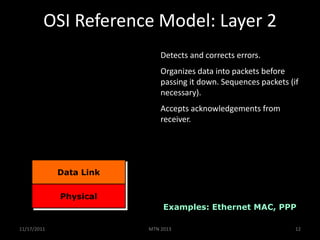
OSI Reference Model: Layer 2
                             Detects and corrects errors.
                             Organizes data into packets before
                             passing it down. Sequences packets (if
                             necessary).
                             Accepts acknowledgements from
                             receiver.


2            Data Link

1            Physical
                              Examples: Ethernet MAC, PPP

11/17/2011               MTN 2013                                 12
OSI Reference Model: Layer 3
                              Relay and route information to
                              destination.
                              Manage journey of packets and
                              figure out intermediate hops (if
                              needed).

3             Network

2             Data Link

1             Physical
                               Examples: IP, X.25

11/17/2011                MTN 2013                             13
OSI Reference Model: Layer 4
                             Provides a consistent interface
                             for end-to-end (application-to-
                             application) communication.
                             Manages flow control.
                             Network interface is similar to a
4            Transport       mailbox.

3            Network

2            Data Link

1            Physical
                              Examples: TCP, UDP

11/17/2011               MTN 2013                              14
OSI Reference Model: Layer 5
                             Services to coordinate dialogue
                             and manage data exchange.
                             Software implemented switch.
5            Session
                             Manage multiple logical
4            Transport
                             connections.
                             Keep track of who is talking:
3            Network         establish & end
                             communications.
2            Data Link

1            Physical         Examples: HTTP 1.1, SSL,
                              NetBIOS

11/17/2011               MTN 2013                            15
OSI Reference Model: Layer 6
                                Data representation
6            Presentation
                                Concerned with the
5              Session
                                meaning of data bits

4             Transport
                                Convert between machine
                                representations
3             Network

2             Data Link

1              Physical          Examples: XDR, ASN.1,
                                 MIME, MIDI

11/17/2011                  MTN 2013                      16
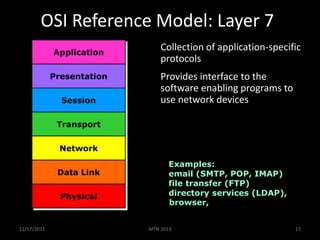
OSI Reference Model: Layer 7
7            Application
                                Collection of application-specific
                                protocols
6            Presentation       Provides interface to the
                                software enabling programs to
5              Session          use network devices

4             Transport

3             Network
                                   Examples:
2             Data Link            email (SMTP, POP, IMAP)
                                   file transfer (FTP)
1              Physical            directory services (LDAP),
                                   browser,


11/17/2011                  MTN 2013                            17
END
              Q&A
11/17/2011   MTN 2013   18

OSI Model

  • 1.
    MTN 2013 Computer NetworkTechnology Chapter 3 OSI Model
  • 2.
    Outline 1. Introduction to OSI Design 2. Issues in OSI 3. OSI Standard 4. OSI Protocol 5. OSI Layer Function & Data Control 11/17/2011 MTN 2013 2
  • 3.
    1. Introduction toOSI Design • Open Systems Interconnected Model – was created in the 70’s by the ISO (International Organization for Standardization) • Several different people got together and considered all functions of communications – The concept of a 7 layer model was provided by the work of Charles Bachman, Honeywell Information Services. – Various aspects of OSI design evolved from experiences with the ARPANET – Integrated Services Digital Network (ISDN) was a big factor – 7 layers = 4 upper and 3 lower 11/17/2011 MTN 2013 3
  • 4.
    OSI Model • OSIModel – Model for understanding and developing computer-to- computer communication – Divides network architecture into seven layers – Modular approach – Ensures error free delivery – Defines functionality NOT services or protocols • Network Architect – Designs networks • Network Administrators – Need to understand 11/17/2011 MTN 2013 4
  • 5.
    OSI Reference Modelin Practice • The OSI reference model is used in many ways: – To provide assistance when troubleshooting network problems – To provide a common terminology and framework for networking technology developers – To facilitate the development of connectivity standards needed for flexible open architectures – To enable the development of protocol stacks that allow network nodes to communicate with one another 11/17/2011 MTN 2013 5
  • 6.
    Seven Layers ofNetwork Architecture ALL PEOPLE SEEM TO NEED DATA PROCESSING FIGURE : OSI Model 11/17/2011 MTN 2013 6
  • 7.
    2. Issues inOSI Sr. No. TCP/IP Reference Model OSI Reference Model Defined after the advent of 1 Defined before advent of internet Internet Service interface and protocols Service interface and protocols are clearly 2 were not clearly distinguished distinguished before 3 TCP/IP supports Internet working Internet working not supported 4 Loosely layered Strict layering 5 Protocol Dependent standard Protocol independent standard 6 More Credible Less Credible TCP reliably delivers packets, IP 7 All packets are reliably delivered does not reliably deliver packets 11/17/2011 MTN 2013 7
  • 8.
    3. OSI Standard •Was created because people realized that our computers needed to talk to each other(and there was no one dominant computer system) • Consist of different technologies – hardware and software • i.e each computer vendor, had a different hardware design, OS and a proprietary protocol to enable communication between two computers of the same make. • Need one standard protocol to define the functionality 11/17/2011 MTN 2013 8
  • 9.
    4. OSI Protocol •It is a way of sub-dividing a communications system into smaller parts called layers. • Similar communication functions are grouped into logical layers. • A layer provides services to its upper layer while receiving services from the layer below. • On each layer, an instance provides service to the instances at the layer above and requests service from the layer below 11/17/2011 MTN 2013 9
  • 10.
    5. OSI LayerFunction & Data Control • 7 layers 1. Physical 2. Data link 3. Network 4. Transport 5. Session 6. Presentation 7. Application 11/17/2011 MTN 2013 10
  • 11.
    OSI Reference Model:Layer 1 Transmits and receives raw data to communication medium. Does not care about contents. voltage levels, speed, connectors 1 Physical Examples: RS-232, 10BaseT 11/17/2011 MTN 2013 11
  • 12.
    OSI Reference Model:Layer 2 Detects and corrects errors. Organizes data into packets before passing it down. Sequences packets (if necessary). Accepts acknowledgements from receiver. 2 Data Link 1 Physical Examples: Ethernet MAC, PPP 11/17/2011 MTN 2013 12
  • 13.
    OSI Reference Model:Layer 3 Relay and route information to destination. Manage journey of packets and figure out intermediate hops (if needed). 3 Network 2 Data Link 1 Physical Examples: IP, X.25 11/17/2011 MTN 2013 13
  • 14.
    OSI Reference Model:Layer 4 Provides a consistent interface for end-to-end (application-to- application) communication. Manages flow control. Network interface is similar to a 4 Transport mailbox. 3 Network 2 Data Link 1 Physical Examples: TCP, UDP 11/17/2011 MTN 2013 14
  • 15.
    OSI Reference Model:Layer 5 Services to coordinate dialogue and manage data exchange. Software implemented switch. 5 Session Manage multiple logical 4 Transport connections. Keep track of who is talking: 3 Network establish & end communications. 2 Data Link 1 Physical Examples: HTTP 1.1, SSL, NetBIOS 11/17/2011 MTN 2013 15
  • 16.
    OSI Reference Model:Layer 6 Data representation 6 Presentation Concerned with the 5 Session meaning of data bits 4 Transport Convert between machine representations 3 Network 2 Data Link 1 Physical Examples: XDR, ASN.1, MIME, MIDI 11/17/2011 MTN 2013 16
  • 17.
    OSI Reference Model:Layer 7 7 Application Collection of application-specific protocols 6 Presentation Provides interface to the software enabling programs to 5 Session use network devices 4 Transport 3 Network Examples: 2 Data Link email (SMTP, POP, IMAP) file transfer (FTP) 1 Physical directory services (LDAP), browser, 11/17/2011 MTN 2013 17
  • 18.
    END Q&A 11/17/2011 MTN 2013 18