

Parminder Singh
Assistant Professor| Chandigarh engineering college,landran
Singh.parminder06@gmail.com
 The number of devices have been use in Networking.
 These devices can be categorized as:
 Personnel Computer (PC)
 Switch (SW)
 Router (R)
 Hub
 Bridge
 A personal computer (PC) is a small, relatively inexpensive
computer designed for an individual user.
 All are based on the microprocessor technology that
enables manufacturers to put an entire CPU on one chip.
 Hubs are commonly used to connect segments of a LAN.
 A hub contain multiple ports.
 When a packet arrives at one port, it is copied to the other
ports so that all segments of the LAN can see all packets.
 A network bridge connects two networks together, or can be used to divide a network
up into segments.
 A bridge device filters data traffic at a network boundary.
 Bridges inspect incoming traffic and decide whether to forward or discard it.
 The Switch is Layer 2 Device that connects number of Pc’s according to the availability
of the Ethernet ports.
 The switch performed on MAC address; it does not verified logical addresses.
 It performs filtering and switching only on MAC (Medium Access Control) addresses.
 The Switch has unicasting feature; the sender send unicast message to the
destination machine and destination machine unicastly reply.
 The Switch employ MAC Table to forwards the data from one device to another.
 Router is a Network Layer device that forwards packet in to the Network.
 This Network Supposed to be either LAN, MAN or WAN.
 The Router is also acting as a Gateway for associates two different network.
 The Router employing ICMP (Internet Control Message Protocol) Protocol for communes
different devices and nodes.
 This Protocol helps the router to create routing table and configure best route path in between
two communicating nodes.
 Router provides quality of service (QOS) feature performance.
 Router Extends the network as a platform for cloud computing.
Four router functions in your network can be listed as follows:
 Packet switching
 Packet filtering
 Internetwork communication
 Path selection
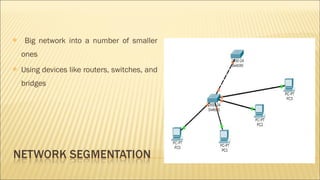
 Big network into a number of smaller
ones
 Using devices like routers, switches, and
bridges
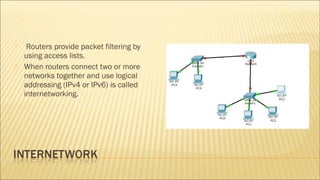
 Routers provide packet filtering by
using access lists.
 When routers connect two or more
networks together and use logical
addressing (IPv4 or IPv6) is called
internetworking.
 Broadcast domain is important because when a host or server sends a network broadcast,
every device on the network must read and process that broadcast
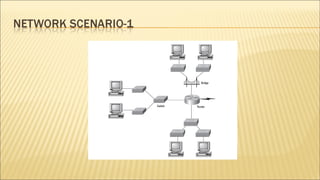
 Collision domain is an Ethernet term used to describe a network scenario (shown in the
previous slide) in which one device sends a packet on a network segment and every other
device on the same segment is forced to pay attention to it.
 Each host segment connects to a hub that represents only one collision domain and only one
broadcast domain.
 Switches create separate collision domains within a single broadcast domain.
 Routers provide a separate broadcast domain for each interface.
 The main purpose of these switches is to make a LAN work better and they do not break up
broadcast domains by default.
 Routers, by default, break up a broadcast domain; the set of all devices on a network
segment that hear all the broadcasts sent on that segment.
 bridging was introduced before routers and hubs were implemented.
 bridges and switches basically do the same thing means break up collision domains on a
LAN.
 Bridges come in 2 or 4 ports and extended up to 16 ports but in a switch you can use up to
100 ports.
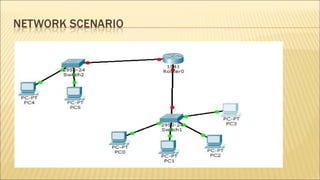
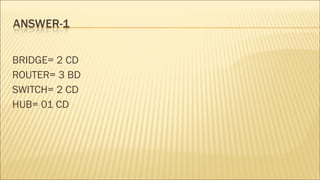
BRIDGE= 2 CD
ROUTER= 3 BD
SWITCH= 2 CD
HUB= 01 CD
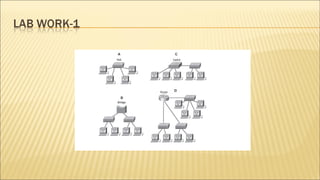
A= one CD, one BD
B= two CD, one BD
C= Four CD, one BD
D= 3 BD, 3 CD
[1] https://www.netacad.com
[2] www.packettracernetwork.com
Singh.parminder06@gmail.com

Basic Networking

  • 1.
    Parminder Singh Assistant Professor|Chandigarh engineering college,landran Singh.parminder06@gmail.com
  • 3.
     The numberof devices have been use in Networking.  These devices can be categorized as:  Personnel Computer (PC)  Switch (SW)  Router (R)  Hub  Bridge
  • 5.
     A personalcomputer (PC) is a small, relatively inexpensive computer designed for an individual user.  All are based on the microprocessor technology that enables manufacturers to put an entire CPU on one chip.
  • 6.
     Hubs arecommonly used to connect segments of a LAN.  A hub contain multiple ports.  When a packet arrives at one port, it is copied to the other ports so that all segments of the LAN can see all packets.
  • 7.
     A networkbridge connects two networks together, or can be used to divide a network up into segments.  A bridge device filters data traffic at a network boundary.  Bridges inspect incoming traffic and decide whether to forward or discard it.
  • 8.
     The Switchis Layer 2 Device that connects number of Pc’s according to the availability of the Ethernet ports.  The switch performed on MAC address; it does not verified logical addresses.  It performs filtering and switching only on MAC (Medium Access Control) addresses.  The Switch has unicasting feature; the sender send unicast message to the destination machine and destination machine unicastly reply.  The Switch employ MAC Table to forwards the data from one device to another.
  • 9.
     Router isa Network Layer device that forwards packet in to the Network.  This Network Supposed to be either LAN, MAN or WAN.  The Router is also acting as a Gateway for associates two different network.  The Router employing ICMP (Internet Control Message Protocol) Protocol for communes different devices and nodes.  This Protocol helps the router to create routing table and configure best route path in between two communicating nodes.  Router provides quality of service (QOS) feature performance.  Router Extends the network as a platform for cloud computing.
  • 10.
    Four router functionsin your network can be listed as follows:  Packet switching  Packet filtering  Internetwork communication  Path selection
  • 11.
     Big networkinto a number of smaller ones  Using devices like routers, switches, and bridges
  • 12.
     Routers providepacket filtering by using access lists.  When routers connect two or more networks together and use logical addressing (IPv4 or IPv6) is called internetworking.
  • 13.
     Broadcast domainis important because when a host or server sends a network broadcast, every device on the network must read and process that broadcast  Collision domain is an Ethernet term used to describe a network scenario (shown in the previous slide) in which one device sends a packet on a network segment and every other device on the same segment is forced to pay attention to it.  Each host segment connects to a hub that represents only one collision domain and only one broadcast domain.  Switches create separate collision domains within a single broadcast domain.  Routers provide a separate broadcast domain for each interface.
  • 14.
     The mainpurpose of these switches is to make a LAN work better and they do not break up broadcast domains by default.  Routers, by default, break up a broadcast domain; the set of all devices on a network segment that hear all the broadcasts sent on that segment.  bridging was introduced before routers and hubs were implemented.  bridges and switches basically do the same thing means break up collision domains on a LAN.  Bridges come in 2 or 4 ports and extended up to 16 ports but in a switch you can use up to 100 ports.
  • 17.
    BRIDGE= 2 CD ROUTER=3 BD SWITCH= 2 CD HUB= 01 CD
  • 19.
    A= one CD,one BD B= two CD, one BD C= Four CD, one BD D= 3 BD, 3 CD
  • 20.
  • 21.

Editor's Notes