Chapter – 1
Networking
Fundamentals
BUVANESH.K
WIPRO,MYSORE
What we cover in this chapter
 1.What is a Computer Network?
 2.Difference between LAN/WAN
 3.Difference between point to point/MPLS and Internet link
 4.Site-to-Site WAN topologies
 5.Collision Domain
 6.Broadcast Domain
 7.Networking devices
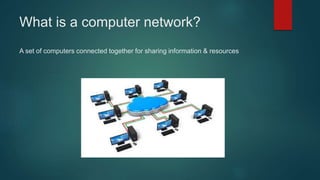
What is a computer network?
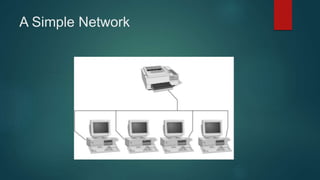
A set of computers connected together for sharing information & resources
A Simple Network
Benefits of a Network
 Information sharing: Authorized users can use other
computers on the network to access and share information and data. This
could include special group projects, databases, etc.
 Hardware sharing: One device connected to a network, can be
shared by many users.
 Software sharing: Instead of purchasing and installing a
software program on each computer, it can be installed on the server. All
of the users can then access the program from a single location.
Types of Networks
 Local Area Network (LAN) – It is a group of network
components that work within small area.
 Wide Area Network (WAN) – It is a group of LANs that are
interconnected within large area.
Difference between point to point,
MPLS and Internet link
 Will explain in training.
Site to Site WAN Topology
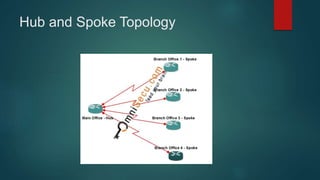
 Hub and Spoke Topology
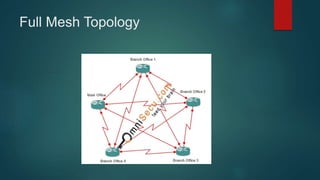
 Full Mesh Topology
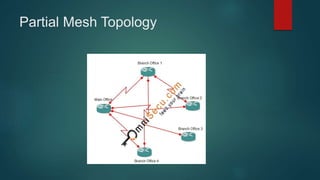
 Partial Mesh Topology
Hub and Spoke Topology
Full Mesh Topology
Partial Mesh Topology
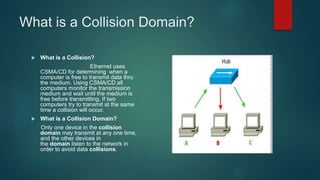
What is a Collision Domain?
 What is a Collision?
Ethernet uses
CSMA/CD for determining when a
computer is free to transmit data thru
the medium. Using CSMA/CD all
computers monitor the transmission
medium and wait until the medium is
free before transmitting. If two
computers try to transmit at the same
time a collision will occur.
 What is a Collision Domain?
Only one device in the collision
domain may transmit at any one time,
and the other devices in
the domain listen to the network in
order to avoid data collisions.
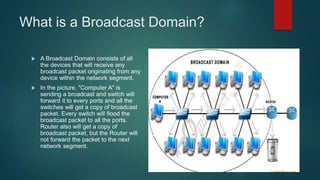
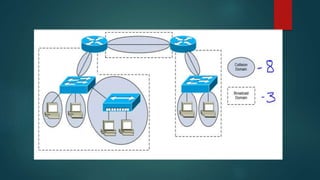
What is a Broadcast Domain?
 A Broadcast Domain consists of all
the devices that will receive any
broadcast packet originating from any
device within the network segment.
 In the picture, "Computer A" is
sending a broadcast and switch will
forward it to every ports and all the
switches will get a copy of broadcast
packet. Every switch will flood the
broadcast packet to all the ports.
Router also will get a copy of
broadcast packet, but the Router will
not forward the packet to the next
network segment.
Networking Devices
Repeater
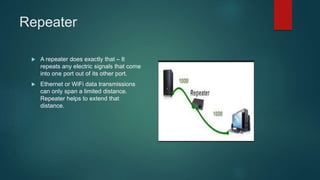
 A repeater does exactly that – It
repeats any electric signals that come
into one port out of its other port.
 Ethernet or WiFi data transmissions
can only span a limited distance.
Repeater helps to extend that
distance.
HUB
 A HUB is a multiport repeater.
 It allows to connect multiple PCs to a
single network.
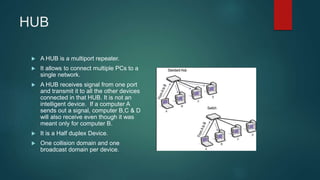
 A HUB receives signal from one port
and transmit it to all the other devices
connected in that HUB. It is not an
intelligent device. If a computer A
sends out a signal, computer B,C & D
will also receive even though it was
meant only for computer B.
 It is a Half duplex Device.
 One collision domain and one
broadcast domain per device.
Switch
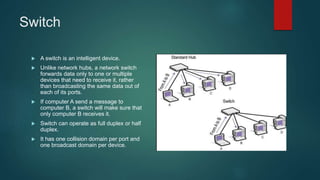
 A switch is an intelligent device.
 Unlike network hubs, a network switch
forwards data only to one or multiple
devices that need to receive it, rather
than broadcasting the same data out of
each of its ports.
 If computer A send a message to
computer B, a switch will make sure that
only computer B receives it.
 Switch can operate as full duplex or half
duplex.
 It has one collision domain per port and
one broadcast domain per device.
Bridge
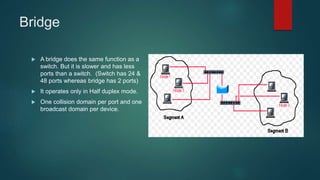
 A bridge does the same function as a
switch. But it is slower and has less
ports than a switch. (Switch has 24 &
48 ports whereas bridge has 2 ports)
 It operates only in Half duplex mode.
 One collision domain per port and one
broadcast domain per device.
Router
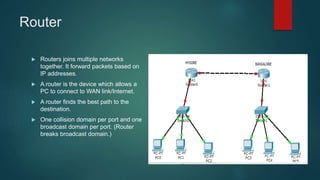
 Routers joins multiple networks
together. It forward packets based on
IP addresses.
 A router is the device which allows a
PC to connect to WAN link/Internet.
 A router finds the best path to the
destination.
 One collision domain per port and one
broadcast domain per port. (Router
breaks broadcast domain.)
Firewall
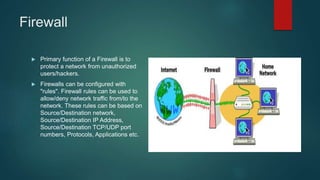
 Primary function of a Firewall is to
protect a network from unauthorized
users/hackers.
 Firewalls can be configured with
"rules". Firewall rules can be used to
allow/deny network traffic from/to the
network. These rules can be based on
Source/Destination network,
Source/Destination IP Address,
Source/Destination TCP/UDP port
numbers, Protocols, Applications etc.
Wireless Access Points
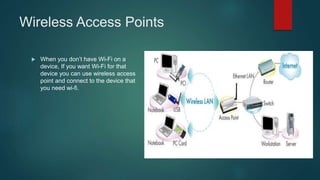
 When you don’t have Wi-Fi on a
device, If you want Wi-Fi for that
device you can use wireless access
point and connect to the device that
you need wi-fi.
Load Balancer
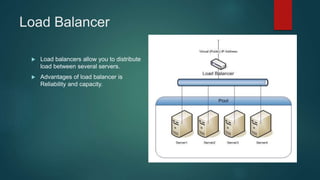
 Load balancers allow you to distribute
load between several servers.
 Advantages of load balancer is
Reliability and capacity.

Chapter_1_Networking_Fundamentals.pptx

  • 1.
  • 2.
    What we coverin this chapter  1.What is a Computer Network?  2.Difference between LAN/WAN  3.Difference between point to point/MPLS and Internet link  4.Site-to-Site WAN topologies  5.Collision Domain  6.Broadcast Domain  7.Networking devices
  • 3.
    What is acomputer network? A set of computers connected together for sharing information & resources
  • 4.
  • 5.
    Benefits of aNetwork  Information sharing: Authorized users can use other computers on the network to access and share information and data. This could include special group projects, databases, etc.  Hardware sharing: One device connected to a network, can be shared by many users.  Software sharing: Instead of purchasing and installing a software program on each computer, it can be installed on the server. All of the users can then access the program from a single location.
  • 6.
    Types of Networks Local Area Network (LAN) – It is a group of network components that work within small area.  Wide Area Network (WAN) – It is a group of LANs that are interconnected within large area.
  • 7.
    Difference between pointto point, MPLS and Internet link  Will explain in training.
  • 8.
    Site to SiteWAN Topology  Hub and Spoke Topology  Full Mesh Topology  Partial Mesh Topology
  • 9.
    Hub and SpokeTopology
  • 10.
  • 11.
  • 12.
    What is aCollision Domain?  What is a Collision? Ethernet uses CSMA/CD for determining when a computer is free to transmit data thru the medium. Using CSMA/CD all computers monitor the transmission medium and wait until the medium is free before transmitting. If two computers try to transmit at the same time a collision will occur.  What is a Collision Domain? Only one device in the collision domain may transmit at any one time, and the other devices in the domain listen to the network in order to avoid data collisions.
  • 13.
    What is aBroadcast Domain?  A Broadcast Domain consists of all the devices that will receive any broadcast packet originating from any device within the network segment.  In the picture, "Computer A" is sending a broadcast and switch will forward it to every ports and all the switches will get a copy of broadcast packet. Every switch will flood the broadcast packet to all the ports. Router also will get a copy of broadcast packet, but the Router will not forward the packet to the next network segment.
  • 15.
  • 16.
    Repeater  A repeaterdoes exactly that – It repeats any electric signals that come into one port out of its other port.  Ethernet or WiFi data transmissions can only span a limited distance. Repeater helps to extend that distance.
  • 17.
    HUB  A HUBis a multiport repeater.  It allows to connect multiple PCs to a single network.  A HUB receives signal from one port and transmit it to all the other devices connected in that HUB. It is not an intelligent device. If a computer A sends out a signal, computer B,C & D will also receive even though it was meant only for computer B.  It is a Half duplex Device.  One collision domain and one broadcast domain per device.
  • 18.
    Switch  A switchis an intelligent device.  Unlike network hubs, a network switch forwards data only to one or multiple devices that need to receive it, rather than broadcasting the same data out of each of its ports.  If computer A send a message to computer B, a switch will make sure that only computer B receives it.  Switch can operate as full duplex or half duplex.  It has one collision domain per port and one broadcast domain per device.
  • 19.
    Bridge  A bridgedoes the same function as a switch. But it is slower and has less ports than a switch. (Switch has 24 & 48 ports whereas bridge has 2 ports)  It operates only in Half duplex mode.  One collision domain per port and one broadcast domain per device.
  • 20.
    Router  Routers joinsmultiple networks together. It forward packets based on IP addresses.  A router is the device which allows a PC to connect to WAN link/Internet.  A router finds the best path to the destination.  One collision domain per port and one broadcast domain per port. (Router breaks broadcast domain.)
  • 21.
    Firewall  Primary functionof a Firewall is to protect a network from unauthorized users/hackers.  Firewalls can be configured with "rules". Firewall rules can be used to allow/deny network traffic from/to the network. These rules can be based on Source/Destination network, Source/Destination IP Address, Source/Destination TCP/UDP port numbers, Protocols, Applications etc.
  • 22.
    Wireless Access Points When you don’t have Wi-Fi on a device, If you want Wi-Fi for that device you can use wireless access point and connect to the device that you need wi-fi.
  • 23.
    Load Balancer  Loadbalancers allow you to distribute load between several servers.  Advantages of load balancer is Reliability and capacity.