The Internet and Child Safety

           Joe Drumgoole
   http:/twitter.com/jdrumgoole
   http://blog.joedrumgoole.com
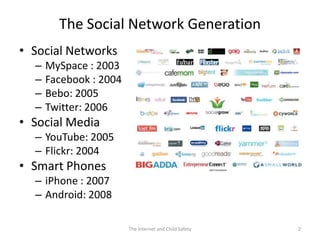
The Social Network Generation
• Social Networks
  –   MySpace : 2003
  –   Facebook : 2004
  –   Bebo: 2005
  –   Twitter: 2006
• Social Media
  – YouTube: 2005
  – Flickr: 2004
• Smart Phones
  – iPhone : 2007
  – Android: 2008

                        The Internet and Child Safety   2
Generational Fears
•   Sexual Predators
•   Grooming
•   Cyberbullying
•   Inappropriate Content
•   High Risk Behaviour
•   Privacy
•   Fear of the unknown


                   The Internet and Child Safety   3
EU Kids Online
http://www2.lse.ac.uk/media@lse/research/EUKidsOnline/Home.aspx

http://www2.lse.ac.uk/media@lse/research/EUKidsOnline/EU%20Kids%20II
%20(2009-11)/EUKidsOnlineIIReports/Final%20report.pdf


• 25,000 Children aged 9-11 and their parents surveyed in 2010
• Evidence based analysis

The purpose was to provide a rigorous evidence base to support
 stakeholders in their efforts to maximise online opportunities
 while minimising the risk of harm associated with internet use.


                           The Internet and Child Safety               4
Children Going Online
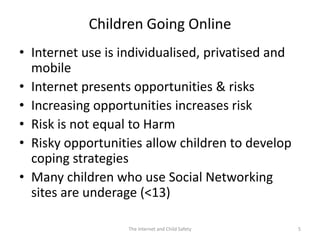
• Internet use is individualised, privatised and
  mobile
• Internet presents opportunities & risks
• Increasing opportunities increases risk
• Risk is not equal to Harm
• Risky opportunities allow children to develop
  coping strategies
• Many children who use Social Networking
  sites are underage (<13)

                   The Internet and Child Safety   5
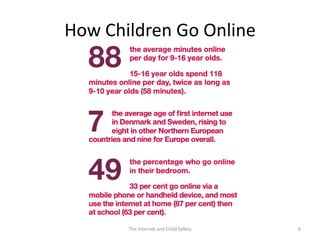
How Children Go Online


       The Internet and Child Safety   6
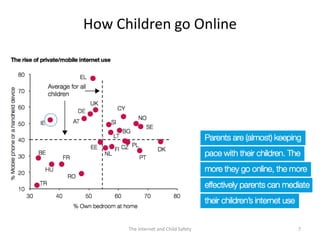
How Children go Online


      The Internet and Child Safety   7
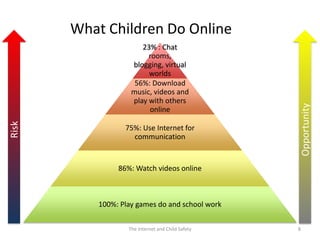
What Children Do Online
                       23% : Chat
                         rooms,
                    blogging, virtual
                         worlds
                     56%: Download
                    music, videos and
                    play with others


                                                   Opportunity
                         online
Risk


                  75%: Use Internet for
                    communication


                86%: Watch videos online


           100%: Play games do and school work

                   The Internet and Child Safety   8
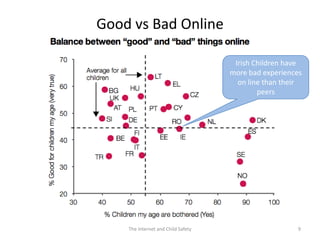
Good vs Bad Online

                                     Irish Children have
                                    more bad experiences
                                      on line than their
                                            peers


    The Internet and Child Safety                     9
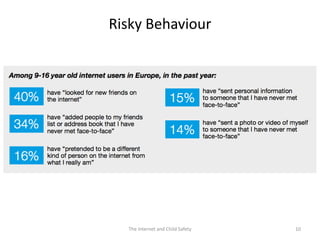
Risky Behaviour


  The Internet and Child Safety   10
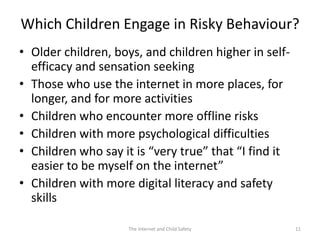
Which Children Engage in Risky Behaviour?
• Older children, boys, and children higher in self-
  efficacy and sensation seeking
• Those who use the internet in more places, for
  longer, and for more activities
• Children who encounter more offline risks
• Children with more psychological difficulties
• Children who say it is “very true” that “I find it
  easier to be myself on the internet”
• Children with more digital literacy and safety
  skills

                     The Internet and Child Safety     11
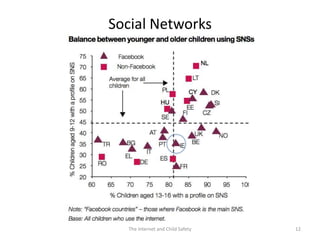
Social Networks


  The Internet and Child Safety   12
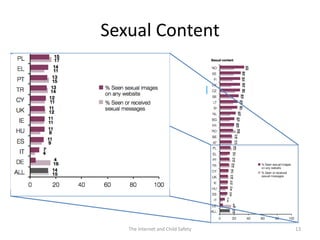
Sexual Content


   The Internet and Child Safety   13
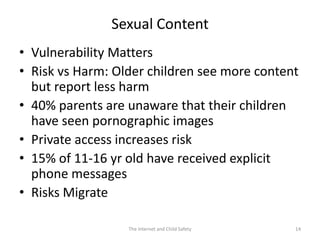
Sexual Content
• Vulnerability Matters
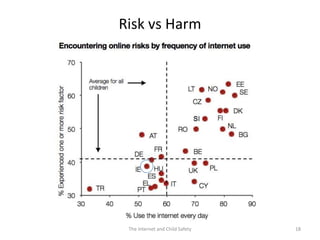
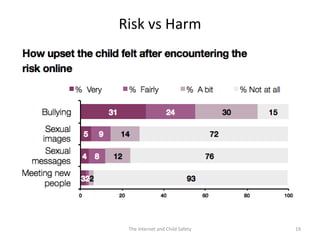
• Risk vs Harm: Older children see more content
  but report less harm
• 40% parents are unaware that their children
  have seen pornographic images
• Private access increases risk
• 15% of 11-16 yr old have received explicit
  phone messages
• Risks Migrate

                  The Internet and Child Safety   14
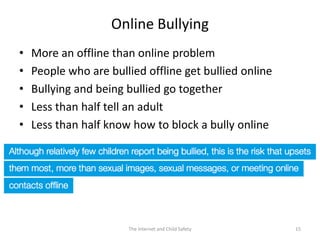
Online Bullying
•   More an offline than online problem
•   People who are bullied offline get bullied online
•   Bullying and being bullied go together
•   Less than half tell an adult
•   Less than half know how to block a bully online


                       The Internet and Child Safety    15
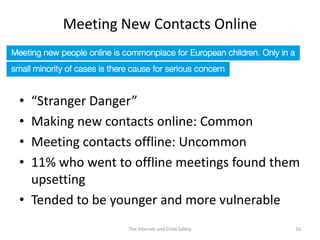
Meeting New Contacts Online


• “Stranger Danger”
• Making new contacts online: Common
• Meeting contacts offline: Uncommon
• 11% who went to offline meetings found them
  upsetting
• Tended to be younger and more vulnerable
                 The Internet and Child Safety   16
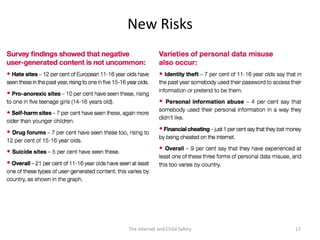
New Risks


The Internet and Child Safety   17
Risk vs Harm


 The Internet and Child Safety   18
Risk vs Harm


 The Internet and Child Safety   19
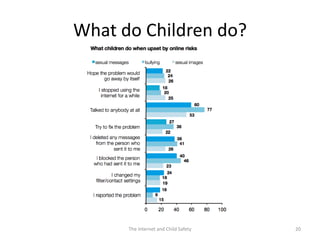
What do Children do?


      The Internet and Child Safety   20
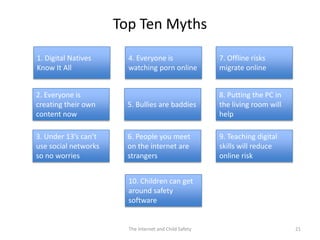
Top Ten Myths
1. Digital Natives      4. Everyone is                  7. Offline risks
Know It All             watching porn online            migrate online


2. Everyone is                                          8. Putting the PC in
creating their own      5. Bullies are baddies          the living room will
content now                                             help

3. Under 13’s can’t     6. People you meet              9. Teaching digital
use social networks     on the internet are             skills will reduce
so no worries           strangers                       online risk


                        10. Children can get
                        around safety
                        software


                        The Internet and Child Safety                          21
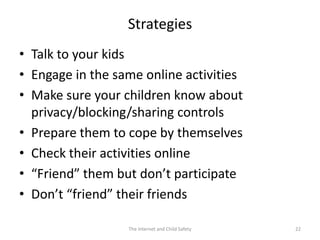
Strategies
• Talk to your kids
• Engage in the same online activities
• Make sure your children know about
  privacy/blocking/sharing controls
• Prepare them to cope by themselves
• Check their activities online
• “Friend” them but don’t participate
• Don’t “friend” their friends

                  The Internet and Child Safety   22
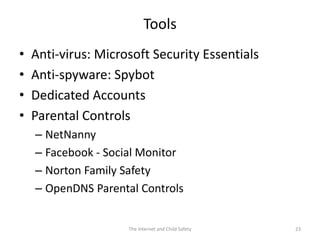
Tools
•   Anti-virus: Microsoft Security Essentials
•   Anti-spyware: Spybot
•   Dedicated Accounts
•   Parental Controls
    – NetNanny
    – Facebook - Social Monitor
    – Norton Family Safety
    – OpenDNS Parental Controls


                     The Internet and Child Safety   23
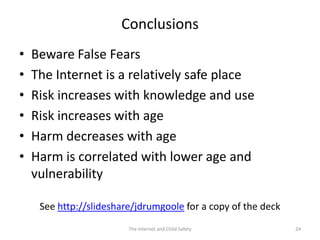
Conclusions
•   Beware False Fears
•   The Internet is a relatively safe place
•   Risk increases with knowledge and use
•   Risk increases with age
•   Harm decreases with age
•   Harm is correlated with lower age and
    vulnerability

     See http://slideshare/jdrumgoole for a copy of the deck
                         The Internet and Child Safety         24
The Internet and Child Safety   25

Internet Safety and Chldren

  • 1.
    The Internet andChild Safety Joe Drumgoole http:/twitter.com/jdrumgoole http://blog.joedrumgoole.com
  • 2.
    The Social NetworkGeneration • Social Networks – MySpace : 2003 – Facebook : 2004 – Bebo: 2005 – Twitter: 2006 • Social Media – YouTube: 2005 – Flickr: 2004 • Smart Phones – iPhone : 2007 – Android: 2008 The Internet and Child Safety 2
  • 3.
    Generational Fears • Sexual Predators • Grooming • Cyberbullying • Inappropriate Content • High Risk Behaviour • Privacy • Fear of the unknown The Internet and Child Safety 3
  • 4.
    EU Kids Online http://www2.lse.ac.uk/media@lse/research/EUKidsOnline/Home.aspx http://www2.lse.ac.uk/media@lse/research/EUKidsOnline/EU%20Kids%20II %20(2009-11)/EUKidsOnlineIIReports/Final%20report.pdf •25,000 Children aged 9-11 and their parents surveyed in 2010 • Evidence based analysis The purpose was to provide a rigorous evidence base to support stakeholders in their efforts to maximise online opportunities while minimising the risk of harm associated with internet use. The Internet and Child Safety 4
  • 5.
    Children Going Online •Internet use is individualised, privatised and mobile • Internet presents opportunities & risks • Increasing opportunities increases risk • Risk is not equal to Harm • Risky opportunities allow children to develop coping strategies • Many children who use Social Networking sites are underage (<13) The Internet and Child Safety 5
  • 6.
    How Children GoOnline The Internet and Child Safety 6
  • 7.
    How Children goOnline The Internet and Child Safety 7
  • 8.
    What Children DoOnline 23% : Chat rooms, blogging, virtual worlds 56%: Download music, videos and play with others Opportunity online Risk 75%: Use Internet for communication 86%: Watch videos online 100%: Play games do and school work The Internet and Child Safety 8
  • 9.
    Good vs BadOnline Irish Children have more bad experiences on line than their peers The Internet and Child Safety 9
  • 10.
    Risky Behaviour The Internet and Child Safety 10
  • 11.
    Which Children Engagein Risky Behaviour? • Older children, boys, and children higher in self- efficacy and sensation seeking • Those who use the internet in more places, for longer, and for more activities • Children who encounter more offline risks • Children with more psychological difficulties • Children who say it is “very true” that “I find it easier to be myself on the internet” • Children with more digital literacy and safety skills The Internet and Child Safety 11
  • 12.
    Social Networks The Internet and Child Safety 12
  • 13.
    Sexual Content The Internet and Child Safety 13
  • 14.
    Sexual Content • VulnerabilityMatters • Risk vs Harm: Older children see more content but report less harm • 40% parents are unaware that their children have seen pornographic images • Private access increases risk • 15% of 11-16 yr old have received explicit phone messages • Risks Migrate The Internet and Child Safety 14
  • 15.
    Online Bullying • More an offline than online problem • People who are bullied offline get bullied online • Bullying and being bullied go together • Less than half tell an adult • Less than half know how to block a bully online The Internet and Child Safety 15
  • 16.
    Meeting New ContactsOnline • “Stranger Danger” • Making new contacts online: Common • Meeting contacts offline: Uncommon • 11% who went to offline meetings found them upsetting • Tended to be younger and more vulnerable The Internet and Child Safety 16
  • 17.
    New Risks The Internetand Child Safety 17
  • 18.
    Risk vs Harm The Internet and Child Safety 18
  • 19.
    Risk vs Harm The Internet and Child Safety 19
  • 20.
    What do Childrendo? The Internet and Child Safety 20
  • 21.
    Top Ten Myths 1.Digital Natives 4. Everyone is 7. Offline risks Know It All watching porn online migrate online 2. Everyone is 8. Putting the PC in creating their own 5. Bullies are baddies the living room will content now help 3. Under 13’s can’t 6. People you meet 9. Teaching digital use social networks on the internet are skills will reduce so no worries strangers online risk 10. Children can get around safety software The Internet and Child Safety 21
  • 22.
    Strategies • Talk toyour kids • Engage in the same online activities • Make sure your children know about privacy/blocking/sharing controls • Prepare them to cope by themselves • Check their activities online • “Friend” them but don’t participate • Don’t “friend” their friends The Internet and Child Safety 22
  • 23.
    Tools • Anti-virus: Microsoft Security Essentials • Anti-spyware: Spybot • Dedicated Accounts • Parental Controls – NetNanny – Facebook - Social Monitor – Norton Family Safety – OpenDNS Parental Controls The Internet and Child Safety 23
  • 24.
    Conclusions • Beware False Fears • The Internet is a relatively safe place • Risk increases with knowledge and use • Risk increases with age • Harm decreases with age • Harm is correlated with lower age and vulnerability See http://slideshare/jdrumgoole for a copy of the deck The Internet and Child Safety 24
  • 25.
    The Internet andChild Safety 25