














Chapter 3

                  RESEARCH DESIGN AND METHODOLOGY


       This chapter presents the research methodology, sources of data,

respondents, research instruments, data gathering procedures and the statistical

tool used in analyzing the data gathered.


Research Method


       The study employed the Assessment of Evaluation Type of Study under

the Descriptive Method.1 Studies using assessment and evaluation, focuses on

the efficiency or effectiveness of a certain variable to be considered. Specefically,

the present study tends to assess the impact of the project “Padaba Ta Ka” of

BUCAL in Bagumbayan Central School.


Sources of Data


       The primary source of data were the responses of the respondents

from Bagumbayan Central School. Likewise, inputs from internet websites and

handouts were considered as the secondary sources of data.
Respondents


       The respondents of this study were the teachers and parents of

Bagumbayan Central School. Ten (10) teachers handling classes from Grades 1

to 6 will be given questionnaires. Likewise, ten (10) parents will also be

respondents. Parents who are current members of GPTA (General Teachers-

Parents Association) will be prioritized though.


Instrumentations


       The Project “Pafaba Ta Ka” of BU College of Arts and Letters was

assessed using a questionnaire.


       The first category of the questionnaire used the five-point Likert Scale2

with the following adjectival interpretations: 5, Highly Sustainable; 4, Very

Sustainable; 3, Sustainable; 2, Less Sustainable; 1, Least Sustainable. The

project sustainability in carrying its five components was scaled.


       The second category also used the Likert Scale. The level of

effectiveness of the project was assessed with the following category: 5, Highly

Effective; 4, Very Effective; 3, Effective; 2, Less Effective; 1, Least Effective.


       The third category, used the Forced Choice Rating Scale3 wherein

choices were listed. The respondents just need to check or choose one among

the others. The last part of the questionnaire was an open-ended question

wherein the respondents sought to give a brief remark about the project.
Data Gathering Procedure


       Having established the respondents for the study, the researchers then

proceeded with the data collection. It underwent the following stages in the data

gathering process.


       Securing permit from the Bagumbayan Central School Principal’s Office. A

letter was hand-carried to the locality involved, securing permission from the

school head to distribute questionnaires among its teachers anf parents.


       Distribution of questionnaires. With a covered letter attached as a way of

informing the respondents of the purpose of the research activity, the

questionnaires was distributed to the respondents who were present in the

conduct of said endeavor. This comprised the actual field work in the data

gathering process and was done personally by the researchers.


       Retrieval of questionnaires. After the respondents were done answering,

the questionnaires will be retrieved immediately. This stage was concluded only

when all necessary data are secured from the respondents.


       After completing the procedure, the responses were tallied and recorded

then analyzed and interpreted.


Statistical Treatment


       Respondent’s responses to the questionnaire were analyzed using

percentage, ratios and rank statistics.
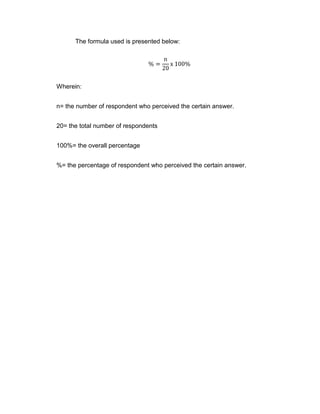
The formula used is presented below:


Wherein:


n= the number of respondent who perceived the certain answer.


20= the total number of respondents


100%= the overall percentage


%= the percentage of respondent who perceived the certain answer.
NOTES

       1
       Estela G. Adanza.Research Method: Principles and Applications. Quezon

City: Rex Printing, Inc., 1995.p.45.

       2
       Estela G. Adanza.Research Method: Principles and Applications. Quezon

City: Rex Printing Company, Inc.,1995.

       3
       Juliet A Catane. Conducting Research: A Practical Application. Quezon

City: JMC Press, Inc.,2006.p.64.
Nick
Nick
Nick
Nick
Nick
Nick
Nick
Nick
Nick
Nick
Nick
Nick
Nick
Nick
Nick

Nick

  • 1.
    Chapter 3 RESEARCH DESIGN AND METHODOLOGY This chapter presents the research methodology, sources of data, respondents, research instruments, data gathering procedures and the statistical tool used in analyzing the data gathered. Research Method The study employed the Assessment of Evaluation Type of Study under the Descriptive Method.1 Studies using assessment and evaluation, focuses on the efficiency or effectiveness of a certain variable to be considered. Specefically, the present study tends to assess the impact of the project “Padaba Ta Ka” of BUCAL in Bagumbayan Central School. Sources of Data The primary source of data were the responses of the respondents from Bagumbayan Central School. Likewise, inputs from internet websites and handouts were considered as the secondary sources of data.
  • 2.
    Respondents The respondents of this study were the teachers and parents of Bagumbayan Central School. Ten (10) teachers handling classes from Grades 1 to 6 will be given questionnaires. Likewise, ten (10) parents will also be respondents. Parents who are current members of GPTA (General Teachers- Parents Association) will be prioritized though. Instrumentations The Project “Pafaba Ta Ka” of BU College of Arts and Letters was assessed using a questionnaire. The first category of the questionnaire used the five-point Likert Scale2 with the following adjectival interpretations: 5, Highly Sustainable; 4, Very Sustainable; 3, Sustainable; 2, Less Sustainable; 1, Least Sustainable. The project sustainability in carrying its five components was scaled. The second category also used the Likert Scale. The level of effectiveness of the project was assessed with the following category: 5, Highly Effective; 4, Very Effective; 3, Effective; 2, Less Effective; 1, Least Effective. The third category, used the Forced Choice Rating Scale3 wherein choices were listed. The respondents just need to check or choose one among the others. The last part of the questionnaire was an open-ended question wherein the respondents sought to give a brief remark about the project.
  • 3.
    Data Gathering Procedure Having established the respondents for the study, the researchers then proceeded with the data collection. It underwent the following stages in the data gathering process. Securing permit from the Bagumbayan Central School Principal’s Office. A letter was hand-carried to the locality involved, securing permission from the school head to distribute questionnaires among its teachers anf parents. Distribution of questionnaires. With a covered letter attached as a way of informing the respondents of the purpose of the research activity, the questionnaires was distributed to the respondents who were present in the conduct of said endeavor. This comprised the actual field work in the data gathering process and was done personally by the researchers. Retrieval of questionnaires. After the respondents were done answering, the questionnaires will be retrieved immediately. This stage was concluded only when all necessary data are secured from the respondents. After completing the procedure, the responses were tallied and recorded then analyzed and interpreted. Statistical Treatment Respondent’s responses to the questionnaire were analyzed using percentage, ratios and rank statistics.
  • 4.
    The formula usedis presented below: Wherein: n= the number of respondent who perceived the certain answer. 20= the total number of respondents 100%= the overall percentage %= the percentage of respondent who perceived the certain answer.
  • 5.
    NOTES 1 Estela G. Adanza.Research Method: Principles and Applications. Quezon City: Rex Printing, Inc., 1995.p.45. 2 Estela G. Adanza.Research Method: Principles and Applications. Quezon City: Rex Printing Company, Inc.,1995. 3 Juliet A Catane. Conducting Research: A Practical Application. Quezon City: JMC Press, Inc.,2006.p.64.