INTERNATIONAL
BUSINESS
TOPIC 4
INTERNATIONAL
TRADE THEORY
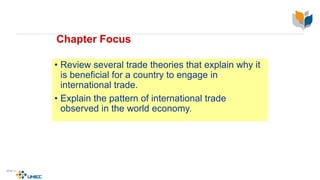
Chapter Focus
• Review several trade theories that explain why it
is beneficial for a country to engage in
international trade.
• Explain the pattern of international trade
observed in the world economy.
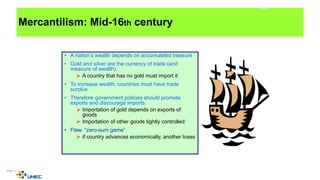
Mercantilism: Mid-16th century
• A nation’s wealth depends on accumulated treasure
• Gold and silver are the currency of trade (and
measure of wealth).
 A country that has no gold must import it
• To increase wealth, countries must have trade
surplus
• Therefore government policies should promote
exports and discourage imports
 Importation of gold depends on exports of
goods
 Importation of other goods tightly controlled
• Flaw: “zero-sum game”
 if country advances economically, another loses
4-8
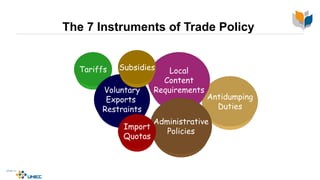
The 7 Instruments of Trade Policy
Antidumping
Duties
Local
Content
Requirements
Tariffs
Voluntary
Exports
Restraints
Subsidies
Administrative
Policies
Import
Quotas
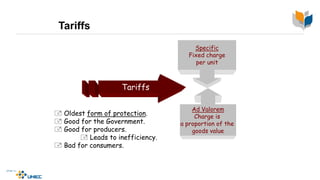
Tariffs
Tariffs
Specific
Fixed charge
per unit
Ad Valorem
Charge is
a proportion of the
goods value
 Oldest form of protection.
 Good for the Government.
 Good for producers.
 Leads to inefficiency.
 Bad for consumers.
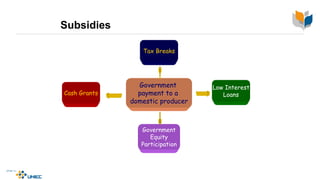
Subsidies
Government
payment to a
domestic producer
Cash Grants
Tax Breaks
Low Interest
Loans
Government
Equity
Participation
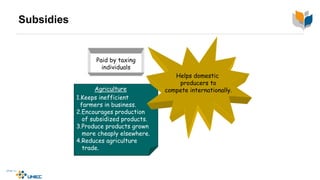
Subsidies
Agriculture
1.Keeps inefficient
farmers in business.
2.Encourages production
of subsidized products.
3.Produce products grown
more cheaply elsewhere.
4.Reduces agriculture
trade.
Helps domestic
producers to
compete internationally.
Paid by taxing
individuals
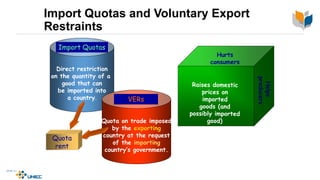
Import Quotas and Voluntary Export
Restraints
Direct restriction
on the quantity of a
good that can
be imported into
a country.
Import Quotas
Quota on trade imposed
by the exporting
country at the request
of the importing
country’s government.
VERs
Helps
producers
Quota
rent
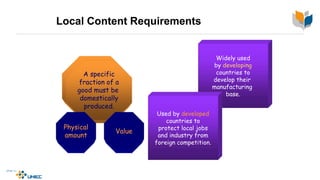
Local Content Requirements
A specific
fraction of a
good must be
domestically
produced.
A specific
fraction of a
good must be
domestically
produced.
Physical
amount
Value
Widely used
by developing
countries to
develop their
manufacturing
base.
Used by developed
countries to
protect local jobs
and industry from
foreign competition.
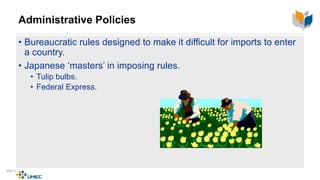
Administrative Policies
• Bureaucratic rules designed to make it difficult for imports to enter
a country.
• Japanese ‘masters’ in imposing rules.
• Tulip bulbs.
• Federal Express.
Antidumping Policies
• Selling goods into a foreign market below
production costs, or
• Selling below “fair market value”.
• Used to unload excess production.
• Or, predatory pricing.
• Antidumping policies are used to punish
foreign firms.
• Protect local industry from “unfair” practices.
• Impose “countervailing” duties.
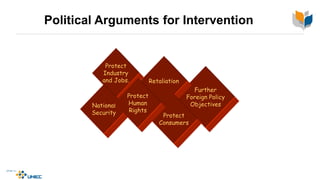
Political Arguments for Intervention
Further
Foreign Policy
Objectives
Protect
Industry
and Jobs.
National
Security
Retaliation
Protect
Consumers
Protect
Human
Rights
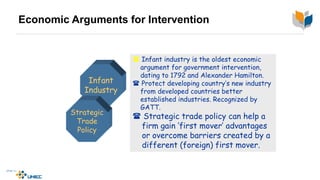
Economic Arguments for Intervention
Infant
Industry
Strategic
Trade
Policy
 Infant industry is the oldest economic
argument for government intervention,
dating to 1792 and Alexander Hamilton.
 Protect developing country’s new industry
from developed countries better
established industries. Recognized by
GATT.
 Strategic trade policy can help a
firm gain ‘first mover’ advantages
or overcome barriers created by a
different (foreign) first mover.
Revised Case for Free Trade
Paul Krugman, MIT economist, argues that strategic
trade policies can lead to trade wars. The best way to
handle disputes is to work to establish rules that minimize
trade-distorting subsidies - a function of the World
Trade Organization.
He also argues that government intervention usually favors
special interest groups that distort the subsidy to their
own ends.
Therefore, “a blanket policy of free trade, with exceptions
granted only under extreme pressure … may be the best
policy that the country is likely to get.”
David Hume - 1752
• Criticized Mercantilism:
Increased exports leads to inflation and higher prices.
Increased imports lead to lower prices.
Result: Country A sells less because of high prices and Country B
sells more because of lower prices.
In the long run, no one can keep a trade surplus.
4-9
McGraw-Hill/Irwin © 2003 The McGraw-Hill Companies, Inc., All Rights Reserved.
Theory of Absolute Advantage
• Advocated by Adam Smith in Wealth of
Nations (1776).
• Market forces, not government controls,
determine the direction, volume and
composition of international trade
• Basis: Capability of one country to produce
more of a product with the same amount of
input than another country.
• A country will export goods in which it has an
absolute advantage over other countries
• the proceeds from exports will allow the
country to import other goods
• So countries should produce only goods
where they are most efficient, trade for those
where they are not efficient.
• Trade between countries is, therefore,
beneficial.
• Assumes there is an absolute advantage
balance among nations.
4-10
McGraw-Hill/Irwin © 2003 The McGraw-Hill Companies, Inc., All Rights Reserved.
Absolute Advantage
To have an absolute advantage a country must
be able to produce:
1) a larger amount of a good or service for the
same amount of inputs as can another country
2) the same amount of a good or service using
fewer inputs than can another country
• In classic economics a “unit of input” is
measured in: land, labor, capital
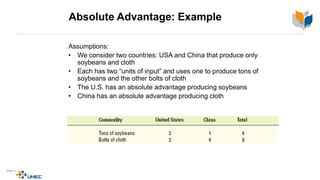
Absolute Advantage: Example
Assumptions:
• We consider two countries: USA and China that produce only
soybeans and cloth
• Each has two “units of input” and uses one to produce tons of
soybeans and the other bolts of cloth
• The U.S. has an absolute advantage producing soybeans
• China has an absolute advantage producing cloth
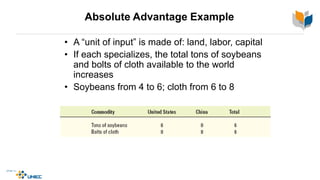
Absolute Advantage Example
• A “unit of input” is made of: land, labor, capital
• If each specializes, the total tons of soybeans
and bolts of cloth available to the world
increases
• Soybeans from 4 to 6; cloth from 6 to 8
Theory of Comparative Advantage
• Advocated by David Ricardo in Principles of Political Economy (1817).
Extends free trade argument
Efficiency of resource utilization leads to more productivity.
Should import even if country is more efficient in the product’s production
than country from which it is buying.
• Look to see how much more efficient. If only comparatively efficient,
than import.
• A nation may have absolute disadvantages in the production of two goods with
respect to another nation
• Yet this nation has a comparative advantage or relative advantage in the
production of the good in which its absolute disadvantage is lower
• By specializing in the production of the good in which the country has lower
comparative disadvantage, and importing other goods, the total goods available
will increase
• Makes better use of resources
• Trade is a positive-sum game.
4-13
McGraw-Hill/Irwin © 2003 The McGraw-Hill Companies, Inc., All Rights Reserved.
Simple Extensions of the Ricardian Model
• Immobile resources:
• Resources do not always move easily from one economic
activity to another.
• Diminishing returns:
• More a country produces, at some point, will require more
resources (diminishing returns to specialization).
• Different goods use resources in different proportions.
• However:
• Free trade might increase a country’s stock of resources (as
labor and capital arrives from abroad), and
• Increase the efficiency of resource utilization.
4-16
McGraw-Hill/Irwin © 2003 The McGraw-Hill Companies, Inc., All Rights Reserved.
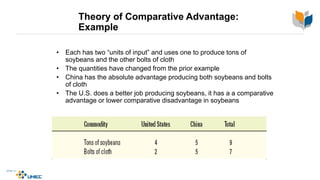
Theory of Comparative Advantage:
Example
• Each has two “units of input” and uses one to produce tons of
soybeans and the other bolts of cloth
• The quantities have changed from the prior example
• China has the absolute advantage producing both soybeans and bolts
of cloth
• The U.S. does a better job producing soybeans, it has a a comparative
advantage or lower comparative disadvantage in soybeans
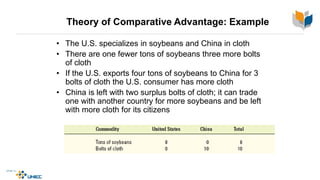
Theory of Comparative Advantage: Example
• The U.S. specializes in soybeans and China in cloth
• There are one fewer tons of soybeans three more bolts
of cloth
• If the U.S. exports four tons of soybeans to China for 3
bolts of cloth the U.S. consumer has more cloth
• China is left with two surplus bolts of cloth; it can trade
one with another country for more soybeans and be left
with more cloth for its citizens
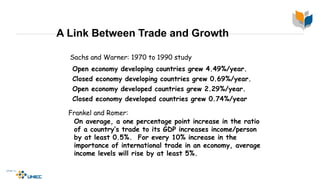
A Link Between Trade and Growth
Sachs and Warner: 1970 to 1990 study
Open economy developing countries grew 4.49%/year.
Closed economy developing countries grew 0.69%/year.
Open economy developed countries grew 2.29%/year.
Closed economy developed countries grew 0.74%/year.
Frankel and Romer:
On average, a one percentage point increase in the ratio
of a country’s trade to its GDP increases income/person
by at least 0.5%. For every 10% increase in the
importance of international trade in an economy, average
income levels will rise by at least 5%.
Heckscher (1919)-Ohlin (1933) Theory
• Focus on factor endowments: i.e. extent to which a
country is endowed with land, labor, and capital.
• Suggests: Export goods that intensively use factor
endowments which are locally abundant and import
goods made from locally scarce factors.
• Patterns of trade are determined by differences in
factor endowments - not productivity.
• Remember, focus on relative advantage, not absolute
advantage.
4-20
McGraw-Hill/Irwin © 2003 The McGraw-Hill Companies, Inc., All Rights Reserved.
Heckscher-Ohlin Theory of Factor
Endowments
• Reasons for countries to export products requiring large amounts of their abundant production
factors:
• Lower cost to produce; more attractive abroad
• Imported products have low relative cost as producing locally would require large
amounts of the importing country’s scarce production factors
• Does not consider
• Government influence on factor prices - no perfect market
• Transportation costs
• Differences in tastes
• Differences in climates
• Population diversity and income levels
The Leontief
Paradox, 1953
• Disputes Heckscher-
Olin in some
instances.
• Factor endowments
can be impacted by
government policy –
e.g. minimum wage.
• US tends to export
labor-intensive
products, but is
regarded as a capital
intensive country.
4-21
McGraw-Hill/Irwin © 2003 The McGraw-Hill Companies, Inc., All Rights Reserved.
Heckscher vs Ricardo
• Economists prefer Heckscher on theoretical
grounds but is a relatively poor predictor of
trade patterns.
• Ricardo’s Comparative Advantage Theory,
regarded as too limited for predicting trade
patterns, actually predicts them with greater
accuracy.
• In the end, differences in productivity may be
the key to determining trade patterns.
4-22
McGraw-Hill/Irwin © 2003 The McGraw-Hill Companies, Inc., All Rights Reserved.
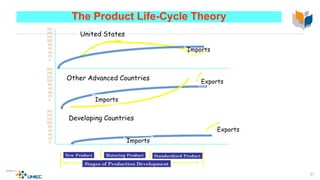
International Product Life-Cycle Theory
(Raymond Vernon, 1966)
• Article in the Quarterly Journal of
Economics.
• As products mature, both location of
sales and optimal production changes.
• Affects the direction and flow of imports
and exports.
• Globalization and integration of the
economy makes this theory less valid.
4-23
McGraw-Hill/Irwin © 2003 The McGraw-Hill Companies, Inc., All Rights Reserved.
31
The Product Life-Cycle Theory
The New Trade Theory
• Began to be recognized in the 1970s.
• Deals with the returns on specialization
where substantial economies of scale are
present.
• Economies of scale: as a plant gets larger,
output increases, per unit production cost
decreases
• Specialization increases output, ability to
enhance economies of scale increase.
• In addition to economies of scale, learning
effects also exist.
• Learning effects are cost savings that come
from “learning by doing”.
• as firms produce more products, they learn
ways to improve production efficiency
further reducing costs
4-25
McGraw-Hill/Irwin © 2003 The McGraw-Hill Companies, Inc., All Rights Reserved.
Application of the New Trade Theory
• Typically, requires industries with high, fixed
costs.
• World demand will support few competitors.
• Competitors may emerge because “they got
there first”.
• First-mover advantage.
• Some argue that it generates government
intervention and strategic trade policy.
4-26
McGraw-Hill/Irwin © 2003 The McGraw-Hill Companies, Inc., All Rights Reserved.
First-Mover Advantage
• Economies of scale may preclude new
entrants.
• Role of the government is critical in assisting
local industry to be the first mover.
4-27
McGraw-Hill/Irwin © 2003 The McGraw-Hill Companies, Inc., All Rights Reserved.
Porter’s Diamond
(Harvard Business School, 1990)
• The Competitive Advantage of
Nations.
• Looked at 100 industries in 10
nations.
• Thought existing theories
didn’t go far enough.
• Question: “Why does a nation
achieve international success in a
particular industry?”
4-28
McGraw-Hill/Irwin © 2003 The McGraw-Hill Companies, Inc., All Rights Reserved.
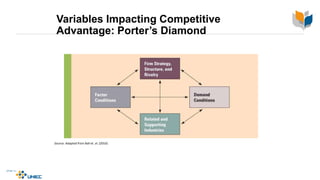
Variables Impacting Competitive
Advantage: Porter’s Diamond
Source: Adapted from Ball et. al. (2010)
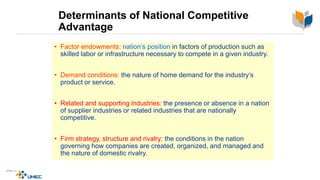
Determinants of National Competitive
Advantage
• Factor endowments: nation’s position in factors of production such as
skilled labor or infrastructure necessary to compete in a given industry.
• Demand conditions: the nature of home demand for the industry’s
product or service.
• Related and supporting industries: the presence or absence in a nation
of supplier industries or related industries that are nationally
competitive.
• Firm strategy, structure and rivalry: the conditions in the nation
governing how companies are created, organized, and managed and
the nature of domestic rivalry.
McGraw-Hill/Irwin © 2003 The McGraw-Hill Companies, Inc., All Rights Reserved.
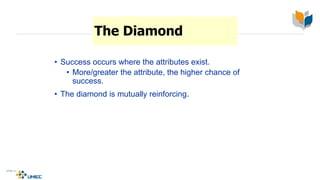
The Diamond
• Success occurs where the attributes exist.
• More/greater the attribute, the higher chance of
success.
• The diamond is mutually reinforcing.
4-31
McGraw-Hill/Irwin © 2003 The McGraw-Hill Companies, Inc., All Rights Reserved.
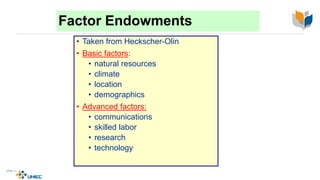
Factor Endowments
• Taken from Heckscher-Olin
• Basic factors:
• natural resources
• climate
• location
• demographics
• Advanced factors:
• communications
• skilled labor
• research
• technology
4-33
McGraw-Hill/Irwin © 2003 The McGraw-Hill Companies, Inc., All Rights Reserved.
Advanced Factor Endowments
• More likely to lead to competitive
advantage.
• Are the result of investment by people,
companies, government.
4-34
McGraw-Hill/Irwin © 2003 The McGraw-Hill Companies, Inc., All Rights Reserved.
Relationship of Basic to
Advanced Factors
• Basic can provide an initial advantage.
• Must be supported by advanced factors to
maintain success.
• No basics, then must invest in advanced factors.
4-35
McGraw-Hill/Irwin © 2003 The McGraw-Hill Companies, Inc., All Rights Reserved.
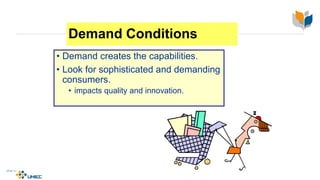
Demand Conditions
• Demand creates the capabilities.
• Look for sophisticated and demanding
consumers.
• impacts quality and innovation.
4-36
McGraw-Hill/Irwin © 2003 The McGraw-Hill Companies, Inc., All Rights Reserved.
Related and Supporting Industries
• Creates clusters of supporting industries that are
internationally competitive.
• Must also meet requirements of other parts of
the Diamond.
4-37
McGraw-Hill/Irwin © 2003 The McGraw-Hill Companies, Inc., All Rights Reserved.
Firm Strategy, Structure and Rivalry
• Management ‘ideology’ can either help or hurt
you.
• Presence of domestic rivalry improves a
company’s competitiveness.
4-38
McGraw-Hill/Irwin © 2003 The McGraw-Hill Companies, Inc., All Rights Reserved.
Implications for Business
• Location implications: makes sense to disperse
production activities to countries where they can be
performed most efficiently.
• First-mover implications: It pays to invest substantial
financial resources in building a first-mover, or early-
mover, advantage.
• Policy implications: promoting free trade is generally in
the best interests of the home-country, although not
always in the best interests of the firm. Even though,
many firms promote open markets.

International Business.pptx

  • 1.
  • 2.
  • 3.
    Chapter Focus • Reviewseveral trade theories that explain why it is beneficial for a country to engage in international trade. • Explain the pattern of international trade observed in the world economy.
  • 4.
    Mercantilism: Mid-16th century •A nation’s wealth depends on accumulated treasure • Gold and silver are the currency of trade (and measure of wealth).  A country that has no gold must import it • To increase wealth, countries must have trade surplus • Therefore government policies should promote exports and discourage imports  Importation of gold depends on exports of goods  Importation of other goods tightly controlled • Flaw: “zero-sum game”  if country advances economically, another loses 4-8
  • 5.
    The 7 Instrumentsof Trade Policy Antidumping Duties Local Content Requirements Tariffs Voluntary Exports Restraints Subsidies Administrative Policies Import Quotas
  • 6.
    Tariffs Tariffs Specific Fixed charge per unit AdValorem Charge is a proportion of the goods value  Oldest form of protection.  Good for the Government.  Good for producers.  Leads to inefficiency.  Bad for consumers.
  • 7.
    Subsidies Government payment to a domesticproducer Cash Grants Tax Breaks Low Interest Loans Government Equity Participation
  • 8.
    Subsidies Agriculture 1.Keeps inefficient farmers inbusiness. 2.Encourages production of subsidized products. 3.Produce products grown more cheaply elsewhere. 4.Reduces agriculture trade. Helps domestic producers to compete internationally. Paid by taxing individuals
  • 9.
    Import Quotas andVoluntary Export Restraints Direct restriction on the quantity of a good that can be imported into a country. Import Quotas Quota on trade imposed by the exporting country at the request of the importing country’s government. VERs Helps producers Quota rent
  • 10.
    Local Content Requirements Aspecific fraction of a good must be domestically produced. A specific fraction of a good must be domestically produced. Physical amount Value Widely used by developing countries to develop their manufacturing base. Used by developed countries to protect local jobs and industry from foreign competition.
  • 11.
    Administrative Policies • Bureaucraticrules designed to make it difficult for imports to enter a country. • Japanese ‘masters’ in imposing rules. • Tulip bulbs. • Federal Express.
  • 12.
    Antidumping Policies • Sellinggoods into a foreign market below production costs, or • Selling below “fair market value”. • Used to unload excess production. • Or, predatory pricing. • Antidumping policies are used to punish foreign firms. • Protect local industry from “unfair” practices. • Impose “countervailing” duties.
  • 13.
    Political Arguments forIntervention Further Foreign Policy Objectives Protect Industry and Jobs. National Security Retaliation Protect Consumers Protect Human Rights
  • 14.
    Economic Arguments forIntervention Infant Industry Strategic Trade Policy  Infant industry is the oldest economic argument for government intervention, dating to 1792 and Alexander Hamilton.  Protect developing country’s new industry from developed countries better established industries. Recognized by GATT.  Strategic trade policy can help a firm gain ‘first mover’ advantages or overcome barriers created by a different (foreign) first mover.
  • 15.
    Revised Case forFree Trade Paul Krugman, MIT economist, argues that strategic trade policies can lead to trade wars. The best way to handle disputes is to work to establish rules that minimize trade-distorting subsidies - a function of the World Trade Organization. He also argues that government intervention usually favors special interest groups that distort the subsidy to their own ends. Therefore, “a blanket policy of free trade, with exceptions granted only under extreme pressure … may be the best policy that the country is likely to get.”
  • 16.
    David Hume -1752 • Criticized Mercantilism: Increased exports leads to inflation and higher prices. Increased imports lead to lower prices. Result: Country A sells less because of high prices and Country B sells more because of lower prices. In the long run, no one can keep a trade surplus. 4-9 McGraw-Hill/Irwin © 2003 The McGraw-Hill Companies, Inc., All Rights Reserved.
  • 17.
    Theory of AbsoluteAdvantage • Advocated by Adam Smith in Wealth of Nations (1776). • Market forces, not government controls, determine the direction, volume and composition of international trade • Basis: Capability of one country to produce more of a product with the same amount of input than another country. • A country will export goods in which it has an absolute advantage over other countries • the proceeds from exports will allow the country to import other goods • So countries should produce only goods where they are most efficient, trade for those where they are not efficient. • Trade between countries is, therefore, beneficial. • Assumes there is an absolute advantage balance among nations. 4-10 McGraw-Hill/Irwin © 2003 The McGraw-Hill Companies, Inc., All Rights Reserved.
  • 18.
    Absolute Advantage To havean absolute advantage a country must be able to produce: 1) a larger amount of a good or service for the same amount of inputs as can another country 2) the same amount of a good or service using fewer inputs than can another country • In classic economics a “unit of input” is measured in: land, labor, capital
  • 19.
    Absolute Advantage: Example Assumptions: •We consider two countries: USA and China that produce only soybeans and cloth • Each has two “units of input” and uses one to produce tons of soybeans and the other bolts of cloth • The U.S. has an absolute advantage producing soybeans • China has an absolute advantage producing cloth
  • 20.
    Absolute Advantage Example •A “unit of input” is made of: land, labor, capital • If each specializes, the total tons of soybeans and bolts of cloth available to the world increases • Soybeans from 4 to 6; cloth from 6 to 8
  • 21.
    Theory of ComparativeAdvantage • Advocated by David Ricardo in Principles of Political Economy (1817). Extends free trade argument Efficiency of resource utilization leads to more productivity. Should import even if country is more efficient in the product’s production than country from which it is buying. • Look to see how much more efficient. If only comparatively efficient, than import. • A nation may have absolute disadvantages in the production of two goods with respect to another nation • Yet this nation has a comparative advantage or relative advantage in the production of the good in which its absolute disadvantage is lower • By specializing in the production of the good in which the country has lower comparative disadvantage, and importing other goods, the total goods available will increase • Makes better use of resources • Trade is a positive-sum game. 4-13 McGraw-Hill/Irwin © 2003 The McGraw-Hill Companies, Inc., All Rights Reserved.
  • 22.
    Simple Extensions ofthe Ricardian Model • Immobile resources: • Resources do not always move easily from one economic activity to another. • Diminishing returns: • More a country produces, at some point, will require more resources (diminishing returns to specialization). • Different goods use resources in different proportions. • However: • Free trade might increase a country’s stock of resources (as labor and capital arrives from abroad), and • Increase the efficiency of resource utilization. 4-16 McGraw-Hill/Irwin © 2003 The McGraw-Hill Companies, Inc., All Rights Reserved.
  • 23.
    Theory of ComparativeAdvantage: Example • Each has two “units of input” and uses one to produce tons of soybeans and the other bolts of cloth • The quantities have changed from the prior example • China has the absolute advantage producing both soybeans and bolts of cloth • The U.S. does a better job producing soybeans, it has a a comparative advantage or lower comparative disadvantage in soybeans
  • 24.
    Theory of ComparativeAdvantage: Example • The U.S. specializes in soybeans and China in cloth • There are one fewer tons of soybeans three more bolts of cloth • If the U.S. exports four tons of soybeans to China for 3 bolts of cloth the U.S. consumer has more cloth • China is left with two surplus bolts of cloth; it can trade one with another country for more soybeans and be left with more cloth for its citizens
  • 25.
    A Link BetweenTrade and Growth Sachs and Warner: 1970 to 1990 study Open economy developing countries grew 4.49%/year. Closed economy developing countries grew 0.69%/year. Open economy developed countries grew 2.29%/year. Closed economy developed countries grew 0.74%/year. Frankel and Romer: On average, a one percentage point increase in the ratio of a country’s trade to its GDP increases income/person by at least 0.5%. For every 10% increase in the importance of international trade in an economy, average income levels will rise by at least 5%.
  • 26.
    Heckscher (1919)-Ohlin (1933)Theory • Focus on factor endowments: i.e. extent to which a country is endowed with land, labor, and capital. • Suggests: Export goods that intensively use factor endowments which are locally abundant and import goods made from locally scarce factors. • Patterns of trade are determined by differences in factor endowments - not productivity. • Remember, focus on relative advantage, not absolute advantage. 4-20 McGraw-Hill/Irwin © 2003 The McGraw-Hill Companies, Inc., All Rights Reserved.
  • 27.
    Heckscher-Ohlin Theory ofFactor Endowments • Reasons for countries to export products requiring large amounts of their abundant production factors: • Lower cost to produce; more attractive abroad • Imported products have low relative cost as producing locally would require large amounts of the importing country’s scarce production factors • Does not consider • Government influence on factor prices - no perfect market • Transportation costs • Differences in tastes • Differences in climates • Population diversity and income levels
  • 28.
    The Leontief Paradox, 1953 •Disputes Heckscher- Olin in some instances. • Factor endowments can be impacted by government policy – e.g. minimum wage. • US tends to export labor-intensive products, but is regarded as a capital intensive country. 4-21 McGraw-Hill/Irwin © 2003 The McGraw-Hill Companies, Inc., All Rights Reserved.
  • 29.
    Heckscher vs Ricardo •Economists prefer Heckscher on theoretical grounds but is a relatively poor predictor of trade patterns. • Ricardo’s Comparative Advantage Theory, regarded as too limited for predicting trade patterns, actually predicts them with greater accuracy. • In the end, differences in productivity may be the key to determining trade patterns. 4-22 McGraw-Hill/Irwin © 2003 The McGraw-Hill Companies, Inc., All Rights Reserved.
  • 30.
    International Product Life-CycleTheory (Raymond Vernon, 1966) • Article in the Quarterly Journal of Economics. • As products mature, both location of sales and optimal production changes. • Affects the direction and flow of imports and exports. • Globalization and integration of the economy makes this theory less valid. 4-23 McGraw-Hill/Irwin © 2003 The McGraw-Hill Companies, Inc., All Rights Reserved.
  • 31.
  • 32.
    The New TradeTheory • Began to be recognized in the 1970s. • Deals with the returns on specialization where substantial economies of scale are present. • Economies of scale: as a plant gets larger, output increases, per unit production cost decreases • Specialization increases output, ability to enhance economies of scale increase. • In addition to economies of scale, learning effects also exist. • Learning effects are cost savings that come from “learning by doing”. • as firms produce more products, they learn ways to improve production efficiency further reducing costs 4-25 McGraw-Hill/Irwin © 2003 The McGraw-Hill Companies, Inc., All Rights Reserved.
  • 33.
    Application of theNew Trade Theory • Typically, requires industries with high, fixed costs. • World demand will support few competitors. • Competitors may emerge because “they got there first”. • First-mover advantage. • Some argue that it generates government intervention and strategic trade policy. 4-26 McGraw-Hill/Irwin © 2003 The McGraw-Hill Companies, Inc., All Rights Reserved.
  • 34.
    First-Mover Advantage • Economiesof scale may preclude new entrants. • Role of the government is critical in assisting local industry to be the first mover. 4-27 McGraw-Hill/Irwin © 2003 The McGraw-Hill Companies, Inc., All Rights Reserved.
  • 35.
    Porter’s Diamond (Harvard BusinessSchool, 1990) • The Competitive Advantage of Nations. • Looked at 100 industries in 10 nations. • Thought existing theories didn’t go far enough. • Question: “Why does a nation achieve international success in a particular industry?” 4-28 McGraw-Hill/Irwin © 2003 The McGraw-Hill Companies, Inc., All Rights Reserved.
  • 36.
    Variables Impacting Competitive Advantage:Porter’s Diamond Source: Adapted from Ball et. al. (2010)
  • 37.
    Determinants of NationalCompetitive Advantage • Factor endowments: nation’s position in factors of production such as skilled labor or infrastructure necessary to compete in a given industry. • Demand conditions: the nature of home demand for the industry’s product or service. • Related and supporting industries: the presence or absence in a nation of supplier industries or related industries that are nationally competitive. • Firm strategy, structure and rivalry: the conditions in the nation governing how companies are created, organized, and managed and the nature of domestic rivalry. McGraw-Hill/Irwin © 2003 The McGraw-Hill Companies, Inc., All Rights Reserved.
  • 38.
    The Diamond • Successoccurs where the attributes exist. • More/greater the attribute, the higher chance of success. • The diamond is mutually reinforcing. 4-31 McGraw-Hill/Irwin © 2003 The McGraw-Hill Companies, Inc., All Rights Reserved.
  • 39.
    Factor Endowments • Takenfrom Heckscher-Olin • Basic factors: • natural resources • climate • location • demographics • Advanced factors: • communications • skilled labor • research • technology 4-33 McGraw-Hill/Irwin © 2003 The McGraw-Hill Companies, Inc., All Rights Reserved.
  • 40.
    Advanced Factor Endowments •More likely to lead to competitive advantage. • Are the result of investment by people, companies, government. 4-34 McGraw-Hill/Irwin © 2003 The McGraw-Hill Companies, Inc., All Rights Reserved.
  • 41.
    Relationship of Basicto Advanced Factors • Basic can provide an initial advantage. • Must be supported by advanced factors to maintain success. • No basics, then must invest in advanced factors. 4-35 McGraw-Hill/Irwin © 2003 The McGraw-Hill Companies, Inc., All Rights Reserved.
  • 42.
    Demand Conditions • Demandcreates the capabilities. • Look for sophisticated and demanding consumers. • impacts quality and innovation. 4-36 McGraw-Hill/Irwin © 2003 The McGraw-Hill Companies, Inc., All Rights Reserved.
  • 43.
    Related and SupportingIndustries • Creates clusters of supporting industries that are internationally competitive. • Must also meet requirements of other parts of the Diamond. 4-37 McGraw-Hill/Irwin © 2003 The McGraw-Hill Companies, Inc., All Rights Reserved.
  • 44.
    Firm Strategy, Structureand Rivalry • Management ‘ideology’ can either help or hurt you. • Presence of domestic rivalry improves a company’s competitiveness. 4-38 McGraw-Hill/Irwin © 2003 The McGraw-Hill Companies, Inc., All Rights Reserved.
  • 45.
    Implications for Business •Location implications: makes sense to disperse production activities to countries where they can be performed most efficiently. • First-mover implications: It pays to invest substantial financial resources in building a first-mover, or early- mover, advantage. • Policy implications: promoting free trade is generally in the best interests of the home-country, although not always in the best interests of the firm. Even though, many firms promote open markets.