Case Presentation 4.1


                   Group 4
        Matthew Cruz, Brooke Feery,
Jacob Hostetler, Daniela Nicula, Manh Duc Tran
Who is Starbucks?
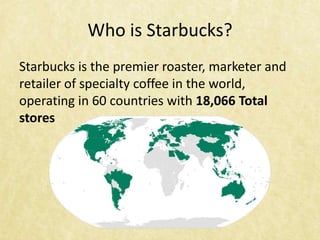
Starbucks is the premier roaster, marketer and
retailer of specialty coffee in the world,
operating in 60 countries with 18,066 Total
stores
Starbucks at a Glance
             Is Starbucks a MNE? YES!
• Industry: Restaurants           Forbes Lists
• Founded: 1985             • #631 Global 2000
• Country: United States    • #54 World’s Most Powerful
• CEO: Howard Schultz         Brands
• Website:                  • #21 Innovative Companies
  www.starbucks.com         • #740 in Sales
• Employees: 149,000        • #493 in Profit
• 2012 Sales: $40 billion   • #1930 in Assets
                            • #192 in Market Value
• Headquarters: Seattle,
  Washington
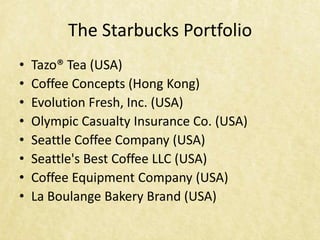
The Starbucks Portfolio
•   Tazo® Tea (USA)
•   Coffee Concepts (Hong Kong)
•   Evolution Fresh, Inc. (USA)
•   Olympic Casualty Insurance Co. (USA)
•   Seattle Coffee Company (USA)
•   Seattle's Best Coffee LLC (USA)
•   Coffee Equipment Company (USA)
•   La Boulange Bakery Brand (USA)
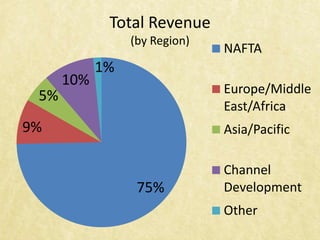
Total Revenue
                 (by Region)
                               NAFTA
            1%
      10%
                               Europe/Middle
 5%
                               East/Africa
9%                             Asia/Pacific

                               Channel
                  75%          Development
                               Other
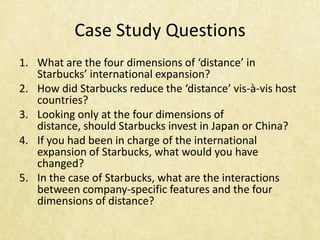
Case Study Questions
1. What are the four dimensions of ‘distance’ in
   Starbucks’ international expansion?
2. How did Starbucks reduce the ‘distance’ vis-à-vis host
   countries?
3. Looking only at the four dimensions of
   distance, should Starbucks invest in Japan or China?
4. If you had been in charge of the international
   expansion of Starbucks, what would you have
   changed?
5. In the case of Starbucks, what are the interactions
   between company-specific features and the four
   dimensions of distance?
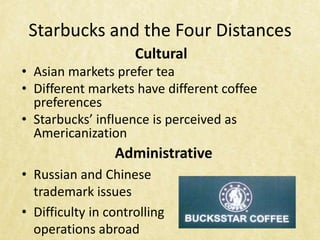
Starbucks and the Four Distances
                     Cultural
• Asian markets prefer tea
• Different markets have different coffee
  preferences
• Starbucks’ influence is perceived as
  Americanization
                 Administrative
• Russian and Chinese
  trademark issues
• Difficulty in controlling
  operations abroad
Starbucks and the Four Distances
                   Geographic
• Difficulty in transporting teas and roasted beans
  to far-away markets
• Rural areas abroad do not have the infrastructure
  required
                    Economic
• In some countries, Starbucks coffee costs more
  than a meal
• Costs of setting up operations in a new country
  can be high
Starbucks’ approach to bridging the Four Distances
classifies it as an International Projector.
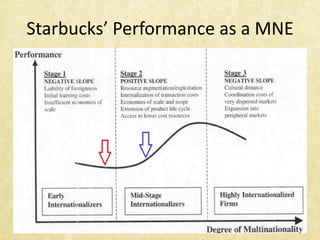
Starbucks’ Performance as a MNE
Degree of Multinationality
Licensing – The bulk of Starbucks’ foreign retail
locations are licensee-operated (53% in Europe and
80% in Asia)
Export – Starbucks exports its “Channel
Development” products from North America
Local Packaging / Assembly – Starbucks operates
two major facilities outside of North America for
roasting and distribution (Netherlands and the
United Kingdom)
FDI – Starbucks owns and operates a minority of its
foreign locations (47% in Europe and 20% in Asia)
International Expansion
• Starbucks plans to add 3,000 new stores to its
  Americas and U.S. division and to renovate
  thousands of other stores in the region
• In Asia, Starbucks will have almost 4,000
  stores by the end of 2013, including 1,000 in
  China
• Right now, the largest markets are the United
  Kingdom, Canada, and Japan
Firm Specific Advantages
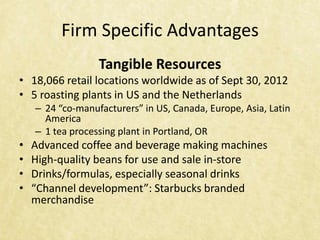
                  Tangible Resources
• 18,066 retail locations worldwide as of Sept 30, 2012
• 5 roasting plants in US and the Netherlands
    – 24 “co-manufacturers” in US, Canada, Europe, Asia, Latin
      America
    – 1 tea processing plant in Portland, OR
•   Advanced coffee and beverage making machines
•   High-quality beans for use and sale in-store
•   Drinks/formulas, especially seasonal drinks
•   “Channel development”: Starbucks branded
    merchandise
Firm Specific Advantages (cont’d)
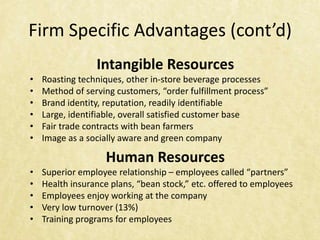
                 Intangible Resources
•   Roasting techniques, other in-store beverage processes
•   Method of serving customers, “order fulfillment process”
•   Brand identity, reputation, readily identifiable
•   Large, identifiable, overall satisfied customer base
•   Fair trade contracts with bean farmers
•   Image as a socially aware and green company

                    Human Resources
•   Superior employee relationship – employees called “partners”
•   Health insurance plans, “bean stock,” etc. offered to employees
•   Employees enjoy working at the company
•   Very low turnover (13%)
•   Training programs for employees
Country Specific Advantages
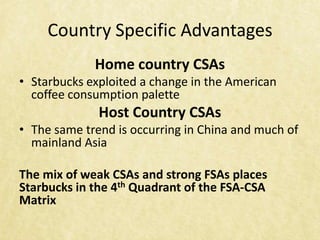
             Home country CSAs
• Starbucks exploited a change in the American
  coffee consumption palette
              Host Country CSAs
• The same trend is occurring in China and much of
  mainland Asia

The mix of weak CSAs and strong FSAs places
Starbucks in the 4th Quadrant of the FSA-CSA
Matrix
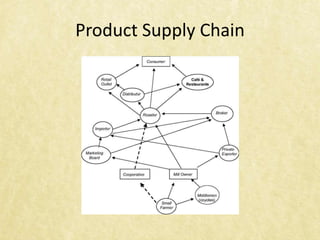
Product Supply Chain
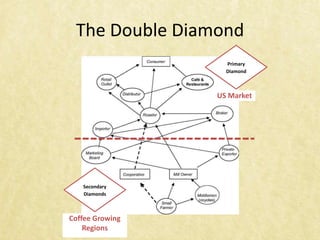
The Double Diamond
                   Primary
                   Diamond


                 US Market


   Secondary
   Diamonds


Coffee Growing
    Regions
Foreign Direct Investment
              Market-Seeking FDI
Starbucks primarily engages in FDI for
distribution and retail centers, the majority of
their foreign-located assets are of this type
            Efficiency-Seeking FDI
Starbucks owns several roasting and packaging
facilities in the host triad regions to facilitate
product distribution
Summary
• Home-Region MNE           • FSAs are Primarily
  (NAFTA)                     Transferrable
• Activity Level:           • Double Diamond
  License, Export, Local
                              Framework
  Packaging, FDI
• International             • FSA-CSA Matrix:
  Performance: Stage 2        Quadrant 4
• MNE Archetype:            • FDI Types: Primarily
  International Projector     Market-Seeking and
                              Efficiency Seeking
Works Cited
• "100 Best Companies to Work For 2010: Starbucks Coffee." CNNMoney.
  Cable News Network, n.d. Web. 20 Feb. 2013.
• 2012 Starbucks Annual Report. Rep. N.p.: n.p., n.d. Print.
• "Career Center." Starbucks Coffee Company. Starbucks, n.d. Web. 20 Feb.
  2013.
• "Clover Coffee Machines Catch Starbucks' Fancy." Business & Technology.
  Starbucks, 3 Apr. 2008. Web. 24 Feb. 2013.
• "From Bean to Cup: How Starbucks Transformed Its Supply
  Chain." CSCMP's Supply Chain Quarterly. Starbucks, n.d. Web. 20 Feb.
  2013.
• "Partner Networks." Starbucks Coffee Company. Starbucks, n.d. Web. 20
  Feb. 2013.
• "Starbucks' Big Expansion Plans: Yes, There's Still Room for It to
  Grow." DailyFinance.com. Starbucks, 5 Dec. 2012. Web. 20 Feb. 2013.
• "Starbucks." Brand Ranking. SyncForce, n.d. Web. 20 Feb. 2013.
• "Starbucks Coffee Company." Starbucks Coffee Company. N.p., n.d. Web.
  20 Feb. 2013.

Starbucks International Case Study

  • 1.
    Case Presentation 4.1 Group 4 Matthew Cruz, Brooke Feery, Jacob Hostetler, Daniela Nicula, Manh Duc Tran
  • 2.
    Who is Starbucks? Starbucksis the premier roaster, marketer and retailer of specialty coffee in the world, operating in 60 countries with 18,066 Total stores
  • 3.
    Starbucks at aGlance Is Starbucks a MNE? YES! • Industry: Restaurants Forbes Lists • Founded: 1985 • #631 Global 2000 • Country: United States • #54 World’s Most Powerful • CEO: Howard Schultz Brands • Website: • #21 Innovative Companies www.starbucks.com • #740 in Sales • Employees: 149,000 • #493 in Profit • 2012 Sales: $40 billion • #1930 in Assets • #192 in Market Value • Headquarters: Seattle, Washington
  • 4.
    The Starbucks Portfolio • Tazo® Tea (USA) • Coffee Concepts (Hong Kong) • Evolution Fresh, Inc. (USA) • Olympic Casualty Insurance Co. (USA) • Seattle Coffee Company (USA) • Seattle's Best Coffee LLC (USA) • Coffee Equipment Company (USA) • La Boulange Bakery Brand (USA)
  • 5.
    Total Revenue (by Region) NAFTA 1% 10% Europe/Middle 5% East/Africa 9% Asia/Pacific Channel 75% Development Other
  • 6.
    Case Study Questions 1.What are the four dimensions of ‘distance’ in Starbucks’ international expansion? 2. How did Starbucks reduce the ‘distance’ vis-à-vis host countries? 3. Looking only at the four dimensions of distance, should Starbucks invest in Japan or China? 4. If you had been in charge of the international expansion of Starbucks, what would you have changed? 5. In the case of Starbucks, what are the interactions between company-specific features and the four dimensions of distance?
  • 7.
    Starbucks and theFour Distances Cultural • Asian markets prefer tea • Different markets have different coffee preferences • Starbucks’ influence is perceived as Americanization Administrative • Russian and Chinese trademark issues • Difficulty in controlling operations abroad
  • 8.
    Starbucks and theFour Distances Geographic • Difficulty in transporting teas and roasted beans to far-away markets • Rural areas abroad do not have the infrastructure required Economic • In some countries, Starbucks coffee costs more than a meal • Costs of setting up operations in a new country can be high Starbucks’ approach to bridging the Four Distances classifies it as an International Projector.
  • 9.
  • 10.
    Degree of Multinationality Licensing– The bulk of Starbucks’ foreign retail locations are licensee-operated (53% in Europe and 80% in Asia) Export – Starbucks exports its “Channel Development” products from North America Local Packaging / Assembly – Starbucks operates two major facilities outside of North America for roasting and distribution (Netherlands and the United Kingdom) FDI – Starbucks owns and operates a minority of its foreign locations (47% in Europe and 20% in Asia)
  • 11.
    International Expansion • Starbucksplans to add 3,000 new stores to its Americas and U.S. division and to renovate thousands of other stores in the region • In Asia, Starbucks will have almost 4,000 stores by the end of 2013, including 1,000 in China • Right now, the largest markets are the United Kingdom, Canada, and Japan
  • 12.
    Firm Specific Advantages Tangible Resources • 18,066 retail locations worldwide as of Sept 30, 2012 • 5 roasting plants in US and the Netherlands – 24 “co-manufacturers” in US, Canada, Europe, Asia, Latin America – 1 tea processing plant in Portland, OR • Advanced coffee and beverage making machines • High-quality beans for use and sale in-store • Drinks/formulas, especially seasonal drinks • “Channel development”: Starbucks branded merchandise
  • 13.
    Firm Specific Advantages(cont’d) Intangible Resources • Roasting techniques, other in-store beverage processes • Method of serving customers, “order fulfillment process” • Brand identity, reputation, readily identifiable • Large, identifiable, overall satisfied customer base • Fair trade contracts with bean farmers • Image as a socially aware and green company Human Resources • Superior employee relationship – employees called “partners” • Health insurance plans, “bean stock,” etc. offered to employees • Employees enjoy working at the company • Very low turnover (13%) • Training programs for employees
  • 14.
    Country Specific Advantages Home country CSAs • Starbucks exploited a change in the American coffee consumption palette Host Country CSAs • The same trend is occurring in China and much of mainland Asia The mix of weak CSAs and strong FSAs places Starbucks in the 4th Quadrant of the FSA-CSA Matrix
  • 15.
  • 16.
    The Double Diamond Primary Diamond US Market Secondary Diamonds Coffee Growing Regions
  • 17.
    Foreign Direct Investment Market-Seeking FDI Starbucks primarily engages in FDI for distribution and retail centers, the majority of their foreign-located assets are of this type Efficiency-Seeking FDI Starbucks owns several roasting and packaging facilities in the host triad regions to facilitate product distribution
  • 18.
    Summary • Home-Region MNE • FSAs are Primarily (NAFTA) Transferrable • Activity Level: • Double Diamond License, Export, Local Framework Packaging, FDI • International • FSA-CSA Matrix: Performance: Stage 2 Quadrant 4 • MNE Archetype: • FDI Types: Primarily International Projector Market-Seeking and Efficiency Seeking
  • 19.
    Works Cited • "100Best Companies to Work For 2010: Starbucks Coffee." CNNMoney. Cable News Network, n.d. Web. 20 Feb. 2013. • 2012 Starbucks Annual Report. Rep. N.p.: n.p., n.d. Print. • "Career Center." Starbucks Coffee Company. Starbucks, n.d. Web. 20 Feb. 2013. • "Clover Coffee Machines Catch Starbucks' Fancy." Business & Technology. Starbucks, 3 Apr. 2008. Web. 24 Feb. 2013. • "From Bean to Cup: How Starbucks Transformed Its Supply Chain." CSCMP's Supply Chain Quarterly. Starbucks, n.d. Web. 20 Feb. 2013. • "Partner Networks." Starbucks Coffee Company. Starbucks, n.d. Web. 20 Feb. 2013. • "Starbucks' Big Expansion Plans: Yes, There's Still Room for It to Grow." DailyFinance.com. Starbucks, 5 Dec. 2012. Web. 20 Feb. 2013. • "Starbucks." Brand Ranking. SyncForce, n.d. Web. 20 Feb. 2013. • "Starbucks Coffee Company." Starbucks Coffee Company. N.p., n.d. Web. 20 Feb. 2013.