1. The document discusses absolute advantage and comparative advantage in production. Absolute advantage refers to being able to produce more of a good using the same inputs or produce a good using fewer inputs. Comparative advantage refers to being able to produce a good at a lower opportunity cost.
2. It provides examples of countries that have an absolute advantage in certain goods and comparative advantages in others. If countries specialize according to their comparative advantages and trade, both countries can benefit through gains from trade.
Discusses absolute and comparative advantage, with definitions and examples of efficiency in production.
Explains absolute advantage through examples, emphasizing production efficiency in terms of time and output. Illustrates PPCs that depict consumption possibilities and the impact of trade on production capabilities. Analyzes comparative advantage between Haiti and Cuba, Brazil and Chile, and opportunity costs related to trade.
Discusses specific country advantages, determining who exports and imports based on comparative advantage. Explores how specialization according to comparative advantage results in greater gains for trading countries.
Summarizes absolute and comparative advantage concepts, analyzing specific cases and trade term implications.
Comparative Advantage –can produce a product at a "lower opportunity cost". Absolute Advantage[outputs] – can produce absolutely more with the same inputs. Absolute Advantage[inputs] – can produce absolutely faster with the same inputs.
3.
Absolute Advantage – [outputs] can produce absolutely more with the same inputs [more efficient]. Absolute Advantage – [inputs] can produce absolutely faster with the same inputs [more efficient]. I Can do 8 push-ups . I Can do 42 push-ups. I have an absolute advantage in the production of push-ups. I can clean that house in 4 hours. I’m more efficient. I can do the same work in 3 hours so I have an absolute advantage . T exas L onghorn T exas Aggie F uture L onghorn Maid F uture Aggie Maid
4.
PPC – before trade & specialization– prisoners of their own PPC’s and CPC’s C O F F E E Bread 80 20 PPC CPC Before trade, I’m a prisoner of my own PPC. Haiti 40 [Consumption Possibilities Curve] 10 0 Haiti’s D omestic C omparative C ost 1 Bread = 4 Coffees ¼ Bread = 1 Coffee
5.
Comparative and Absolute Advantage [ C omparative A dvantage can produce at a lower productive opportunity cost ] Haiti’s DCC Cuba’s DCC 1B = __ C 1B = __ C __ B = 1C __ B = 1C 4 6 1/4 1/6 100 18 “ D o what you do best & trade for the rest.” Absolute Advantage - more efficient, can produce more with the same number of inputs [who can do the most in absolute numbers] “ Export” what it can produce at a lower relative price and “import” goods it can buy at a lower relative price . 1. (Haiti/Cuba) has an absolute advantage in coffee and (Haiti/Cuba) has an absolute advantage in bread . 2. Haiti will export (bread/coffee) [ comparative advantage ] and import (bread/coffee). [ comparative disadvantage ] & Cuba will export (bread/coffee) & import (bread/coffee). 3. Mutually advantageous trade can occur between Haiti & Cuba when 1 bread is exchanged for (3/5/7) tons of coffee . Production in both is subject to (increasing/constant) opportunity costs. “ Trade is the free lunch of economics.” Terms of Trade 1 bread = __ coffees World CC 1 Bread =__ Coffees __ Bread=1 Coffee 5 5 1 / 5 80 o 20 90 0 15 Haiti Cuba “ A prisoner of my own PPC.” Bread Bread Coffee Coffee “ I can consume only on my PPC.”
6.
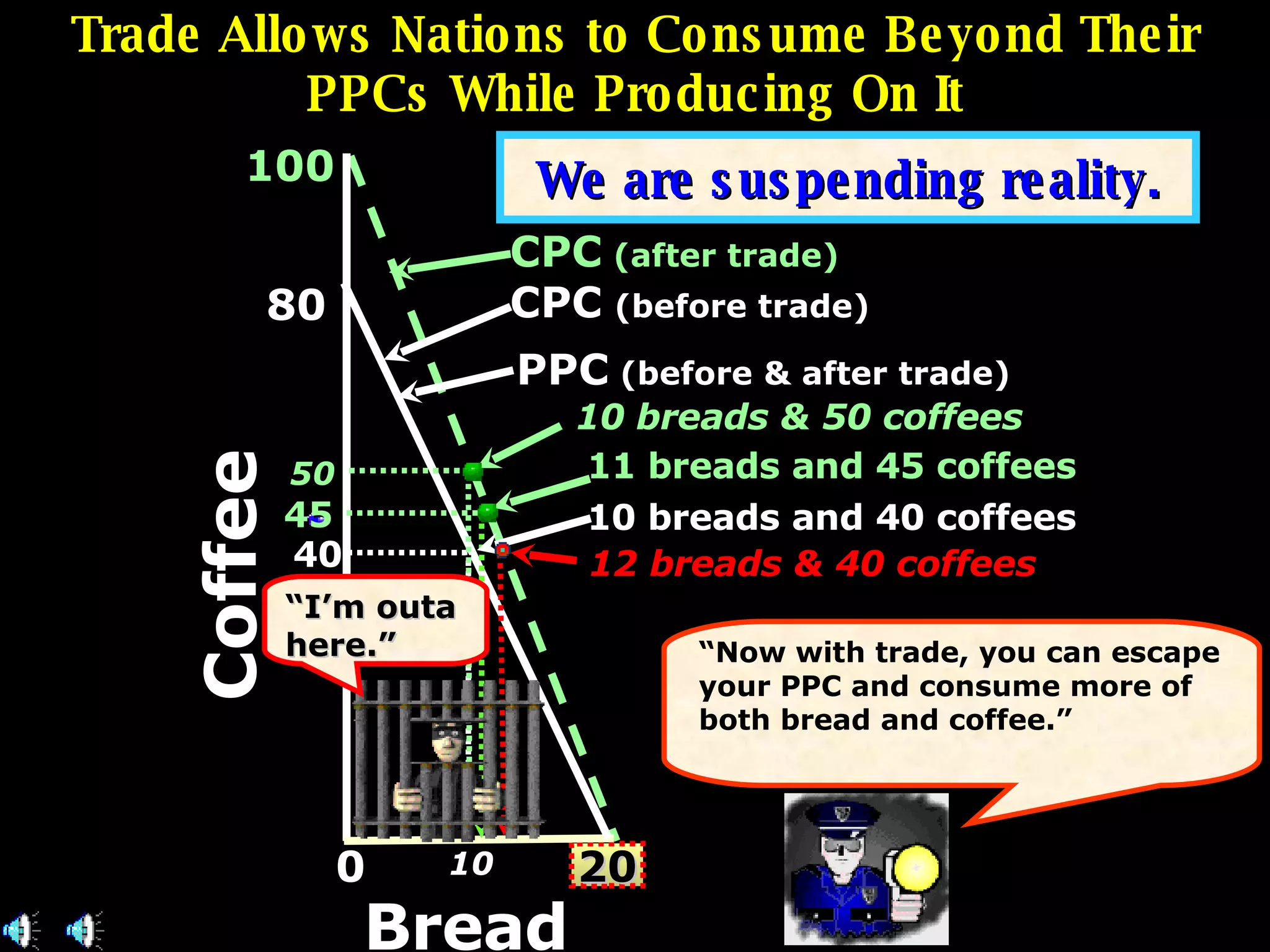
Trade Allows Nationsto Consume Beyond Their PPCs While Producing On It 10 breads & 50 coffees 12 breads & 40 coffees 50 10 20 We are suspending reality. CPC (after trade) CPC (before trade) PPC (before & after trade) 100 80 40 Coffee 0 11 breads and 45 coffees 10 breads and 40 coffees Bread “ Now with trade, you can escape your PPC and consume more of both bread and coffee.” 45 “ I’m outa here.”
7.
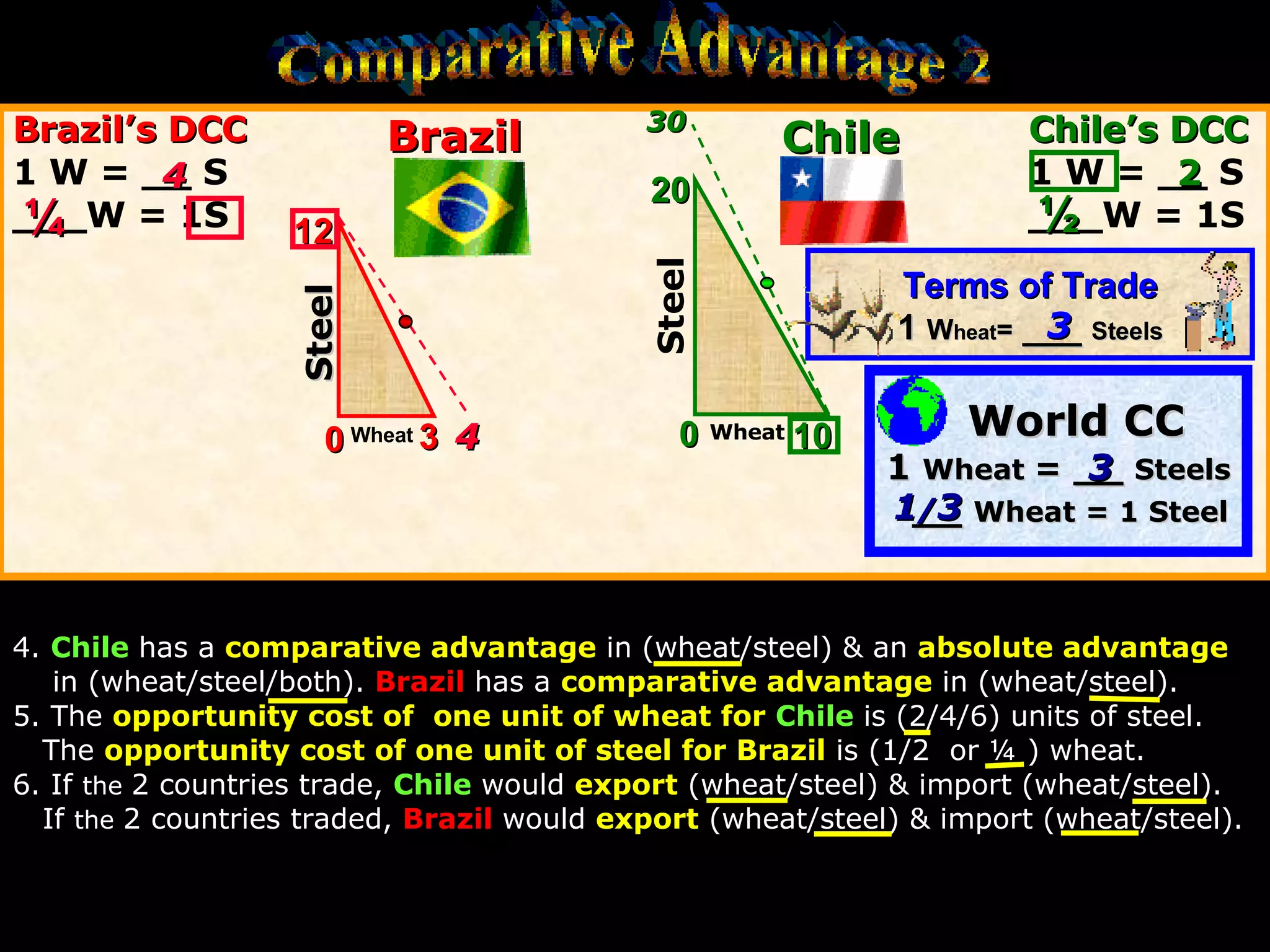
Brazil’s DCC Chile’sDCC 1 W = __ S 1 W = __ S ___W = 1S ___W = 1S 4. Chile has a comparative advantage in (wheat/steel) & an absolute advantage in (wheat/steel/both). Brazil has a comparative advantage in (wheat/steel). 5. The opportunity cost of one unit of wheat for Chile is (2/4/6) units of steel. The opportunity cost of one unit of steel for Brazil is (1/2 or ¼ ) wheat. 6. If the 2 countries trade, Chile would export (wheat/steel) & import (wheat/steel). If the 2 countries traded, Brazil would export (wheat/steel) & import (wheat/steel). 4 2 ¼ ½ 30 4 Terms of Trade 1 W heat = ___ Steels 3 World CC 1 Wheat = __ Steels __ Wheat = 1 Steel 1 / 3 3 12 0 3 20 0 10 Brazil Chile Steel Steel Wheat Wheat Comparative Advantage 2
8.
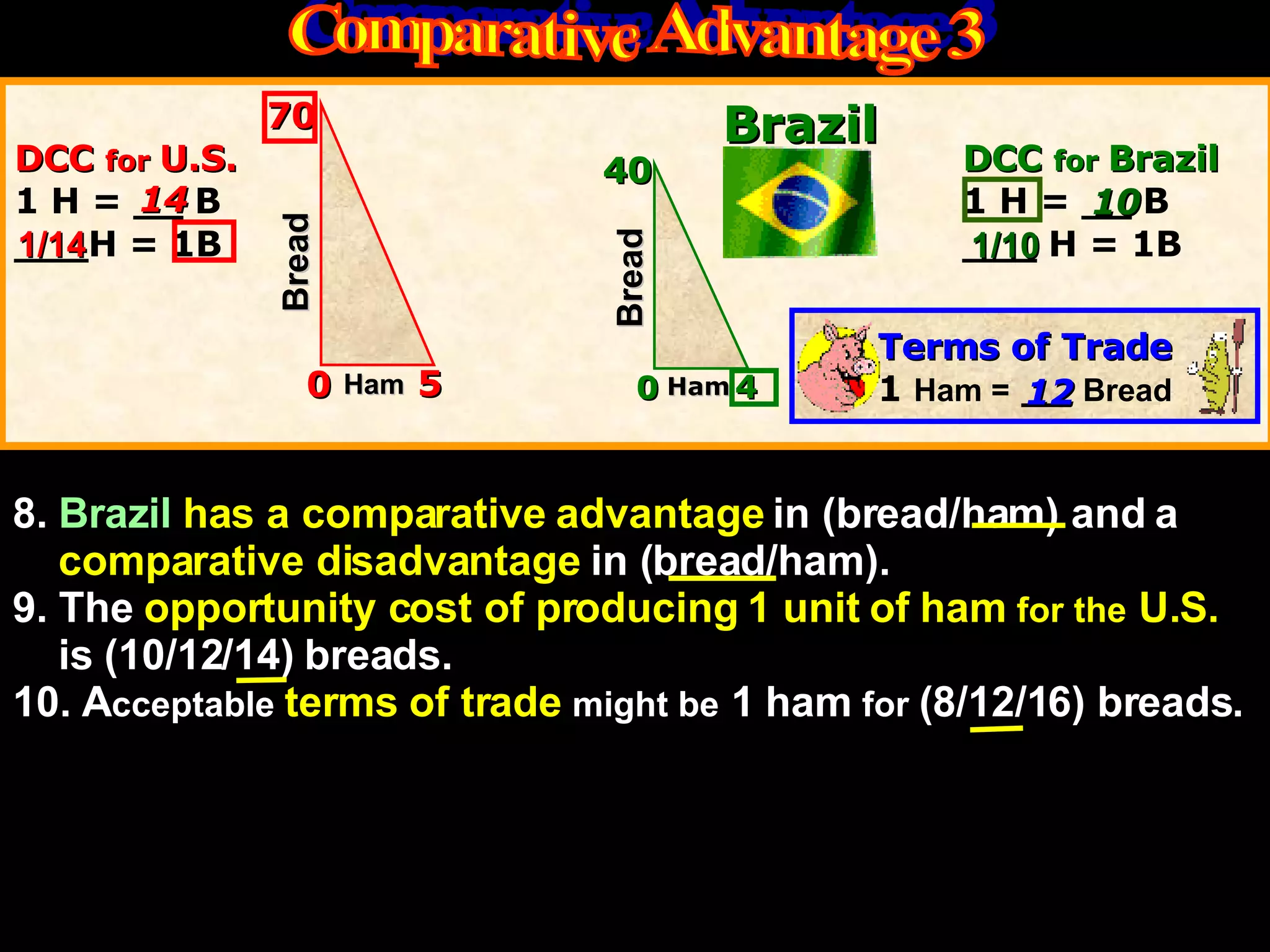
DCC for U.S. DCC for Brazil 1 H = __ B 1 H = __ B ___H = 1B ___ H = 1B 8. Brazil has a comparative advantage in (bread/ham) and a comparative disadvantage in (bread/ham). 9. The opportunity cost of producing 1 unit of ham for the U.S. is (10/12/14) breads. 10. A cceptable terms of trade might be 1 ham for (8/12/16) breads. 14 1/14 1/10 70 0 5 40 4 0 Ham Ham Bread Bread Terms of Trade 1 Ham = __ Bread 10 12 Brazil Comparative Advantage 3
9.
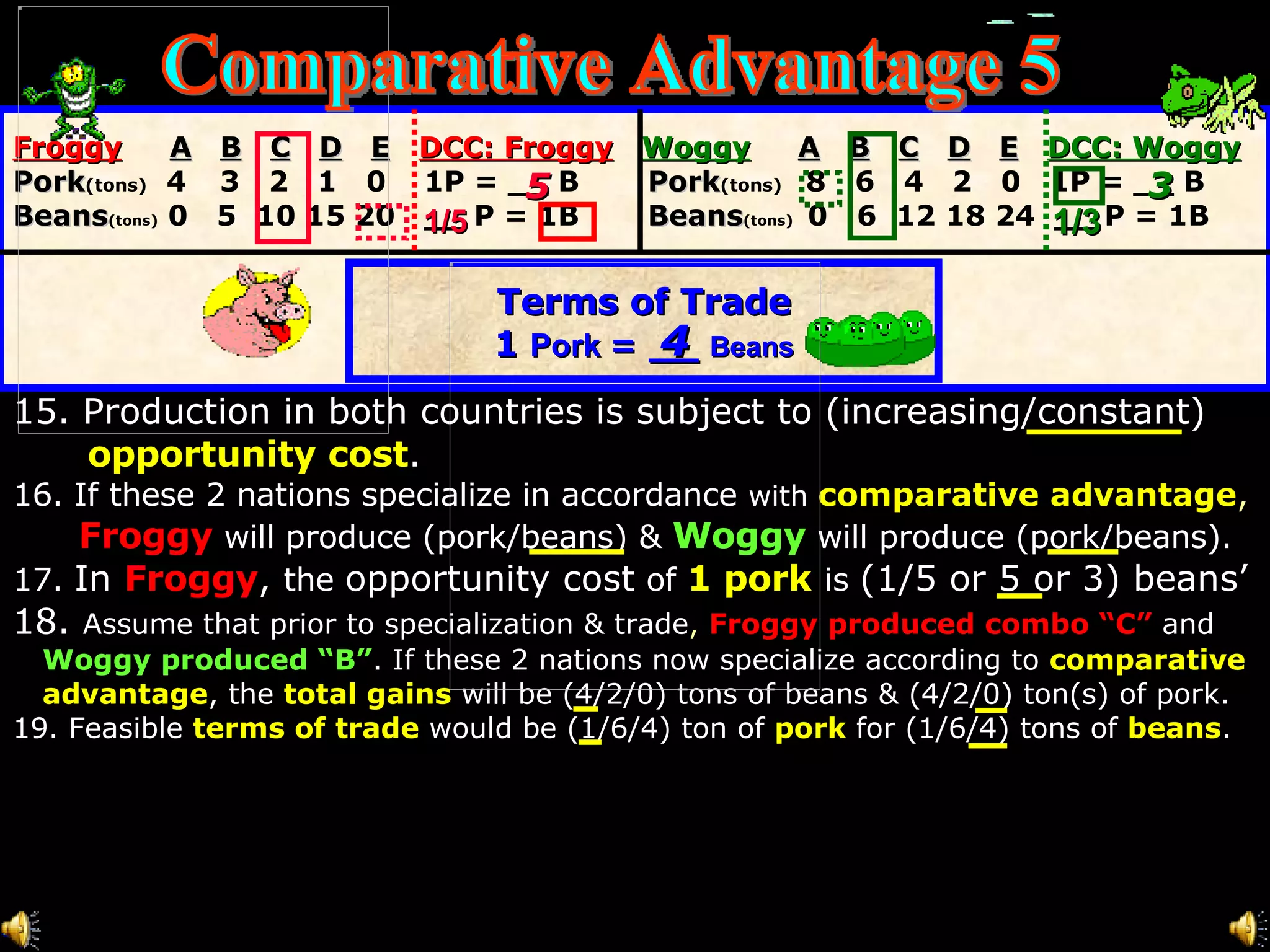
Froggy A B C D E DCC: Froggy Woggy A B C D E DCC: Woggy Pork (tons) 4 3 2 1 0 1P = __ B Pork (tons) 8 6 4 2 0 1P = __ B Beans (tons) 0 5 10 15 20 __ P = 1B Beans (tons) 0 6 12 18 24 __ P = 1B Terms of Trade 1 Pork = __ Beans 15. Production in both countries is subject to (increasing/constant) opportunity cost . 16. If these 2 nations specialize in accordance with comparative advantage , Froggy will produce (pork/beans) & Woggy will produce (pork/beans). 17. In Froggy , the opportunity cost of 1 pork is (1/5 or 5 or 3) beans’ 18. Assume that prior to specialization & trade , Froggy produced combo “C” and Woggy produced “B” . If these 2 nations now specialize according to comparative advantage , the total gains will be (4/2/0) tons of beans & (4/2/0) ton(s) of pork. 19. Feasible terms of trade would be (1/6/4) ton of pork for (1/6/4) tons of beans . 5 1/5 3 1/3 4 Comparative Advantage 5
10.
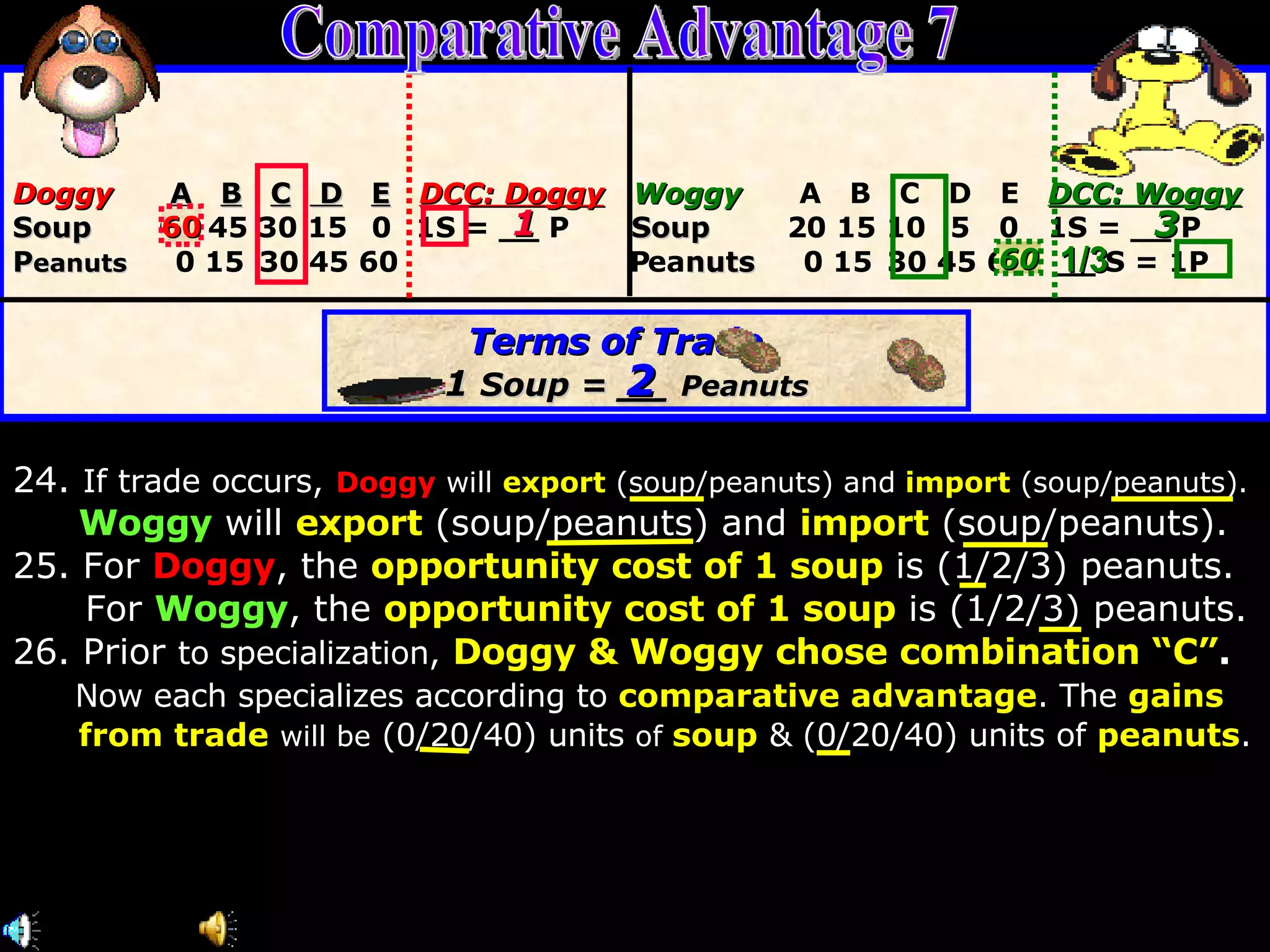
24. Iftrade occurs, Doggy will export (soup/peanuts) and import (soup/peanuts). Woggy will export (soup/peanuts) and import (soup/peanuts). 25. For Doggy , the opportunity cost of 1 soup is (1/2/3) peanuts. For Woggy , the opportunity cost of 1 soup is (1/2/3) peanuts. 26. Prior to specialization, Doggy & Woggy chose combination “C” . Now each specializes according to comparative advantage . The gains from trade will be (0/20/40) units of soup & (0/20/40) units of peanuts . Doggy A B C D E DCC: Doggy Woggy A B C D E DCC: Woggy Soup 60 45 30 15 0 1S = __ P Soup 20 15 10 5 0 1S = __ P P eanuts 0 15 30 45 60 Pea nuts 0 15 30 45 60 __ S = 1P 1 3 1/3 60 60 Terms of Trade 1 Soup = __ Peanuts 2 Comparative Advantage 7
11.
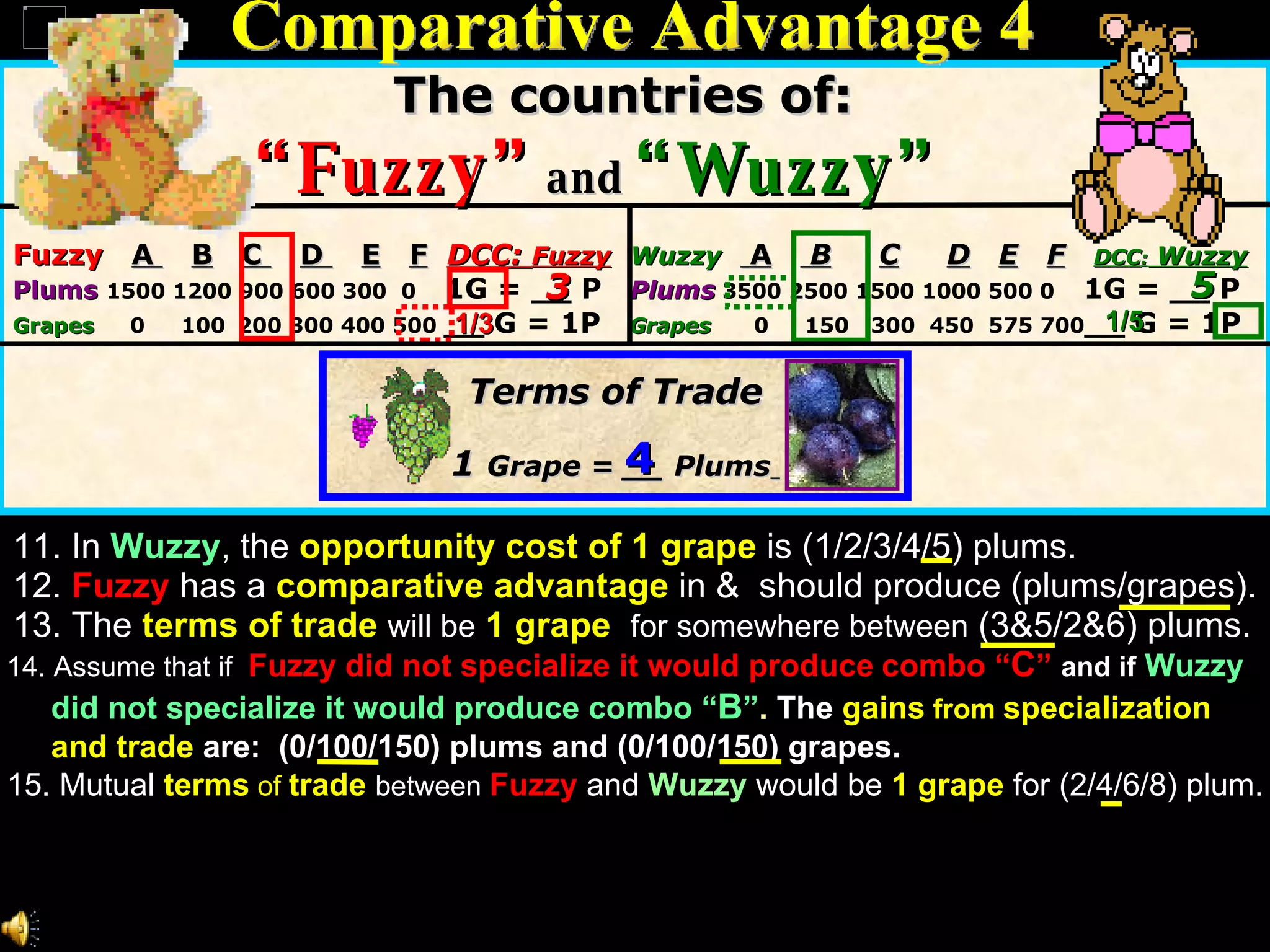
Fuzzy A B C D E F DCC: Fuzzy Wuzzy A B C D E F DCC : Wuzzy Plums 1500 1200 900 600 300 0 1G = __ P Plums 3500 2500 1500 1000 500 0 1G = __ P Grapes 0 100 200 300 400 500 __ G = 1P Grapes 0 150 300 450 575 700 __ G = 1P Terms of Trade 1 Grape = __ Plums 1/3 5 1/5 11. In Wuzzy , the opportunity cost of 1 grape is (1/2/3/4/5) plums. 12. Fuzzy has a comparative advantage in & should produce (plums/grapes). 13. The terms of trade will be 1 grape for somewhere between (3&5/2&6) plums. 14. Assume that if Fuzzy did not specialize it would produce combo “ C ” and if Wuzzy did not specialize it would produce combo “ B ” . The gains from specialization and trade are: (0/100/150) plums and (0/100/150) grapes. 15. Mutual terms of trade between Fuzzy and Wuzzy would be 1 grape for (2/4/6/8) plum. 4 3 The countries of: “ F uzz y” and “W uzz y” Comparative Advantage 4
12.
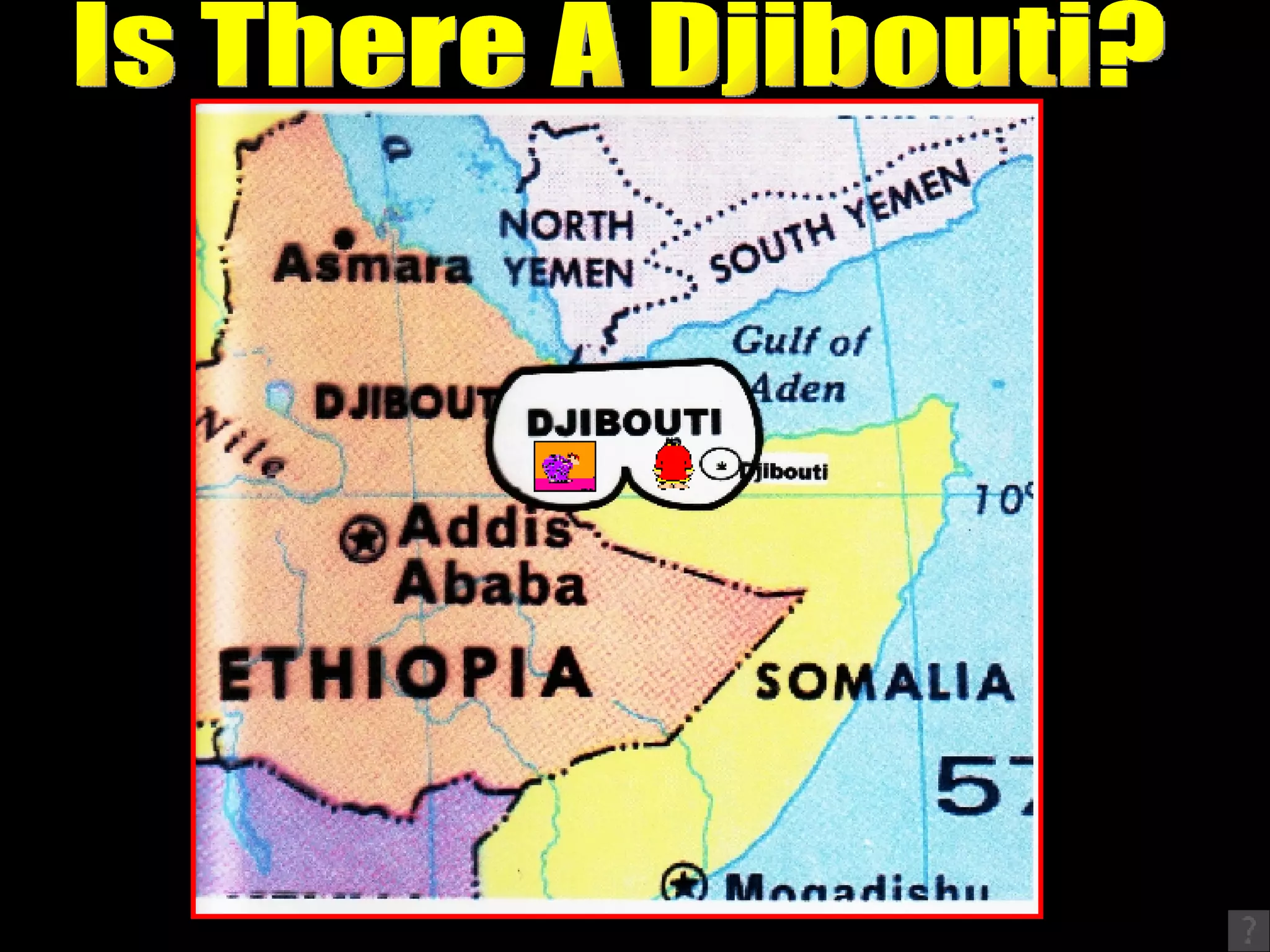
[lower # ofhours gives absolute advantage] Djibouti DCC : Djibouti Canada DCC : Canada Fish 10 hours 1W =__F Fish 20 hours 1 W = __ F Wheat 20 hours ___ W=1F W hea t 60 hours ___W = 1F Terms of Trade: 1 Wheat = __ Fish 2 1/2 3 1/3 2 . 5 27. (Djibouti/Canada) has an absolute advantage in both commodities. (Djibouti/Canada) has a comparative advantage in producing wheat . 28. (Djibouti/Canada) has an absolute disadvantage in both , but a comparative advantage in fish . 29. Advantageous trade can occur between the two when 1 wheat is exchanged for (1/2.5/3) fish. We are going to turn inputs into outputs . In 20 hours , Djibouti can produce an output of 1 wheat or 2 fish . In 60 hours , Canada can produce an output of 1 wheat or 3 fish . Looking at inputs [hours] Comparative Advantage 8 [Inputs]
[lower # ofhours gives absolute advantage] DCC: U.S. Russia DCC: R ussia Caviar 6 hours 1C = __W Caviar 16 hours 1C = __ W Wheat 3 hours __ C =1W Wheat 4 hours __ C = 1W 30. (Russia/U.S.) has an absolute disadvantage in both commodities . (Russia/U.S.) has a comparative advantage in wheat . 31. (Russia/U.S) has an absolute advantage in both commodities . (Russia/U.S.) has a comparative advantage in caviar . 31. Advantageous trade can occur between the two nations when 1 caviar is exchanged for (1/3/5) tons of wheat . 2 1/2 4 1/4 Terms of Trade 1 Caviar = __ Wheats 3 We are once again turning inputs into outputs . In 6 hours , the U.S.A. can produce an output of 1 caviar or 2 wheats . In 16 hours , R ussia can produce an output of 1 caviar or 4 wheats . Comparative Advantage 9 [Inputs]
16.
Absolute Advantage [Outputs v. Inputs ] Remember that with outputs or quantity , the larger number indicates absolute advantage ; that country can produce absolutely more with the same inputs, and is more efficient . And with inputs ( hours ), the smaller number indicates absolute advantage ; that country is more efficient because it can produce a good absolutely faster than the other with the same inputs. Product Market Resource Market
17.
2 nd M ost M issed Q uestion On 95 AP E xam [26% correct] Country Food Clothing Ducky 20 hours 50 hours Wucky 10 hours 20 hours a. Ducky has a comparative advantage in the production of both food and clothing. b. Wucky has a comparative advantage in the production of both food and clothing. c. Ducky has a comparative advantage in food production, & W ucky has a comparative advantage in clothing production . d. Ducky has a comparative advantage in clothing production, & Wucky has a comparative advantage in food production . Neither country has a comparative advantage in the production of either good. Country Food Clothing Ducky 20 hrs 50 hrs 1C = 2.5F; .4C = 1F Wucky 10 hrs 20 hrs 1C = 2F; .5C = 1F Terms of Trade might be 1C = 2.2F Ducky Wucky
18.
Product Market [outputs] Country Guns Butter Rabbit 20 units 60 units Wabbit 10 units 20 units Resource Market [inputs] Country Guns Butter Rabbit 20 hours 60 hours Wabbit 10 hours 20 hours W hat country has an absolute advantage in guns ? W hat country has an absolute advantage in guns ? Rabbit Wabbit Why does Rabbit have an absolute advantage in guns ? Why does Wabbit have an absolute advantage in guns ? Rabbit can produce absolutely more guns than Wabbit [ 20 units v. 10 units ] Wabbit can produce guns absolutely faster than Rabbit [ 10 hours v. 20 hours ] Rabbit W hat country has a comparative advantage in guns ? W hat country has a comparative advantage in guns ? Wabbit Rabbit Wabbit can produce guns at a lower opportunity cost [ 2 butters v. 3 butters ] Rabbit can produce guns at a lower opportunity cost [ 1/3 butter v. 1/2 butter ] Rabbit 1 G = 3 B 1/3 G=1B Wabbit 1 G = 2 B 1/2 G=1B Rabbit 1 B = 3 G 1/3 B=1G Wabbit 1 B = 2 G 1/2 B=1G Wabbit Rabbit Wabbit “ Let’s change inputs into outputs.”

![Comparative Advantage – can produce a product at a "lower opportunity cost". Absolute Advantage[outputs] – can produce absolutely more with the same inputs. Absolute Advantage[inputs] – can produce absolutely faster with the same inputs.](https://image.slidesharecdn.com/comparative-advantage-7812/75/Comparative-Advantage-2-2048.jpg)
![Absolute Advantage – [outputs] can produce absolutely more with the same inputs [more efficient]. Absolute Advantage – [inputs] can produce absolutely faster with the same inputs [more efficient]. I Can do 8 push-ups . I Can do 42 push-ups. I have an absolute advantage in the production of push-ups. I can clean that house in 4 hours. I’m more efficient. I can do the same work in 3 hours so I have an absolute advantage . T exas L onghorn T exas Aggie F uture L onghorn Maid F uture Aggie Maid](https://image.slidesharecdn.com/comparative-advantage-7812/75/Comparative-Advantage-3-2048.jpg)
![PPC – before trade & specialization– prisoners of their own PPC’s and CPC’s C O F F E E Bread 80 20 PPC CPC Before trade, I’m a prisoner of my own PPC. Haiti 40 [Consumption Possibilities Curve] 10 0 Haiti’s D omestic C omparative C ost 1 Bread = 4 Coffees ¼ Bread = 1 Coffee](https://image.slidesharecdn.com/comparative-advantage-7812/75/Comparative-Advantage-4-2048.jpg)
![Comparative and Absolute Advantage [ C omparative A dvantage can produce at a lower productive opportunity cost ] Haiti’s DCC Cuba’s DCC 1B = __ C 1B = __ C __ B = 1C __ B = 1C 4 6 1/4 1/6 100 18 “ D o what you do best & trade for the rest.” Absolute Advantage - more efficient, can produce more with the same number of inputs [who can do the most in absolute numbers] “ Export” what it can produce at a lower relative price and “import” goods it can buy at a lower relative price . 1. (Haiti/Cuba) has an absolute advantage in coffee and (Haiti/Cuba) has an absolute advantage in bread . 2. Haiti will export (bread/coffee) [ comparative advantage ] and import (bread/coffee). [ comparative disadvantage ] & Cuba will export (bread/coffee) & import (bread/coffee). 3. Mutually advantageous trade can occur between Haiti & Cuba when 1 bread is exchanged for (3/5/7) tons of coffee . Production in both is subject to (increasing/constant) opportunity costs. “ Trade is the free lunch of economics.” Terms of Trade 1 bread = __ coffees World CC 1 Bread =__ Coffees __ Bread=1 Coffee 5 5 1 / 5 80 o 20 90 0 15 Haiti Cuba “ A prisoner of my own PPC.” Bread Bread Coffee Coffee “ I can consume only on my PPC.”](https://image.slidesharecdn.com/comparative-advantage-7812/75/Comparative-Advantage-5-2048.jpg)
![[lower # of hours gives absolute advantage] Djibouti DCC : Djibouti Canada DCC : Canada Fish 10 hours 1W =__F Fish 20 hours 1 W = __ F Wheat 20 hours ___ W=1F W hea t 60 hours ___W = 1F Terms of Trade: 1 Wheat = __ Fish 2 1/2 3 1/3 2 . 5 27. (Djibouti/Canada) has an absolute advantage in both commodities. (Djibouti/Canada) has a comparative advantage in producing wheat . 28. (Djibouti/Canada) has an absolute disadvantage in both , but a comparative advantage in fish . 29. Advantageous trade can occur between the two when 1 wheat is exchanged for (1/2.5/3) fish. We are going to turn inputs into outputs . In 20 hours , Djibouti can produce an output of 1 wheat or 2 fish . In 60 hours , Canada can produce an output of 1 wheat or 3 fish . Looking at inputs [hours] Comparative Advantage 8 [Inputs]](https://image.slidesharecdn.com/comparative-advantage-7812/75/Comparative-Advantage-12-2048.jpg)

![[lower # of hours gives absolute advantage] DCC: U.S. Russia DCC: R ussia Caviar 6 hours 1C = __W Caviar 16 hours 1C = __ W Wheat 3 hours __ C =1W Wheat 4 hours __ C = 1W 30. (Russia/U.S.) has an absolute disadvantage in both commodities . (Russia/U.S.) has a comparative advantage in wheat . 31. (Russia/U.S) has an absolute advantage in both commodities . (Russia/U.S.) has a comparative advantage in caviar . 31. Advantageous trade can occur between the two nations when 1 caviar is exchanged for (1/3/5) tons of wheat . 2 1/2 4 1/4 Terms of Trade 1 Caviar = __ Wheats 3 We are once again turning inputs into outputs . In 6 hours , the U.S.A. can produce an output of 1 caviar or 2 wheats . In 16 hours , R ussia can produce an output of 1 caviar or 4 wheats . Comparative Advantage 9 [Inputs]](https://image.slidesharecdn.com/comparative-advantage-7812/75/Comparative-Advantage-15-2048.jpg)
![Absolute Advantage [ Outputs v. Inputs ] Remember that with outputs or quantity , the larger number indicates absolute advantage ; that country can produce absolutely more with the same inputs, and is more efficient . And with inputs ( hours ), the smaller number indicates absolute advantage ; that country is more efficient because it can produce a good absolutely faster than the other with the same inputs. Product Market Resource Market](https://image.slidesharecdn.com/comparative-advantage-7812/75/Comparative-Advantage-16-2048.jpg)
![2 nd M ost M issed Q uestion On 95 AP E xam [26% correct] Country Food Clothing Ducky 20 hours 50 hours Wucky 10 hours 20 hours a. Ducky has a comparative advantage in the production of both food and clothing. b. Wucky has a comparative advantage in the production of both food and clothing. c. Ducky has a comparative advantage in food production, & W ucky has a comparative advantage in clothing production . d. Ducky has a comparative advantage in clothing production, & Wucky has a comparative advantage in food production . Neither country has a comparative advantage in the production of either good. Country Food Clothing Ducky 20 hrs 50 hrs 1C = 2.5F; .4C = 1F Wucky 10 hrs 20 hrs 1C = 2F; .5C = 1F Terms of Trade might be 1C = 2.2F Ducky Wucky](https://image.slidesharecdn.com/comparative-advantage-7812/75/Comparative-Advantage-17-2048.jpg)
![Product Market [outputs] Country Guns Butter Rabbit 20 units 60 units Wabbit 10 units 20 units Resource Market [inputs] Country Guns Butter Rabbit 20 hours 60 hours Wabbit 10 hours 20 hours W hat country has an absolute advantage in guns ? W hat country has an absolute advantage in guns ? Rabbit Wabbit Why does Rabbit have an absolute advantage in guns ? Why does Wabbit have an absolute advantage in guns ? Rabbit can produce absolutely more guns than Wabbit [ 20 units v. 10 units ] Wabbit can produce guns absolutely faster than Rabbit [ 10 hours v. 20 hours ] Rabbit W hat country has a comparative advantage in guns ? W hat country has a comparative advantage in guns ? Wabbit Rabbit Wabbit can produce guns at a lower opportunity cost [ 2 butters v. 3 butters ] Rabbit can produce guns at a lower opportunity cost [ 1/3 butter v. 1/2 butter ] Rabbit 1 G = 3 B 1/3 G=1B Wabbit 1 G = 2 B 1/2 G=1B Rabbit 1 B = 3 G 1/3 B=1G Wabbit 1 B = 2 G 1/2 B=1G Wabbit Rabbit Wabbit “ Let’s change inputs into outputs.”](https://image.slidesharecdn.com/comparative-advantage-7812/75/Comparative-Advantage-18-2048.jpg)



![Gross Domestic Product [What is not included]](https://cdn.slidesharecdn.com/ss_thumbnails/gross-domestic-product-what-is-not-included-12300-thumbnail.jpg?width=640&height=640&fit=bounds)


