FINAL EXAM
INTERNATIONAL BUSINESS AND TRADE
THE IMPORTANCE OF INTERNATIONAL TRADE
SUBMITTED BY: JABAGAT, CHABELIN DELROSARIO; BSBA 3-3 MARKETING MANAGEMENT
SUBMITTED TO: PROF. ELENA TUBERA; IBT PROFESSOR, CUP
AGENDA
(CONTENTS)
 INTERNATIONAL BUSINESS AND TRADE
 Meaning
 Originated
 THE IMPORTANCE OF TRADE
 Make use of abundant raw materials
 Comparative advantage
 Greater choice for consumers
 Specialization and economies of scale – greater
efficiency
 Service sector trade
 Global growth and economic development
 Grows Jobs and Businesses
 Grows and Strengthen Markets
 Competition
 Innovation
 Economies of Scale Up
 SELF- REFLECTION!
 International business refers to the
trade of goods, services, technology,
capital and/or knowledge across
national borders and at a global or
transnational scale. It involves cross-
border transactions of goods and
services between two or more
countries.
WHAT IS
INTERNATIONAL
TRADE?
ORIGINATED!
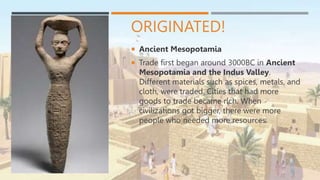
 Ancient Mesopotamia
 Trade first began around 3000BC in Ancient
Mesopotamia and the Indus Valley.
Different materials such as spices, metals, and
cloth, were traded. Cities that had more
goods to trade became rich. When
civilizations got bigger, there were more
people who needed more resources.
THE IMPORTANCE OF TRADE!
Make use of abundant raw materials
Some countries are naturally abundant in raw materials – oil (Qatar),
metals, fish (Iceland), Congo (diamonds) Butter (New Zealand). Without
trade, these countries would not benefit from the natural endowments of
raw materials.
THE IMPORTANCE OF TRADE!
Make use of abundant raw materials
A theoretical model for this was developed by Eli Heckscher and Bertil Ohlin.
Known as the Heckscher–Ohlin model (H–O model) it states countries will
specialize in producing and exports goods which use abundant local factor
endowments. Countries will import those goods, where resources are scarce.
COMPARATIVE ADVANTAGE!
The theory of comparative advantage states that countries should specialize in
those goods where they have a relatively lower opportunity cost. Even if one
country can produce two goods at a lower absolute cost– doesn’t mean they
should produce everything. India, with lower labour costs, may have a
comparative advantage in labour-intensive production (e.g. call centres,
clothing manufacture).
COMPARATIVE ADVANTAGE!
Therefore, it would be efficient for India to export these services and goods. While an economy
like the UK may have a comparative advantage in education and video game production. Trade
allows countries to specialize. More details on how comparative advantage can increase
economic welfare. The theory of comparative advantage has limitations, but it explains at least
some aspects of international trade. Therefore, it would be efficient for India to export these
services and goods. While an economy like the UK may have a comparative advantage in
education and video game production. Trade allows countries to specialise. More details on
how comparative advantage can increase economic welfare. The theory of comparative
advantage has limitations, but it explains at least some aspects of international trade.
GREATER CHOICE FOR CONSUMERS!
Places less emphasis on comparative advantage
and relative input costs. New trade theory states
that in the real world, a driving factor behind the
trade is giving consumers greater choice of
differentiated products. We import BMW cars
from Germany, not because they are the
cheapest but because of the quality and brand
image. Regarding music and film, trade enables
the widest choice of music and film to appeal to
different tastes. When the Beatles went on tour
to the US in the 1960s, it was exporting British
music – relative labour costs were unimportant.
GREATER CHOICE FOR CONSUMERS!
Perhaps the best example is with goods like
clothing. Some clothing (e.g. value clothes from
Primark – price is very important and they are likely
to be imported from low-labour cost countries like
Bangladesh. However, we also import fashion labels
Gucci (Italy) Chanel (France). Here consumers are
benefitting from choice, rather than the lowest price.
Economists argue that international trade often fits
the model of monopolistic competition. In this
model, the important aspect is brand differentiation.
For many goods, we want to buy goods with strong
brands and reputations. e.g. the popularity of Coca-
Cola, Nike, Addidas, McDonalds e.t.c.
SPECIALIZATION AND ECONOMIES OF SCALE – GREATER
EFFICIENCY!
 Another aspect of new trade theory is that
it doesn’t really matter what countries
specialize in, the important thing is to
pursue specialization and this enables
companies to benefit from economic
scale which outweigh most other factors.
Sometimes, countries may specialize in
particular industries for no over-riding
reason – it may just be a historical
accident. But, that specialization enables
improved efficiency.
 For high value-added products,
multinationals often split the production
process into a global production system.
For example, Apple designs their
computers in the US but contract the
production to Asian factories. Trade
enables a product to have multiple
country sources. With car production, the
productive process is often even more
global with engines, tyres, design and
marketing all potentially coming from
different countries.
 Trade tends to conjure images of physical
goods import bananas, export cars. But,
increasingly the service sector economy
means more trade is of invisibles – services,
such as insurance, IT services and banking.
Even in making this website, It sometimes
outsource IT services to developers in other
countries. It may be for jobs as small as $50.
Furthermore, It may export a revision guide
for £7.49 to countries all around the world. A
global economy with modern
communications enables many micro trades,
which wouldn’t have been as possible in a
pre-internet age.
SERVICE SECTOR
TRADE
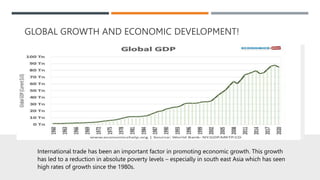
GLOBAL GROWTH AND ECONOMIC DEVELOPMENT!
International trade has been an important factor in promoting economic growth. This growth
has led to a reduction in absolute poverty levels – especially in south east Asia which has seen
high rates of growth since the 1980s.
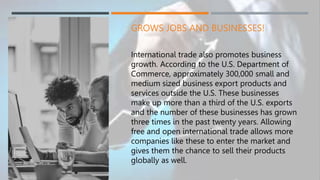
GROWS JOBS AND BUSINESSES!
International trade also promotes business
growth. According to the U.S. Department of
Commerce, approximately 300,000 small and
medium sized business export products and
services outside the U.S. These businesses
make up more than a third of the U.S. exports
and the number of these businesses has grown
three times in the past twenty years. Allowing
free and open international trade allows more
companies like these to enter the market and
gives them the chance to sell their products
globally as well.
GROWS AND STRENGTHEN MARKETS!
Another benefit of international trade is that it fuels
competition, innovation, and economies of scale.
COMPETITION
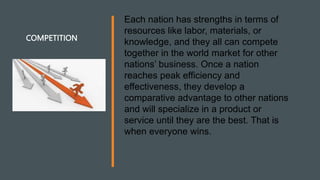
Each nation has strengths in terms of
resources like labor, materials, or
knowledge, and they all can compete
together in the world market for other
nations’ business. Once a nation
reaches peak efficiency and
effectiveness, they develop a
comparative advantage to other nations
and will specialize in a product or
service until they are the best. That is
when everyone wins.
COMPETITION
Consumers are able to purchase from
more options, and sellers compete for
the business by making the best
products and services the most
efficiently. Prohibiting international
trade keeps sellers from entering the
market and does not incentivize the
other nations to produce the best that
they can. The competition is vital for
nations to grow, expand, and innovate
their processes to produce the best
goods and services possible.
 is a key tenet of competition.
Trade gives nations reasons to
discover new ways to produce
goods and services better,
more cheaply, and more
quickly. Countries that only
rely on themselves close
themselves off from new
developments the rest of the
world has to offer.
INNOVATION
 As discussed earlier, international trade promotes job
innovation. Protectionists are often concerned that
the same jobs are not available that once were, and
that is true – new industries often replace the old
ones. A popular example is that in modern America,
there is an abundance of car manufacturers and a
minority of Conestoga wagon makers – whereas in
the 1800s this would not have been the case.
Companies like Samsung create new Blu-ray players
and not as many VHS players (or, more likely, none at
all). As trade progresses, new technology is
developed. Innovation is ignited and better products
are available – in greater numbers. With international
trade, those innovations reach more people who also
must innovate to get ahead. The consumer is able to
win by getting the best products at the best price
available.
INNOVATION
ECONOMIES OF SCALE !
Nations that participate in international trade are able to
develop and strengthen economies of scale for their products
and services. When a nation has the entire globe to trade with,
rather than just its people alone, the marketplace (and
subsequent demand) is larger. More consumers will want a
product or service and nations can lower prices. The more
products and services nations can provide, the cheaper those
products and service can be. That is because the costs can be
spread over more products and drive down the price per unit.
SELF REFLECTION!
I chose the topic because, although it is a broad topic to
discuss however, it is very important that we have an idea
or at least a simple knowledge that will help us in our
everyday living. This course has improved my knowledge,
skills and abilities about International Business to a point
where I feel not only can I use what I’ve learned at work
but also in my personal life I had no knowledge of
International Business and the elements involved. I just
thought as long as you have money you could run a
business. Now that I understand and know more about it, I
feel I can make smart business decisions. I also feel my skill
has not only risen but become sharper because I have
learned the tools necessary to accomplish the goal in
mind, which in return, can make for a great business
market.
THANK YOU

BSBA 3-3 MM IBT FINAL EXAM.pptx

  • 1.
    FINAL EXAM INTERNATIONAL BUSINESSAND TRADE THE IMPORTANCE OF INTERNATIONAL TRADE SUBMITTED BY: JABAGAT, CHABELIN DELROSARIO; BSBA 3-3 MARKETING MANAGEMENT SUBMITTED TO: PROF. ELENA TUBERA; IBT PROFESSOR, CUP
  • 2.
    AGENDA (CONTENTS)  INTERNATIONAL BUSINESSAND TRADE  Meaning  Originated  THE IMPORTANCE OF TRADE  Make use of abundant raw materials  Comparative advantage  Greater choice for consumers  Specialization and economies of scale – greater efficiency  Service sector trade  Global growth and economic development  Grows Jobs and Businesses  Grows and Strengthen Markets  Competition  Innovation  Economies of Scale Up  SELF- REFLECTION!
  • 3.
     International businessrefers to the trade of goods, services, technology, capital and/or knowledge across national borders and at a global or transnational scale. It involves cross- border transactions of goods and services between two or more countries. WHAT IS INTERNATIONAL TRADE?
  • 4.
    ORIGINATED!  Ancient Mesopotamia Trade first began around 3000BC in Ancient Mesopotamia and the Indus Valley. Different materials such as spices, metals, and cloth, were traded. Cities that had more goods to trade became rich. When civilizations got bigger, there were more people who needed more resources.
  • 5.
    THE IMPORTANCE OFTRADE! Make use of abundant raw materials Some countries are naturally abundant in raw materials – oil (Qatar), metals, fish (Iceland), Congo (diamonds) Butter (New Zealand). Without trade, these countries would not benefit from the natural endowments of raw materials.
  • 6.
    THE IMPORTANCE OFTRADE! Make use of abundant raw materials A theoretical model for this was developed by Eli Heckscher and Bertil Ohlin. Known as the Heckscher–Ohlin model (H–O model) it states countries will specialize in producing and exports goods which use abundant local factor endowments. Countries will import those goods, where resources are scarce.
  • 7.
    COMPARATIVE ADVANTAGE! The theoryof comparative advantage states that countries should specialize in those goods where they have a relatively lower opportunity cost. Even if one country can produce two goods at a lower absolute cost– doesn’t mean they should produce everything. India, with lower labour costs, may have a comparative advantage in labour-intensive production (e.g. call centres, clothing manufacture).
  • 8.
    COMPARATIVE ADVANTAGE! Therefore, itwould be efficient for India to export these services and goods. While an economy like the UK may have a comparative advantage in education and video game production. Trade allows countries to specialize. More details on how comparative advantage can increase economic welfare. The theory of comparative advantage has limitations, but it explains at least some aspects of international trade. Therefore, it would be efficient for India to export these services and goods. While an economy like the UK may have a comparative advantage in education and video game production. Trade allows countries to specialise. More details on how comparative advantage can increase economic welfare. The theory of comparative advantage has limitations, but it explains at least some aspects of international trade.
  • 9.
    GREATER CHOICE FORCONSUMERS! Places less emphasis on comparative advantage and relative input costs. New trade theory states that in the real world, a driving factor behind the trade is giving consumers greater choice of differentiated products. We import BMW cars from Germany, not because they are the cheapest but because of the quality and brand image. Regarding music and film, trade enables the widest choice of music and film to appeal to different tastes. When the Beatles went on tour to the US in the 1960s, it was exporting British music – relative labour costs were unimportant.
  • 10.
    GREATER CHOICE FORCONSUMERS! Perhaps the best example is with goods like clothing. Some clothing (e.g. value clothes from Primark – price is very important and they are likely to be imported from low-labour cost countries like Bangladesh. However, we also import fashion labels Gucci (Italy) Chanel (France). Here consumers are benefitting from choice, rather than the lowest price. Economists argue that international trade often fits the model of monopolistic competition. In this model, the important aspect is brand differentiation. For many goods, we want to buy goods with strong brands and reputations. e.g. the popularity of Coca- Cola, Nike, Addidas, McDonalds e.t.c.
  • 11.
    SPECIALIZATION AND ECONOMIESOF SCALE – GREATER EFFICIENCY!  Another aspect of new trade theory is that it doesn’t really matter what countries specialize in, the important thing is to pursue specialization and this enables companies to benefit from economic scale which outweigh most other factors. Sometimes, countries may specialize in particular industries for no over-riding reason – it may just be a historical accident. But, that specialization enables improved efficiency.  For high value-added products, multinationals often split the production process into a global production system. For example, Apple designs their computers in the US but contract the production to Asian factories. Trade enables a product to have multiple country sources. With car production, the productive process is often even more global with engines, tyres, design and marketing all potentially coming from different countries.
  • 12.
     Trade tendsto conjure images of physical goods import bananas, export cars. But, increasingly the service sector economy means more trade is of invisibles – services, such as insurance, IT services and banking. Even in making this website, It sometimes outsource IT services to developers in other countries. It may be for jobs as small as $50. Furthermore, It may export a revision guide for £7.49 to countries all around the world. A global economy with modern communications enables many micro trades, which wouldn’t have been as possible in a pre-internet age. SERVICE SECTOR TRADE
  • 13.
    GLOBAL GROWTH ANDECONOMIC DEVELOPMENT! International trade has been an important factor in promoting economic growth. This growth has led to a reduction in absolute poverty levels – especially in south east Asia which has seen high rates of growth since the 1980s.
  • 14.
    GROWS JOBS ANDBUSINESSES! International trade also promotes business growth. According to the U.S. Department of Commerce, approximately 300,000 small and medium sized business export products and services outside the U.S. These businesses make up more than a third of the U.S. exports and the number of these businesses has grown three times in the past twenty years. Allowing free and open international trade allows more companies like these to enter the market and gives them the chance to sell their products globally as well.
  • 15.
    GROWS AND STRENGTHENMARKETS! Another benefit of international trade is that it fuels competition, innovation, and economies of scale.
  • 16.
    COMPETITION Each nation hasstrengths in terms of resources like labor, materials, or knowledge, and they all can compete together in the world market for other nations’ business. Once a nation reaches peak efficiency and effectiveness, they develop a comparative advantage to other nations and will specialize in a product or service until they are the best. That is when everyone wins.
  • 17.
    COMPETITION Consumers are ableto purchase from more options, and sellers compete for the business by making the best products and services the most efficiently. Prohibiting international trade keeps sellers from entering the market and does not incentivize the other nations to produce the best that they can. The competition is vital for nations to grow, expand, and innovate their processes to produce the best goods and services possible.
  • 18.
     is akey tenet of competition. Trade gives nations reasons to discover new ways to produce goods and services better, more cheaply, and more quickly. Countries that only rely on themselves close themselves off from new developments the rest of the world has to offer. INNOVATION
  • 19.
     As discussedearlier, international trade promotes job innovation. Protectionists are often concerned that the same jobs are not available that once were, and that is true – new industries often replace the old ones. A popular example is that in modern America, there is an abundance of car manufacturers and a minority of Conestoga wagon makers – whereas in the 1800s this would not have been the case. Companies like Samsung create new Blu-ray players and not as many VHS players (or, more likely, none at all). As trade progresses, new technology is developed. Innovation is ignited and better products are available – in greater numbers. With international trade, those innovations reach more people who also must innovate to get ahead. The consumer is able to win by getting the best products at the best price available. INNOVATION
  • 20.
    ECONOMIES OF SCALE! Nations that participate in international trade are able to develop and strengthen economies of scale for their products and services. When a nation has the entire globe to trade with, rather than just its people alone, the marketplace (and subsequent demand) is larger. More consumers will want a product or service and nations can lower prices. The more products and services nations can provide, the cheaper those products and service can be. That is because the costs can be spread over more products and drive down the price per unit.
  • 21.
    SELF REFLECTION! I chosethe topic because, although it is a broad topic to discuss however, it is very important that we have an idea or at least a simple knowledge that will help us in our everyday living. This course has improved my knowledge, skills and abilities about International Business to a point where I feel not only can I use what I’ve learned at work but also in my personal life I had no knowledge of International Business and the elements involved. I just thought as long as you have money you could run a business. Now that I understand and know more about it, I feel I can make smart business decisions. I also feel my skill has not only risen but become sharper because I have learned the tools necessary to accomplish the goal in mind, which in return, can make for a great business market.
  • 22.