





Chapter 22Chapter 22
Developing Countries:Developing Countries:
Growth, Crisis, and ReformGrowth, Crisis, and Reform
Prepared by Iordanis Petsas
To Accompany
International Economics: Theory and PolicyInternational Economics: Theory and Policy, Sixth Edition
by Paul R. Krugman and Maurice Obstfeld
 Introduction
 Income, Wealth, and Growth in the World Economy
 Structural Features of Developing Countries
 Developing Country Borrowing and Debt
 Latin America: From Crisis to Uneven Reform
 East Asia: Success and Crisis
 Lessons of Developing Country Crises
 Reforming the World’s Financial “Architecture”
 Summary
Chapter Organization
Introduction
 The macroeconomic problems of the world’s
developing countries affect the stability of the entire
international economy.
• There has been greater economic dependency between
developing and industrial countries since WWII.
 This chapter examines the macroeconomic problems
of developing countries and the repercussions of
those problems on the developed countries.
• Example: Causes and effects of the East Asian
financial crisis in 1997
 The Gap Between Rich and Poor
• The world's economies can be divided into four main
categories according to their annual per-capita income
levels:
– Low-income economies
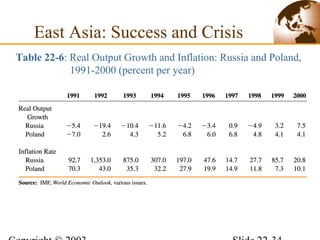
– Lower middle-income economies
– Upper middle-income economies
– High-income economies
Income, Wealth, and Growth
In the World Economy
Income, Wealth, and Growth
in the World Economy
Table 22-1: Indicators of Economic Welfare in Four Groups
of Countries, 1999
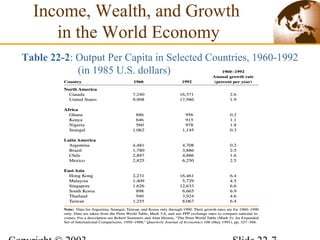
 Has the World Income Gap Narrowed Over Time?
• Industrial countries have shown convergence in their
per capita incomes.
• Developing countries have not shown a uniform
tendency of convergence to the income levels of
industrial countries.
– Countries in Africa and Latin America have grown at
very low rates.
– East Asian countries have tended to grow at very high
rates.
Income, Wealth, and Growth
in the World Economy
Income, Wealth, and Growth
in the World Economy
Table 22-2: Output Per Capita in Selected Countries, 1960-1992
(in 1985 U.S. dollars)
Structural Features of
Developing Countries
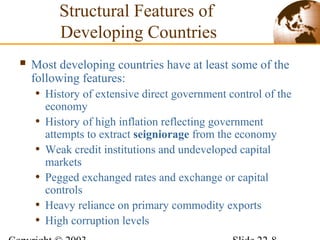
 Most developing countries have at least some of the
following features:
• History of extensive direct government control of the
economy
• History of high inflation reflecting government
attempts to extract seigniorage from the economy
• Weak credit institutions and undeveloped capital
markets
• Pegged exchanged rates and exchange or capital
controls
• Heavy reliance on primary commodity exports
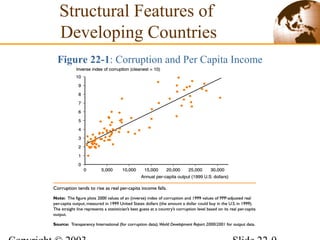
• High corruption levels
Figure 22-1: Corruption and Per Capita Income
Structural Features of
Developing Countries
Developing Country
Borrowing and Debt
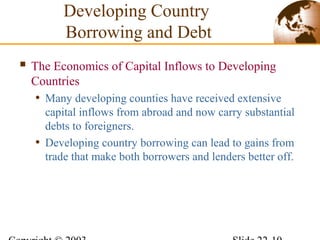
 The Economics of Capital Inflows to Developing
Countries
• Many developing counties have received extensive
capital inflows from abroad and now carry substantial
debts to foreigners.
• Developing country borrowing can lead to gains from
trade that make both borrowers and lenders better off.
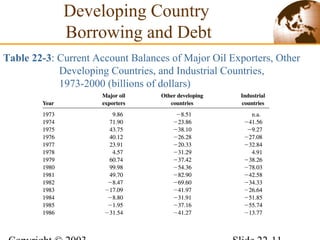
Table 22-3: Current Account Balances of Major Oil Exporters, Other
Developing Countries, and Industrial Countries,
1973-2000 (billions of dollars)
Developing Country
Borrowing and Debt
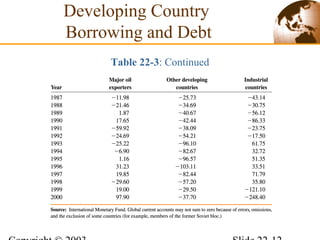
Table 22-3: Continued
Developing Country
Borrowing and Debt
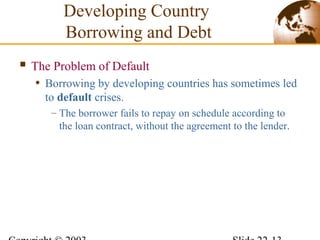
 The Problem of Default
• Borrowing by developing countries has sometimes led
to default crises.
– The borrower fails to repay on schedule according to
the loan contract, without the agreement to the lender.
Developing Country
Borrowing and Debt
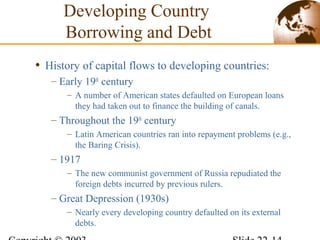
• History of capital flows to developing countries:
– Early 19th
century
– A number of American states defaulted on European loans
they had taken out to finance the building of canals.
– Throughout the 19th
century
– Latin American countries ran into repayment problems (e.g.,
the Baring Crisis).
– 1917
– The new communist government of Russia repudiated the
foreign debts incurred by previous rulers.
– Great Depression (1930s)
– Nearly every developing country defaulted on its external
debts.
Developing Country
Borrowing and Debt
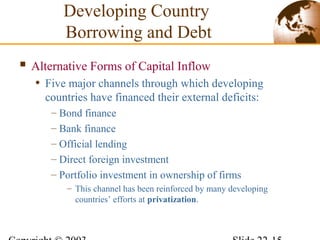
 Alternative Forms of Capital Inflow
• Five major channels through which developing
countries have financed their external deficits:
– Bond finance
– Bank finance
– Official lending
– Direct foreign investment
– Portfolio investment in ownership of firms
– This channel has been reinforced by many developing
countries’ efforts at privatization.
Developing Country
Borrowing and Debt
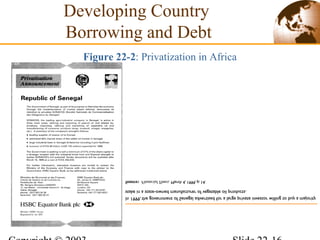
Figure 22-2: Privatization in Africa
Developing Country
Borrowing and Debt
• The five types of finance can be classified into two
categories:
– Debt finance
– Bond, bank, and official finance
– Equity finance
– Direct investment and portfolio purchases of stock shares
Developing Country
Borrowing and Debt
Latin America:
From Crisis to Uneven Reform
 Inflation and the 1980s Debt Crisis in Latin America
• In the 1970s, as the Bretton Woods system collapsed,
countries in Latin America entered an era of inferior
macroeconomic performance.
• Unsuccessful Assaults on Inflation: The Tablitas of
the 1970s
– 1978
– Argentina, Chile, and Uruguay all turned to a new exchange-
rate-based strategy in the hope of taming inflation.
– Tablita
– It is a preannounced schedule of declining rates of domestic
currency depreciation against the U.S. dollar.
– It is a type of exchange rate regime known as a crawling peg.
– It declined the rate of currency depreciation against the dollar
by reducing the rate of increase in the prices of internationally
tradable goods to force overall inflation down.
Latin America:
From Crisis to Uneven Reform
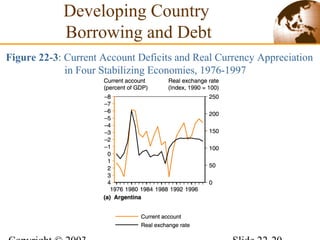
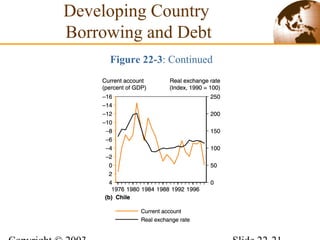
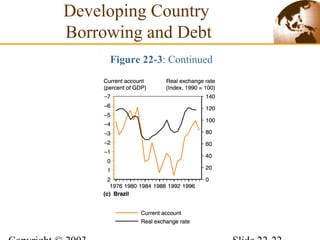
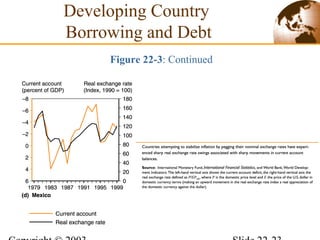
Figure 22-3: Current Account Deficits and Real Currency Appreciation
in Four Stabilizing Economies, 1976-1997
Developing Country
Borrowing and Debt
Figure 22-3: Continued
Developing Country
Borrowing and Debt
Developing Country
Borrowing and Debt
Figure 22-3: Continued
Developing Country
Borrowing and Debt
Figure 22-3: Continued
• The Debt Crisis of the 1980s
– The great recession of the early 1980s sparked a crisis
over developing country debt.
– The shift to contractionary policy by the U.S. led to:
– The fall in industrial countries' aggregate demand
– An immediate and spectacular rise in the interest burden debtor
countries had to pay
– A sharp appreciation of the dollar
– A collapse in the primary commodity prices
– The crisis began in August 1982 when Mexico’s central
bank could no longer pay its $80 billion in foreign debt.
– By the end of 1986 more than 40 countries had
encountered several external financial problems.
Developing Country
Borrowing and Debt
 Reforms, Capital Inflows, and the Return of Crisis
• Argentina
– 1970s – It tried unsuccessfully to stabilize inflation
through a crawling peg.
– 1980s – It implemented successive inflation
stabilization plans involving currency reforms, price
controls, and other measures.
– 1990s – It adopted a currency board (peso-dollar peg).
– 2001-2002 – It defaulted on its debts and abandoned the
peso-dollar peg.
Developing Country
Borrowing and Debt
• Brazil
– 1980s – It suffered runaway inflation and multiple
failed attempts at stabilization accompanied by currency
reforms.
– 1990s – It introduced a new currency (the real pegged to
the dollar), defended it with high interest rates, and
decreased inflation under 10%.
• Chile
– 1980s – It implemented more reforms and used a
crawling peg type of exchange rate regime to bring
inflation down gradually.
– 1990-1997 – It enjoyed an average growth rate of more
than 8% per year and a 20% inflation decrease.
Developing Country
Borrowing and Debt
• Mexico
– 1987 – It introduced a broad stabilization and reform
program and fixed its peso’s exchange rate against the
U.S. dollar.
– 1989-1991 – It moved to a crawling peg and crawling
band.
– 1994 – It joined the North American Free Trade Area
and achieved 7% inflation.
Developing Country
Borrowing and Debt
East Asia: Success and Crisis
 The East Asian Economic Miracle
• Until 1997 the countries of East Asia were having very
high growth rates.
• What are the ingredients for the success of the East
Asian Miracle?
– High saving and investment rates
– Strong emphasis on education
– Stable macroeconomic environment
– Free from high inflation or major economic slumps
– High share of trade in GDP
East Asia: Success and Crisis
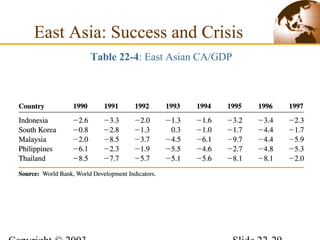
Table 22-4: East Asian CA/GDP
 Asian Weaknesses
• Three weaknesses in the Asian economies’ structures
became apparent with the 1997 financial crisis:
– Productivity
– Rapid growth of production inputs but little increase in the
output per unit of input
– Banking regulation
– Poor state of banking regulation
– Legal framework
– Lack of a good legal framework for dealing with companies in
trouble
East Asia: Success and Crisis
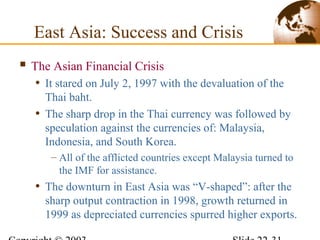
 The Asian Financial Crisis
• It stared on July 2, 1997 with the devaluation of the
Thai baht.
• The sharp drop in the Thai currency was followed by
speculation against the currencies of: Malaysia,
Indonesia, and South Korea.
– All of the afflicted countries except Malaysia turned to
the IMF for assistance.
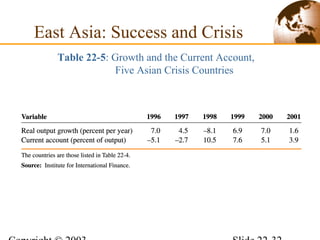
• The downturn in East Asia was “V-shaped”: after the
sharp output contraction in 1998, growth returned in
1999 as depreciated currencies spurred higher exports.
East Asia: Success and Crisis
Table 22-5: Growth and the Current Account,
Five Asian Crisis Countries
 Crises in Other Developing Regions
• Russia’s Crisis
– 1989 – It embarked on transitions from centrally
planned economic allocation to the market.
– These transitions involved: rapid inflation, steep output
declines, and unemployment.
– 1997 – It managed to stabilize the ruble and reduce
inflation with the help of IMF credits.
– 2000 – It enjoyed a rapid growth rate.
East Asia: Success and Crisis
Table 22-6: Real Output Growth and Inflation: Russia and Poland,
1991-2000 (percent per year)
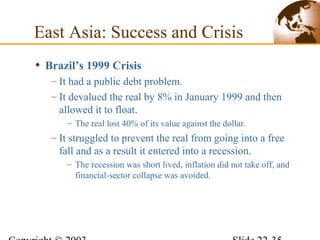
• Brazil’s 1999 Crisis
– It had a public debt problem.
– It devalued the real by 8% in January 1999 and then
allowed it to float.
– The real lost 40% of its value against the dollar.
– It struggled to prevent the real from going into a free
fall and as a result it entered into a recession.
– The recession was short lived, inflation did not take off, and
financial-sector collapse was avoided.
East Asia: Success and Crisis
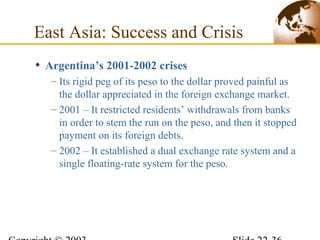
• Argentina’s 2001-2002 crises
– Its rigid peg of its peso to the dollar proved painful as
the dollar appreciated in the foreign exchange market.
– 2001 – It restricted residents’ withdrawals from banks
in order to stem the run on the peso, and then it stopped
payment on its foreign debts.
– 2002 – It established a dual exchange rate system and a
single floating-rate system for the peso.
East Asia: Success and Crisis
Lessons of Developing
Country Crises
 The lessons from developing country crises are
summarized as:
• Choosing the right exchange rate regime
• The central importance of banking
• The proper sequence of reform measures
• The importance of contagion
Reforming the World’s
Financial “Architecture”
 The Asian crisis convinced nearly everyone of an
urgent need for rethinking international monetary
relations because of two reasons:
• The fact that the East Asian countries had few
apparent problems before their crisis struck
• The apparent strength of contagion through the
international capital markets
 Capital Mobility and the Trilemma of the Exchange
Rate Regime
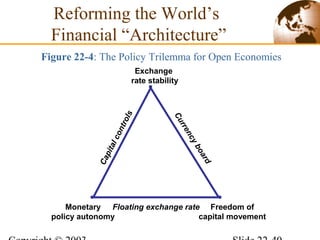
• The macroeconomic policy trilemma for open
economies:
– Independence in monetary policy
– Stability in the exchange rate
– Free movement of capital
• Only two of the three goals can be reached
simultaneously.
• Exchange rate stability is more important for
developing than developed countries.
Reforming the World’s
Financial “Architecture”
Reforming the World’s
Financial “Architecture”
Figure 22-4: The Policy Trilemma for Open Economies
Currencyboard
Capitalcontrols
Floating exchange rate
Exchange
rate stability
Freedom of
capital movement
Monetary
policy autonomy
 Proposals to reform the international architecture can
be grouped as preventive measures or as ex-post
measures.
 “Prophylactic” Measures
• Among preventive measures are:
– More “transparency”
– Stronger banking systems
– Enhanced credit lines
– Increased equity capital inflows relative to debt inflows
• The effectiveness of these measures is controversial.
Reforming the World’s
Financial “Architecture”
 Coping with Crisis
• The ex-post measures that have been suggested
include:
– More extensive lending by the IMF
– “Chapter 11” bankruptcy proceeding for the orderly
resolution of creditor claims on developing countries
that cannot pay in full.
Reforming the World’s
Financial “Architecture”
 A Confused Future
• In the years to come, developing countries will
experiment with:
– Floating exchange rates
– Capital controls
– Currency boards
– Abolition of national currencies and adoption of the
dollar or euro for domestic transactions
Reforming the World’s
Financial “Architecture”
Summary
 There are vast differences in per-capita income
between countries at different stages of economic
development.
 Because many developing economies offer
potentially rich opportunities for investment, it is
natural that they have current account deficits and
borrow from richer countries.
 In the 1970s countries in Latin America entered an
era of distinctly inferior macroeconomic
performance.
Summary
 Despite their excellent records of high output growth
and low inflation, key developing countries in East
Asia were hit by currency depreciation in 1997.
 Proposals to reform the international architecture can
be grouped as preventive measures or as ex-post
measures.
• The architecture that will ultimately emerge is not at
all clear.

International economic ch22

  • 1.
    Chapter 22Chapter 22 DevelopingCountries:Developing Countries: Growth, Crisis, and ReformGrowth, Crisis, and Reform Prepared by Iordanis Petsas To Accompany International Economics: Theory and PolicyInternational Economics: Theory and Policy, Sixth Edition by Paul R. Krugman and Maurice Obstfeld
  • 2.
     Introduction  Income,Wealth, and Growth in the World Economy  Structural Features of Developing Countries  Developing Country Borrowing and Debt  Latin America: From Crisis to Uneven Reform  East Asia: Success and Crisis  Lessons of Developing Country Crises  Reforming the World’s Financial “Architecture”  Summary Chapter Organization
  • 3.
    Introduction  The macroeconomicproblems of the world’s developing countries affect the stability of the entire international economy. • There has been greater economic dependency between developing and industrial countries since WWII.  This chapter examines the macroeconomic problems of developing countries and the repercussions of those problems on the developed countries. • Example: Causes and effects of the East Asian financial crisis in 1997
  • 4.
     The GapBetween Rich and Poor • The world's economies can be divided into four main categories according to their annual per-capita income levels: – Low-income economies – Lower middle-income economies – Upper middle-income economies – High-income economies Income, Wealth, and Growth In the World Economy
  • 5.
    Income, Wealth, andGrowth in the World Economy Table 22-1: Indicators of Economic Welfare in Four Groups of Countries, 1999
  • 6.
     Has theWorld Income Gap Narrowed Over Time? • Industrial countries have shown convergence in their per capita incomes. • Developing countries have not shown a uniform tendency of convergence to the income levels of industrial countries. – Countries in Africa and Latin America have grown at very low rates. – East Asian countries have tended to grow at very high rates. Income, Wealth, and Growth in the World Economy
  • 7.
    Income, Wealth, andGrowth in the World Economy Table 22-2: Output Per Capita in Selected Countries, 1960-1992 (in 1985 U.S. dollars)
  • 8.
    Structural Features of DevelopingCountries  Most developing countries have at least some of the following features: • History of extensive direct government control of the economy • History of high inflation reflecting government attempts to extract seigniorage from the economy • Weak credit institutions and undeveloped capital markets • Pegged exchanged rates and exchange or capital controls • Heavy reliance on primary commodity exports • High corruption levels
  • 9.
    Figure 22-1: Corruptionand Per Capita Income Structural Features of Developing Countries
  • 10.
    Developing Country Borrowing andDebt  The Economics of Capital Inflows to Developing Countries • Many developing counties have received extensive capital inflows from abroad and now carry substantial debts to foreigners. • Developing country borrowing can lead to gains from trade that make both borrowers and lenders better off.
  • 11.
    Table 22-3: CurrentAccount Balances of Major Oil Exporters, Other Developing Countries, and Industrial Countries, 1973-2000 (billions of dollars) Developing Country Borrowing and Debt
  • 12.
    Table 22-3: Continued DevelopingCountry Borrowing and Debt
  • 13.
     The Problemof Default • Borrowing by developing countries has sometimes led to default crises. – The borrower fails to repay on schedule according to the loan contract, without the agreement to the lender. Developing Country Borrowing and Debt
  • 14.
    • History ofcapital flows to developing countries: – Early 19th century – A number of American states defaulted on European loans they had taken out to finance the building of canals. – Throughout the 19th century – Latin American countries ran into repayment problems (e.g., the Baring Crisis). – 1917 – The new communist government of Russia repudiated the foreign debts incurred by previous rulers. – Great Depression (1930s) – Nearly every developing country defaulted on its external debts. Developing Country Borrowing and Debt
  • 15.
     Alternative Formsof Capital Inflow • Five major channels through which developing countries have financed their external deficits: – Bond finance – Bank finance – Official lending – Direct foreign investment – Portfolio investment in ownership of firms – This channel has been reinforced by many developing countries’ efforts at privatization. Developing Country Borrowing and Debt
  • 16.
    Figure 22-2: Privatizationin Africa Developing Country Borrowing and Debt
  • 17.
    • The fivetypes of finance can be classified into two categories: – Debt finance – Bond, bank, and official finance – Equity finance – Direct investment and portfolio purchases of stock shares Developing Country Borrowing and Debt
  • 18.
    Latin America: From Crisisto Uneven Reform  Inflation and the 1980s Debt Crisis in Latin America • In the 1970s, as the Bretton Woods system collapsed, countries in Latin America entered an era of inferior macroeconomic performance.
  • 19.
    • Unsuccessful Assaultson Inflation: The Tablitas of the 1970s – 1978 – Argentina, Chile, and Uruguay all turned to a new exchange- rate-based strategy in the hope of taming inflation. – Tablita – It is a preannounced schedule of declining rates of domestic currency depreciation against the U.S. dollar. – It is a type of exchange rate regime known as a crawling peg. – It declined the rate of currency depreciation against the dollar by reducing the rate of increase in the prices of internationally tradable goods to force overall inflation down. Latin America: From Crisis to Uneven Reform
  • 20.
    Figure 22-3: CurrentAccount Deficits and Real Currency Appreciation in Four Stabilizing Economies, 1976-1997 Developing Country Borrowing and Debt
  • 21.
    Figure 22-3: Continued DevelopingCountry Borrowing and Debt
  • 22.
    Developing Country Borrowing andDebt Figure 22-3: Continued
  • 23.
    Developing Country Borrowing andDebt Figure 22-3: Continued
  • 24.
    • The DebtCrisis of the 1980s – The great recession of the early 1980s sparked a crisis over developing country debt. – The shift to contractionary policy by the U.S. led to: – The fall in industrial countries' aggregate demand – An immediate and spectacular rise in the interest burden debtor countries had to pay – A sharp appreciation of the dollar – A collapse in the primary commodity prices – The crisis began in August 1982 when Mexico’s central bank could no longer pay its $80 billion in foreign debt. – By the end of 1986 more than 40 countries had encountered several external financial problems. Developing Country Borrowing and Debt
  • 25.
     Reforms, CapitalInflows, and the Return of Crisis • Argentina – 1970s – It tried unsuccessfully to stabilize inflation through a crawling peg. – 1980s – It implemented successive inflation stabilization plans involving currency reforms, price controls, and other measures. – 1990s – It adopted a currency board (peso-dollar peg). – 2001-2002 – It defaulted on its debts and abandoned the peso-dollar peg. Developing Country Borrowing and Debt
  • 26.
    • Brazil – 1980s– It suffered runaway inflation and multiple failed attempts at stabilization accompanied by currency reforms. – 1990s – It introduced a new currency (the real pegged to the dollar), defended it with high interest rates, and decreased inflation under 10%. • Chile – 1980s – It implemented more reforms and used a crawling peg type of exchange rate regime to bring inflation down gradually. – 1990-1997 – It enjoyed an average growth rate of more than 8% per year and a 20% inflation decrease. Developing Country Borrowing and Debt
  • 27.
    • Mexico – 1987– It introduced a broad stabilization and reform program and fixed its peso’s exchange rate against the U.S. dollar. – 1989-1991 – It moved to a crawling peg and crawling band. – 1994 – It joined the North American Free Trade Area and achieved 7% inflation. Developing Country Borrowing and Debt
  • 28.
    East Asia: Successand Crisis  The East Asian Economic Miracle • Until 1997 the countries of East Asia were having very high growth rates. • What are the ingredients for the success of the East Asian Miracle? – High saving and investment rates – Strong emphasis on education – Stable macroeconomic environment – Free from high inflation or major economic slumps – High share of trade in GDP
  • 29.
    East Asia: Successand Crisis Table 22-4: East Asian CA/GDP
  • 30.
     Asian Weaknesses •Three weaknesses in the Asian economies’ structures became apparent with the 1997 financial crisis: – Productivity – Rapid growth of production inputs but little increase in the output per unit of input – Banking regulation – Poor state of banking regulation – Legal framework – Lack of a good legal framework for dealing with companies in trouble East Asia: Success and Crisis
  • 31.
     The AsianFinancial Crisis • It stared on July 2, 1997 with the devaluation of the Thai baht. • The sharp drop in the Thai currency was followed by speculation against the currencies of: Malaysia, Indonesia, and South Korea. – All of the afflicted countries except Malaysia turned to the IMF for assistance. • The downturn in East Asia was “V-shaped”: after the sharp output contraction in 1998, growth returned in 1999 as depreciated currencies spurred higher exports. East Asia: Success and Crisis
  • 32.
    East Asia: Successand Crisis Table 22-5: Growth and the Current Account, Five Asian Crisis Countries
  • 33.
     Crises inOther Developing Regions • Russia’s Crisis – 1989 – It embarked on transitions from centrally planned economic allocation to the market. – These transitions involved: rapid inflation, steep output declines, and unemployment. – 1997 – It managed to stabilize the ruble and reduce inflation with the help of IMF credits. – 2000 – It enjoyed a rapid growth rate. East Asia: Success and Crisis
  • 34.
    East Asia: Successand Crisis Table 22-6: Real Output Growth and Inflation: Russia and Poland, 1991-2000 (percent per year)
  • 35.
    • Brazil’s 1999Crisis – It had a public debt problem. – It devalued the real by 8% in January 1999 and then allowed it to float. – The real lost 40% of its value against the dollar. – It struggled to prevent the real from going into a free fall and as a result it entered into a recession. – The recession was short lived, inflation did not take off, and financial-sector collapse was avoided. East Asia: Success and Crisis
  • 36.
    • Argentina’s 2001-2002crises – Its rigid peg of its peso to the dollar proved painful as the dollar appreciated in the foreign exchange market. – 2001 – It restricted residents’ withdrawals from banks in order to stem the run on the peso, and then it stopped payment on its foreign debts. – 2002 – It established a dual exchange rate system and a single floating-rate system for the peso. East Asia: Success and Crisis
  • 37.
    Lessons of Developing CountryCrises  The lessons from developing country crises are summarized as: • Choosing the right exchange rate regime • The central importance of banking • The proper sequence of reform measures • The importance of contagion
  • 38.
    Reforming the World’s Financial“Architecture”  The Asian crisis convinced nearly everyone of an urgent need for rethinking international monetary relations because of two reasons: • The fact that the East Asian countries had few apparent problems before their crisis struck • The apparent strength of contagion through the international capital markets
  • 39.
     Capital Mobilityand the Trilemma of the Exchange Rate Regime • The macroeconomic policy trilemma for open economies: – Independence in monetary policy – Stability in the exchange rate – Free movement of capital • Only two of the three goals can be reached simultaneously. • Exchange rate stability is more important for developing than developed countries. Reforming the World’s Financial “Architecture”
  • 40.
    Reforming the World’s Financial“Architecture” Figure 22-4: The Policy Trilemma for Open Economies Currencyboard Capitalcontrols Floating exchange rate Exchange rate stability Freedom of capital movement Monetary policy autonomy
  • 41.
     Proposals toreform the international architecture can be grouped as preventive measures or as ex-post measures.  “Prophylactic” Measures • Among preventive measures are: – More “transparency” – Stronger banking systems – Enhanced credit lines – Increased equity capital inflows relative to debt inflows • The effectiveness of these measures is controversial. Reforming the World’s Financial “Architecture”
  • 42.
     Coping withCrisis • The ex-post measures that have been suggested include: – More extensive lending by the IMF – “Chapter 11” bankruptcy proceeding for the orderly resolution of creditor claims on developing countries that cannot pay in full. Reforming the World’s Financial “Architecture”
  • 43.
     A ConfusedFuture • In the years to come, developing countries will experiment with: – Floating exchange rates – Capital controls – Currency boards – Abolition of national currencies and adoption of the dollar or euro for domestic transactions Reforming the World’s Financial “Architecture”
  • 44.
    Summary  There arevast differences in per-capita income between countries at different stages of economic development.  Because many developing economies offer potentially rich opportunities for investment, it is natural that they have current account deficits and borrow from richer countries.  In the 1970s countries in Latin America entered an era of distinctly inferior macroeconomic performance.
  • 45.
    Summary  Despite theirexcellent records of high output growth and low inflation, key developing countries in East Asia were hit by currency depreciation in 1997.  Proposals to reform the international architecture can be grouped as preventive measures or as ex-post measures. • The architecture that will ultimately emerge is not at all clear.