
MKTG7037 / MKTG2032 E-marketing Week 5
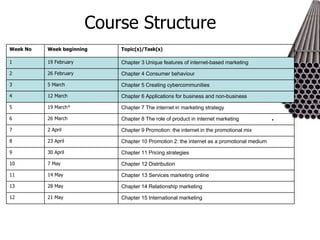
Course Structure Chapter 15 International marketing 21 May 12 Chapter 14 Relationship marketing 28 May 13 Chapter 13 Services marketing online 14 May 11 Chapter 12 Distribution 7 May 10 Chapter 11 Pricing strategies 30 April 9 Chapter 10 Promotion 2: the internet as a promotional medium 23 April 8 Chapter 9 Promotion: the internet in the promotional mix 2 April 7 Chapter 8 The role of product in internet marketing 26 March 6 Chapter 7 The internet in marketing strategy 19 March* 5 Chapter 6 Applications for business and non-business 12 March 4 Chapter 5 Creating cybercommunities 5 March 3 Chapter 4 Consumer behaviour 26 February 2 Chapter 3 Unique features of internet-based marketing 19 February  1 Topic(s)/Task(s) Week beginning Week No
Assessment Due Dates Task  Weighting Due Essay Registration 01 March 16 Solo Assignment 20 March 26 Group-Optional Essay 29 May 21 Final Examination 30 June Online Forum 20 During semester
Solo Assignment Due: March 26, Monday Week 6, no later than 7pm.  Electronic Upload via WebCT Topic: “Hype or Hope? The value of a new technology for marketing” This assessment item is a solo paper where the student examines value of a contemporary technology for marketing practice. The list of contemporary technology includes: RFID tags for marketing and marketing research m-commerce, including m-gaming, m-gambling and m-shopping MMORPG environments such as Second Life social media marketing  online viral marketing  You are expected to write between 1000 and 1500 words addressing the value of one of the five topic areas for marketing, using references to marketing theory, practice and internet theory.  Full referencing is expected. Penalties apply for not using references.
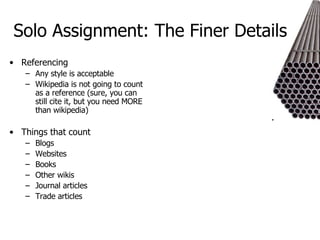
Solo Assignment: The Finer Details Referencing Any style is acceptable Wikipedia is not going to count as a reference (sure, you can still cite it, but you need MORE than wikipedia) Things that count Blogs  Websites  Books Other wikis Journal articles Trade articles
Solo Assignment II: Expectations 1000 to 1500 Don’t go over, don’t go under Addressing the value of the topic areas for marketing using references to  marketing theory,  practice and  internet theory.  Needs to have a conclusion Is your topic area hype or hope? Saying maybe won’t cut it this time. BE BIASED.
Stepping back a week or two  That's happening because the team at Threadless understands that online communities don't create around the idea of being monetized, they create around a shared interest and passion. Online communities aren't simply waiting for you to find a way to make money off them. (Again if anyone needs a moment, feel free... .)  http://www.mpdailyfix.com/2007/03/how_threadless_creates_online_1.html
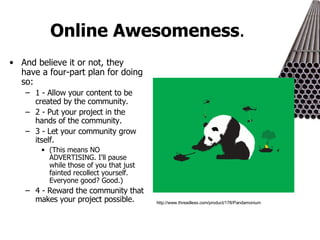
Online Awesomeness .  And believe it or not, they have a four-part plan for doing so: 1 - Allow your content to be created by the community. 2 - Put your project in the hands of the community. 3 - Let your community grow itself.  (This means NO ADVERTISING. I'll pause while those of you that just fainted recollect yourself. Everyone good? Good.) 4 - Reward the community that makes your project possible. http://www.threadless.com/product/178/Pandamonium
The internet in marketing strategy
Managerial activities associated with marketing  Researching the market Developing market segmentation strategies Targeting key segments Creating positioning strategies for the product Developing marketing mix  Conducting all the above to achieve organisational goals
SMART concept Objectives need to address the SMART concept: Specific Measurable Actionable Realistic Timetabled Ask the question: what is the company trying to achieve by going online?
Common Internet objectives Common Internet strategic objectives can include: Enhancing communications Increasing online sales Improving customer service Increasing market share
Web site and marketing  Valuable for conveying information Cost-effective in reaching target markets Effective in obtaining consumer action Ineffective for long- and short-term promotions Not effective in grabbing attention Less effective in relation to changing or maintaining attitudes
Online marketing objectives Cost-oriented objectives Sales-oriented objectives Behavioural change objectives Information dissemination objectives Promotional objectives Entertainment-oriented objectives
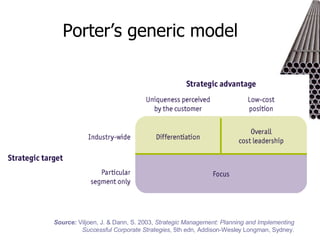
Porter’s generic model Source:  Viljoen, J. & Dann, S. 2003,  Strategic Management: Planning and Implementing Successful Corporate Strategies , 5th edn, Addison-Wesley Longman, Sydney.
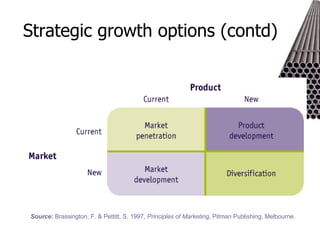
Strategic growth options Market penetration Market development Product development Diversification
Strategic growth options (contd) Source:   Brassington, F. & Pettitt, S. 1997,  Principles of Marketing , Pitman Publishing, Melbourne.
Segmentation Sarabia (1996) suggests that segmentation can be broken into four tasks, namely: Describing the segments Comparing the segment to the firm’s requirements Selecting the most interesting segment Making the marketing mix decisions.
Information for online segmentation For online segmentation a marketer needs the following information: Online usage patterns Internet experience Familiarity Usefulness of the site Technical characteristic
A four-stage analysis  A four-stage analysis used to understand segmentation: Study the segment. Analyse the firm in relation to the segment. Analyse the effects of the firm’s decision about the segment. Finally evaluate and construct an evaluation matrix.
Positioning  Positioning strategies are determined by aligning the company and the product offerings within the marketplace in relation to the other competitors and their products.
Positioning Generic positioning methods through: Attributes and benefits Price quality Use or application Product class Product user Competitor positioning Cultural symbol positioning
Online branding Online branding begins with the domain name and the selection of a regional or global orientation.  For example, Procter & Gamble ( www.pg.com ) owns a range of brand name-specific domain names for its primary products, such as Vicks ( www.vicks.com ) and Pringles ( www.pringles.com )
Online branding Brands also play a major role in the reduction of perceived risk associated with shopping online. Also, branding web pages can be used to create, develop and maintain image associations with known (or soon-to-be-known) brands by careful site design and positioning.
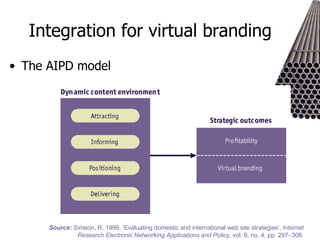
Strategic integration Integration is where the marketing mix, positioning and strategic objectives are integrated into a single coherent outcome to be acted upon in the implementation. The role of strategic Internet marketing is to bring the whole package together online and to enable the marketing mix, the web site, and the company’s on- and offline objectives to integrate smoothly for maximum benefits.
Integration for virtual branding The AIPD model Source:   Simeon, R. 1999, ‘Evaluating domestic and international web site strategies’,  Internet Research Electronic Networking Applications and Policy , vol. 9, no. 4, pp. 297–308.
Blueprinting Blueprint decisions are critical to overall organisational success. They may cut across several product lines or divisional boundaries. They frequently require the resolution of cross-functional conflict.
Budgeting  Determining an Internet budget: Last year’s budget + increases Based on percentage of company’s sales Percentage of overall marketing budget Reallocation of existing marketing budget Competitors’ budgets and activities Needs and creating an effective online presence A graduated plan linked to results
Unlocking the Internet’s potential View the Internet as an adjunct. Use email strategically. Crosspollinate. Provide extra value. Analyse content and use.
Unlocking the Internet’s potential (contd) Repurpose material. Design with online in mind. Plan frequent revisions. Manage for the long term. Set reasonable goals.
Discussion Questions for the Board Explain the importance of integrating the activities of the web site and Internet marketing into the organisation’s overall marketing strategy and business activities Read  "The Future is Collaborative" . Do you agree or disagree with the author's position?  Give reasons and justifications for your position.

E Marketing Week05

  • 1.
    MKTG7037 / MKTG2032E-marketing Week 5
  • 2.
    Course Structure Chapter15 International marketing 21 May 12 Chapter 14 Relationship marketing 28 May 13 Chapter 13 Services marketing online 14 May 11 Chapter 12 Distribution 7 May 10 Chapter 11 Pricing strategies 30 April 9 Chapter 10 Promotion 2: the internet as a promotional medium 23 April 8 Chapter 9 Promotion: the internet in the promotional mix 2 April 7 Chapter 8 The role of product in internet marketing 26 March 6 Chapter 7 The internet in marketing strategy 19 March* 5 Chapter 6 Applications for business and non-business 12 March 4 Chapter 5 Creating cybercommunities 5 March 3 Chapter 4 Consumer behaviour 26 February 2 Chapter 3 Unique features of internet-based marketing 19 February 1 Topic(s)/Task(s) Week beginning Week No
  • 3.
    Assessment Due DatesTask Weighting Due Essay Registration 01 March 16 Solo Assignment 20 March 26 Group-Optional Essay 29 May 21 Final Examination 30 June Online Forum 20 During semester
  • 4.
    Solo Assignment Due:March 26, Monday Week 6, no later than 7pm. Electronic Upload via WebCT Topic: “Hype or Hope? The value of a new technology for marketing” This assessment item is a solo paper where the student examines value of a contemporary technology for marketing practice. The list of contemporary technology includes: RFID tags for marketing and marketing research m-commerce, including m-gaming, m-gambling and m-shopping MMORPG environments such as Second Life social media marketing online viral marketing You are expected to write between 1000 and 1500 words addressing the value of one of the five topic areas for marketing, using references to marketing theory, practice and internet theory. Full referencing is expected. Penalties apply for not using references.
  • 5.
    Solo Assignment: TheFiner Details Referencing Any style is acceptable Wikipedia is not going to count as a reference (sure, you can still cite it, but you need MORE than wikipedia) Things that count Blogs Websites Books Other wikis Journal articles Trade articles
  • 6.
    Solo Assignment II:Expectations 1000 to 1500 Don’t go over, don’t go under Addressing the value of the topic areas for marketing using references to marketing theory, practice and internet theory. Needs to have a conclusion Is your topic area hype or hope? Saying maybe won’t cut it this time. BE BIASED.
  • 7.
    Stepping back aweek or two That's happening because the team at Threadless understands that online communities don't create around the idea of being monetized, they create around a shared interest and passion. Online communities aren't simply waiting for you to find a way to make money off them. (Again if anyone needs a moment, feel free... .) http://www.mpdailyfix.com/2007/03/how_threadless_creates_online_1.html
  • 8.
    Online Awesomeness . And believe it or not, they have a four-part plan for doing so: 1 - Allow your content to be created by the community. 2 - Put your project in the hands of the community. 3 - Let your community grow itself. (This means NO ADVERTISING. I'll pause while those of you that just fainted recollect yourself. Everyone good? Good.) 4 - Reward the community that makes your project possible. http://www.threadless.com/product/178/Pandamonium
  • 9.
    The internet inmarketing strategy
  • 10.
    Managerial activities associatedwith marketing Researching the market Developing market segmentation strategies Targeting key segments Creating positioning strategies for the product Developing marketing mix Conducting all the above to achieve organisational goals
  • 11.
    SMART concept Objectivesneed to address the SMART concept: Specific Measurable Actionable Realistic Timetabled Ask the question: what is the company trying to achieve by going online?
  • 12.
    Common Internet objectivesCommon Internet strategic objectives can include: Enhancing communications Increasing online sales Improving customer service Increasing market share
  • 13.
    Web site andmarketing Valuable for conveying information Cost-effective in reaching target markets Effective in obtaining consumer action Ineffective for long- and short-term promotions Not effective in grabbing attention Less effective in relation to changing or maintaining attitudes
  • 14.
    Online marketing objectivesCost-oriented objectives Sales-oriented objectives Behavioural change objectives Information dissemination objectives Promotional objectives Entertainment-oriented objectives
  • 15.
    Porter’s generic modelSource: Viljoen, J. & Dann, S. 2003, Strategic Management: Planning and Implementing Successful Corporate Strategies , 5th edn, Addison-Wesley Longman, Sydney.
  • 16.
    Strategic growth optionsMarket penetration Market development Product development Diversification
  • 17.
    Strategic growth options(contd) Source: Brassington, F. & Pettitt, S. 1997, Principles of Marketing , Pitman Publishing, Melbourne.
  • 18.
    Segmentation Sarabia (1996)suggests that segmentation can be broken into four tasks, namely: Describing the segments Comparing the segment to the firm’s requirements Selecting the most interesting segment Making the marketing mix decisions.
  • 19.
    Information for onlinesegmentation For online segmentation a marketer needs the following information: Online usage patterns Internet experience Familiarity Usefulness of the site Technical characteristic
  • 20.
    A four-stage analysis A four-stage analysis used to understand segmentation: Study the segment. Analyse the firm in relation to the segment. Analyse the effects of the firm’s decision about the segment. Finally evaluate and construct an evaluation matrix.
  • 21.
    Positioning Positioningstrategies are determined by aligning the company and the product offerings within the marketplace in relation to the other competitors and their products.
  • 22.
    Positioning Generic positioningmethods through: Attributes and benefits Price quality Use or application Product class Product user Competitor positioning Cultural symbol positioning
  • 23.
    Online branding Onlinebranding begins with the domain name and the selection of a regional or global orientation. For example, Procter & Gamble ( www.pg.com ) owns a range of brand name-specific domain names for its primary products, such as Vicks ( www.vicks.com ) and Pringles ( www.pringles.com )
  • 24.
    Online branding Brandsalso play a major role in the reduction of perceived risk associated with shopping online. Also, branding web pages can be used to create, develop and maintain image associations with known (or soon-to-be-known) brands by careful site design and positioning.
  • 25.
    Strategic integration Integrationis where the marketing mix, positioning and strategic objectives are integrated into a single coherent outcome to be acted upon in the implementation. The role of strategic Internet marketing is to bring the whole package together online and to enable the marketing mix, the web site, and the company’s on- and offline objectives to integrate smoothly for maximum benefits.
  • 26.
    Integration for virtualbranding The AIPD model Source: Simeon, R. 1999, ‘Evaluating domestic and international web site strategies’, Internet Research Electronic Networking Applications and Policy , vol. 9, no. 4, pp. 297–308.
  • 27.
    Blueprinting Blueprint decisionsare critical to overall organisational success. They may cut across several product lines or divisional boundaries. They frequently require the resolution of cross-functional conflict.
  • 28.
    Budgeting Determiningan Internet budget: Last year’s budget + increases Based on percentage of company’s sales Percentage of overall marketing budget Reallocation of existing marketing budget Competitors’ budgets and activities Needs and creating an effective online presence A graduated plan linked to results
  • 29.
    Unlocking the Internet’spotential View the Internet as an adjunct. Use email strategically. Crosspollinate. Provide extra value. Analyse content and use.
  • 30.
    Unlocking the Internet’spotential (contd) Repurpose material. Design with online in mind. Plan frequent revisions. Manage for the long term. Set reasonable goals.
  • 31.
    Discussion Questions forthe Board Explain the importance of integrating the activities of the web site and Internet marketing into the organisation’s overall marketing strategy and business activities Read "The Future is Collaborative" . Do you agree or disagree with the author's position?  Give reasons and justifications for your position.