INTERNATIONAL  MARKETING Krista Duniach Université d’Angers [email_address]
BIBLIOGRAPHY Czinkota and Ronkainen (2002),  International Marketing , Thomson South-Western. De Mooij (2003),  Global Marketing and Advertising, Understanding Global Paradoxes , Sage. Keegan and Green (2005),  Global Marketing , Prentice Hall. Kotler and Armstrong (2006),  Principles of Marketing , Prentice Hall. Prime et Usunier (2004),  Marketing international, Développement des marchés et management interculturel , Vuibert. Usunier (2000),  Marketing across Cultures , Prentice Hall. Periodicals: MOCI, HBR, JIBS, JM, JMR…
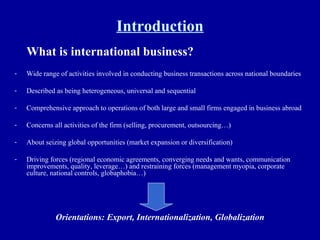
Introduction What is international business? Wide range of activities involved in conducting business transactions across national boundaries Described as being heterogeneous, universal and sequential Comprehensive approach to operations of both large and small firms engaged in business abroad Concerns all activities of the firm (selling, procurement, outsourcing…) About seizing global opportunities (market expansion or diversification) Driving forces (regional economic agreements, converging needs and wants, communication improvements, quality, leverage…) and restraining forces (management myopia, corporate culture, national controls, globaphobia…)  Orientations: Export, Internationalization, Globalization
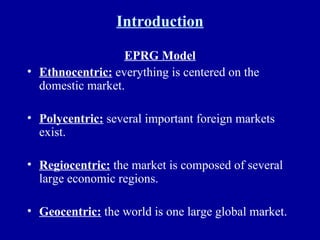
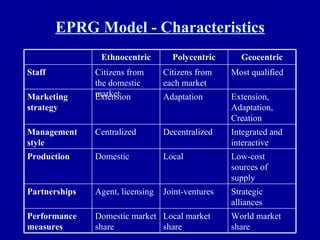
Introduction EPRG Model Ethnocentric:  everything is centered on the domestic market. Polycentric:  several important foreign markets exist. Regiocentric:  the market is composed of several large economic regions. Geocentric:  the world is one large global market.
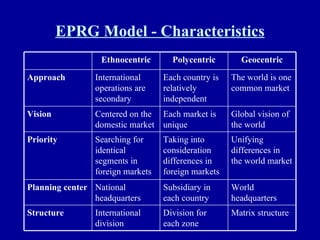
EPRG Model - Characteristics Matrix structure Division for each zone International division Structure World headquarters Subsidiary in each country National headquarters Planning center Unifying differences in the world market Taking into consideration differences in foreign markets Searching for identical segments in foreign markets Priority Global vision of the world Each market is unique Centered on the domestic market Vision The world is one common market Each country is relatively independent International operations are secondary Approach Geocentric Polycentric Ethnocentric
EPRG Model - Characteristics World market share Local market share Domestic market share Performance measures Strategic alliances Joint-ventures Agent, licensing Partnerships Low-cost sources of supply Local Domestic  Production Integrated and interactive Decentralized Centralized Management style Extension, Adaptation, Creation Adaptation Extension Marketing strategy Most qualified Citizens from each market Citizens from the domestic market Staff Geocentric Polycentric Ethnocentric
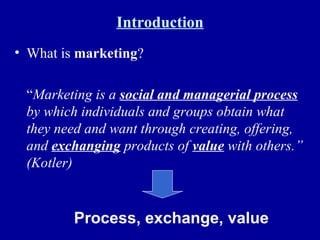
Introduction What is  marketing ? “ Marketing is a  social and managerial process  by which individuals and groups obtain what they need and want through creating, offering, and  exchanging  products of  value  with others.” (Kotler) Process, exchange, value
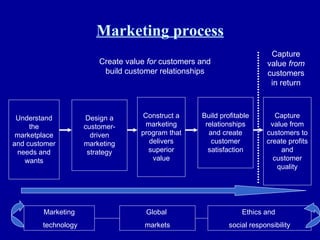
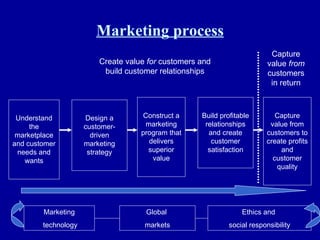
Marketing process Understand the marketplace and customer needs and wants Design a customer-driven marketing strategy Construct a marketing program that delivers superior value Build profitable relationships and create customer satisfaction Capture value from customers to create profits and customer quality Create value  for  customers and build customer relationships Capture value  from  customers in return Marketing technology Global  markets Ethics and  social responsibility
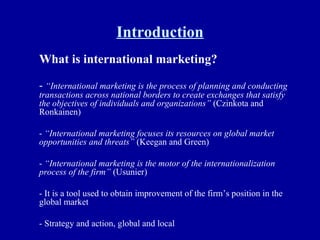
Introduction What is international marketing? -  “International marketing is the process of planning and conducting transactions across national borders to create exchanges that satisfy the objectives of individuals and organizations”  (Czinkota and Ronkainen) -  “International marketing focuses its resources on global market opportunities and threats”  (Keegan and Green) -  “International marketing is the motor of the internationalization process of the firm”  (Usunier) - It is a tool used to obtain improvement of the firm’s position in the global market - Strategy and action, global and local
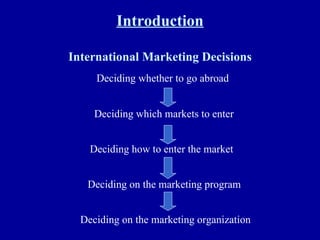
Introduction International Marketing Decisions Deciding whether to go abroad Deciding which markets to enter Deciding how to enter the market Deciding on the marketing program Deciding on the marketing organization
Introduction What are the similarities and differences between international marketing and domestic marketing? Similarities:  basic concepts, practices and tools are almost identical, key success factors are the same… Differences:  more strategic, more variables, more complex, cultural differences, legal constraints, information sources, managing distances, entry mode choice…
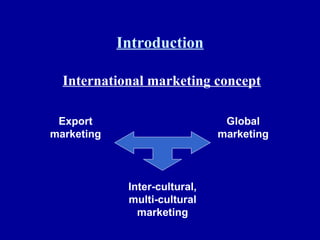
Introduction International marketing concept Export marketing Global marketing Inter-cultural, multi-cultural marketing
Course Outline Culture and international marketing International marketing research International marketing strategy and programs
Chapter 1 Culture and  international marketing
Culture and international marketing Concepts of culture Dimensions and models of culture Examples and international marketing consequences
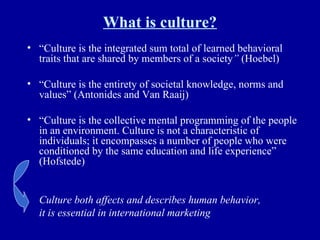
What is culture? “ Culture is the integrated sum total of learned behavioral traits that are shared by members of a society ”  (Hoebel) “ Culture is the entirety of societal knowledge, norms and values” (Antonides and Van Raaij) “ Culture is the collective mental programming of the people in an environment. Culture is not a characteristic of individuals; it encompasses a number of people who were conditioned by the same education and life experience” (Hofstede) Culture both affects and describes human behavior,  it is essential in international marketing
Fundamentals of culture Culture is a  total pattern of behavior  that is consistent and compatible in its components. It is not a collection of random behaviors… Culture is a  learned behavior . It is not biologically transmitted. It depends on environment, not heredity. Culture is behavior that is  shared by a group  of people, a society. It is a distinctive way of life.
Culture vs. personality Personality is the individual’s unique personal set of mental programs that he/she does not share with any other human being. Culture is what members of a group have in common. “It is the glue that binds groups together” (De Mooij) Human nature depends on culture: ideas, values, acts, emotions… are cultural products. Cultural patterns help people to live together in a society.
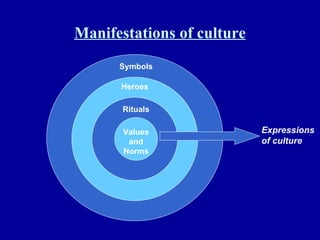
Manifestations of culture Symbols Heroes Rituals Values and Norms Expressions of culture
Symbols Symbols are words, gestures, pictures, or objects that carry a particular meaning recognized only by those who share a culture. This is the most superficial manifestation of culture. New symbols are easily developed and old ones quickly disappear. Symbols from one cultural group are regularly copied by others.
Heroes Heroes are people, alive or dead, real or imaginary, who possess characteristics that are highly prized in a society. They serve as role models for behavior. They can become globally known, but their stories often become local.
Rituals Rituals are the collective activities considered socially essential within a culture. They are carried out for their own sake. They are easily observed, but not always understood.
Values Values are at the core of culture. Values are stable beliefs regarding desired behavior or end states. They often have a religious, ideological or humanistic background. Goals are derived from values. Values are among the first things children learn, not consciously but implicitly. Core values are resistant to globalization; they vary across cultures and are not likely to change frequently.
Norms Norms and values are part of the “non-material” culture. Norms are beliefs regarding how to behave and how not to behave (do’s and don’ts). People differ in the extent to which they accept and comply with norms. They create expectations and criteria regarding the conduct of others.
Explicit vs. implicit culture Explicit culture:  languages, behavior, know-how, institutions (directly observable) Implicit culture:  moral values, learning process, beliefs and representations (subconscious)
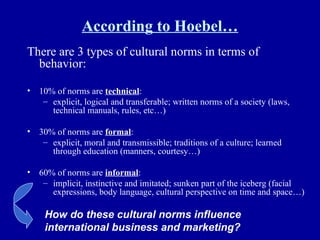
According to Hoebel… There are 3 types of cultural norms in terms of  behavior: 10% of norms are  technical :  explicit, logical and transferable; written norms of a society (laws, technical manuals, rules, etc…) 30% of norms are  formal :  explicit, moral and transmissible; traditions of a culture; learned through education (manners, courtesy…) 60% of norms are  informal : implicit, instinctive and imitated; sunken part of the iceberg (facial expressions, body language, cultural perspective on time and space…) How do these cultural norms influence international business and marketing?
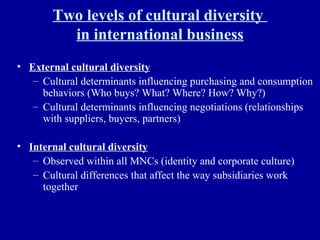
Two levels of cultural diversity  in international business External cultural diversity Cultural determinants influencing purchasing and consumption behaviors (Who buys? What? Where? How? Why?) Cultural determinants influencing negotiations (relationships with suppliers, buyers, partners) Internal cultural diversity Observed within all MNCs (identity and corporate culture) Cultural differences that affect the way subsidiaries work together
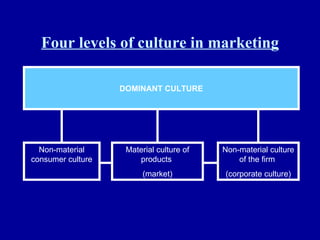
Four levels of culture in marketing DOMINANT CULTURE Non-material consumer culture Material culture of products  (market) Non-material culture of the firm  (corporate culture)
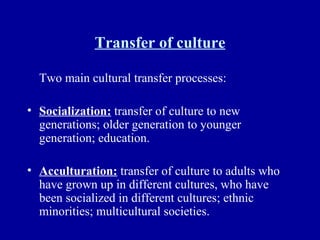
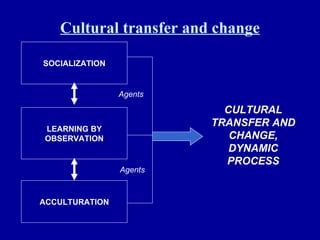
Transfer of culture Two main cultural transfer processes: Socialization:  transfer of culture to new generations; older generation to younger generation; education. Acculturation:  transfer of culture to adults who have grown up in different cultures, who have been socialized in different cultures; ethnic minorities; multicultural societies.
Cultural transfer and change SOCIALIZATION LEARNING BY OBSERVATION ACCULTURATION CULTURAL TRANSFER AND CHANGE, DYNAMIC PROCESS Agents Agents
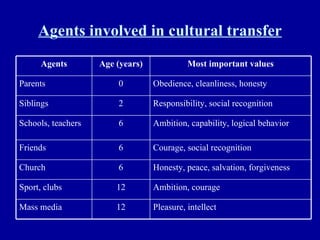
Agents involved in cultural transfer Pleasure, intellect 12 Mass media Ambition, courage 12 Sport, clubs Honesty, peace, salvation, forgiveness 6 Church Courage, social recognition 6 Friends Ambition, capability, logical behavior 6 Schools, teachers Responsibility, social recognition 2 Siblings Obedience, cleanliness, honesty 0 Parents Most important values Age (years) Agents
Processes of cultural change Socialization and acculturation usually imply a gradual cultural change because transfer agents tend to favor cultural continuity rather than jeopardize their powerful position. In contrast, innovative forces are less conservative and may challenge the status quo. 4 processes: cohort effects, age effects, democratization and exclusivation.
Cohort effects Acceptance of new values and behaviors begins at a young age. These values and behaviors are retained over the years. They are spread in society because young people grow older and the “old” values gradually disappear with the extinction of the older cohorts. Implies a slow cultural change.
Age effect Certain values or behaviors are associated with a particular age group. Behaviors are modified as age groups change. Age-bound consumer behavior. Possible reverse socialization.
Democratization Cultural “leveling” or “spreading” Cultural differences across social classes decrease. Results from an increasing level of general welfare, the influence of mass media and the stress on the equality ideal. Mechanisms of democratization: trickle-down, trickle-up, trickle-across.
Exclusivation Reverse of democratization Occurs less frequently Implies limited social spreading of values, goods and behavior. Cultural change is limited to a certain group (“elite”, “leading edge”).
Dimensions of culture What makes one culture different from another culture? How can we compare cultures or cluster cultures according to behavioral characteristics? Stereotypes vs. cultural dimensions Different cultures have different stereotypes of other cultures. Ethnocentrism and SRC
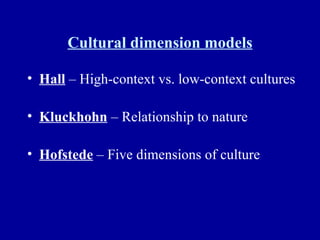
Cultural dimension models Hall  – High-context vs. low-context cultures Kluckhohn  – Relationship to nature Hofstede  – Five dimensions of culture
Hall’s cultural model Focuses on communication patterns found within cultures Four essential dimensions in terms of communication patterns: Context Time Space Information flow High-context vs. low-context cultures
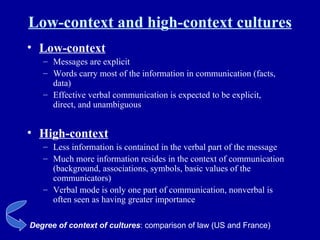
Low-context and high-context cultures Low-context Messages are explicit Words carry most of the information in communication (facts, data) Effective verbal communication is expected to be explicit, direct, and unambiguous High-context Less information is contained in the verbal part of the message  Much more information resides in the context of communication (background, associations, symbols, basic values of the communicators) Verbal mode is only one part of communication, nonverbal is often seen as having greater importance Degree of context of cultures : comparison of law (US and France)
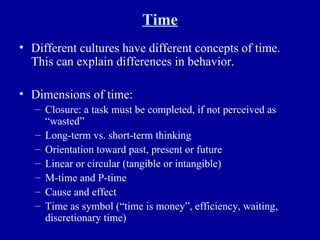
Time Different cultures have different concepts of time. This can explain differences in behavior. Dimensions of time: Closure: a task must be completed, if not perceived as “wasted” Long-term vs. short-term thinking Orientation toward past, present or future Linear or circular (tangible or intangible) M-time and P-time Cause and effect Time as symbol (“time is money”, efficiency, waiting, discretionary time)
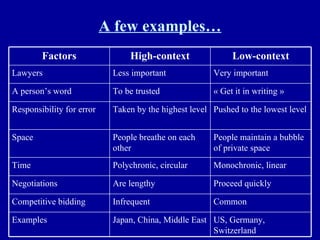
A few examples… US, Germany, Switzerland Japan, China, Middle East Examples Common Infrequent Competitive bidding Proceed quickly Are lengthy Negotiations Monochronic, linear Polychronic, circular Time People maintain a bubble of private space People breathe on each other Space Pushed to the lowest level Taken by the highest level Responsibility for error « Get it in writing » To be trusted A person’s word Very important Less important Lawyers Low-context High-context Factors
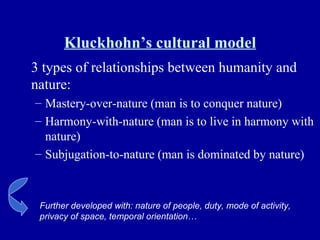
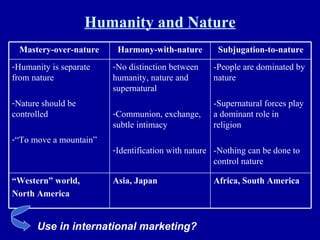
Kluckhohn’s cultural model 3 types of relationships between humanity and nature: Mastery-over-nature (man is to conquer nature) Harmony-with-nature (man is to live in harmony with nature) Subjugation-to-nature (man is dominated by nature) Further developed with: nature of people, duty, mode of activity, privacy of space, temporal orientation…
Humanity and Nature Use in international marketing? Africa, South America Asia, Japan “ Western” world,  North America -People are dominated by nature -Supernatural forces play a dominant role in religion -Nothing can be done to control nature  No distinction between humanity, nature and supernatural Communion, exchange, subtle intimacy Identification with nature Humanity is separate from nature Nature should be controlled “ To move a mountain” Subjugation-to-nature Harmony-with-nature Mastery-over-nature
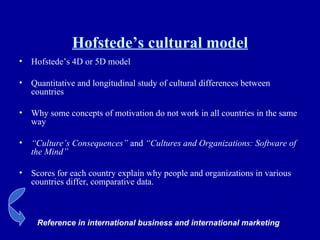
Hofstede’s cultural model Hofstede’s 4D or 5D model Quantitative and longitudinal study of cultural differences between countries Why some concepts of motivation do not work in all countries in the same way “ Culture’s Consequences”  and  “Cultures and Organizations: Software of the Mind” Scores for each country explain why people and organizations in various countries differ, comparative data. Reference in international business and international marketing
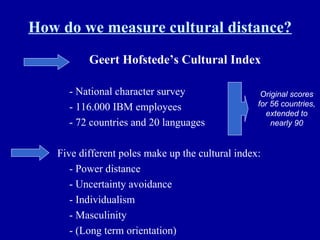
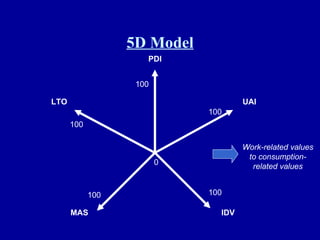
How do we measure cultural distance? Geert Hofstede’s Cultural Index - National character survey - 116.000 IBM employees - 72 countries and 20 languages Five different poles make up the cultural index: - Power distance - Uncertainty avoidance - Individualism - Masculinity - (Long term orientation) Original scores for 56 countries, extended to nearly 90
5D Model 0 100 100 100 100 100 PDI UAI IDV MAS LTO Work-related values to consumption-related values
Power distance (PDI) High PDI vs. Low PDI  “ the extent to which less powerful members of a society accept and expect that power is distributed unequally” Reflected in the values of both the less powerful and more powerful members of society Influences the way people accept and give authority Shows class or social structure Focuses on the degree of equality, or inequality, between people in the country’s society
Uncertainty avoidance (UAI) High UAI vs. Low UAI “  the extent to which people feel threatened by uncertainty and ambiguity and try to avoid these situations” Strong UAI = need for rules and formality to structure life, search for truth and belief in experts  Conflict and competition are threatening Higher level of anxiety, show of emotions is accepted
Individualism (IDV) Individualistic vs. Collectivistic “ people looking after themselves and their immediate family only, versus people belonging to in-groups that look after them in exchange for loyalty” “ I”-conscious and “we”-conscious Focuses on the degree the society reinforces individual or collective achievement and interpersonal relationships Distinguishes between societies where the group and being a member is important (collectiveness) and societies where the group is less important (individualism)
Masculinity (MAS) Masculine vs. Feminine “ the dominant values in a masculine society are achievement and success; the dominant values in a feminine society are caring for others and quality of life” Focuses on the degree the society reinforces, or does not reinforce, the traditional masculine work role model of male achievement, performance, control and power Shows the importance of status in societies Indicates the degree of gender differentiation and the importance of masculine values (assertiveness, money, material goods, success…)
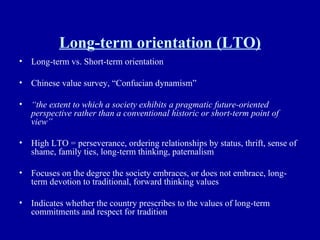
Long-term orientation (LTO) Long-term vs. Short-term orientation Chinese value survey, “Confucian dynamism” “ the extent to which a society exhibits a pragmatic future-oriented perspective rather than a conventional historic or short-term point of view” High LTO = perseverance, ordering relationships by status, thrift, sense of shame, family ties, long-term thinking, paternalism Focuses on the degree the society embraces, or does not embrace, long-term devotion to traditional, forward thinking values Indicates whether the country prescribes to the values of long-term commitments and respect for tradition
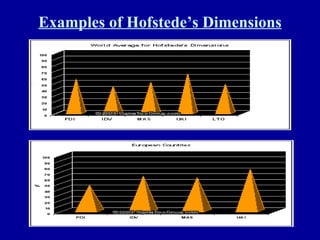
Examples of Hofstede’s Dimensions
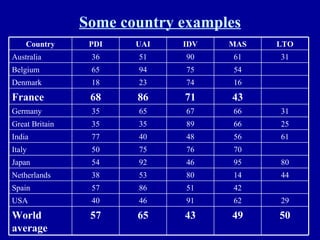
Some country examples 50 49 43 65 57 World average 29 62 91 46 40 USA 42 51 86 57 Spain 44 14 80 53 38 Netherlands 80 95 46 92 54 Japan 70 76 75 50 Italy 61 56 48 40 77 India 25 66 89 35 35 Great Britain 31 66 67 65 35 Germany 43 71 86 68 France 16 74 23 18 Denmark 54 75 94 65 Belgium 31 61 90 51 36 Australia LTO MAS IDV UAI PDI Country
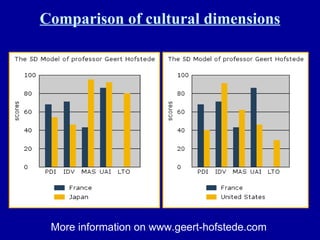
Comparison of cultural dimensions More information on www.geert-hofstede.com
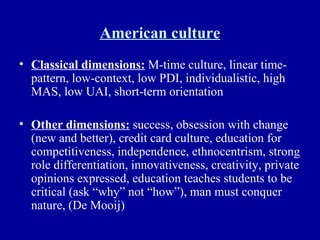
American culture Classical dimensions:  M-time culture, linear time-pattern, low-context, low PDI, individualistic, high MAS, low UAI, short-term orientation Other dimensions:  success, obsession with change (new and better), credit card culture, education for competitiveness, independence, ethnocentrism, strong role differentiation, innovativeness, creativity, private opinions expressed, education teaches students to be critical (ask “why” not “how”), man must conquer nature, (De Mooij)
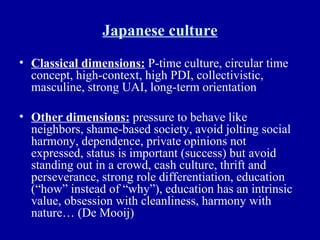
Japanese culture Classical dimensions:  P-time culture, circular time concept, high-context, high PDI, collectivistic, masculine, strong UAI, long-term orientation Other dimensions:  pressure to behave like neighbors, shame-based society, avoid jolting social harmony, dependence, private opinions not expressed, status is important (success) but avoid standing out in a crowd, cash culture, thrift and perseverance, strong role differentiation, education (“how” instead of “why”), education has an intrinsic value, obsession with cleanliness, harmony with nature… (De Mooij)
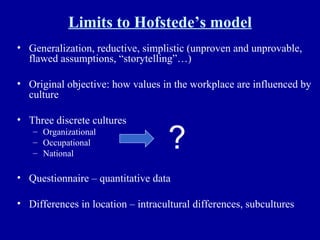
Limits to Hofstede’s model Generalization, reductive, simplistic (unproven and unprovable, flawed assumptions, “storytelling”…) Original objective: how values in the workplace are influenced by culture Three discrete cultures Organizational Occupational National Questionnaire – quantitative data Differences in location – intracultural differences, subcultures ?
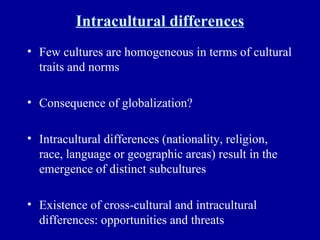
Intracultural differences Few cultures are homogeneous in terms of cultural traits and norms Consequence of globalization? Intracultural differences (nationality, religion, race, language or geographic areas) result in the emergence of distinct subcultures Existence of cross-cultural and intracultural differences: opportunities and threats
To summarize on culture… Culture is complex and multi-dimensional, but classification is important in business Cultural distance is essential in international marketing Culture influences perceptions and drives how we communicate and what we communicate SRC  and ethnocentrism can explain the failure of many companies in the international arena Acculturation (adjusting and adapting to a specific culture other than one’s own) is one of the keys to success in international operations
How does culture affect  international marketing? Languages and the use of language in communicating, advertising, negotiating… Marketing research is much more difficult to conduct from a methodological perspective Buying patterns and behaviors will vary in different cultural contexts Marketing mix will be perceived differently from one country to another Management styles will be directly related to culture…
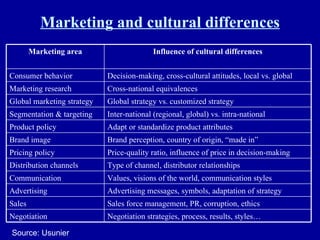
Marketing and cultural differences Source: Usunier Negotiation strategies, process, results, styles… Negotiation Sales force management, PR, corruption, ethics Sales Advertising messages, symbols, adaptation of strategy Advertising Values, visions of the world, communication styles Communication Type of channel, distributor relationships Distribution channels Price-quality ratio, influence of price in decision-making Pricing policy Brand perception, country of origin, “made in” Brand image Adapt or standardize product attributes Product policy Inter-national (regional, global) vs. intra-national Segmentation & targeting Global strategy vs. customized strategy Global marketing strategy Cross-national equivalences Marketing research Decision-making, cross-cultural attitudes, local vs. global Consumer behavior Influence of cultural differences Marketing area
Culture’s consequences on international marketing Marketing research  (understanding consumers) Segmentation  (classifying consumers) Product policy  (satisfying consumers) Distribution channels  (reaching consumers) Advertising  (communicating with consumers)
Chapter 2 International Marketing Research
International marketing research Review of marketing research techniques Specific problems in international markets
Review of marketing research techniques General principles of marketing research Qualitative research Quantitative research
What is marketing research? Marketing research is the link between the marketer and the market… It is the starting point of marketing… Marketing research is the systematic design, collection, analysis, and reporting of data and findings relevant to a specific marketing situation facing the company. MIS : consists of people, equipment, and procedures to gather, sort, analyze, evaluate, and distribute needed, timely, and accurate information to marketing decision makers.
Marketing process Understand the marketplace and customer needs and wants Design a customer-driven marketing strategy Construct a marketing program that delivers superior value Build profitable relationships and create customer satisfaction Capture value from customers to create profits and customer quality Create value  for  customers and build customer relationships Capture value  from  customers in return Marketing technology Global  markets Ethics and  social responsibility
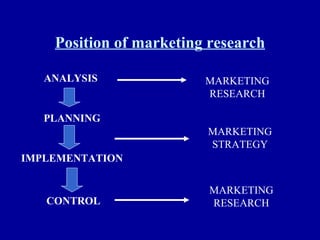
Position of marketing research ANALYSIS PLANNING IMPLEMENTATION CONTROL MARKETING RESEARCH MARKETING STRATEGY MARKETING RESEARCH
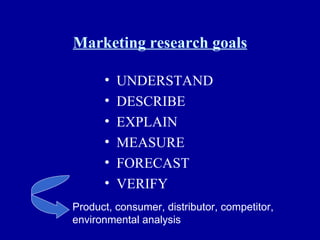
Marketing research goals UNDERSTAND DESCRIBE EXPLAIN MEASURE FORECAST VERIFY Product, consumer, distributor, competitor, environmental analysis
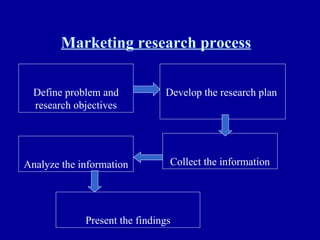
Marketing research process Define problem and research objectives Develop the research plan  Collect the information Analyze the information Present the findings
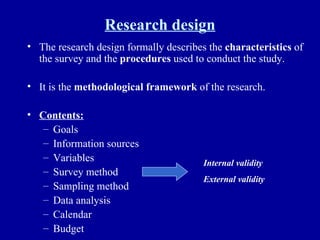
Research design The research design formally describes the  characteristics  of the survey and the  procedures  used to conduct the study. It is the  methodological framework  of the research. Contents: Goals Information sources Variables Survey method Sampling method Data analysis Calendar Budget Internal validity External validity
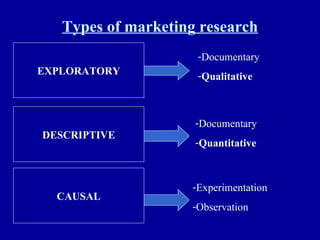
Types of marketing research EXPLORATORY DESCRIPTIVE CAUSAL Documentary Qualitative Documentary Quantitative Experimentation Observation
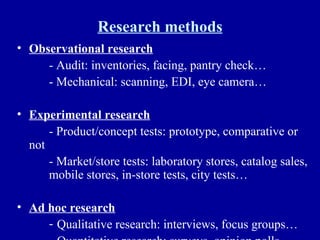
Research methods Observational research - Audit: inventories, facing, pantry check… - Mechanical: scanning, EDI, eye camera… Experimental research - Product/concept tests: prototype, comparative or not - Market/store tests: laboratory stores, catalog sales,  mobile stores, in-store tests, city tests… Ad hoc research Qualitative research: interviews, focus groups… Quantitative research: surveys, opinion polls…
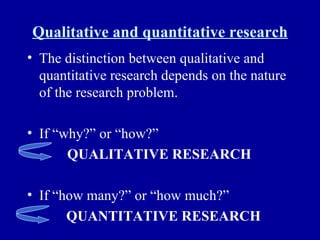
Qualitative and quantitative research The distinction between qualitative and quantitative research depends on the nature of the research problem. If “why?” or “how?” QUALITATIVE RESEARCH If “how many?” or “how much?”   QUANTITATIVE RESEARCH
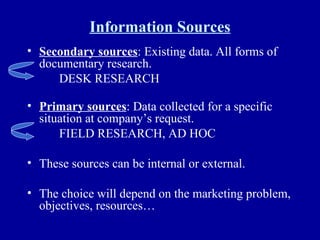
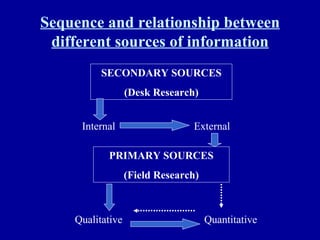
Information Sources Secondary sources : Existing data. All forms of documentary research. DESK RESEARCH Primary sources : Data collected for a specific situation at company’s request. FIELD RESEARCH, AD HOC These sources can be internal or external. The choice will depend on the marketing problem, objectives, resources…
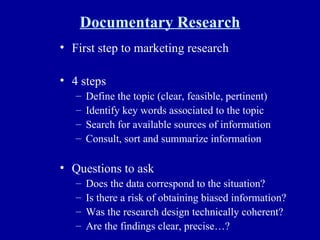
Documentary Research First step to marketing research 4 steps Define the topic (clear, feasible, pertinent) Identify key words associated to the topic Search for available sources of information Consult, sort and summarize information Questions to ask Does the data correspond to the situation? Is there a risk of obtaining biased information? Was the research design technically coherent? Are the findings clear, precise…?
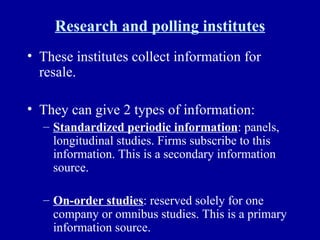
Research and polling institutes These institutes collect information for resale.  They can give 2 types of information: Standardized periodic information : panels, longitudinal studies. Firms subscribe to this information. This is a secondary information source. On-order studies : reserved solely for one company or omnibus studies. This is a primary information source.
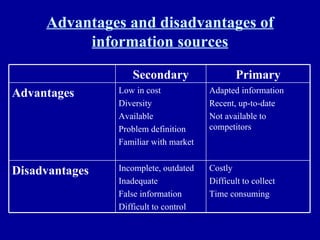
Advantages and disadvantages of information sources Costly Difficult to collect Time consuming Incomplete, outdated Inadequate False information Difficult to control Disadvantages Adapted information Recent, up-to-date Not available to competitors Low in cost Diversity Available Problem definition Familiar with market Advantages Primary Secondary
Sequence and relationship between different sources of information SECONDARY SOURCES (Desk Research) Internal External PRIMARY SOURCES (Field Research) Qualitative Quantitative
Qualitative marketing research
What is qualitative marketing research? Collecting and analyzing psycho-sociological elements which explain facts, attitudes, opinions, motivations and behaviors of all people involved in a given marketing situation Qualitative research methods are used for in-depth exploratory studies of the decision-making process and psychological mechanisms that affect individual or group behavior
Why use qualitative research? Qualitative research studies lead to understanding the causes or the basis for behaviors, attitudes and opinions. They are often based on analyzing how a product or company is perceived by individuals or consumers. However, results cannot be extrapolated. They cannot be considered as being representative of the entire population. Sample size = 10 - 70
Qualitative research is used in the following cases: Defining the marketing problem is difficult (explore market) Finding causes, decision-making criteria of consumer behavior Secondary information is insufficient Constructing questionnaire for a survey Explaining surprising results of quantitative research Promoting creativity
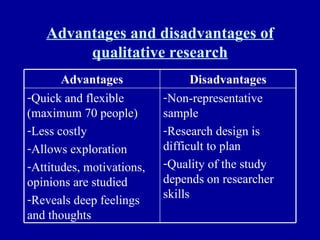
Advantages and disadvantages of qualitative research Non-representative sample Research design is difficult to plan Quality of the study depends on researcher skills Quick and flexible (maximum 70 people) Less costly Allows exploration Attitudes, motivations, opinions are studied Reveals deep feelings and thoughts Disadvantages Advantages
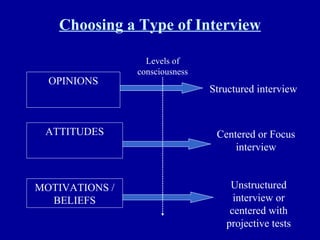
Different types of qualitative research Two ways of classifying qualitative studies: Degree of induction (level of consciousness) Unstructured interview (pure exploration) Centered or focus interview (exploration and in-depth analysis) Structured interview (identification and verification) Number of people being interviewed Individual Group
Choosing a Type of Interview OPINIONS ATTITUDES MOTIVATIONS / BELIEFS Structured interview Centered or Focus interview Unstructured interview or centered with projective tests Levels of consciousness
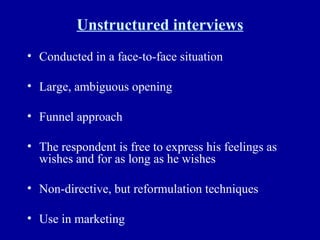
Unstructured interviews Conducted in a face-to-face situation Large, ambiguous opening Funnel approach The respondent is free to express his feelings as wishes and for as long as he wishes Non-directive, but reformulation techniques Use in marketing
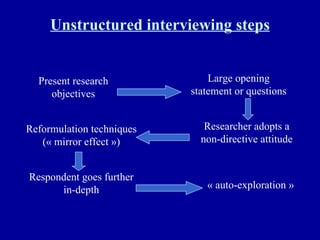
Unstructured interviewing steps Present research objectives Large opening statement or questions Researcher adopts a non-directive attitude Reformulation techniques (« mirror effect ») Respondent goes further in-depth « auto-exploration »
Centered or focus interviews Same general structure and basic principles as the unstructured interview However, an  interview guide  is used This guide is composed of topics or questions to be addressed during the interview The interviewer will bring up topic if and only if respondent does not spontaneously address issues This is  NOT  a questionnaire (no order, modifications possible, different versions allowed) This is the most popular form of qualitative research
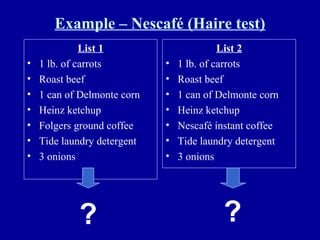
Projective techniques Used to avoid psychological obstacles (taboos, reluctance, courtesy bias, subconscious…) or to go further in-depth Visual or written stimuli The respondent will overcome hesitations Difficult to analyze, ambiguous Different tests Word association Sentence completion Story completion Frustration or cartoon test TAT (Thematic Apperception Test) Haire test
Example – Nescafé (Haire test) List 1 1 lb. of carrots Roast beef 1 can of Delmonte corn Heinz ketchup Folgers ground coffee Tide laundry detergent 3 onions List 2 1 lb. of carrots Roast beef 1 can of Delmonte corn Heinz ketchup Nescafé instant coffee Tide laundry detergent 3 onions ? ?
Structured interviews Most directive method in qualitative marketing research A  questionnaire  is used However, the questionnaire is only composed of open-end questions Questionnaire facilitates the research process as well as analysis Confusion between qualitative and quantitative research It is theoretically incorrect to extrapolate or generalize the findings
Focus groups Nearly always use the  centered approach  (interview guide, group discussion is directed by interviewer) About  7 to 10  participants per group The role of the interviewer is very important Interviewer must manage the group in terms of participation, conflict, domination, summaries, etc… Organization and logistical aspects
Focus group phases Three phases during the group interview: Presentation  (warming up): explanations, rules of the game, individual introductions, anonymous responses… Exchange : each participant gives his or her opinions, thoughts, group dialogue, tests… Summarize : verify all topics of interview guide, repeats, star technique (circept), gift…
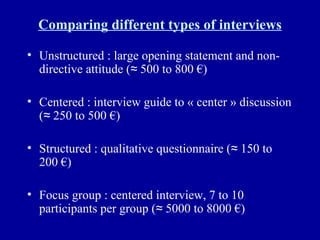
Comparing different types of interviews Unstructured : large opening statement and non-directive attitude (≈ 500 to 800 €) Centered : interview guide to « center » discussion (≈ 250 to 500 €) Structured : qualitative questionnaire (≈ 150 to 200 €) Focus group : centered interview, 7 to 10 participants per group (≈ 5000 to 8000 €)
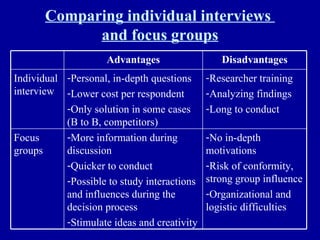
Comparing individual interviews  and focus groups No in-depth motivations Risk of conformity, strong group influence Organizational and logistic difficulties More information during discussion Quicker to conduct Possible to study interactions and influences during the decision process Stimulate ideas and creativity Focus groups Researcher training Analyzing findings Long to conduct Personal, in-depth questions Lower cost per respondent Only solution in some cases (B to B, competitors) Individual interview Disadvantages Advantages
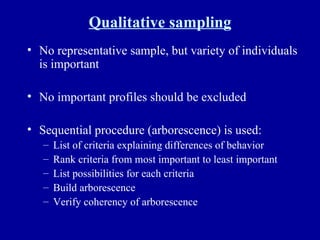
Qualitative sampling No representative sample, but variety of individuals is important No important profiles should be excluded Sequential procedure (arborescence) is used: List of criteria explaining differences of behavior Rank criteria from most important to least important List possibilities for each criteria Build arborescence Verify coherency of arborescence
Sampling in focus groups Same basic principles (arborescence) All participants must feel “equal” However, there are two important rules: Group must be heterogeneous (cover all of the profiles of the populations) Group must be homogeneous (for criteria that may lead to an unbalanced group) Many groups may be need to be organized in order to avoid unbalanced groups or inter-group pressure
Qualitative data analysis Two different methods can be used: Summaries of interviews, “verbatims” Content analysis Requires re-transcribing of all interviews Specialized software Quantification, scientific rigor Time and budget
Quantitative marketing research
Differences compared to  qualitative research Associated with descriptive research Objectives are different: verify, measure, estimate...  Sampling methods are different Large sample size (300 – 1000+) Methods of administration change Precision of an estimation, margin of error Data analysis is more sophisticated
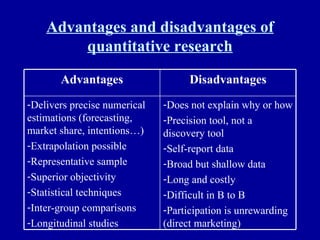
Advantages and disadvantages of quantitative research Does not explain why or how Precision tool, not a discovery tool Self-report data Broad but shallow data Long and costly Difficult in B to B Participation is unrewarding (direct marketing) Delivers precise numerical estimations (forecasting, market share, intentions…) Extrapolation possible Representative sample Superior objectivity Statistical techniques Inter-group comparisons Longitudinal studies Disadvantages Advantages
Categories of quantitative research Census Collect information from each member of the population Complete canvass of the population Depends on the size of the target population Survey Most familiar of all market research methodologies Collect information from a portion of the population Procedure in which a fixed set of questions is asked of a sample of respondents On the basis of information collected on the subset, it is possible to infer something about the larger group Inference depends on the sampling method
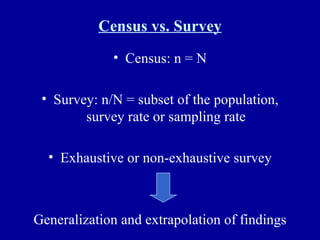
Census vs. Survey Census: n = N Survey: n/N = subset of the population, survey rate or sampling rate Exhaustive or non-exhaustive survey Generalization and extrapolation of findings
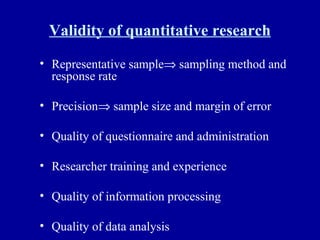
Validity of quantitative research Representative sample   sampling method and response rate Precision   sample size and margin of error Quality of questionnaire and administration Researcher training and experience Quality of information processing Quality of data analysis
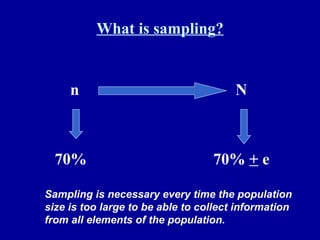
What is sampling? n 70% N 70%  +  e Sampling is necessary every time the population size is too large to be able to collect information from all elements of the population.
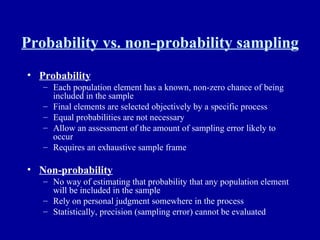
Probability vs. non-probability sampling Probability Each population element has a known, non-zero chance of being included in the sample Final elements are selected objectively by a specific process Equal probabilities are not necessary Allow an assessment of the amount of sampling error likely to occur Requires an exhaustive sample frame Non-probability No way of estimating that probability that any population element will be included in the sample Rely on personal judgment somewhere in the process Statistically, precision (sampling error) cannot be evaluated
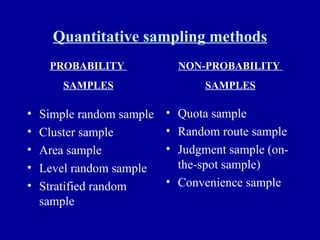
Quantitative sampling methods Simple random sample Cluster sample Area sample Level random sample Stratified random sample Quota sample  Random route sample Judgment sample (on-the-spot sample) Convenience sample PROBABILITY  SAMPLES NON-PROBABILITY  SAMPLES
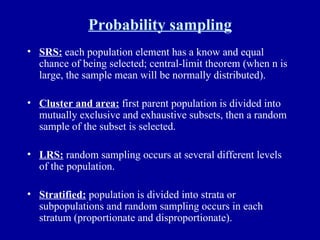
Probability sampling SRS:  each population element has a know and equal chance of being selected; central-limit theorem (when n is large, the sample mean will be normally distributed). Cluster and area:  first parent population is divided into mutually exclusive and exhaustive subsets, then a random sample of the subset is selected. LRS:  random sampling occurs at several different levels of the population. Stratified:  population is divided into strata or subpopulations and random sampling occurs in each stratum (proportionate and disproportionate).
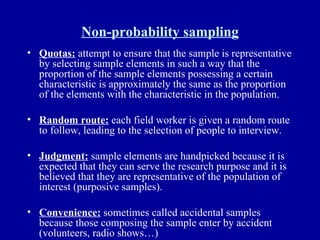
Non-probability sampling Quotas:  attempt to ensure that the sample is representative by selecting sample elements in such a way that the proportion of the sample elements possessing a certain characteristic is approximately the same as the proportion of the elements with the characteristic in the population. Random route:  each field worker is given a random route to follow, leading to the selection of people to interview. Judgment:  sample elements are handpicked because it is expected that they can serve the research purpose and it is believed that they are representative of the population of interest (purposive samples). Convenience:  sometimes called accidental samples because those composing the sample enter by accident (volunteers, radio shows…)
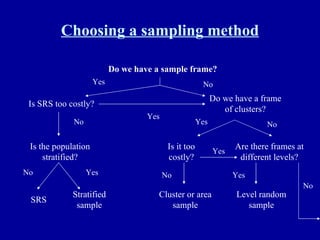
Choosing a sampling method Do we have a sample frame? Is SRS too costly? Is the population stratified? SRS Stratified sample Do we have a frame of clusters? Is it too costly? Cluster or area sample Are there frames at different levels? Level random sample Yes No No No Yes Yes Yes No Yes No Yes No
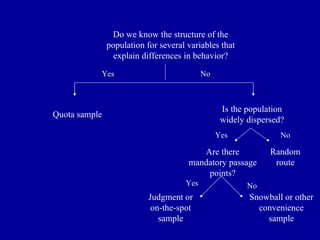
Do we know the structure of the population for several variables that explain differences in behavior? Quota sample Yes No Is the population widely dispersed? Random route No Are there mandatory passage points? Judgment or on-the-spot sample Snowball or other convenience sample Yes No Yes
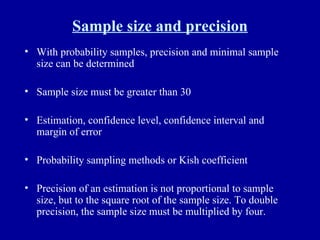
Sample size and precision With probability samples, precision and minimal sample size can be determined Sample size must be greater than 30 Estimation, confidence level, confidence interval and margin of error Probability sampling methods or Kish coefficient Precision of an estimation is not proportional to sample size, but to the square root of the sample size. To double precision, the sample size must be multiplied by four.
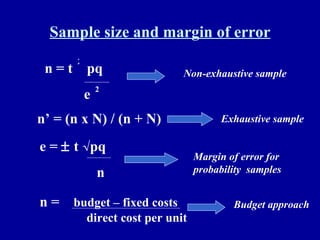
Sample size and margin of error n = t  pq e 2 2 Non-exhaustive sample n’ = (n x N) / (n + N) Exhaustive sample e =    t √pq   n Margin of error for probability  samples n =  budget – fixed costs direct cost per unit Budget approach
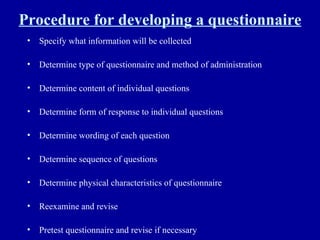
Procedure for developing a questionnaire Specify what information will be collected Determine type of questionnaire and method of administration Determine content of individual questions Determine form of response to individual questions Determine wording of each question Determine sequence of questions Determine physical characteristics of questionnaire Reexamine and revise Pretest questionnaire and revise if necessary
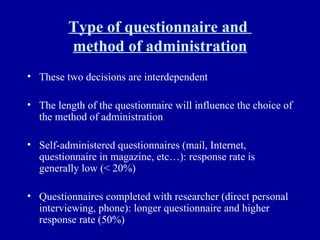
Type of questionnaire and  method of administration These two decisions are interdependent The length of the questionnaire will influence the choice of the method of administration Self-administered questionnaires (mail, Internet, questionnaire in magazine, etc…): response rate is generally low (< 20%) Questionnaires completed with researcher (direct personal interviewing, phone): longer questionnaire and higher response rate (50%)
Form of response Open-ended Dichotomous: 2 possible answers Multiple choice: 3 or more possible answers Likert scale: a statement with which the respondent shows the amount of agreement or disagreement (strongly agree – strongly disagree) Semantic differential scale: a scale connecting two bipolar words, respondent selects the point that represents his/her opinion (enthusiastic – unenthusiastic) Importance scale: rates the importance of some attribute (extremely important – extremely unimportant)  Rating scale: rates some attribute from “poor” to “excellent” Intention-to-buy scale: describes respondent’s intention to buy a product or service (definitely buy – definitely not buy) Avoid halo effect (change direction in scales to avoid repetition)
Question wording The phrasing of a question can directly affect the responses. General rules: Use simple words Avoid technical vocabulary in consumer research Avoid double negations Avoid ambiguous words and questions Avoid leading questions Avoid double-barreled questions Examples
Question sequence General rules: Questionnaire should be very logical and easy to respond to. Use simple, interesting opening question. Use the funnel approach (start with broad questions and progressively narrow down in scope). Avoid jumping around from topic to topic. Use transitions. Design branching questions with care. Place difficult or sensitive questions late in the questionnaire. Ask for classification information last.
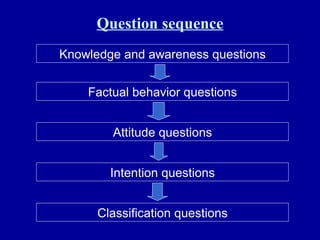
Question sequence Knowledge and awareness questions Factual behavior questions Attitude questions Intention questions Classification questions
Questionnaire pretest Data collection should never begin without an adequate pretest of the instrument. Can be used to assess both individual questions and their sequence. Small sample of 10 to 30 Questionnaire followed by interview to identify problems and misunderstandings Pretest results are not included in the final results of the survey “ The pretest is the most inexpensive insurance the marketer can buy to ensure the success of the questionnaire and the entire research project”
Quantitative data analysis Univariate analysis   descriptive statistics and graphical information Multivariate analysis   cross-tabulations, Chi square tests, correlation analysis, multiple regression analysis, cluster analysis (perceptual mapping), factor analysis….
Cost factors affecting surveys Sample size Accessibility Survey length Analysis ≈  100 € per respondent
Specific problems in international markets
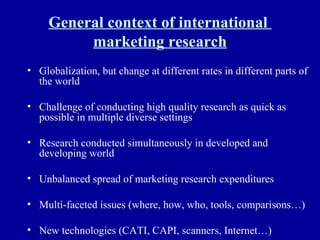
General context of international  marketing research Globalization, but change at different rates in different parts of the world Challenge of conducting high quality research as quick as possible in multiple diverse settings Research conducted simultaneously in developed and developing world Unbalanced spread of marketing research expenditures Multi-faceted issues (where, how, who, tools, comparisons…) New technologies (CATI, CAPI, scanners, Internet…)
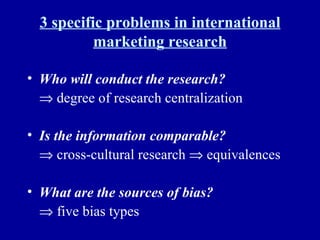
3 specific problems in international marketing research Who will conduct the research?      degree of research centralization Is the information comparable?      cross-cultural research    equivalences What are the sources of bias?      five bias types
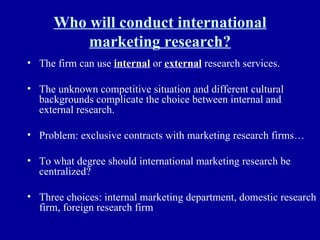
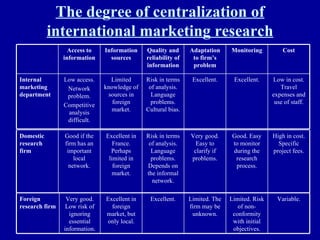
Who will conduct international marketing research? The firm can use  internal  or  external  research services. The unknown competitive situation and different cultural backgrounds complicate the choice between internal and external research. Problem: exclusive contracts with marketing research firms… To what degree should international marketing research be centralized? Three choices: internal marketing department, domestic research firm, foreign research firm
The degree of centralization of international marketing research Low in cost. Travel expenses and use of staff. Excellent. Excellent. Risk in terms of analysis. Language problems. Cultural bias. Limited knowledge of sources in foreign market. Low access. Network problem. Competitive analysis difficult. Internal marketing department Cost Monitoring Adaptation to firm’s problem Quality and reliability of information Information sources Access to information High in cost. Specific project fees. Good. Easy to monitor during the research process. Very good. Easy to clarify if problems. Risk in terms of analysis. Language problems. Depends on the informal network. Excellent in France. Perhaps limited in foreign market. Good if the firm has an important local network. Domestic research firm Variable. Limited. Risk of non-conformity with initial objectives. Limited. The firm may be unknown. Excellent. Excellent in foreign market, but only local. Very good. Low risk of ignoring essential information. Foreign research firm
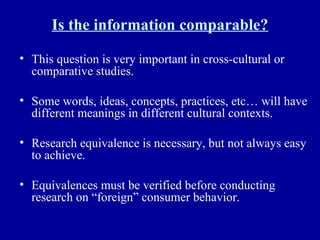
Is the information comparable? This question is very important in cross-cultural or comparative studies. Some words, ideas, concepts, practices, etc… will have different meanings in different cultural contexts. Research equivalence is necessary, but not always easy to achieve. Equivalences must be verified before conducting research on “foreign” consumer behavior.
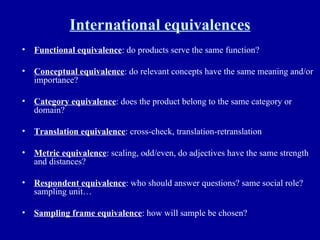
International equivalences Functional equivalence : do products serve the same function? Conceptual equivalence : do relevant concepts have the same meaning and/or importance? Category equivalence : does the product belong to the same category or domain? Translation equivalence : cross-check, translation-retranslation Metric equivalence : scaling, odd/even, do adjectives have the same strength and distances? Respondent equivalence : who should answer questions? same social role? sampling unit… Sampling frame equivalence : how will sample be chosen?
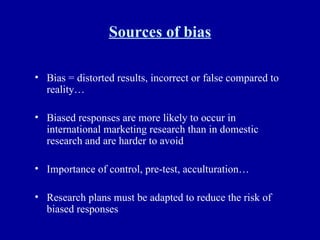
Sources of bias Bias = distorted results, incorrect or false compared to reality… Biased responses are more likely to occur in international marketing research than in domestic research and are harder to avoid Importance of control, pre-test, acculturation… Research plans must be adapted to reduce the risk of biased responses
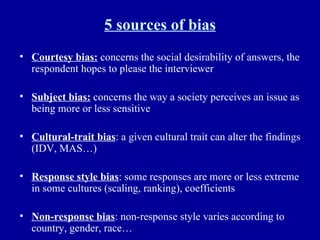
5 sources of bias Courtesy bias:  concerns the social desirability of answers, the respondent hopes to please the interviewer  Subject bias:  concerns the way a society perceives an issue as being more or less sensitive Cultural-trait bias : a given cultural trait can alter the findings (IDV, MAS…) Response style bias : some responses are more or less extreme in some cultures (scaling, ranking), coefficients Non-response bias : non-response style varies according to country, gender, race…
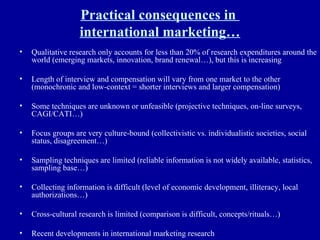
Practical consequences in  international marketing… Qualitative research only accounts for less than 20% of research expenditures around the world (emerging markets, innovation, brand renewal…), but this is increasing Length of interview and compensation will vary from one market to the other (monochronic and low-context = shorter interviews and larger compensation) Some techniques are unknown or unfeasible (projective techniques, on-line surveys, CAGI/CATI…) Focus groups are very culture-bound (collectivistic vs. individualistic societies, social status, disagreement…) Sampling techniques are limited (reliable information is not widely available, statistics, sampling base…) Collecting information is difficult (level of economic development, illiteracy, local authorizations…) Cross-cultural research is limited (comparison is difficult, concepts/rituals…) Recent developments in international marketing research
Chapter 3 International Marketing  Strategy and Programs
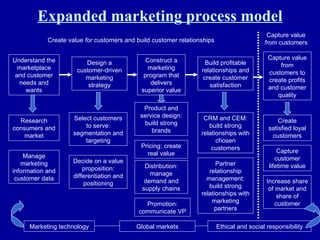
Expanded marketing process model Understand the marketplace and customer needs and wants Design a customer-driven marketing strategy Construct a marketing program that delivers superior value Build profitable relationships and create customer satisfaction Capture value from customers to create profits and customer quality Create value  for  customers and build customer relationships Capture value  from  customers Research consumers and market Manage marketing information and customer data Select customers to serve: segmentation and targeting Decide on a value proposition: differentiation and positioning Product and service design: build strong brands Pricing: create real value Distribution: manage demand and supply chains Promotion: communicate VP CRM and CEM: build strong relationships with chosen customers Partner relationship management: build strong relationships with marketing partners Create satisfied loyal customers Capture customer lifetime value Increase share of market and share of customer Marketing technology Global markets Ethical and social responsibility
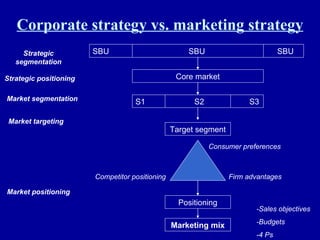
Corporate strategy vs. marketing strategy SBU SBU   SBU Core market S1   S2   S3 Target segment Positioning Marketing mix Strategic segmentation Strategic positioning Market segmentation Market targeting Market positioning -Sales objectives -Budgets -4 Ps Consumer preferences Competitor positioning Firm advantages
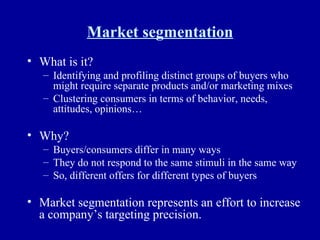
Market segmentation What is it? Identifying and profiling distinct groups of buyers who might require separate products and/or marketing mixes Clustering consumers in terms of behavior, needs, attitudes, opinions… Why? Buyers/consumers differ in many ways They do not respond to the same stimuli in the same way So, different offers for different types of buyers Market segmentation represents an effort to increase a company’s targeting precision.
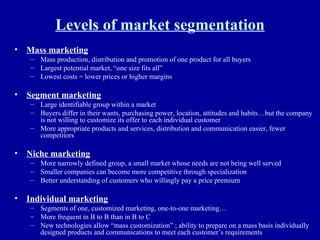
Levels of market segmentation Mass marketing Mass production, distribution and promotion of one product for all buyers Largest potential market, “one size fits all” Lowest costs = lower prices or higher margins Segment marketing Large identifiable group within a market Buyers differ in their wants, purchasing power, location, attitudes and habits…but the company is not willing to customize its offer to each individual customer More appropriate products and services, distribution and communication easier, fewer competitors Niche marketing More narrowly defined group, a small market whose needs are not being well served Smaller companies can become more competitive through specialization Better understanding of customers who willingly pay a price premium Individual marketing Segments of one, customized marketing, one-to-one marketing… More frequent in B to B than in B to C New technologies allow “mass customization” ; ability to prepare on a mass basis individually designed products and communications to meet each customer’s requirements
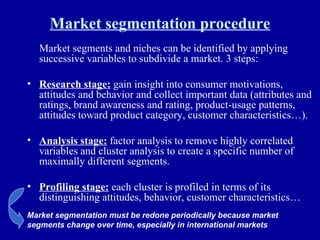
Market segmentation procedure Market segments and niches can be identified by applying successive variables to subdivide a market. 3 steps: Research stage:  gain insight into consumer motivations, attitudes and behavior and collect important data (attributes and ratings, brand awareness and rating, product-usage patterns, attitudes toward product category, customer characteristics…). Analysis stage:  factor analysis to remove highly correlated variables and cluster analysis to create a specific number of maximally different segments. Profiling stage:  each cluster is profiled in terms of its distinguishing attitudes, behavior, customer characteristics… Market segmentation must be redone periodically because market segments change over time, especially in international markets
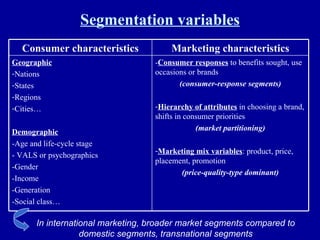
Segmentation variables In international marketing, broader market segments compared to domestic segments, transnational segments - Consumer responses  to benefits sought, use occasions or brands (consumer-response segments) Hierarchy of attributes  in choosing a brand, shifts in consumer priorities  (market partitioning) Marketing mix variables : product, price, placement, promotion  (price-quality-type dominant) Geographic Nations States Regions Cities… Demographic -Age and life-cycle stage - VALS or psychographics -Gender -Income -Generation -Social class… Marketing characteristics Consumer characteristics
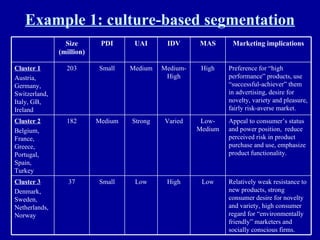
Example 1: culture-based segmentation Relatively weak resistance to new products, strong consumer desire for novelty and variety, high consumer regard for “environmentally friendly” marketers and socially conscious firms. Low High Low Small 37 Cluster 3 Denmark, Sweden, Netherlands, Norway Appeal to consumer’s status and power position,  reduce perceived risk in product purchase and use, emphasize product functionality. Low-Medium Varied Strong Medium 182 Cluster 2 Belgium, France, Greece, Portugal, Spain, Turkey Preference for “high performance” products, use “successful-achiever” them in advertising, desire for novelty, variety and pleasure, fairly risk-averse market. High Medium-High Medium Small 203 Cluster 1 Austria, Germany, Switzerland, Italy, GB, Ireland Marketing implications MAS IDV UAI PDI Size (million)
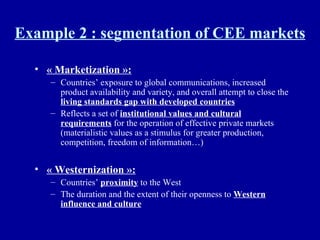
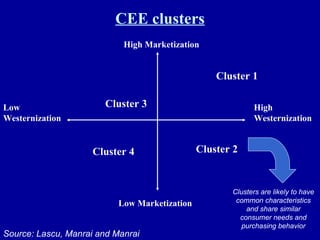
Example 2 : segmentation of CEE markets « Marketization »:   Countries’ exposure to global communications, increased product availability and variety, and overall attempt to close the  living standards gap with developed countries Reflects a set of  institutional values and cultural requirements  for the operation of effective private markets (materialistic values as a stimulus for greater production, competition, freedom of information…) « Westernization »:   Countries’  proximity  to the West The duration and the extent of their openness to  Western influence and culture
CEE clusters High Marketization Low Marketization Low Westernization High Westernization Cluster 1 Cluster 2 Cluster 3 Cluster 4 Source: Lascu, Manrai and Manrai Clusters are likely to have common characteristics and share similar consumer needs and purchasing behavior
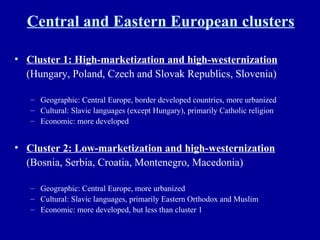
Central and Eastern European clusters Cluster 1: High-marketization and high-westernization   (Hungary, Poland, Czech and Slovak Republics, Slovenia) Geographic: Central Europe, border developed countries, more urbanized Cultural: Slavic languages (except Hungary), primarily Catholic religion Economic: more developed Cluster 2: Low-marketization and high-westernization   (Bosnia, Serbia, Croatia, Montenegro, Macedonia) Geographic: Central Europe, more urbanized Cultural: Slavic languages, primarily Eastern Orthodox and Muslim Economic: more developed, but less than cluster 1
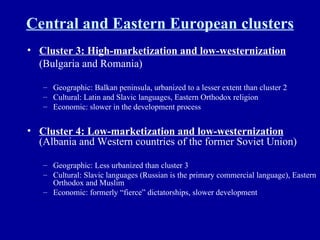
Central and Eastern European clusters Cluster 3: High-marketization and low-westernization   (Bulgaria and Romania) Geographic: Balkan peninsula, urbanized to a lesser extent than cluster 2 Cultural: Latin and Slavic languages, Eastern Orthodox religion Economic: slower in the development process Cluster 4: Low-marketization and low-westernization  (Albania and Western countries of the former Soviet Union) Geographic: Less urbanized than cluster 3 Cultural: Slavic languages (Russian is the primary commercial language), Eastern Orthodox and Muslim Economic: formerly “fierce” dictatorships, slower development
Market targeting After identifying different markets and market segments, the firm must: Evaluate the various segments Decide how many and which ones to target
Evaluating the market segments Overall attractiveness of the segment Size, growth, profitability, scale economies, low risk… How easy is it to persuade buyers to shift their purchases (consumers, relative non-consumers, absolute non-consumers)? Brand loyalty vs. dissatisfied buyers Company’s objectives and resources Do segments correspond to the company’s long-term objectives? Does company possess the skills and resources needed to succeed in the segment? The company should only enter market segments in which it can offer superior value
Selecting market segments 5 different target market strategies: Single-segment concentration Concentrated marketing Strong knowledge of segment’s needs Strong market position in segment Economies through specialization = high returns Risks are higher than normal Selective specialization Several segments that are objectively attractive Little or no synergy among segments but each is profitable Diversification of firm’s risk
Selecting market segments Product specialization Concentrate on certain product to several segments Strong reputation in specific product area Risk of technology Market specialization Concentrate on serving many needs of a particular customer group Strong reputation with group, channel for all new products Risk of decreased buying power in the group Full market coverage Serve all customer groups with all products they need Limited to very large firms Undifferentiated: ignore segment differences, one offer for entire market Differentiated: operate in several segments with different programs for each
Market positioning Market positioning : act of designing the company’s offering and image so that they occupy a meaningful and distinctive competitive position in the target customer’s mind; refers to the consumer’s perception of a product or brand amongst other brands Objective:  attaining a prominent place for company’s brand amongst other brands in the minds of consumers Positioning mainly results from marketing communication regarding brands, social communication and personal experience Categorization and positioning within category Product differentiation, international coherency
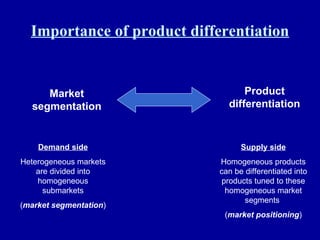
Importance of product differentiation Market segmentation Product differentiation Demand side Heterogeneous markets are divided into homogeneous submarkets ( market segmentation ) Supply side Homogeneous products can be differentiated into products tuned to these homogeneous market segments  ( market positioning )
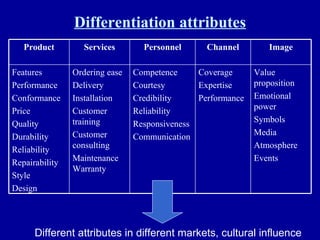
Differentiation attributes Different attributes in different markets, cultural influence Value proposition Emotional power Symbols Media Atmosphere Events Coverage Expertise Performance Competence Courtesy Credibility Reliability Responsiveness Communication Ordering ease Delivery Installation Customer training Customer consulting Maintenance Warranty Features Performance Conformance Price Quality Durability Reliability Repairability Style Design Image Channel Personnel Services Product
Promoting the difference How many difference should a firm promote? USP:  “best quality”, “best service”, “lowest price”, “best value”, “safest”, “fastest”, “most convenient”, “most advanced technology”… Double-benefit positioning : if two or more firms are claiming to be best on the same attribute, search for special niche within the target segment, two benefits must be compatible (“safest” and “most durable”) The number of differences should be limited (communication, clarity, credibility) Coherency in international markets is essential, between markets and between segments
Communicating the firm’s positioning Once positioning strategy chosen, the firm must communicate the positioning effectively Mentally distinguish offerings, enter into the minds of consumers Communication through physical signs and cues Marketing mix is used to communicate the company’s positioning
From marketing strategy to  marketing programs Marketing strategy must be implemented through marketing programs Managers must decide on marketing expenditures, marketing mix, and resource allocation Internal cultural diversity External cultural diversity Marketing mix allows firm to communicate and implement its strategy, formalized in marketing plan
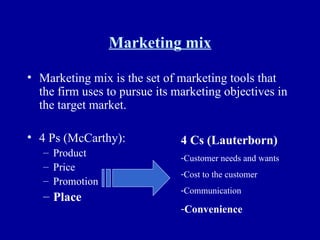
Marketing mix Marketing mix is the set of marketing tools that the firm uses to pursue its marketing objectives in the target market. 4 Ps (McCarthy): Product Price Promotion Place 4 Cs (Lauterborn) Customer needs and wants Cost to the customer Communication Convenience
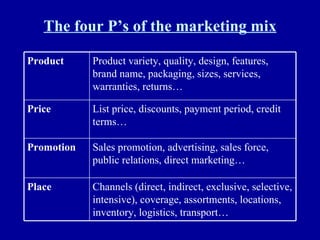
The four P’s of the marketing mix Channels (direct, indirect, exclusive, selective, intensive), coverage, assortments, locations, inventory, logistics, transport… Place Sales promotion, advertising, sales force, public relations, direct marketing… Promotion List price, discounts, payment period, credit terms… Price Product variety, quality, design, features, brand name, packaging, sizes, services, warranties, returns… Product
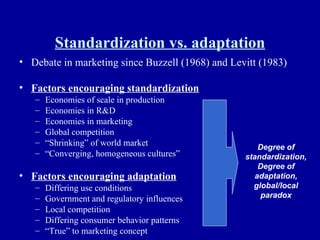
Standardization vs. adaptation Debate in marketing since Buzzell (1968) and Levitt (1983) Factors encouraging standardization Economies of scale in production Economies in R&D Economies in marketing Global competition “ Shrinking” of world market “ Converging, homogeneous cultures” Factors encouraging adaptation Differing use conditions Government and regulatory influences Local competition Differing consumer behavior patterns “ True” to marketing concept Degree of standardization, Degree of adaptation, global/local paradox
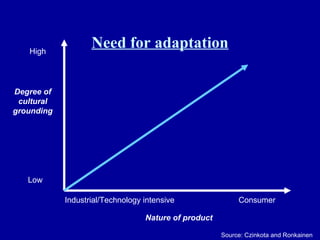
Need for adaptation Degree of cultural grounding High Low Nature of product Industrial/Technology intensive Consumer Source: Czinkota and Ronkainen
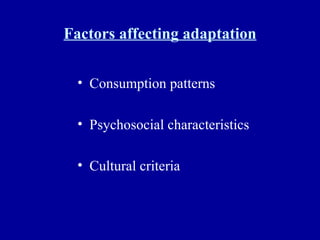
Factors affecting adaptation Consumption patterns Psychosocial characteristics Cultural criteria
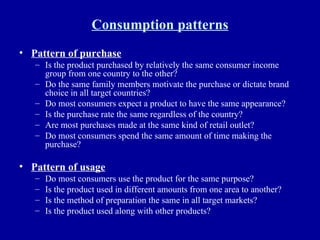
Consumption patterns Pattern of purchase Is the product purchased by relatively the same consumer income group from one country to the other? Do the same family members motivate the purchase or dictate brand choice in all target countries? Do most consumers expect a product to have the same appearance? Is the purchase rate the same regardless of the country? Are most purchases made at the same kind of retail outlet? Do most consumers spend the same amount of time making the purchase? Pattern of usage Do most consumers use the product for the same purpose? Is the product used in different amounts from one area to another? Is the method of preparation the same in all target markets? Is the product used along with other products?
Psychosocial characteristics Attitudes toward the product Are the basic psychological, social, and economic factors motivating the purchase and use of the product the same for all target markets? Are the advantages/disadvantages of the product in the minds of consumers basically the same from one country to another? Does the symbolic content of the product differ from one country to another? Is the psychic cost of purchasing and using the product the same? Attitudes toward the brand Is the brand name equally known and accepted in all target countries? Are customer attitudes toward the package basically the same? Are customer attitudes toward pricing basically the same? Is brand loyalty the same throughout target countries for the product?
Cultural criteria Does society restrict the purchase and/or use of the product to a particular group? Is there a stigma attached to a product? Does the usage of the product interfere with tradition in one or more of the targeted markets? Does the message of the product correspond to core cultural values? How do the different dimensions of culture influence the purchase and use of the product?
Product “ A product is anything that can be offered to a market to satisfy a want or need” (Kotler) Physical goods Services Persons Places Organizations Ideas Common product problems : Developing new products Managing life-cycle strategies Managing product lines  Managing brands… Product policy, product mix
Product mix: product lines and brands Product lines Width: how many product lines the firm carries Length: how many items in each product line Depth: how many variants are offered of each product in the line Consistency: how closely related the various product lines are (end use, production, distribution channels, etc…) Brandin g Identifies the company at six different levels: attributes, benefits, values, culture, personality and user Brand awareness, brand acceptability, brand preference, brand loyalty Global branding and international coherency Degree of adaptation in FMCG
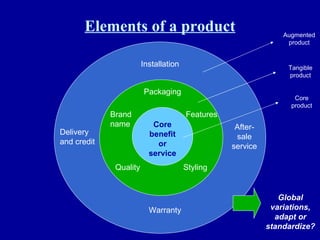
Elements of a product Core benefit or service Packaging Brand name Quality Styling Features Installation Delivery and credit After-sale service Warranty Augmented product Tangible product Core product Global variations, adapt or standardize?
Specific international  product policy problems Country of origin, made in effect Preference for national brands Global branding (mono, line, umbrella) Brand equity and extension International standards Product protection Product adaptation
International product policy Existence of global product? International standard? Three common strategies Straight extension Product invention Product adaptation Technical adaptation Commercial adaptation Consumer products vs. industrial products
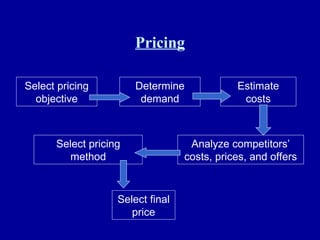
Pricing Select pricing objective Determine demand Estimate costs Analyze competitors’ costs, prices, and offers Select pricing method Select final price
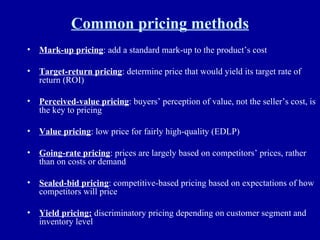
Common pricing methods Mark-up pricing : add a standard mark-up to the product’s cost Target-return pricing : determine price that would yield its target rate of return (ROI) Perceived-value pricing : buyers’ perception of value, not the seller’s cost, is the key to pricing Value pricing : low price for fairly high-quality (EDLP) Going-rate pricing : prices are largely based on competitors’ prices, rather than on costs or demand Sealed-bid pricing : competitive-based pricing based on expectations of how competitors will price Yield pricing:  discriminatory pricing depending on customer segment and inventory level
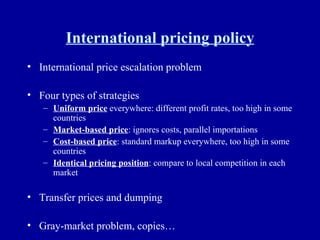
International pricing policy International price escalation problem Four types of strategies Uniform price  everywhere: different profit rates, too high in some countries Market-based price : ignores costs, parallel importations Cost-based price : standard markup everywhere, too high in some countries Identical pricing position : compare to local competition in each market Transfer prices and dumping Gray-market problem, copies…
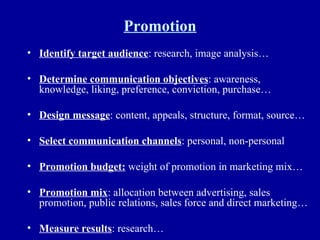
Promotion Identify target audience : research, image analysis… Determine communication objectives : awareness, knowledge, liking, preference, conviction, purchase… Design message : content, appeals, structure, format, source… Select communication channels : personal, non-personal Promotion budget:  weight of promotion in marketing mix… Promotion mix : allocation between advertising, sales promotion, public relations, sales force and direct marketing… Measure results : research…
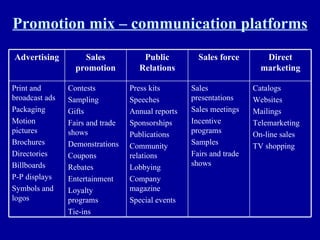
Promotion mix – communication platforms Catalogs Websites Mailings Telemarketing On-line sales TV shopping Sales presentations Sales meetings Incentive programs Samples Fairs and trade shows Press kits Speeches Annual reports Sponsorships Publications Community relations Lobbying Company magazine Special events Contests Sampling Gifts Fairs and trade shows Demonstrations Coupons Rebates Entertainment Loyalty programs Tie-ins Print and broadcast ads Packaging Motion pictures Brochures Directories Billboards P-P displays Symbols and logos Direct marketing Sales force Public Relations Sales promotion Advertising
International promotion policy Three different levels of communication: Corporate communication : inform firm’s partners (shareholders, administrations, suppliers, press, etc…) Institutional communication : communicate the firm’s values to the public and inside the organization Brand or product communication : image, consumer’s desires, technical characteristics, performance, etc… Corporate and institutional communication are easily standardized, but brand/product communication is harder to standardize
Communication and advertising Advertising is a form of communication A product’s position or difference is transmitted to target segment through communication Communication styles vary from country to country, they are culture-bound The role and importance of advertising/media also vary from one country to another Cultural factors affecting communication: High-context vs. low-context Explicit vs. implicit Direct vs. indirect Informational vs. emotional
Cultural dimensions and  advertising appeals Power distance High: status symbols, presence and importance of elders, master-learner relationships… Low: independence, “empowered” consumers Individualism/Collectivism IDV: low context, direct, explicit (you, we, I…), data, facts COL: high context, indirect, symbols, entertainment, groups Masculinity/Femininity MAS: winning, success, domination, persuasion, comparative advertising, reverse sexism… FEM: less endorsement, caring, less role differentiation Uncertainty avoidance High: explanations, testing, technology, design, structure, well-groomed Low: results are important, change, subtle LTO/STO STO: sense of urgency, direct style LTO: build trust, nature, entertainment
Advertising models and culture (1/2) Sales-response model Simple stimulus-response model Very direct, “buy now” strategy, short term effect Low PDI, IDV, MAS, Low UAI (Anglo-Saxon model) Persuasion model Short term shift in attitude, buying intention, and brand preference through providing arguments “ Lecture” form (presenters, demonstrations, testimonials), persuasive and direct US, UK, Germany, Switzerland, Austria…  Involvement model Build relationships between consumers and brands by creating emotional closeness Brand becomes a “personality”, indirect style FEM, IDV (Netherlands, Scandinavia, France…)
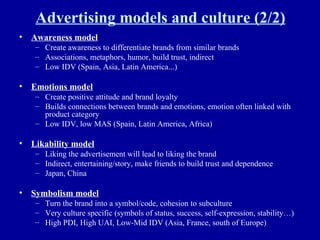
Advertising models and culture (2/2) Awareness model Create awareness to differentiate brands from similar brands Associations, metaphors, humor, build trust, indirect Low IDV (Spain, Asia, Latin America...) Emotions model Create positive attitude and brand loyalty Builds connections between brands and emotions, emotion often linked with product category Low IDV, low MAS (Spain, Latin America, Africa) Likability model Liking the advertisement will lead to liking the brand Indirect, entertaining/story, make friends to build trust and dependence Japan, China Symbolism model Turn the brand into a symbol/code, cohesion to subculture Very culture specific (symbols of status, success, self-expression, stability…) High PDI, High UAI, Low-Mid IDV (Asia, France, south of Europe)
Place - Marketing Channels What is a marketing channel (or distribution channel)? “ Marketing channels are sets of interdependent organizations involved in the process of making a product or service available for use or consumption by the consumer or business user” (Kotler) What about international marketing channels? These interdependent organizations allow goods and services to cross national boundaries. SCM, BtoC and BtoB, IMM
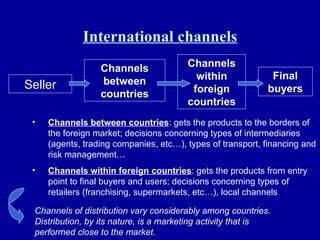
International channels Seller Channels between countries Channels within foreign countries Final buyers Channels between countries : gets the products to the borders of the foreign market; decisions concerning types of intermediaries (agents, trading companies, etc…), types of transport, financing and risk management… Channels within foreign countries : gets the products from entry point to final buyers and users; decisions concerning types of retailers (franchising, supermarkets, etc…), local channels Channels of distribution vary considerably among countries. Distribution, by its nature, is a marketing activity that is performed close to the market.
Channel management Channel design: types of intermediaries, number of intermediaries (exclusive, selective, intensive), contractual arrangements… Managing retailing, wholesaling and market logistics… Selecting, motivating and evaluating channel members (cooperation, conflict, competition) Channel dynamics: traditional, VMS, HMS, multi-channel marketing systems… Most difficult part of the mix to standardize
Entry mode choice Considered by many as the most important aspect of a firm’s internationalization strategy Entry mode will determine long-term success or withdrawal from foreign markets Poor decisions can be very costly for the firm
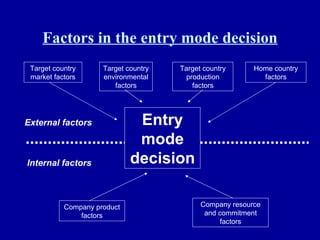
Factors in the entry mode decision Entry mode decision Target country market factors Target country environmental factors Target country production factors Home country factors Company product factors Company resource and commitment factors External factors Internal factors
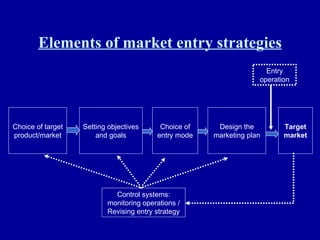
Elements of market entry strategies Choice of target product/market Setting objectives and goals Choice of entry mode Design the marketing plan Control systems: monitoring operations / Revising entry strategy Target market Entry operation
Different types of entry modes Exporting   (commercial strategy, commercial modes) Foreign direct investment   (industrial strategy, integrated modes) Associated or contractual modes   (contractual strategy, competitive alliances)
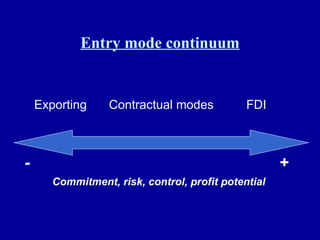
Entry mode continuum Exporting Contractual modes FDI Commitment, risk, control, profit potential - +
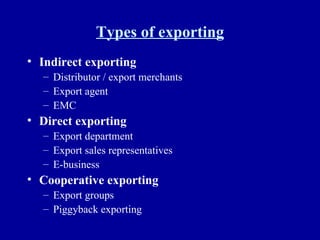
Types of exporting Indirect exporting Distributor / export merchants Export agent EMC Direct exporting Export department Export sales representatives E-business Cooperative exporting Export groups Piggyback exporting
Foreign direct investment (FDI) The ultimate form of foreign involvement Direct ownership of foreign-based assembly, manufacturing or sales facilities The company can buy part or full interest in a local company (M&A) or build its own facilities (GFI, ex nihilo) Considered the “preferred” mode of entry
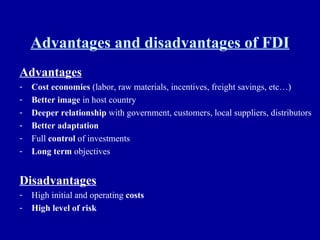
Advantages and disadvantages of FDI Advantages Cost economies  (labor, raw materials, incentives, freight savings, etc…) Better image  in host country Deeper relationship  with government, customers, local suppliers, distributors Better adaptation Full  control  of investments Long term  objectives Disadvantages High initial and operating  costs High level of risk
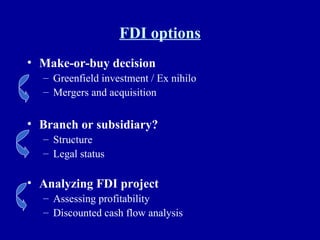
FDI options Make-or-buy decision Greenfield investment / Ex nihilo Mergers and acquisition Branch or subsidiary? Structure Legal status Analyzing FDI project Assessing profitability Discounted cash flow analysis
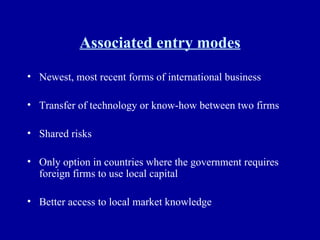
Associated entry modes Newest, most recent forms of international business Transfer of technology or know-how between two firms Shared risks Only option in countries where the government requires foreign firms to use local capital Better access to local market knowledge
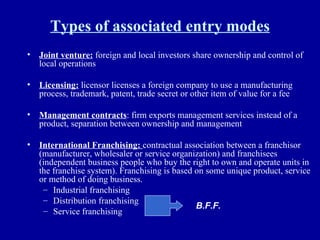
Types of associated entry modes Joint venture:  foreign and local investors share ownership and control of local operations Licensing:  licensor licenses a foreign company to use a manufacturing process, trademark, patent, trade secret or other item of value for a fee Management contracts : firm exports management services instead of a product, separation between ownership and management International Franchising:  contractual association between a franchisor (manufacturer, wholesaler or service organization) and franchisees (independent business people who buy the right to own and operate units in the franchise system). Franchising is based on some unique product, service or method of doing business. Industrial franchising Distribution franchising Service franchising B.F.F.
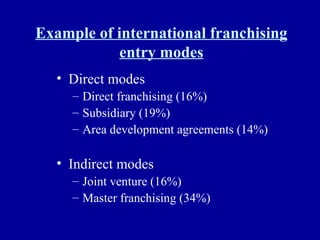
Example of international franchising entry modes Direct modes Direct franchising (16%) Subsidiary (19%) Area development agreements (14%) Indirect modes Joint venture (16%) Master franchising (34%)
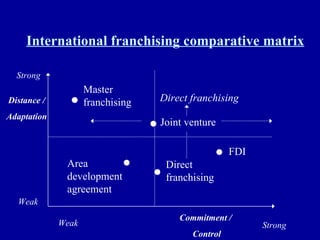
International franchising comparative matrix Distance / Adaptation Commitment /  Control Strong Weak Weak Strong Area development agreement Direct franchising FDI Master franchising Joint venture Direct franchising     
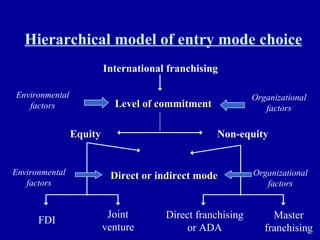
Hierarchical model of entry mode choice International franchising Level of commitment Equity Non-equity Direct or indirect mode FDI Joint venture Direct franchising or ADA Master franchising Environmental factors Organizational factors Environmental factors Organizational factors
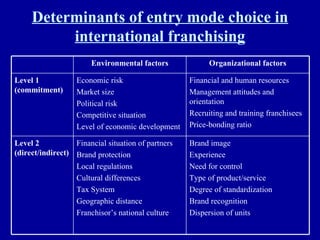
Determinants of entry mode choice in international franchising Brand image Experience Need for control Type of product/service Degree of standardization Brand recognition Dispersion of units Financial situation of partners Brand protection Local regulations Cultural differences Tax System Geographic distance Franchisor’s national culture Level 2 (direct/indirect) Financial and human resources Management attitudes and orientation Recruiting and training franchisees Price-bonding ratio Economic risk Market size Political risk Competitive situation Level of economic development Level 1 (commitment) Organizational factors Environmental factors
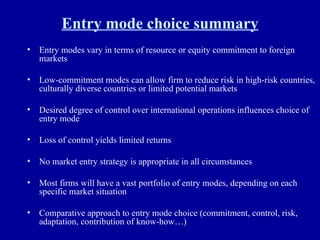
Entry mode choice summary Entry modes vary in terms of resource or equity commitment to foreign markets Low-commitment modes can allow firm to reduce risk in high-risk countries, culturally diverse countries or limited potential markets Desired degree of control over international operations influences choice of entry mode Loss of control yields limited returns No market entry strategy is appropriate in all circumstances Most firms will have a vast portfolio of entry modes, depending on each specific market situation Comparative approach to entry mode choice (commitment, control, risk, adaptation, contribution of know-how…)
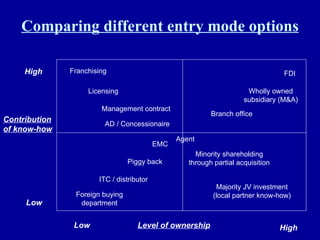
Comparing different entry mode options Foreign buying department ITC / distributor Piggy back EMC Agent Branch office Wholly owned subsidiary (M&A) FDI Franchising Licensing Management contract AD / Concessionaire Minority shareholding through partial acquisition Majority JV investment (local partner know-how) Level of ownership Contribution of know-how High Low Low High
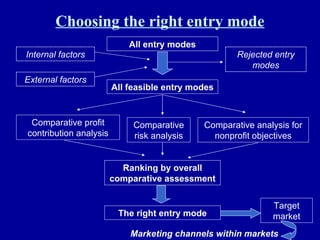
Choosing the right entry mode All entry modes All feasible entry modes Internal factors External factors Rejected entry modes Comparative profit contribution analysis Comparative risk analysis Comparative analysis for nonprofit objectives Ranking by overall comparative assessment The right entry mode Target market Marketing channels within markets
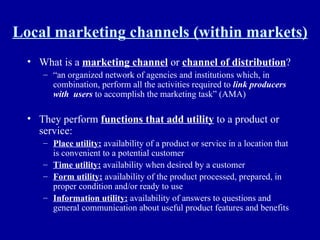
Local marketing channels (within markets) What is a  marketing channel  or  channel of distribution ? “ an organized network of agencies and institutions which, in combination, perform all the activities required to  link producers with  users  to accomplish the marketing task” (AMA) They perform  functions that add utility  to a product or service: Place utility:  availability of a product or service in a location that is convenient to a potential customer Time utility:  availability when desired by a customer Form utility:  availability of the product processed, prepared, in proper condition and/or ready to use Information utility:  availability of answers to questions and general communication about useful product features and benefits
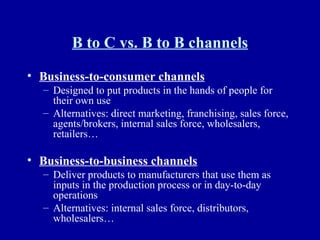
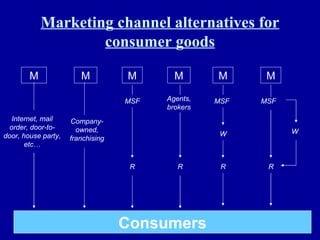
B to C vs. B to B channels Business-to-consumer channels Designed to put products in the hands of people for their own use Alternatives: direct marketing, franchising, sales force, agents/brokers, internal sales force, wholesalers, retailers… Business-to-business channels Deliver products to manufacturers that use them as inputs in the production process or in day-to-day operations Alternatives: internal sales force, distributors, wholesalers…
Marketing channel alternatives for consumer goods Consumers M Internet, mail order, door-to-door, house party, etc… M Company-owned, franchising M MSF R M Agents, brokers R M MSF W R M MSF R W
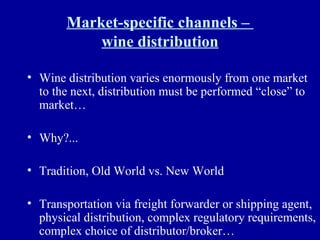
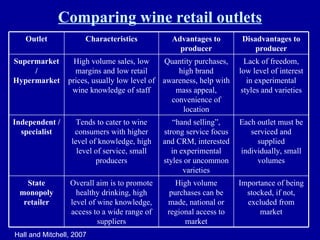
Problems in international  marketing channels Global retailing Case of hypermarkets Multi-channel strategies Case of franchising-Internet Market-specific channels Case of wine distribution
Global retailing Global retailing since 1970s, but many variations… Differences in the importance and types of retailing channels: shopping malls, department stores, discount stores, wholesale clubs, category killers, outlet centers, hypermarkets… Factors affecting the success of hypermarkets: culture, income, market fragmentation, traditional stores, locations, demography… Global retailing market entry Wal-mart case
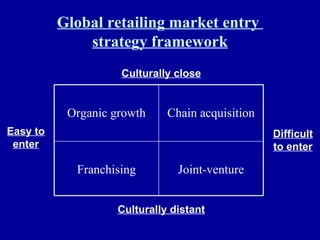
Global retailing market entry  strategy framework Culturally close Culturally distant Easy to enter Difficult to enter Joint-venture Franchising Chain acquisition Organic growth
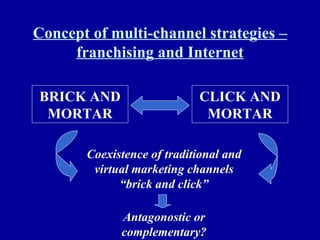
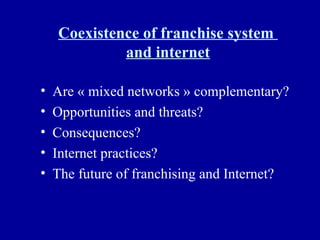
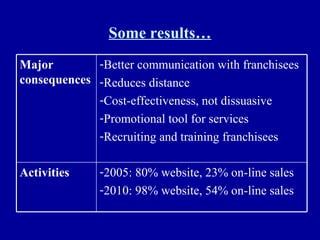
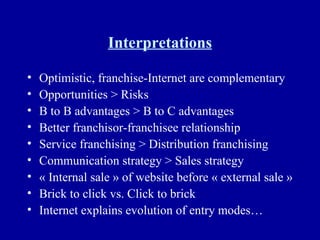
Concept of multi-channel strategies – franchising and Internet BRICK AND MORTAR CLICK AND MORTAR Coexistence of traditional and virtual marketing channels “brick and click” Antagonostic or complementary?
Some practical advice… Brand structure rather than channel structure (reduce risk of network competition) Sell all products on-line Ensure multi-channel coherency Back-office motivation Use Internet to increase visits (locations, maps) Limit use of e-mail… …  But does this apply to franchising?
Multi-channel strategies in franchising Franchising firms are « plural form networks » Internet is another distribution channel Internet seems to be a priority Internet is « revolutionizing » franchising … But, franchisors offering on-line sales are limited 32% in the US 30% in the UK Less than 20% in France
Opportunities and threats of multi-channel strategies (Franchising-Internet) Cannibalism Restriction franchisee sales Non-conformity websites Exclusive territories Definition catchment area Limits some entry modes New marketing channel Increased sales Network image Positive internal effects Threats Opportunities
Coexistence of franchise system  and internet Are « mixed networks » complementary? Opportunities and threats? Consequences? Internet practices? The future of franchising and Internet?
Some results… 2005: 80% website, 23% on-line sales 2010: 98% website, 54% on-line sales Activities Better communication with franchisees Reduces distance Cost-effectiveness, not dissuasive Promotional tool for services Recruiting and training franchisees Major consequences
Interpretations Optimistic, franchise-Internet are complementary Opportunities > Risks B to B advantages > B to C advantages Better franchisor-franchisee relationship Service franchising > Distribution franchising Communication strategy > Sales strategy « Internal sale » of website before « external sale » Brick to click vs. Click to brick Internet explains evolution of entry modes…
Market-specific channels –  wine distribution Wine distribution varies enormously from one market to the next, distribution must be performed “close” to market… Why?... Tradition, Old World vs. New World Transportation via freight forwarder or shipping agent, physical distribution, complex regulatory requirements, complex choice of distributor/broker…
Wine distribution choices Four possibilities for exporting Import distributor ( négociant ) Broker ( courtier, agent ) Export groups Direct sales End of channel (off-premise, on-premise) Supermarkets/Hypermarkets (FMCG) Specialized wine shops Duty-free HORECA Estate, e-commerce… Bottle vs. bulk Brand image, packaging… B to C approach Unbranded, supply chain … B to B approach
Wine distribution systems Regulatory framework, levels of marketing and market access Three types of systems around the world: Regulated open market : normal FMCG Controlled markets : government intervention in nearly all aspects of wine marketing Mixed systems : both open and controlled
U.S. wine distribution system 18th Amendment (1919 – Prohibition), 21st Amendment (1933 - authority to states), FAA Act Aim:  separate suppliers and retail outlets (tied-house relationship) Result:  three-tier system of distribution with independent licensed wholesaler in between the retailer and the supplier/exporter 31 “open” states, 19 “control” or “monopoly” states
Three-tier system Winery, Supplier Distributor / Wholesaler Supermarkets, wine shops, HORECA, bars, transportation, etc… Consumers Winery, Supplier Control States State controlled retail stores HORECA, clubs, etc… Consumers Open States Control States Tier I Tier II Tier III
Comparing wine retail outlets Hall and Mitchell, 2007 Disadvantages to producer Advantages to producer Characteristics Outlet Lack of freedom, low level of interest in experimental styles and varieties Quantity purchases, high brand awareness, help with mass appeal, convenience of location High volume sales, low margins and low retail prices, usually low level of wine knowledge of staff Supermarket / Hypermarket Each outlet must be serviced and supplied individually, small volumes “ hand selling”, strong service focus and CRM, interested in experimental styles or uncommon varieties Tends to cater to wine consumers with higher level of knowledge, high level of service, small producers Independent / specialist Importance of being stocked, if not, excluded from market High volume purchases can be made, national or regional access to market Overall aim is to promote healthy drinking, high level of wine knowledge, access to a wide range of suppliers State monopoly retailer
Conclusion –  7 Rules of International Distribution Select distributors. Don’t let them select you. Look for distributors capable of developing markets, rather than those with a few good customer contacts. Treat local distributors as long-term partners, not temporary market-entry vehicles. Support market entry by committing money, managers, and proven marketing ideas. From the start, maintain control over marketing strategy. Make sure distributors provide you with detailed market and financial performance data. Build links among national distributors at the earliest opportunity. Source: D. Arnold, HBR, 2005
Conclusion: SRC and cultural risk Cultural risk  is the most subjective of international business risks; it is the most difficult to assess SRC: the unconscious reference to one’s own cultural values SRC is the root of many international marketing problems Recognizing and admitting SRC is quite often difficult Analytical approach to reduce the influence of one’s own cultural values (A.C. Samli)
4 step process to reducing SRC 1. Define the problem or goal in terms of domestic cultural traits, habits or norms. 2. Define the problem or goal in terms of foreign cultural traits, habits or norms. Make no value judgments. 3. Isolate de SRC influence in the problem and examine it carefully to see how it complicates the problem. 4. Redefine the problem without the SRC influence and solve for the optimal goal situation.

International marketing

  • 1.
    INTERNATIONAL MARKETINGKrista Duniach Université d’Angers [email_address]
  • 2.
    BIBLIOGRAPHY Czinkota andRonkainen (2002), International Marketing , Thomson South-Western. De Mooij (2003), Global Marketing and Advertising, Understanding Global Paradoxes , Sage. Keegan and Green (2005), Global Marketing , Prentice Hall. Kotler and Armstrong (2006), Principles of Marketing , Prentice Hall. Prime et Usunier (2004), Marketing international, Développement des marchés et management interculturel , Vuibert. Usunier (2000), Marketing across Cultures , Prentice Hall. Periodicals: MOCI, HBR, JIBS, JM, JMR…
  • 3.
    Introduction What isinternational business? Wide range of activities involved in conducting business transactions across national boundaries Described as being heterogeneous, universal and sequential Comprehensive approach to operations of both large and small firms engaged in business abroad Concerns all activities of the firm (selling, procurement, outsourcing…) About seizing global opportunities (market expansion or diversification) Driving forces (regional economic agreements, converging needs and wants, communication improvements, quality, leverage…) and restraining forces (management myopia, corporate culture, national controls, globaphobia…) Orientations: Export, Internationalization, Globalization
  • 4.
    Introduction EPRG ModelEthnocentric: everything is centered on the domestic market. Polycentric: several important foreign markets exist. Regiocentric: the market is composed of several large economic regions. Geocentric: the world is one large global market.
  • 5.
    EPRG Model -Characteristics Matrix structure Division for each zone International division Structure World headquarters Subsidiary in each country National headquarters Planning center Unifying differences in the world market Taking into consideration differences in foreign markets Searching for identical segments in foreign markets Priority Global vision of the world Each market is unique Centered on the domestic market Vision The world is one common market Each country is relatively independent International operations are secondary Approach Geocentric Polycentric Ethnocentric
  • 6.
    EPRG Model -Characteristics World market share Local market share Domestic market share Performance measures Strategic alliances Joint-ventures Agent, licensing Partnerships Low-cost sources of supply Local Domestic Production Integrated and interactive Decentralized Centralized Management style Extension, Adaptation, Creation Adaptation Extension Marketing strategy Most qualified Citizens from each market Citizens from the domestic market Staff Geocentric Polycentric Ethnocentric
  • 7.
    Introduction What is marketing ? “ Marketing is a social and managerial process by which individuals and groups obtain what they need and want through creating, offering, and exchanging products of value with others.” (Kotler) Process, exchange, value
  • 8.
    Marketing process Understandthe marketplace and customer needs and wants Design a customer-driven marketing strategy Construct a marketing program that delivers superior value Build profitable relationships and create customer satisfaction Capture value from customers to create profits and customer quality Create value for customers and build customer relationships Capture value from customers in return Marketing technology Global markets Ethics and social responsibility
  • 9.
    Introduction What isinternational marketing? - “International marketing is the process of planning and conducting transactions across national borders to create exchanges that satisfy the objectives of individuals and organizations” (Czinkota and Ronkainen) - “International marketing focuses its resources on global market opportunities and threats” (Keegan and Green) - “International marketing is the motor of the internationalization process of the firm” (Usunier) - It is a tool used to obtain improvement of the firm’s position in the global market - Strategy and action, global and local
  • 10.
    Introduction International MarketingDecisions Deciding whether to go abroad Deciding which markets to enter Deciding how to enter the market Deciding on the marketing program Deciding on the marketing organization
  • 11.
    Introduction What arethe similarities and differences between international marketing and domestic marketing? Similarities: basic concepts, practices and tools are almost identical, key success factors are the same… Differences: more strategic, more variables, more complex, cultural differences, legal constraints, information sources, managing distances, entry mode choice…
  • 12.
    Introduction International marketingconcept Export marketing Global marketing Inter-cultural, multi-cultural marketing
  • 13.
    Course Outline Cultureand international marketing International marketing research International marketing strategy and programs
  • 14.
    Chapter 1 Cultureand international marketing
  • 15.
    Culture and internationalmarketing Concepts of culture Dimensions and models of culture Examples and international marketing consequences
  • 16.
    What is culture?“ Culture is the integrated sum total of learned behavioral traits that are shared by members of a society ” (Hoebel) “ Culture is the entirety of societal knowledge, norms and values” (Antonides and Van Raaij) “ Culture is the collective mental programming of the people in an environment. Culture is not a characteristic of individuals; it encompasses a number of people who were conditioned by the same education and life experience” (Hofstede) Culture both affects and describes human behavior, it is essential in international marketing
  • 17.
    Fundamentals of cultureCulture is a total pattern of behavior that is consistent and compatible in its components. It is not a collection of random behaviors… Culture is a learned behavior . It is not biologically transmitted. It depends on environment, not heredity. Culture is behavior that is shared by a group of people, a society. It is a distinctive way of life.
  • 18.
    Culture vs. personalityPersonality is the individual’s unique personal set of mental programs that he/she does not share with any other human being. Culture is what members of a group have in common. “It is the glue that binds groups together” (De Mooij) Human nature depends on culture: ideas, values, acts, emotions… are cultural products. Cultural patterns help people to live together in a society.
  • 19.
    Manifestations of cultureSymbols Heroes Rituals Values and Norms Expressions of culture
  • 20.
    Symbols Symbols arewords, gestures, pictures, or objects that carry a particular meaning recognized only by those who share a culture. This is the most superficial manifestation of culture. New symbols are easily developed and old ones quickly disappear. Symbols from one cultural group are regularly copied by others.
  • 21.
    Heroes Heroes arepeople, alive or dead, real or imaginary, who possess characteristics that are highly prized in a society. They serve as role models for behavior. They can become globally known, but their stories often become local.
  • 22.
    Rituals Rituals arethe collective activities considered socially essential within a culture. They are carried out for their own sake. They are easily observed, but not always understood.
  • 23.
    Values Values areat the core of culture. Values are stable beliefs regarding desired behavior or end states. They often have a religious, ideological or humanistic background. Goals are derived from values. Values are among the first things children learn, not consciously but implicitly. Core values are resistant to globalization; they vary across cultures and are not likely to change frequently.
  • 24.
    Norms Norms andvalues are part of the “non-material” culture. Norms are beliefs regarding how to behave and how not to behave (do’s and don’ts). People differ in the extent to which they accept and comply with norms. They create expectations and criteria regarding the conduct of others.
  • 25.
    Explicit vs. implicitculture Explicit culture: languages, behavior, know-how, institutions (directly observable) Implicit culture: moral values, learning process, beliefs and representations (subconscious)
  • 26.
    According to Hoebel…There are 3 types of cultural norms in terms of behavior: 10% of norms are technical : explicit, logical and transferable; written norms of a society (laws, technical manuals, rules, etc…) 30% of norms are formal : explicit, moral and transmissible; traditions of a culture; learned through education (manners, courtesy…) 60% of norms are informal : implicit, instinctive and imitated; sunken part of the iceberg (facial expressions, body language, cultural perspective on time and space…) How do these cultural norms influence international business and marketing?
  • 27.
    Two levels ofcultural diversity in international business External cultural diversity Cultural determinants influencing purchasing and consumption behaviors (Who buys? What? Where? How? Why?) Cultural determinants influencing negotiations (relationships with suppliers, buyers, partners) Internal cultural diversity Observed within all MNCs (identity and corporate culture) Cultural differences that affect the way subsidiaries work together
  • 28.
    Four levels ofculture in marketing DOMINANT CULTURE Non-material consumer culture Material culture of products (market) Non-material culture of the firm (corporate culture)
  • 29.
    Transfer of cultureTwo main cultural transfer processes: Socialization: transfer of culture to new generations; older generation to younger generation; education. Acculturation: transfer of culture to adults who have grown up in different cultures, who have been socialized in different cultures; ethnic minorities; multicultural societies.
  • 30.
    Cultural transfer andchange SOCIALIZATION LEARNING BY OBSERVATION ACCULTURATION CULTURAL TRANSFER AND CHANGE, DYNAMIC PROCESS Agents Agents
  • 31.
    Agents involved incultural transfer Pleasure, intellect 12 Mass media Ambition, courage 12 Sport, clubs Honesty, peace, salvation, forgiveness 6 Church Courage, social recognition 6 Friends Ambition, capability, logical behavior 6 Schools, teachers Responsibility, social recognition 2 Siblings Obedience, cleanliness, honesty 0 Parents Most important values Age (years) Agents
  • 32.
    Processes of culturalchange Socialization and acculturation usually imply a gradual cultural change because transfer agents tend to favor cultural continuity rather than jeopardize their powerful position. In contrast, innovative forces are less conservative and may challenge the status quo. 4 processes: cohort effects, age effects, democratization and exclusivation.
  • 33.
    Cohort effects Acceptanceof new values and behaviors begins at a young age. These values and behaviors are retained over the years. They are spread in society because young people grow older and the “old” values gradually disappear with the extinction of the older cohorts. Implies a slow cultural change.
  • 34.
    Age effect Certainvalues or behaviors are associated with a particular age group. Behaviors are modified as age groups change. Age-bound consumer behavior. Possible reverse socialization.
  • 35.
    Democratization Cultural “leveling”or “spreading” Cultural differences across social classes decrease. Results from an increasing level of general welfare, the influence of mass media and the stress on the equality ideal. Mechanisms of democratization: trickle-down, trickle-up, trickle-across.
  • 36.
    Exclusivation Reverse ofdemocratization Occurs less frequently Implies limited social spreading of values, goods and behavior. Cultural change is limited to a certain group (“elite”, “leading edge”).
  • 37.
    Dimensions of cultureWhat makes one culture different from another culture? How can we compare cultures or cluster cultures according to behavioral characteristics? Stereotypes vs. cultural dimensions Different cultures have different stereotypes of other cultures. Ethnocentrism and SRC
  • 38.
    Cultural dimension modelsHall – High-context vs. low-context cultures Kluckhohn – Relationship to nature Hofstede – Five dimensions of culture
  • 39.
    Hall’s cultural modelFocuses on communication patterns found within cultures Four essential dimensions in terms of communication patterns: Context Time Space Information flow High-context vs. low-context cultures
  • 40.
    Low-context and high-contextcultures Low-context Messages are explicit Words carry most of the information in communication (facts, data) Effective verbal communication is expected to be explicit, direct, and unambiguous High-context Less information is contained in the verbal part of the message Much more information resides in the context of communication (background, associations, symbols, basic values of the communicators) Verbal mode is only one part of communication, nonverbal is often seen as having greater importance Degree of context of cultures : comparison of law (US and France)
  • 41.
    Time Different cultureshave different concepts of time. This can explain differences in behavior. Dimensions of time: Closure: a task must be completed, if not perceived as “wasted” Long-term vs. short-term thinking Orientation toward past, present or future Linear or circular (tangible or intangible) M-time and P-time Cause and effect Time as symbol (“time is money”, efficiency, waiting, discretionary time)
  • 42.
    A few examples…US, Germany, Switzerland Japan, China, Middle East Examples Common Infrequent Competitive bidding Proceed quickly Are lengthy Negotiations Monochronic, linear Polychronic, circular Time People maintain a bubble of private space People breathe on each other Space Pushed to the lowest level Taken by the highest level Responsibility for error « Get it in writing » To be trusted A person’s word Very important Less important Lawyers Low-context High-context Factors
  • 43.
    Kluckhohn’s cultural model3 types of relationships between humanity and nature: Mastery-over-nature (man is to conquer nature) Harmony-with-nature (man is to live in harmony with nature) Subjugation-to-nature (man is dominated by nature) Further developed with: nature of people, duty, mode of activity, privacy of space, temporal orientation…
  • 44.
    Humanity and NatureUse in international marketing? Africa, South America Asia, Japan “ Western” world, North America -People are dominated by nature -Supernatural forces play a dominant role in religion -Nothing can be done to control nature No distinction between humanity, nature and supernatural Communion, exchange, subtle intimacy Identification with nature Humanity is separate from nature Nature should be controlled “ To move a mountain” Subjugation-to-nature Harmony-with-nature Mastery-over-nature
  • 45.
    Hofstede’s cultural modelHofstede’s 4D or 5D model Quantitative and longitudinal study of cultural differences between countries Why some concepts of motivation do not work in all countries in the same way “ Culture’s Consequences” and “Cultures and Organizations: Software of the Mind” Scores for each country explain why people and organizations in various countries differ, comparative data. Reference in international business and international marketing
  • 46.
    How do wemeasure cultural distance? Geert Hofstede’s Cultural Index - National character survey - 116.000 IBM employees - 72 countries and 20 languages Five different poles make up the cultural index: - Power distance - Uncertainty avoidance - Individualism - Masculinity - (Long term orientation) Original scores for 56 countries, extended to nearly 90
  • 47.
    5D Model 0100 100 100 100 100 PDI UAI IDV MAS LTO Work-related values to consumption-related values
  • 48.
    Power distance (PDI)High PDI vs. Low PDI “ the extent to which less powerful members of a society accept and expect that power is distributed unequally” Reflected in the values of both the less powerful and more powerful members of society Influences the way people accept and give authority Shows class or social structure Focuses on the degree of equality, or inequality, between people in the country’s society
  • 49.
    Uncertainty avoidance (UAI)High UAI vs. Low UAI “ the extent to which people feel threatened by uncertainty and ambiguity and try to avoid these situations” Strong UAI = need for rules and formality to structure life, search for truth and belief in experts Conflict and competition are threatening Higher level of anxiety, show of emotions is accepted
  • 50.
    Individualism (IDV) Individualisticvs. Collectivistic “ people looking after themselves and their immediate family only, versus people belonging to in-groups that look after them in exchange for loyalty” “ I”-conscious and “we”-conscious Focuses on the degree the society reinforces individual or collective achievement and interpersonal relationships Distinguishes between societies where the group and being a member is important (collectiveness) and societies where the group is less important (individualism)
  • 51.
    Masculinity (MAS) Masculinevs. Feminine “ the dominant values in a masculine society are achievement and success; the dominant values in a feminine society are caring for others and quality of life” Focuses on the degree the society reinforces, or does not reinforce, the traditional masculine work role model of male achievement, performance, control and power Shows the importance of status in societies Indicates the degree of gender differentiation and the importance of masculine values (assertiveness, money, material goods, success…)
  • 52.
    Long-term orientation (LTO)Long-term vs. Short-term orientation Chinese value survey, “Confucian dynamism” “ the extent to which a society exhibits a pragmatic future-oriented perspective rather than a conventional historic or short-term point of view” High LTO = perseverance, ordering relationships by status, thrift, sense of shame, family ties, long-term thinking, paternalism Focuses on the degree the society embraces, or does not embrace, long-term devotion to traditional, forward thinking values Indicates whether the country prescribes to the values of long-term commitments and respect for tradition
  • 53.
  • 54.
    Some country examples50 49 43 65 57 World average 29 62 91 46 40 USA 42 51 86 57 Spain 44 14 80 53 38 Netherlands 80 95 46 92 54 Japan 70 76 75 50 Italy 61 56 48 40 77 India 25 66 89 35 35 Great Britain 31 66 67 65 35 Germany 43 71 86 68 France 16 74 23 18 Denmark 54 75 94 65 Belgium 31 61 90 51 36 Australia LTO MAS IDV UAI PDI Country
  • 55.
    Comparison of culturaldimensions More information on www.geert-hofstede.com
  • 56.
    American culture Classicaldimensions: M-time culture, linear time-pattern, low-context, low PDI, individualistic, high MAS, low UAI, short-term orientation Other dimensions: success, obsession with change (new and better), credit card culture, education for competitiveness, independence, ethnocentrism, strong role differentiation, innovativeness, creativity, private opinions expressed, education teaches students to be critical (ask “why” not “how”), man must conquer nature, (De Mooij)
  • 57.
    Japanese culture Classicaldimensions: P-time culture, circular time concept, high-context, high PDI, collectivistic, masculine, strong UAI, long-term orientation Other dimensions: pressure to behave like neighbors, shame-based society, avoid jolting social harmony, dependence, private opinions not expressed, status is important (success) but avoid standing out in a crowd, cash culture, thrift and perseverance, strong role differentiation, education (“how” instead of “why”), education has an intrinsic value, obsession with cleanliness, harmony with nature… (De Mooij)
  • 58.
    Limits to Hofstede’smodel Generalization, reductive, simplistic (unproven and unprovable, flawed assumptions, “storytelling”…) Original objective: how values in the workplace are influenced by culture Three discrete cultures Organizational Occupational National Questionnaire – quantitative data Differences in location – intracultural differences, subcultures ?
  • 59.
    Intracultural differences Fewcultures are homogeneous in terms of cultural traits and norms Consequence of globalization? Intracultural differences (nationality, religion, race, language or geographic areas) result in the emergence of distinct subcultures Existence of cross-cultural and intracultural differences: opportunities and threats
  • 60.
    To summarize onculture… Culture is complex and multi-dimensional, but classification is important in business Cultural distance is essential in international marketing Culture influences perceptions and drives how we communicate and what we communicate SRC and ethnocentrism can explain the failure of many companies in the international arena Acculturation (adjusting and adapting to a specific culture other than one’s own) is one of the keys to success in international operations
  • 61.
    How does cultureaffect international marketing? Languages and the use of language in communicating, advertising, negotiating… Marketing research is much more difficult to conduct from a methodological perspective Buying patterns and behaviors will vary in different cultural contexts Marketing mix will be perceived differently from one country to another Management styles will be directly related to culture…
  • 62.
    Marketing and culturaldifferences Source: Usunier Negotiation strategies, process, results, styles… Negotiation Sales force management, PR, corruption, ethics Sales Advertising messages, symbols, adaptation of strategy Advertising Values, visions of the world, communication styles Communication Type of channel, distributor relationships Distribution channels Price-quality ratio, influence of price in decision-making Pricing policy Brand perception, country of origin, “made in” Brand image Adapt or standardize product attributes Product policy Inter-national (regional, global) vs. intra-national Segmentation & targeting Global strategy vs. customized strategy Global marketing strategy Cross-national equivalences Marketing research Decision-making, cross-cultural attitudes, local vs. global Consumer behavior Influence of cultural differences Marketing area
  • 63.
    Culture’s consequences oninternational marketing Marketing research (understanding consumers) Segmentation (classifying consumers) Product policy (satisfying consumers) Distribution channels (reaching consumers) Advertising (communicating with consumers)
  • 64.
    Chapter 2 InternationalMarketing Research
  • 65.
    International marketing researchReview of marketing research techniques Specific problems in international markets
  • 66.
    Review of marketingresearch techniques General principles of marketing research Qualitative research Quantitative research
  • 67.
    What is marketingresearch? Marketing research is the link between the marketer and the market… It is the starting point of marketing… Marketing research is the systematic design, collection, analysis, and reporting of data and findings relevant to a specific marketing situation facing the company. MIS : consists of people, equipment, and procedures to gather, sort, analyze, evaluate, and distribute needed, timely, and accurate information to marketing decision makers.
  • 68.
    Marketing process Understandthe marketplace and customer needs and wants Design a customer-driven marketing strategy Construct a marketing program that delivers superior value Build profitable relationships and create customer satisfaction Capture value from customers to create profits and customer quality Create value for customers and build customer relationships Capture value from customers in return Marketing technology Global markets Ethics and social responsibility
  • 69.
    Position of marketingresearch ANALYSIS PLANNING IMPLEMENTATION CONTROL MARKETING RESEARCH MARKETING STRATEGY MARKETING RESEARCH
  • 70.
    Marketing research goalsUNDERSTAND DESCRIBE EXPLAIN MEASURE FORECAST VERIFY Product, consumer, distributor, competitor, environmental analysis
  • 71.
    Marketing research processDefine problem and research objectives Develop the research plan Collect the information Analyze the information Present the findings
  • 72.
    Research design Theresearch design formally describes the characteristics of the survey and the procedures used to conduct the study. It is the methodological framework of the research. Contents: Goals Information sources Variables Survey method Sampling method Data analysis Calendar Budget Internal validity External validity
  • 73.
    Types of marketingresearch EXPLORATORY DESCRIPTIVE CAUSAL Documentary Qualitative Documentary Quantitative Experimentation Observation
  • 74.
    Research methods Observationalresearch - Audit: inventories, facing, pantry check… - Mechanical: scanning, EDI, eye camera… Experimental research - Product/concept tests: prototype, comparative or not - Market/store tests: laboratory stores, catalog sales, mobile stores, in-store tests, city tests… Ad hoc research Qualitative research: interviews, focus groups… Quantitative research: surveys, opinion polls…
  • 75.
    Qualitative and quantitativeresearch The distinction between qualitative and quantitative research depends on the nature of the research problem. If “why?” or “how?” QUALITATIVE RESEARCH If “how many?” or “how much?” QUANTITATIVE RESEARCH
  • 76.
    Information Sources Secondarysources : Existing data. All forms of documentary research. DESK RESEARCH Primary sources : Data collected for a specific situation at company’s request. FIELD RESEARCH, AD HOC These sources can be internal or external. The choice will depend on the marketing problem, objectives, resources…
  • 77.
    Documentary Research Firststep to marketing research 4 steps Define the topic (clear, feasible, pertinent) Identify key words associated to the topic Search for available sources of information Consult, sort and summarize information Questions to ask Does the data correspond to the situation? Is there a risk of obtaining biased information? Was the research design technically coherent? Are the findings clear, precise…?
  • 78.
    Research and pollinginstitutes These institutes collect information for resale. They can give 2 types of information: Standardized periodic information : panels, longitudinal studies. Firms subscribe to this information. This is a secondary information source. On-order studies : reserved solely for one company or omnibus studies. This is a primary information source.
  • 79.
    Advantages and disadvantagesof information sources Costly Difficult to collect Time consuming Incomplete, outdated Inadequate False information Difficult to control Disadvantages Adapted information Recent, up-to-date Not available to competitors Low in cost Diversity Available Problem definition Familiar with market Advantages Primary Secondary
  • 80.
    Sequence and relationshipbetween different sources of information SECONDARY SOURCES (Desk Research) Internal External PRIMARY SOURCES (Field Research) Qualitative Quantitative
  • 81.
  • 82.
    What is qualitativemarketing research? Collecting and analyzing psycho-sociological elements which explain facts, attitudes, opinions, motivations and behaviors of all people involved in a given marketing situation Qualitative research methods are used for in-depth exploratory studies of the decision-making process and psychological mechanisms that affect individual or group behavior
  • 83.
    Why use qualitativeresearch? Qualitative research studies lead to understanding the causes or the basis for behaviors, attitudes and opinions. They are often based on analyzing how a product or company is perceived by individuals or consumers. However, results cannot be extrapolated. They cannot be considered as being representative of the entire population. Sample size = 10 - 70
  • 84.
    Qualitative research isused in the following cases: Defining the marketing problem is difficult (explore market) Finding causes, decision-making criteria of consumer behavior Secondary information is insufficient Constructing questionnaire for a survey Explaining surprising results of quantitative research Promoting creativity
  • 85.
    Advantages and disadvantagesof qualitative research Non-representative sample Research design is difficult to plan Quality of the study depends on researcher skills Quick and flexible (maximum 70 people) Less costly Allows exploration Attitudes, motivations, opinions are studied Reveals deep feelings and thoughts Disadvantages Advantages
  • 86.
    Different types ofqualitative research Two ways of classifying qualitative studies: Degree of induction (level of consciousness) Unstructured interview (pure exploration) Centered or focus interview (exploration and in-depth analysis) Structured interview (identification and verification) Number of people being interviewed Individual Group
  • 87.
    Choosing a Typeof Interview OPINIONS ATTITUDES MOTIVATIONS / BELIEFS Structured interview Centered or Focus interview Unstructured interview or centered with projective tests Levels of consciousness
  • 88.
    Unstructured interviews Conductedin a face-to-face situation Large, ambiguous opening Funnel approach The respondent is free to express his feelings as wishes and for as long as he wishes Non-directive, but reformulation techniques Use in marketing
  • 89.
    Unstructured interviewing stepsPresent research objectives Large opening statement or questions Researcher adopts a non-directive attitude Reformulation techniques (« mirror effect ») Respondent goes further in-depth « auto-exploration »
  • 90.
    Centered or focusinterviews Same general structure and basic principles as the unstructured interview However, an interview guide is used This guide is composed of topics or questions to be addressed during the interview The interviewer will bring up topic if and only if respondent does not spontaneously address issues This is NOT a questionnaire (no order, modifications possible, different versions allowed) This is the most popular form of qualitative research
  • 91.
    Projective techniques Usedto avoid psychological obstacles (taboos, reluctance, courtesy bias, subconscious…) or to go further in-depth Visual or written stimuli The respondent will overcome hesitations Difficult to analyze, ambiguous Different tests Word association Sentence completion Story completion Frustration or cartoon test TAT (Thematic Apperception Test) Haire test
  • 92.
    Example – Nescafé(Haire test) List 1 1 lb. of carrots Roast beef 1 can of Delmonte corn Heinz ketchup Folgers ground coffee Tide laundry detergent 3 onions List 2 1 lb. of carrots Roast beef 1 can of Delmonte corn Heinz ketchup Nescafé instant coffee Tide laundry detergent 3 onions ? ?
  • 93.
    Structured interviews Mostdirective method in qualitative marketing research A questionnaire is used However, the questionnaire is only composed of open-end questions Questionnaire facilitates the research process as well as analysis Confusion between qualitative and quantitative research It is theoretically incorrect to extrapolate or generalize the findings
  • 94.
    Focus groups Nearlyalways use the centered approach (interview guide, group discussion is directed by interviewer) About 7 to 10 participants per group The role of the interviewer is very important Interviewer must manage the group in terms of participation, conflict, domination, summaries, etc… Organization and logistical aspects
  • 95.
    Focus group phasesThree phases during the group interview: Presentation (warming up): explanations, rules of the game, individual introductions, anonymous responses… Exchange : each participant gives his or her opinions, thoughts, group dialogue, tests… Summarize : verify all topics of interview guide, repeats, star technique (circept), gift…
  • 96.
    Comparing different typesof interviews Unstructured : large opening statement and non-directive attitude (≈ 500 to 800 €) Centered : interview guide to « center » discussion (≈ 250 to 500 €) Structured : qualitative questionnaire (≈ 150 to 200 €) Focus group : centered interview, 7 to 10 participants per group (≈ 5000 to 8000 €)
  • 97.
    Comparing individual interviews and focus groups No in-depth motivations Risk of conformity, strong group influence Organizational and logistic difficulties More information during discussion Quicker to conduct Possible to study interactions and influences during the decision process Stimulate ideas and creativity Focus groups Researcher training Analyzing findings Long to conduct Personal, in-depth questions Lower cost per respondent Only solution in some cases (B to B, competitors) Individual interview Disadvantages Advantages
  • 98.
    Qualitative sampling Norepresentative sample, but variety of individuals is important No important profiles should be excluded Sequential procedure (arborescence) is used: List of criteria explaining differences of behavior Rank criteria from most important to least important List possibilities for each criteria Build arborescence Verify coherency of arborescence
  • 99.
    Sampling in focusgroups Same basic principles (arborescence) All participants must feel “equal” However, there are two important rules: Group must be heterogeneous (cover all of the profiles of the populations) Group must be homogeneous (for criteria that may lead to an unbalanced group) Many groups may be need to be organized in order to avoid unbalanced groups or inter-group pressure
  • 100.
    Qualitative data analysisTwo different methods can be used: Summaries of interviews, “verbatims” Content analysis Requires re-transcribing of all interviews Specialized software Quantification, scientific rigor Time and budget
  • 101.
  • 102.
    Differences compared to qualitative research Associated with descriptive research Objectives are different: verify, measure, estimate... Sampling methods are different Large sample size (300 – 1000+) Methods of administration change Precision of an estimation, margin of error Data analysis is more sophisticated
  • 103.
    Advantages and disadvantagesof quantitative research Does not explain why or how Precision tool, not a discovery tool Self-report data Broad but shallow data Long and costly Difficult in B to B Participation is unrewarding (direct marketing) Delivers precise numerical estimations (forecasting, market share, intentions…) Extrapolation possible Representative sample Superior objectivity Statistical techniques Inter-group comparisons Longitudinal studies Disadvantages Advantages
  • 104.
    Categories of quantitativeresearch Census Collect information from each member of the population Complete canvass of the population Depends on the size of the target population Survey Most familiar of all market research methodologies Collect information from a portion of the population Procedure in which a fixed set of questions is asked of a sample of respondents On the basis of information collected on the subset, it is possible to infer something about the larger group Inference depends on the sampling method
  • 105.
    Census vs. SurveyCensus: n = N Survey: n/N = subset of the population, survey rate or sampling rate Exhaustive or non-exhaustive survey Generalization and extrapolation of findings
  • 106.
    Validity of quantitativeresearch Representative sample  sampling method and response rate Precision  sample size and margin of error Quality of questionnaire and administration Researcher training and experience Quality of information processing Quality of data analysis
  • 107.
    What is sampling?n 70% N 70% + e Sampling is necessary every time the population size is too large to be able to collect information from all elements of the population.
  • 108.
    Probability vs. non-probabilitysampling Probability Each population element has a known, non-zero chance of being included in the sample Final elements are selected objectively by a specific process Equal probabilities are not necessary Allow an assessment of the amount of sampling error likely to occur Requires an exhaustive sample frame Non-probability No way of estimating that probability that any population element will be included in the sample Rely on personal judgment somewhere in the process Statistically, precision (sampling error) cannot be evaluated
  • 109.
    Quantitative sampling methodsSimple random sample Cluster sample Area sample Level random sample Stratified random sample Quota sample Random route sample Judgment sample (on-the-spot sample) Convenience sample PROBABILITY SAMPLES NON-PROBABILITY SAMPLES
  • 110.
    Probability sampling SRS: each population element has a know and equal chance of being selected; central-limit theorem (when n is large, the sample mean will be normally distributed). Cluster and area: first parent population is divided into mutually exclusive and exhaustive subsets, then a random sample of the subset is selected. LRS: random sampling occurs at several different levels of the population. Stratified: population is divided into strata or subpopulations and random sampling occurs in each stratum (proportionate and disproportionate).
  • 111.
    Non-probability sampling Quotas: attempt to ensure that the sample is representative by selecting sample elements in such a way that the proportion of the sample elements possessing a certain characteristic is approximately the same as the proportion of the elements with the characteristic in the population. Random route: each field worker is given a random route to follow, leading to the selection of people to interview. Judgment: sample elements are handpicked because it is expected that they can serve the research purpose and it is believed that they are representative of the population of interest (purposive samples). Convenience: sometimes called accidental samples because those composing the sample enter by accident (volunteers, radio shows…)
  • 112.
    Choosing a samplingmethod Do we have a sample frame? Is SRS too costly? Is the population stratified? SRS Stratified sample Do we have a frame of clusters? Is it too costly? Cluster or area sample Are there frames at different levels? Level random sample Yes No No No Yes Yes Yes No Yes No Yes No
  • 113.
    Do we knowthe structure of the population for several variables that explain differences in behavior? Quota sample Yes No Is the population widely dispersed? Random route No Are there mandatory passage points? Judgment or on-the-spot sample Snowball or other convenience sample Yes No Yes
  • 114.
    Sample size andprecision With probability samples, precision and minimal sample size can be determined Sample size must be greater than 30 Estimation, confidence level, confidence interval and margin of error Probability sampling methods or Kish coefficient Precision of an estimation is not proportional to sample size, but to the square root of the sample size. To double precision, the sample size must be multiplied by four.
  • 115.
    Sample size andmargin of error n = t pq e 2 2 Non-exhaustive sample n’ = (n x N) / (n + N) Exhaustive sample e =  t √pq n Margin of error for probability samples n = budget – fixed costs direct cost per unit Budget approach
  • 116.
    Procedure for developinga questionnaire Specify what information will be collected Determine type of questionnaire and method of administration Determine content of individual questions Determine form of response to individual questions Determine wording of each question Determine sequence of questions Determine physical characteristics of questionnaire Reexamine and revise Pretest questionnaire and revise if necessary
  • 117.
    Type of questionnaireand method of administration These two decisions are interdependent The length of the questionnaire will influence the choice of the method of administration Self-administered questionnaires (mail, Internet, questionnaire in magazine, etc…): response rate is generally low (< 20%) Questionnaires completed with researcher (direct personal interviewing, phone): longer questionnaire and higher response rate (50%)
  • 118.
    Form of responseOpen-ended Dichotomous: 2 possible answers Multiple choice: 3 or more possible answers Likert scale: a statement with which the respondent shows the amount of agreement or disagreement (strongly agree – strongly disagree) Semantic differential scale: a scale connecting two bipolar words, respondent selects the point that represents his/her opinion (enthusiastic – unenthusiastic) Importance scale: rates the importance of some attribute (extremely important – extremely unimportant) Rating scale: rates some attribute from “poor” to “excellent” Intention-to-buy scale: describes respondent’s intention to buy a product or service (definitely buy – definitely not buy) Avoid halo effect (change direction in scales to avoid repetition)
  • 119.
    Question wording Thephrasing of a question can directly affect the responses. General rules: Use simple words Avoid technical vocabulary in consumer research Avoid double negations Avoid ambiguous words and questions Avoid leading questions Avoid double-barreled questions Examples
  • 120.
    Question sequence Generalrules: Questionnaire should be very logical and easy to respond to. Use simple, interesting opening question. Use the funnel approach (start with broad questions and progressively narrow down in scope). Avoid jumping around from topic to topic. Use transitions. Design branching questions with care. Place difficult or sensitive questions late in the questionnaire. Ask for classification information last.
  • 121.
    Question sequence Knowledgeand awareness questions Factual behavior questions Attitude questions Intention questions Classification questions
  • 122.
    Questionnaire pretest Datacollection should never begin without an adequate pretest of the instrument. Can be used to assess both individual questions and their sequence. Small sample of 10 to 30 Questionnaire followed by interview to identify problems and misunderstandings Pretest results are not included in the final results of the survey “ The pretest is the most inexpensive insurance the marketer can buy to ensure the success of the questionnaire and the entire research project”
  • 123.
    Quantitative data analysisUnivariate analysis  descriptive statistics and graphical information Multivariate analysis  cross-tabulations, Chi square tests, correlation analysis, multiple regression analysis, cluster analysis (perceptual mapping), factor analysis….
  • 124.
    Cost factors affectingsurveys Sample size Accessibility Survey length Analysis ≈ 100 € per respondent
  • 125.
    Specific problems ininternational markets
  • 126.
    General context ofinternational marketing research Globalization, but change at different rates in different parts of the world Challenge of conducting high quality research as quick as possible in multiple diverse settings Research conducted simultaneously in developed and developing world Unbalanced spread of marketing research expenditures Multi-faceted issues (where, how, who, tools, comparisons…) New technologies (CATI, CAPI, scanners, Internet…)
  • 127.
    3 specific problemsin international marketing research Who will conduct the research?  degree of research centralization Is the information comparable?  cross-cultural research  equivalences What are the sources of bias?  five bias types
  • 128.
    Who will conductinternational marketing research? The firm can use internal or external research services. The unknown competitive situation and different cultural backgrounds complicate the choice between internal and external research. Problem: exclusive contracts with marketing research firms… To what degree should international marketing research be centralized? Three choices: internal marketing department, domestic research firm, foreign research firm
  • 129.
    The degree ofcentralization of international marketing research Low in cost. Travel expenses and use of staff. Excellent. Excellent. Risk in terms of analysis. Language problems. Cultural bias. Limited knowledge of sources in foreign market. Low access. Network problem. Competitive analysis difficult. Internal marketing department Cost Monitoring Adaptation to firm’s problem Quality and reliability of information Information sources Access to information High in cost. Specific project fees. Good. Easy to monitor during the research process. Very good. Easy to clarify if problems. Risk in terms of analysis. Language problems. Depends on the informal network. Excellent in France. Perhaps limited in foreign market. Good if the firm has an important local network. Domestic research firm Variable. Limited. Risk of non-conformity with initial objectives. Limited. The firm may be unknown. Excellent. Excellent in foreign market, but only local. Very good. Low risk of ignoring essential information. Foreign research firm
  • 130.
    Is the informationcomparable? This question is very important in cross-cultural or comparative studies. Some words, ideas, concepts, practices, etc… will have different meanings in different cultural contexts. Research equivalence is necessary, but not always easy to achieve. Equivalences must be verified before conducting research on “foreign” consumer behavior.
  • 131.
    International equivalences Functionalequivalence : do products serve the same function? Conceptual equivalence : do relevant concepts have the same meaning and/or importance? Category equivalence : does the product belong to the same category or domain? Translation equivalence : cross-check, translation-retranslation Metric equivalence : scaling, odd/even, do adjectives have the same strength and distances? Respondent equivalence : who should answer questions? same social role? sampling unit… Sampling frame equivalence : how will sample be chosen?
  • 132.
    Sources of biasBias = distorted results, incorrect or false compared to reality… Biased responses are more likely to occur in international marketing research than in domestic research and are harder to avoid Importance of control, pre-test, acculturation… Research plans must be adapted to reduce the risk of biased responses
  • 133.
    5 sources ofbias Courtesy bias: concerns the social desirability of answers, the respondent hopes to please the interviewer Subject bias: concerns the way a society perceives an issue as being more or less sensitive Cultural-trait bias : a given cultural trait can alter the findings (IDV, MAS…) Response style bias : some responses are more or less extreme in some cultures (scaling, ranking), coefficients Non-response bias : non-response style varies according to country, gender, race…
  • 134.
    Practical consequences in international marketing… Qualitative research only accounts for less than 20% of research expenditures around the world (emerging markets, innovation, brand renewal…), but this is increasing Length of interview and compensation will vary from one market to the other (monochronic and low-context = shorter interviews and larger compensation) Some techniques are unknown or unfeasible (projective techniques, on-line surveys, CAGI/CATI…) Focus groups are very culture-bound (collectivistic vs. individualistic societies, social status, disagreement…) Sampling techniques are limited (reliable information is not widely available, statistics, sampling base…) Collecting information is difficult (level of economic development, illiteracy, local authorizations…) Cross-cultural research is limited (comparison is difficult, concepts/rituals…) Recent developments in international marketing research
  • 135.
    Chapter 3 InternationalMarketing Strategy and Programs
  • 136.
    Expanded marketing processmodel Understand the marketplace and customer needs and wants Design a customer-driven marketing strategy Construct a marketing program that delivers superior value Build profitable relationships and create customer satisfaction Capture value from customers to create profits and customer quality Create value for customers and build customer relationships Capture value from customers Research consumers and market Manage marketing information and customer data Select customers to serve: segmentation and targeting Decide on a value proposition: differentiation and positioning Product and service design: build strong brands Pricing: create real value Distribution: manage demand and supply chains Promotion: communicate VP CRM and CEM: build strong relationships with chosen customers Partner relationship management: build strong relationships with marketing partners Create satisfied loyal customers Capture customer lifetime value Increase share of market and share of customer Marketing technology Global markets Ethical and social responsibility
  • 137.
    Corporate strategy vs.marketing strategy SBU SBU SBU Core market S1 S2 S3 Target segment Positioning Marketing mix Strategic segmentation Strategic positioning Market segmentation Market targeting Market positioning -Sales objectives -Budgets -4 Ps Consumer preferences Competitor positioning Firm advantages
  • 138.
    Market segmentation Whatis it? Identifying and profiling distinct groups of buyers who might require separate products and/or marketing mixes Clustering consumers in terms of behavior, needs, attitudes, opinions… Why? Buyers/consumers differ in many ways They do not respond to the same stimuli in the same way So, different offers for different types of buyers Market segmentation represents an effort to increase a company’s targeting precision.
  • 139.
    Levels of marketsegmentation Mass marketing Mass production, distribution and promotion of one product for all buyers Largest potential market, “one size fits all” Lowest costs = lower prices or higher margins Segment marketing Large identifiable group within a market Buyers differ in their wants, purchasing power, location, attitudes and habits…but the company is not willing to customize its offer to each individual customer More appropriate products and services, distribution and communication easier, fewer competitors Niche marketing More narrowly defined group, a small market whose needs are not being well served Smaller companies can become more competitive through specialization Better understanding of customers who willingly pay a price premium Individual marketing Segments of one, customized marketing, one-to-one marketing… More frequent in B to B than in B to C New technologies allow “mass customization” ; ability to prepare on a mass basis individually designed products and communications to meet each customer’s requirements
  • 140.
    Market segmentation procedureMarket segments and niches can be identified by applying successive variables to subdivide a market. 3 steps: Research stage: gain insight into consumer motivations, attitudes and behavior and collect important data (attributes and ratings, brand awareness and rating, product-usage patterns, attitudes toward product category, customer characteristics…). Analysis stage: factor analysis to remove highly correlated variables and cluster analysis to create a specific number of maximally different segments. Profiling stage: each cluster is profiled in terms of its distinguishing attitudes, behavior, customer characteristics… Market segmentation must be redone periodically because market segments change over time, especially in international markets
  • 141.
    Segmentation variables Ininternational marketing, broader market segments compared to domestic segments, transnational segments - Consumer responses to benefits sought, use occasions or brands (consumer-response segments) Hierarchy of attributes in choosing a brand, shifts in consumer priorities (market partitioning) Marketing mix variables : product, price, placement, promotion (price-quality-type dominant) Geographic Nations States Regions Cities… Demographic -Age and life-cycle stage - VALS or psychographics -Gender -Income -Generation -Social class… Marketing characteristics Consumer characteristics
  • 142.
    Example 1: culture-basedsegmentation Relatively weak resistance to new products, strong consumer desire for novelty and variety, high consumer regard for “environmentally friendly” marketers and socially conscious firms. Low High Low Small 37 Cluster 3 Denmark, Sweden, Netherlands, Norway Appeal to consumer’s status and power position, reduce perceived risk in product purchase and use, emphasize product functionality. Low-Medium Varied Strong Medium 182 Cluster 2 Belgium, France, Greece, Portugal, Spain, Turkey Preference for “high performance” products, use “successful-achiever” them in advertising, desire for novelty, variety and pleasure, fairly risk-averse market. High Medium-High Medium Small 203 Cluster 1 Austria, Germany, Switzerland, Italy, GB, Ireland Marketing implications MAS IDV UAI PDI Size (million)
  • 143.
    Example 2 :segmentation of CEE markets « Marketization »: Countries’ exposure to global communications, increased product availability and variety, and overall attempt to close the living standards gap with developed countries Reflects a set of institutional values and cultural requirements for the operation of effective private markets (materialistic values as a stimulus for greater production, competition, freedom of information…) « Westernization »: Countries’ proximity to the West The duration and the extent of their openness to Western influence and culture
  • 144.
    CEE clusters HighMarketization Low Marketization Low Westernization High Westernization Cluster 1 Cluster 2 Cluster 3 Cluster 4 Source: Lascu, Manrai and Manrai Clusters are likely to have common characteristics and share similar consumer needs and purchasing behavior
  • 145.
    Central and EasternEuropean clusters Cluster 1: High-marketization and high-westernization (Hungary, Poland, Czech and Slovak Republics, Slovenia) Geographic: Central Europe, border developed countries, more urbanized Cultural: Slavic languages (except Hungary), primarily Catholic religion Economic: more developed Cluster 2: Low-marketization and high-westernization (Bosnia, Serbia, Croatia, Montenegro, Macedonia) Geographic: Central Europe, more urbanized Cultural: Slavic languages, primarily Eastern Orthodox and Muslim Economic: more developed, but less than cluster 1
  • 146.
    Central and EasternEuropean clusters Cluster 3: High-marketization and low-westernization (Bulgaria and Romania) Geographic: Balkan peninsula, urbanized to a lesser extent than cluster 2 Cultural: Latin and Slavic languages, Eastern Orthodox religion Economic: slower in the development process Cluster 4: Low-marketization and low-westernization (Albania and Western countries of the former Soviet Union) Geographic: Less urbanized than cluster 3 Cultural: Slavic languages (Russian is the primary commercial language), Eastern Orthodox and Muslim Economic: formerly “fierce” dictatorships, slower development
  • 147.
    Market targeting Afteridentifying different markets and market segments, the firm must: Evaluate the various segments Decide how many and which ones to target
  • 148.
    Evaluating the marketsegments Overall attractiveness of the segment Size, growth, profitability, scale economies, low risk… How easy is it to persuade buyers to shift their purchases (consumers, relative non-consumers, absolute non-consumers)? Brand loyalty vs. dissatisfied buyers Company’s objectives and resources Do segments correspond to the company’s long-term objectives? Does company possess the skills and resources needed to succeed in the segment? The company should only enter market segments in which it can offer superior value
  • 149.
    Selecting market segments5 different target market strategies: Single-segment concentration Concentrated marketing Strong knowledge of segment’s needs Strong market position in segment Economies through specialization = high returns Risks are higher than normal Selective specialization Several segments that are objectively attractive Little or no synergy among segments but each is profitable Diversification of firm’s risk
  • 150.
    Selecting market segmentsProduct specialization Concentrate on certain product to several segments Strong reputation in specific product area Risk of technology Market specialization Concentrate on serving many needs of a particular customer group Strong reputation with group, channel for all new products Risk of decreased buying power in the group Full market coverage Serve all customer groups with all products they need Limited to very large firms Undifferentiated: ignore segment differences, one offer for entire market Differentiated: operate in several segments with different programs for each
  • 151.
    Market positioning Marketpositioning : act of designing the company’s offering and image so that they occupy a meaningful and distinctive competitive position in the target customer’s mind; refers to the consumer’s perception of a product or brand amongst other brands Objective: attaining a prominent place for company’s brand amongst other brands in the minds of consumers Positioning mainly results from marketing communication regarding brands, social communication and personal experience Categorization and positioning within category Product differentiation, international coherency
  • 152.
    Importance of productdifferentiation Market segmentation Product differentiation Demand side Heterogeneous markets are divided into homogeneous submarkets ( market segmentation ) Supply side Homogeneous products can be differentiated into products tuned to these homogeneous market segments ( market positioning )
  • 153.
    Differentiation attributes Differentattributes in different markets, cultural influence Value proposition Emotional power Symbols Media Atmosphere Events Coverage Expertise Performance Competence Courtesy Credibility Reliability Responsiveness Communication Ordering ease Delivery Installation Customer training Customer consulting Maintenance Warranty Features Performance Conformance Price Quality Durability Reliability Repairability Style Design Image Channel Personnel Services Product
  • 154.
    Promoting the differenceHow many difference should a firm promote? USP: “best quality”, “best service”, “lowest price”, “best value”, “safest”, “fastest”, “most convenient”, “most advanced technology”… Double-benefit positioning : if two or more firms are claiming to be best on the same attribute, search for special niche within the target segment, two benefits must be compatible (“safest” and “most durable”) The number of differences should be limited (communication, clarity, credibility) Coherency in international markets is essential, between markets and between segments
  • 155.
    Communicating the firm’spositioning Once positioning strategy chosen, the firm must communicate the positioning effectively Mentally distinguish offerings, enter into the minds of consumers Communication through physical signs and cues Marketing mix is used to communicate the company’s positioning
  • 156.
    From marketing strategyto marketing programs Marketing strategy must be implemented through marketing programs Managers must decide on marketing expenditures, marketing mix, and resource allocation Internal cultural diversity External cultural diversity Marketing mix allows firm to communicate and implement its strategy, formalized in marketing plan
  • 157.
    Marketing mix Marketingmix is the set of marketing tools that the firm uses to pursue its marketing objectives in the target market. 4 Ps (McCarthy): Product Price Promotion Place 4 Cs (Lauterborn) Customer needs and wants Cost to the customer Communication Convenience
  • 158.
    The four P’sof the marketing mix Channels (direct, indirect, exclusive, selective, intensive), coverage, assortments, locations, inventory, logistics, transport… Place Sales promotion, advertising, sales force, public relations, direct marketing… Promotion List price, discounts, payment period, credit terms… Price Product variety, quality, design, features, brand name, packaging, sizes, services, warranties, returns… Product
  • 159.
    Standardization vs. adaptationDebate in marketing since Buzzell (1968) and Levitt (1983) Factors encouraging standardization Economies of scale in production Economies in R&D Economies in marketing Global competition “ Shrinking” of world market “ Converging, homogeneous cultures” Factors encouraging adaptation Differing use conditions Government and regulatory influences Local competition Differing consumer behavior patterns “ True” to marketing concept Degree of standardization, Degree of adaptation, global/local paradox
  • 160.
    Need for adaptationDegree of cultural grounding High Low Nature of product Industrial/Technology intensive Consumer Source: Czinkota and Ronkainen
  • 161.
    Factors affecting adaptationConsumption patterns Psychosocial characteristics Cultural criteria
  • 162.
    Consumption patterns Patternof purchase Is the product purchased by relatively the same consumer income group from one country to the other? Do the same family members motivate the purchase or dictate brand choice in all target countries? Do most consumers expect a product to have the same appearance? Is the purchase rate the same regardless of the country? Are most purchases made at the same kind of retail outlet? Do most consumers spend the same amount of time making the purchase? Pattern of usage Do most consumers use the product for the same purpose? Is the product used in different amounts from one area to another? Is the method of preparation the same in all target markets? Is the product used along with other products?
  • 163.
    Psychosocial characteristics Attitudestoward the product Are the basic psychological, social, and economic factors motivating the purchase and use of the product the same for all target markets? Are the advantages/disadvantages of the product in the minds of consumers basically the same from one country to another? Does the symbolic content of the product differ from one country to another? Is the psychic cost of purchasing and using the product the same? Attitudes toward the brand Is the brand name equally known and accepted in all target countries? Are customer attitudes toward the package basically the same? Are customer attitudes toward pricing basically the same? Is brand loyalty the same throughout target countries for the product?
  • 164.
    Cultural criteria Doessociety restrict the purchase and/or use of the product to a particular group? Is there a stigma attached to a product? Does the usage of the product interfere with tradition in one or more of the targeted markets? Does the message of the product correspond to core cultural values? How do the different dimensions of culture influence the purchase and use of the product?
  • 165.
    Product “ Aproduct is anything that can be offered to a market to satisfy a want or need” (Kotler) Physical goods Services Persons Places Organizations Ideas Common product problems : Developing new products Managing life-cycle strategies Managing product lines Managing brands… Product policy, product mix
  • 166.
    Product mix: productlines and brands Product lines Width: how many product lines the firm carries Length: how many items in each product line Depth: how many variants are offered of each product in the line Consistency: how closely related the various product lines are (end use, production, distribution channels, etc…) Brandin g Identifies the company at six different levels: attributes, benefits, values, culture, personality and user Brand awareness, brand acceptability, brand preference, brand loyalty Global branding and international coherency Degree of adaptation in FMCG
  • 167.
    Elements of aproduct Core benefit or service Packaging Brand name Quality Styling Features Installation Delivery and credit After-sale service Warranty Augmented product Tangible product Core product Global variations, adapt or standardize?
  • 168.
    Specific international product policy problems Country of origin, made in effect Preference for national brands Global branding (mono, line, umbrella) Brand equity and extension International standards Product protection Product adaptation
  • 169.
    International product policyExistence of global product? International standard? Three common strategies Straight extension Product invention Product adaptation Technical adaptation Commercial adaptation Consumer products vs. industrial products
  • 170.
    Pricing Select pricingobjective Determine demand Estimate costs Analyze competitors’ costs, prices, and offers Select pricing method Select final price
  • 171.
    Common pricing methodsMark-up pricing : add a standard mark-up to the product’s cost Target-return pricing : determine price that would yield its target rate of return (ROI) Perceived-value pricing : buyers’ perception of value, not the seller’s cost, is the key to pricing Value pricing : low price for fairly high-quality (EDLP) Going-rate pricing : prices are largely based on competitors’ prices, rather than on costs or demand Sealed-bid pricing : competitive-based pricing based on expectations of how competitors will price Yield pricing: discriminatory pricing depending on customer segment and inventory level
  • 172.
    International pricing policyInternational price escalation problem Four types of strategies Uniform price everywhere: different profit rates, too high in some countries Market-based price : ignores costs, parallel importations Cost-based price : standard markup everywhere, too high in some countries Identical pricing position : compare to local competition in each market Transfer prices and dumping Gray-market problem, copies…
  • 173.
    Promotion Identify targetaudience : research, image analysis… Determine communication objectives : awareness, knowledge, liking, preference, conviction, purchase… Design message : content, appeals, structure, format, source… Select communication channels : personal, non-personal Promotion budget: weight of promotion in marketing mix… Promotion mix : allocation between advertising, sales promotion, public relations, sales force and direct marketing… Measure results : research…
  • 174.
    Promotion mix –communication platforms Catalogs Websites Mailings Telemarketing On-line sales TV shopping Sales presentations Sales meetings Incentive programs Samples Fairs and trade shows Press kits Speeches Annual reports Sponsorships Publications Community relations Lobbying Company magazine Special events Contests Sampling Gifts Fairs and trade shows Demonstrations Coupons Rebates Entertainment Loyalty programs Tie-ins Print and broadcast ads Packaging Motion pictures Brochures Directories Billboards P-P displays Symbols and logos Direct marketing Sales force Public Relations Sales promotion Advertising
  • 175.
    International promotion policyThree different levels of communication: Corporate communication : inform firm’s partners (shareholders, administrations, suppliers, press, etc…) Institutional communication : communicate the firm’s values to the public and inside the organization Brand or product communication : image, consumer’s desires, technical characteristics, performance, etc… Corporate and institutional communication are easily standardized, but brand/product communication is harder to standardize
  • 176.
    Communication and advertisingAdvertising is a form of communication A product’s position or difference is transmitted to target segment through communication Communication styles vary from country to country, they are culture-bound The role and importance of advertising/media also vary from one country to another Cultural factors affecting communication: High-context vs. low-context Explicit vs. implicit Direct vs. indirect Informational vs. emotional
  • 177.
    Cultural dimensions and advertising appeals Power distance High: status symbols, presence and importance of elders, master-learner relationships… Low: independence, “empowered” consumers Individualism/Collectivism IDV: low context, direct, explicit (you, we, I…), data, facts COL: high context, indirect, symbols, entertainment, groups Masculinity/Femininity MAS: winning, success, domination, persuasion, comparative advertising, reverse sexism… FEM: less endorsement, caring, less role differentiation Uncertainty avoidance High: explanations, testing, technology, design, structure, well-groomed Low: results are important, change, subtle LTO/STO STO: sense of urgency, direct style LTO: build trust, nature, entertainment
  • 178.
    Advertising models andculture (1/2) Sales-response model Simple stimulus-response model Very direct, “buy now” strategy, short term effect Low PDI, IDV, MAS, Low UAI (Anglo-Saxon model) Persuasion model Short term shift in attitude, buying intention, and brand preference through providing arguments “ Lecture” form (presenters, demonstrations, testimonials), persuasive and direct US, UK, Germany, Switzerland, Austria… Involvement model Build relationships between consumers and brands by creating emotional closeness Brand becomes a “personality”, indirect style FEM, IDV (Netherlands, Scandinavia, France…)
  • 179.
    Advertising models andculture (2/2) Awareness model Create awareness to differentiate brands from similar brands Associations, metaphors, humor, build trust, indirect Low IDV (Spain, Asia, Latin America...) Emotions model Create positive attitude and brand loyalty Builds connections between brands and emotions, emotion often linked with product category Low IDV, low MAS (Spain, Latin America, Africa) Likability model Liking the advertisement will lead to liking the brand Indirect, entertaining/story, make friends to build trust and dependence Japan, China Symbolism model Turn the brand into a symbol/code, cohesion to subculture Very culture specific (symbols of status, success, self-expression, stability…) High PDI, High UAI, Low-Mid IDV (Asia, France, south of Europe)
  • 180.
    Place - MarketingChannels What is a marketing channel (or distribution channel)? “ Marketing channels are sets of interdependent organizations involved in the process of making a product or service available for use or consumption by the consumer or business user” (Kotler) What about international marketing channels? These interdependent organizations allow goods and services to cross national boundaries. SCM, BtoC and BtoB, IMM
  • 181.
    International channels SellerChannels between countries Channels within foreign countries Final buyers Channels between countries : gets the products to the borders of the foreign market; decisions concerning types of intermediaries (agents, trading companies, etc…), types of transport, financing and risk management… Channels within foreign countries : gets the products from entry point to final buyers and users; decisions concerning types of retailers (franchising, supermarkets, etc…), local channels Channels of distribution vary considerably among countries. Distribution, by its nature, is a marketing activity that is performed close to the market.
  • 182.
    Channel management Channeldesign: types of intermediaries, number of intermediaries (exclusive, selective, intensive), contractual arrangements… Managing retailing, wholesaling and market logistics… Selecting, motivating and evaluating channel members (cooperation, conflict, competition) Channel dynamics: traditional, VMS, HMS, multi-channel marketing systems… Most difficult part of the mix to standardize
  • 183.
    Entry mode choiceConsidered by many as the most important aspect of a firm’s internationalization strategy Entry mode will determine long-term success or withdrawal from foreign markets Poor decisions can be very costly for the firm
  • 184.
    Factors in theentry mode decision Entry mode decision Target country market factors Target country environmental factors Target country production factors Home country factors Company product factors Company resource and commitment factors External factors Internal factors
  • 185.
    Elements of marketentry strategies Choice of target product/market Setting objectives and goals Choice of entry mode Design the marketing plan Control systems: monitoring operations / Revising entry strategy Target market Entry operation
  • 186.
    Different types ofentry modes Exporting (commercial strategy, commercial modes) Foreign direct investment (industrial strategy, integrated modes) Associated or contractual modes (contractual strategy, competitive alliances)
  • 187.
    Entry mode continuumExporting Contractual modes FDI Commitment, risk, control, profit potential - +
  • 188.
    Types of exportingIndirect exporting Distributor / export merchants Export agent EMC Direct exporting Export department Export sales representatives E-business Cooperative exporting Export groups Piggyback exporting
  • 189.
    Foreign direct investment(FDI) The ultimate form of foreign involvement Direct ownership of foreign-based assembly, manufacturing or sales facilities The company can buy part or full interest in a local company (M&A) or build its own facilities (GFI, ex nihilo) Considered the “preferred” mode of entry
  • 190.
    Advantages and disadvantagesof FDI Advantages Cost economies (labor, raw materials, incentives, freight savings, etc…) Better image in host country Deeper relationship with government, customers, local suppliers, distributors Better adaptation Full control of investments Long term objectives Disadvantages High initial and operating costs High level of risk
  • 191.
    FDI options Make-or-buydecision Greenfield investment / Ex nihilo Mergers and acquisition Branch or subsidiary? Structure Legal status Analyzing FDI project Assessing profitability Discounted cash flow analysis
  • 192.
    Associated entry modesNewest, most recent forms of international business Transfer of technology or know-how between two firms Shared risks Only option in countries where the government requires foreign firms to use local capital Better access to local market knowledge
  • 193.
    Types of associatedentry modes Joint venture: foreign and local investors share ownership and control of local operations Licensing: licensor licenses a foreign company to use a manufacturing process, trademark, patent, trade secret or other item of value for a fee Management contracts : firm exports management services instead of a product, separation between ownership and management International Franchising: contractual association between a franchisor (manufacturer, wholesaler or service organization) and franchisees (independent business people who buy the right to own and operate units in the franchise system). Franchising is based on some unique product, service or method of doing business. Industrial franchising Distribution franchising Service franchising B.F.F.
  • 194.
    Example of internationalfranchising entry modes Direct modes Direct franchising (16%) Subsidiary (19%) Area development agreements (14%) Indirect modes Joint venture (16%) Master franchising (34%)
  • 195.
    International franchising comparativematrix Distance / Adaptation Commitment / Control Strong Weak Weak Strong Area development agreement Direct franchising FDI Master franchising Joint venture Direct franchising     
  • 196.
    Hierarchical model ofentry mode choice International franchising Level of commitment Equity Non-equity Direct or indirect mode FDI Joint venture Direct franchising or ADA Master franchising Environmental factors Organizational factors Environmental factors Organizational factors
  • 197.
    Determinants of entrymode choice in international franchising Brand image Experience Need for control Type of product/service Degree of standardization Brand recognition Dispersion of units Financial situation of partners Brand protection Local regulations Cultural differences Tax System Geographic distance Franchisor’s national culture Level 2 (direct/indirect) Financial and human resources Management attitudes and orientation Recruiting and training franchisees Price-bonding ratio Economic risk Market size Political risk Competitive situation Level of economic development Level 1 (commitment) Organizational factors Environmental factors
  • 198.
    Entry mode choicesummary Entry modes vary in terms of resource or equity commitment to foreign markets Low-commitment modes can allow firm to reduce risk in high-risk countries, culturally diverse countries or limited potential markets Desired degree of control over international operations influences choice of entry mode Loss of control yields limited returns No market entry strategy is appropriate in all circumstances Most firms will have a vast portfolio of entry modes, depending on each specific market situation Comparative approach to entry mode choice (commitment, control, risk, adaptation, contribution of know-how…)
  • 199.
    Comparing different entrymode options Foreign buying department ITC / distributor Piggy back EMC Agent Branch office Wholly owned subsidiary (M&A) FDI Franchising Licensing Management contract AD / Concessionaire Minority shareholding through partial acquisition Majority JV investment (local partner know-how) Level of ownership Contribution of know-how High Low Low High
  • 200.
    Choosing the rightentry mode All entry modes All feasible entry modes Internal factors External factors Rejected entry modes Comparative profit contribution analysis Comparative risk analysis Comparative analysis for nonprofit objectives Ranking by overall comparative assessment The right entry mode Target market Marketing channels within markets
  • 201.
    Local marketing channels(within markets) What is a marketing channel or channel of distribution ? “ an organized network of agencies and institutions which, in combination, perform all the activities required to link producers with users to accomplish the marketing task” (AMA) They perform functions that add utility to a product or service: Place utility: availability of a product or service in a location that is convenient to a potential customer Time utility: availability when desired by a customer Form utility: availability of the product processed, prepared, in proper condition and/or ready to use Information utility: availability of answers to questions and general communication about useful product features and benefits
  • 202.
    B to Cvs. B to B channels Business-to-consumer channels Designed to put products in the hands of people for their own use Alternatives: direct marketing, franchising, sales force, agents/brokers, internal sales force, wholesalers, retailers… Business-to-business channels Deliver products to manufacturers that use them as inputs in the production process or in day-to-day operations Alternatives: internal sales force, distributors, wholesalers…
  • 203.
    Marketing channel alternativesfor consumer goods Consumers M Internet, mail order, door-to-door, house party, etc… M Company-owned, franchising M MSF R M Agents, brokers R M MSF W R M MSF R W
  • 204.
    Problems in international marketing channels Global retailing Case of hypermarkets Multi-channel strategies Case of franchising-Internet Market-specific channels Case of wine distribution
  • 205.
    Global retailing Globalretailing since 1970s, but many variations… Differences in the importance and types of retailing channels: shopping malls, department stores, discount stores, wholesale clubs, category killers, outlet centers, hypermarkets… Factors affecting the success of hypermarkets: culture, income, market fragmentation, traditional stores, locations, demography… Global retailing market entry Wal-mart case
  • 206.
    Global retailing marketentry strategy framework Culturally close Culturally distant Easy to enter Difficult to enter Joint-venture Franchising Chain acquisition Organic growth
  • 207.
    Concept of multi-channelstrategies – franchising and Internet BRICK AND MORTAR CLICK AND MORTAR Coexistence of traditional and virtual marketing channels “brick and click” Antagonostic or complementary?
  • 208.
    Some practical advice…Brand structure rather than channel structure (reduce risk of network competition) Sell all products on-line Ensure multi-channel coherency Back-office motivation Use Internet to increase visits (locations, maps) Limit use of e-mail… … But does this apply to franchising?
  • 209.
    Multi-channel strategies infranchising Franchising firms are « plural form networks » Internet is another distribution channel Internet seems to be a priority Internet is « revolutionizing » franchising … But, franchisors offering on-line sales are limited 32% in the US 30% in the UK Less than 20% in France
  • 210.
    Opportunities and threatsof multi-channel strategies (Franchising-Internet) Cannibalism Restriction franchisee sales Non-conformity websites Exclusive territories Definition catchment area Limits some entry modes New marketing channel Increased sales Network image Positive internal effects Threats Opportunities
  • 211.
    Coexistence of franchisesystem and internet Are « mixed networks » complementary? Opportunities and threats? Consequences? Internet practices? The future of franchising and Internet?
  • 212.
    Some results… 2005:80% website, 23% on-line sales 2010: 98% website, 54% on-line sales Activities Better communication with franchisees Reduces distance Cost-effectiveness, not dissuasive Promotional tool for services Recruiting and training franchisees Major consequences
  • 213.
    Interpretations Optimistic, franchise-Internetare complementary Opportunities > Risks B to B advantages > B to C advantages Better franchisor-franchisee relationship Service franchising > Distribution franchising Communication strategy > Sales strategy « Internal sale » of website before « external sale » Brick to click vs. Click to brick Internet explains evolution of entry modes…
  • 214.
    Market-specific channels – wine distribution Wine distribution varies enormously from one market to the next, distribution must be performed “close” to market… Why?... Tradition, Old World vs. New World Transportation via freight forwarder or shipping agent, physical distribution, complex regulatory requirements, complex choice of distributor/broker…
  • 215.
    Wine distribution choicesFour possibilities for exporting Import distributor ( négociant ) Broker ( courtier, agent ) Export groups Direct sales End of channel (off-premise, on-premise) Supermarkets/Hypermarkets (FMCG) Specialized wine shops Duty-free HORECA Estate, e-commerce… Bottle vs. bulk Brand image, packaging… B to C approach Unbranded, supply chain … B to B approach
  • 216.
    Wine distribution systemsRegulatory framework, levels of marketing and market access Three types of systems around the world: Regulated open market : normal FMCG Controlled markets : government intervention in nearly all aspects of wine marketing Mixed systems : both open and controlled
  • 217.
    U.S. wine distributionsystem 18th Amendment (1919 – Prohibition), 21st Amendment (1933 - authority to states), FAA Act Aim: separate suppliers and retail outlets (tied-house relationship) Result: three-tier system of distribution with independent licensed wholesaler in between the retailer and the supplier/exporter 31 “open” states, 19 “control” or “monopoly” states
  • 218.
    Three-tier system Winery,Supplier Distributor / Wholesaler Supermarkets, wine shops, HORECA, bars, transportation, etc… Consumers Winery, Supplier Control States State controlled retail stores HORECA, clubs, etc… Consumers Open States Control States Tier I Tier II Tier III
  • 219.
    Comparing wine retailoutlets Hall and Mitchell, 2007 Disadvantages to producer Advantages to producer Characteristics Outlet Lack of freedom, low level of interest in experimental styles and varieties Quantity purchases, high brand awareness, help with mass appeal, convenience of location High volume sales, low margins and low retail prices, usually low level of wine knowledge of staff Supermarket / Hypermarket Each outlet must be serviced and supplied individually, small volumes “ hand selling”, strong service focus and CRM, interested in experimental styles or uncommon varieties Tends to cater to wine consumers with higher level of knowledge, high level of service, small producers Independent / specialist Importance of being stocked, if not, excluded from market High volume purchases can be made, national or regional access to market Overall aim is to promote healthy drinking, high level of wine knowledge, access to a wide range of suppliers State monopoly retailer
  • 220.
    Conclusion – 7 Rules of International Distribution Select distributors. Don’t let them select you. Look for distributors capable of developing markets, rather than those with a few good customer contacts. Treat local distributors as long-term partners, not temporary market-entry vehicles. Support market entry by committing money, managers, and proven marketing ideas. From the start, maintain control over marketing strategy. Make sure distributors provide you with detailed market and financial performance data. Build links among national distributors at the earliest opportunity. Source: D. Arnold, HBR, 2005
  • 221.
    Conclusion: SRC andcultural risk Cultural risk is the most subjective of international business risks; it is the most difficult to assess SRC: the unconscious reference to one’s own cultural values SRC is the root of many international marketing problems Recognizing and admitting SRC is quite often difficult Analytical approach to reduce the influence of one’s own cultural values (A.C. Samli)
  • 222.
    4 step processto reducing SRC 1. Define the problem or goal in terms of domestic cultural traits, habits or norms. 2. Define the problem or goal in terms of foreign cultural traits, habits or norms. Make no value judgments. 3. Isolate de SRC influence in the problem and examine it carefully to see how it complicates the problem. 4. Redefine the problem without the SRC influence and solve for the optimal goal situation.