THE CULTURAL DYNAMICS
OF
INTERNATIONAL
MARKETING
INTRODUCTION
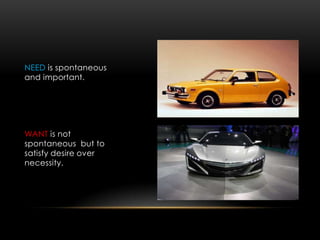
NEED is spontaneous
and important.
WANT is not
spontaneous but to
satisfy desire over
necessity.
CULTURE
CULTURE
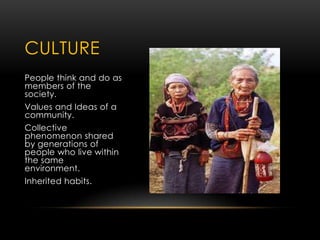
People think and do as
members of the
society.
Values and Ideas of a
community.
Collective
phenomenon shared
by generations of
people who live within
the same
environment.
Inherited habits.
Result of Culture
MARKET
MARKETERS
Are constantly
adjusting efforts
to the cultural
demands of the
market
People who see
the opportunity to
buy and sell.
Factual Knowledge
Interpretive Knowledge
CULTURAL
KNOWLEDGE
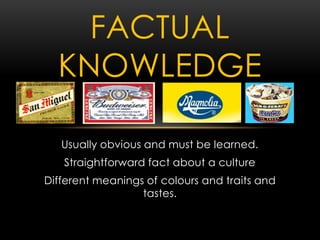
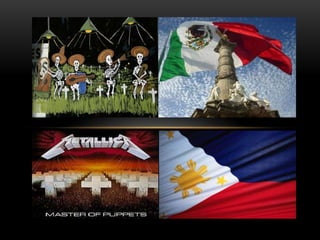
Usually obvious and must be learned.
Straightforward fact about a culture
Different meanings of colours and traits and
tastes.
FACTUAL
KNOWLEDGE
May be best described as a feeling.
Must be able to understand and fully appreciate
nuances of different cultural traits
Dependent on past-experience interpretation.
INTERPRETATIVE
KNOWLEDGE
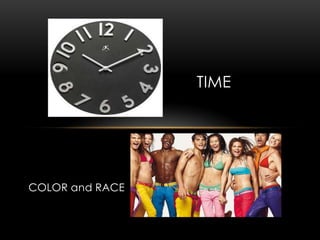
TIME
COLOR and RACE
Being attuned to the nuances of culture, new
culture can be viewed objectively, evaluated
and appreciated.
CULTURAL
SENSITIVITY
ELEMENTS OF
CULTURE
Material
Culture
Technology
Economics
Social
Organizations
Political
Structures
SOCIAL INSTITUTIONS
Literacy Rate
Role and Levels
EDUCATION
Belief
Systems
Religion
Superstition
Power
Structure
AESTHETICS
Graphic Arts
Plastic Arts
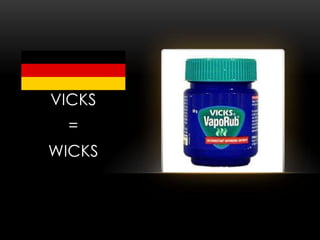
VICKS
=
WICKS
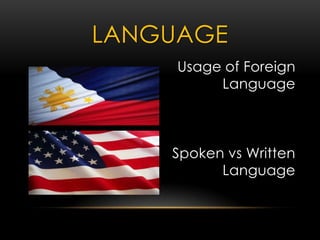
Usage of Foreign
Language
Spoken vs Written
Language
LANGUAGE
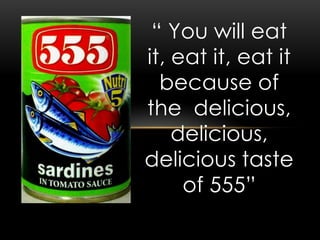
“ You will eat
it, eat it, eat it
because of
the delicious,
delicious,
delicious taste
of 555”
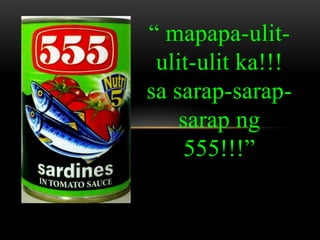
“ mapapa-ulit-
ulit-ulit ka!!!
sa sarap-sarap-
sarap ng
555!!!”
Product-established market=
>STUDY OF CULTURE vs Product-
new market=<CULTURE STUDY
ANALYSIS OF THE
ELEMENTS
Is a responsible effort to
borrow helpful cultural ways in
an effort to find better
solutions to the society.
CULTURAL
BORROWING
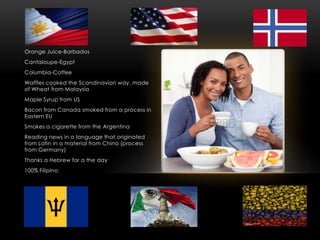
Orange Juice-Barbados
Cantaloupe-Egypt
Columbia-Coffee
Waffles cooked the Scandinavian way, made
of Wheat from Malaysia
Maple Syrup from US
Bacon from Canada smoked from a process in
Eastern EU
Smokes a cigarette from the Argentina
Reading news in a language that originated
from Latin in a material from China (process
from Germany)
Thanks a Hebrew for a the day
100% Filipino
.
CULTURAL
SIMILARITIES:
AN ILLUSION
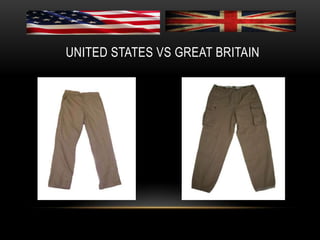
UNITED STATES VS GREAT BRITAIN
Some products when introduced
are easily accepted but some
are not because of culture.
RESISTANCE TO
CHANGE
A plan in introducing something
new to the culture in a
calculated way to overcome
resistance.
PLANNED CULTURAL
CHANGE
Product acceptance always have a
positive and negative effect. Everything

new that is introduced may have glitches
but we must always be optimistic.
CONSEQUENCE OF
AN INNOVATION
“A SUCCESFUL MARKETER MUST
BE A STUDENT OF CULTURE”
- Geert Hofstede
A Presentation by
CARLO MIGUEL A. NARBONETA
7.3.12 cultural dynamics   3.25pm

7.3.12 cultural dynamics 3.25pm