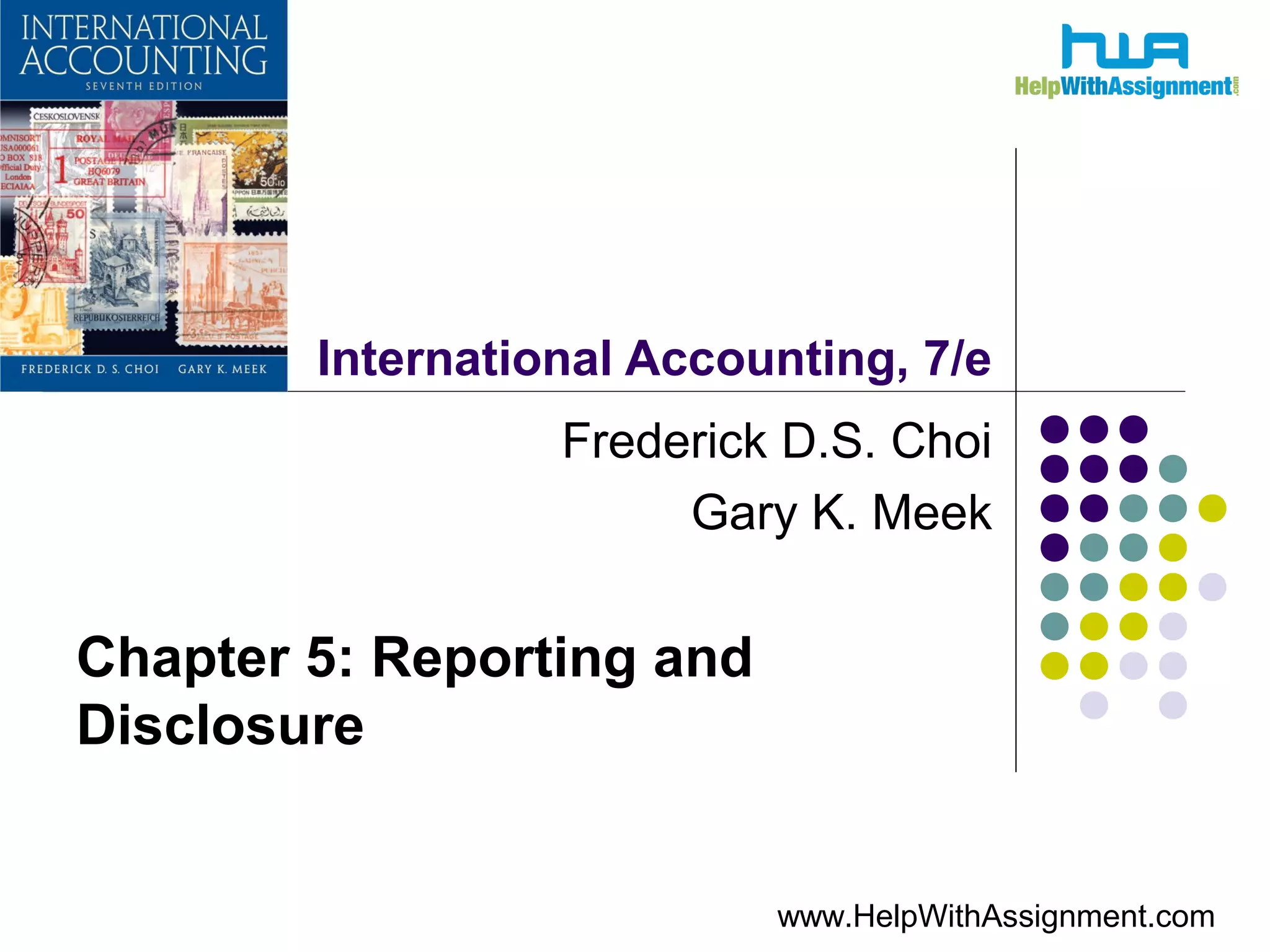

International Accounting, 7/e
Frederick D.S. Choi
Gary K. Meek
Chapter 5: Reporting and
Disclosure
www.HelpWithAssignment.com
Learning Objectives
 Distinguish voluntary and mandatory disclosure and the applicable
regulatory measures.
 Identify the broad objectives for accounting disclosure systems in
investor-oriented equity markets.
 Discuss “triple-bottom line” reporting and why it is a growing
tendency among large multinational corporations.
 Have a basic understanding of the following selected corporate
financial-disclosure practices: (a) disclosures of forward-looking
information, (b) segment disclosures, (c) social responsibility
reporting, (d) corporate governance disclosures, and (e) Internet
business reporting and XBRL.
www.HelpWithAssignment.com
Development of Disclosure
 Voluntary disclosure
 Voluntary disclosures are increasing as investors
demand more detailed and timely information.
 But managers’ incentives for disclosure aren’t
always aligned with those of investors.
 Disclosure regulations and third party certification
can improve the functioning of capital markets.
www.HelpWithAssignment.com
Development of Disclosure
(contin) Regulatory disclosure requirements
 Stock exchanges want to be sure that investors have enough information to
evaluate a company’s performance and prospects.
 Disclosure protects investors, but shareholder protection varies across countries.
 Twin objectives of investor oriented markets (Frost and Lang 1996):
 Investor protection
 Investors are provided with material information.
 And are protected through monitoring and enforcement.
 Market quality
 Markets are fair, orderly, and efficient.
 And free from abuse and misconduct.
 SEC financial reporting debate
 Foreign registrants must furnish financial information substantially similar to that
required of domestic companies.
 Must reconcile net income and stockholders’ equity to U.S. GAAP if the registrant
uses another GAAP besides US GAAP or IFRS.
 Do SEC requirements deter foreign companies from listing their securities in the
U.S.?
 Or do the requirements protect investors and ensure the quality of U.S. capital
markets?
 Sarbanes-Oxley requirements are also believed to deter foreign companies from
listing in the U.S.
www.HelpWithAssignment.com
Reporting and Disclosure
Practices
 Forward-looking information
 Includes
 Forecasts of revenues, income, cash flows, capital
expenditures
 Prospective information about future economic
performance or position
 Statements of management’s plans and objectives for
future operations
 Softer information about future prospects is more common
than precise forecasts.
 Why?
 Forecasts are inherently unreliable.
 Legal repercussions if forecasts aren’t met.
www.HelpWithAssignment.com
Reporting and Disclosure
Practices (contin)
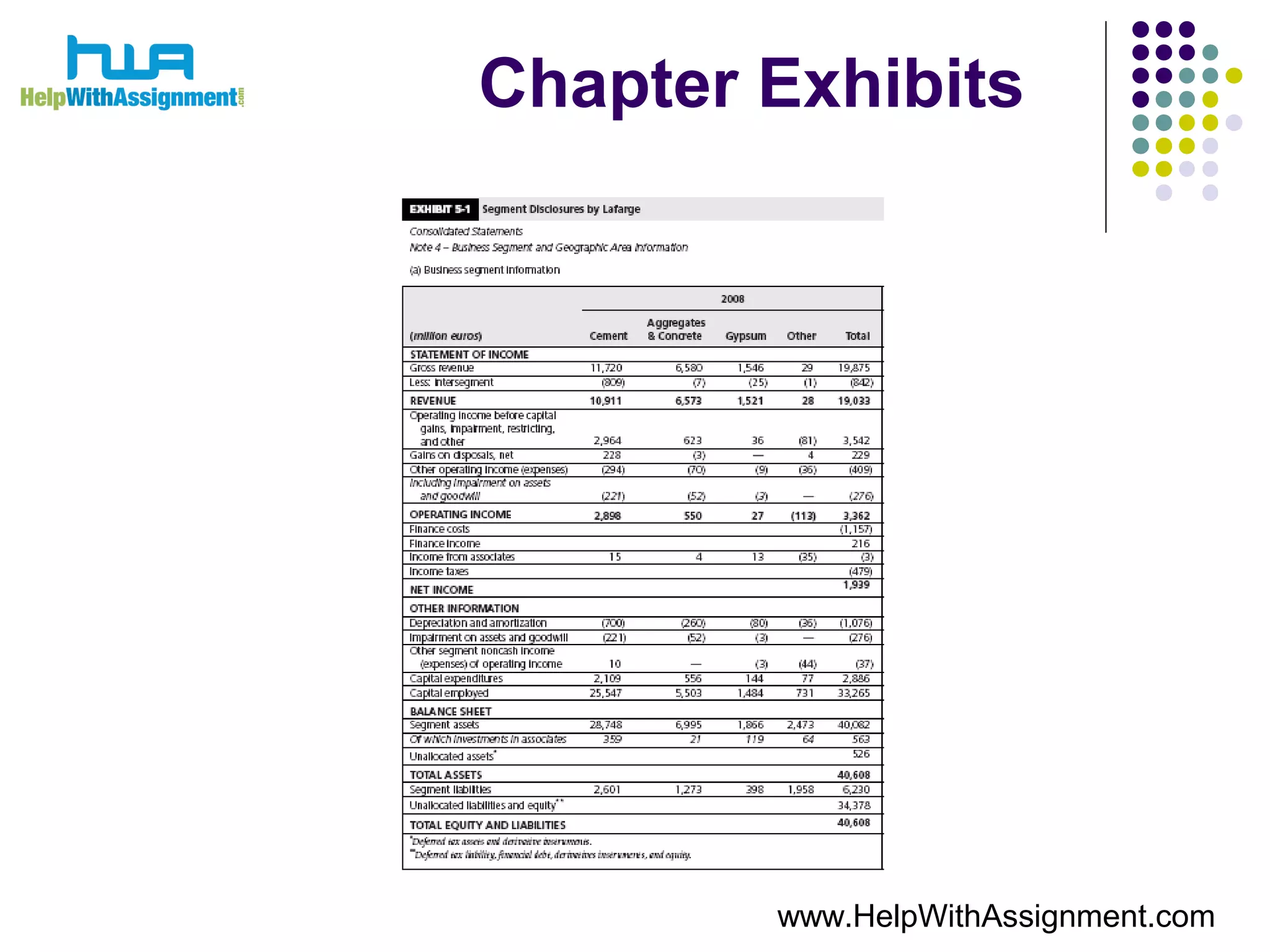
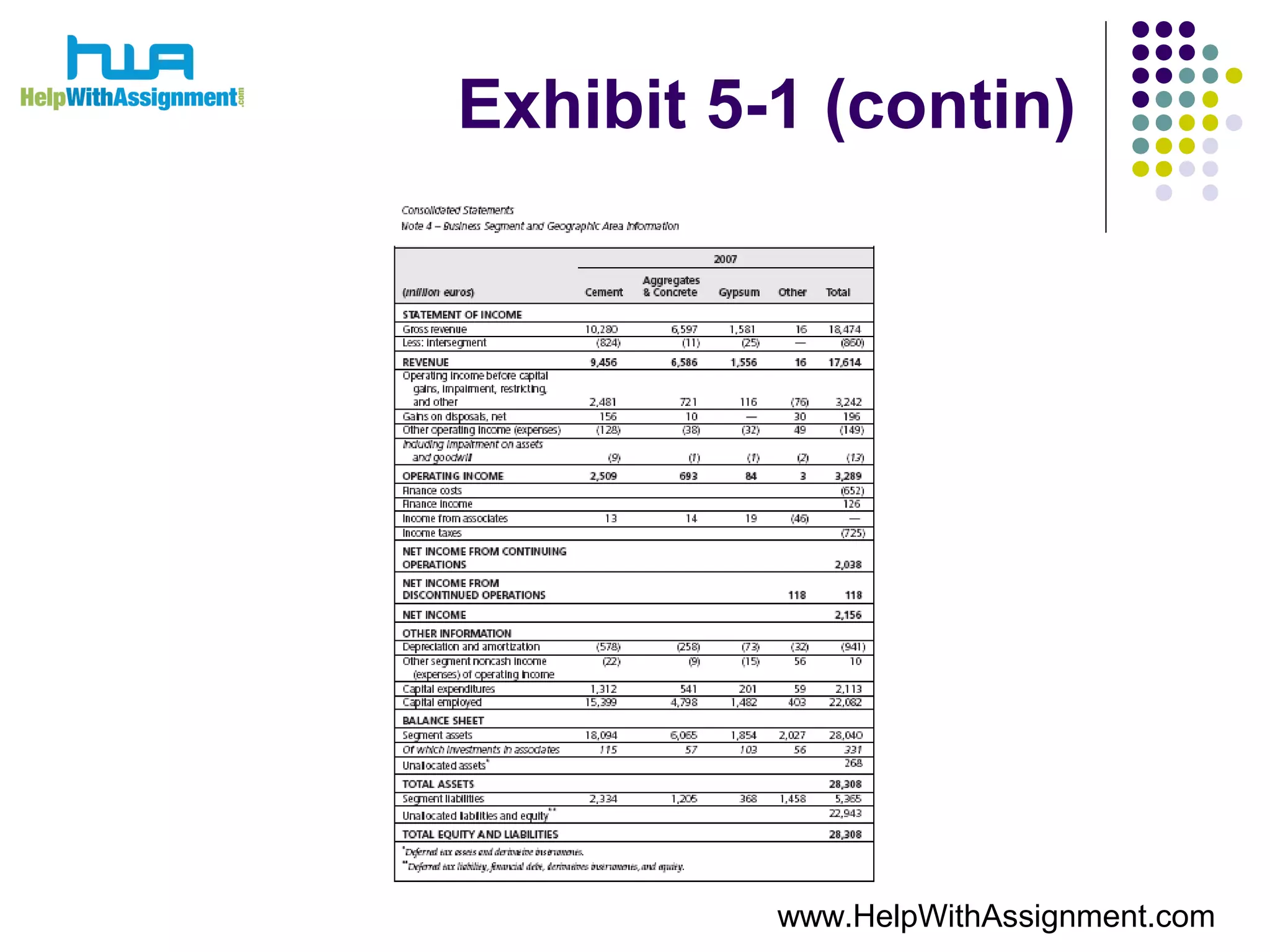
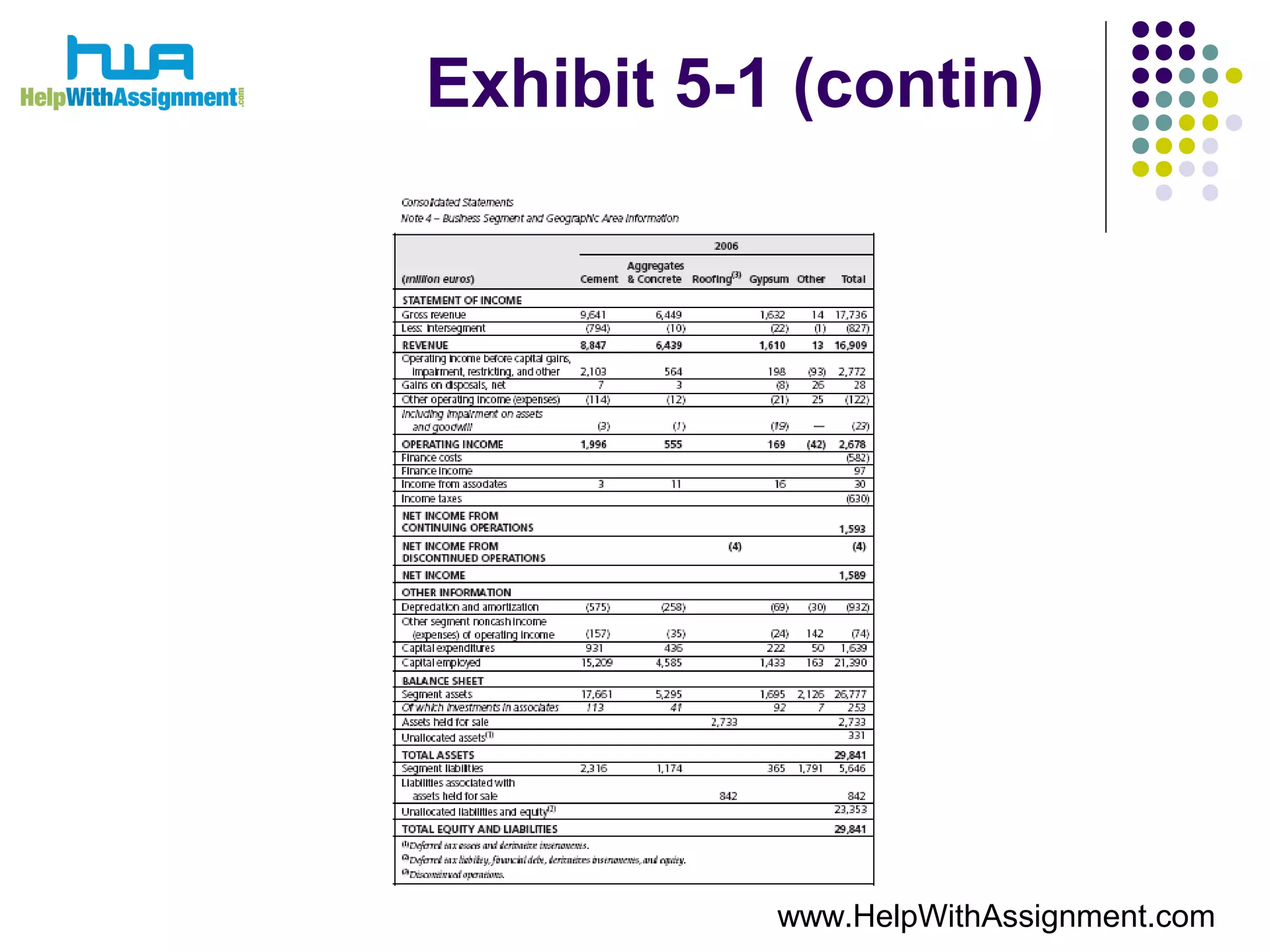
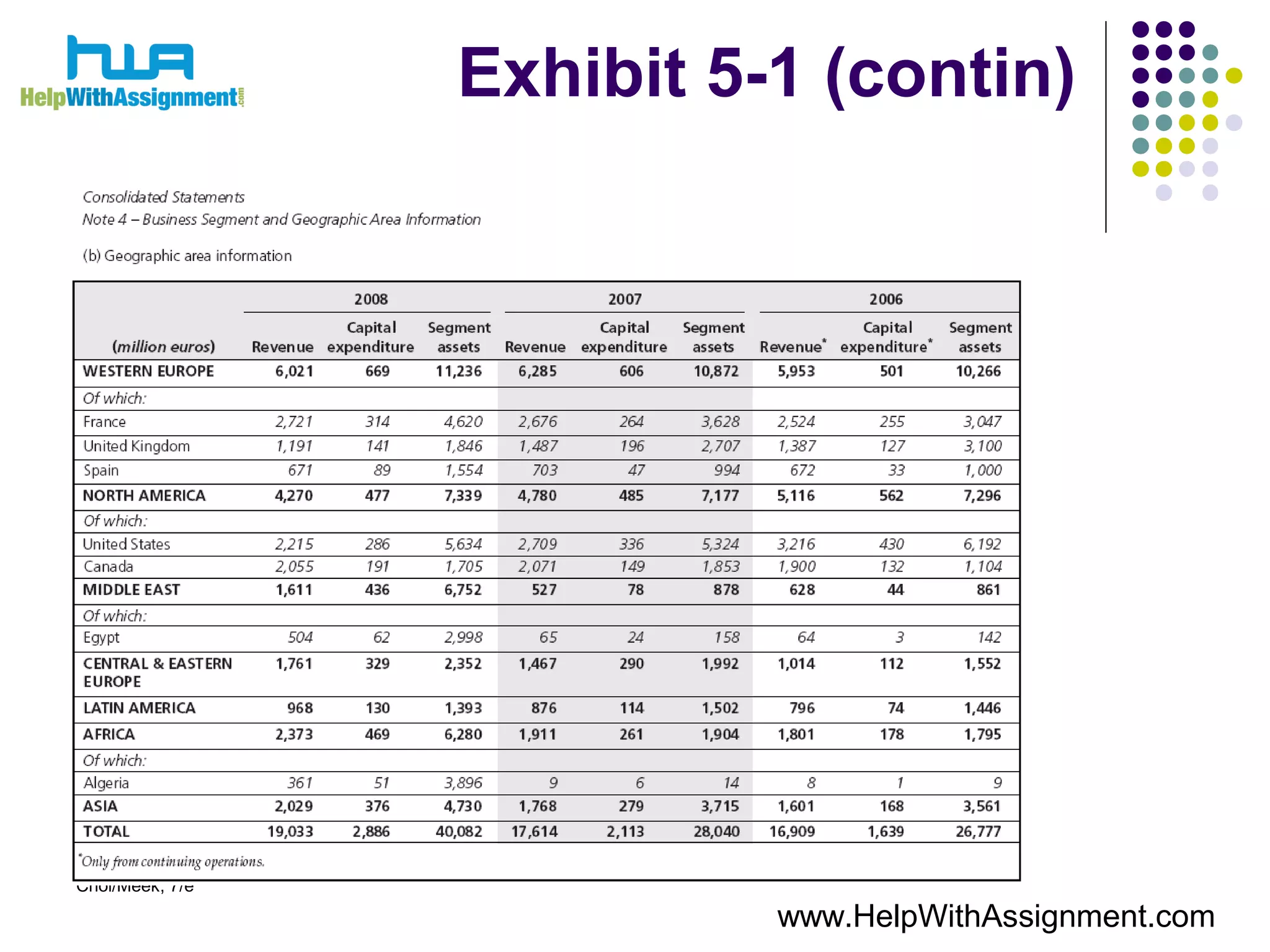
 Segment disclosures
 Disaggregated information about a firm’s industry and
geographic operations and results
 Includes disaggregated information on
 Revenue
 Income
 Depreciation and amortization
 Capital expenditures
 Assets
 Liabilities
 Helps users understand how the parts make up the whole
 Product lines and areas of the world vary in terms of
risks, returns, and opportunities
www.HelpWithAssignment.com
Reporting and Disclosure
Practices (contin)
 Social responsibility reporting
 Reporting to “stakeholders”: employees, customers,
suppliers, governments, activist groups, the general public,
in addition to investors
 The measurement and communication of information about
a company’s effects on employee welfare, the local
community, and the environment
 A way to demonstrate corporate citizenship
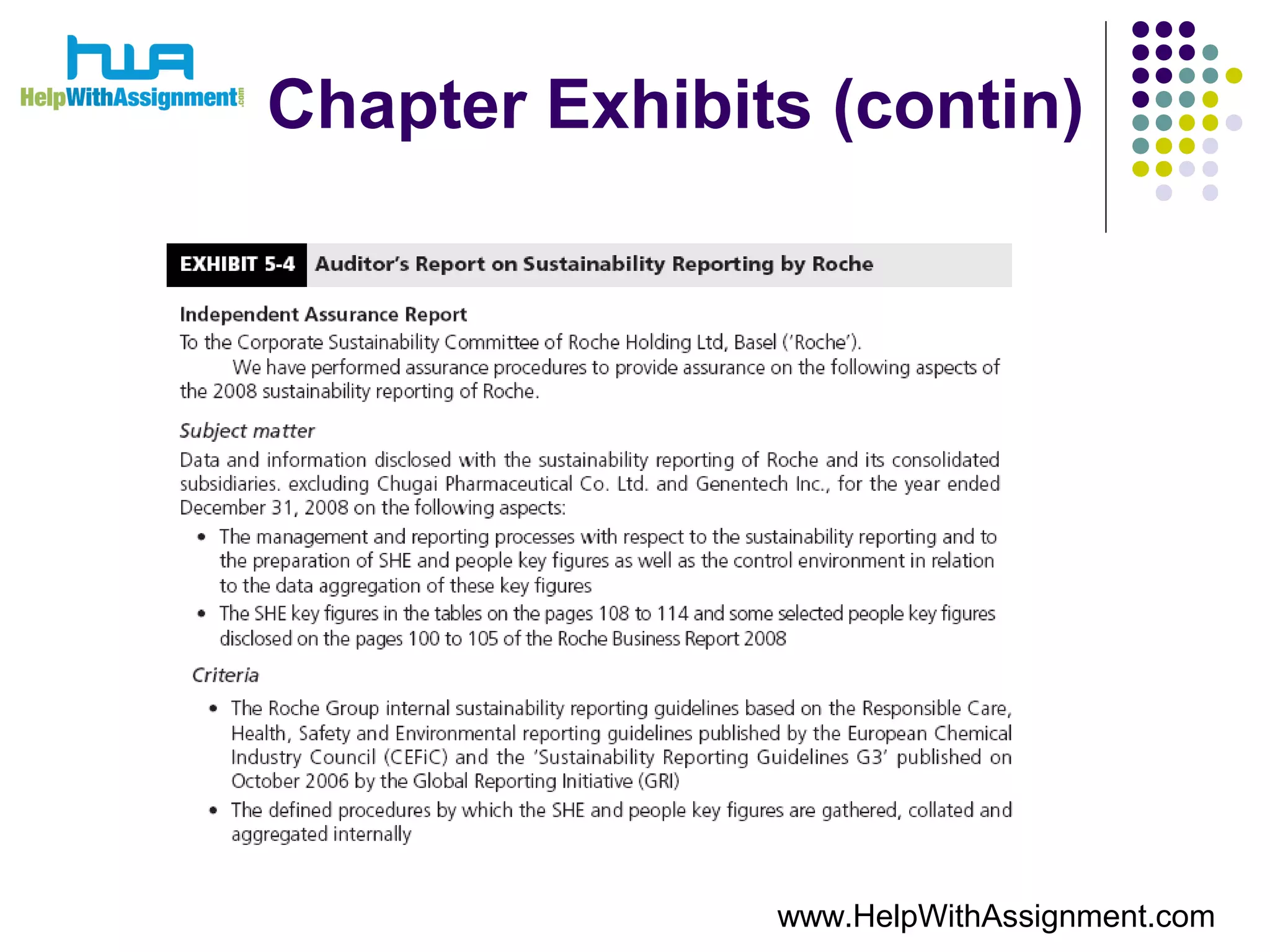
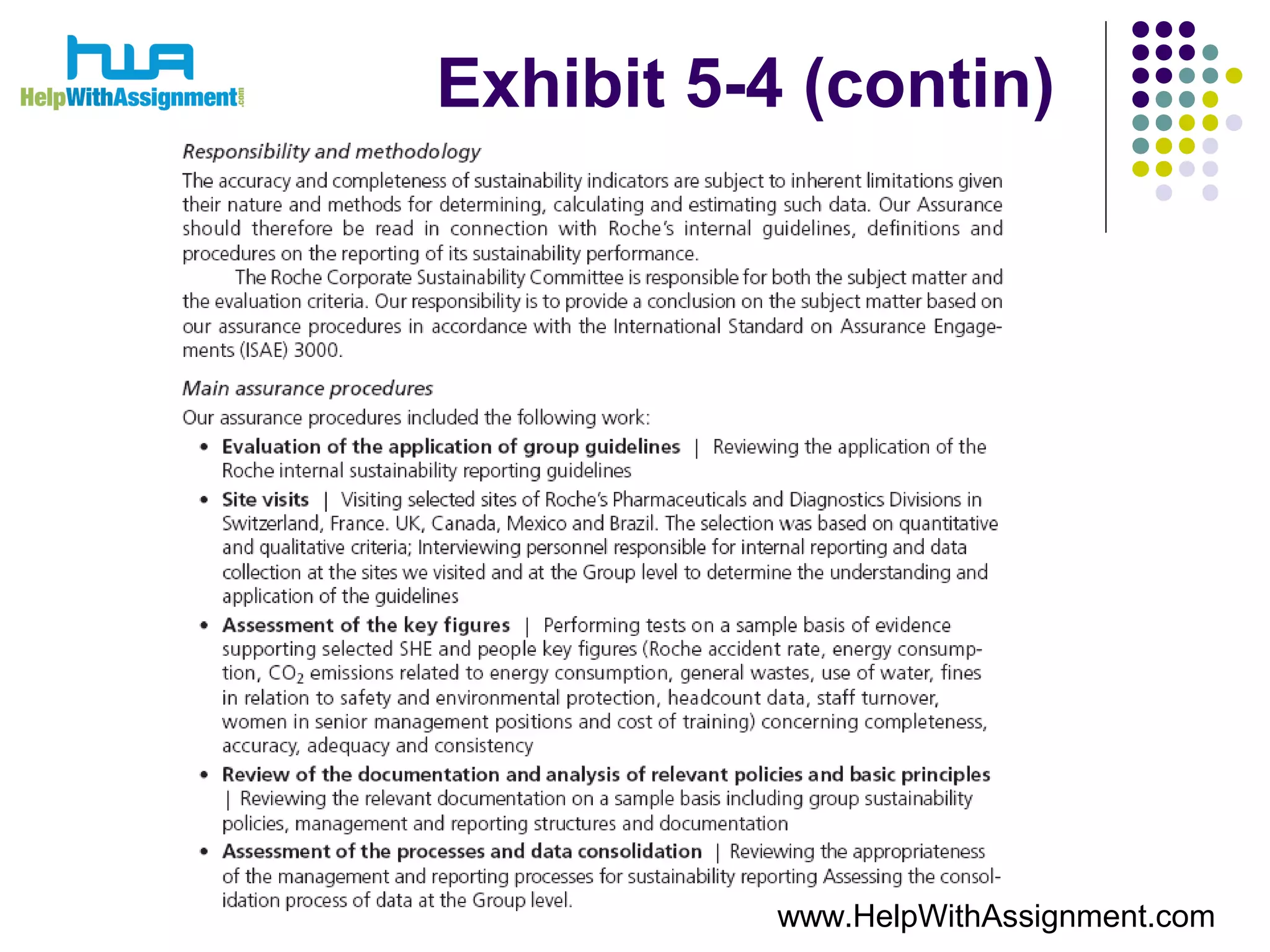
 “Sustainability” reports integrate economic, social, and
environmental performance
 “Triple-bottom line reporting”: profits, people, planet
 Increasingly being audited to avoid the charge of “green-
washing”
www.HelpWithAssignment.com
Reporting and Disclosure
Practices (contin)
 Examples:
 Employee reporting
 Employment levels and personnel costs by division and region of the world
 Management development
 Compensation
 Diversity
 Human rights
 Environmental reporting
 Impact of production processes, products, and services on
 Air
 Water
 Land
 Biodiversity
 Human health
 Water, raw material, and energy consumption
 Activities to reduce pollution
 Spending on all of the above
 Despite criticisms, becoming mainstream among multinational
companies
 Global Reporting Initiative has issued guidelines
www.HelpWithAssignment.com
Reporting and Disclosure
Practices (contin)
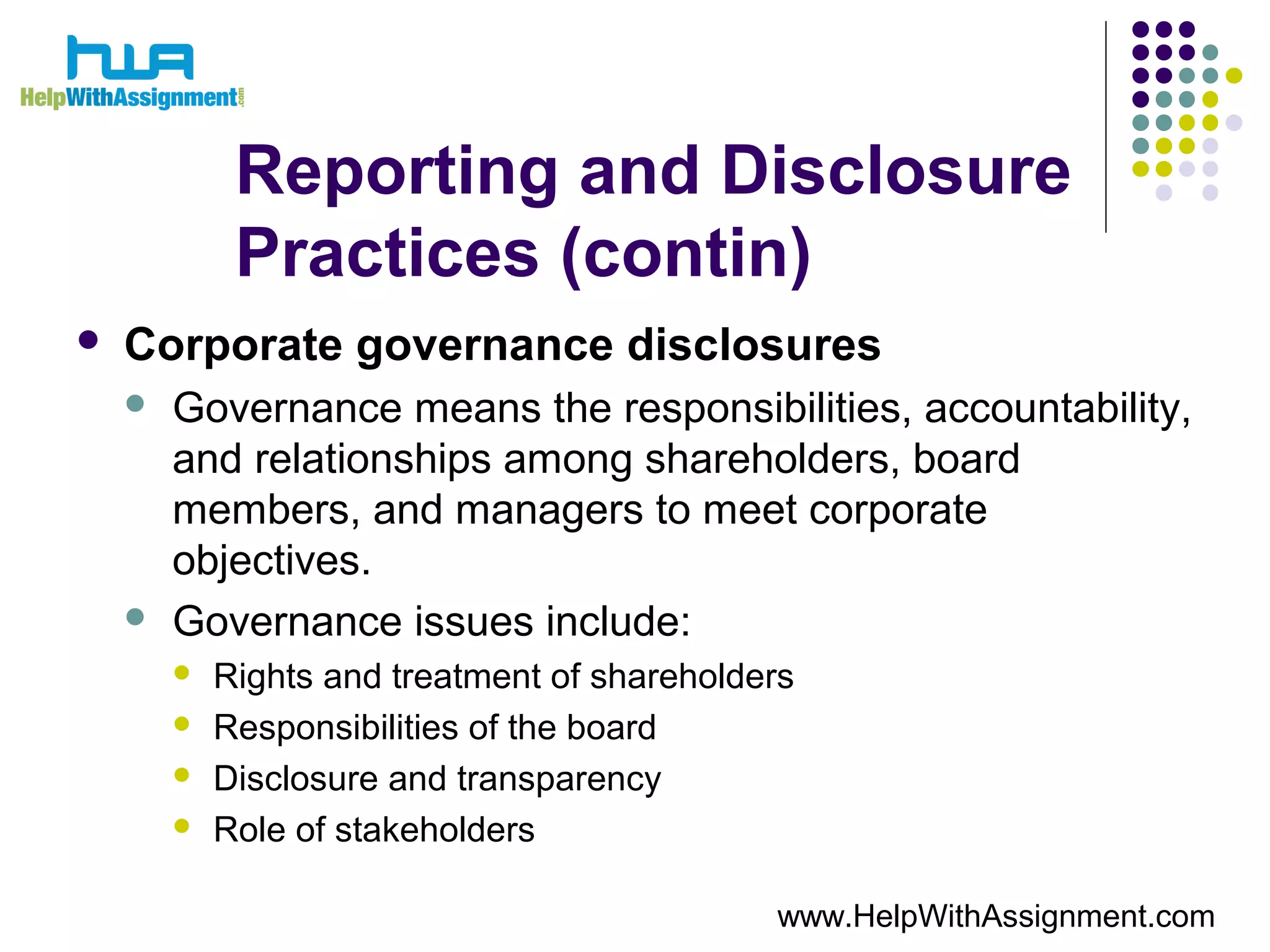
 Corporate governance disclosures
 Governance means the responsibilities, accountability,
and relationships among shareholders, board
members, and managers to meet corporate
objectives.
 Governance issues include:
 Rights and treatment of shareholders
 Responsibilities of the board
 Disclosure and transparency
 Role of stakeholders
www.HelpWithAssignment.com
Reporting and Disclosure
Practices (contin)
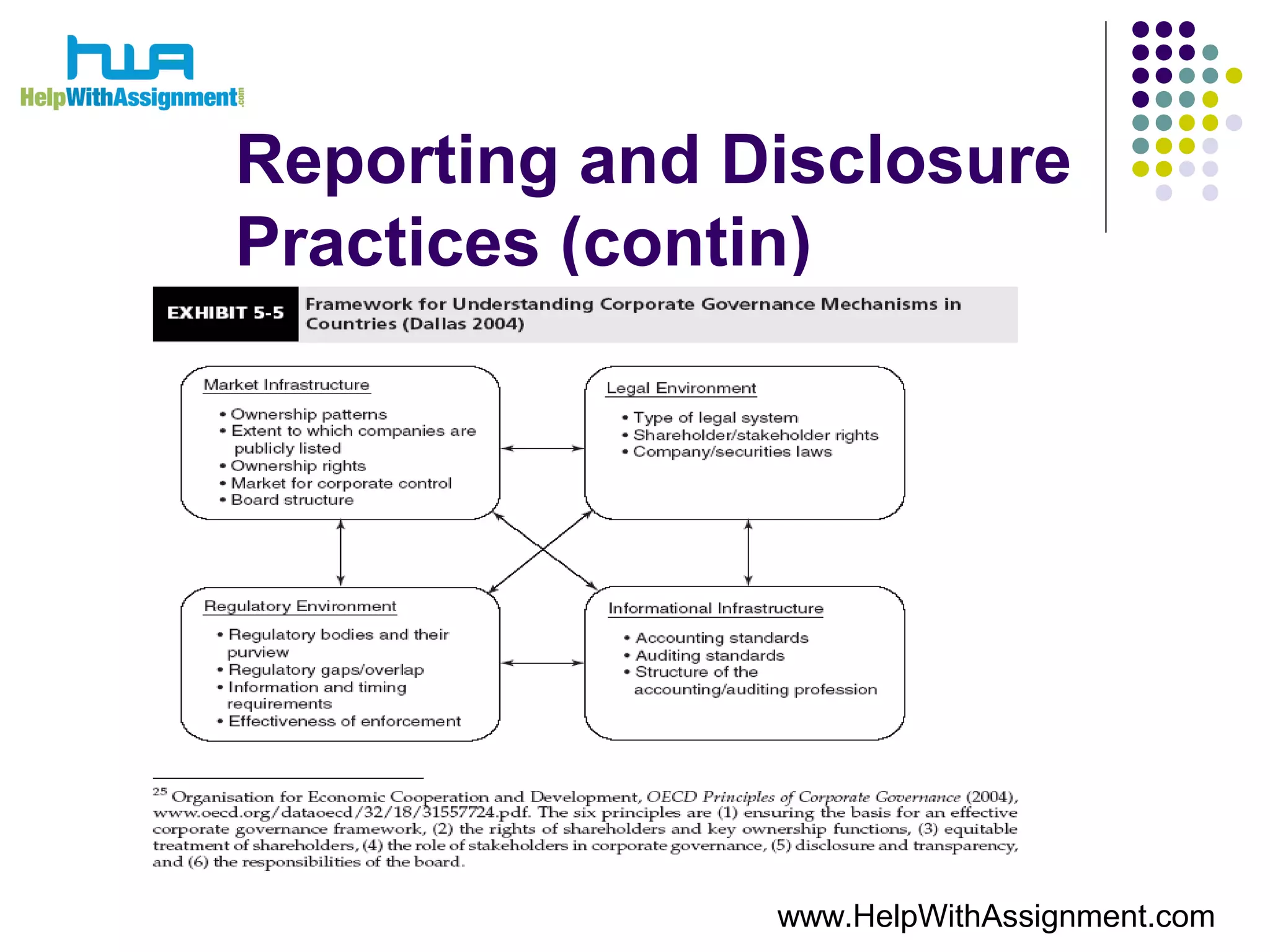
www.HelpWithAssignment.com
Chapter Exhibits (contin)
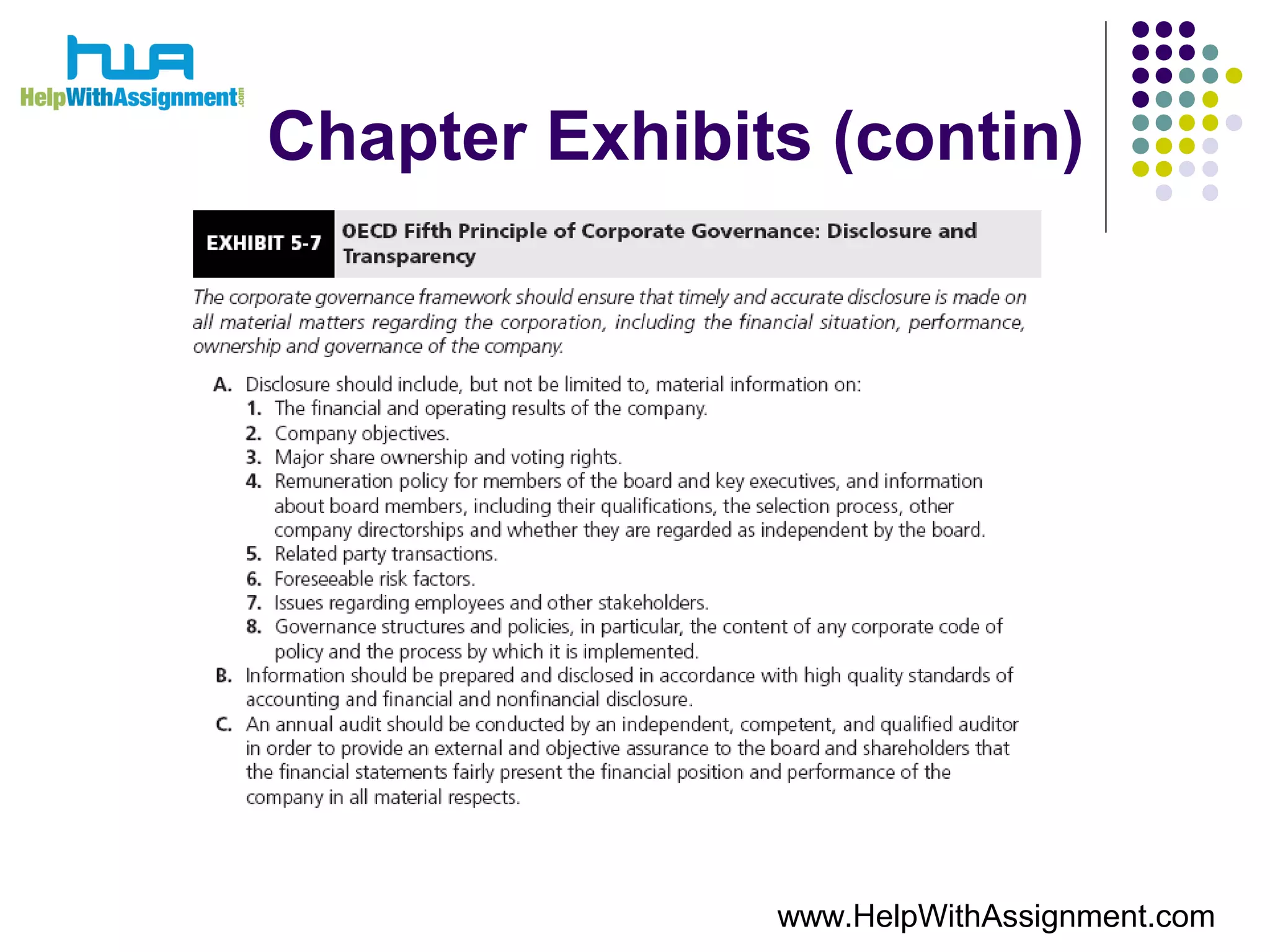
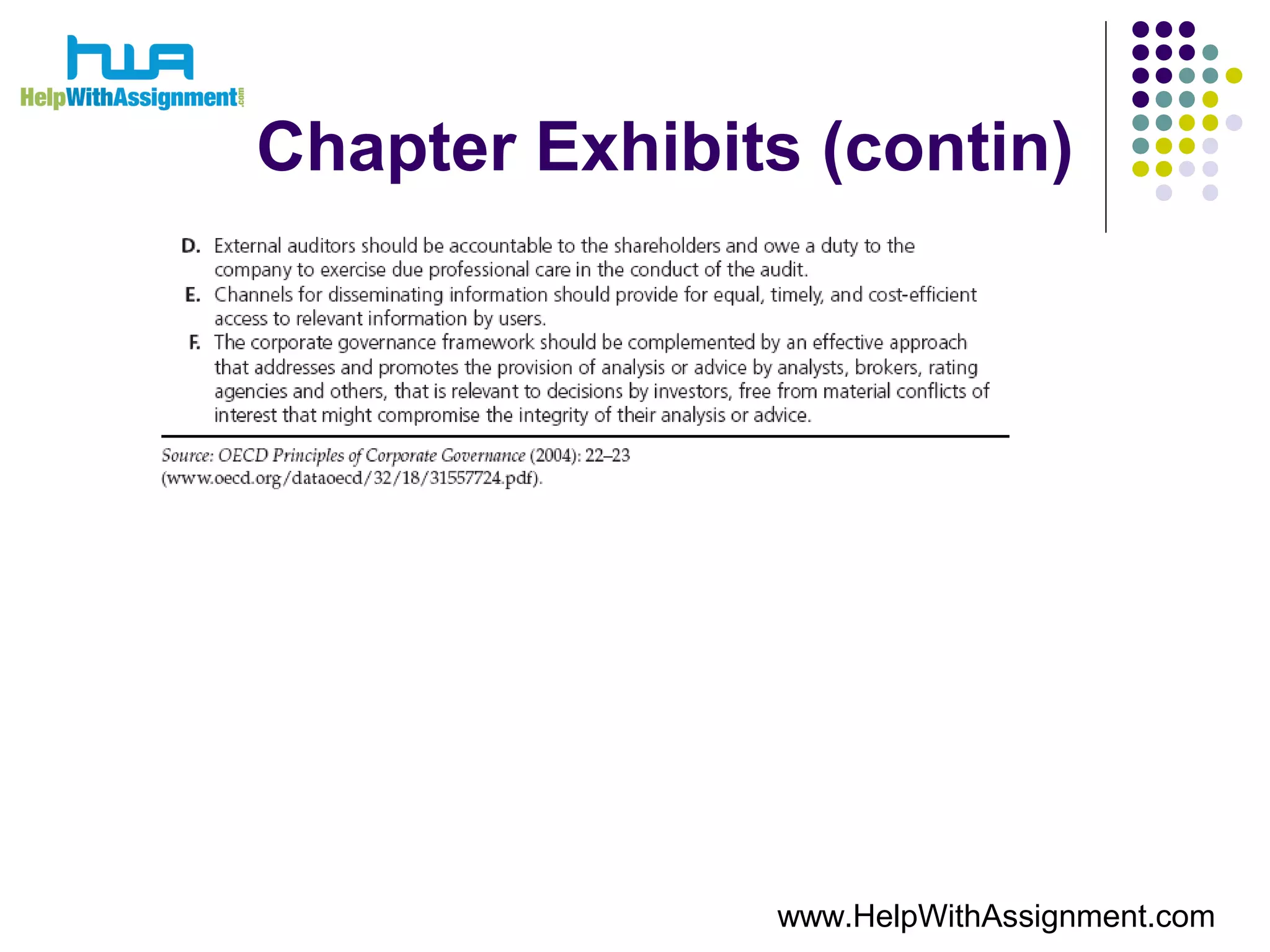
 Governance mechanisms and disclosures are
improving around the world.
 OECD issued its revised Principles of Corporate
Governance in 2004.
 Disclosure is a key element of any good system
of corporate governance.
www.HelpWithAssignment.com
Reporting and Disclosure
Practices (contin)
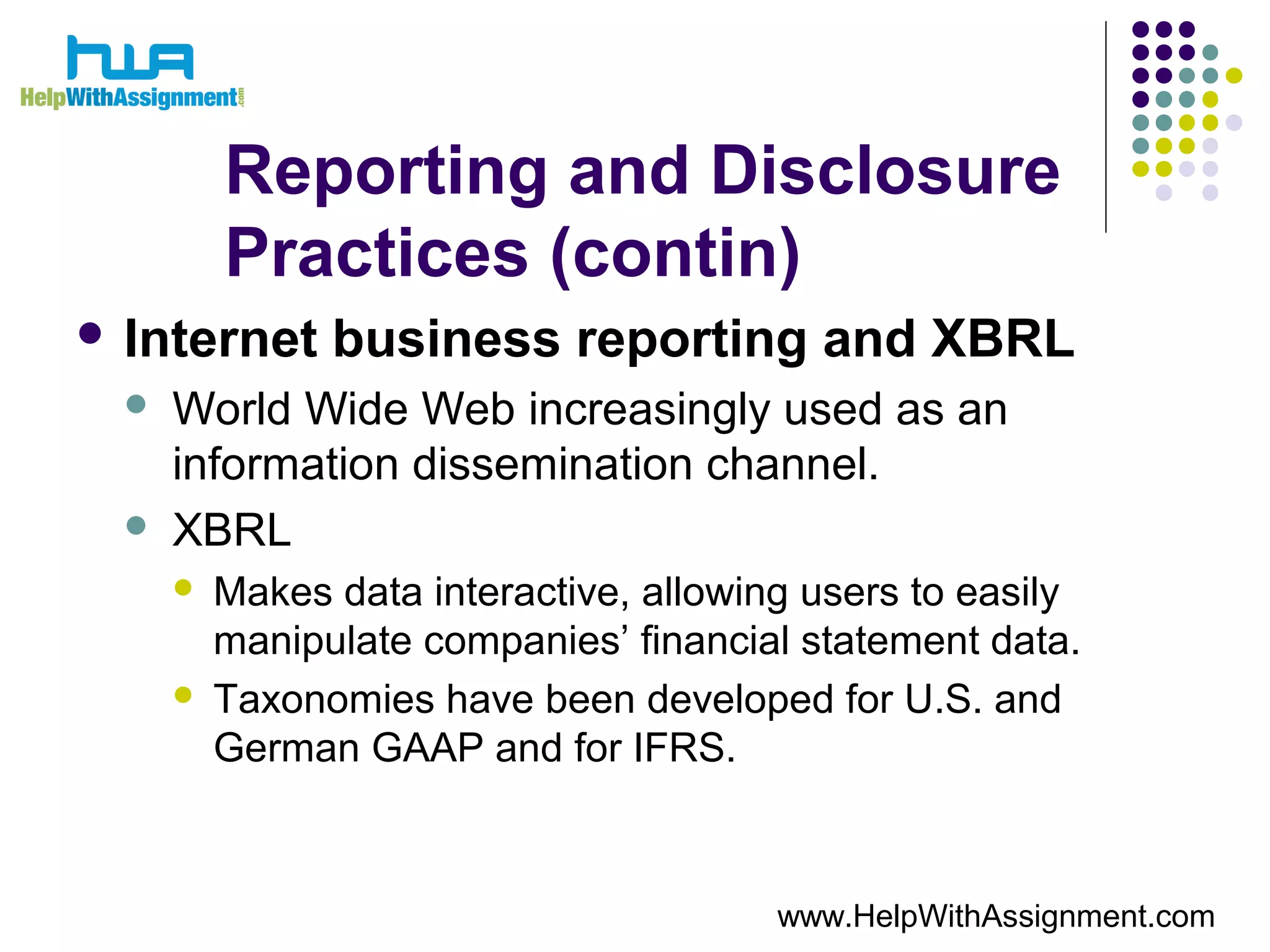
 Internet business reporting and XBRL
 World Wide Web increasingly used as an
information dissemination channel.
 XBRL
 Makes data interactive, allowing users to easily
manipulate companies’ financial statement data.
 Taxonomies have been developed for U.S. and
German GAAP and for IFRS.
www.HelpWithAssignment.com
Annual Report Disclosures in
Emerging-Market Countries
 Generally less extensive and less credible
than disclosures of companies from
developed countries.
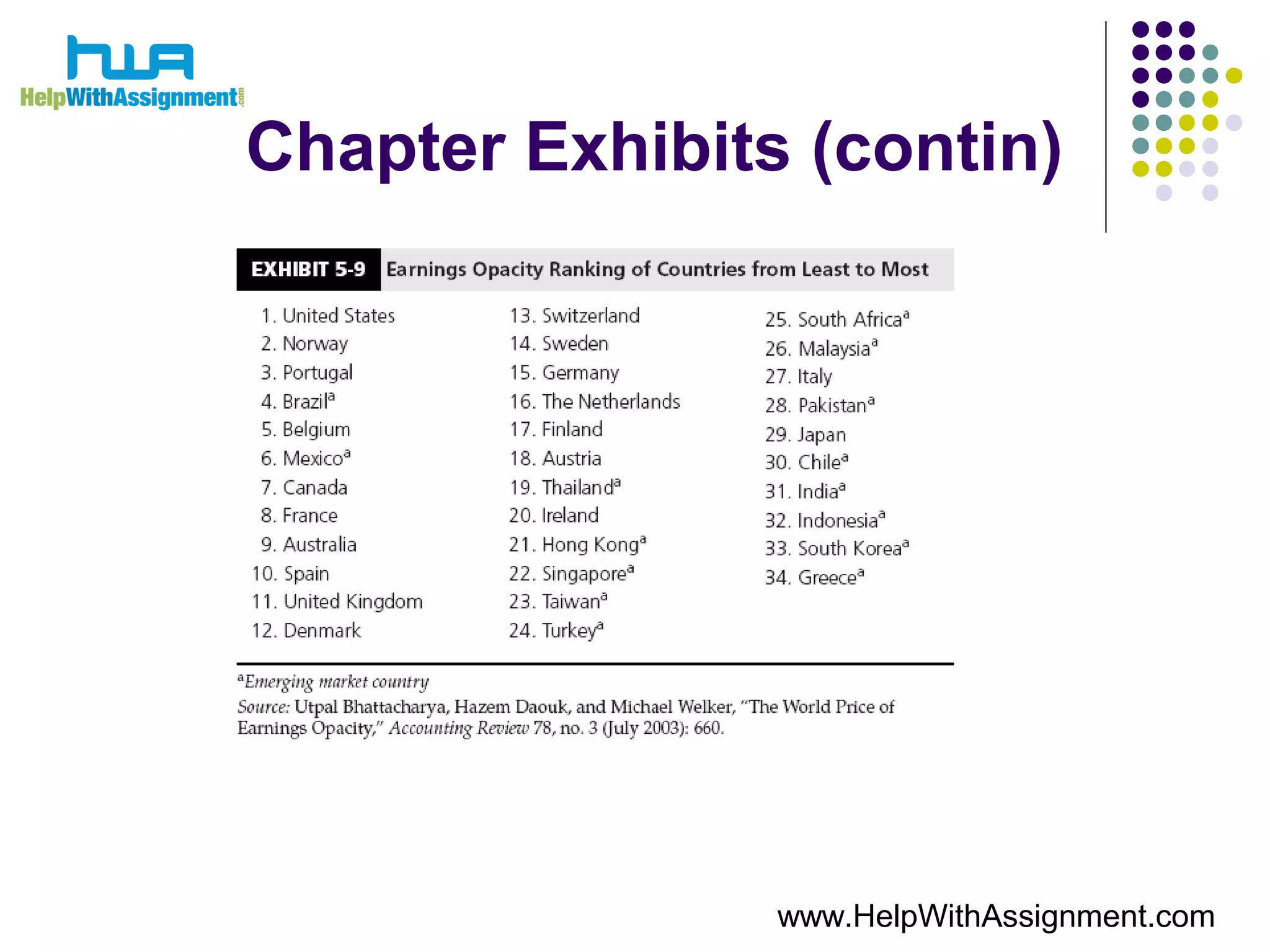
 Empirical evidence shows that earnings are
less opaque in developed countries than in
developing countries.
 Monitoring and enforcement of disclosure
requirements are also less extensive in
developing countries.
www.HelpWithAssignment.com
Implications for Financial
Statement Users
 Expect wide variation in disclosure levels and
financial reporting practices.
 The levels of mandatory and voluntary disclosure
are increasing worldwide.
 Managers of companies from low-disclosure
countries should consider adopting enhanced
disclosure.
 Enhanced disclosures can result in competitive
advantage over companies with restrictive
disclosure policies.
www.HelpWithAssignment.com
Chapter Exhibits
www.HelpWithAssignment.com
Exhibit 5-1 (contin)
www.HelpWithAssignment.com
Exhibit 5-1 (contin)
www.HelpWithAssignment.com
Choi/Meek, 7/e
Exhibit 5-1 (contin)
www.HelpWithAssignment.com
Chapter Exhibits (contin)
www.HelpWithAssignment.com
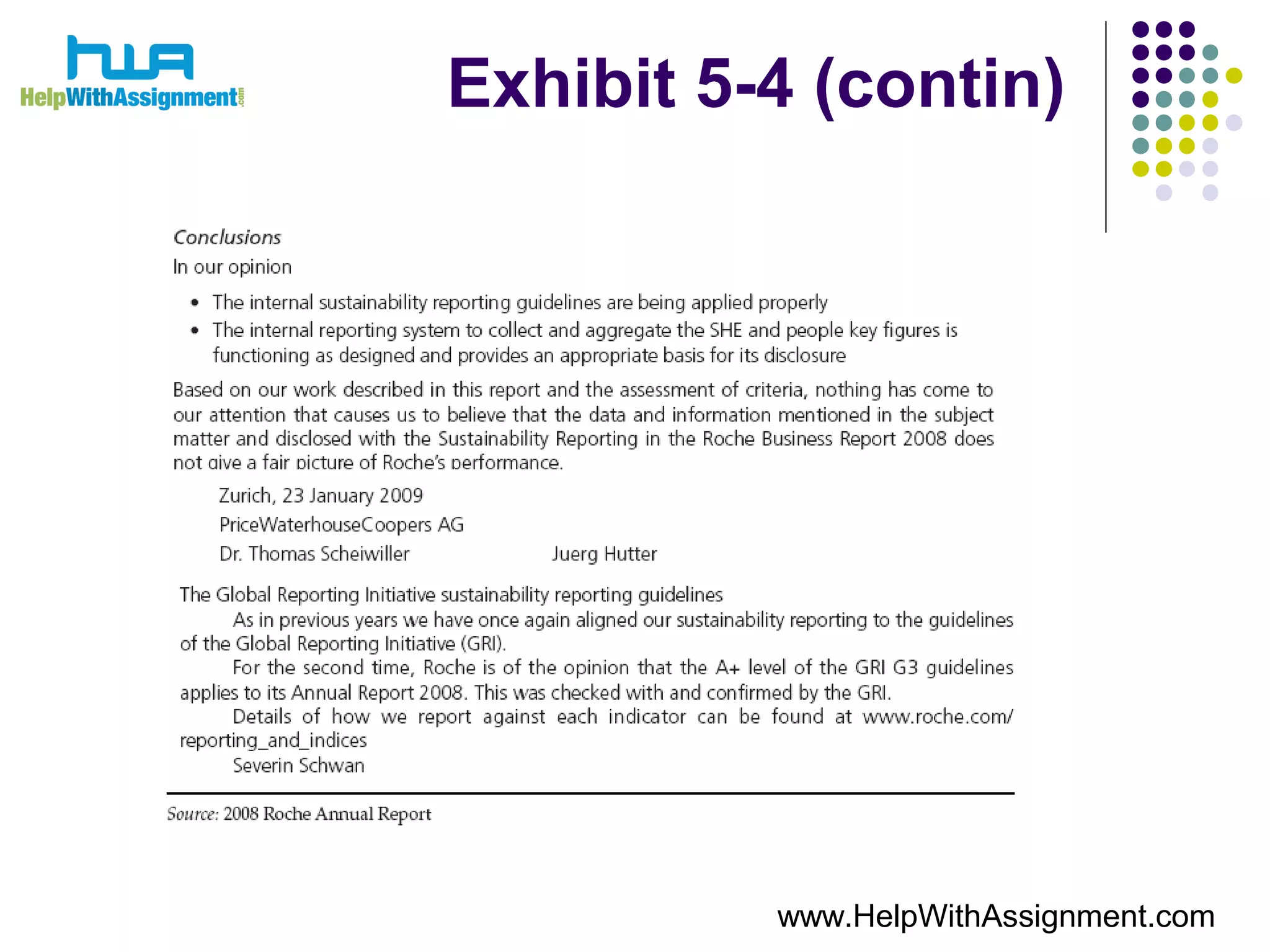
Exhibit 5-4 (contin)
www.HelpWithAssignment.com
Exhibit 5-4 (contin)
www.HelpWithAssignment.com
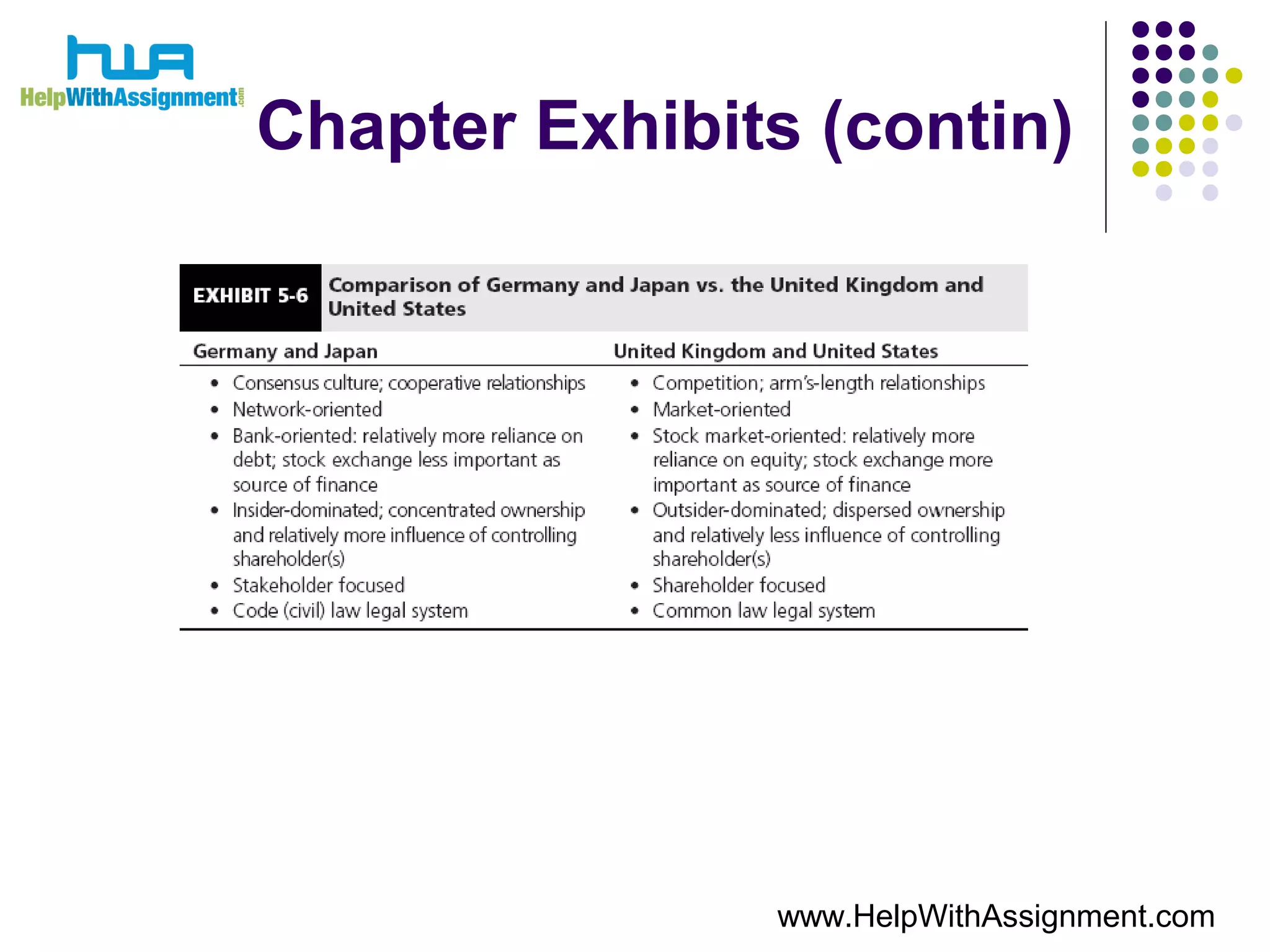
Chapter Exhibits (contin)
www.HelpWithAssignment.com
Chapter Exhibits (contin)
www.HelpWithAssignment.com
Chapter Exhibits (contin)
www.HelpWithAssignment.com
Chapter Exhibits (contin)
www.HelpWithAssignment.com
For more details on Accounting Assignment Help visit our website
at http://www.helpwithassignment.com/accounting-assignment-help
www.HelpWithAssignment.com

International Accounting:Reporting and Disclosure

  • 1.
    International Accounting, 7/e FrederickD.S. Choi Gary K. Meek Chapter 5: Reporting and Disclosure www.HelpWithAssignment.com
  • 2.
    Learning Objectives  Distinguishvoluntary and mandatory disclosure and the applicable regulatory measures.  Identify the broad objectives for accounting disclosure systems in investor-oriented equity markets.  Discuss “triple-bottom line” reporting and why it is a growing tendency among large multinational corporations.  Have a basic understanding of the following selected corporate financial-disclosure practices: (a) disclosures of forward-looking information, (b) segment disclosures, (c) social responsibility reporting, (d) corporate governance disclosures, and (e) Internet business reporting and XBRL. www.HelpWithAssignment.com
  • 3.
    Development of Disclosure Voluntary disclosure  Voluntary disclosures are increasing as investors demand more detailed and timely information.  But managers’ incentives for disclosure aren’t always aligned with those of investors.  Disclosure regulations and third party certification can improve the functioning of capital markets. www.HelpWithAssignment.com
  • 4.
    Development of Disclosure (contin)Regulatory disclosure requirements  Stock exchanges want to be sure that investors have enough information to evaluate a company’s performance and prospects.  Disclosure protects investors, but shareholder protection varies across countries.  Twin objectives of investor oriented markets (Frost and Lang 1996):  Investor protection  Investors are provided with material information.  And are protected through monitoring and enforcement.  Market quality  Markets are fair, orderly, and efficient.  And free from abuse and misconduct.  SEC financial reporting debate  Foreign registrants must furnish financial information substantially similar to that required of domestic companies.  Must reconcile net income and stockholders’ equity to U.S. GAAP if the registrant uses another GAAP besides US GAAP or IFRS.  Do SEC requirements deter foreign companies from listing their securities in the U.S.?  Or do the requirements protect investors and ensure the quality of U.S. capital markets?  Sarbanes-Oxley requirements are also believed to deter foreign companies from listing in the U.S. www.HelpWithAssignment.com
  • 5.
    Reporting and Disclosure Practices Forward-looking information  Includes  Forecasts of revenues, income, cash flows, capital expenditures  Prospective information about future economic performance or position  Statements of management’s plans and objectives for future operations  Softer information about future prospects is more common than precise forecasts.  Why?  Forecasts are inherently unreliable.  Legal repercussions if forecasts aren’t met. www.HelpWithAssignment.com
  • 6.
    Reporting and Disclosure Practices(contin)  Segment disclosures  Disaggregated information about a firm’s industry and geographic operations and results  Includes disaggregated information on  Revenue  Income  Depreciation and amortization  Capital expenditures  Assets  Liabilities  Helps users understand how the parts make up the whole  Product lines and areas of the world vary in terms of risks, returns, and opportunities www.HelpWithAssignment.com
  • 7.
    Reporting and Disclosure Practices(contin)  Social responsibility reporting  Reporting to “stakeholders”: employees, customers, suppliers, governments, activist groups, the general public, in addition to investors  The measurement and communication of information about a company’s effects on employee welfare, the local community, and the environment  A way to demonstrate corporate citizenship  “Sustainability” reports integrate economic, social, and environmental performance  “Triple-bottom line reporting”: profits, people, planet  Increasingly being audited to avoid the charge of “green- washing” www.HelpWithAssignment.com
  • 8.
    Reporting and Disclosure Practices(contin)  Examples:  Employee reporting  Employment levels and personnel costs by division and region of the world  Management development  Compensation  Diversity  Human rights  Environmental reporting  Impact of production processes, products, and services on  Air  Water  Land  Biodiversity  Human health  Water, raw material, and energy consumption  Activities to reduce pollution  Spending on all of the above  Despite criticisms, becoming mainstream among multinational companies  Global Reporting Initiative has issued guidelines www.HelpWithAssignment.com
  • 9.
    Reporting and Disclosure Practices(contin)  Corporate governance disclosures  Governance means the responsibilities, accountability, and relationships among shareholders, board members, and managers to meet corporate objectives.  Governance issues include:  Rights and treatment of shareholders  Responsibilities of the board  Disclosure and transparency  Role of stakeholders www.HelpWithAssignment.com
  • 10.
    Reporting and Disclosure Practices(contin) www.HelpWithAssignment.com
  • 11.
    Chapter Exhibits (contin) Governance mechanisms and disclosures are improving around the world.  OECD issued its revised Principles of Corporate Governance in 2004.  Disclosure is a key element of any good system of corporate governance. www.HelpWithAssignment.com
  • 12.
    Reporting and Disclosure Practices(contin)  Internet business reporting and XBRL  World Wide Web increasingly used as an information dissemination channel.  XBRL  Makes data interactive, allowing users to easily manipulate companies’ financial statement data.  Taxonomies have been developed for U.S. and German GAAP and for IFRS. www.HelpWithAssignment.com
  • 13.
    Annual Report Disclosuresin Emerging-Market Countries  Generally less extensive and less credible than disclosures of companies from developed countries.  Empirical evidence shows that earnings are less opaque in developed countries than in developing countries.  Monitoring and enforcement of disclosure requirements are also less extensive in developing countries. www.HelpWithAssignment.com
  • 14.
    Implications for Financial StatementUsers  Expect wide variation in disclosure levels and financial reporting practices.  The levels of mandatory and voluntary disclosure are increasing worldwide.  Managers of companies from low-disclosure countries should consider adopting enhanced disclosure.  Enhanced disclosures can result in competitive advantage over companies with restrictive disclosure policies. www.HelpWithAssignment.com
  • 15.
  • 16.
  • 17.
  • 18.
    Choi/Meek, 7/e Exhibit 5-1(contin) www.HelpWithAssignment.com
  • 19.
  • 20.
  • 21.
  • 22.
  • 23.
  • 24.
  • 25.
  • 26.
    www.HelpWithAssignment.com For more detailson Accounting Assignment Help visit our website at http://www.helpwithassignment.com/accounting-assignment-help www.HelpWithAssignment.com