Nov 12, 2025
How transparent reporting
shapes investor sentiment in
India’s evolving markets
Anshul Verma
India’s capital markets are becoming more
mature and interconnected. Retail participation is
growing. Foreign institutional investors continue
to show interest. But investor con dence depends
heavily on one thing: transparency. Transparent
reporting tells the story behind the numbers. It
helps investors judge risk, builds trust in
management, and helps them decide where to
invest. When reporting is weak, markets wobble.
When reporting is clear and consistent, investor
sentiment strengthens.
Why transparent reporting matters
India’s evolving disclosure rules and recent updates (2024–
25)
India has been steadily improving its regulatory framework for corporate reporting. Some key
developments include SEBI’s Listing Obligations and Disclosure Requirements (LODR), which
continues to demand quarterly nancial disclosures.
Companies that provide clarity and transparency have the right to demand a premium,
while those that don’t have increased chances of facing reputational damage and
unpredictable investor behaviour.
Investors are able to understand strategy, performance, and governance when companies
report fully in a deeper manner.
If disclosures are made preemptively and transparently, it helps decrease irregularities or
uneven information distribution among founders, their boards, and key stakeholders.
In uncertain times, like regulatory stress or supply chain shocks, clear reporting can enable
stabilisation in processes and the environment.
In February 2025, SEBI introduced industry standards for related-party transactions (RPTs),
requiring listed companies to provide minimum information to audit committees and
shareholders. SEBI was also exible and extended implementation deadlines for those RPT
standards to allow time for companies to adapt. As recently as September 2025, further rules
Transparent reporting in uences investor behaviour in several ways:
Investors can evaluate nancial health, governance risks, and related-party con icts.
have been introduced that require detailed certi cates, valuations, and disclosures for RPTs
above a certain threshold.
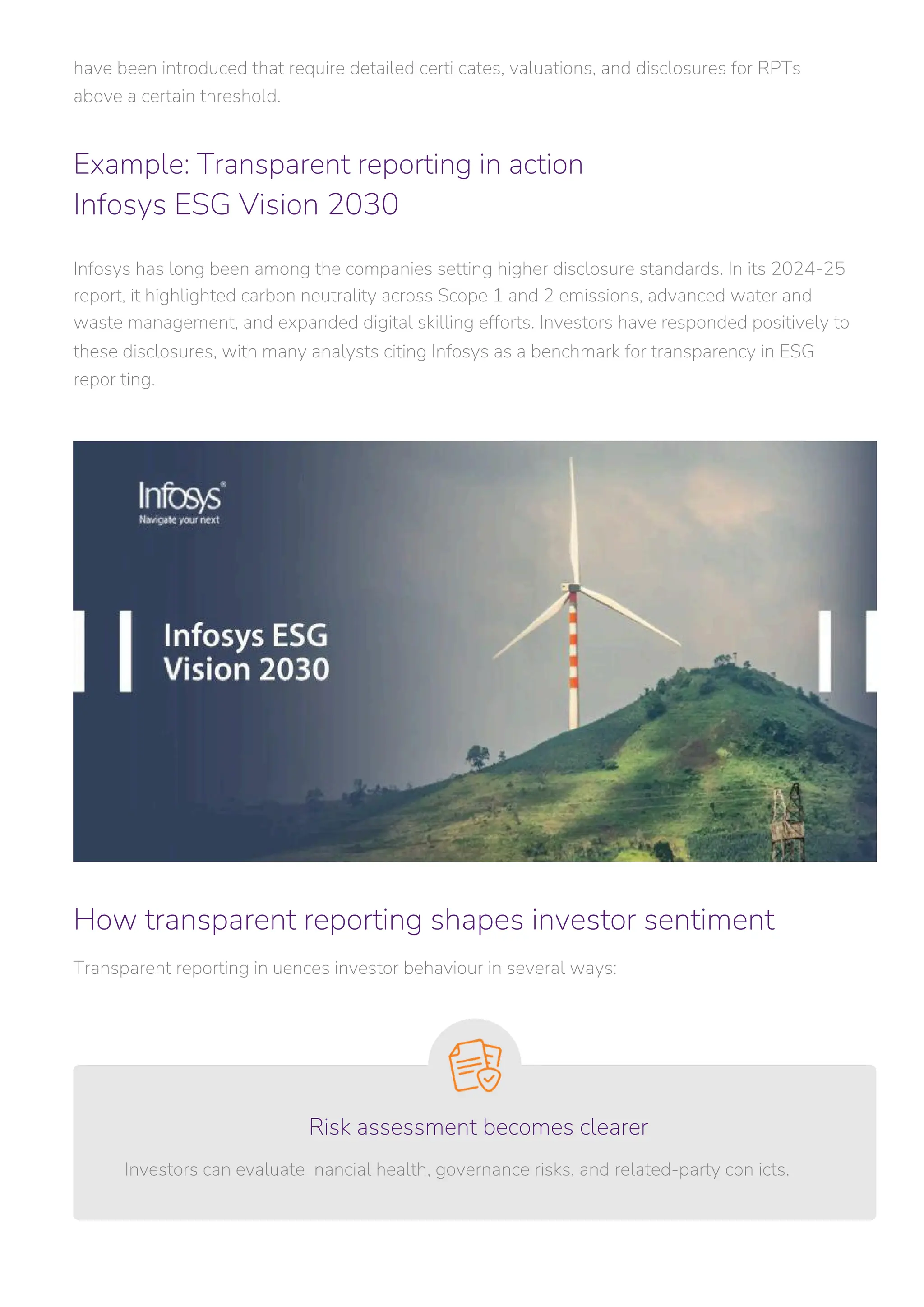
Infosys has long been among the companies setting higher disclosure standards. In its 2024-25
report, it highlighted carbon neutrality across Scope 1 and 2 emissions, advanced water and
waste management, and expanded digital skilling efforts. Investors have responded positively to
these disclosures, with many analysts citing Infosys as a benchmark for transparency in ESG
repor ting.
Example: Transparent reporting in action
Infosys ESG Vision 2030
How transparent reporting shapes investor sentiment
Risk assessment becomes clearer
Challenges that remain
Despite progress in India with regard to rules and regulatory frameworks and the growing
adoption of such practices, some gaps still remain:
Unexpected bad outcomes drop when disclosures are open. Rumours and speculation
have less room.
Strong disclosure practices also tend to attract foreign and institutional investors. Even
retail investors tend to favour organisations that they believe are more trustworthy and
transparent.
Many companies still focus mostly on compliance rather than narrative. The “why” behind
numbers is often missing.
When companies share their strategy, goals, and challenges (not just past performance),
investors feel more involved.
Reduced volatility
Forward guidance helps
Attracting long-term capital
Global benchmarks and India’s relative positioning
If we look abroad, we can study the EU’s Corporate
Sustainability Reporting Directive (CSRD), which came into
effect recently, which emphasises non- nancial disclosures,
forward looking statements, and stakeholder engagement.
Further west, we see the U.S. SEC also expects more detailed
management discussion & analysis, risk disclosures, and
oversight.
In comparison, India is on a promising path. The BRSR (Business Responsibility and
Sustainability Reporting) framework for the top 1,000 listed companies is a strong move. But
narrative reporting and consistent forward-guidance still lag behind global best practice.
Enforcement and consistency remain concerns. Smaller listed entities sometimes struggle to
comply with detailed disclosure norms.
ESG disclosures are also seen to vary highly in quality and depth. Some rms publish glossy
reports; others provide minimal or boilerplate content.
Forward-looking guidance is weak. A very small number of organisations are even able to set
out realistic targets. Then, following through and planning how these targets will be met is
also quite a hurdle.
Technology as an enabler of transparency
Technology helps bridge disclosure gaps:
Implications for corporates, regulators and investors
These tools raise the baseline of what investors expect. They also empower activist
shareholders and analysts.
Digital platforms are making nancial reports more accessible to retail investors.
Use of XBRL (eXtensible Business Reporting Language) for standardised nancial
reporting improves comparability.
Corporations
must view disclosures not merely as rules to comply with, but as strategic tools. Clear
reporting can strengthen credibility, valuation, and investor loyalty.
AI tools and analytics are increasingly used to ag anomalies in reporting (e.g., unusual
RPTs or missing disclosures).
Conclusion
Transparent reporting is the cornerstone of trust in India’s evolving markets. When companies fully
disclose their nances, related-party transactions, strategy, and ESG risks, investors gain
con dence. They feel safer placing capital. The reforms in 2024-25 show SEBI and Indian
companies are moving in the right direction.
Regulators
need to balance strict norms with ease of compliance for smaller rms. Uniform standards
and timely guidance help.
Investors
should deepen their literacy in reading disclosures, looking for narrative, strategy, and risk,
not just top-line numbers.
But the journey is far from over. Firms that embed transparency in their culture will lead the
pack. Regulators who enforce meaning and consistency will hold the line. And investors who
demand clarity will shape the norms.
At SPJIMR’s PGPM, we train professionals who understand this ecosystem deeply. We teach
them nancial reporting, governance, ESG frameworks, and narrative transparency. We believe
that India’s growth story will be written not by silent balance sheets, but by companies that
speak openly, honestly, and strategically.

How transparent reporting shapes investor sentiment in India’s evolving markets

  • 1.
    Nov 12, 2025 Howtransparent reporting shapes investor sentiment in India’s evolving markets Anshul Verma India’s capital markets are becoming more mature and interconnected. Retail participation is growing. Foreign institutional investors continue to show interest. But investor con dence depends heavily on one thing: transparency. Transparent reporting tells the story behind the numbers. It helps investors judge risk, builds trust in management, and helps them decide where to invest. When reporting is weak, markets wobble. When reporting is clear and consistent, investor sentiment strengthens. Why transparent reporting matters
  • 2.
    India’s evolving disclosurerules and recent updates (2024– 25) India has been steadily improving its regulatory framework for corporate reporting. Some key developments include SEBI’s Listing Obligations and Disclosure Requirements (LODR), which continues to demand quarterly nancial disclosures. Companies that provide clarity and transparency have the right to demand a premium, while those that don’t have increased chances of facing reputational damage and unpredictable investor behaviour. Investors are able to understand strategy, performance, and governance when companies report fully in a deeper manner. If disclosures are made preemptively and transparently, it helps decrease irregularities or uneven information distribution among founders, their boards, and key stakeholders. In uncertain times, like regulatory stress or supply chain shocks, clear reporting can enable stabilisation in processes and the environment. In February 2025, SEBI introduced industry standards for related-party transactions (RPTs), requiring listed companies to provide minimum information to audit committees and shareholders. SEBI was also exible and extended implementation deadlines for those RPT standards to allow time for companies to adapt. As recently as September 2025, further rules
  • 3.
    Transparent reporting inuences investor behaviour in several ways: Investors can evaluate nancial health, governance risks, and related-party con icts. have been introduced that require detailed certi cates, valuations, and disclosures for RPTs above a certain threshold. Infosys has long been among the companies setting higher disclosure standards. In its 2024-25 report, it highlighted carbon neutrality across Scope 1 and 2 emissions, advanced water and waste management, and expanded digital skilling efforts. Investors have responded positively to these disclosures, with many analysts citing Infosys as a benchmark for transparency in ESG repor ting. Example: Transparent reporting in action Infosys ESG Vision 2030 How transparent reporting shapes investor sentiment Risk assessment becomes clearer
  • 4.
    Challenges that remain Despiteprogress in India with regard to rules and regulatory frameworks and the growing adoption of such practices, some gaps still remain: Unexpected bad outcomes drop when disclosures are open. Rumours and speculation have less room. Strong disclosure practices also tend to attract foreign and institutional investors. Even retail investors tend to favour organisations that they believe are more trustworthy and transparent. Many companies still focus mostly on compliance rather than narrative. The “why” behind numbers is often missing. When companies share their strategy, goals, and challenges (not just past performance), investors feel more involved. Reduced volatility Forward guidance helps Attracting long-term capital
  • 5.
    Global benchmarks andIndia’s relative positioning If we look abroad, we can study the EU’s Corporate Sustainability Reporting Directive (CSRD), which came into effect recently, which emphasises non- nancial disclosures, forward looking statements, and stakeholder engagement. Further west, we see the U.S. SEC also expects more detailed management discussion & analysis, risk disclosures, and oversight. In comparison, India is on a promising path. The BRSR (Business Responsibility and Sustainability Reporting) framework for the top 1,000 listed companies is a strong move. But narrative reporting and consistent forward-guidance still lag behind global best practice. Enforcement and consistency remain concerns. Smaller listed entities sometimes struggle to comply with detailed disclosure norms. ESG disclosures are also seen to vary highly in quality and depth. Some rms publish glossy reports; others provide minimal or boilerplate content. Forward-looking guidance is weak. A very small number of organisations are even able to set out realistic targets. Then, following through and planning how these targets will be met is also quite a hurdle.
  • 6.
    Technology as anenabler of transparency Technology helps bridge disclosure gaps: Implications for corporates, regulators and investors These tools raise the baseline of what investors expect. They also empower activist shareholders and analysts. Digital platforms are making nancial reports more accessible to retail investors. Use of XBRL (eXtensible Business Reporting Language) for standardised nancial reporting improves comparability. Corporations must view disclosures not merely as rules to comply with, but as strategic tools. Clear reporting can strengthen credibility, valuation, and investor loyalty. AI tools and analytics are increasingly used to ag anomalies in reporting (e.g., unusual RPTs or missing disclosures).
  • 7.
    Conclusion Transparent reporting isthe cornerstone of trust in India’s evolving markets. When companies fully disclose their nances, related-party transactions, strategy, and ESG risks, investors gain con dence. They feel safer placing capital. The reforms in 2024-25 show SEBI and Indian companies are moving in the right direction. Regulators need to balance strict norms with ease of compliance for smaller rms. Uniform standards and timely guidance help. Investors should deepen their literacy in reading disclosures, looking for narrative, strategy, and risk, not just top-line numbers. But the journey is far from over. Firms that embed transparency in their culture will lead the pack. Regulators who enforce meaning and consistency will hold the line. And investors who demand clarity will shape the norms. At SPJIMR’s PGPM, we train professionals who understand this ecosystem deeply. We teach them nancial reporting, governance, ESG frameworks, and narrative transparency. We believe that India’s growth story will be written not by silent balance sheets, but by companies that speak openly, honestly, and strategically.