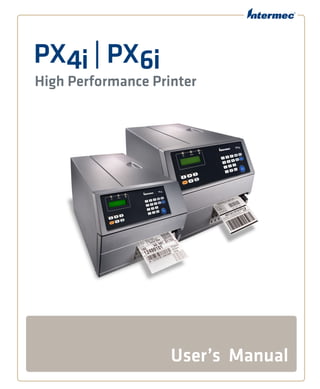
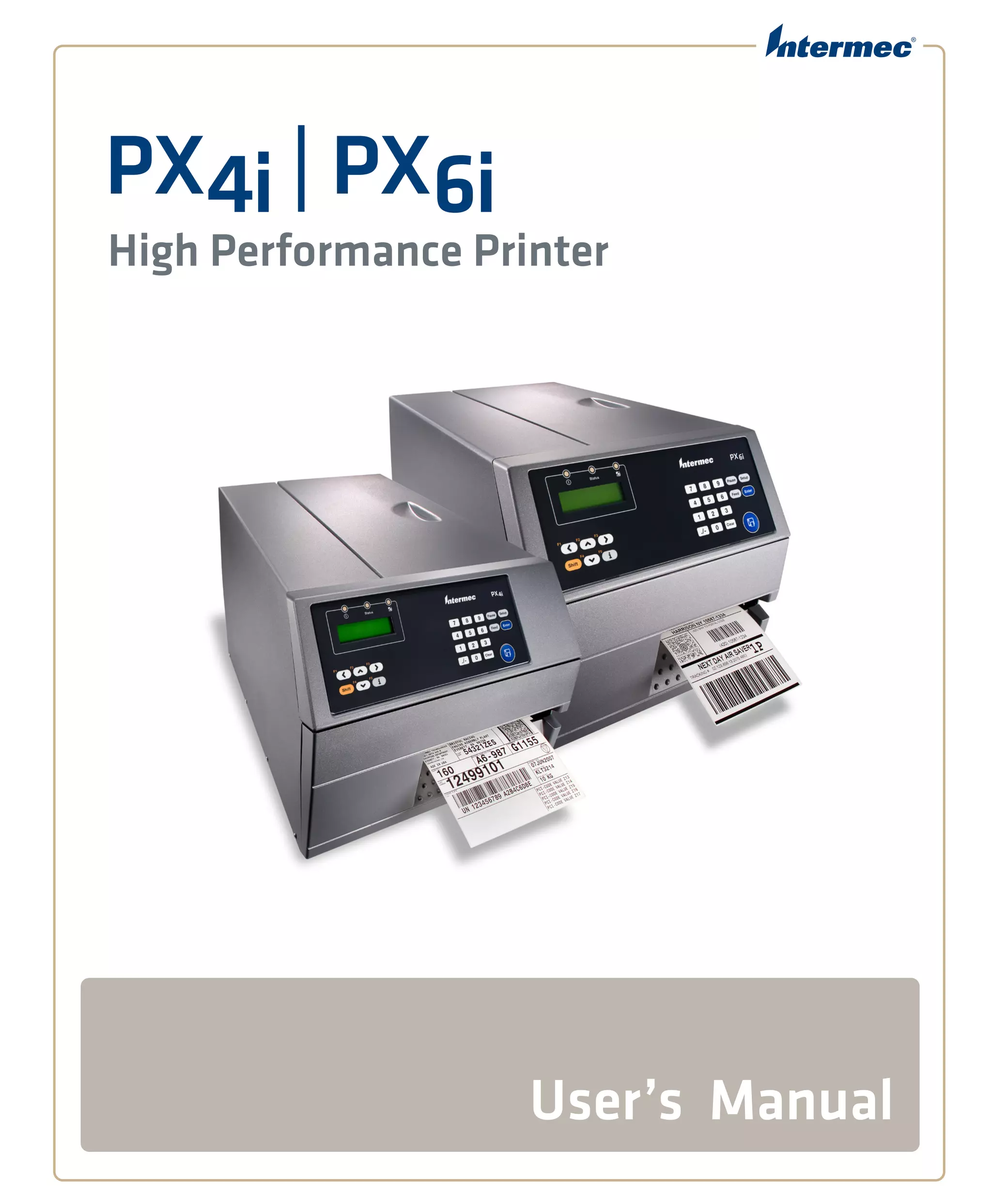
PX4i | PX6i
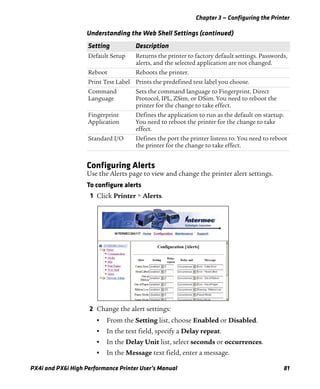
High Performance Printer
User’s Manual
ii PX4i and PX6i High Performance Printer User’s Manual
Intermec Technologies Corporation
Worldwide Headquarters
6001 36th Ave.W.
Everett, WA 98203
U.S.A.
www.intermec.com
The information contained herein is proprietary and is provided solely for the purpose of allowing
customers to operate and service Intermec-manufactured equipment and is not to be released,
reproduced, or used for any other purpose without written permission of Intermec Technologies
Corporation.
Information and specifications contained in this document are subject to change without prior
notice and do not represent a commitment on the part of Intermec Technologies Corporation.
©200 -2010 by Intermec Technologies Corporation. All rights reserved.
The word Intermec, the Intermec logo, Norand, ArciTech, Beverage Routebook, CrossBar,
dcBrowser, Duratherm, EasyADC, EasyCoder, EasySet, Fingerprint, i-gistics, INCA (under license),
Intellitag, Intellitag Gen2, JANUS, LabelShop, MobileLAN, Picolink, Ready-to-Work, RoutePower,
Sabre, ScanPlus, ShopScan, Smart Mobile Computing, SmartSystems, TE 2000, Trakker Antares,
and Vista Powered are either trademarks or registered trademarks of Intermec Technologies
Corporation.
There are U.S. and foreign patents pending.
Wi-Fi is a registered certification mark of the Wi-Fi Alliance.
Microsoft, Windows, and the Windows logo are registered trademarks of Microsoft Corporation
in the United States and/or other countries.
Kimdura is a registered trademark of Kimberly Clark.
Valeron is a registered trademark of Valéron Strength Films, an ITW Company.
The name Centronics is wholly owned by GENICOM Corporation.
TrueDoc is a registered trademark of Bitstream, Inc.
TrueType is a trademark of Apple Computer Inc.
Unicode is a trademark of Unicode Inc.
This product includes software developed by the OpenSSL Project for use in the OpenSSL Toolkit
(www.openssl.org).
This product includes cryptographic software written by Eric Young (EAY@cryptsoft.com).
This product uses Regex++, Index software during its operational phases. The owner of Regex++
has granted use of the software to anyone provided such use is accompanied by the following
copyright and permission notice:
Regex++, Index. (Version 3.31, 16th Dec 2001)
Copyright © 1998-2001 Dr John Maddock
Permission to use, copy, modify, distribute and sell this software and its documentation for any
purpose is hereby granted without fee, provided that the above copyright notice appear in all
copies and that both that copyright notice and this permission notice appear in supporting
documentation. Dr John Maddock makes no representations about the suitability of this software
for any purpose. It is provided “as is” without express or implied warranty.
PX4i and PX6i High Performance Printer User’s Manual iii
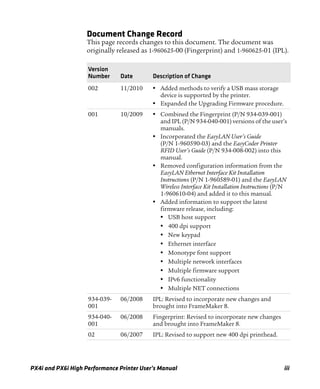
Document Change Record
This page records changes to this document. The document was
originally released as 1-960625-00 (Fingerprint) and 1-960625-01 (IPL).
Version
Number Date Description of Change
002 11/2010 • Added methods to verify a USB mass storage
device is supported by the printer.
• Expanded the Upgrading Firmware procedure.
001 10/2009 • Combined the Fingerprint (P/N 934-039-001)
and IPL (P/N 934-040-001) versions of the user’s
manuals.
• Incorporated the EasyLAN User’s Guide
(P/N 1-960590-03) and the EasyCoder Printer
RFID User’s Guide (P/N 934-008-002) into this
manual.
• Removed configuration information from the
EasyLAN Ethernet Interface Kit Installation
Instructions (P/N 1-960589-01) and the EasyLAN
Wireless Interface Kit Installation Instructions (P/N
1-960610-04) and added it to this manual.
• Added information to support the latest
firmware release, including:
• USB host support
• 400 dpi support
• New keypad
• Ethernet interface
• Monotype font support
• Multiple network interfaces
• Multiple firmware support
• IPv6 functionality
• Multiple NET connections
934-039-
001
06/2008 IPL: Revised to incorporate new changes and
brought into FrameMaker 8.
934-040-
001
06/2008 Fingerprint: Revised to incorporate new changes
and brought into FrameMaker 8.
02 06/2007 IPL: Revised to support new 400 dpi printhead.
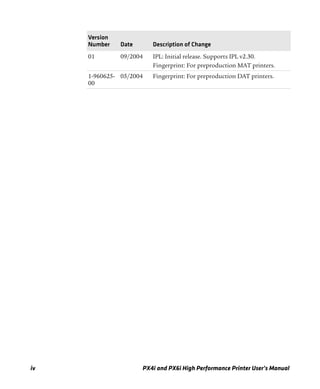
iv PX4i and PX6i High Performance Printer User’s Manual
01 09/2004 IPL: Initial release. Supports IPL v2.30.
Fingerprint: For preproduction MAT printers.
1-960625-
00
05/2004 Fingerprint: For preproduction DAT printers.
Version
Number Date Description of Change
Contents
PX4i and PX6i High Performance Printer User’s Manual v
Contents
Before You Begin. . . . . . . . . . . . . . . . . . . . . . . . . . . . . . . . . . . . . . . . . . . . . . . . . . . . . . . . . . . . . . . . . xi
Safety Information. . . . . . . . . . . . . . . . . . . . . . . . . . . . . . . . . . . . . . . . . . . . . . . . . . . . . . . xi
Global Services and Support . . . . . . . . . . . . . . . . . . . . . . . . . . . . . . . . . . . . . . . . . . . . . .xii
Warranty Information. . . . . . . . . . . . . . . . . . . . . . . . . . . . . . . . . . . . . . . . . . . .xii
Web Support . . . . . . . . . . . . . . . . . . . . . . . . . . . . . . . . . . . . . . . . . . . . . . . . . . . .xii
Telephone Support . . . . . . . . . . . . . . . . . . . . . . . . . . . . . . . . . . . . . . . . . . . . . .xii
Service Location Support . . . . . . . . . . . . . . . . . . . . . . . . . . . . . . . . . . . . . . . . .xii
Who Should Read This Manual . . . . . . . . . . . . . . . . . . . . . . . . . . . . . . . . . . . . . . . . . . xiii
Related Documents . . . . . . . . . . . . . . . . . . . . . . . . . . . . . . . . . . . . . . . . . . . . . . . . . . . . . xiii
Patent Information . . . . . . . . . . . . . . . . . . . . . . . . . . . . . . . . . . . . . . . . . . . . . . . . . . . . . xiv
1 Using the Printer . . . . . . . . . . . . . . . . . . . . . . . . . . . . . . . . . . . . . . . . . . . . . . . . . . . . . . . . 1
Learning About the Printers . . . . . . . . . . . . . . . . . . . . . . . . . . . . . . . . . . . . . . . . . . . . . . . . . . . . . . . 2
What’s New?. . . . . . . . . . . . . . . . . . . . . . . . . . . . . . . . . . . . . . . . . . . . . . . . . . . . . . . . . . . . . . 2
Identifying the Parts of the Printer . . . . . . . . . . . . . . . . . . . . . . . . . . . . . . . . . . . . . . . . . 2
Selecting a Printer Language . . . . . . . . . . . . . . . . . . . . . . . . . . . . . . . . . . . . . . . . . . . . . . . 3
Understanding the Control Panel . . . . . . . . . . . . . . . . . . . . . . . . . . . . . . . . . . . . . . . . . . 5
Understanding the Buttons. . . . . . . . . . . . . . . . . . . . . . . . . . . . . . . . . . . . . . . . 5
Understanding the LEDs . . . . . . . . . . . . . . . . . . . . . . . . . . . . . . . . . . . . . . . . . . 6
Understanding the Screen . . . . . . . . . . . . . . . . . . . . . . . . . . . . . . . . . . . . . . . . . 7
Understanding the Printer Sounds . . . . . . . . . . . . . . . . . . . . . . . . . . . . . . . . . . . . . . . . . 7
Loading Media. . . . . . . . . . . . . . . . . . . . . . . . . . . . . . . . . . . . . . . . . . . . . . . . . . . . . . . . . . . . . . . . . . . . 7
Loading Media for Tear-Off Printing . . . . . . . . . . . . . . . . . . . . . . . . . . . . . . . . . . . . . . . 8
Loading Media for Peel-Off Printing. . . . . . . . . . . . . . . . . . . . . . . . . . . . . . . . . . . . . . .15
Loading Media for Cut-Off Printing . . . . . . . . . . . . . . . . . . . . . . . . . . . . . . . . . . . . . . .24
Loading Media for Internal Batch Takeup Printing . . . . . . . . . . . . . . . . . . . . . . . . .32
Loading Media for Printing From an External Supply . . . . . . . . . . . . . . . . . . . . . . .41
Loading Ribbon . . . . . . . . . . . . . . . . . . . . . . . . . . . . . . . . . . . . . . . . . . . . . . . . . . . . . . . . . . . . . . . . .43
Printing a Test Label . . . . . . . . . . . . . . . . . . . . . . . . . . . . . . . . . . . . . . . . . . . . . . . . . . . . . . . . . . . . .51
Creating and Printing Labels. . . . . . . . . . . . . . . . . . . . . . . . . . . . . . . . . . . . . . . . . . . . . . . . . . . . . .53
Printing on RFID Media . . . . . . . . . . . . . . . . . . . . . . . . . . . . . . . . . . . . . . . . . . . . . . . . . . . . . . . . . .54
Contents
vi PX4i and PX6i High Performance Printer User’s Manual
2 Connecting the Printer . . . . . . . . . . . . . . . . . . . . . . . . . . . . . . . . . . . . . . . . . . . . . . . . 55
Connecting the Printer to Your PC . . . . . . . . . . . . . . . . . . . . . . . . . . . . . . . . . . . . . . . . . . . . . . . .56
Connecting the Printer to a PC Through the Serial Port . . . . . . . . . . . . . . . . . . . . .56
Connecting the Printer to a PC Through the USB Device Port . . . . . . . . . . . . . . .57
Connecting the Printer to a PC Through the IEEE 1284 Port . . . . . . . . . . . . . . . .57
Connecting the Printer to Your Network . . . . . . . . . . . . . . . . . . . . . . . . . . . . . . . . . . . . . . . . . . .58
Setting Up Ethernet Communications . . . . . . . . . . . . . . . . . . . . . . . . . . . . . . . . . . . . .58
Manually Configuring IP Settings . . . . . . . . . . . . . . . . . . . . . . . . . . . . . . . . . . . . . . . . .60
Setting Up 802.11 Radio Communications. . . . . . . . . . . . . . . . . . . . . . . . . . . . . . . . .61
Configuring 802.11 Wireless Security Using Fingerprint . . . . . . . . . . . .64
Configuring 802.11 Wireless Security Using IPL . . . . . . . . . . . . . . . . . . . .67
Connecting Peripherals to the USB Host Port . . . . . . . . . . . . . . . . . . . . . . . . . . . . . . . . . . . . . .70
Using a USB Mass Storage Device . . . . . . . . . . . . . . . . . . . . . . . . . . . . . . . . . . . . . . . . .71
Connecting a Keyboard to the USB Host Port . . . . . . . . . . . . . . . . . . . . . . . . . . . . . .71
Connecting a Bar Code Scanner to the USB Host Port. . . . . . . . . . . . . . . . . . . . . . .72
Connecting a USB Hub to the USB Host Port . . . . . . . . . . . . . . . . . . . . . . . . . . . . . .72
3 Configuring the Printer. . . . . . . . . . . . . . . . . . . . . . . . . . . . . . . . . . . . . . . . . . . . . . . . 73
Configuring Your Printer . . . . . . . . . . . . . . . . . . . . . . . . . . . . . . . . . . . . . . . . . . . . . . . . . . . . . . . . .74
Configuring Your Printer From the Screen . . . . . . . . . . . . . . . . . . . . . . . . . . . . . . . . .74
Configuring Your Printer From the Printer Home Page. . . . . . . . . . . . . . . . . . . . . .76
Configuring Communications Settings . . . . . . . . . . . . . . . . . . . . . . . . . . . .77
Configuring Media Settings . . . . . . . . . . . . . . . . . . . . . . . . . . . . . . . . . . . . . .77
Configuring RFID Settings (Printer With RFID Option) . . . . . . . . . . . .78
Configuring Print Engine Settings . . . . . . . . . . . . . . . . . . . . . . . . . . . . . . . .79
Configuring Web Shell Settings . . . . . . . . . . . . . . . . . . . . . . . . . . . . . . . . . . .80
Configuring Alerts . . . . . . . . . . . . . . . . . . . . . . . . . . . . . . . . . . . . . . . . . . . . . . .81
Configuring General Network Settings . . . . . . . . . . . . . . . . . . . . . . . . . . . .83
Configuring Mail Settings . . . . . . . . . . . . . . . . . . . . . . . . . . . . . . . . . . . . . . . .85
Configuring SNMP Settings . . . . . . . . . . . . . . . . . . . . . . . . . . . . . . . . . . . . . .87
Configuring TCP/IP Settings . . . . . . . . . . . . . . . . . . . . . . . . . . . . . . . . . . . . .89
Configuring the Network Type. . . . . . . . . . . . . . . . . . . . . . . . . . . . . . . . . . . .91
Configuring Avalanche Settings. . . . . . . . . . . . . . . . . . . . . . . . . . . . . . . . . . .92
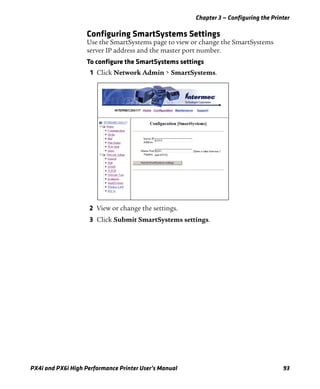
Configuring SmartSystems Settings . . . . . . . . . . . . . . . . . . . . . . . . . . . . . . .93
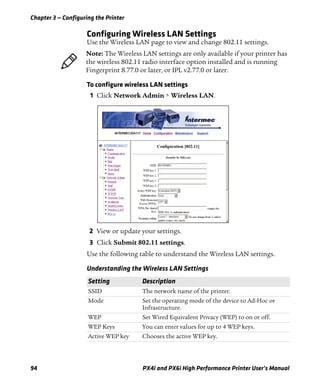
Configuring Wireless LAN Settings. . . . . . . . . . . . . . . . . . . . . . . . . . . . . . . .94
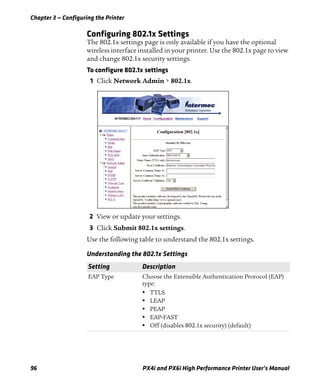
Configuring 802.1x Settings . . . . . . . . . . . . . . . . . . . . . . . . . . . . . . . . . . . . . .96
Configuring Your Printer With PrintSet. . . . . . . . . . . . . . . . . . . . . . . . . . . . . . . . . . . .98
Configuring Your Printer With Commands Sent From Your PC. . . . . . . . . . . . . .98
Configuring Your Printer Using SmartSystems Foundation . . . . . . . . . . . . . . . . .99
Configuring Your Printer Using Wavelink Avalanche. . . . . . . . . . . . . . . . . . . . . . .100
Contents
PX4i and PX6i High Performance Printer User’s Manual vii
Choosing an Ethernet or Wireless Network. . . . . . . . . . . . . . . . . . . . . . . . . . . . . . . . . . . . . . . .100
Choosing the Network Type From the Printer Screen . . . . . . . . . . . . . . . . . . . . . .101
Choosing the Network Type Using Printer Commands. . . . . . . . . . . . . . . . . . . . .101
Upgrading Firmware . . . . . . . . . . . . . . . . . . . . . . . . . . . . . . . . . . . . . . . . . . . . . . . . . . . . . . . . . . . .102
Downloading Fonts and Graphics . . . . . . . . . . . . . . . . . . . . . . . . . . . . . . . . . . . . . . . . . . . . . . . .104
4 Troubleshooting and Maintaining the Printer. . . . . . . . . . . . . . . . . . . . . 105
Troubleshooting the Printer . . . . . . . . . . . . . . . . . . . . . . . . . . . . . . . . . . . . . . . . . . . . . . . . . . . . .106
Contacting Product Support. . . . . . . . . . . . . . . . . . . . . . . . . . . . . . . . . . . . . . . . . . . . .106
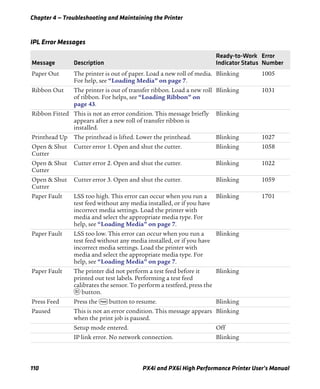
Understanding Error Messages. . . . . . . . . . . . . . . . . . . . . . . . . . . . . . . . . . . . . . . . . . .107
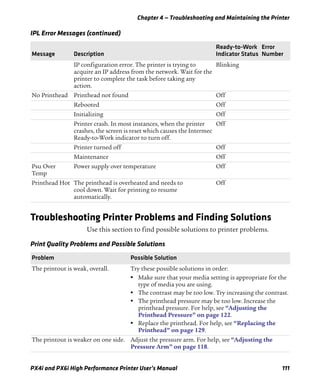
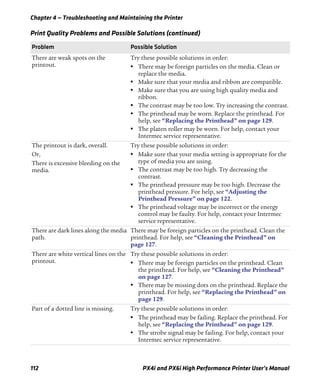
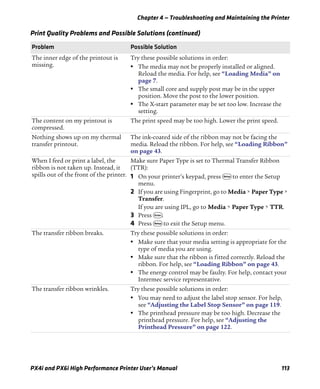
Troubleshooting Printer Problems and Finding Solutions . . . . . . . . . . . . . . . . . .111
Resetting the Printer . . . . . . . . . . . . . . . . . . . . . . . . . . . . . . . . . . . . . . . . . . . . . . . . . . . .117
Adjusting the Printer . . . . . . . . . . . . . . . . . . . . . . . . . . . . . . . . . . . . . . . . . . . . . . . . . . . . . . . . . . . .118
Adjusting the Pressure Arm . . . . . . . . . . . . . . . . . . . . . . . . . . . . . . . . . . . . . . . . . . . . . .118
Adjusting the Label Stop Sensor. . . . . . . . . . . . . . . . . . . . . . . . . . . . . . . . . . . . . . . . . .119
Adjusting the Printhead Pressure. . . . . . . . . . . . . . . . . . . . . . . . . . . . . . . . . . . . . . . . .122
Adjusting the Label Taken Sensor . . . . . . . . . . . . . . . . . . . . . . . . . . . . . . . . . . . . . . . .123
Maintaining the Printer . . . . . . . . . . . . . . . . . . . . . . . . . . . . . . . . . . . . . . . . . . . . . . . . . . . . . . . . .124
Cleaning the Printer. . . . . . . . . . . . . . . . . . . . . . . . . . . . . . . . . . . . . . . . . . . . . . . . . . . . .124
Cleaning the Exterior of the Printer. . . . . . . . . . . . . . . . . . . . . . . . . . . . . . .125
Cleaning the Media Guides . . . . . . . . . . . . . . . . . . . . . . . . . . . . . . . . . . . . . .125
Cleaning the Printhead . . . . . . . . . . . . . . . . . . . . . . . . . . . . . . . . . . . . . . . . . .127
Replacing the Printhead . . . . . . . . . . . . . . . . . . . . . . . . . . . . . . . . . . . . . . . . . . . . . . . . .129
A Specifications . . . . . . . . . . . . . . . . . . . . . . . . . . . . . . . . . . . . . . . . . . . . . . . . . . . . . . . . 135
Specifications. . . . . . . . . . . . . . . . . . . . . . . . . . . . . . . . . . . . . . . . . . . . . . . . . . . . . . . . . . . . . . . . . . .136
Interfaces. . . . . . . . . . . . . . . . . . . . . . . . . . . . . . . . . . . . . . . . . . . . . . . . . . . . . . . . . . . . . . . . . . . . . . .138
RS-232 Serial Interface . . . . . . . . . . . . . . . . . . . . . . . . . . . . . . . . . . . . . . . . . . . . . . . . . .138
USB Interface. . . . . . . . . . . . . . . . . . . . . . . . . . . . . . . . . . . . . . . . . . . . . . . . . . . . . . . . . . .139
USB Host Interface. . . . . . . . . . . . . . . . . . . . . . . . . . . . . . . . . . . . . . . . . . . . . . . . . . . . . .140
Ethernet Interface. . . . . . . . . . . . . . . . . . . . . . . . . . . . . . . . . . . . . . . . . . . . . . . . . . . . . . .140
Parallel IEEE 1284 Interface . . . . . . . . . . . . . . . . . . . . . . . . . . . . . . . . . . . . . . . . . . . . .141
Media Specifications . . . . . . . . . . . . . . . . . . . . . . . . . . . . . . . . . . . . . . . . . . . . . . . . . . . . . . . . . . . .142
Accessories for the Printer . . . . . . . . . . . . . . . . . . . . . . . . . . . . . . . . . . . . . . . . . . . . . . . . . . . . . . .153
Contents
viii PX4i and PX6i High Performance Printer User’s Manual
B Default Settings . . . . . . . . . . . . . . . . . . . . . . . . . . . . . . . . . . . . . . . . . . . . . . . . . . . . . . 155
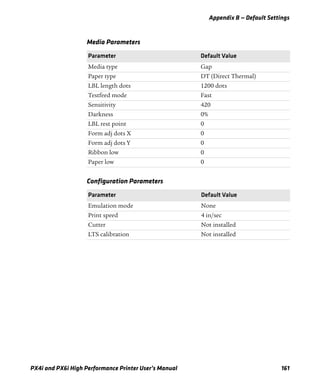
Default Configuration . . . . . . . . . . . . . . . . . . . . . . . . . . . . . . . . . . . . . . . . . . . . . . . . . . . . . . . . . .156
Fingerprint Default Configuration . . . . . . . . . . . . . . . . . . . . . . . . . . . . . . . . . . . . . . .156
IPL Default Configuration. . . . . . . . . . . . . . . . . . . . . . . . . . . . . . . . . . . . . . . . . . . . . . .159
C Fingerprint and IPL Setup Menus . . . . . . . . . . . . . . . . . . . . . . . . . . . . . . . . . . . 163
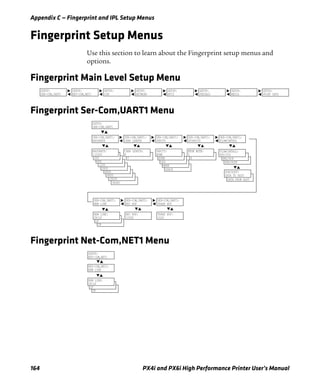
Fingerprint Setup Menus . . . . . . . . . . . . . . . . . . . . . . . . . . . . . . . . . . . . . . . . . . . . . . . . . . . . . . . .164
Fingerprint Main Level Setup Menu . . . . . . . . . . . . . . . . . . . . . . . . . . . . . . . . . . . . . .164
Fingerprint Ser-Com,UART1 Menu. . . . . . . . . . . . . . . . . . . . . . . . . . . . . . . . . . . . . . .164
Fingerprint Net-Com,NET1 Menu . . . . . . . . . . . . . . . . . . . . . . . . . . . . . . . . . . . . . . .164
Fingerprint COM Menu . . . . . . . . . . . . . . . . . . . . . . . . . . . . . . . . . . . . . . . . . . . . . . . . .165
Fingerprint Network Menu . . . . . . . . . . . . . . . . . . . . . . . . . . . . . . . . . . . . . . . . . . . . . .165
Fingerprint RFID Menu . . . . . . . . . . . . . . . . . . . . . . . . . . . . . . . . . . . . . . . . . . . . . . . . .165
Fingerprint Feedadj Menu . . . . . . . . . . . . . . . . . . . . . . . . . . . . . . . . . . . . . . . . . . . . . . .165
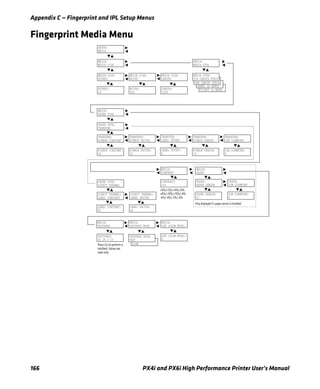
Fingerprint Media Menu . . . . . . . . . . . . . . . . . . . . . . . . . . . . . . . . . . . . . . . . . . . . . . . .166
Fingerprint Print Defs Menu. . . . . . . . . . . . . . . . . . . . . . . . . . . . . . . . . . . . . . . . . . . . .167
IPL Setup Menus. . . . . . . . . . . . . . . . . . . . . . . . . . . . . . . . . . . . . . . . . . . . . . . . . . . . . . . . . . . . . . . .168
IPL Main Level Setup Menu. . . . . . . . . . . . . . . . . . . . . . . . . . . . . . . . . . . . . . . . . . . . . .168
IPL Ser-Com Menu. . . . . . . . . . . . . . . . . . . . . . . . . . . . . . . . . . . . . . . . . . . . . . . . . . . . . .168
IPL COM Menu. . . . . . . . . . . . . . . . . . . . . . . . . . . . . . . . . . . . . . . . . . . . . . . . . . . . . . . . .168
IPL Network Menu. . . . . . . . . . . . . . . . . . . . . . . . . . . . . . . . . . . . . . . . . . . . . . . . . . . . . .169
IPL RFID Menu. . . . . . . . . . . . . . . . . . . . . . . . . . . . . . . . . . . . . . . . . . . . . . . . . . . . . . . . .169
IPL Test/Service Menu . . . . . . . . . . . . . . . . . . . . . . . . . . . . . . . . . . . . . . . . . . . . . . . . . .169
IPL Media Menu . . . . . . . . . . . . . . . . . . . . . . . . . . . . . . . . . . . . . . . . . . . . . . . . . . . . . . . .170
IPL Configuration Menu . . . . . . . . . . . . . . . . . . . . . . . . . . . . . . . . . . . . . . . . . . . . . . . .170
D Advanced Configuration. . . . . . . . . . . . . . . . . . . . . . . . . . . . . . . . . . . . . . . . . . . . . 171
Printer File System (Fingerprint) . . . . . . . . . . . . . . . . . . . . . . . . . . . . . . . . . . . . . . . . . . . . . . . . .172
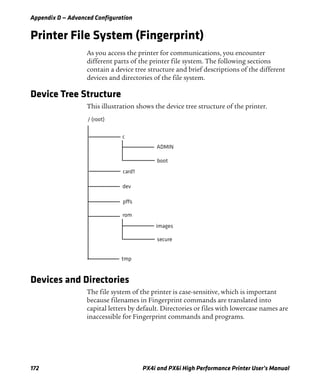
Device Tree Structure . . . . . . . . . . . . . . . . . . . . . . . . . . . . . . . . . . . . . . . . . . . . . . . . . . .172
Devices and Directories. . . . . . . . . . . . . . . . . . . . . . . . . . . . . . . . . . . . . . . . . . . . . . . . . .172
Customizing the Printer Home Page. . . . . . . . . . . . . . . . . . . . . . . . . . . . . . . . . . . . . . . . . . . . . .174
Web Style Guide Files . . . . . . . . . . . . . . . . . . . . . . . . . . . . . . . . . . . . . . . . . . . . . . . . . . .175
Content of a Web Style Guide File . . . . . . . . . . . . . . . . . . . . . . . . . . . . . . . . . . . . . . . .175
Required Environment Variables . . . . . . . . . . . . . . . . . . . . . . . . . . . . . . . . .175
Optional Environment Variables . . . . . . . . . . . . . . . . . . . . . . . . . . . . . . . . .176
x-www-url-Encoding Syntax Rules. . . . . . . . . . . . . . . . . . . . . . . . . . . . . . . .177
Memory and Storage . . . . . . . . . . . . . . . . . . . . . . . . . . . . . . . . . . . . . . . . . . . .178
Creating a Web Style Guide File . . . . . . . . . . . . . . . . . . . . . . . . . . . . . . . . . . . . . . . . . .178
Contents
PX4i and PX6i High Performance Printer User’s Manual ix
I Index . . . . . . . . . . . . . . . . . . . . . . . . . . . . . . . . . . . . . . . . . . . . . . . . . . . . . . . . . . . . . . . . . . . . 179
Contents
x PX4i and PX6i High Performance Printer User’s Manual
Before You Begin
PX4i and PX6i High Performance Printer User’s Manual xi
Before You Begin
This section provides you with safety information, technical support
information, and sources for additional product information.
Safety Information
Your safety is extremely important. Read and follow all warnings and
cautions in this document before handling and operating Intermec
equipment. You can be seriously injured, and equipment and data can
be damaged if you do not follow the safety warnings and cautions.
This section explains how to identify and understand warnings,
cautions, and notes that are in this document.
A warning alerts you of an operating procedure, practice,
condition, or statement that must be strictly observed to avoid
death or serious injury to the persons working on the equipment.
A caution alerts you to an operating procedure, practice,
condition, or statement that must be strictly observed to prevent
equipment damage or destruction, or corruption or loss of data.
Note: Notes either provide extra information about a topic or contain
special instructions for handling a particular condition or set of
circumstances.
This icon appears at the beginning of any procedure in this
manual that could cause you to touch components (such as
printed circuit boards) that are susceptible to damage from
electrostatic discharge (ESD). When you see this icon, you must
follow standard ESD guidelines to avoid damaging the
equipment you are servicing.
Before You Begin
xii PX4i and PX6i High Performance Printer User’s Manual
Global Services and Support
Warranty Information
To understand the warranty for your Intermec product, visit the
Intermec web site at www.intermec.com and click Support >
Returns and Repairs > Warranty.
Disclaimer of warranties: The sample code included in this document
is presented for reference only. The code does not necessarily
represent complete, tested programs. The code is provided “as is with
all faults.” All warranties are expressly disclaimed, including the
implied warranties of merchantability and fitness for a particular
purpose.
Web Support
Visit the Intermec web site at www.intermec.com to download our
current manuals (in PDF).
Visit the Intermec technical knowledge base (Knowledge Central) at
www.intermec.com and click Support > Knowledge Central to
review technical information or to request technical support for your
Intermec product.
Telephone Support
In the U.S.A. and Canada, call 1-800-755-5505.
Outside the U.S.A. and Canada, contact your local Intermec
representative. To search for your local representative, from the
Intermec web site, click About Us > Contact Us.
Service Location Support
For the most current listing of service locations, go to
www.intermec.com and click Support >Returns and Repairs >
Repair Locations.
For technical support in South Korea, use the after service locations
listed below:
Before You Begin
PX4i and PX6i High Performance Printer User’s Manual xiii
AWOO Systems
102-1304 SK Ventium
522 Dangjung-dong
Gunpo-si, Gyeonggi-do Korea, South 435-776
Contact: Mr. Sinbum Kang
Telephone: +82-31-436-1191
E-mail: mjyun@awoo.co.kr
IN Information System PTD LTD
6th Floor
Daegu Venture Center Bldg 95
Shinchun 3 Dong
Donggu, Daegu City, Korea
E-mail: jmyou@idif.co.kr or korlim@gw.idif.co.kr
Who Should Read This Manual
This manual is for the person who is responsible for installing,
configuring, and maintaining the PX4i or PX6i.
This manual provides you with information about the features of the
PX4i and PX6i, and how to install, configure, operate, maintain, and
troubleshoot them.
Before you work with the PX4i or PX6i, you should be familiar with
your network and general networking terms, such as IP address.
Related Documents
Here are some related Intermec documents you might find useful:
• Intermec Fingerprint Developer’s Guide
• Intermec Fingerprint Command Reference Manual
• Intermec Printer Language (IPL) Developer’s Guide
• Intermec Printer Language (IPL) Command Reference Manual
• DSim Programmer’s Guide
• ZSim Programmer’s Guide
The Intermec web site at www.intermec.com contains our
documents (as .pdf files) that you can download for free.
Before You Begin
xiv PX4i and PX6i High Performance Printer User’s Manual
To download documents
1 Visit the Intermec web site at www.intermec.com.
2 Click the Products tab.
3 Using the Products menu, navigate to your product page. For
example, to find the CN3 computer product page, click
Computers > Handheld Computers > CN3.
4 Click the Manuals tab.
5 If your product does not have its own product page, click Support
> Manuals. Use the Product Category field, the Product Family
field, and the Product field to help you locate the documentation
for your product.
Patent Information
Product is covered by one or more patents. There may be other U.S.
and foreign patents pending.
1
1
Using the Printer
Use this chapter to familiarize yourself with the PX4i and PX6i
printers. This chapter contains these sections:
• Learning About the Printers
• Loading Media
• Loading Ribbon
• Printing a Test Label
• Creating and Printing Labels
• Printing on RFID Media
Chapter 1 — Using the Printer
2 PX4i and PX6i High Performance Printer User’s Manual
Learning About the Printers
The PX4i and PX6i High Performance printers are rugged,
high-volume, thermal transfer printers. With sturdy, all-metal
construction, these printers are designed to excel at 24/7 printing in
harsh industrial environments and easily adapt to changes in host
environments or applications.
The PX4i and PX6i support a maximum print width of four or six
inches, respectively. Throughout this manual, both models of the
printer are referred to as “printer” unless otherwise noted.
What’s New?
This version of the user’s manual includes information to support
these features:
• Verify a USB mass storage device is supported by the printer.
• Using a USB mass storage device to upgrade firmware.
Identifying the Parts of the Printer
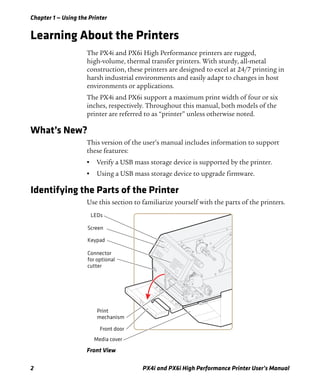
Use this section to familiarize yourself with the parts of the printers.
Front View
Media cover
LEDs
Screen
Keypad
Front door
Print
mechanism
Connector
for optional
cutter
Chapter 1 — Using the Printer
PX4i and PX6i High Performance Printer User’s Manual 3
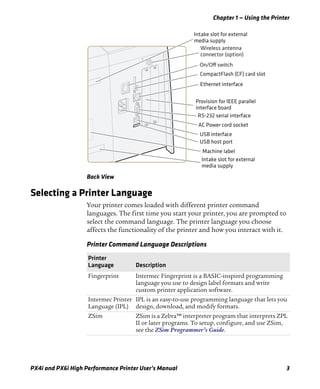
Back View
Selecting a Printer Language
Your printer comes loaded with different printer command
languages. The first time you start your printer, you are prompted to
select the command language. The printer language you choose
affects the functionality of the printer and how you interact with it.
On/Off switch
AC Power cord socket
CompactFlash (CF) card slot
Machine label
RS-232 serial interface
Provision for IEEE parallel
interface board
USB interface
Intake slot for external
media supply
Intake slot for external
media supply
Wireless antenna
connector (option)
USB host port
Ethernet interface
Printer Command Language Descriptions
Printer
Language Description
Fingerprint Intermec Fingerprint is a BASIC-inspired programming
language you use to design label formats and write
custom printer application software.
Intermec Printer
Language (IPL)
IPL is an easy-to-use programming language that lets you
design, download, and modify formats.
ZSim ZSim is a Zebra™ interpreter program that interprets ZPL
II or later programs. To setup, configure, and use ZSim,
see the ZSim Programmer’s Guide.
Chapter 1 — Using the Printer
4 PX4i and PX6i High Performance Printer User’s Manual
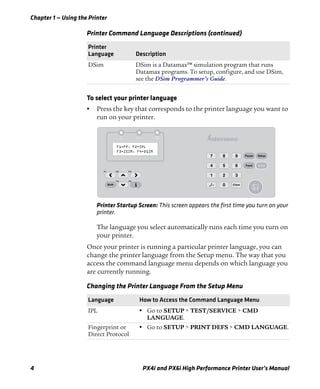
To select your printer language
• Press the key that corresponds to the printer language you want to
run on your printer.
Printer Startup Screen: This screen appears the first time you turn on your
printer.
The language you select automatically runs each time you turn on
your printer.
Once your printer is running a particular printer language, you can
change the printer language from the Setup menu. The way that you
access the command language menu depends on which language you
are currently running.
DSim DSim is a Datamax™ simulation program that runs
Datamax programs. To setup, configure, and use DSim,
see the DSim Programmer’s Guide.
Changing the Printer Language From the Setup Menu
Language How to Access the Command Language Menu
IPL • Go to SETUP > TEST/SERVICE > CMD
LANGUAGE.
Fingerprint or
Direct Protocol
• Go to SETUP > PRINT DEFS > CMD LANGUAGE.
Printer Command Language Descriptions (continued)
Printer
Language Description
F1=FP, F2=IPL
F3=ZSIM, F4=DSIM
Pause Setup
Feed
F3
F5
F2
F4
F1
Shift
1 2 3
4 5 6
7 8 9
0 Clear
Enter
./-
Status
Chapter 1 — Using the Printer
PX4i and PX6i High Performance Printer User’s Manual 5
Understanding the Control Panel
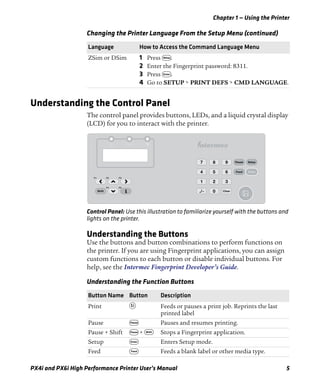
The control panel provides buttons, LEDs, and a liquid crystal display
(LCD) for you to interact with the printer.
Control Panel: Use this illustration to familiarize yourself with the buttons and
lights on the printer.
Understanding the Buttons
Use the buttons and button combinations to perform functions on
the printer. If you are using Fingerprint applications, you can assign
custom functions to each button or disable individual buttons. For
help, see the Intermec Fingerprint Developer’s Guide.
ZSim or DSim 1 Press T.
2 Enter the Fingerprint password: 8311.
3 Press E.
4 Go to SETUP > PRINT DEFS > CMD LANGUAGE.
Changing the Printer Language From the Setup Menu (continued)
Language How to Access the Command Language Menu
Understanding the Function Buttons
Button Name Button Description
Print A Feeds or pauses a print job. Reprints the last
printed label
Pause P Pauses and resumes printing.
Pause + Shift P + S Stops a Fingerprint application.
Setup E Enters Setup mode.
Feed F Feeds a blank label or other media type.
Pause Setup
Feed
F3
F5
F2
F4
F1
Shift
1 2 3
4 5 6
7 8 9
0 Clear
Enter
./-
Status
Chapter 1 — Using the Printer
6 PX4i and PX6i High Performance Printer User’s Manual
Understanding the LEDs
The printer has three LEDs: Power, Status, and the Intermec Ready-
to-Work® indicator.
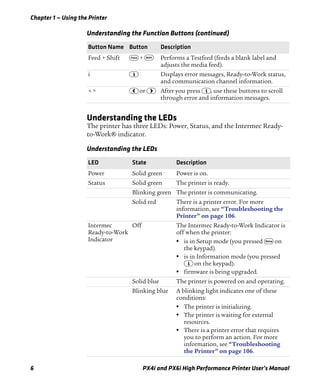
Feed + Shift F + S Performs a Testfeed (feeds a blank label and
adjusts the media feed).
i I Displays error messages, Ready-to-Work status,
and communication channel information.
< > L or R After you press I, use these buttons to scroll
through error and information messages.
Understanding the LEDs
LED State Description
Power Solid green Power is on.
Status Solid green The printer is ready.
Blinking green The printer is communicating.
Solid red There is a printer error. For more
information, see “Troubleshooting the
Printer” on page 106.
Intermec
Ready-to-Work
Indicator
Off The Intermec Ready-to-Work Indicator is
off when the printer:
• is in Setup mode (you pressed T on
the keypad).
• is in Information mode (you pressed
I on the keypad).
• firmware is being upgraded.
Solid blue The printer is powered on and operating.
Blinking blue A blinking light indicates one of these
conditions:
• The printer is initializing.
• The printer is waiting for external
resources.
• There is a printer error that requires
you to perform an action. For more
information, see “Troubleshooting
the Printer” on page 106.
Understanding the Function Buttons (continued)
Button Name Button Description
Chapter 1 — Using the Printer
PX4i and PX6i High Performance Printer User’s Manual 7
Understanding the Screen
The screen provides background illumination and displays two lines
of text, each with 16 characters. The screen displays error messages, as
well as useful information when you start, setup, and upgrade your
printer.
The Intermec Fingerprint programming language and Intermec
Direct Protocol allow custom-made messages to be composed and
displayed according to the requirements of the application.
Understanding the Printer Sounds
The printer plays sounds in response to certain actions. The sounds
that are played depend on which version of firmware you are running:
• If you are running IPL:
• the printer beeps when you press a button.
• the printer beeps continuously if the printer is out of media or
ribbon.
• you can use an IPL command to create an audio alarm. For
help, see the Intermec Printer Language (IPL) Developer’s
Guide.
• If you are running Fingerprint:
• the printer beeps when you press a button. You can also use a
Fingerprint command to turn off this beep.
• the printer beeps when an error occurs.
• you can use Fingerprint commands to specify the frequency
and duration of beeps for different conditions or even make
the printer play simple melodies. For help, see the Intermec
Fingerprint Developer’s Guide.
Loading Media
The PX4i and PX6i can print on labels, tickets, tags, and continuous
stock in various forms. The method you use to load media depends on
how you want the printer to operate. The PX4i and PX6i can print in
these modes:
• Tear-off (straight-through)
Chapter 1 — Using the Printer
8 PX4i and PX6i High Performance Printer User’s Manual
• Peel-off (self-strip)
• Cut-off
• Batch take-up
• External supply
• RFID
If you are using Fingerprint, use the F key to load the same type of
media. If you change the media type, or if the printer does not feed the
media properly, simultaneously press the S and F keys to perform
a “testfeed.”
If you are using IPL, save the label with the sensitivity number
attached to the media roll. You need this number to set the media
sensitivity.
Loading Media for Tear-Off Printing
In tear-off, or straight-through, printing mode, you manually tear off
the media against the printer’s tear bar. In tear-off mode, use these
types of media:
• Non-adhesive continuous stock
• Self-adhesive continuous stock with liner
• Self-adhesive labels with liner
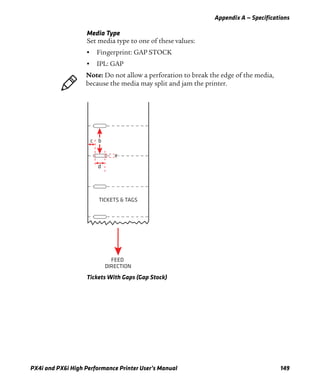
• Tickets with gaps (gap stock), with or without perforations
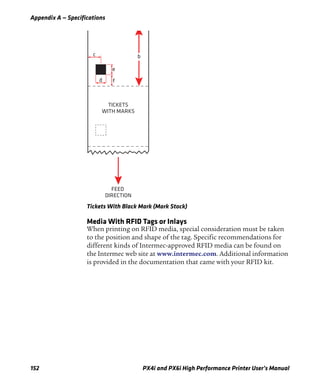
• Tickets with black marks (mark stock), with or without
perforations
You can also install an optional label taken sensor so that the next
copy in the batch is not printed until the current copy is removed. For
more information, see “Accessories for the Printer” on page 153.
If you are running Fingerprint, use the F key to load the same type
of media. If you switch to a new type of media, or if the printer does
not feed out the media properly, simultaneously press the S and F
keys to perform a “testfeed.”
If you are running IPL, save the label indicating the sensitivity number
attached to the media roll. You need this number to set the media
sensitivity.
Chapter 1 — Using the Printer
PX4i and PX6i High Performance Printer User’s Manual 9
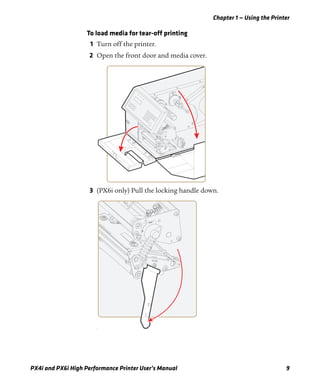
To load media for tear-off printing
1 Turn off the printer.
2 Open the front door and media cover.
3 (PX6i only) Pull the locking handle down.
f
Chapter 1 — Using the Printer
10 PX4i and PX6i High Performance Printer User’s Manual
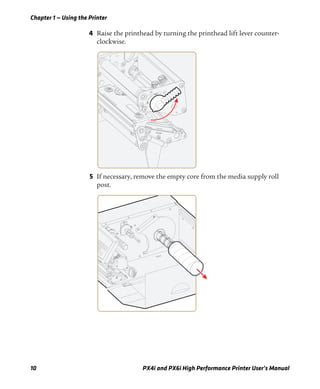
4 Raise the printhead by turning the printhead lift lever counter-
clockwise.
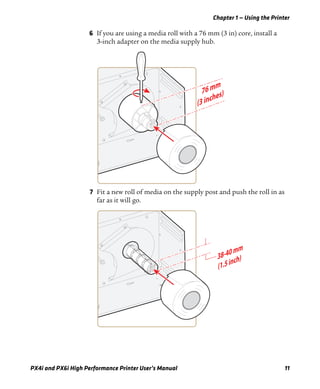
5 If necessary, remove the empty core from the media supply roll
post.
Chapter 1 — Using the Printer
PX4i and PX6i High Performance Printer User’s Manual 11
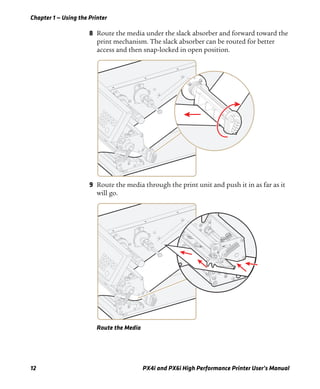
6 If you are using a media roll with a 76 mm (3 in) core, install a
3-inch adapter on the media supply hub.
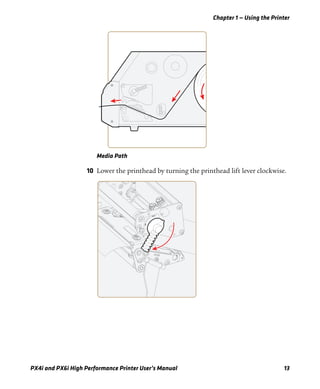
7 Fit a new roll of media on the supply post and push the roll in as
far as it will go.
Chapter 1 — Using the Printer
12 PX4i and PX6i High Performance Printer User’s Manual
8 Route the media under the slack absorber and forward toward the
print mechanism. The slack absorber can be routed for better
access and then snap-locked in open position.
9 Route the media through the print unit and push it in as far as it
will go.
Route the Media
Chapter 1 — Using the Printer
PX4i and PX6i High Performance Printer User’s Manual 13
Media Path
10 Lower the printhead by turning the printhead lift lever clockwise.
Chapter 1 — Using the Printer
14 PX4i and PX6i High Performance Printer User’s Manual
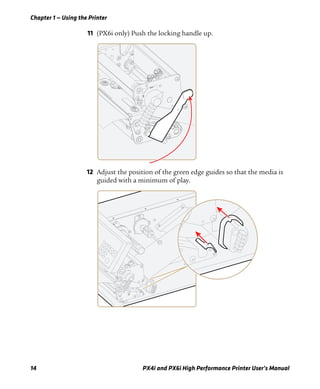
11 (PX6i only) Push the locking handle up.
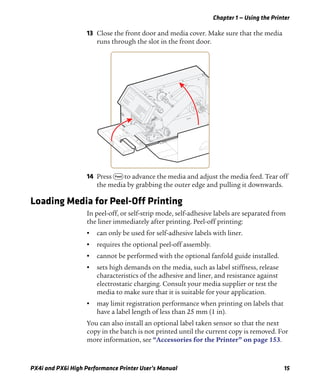
12 Adjust the position of the green edge guides so that the media is
guided with a minimum of play.
Chapter 1 — Using the Printer
PX4i and PX6i High Performance Printer User’s Manual 15
13 Close the front door and media cover. Make sure that the media
runs through the slot in the front door.
14 Press F to advance the media and adjust the media feed. Tear off
the media by grabbing the outer edge and pulling it downwards.
Loading Media for Peel-Off Printing
In peel-off, or self-strip mode, self-adhesive labels are separated from
the liner immediately after printing. Peel-off printing:
• can only be used for self-adhesive labels with liner.
• requires the optional peel-off assembly.
• cannot be performed with the optional fanfold guide installed.
• sets high demands on the media, such as label stiffness, release
characteristics of the adhesive and liner, and resistance against
electrostatic charging. Consult your media supplier or test the
media to make sure that it is suitable for your application.
• may limit registration performance when printing on labels that
have a label length of less than 25 mm (1 in).
You can also install an optional label taken sensor so that the next
copy in the batch is not printed until the current copy is removed. For
more information, see “Accessories for the Printer” on page 153.
Chapter 1 — Using the Printer
16 PX4i and PX6i High Performance Printer User’s Manual
To load media for peel-off printing
1 Turn off the printer.
2 Open the front door and media cover.
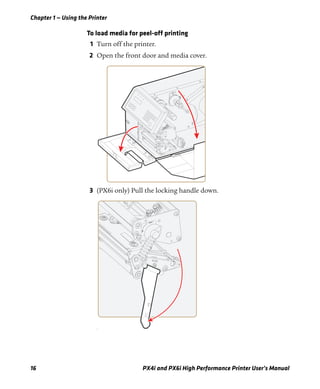
3 (PX6i only) Pull the locking handle down.
f
Chapter 1 — Using the Printer
PX4i and PX6i High Performance Printer User’s Manual 17
4 Raise the printhead by turning the printhead lift lever counter-
clockwise.
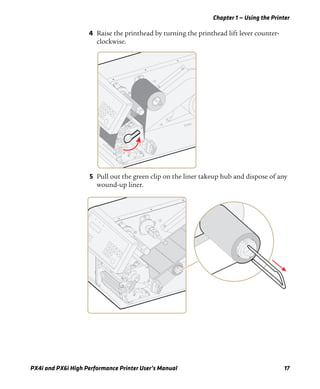
5 Pull out the green clip on the liner takeup hub and dispose of any
wound-up liner.
Chapter 1 — Using the Printer
18 PX4i and PX6i High Performance Printer User’s Manual
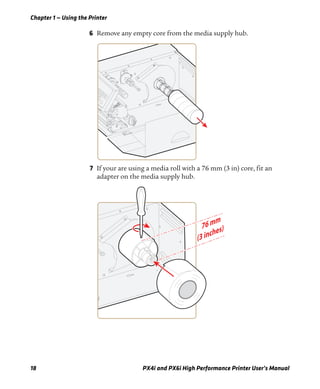
6 Remove any empty core from the media supply hub.
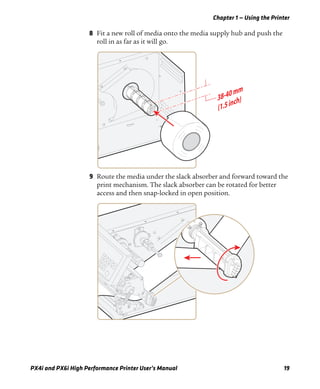
7 If your are using a media roll with a 76 mm (3 in) core, fit an
adapter on the media supply hub.
Chapter 1 — Using the Printer
PX4i and PX6i High Performance Printer User’s Manual 19
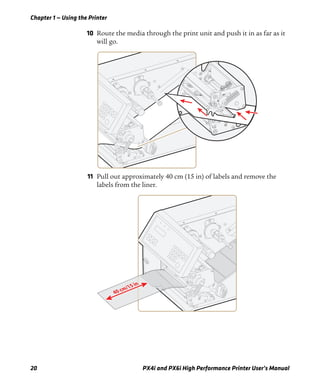
8 Fit a new roll of media onto the media supply hub and push the
roll in as far as it will go.
9 Route the media under the slack absorber and forward toward the
print mechanism. The slack absorber can be rotated for better
access and then snap-locked in open position.
Chapter 1 — Using the Printer
20 PX4i and PX6i High Performance Printer User’s Manual
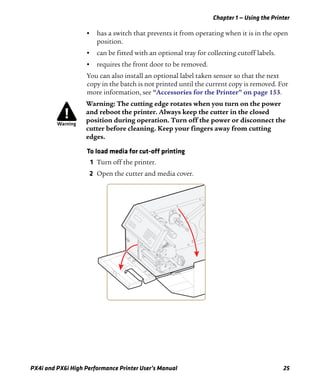
10 Route the media through the print unit and push it in as far as it
will go.
11 Pull out approximately 40 cm (15 in) of labels and remove the
labels from the liner.
40 cm/15 in
Chapter 1 — Using the Printer
PX4i and PX6i High Performance Printer User’s Manual 21
12 Route the liner around the tear bar and back under the print unit.
13 Secure the liner to the takeup hub with the green clip and rotate
the hub until the media is pulled tight.
Secure the Liner
Chapter 1 — Using the Printer
22 PX4i and PX6i High Performance Printer User’s Manual
Media Path
14 Turn the printhead lift lever clockwise to lower the printhead.
Chapter 1 — Using the Printer
PX4i and PX6i High Performance Printer User’s Manual 23
15 (PX6i only) Push the locking handle up.
16 Adjust the position of the green edge guides so that the media is
guided with a minimum of play.
Chapter 1 — Using the Printer
24 PX4i and PX6i High Performance Printer User’s Manual
17 Close the front door and media cover.
18 Press F to advance the media and adjust the media feed.
Loading Media for Cut-Off Printing
You can install the automatic paper cutter option to cut off the
media. Cut-off printing can be used for non-adhesive continuous
stock and self-adhesive labels with liner (cut only liner between
labels). The cutter option:
• is designed for paper-based media with a thickness between
60 and 175 μm, roughly corresponding to a paper weight of
60 to 175 grams/m2 (basis weight 40 to 120 lb).
• cuts through the media approximately 37 mm (1.5 in) in front of
the printer’s dot line. Make sure to properly adjust the media feed.
For help, see “Configuring Your Printer” on page 74.
• should not be used to cut through labels, because the adhesive
sticks to the shears, which can damage the cutter. If you do cut
through adhesive labels, tilt the cutter down and clean it with
isopropyl alcohol.
• must be enabled in Setup mode. For help, see “Configuring Your
Printer From the Screen” on page 74.
• is held by a latch inside the media compartment and can be tilted
forward to facilitate loading media.
Chapter 1 — Using the Printer
PX4i and PX6i High Performance Printer User’s Manual 25
• has a switch that prevents it from operating when it is in the open
position.
• can be fitted with an optional tray for collecting cutoff labels.
• requires the front door to be removed.
You can also install an optional label taken sensor so that the next
copy in the batch is not printed until the current copy is removed. For
more information, see “Accessories for the Printer” on page 153.
To load media for cut-off printing
1 Turn off the printer.
2 Open the cutter and media cover.
Warning: The cutting edge rotates when you turn on the power
and reboot the printer. Always keep the cutter in the closed
position during operation. Turn off the power or disconnect the
cutter before cleaning. Keep your fingers away from cutting
edges.
Chapter 1 — Using the Printer
26 PX4i and PX6i High Performance Printer User’s Manual
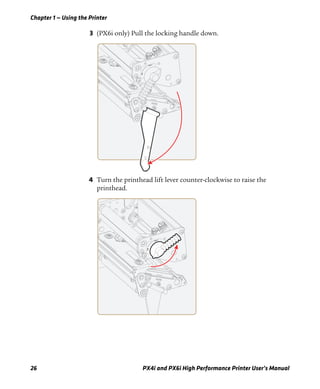
3 (PX6i only) Pull the locking handle down.
4 Turn the printhead lift lever counter-clockwise to raise the
printhead.
Chapter 1 — Using the Printer
PX4i and PX6i High Performance Printer User’s Manual 27
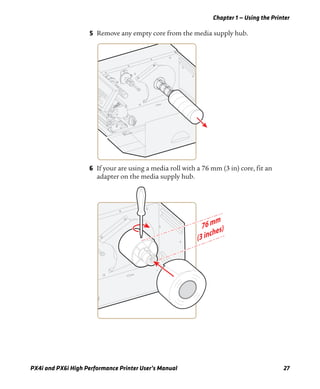
5 Remove any empty core from the media supply hub.
6 If your are using a media roll with a 76 mm (3 in) core, fit an
adapter on the media supply hub.
Chapter 1 — Using the Printer
28 PX4i and PX6i High Performance Printer User’s Manual
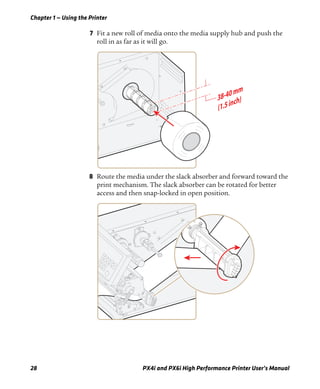
7 Fit a new roll of media onto the media supply hub and push the
roll in as far as it will go.
8 Route the media under the slack absorber and forward toward the
print mechanism. The slack absorber can be rotated for better
access and then snap-locked in open position.
Chapter 1 — Using the Printer
PX4i and PX6i High Performance Printer User’s Manual 29
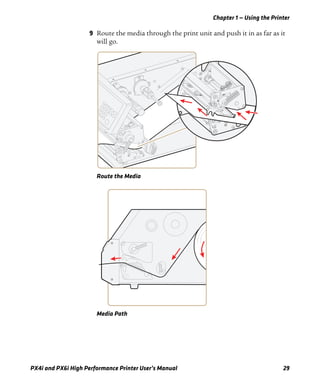
9 Route the media through the print unit and push it in as far as it
will go.
Route the Media
Media Path
Chapter 1 — Using the Printer
30 PX4i and PX6i High Performance Printer User’s Manual
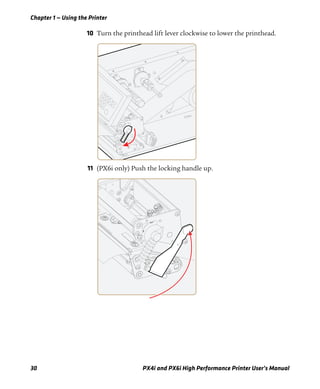
10 Turn the printhead lift lever clockwise to lower the printhead.
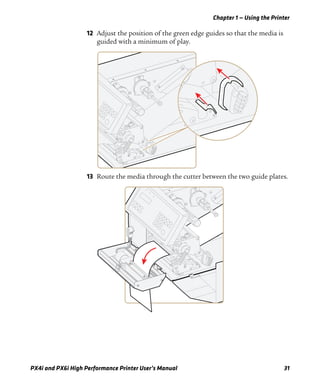
11 (PX6i only) Push the locking handle up.
Chapter 1 — Using the Printer
PX4i and PX6i High Performance Printer User’s Manual 31
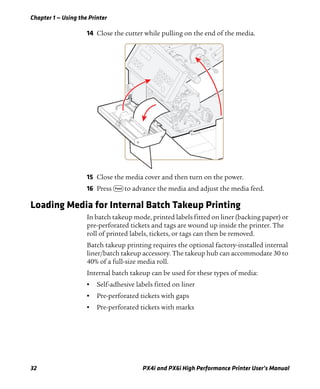
12 Adjust the position of the green edge guides so that the media is
guided with a minimum of play.
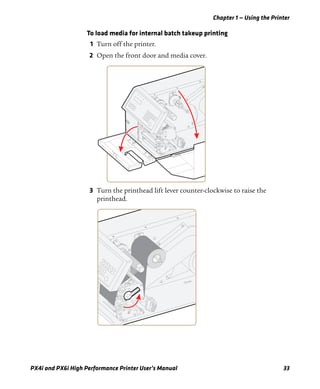
13 Route the media through the cutter between the two guide plates.
Chapter 1 — Using the Printer
32 PX4i and PX6i High Performance Printer User’s Manual
14 Close the cutter while pulling on the end of the media.
15 Close the media cover and then turn on the power.
16 Press F to advance the media and adjust the media feed.
Loading Media for Internal Batch Takeup Printing
In batch takeup mode, printed labels fitted on liner (backing paper) or
pre-perforated tickets and tags are wound up inside the printer. The
roll of printed labels, tickets, or tags can then be removed.
Batch takeup printing requires the optional factory-installed internal
liner/batch takeup accessory. The takeup hub can accommodate 30 to
40% of a full-size media roll.
Internal batch takeup can be used for these types of media:
• Self-adhesive labels fitted on liner
• Pre-perforated tickets with gaps
• Pre-perforated tickets with marks
Chapter 1 — Using the Printer
PX4i and PX6i High Performance Printer User’s Manual 33
To load media for internal batch takeup printing
1 Turn off the printer.
2 Open the front door and media cover.
3 Turn the printhead lift lever counter-clockwise to raise the
printhead.
Chapter 1 — Using the Printer
34 PX4i and PX6i High Performance Printer User’s Manual
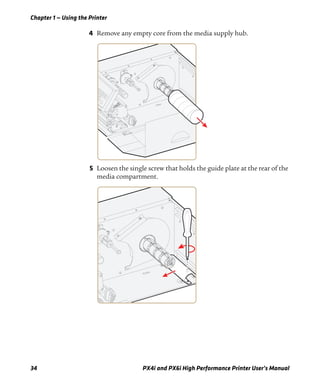
4 Remove any empty core from the media supply hub.
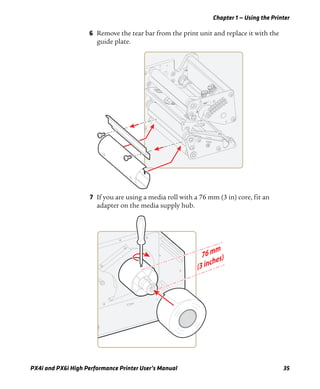
5 Loosen the single screw that holds the guide plate at the rear of the
media compartment.
Chapter 1 — Using the Printer
PX4i and PX6i High Performance Printer User’s Manual 35
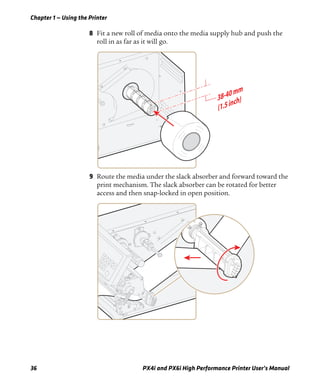
6 Remove the tear bar from the print unit and replace it with the
guide plate.
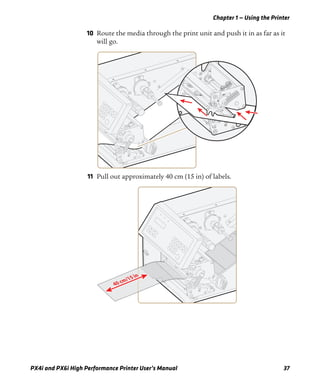
7 If you are using a media roll with a 76 mm (3 in) core, fit an
adapter on the media supply hub.
Chapter 1 — Using the Printer
36 PX4i and PX6i High Performance Printer User’s Manual
8 Fit a new roll of media onto the media supply hub and push the
roll in as far as it will go.
9 Route the media under the slack absorber and forward toward the
print mechanism. The slack absorber can be rotated for better
access and then snap-locked in open position.
Chapter 1 — Using the Printer
PX4i and PX6i High Performance Printer User’s Manual 37
10 Route the media through the print unit and push it in as far as it
will go.
11 Pull out approximately 40 cm (15 in) of labels.
40 cm/15 in
Chapter 1 — Using the Printer
38 PX4i and PX6i High Performance Printer User’s Manual
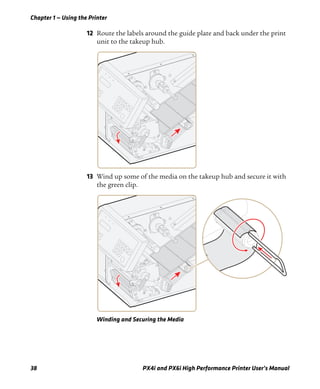
12 Route the labels around the guide plate and back under the print
unit to the takeup hub.
13 Wind up some of the media on the takeup hub and secure it with
the green clip.
Winding and Securing the Media
Chapter 1 — Using the Printer
PX4i and PX6i High Performance Printer User’s Manual 39
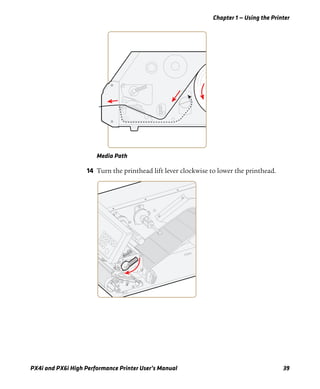
Media Path
14 Turn the printhead lift lever clockwise to lower the printhead.
Chapter 1 — Using the Printer
40 PX4i and PX6i High Performance Printer User’s Manual
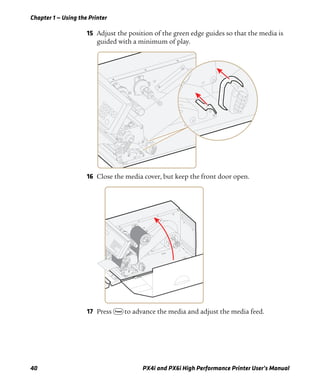
15 Adjust the position of the green edge guides so that the media is
guided with a minimum of play.
16 Close the media cover, but keep the front door open.
17 Press F to advance the media and adjust the media feed.
Chapter 1 — Using the Printer
PX4i and PX6i High Performance Printer User’s Manual 41
Loading Media for Printing From an External Supply
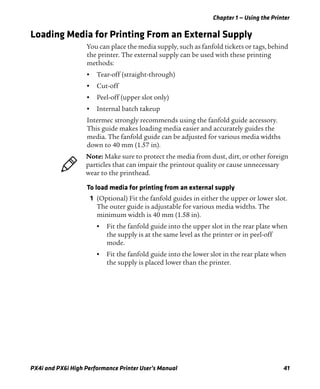
You can place the media supply, such as fanfold tickets or tags, behind
the printer. The external supply can be used with these printing
methods:
• Tear-off (straight-through)
• Cut-off
• Peel-off (upper slot only)
• Internal batch takeup
Intermec strongly recommends using the fanfold guide accessory.
This guide makes loading media easier and accurately guides the
media. The fanfold guide can be adjusted for various media widths
down to 40 mm (1.57 in).
To load media for printing from an external supply
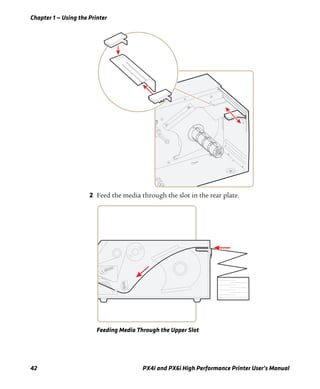
1 (Optional) Fit the fanfold guides in either the upper or lower slot.
The outer guide is adjustable for various media widths. The
minimum width is 40 mm (1.58 in).
• Fit the fanfold guide into the upper slot in the rear plate when
the supply is at the same level as the printer or in peel-off
mode.
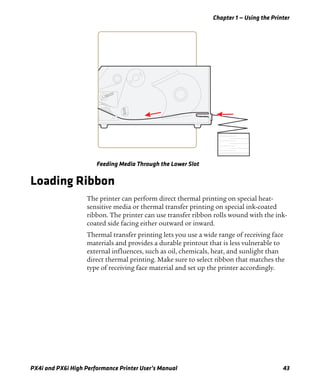
• Fit the fanfold guide into the lower slot in the rear plate when
the supply is placed lower than the printer.
Note: Make sure to protect the media from dust, dirt, or other foreign
particles that can impair the printout quality or cause unnecessary
wear to the printhead.
Chapter 1 — Using the Printer
42 PX4i and PX6i High Performance Printer User’s Manual
2 Feed the media through the slot in the rear plate.
Feeding Media Through the Upper Slot
Chapter 1 — Using the Printer
PX4i and PX6i High Performance Printer User’s Manual 43
Feeding Media Through the Lower Slot
Loading Ribbon
The printer can perform direct thermal printing on special heat-
sensitive media or thermal transfer printing on special ink-coated
ribbon. The printer can use transfer ribbon rolls wound with the ink-
coated side facing either outward or inward.
Thermal transfer printing lets you use a wide range of receiving face
materials and provides a durable printout that is less vulnerable to
external influences, such as oil, chemicals, heat, and sunlight than
direct thermal printing. Make sure to select ribbon that matches the
type of receiving face material and set up the printer accordingly.
Chapter 1 — Using the Printer
44 PX4i and PX6i High Performance Printer User’s Manual
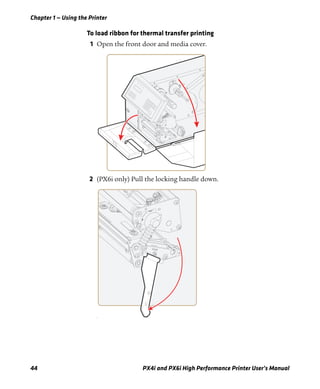
To load ribbon for thermal transfer printing
1 Open the front door and media cover.
2 (PX6i only) Pull the locking handle down.
f
Chapter 1 — Using the Printer
PX4i and PX6i High Performance Printer User’s Manual 45
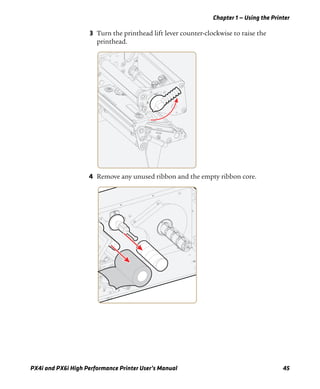
3 Turn the printhead lift lever counter-clockwise to raise the
printhead.
4 Remove any unused ribbon and the empty ribbon core.
EasyCo
der PX4i
Chapter 1 — Using the Printer
46 PX4i and PX6i High Performance Printer User’s Manual
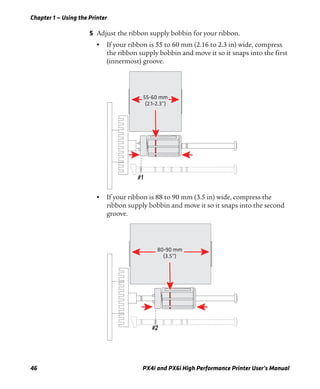
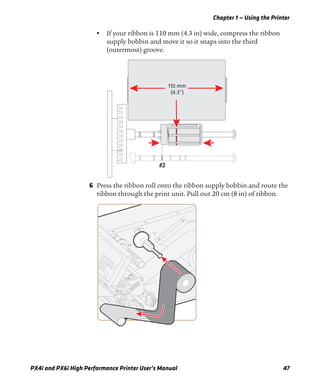
5 Adjust the ribbon supply bobbin for your ribbon.
• If your ribbon is 55 to 60 mm (2.16 to 2.3 in) wide, compress
the ribbon supply bobbin and move it so it snaps into the first
(innermost) groove.
• If your ribbon is 88 to 90 mm (3.5 in) wide, compress the
ribbon supply bobbin and move it so it snaps into the second
groove.
55-60 mm
(2.1-2.3”)
80-90 mm
(3.5”)
Chapter 1 — Using the Printer
PX4i and PX6i High Performance Printer User’s Manual 47
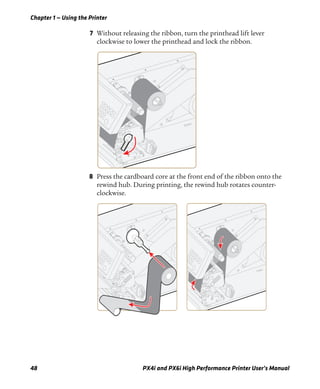
• If your ribbon is 110 mm (4.3 in) wide, compress the ribbon
supply bobbin and move it so it snaps into the third
(outermost) groove.
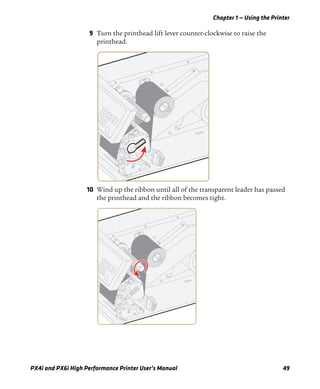
6 Press the ribbon roll onto the ribbon supply bobbin and route the
ribbon through the print unit. Pull out 20 cm (8 in) of ribbon.
110 mm
(4.3”)
Chapter 1 — Using the Printer
48 PX4i and PX6i High Performance Printer User’s Manual
7 Without releasing the ribbon, turn the printhead lift lever
clockwise to lower the printhead and lock the ribbon.
8 Press the cardboard core at the front end of the ribbon onto the
rewind hub. During printing, the rewind hub rotates counter-
clockwise.
Chapter 1 — Using the Printer
PX4i and PX6i High Performance Printer User’s Manual 49
9 Turn the printhead lift lever counter-clockwise to raise the
printhead.
10 Wind up the ribbon until all of the transparent leader has passed
the printhead and the ribbon becomes tight.
Chapter 1 — Using the Printer
50 PX4i and PX6i High Performance Printer User’s Manual
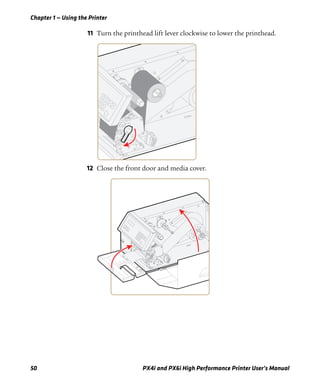
11 Turn the printhead lift lever clockwise to lower the printhead.
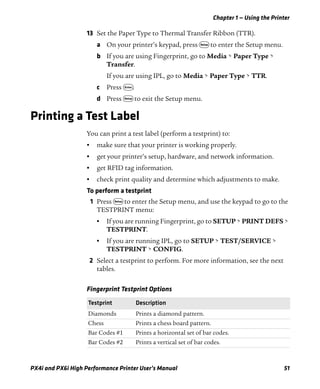
12 Close the front door and media cover.
Chapter 1 — Using the Printer
PX4i and PX6i High Performance Printer User’s Manual 51
13 Set the Paper Type to Thermal Transfer Ribbon (TTR).
a On your printer’s keypad, press T to enter the Setup menu.
b If you are using Fingerprint, go to Media > Paper Type >
Transfer.
If you are using IPL, go to Media > Paper Type > TTR.
c Press E.
d Press T to exit the Setup menu.
Printing a Test Label
You can print a test label (perform a testprint) to:
• make sure that your printer is working properly.
• get your printer’s setup, hardware, and network information.
• get RFID tag information.
• check print quality and determine which adjustments to make.
To perform a testprint
1 Press T to enter the Setup menu, and use the keypad to go to the
TESTPRINT menu:
• If you are running Fingerprint, go to SETUP > PRINT DEFS >
TESTPRINT.
• If you are running IPL, go to SETUP > TEST/SERVICE >
TESTPRINT > CONFIG.
2 Select a testprint to perform. For more information, see the next
tables.
Fingerprint Testprint Options
Testprint Description
Diamonds Prints a diamond pattern.
Chess Prints a chess board pattern.
Bar Codes #1 Prints a horizontal set of bar codes.
Bar Codes #2 Prints a vertical set of bar codes.
Chapter 1 — Using the Printer
52 PX4i and PX6i High Performance Printer User’s Manual
Setup Info Contains current configuration parameters stored in the
printer’s memory, defined pages, defined formats, defined
graphics, defined fonts, and any installed printer options.
Hardware Info Contains printer memory information; printer mileage;
printhead settings; firmware checksum, program, and
version number.
RFID Test Label Prints an RFID test label that includes the tag type name.
Network Info Contains WINS name, MAC address, IP selection, IP
address, netmask, default router, name server, mail server,
primary WINS server, secondary WINS server, and
network statistics.
IPL Testprint Options
Testprint Description
Config
SW Contains current configuration parameters stored
in the printer’s memory, defined pages, defined
formats, defined graphics, defined fonts, and any
installed printer options.
HW Contains printer memory information; printer
mileage; printhead settings; firmware checksum,
program, and version number.
Network Contains WINS name, MAC address, IP selection, IP
address, netmask, default router, name server, mail
server, primary WINS server, secondary WINS
server, and network statistics.
RFID Test Label Prints an RFID test label that includes the tag type
name.
Test Labels
Pitch Contains an even pattern of small dots that reveals
failing printhead dots and variations of printout
darkness due to uneven printhead pressure or bad
energy regulation to the printhead.
Print Quality Contains bar codes with different characteristics
and useful information about the printer model,
program version, print speed, and media sensitivity
setup.
Fingerprint Testprint Options (continued)
Testprint Description
Chapter 1 — Using the Printer
PX4i and PX6i High Performance Printer User’s Manual 53
Creating and Printing Labels
The easiest way to create and print labels is to use the label design
software LabelShop®. You can download LabelShop from the
PrinterCompanion CD that shipped with your printer, or you can
download it from the Downloads page for your printer on the
Intermec web site at www.intermec.com.
You can also use Fingerprint and IPL to create and print labels. For
more information, see the Intermec Fingerprint Command Reference
Manual or the IPL Command Reference Manual.
Format
All > Print Formats Contains a single format that you can use to
evaluate the print quality of a particular format.
This option prints labels for all the formats stored
in the printer’s memory.
Page
All > Print Pages Tests the ability of the printer to receive and print
single or multiple pages of label data that is sent
from the host. This option prints labels for all the
pages stored in the printer’s memory.
UDC
All > Print UDC Tests the ability of the printer to receive and print
single or multiple user-defined characters (bitmap
graphics) that are sent from the host. This option
prints labels for all the UDCs stored in the printer’s
memory.
Font Contains all the characters in a single font. This
option prints labels for all the user-defined fonts
(UDF) stored in the printer’s memory.
IPL Testprint Options (continued)
Testprint Description
Chapter 1 — Using the Printer
54 PX4i and PX6i High Performance Printer User’s Manual
Printing on RFID Media
Media containing RFID tags is slightly thicker where the RFID tag is
located. The slight thickness of this part of the label may affect print
quality. For thermal transfer labels, Intermec recommends using a
high-quality ink ribbon, such as TMX 2304 or TMX 1500.
To achieve the best possible print quality, follow these guidelines:
• After you load RFID media, restart the printer or run a
TESTFEED to let the printer identify the RFID media type.
• If necessary, modify the TAGADJUST variable to make sure that
the RFID labels are properly aligned with the antenna.
• If necessary, avoid printing on the thickest part of the label.
• For printers running Fingerprint:
• If you are using thermal transfer labels, start with the ribbon
constant set to 80 and the ribbon factor set to 25. You may
need to adjust these values depending on the type of media you
choose.
• To write to Gen 2 RFID tags using the TAGFIELD command,
set the start and length parameters to even numbers.
• For printers running IPL:
• Start with the sensitivity set to 565. You may need to adjust
this value depending on the type of media you choose.
• To write to Gen 2 RFID tags, set the start and length
parameters of the RFID tag field setup command (a) to even
numbers.
For help configuring RFID parameters, see the Intermec Fingerprint
Command Reference Manual or the IPL Command Reference Manual.
55
2
Connecting the Printer
This chapter contains these sections:
• Connecting the Printer to Your PC
• Connecting the Printer to Your Network
• Connecting Peripherals to the USB Host Port
Chapter 2 — Connecting the Printer
56 PX4i and PX6i High Performance Printer User’s Manual
Connecting the Printer to Your PC
You can easily connect the printer to your PC using one of these ports:
• RS-232 serial port
• USB device port
• IEEE 1284 communications port (optional)
Connecting the Printer to a PC Through the Serial Port
You can use a serial connection to communicate with your PC and
run PrintSet, LabelShop, or InterDriver. You can also use the serial
port to send commands directly to the printer through a terminal
connection, for instance with Telnet.
Before you can establish a serial connection, make sure that the
settings on the PC match those of your printer.
Serial Port Settings on the Printer
Parameter Default Setting
Baud rate 9600
Data bits (IPL) or Character length (Fingerprint) 8
Parity None
Stop bits 1
RTS/CTS (Fingerprint only) Disable
ENQ/ACK (Fingerprint only) Disable
XON/XOFF, data to host (Fingerprint only) Disable
XON/XOFF, data from host (Fingerprint only) Disable
New line (Fingerprint only) CR/LF
Receive buffer (Fingerprint only) 1024 bytes
Transmit buffer (Fingerprint only) 1024 bytes
Chapter 2 — Connecting the Printer
PX4i and PX6i High Performance Printer User’s Manual 57
To connect the printer to a PC through the serial port
1 Connect one end of the RS-232 cable that ships with your printer
to the back of the printer and connect the other end of the cable to
a serial COM port on the PC.
2 If necessary, change the PC serial port configuration to match
your printer.
Connecting the Printer to a PC Through the USB Device Port
Intermec recommends that you only connect one printer to each PC,
either directly, or through a hub. To connect the printer to a PC
through the USB device port, you need:
• a USB Type B to USB Type A cable.
• Intermec InterDriver® software, which is available on the
PrinterCompanion CD that ships with the printer. To make sure
you have the latest version of InterDriver, you may want to go to
the downloads page for the printer on the Intermec web site at
www.intermec.com.
To connect the printer to a PC through the USB port
1 Download and install the InterDriver software on your PC.
2 Connect the USB cable to the Type B connector on the back of the
printer and connect the other end to your PC.
You do not need to set up any parameters for USB communications.
Connecting the Printer to a PC Through the IEEE 1284 Port
You can use the parallel connection with LabelShop or Intermec
InterDriver. The parallel port supports Universal Plug and Play
(UPnP) and additional status reporting through IEEE 1284 nibble ID
mode.
Note: You cannot communicate with the printer using PrintSet
through a USB connection. To use PrintSet, you must be connected
serially or through the Ethernet or 802.11 network.
Chapter 2 — Connecting the Printer
58 PX4i and PX6i High Performance Printer User’s Manual
If you are using a parallel port to communicate with the printer, you
need:
• an IEEE 1284 interface adapter installed in the printer. If you do
not have the parallel interface installed in your printer, you can
purchase the field installable option and have it installed by an
authorized Intermec service technician. For help, contact your
Intermec representative.
• a parallel cable to run between the printer and the PC.
To connect your printer to a PC parallel port
• Connect the IEEE 1284 cable connector to the interface adapter
port on the back of the printer and connect the other end of the
cable into a parallel port on the PC.
Connecting the Printer to Your Network
You can connect your printer to your network using the:
• integrated Ethernet interface.
• optional 802.11 wireless interface.
These network interfaces provide features such as security, FTP server,
web server, and Alert handling.
Setting Up Ethernet Communications
Use the Ethernet port to set up the PX4i or PX6i as a network printer.
If Ethernet is selected as your Network Type, when you turn on your
printer, it automatically retrieves an IP address from the network
(DHCP+BOOTP). You can use the network connection with
LabelShop or the Intermec InterDriver. You can also use this
connection to send commands directly to the printer through a
terminal connection (Telnet) or FTP.
Chapter 2 — Connecting the Printer
PX4i and PX6i High Performance Printer User’s Manual 59
To connect your printer to your Ethernet network
1 Make sure that Ethernet is selected as your Network Type.
a On the keypad, press T to enter the Setup menu.
b Go to SETUP > NETWORK > NETWORK TYPE >
ETHERNET.
c Press T again to exit the Setup menu.
2 Connect the cable from your Ethernet network to the Ethernet
port on your printer’s back plate.
3 Turn your printer off and then on.
4 Enter Information mode by pressing the I button. The printer
displays interface information in five-second intervals. Note the IP
address displayed under I/O net1.
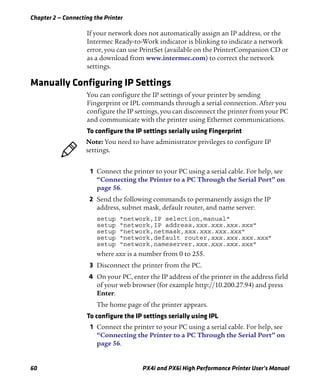
5 On your PC, start your web browser.
6 Enter the IP address of your printer in the address field and press
Enter. Your printer home page appears.
7 When you are prompted, enter your login and password. The
default values are: login = admin, password = pass.
For help using the printer web page to configure your printer, see
“Configuring Your Printer From the Printer Home Page” on
page 76.
Chapter 2 — Connecting the Printer
60 PX4i and PX6i High Performance Printer User’s Manual
If your network does not automatically assign an IP address, or the
Intermec Ready-to-Work indicator is blinking to indicate a network
error, you can use PrintSet (available on the PrinterCompanion CD or
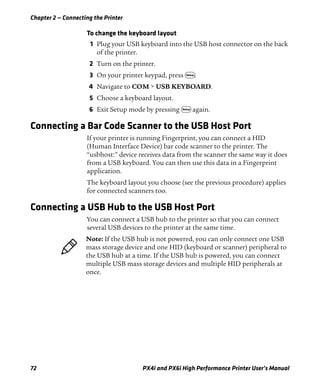
as a download from www.intermec.com) to correct the network
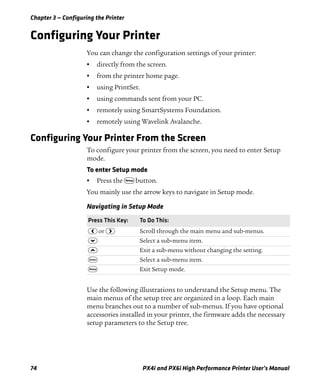
settings.
Manually Configuring IP Settings
You can configure the IP settings of your printer by sending
Fingerprint or IPL commands through a serial connection. After you
configure the IP settings, you can disconnect the printer from your PC
and communicate with the printer using Ethernet communications.
To configure the IP settings serially using Fingerprint
1 Connect the printer to your PC using a serial cable. For help, see
“Connecting the Printer to a PC Through the Serial Port” on
page 56.
2 Send the following commands to permanently assign the IP
address, subnet mask, default router, and name server:
setup "network,IP selection,manual"
setup "network,IP address,xxx.xxx.xxx.xxx"
setup "network,netmask,xxx.xxx.xxx.xxx"
setup "network,default router,xxx.xxx.xxx.xxx"
setup "network,nameserver,xxx.xxx.xxx.xxx"
where xxx is a number from 0 to 255.
3 Disconnect the printer from the PC.
4 On your PC, enter the IP address of the printer in the address field
of your web browser (for example http://10.200.27.94) and press
Enter.
The home page of the printer appears.
To configure the IP settings serially using IPL
1 Connect the printer to your PC using a serial cable. For help, see
“Connecting the Printer to a PC Through the Serial Port” on
page 56.
Note: You need to have administrator privileges to configure IP
settings.
Chapter 2 — Connecting the Printer
PX4i and PX6i High Performance Printer User’s Manual 61
2 Send the following commands to permanently assign the IP
address, subnet mask, default router, and name server:
<SI>nn[,m1[,m2]]
where:
n is the IP address of the printer in the format n.n.n.n, where n is a
number from 0 to 255.
,m1 is the subnet mask address in the format n.n.n.n, where n is a
number from 0 to 255.
,m2 is the router address in the format n.n.n.n, where n is a
number from 0 to 255.
3 Disconnect the printer from the PC.
4 On your PC, enter the IP address of the printer in the address field
of your web browser (for example http://10.200.27.94) and press
Enter.
The home page of the printer appears.
Setting Up 802.11 Radio Communications
If your printer has an optional 802.11 b/g radio, you can transfer and
receive data using wireless communications. This manual assumes
that you have already set up your wireless communications network
including your access points. This section describes how to set up
wireless security on your printer.
The printer supports these authentication modes:
• none
• WEP (64 bit and 128 bit)
• WPA Personal and Enterprise mode (802.1x authentication)
• WPA2 Personal and Enterprise mode (802.1x authentication)
Note: You must specify at least two of the three parameters for the
command to take effect.
Note: WPA and WPA2 Enterprise mode currently support PEAP,
TTLS, LEAP, and EAP-FAST. For LEAP authentication, the printer
supports Open EAP, but does not support Network EAP.
Chapter 2 — Connecting the Printer
62 PX4i and PX6i High Performance Printer User’s Manual
To set up the printer to work in your wireless network, you need:
• a serial cable.
• a PC running Windows or Linux.
• PrintSet. PrintSet is available on the CD that ships with your
Printer. For the latest version of PrintSet, go to the Downloads
page of the Intermec web site at www.intermec.com.
• (optional) Serial port software such as HyperTerminal. If you are
using IPL commands with HyperTerminal, you may want to be
able to see the commands as you type them on your screen. For
help, see “Configuring Your Printer With Commands Sent
From Your PC” on page 98.
To set up the printer for 802.11 communications using PrintSet
1 Download and install PrintSet on your PC.
2 Connect one end of the serial cable to your printer, and connect
the other end to your PC.
3 If necessary, change the serial port settings on your PC to match
your printer:
4 On your PC, start PrintSet.
5 In the General Tasks box, click Add Printer.
6 Step through the Add Printer Wizard until you have successfully
added your printer.
7 In the Printer Tasks box, click Wireless Setup Wizard.
8 Step through the Wireless Setup Wizard to set up wireless network
and security parameters.
Parameter Default Setting
Baud rate 9600
Data bits 8
Parity None
Stop bits 1
Chapter 2 — Connecting the Printer
PX4i and PX6i High Performance Printer User’s Manual 63
To set up the printer for 802.11 communications using HyperTerminal
1 Connect one end of the serial cable to your printer, and connect
the other end to your PC.
2 On your PC, open HyperTerminal and set these serial port
parameters:
3 From the host PC, check the wireless settings. For help, see
“Manually Configuring IP Settings” on page 60.
If you are running IPL, send this command to the printer:
<STX><SI>wt<ETX>
If you are running Fingerprint, send these commands to the
printer:
setup write "wlan","uart1:"
setup write "8021x","uart1:"
4 Configure your printer to use the correct SSID and authentication
modes. For help, see the next section, “Configuring 802.11
Wireless Security Using IPL” or “Configuring 802.11 Wireless
Security Using Fingerprint” on page 64.
5 If you are using certificates for validation, Intermec recommends
testing first without the certificate. Only after performing this test
should you transfer the certificate to the printer. The printer can
accept PEM (.pem), DER (.der), and PKCS #12 (.p12 or .pfx)
certificates.
6 Verify that the printer is connected to the access point and make
sure it has an IP address allocated to it.
Use the following sections to set most of your wireless
communication settings. For more information, see the Intermec
Fingerprint Command Reference Manual or the IPL Command
Reference Manual.
Parameter Default Setting
Baud rate 9600
Data bits 8
Parity None
Stop bits 1
Chapter 2 — Connecting the Printer
64 PX4i and PX6i High Performance Printer User’s Manual
Configuring 802.11 Wireless Security Using Fingerprint
Use the following procedures to configure 802.11 wireless security
parameters on your printer using Fingerprint.
To configure the printer to use WEP authentication
1 Send the following commands to login as an admin and set the
SSID:
run"su -p pass admin"
setup write "wlan","uart1:"
setup "wlan","SSID","xxxxx"
where xxxxx can be from 0 to 32 ASCII characters, not including
the double quote.
To enter non-alphanumeric octets, use “%nn,” where nn is two
hexadecimal digits representing the value of the character
2 Send the following commands to configure the WEP keys.
The following example sets WEP key 1 to 01234 and enables
WEP key 1.
setup "wlan","WEP1","0x3031323334"
setup "wlan",".WEP_KEY","1"
setup "wlan","ACTIVE","1"
setup write "wlan","uart1:"
To configure the printer to use WPA-PSK or WPA2-PSK mode
1 Send the following commands to login as an admin and set the
SSID:
run"su-p pass admin"
setup write "wlan","uart1:"
setup "wlan","SSID","xxxxx"
where xxxxx can be from 0 to 32 alphanumeric characters.
To enter non-alphanumeric octets, use “%nn,” where nn is two
hexadecimal digits representing the value of the character
Note: The default password for logging in as an admin is “pass.”
If you have changed the password, you will need to use your
password instead of “pass.”
Note: The default password for logging in as an admin is “pass.”
If you have changed the password, you will need to use your
password instead of “pass.”
Chapter 2 — Connecting the Printer
PX4i and PX6i High Performance Printer User’s Manual 65
2 Send one of the following WPA/WPA2 ON commands to turn on
WPA or WPA2 authentication. Send the WPA-PSK or WPA2-PSK
command to set a pre-shared key:
setup "wlan","WPA","OFF"
setup "wlan","WPA2","ON"
setup "wlan","WPA_PSK","xxxxxxxxxx"
setup "wlan","ACTIVE","1"
setup write "wlan","uart1:"
where xxxxxxxxxx is a value between 8 and 64 characters.
To configure the printer to use WPA or WPA2 Enterprise mode
1 Send the following commands to login as an admin and set the
SSID:
run"su-p pass admin"
setup write "wlan","uart1:"
setup "wlan","SSID","xxxxx"
where xxxxx can be from 0 to 32 alphanumeric characters.
To enter non-alphanumeric octets, use “%nn,” where nn is two
hexadecimal digits representing the value of the character
2 Send one of the following WPA/WPA2 ON commands to set up
WPA-802.1x or WPA2-802.1x authentication. You should also
send the WPA_PSK command that does not contain a value:
setup "wlan","WPA","OFF"
setup "wlan","WPA2","ON"
setup "wlan","WPA_PSK",""
setup write "wlan","uart1:"
To view the 802.1x values, send this command:
setup write "8021x","uart1:"
Note: The default password for logging in as an admin is “pass.”
If you have changed the password, you will need to use your
password instead of “pass.”
Chapter 2 — Connecting the Printer
66 PX4i and PX6i High Performance Printer User’s Manual
3 Send these commands to configure the EAP_TYPE:
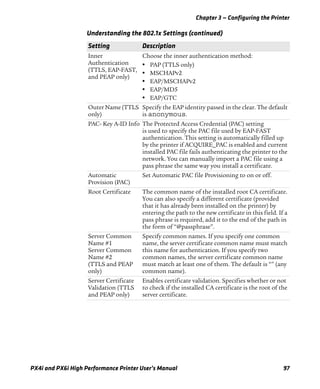
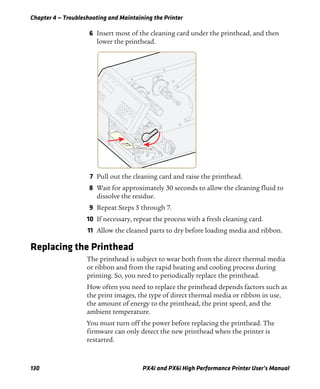
setup "8021x","EAP_TYPE","xxxx"
where xxxx can be OFF, LEAP, PEAP, TTLS, or EAP-FAST.
setup "8021x",".EAP_USER","xxxx"
setup "8021x","EAP_PASS","xxxx"
where xxxx is the unique username and the unique password for
this protocol.
4 If you are using TTLS, you may need to send this command to set
the TTLS outer name:
setup "8021x","TTLS_USER","xxxx"
where xxxx is the outer name.
5 If you are using EAP-FAST, you can use PAC and ACQUIRE_PAC
commands. The PAC setting specifies the PAC file to use for EAP-
FAST authentication. The ACQUIRE_PAC setting checks to see if
automatic PAC file provisioning is enabled. You can set
ACQUIRE_PAC to on or off.
• Send the following command to set PAC to use /tmp/my.pac
with a pass phrase of “verysecret”:
setup "8021x","PAC","/tmp/my.pac@verysecret"
• Send the following command to set ACQUIRE_PAC to on:
setup "8021x","ACQUIRE_PAC","ON"
6 If you are using certificates for validation, here are some
commands you may need to use.
• Send the following commands to set a certificate and enable
validation:
setup "8021x","CA_CERT","c:/test.pfx@export"
setup "8021x","VALIDATE","ON"
where c:/test.pfx is the location and name of the certificate on
the printer and export is the passphrase.
Chapter 2 — Connecting the Printer
PX4i and PX6i High Performance Printer User’s Manual 67
• Send the following commands to set a common name for
server 1 and server 2:
setup "8021x",".SERVER_CN1","xxxxxxxxxx"
setup "8021x",".SERVER_CN2","xxxxxxxxxx"
where xxxxxxxxxx is at least 8 characters but less than 96
characters.
• Send the following commands to make sure your values match
those used by the access point:
setup write "8021x","uart1:"
setup write "wlan","uart1:"
• You may need to send the following command several times for
the wireless station to connect:
setup "wlan","ACTIVE","1"<ETX>
Configuring 802.11 Wireless Security Using IPL
Use the following procedures to configure 802.11 wireless security
parameters on your printer using IPL.
To configure the printer to use WEP authentication
1 Send the following commands to login as an admin and set the
SSID:
<STX><ESC>.x,su -p pass admin<ETX>
<STX><SI>ws,SSID,xxxxx<ETX>
where xxxxx can be from 0 to 32 ASCII characters.
To enter non-alphanumeric octets, use “%nn,” where nn is two
hexadecimal digits representing the value of the character
2 Send the following commands to configure the WEP keys.
The following example sets WEP key 1 to 01234 and enables
WEP key 1.
<STX><SI>ws,WEP1,0x3031323334<ETX>
<STX><SI>ws,.WEP_KEY,1<ETX>
Note: The default password for logging in as an admin is “pass.”
If you have changed the password, you will need to use your
password instead of “pass.”
Chapter 2 — Connecting the Printer
68 PX4i and PX6i High Performance Printer User’s Manual
3 Send the following command to activate the settings.
<STX><SI>ws,ACTIVE,1<ETX>
To configure the printer to use WPA-PSK or WPA2-PSK mode
1 Send the following commands to login as an admin and set the
SSID:
<STX><ESC>.x,su -p pass admin<ETX>
<STX><SI>ws,SSID,xxxxx<ETX>
where xxxxx can be from 0 to 32 alphanumeric characters.
To enter non-alphanumeric octets, use “%nn,” where nn is two
hexadecimal digits representing the value of the character
2 Send one of the following commands to turn on WPA or WPA2
authentication. Send the WPA-PSK or WPA2-PSK command to set
a pre-shared key:
<STX><SI>ws,WPA,OFF<ETX>
<STX><SI>ws,WPA2,ON<ETX>
<STX><SI>ws,WPA_PSK,xxxxxxxxxx<ETX>
where xxxxxxxxxx is a value between 8 and 64 characters.
3 Send the following command to activate the settings:
<STX><SI>ws,ACTIVE,1<ETX>
To configure the printer to use WPA or WPA2 Enterprise mode
1 Send the following commands to login as an admin and set the
SSID:
<STX><ESC>.x,su -p pass admin<ETX>
<STX><SI>ws,SSID,xxxxx<ETX>
where xxxxx can be from 0 to 32 alphanumeric characters.
To enter non-alphanumeric octets, use “%nn,” where nn is two
hexadecimal digits representing the value of the character
Note: The default password for logging in as an admin is “pass.”
If you have changed the password, you will need to use your
password instead of “pass.”
Note: The default password for logging in as an admin is “pass.”
If you have changed the password, you will need to use your
password instead of “pass.”
Chapter 2 — Connecting the Printer
PX4i and PX6i High Performance Printer User’s Manual 69
2 Send one of the following commands to enable WPA-802.1x or
WPA2-802.1x authentication. You should also send the WPA_PSK
command that does not contain a value:
<STX><SI>ws,WPA,OFF<ETX>
<STX><SI>ws,WPA2,ON<ETX>
<STX><SI>ws,WPA_PSK, <ETX>
3 Send these commands to configure the EAP_TYPE:
<STX><SI>ws,EAP_TYPE,xxxx<ETX>
where xxxx can be OFF, LEAP, PEAP, TTLS, or EAP-FAST.
<STX><SI>ws,.EAP_USER,xxxx<ETX>
<STX><SI>ws,EAP_PASS,xxxx<ETX>
where xxxx is the unique username and the unique password for
this protocol.
4 If you are using TTLS, you may need to send this command to set
the TTLS outer name:
<STX><SI>ws,TTLS_USER,xxxx<ETX>
where xxxx is the outer name.
5 If you are using EAP-FAST, you can use PAC and ACQUIRE_PAC
commands. The PAC setting specifies the PAC file to use for EAP-
FAST authentication. The ACQUIRE_PAC setting checks to see if
automatic PAC file provisioning is enabled. You can set
ACQUIRE_PAC to on or off.
• Send the following command to set PAC to use /tmp/my.pac
with a pass phrase of “verysecret”:
<STX><SI>ws,PAC,/tmp/my.pac@verysecret<ETX>
• Send the following command to set ACQUIRE_PAC to on:
<STX><SI>ws,ACQUIRE_PAC,ON<ETX>
Chapter 2 — Connecting the Printer
70 PX4i and PX6i High Performance Printer User’s Manual
6 If you are using certificates for validation, here are some
commands you may need to use.
• Send the following commands to set a certificate and enable
validation:
<STX><SI>ws,CA_CERT,c:/testCA.pfx@export<ETX>
<STX><SI>ws,VALIDATE,ON<ETX>
where c:/testCA.pfx is the location and name of the certificate
on the printer and export is the passphrase.
• Send the following commands to set a common name for
server 1 and server 2:
<STX><SI>ws,.SERVER_CN1,xxxxxxxxxx<ETX>
<STX><SI>ws,.SERVER_CN2,xxxxxxxxxx<ETX>
where xxxxxxxxxx is at least 8 characters but less than 96
characters.
• Send the following command to make sure your values match
those used by the access point:
<STX><SI>wt<ETX>
All variables are returned with the exception of EAP_PASS
which always returns “****” if configured and CA_CERT
which transmits the name of the last certificate authority
successfully installed. An additional read-only variable for the
supplicant state, called STATE, is also returned.
• You may need to send the following command several times for
the wireless station to connect:
<STX><SI>ws,ACTIVE,1<ETX>
Connecting Peripherals to the USB Host Port
You can connect these peripheral devices to the USB host interface
port on the printer:
• USB mass storage device
• Keyboard
• Bar code scanner
• USB hub
Chapter 2 — Connecting the Printer
PX4i and PX6i High Performance Printer User’s Manual 71
Using a USB Mass Storage Device
You can use a USB mass storage device (thumb drive) to store
additional fonts and images for the printer. You can also use the
device to upgrade your firmware. For more information on using the
USB mass storage device to upgrade the printer, see “Upgrading
Firmware” on page 102.
To verify the USB storage device is supported by your printer, insert
the USB storage device in the appropriate slot on the back of your
printer. On the display screen, one of the following status messages
briefly appears:
• USB memory stick connected
• USB memory stick not supported
If no status message appears when you insert the USB storage device,
you can manually verify the USB storage device is supported using
HyperTerminal.
To verify the USB storage device is supported by your printer
1 Connect one end of your serial cable to your printer, and connect
the other end to your PC.
2 On your PC, open HyperTerminal.
3 In HyperTerminal, use one of the following Fingerprint
commands:
• Type DEVICES. The list of devices your printer supports
appears. If the USB storage device is supported, it appears as
drive d: in this list.
• Type Run “cd d:” and press Enter.
Type Run “ls” and press Enter. If the USB storage device is
supported, the contents of the USB storage device appears.
Connecting a Keyboard to the USB Host Port
You can use an external USB keyboard to input data in Fingerprint
applications. Some applications may require more complex input
from users than the simple push of a button.
The printer comes with five keyboard layouts: US, Swedish, French,
German, and User Defined.
Chapter 2 — Connecting the Printer
72 PX4i and PX6i High Performance Printer User’s Manual
To change the keyboard layout
1 Plug your USB keyboard into the USB host connector on the back
of the printer.
2 Turn on the printer.
3 On your printer keypad, press T.
4 Navigate to COM > USB KEYBOARD.
5 Choose a keyboard layout.
6 Exit Setup mode by pressing T again.
Connecting a Bar Code Scanner to the USB Host Port
If your printer is running Fingerprint, you can connect a HID
(Human Interface Device) bar code scanner to the printer. The
“usbhost:” device receives data from the scanner the same way it does
from a USB keyboard. You can then use this data in a Fingerprint
application.
The keyboard layout you choose (see the previous procedure) applies
for connected scanners too.
Connecting a USB Hub to the USB Host Port
You can connect a USB hub to the printer so that you can connect
several USB devices to the printer at the same time.
Note: If the USB hub is not powered, you can only connect one USB
mass storage device and one HID (keyboard or scanner) peripheral to
the USB hub at a time. If the USB hub is powered, you can connect
multiple USB mass storage devices and multiple HID peripherals at
once.
73
3
Configuring the Printer
Use this chapter to understand how to configure the printer,
upgrade firmware, and download fonts and graphics. This
chapter contains these sections:
• Configuring Your Printer
• Choosing an Ethernet or Wireless Network
• Upgrading Firmware
• Downloading Fonts and Graphics
Chapter 3 — Configuring the Printer
74 PX4i and PX6i High Performance Printer User’s Manual
Configuring Your Printer
You can change the configuration settings of your printer:
• directly from the screen.
• from the printer home page.
• using PrintSet.
• using commands sent from your PC.
• remotely using SmartSystems Foundation.
• remotely using Wavelink Avalanche.
Configuring Your Printer From the Screen
To configure your printer from the screen, you need to enter Setup
mode.
To enter Setup mode
• Press the T button.
You mainly use the arrow keys to navigate in Setup mode.
Use the following illustrations to understand the Setup menu. The
main menus of the setup tree are organized in a loop. Each main
menu branches out to a number of sub-menus. If you have optional
accessories installed in your printer, the firmware adds the necessary
setup parameters to the Setup tree.
Navigating in Setup Mode
Press This Key: To Do This:
L or R Scroll through the main menu and sub-menus.
D Select a sub-menu item.
U Exit a sub-menu without changing the setting.
E Select a sub-menu item.
T Exit Setup mode.
Chapter 3 — Configuring the Printer
PX4i and PX6i High Performance Printer User’s Manual 75
The Main Menus in Setup Mode for Fingerprint
The Main Levels of the Setup Menu in IPL
For more information on the IPL and Fingerprint menu systems, see
Appendix C, “Fingerprint and IPL Setup Menus” on page 163
SETUP:
SER-COM, UART1
SETUP:
PRINT DEFS
SETUP:
MEDIA
SETUP:
SER-COM, UART3
Option
SETUP:
SER-COM, UART4
Option
SETUP:
SER-COM, UART5
Option
SETUP:
SER-COM, UART2
Option
Starting point
SETUP:
NETWORK
T
L
>R
SETUP:
FEEDADJ
SETUP:
COM
SETUP:
RFID
Option
SETUP:
NET-COM, NET1
SETUP:
SER-COM
SETUP:
CONFIGURATION
SETUP:
MEDIA SETUP:
TEST/SERVICE
Starting pointT
R
L
SETUP:
NETWORK
SETUP:
COM
SETUP:
RFID
Option
Chapter 3 — Configuring the Printer
76 PX4i and PX6i High Performance Printer User’s Manual
Configuring Your Printer From the Printer Home Page
If you are using an Ethernet or 802.11 wireless connection, you can
change configuration settings from your printer’s home page.
To access your printer’s home page
1 Start your web browser application.
2 In the address field, enter the IP address of your printer.
3 Press Enter. Your printer’s home page appears.
The home page displays the assigned name, firmware version,
Active Command Set, MAC address, and IP address of your
printer. The home page also displays the contents of the image
buffer, as well as the status of the Ready-to-Work indicator.
4 Click Configuration.
5 Click the link for the settings you want to configure.
6 When you are prompted, enter your login and password. The
default values are: login = admin, password = pass.
Use the next sections to understand and configure the settings on
each configuration page.
Note: You should have already connected your printer to your
network and obtained an IP address. For help, see “Connecting the
Printer to Your Network” on page 58.
Chapter 3 — Configuring the Printer
PX4i and PX6i High Performance Printer User’s Manual 77
Configuring Communications Settings
Use the communications page to configure serial communications,
the communications interface, and the keyboard layout.
To configure communications settings
1 Click Printer > Communication.
2 Choose the settings you want to change.
3 Click Submit Setup.
Configuring Media Settings
Use the media page to view and change media settings such as
XSTART position, media type, and contrast.
To configure media settings
1 Click Printer > Media.
Chapter 3 — Configuring the Printer
78 PX4i and PX6i High Performance Printer User’s Manual
2 Enter the correct information for the media you are using.
3 Click Submit Setup.
Configuring RFID Settings (Printer With RFID Option)
Use the RFID page to configure settings for printing on RFID media.
To configure media settings
1 Click Printer > Rfid.
2 Enter the correct information for the RFID media you are using.
3 Click Submit Setup.
Chapter 3 — Configuring the Printer
PX4i and PX6i High Performance Printer User’s Manual 79
Configuring Print Engine Settings
Use the print engine page to adjust the media feed direction (start and
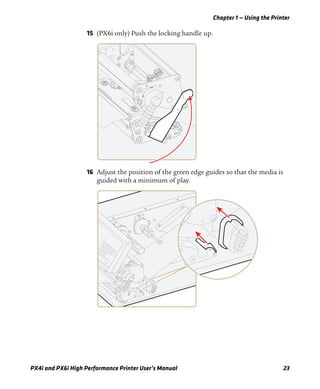
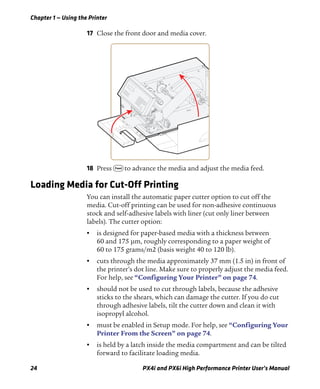
stop adjust positions) and print speed. The value of the head
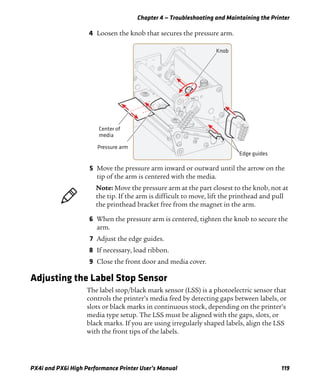
resistance is read-only and is measured by the firmware when the
printer starts up.
To configure print engine settings
1 Click Printer > Print Engine.
2 Enter the correct information for the print engine.
3 Click Submit Setup.
Chapter 3 — Configuring the Printer
80 PX4i and PX6i High Performance Printer User’s Manual
Configuring Web Shell Settings
Use the Web Shell page to view and change test and default settings.
You can also use the Web Shell page to print test labels and change the
command language.
To configure Web Shell settings
1 Click Printer > Web Shell.
2 Select the action you want to take or the setting you want to
change.
• For the actions in the top of the screen, the printer performs
the action and may prompt you to reboot the printer.
• For the settings in the bottom of the screen, select the settings
you want and click Submit Setup. A message appears stating,
“Application change will take effect at reboot.” You can select
Reboot or wait until you are done making other configuration
changes.
Use the following table to understand the Web Shell settings.
Understanding the Web Shell Settings
Setting Description
Testfeed [value] Calibrates the label stop sensor performs a testfeed.
Selecting this setting is equivalent to issuing the
TESTFEED command on the printer.
Ribbon Sensor
[value]
Detects if the printer runs out of ribbon during printing.
Chapter 3 — Configuring the Printer
PX4i and PX6i High Performance Printer User’s Manual 81
Configuring Alerts
Use the Alerts page to view and change the printer alert settings.
To configure alerts
1 Click Printer > Alerts.
2 Change the alert settings:
• From the Setting list, choose Enabled or Disabled.
• In the text field, specify a Delay repeat.
• In the Delay Unit list, select seconds or occurrences.
• In the Message text field, enter a message.
Default Setup Returns the printer to factory default settings. Passwords,
alerts, and the selected application are not changed.
Reboot Reboots the printer.
Print Test Label Prints the predefined test label you choose.
Command
Language
Sets the command language to Fingerprint, Direct
Protocol, IPL, ZSim, or DSim. You need to reboot the
printer for the change to take effect.
Fingerprint
Application
Defines the application to run as the default on startup.
You need to reboot the printer for the change to take
effect.
Standard I/O Defines the port the printer listens to. You need to reboot
the printer for the change to take effect.
Understanding the Web Shell Settings (continued)
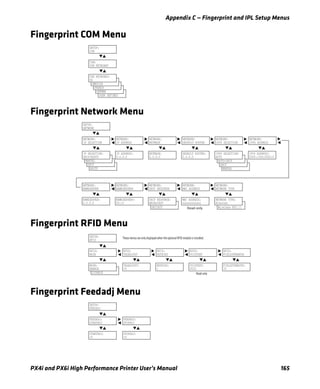
Setting Description
Chapter 3 — Configuring the Printer
82 PX4i and PX6i High Performance Printer User’s Manual
3 Select the Notification method.
4 Click Submit Settings.
Use the following table to understand the Alert Settings.
Understanding the Alert Settings
Setting Description
Label Not Taken
(Fingerprint only)
Sent when the printed label is not taken from the
printer. This setting applies to label and ticket media
and requires an optional label taken sensor.
Cutter Error There was an error related to the label cutter.
Head Lifted A printer job was sent to the printer while the
printhead was lifted.
Out of Ribbon You have thermal transfer ribbon selected and the
printer is out of ribbon.
Pause Mode The printer is in Pause mode.
Setup Mode The printer is in Setup mode.
Error Condition
(Fingerprint only)
An error has occurred in the Fingerprint application.
The error does not have to be critical to the print job for
the printer to send this alert.
Application Break
(Fingerprint only)
A running Fingerprint application has been
interrupted manually or because of an error.
Print Job Complete
(Fingerprint only)
The print job has been successfully completed.
Odometer Count 1 The amount of media printed has reached a preset
amount, measured in meters or in number of labels.
The Delay repeat setting represents how often the alert
message will be sent when the preset value is reached.
Notification
Method
The method used to send an alert message. You can
choose from mail, SNMP-trap, or both.
Chapter 3 — Configuring the Printer
PX4i and PX6i High Performance Printer User’s Manual 83
Configuring General Network Settings
Use the General network page to view the printer name, change
passwords, and set restrictions.
To configure general network settings
1 Click Network Admin > General.
2 View or update your settings.
3 Click Submit General settings.
Note: To enter a new password, you need to check the Set
password check box.
Chapter 3 — Configuring the Printer
84 PX4i and PX6i High Performance Printer User’s Manual
Use the following table to understand the general network settings.
Understanding the General Network Settings
Setting Description
Printer Name The network identification name (WINS name) of the
printer. The default name is INTERMEC followed by
the last six positions of the MAC address.
System Location (Optional) The printer location.
System Contact (Optional) The printer administrator.
Set Password You must check this box if you want to change the
admin password.
Old Admin
Password
You need to enter the old password before you can
change the password.
New Admin
Password
The new password you want to use.
Restrictions Sets restrictions on who is allowed to upgrade the
printer firmware or view and change network settings.
You cannot remove “admin” from the list of authorized
users.
Users allowed to update: Defines who may perform a
firmware upgrade using FTP, PrintSet, or IFAB. This
setting does not affect upgrading from a Compact
Flash card.
Users allowed to read/write protected LAN1
settings: (Fingerprint only) Defines who may read/
write settings in the LAN1 section.
Users allowed to change network settings:
(Fingerprint only) Defines who may change the
network node in the setup. This setting is not
supported if you are setting up the printer from its
internal keyboard.
Users allowed to change wireless settings: Defines
who may change WLAN or 802.1x settings.
Chapter 3 — Configuring the Printer
PX4i and PX6i High Performance Printer User’s Manual 85
Configuring Mail Settings
Use the mail settings page to view and change e-mail (SMTP) server
settings.
To configure mail settings
1 Click Network Admin > Mail.
2 Select the mail server settings and enter mail addresses.
3 Click:
• Submit Mail Settings to send the changes to the printer.
• Submit & Send test mail to send the changes to the printer
and test your new settings.
Chapter 3 — Configuring the Printer
86 PX4i and PX6i High Performance Printer User’s Manual
Use the following table to understand the mail settings.
Understanding the Mail Settings
Setting Description
Mail (SMTP)
Server
Choose a configuration method for your mail server
settings:
• SMTP settings from DHCP: Choose this setting if
you want the printer to receive settings
automatically from your DHCP server. This setting
requires that you choose DHCP and IP Selection in
the TCP/IP section.
• Manual settings: Choose this option to manually
configure the Mail Server address and port. The
default port is 25.
Mail addresses Defines the e-mail addresses to use when the printer
sends alert messages:
• From address: The address that displays as the
sender of alert messages. E-mail will be returned to
this address if the recipient is unreachable. To
prevent e-mail bounces when the recipient is
unreachable, leave this field empty.
• To address: The recipient of alert messages. To
enter several addresses, separate them with a comma
(,) or a semicolon (;).
Chapter 3 — Configuring the Printer
PX4i and PX6i High Performance Printer User’s Manual 87
Configuring SNMP Settings
Use the SNMP page to view and change SNMP settings.
To configure SNMP settings
1 Click Network Admin > SNMP.
2 Change the SNMP settings.
3 Click Add to add trap settings. You can define up to four
authentication failure traps.
After you add a trap, it appears in the Trap Address Settings list.
You can edit or delete each trap in the list by clicking Edit or
Delete.
4 Click Submit SNMP settings.
Chapter 3 — Configuring the Printer
88 PX4i and PX6i High Performance Printer User’s Manual
Use the following table to understand SNMP settings.
Understanding the SNMP Settings
Setting Description
Read Community Community with rights to read the SNMP MIBs.
Read/Write
Community
Community with rights to read and write SNMP MIBs.
Username Username when using SNMPv3. The default value is
“initial”.
Authentication Key The authentication key for SNMPv3. The default value
is “auth_key”.
Encryption Key The privacy key for SNMPv3. The default value is
“priv_key”.
System Name Administrative name for the SNMP node.
Authentication
Failure Trap
Defines if a trap is sent when an unauthorized SNMP
request tries to access the printer. Choose Enable to
send the trap.
Trap Address
Settings
Click Add to specify these trap address settings:
• Trap Address: IP address of the receiver of SNMP
traps. You can specify up to four trap addresses.
• Trap Port: The port where SNMP traps are sent.
The default port if 162.
• Trap Community: Defines the community to
which SNMP traps will be sent.
• Friendly Name: A user-defined text string that
identifies the trap.
• Trap Enable Status: Defines whether the specified
trap is enabled.
Chapter 3 — Configuring the Printer
PX4i and PX6i High Performance Printer User’s Manual 89
Configuring TCP/IP Settings
Use the TCP/IP settings page to view and change TCP/IP network
settings.
To configure TCP/IP settings
1 Click Network Admin > TCP/IP.
2 View or update your settings.
3 Click Submit TCP/IP settings.
Use the following table to understand the TCP/IP settings.
Understanding the TCP/IP Settings
Setting Description
IPV4 Settings Configuration method: The method by which an IP
address is assigned to the printer. You can choose
between DHCP, BOOTP, DHCP+BOOTP, or
MANUAL.
Address: The current IP address of the printer.
Netmask: Manually assigned netmask for the printer.
Default Router: The IP address of the default router.
Chapter 3 — Configuring the Printer
90 PX4i and PX6i High Performance Printer User’s Manual
IPV6 Settings Configuration method: The method by which an IP
address is assigned to the printer. You can choose
between:
• AUTO: The IP address is obtained using stateless
auto-configuration. This is the default
configuration method.
• AUTO+DHCP: The IP address is obtained using
stateless auto-configuration, but DNS options are
obtained using DHCP.
• DHCP: The IP address and DNS options are
obtained using DHCP.
• MANUAL: The IP address is set to a static address
that you enter in the Static Address field.
Current addresses: A list of all the currently
configured IP addresses for the Ethernet interface. The
address starting with FE80:: is the link-local address
and is available regardless of the configuration method
you choose.
Static address: This address applies if you selected
manual as the configuration method. The IP address
is specified as an address and a prefix separated by a
slash. You can use “::” to represent a large number of
consecutive zeros. You should typically set the prefix
to 64.
Example:
2001:DB8:0:F101::2/64
Name Resolution DNS Server: The IP address of the name server.
DNSv6 Server: The IP address of the name server for
IPv6.
WINS Server (Primary and Secondary): The IP
addresses of the primary and secondary WINS servers.
If you chose DHCP or BOOTP for the configuration
method, you may see the currently assigned WINS IP
addresses depending on the configuration of your
DHCP server.
Printer Service NET1 TCP Port Number: The port number for raw
TCP. The default is 9100.
NET1 Queuing: Determines whether queuing for the
TCP port is turned on, off, or enabled for multiple
network connections (Multi).
Understanding the TCP/IP Settings (continued)
Setting Description
Chapter 3 — Configuring the Printer
PX4i and PX6i High Performance Printer User’s Manual 91
Configuring the Network Type
Use the Network Type page to choose whether you are using an
Ethernet or wireless 802.11 network.
To configure the network type
1 Click Network Admin > Network Type.
2 Select either Ethernet or Wireless 802.11.
3 Click Submit new settings.
4 Reboot the printer for the changes to take effect.
Note: Once you change the network type to Wireless 802.11, you
cannot communicate with the printer using Ethernet. You need to
change the command through the Setup menu or send a command
through a serial connection.
Chapter 3 — Configuring the Printer
92 PX4i and PX6i High Performance Printer User’s Manual
Configuring Avalanche Settings
Use the Avalanche page to view and change Wavelink Avalanche
settings.
To configure Avalanche settings
1 Click Network Admin > Avalanche.
2 View or update your settings.
3 Click Submit Avalanche settings.
Use the following table to understand the Avalanche settings.
Understanding the Avalanche Settings
Setting Description
Enabler Mode Click one of the option buttons:
• Disabled: Disables Avalanche.
• Manual settings: Enables Avalanche. You need to
enter the Agent address and Port in the text fields.
• Find agent by broadcast: Enables Avalanche and
the network connection broadcasts to find the
agent.
Agent
authorization
Enter your user name and password in the entry fields.
Chapter 3 — Configuring the Printer
PX4i and PX6i High Performance Printer User’s Manual 93
Configuring SmartSystems Settings
Use the SmartSystems page to view or change the SmartSystems
server IP address and the master port number.
To configure the SmartSystems settings
1 Click Network Admin > SmartSystems.
2 View or change the settings.
3 Click Submit SmartSystems settings.
Chapter 3 — Configuring the Printer
94 PX4i and PX6i High Performance Printer User’s Manual
Configuring Wireless LAN Settings
Use the Wireless LAN page to view and change 802.11 settings.
To configure wireless LAN settings
1 Click Network Admin > Wireless LAN.
2 View or update your settings.
3 Click Submit 802.11 settings.
Use the following table to understand the Wireless LAN settings.
Note: The Wireless LAN settings are only available if your printer has
the wireless 802.11 radio interface option installed and is running
Fingerprint 8.77.0 or later, or IPL v2.77.0 or later.
Understanding the Wireless LAN Settings
Setting Description
SSID The network name of the printer.
Mode Set the operating mode of the device to Ad-Hoc or
Infrastructure.
WEP Set Wired Equivalent Privacy (WEP) to on or off.
WEP Keys You can enter values for up to 4 WEP keys.
Active WEP key Chooses the active WEP key.
Chapter 3 — Configuring the Printer
PX4i and PX6i High Performance Printer User’s Manual 95
Authentication Sets the type of authentication to use for your WEP
keys. You can choose between Auto, Open System, and
Shared.
WPA Sets the Wi-Fi Protected Access (WPA) to either on or
off.
WPA Pre-shared
key
Sets the WPA Pre-shared key.
WPA2 Sets the Wi-Fi-Protected Access version 2 to either on or
off.
Roaming setting Sets the roaming reluctancy to 1, 2 or 3. Setting the
roaming reluctancy to 0 turns off the roaming feature.
Current channel (Read only or read/write for adhoc connections)
Shows the current channel being used.
AP MAC Address (Read only) MAC address of the access point to which
the printer is connected.
Signal strength (Read only) Radio signal strength of the access point.
Speed (Read only) Speed of the current connection.
Region (Read only) Shows the country short names provided
by the 802.11d standard for the currently selected
region or country.
Understanding the Wireless LAN Settings (continued)
Setting Description
Chapter 3 — Configuring the Printer
96 PX4i and PX6i High Performance Printer User’s Manual
Configuring 802.1x Settings
The 802.1x settings page is only available if you have the optional
wireless interface installed in your printer. Use the 802.1x page to view
and change 802.1x security settings.
To configure 802.1x settings
1 Click Network Admin > 802.1x.
2 View or update your settings.
3 Click Submit 802.1x settings.
Use the following table to understand the 802.1x settings.
Understanding the 802.1x Settings
Setting Description
EAP Type Choose the Extensible Authentication Protocol (EAP)
type:
• TTLS
• LEAP
• PEAP
• EAP-FAST
• Off (disables 802.1x security) (default)
Chapter 3 — Configuring the Printer
PX4i and PX6i High Performance Printer User’s Manual 97
Inner
Authentication
(TTLS, EAP-FAST,
and PEAP only)
Choose the inner authentication method:
• PAP (TTLS only)
• MSCHAPv2
• EAP/MSCHAPv2
• EAP/MD5
• EAP/GTC
Outer Name (TTLS
only)
Specify the EAP identity passed in the clear. The default
is anonymous.
PAC- Key A-ID Info The Protected Access Credential (PAC) setting
is used to specify the PAC file used by EAP-FAST
authentication. This setting is automatically filled up
by the printer if ACQUIRE_PAC is enabled and current
installed PAC file fails authenticating the printer to the
network. You can manually import a PAC file using a
pass phrase the same way you install a certificate.
Automatic
Provision (PAC)
Set Automatic PAC file Provisioning to on or off.
Root Certificate The common name of the installed root CA certificate.
You can also specify a different certificate (provided
that it has already been installed on the printer) by
entering the path to the new certificate in this field. If a
pass phrase is required, add it to the end of the path in
the form of “@passphrase”.
Server Common
Name #1
Server Common
Name #2
(TTLS and PEAP
only)
Specify common names. If you specify one common
name, the server certificate common name must match
this name for authentication. If you specify two
common names, the server certificate common name
must match at least one of them. The default is “” (any
common name).
Server Certificate
Validation (TTLS
and PEAP only)
Enables certificate validation. Specifies whether or not
to check if the installed CA certificate is the root of the
server certificate.
Understanding the 802.1x Settings (continued)
Setting Description
Chapter 3 — Configuring the Printer
98 PX4i and PX6i High Performance Printer User’s Manual
Configuring Your Printer With PrintSet
PrintSet is a printer configuration tool that allows you to easily
change your setup parameters. You can also use PrintSet’s setup
wizards to guide you through common configuration tasks.
To configure the printer with PrintSet
1 Make sure that you have a PC running Microsoft Windows 2000
or later.
2 Download PrintSet from the Downloads page of the Intermec web
site at www.intermec.com.
3 Connect your printer to your PC using a serial cable. For help, see
“Connecting the Printer to a PC Through the Serial Port” on
page 56.
Configuring Your Printer With Commands Sent From Your PC
You can change configuration parameters by sending commands
directly to the printer using your terminal program (HyperTerminal)
and a serial or network connection.
If your printer uses the Fingerprint language, you use the SETUP
command, followed by the node, subnode, and parameters setting.
This Fingerprint example sets the media setting to labels with gaps:
SETUP "MEDIA,MEDIA TYPE,LABEL (w GAPS)"
If your printer uses the IPL language, you would send this command:
<STX><SI>T1<ETX>
To see the node, subnode, and parameters for Fingerprint and IPL, see
Appendix C, “Fingerprint and IPL Setup Menus” on page 163.
Fingerprint automatically sends feedback to HyperTerminal as you
type. If you want to see what you are typing with IPL, you need to
perform the following procedure.
Note: You cannot communicate with the printer using PrintSet
through a USB connection. To use PrintSet, you must be connected
serially or through the Ethernet or 802.11 network.
Chapter 3 — Configuring the Printer
PX4i and PX6i High Performance Printer User’s Manual 99
To see IPL commands as you type
1 From the HyperTerminal menu, select File > Properties > the
Settings tab.
2 Click the ASCII Setup button.
3 Select Echo typed characters locally.
4 Click OK twice.
For more information on how to change configuration settings, see
either the Intermec Fingerprint Command Reference Manual or the
IPL Command Reference Manual.
Configuring Your Printer Using SmartSystems Foundation
SmartSystems™ Foundation is an Intermec software platform that
lets you manage all of your SmartSystems-enabled devices
simultaneously from a central server. The SmartSystems Console
displays all SmartSystems-enabled computers and peripherals in your
network.
Through the Console, you can:
• drag-and-drop configuration bundles, OS updates, and firmware
upgrades to multiple computers.
• create a “golden” device configuration to use when updating other
computers.
• remotely change settings on SmartSystems-enabled computers
and peripherals.
With an AutoDeploy license, SmartSystems can automatically push
software, configuration settings, and other files to connected PX4i
and PX6i printers. AutoDeploy can report on asset locations and
battery status, making it easier to manage your mobile devices. The
license also enables Scan-to-Connect, which makes connecting
additional PX4i and PX6i printers to your secure wireless network as
easy as reading bar codes.
You can download SmartSystems Foundation at no charge from the
Intermec web site. For more information on SmartSystems, go to
www.intermec.com/SmartSystems. To purchase an AutoDeploy
license, contact your local Intermec sales representative.
Chapter 3 — Configuring the Printer
100 PX4i and PX6i High Performance Printer User’s Manual
Configuring Your Printer Using Wavelink Avalanche
You can use the Wavelink Avalanche device management system to
configure all of your wireless printers. You printer ships with the
Avalanche Enabler already loaded.
Each time the Avalanche Enabler is activated (typically on a warm
boot), the printer attempts to connect to the Avalanche Agent. When
the printer connects to the Agent, the Agent determines whether an
update is available and immediately starts the software upgrade, file
transfer, or configuration update.
To use Avalanche to remotely manage the printer
1 Install the configuration updates for the printer using the
Avalanche Administrative Console.
2 Schedule the printer updates or manually initiate an update using
the Avalanche Administrative Console.
For more information on using Wavelink Avalanche, contact your
local Intermec representative or visit the Wavelink web site at
www.wavelink.com.
Choosing an Ethernet or Wireless Network
If you have an 802.11 wireless radio option installed in your printer,
you need to choose between an Ethernet network or a wireless 802.11
network.
You can choose the network type of your printer:
• directly from the screen.
• using commands sent from your PC.
• using SmartSystems Foundation. For help, see the previous
section “Configuring Your Printer Using SmartSystems
Foundation.”
• from the printer home page. For help, see “Configuring the
Network Type” on page 91.
• using PrintSet. For help, see “Configuring Your Printer With
PrintSet” on page 98.
Chapter 3 — Configuring the Printer
PX4i and PX6i High Performance Printer User’s Manual 101
Choosing the Network Type From the Printer Screen
To configure the printer from the screen, you need to enter Setup
mode.
To choose the network type from the printer screen
1 Press T to enter Setup mode.
2 Navigate to Network > Network Type and press E.
3 Select either Ethernet or Wireless 802.11 and press E.
4 Press T to exit Setup mode.
5 Reboot the printer for the change to take effect.
Choosing the Network Type Using Printer Commands
You can use a serial connection to send Fingerprint or IPL commands
the printer.
To choose the network type using printer commands
1 Connect your printer to your PC using a serial cable. For help, see
“Connecting the Printer to a PC Through the Serial Port” on
page 56.
2 Start a terminal application, such as HyperTerminal.
• If you are running Fingerprint, send this command to the
printer:
setup "NETWORK","NETWORK TYPE","n"
where n is either Ethernet or Wireless 802.11.
• If you are using IPL, send this command to the printer:
<STX><SI>n,,,p<ETX>
where p is either 0 (select Ethernet interface) or 1 (Select Wireless
802.11 interface).
3 Reboot the printer for the change to take effect.
Chapter 3 — Configuring the Printer
102 PX4i and PX6i High Performance Printer User’s Manual
Upgrading Firmware
The latest firmware and software is available for download from the
Downloads page on the Intermec web site at www.intermec.com.
You can upgrade your printer’s firmware using:
• PrintSet. You can download PrintSet from the downloads page for
the printer on the Intermec web site at www.intermec.com.
• a CompactFlash (CF) card.
• a USB storage device (maximum 2 GB).
• a serial or USB connection.
• an Ethernet or 802.11 network connection.
To download firmware updates
1 Go to the Intermec web site at www.intermec.com.
2 Click Support > Downloads.
3 Use the Product Category, Product Family, and Product fields,
to select the printer.
4 Click Submit.
5 The latest available software appears on the page.
6 Download the latest firmware version to your PC.
7 Extract the .zip file to a folder on your PC.
To upgrade using PrintSet
1 Download the latest version of PrintSet from the Intermec web
site at www.intermec.com.
2 Select File > Add Printer. The Add Printer Wizard starts.
3 Under My Printers, select your printer.
4 Go to Printer > Firmware Wizard.
5 Follow the steps to update your firmware.
To upgrade using a CF card
1 Copy the firmware upgrade file to a CF card.
2 Insert the CF card in the appropriate slot on the back of your
printer.
Chapter 3 — Configuring the Printer
PX4i and PX6i High Performance Printer User’s Manual 103
3 Turn on your printer.
To upgrade using a USB storage device
1 Turn on your printer.
2 Verify the USB storage device is supported by your printer. Insert
the USB storage device in the appropriate slot on the back of your
printer. On the display screen, one of the following status
messages briefly appears:
• USB memory stick connected
• USB memory stick not supported
3 Insert the USB storage device in the appropriate slot on your PC.
4 In the root directory of the USB storage device, create a folder
named “upgrade.”
5 Copy the firmware binary upgrade file to the upgrade folder on
the USB storage device.
6 Insert the USB storage device in the appropriate slot on the back
of your printer. The upgrade starts. On the display screen, the
status message, “Time Out,” appears.
7 When the upgrade is complete, the status message, “Check
Integrity,” appears. Remove the USB storage device. You may need
to restart your printer.
To upgrade using a serial or USB connection
• Use Fingerprint or IPL commands to send the upgrade file to your
printer.
For help, see the Intermec Fingerprint Command Reference Manual
or the IPL Command Reference Manual.
Note: If no status message appears when you insert the USB
storage device, remove and reinsert the USB storage device. To
manually verify the USB storage device is supported, see “Using a
USB Mass Storage Device” on page 71.
Note: The printer supports 8.3 binary filenames, which means the
filename can have up to eight characters and a .bin extension.
Chapter 3 — Configuring the Printer
104 PX4i and PX6i High Performance Printer User’s Manual
To upgrade using an Ethernet or 802.11 network connection
1 Start your web browser application.
2 In the address field, enter the IP address of your printer.
3 Press Enter. Your printer’s home page appears.
4 From the menu at the top of the page, click Maintenance. The
firmware upgrade screen appears.
5 Click Browse and browse to the location of the firmware upgrade
file.
6 Double-click the file, and then click Upgrade.
Downloading Fonts and Graphics
The printer supports 15 scalable Unicode TrueType and TrueDoc
fonts as standard. The Unicode standard allows the use of special
characters for various languages including non-Latin fonts, such as
Arabic, Cyrillic, Chinese (including enhanced Simplified Chinese
GB18030), Japanese, Korean, and Hebrew.
You can download additional fonts to the printer’s Flash memory
using:
• PrintSet. You can download PrintSet from the downloads page for
the printer on the Intermec web site at www.intermec.com.
• Fingerprint or IPL commands. For help, see the Intermec
Fingerprint Command Reference Manual or the IPL Command
Reference Manual.
• a CompactFlash card or external 2 GB USB mass storage device.
105
4
Troubleshooting and Maintaining the
Printer
This chapter contains possible solutions to problems you may
encounter while using the printer. This chapter also contains
information on booting the printer and performing routine
maintenance. This chapter contains these sections:
• Troubleshooting the Printer
• Adjusting the Printer
• Maintaining the Printer
Chapter 4 — Troubleshooting and Maintaining the Printer
106 PX4i and PX6i High Performance Printer User’s Manual
Troubleshooting the Printer
You may have printer operation, print quality, or printer
communication problems at some time during the life of your printer.
You can easily fix most of the problems you encounter. If you cannot
find the answer to your problem in this section, you may need to
contact Product Support.
Contacting Product Support
Before contacting Intermec Product Support, you may want to visit
the Intermec technical knowledge base (Knowledge Central) at
intermec.custhelp.com to review technical information or to request
technical support. If you still need help after visiting Knowledge
Central, you may need to call Product Support.
To talk to an Intermec Product Support representative in the U.S.A.
or Canada, call:
1-800-755-5505
Outside the U.S.A. and Canada, go to www.intermec.com and click
Contact to find your local Intermec representative.
Before calling Intermec Product Support, make sure you have the
following information ready:
• Printer serial number
• Firmware type and version
• Ethernet, wireless, or serial port settings
You can find all of the information listed above in the printer menu
system or on a test print page.
Chapter 4 — Troubleshooting and Maintaining the Printer
PX4i and PX6i High Performance Printer User’s Manual 107
Understanding Error Messages
Use the following tables to troubleshoot common error messages you
may see displayed on your printer’s screen. Keep in mind that some
error messages:
• are specific to the type of firmware you are running.
• have corresponding error numbers.
• cause the Intermec Ready-to-Work indicator to blink or turn off.
Fingerprint Error Messages
Message Description
Ready-to-Work
Indicator Status
Error
Number
Out of paper The printer is out of paper. Load a new roll of media.
For help, see “Loading Media” on page 7.
Blinking 1005
Next label not
found
Next label not found Blinking 1031
Label not
taken
Label not taken Blinking
Out of
transfer
ribbon
The printer is out of transfer ribbon. Load a new roll
of ribbon. For helps, see “Loading Ribbon” on
page 43.
Blinking 1027
Transfer
ribbon is
installed
This is not an error condition. This message briefly
appears after a new roll of transfer ribbon is
installed.
Blinking 1058
Head lifted The printhead is lifted. Lower the printhead. Blinking 1022
Cutter does
not respond
Open and shut the cutter. Blinking 1059
Cutter error1 Open and shut the cutter. Blinking 1701
Cutter error2 Open and shut the cutter. Blinking 1702
Cutter error3 Open and shut the cutter. Blinking 1703
Cutter open Shut the cutter. 1704
LSS too high This error can occur when you run a test feed
without any media installed, or if you have incorrect
media settings. Load the printer with media and
select the appropriate media type. For help, see
“Loading Media” on page 7.
Blinking 1007
Chapter 4 — Troubleshooting and Maintaining the Printer
108 PX4i and PX6i High Performance Printer User’s Manual
LSS too low This error can occur when you run a test feed
without any media installed, or if you have incorrect
media settings. Load the printer with media and
select the appropriate media type. For help, see
“Loading Media” on page 7.
Blinking 1008
Testfeed not
done
The printer did not perform a test feed before it
printed out test labels. Performing a test feed
calibrates the sensor. To perform a testfeed, press the
A button.
Blinking 1606
No RFID
support
installed
The optional RFID interface is not installed in the
printer.
Blinking 1320
No tag found No RFID tag has been found. Blinking 1321
Pause Mode
Entered
The print job is paused. Blinking
Setup Mode
Entered
The printer is in Setup mode. Off
IP link error No network connection. Blinking
IP
configuration
error
The printer is trying to acquire an IP address from
the network. Wait for the printer to complete the
task before taking any action.
Blinking
Generic DP
error
In Direct Protocol, you can enable error handling for
specific errors using the ERROR statement. When
errors added to the built-in error handling occur, this
event is set. The text included in the SNMP trap is
the standard text corresponding to the error.
Blinking
Press any key
to continue
If an error occurs in the Fingerprint immediate
mode, for example “out of paper” when the print key
is pressed, this event is set.
Off
Application
load error
If an application is started but does not run, the
Intermec Ready-to-Work indicator blinks. For
example, if there is a syntax error in the loaded
program file.
Blinking
RtW blink by
application
This condition is set by the Fingerprint SYSHEALTH
command. For more information, see the Intermec
Fingerprint Command Reference Manual.
Blinking
Fingerprint Error Messages (continued)
Message Description
Ready-to-Work
Indicator Status
Error
Number
Chapter 4 — Troubleshooting and Maintaining the Printer
PX4i and PX6i High Performance Printer User’s Manual 109
RtW off by
application
This condition is set by the Fingerprint SYSHEALTH
command. For more information, see the Intermec
Fingerprint Command Reference Manual.
Off
Application
break
If you perform a user break by pressing S - P to
stop an application from running, or if a runtime
error occurs, the Intermec Ready-to-Work indicator
turns off. You can turn the indicator on by changing
to Direct Protocol or running an application.
But, if the application handles the break (ON
BREAK) or runtime error (ON ERROR GOTO), the
Intermec Ready-to-Work indicator is not affected,
and the application sets the status. For more
information, see the Intermec Fingerprint Command
Reference Manual.
Off
Printhead not
found
Printhead not found. Off
Rebooted The printer has been rebooted. Off
Initializing The printer is initializing. Off
Printer crash Printer crash. In most instances, when the printer
crashes, the screen is reset which causes the Intermec
Ready-to-Work indicator to turn off.
Off
Printer turned
off
The printer is off. Off
Maintenance Maintenance Off
Power supply
Over
temperature
The power supply is overheated and needs to cool
down.
Off 1718
Printhead too
hot
The printhead is overheated and needs to cool down.
You need to resend your print job.
Off 1088
Fingerprint Error Messages (continued)
Message Description
Ready-to-Work
Indicator Status
Error
Number
Chapter 4 — Troubleshooting and Maintaining the Printer
110 PX4i and PX6i High Performance Printer User’s Manual
IPL Error Messages
Message Description
Ready-to-Work
Indicator Status
Error
Number
Paper Out The printer is out of paper. Load a new roll of media.
For help, see “Loading Media” on page 7.
Blinking 1005
Ribbon Out The printer is out of transfer ribbon. Load a new roll
of ribbon. For helps, see “Loading Ribbon” on
page 43.
Blinking 1031
Ribbon Fitted This is not an error condition. This message briefly
appears after a new roll of transfer ribbon is
installed.
Blinking
Printhead Up The printhead is lifted. Lower the printhead. Blinking 1027
Open & Shut
Cutter
Cutter error 1. Open and shut the cutter. Blinking 1058
Open & Shut
Cutter
Cutter error 2. Open and shut the cutter. Blinking 1022
Open & Shut
Cutter
Cutter error 3. Open and shut the cutter. Blinking 1059
Paper Fault LSS too high. This error can occur when you run a
test feed without any media installed, or if you have
incorrect media settings. Load the printer with
media and select the appropriate media type. For
help, see “Loading Media” on page 7.
Blinking 1701
Paper Fault LSS too low. This error can occur when you run a
test feed without any media installed, or if you have
incorrect media settings. Load the printer with
media and select the appropriate media type. For
help, see “Loading Media” on page 7.
Blinking
Paper Fault The printer did not perform a test feed before it
printed out test labels. Performing a test feed
calibrates the sensor. To perform a testfeed, press the
A button.
Blinking
Press Feed Press the F button to resume. Blinking
Paused This is not an error condition. This message appears
when the print job is paused.
Blinking
Setup mode entered. Off
IP link error. No network connection. Blinking
Chapter 4 — Troubleshooting and Maintaining the Printer
PX4i and PX6i High Performance Printer User’s Manual 111
Troubleshooting Printer Problems and Finding Solutions
Use this section to find possible solutions to printer problems.
IP configuration error. The printer is trying to
acquire an IP address from the network. Wait for the
printer to complete the task before taking any
action.
Blinking
No Printhead Printhead not found Off
Rebooted Off
Initializing Off
Printer crash. In most instances, when the printer
crashes, the screen is reset which causes the Intermec
Ready-to-Work indicator to turn off.
Off
Printer turned off Off
Maintenance Off
Psu Over
Temp
Power supply over temperature Off
Printhead Hot The printhead is overheated and needs to
cool down. Wait for printing to resume
automatically.
Off
IPL Error Messages (continued)
Message Description
Ready-to-Work
Indicator Status
Error
Number
Print Quality Problems and Possible Solutions
Problem Possible Solution
The printout is weak, overall. Try these possible solutions in order:
• Make sure that your media setting is appropriate for the
type of media you are using.
• The contrast may be too low. Try increasing the contrast.
• The printhead pressure may be too low. Increase the
printhead pressure. For help, see “Adjusting the
Printhead Pressure” on page 122.
• Replace the printhead. For help, see “Replacing the
Printhead” on page 129.
The printout is weaker on one side. Adjust the pressure arm. For help, see “Adjusting the
Pressure Arm” on page 118.
Chapter 4 — Troubleshooting and Maintaining the Printer
112 PX4i and PX6i High Performance Printer User’s Manual
There are weak spots on the
printout.
Try these possible solutions in order:
• There may be foreign particles on the media. Clean or
replace the media.
• Make sure that your media and ribbon are compatible.
• Make sure that you are using high quality media and
ribbon.
• The contrast may be too low. Try increasing the contrast.
• The printhead may be worn. Replace the printhead. For
help, see “Replacing the Printhead” on page 129.
• The platen roller may be worn. For help, contact your
Intermec service representative.
The printout is dark, overall.
Or,
There is excessive bleeding on the
media.
Try these possible solutions in order:
• Make sure that your media setting is appropriate for the
type of media you are using.
• The contrast may be too high. Try decreasing the
contrast.
• The printhead pressure may be too high. Decrease the
printhead pressure. For help, see “Adjusting the
Printhead Pressure” on page 122.
• The printhead voltage may be incorrect or the energy
control may be faulty. For help, contact your Intermec
service representative.
There are dark lines along the media
path.
There may be foreign particles on the printhead. Clean the
printhead. For help, see “Cleaning the Printhead” on
page 127.
There are white vertical lines on the
printout.
Try these possible solutions in order:
• There may be foreign particles on the printhead. Clean
the printhead. For help, see “Cleaning the Printhead”
on page 127.
• There may be missing dots on the printhead. Replace the
printhead. For help, see “Replacing the Printhead” on
page 129.
Part of a dotted line is missing. Try these possible solutions in order:
• The printhead may be failing. Replace the printhead. For
help, see “Replacing the Printhead” on page 129.
• The strobe signal may be failing. For help, contact your
Intermec service representative.
Print Quality Problems and Possible Solutions (continued)
Problem Possible Solution
Chapter 4 — Troubleshooting and Maintaining the Printer
PX4i and PX6i High Performance Printer User’s Manual 113
The inner edge of the printout is
missing.
Try these possible solutions in order:
• The media may not be properly installed or aligned.
Reload the media. For help, see “Loading Media” on
page 7.
• The small core and supply post may be in the upper
position. Move the post to the lower position.
• The X-start parameter may be set too low. Increase the
setting.
The content on my printout is
compressed.
The print speed may be too high. Lower the print speed.
Nothing shows up on my thermal
transfer printout.
The ink-coated side of the ribbon may not be facing the
media. Reload the ribbon. For help, see “Loading Ribbon”
on page 43.
When I feed or print a label, the
ribbon is not taken up. Instead, it
spills out of the front of the printer.
Make sure Paper Type is set to Thermal Transfer Ribbon
(TTR):
1 On your printer’s keypad, press T to enter the Setup
menu.
2 If you are using Fingerprint, go to Media > Paper Type >
Transfer.
If you are using IPL, go to Media > Paper Type > TTR.
3 Press E.
4 Press T to exit the Setup menu.
The transfer ribbon breaks. Try these possible solutions in order:
• Make sure that your media setting is appropriate for the
type of media you are using.
• Make sure that the ribbon is fitted correctly. Reload the
ribbon. For help, see “Loading Ribbon” on page 43.
• The energy control may be faulty. For help, contact your
Intermec service representative.
The transfer ribbon wrinkles. Try these possible solutions in order:
• You may need to adjust the label stop sensor. For help,
see “Adjusting the Label Stop Sensor” on page 119.
• The printhead pressure may be too high. Decrease the
printhead pressure. For help, see “Adjusting the
Printhead Pressure” on page 122.
Print Quality Problems and Possible Solutions (continued)
Problem Possible Solution
Chapter 4 — Troubleshooting and Maintaining the Printer
114 PX4i and PX6i High Performance Printer User’s Manual
The media feed is not working
properly.
Try these possible solutions in order:
• The media characteristics may have changed. Press the A
button.
• One of these parameters may not be properly configured:
Label rest dots, Media type, or LSS position. Verify the
settings for these parameters.
• The sensors may be dirty. Clean the media guides. For
help, see “Cleaning the Media Guides” on page 125.
• The sensors may need to be replaced. For help, contact
your Intermec service representative.
Print Quality Problems and Possible Solutions (continued)
Problem Possible Solution
Networking Problems and Possible Solutions
Problem Possible Solution
I am having problems with my
Ethernet or 802.11 radio network
connection.
Try these possible solutions:
• Make sure that your network cable is:
• securely connected to your printer.
• a straight “pin to pin” cable, not a “crossover” cable.
• Make sure that your PC is correctly configured for and
connected to your network.
• Make sure that your printer is correctly configured for
your network.
I cannot connect to my printer
home page.
If you are connecting your printer with a crossover network
cable, you may need to disable the web browser’s proxy
settings on your computer to access your printer’s home
page.
RFID Problems and Possible Solutions
Problem Possible Solution
I loaded my printer with RFID
media, but it is not writing to the
tags.
After you load RFID media, restart the printer or run a
TESTFEED to let the printer identify the RFID media type.
Chapter 4 — Troubleshooting and Maintaining the Printer
PX4i and PX6i High Performance Printer User’s Manual 115
The RFID kit is installed, but
“RFID” does not appear in the setup
tree.
The printer is not communicating properly with the RFID
hardware. For help, contact your local Intermec
representative.
When I try to set RFID MODE to
ENABLE, I get one of these error
messages:
• “Error in filename” (Fingerprint
or Intermec Direct Protocol)
• “No RFID support” (IPL)
An RFID kit is not installed in the printer. For help, contact
your local Intermec representative.
None of the RFID commands work,
and I get this message: “RFID
Inactive.”
RFID MODE is disabled. Change MODE to ENABLE.
Printing on regular media (not
RFID) is slow and halted in between
labels.
RFID MODE is enabled. Change MODE to DISABLE.
I am using an application to write to
RFID tags, and the printer is
printing “VOID” labels.
• The printer may not recognize the RFID media type. For
Fingerprint printers, run a TESTFEED. For IPL printers,
raise and lower the printhead, and then press F or turn
on the printer.
• You may need to modify the TAGADJUST parameter.
• You may need to adjust the output power (field strength)
to the antenna.
When I try to perform a TESTFEED,
I get this message, “No tag found.”
• Make sure that you are using RFID media.
• You may need to modify the TAGADJUST parameter.
• The tag may be broken. Try printing on a different label.
I get this error message: “Not
supported by tag type.”
(Fingerprint)
This error message indicates that a command:
• may be trying to access a tag data segment that is not
available on the RFID media.
• is being used with a level of security that is not allowed by
the tag type.
Make sure that you are using the appropriate media for
your application.
RFID Problems and Possible Solutions (continued)
Problem Possible Solution
Chapter 4 — Troubleshooting and Maintaining the Printer
116 PX4i and PX6i High Performance Printer User’s Manual
When I send a TAGREAD or
TAGWRITE command, I get this
error message: “Tag format error.”
The TAGFORMAT defined for the operation determines
the number of required parameters. You may need to
modify the TAGFORMAT. For help, see the Intermec
Fingerprint Command Reference Manual or the IPL
Command Reference Manual. For more information, see the
EPC Tag Data Standard (v1.1, revision 1.27) available from
the EPCglobal web site at www.epcglobalinc.org.
Data can be written unlawfully to a
write protected ISO 18000-6B tag.
For some ISO 18000-6B tag chips, the functionality to
protect the tag memory from being rewritten has not been
implemented. Switch to tags with a different chip that have
this functionality implemented.
I can read ISO 18000-6B tags, but
when I try to read Class 1 tags, I get
this error message: “No tag found.”
Class 1 tags require an MPR6100 RFID Radio Module. To
order an MPR6100 kit, contact your local Intermec
representative.
(Fingerprint only) My printer
displays an error code.
Use the error code text to troubleshoot the problem:
1320 No RFID support installed.
1321 No tag found.
1322 Access outside tag memory.
1323 Tag format error.
1324 RFID inactive.
1325 Not supported by tag type.
1326 RFID module too hot.
1327 RFID duty cycle exceeded.
1328 RFID lock error. Tag cannot be locked.
1329 RFID access error. Tag is locked.
Note: If you are using Intermec Direct Protocol, error codes
1320 to 1329 are supported and displayed with the error
text.
RFID Problems and Possible Solutions (continued)
Problem Possible Solution
Chapter 4 — Troubleshooting and Maintaining the Printer
PX4i and PX6i High Performance Printer User’s Manual 117
Resetting the Printer
When you reset the printer, you return it to the factory default
settings. Resetting the printer removes all files used to store settings.
But, it does not reset settings that have already been read when the
files. So, wireless communication settings, such as SSID and keys
retain their values from the previous start. However, the next reboot
resets them to the factory default values.
Resetting the printer also does not change the selected printer
language (Fingerprint, IPL, ZSim, or DSim).
There are two ways to reset the printer:
• Insert a special CompactFlash memory card and restart the
printer.
• Use the printer’s keypad.
To reset the printer using the keypad
1 Turn off the printer.
2 Open the right cover and lift the printhead.
3 Turn on the printer and press and hold the I key until the
printer beeps.
4 Quickly press the following keys in sequence:
D U U L
The following message appears:
Factory Default?
Enter=Yes ESC=No
5 Within 10 seconds, press E to reset the printer to its factory
default settings. The parameters are reset and the printer
continues the normal startup process.
If you do not press E within 10 seconds, the normal startup
continues and the printer is not reset.
Chapter 4 — Troubleshooting and Maintaining the Printer
118 PX4i and PX6i High Performance Printer User’s Manual
Adjusting the Printer
You may need to adjust your printer to accommodate your printing
needs or improve performance. You can adjust the:
• pressure arm.
• label stop sensor (LSS) position.
• printhead pressure.
• label taken sensor.
Adjusting the Pressure Arm
The printer is factory-adjusted for full-size media width. If you are
using media that is less than full width, Intermec recommends that
you adjust the position of the pressure arm so that it is centered on
the media and provides even pressure.
A poorly adjusted pressure arm may be detected by a weaker printout
on either side of the media path.
To adjust the pressure arm
1 Turn off the printer.
2 Open the front door and media cover.
3 If necessary, remove the ribbon.
Chapter 4 — Troubleshooting and Maintaining the Printer
PX4i and PX6i High Performance Printer User’s Manual 119
4 Loosen the knob that secures the pressure arm.
5 Move the pressure arm inward or outward until the arrow on the
tip of the arm is centered with the media.
6 When the pressure arm is centered, tighten the knob to secure the
arm.
7 Adjust the edge guides.
8 If necessary, load ribbon.
9 Close the front door and media cover.
Adjusting the Label Stop Sensor
The label stop/black mark sensor (LSS) is a photoelectric sensor that
controls the printer’s media feed by detecting gaps between labels, or
slots or black marks in continuous stock, depending on the printer’s
media type setup. The LSS must be aligned with the gaps, slots, or
black marks. If you are using irregularly shaped labels, align the LSS
with the front tips of the labels.
Center of
media
Pressure arm
Knob
Edge guides
Note: Move the pressure arm at the part closest to the knob, not at
the tip. If the arm is difficult to move, lift the printhead and pull
the printhead bracket free from the magnet in the arm.
Chapter 4 — Troubleshooting and Maintaining the Printer
120 PX4i and PX6i High Performance Printer User’s Manual
The LSS can be moved laterally from the inner edge of the media path
to 50 mm (1.96 in) outward, which corresponds to the center line of
full width media. One part of the sensor is on the upper media guide
and the other part of the sensor is under the lower guide.
To adjust the LSS
1 Use a slotted screwdriver to turn the adjustment screw.
• Rotate the screw clockwise to move the sensor toward the
center section.
• Rotate the screw counterclockwise to move the sensor outward,
away from the center section.
2 Look at the print mechanism from the front with the printhead
lifted to make sure that the point of detection on the upper sensor
is aligned with the center of the slots or marks in the media.
Upper part of LSS
Detection slots
Adjustment
screw
Note: You can also use the markings, spaced at 1 cm (0.39 in)
intervals, on the lower guide plate. This method can be especially
useful for black marks. Be sure to measure the lateral position of
the black marks with a ruler before loading the media.
Chapter 4 — Troubleshooting and Maintaining the Printer
PX4i and PX6i High Performance Printer User’s Manual 121
To test the LSS
1 Make sure that your printer is properly configured for the type of
media you are using. Go to SETUP > MEDIA > MEDIA TYPE.
2 Open the media cover.
3 Lift and lower the printhead.
4 Press the A button.
5 Make sure there is a label (not a gap or mark) at the LSS.
6 Make sure that the media is routed as close to the center section as
the guide allows.
7 Press T to enter the Setup menu, and use the keypad to go to the
LSS menu:
• If you are running Fingerprint, go to SETUP > PRINT DEFS >
LSS TEST > LSS AUTO.
• If you are running IPL, go to SETUP > TEST/SERVICE > LSS
TEST > LSS AUTO.
The screen displays the LSS AUTO menu with the cursor in the
center.
8 Check gap detection:
a Lift the printhead.
b Slowly pull out the media. When the LSS detects a gap or
detection slot, the cursor moves to the right.
LSS AUTO
Note: There is no way to adjust the LSS function; the menus
only indicate values obtained from the LSS. The test menu can
determine if the sensor unit is not physically in position, is blocked
by dust or stuck labels, or is defective in some way.
LSS AUTO
Chapter 4 — Troubleshooting and Maintaining the Printer
122 PX4i and PX6i High Performance Printer User’s Manual
9 Check mark detection:
a Lift the printhead.
b Slowly pull out the media. When the LSS detects a black mark,
the cursor moves to the left.
10 If the LSS does not move as described in Steps 8 and 9, make sure
that:
• the cursor position is accurate. Refresh the cursor position by
pressing the D key.
• the LSS is laterally aligned with the slots or black marks.
• both the upper and lower parts of the LSS are aligned with
each other.
• the transfer ribbon is properly loaded so it does not interfere
with the LSS. For help, see “Loading Ribbon” on page 43.
• the LSS guides are clean and free from stuck labels or other
objects that may interfere with the light that goes from one
part of the LSS to the other. For help, see “Cleaning the
Printer” on page 124.
• the media does not have some kind of preprint that may
disturb detection.
• there is enough difference between the black marks and the
surrounding areas.
• the liner is transparent enough.
• the LSS works properly with another type of media.
Adjusting the Printhead Pressure
The pressure of the thermal printhead against the direct thermal
media is factory-adjusted. But, you may need to adjust the printhead
pressure to accommodate thicker or thinner media.
LSS AUTO
Chapter 4 — Troubleshooting and Maintaining the Printer
PX4i and PX6i High Performance Printer User’s Manual 123
Note: Do not use a higher printhead pressure than necessary, because
it may increase the wear of the printhead and shorten its life.
Chapter 4 — Troubleshooting and Maintaining the Printer
124 PX4i and PX6i High Performance Printer User’s Manual
To adjust the printhead pressure
1 Turn the adjustment knob clockwise for more pressure and a
darker printout (+) or counter-clockwise for less pressure (-) and a
lighter printout.
2 Print test labels to check the print quality. For help, see “Printing
a Test Label” on page 51.
To return the printhead pressure to the factory default setting
• Tighten the knob (+) as much as you can, and then loosen it (-)
four full turns.
Adjusting the Label Taken Sensor
If you are using the optional label taken sensor (LTS), you may need
to adjust the sensitivity depending on ambient light conditions and
the reflective characteristics of the back side of the media.
To adjust the LTS
1 Press T to enter the Setup menu, and use the keypad to go to the
LTS menu:
• If you are running Fingerprint, go to SETUP > PRINT DEFS >
LTS.
• If you are running IPL, go to SETUP > TEST/SERVICE >
LTS.
Chapter 4 — Troubleshooting and Maintaining the Printer
PX4i and PX6i High Performance Printer User’s Manual 125
2 Modify one or more LTS settings.
Maintaining the Printer
To keep your printer working properly, you should perform regular
maintenance.
Cleaning the Printer
To properly maintain your printer, you should regularly clean it. You
can clean the:
• exterior of the printer.
• media guides.
• printhead.
Setting How to Modify
LTS Adjust 1 Press E. The printer feeds a label.
2 Remove the label and press E again. The printer
displays the sensitivity value that is automatically
selected by the firmware and the range in which the
LTS will work.
3 Press E again to proceed to the LTS Test menu.
LTS Test 1 Press E. The printer feeds a label.
2 Remove the label. The printer automatically feeds
another label.
3 Repeat Steps 1 and 2 until you are sure the LTS is
working properly.
4 Press E to stop the test and exit.
LTS Value 1 Press E.
2 Enter a new LTS value within the range indicated in
the LTS Adjust menu (0 to 10).
To avoid possible personal injury or damage to the printer, never
insert any pointed or sharp objects into the printer.
Chapter 4 — Troubleshooting and Maintaining the Printer
126 PX4i and PX6i High Performance Printer User’s Manual
Follow these guidelines for cleaning the printer:
• Always remove the power cord before cleaning.
• Never spray the printer. Protect it from water when cleaning the
premises.
• Never use any sharp tools for removing stuck labels. The printhead
and rollers are delicate.
Cleaning the Exterior of the Printer
Clean the exterior of the printer as needed.
To clean the exterior of the printer
• Wipe external surfaces with a soft cloth slightly moistened with
water or a mild detergent.
Cleaning the Media Guides
The label stop sensor, which controls the media feed, is covered by two
plastic guides. The guides are transparent to allow the light to pass
between the two parts of the label stop sensor. These areas must be
kept clean from dust, stuck labels, and adhesive residue.
If your printer starts to feed labels in an unexpected way, pull out
the upper guide check for objects, such as dust, adhesive residue, or
labels, that may be blocking the beam of light. If necessary, clean the
guides.
Use only the cleaning agents specified in this section. Intermec is
not responsible for damage caused by any other cleaning
materials used on this printer. Clean the printer with a cotton
swab saturated with alcohol.
When cleaning or replacing the printhead, take precautions to
avoid electrostatic discharges.
Isopropyl alcohol [(CH 3)2CHOH; CAS 67-63-0] is a highly
flammable, moderately toxic, and mildly irritating substance.
Chapter 4 — Troubleshooting and Maintaining the Printer
PX4i and PX6i High Performance Printer User’s Manual 127
To clean the media guides
1 Open the front door and media cover.
2 Pull the upper guide straight out.
Chapter 4 — Troubleshooting and Maintaining the Printer
128 PX4i and PX6i High Performance Printer User’s Manual
3 Press the snap-lock, lift the edge of the lower guide, and pull the
lower guide straight out.
4 Clean the guides with a cleaning card or a soft cloth soaked in
isopropyl alcohol. Be careful not to scratch the guides.
5 Replace the upper and lower guides.
Cleaning the Printhead
Cleaning the printhead on a regular basis is important for the life of
the printhead and for the printout quality. You should clean the
printhead each time you replace the media. This section describes how
to clean the printhead using cleaning cards. If additional cleaning is
required, for example removing adhesive residue from the platen
roller or tear bar, use a cotton swab moistened with isopropyl alcohol.
Isopropyl alcohol [(CH 3)2CHOH; CAS 67-63-0] is a highly
flammable, moderately toxic, and mildly irritating substance.
Chapter 4 — Troubleshooting and Maintaining the Printer
PX4i and PX6i High Performance Printer User’s Manual 129
To clean the printhead
1 Turn off the printer.
2 Open the front door and media cover.
3 Turn the printhead lift lever counter-clockwise to raise the
printhead.
4 Remove any media and transfer ribbon.
5 Open the cleaning card envelope and pull out the cleaning card.
Read the warning text.
Chapter 4 — Troubleshooting and Maintaining the Printer
130 PX4i and PX6i High Performance Printer User’s Manual
6 Insert most of the cleaning card under the printhead, and then
lower the printhead.
7 Pull out the cleaning card and raise the printhead.
8 Wait for approximately 30 seconds to allow the cleaning fluid to
dissolve the residue.
9 Repeat Steps 5 through 7.
10 If necessary, repeat the process with a fresh cleaning card.
11 Allow the cleaned parts to dry before loading media and ribbon.
Replacing the Printhead
The printhead is subject to wear both from the direct thermal media
or ribbon and from the rapid heating and cooling process during
printing. So, you need to periodically replace the printhead.
How often you need to replace the printhead depends factors such as
the print images, the type of direct thermal media or ribbon in use,
the amount of energy to the printhead, the print speed, and the
ambient temperature.
You must turn off the power before replacing the printhead. The
firmware can only detect the new printhead when the printer is
restarted.
2.5cm
(1in)
Chapter 4 — Troubleshooting and Maintaining the Printer
PX4i and PX6i High Performance Printer User’s Manual 131
To replace the printhead
1 Turn off the printer.
2 Open the front door and media cover.
3 (PX6i only) Pull the locking handle down.
f
Chapter 4 — Troubleshooting and Maintaining the Printer
132 PX4i and PX6i High Performance Printer User’s Manual
4 Turn the printhead lift lever counter-clockwise to raise the
printhead.
5 Remove any media and transfer ribbon.
6 Pull the printhead bracket away from the magnet in the pressure
arm.
Chapter 4 — Troubleshooting and Maintaining the Printer
PX4i and PX6i High Performance Printer User’s Manual 133
7 Disconnect the hooks of the printhead bracket from the shaft, and
pull out the printhead as far as the cables allow.
8 Disconnect the cables from the printhead. Note the snap-lock on
the inner connector. Pull at the connectors, not at the cables.
Chapter 4 — Troubleshooting and Maintaining the Printer
134 PX4i and PX6i High Performance Printer User’s Manual
9 Connect the two cables to the replacement printhead.
10 Connect the hooks of the printhead bracket to the headlift shaft.
Make sure that the cables are not in the way.
Chapter 4 — Troubleshooting and Maintaining the Printer
PX4i and PX6i High Performance Printer User’s Manual 135
11 Turn the printhead lift lever clockwise so the magnet engages the
printhead bracket.
12 (PX6i only) Push the locking handle up.
13 Load a new supply of media and ribbon. For help, see “Loading
Media” on page 7 and “Loading Ribbon” on page 43.
Chapter 4 — Troubleshooting and Maintaining the Printer
136 PX4i and PX6i High Performance Printer User’s Manual
135
A
Specifications
This appendix contains specifications for the printer and
media. It also contains information about accessories for the
printer.
Appendix A — Specifications
136 PX4i and PX6i High Performance Printer User’s Manual
Specifications
Physical Specifications
PX4i Dimensions: 27.5 x 48.2 x 23.8 cm (10.8 x 19.0 x 9.4 in)
PX4i Weight: 12.85 kg (28.4 lb)
PX6i Dimensions: 33.5 x 48.2 x 23.8 cm (13.2 x 19.0 x 9.4 in)
PX6i Weight: 14.8 kg (32.6 lb)
Power Specifications
Printer Voltage: v100-240 V, 3-1,5A, 50-60Hz
Temperature and Humidity Specifications
Operating Temperature: 5°C to 40°C (41°F to 104°F)
Storage Temperature: -20°C to 70°C (-4°F to 152°F)
Humidity: 10 to 90% non-condensing
Communications and Connectivity
• Serial port (RS-232)
• USB device
• USB full speed host
• Ethernet, 100 Mbps
• 802.11b/g (optional)
• IPv6
Memory
• 32MB RAM
• 16MB Flash
• CompactFlash (CF) card (optional)
• USB memory device (optional)
Appendix A — Specifications
PX4i and PX6i High Performance Printer User’s Manual 137
Printing Speed and Resolution
Specification Description
Print Mode Direct
Thermal Transfer
Print Speed (variable) 100 to 300 mm/sec (4 to 12 in/sec)
Printhead Resolution 8 dots/mm (203.2 dpi)
11.81 dots/mm (300 dpi)
16 dots/mm (406 dpi) (PX4i only)
Print Width (maximum)
PX4i Direct Transfer
PX4i Thermal Transfer
PX6i
112 mm (4.41 in)
110 mm (4.33 in)
167.4 mm (6.59 in)
Print Length (maximum)
Fingerprint
IPL
32767 dots
= 409.5 cm (161.25 in) at 203.2 dpi
= 277.5 cm (109.23 in) at 300 dpi
= 409.5 cm (161.25 in) at 203 dpi
Note: The maximum print length is also
restricted by the amount of free SDRAM
memory.
Media Width
PX4i
PX6i
25 to 120 mm (1 to 4.72 in)
76.2 to 170 mm (3 to 6.69 in)
Media Roll Diameter (maximum) 213 mm (8.38 in) Tear-Off
205 mm (8.07 in Peel-Off
Media Roll Core Diameter 38 to 40 mm (1.5 in)
76 mm (3 in) with adapter fitted
Ribbon Width
PX4i
PX6i
55 to 110 mm (2.17 to 4.33 in)
76.2 to 168 mm (3 to 6.61 in)
Ribbon Roll Outer Diameter
(maximum)
80 mm (3.15 in)
± 450 m (1476 ft) of ribbon
Ribbon Roll Core Inner Diameter 25 mm (1 in)
Print Directions 4
Appendix A — Specifications
138 PX4i and PX6i High Performance Printer User’s Manual
Interfaces
This section describes the standard interfaces available on the PX4i
and PX6i printers.
RS-232 Serial Interface
Use this table to understand the default settings of the serial port.
The printer end of the serial cable is a DB9 pin and the PC end is
dependent on the model of the PC.
RS-232 Serial Cable DB9 Pins
Default Settings of the Serial Port
Parameter Default Setting
Baud rate 9600
Character Length or Data Bits 8
Parity None
Stop Bits 1
Handshaking none (Fingerprint
XON/XOFF (IPL)
Serial Cable Pins and Description
Pin Signal Description
1 External +5 V DC, Max 500 mA
2 TXD Transmit data
3 RXD Receive data
4
5 GND Ground
6
1 2 3 4
6 7 8 9
5
Appendix A — Specifications
PX4i and PX6i High Performance Printer User’s Manual 139
USB Interface
The printer supports USB full speed v2.0 Host. To use the USB
interface to print from a PC, you need to have the Intermec
InterDriver printer driver installed on your PC. For help setting up
USB communications, see “Connecting the Printer to a PC
Through the USB Device Port” on page 57.
The printer is a “self-powered device.” Intermec recommends that you
only connect one printer to each USB port on the PC, either directly
or through a hub. You can connect other devices, such as a keyboard
or a mouse, to the same hub. If you need more than one USB printer
to a host, you should use different USB ports.
The USB cable that ships with the printer has a USB Type A connector
on one end to connect to the PC and a USB Type B connector on the
other end to connect to the printer. You do not need to configure
communications for the USB port.
USB Type A Connector
USB Type B Connector
7 CTS Clear to send
8 RTS Request to send
9
Serial Cable Pins and Description (continued)
Pin Signal Description
Appendix A — Specifications
140 PX4i and PX6i High Performance Printer User’s Manual
USB Host Interface
The printer has a USB host interface for connecting USB devices such
as HID bar code scanners and keyboards, USB storage devices, and
USB hubs.
USB Host Interface
Ethernet Interface
The Ethernet interface has an RJ-45 socket for use with a standard
RJ-45 cable. The interface supports 10/100 Mbps Fast Ethernet
(10BASE-T, 100BASE-TX) and is fully compliant with the IEEE
802.3u standard. The network card MAC address can be found on
the label below the socket.
Ethernet Socket
Ethernet Connector
USB Host Interface Pins and Descriptions
Pin Description
1 VBUS
2 D-
3 D+
4 Gnd
1 2 3 4
Appendix A — Specifications
PX4i and PX6i High Performance Printer User’s Manual 141
One yellow and one green LED indicate the network status.
Parallel IEEE 1284 Interface
The parallel port supports Universal Plug and Play (UPnP) and
additional status reporting through IEEE 1284 nibble ID mode.
Understanding the Ethernet LEDs
LED Status Description
Green On Link
Off No link
Blinking Network activity
Yellow On 100BASE-TX
Off 10BASE-T
Parallel IEEE 1284 Pins and Descriptions
Pin Description Transmitter Comments
1 nStrobe Host
2 to 9 Data 0-7 Host
10 nAcknowledge Printer
11 Busy Printer
12 Perror Printer
13 Select Printer
14 nAutoFd
15 to 16 Not connected
17 Chassis ground
18 External +5 V DC Max 500 mA
19 to 30 Signal ground
31 nInit
32 nFault Printer
33 Signal ground
34 to 35 Not connected
36 nSelectIn
Appendix A — Specifications
142 PX4i and PX6i High Performance Printer User’s Manual
Media Specifications
Core and Roll Specifications
Non-Adhesive Strip
Measurement Value
Core inside diameter, standard 38 to 40 mm (1.5 in)
Core inside diameter, with adapter 76.2 mm (3 in)
Core width must not protrude
outside the media
Maximum roll outside diameter
Tear-off and cut-off
Peel-off and batch takeup
213 mm (8.38 in)
205 mm (8.07 in)
Minimum media width
PX4i
PX6i
25 mm (1.00 in)
76 mm (3.00 in)
Maximum media width
PX4i
PX6i
114.3 mm (4.50 in)
170 mm (6.69 in)
Media Width (a)
Printer Measurement Value
PX4i Maximum 120 mm (4.72 in)
Minimum 25.0 mm (1.00 in)
PX6i Maximum 170 mm (6.69 in)
Minimum 76.0 mm (3.00 in)
Appendix A — Specifications
PX4i and PX6i High Performance Printer User’s Manual 143
Media Type
Set media type to one of these values:
• Fingerprint:
• FIX LENGTH STRIP
• VAR LENGTH STRIP
• IPL: CONTINUOUS
Non-Adhesive Strip
a
Non-Adhesive
Strip
Appendix A — Specifications
144 PX4i and PX6i High Performance Printer User’s Manual
Self-Adhesive Strip
Liner (b)
The liner must not extend more than a total of 1.6 mm (0.06 in)
outside the face material and should protrude equally on both sides.
Media Type
Set media type to one of these values:
• Fingerprint:
• FIX LENGTH STRIP
• VAR LENGTH STRIP
• IPL: CONTINUOUS
External Media Width Including Liner (a)
Printer Measurement Value
PX4i Maximum 120 mm (4.72 in)
Minimum 25.0 mm (1.00 in)
PX6i Maximum 170 mm (6.69 in)
Minimum 76.0 mm (3.00 in)
External Media Width Excluding Liner (c)
Printer Measurement Value
PX4i Maximum 118.4 mm (4.66 in)
Minimum 23.8 mm (0.94 in)
PX6i Maximum 168.4 mm (6.63 in)
Minimum 74.4 mm (2.93 in)
Appendix A — Specifications
PX4i and PX6i High Performance Printer User’s Manual 145
Self-Adhesive Strip
Self-Adhesive Labels
External Media Width Including Liner (a)
Printer Measurement Value
PX4i Maximum 120 mm (4.72 in)
Minimum 25.0 mm (1.00 in)
PX6i Maximum 170 mm (6.69 in)
Minimum 76.0 mm (3.00 in)
a
c
bb
SELF-ADHESIVE
STRIP
Appendix A — Specifications
146 PX4i and PX6i High Performance Printer User’s Manual
Liner (b)
The backing paper must not extend more than a total of 1.6 mm
(0.06 in) outside the labels and should protrude equally on both side.
Recommended minimum transparency: 40% (DIN 53147).
The Label Stop Sensor (LSS) must be able to detect the extreme front
edges of the labels.
Media Width Excluding Liner (c)
Printer Measurement Value
PX4i Maximum 118.4 mm (4.66 in)
Minimum 23.8 mm (0.94 in)
PX6i Maximum 168.4 mm (6.63 in)
Minimum 74.4 mm (2.93 in)
Label Length (d)
Measurement Value
Minimum without LTS 8 mm (0.32 in)
Minimum with LTS 12 mm (0.47 in)
Maximum 6,143 mm (241 in) Depends on SDRAM size.
Note: Under ideal circumstances, a minimum label length of 4 mm
(0.16 in) could be used. It requires the sum of the label length (d) and
the label gap (e) to be larger than 7 mm (0.28 in), that batch printing is
used, and that no pull back of the media is performed. Intermec does
not guarantee that such short labels will work, but it is up to users to
test this in their unique application.
Label Gap (e)
Measurement Value
Maximum 25.0 mm (0.98 in)
Recommended 3.0 mm (0.12 in)
Minimum 1.2 mm (0.05 in)
Appendix A — Specifications
PX4i and PX6i High Performance Printer User’s Manual 147
Self-Adhesive Labels
Media Type
Set media type to one of these values:
• Fingerprint: LABEL (w GAPS)
• IPL: GAP
c
d
bb
SELF-ADHESIVE
LABELS
FEED
DIRECTION
Appendix A — Specifications
148 PX4i and PX6i High Performance Printer User’s Manual
Tickets With Gaps (Gap Stock)
LSS Detection Position (c)
This position is variable. For help, see “Adjusting the Label Stop
Sensor” on page 119.
Detection Slit Length (d)
The length of the detection slit (excluding corner radii) must be a
minimum of 2.5 mm (0.10 in) on either side of the LSS detection
position (c).
Media Width (a)
Printer Measurement Value
PX4i Maximum 120 mm (4.72 in)
Minimum 25.0 mm (1.00 in)
PX6i Maximum 170 mm (6.69 in)
Minimum 76.0 mm (3.00 in)
Copy Length (b)
Measurement Value
Minimum without LTS 8 mm (0.32 in)
Minimum with LTS 12 mm (0.47 in)
Maximum 6,143 mm (241 in) Depends on SDRAM size.
Note: Under ideal circumstances, a minimum ticket length of 4 mm
(0.16 in) could be used. It requires the sum of the copy length (b) and
the detection slit height (e) to be larger than 7 mm (0.28 in), that batch
printing is used, and that no pull back of the media is performed.
Intermec does not guarantee that such short tickets will work, but it is
up to users to test this in their unique application.
Detection Slit Height (e)
Measurement Value
Maximum 25.0 mm (0.98 in)
Recommended 1.6 mm (0.06 in)
Minimum 1.2 mm (0.05 in)
Appendix A — Specifications
PX4i and PX6i High Performance Printer User’s Manual 149
Media Type
Set media type to one of these values:
• Fingerprint: GAP STOCK
• IPL: GAP
Tickets With Gaps (Gap Stock)
Note: Do not allow a perforation to break the edge of the media,
because the media may split and jam the printer.
TICKETS & TAGS
bc
d
e
FEED
DIRECTION
Appendix A — Specifications
150 PX4i and PX6i High Performance Printer User’s Manual
Tickets With Black Mark (Mark Stock)
LSS Detection Position (c)
This position is variable. For help, see “Adjusting the Label Stop
Sensor” on page 119.
Media Width (a)
Printer Measurement Value
PX4i Maximum 120 mm (4.72 in)
Minimum 25.0 mm (1.00 in)
PX6i Maximum 170 mm (6.69 in)
Minimum 76.0 mm (3.00 in)
Copy Length (b)
Measurement Value
Minimum 20.0 mm (0.8 in)
Maximum 6,143 mm (241 in) Depends on SDRAM size.
Black Mark Width (d)
Measurement Value
Maximum Full media width
Recommended 10.0 mm (0.39 in)
Minimum 5.0 mm (0.20 in)
Black Mark Length (e)
Measurement Value
Maximum 25.0 mm (0.98 in)
Recommended 3.2 mm (0.13 in)
Minimum 1.27 mm (0.05 in)
Appendix A — Specifications
PX4i and PX6i High Performance Printer User’s Manual 151
Black Mark Y-Position (f)
Intermec recommends that you place the black mark as close to the
front edge of the ticket as possible and use a negative Stop Adjust
value to control the media feed, so the tickets can be properly torn off.
Media Type
Set media type to one of these values:
• Fingerprint: MARK STOCK
• IPL: TICKET (w MARK)
Note: The black mark should be non-reflective carbon black on a
whitish background. Do not allow a perforation to break the edge of
the media, because the media may split and jam the printer.
Note: Try to avoid preprint that may interfere with the detection of
the black mark. However, if your are running Fingerprint, you can use
the command LBLCOND to temporarily disable the sensor for a
specified amount of media feed to avoid unintentional detection. For
help, see the Intermec Fingerprint Command Reference Manual.
Appendix A — Specifications
152 PX4i and PX6i High Performance Printer User’s Manual
Tickets With Black Mark (Mark Stock)
Media With RFID Tags or Inlays
When printing on RFID media, special consideration must be taken
to the position and shape of the tag. Specific recommendations for
different kinds of Intermec-approved RFID media can be found on
the Intermec web site at www.intermec.com. Additional information
is provided in the documentation that came with your RFID kit.
bc
e
fd
TICKETS
WITH MARKS
FEED
DIRECTION
Appendix A — Specifications
PX4i and PX6i High Performance Printer User’s Manual 153
Accessories for the Printer
You can use these accessories (sold and ordered separately) with the
printer. To order accessories, contact your local Intermec sales
representative.
Liner/Batch Takeup
This factory-installed option separates labels from the liner and winds
up the spent liner inside the printer’s media compartment. For more
information on using the liner/batch takeup, see “Loading Media
for Internal Batch Takeup Printing” on page 32.
Paper Cutter
Use the paper cutter to cut through continuous non-adhesive paper-
based media or the liner between labels.
If you are running Fingerprint or Direct Protocol, you can control the
paper cutter using the commands CUT, CUT ON, and CUT OFF. For
help, see the Intermec Fingerprint Command Reference Manual.
Media Roll Retainer
Use the media roll retainer with a rotating media supply hub to keep
large media rolls in place.
76 mm (3-in) Adapter
Use the 76 mm (3-in) adapter with a rotating media supply hub to use
media rolls with 76 mm (3-in) inner diameter cores. The adapter
cannot be used with a media supply roll post.
Internal Fanfold Guides
Use the internal fanfold guides to facilitate loading media from an
external supply. The internal fanfold guide cannot be used in peel-off
(self-strip) mode or with the label slack absorber.
Label Taken Sensor
The label taken sensor (LTS) is a photoelectric sensor that enables the
printer’s firmware to detect if the last printed label, ticket, tag, etc. has
been removed before printing another copy. The LTS cannot be used
with a paper cutter.
Appendix A — Specifications
154 PX4i and PX6i High Performance Printer User’s Manual
If you are running Fingerprint or Direct Protocol, you can enable or
disable the LTS using the commands LTS& ON and LTS& OFF. For
help, see the Intermec Fingerprint Command Reference Manual.
Real Time Clock
The Real Time Clock (RTC) automatically keeps track of the current
time. The RTC has its own backup battery backup that lasts for at
least 10 years.
CompactFlash Protection Plate
The protection plate provides extra security by covering a
CompactFlash card inserted in the back of the printer.
Interface Boards
A number of interface boards are available for use with the printer.
The interface boards are either installed at the factory or can easily be
installed by an Intermec authorized service technician.
The printer can accommodate these interface boards:
• 802.11 Radio Interface Board
• Parallel Interface Board (IEEE 1284)
• Double Serial Interface Board
• Serial/Industrial Interface Board
• RFID/Serial Interface Board
155
B
Default Settings
Appendix B — Default Settings
156 PX4i and PX6i High Performance Printer User’s Manual
Default Configuration
The following tables list the default values of the configuration
commands supported on the printer. If you restore the printer to
factory default settings, the printer uses these values.
The commands are grouped by function and reflect the organization
of the IPL and Fingerprint setup menus. For detailed information on
most of the commands, see the Intermec Fingerprint Command
Reference Manual or the IPL Command Reference Manual.
Fingerprint Default Configuration
Ser-Com “uart1:” Parameters
Parameter Default Value
Baud rate 9600
Character length 8
Parity None
Stop bits 1
Flow control
RTS/CTS
ENQ/ACK
XON/XOFF; data to host
XON/XOFF; data from host
Disable
Disable
Disable
Disable
New line CR/LF
Receive buffer 1024 bytes
Transmit butter 1024 bytes
Net-Com “net1:” Parameters
Parameter Default Value
New line CR/LF
COM Parameters
Parameter Default Value
USB keyboard US
Appendix B — Default Settings
PX4i and PX6i High Performance Printer User’s Manual 157
Network Parameters
Parameter Default Value
IP selection DHCP+BOOTP
IP address N/A
Netmask N/A
Default router N/A
IPv6 selection Auto
IPv6 address N/A
Nameserver N/A
Nameserver6 N/A
DHCP response Broadcast
MAC address N/A
Network type Ethernet (if no 802.11 radio is installed)
Wireless 802.11 (if an 802.11 radio is installed)
RFID Parameters
Parameter Default Value
Mode Enable
Tagadjust +0%
Retries 1
Voidtext N/A
Fieldstrength 100
Feedadjust Parameters
Parameter Default Value
Startadjust 0
Stopadjust 0
Appendix B — Default Settings
158 PX4i and PX6i High Performance Printer User’s Manual
Media Parameters
Parameter Default Value
X-start
8 dots/mm = 203.2 dpi
11.81 dots/mm = 300 dpi
24 dots
36 dots
Width
8 dots/mm = 203.2 dpi
11.81 dots/mm = 300 dpi
832 dots
1248 dots
Length
8 dots/mm = 203.2 dpi
11.81 dots/mm = 300 dpi
1200 dots
1800 dots
Media type Label (with gaps)
Paper type Thermal transfer
Ribbon constant 90
Ribbon factor 25
Label offset 0
Ribbon sensor 14
Low diameter (ribbon) 0 dots
Label constant 85
Label factor 40
Contrast +0%
Paper sensor 10
Low diameter (paper) 0 dots
Testfeed N/A
Testfeed mode Fast
Len (slow mode) 0
Print Defines Parameters
Parameter Default Value
Head resistance N/A
Testprint N/A
Print speed 100 mm/sec
LSS test N/A
Clip default Off
Cmd language N/A
Appendix B — Default Settings
PX4i and PX6i High Performance Printer User’s Manual 159
IPL Default Configuration
Label taken sensor (LTS)
LTS adjust
LTS test
LTS value
N/A
N/A
10
Print Defines Parameters (continued)
Parameter Default Value
Ser-Com Parameters
Parameter Default Value
Baud rate 9600
Data bits 8
Parity None
Stop bits 1
Protocol XON/XOFF
COM Parameters
Parameter Default Value
USB keyboard US
Network Parameters
Parameter Default Value
IP selection DHCP+BOOTP
IP address N/A
Netmask N/A
Default router N/A
IPv6 selection Auto
IPv6 address N/A
Nameserver N/A
Nameserver6 N/A
Appendix B — Default Settings
160 PX4i and PX6i High Performance Printer User’s Manual
DHCP response Broadcast
MAC address N/A
Network type Ethernet (if no 802.11 radio is installed)
Wireless 802.11 (if an 802.11 radio is installed)
RFID Parameters
Parameter Default Value
Mode Enable
Tagread N/A
Tagadjust +0%
Retries 1
Voidtext N/A
Fieldstrength 100
Test/Service Parameters
Parameter Default Value
Testprint
Config
Test labels
Format
Page
UDC
Font
N/A
Data dump No
Memory reset All
LSS test N/A
Cmd language N/A
Network Parameters (continued)
Parameter Default Value
Appendix B — Default Settings
PX4i and PX6i High Performance Printer User’s Manual 161
Media Parameters
Parameter Default Value
Media type Gap
Paper type DT (Direct Thermal)
LBL length dots 1200 dots
Testfeed mode Fast
Sensitivity 420
Darkness 0%
LBL rest point 0
Form adj dots X 0
Form adj dots Y 0
Ribbon low 0
Paper low 0
Configuration Parameters
Parameter Default Value
Emulation mode None
Print speed 4 in/sec
Cutter Not installed
LTS calibration Not installed
Appendix B — Default Settings
162 PX4i and PX6i High Performance Printer User’s Manual
163
C
Fingerprint and IPL Setup Menus
The setup parameters of the printer control the way the
printer operates. This appendix provides an overview of the
setup menu you can use to configure parameters for your
printer.
Appendix C — Fingerprint and IPL Setup Menus
164 PX4i and PX6i High Performance Printer User’s Manual
Fingerprint Setup Menus
Use this section to learn about the Fingerprint setup menus and
options.
Fingerprint Main Level Setup Menu
Fingerprint Ser-Com,UART1 Menu
Fingerprint Net-Com,NET1 Menu
SETUP:
SER-COM,UART1
SETUP:
NET-COM,NET1
SETUP:
COM
SETUP:
NETWORK
SETUP:
RFID
SETUP:
FEEDADJ
SETUP:
MEDIA
SETUP:
PRINT DEFS
XON/XOFF:
DATA FROM HOST
PARITY:
SPACE
BAUDRATE:
38400
FLOWCONTROL:
XON/XOFF
FLOWCONTROL:
ENQ/ACK
BAUDRATE:
19200
BAUDRATE:
9600
BAUDRATE:
4800
BAUDRATE:
2400
BAUDRATE:
1200
BAUDRATE:
600
BAUDRATE:
300
PARITY:
MARK
PARITY:
ODD
PARITY:
EVEN
CHAR LENGTH
7
STOP BITS:
2
SETUP:
SER-COM,UART1
SER-COM,UART1:
BAUDRATE
SER-COM,UART1:
CHAR LENGTH
SER-COM,UART1:
PARITY
SER-COM,UART1:
STOPBITS
SER-COM,UART1:
FLOWCONTROL
BAUDRATE:
115200
CHAR LENGTH:
8
PARITY:
NONE
STOP BITS:
1
FLOWCONTROL:
RTS/CTS
NEW LINE:
CR
NEW LINE:
LF
SER-COM,UART1:
NEW LINE
SER-COM,UART1:
REC BUF
SER-COM,UART1:
TRANS BUF
NEW LINE:
CR/LF
REC BUF:
10000
TRANS BUF:
1024
XON/XOFF:
DATA TO HOST
SETUP:
NET-COM,NET1
NEW LINE:
CR
NEW LINE:
LF
NET-COM,NET1:
NEW LINE
NEW LINE:
CR/LF
Appendix C — Fingerprint and IPL Setup Menus
PX4i and PX6i High Performance Printer User’s Manual 165
Fingerprint COM Menu
Fingerprint Network Menu
Fingerprint RFID Menu
Fingerprint Feedadj Menu
USB KEYBOARD:
USER DEFINED
USB KEYBOARD:
GERMAN
USB KEYBOARD:
FRENCH
USB KEYBOARD:
SWEDISH
SETUP:
COM
COM:
USB KEYBOARD
USB KEYBOARD:
US
NETWORK TYPE:
Wireless 802.11
DHCP RESPONSE:
UNICAST
IPV6 SELECTION:
MANUAL
IPV6 SELECTION:
DHCP
IPV6 SELECTION:
AUTO+DHCP
PARITY:
BOOTP
PARITY:
DHCP
SETUP:
NETWORK
NETWORK:
IP SELECTION
NETWORK:
IP ADDRESS
NETWORK:
NETMASK
NETWORK:
DEFAULT ROUTER
NETWORK:
IPV6 SELECTION
PARITY:
MANUAL
IP SELECTION:
DHCP+BOOTP
IP ADDRESS:
0.0.0.0
NETMASK:
0.0.0.0
DEFAULT ROUTER:
0.0.0.0
IPV6 SELECTION:
AUTO
NETWORK:
IPV6 ADDRESS
IPV6 ADDRESS:
0000::000:0000:0
NETWORK:
NAMESERVER
NETWORK:
NAMESERVER6
NETWORK:
DHCP RESPONSE
NETWORK:
MAC ADDRESS
NETWORK:
NETWORK TYPE
NAMESERVER:
0.0.0.0
NAMESERVER6:
00::0
DHCP RESPONSE:
BROADCAST
MAC ADDRESS:
nnnnnnnnnnnn
NETWORK TYPE:
Ethernet
Read-only
MODE:
DISABLE
SETUP:
RFID
RFID:
MODE
RFID:
TAGADJUST
RFID:
RETRIES
RFID:
VOIDTEXT
MODE:
ENABLE
TAGADJUST:
+0
RETRIES:
1
VOIDTEXT:
VOID
RFID:
FIELDSTRENGTH
FIELDSTRENGTH:
72
These menus are only displayed when the optional RFID module is installed.
Read-only
SETUP:
FEEDADJ
FEEDADJ:
STARTADJ
FEEDADJ:
STOPADJ
STARTADJ:
+0
STOPADJ:
+0
Appendix C — Fingerprint and IPL Setup Menus
166 PX4i and PX6i High Performance Printer User’s Manual
Fingerprint Media Menu
TRANSFER:
LOW DIAMETER
TRANSFER:
RIBBON SENSOR
TRANSFER:
LABEL OFFSET
TRANSFER:
RIBBON FACTOR
TRANSFER:
RIBBON CONSTANT
MEDIA TYPE:
TICKET (w MARK)
MEDIA TYPE:
LABEL (w GAPS)
MEDIA SIZE:
LENGTH
MEDIA SIZE:
WIDTH
SETUP:
MEDIA
MEDIA:
MEDIA SIZE
MEDIA SIZE:
XSTART
MEDIA:
MEDIA TYPE
MEDIA TYPE:
VAR LENGTH STRIP
MEDIA TYPE:
FIX LENGTH STRIP
MEDIA:
PAPER TYPE
PAPER TYPE:
TRANSFER
MEDIA:
CONTRAST
PAPER TYPE:
DIRECT THERMAL
DIRECT THERMAL:
LABEL FACTOR
DIRECT THERMAL:
LABEL CONSTANT
TESTFEED MODE:
SLOW
MEDIA:
LEN (SLOW MODE)
MEDIA:
TESTFEED
MEDIA:
TESTFEED MODE
TESTFEED MODE:
FAST
LENGTH:
1200
WIDTH:
832
XSTART:
24
LOW DIAMETER:
0
RIBBON SENSOR:
14
LABEL OFFSET:
0
RIBBON FACTOR:
25
RIBBON CONSTANT:
90
LABEL FACTOR:
40
LABEL CONSTANT:
85
CONTRAST:
+0%
TESTFEED:
26 28 0 10
MEDIA:
PAPER
PAPER:
LOW DIAMETER
PAPER:
PAPER SENSOR
LOW DIAMETER:
0
PAPER SENSOR:
10
Only displayed if a paper sensor is installed.
+0%/+2%/+4%/+6%
+8%/+10%/-10%/-8%
-6%/-4%/-2%/-0%
LEN (SLOW MODE):
0
Press E to perform a
testfeed. Values are
read-only.
Appendix C — Fingerprint and IPL Setup Menus
PX4i and PX6i High Performance Printer User’s Manual 167
Fingerprint Print Defs Menu
CMD LANGUAGE:
DSim
CMD LANGUAGE:
ZSim
CMD LANGUAGE:
IPL
CLIP DEFAULT:
OFF
TESTPRINT:
NETWORK INFO
TESTPRINT:
RFID TEST LABEL
TESTPRINT:
HARDWARE INFO
TESTPRINT:
SETUP INFO
TESTPRINT:
BAR CODES #2
TESTPRINT:
BAR CODES #1
TESTPRINT:
CHESS
PRINT DEFS:
TESTPRINT
LTS:
LTS ADJUST
LTS:
LTS TEST
LTS:
LTS VALUE
LTS VALUE:
10
TESTPRINT:
DIAMONDS
PRINT DEFS:
PRINT SPEED
PRINT DEFS:
LSS TEST
PRINT SPEED:
100
LSS TEST:
LSS MANUAL
LSS [G: 1]D: 13
REMOVE LABEL
ENTER TO STOP
REMOVE LABEL AND
PRESS ENTER
SETUP:
PRINT DEFS
PRINT DEFS:
HEAD RESIST
HEAD RESIST:
nnn
LSS TEST:
LSS AUTO
LSS AUTO:
Toggle between
gain (G) and drive (D)
Decrease or increase
value in brackets
PRINT DEFS:
LTS
SENSITIVITY 10
OUT OF 9-10
PRINT DEFS:
CMD LANGUAGE
PRINT DEFS:
CLIP DEFAULT
CLIP DEFAULT:
ON CMD LANGUAGE:
Direct Protocol
CMD LANGUAGE:
Fingerprint
Only displayed if a paper sensor is installed.
Appendix C — Fingerprint and IPL Setup Menus
168 PX4i and PX6i High Performance Printer User’s Manual
IPL Setup Menus
Use this section to learn about the IPL setup menus and options.
IPL Main Level Setup Menu
IPL Ser-Com Menu
IPL COM Menu
SETUP:
SER-COM
SETUP:
COM
SETUP:
NETWORK
SETUP:
RFID
SETUP:
TEST/SERVICE
SETUP:
MEDIA
SETUP:
CONFIGURATION
PROTOCOL:
STANDARD
PROTOCOL:
XON/XOFF+STATUS
BAUDRATE:
4800
BAUDRATE:
2400
BAUDRATE:
1200
BAUDRATE:
115200
BAUDRATE:
57600
BAUDRATE:
38400
BAUDRATE:
19200
PARITY:
SPACE
PARITY:
ODD
PARITY:
EVEN
CHAR LENGTH
7
STOP BITS:
2
SETUP:
SER-COM
SER-COM:
BAUDRATE
SER-COM:
DATA BITS
SER-COM:
PARITY
SER-COM:
STOP BITS
SER-COM:
PROTOCOL
BAUDRATE:
9600
DATA BITS:
8
PARITY:
NONE
STOP BITS:
1
PROTOCOL:
XON XOFF
USB KEYBOARD:
USER DEFINED
USB KEYBOARD:
GERMAN
USB KEYBOARD:
FRENCH
USB KEYBOARD:
SWEDISH
SETUP:
COM
COM:
USB KEYBOARD
USB KEYBOARD:
US
Appendix C — Fingerprint and IPL Setup Menus
PX4i and PX6i High Performance Printer User’s Manual 169
IPL Network Menu
IPL RFID Menu
IPL Test/Service Menu
NETWORK TYPE:
Wireless 802.11
DHCP RESPONSE:
UNICAST
IPV6 SELECTION:
MANUAL
IPV6 SELECTION:
DHCP
IPV6 SELECTION:
AUTO+DHCP
PARITY:
BOOTP
PARITY:
DHCP
PARITY:
MANUAL
SETUP:
NETWORK
NETWORK:
IP SELECTION
NETWORK:
IP ADDRESS
NETWORK:
NETMASK
NETWORK:
DEFAULT ROUTER
NETWORK:
IPV6 SELECTION
IP SELECTION:
DHCP+BOOTP
IP ADDRESS:
0.0.0.0
NETMASK:
0.0.0.0
DEFAULT ROUTER:
0.0.0.0
IPV6 SELECTION:
AUTO
NETWORK:
IPV6 ADDRESS
IPV6 ADDRESS:
0000::000:0000:0
NETWORK:
NAMESERVER
NETWORK:
NAMESERVER6
NETWORK:
DHCP RESPONSE
NETWORK:
MAC ADDRESS
NETWORK:
NETWORK TYPE
NAMESERVER:
0.0.0.0
NAMESERVER6:
00::0
DHCP RESPONSE:
BROADCAST
MAC ADDRESS:
nnnnnnnnnnnn
NETWORK TYPE:
Ethernet
Read_only
MODE:
DISABLE
SETUP:
RFID
RFID:
MODE
RFID:
TAGREAD
RFID:
TAGADJUST
RFID:
RETRIES
RFID:
VOIDTEXT
MODE:
ENABLE
TAGREAD: TAGADJUST:
+0
RETRIES:
1
VOIDTEXT:
VOID
RFID:
FIELDSTRENGTH
FIELDSTRENGTH:
100
Only displayed if an RFID module is installed.
Read-only Read-only
CMD LANGUAGE:
Direct Protocol
CMD LANGUAGE:
Fingerprint
TEST LABELS:
PRINT QUALITY
SETUP:
TEST/SERVICE
TEST/SERVICE:
TESTPRINT
TEST/SERVICE:
DATA DUMP
TEST/SERVICE:
MEMORY RESET
TEST/SERVICE:
LSS TEST
TEST/SERVICE:
CMD LANGUAGE
LSS TEST:
LSS AUTO
CONFIG:
NETWORK
TESTPRINT:
CONFIG
TESTPRINT:
TEST LABELS
TESTPRINT:
FORMAT
TESTPRINT:
PAGE
TESTPRINT:
UDC
CONFIG:
HW
CONFIG:
SW
TEST LABELS:
PITCH
FORMAT:
ALL
PAGE:
ALL
UDC:
ALL
TESTPRINT:
FONT
FONT:
ALL
ALL:
PRINT FORMATS
ALL:
PRINT PAGES
ALL:
PRINT UDCs
ALL:
PRINT UDFs
LSS AUTO:
MEMORY RESET:
CONFIGURATION
MEMORY RESET:
ALLDATA DUMP:
YES
DATA DUMP:
NO
CMD LANGUAGE:
DSim
CMD LANGUAGE:
ZSim
CMD LANGUAGE:
IPL
LTS:
LTS ADJUST
LTS:
LTS TEST
REMOVE LABEL
ENTER TO STOP
REMOVE LABEL AND
PRESS ENTER
PRINT DEFS:
LTS Only displayed if a paper
Appendix C — Fingerprint and IPL Setup Menus
170 PX4i and PX6i High Performance Printer User’s Manual
IPL Media Menu
IPL Configuration Menu
MEDIA TYPE:
CONTINUOUS
MEDIA TYPE:
MARK
SETUP:
MEDIA
MEDIA:
MEDIA TYPE
MEDIA TYPE:
GAP
MEDIA:
PAPER TYPE
PAPER TYPE:
TTR
PAPER TYPE:
DT
MEDIA:
LBL LENGTH DOTS
LBL LENGTH DOTS:
1200
MEDIA:
LBL REST POINT
LBL REST POINT:
0
MEDIA:
FORM ADJ DOTS X
FORM ADJ DOTS X:
0
MEDIA:
FORM ADJ DOTS Y
FORM ADJ DOTS Y:
0
100/200/400/800/
1200/1600/2000/
2500/3000/3600/
4200/4800
0/2/4/6/8/10/15/20/25/
30/-30/-25/-20/-15/-10/
-8/-6/-4/-2
0/2/4/6/8/10/15/20/25/
30/-30/-25/-20/-15/-10/
-8/-6/-4/-2
0/2/4/6/8/10/15/20/25/
30/-30/-25/-20/-15/-10/
-8/-6/-4/-2
MEDIA:
RIBBON LOW
RIBBON LOW:
0
0/5/10/15/20/25/30/35/
40/45/50/55/60/65/70/
75/80
MEDIA:
PAPER LOW
PAPER LOW:
0
0/10/20/30/40/50/60/70/
80/90/100/110/120/130/
140/150
MEDIA:
TESTFEED MODE
TESTFEED MODE:
FAST
MEDIA:
SENSITIVITY
SENSITIVITY:
420
MEDIA:
DARKNESS
DARKNESS:
0
120/130/140/160/170/
180/222/226/236/238/
366/369/420/440/450/
460/470/480/513/527/
533/563/565/567/623/
627/633/647/673/677/
687/720/854/864
0/1/2/3/4/5/6/7/8/
9/10/-10/-9/-8/-7/
-6/-5/-4/-3/-2/-1
EMULATION MODE:
86XX-15MIL
PRINT SPPED:
4 IN/SEC
PRINT SPPED:
3 IN/SEC
PRINT SPPED:
2 IN/SEC
PRINT SPPED:
8 IN/SEC
PRINT SPPED:
7 IN/SEC
PRINT SPPED:
6 IN/SEC
SETUP:
CONFIGURATION
CONFIGURATION:
LTS CALIBRATION
LTS CALIBRATION:
PRESS <ENTER>
REMOVE LABEL AND
PRESS ENTER
CONFIGURATION:
PWRUP EMULATION
CONFIG:
DISABLE
CONFIG:
ENABLE
CUTTER:
NOT INSTALLED
Labels are fed out
SENSITIVITY 9
OUT OF 8-14
Press E
Read only,
press E
CONFIGURATION:
PRINT SPEED
PRINT SPEED:
5 IN/SEC
CONFIGURATION:
CUTTER
PWRUP EMULATION:
EMULATION MODE
EMULATION MODE:
86XX-10MIL
EMULATION MODE:
5MIL
EMULATION MODE:
NONE
EMULATION MODE:
86XX-15MIL
PRINT SPPED:
4 IN/SEC
PRINT SPPED:
3 IN/SEC
PRINT SPPED:
2 IN/SEC
PRINT SPPED:
8 IN/SEC
PRINT SPPED:
7 IN/SEC
PRINT SPPED:
6 IN/SEC
SETUP:
CONFIGURATION
CONFIGURATION:
LTS CALIBRATION
LTS CALIBRATION:
PRESS <ENTER>
REMOVE LABEL AND
PRESS ENTER
CONFIGURATION:
PWRUP EMULATION
CONFIG:
DISABLE
CONFIG:
ENABLE
CUTTER:
NOT INSTALLED
Labels are fed out
SENSITIVITY 9
OUT OF 8-14
Press E
Read only,
press E
CONFIGURATION:
PRINT SPEED
PRINT SPEED:
5 IN/SEC
CONFIGURATION:
CUTTER
PWRUP EMULATION:
EMULATION MODE
EMULATION MODE:
86XX-10MIL
EMULATION MODE:
5MIL
EMULATION MODE:
NONE
171
D
Advanced Configuration
This appendix contains information on the printer file system
and how to modify the appearance of the printer web page.
Appendix D — Advanced Configuration
172 PX4i and PX6i High Performance Printer User’s Manual
Printer File System (Fingerprint)
As you access the printer for communications, you encounter
different parts of the printer file system. The following sections
contain a device tree structure and brief descriptions of the different
devices and directories of the file system.
Device Tree Structure
This illustration shows the device tree structure of the printer.
Devices and Directories
The file system of the printer is case-sensitive, which is important
because filenames in Fingerprint commands are translated into
capital letters by default. Directories or files with lowercase names are
inaccessible for Fingerprint commands and programs.
/ (root)
c
ADMIN
boot
tmp
rom
pffs
dev
card1
secure
images
Appendix D — Advanced Configuration
PX4i and PX6i High Performance Printer User’s Manual 173
The commands you use depend on how you navigate the printer file
system:
• If you are accessing the printer through an FTP client or a web
browser, you can easily navigate through the different devices and
directories. Lowercase letters are not an issue for FTP or a web
browser.
• If you are accessing the printer through raw TCP (“net1:”), you use
Fingerprint to communicate with the printer. Because Fingerprint
commands are translated into uppercase letters, you are restricted
from accessing devices and directories with lowercase names. For
more information on using Fingerprint, see the Intermec
Fingerprint Command Reference Manual.
/(root)
The root node is write protected to preserve the device and file
structure of the printer.
/c (or c:)
/c is the user file system. You can create directories here to store files
such as programs, fonts, and images.
/c/ADMIN (or c:ADMIN)
This directory is only accessible for the admin user. It contains start
order, Fingerprint restrictions, and other configuration parameters
only configurable for an administrator.
/c/boot (or c:boot)
This directory contains the firmware, password file, and other system
information.
/card1 (or card1:)
This directory is the CompactFlash (CF) card file system used to store
files such as large fonts and images. You can also use the CF card to
upgrade printer firmware.
/dev
This directory contains devices used for input/output, such as uart1,
Flash, net1, parallel IEEE 1284.
Appendix D — Advanced Configuration
174 PX4i and PX6i High Performance Printer User’s Manual
/pffs (or pffs:)
The power fail file system is used to store files that need to be saved
when the printer is turned off. Files stored in this location cannot
exceed 256 bytes each. The total size of the “pffs” unit is 32 KB.
/rom (or rom:)
This device is used to store a collection of files that are available by
default in the printer, for example the default web pages, fonts, and
images.
/rom/images (or rom:images)
This directory is used to store images used for the default web pages.
/rom/secure (or rom:secure)
This directory is used to store the password protected web pages.
/tmp (or tmp:)
This is the printer’s temporary read/write memory. Files in this
location are not saved when the power is turned off or if there is a
power failure. Do not store valuable data in this location. You may
want to use “tmp:” instead of “/c” to temporarily store data, because
data can be written to SDRAM faster than to the flash memory.
Customizing the Printer Home Page
The easiest way to modify the appearance of the printer web page is to
create an HTML file called “INDEX.HTM” on the device “/c” with
custom designed logo and colors. From this file you can easily link to
the printer configuration pages. The web server generates these web
pages with dynamic information on the fly. This process makes the
real-time generated pages of the printer appear in the Intermec style.
The colors and logo of the customer are ignored.
Appendix D — Advanced Configuration
PX4i and PX6i High Performance Printer User’s Manual 175
Web Style Guide Files
The printer network cards customizes the default web pages by
changing the configuration of the engine that generates the pages.
While generating the pages, the web server accesses configuration
parameters, like the background color, the name of logos to display
on the page and generates the HTML code. Default configuration of
these parameters makes the printer’s web page appear in the Intermec
style, with corporate colors and logos. When changing the
parameters, the web pages are permanently customized.
Customization of these parameters has to be done in specific files
called “Web Style Guide Files”, assigning user-defined values to several
support environment variables.
Web style guide files contain parameters to set web page content and
layout. These files can be stored either on /c or pffs:.
In the file system, /c has priority over pffs:, which implies that if there
is a web style guide on /c (for example /c/webstyleguide.0), the printer
will not look for pffs:webstyleguide.1. Intermec recommends that you
store web style guides on pffs to minimize the risk of them being
accidentally removed.
Content of a Web Style Guide File
A Web Style Guide file has to contain a set of mandatory environment
variables and it can also contain optional variables. All variables have
to be lowercase, followed by a “=” sign and a consistent value. There is
no specific order of the variables.
Required Environment Variables
Use the reference table below to understand all of the required
environment variables.
Understanding Required Environment Variables
Variable Description
bgco Background color, BGCOLOR attribute of BODY tag.
coli Copyright link, link to html file showing Copyright notes.
cona Company name.
Appendix D — Advanced Configuration
176 PX4i and PX6i High Performance Printer User’s Manual
Optional Environment Variables
The optional environment variables are used to specify extra
parameters; for instance, these variables permit to change the printer’s
model name. The web server only recognizes the following model
names:
• PF2i
• PF4i
• PM4i
• PX4i
• PX6i
The web server checks the available hardware and then displays the
correct model name in the web page. If the page has to show a
different name of the printer, the web style guide file has to contain
the optional variable printer=your name.
loat Logotype attributes, contains all attributes for the IMG-tag to
replace the Intermec logo.
trna Trade name.
Optional Variables Reference Table
Variable Description Comments
alco Active link color, ALINK attribute of
BODY tag.
BGLI Background image link, BACKGROUND
attribute of BODY tag.
heon Help on, enables a help link on the page. If this parameter is in
the webstyle guide
file, the variables
“heli” and “hena”
must have a value.
heli Help link, link associated to the Help tag.
hena Help link name, the label to be shown on
the web page.
Understanding Required Environment Variables (continued)
Variable Description
Appendix D — Advanced Configuration
PX4i and PX6i High Performance Printer User’s Manual 177
x-www-url-Encoding Syntax Rules
The value given to environment variables has to be specified
respecting the x-www-url-encoding syntax rules. According to the
syntax rules, characters can be inserted using the notation %<ASCII
Hex>. For example, space in the ASCII table has the Hex number 20 so
it corresponds to %20. For example, “Intermec Technologies
Corporation” corresponds to
“Intermec%20Technologies%20Corporation” (it can also be written
“Intermec+Technologies+Corporation”).
Colors are specified according to the RGB syntax: %23cdcdcd
corresponds to #cdcdcd.
Any quotation marks (%22) must be preceded by a back slash ().
The file must contain only one line, where the different variables and
valuers are separated by ampersand (&) characters.
lico Link color, LINK attribute of BODY tag.
suon Support link on, enables a support link on
the page.
If this parameter is in
the webstyle guide
file, then the
variables “suli” and
“suna” must have a
value.
suli Support link, this is the link associated
withe the support tag.
suna Support link name, this is the label to be
shown on the web page.
teco Text color, TEXT attribute of the BODY
tag.
vlco Visited link color.
Optional Variables Reference Table (continued)
Variable Description Comments
Appendix D — Advanced Configuration
178 PX4i and PX6i High Performance Printer User’s Manual
Memory and Storage
Web Style Guide files are designed to be placed on the printer’s pffs, as
mentioned. Due to the memory limits of the pffs the environment
variables have very short name (4 bytes), which may make them less
user friendly to use, but this allows more space to be used for the value
of the variable.
There is also a size limit per file that is set to 256 bytes. In case the
Web Style Guide File you want to create is bigger than 256 bytes, the
content has to be split in more than one file.
The parser daemon will start looking for the first Web Style Guide
File which has to be named “webstyleguide.0”, then it will try to read
the next file called “webstyleguide.1” and so on.
Creating a Web Style Guide File
You can create Web Style Guide Files with a standard text editor and
then transfer them to the printer. Follow these rules when creating a
Web Style Guide File:
• The name has to be lowercase.
• The first file has to have extension “.0”. The following files have to
have sequential extension number if one number is missing in the
sequence the parser will stop reading the files.
• The split point between one web style guide and the other cannot
be in the middle of a line. The last line of the file has to be
consistent in the syntax and the first line of the following web style
guide file has to be a new line.
• If variables are specified more than one time, the last value is the
one assumed.
Intermec recommends that you use the FTP server to transfer the
files.
Example (the default Web Style Guide):
bgco=%23ffffff&loat=src%3d%22/rom/images/
itclogo1.gif%22+align%3dbottom+alt%3d%22Intermec_
Technologies_Corporation %22+border%3d0
&cona=Intermec+Technologies+Corporation&coli=copyrigh
t.htmf&suli=support.htmf&suna=Support&suon=t&trna=Eas
yCoder
179
I
Index
Index
180 PX4i and PX6i High Performance Printer User’s Manual
Numerics
76 mm (3-in) adapter, accessory
153
802.11
choosing as network type 91,
100
radio
communications, setting up
61
connection, troubleshooting
114
security, setting from web page
94
802.1x
configuring from web page 96
settings, described 96
A
accessories, described 153
adjusting
LSS position 119
LTS 123
pressure arm 118
printhead pressure 122
advanced configuration 171
alerts
configuring from web page 81
settings, described 82
application break, error message
109
application load error, error
message 108
audio feedback, described 7
authentication modes, supported
61
Automatic Provision (PAC),
turning on or off 97
Avalanche
configuring from web page 92
settings, described 92
using to configure the printer
100
B
back view of printer 3
bar code scanner, connecting to
printer 72
batch takeup
label taken sensor accessory 153
loading media 15, 25, 32
beeps, described 7
blank printout, troubleshooting
113
bleeding, troubleshooting 112
blue light. See LEDs.
buttons, described 5
C
calibrating the sensor 110
CF card
protection plate, accessory 154
using to download fonts and
graphics 104
using to upgrade firmware 102
changing command language 4
Class 1 tag, troubleshooting 116
cleaning
exterior 125
media guides 125
printhead 127
COM menu
Fingerprint 165, 166
IPL 168
command language
changing from the Setup menu
4
changing from web page 80
selecting at startup 3
communications
page 77
ports and options 136
setting up 802.11 radio 61
setting up Ethernet 58, 59
settings, configuring 77
compressed printout,
troubleshooting 113
configuration
advanced 171
menu, IPL 170
settings, changing 74–99
contacting Product Support 106
control panel, described 5
core and roll, media specifications
142
creating labels 53
cut-off printing, loading media 24
cutter, error message 107, 110
D
default configuration
Fingerprint 156
IPL 159
serial port settings 56
Index
PX4i and PX6i High Performance Printer User’s Manual 181
default configuration (continued)
settings 156–161
viewing and changing with web
page 80
device tree structure 172
DHCP, default setting 58, 59
directories, printer 172
downloading
firmware 102
fonts and graphics 104
DSim, command language
changing 4
described 4
E
EAP Type, choosing 802.1x with
web page 96
environmental specifications 136
error
messages, understanding 107
numbers 107–110
error in filename, error message 115
Ethernet
choosing as network type 100
choosing network type 91
connection, troubleshooting
114
interface description 140
LEDs, understanding 141
setting up communications 58,
59
exterior, cleaning 125
external supply, loading media 41
F
factory default
resetting the printer 117
settings 156–161
fanfold guides
accessory 153
installing 41
Feed button, described 5
Feedadj menu, Fingerprint 165,
166
file system, Fingerprint printer 172
Fingerprint
COM menu 165, 166
command language
changing 4
described 3
configuring wireless security 64
default configuration 156
Feedadj menu 165, 166
Net-Com, NET1 menu 164
Network menu 165, 166
Print Defs menu 167
RFID menu 165, 166
Ser-Com, UART1 menu 164
Setup menu illustration 75
sounds, described 7
using commands to upgrade
firmware 103
using to configure network type
101
using to configure the printer 98
using to download fonts and
graphics 104
using to serially configure IP
settings 60
firmware
upgrading
using PrintSet 102
with CF card or USB mass
storage device 102
with printer commands 103
with web page 104
fonts, downloading 104
front view of printer 2
G
General network web page
configuring settings 83
understanding settings 83
generic DP error, error message 108
graphics, downloading 104
green light. See LEDs.
H
head lifted, error message 107
home page
customizing printer 174
illustration 59
printer login and password 59
humidity specifications 136
HyperTerminal
sending configuration
commands 98
setting up wireless
communications 63
turning on typing with IPL 99
I
i button, described 6
Index
182 PX4i and PX6i High Performance Printer User’s Manual
IEEE 1284
interface, pins and descriptions
141
port, using to connect printer to
PC 57
incomplete printout,
troubleshooting 113
Information button, described 6
initial startup screen 4
inner authentication, choosing
802.1x with web page 96
InterDriver software, how to
download 57
interface
Ethernet 140
IEEE 1284 141
serial 138
standard 138
USB 139
USB host 140
interface board, accessory 154
Intermec Ready-to-Work Indicator
blinking 107, 108, 110, 111
described 6
off 108–111
internal batch takeup printing,
loading media 32
IP address
configuring manually 60
retrieving with DHCP 59
IP configuration error, error
message 108, 111
IP link error, error message 108
IP settings, configuring serially 60
IPL
COM menu 168
command language
changing 4
described 3
Configuration menu 170
configuring wireless security 67
default configuration 159
Media menu 170
Network menu 169
RFID menu 169
Ser-Com menu 168
Setup menu illustration 75
sounds, described 7
Test/Service menu 169
using commands to upgrade
firmware 103
using to configure network type
101
using to configure the printer 98
using to download fonts and
graphics 104
using to serially configure IP
settings 60
IPV4 settings, web page, described
89
IPV6 settings, web page, described
89
ISO 18000-6B tag, write protected
116
K
keyboard
changing layout 72
configuring layout from web
page 77
connecting to the printer 71
Knowledge Central, web site 106
L
label
creating and printing 53
printing test 51
label not taken, error message 107
label taken sensor, accessory 153
LEDs, described 6
line
dark, troubleshooting 112
missing, troubleshooting 112
white, troubleshooting 112
liner/batch takeup, accessory 153
loading media
batch takeup 15, 25, 32
cut-off printing 24
described 7
from an external supply 41
LTS 15, 25
peel-off printing 15
self-strip printing 15
tear-off printing 8
loading ribbon 43
login name, home page 59
LSS position, adjusting 119
LSS too high, error message 107
LSS too low, error message 108
LSS, testing 121
LTS
adjusting 123
loading media 15, 25
Index
PX4i and PX6i High Performance Printer User’s Manual 183
LTS (continued)
settings, described 124
M
mailsettings,configuringfromweb
page 85
maintaining the printer 124
maintenance, error message 109
media
feed direction, configuring 79
loading 7
menu
Fingerprint 166
IPL 170
not feeding, troubleshooting
114
RFID, printing on 54
roll diameter, max and min 137
settings, configuring 77
specifications 142
core and roll 142
non-adhesive strip 142
self-adhesive labels 145
self-adhesive strip 144
tickets with black mark 150
tickets with gaps 148
thicker or thinner, adjusting for
122
web page 77
width, max and min 137
media guides, cleaning 125
media roll retainer, accessory 153
memory and storage, web style
guide 178
memory, printer 136
missing part of printout,
troubleshooting 113
missing printout, troubleshooting
113
N
navigating in Setup mode 74
Net-Com,NET1menu,Fingerprint
164
Network menu
Fingerprint 165, 166
IPL 169
network type
choosing Ethernet or wireless
802.11 100
choosing from the screen 101
choosing with printer
commands 101
configuring from web page 91
network, connecting your printer
58
new features 2
next label not found, error message
107
no printhead, error message 111
no RFID support installed, error
message 108
no RFID support, error message
115
no tag found, error message 108,
115, 116
non-adhesive strip, media
specifications 142
not supported by tag type, error
message 115
O
optional environment variables,
web style guide 176
out of paper, error message 107
out of transfer ribbon, error
message 107
P
paper cutter
accessory 153
loading media 25
paper fault, error message 110
paper out, error message 110
parallel port
pins and descriptions 141
using to connect printer to PC
57
password
changing with web page 83
home page 59
pause button, described 5
peel-off printing, loading media 15
performing a testprint 51
physical specifications 136
power LED, described 6
power specifications 136
power supply over temperature,
error message 109, 111
press feed, error message 110
pressure arm, adjusting 118
print button, described 5
Print Defs menu, Fingerprint 167
Index
184 PX4i and PX6i High Performance Printer User’s Manual
print engine settings, configuring
79
print speed, configuring 79
print width, max and min 137
printer
adjusting 118
LSS 119
LTS 123
pressure arm 118
printhead pressure 122
back view 3
choosing network type from the
screen 101
configuring 74–99
from screen 74
from the home page 76
using commands 98
using PrintSet 98
using SmartSystems
Foundation 99
using Wavelink Avalanche
100
connecting to a PC 56–58
through the IEEE 1284 port
57
through the serial port 56
through the USB device port
57
connecting to your network 58
directories, Fingerprint file
system 172
file system, Fingerprint 172
front view 2
home page
illustration 59
login name and password 59
problems connecting to,
troubleshooting 114
using to configure printer 76
identifying parts 2
initial startup screen 4
learning about 2
maintaining 124
memory 136
modifying web page 171
name, viewing 83
resetting 117
slow, troubleshooting 115
sounds, described 7
specifications 136
standard interfaces 138
troubleshooting 106
printer crash, error message 109
printhead
cleaning 127
pressure, adjusting 122
replacing 129
up, error message 110
printhead hot, error message 111
printhead not found, error message
109, 111
printhead too hot, error message
109
printing
a test label 51
labels, how to 53
on RFID media 54
printout
blank, troubleshooting 113
compressed, troubleshooting
113
dark, troubleshooting 112
incomplete, troubleshooting
113
lines, troubleshooting 112
partly missing, troubleshooting
113
spots, troubleshooting 112
weak, troubleshooting 111
PrintSet
using to configure the printer 98
using to download fonts and
graphics 104
using to set up wireless
communications 62
using to upgrade firmware 102
Product Support, contacting 106
PSU over temperature, error
message 111
R
real time clock, accessory 154
red light. See LEDs.
replacing, printhead 129
required environment variables,
web style guide 175
resetting the printer 117
RFID
error codes, troubleshooting 116
media, printing on 54
menu
Fingerprint 165, 166
Index
PX4i and PX6i High Performance Printer User’s Manual 185
IPL 169
settings, configuring 78
troubleshooting 114–116
web page 78
RFID inactive, error message 115
ribbon
breaks, troubleshooting 113
loading 44
loading thermal transfer 43
not winding, troubleshooting
113
roll diameter, max and min 137
width, max and min 137
wrinkles, troubleshooting 113
ribbon out, error message 110
RS-232 serial interface 138
RtW blink by application, error
message 108
RtW off by application, error
message 109
S
scanner, connecting to printer 72
screen
choosing network type 101
described 7
initial startup 4
using to configure the printer 74
security, configuring wireless 94
selecting a command language 3
self-adhesive labels, media
specifications 145
self-adhesive strip, media
specifications 144
self-strip printing, loading media
15
sensor, calibrating 110
Ser-Com, UART1 menu,
Fingerprint 164
serial communications,
configuring from web page
77
serial interface
default settings 138
illustration and pin descriptions
138
serial port
default communication settings
56
using to connect printer to PC
56
Setup button, described 5
Setup menu
changing command language 4
Fingerprint illustration 75
IPL illustration 75
setup menus
Fingerprint 164
IPL 168
Setup mode
entering 74
navigating 74
Shift button, described 5
slow printing, troubleshooting 115
SmartSystems
configuring with web page 93
Foundation, using to configure
the printer 99
SNMP
configuring with web page 87
setting descriptions 88
sounds, described 7
specifications
humidity 136
media 142
physical 136
physical and environmental 136
power 136
printer 136
temperature 136
SSID 94
status LED, described 6
style guide
content of web 175
creating web 178
memory and storage 178
optional environment variables
176
required environment variables
175
URL encoding syntax rules 177
web pages 175
T
tag format error, error message 116
TCP/IP
configuring with web page 89
setting described 89
tear-off printing, loading media 8
temperature specifications 136
test labels
printing from Setup menu 51
Index
186 PX4i and PX6i High Performance Printer User’s Manual
test labels (continued)
printing from web page 80
Test/Service menu, IPL 169
testfeed not done, error message
108
testfeed, described 6
thermal transfer ribbon, loading 43
thumb drive. See USB mass storage
drive
tickets with black mark, media
specifications 150
tickets with gaps, media
specifications 148
troubleshooting
printer 106
resetting the printer 117
U
URL encoding syntax rules, web
style guide 177
USB
host interface, pins and
descriptions 140
hub, connecting to printer 72
interface description 139
USB device port, using to connect
printer to PC 57
USB host port
connecting a USB hub 72
connecting bar code scanner 72
connecting keyboard 71
connecting peripherals 70
USB mass storage device
using to download fonts and
graphics 104
using to upgrade firmware 102
using with printer 71
V
views, printer 3
W
Wavelink Avalanche
configuring from web page 92
using to configure the printer
100
weak printout
preventing 118
troubleshooting 111
web page
creating a web style guide 178
customizing the home page 174
modifying printer 171
style guide content 175
style guide files 175
using to configure printer 76
using to upgrade firmware 104
Web Shell settings
configuring 80
described 80
web style guide files 175
WEP
configuring with Fingerprint 64
configuring with IPL 67
keys 94
setting and description 94
wireless LAN, configuring from
web page 94
wireless security
configuring from web page 94
configuring with Fingerprint 64
configuring with IPL 67
WPA 95
configuring with Fingerprint 65
configuring with IPL 68
WPA2
configuring with Fingerprint 65
configuring with IPL 68
WPA2-PSK
configuring with Fingerprint 64
configuring with IPL 68
WPA-PSK 95
configuring with Fingerprint 64
configuring with IPL 68
write protected ISO 18000-6B tag
116
Z
ZSim, command language
changing 4
described 3
Worldwide Headquarters
6001 36th Avenue West
Everett, Washington 98203
U.S.A.
tel 425.348.2600
fax 425.355.9551
www.intermec.com
© 2010 Intermec Technologies
Corporation. All rights reserved.
PX4i and PX6i High Performance Printer User’s Manual
*935-024-002*
P/N 935-024-002

인터맥프린터 Intermec PX4i PX6i 열전사감열 RFID 산업용 바코드프린터 매뉴얼

  • 1.
    PX4i | PX6i HighPerformance Printer User’s Manual
  • 2.
    ii PX4i andPX6i High Performance Printer User’s Manual Intermec Technologies Corporation Worldwide Headquarters 6001 36th Ave.W. Everett, WA 98203 U.S.A. www.intermec.com The information contained herein is proprietary and is provided solely for the purpose of allowing customers to operate and service Intermec-manufactured equipment and is not to be released, reproduced, or used for any other purpose without written permission of Intermec Technologies Corporation. Information and specifications contained in this document are subject to change without prior notice and do not represent a commitment on the part of Intermec Technologies Corporation. ©200 -2010 by Intermec Technologies Corporation. All rights reserved. The word Intermec, the Intermec logo, Norand, ArciTech, Beverage Routebook, CrossBar, dcBrowser, Duratherm, EasyADC, EasyCoder, EasySet, Fingerprint, i-gistics, INCA (under license), Intellitag, Intellitag Gen2, JANUS, LabelShop, MobileLAN, Picolink, Ready-to-Work, RoutePower, Sabre, ScanPlus, ShopScan, Smart Mobile Computing, SmartSystems, TE 2000, Trakker Antares, and Vista Powered are either trademarks or registered trademarks of Intermec Technologies Corporation. There are U.S. and foreign patents pending. Wi-Fi is a registered certification mark of the Wi-Fi Alliance. Microsoft, Windows, and the Windows logo are registered trademarks of Microsoft Corporation in the United States and/or other countries. Kimdura is a registered trademark of Kimberly Clark. Valeron is a registered trademark of Valéron Strength Films, an ITW Company. The name Centronics is wholly owned by GENICOM Corporation. TrueDoc is a registered trademark of Bitstream, Inc. TrueType is a trademark of Apple Computer Inc. Unicode is a trademark of Unicode Inc. This product includes software developed by the OpenSSL Project for use in the OpenSSL Toolkit (www.openssl.org). This product includes cryptographic software written by Eric Young (EAY@cryptsoft.com). This product uses Regex++, Index software during its operational phases. The owner of Regex++ has granted use of the software to anyone provided such use is accompanied by the following copyright and permission notice: Regex++, Index. (Version 3.31, 16th Dec 2001) Copyright © 1998-2001 Dr John Maddock Permission to use, copy, modify, distribute and sell this software and its documentation for any purpose is hereby granted without fee, provided that the above copyright notice appear in all copies and that both that copyright notice and this permission notice appear in supporting documentation. Dr John Maddock makes no representations about the suitability of this software for any purpose. It is provided “as is” without express or implied warranty.
  • 3.
    PX4i and PX6iHigh Performance Printer User’s Manual iii Document Change Record This page records changes to this document. The document was originally released as 1-960625-00 (Fingerprint) and 1-960625-01 (IPL). Version Number Date Description of Change 002 11/2010 • Added methods to verify a USB mass storage device is supported by the printer. • Expanded the Upgrading Firmware procedure. 001 10/2009 • Combined the Fingerprint (P/N 934-039-001) and IPL (P/N 934-040-001) versions of the user’s manuals. • Incorporated the EasyLAN User’s Guide (P/N 1-960590-03) and the EasyCoder Printer RFID User’s Guide (P/N 934-008-002) into this manual. • Removed configuration information from the EasyLAN Ethernet Interface Kit Installation Instructions (P/N 1-960589-01) and the EasyLAN Wireless Interface Kit Installation Instructions (P/N 1-960610-04) and added it to this manual. • Added information to support the latest firmware release, including: • USB host support • 400 dpi support • New keypad • Ethernet interface • Monotype font support • Multiple network interfaces • Multiple firmware support • IPv6 functionality • Multiple NET connections 934-039- 001 06/2008 IPL: Revised to incorporate new changes and brought into FrameMaker 8. 934-040- 001 06/2008 Fingerprint: Revised to incorporate new changes and brought into FrameMaker 8. 02 06/2007 IPL: Revised to support new 400 dpi printhead.
  • 4.
    iv PX4i andPX6i High Performance Printer User’s Manual 01 09/2004 IPL: Initial release. Supports IPL v2.30. Fingerprint: For preproduction MAT printers. 1-960625- 00 05/2004 Fingerprint: For preproduction DAT printers. Version Number Date Description of Change
  • 5.
    Contents PX4i and PX6iHigh Performance Printer User’s Manual v Contents Before You Begin. . . . . . . . . . . . . . . . . . . . . . . . . . . . . . . . . . . . . . . . . . . . . . . . . . . . . . . . . . . . . . . . . xi Safety Information. . . . . . . . . . . . . . . . . . . . . . . . . . . . . . . . . . . . . . . . . . . . . . . . . . . . . . . xi Global Services and Support . . . . . . . . . . . . . . . . . . . . . . . . . . . . . . . . . . . . . . . . . . . . . .xii Warranty Information. . . . . . . . . . . . . . . . . . . . . . . . . . . . . . . . . . . . . . . . . . . .xii Web Support . . . . . . . . . . . . . . . . . . . . . . . . . . . . . . . . . . . . . . . . . . . . . . . . . . . .xii Telephone Support . . . . . . . . . . . . . . . . . . . . . . . . . . . . . . . . . . . . . . . . . . . . . .xii Service Location Support . . . . . . . . . . . . . . . . . . . . . . . . . . . . . . . . . . . . . . . . .xii Who Should Read This Manual . . . . . . . . . . . . . . . . . . . . . . . . . . . . . . . . . . . . . . . . . . xiii Related Documents . . . . . . . . . . . . . . . . . . . . . . . . . . . . . . . . . . . . . . . . . . . . . . . . . . . . . xiii Patent Information . . . . . . . . . . . . . . . . . . . . . . . . . . . . . . . . . . . . . . . . . . . . . . . . . . . . . xiv 1 Using the Printer . . . . . . . . . . . . . . . . . . . . . . . . . . . . . . . . . . . . . . . . . . . . . . . . . . . . . . . . 1 Learning About the Printers . . . . . . . . . . . . . . . . . . . . . . . . . . . . . . . . . . . . . . . . . . . . . . . . . . . . . . . 2 What’s New?. . . . . . . . . . . . . . . . . . . . . . . . . . . . . . . . . . . . . . . . . . . . . . . . . . . . . . . . . . . . . . 2 Identifying the Parts of the Printer . . . . . . . . . . . . . . . . . . . . . . . . . . . . . . . . . . . . . . . . . 2 Selecting a Printer Language . . . . . . . . . . . . . . . . . . . . . . . . . . . . . . . . . . . . . . . . . . . . . . . 3 Understanding the Control Panel . . . . . . . . . . . . . . . . . . . . . . . . . . . . . . . . . . . . . . . . . . 5 Understanding the Buttons. . . . . . . . . . . . . . . . . . . . . . . . . . . . . . . . . . . . . . . . 5 Understanding the LEDs . . . . . . . . . . . . . . . . . . . . . . . . . . . . . . . . . . . . . . . . . . 6 Understanding the Screen . . . . . . . . . . . . . . . . . . . . . . . . . . . . . . . . . . . . . . . . . 7 Understanding the Printer Sounds . . . . . . . . . . . . . . . . . . . . . . . . . . . . . . . . . . . . . . . . . 7 Loading Media. . . . . . . . . . . . . . . . . . . . . . . . . . . . . . . . . . . . . . . . . . . . . . . . . . . . . . . . . . . . . . . . . . . . 7 Loading Media for Tear-Off Printing . . . . . . . . . . . . . . . . . . . . . . . . . . . . . . . . . . . . . . . 8 Loading Media for Peel-Off Printing. . . . . . . . . . . . . . . . . . . . . . . . . . . . . . . . . . . . . . .15 Loading Media for Cut-Off Printing . . . . . . . . . . . . . . . . . . . . . . . . . . . . . . . . . . . . . . .24 Loading Media for Internal Batch Takeup Printing . . . . . . . . . . . . . . . . . . . . . . . . .32 Loading Media for Printing From an External Supply . . . . . . . . . . . . . . . . . . . . . . .41 Loading Ribbon . . . . . . . . . . . . . . . . . . . . . . . . . . . . . . . . . . . . . . . . . . . . . . . . . . . . . . . . . . . . . . . . .43 Printing a Test Label . . . . . . . . . . . . . . . . . . . . . . . . . . . . . . . . . . . . . . . . . . . . . . . . . . . . . . . . . . . . .51 Creating and Printing Labels. . . . . . . . . . . . . . . . . . . . . . . . . . . . . . . . . . . . . . . . . . . . . . . . . . . . . .53 Printing on RFID Media . . . . . . . . . . . . . . . . . . . . . . . . . . . . . . . . . . . . . . . . . . . . . . . . . . . . . . . . . .54
  • 6.
    Contents vi PX4i andPX6i High Performance Printer User’s Manual 2 Connecting the Printer . . . . . . . . . . . . . . . . . . . . . . . . . . . . . . . . . . . . . . . . . . . . . . . . 55 Connecting the Printer to Your PC . . . . . . . . . . . . . . . . . . . . . . . . . . . . . . . . . . . . . . . . . . . . . . . .56 Connecting the Printer to a PC Through the Serial Port . . . . . . . . . . . . . . . . . . . . .56 Connecting the Printer to a PC Through the USB Device Port . . . . . . . . . . . . . . .57 Connecting the Printer to a PC Through the IEEE 1284 Port . . . . . . . . . . . . . . . .57 Connecting the Printer to Your Network . . . . . . . . . . . . . . . . . . . . . . . . . . . . . . . . . . . . . . . . . . .58 Setting Up Ethernet Communications . . . . . . . . . . . . . . . . . . . . . . . . . . . . . . . . . . . . .58 Manually Configuring IP Settings . . . . . . . . . . . . . . . . . . . . . . . . . . . . . . . . . . . . . . . . .60 Setting Up 802.11 Radio Communications. . . . . . . . . . . . . . . . . . . . . . . . . . . . . . . . .61 Configuring 802.11 Wireless Security Using Fingerprint . . . . . . . . . . . .64 Configuring 802.11 Wireless Security Using IPL . . . . . . . . . . . . . . . . . . . .67 Connecting Peripherals to the USB Host Port . . . . . . . . . . . . . . . . . . . . . . . . . . . . . . . . . . . . . .70 Using a USB Mass Storage Device . . . . . . . . . . . . . . . . . . . . . . . . . . . . . . . . . . . . . . . . .71 Connecting a Keyboard to the USB Host Port . . . . . . . . . . . . . . . . . . . . . . . . . . . . . .71 Connecting a Bar Code Scanner to the USB Host Port. . . . . . . . . . . . . . . . . . . . . . .72 Connecting a USB Hub to the USB Host Port . . . . . . . . . . . . . . . . . . . . . . . . . . . . . .72 3 Configuring the Printer. . . . . . . . . . . . . . . . . . . . . . . . . . . . . . . . . . . . . . . . . . . . . . . . 73 Configuring Your Printer . . . . . . . . . . . . . . . . . . . . . . . . . . . . . . . . . . . . . . . . . . . . . . . . . . . . . . . . .74 Configuring Your Printer From the Screen . . . . . . . . . . . . . . . . . . . . . . . . . . . . . . . . .74 Configuring Your Printer From the Printer Home Page. . . . . . . . . . . . . . . . . . . . . .76 Configuring Communications Settings . . . . . . . . . . . . . . . . . . . . . . . . . . . .77 Configuring Media Settings . . . . . . . . . . . . . . . . . . . . . . . . . . . . . . . . . . . . . .77 Configuring RFID Settings (Printer With RFID Option) . . . . . . . . . . . .78 Configuring Print Engine Settings . . . . . . . . . . . . . . . . . . . . . . . . . . . . . . . .79 Configuring Web Shell Settings . . . . . . . . . . . . . . . . . . . . . . . . . . . . . . . . . . .80 Configuring Alerts . . . . . . . . . . . . . . . . . . . . . . . . . . . . . . . . . . . . . . . . . . . . . . .81 Configuring General Network Settings . . . . . . . . . . . . . . . . . . . . . . . . . . . .83 Configuring Mail Settings . . . . . . . . . . . . . . . . . . . . . . . . . . . . . . . . . . . . . . . .85 Configuring SNMP Settings . . . . . . . . . . . . . . . . . . . . . . . . . . . . . . . . . . . . . .87 Configuring TCP/IP Settings . . . . . . . . . . . . . . . . . . . . . . . . . . . . . . . . . . . . .89 Configuring the Network Type. . . . . . . . . . . . . . . . . . . . . . . . . . . . . . . . . . . .91 Configuring Avalanche Settings. . . . . . . . . . . . . . . . . . . . . . . . . . . . . . . . . . .92 Configuring SmartSystems Settings . . . . . . . . . . . . . . . . . . . . . . . . . . . . . . .93 Configuring Wireless LAN Settings. . . . . . . . . . . . . . . . . . . . . . . . . . . . . . . .94 Configuring 802.1x Settings . . . . . . . . . . . . . . . . . . . . . . . . . . . . . . . . . . . . . .96 Configuring Your Printer With PrintSet. . . . . . . . . . . . . . . . . . . . . . . . . . . . . . . . . . . .98 Configuring Your Printer With Commands Sent From Your PC. . . . . . . . . . . . . .98 Configuring Your Printer Using SmartSystems Foundation . . . . . . . . . . . . . . . . .99 Configuring Your Printer Using Wavelink Avalanche. . . . . . . . . . . . . . . . . . . . . . .100
  • 7.
    Contents PX4i and PX6iHigh Performance Printer User’s Manual vii Choosing an Ethernet or Wireless Network. . . . . . . . . . . . . . . . . . . . . . . . . . . . . . . . . . . . . . . .100 Choosing the Network Type From the Printer Screen . . . . . . . . . . . . . . . . . . . . . .101 Choosing the Network Type Using Printer Commands. . . . . . . . . . . . . . . . . . . . .101 Upgrading Firmware . . . . . . . . . . . . . . . . . . . . . . . . . . . . . . . . . . . . . . . . . . . . . . . . . . . . . . . . . . . .102 Downloading Fonts and Graphics . . . . . . . . . . . . . . . . . . . . . . . . . . . . . . . . . . . . . . . . . . . . . . . .104 4 Troubleshooting and Maintaining the Printer. . . . . . . . . . . . . . . . . . . . . 105 Troubleshooting the Printer . . . . . . . . . . . . . . . . . . . . . . . . . . . . . . . . . . . . . . . . . . . . . . . . . . . . .106 Contacting Product Support. . . . . . . . . . . . . . . . . . . . . . . . . . . . . . . . . . . . . . . . . . . . .106 Understanding Error Messages. . . . . . . . . . . . . . . . . . . . . . . . . . . . . . . . . . . . . . . . . . .107 Troubleshooting Printer Problems and Finding Solutions . . . . . . . . . . . . . . . . . .111 Resetting the Printer . . . . . . . . . . . . . . . . . . . . . . . . . . . . . . . . . . . . . . . . . . . . . . . . . . . .117 Adjusting the Printer . . . . . . . . . . . . . . . . . . . . . . . . . . . . . . . . . . . . . . . . . . . . . . . . . . . . . . . . . . . .118 Adjusting the Pressure Arm . . . . . . . . . . . . . . . . . . . . . . . . . . . . . . . . . . . . . . . . . . . . . .118 Adjusting the Label Stop Sensor. . . . . . . . . . . . . . . . . . . . . . . . . . . . . . . . . . . . . . . . . .119 Adjusting the Printhead Pressure. . . . . . . . . . . . . . . . . . . . . . . . . . . . . . . . . . . . . . . . .122 Adjusting the Label Taken Sensor . . . . . . . . . . . . . . . . . . . . . . . . . . . . . . . . . . . . . . . .123 Maintaining the Printer . . . . . . . . . . . . . . . . . . . . . . . . . . . . . . . . . . . . . . . . . . . . . . . . . . . . . . . . .124 Cleaning the Printer. . . . . . . . . . . . . . . . . . . . . . . . . . . . . . . . . . . . . . . . . . . . . . . . . . . . .124 Cleaning the Exterior of the Printer. . . . . . . . . . . . . . . . . . . . . . . . . . . . . . .125 Cleaning the Media Guides . . . . . . . . . . . . . . . . . . . . . . . . . . . . . . . . . . . . . .125 Cleaning the Printhead . . . . . . . . . . . . . . . . . . . . . . . . . . . . . . . . . . . . . . . . . .127 Replacing the Printhead . . . . . . . . . . . . . . . . . . . . . . . . . . . . . . . . . . . . . . . . . . . . . . . . .129 A Specifications . . . . . . . . . . . . . . . . . . . . . . . . . . . . . . . . . . . . . . . . . . . . . . . . . . . . . . . . 135 Specifications. . . . . . . . . . . . . . . . . . . . . . . . . . . . . . . . . . . . . . . . . . . . . . . . . . . . . . . . . . . . . . . . . . .136 Interfaces. . . . . . . . . . . . . . . . . . . . . . . . . . . . . . . . . . . . . . . . . . . . . . . . . . . . . . . . . . . . . . . . . . . . . . .138 RS-232 Serial Interface . . . . . . . . . . . . . . . . . . . . . . . . . . . . . . . . . . . . . . . . . . . . . . . . . .138 USB Interface. . . . . . . . . . . . . . . . . . . . . . . . . . . . . . . . . . . . . . . . . . . . . . . . . . . . . . . . . . .139 USB Host Interface. . . . . . . . . . . . . . . . . . . . . . . . . . . . . . . . . . . . . . . . . . . . . . . . . . . . . .140 Ethernet Interface. . . . . . . . . . . . . . . . . . . . . . . . . . . . . . . . . . . . . . . . . . . . . . . . . . . . . . .140 Parallel IEEE 1284 Interface . . . . . . . . . . . . . . . . . . . . . . . . . . . . . . . . . . . . . . . . . . . . .141 Media Specifications . . . . . . . . . . . . . . . . . . . . . . . . . . . . . . . . . . . . . . . . . . . . . . . . . . . . . . . . . . . .142 Accessories for the Printer . . . . . . . . . . . . . . . . . . . . . . . . . . . . . . . . . . . . . . . . . . . . . . . . . . . . . . .153
  • 8.
    Contents viii PX4i andPX6i High Performance Printer User’s Manual B Default Settings . . . . . . . . . . . . . . . . . . . . . . . . . . . . . . . . . . . . . . . . . . . . . . . . . . . . . . 155 Default Configuration . . . . . . . . . . . . . . . . . . . . . . . . . . . . . . . . . . . . . . . . . . . . . . . . . . . . . . . . . .156 Fingerprint Default Configuration . . . . . . . . . . . . . . . . . . . . . . . . . . . . . . . . . . . . . . .156 IPL Default Configuration. . . . . . . . . . . . . . . . . . . . . . . . . . . . . . . . . . . . . . . . . . . . . . .159 C Fingerprint and IPL Setup Menus . . . . . . . . . . . . . . . . . . . . . . . . . . . . . . . . . . . 163 Fingerprint Setup Menus . . . . . . . . . . . . . . . . . . . . . . . . . . . . . . . . . . . . . . . . . . . . . . . . . . . . . . . .164 Fingerprint Main Level Setup Menu . . . . . . . . . . . . . . . . . . . . . . . . . . . . . . . . . . . . . .164 Fingerprint Ser-Com,UART1 Menu. . . . . . . . . . . . . . . . . . . . . . . . . . . . . . . . . . . . . . .164 Fingerprint Net-Com,NET1 Menu . . . . . . . . . . . . . . . . . . . . . . . . . . . . . . . . . . . . . . .164 Fingerprint COM Menu . . . . . . . . . . . . . . . . . . . . . . . . . . . . . . . . . . . . . . . . . . . . . . . . .165 Fingerprint Network Menu . . . . . . . . . . . . . . . . . . . . . . . . . . . . . . . . . . . . . . . . . . . . . .165 Fingerprint RFID Menu . . . . . . . . . . . . . . . . . . . . . . . . . . . . . . . . . . . . . . . . . . . . . . . . .165 Fingerprint Feedadj Menu . . . . . . . . . . . . . . . . . . . . . . . . . . . . . . . . . . . . . . . . . . . . . . .165 Fingerprint Media Menu . . . . . . . . . . . . . . . . . . . . . . . . . . . . . . . . . . . . . . . . . . . . . . . .166 Fingerprint Print Defs Menu. . . . . . . . . . . . . . . . . . . . . . . . . . . . . . . . . . . . . . . . . . . . .167 IPL Setup Menus. . . . . . . . . . . . . . . . . . . . . . . . . . . . . . . . . . . . . . . . . . . . . . . . . . . . . . . . . . . . . . . .168 IPL Main Level Setup Menu. . . . . . . . . . . . . . . . . . . . . . . . . . . . . . . . . . . . . . . . . . . . . .168 IPL Ser-Com Menu. . . . . . . . . . . . . . . . . . . . . . . . . . . . . . . . . . . . . . . . . . . . . . . . . . . . . .168 IPL COM Menu. . . . . . . . . . . . . . . . . . . . . . . . . . . . . . . . . . . . . . . . . . . . . . . . . . . . . . . . .168 IPL Network Menu. . . . . . . . . . . . . . . . . . . . . . . . . . . . . . . . . . . . . . . . . . . . . . . . . . . . . .169 IPL RFID Menu. . . . . . . . . . . . . . . . . . . . . . . . . . . . . . . . . . . . . . . . . . . . . . . . . . . . . . . . .169 IPL Test/Service Menu . . . . . . . . . . . . . . . . . . . . . . . . . . . . . . . . . . . . . . . . . . . . . . . . . .169 IPL Media Menu . . . . . . . . . . . . . . . . . . . . . . . . . . . . . . . . . . . . . . . . . . . . . . . . . . . . . . . .170 IPL Configuration Menu . . . . . . . . . . . . . . . . . . . . . . . . . . . . . . . . . . . . . . . . . . . . . . . .170 D Advanced Configuration. . . . . . . . . . . . . . . . . . . . . . . . . . . . . . . . . . . . . . . . . . . . . 171 Printer File System (Fingerprint) . . . . . . . . . . . . . . . . . . . . . . . . . . . . . . . . . . . . . . . . . . . . . . . . .172 Device Tree Structure . . . . . . . . . . . . . . . . . . . . . . . . . . . . . . . . . . . . . . . . . . . . . . . . . . .172 Devices and Directories. . . . . . . . . . . . . . . . . . . . . . . . . . . . . . . . . . . . . . . . . . . . . . . . . .172 Customizing the Printer Home Page. . . . . . . . . . . . . . . . . . . . . . . . . . . . . . . . . . . . . . . . . . . . . .174 Web Style Guide Files . . . . . . . . . . . . . . . . . . . . . . . . . . . . . . . . . . . . . . . . . . . . . . . . . . .175 Content of a Web Style Guide File . . . . . . . . . . . . . . . . . . . . . . . . . . . . . . . . . . . . . . . .175 Required Environment Variables . . . . . . . . . . . . . . . . . . . . . . . . . . . . . . . . .175 Optional Environment Variables . . . . . . . . . . . . . . . . . . . . . . . . . . . . . . . . .176 x-www-url-Encoding Syntax Rules. . . . . . . . . . . . . . . . . . . . . . . . . . . . . . . .177 Memory and Storage . . . . . . . . . . . . . . . . . . . . . . . . . . . . . . . . . . . . . . . . . . . .178 Creating a Web Style Guide File . . . . . . . . . . . . . . . . . . . . . . . . . . . . . . . . . . . . . . . . . .178
  • 9.
    Contents PX4i and PX6iHigh Performance Printer User’s Manual ix I Index . . . . . . . . . . . . . . . . . . . . . . . . . . . . . . . . . . . . . . . . . . . . . . . . . . . . . . . . . . . . . . . . . . . . 179
  • 10.
    Contents x PX4i andPX6i High Performance Printer User’s Manual
  • 11.
    Before You Begin PX4iand PX6i High Performance Printer User’s Manual xi Before You Begin This section provides you with safety information, technical support information, and sources for additional product information. Safety Information Your safety is extremely important. Read and follow all warnings and cautions in this document before handling and operating Intermec equipment. You can be seriously injured, and equipment and data can be damaged if you do not follow the safety warnings and cautions. This section explains how to identify and understand warnings, cautions, and notes that are in this document. A warning alerts you of an operating procedure, practice, condition, or statement that must be strictly observed to avoid death or serious injury to the persons working on the equipment. A caution alerts you to an operating procedure, practice, condition, or statement that must be strictly observed to prevent equipment damage or destruction, or corruption or loss of data. Note: Notes either provide extra information about a topic or contain special instructions for handling a particular condition or set of circumstances. This icon appears at the beginning of any procedure in this manual that could cause you to touch components (such as printed circuit boards) that are susceptible to damage from electrostatic discharge (ESD). When you see this icon, you must follow standard ESD guidelines to avoid damaging the equipment you are servicing.
  • 12.
    Before You Begin xiiPX4i and PX6i High Performance Printer User’s Manual Global Services and Support Warranty Information To understand the warranty for your Intermec product, visit the Intermec web site at www.intermec.com and click Support > Returns and Repairs > Warranty. Disclaimer of warranties: The sample code included in this document is presented for reference only. The code does not necessarily represent complete, tested programs. The code is provided “as is with all faults.” All warranties are expressly disclaimed, including the implied warranties of merchantability and fitness for a particular purpose. Web Support Visit the Intermec web site at www.intermec.com to download our current manuals (in PDF). Visit the Intermec technical knowledge base (Knowledge Central) at www.intermec.com and click Support > Knowledge Central to review technical information or to request technical support for your Intermec product. Telephone Support In the U.S.A. and Canada, call 1-800-755-5505. Outside the U.S.A. and Canada, contact your local Intermec representative. To search for your local representative, from the Intermec web site, click About Us > Contact Us. Service Location Support For the most current listing of service locations, go to www.intermec.com and click Support >Returns and Repairs > Repair Locations. For technical support in South Korea, use the after service locations listed below:
  • 13.
    Before You Begin PX4iand PX6i High Performance Printer User’s Manual xiii AWOO Systems 102-1304 SK Ventium 522 Dangjung-dong Gunpo-si, Gyeonggi-do Korea, South 435-776 Contact: Mr. Sinbum Kang Telephone: +82-31-436-1191 E-mail: mjyun@awoo.co.kr IN Information System PTD LTD 6th Floor Daegu Venture Center Bldg 95 Shinchun 3 Dong Donggu, Daegu City, Korea E-mail: jmyou@idif.co.kr or korlim@gw.idif.co.kr Who Should Read This Manual This manual is for the person who is responsible for installing, configuring, and maintaining the PX4i or PX6i. This manual provides you with information about the features of the PX4i and PX6i, and how to install, configure, operate, maintain, and troubleshoot them. Before you work with the PX4i or PX6i, you should be familiar with your network and general networking terms, such as IP address. Related Documents Here are some related Intermec documents you might find useful: • Intermec Fingerprint Developer’s Guide • Intermec Fingerprint Command Reference Manual • Intermec Printer Language (IPL) Developer’s Guide • Intermec Printer Language (IPL) Command Reference Manual • DSim Programmer’s Guide • ZSim Programmer’s Guide The Intermec web site at www.intermec.com contains our documents (as .pdf files) that you can download for free.
  • 14.
    Before You Begin xivPX4i and PX6i High Performance Printer User’s Manual To download documents 1 Visit the Intermec web site at www.intermec.com. 2 Click the Products tab. 3 Using the Products menu, navigate to your product page. For example, to find the CN3 computer product page, click Computers > Handheld Computers > CN3. 4 Click the Manuals tab. 5 If your product does not have its own product page, click Support > Manuals. Use the Product Category field, the Product Family field, and the Product field to help you locate the documentation for your product. Patent Information Product is covered by one or more patents. There may be other U.S. and foreign patents pending.
  • 15.
    1 1 Using the Printer Usethis chapter to familiarize yourself with the PX4i and PX6i printers. This chapter contains these sections: • Learning About the Printers • Loading Media • Loading Ribbon • Printing a Test Label • Creating and Printing Labels • Printing on RFID Media
  • 16.
    Chapter 1 —Using the Printer 2 PX4i and PX6i High Performance Printer User’s Manual Learning About the Printers The PX4i and PX6i High Performance printers are rugged, high-volume, thermal transfer printers. With sturdy, all-metal construction, these printers are designed to excel at 24/7 printing in harsh industrial environments and easily adapt to changes in host environments or applications. The PX4i and PX6i support a maximum print width of four or six inches, respectively. Throughout this manual, both models of the printer are referred to as “printer” unless otherwise noted. What’s New? This version of the user’s manual includes information to support these features: • Verify a USB mass storage device is supported by the printer. • Using a USB mass storage device to upgrade firmware. Identifying the Parts of the Printer Use this section to familiarize yourself with the parts of the printers. Front View Media cover LEDs Screen Keypad Front door Print mechanism Connector for optional cutter
  • 17.
    Chapter 1 —Using the Printer PX4i and PX6i High Performance Printer User’s Manual 3 Back View Selecting a Printer Language Your printer comes loaded with different printer command languages. The first time you start your printer, you are prompted to select the command language. The printer language you choose affects the functionality of the printer and how you interact with it. On/Off switch AC Power cord socket CompactFlash (CF) card slot Machine label RS-232 serial interface Provision for IEEE parallel interface board USB interface Intake slot for external media supply Intake slot for external media supply Wireless antenna connector (option) USB host port Ethernet interface Printer Command Language Descriptions Printer Language Description Fingerprint Intermec Fingerprint is a BASIC-inspired programming language you use to design label formats and write custom printer application software. Intermec Printer Language (IPL) IPL is an easy-to-use programming language that lets you design, download, and modify formats. ZSim ZSim is a Zebra™ interpreter program that interprets ZPL II or later programs. To setup, configure, and use ZSim, see the ZSim Programmer’s Guide.
  • 18.
    Chapter 1 —Using the Printer 4 PX4i and PX6i High Performance Printer User’s Manual To select your printer language • Press the key that corresponds to the printer language you want to run on your printer. Printer Startup Screen: This screen appears the first time you turn on your printer. The language you select automatically runs each time you turn on your printer. Once your printer is running a particular printer language, you can change the printer language from the Setup menu. The way that you access the command language menu depends on which language you are currently running. DSim DSim is a Datamax™ simulation program that runs Datamax programs. To setup, configure, and use DSim, see the DSim Programmer’s Guide. Changing the Printer Language From the Setup Menu Language How to Access the Command Language Menu IPL • Go to SETUP > TEST/SERVICE > CMD LANGUAGE. Fingerprint or Direct Protocol • Go to SETUP > PRINT DEFS > CMD LANGUAGE. Printer Command Language Descriptions (continued) Printer Language Description F1=FP, F2=IPL F3=ZSIM, F4=DSIM Pause Setup Feed F3 F5 F2 F4 F1 Shift 1 2 3 4 5 6 7 8 9 0 Clear Enter ./- Status
  • 19.
    Chapter 1 —Using the Printer PX4i and PX6i High Performance Printer User’s Manual 5 Understanding the Control Panel The control panel provides buttons, LEDs, and a liquid crystal display (LCD) for you to interact with the printer. Control Panel: Use this illustration to familiarize yourself with the buttons and lights on the printer. Understanding the Buttons Use the buttons and button combinations to perform functions on the printer. If you are using Fingerprint applications, you can assign custom functions to each button or disable individual buttons. For help, see the Intermec Fingerprint Developer’s Guide. ZSim or DSim 1 Press T. 2 Enter the Fingerprint password: 8311. 3 Press E. 4 Go to SETUP > PRINT DEFS > CMD LANGUAGE. Changing the Printer Language From the Setup Menu (continued) Language How to Access the Command Language Menu Understanding the Function Buttons Button Name Button Description Print A Feeds or pauses a print job. Reprints the last printed label Pause P Pauses and resumes printing. Pause + Shift P + S Stops a Fingerprint application. Setup E Enters Setup mode. Feed F Feeds a blank label or other media type. Pause Setup Feed F3 F5 F2 F4 F1 Shift 1 2 3 4 5 6 7 8 9 0 Clear Enter ./- Status
  • 20.
    Chapter 1 —Using the Printer 6 PX4i and PX6i High Performance Printer User’s Manual Understanding the LEDs The printer has three LEDs: Power, Status, and the Intermec Ready- to-Work® indicator. Feed + Shift F + S Performs a Testfeed (feeds a blank label and adjusts the media feed). i I Displays error messages, Ready-to-Work status, and communication channel information. < > L or R After you press I, use these buttons to scroll through error and information messages. Understanding the LEDs LED State Description Power Solid green Power is on. Status Solid green The printer is ready. Blinking green The printer is communicating. Solid red There is a printer error. For more information, see “Troubleshooting the Printer” on page 106. Intermec Ready-to-Work Indicator Off The Intermec Ready-to-Work Indicator is off when the printer: • is in Setup mode (you pressed T on the keypad). • is in Information mode (you pressed I on the keypad). • firmware is being upgraded. Solid blue The printer is powered on and operating. Blinking blue A blinking light indicates one of these conditions: • The printer is initializing. • The printer is waiting for external resources. • There is a printer error that requires you to perform an action. For more information, see “Troubleshooting the Printer” on page 106. Understanding the Function Buttons (continued) Button Name Button Description
  • 21.
    Chapter 1 —Using the Printer PX4i and PX6i High Performance Printer User’s Manual 7 Understanding the Screen The screen provides background illumination and displays two lines of text, each with 16 characters. The screen displays error messages, as well as useful information when you start, setup, and upgrade your printer. The Intermec Fingerprint programming language and Intermec Direct Protocol allow custom-made messages to be composed and displayed according to the requirements of the application. Understanding the Printer Sounds The printer plays sounds in response to certain actions. The sounds that are played depend on which version of firmware you are running: • If you are running IPL: • the printer beeps when you press a button. • the printer beeps continuously if the printer is out of media or ribbon. • you can use an IPL command to create an audio alarm. For help, see the Intermec Printer Language (IPL) Developer’s Guide. • If you are running Fingerprint: • the printer beeps when you press a button. You can also use a Fingerprint command to turn off this beep. • the printer beeps when an error occurs. • you can use Fingerprint commands to specify the frequency and duration of beeps for different conditions or even make the printer play simple melodies. For help, see the Intermec Fingerprint Developer’s Guide. Loading Media The PX4i and PX6i can print on labels, tickets, tags, and continuous stock in various forms. The method you use to load media depends on how you want the printer to operate. The PX4i and PX6i can print in these modes: • Tear-off (straight-through)
  • 22.
    Chapter 1 —Using the Printer 8 PX4i and PX6i High Performance Printer User’s Manual • Peel-off (self-strip) • Cut-off • Batch take-up • External supply • RFID If you are using Fingerprint, use the F key to load the same type of media. If you change the media type, or if the printer does not feed the media properly, simultaneously press the S and F keys to perform a “testfeed.” If you are using IPL, save the label with the sensitivity number attached to the media roll. You need this number to set the media sensitivity. Loading Media for Tear-Off Printing In tear-off, or straight-through, printing mode, you manually tear off the media against the printer’s tear bar. In tear-off mode, use these types of media: • Non-adhesive continuous stock • Self-adhesive continuous stock with liner • Self-adhesive labels with liner • Tickets with gaps (gap stock), with or without perforations • Tickets with black marks (mark stock), with or without perforations You can also install an optional label taken sensor so that the next copy in the batch is not printed until the current copy is removed. For more information, see “Accessories for the Printer” on page 153. If you are running Fingerprint, use the F key to load the same type of media. If you switch to a new type of media, or if the printer does not feed out the media properly, simultaneously press the S and F keys to perform a “testfeed.” If you are running IPL, save the label indicating the sensitivity number attached to the media roll. You need this number to set the media sensitivity.
  • 23.
    Chapter 1 —Using the Printer PX4i and PX6i High Performance Printer User’s Manual 9 To load media for tear-off printing 1 Turn off the printer. 2 Open the front door and media cover. 3 (PX6i only) Pull the locking handle down. f
  • 24.
    Chapter 1 —Using the Printer 10 PX4i and PX6i High Performance Printer User’s Manual 4 Raise the printhead by turning the printhead lift lever counter- clockwise. 5 If necessary, remove the empty core from the media supply roll post.
  • 25.
    Chapter 1 —Using the Printer PX4i and PX6i High Performance Printer User’s Manual 11 6 If you are using a media roll with a 76 mm (3 in) core, install a 3-inch adapter on the media supply hub. 7 Fit a new roll of media on the supply post and push the roll in as far as it will go.
  • 26.
    Chapter 1 —Using the Printer 12 PX4i and PX6i High Performance Printer User’s Manual 8 Route the media under the slack absorber and forward toward the print mechanism. The slack absorber can be routed for better access and then snap-locked in open position. 9 Route the media through the print unit and push it in as far as it will go. Route the Media
  • 27.
    Chapter 1 —Using the Printer PX4i and PX6i High Performance Printer User’s Manual 13 Media Path 10 Lower the printhead by turning the printhead lift lever clockwise.
  • 28.
    Chapter 1 —Using the Printer 14 PX4i and PX6i High Performance Printer User’s Manual 11 (PX6i only) Push the locking handle up. 12 Adjust the position of the green edge guides so that the media is guided with a minimum of play.
  • 29.
    Chapter 1 —Using the Printer PX4i and PX6i High Performance Printer User’s Manual 15 13 Close the front door and media cover. Make sure that the media runs through the slot in the front door. 14 Press F to advance the media and adjust the media feed. Tear off the media by grabbing the outer edge and pulling it downwards. Loading Media for Peel-Off Printing In peel-off, or self-strip mode, self-adhesive labels are separated from the liner immediately after printing. Peel-off printing: • can only be used for self-adhesive labels with liner. • requires the optional peel-off assembly. • cannot be performed with the optional fanfold guide installed. • sets high demands on the media, such as label stiffness, release characteristics of the adhesive and liner, and resistance against electrostatic charging. Consult your media supplier or test the media to make sure that it is suitable for your application. • may limit registration performance when printing on labels that have a label length of less than 25 mm (1 in). You can also install an optional label taken sensor so that the next copy in the batch is not printed until the current copy is removed. For more information, see “Accessories for the Printer” on page 153.
  • 30.
    Chapter 1 —Using the Printer 16 PX4i and PX6i High Performance Printer User’s Manual To load media for peel-off printing 1 Turn off the printer. 2 Open the front door and media cover. 3 (PX6i only) Pull the locking handle down. f
  • 31.
    Chapter 1 —Using the Printer PX4i and PX6i High Performance Printer User’s Manual 17 4 Raise the printhead by turning the printhead lift lever counter- clockwise. 5 Pull out the green clip on the liner takeup hub and dispose of any wound-up liner.
  • 32.
    Chapter 1 —Using the Printer 18 PX4i and PX6i High Performance Printer User’s Manual 6 Remove any empty core from the media supply hub. 7 If your are using a media roll with a 76 mm (3 in) core, fit an adapter on the media supply hub.
  • 33.
    Chapter 1 —Using the Printer PX4i and PX6i High Performance Printer User’s Manual 19 8 Fit a new roll of media onto the media supply hub and push the roll in as far as it will go. 9 Route the media under the slack absorber and forward toward the print mechanism. The slack absorber can be rotated for better access and then snap-locked in open position.
  • 34.
    Chapter 1 —Using the Printer 20 PX4i and PX6i High Performance Printer User’s Manual 10 Route the media through the print unit and push it in as far as it will go. 11 Pull out approximately 40 cm (15 in) of labels and remove the labels from the liner. 40 cm/15 in
  • 35.
    Chapter 1 —Using the Printer PX4i and PX6i High Performance Printer User’s Manual 21 12 Route the liner around the tear bar and back under the print unit. 13 Secure the liner to the takeup hub with the green clip and rotate the hub until the media is pulled tight. Secure the Liner
  • 36.
    Chapter 1 —Using the Printer 22 PX4i and PX6i High Performance Printer User’s Manual Media Path 14 Turn the printhead lift lever clockwise to lower the printhead.
  • 37.
    Chapter 1 —Using the Printer PX4i and PX6i High Performance Printer User’s Manual 23 15 (PX6i only) Push the locking handle up. 16 Adjust the position of the green edge guides so that the media is guided with a minimum of play.
  • 38.
    Chapter 1 —Using the Printer 24 PX4i and PX6i High Performance Printer User’s Manual 17 Close the front door and media cover. 18 Press F to advance the media and adjust the media feed. Loading Media for Cut-Off Printing You can install the automatic paper cutter option to cut off the media. Cut-off printing can be used for non-adhesive continuous stock and self-adhesive labels with liner (cut only liner between labels). The cutter option: • is designed for paper-based media with a thickness between 60 and 175 μm, roughly corresponding to a paper weight of 60 to 175 grams/m2 (basis weight 40 to 120 lb). • cuts through the media approximately 37 mm (1.5 in) in front of the printer’s dot line. Make sure to properly adjust the media feed. For help, see “Configuring Your Printer” on page 74. • should not be used to cut through labels, because the adhesive sticks to the shears, which can damage the cutter. If you do cut through adhesive labels, tilt the cutter down and clean it with isopropyl alcohol. • must be enabled in Setup mode. For help, see “Configuring Your Printer From the Screen” on page 74. • is held by a latch inside the media compartment and can be tilted forward to facilitate loading media.
  • 39.
    Chapter 1 —Using the Printer PX4i and PX6i High Performance Printer User’s Manual 25 • has a switch that prevents it from operating when it is in the open position. • can be fitted with an optional tray for collecting cutoff labels. • requires the front door to be removed. You can also install an optional label taken sensor so that the next copy in the batch is not printed until the current copy is removed. For more information, see “Accessories for the Printer” on page 153. To load media for cut-off printing 1 Turn off the printer. 2 Open the cutter and media cover. Warning: The cutting edge rotates when you turn on the power and reboot the printer. Always keep the cutter in the closed position during operation. Turn off the power or disconnect the cutter before cleaning. Keep your fingers away from cutting edges.
  • 40.
    Chapter 1 —Using the Printer 26 PX4i and PX6i High Performance Printer User’s Manual 3 (PX6i only) Pull the locking handle down. 4 Turn the printhead lift lever counter-clockwise to raise the printhead.
  • 41.
    Chapter 1 —Using the Printer PX4i and PX6i High Performance Printer User’s Manual 27 5 Remove any empty core from the media supply hub. 6 If your are using a media roll with a 76 mm (3 in) core, fit an adapter on the media supply hub.
  • 42.
    Chapter 1 —Using the Printer 28 PX4i and PX6i High Performance Printer User’s Manual 7 Fit a new roll of media onto the media supply hub and push the roll in as far as it will go. 8 Route the media under the slack absorber and forward toward the print mechanism. The slack absorber can be rotated for better access and then snap-locked in open position.
  • 43.
    Chapter 1 —Using the Printer PX4i and PX6i High Performance Printer User’s Manual 29 9 Route the media through the print unit and push it in as far as it will go. Route the Media Media Path
  • 44.
    Chapter 1 —Using the Printer 30 PX4i and PX6i High Performance Printer User’s Manual 10 Turn the printhead lift lever clockwise to lower the printhead. 11 (PX6i only) Push the locking handle up.
  • 45.
    Chapter 1 —Using the Printer PX4i and PX6i High Performance Printer User’s Manual 31 12 Adjust the position of the green edge guides so that the media is guided with a minimum of play. 13 Route the media through the cutter between the two guide plates.
  • 46.
    Chapter 1 —Using the Printer 32 PX4i and PX6i High Performance Printer User’s Manual 14 Close the cutter while pulling on the end of the media. 15 Close the media cover and then turn on the power. 16 Press F to advance the media and adjust the media feed. Loading Media for Internal Batch Takeup Printing In batch takeup mode, printed labels fitted on liner (backing paper) or pre-perforated tickets and tags are wound up inside the printer. The roll of printed labels, tickets, or tags can then be removed. Batch takeup printing requires the optional factory-installed internal liner/batch takeup accessory. The takeup hub can accommodate 30 to 40% of a full-size media roll. Internal batch takeup can be used for these types of media: • Self-adhesive labels fitted on liner • Pre-perforated tickets with gaps • Pre-perforated tickets with marks
  • 47.
    Chapter 1 —Using the Printer PX4i and PX6i High Performance Printer User’s Manual 33 To load media for internal batch takeup printing 1 Turn off the printer. 2 Open the front door and media cover. 3 Turn the printhead lift lever counter-clockwise to raise the printhead.
  • 48.
    Chapter 1 —Using the Printer 34 PX4i and PX6i High Performance Printer User’s Manual 4 Remove any empty core from the media supply hub. 5 Loosen the single screw that holds the guide plate at the rear of the media compartment.
  • 49.
    Chapter 1 —Using the Printer PX4i and PX6i High Performance Printer User’s Manual 35 6 Remove the tear bar from the print unit and replace it with the guide plate. 7 If you are using a media roll with a 76 mm (3 in) core, fit an adapter on the media supply hub.
  • 50.
    Chapter 1 —Using the Printer 36 PX4i and PX6i High Performance Printer User’s Manual 8 Fit a new roll of media onto the media supply hub and push the roll in as far as it will go. 9 Route the media under the slack absorber and forward toward the print mechanism. The slack absorber can be rotated for better access and then snap-locked in open position.
  • 51.
    Chapter 1 —Using the Printer PX4i and PX6i High Performance Printer User’s Manual 37 10 Route the media through the print unit and push it in as far as it will go. 11 Pull out approximately 40 cm (15 in) of labels. 40 cm/15 in
  • 52.
    Chapter 1 —Using the Printer 38 PX4i and PX6i High Performance Printer User’s Manual 12 Route the labels around the guide plate and back under the print unit to the takeup hub. 13 Wind up some of the media on the takeup hub and secure it with the green clip. Winding and Securing the Media
  • 53.
    Chapter 1 —Using the Printer PX4i and PX6i High Performance Printer User’s Manual 39 Media Path 14 Turn the printhead lift lever clockwise to lower the printhead.
  • 54.
    Chapter 1 —Using the Printer 40 PX4i and PX6i High Performance Printer User’s Manual 15 Adjust the position of the green edge guides so that the media is guided with a minimum of play. 16 Close the media cover, but keep the front door open. 17 Press F to advance the media and adjust the media feed.
  • 55.
    Chapter 1 —Using the Printer PX4i and PX6i High Performance Printer User’s Manual 41 Loading Media for Printing From an External Supply You can place the media supply, such as fanfold tickets or tags, behind the printer. The external supply can be used with these printing methods: • Tear-off (straight-through) • Cut-off • Peel-off (upper slot only) • Internal batch takeup Intermec strongly recommends using the fanfold guide accessory. This guide makes loading media easier and accurately guides the media. The fanfold guide can be adjusted for various media widths down to 40 mm (1.57 in). To load media for printing from an external supply 1 (Optional) Fit the fanfold guides in either the upper or lower slot. The outer guide is adjustable for various media widths. The minimum width is 40 mm (1.58 in). • Fit the fanfold guide into the upper slot in the rear plate when the supply is at the same level as the printer or in peel-off mode. • Fit the fanfold guide into the lower slot in the rear plate when the supply is placed lower than the printer. Note: Make sure to protect the media from dust, dirt, or other foreign particles that can impair the printout quality or cause unnecessary wear to the printhead.
  • 56.
    Chapter 1 —Using the Printer 42 PX4i and PX6i High Performance Printer User’s Manual 2 Feed the media through the slot in the rear plate. Feeding Media Through the Upper Slot
  • 57.
    Chapter 1 —Using the Printer PX4i and PX6i High Performance Printer User’s Manual 43 Feeding Media Through the Lower Slot Loading Ribbon The printer can perform direct thermal printing on special heat- sensitive media or thermal transfer printing on special ink-coated ribbon. The printer can use transfer ribbon rolls wound with the ink- coated side facing either outward or inward. Thermal transfer printing lets you use a wide range of receiving face materials and provides a durable printout that is less vulnerable to external influences, such as oil, chemicals, heat, and sunlight than direct thermal printing. Make sure to select ribbon that matches the type of receiving face material and set up the printer accordingly.
  • 58.
    Chapter 1 —Using the Printer 44 PX4i and PX6i High Performance Printer User’s Manual To load ribbon for thermal transfer printing 1 Open the front door and media cover. 2 (PX6i only) Pull the locking handle down. f
  • 59.
    Chapter 1 —Using the Printer PX4i and PX6i High Performance Printer User’s Manual 45 3 Turn the printhead lift lever counter-clockwise to raise the printhead. 4 Remove any unused ribbon and the empty ribbon core. EasyCo der PX4i
  • 60.
    Chapter 1 —Using the Printer 46 PX4i and PX6i High Performance Printer User’s Manual 5 Adjust the ribbon supply bobbin for your ribbon. • If your ribbon is 55 to 60 mm (2.16 to 2.3 in) wide, compress the ribbon supply bobbin and move it so it snaps into the first (innermost) groove. • If your ribbon is 88 to 90 mm (3.5 in) wide, compress the ribbon supply bobbin and move it so it snaps into the second groove. 55-60 mm (2.1-2.3”) 80-90 mm (3.5”)
  • 61.
    Chapter 1 —Using the Printer PX4i and PX6i High Performance Printer User’s Manual 47 • If your ribbon is 110 mm (4.3 in) wide, compress the ribbon supply bobbin and move it so it snaps into the third (outermost) groove. 6 Press the ribbon roll onto the ribbon supply bobbin and route the ribbon through the print unit. Pull out 20 cm (8 in) of ribbon. 110 mm (4.3”)
  • 62.
    Chapter 1 —Using the Printer 48 PX4i and PX6i High Performance Printer User’s Manual 7 Without releasing the ribbon, turn the printhead lift lever clockwise to lower the printhead and lock the ribbon. 8 Press the cardboard core at the front end of the ribbon onto the rewind hub. During printing, the rewind hub rotates counter- clockwise.
  • 63.
    Chapter 1 —Using the Printer PX4i and PX6i High Performance Printer User’s Manual 49 9 Turn the printhead lift lever counter-clockwise to raise the printhead. 10 Wind up the ribbon until all of the transparent leader has passed the printhead and the ribbon becomes tight.
  • 64.
    Chapter 1 —Using the Printer 50 PX4i and PX6i High Performance Printer User’s Manual 11 Turn the printhead lift lever clockwise to lower the printhead. 12 Close the front door and media cover.
  • 65.
    Chapter 1 —Using the Printer PX4i and PX6i High Performance Printer User’s Manual 51 13 Set the Paper Type to Thermal Transfer Ribbon (TTR). a On your printer’s keypad, press T to enter the Setup menu. b If you are using Fingerprint, go to Media > Paper Type > Transfer. If you are using IPL, go to Media > Paper Type > TTR. c Press E. d Press T to exit the Setup menu. Printing a Test Label You can print a test label (perform a testprint) to: • make sure that your printer is working properly. • get your printer’s setup, hardware, and network information. • get RFID tag information. • check print quality and determine which adjustments to make. To perform a testprint 1 Press T to enter the Setup menu, and use the keypad to go to the TESTPRINT menu: • If you are running Fingerprint, go to SETUP > PRINT DEFS > TESTPRINT. • If you are running IPL, go to SETUP > TEST/SERVICE > TESTPRINT > CONFIG. 2 Select a testprint to perform. For more information, see the next tables. Fingerprint Testprint Options Testprint Description Diamonds Prints a diamond pattern. Chess Prints a chess board pattern. Bar Codes #1 Prints a horizontal set of bar codes. Bar Codes #2 Prints a vertical set of bar codes.
  • 66.
    Chapter 1 —Using the Printer 52 PX4i and PX6i High Performance Printer User’s Manual Setup Info Contains current configuration parameters stored in the printer’s memory, defined pages, defined formats, defined graphics, defined fonts, and any installed printer options. Hardware Info Contains printer memory information; printer mileage; printhead settings; firmware checksum, program, and version number. RFID Test Label Prints an RFID test label that includes the tag type name. Network Info Contains WINS name, MAC address, IP selection, IP address, netmask, default router, name server, mail server, primary WINS server, secondary WINS server, and network statistics. IPL Testprint Options Testprint Description Config SW Contains current configuration parameters stored in the printer’s memory, defined pages, defined formats, defined graphics, defined fonts, and any installed printer options. HW Contains printer memory information; printer mileage; printhead settings; firmware checksum, program, and version number. Network Contains WINS name, MAC address, IP selection, IP address, netmask, default router, name server, mail server, primary WINS server, secondary WINS server, and network statistics. RFID Test Label Prints an RFID test label that includes the tag type name. Test Labels Pitch Contains an even pattern of small dots that reveals failing printhead dots and variations of printout darkness due to uneven printhead pressure or bad energy regulation to the printhead. Print Quality Contains bar codes with different characteristics and useful information about the printer model, program version, print speed, and media sensitivity setup. Fingerprint Testprint Options (continued) Testprint Description
  • 67.
    Chapter 1 —Using the Printer PX4i and PX6i High Performance Printer User’s Manual 53 Creating and Printing Labels The easiest way to create and print labels is to use the label design software LabelShop®. You can download LabelShop from the PrinterCompanion CD that shipped with your printer, or you can download it from the Downloads page for your printer on the Intermec web site at www.intermec.com. You can also use Fingerprint and IPL to create and print labels. For more information, see the Intermec Fingerprint Command Reference Manual or the IPL Command Reference Manual. Format All > Print Formats Contains a single format that you can use to evaluate the print quality of a particular format. This option prints labels for all the formats stored in the printer’s memory. Page All > Print Pages Tests the ability of the printer to receive and print single or multiple pages of label data that is sent from the host. This option prints labels for all the pages stored in the printer’s memory. UDC All > Print UDC Tests the ability of the printer to receive and print single or multiple user-defined characters (bitmap graphics) that are sent from the host. This option prints labels for all the UDCs stored in the printer’s memory. Font Contains all the characters in a single font. This option prints labels for all the user-defined fonts (UDF) stored in the printer’s memory. IPL Testprint Options (continued) Testprint Description
  • 68.
    Chapter 1 —Using the Printer 54 PX4i and PX6i High Performance Printer User’s Manual Printing on RFID Media Media containing RFID tags is slightly thicker where the RFID tag is located. The slight thickness of this part of the label may affect print quality. For thermal transfer labels, Intermec recommends using a high-quality ink ribbon, such as TMX 2304 or TMX 1500. To achieve the best possible print quality, follow these guidelines: • After you load RFID media, restart the printer or run a TESTFEED to let the printer identify the RFID media type. • If necessary, modify the TAGADJUST variable to make sure that the RFID labels are properly aligned with the antenna. • If necessary, avoid printing on the thickest part of the label. • For printers running Fingerprint: • If you are using thermal transfer labels, start with the ribbon constant set to 80 and the ribbon factor set to 25. You may need to adjust these values depending on the type of media you choose. • To write to Gen 2 RFID tags using the TAGFIELD command, set the start and length parameters to even numbers. • For printers running IPL: • Start with the sensitivity set to 565. You may need to adjust this value depending on the type of media you choose. • To write to Gen 2 RFID tags, set the start and length parameters of the RFID tag field setup command (a) to even numbers. For help configuring RFID parameters, see the Intermec Fingerprint Command Reference Manual or the IPL Command Reference Manual.
  • 69.
    55 2 Connecting the Printer Thischapter contains these sections: • Connecting the Printer to Your PC • Connecting the Printer to Your Network • Connecting Peripherals to the USB Host Port
  • 70.
    Chapter 2 —Connecting the Printer 56 PX4i and PX6i High Performance Printer User’s Manual Connecting the Printer to Your PC You can easily connect the printer to your PC using one of these ports: • RS-232 serial port • USB device port • IEEE 1284 communications port (optional) Connecting the Printer to a PC Through the Serial Port You can use a serial connection to communicate with your PC and run PrintSet, LabelShop, or InterDriver. You can also use the serial port to send commands directly to the printer through a terminal connection, for instance with Telnet. Before you can establish a serial connection, make sure that the settings on the PC match those of your printer. Serial Port Settings on the Printer Parameter Default Setting Baud rate 9600 Data bits (IPL) or Character length (Fingerprint) 8 Parity None Stop bits 1 RTS/CTS (Fingerprint only) Disable ENQ/ACK (Fingerprint only) Disable XON/XOFF, data to host (Fingerprint only) Disable XON/XOFF, data from host (Fingerprint only) Disable New line (Fingerprint only) CR/LF Receive buffer (Fingerprint only) 1024 bytes Transmit buffer (Fingerprint only) 1024 bytes
  • 71.
    Chapter 2 —Connecting the Printer PX4i and PX6i High Performance Printer User’s Manual 57 To connect the printer to a PC through the serial port 1 Connect one end of the RS-232 cable that ships with your printer to the back of the printer and connect the other end of the cable to a serial COM port on the PC. 2 If necessary, change the PC serial port configuration to match your printer. Connecting the Printer to a PC Through the USB Device Port Intermec recommends that you only connect one printer to each PC, either directly, or through a hub. To connect the printer to a PC through the USB device port, you need: • a USB Type B to USB Type A cable. • Intermec InterDriver® software, which is available on the PrinterCompanion CD that ships with the printer. To make sure you have the latest version of InterDriver, you may want to go to the downloads page for the printer on the Intermec web site at www.intermec.com. To connect the printer to a PC through the USB port 1 Download and install the InterDriver software on your PC. 2 Connect the USB cable to the Type B connector on the back of the printer and connect the other end to your PC. You do not need to set up any parameters for USB communications. Connecting the Printer to a PC Through the IEEE 1284 Port You can use the parallel connection with LabelShop or Intermec InterDriver. The parallel port supports Universal Plug and Play (UPnP) and additional status reporting through IEEE 1284 nibble ID mode. Note: You cannot communicate with the printer using PrintSet through a USB connection. To use PrintSet, you must be connected serially or through the Ethernet or 802.11 network.
  • 72.
    Chapter 2 —Connecting the Printer 58 PX4i and PX6i High Performance Printer User’s Manual If you are using a parallel port to communicate with the printer, you need: • an IEEE 1284 interface adapter installed in the printer. If you do not have the parallel interface installed in your printer, you can purchase the field installable option and have it installed by an authorized Intermec service technician. For help, contact your Intermec representative. • a parallel cable to run between the printer and the PC. To connect your printer to a PC parallel port • Connect the IEEE 1284 cable connector to the interface adapter port on the back of the printer and connect the other end of the cable into a parallel port on the PC. Connecting the Printer to Your Network You can connect your printer to your network using the: • integrated Ethernet interface. • optional 802.11 wireless interface. These network interfaces provide features such as security, FTP server, web server, and Alert handling. Setting Up Ethernet Communications Use the Ethernet port to set up the PX4i or PX6i as a network printer. If Ethernet is selected as your Network Type, when you turn on your printer, it automatically retrieves an IP address from the network (DHCP+BOOTP). You can use the network connection with LabelShop or the Intermec InterDriver. You can also use this connection to send commands directly to the printer through a terminal connection (Telnet) or FTP.
  • 73.
    Chapter 2 —Connecting the Printer PX4i and PX6i High Performance Printer User’s Manual 59 To connect your printer to your Ethernet network 1 Make sure that Ethernet is selected as your Network Type. a On the keypad, press T to enter the Setup menu. b Go to SETUP > NETWORK > NETWORK TYPE > ETHERNET. c Press T again to exit the Setup menu. 2 Connect the cable from your Ethernet network to the Ethernet port on your printer’s back plate. 3 Turn your printer off and then on. 4 Enter Information mode by pressing the I button. The printer displays interface information in five-second intervals. Note the IP address displayed under I/O net1. 5 On your PC, start your web browser. 6 Enter the IP address of your printer in the address field and press Enter. Your printer home page appears. 7 When you are prompted, enter your login and password. The default values are: login = admin, password = pass. For help using the printer web page to configure your printer, see “Configuring Your Printer From the Printer Home Page” on page 76.
  • 74.
    Chapter 2 —Connecting the Printer 60 PX4i and PX6i High Performance Printer User’s Manual If your network does not automatically assign an IP address, or the Intermec Ready-to-Work indicator is blinking to indicate a network error, you can use PrintSet (available on the PrinterCompanion CD or as a download from www.intermec.com) to correct the network settings. Manually Configuring IP Settings You can configure the IP settings of your printer by sending Fingerprint or IPL commands through a serial connection. After you configure the IP settings, you can disconnect the printer from your PC and communicate with the printer using Ethernet communications. To configure the IP settings serially using Fingerprint 1 Connect the printer to your PC using a serial cable. For help, see “Connecting the Printer to a PC Through the Serial Port” on page 56. 2 Send the following commands to permanently assign the IP address, subnet mask, default router, and name server: setup "network,IP selection,manual" setup "network,IP address,xxx.xxx.xxx.xxx" setup "network,netmask,xxx.xxx.xxx.xxx" setup "network,default router,xxx.xxx.xxx.xxx" setup "network,nameserver,xxx.xxx.xxx.xxx" where xxx is a number from 0 to 255. 3 Disconnect the printer from the PC. 4 On your PC, enter the IP address of the printer in the address field of your web browser (for example http://10.200.27.94) and press Enter. The home page of the printer appears. To configure the IP settings serially using IPL 1 Connect the printer to your PC using a serial cable. For help, see “Connecting the Printer to a PC Through the Serial Port” on page 56. Note: You need to have administrator privileges to configure IP settings.
  • 75.
    Chapter 2 —Connecting the Printer PX4i and PX6i High Performance Printer User’s Manual 61 2 Send the following commands to permanently assign the IP address, subnet mask, default router, and name server: <SI>nn[,m1[,m2]] where: n is the IP address of the printer in the format n.n.n.n, where n is a number from 0 to 255. ,m1 is the subnet mask address in the format n.n.n.n, where n is a number from 0 to 255. ,m2 is the router address in the format n.n.n.n, where n is a number from 0 to 255. 3 Disconnect the printer from the PC. 4 On your PC, enter the IP address of the printer in the address field of your web browser (for example http://10.200.27.94) and press Enter. The home page of the printer appears. Setting Up 802.11 Radio Communications If your printer has an optional 802.11 b/g radio, you can transfer and receive data using wireless communications. This manual assumes that you have already set up your wireless communications network including your access points. This section describes how to set up wireless security on your printer. The printer supports these authentication modes: • none • WEP (64 bit and 128 bit) • WPA Personal and Enterprise mode (802.1x authentication) • WPA2 Personal and Enterprise mode (802.1x authentication) Note: You must specify at least two of the three parameters for the command to take effect. Note: WPA and WPA2 Enterprise mode currently support PEAP, TTLS, LEAP, and EAP-FAST. For LEAP authentication, the printer supports Open EAP, but does not support Network EAP.
  • 76.
    Chapter 2 —Connecting the Printer 62 PX4i and PX6i High Performance Printer User’s Manual To set up the printer to work in your wireless network, you need: • a serial cable. • a PC running Windows or Linux. • PrintSet. PrintSet is available on the CD that ships with your Printer. For the latest version of PrintSet, go to the Downloads page of the Intermec web site at www.intermec.com. • (optional) Serial port software such as HyperTerminal. If you are using IPL commands with HyperTerminal, you may want to be able to see the commands as you type them on your screen. For help, see “Configuring Your Printer With Commands Sent From Your PC” on page 98. To set up the printer for 802.11 communications using PrintSet 1 Download and install PrintSet on your PC. 2 Connect one end of the serial cable to your printer, and connect the other end to your PC. 3 If necessary, change the serial port settings on your PC to match your printer: 4 On your PC, start PrintSet. 5 In the General Tasks box, click Add Printer. 6 Step through the Add Printer Wizard until you have successfully added your printer. 7 In the Printer Tasks box, click Wireless Setup Wizard. 8 Step through the Wireless Setup Wizard to set up wireless network and security parameters. Parameter Default Setting Baud rate 9600 Data bits 8 Parity None Stop bits 1
  • 77.
    Chapter 2 —Connecting the Printer PX4i and PX6i High Performance Printer User’s Manual 63 To set up the printer for 802.11 communications using HyperTerminal 1 Connect one end of the serial cable to your printer, and connect the other end to your PC. 2 On your PC, open HyperTerminal and set these serial port parameters: 3 From the host PC, check the wireless settings. For help, see “Manually Configuring IP Settings” on page 60. If you are running IPL, send this command to the printer: <STX><SI>wt<ETX> If you are running Fingerprint, send these commands to the printer: setup write "wlan","uart1:" setup write "8021x","uart1:" 4 Configure your printer to use the correct SSID and authentication modes. For help, see the next section, “Configuring 802.11 Wireless Security Using IPL” or “Configuring 802.11 Wireless Security Using Fingerprint” on page 64. 5 If you are using certificates for validation, Intermec recommends testing first without the certificate. Only after performing this test should you transfer the certificate to the printer. The printer can accept PEM (.pem), DER (.der), and PKCS #12 (.p12 or .pfx) certificates. 6 Verify that the printer is connected to the access point and make sure it has an IP address allocated to it. Use the following sections to set most of your wireless communication settings. For more information, see the Intermec Fingerprint Command Reference Manual or the IPL Command Reference Manual. Parameter Default Setting Baud rate 9600 Data bits 8 Parity None Stop bits 1
  • 78.
    Chapter 2 —Connecting the Printer 64 PX4i and PX6i High Performance Printer User’s Manual Configuring 802.11 Wireless Security Using Fingerprint Use the following procedures to configure 802.11 wireless security parameters on your printer using Fingerprint. To configure the printer to use WEP authentication 1 Send the following commands to login as an admin and set the SSID: run"su -p pass admin" setup write "wlan","uart1:" setup "wlan","SSID","xxxxx" where xxxxx can be from 0 to 32 ASCII characters, not including the double quote. To enter non-alphanumeric octets, use “%nn,” where nn is two hexadecimal digits representing the value of the character 2 Send the following commands to configure the WEP keys. The following example sets WEP key 1 to 01234 and enables WEP key 1. setup "wlan","WEP1","0x3031323334" setup "wlan",".WEP_KEY","1" setup "wlan","ACTIVE","1" setup write "wlan","uart1:" To configure the printer to use WPA-PSK or WPA2-PSK mode 1 Send the following commands to login as an admin and set the SSID: run"su-p pass admin" setup write "wlan","uart1:" setup "wlan","SSID","xxxxx" where xxxxx can be from 0 to 32 alphanumeric characters. To enter non-alphanumeric octets, use “%nn,” where nn is two hexadecimal digits representing the value of the character Note: The default password for logging in as an admin is “pass.” If you have changed the password, you will need to use your password instead of “pass.” Note: The default password for logging in as an admin is “pass.” If you have changed the password, you will need to use your password instead of “pass.”
  • 79.
    Chapter 2 —Connecting the Printer PX4i and PX6i High Performance Printer User’s Manual 65 2 Send one of the following WPA/WPA2 ON commands to turn on WPA or WPA2 authentication. Send the WPA-PSK or WPA2-PSK command to set a pre-shared key: setup "wlan","WPA","OFF" setup "wlan","WPA2","ON" setup "wlan","WPA_PSK","xxxxxxxxxx" setup "wlan","ACTIVE","1" setup write "wlan","uart1:" where xxxxxxxxxx is a value between 8 and 64 characters. To configure the printer to use WPA or WPA2 Enterprise mode 1 Send the following commands to login as an admin and set the SSID: run"su-p pass admin" setup write "wlan","uart1:" setup "wlan","SSID","xxxxx" where xxxxx can be from 0 to 32 alphanumeric characters. To enter non-alphanumeric octets, use “%nn,” where nn is two hexadecimal digits representing the value of the character 2 Send one of the following WPA/WPA2 ON commands to set up WPA-802.1x or WPA2-802.1x authentication. You should also send the WPA_PSK command that does not contain a value: setup "wlan","WPA","OFF" setup "wlan","WPA2","ON" setup "wlan","WPA_PSK","" setup write "wlan","uart1:" To view the 802.1x values, send this command: setup write "8021x","uart1:" Note: The default password for logging in as an admin is “pass.” If you have changed the password, you will need to use your password instead of “pass.”
  • 80.
    Chapter 2 —Connecting the Printer 66 PX4i and PX6i High Performance Printer User’s Manual 3 Send these commands to configure the EAP_TYPE: setup "8021x","EAP_TYPE","xxxx" where xxxx can be OFF, LEAP, PEAP, TTLS, or EAP-FAST. setup "8021x",".EAP_USER","xxxx" setup "8021x","EAP_PASS","xxxx" where xxxx is the unique username and the unique password for this protocol. 4 If you are using TTLS, you may need to send this command to set the TTLS outer name: setup "8021x","TTLS_USER","xxxx" where xxxx is the outer name. 5 If you are using EAP-FAST, you can use PAC and ACQUIRE_PAC commands. The PAC setting specifies the PAC file to use for EAP- FAST authentication. The ACQUIRE_PAC setting checks to see if automatic PAC file provisioning is enabled. You can set ACQUIRE_PAC to on or off. • Send the following command to set PAC to use /tmp/my.pac with a pass phrase of “verysecret”: setup "8021x","PAC","/tmp/my.pac@verysecret" • Send the following command to set ACQUIRE_PAC to on: setup "8021x","ACQUIRE_PAC","ON" 6 If you are using certificates for validation, here are some commands you may need to use. • Send the following commands to set a certificate and enable validation: setup "8021x","CA_CERT","c:/test.pfx@export" setup "8021x","VALIDATE","ON" where c:/test.pfx is the location and name of the certificate on the printer and export is the passphrase.
  • 81.
    Chapter 2 —Connecting the Printer PX4i and PX6i High Performance Printer User’s Manual 67 • Send the following commands to set a common name for server 1 and server 2: setup "8021x",".SERVER_CN1","xxxxxxxxxx" setup "8021x",".SERVER_CN2","xxxxxxxxxx" where xxxxxxxxxx is at least 8 characters but less than 96 characters. • Send the following commands to make sure your values match those used by the access point: setup write "8021x","uart1:" setup write "wlan","uart1:" • You may need to send the following command several times for the wireless station to connect: setup "wlan","ACTIVE","1"<ETX> Configuring 802.11 Wireless Security Using IPL Use the following procedures to configure 802.11 wireless security parameters on your printer using IPL. To configure the printer to use WEP authentication 1 Send the following commands to login as an admin and set the SSID: <STX><ESC>.x,su -p pass admin<ETX> <STX><SI>ws,SSID,xxxxx<ETX> where xxxxx can be from 0 to 32 ASCII characters. To enter non-alphanumeric octets, use “%nn,” where nn is two hexadecimal digits representing the value of the character 2 Send the following commands to configure the WEP keys. The following example sets WEP key 1 to 01234 and enables WEP key 1. <STX><SI>ws,WEP1,0x3031323334<ETX> <STX><SI>ws,.WEP_KEY,1<ETX> Note: The default password for logging in as an admin is “pass.” If you have changed the password, you will need to use your password instead of “pass.”
  • 82.
    Chapter 2 —Connecting the Printer 68 PX4i and PX6i High Performance Printer User’s Manual 3 Send the following command to activate the settings. <STX><SI>ws,ACTIVE,1<ETX> To configure the printer to use WPA-PSK or WPA2-PSK mode 1 Send the following commands to login as an admin and set the SSID: <STX><ESC>.x,su -p pass admin<ETX> <STX><SI>ws,SSID,xxxxx<ETX> where xxxxx can be from 0 to 32 alphanumeric characters. To enter non-alphanumeric octets, use “%nn,” where nn is two hexadecimal digits representing the value of the character 2 Send one of the following commands to turn on WPA or WPA2 authentication. Send the WPA-PSK or WPA2-PSK command to set a pre-shared key: <STX><SI>ws,WPA,OFF<ETX> <STX><SI>ws,WPA2,ON<ETX> <STX><SI>ws,WPA_PSK,xxxxxxxxxx<ETX> where xxxxxxxxxx is a value between 8 and 64 characters. 3 Send the following command to activate the settings: <STX><SI>ws,ACTIVE,1<ETX> To configure the printer to use WPA or WPA2 Enterprise mode 1 Send the following commands to login as an admin and set the SSID: <STX><ESC>.x,su -p pass admin<ETX> <STX><SI>ws,SSID,xxxxx<ETX> where xxxxx can be from 0 to 32 alphanumeric characters. To enter non-alphanumeric octets, use “%nn,” where nn is two hexadecimal digits representing the value of the character Note: The default password for logging in as an admin is “pass.” If you have changed the password, you will need to use your password instead of “pass.” Note: The default password for logging in as an admin is “pass.” If you have changed the password, you will need to use your password instead of “pass.”
  • 83.
    Chapter 2 —Connecting the Printer PX4i and PX6i High Performance Printer User’s Manual 69 2 Send one of the following commands to enable WPA-802.1x or WPA2-802.1x authentication. You should also send the WPA_PSK command that does not contain a value: <STX><SI>ws,WPA,OFF<ETX> <STX><SI>ws,WPA2,ON<ETX> <STX><SI>ws,WPA_PSK, <ETX> 3 Send these commands to configure the EAP_TYPE: <STX><SI>ws,EAP_TYPE,xxxx<ETX> where xxxx can be OFF, LEAP, PEAP, TTLS, or EAP-FAST. <STX><SI>ws,.EAP_USER,xxxx<ETX> <STX><SI>ws,EAP_PASS,xxxx<ETX> where xxxx is the unique username and the unique password for this protocol. 4 If you are using TTLS, you may need to send this command to set the TTLS outer name: <STX><SI>ws,TTLS_USER,xxxx<ETX> where xxxx is the outer name. 5 If you are using EAP-FAST, you can use PAC and ACQUIRE_PAC commands. The PAC setting specifies the PAC file to use for EAP- FAST authentication. The ACQUIRE_PAC setting checks to see if automatic PAC file provisioning is enabled. You can set ACQUIRE_PAC to on or off. • Send the following command to set PAC to use /tmp/my.pac with a pass phrase of “verysecret”: <STX><SI>ws,PAC,/tmp/my.pac@verysecret<ETX> • Send the following command to set ACQUIRE_PAC to on: <STX><SI>ws,ACQUIRE_PAC,ON<ETX>
  • 84.
    Chapter 2 —Connecting the Printer 70 PX4i and PX6i High Performance Printer User’s Manual 6 If you are using certificates for validation, here are some commands you may need to use. • Send the following commands to set a certificate and enable validation: <STX><SI>ws,CA_CERT,c:/testCA.pfx@export<ETX> <STX><SI>ws,VALIDATE,ON<ETX> where c:/testCA.pfx is the location and name of the certificate on the printer and export is the passphrase. • Send the following commands to set a common name for server 1 and server 2: <STX><SI>ws,.SERVER_CN1,xxxxxxxxxx<ETX> <STX><SI>ws,.SERVER_CN2,xxxxxxxxxx<ETX> where xxxxxxxxxx is at least 8 characters but less than 96 characters. • Send the following command to make sure your values match those used by the access point: <STX><SI>wt<ETX> All variables are returned with the exception of EAP_PASS which always returns “****” if configured and CA_CERT which transmits the name of the last certificate authority successfully installed. An additional read-only variable for the supplicant state, called STATE, is also returned. • You may need to send the following command several times for the wireless station to connect: <STX><SI>ws,ACTIVE,1<ETX> Connecting Peripherals to the USB Host Port You can connect these peripheral devices to the USB host interface port on the printer: • USB mass storage device • Keyboard • Bar code scanner • USB hub
  • 85.
    Chapter 2 —Connecting the Printer PX4i and PX6i High Performance Printer User’s Manual 71 Using a USB Mass Storage Device You can use a USB mass storage device (thumb drive) to store additional fonts and images for the printer. You can also use the device to upgrade your firmware. For more information on using the USB mass storage device to upgrade the printer, see “Upgrading Firmware” on page 102. To verify the USB storage device is supported by your printer, insert the USB storage device in the appropriate slot on the back of your printer. On the display screen, one of the following status messages briefly appears: • USB memory stick connected • USB memory stick not supported If no status message appears when you insert the USB storage device, you can manually verify the USB storage device is supported using HyperTerminal. To verify the USB storage device is supported by your printer 1 Connect one end of your serial cable to your printer, and connect the other end to your PC. 2 On your PC, open HyperTerminal. 3 In HyperTerminal, use one of the following Fingerprint commands: • Type DEVICES. The list of devices your printer supports appears. If the USB storage device is supported, it appears as drive d: in this list. • Type Run “cd d:” and press Enter. Type Run “ls” and press Enter. If the USB storage device is supported, the contents of the USB storage device appears. Connecting a Keyboard to the USB Host Port You can use an external USB keyboard to input data in Fingerprint applications. Some applications may require more complex input from users than the simple push of a button. The printer comes with five keyboard layouts: US, Swedish, French, German, and User Defined.
  • 86.
    Chapter 2 —Connecting the Printer 72 PX4i and PX6i High Performance Printer User’s Manual To change the keyboard layout 1 Plug your USB keyboard into the USB host connector on the back of the printer. 2 Turn on the printer. 3 On your printer keypad, press T. 4 Navigate to COM > USB KEYBOARD. 5 Choose a keyboard layout. 6 Exit Setup mode by pressing T again. Connecting a Bar Code Scanner to the USB Host Port If your printer is running Fingerprint, you can connect a HID (Human Interface Device) bar code scanner to the printer. The “usbhost:” device receives data from the scanner the same way it does from a USB keyboard. You can then use this data in a Fingerprint application. The keyboard layout you choose (see the previous procedure) applies for connected scanners too. Connecting a USB Hub to the USB Host Port You can connect a USB hub to the printer so that you can connect several USB devices to the printer at the same time. Note: If the USB hub is not powered, you can only connect one USB mass storage device and one HID (keyboard or scanner) peripheral to the USB hub at a time. If the USB hub is powered, you can connect multiple USB mass storage devices and multiple HID peripherals at once.
  • 87.
    73 3 Configuring the Printer Usethis chapter to understand how to configure the printer, upgrade firmware, and download fonts and graphics. This chapter contains these sections: • Configuring Your Printer • Choosing an Ethernet or Wireless Network • Upgrading Firmware • Downloading Fonts and Graphics
  • 88.
    Chapter 3 —Configuring the Printer 74 PX4i and PX6i High Performance Printer User’s Manual Configuring Your Printer You can change the configuration settings of your printer: • directly from the screen. • from the printer home page. • using PrintSet. • using commands sent from your PC. • remotely using SmartSystems Foundation. • remotely using Wavelink Avalanche. Configuring Your Printer From the Screen To configure your printer from the screen, you need to enter Setup mode. To enter Setup mode • Press the T button. You mainly use the arrow keys to navigate in Setup mode. Use the following illustrations to understand the Setup menu. The main menus of the setup tree are organized in a loop. Each main menu branches out to a number of sub-menus. If you have optional accessories installed in your printer, the firmware adds the necessary setup parameters to the Setup tree. Navigating in Setup Mode Press This Key: To Do This: L or R Scroll through the main menu and sub-menus. D Select a sub-menu item. U Exit a sub-menu without changing the setting. E Select a sub-menu item. T Exit Setup mode.
  • 89.
    Chapter 3 —Configuring the Printer PX4i and PX6i High Performance Printer User’s Manual 75 The Main Menus in Setup Mode for Fingerprint The Main Levels of the Setup Menu in IPL For more information on the IPL and Fingerprint menu systems, see Appendix C, “Fingerprint and IPL Setup Menus” on page 163 SETUP: SER-COM, UART1 SETUP: PRINT DEFS SETUP: MEDIA SETUP: SER-COM, UART3 Option SETUP: SER-COM, UART4 Option SETUP: SER-COM, UART5 Option SETUP: SER-COM, UART2 Option Starting point SETUP: NETWORK T L >R SETUP: FEEDADJ SETUP: COM SETUP: RFID Option SETUP: NET-COM, NET1 SETUP: SER-COM SETUP: CONFIGURATION SETUP: MEDIA SETUP: TEST/SERVICE Starting pointT R L SETUP: NETWORK SETUP: COM SETUP: RFID Option
  • 90.
    Chapter 3 —Configuring the Printer 76 PX4i and PX6i High Performance Printer User’s Manual Configuring Your Printer From the Printer Home Page If you are using an Ethernet or 802.11 wireless connection, you can change configuration settings from your printer’s home page. To access your printer’s home page 1 Start your web browser application. 2 In the address field, enter the IP address of your printer. 3 Press Enter. Your printer’s home page appears. The home page displays the assigned name, firmware version, Active Command Set, MAC address, and IP address of your printer. The home page also displays the contents of the image buffer, as well as the status of the Ready-to-Work indicator. 4 Click Configuration. 5 Click the link for the settings you want to configure. 6 When you are prompted, enter your login and password. The default values are: login = admin, password = pass. Use the next sections to understand and configure the settings on each configuration page. Note: You should have already connected your printer to your network and obtained an IP address. For help, see “Connecting the Printer to Your Network” on page 58.
  • 91.
    Chapter 3 —Configuring the Printer PX4i and PX6i High Performance Printer User’s Manual 77 Configuring Communications Settings Use the communications page to configure serial communications, the communications interface, and the keyboard layout. To configure communications settings 1 Click Printer > Communication. 2 Choose the settings you want to change. 3 Click Submit Setup. Configuring Media Settings Use the media page to view and change media settings such as XSTART position, media type, and contrast. To configure media settings 1 Click Printer > Media.
  • 92.
    Chapter 3 —Configuring the Printer 78 PX4i and PX6i High Performance Printer User’s Manual 2 Enter the correct information for the media you are using. 3 Click Submit Setup. Configuring RFID Settings (Printer With RFID Option) Use the RFID page to configure settings for printing on RFID media. To configure media settings 1 Click Printer > Rfid. 2 Enter the correct information for the RFID media you are using. 3 Click Submit Setup.
  • 93.
    Chapter 3 —Configuring the Printer PX4i and PX6i High Performance Printer User’s Manual 79 Configuring Print Engine Settings Use the print engine page to adjust the media feed direction (start and stop adjust positions) and print speed. The value of the head resistance is read-only and is measured by the firmware when the printer starts up. To configure print engine settings 1 Click Printer > Print Engine. 2 Enter the correct information for the print engine. 3 Click Submit Setup.
  • 94.
    Chapter 3 —Configuring the Printer 80 PX4i and PX6i High Performance Printer User’s Manual Configuring Web Shell Settings Use the Web Shell page to view and change test and default settings. You can also use the Web Shell page to print test labels and change the command language. To configure Web Shell settings 1 Click Printer > Web Shell. 2 Select the action you want to take or the setting you want to change. • For the actions in the top of the screen, the printer performs the action and may prompt you to reboot the printer. • For the settings in the bottom of the screen, select the settings you want and click Submit Setup. A message appears stating, “Application change will take effect at reboot.” You can select Reboot or wait until you are done making other configuration changes. Use the following table to understand the Web Shell settings. Understanding the Web Shell Settings Setting Description Testfeed [value] Calibrates the label stop sensor performs a testfeed. Selecting this setting is equivalent to issuing the TESTFEED command on the printer. Ribbon Sensor [value] Detects if the printer runs out of ribbon during printing.
  • 95.
    Chapter 3 —Configuring the Printer PX4i and PX6i High Performance Printer User’s Manual 81 Configuring Alerts Use the Alerts page to view and change the printer alert settings. To configure alerts 1 Click Printer > Alerts. 2 Change the alert settings: • From the Setting list, choose Enabled or Disabled. • In the text field, specify a Delay repeat. • In the Delay Unit list, select seconds or occurrences. • In the Message text field, enter a message. Default Setup Returns the printer to factory default settings. Passwords, alerts, and the selected application are not changed. Reboot Reboots the printer. Print Test Label Prints the predefined test label you choose. Command Language Sets the command language to Fingerprint, Direct Protocol, IPL, ZSim, or DSim. You need to reboot the printer for the change to take effect. Fingerprint Application Defines the application to run as the default on startup. You need to reboot the printer for the change to take effect. Standard I/O Defines the port the printer listens to. You need to reboot the printer for the change to take effect. Understanding the Web Shell Settings (continued) Setting Description
  • 96.
    Chapter 3 —Configuring the Printer 82 PX4i and PX6i High Performance Printer User’s Manual 3 Select the Notification method. 4 Click Submit Settings. Use the following table to understand the Alert Settings. Understanding the Alert Settings Setting Description Label Not Taken (Fingerprint only) Sent when the printed label is not taken from the printer. This setting applies to label and ticket media and requires an optional label taken sensor. Cutter Error There was an error related to the label cutter. Head Lifted A printer job was sent to the printer while the printhead was lifted. Out of Ribbon You have thermal transfer ribbon selected and the printer is out of ribbon. Pause Mode The printer is in Pause mode. Setup Mode The printer is in Setup mode. Error Condition (Fingerprint only) An error has occurred in the Fingerprint application. The error does not have to be critical to the print job for the printer to send this alert. Application Break (Fingerprint only) A running Fingerprint application has been interrupted manually or because of an error. Print Job Complete (Fingerprint only) The print job has been successfully completed. Odometer Count 1 The amount of media printed has reached a preset amount, measured in meters or in number of labels. The Delay repeat setting represents how often the alert message will be sent when the preset value is reached. Notification Method The method used to send an alert message. You can choose from mail, SNMP-trap, or both.
  • 97.
    Chapter 3 —Configuring the Printer PX4i and PX6i High Performance Printer User’s Manual 83 Configuring General Network Settings Use the General network page to view the printer name, change passwords, and set restrictions. To configure general network settings 1 Click Network Admin > General. 2 View or update your settings. 3 Click Submit General settings. Note: To enter a new password, you need to check the Set password check box.
  • 98.
    Chapter 3 —Configuring the Printer 84 PX4i and PX6i High Performance Printer User’s Manual Use the following table to understand the general network settings. Understanding the General Network Settings Setting Description Printer Name The network identification name (WINS name) of the printer. The default name is INTERMEC followed by the last six positions of the MAC address. System Location (Optional) The printer location. System Contact (Optional) The printer administrator. Set Password You must check this box if you want to change the admin password. Old Admin Password You need to enter the old password before you can change the password. New Admin Password The new password you want to use. Restrictions Sets restrictions on who is allowed to upgrade the printer firmware or view and change network settings. You cannot remove “admin” from the list of authorized users. Users allowed to update: Defines who may perform a firmware upgrade using FTP, PrintSet, or IFAB. This setting does not affect upgrading from a Compact Flash card. Users allowed to read/write protected LAN1 settings: (Fingerprint only) Defines who may read/ write settings in the LAN1 section. Users allowed to change network settings: (Fingerprint only) Defines who may change the network node in the setup. This setting is not supported if you are setting up the printer from its internal keyboard. Users allowed to change wireless settings: Defines who may change WLAN or 802.1x settings.
  • 99.
    Chapter 3 —Configuring the Printer PX4i and PX6i High Performance Printer User’s Manual 85 Configuring Mail Settings Use the mail settings page to view and change e-mail (SMTP) server settings. To configure mail settings 1 Click Network Admin > Mail. 2 Select the mail server settings and enter mail addresses. 3 Click: • Submit Mail Settings to send the changes to the printer. • Submit & Send test mail to send the changes to the printer and test your new settings.
  • 100.
    Chapter 3 —Configuring the Printer 86 PX4i and PX6i High Performance Printer User’s Manual Use the following table to understand the mail settings. Understanding the Mail Settings Setting Description Mail (SMTP) Server Choose a configuration method for your mail server settings: • SMTP settings from DHCP: Choose this setting if you want the printer to receive settings automatically from your DHCP server. This setting requires that you choose DHCP and IP Selection in the TCP/IP section. • Manual settings: Choose this option to manually configure the Mail Server address and port. The default port is 25. Mail addresses Defines the e-mail addresses to use when the printer sends alert messages: • From address: The address that displays as the sender of alert messages. E-mail will be returned to this address if the recipient is unreachable. To prevent e-mail bounces when the recipient is unreachable, leave this field empty. • To address: The recipient of alert messages. To enter several addresses, separate them with a comma (,) or a semicolon (;).
  • 101.
    Chapter 3 —Configuring the Printer PX4i and PX6i High Performance Printer User’s Manual 87 Configuring SNMP Settings Use the SNMP page to view and change SNMP settings. To configure SNMP settings 1 Click Network Admin > SNMP. 2 Change the SNMP settings. 3 Click Add to add trap settings. You can define up to four authentication failure traps. After you add a trap, it appears in the Trap Address Settings list. You can edit or delete each trap in the list by clicking Edit or Delete. 4 Click Submit SNMP settings.
  • 102.
    Chapter 3 —Configuring the Printer 88 PX4i and PX6i High Performance Printer User’s Manual Use the following table to understand SNMP settings. Understanding the SNMP Settings Setting Description Read Community Community with rights to read the SNMP MIBs. Read/Write Community Community with rights to read and write SNMP MIBs. Username Username when using SNMPv3. The default value is “initial”. Authentication Key The authentication key for SNMPv3. The default value is “auth_key”. Encryption Key The privacy key for SNMPv3. The default value is “priv_key”. System Name Administrative name for the SNMP node. Authentication Failure Trap Defines if a trap is sent when an unauthorized SNMP request tries to access the printer. Choose Enable to send the trap. Trap Address Settings Click Add to specify these trap address settings: • Trap Address: IP address of the receiver of SNMP traps. You can specify up to four trap addresses. • Trap Port: The port where SNMP traps are sent. The default port if 162. • Trap Community: Defines the community to which SNMP traps will be sent. • Friendly Name: A user-defined text string that identifies the trap. • Trap Enable Status: Defines whether the specified trap is enabled.
  • 103.
    Chapter 3 —Configuring the Printer PX4i and PX6i High Performance Printer User’s Manual 89 Configuring TCP/IP Settings Use the TCP/IP settings page to view and change TCP/IP network settings. To configure TCP/IP settings 1 Click Network Admin > TCP/IP. 2 View or update your settings. 3 Click Submit TCP/IP settings. Use the following table to understand the TCP/IP settings. Understanding the TCP/IP Settings Setting Description IPV4 Settings Configuration method: The method by which an IP address is assigned to the printer. You can choose between DHCP, BOOTP, DHCP+BOOTP, or MANUAL. Address: The current IP address of the printer. Netmask: Manually assigned netmask for the printer. Default Router: The IP address of the default router.
  • 104.
    Chapter 3 —Configuring the Printer 90 PX4i and PX6i High Performance Printer User’s Manual IPV6 Settings Configuration method: The method by which an IP address is assigned to the printer. You can choose between: • AUTO: The IP address is obtained using stateless auto-configuration. This is the default configuration method. • AUTO+DHCP: The IP address is obtained using stateless auto-configuration, but DNS options are obtained using DHCP. • DHCP: The IP address and DNS options are obtained using DHCP. • MANUAL: The IP address is set to a static address that you enter in the Static Address field. Current addresses: A list of all the currently configured IP addresses for the Ethernet interface. The address starting with FE80:: is the link-local address and is available regardless of the configuration method you choose. Static address: This address applies if you selected manual as the configuration method. The IP address is specified as an address and a prefix separated by a slash. You can use “::” to represent a large number of consecutive zeros. You should typically set the prefix to 64. Example: 2001:DB8:0:F101::2/64 Name Resolution DNS Server: The IP address of the name server. DNSv6 Server: The IP address of the name server for IPv6. WINS Server (Primary and Secondary): The IP addresses of the primary and secondary WINS servers. If you chose DHCP or BOOTP for the configuration method, you may see the currently assigned WINS IP addresses depending on the configuration of your DHCP server. Printer Service NET1 TCP Port Number: The port number for raw TCP. The default is 9100. NET1 Queuing: Determines whether queuing for the TCP port is turned on, off, or enabled for multiple network connections (Multi). Understanding the TCP/IP Settings (continued) Setting Description
  • 105.
    Chapter 3 —Configuring the Printer PX4i and PX6i High Performance Printer User’s Manual 91 Configuring the Network Type Use the Network Type page to choose whether you are using an Ethernet or wireless 802.11 network. To configure the network type 1 Click Network Admin > Network Type. 2 Select either Ethernet or Wireless 802.11. 3 Click Submit new settings. 4 Reboot the printer for the changes to take effect. Note: Once you change the network type to Wireless 802.11, you cannot communicate with the printer using Ethernet. You need to change the command through the Setup menu or send a command through a serial connection.
  • 106.
    Chapter 3 —Configuring the Printer 92 PX4i and PX6i High Performance Printer User’s Manual Configuring Avalanche Settings Use the Avalanche page to view and change Wavelink Avalanche settings. To configure Avalanche settings 1 Click Network Admin > Avalanche. 2 View or update your settings. 3 Click Submit Avalanche settings. Use the following table to understand the Avalanche settings. Understanding the Avalanche Settings Setting Description Enabler Mode Click one of the option buttons: • Disabled: Disables Avalanche. • Manual settings: Enables Avalanche. You need to enter the Agent address and Port in the text fields. • Find agent by broadcast: Enables Avalanche and the network connection broadcasts to find the agent. Agent authorization Enter your user name and password in the entry fields.
  • 107.
    Chapter 3 —Configuring the Printer PX4i and PX6i High Performance Printer User’s Manual 93 Configuring SmartSystems Settings Use the SmartSystems page to view or change the SmartSystems server IP address and the master port number. To configure the SmartSystems settings 1 Click Network Admin > SmartSystems. 2 View or change the settings. 3 Click Submit SmartSystems settings.
  • 108.
    Chapter 3 —Configuring the Printer 94 PX4i and PX6i High Performance Printer User’s Manual Configuring Wireless LAN Settings Use the Wireless LAN page to view and change 802.11 settings. To configure wireless LAN settings 1 Click Network Admin > Wireless LAN. 2 View or update your settings. 3 Click Submit 802.11 settings. Use the following table to understand the Wireless LAN settings. Note: The Wireless LAN settings are only available if your printer has the wireless 802.11 radio interface option installed and is running Fingerprint 8.77.0 or later, or IPL v2.77.0 or later. Understanding the Wireless LAN Settings Setting Description SSID The network name of the printer. Mode Set the operating mode of the device to Ad-Hoc or Infrastructure. WEP Set Wired Equivalent Privacy (WEP) to on or off. WEP Keys You can enter values for up to 4 WEP keys. Active WEP key Chooses the active WEP key.
  • 109.
    Chapter 3 —Configuring the Printer PX4i and PX6i High Performance Printer User’s Manual 95 Authentication Sets the type of authentication to use for your WEP keys. You can choose between Auto, Open System, and Shared. WPA Sets the Wi-Fi Protected Access (WPA) to either on or off. WPA Pre-shared key Sets the WPA Pre-shared key. WPA2 Sets the Wi-Fi-Protected Access version 2 to either on or off. Roaming setting Sets the roaming reluctancy to 1, 2 or 3. Setting the roaming reluctancy to 0 turns off the roaming feature. Current channel (Read only or read/write for adhoc connections) Shows the current channel being used. AP MAC Address (Read only) MAC address of the access point to which the printer is connected. Signal strength (Read only) Radio signal strength of the access point. Speed (Read only) Speed of the current connection. Region (Read only) Shows the country short names provided by the 802.11d standard for the currently selected region or country. Understanding the Wireless LAN Settings (continued) Setting Description
  • 110.
    Chapter 3 —Configuring the Printer 96 PX4i and PX6i High Performance Printer User’s Manual Configuring 802.1x Settings The 802.1x settings page is only available if you have the optional wireless interface installed in your printer. Use the 802.1x page to view and change 802.1x security settings. To configure 802.1x settings 1 Click Network Admin > 802.1x. 2 View or update your settings. 3 Click Submit 802.1x settings. Use the following table to understand the 802.1x settings. Understanding the 802.1x Settings Setting Description EAP Type Choose the Extensible Authentication Protocol (EAP) type: • TTLS • LEAP • PEAP • EAP-FAST • Off (disables 802.1x security) (default)
  • 111.
    Chapter 3 —Configuring the Printer PX4i and PX6i High Performance Printer User’s Manual 97 Inner Authentication (TTLS, EAP-FAST, and PEAP only) Choose the inner authentication method: • PAP (TTLS only) • MSCHAPv2 • EAP/MSCHAPv2 • EAP/MD5 • EAP/GTC Outer Name (TTLS only) Specify the EAP identity passed in the clear. The default is anonymous. PAC- Key A-ID Info The Protected Access Credential (PAC) setting is used to specify the PAC file used by EAP-FAST authentication. This setting is automatically filled up by the printer if ACQUIRE_PAC is enabled and current installed PAC file fails authenticating the printer to the network. You can manually import a PAC file using a pass phrase the same way you install a certificate. Automatic Provision (PAC) Set Automatic PAC file Provisioning to on or off. Root Certificate The common name of the installed root CA certificate. You can also specify a different certificate (provided that it has already been installed on the printer) by entering the path to the new certificate in this field. If a pass phrase is required, add it to the end of the path in the form of “@passphrase”. Server Common Name #1 Server Common Name #2 (TTLS and PEAP only) Specify common names. If you specify one common name, the server certificate common name must match this name for authentication. If you specify two common names, the server certificate common name must match at least one of them. The default is “” (any common name). Server Certificate Validation (TTLS and PEAP only) Enables certificate validation. Specifies whether or not to check if the installed CA certificate is the root of the server certificate. Understanding the 802.1x Settings (continued) Setting Description
  • 112.
    Chapter 3 —Configuring the Printer 98 PX4i and PX6i High Performance Printer User’s Manual Configuring Your Printer With PrintSet PrintSet is a printer configuration tool that allows you to easily change your setup parameters. You can also use PrintSet’s setup wizards to guide you through common configuration tasks. To configure the printer with PrintSet 1 Make sure that you have a PC running Microsoft Windows 2000 or later. 2 Download PrintSet from the Downloads page of the Intermec web site at www.intermec.com. 3 Connect your printer to your PC using a serial cable. For help, see “Connecting the Printer to a PC Through the Serial Port” on page 56. Configuring Your Printer With Commands Sent From Your PC You can change configuration parameters by sending commands directly to the printer using your terminal program (HyperTerminal) and a serial or network connection. If your printer uses the Fingerprint language, you use the SETUP command, followed by the node, subnode, and parameters setting. This Fingerprint example sets the media setting to labels with gaps: SETUP "MEDIA,MEDIA TYPE,LABEL (w GAPS)" If your printer uses the IPL language, you would send this command: <STX><SI>T1<ETX> To see the node, subnode, and parameters for Fingerprint and IPL, see Appendix C, “Fingerprint and IPL Setup Menus” on page 163. Fingerprint automatically sends feedback to HyperTerminal as you type. If you want to see what you are typing with IPL, you need to perform the following procedure. Note: You cannot communicate with the printer using PrintSet through a USB connection. To use PrintSet, you must be connected serially or through the Ethernet or 802.11 network.
  • 113.
    Chapter 3 —Configuring the Printer PX4i and PX6i High Performance Printer User’s Manual 99 To see IPL commands as you type 1 From the HyperTerminal menu, select File > Properties > the Settings tab. 2 Click the ASCII Setup button. 3 Select Echo typed characters locally. 4 Click OK twice. For more information on how to change configuration settings, see either the Intermec Fingerprint Command Reference Manual or the IPL Command Reference Manual. Configuring Your Printer Using SmartSystems Foundation SmartSystems™ Foundation is an Intermec software platform that lets you manage all of your SmartSystems-enabled devices simultaneously from a central server. The SmartSystems Console displays all SmartSystems-enabled computers and peripherals in your network. Through the Console, you can: • drag-and-drop configuration bundles, OS updates, and firmware upgrades to multiple computers. • create a “golden” device configuration to use when updating other computers. • remotely change settings on SmartSystems-enabled computers and peripherals. With an AutoDeploy license, SmartSystems can automatically push software, configuration settings, and other files to connected PX4i and PX6i printers. AutoDeploy can report on asset locations and battery status, making it easier to manage your mobile devices. The license also enables Scan-to-Connect, which makes connecting additional PX4i and PX6i printers to your secure wireless network as easy as reading bar codes. You can download SmartSystems Foundation at no charge from the Intermec web site. For more information on SmartSystems, go to www.intermec.com/SmartSystems. To purchase an AutoDeploy license, contact your local Intermec sales representative.
  • 114.
    Chapter 3 —Configuring the Printer 100 PX4i and PX6i High Performance Printer User’s Manual Configuring Your Printer Using Wavelink Avalanche You can use the Wavelink Avalanche device management system to configure all of your wireless printers. You printer ships with the Avalanche Enabler already loaded. Each time the Avalanche Enabler is activated (typically on a warm boot), the printer attempts to connect to the Avalanche Agent. When the printer connects to the Agent, the Agent determines whether an update is available and immediately starts the software upgrade, file transfer, or configuration update. To use Avalanche to remotely manage the printer 1 Install the configuration updates for the printer using the Avalanche Administrative Console. 2 Schedule the printer updates or manually initiate an update using the Avalanche Administrative Console. For more information on using Wavelink Avalanche, contact your local Intermec representative or visit the Wavelink web site at www.wavelink.com. Choosing an Ethernet or Wireless Network If you have an 802.11 wireless radio option installed in your printer, you need to choose between an Ethernet network or a wireless 802.11 network. You can choose the network type of your printer: • directly from the screen. • using commands sent from your PC. • using SmartSystems Foundation. For help, see the previous section “Configuring Your Printer Using SmartSystems Foundation.” • from the printer home page. For help, see “Configuring the Network Type” on page 91. • using PrintSet. For help, see “Configuring Your Printer With PrintSet” on page 98.
  • 115.
    Chapter 3 —Configuring the Printer PX4i and PX6i High Performance Printer User’s Manual 101 Choosing the Network Type From the Printer Screen To configure the printer from the screen, you need to enter Setup mode. To choose the network type from the printer screen 1 Press T to enter Setup mode. 2 Navigate to Network > Network Type and press E. 3 Select either Ethernet or Wireless 802.11 and press E. 4 Press T to exit Setup mode. 5 Reboot the printer for the change to take effect. Choosing the Network Type Using Printer Commands You can use a serial connection to send Fingerprint or IPL commands the printer. To choose the network type using printer commands 1 Connect your printer to your PC using a serial cable. For help, see “Connecting the Printer to a PC Through the Serial Port” on page 56. 2 Start a terminal application, such as HyperTerminal. • If you are running Fingerprint, send this command to the printer: setup "NETWORK","NETWORK TYPE","n" where n is either Ethernet or Wireless 802.11. • If you are using IPL, send this command to the printer: <STX><SI>n,,,p<ETX> where p is either 0 (select Ethernet interface) or 1 (Select Wireless 802.11 interface). 3 Reboot the printer for the change to take effect.
  • 116.
    Chapter 3 —Configuring the Printer 102 PX4i and PX6i High Performance Printer User’s Manual Upgrading Firmware The latest firmware and software is available for download from the Downloads page on the Intermec web site at www.intermec.com. You can upgrade your printer’s firmware using: • PrintSet. You can download PrintSet from the downloads page for the printer on the Intermec web site at www.intermec.com. • a CompactFlash (CF) card. • a USB storage device (maximum 2 GB). • a serial or USB connection. • an Ethernet or 802.11 network connection. To download firmware updates 1 Go to the Intermec web site at www.intermec.com. 2 Click Support > Downloads. 3 Use the Product Category, Product Family, and Product fields, to select the printer. 4 Click Submit. 5 The latest available software appears on the page. 6 Download the latest firmware version to your PC. 7 Extract the .zip file to a folder on your PC. To upgrade using PrintSet 1 Download the latest version of PrintSet from the Intermec web site at www.intermec.com. 2 Select File > Add Printer. The Add Printer Wizard starts. 3 Under My Printers, select your printer. 4 Go to Printer > Firmware Wizard. 5 Follow the steps to update your firmware. To upgrade using a CF card 1 Copy the firmware upgrade file to a CF card. 2 Insert the CF card in the appropriate slot on the back of your printer.
  • 117.
    Chapter 3 —Configuring the Printer PX4i and PX6i High Performance Printer User’s Manual 103 3 Turn on your printer. To upgrade using a USB storage device 1 Turn on your printer. 2 Verify the USB storage device is supported by your printer. Insert the USB storage device in the appropriate slot on the back of your printer. On the display screen, one of the following status messages briefly appears: • USB memory stick connected • USB memory stick not supported 3 Insert the USB storage device in the appropriate slot on your PC. 4 In the root directory of the USB storage device, create a folder named “upgrade.” 5 Copy the firmware binary upgrade file to the upgrade folder on the USB storage device. 6 Insert the USB storage device in the appropriate slot on the back of your printer. The upgrade starts. On the display screen, the status message, “Time Out,” appears. 7 When the upgrade is complete, the status message, “Check Integrity,” appears. Remove the USB storage device. You may need to restart your printer. To upgrade using a serial or USB connection • Use Fingerprint or IPL commands to send the upgrade file to your printer. For help, see the Intermec Fingerprint Command Reference Manual or the IPL Command Reference Manual. Note: If no status message appears when you insert the USB storage device, remove and reinsert the USB storage device. To manually verify the USB storage device is supported, see “Using a USB Mass Storage Device” on page 71. Note: The printer supports 8.3 binary filenames, which means the filename can have up to eight characters and a .bin extension.
  • 118.
    Chapter 3 —Configuring the Printer 104 PX4i and PX6i High Performance Printer User’s Manual To upgrade using an Ethernet or 802.11 network connection 1 Start your web browser application. 2 In the address field, enter the IP address of your printer. 3 Press Enter. Your printer’s home page appears. 4 From the menu at the top of the page, click Maintenance. The firmware upgrade screen appears. 5 Click Browse and browse to the location of the firmware upgrade file. 6 Double-click the file, and then click Upgrade. Downloading Fonts and Graphics The printer supports 15 scalable Unicode TrueType and TrueDoc fonts as standard. The Unicode standard allows the use of special characters for various languages including non-Latin fonts, such as Arabic, Cyrillic, Chinese (including enhanced Simplified Chinese GB18030), Japanese, Korean, and Hebrew. You can download additional fonts to the printer’s Flash memory using: • PrintSet. You can download PrintSet from the downloads page for the printer on the Intermec web site at www.intermec.com. • Fingerprint or IPL commands. For help, see the Intermec Fingerprint Command Reference Manual or the IPL Command Reference Manual. • a CompactFlash card or external 2 GB USB mass storage device.
  • 119.
    105 4 Troubleshooting and Maintainingthe Printer This chapter contains possible solutions to problems you may encounter while using the printer. This chapter also contains information on booting the printer and performing routine maintenance. This chapter contains these sections: • Troubleshooting the Printer • Adjusting the Printer • Maintaining the Printer
  • 120.
    Chapter 4 —Troubleshooting and Maintaining the Printer 106 PX4i and PX6i High Performance Printer User’s Manual Troubleshooting the Printer You may have printer operation, print quality, or printer communication problems at some time during the life of your printer. You can easily fix most of the problems you encounter. If you cannot find the answer to your problem in this section, you may need to contact Product Support. Contacting Product Support Before contacting Intermec Product Support, you may want to visit the Intermec technical knowledge base (Knowledge Central) at intermec.custhelp.com to review technical information or to request technical support. If you still need help after visiting Knowledge Central, you may need to call Product Support. To talk to an Intermec Product Support representative in the U.S.A. or Canada, call: 1-800-755-5505 Outside the U.S.A. and Canada, go to www.intermec.com and click Contact to find your local Intermec representative. Before calling Intermec Product Support, make sure you have the following information ready: • Printer serial number • Firmware type and version • Ethernet, wireless, or serial port settings You can find all of the information listed above in the printer menu system or on a test print page.
  • 121.
    Chapter 4 —Troubleshooting and Maintaining the Printer PX4i and PX6i High Performance Printer User’s Manual 107 Understanding Error Messages Use the following tables to troubleshoot common error messages you may see displayed on your printer’s screen. Keep in mind that some error messages: • are specific to the type of firmware you are running. • have corresponding error numbers. • cause the Intermec Ready-to-Work indicator to blink or turn off. Fingerprint Error Messages Message Description Ready-to-Work Indicator Status Error Number Out of paper The printer is out of paper. Load a new roll of media. For help, see “Loading Media” on page 7. Blinking 1005 Next label not found Next label not found Blinking 1031 Label not taken Label not taken Blinking Out of transfer ribbon The printer is out of transfer ribbon. Load a new roll of ribbon. For helps, see “Loading Ribbon” on page 43. Blinking 1027 Transfer ribbon is installed This is not an error condition. This message briefly appears after a new roll of transfer ribbon is installed. Blinking 1058 Head lifted The printhead is lifted. Lower the printhead. Blinking 1022 Cutter does not respond Open and shut the cutter. Blinking 1059 Cutter error1 Open and shut the cutter. Blinking 1701 Cutter error2 Open and shut the cutter. Blinking 1702 Cutter error3 Open and shut the cutter. Blinking 1703 Cutter open Shut the cutter. 1704 LSS too high This error can occur when you run a test feed without any media installed, or if you have incorrect media settings. Load the printer with media and select the appropriate media type. For help, see “Loading Media” on page 7. Blinking 1007
  • 122.
    Chapter 4 —Troubleshooting and Maintaining the Printer 108 PX4i and PX6i High Performance Printer User’s Manual LSS too low This error can occur when you run a test feed without any media installed, or if you have incorrect media settings. Load the printer with media and select the appropriate media type. For help, see “Loading Media” on page 7. Blinking 1008 Testfeed not done The printer did not perform a test feed before it printed out test labels. Performing a test feed calibrates the sensor. To perform a testfeed, press the A button. Blinking 1606 No RFID support installed The optional RFID interface is not installed in the printer. Blinking 1320 No tag found No RFID tag has been found. Blinking 1321 Pause Mode Entered The print job is paused. Blinking Setup Mode Entered The printer is in Setup mode. Off IP link error No network connection. Blinking IP configuration error The printer is trying to acquire an IP address from the network. Wait for the printer to complete the task before taking any action. Blinking Generic DP error In Direct Protocol, you can enable error handling for specific errors using the ERROR statement. When errors added to the built-in error handling occur, this event is set. The text included in the SNMP trap is the standard text corresponding to the error. Blinking Press any key to continue If an error occurs in the Fingerprint immediate mode, for example “out of paper” when the print key is pressed, this event is set. Off Application load error If an application is started but does not run, the Intermec Ready-to-Work indicator blinks. For example, if there is a syntax error in the loaded program file. Blinking RtW blink by application This condition is set by the Fingerprint SYSHEALTH command. For more information, see the Intermec Fingerprint Command Reference Manual. Blinking Fingerprint Error Messages (continued) Message Description Ready-to-Work Indicator Status Error Number
  • 123.
    Chapter 4 —Troubleshooting and Maintaining the Printer PX4i and PX6i High Performance Printer User’s Manual 109 RtW off by application This condition is set by the Fingerprint SYSHEALTH command. For more information, see the Intermec Fingerprint Command Reference Manual. Off Application break If you perform a user break by pressing S - P to stop an application from running, or if a runtime error occurs, the Intermec Ready-to-Work indicator turns off. You can turn the indicator on by changing to Direct Protocol or running an application. But, if the application handles the break (ON BREAK) or runtime error (ON ERROR GOTO), the Intermec Ready-to-Work indicator is not affected, and the application sets the status. For more information, see the Intermec Fingerprint Command Reference Manual. Off Printhead not found Printhead not found. Off Rebooted The printer has been rebooted. Off Initializing The printer is initializing. Off Printer crash Printer crash. In most instances, when the printer crashes, the screen is reset which causes the Intermec Ready-to-Work indicator to turn off. Off Printer turned off The printer is off. Off Maintenance Maintenance Off Power supply Over temperature The power supply is overheated and needs to cool down. Off 1718 Printhead too hot The printhead is overheated and needs to cool down. You need to resend your print job. Off 1088 Fingerprint Error Messages (continued) Message Description Ready-to-Work Indicator Status Error Number
  • 124.
    Chapter 4 —Troubleshooting and Maintaining the Printer 110 PX4i and PX6i High Performance Printer User’s Manual IPL Error Messages Message Description Ready-to-Work Indicator Status Error Number Paper Out The printer is out of paper. Load a new roll of media. For help, see “Loading Media” on page 7. Blinking 1005 Ribbon Out The printer is out of transfer ribbon. Load a new roll of ribbon. For helps, see “Loading Ribbon” on page 43. Blinking 1031 Ribbon Fitted This is not an error condition. This message briefly appears after a new roll of transfer ribbon is installed. Blinking Printhead Up The printhead is lifted. Lower the printhead. Blinking 1027 Open & Shut Cutter Cutter error 1. Open and shut the cutter. Blinking 1058 Open & Shut Cutter Cutter error 2. Open and shut the cutter. Blinking 1022 Open & Shut Cutter Cutter error 3. Open and shut the cutter. Blinking 1059 Paper Fault LSS too high. This error can occur when you run a test feed without any media installed, or if you have incorrect media settings. Load the printer with media and select the appropriate media type. For help, see “Loading Media” on page 7. Blinking 1701 Paper Fault LSS too low. This error can occur when you run a test feed without any media installed, or if you have incorrect media settings. Load the printer with media and select the appropriate media type. For help, see “Loading Media” on page 7. Blinking Paper Fault The printer did not perform a test feed before it printed out test labels. Performing a test feed calibrates the sensor. To perform a testfeed, press the A button. Blinking Press Feed Press the F button to resume. Blinking Paused This is not an error condition. This message appears when the print job is paused. Blinking Setup mode entered. Off IP link error. No network connection. Blinking
  • 125.
    Chapter 4 —Troubleshooting and Maintaining the Printer PX4i and PX6i High Performance Printer User’s Manual 111 Troubleshooting Printer Problems and Finding Solutions Use this section to find possible solutions to printer problems. IP configuration error. The printer is trying to acquire an IP address from the network. Wait for the printer to complete the task before taking any action. Blinking No Printhead Printhead not found Off Rebooted Off Initializing Off Printer crash. In most instances, when the printer crashes, the screen is reset which causes the Intermec Ready-to-Work indicator to turn off. Off Printer turned off Off Maintenance Off Psu Over Temp Power supply over temperature Off Printhead Hot The printhead is overheated and needs to cool down. Wait for printing to resume automatically. Off IPL Error Messages (continued) Message Description Ready-to-Work Indicator Status Error Number Print Quality Problems and Possible Solutions Problem Possible Solution The printout is weak, overall. Try these possible solutions in order: • Make sure that your media setting is appropriate for the type of media you are using. • The contrast may be too low. Try increasing the contrast. • The printhead pressure may be too low. Increase the printhead pressure. For help, see “Adjusting the Printhead Pressure” on page 122. • Replace the printhead. For help, see “Replacing the Printhead” on page 129. The printout is weaker on one side. Adjust the pressure arm. For help, see “Adjusting the Pressure Arm” on page 118.
  • 126.
    Chapter 4 —Troubleshooting and Maintaining the Printer 112 PX4i and PX6i High Performance Printer User’s Manual There are weak spots on the printout. Try these possible solutions in order: • There may be foreign particles on the media. Clean or replace the media. • Make sure that your media and ribbon are compatible. • Make sure that you are using high quality media and ribbon. • The contrast may be too low. Try increasing the contrast. • The printhead may be worn. Replace the printhead. For help, see “Replacing the Printhead” on page 129. • The platen roller may be worn. For help, contact your Intermec service representative. The printout is dark, overall. Or, There is excessive bleeding on the media. Try these possible solutions in order: • Make sure that your media setting is appropriate for the type of media you are using. • The contrast may be too high. Try decreasing the contrast. • The printhead pressure may be too high. Decrease the printhead pressure. For help, see “Adjusting the Printhead Pressure” on page 122. • The printhead voltage may be incorrect or the energy control may be faulty. For help, contact your Intermec service representative. There are dark lines along the media path. There may be foreign particles on the printhead. Clean the printhead. For help, see “Cleaning the Printhead” on page 127. There are white vertical lines on the printout. Try these possible solutions in order: • There may be foreign particles on the printhead. Clean the printhead. For help, see “Cleaning the Printhead” on page 127. • There may be missing dots on the printhead. Replace the printhead. For help, see “Replacing the Printhead” on page 129. Part of a dotted line is missing. Try these possible solutions in order: • The printhead may be failing. Replace the printhead. For help, see “Replacing the Printhead” on page 129. • The strobe signal may be failing. For help, contact your Intermec service representative. Print Quality Problems and Possible Solutions (continued) Problem Possible Solution
  • 127.
    Chapter 4 —Troubleshooting and Maintaining the Printer PX4i and PX6i High Performance Printer User’s Manual 113 The inner edge of the printout is missing. Try these possible solutions in order: • The media may not be properly installed or aligned. Reload the media. For help, see “Loading Media” on page 7. • The small core and supply post may be in the upper position. Move the post to the lower position. • The X-start parameter may be set too low. Increase the setting. The content on my printout is compressed. The print speed may be too high. Lower the print speed. Nothing shows up on my thermal transfer printout. The ink-coated side of the ribbon may not be facing the media. Reload the ribbon. For help, see “Loading Ribbon” on page 43. When I feed or print a label, the ribbon is not taken up. Instead, it spills out of the front of the printer. Make sure Paper Type is set to Thermal Transfer Ribbon (TTR): 1 On your printer’s keypad, press T to enter the Setup menu. 2 If you are using Fingerprint, go to Media > Paper Type > Transfer. If you are using IPL, go to Media > Paper Type > TTR. 3 Press E. 4 Press T to exit the Setup menu. The transfer ribbon breaks. Try these possible solutions in order: • Make sure that your media setting is appropriate for the type of media you are using. • Make sure that the ribbon is fitted correctly. Reload the ribbon. For help, see “Loading Ribbon” on page 43. • The energy control may be faulty. For help, contact your Intermec service representative. The transfer ribbon wrinkles. Try these possible solutions in order: • You may need to adjust the label stop sensor. For help, see “Adjusting the Label Stop Sensor” on page 119. • The printhead pressure may be too high. Decrease the printhead pressure. For help, see “Adjusting the Printhead Pressure” on page 122. Print Quality Problems and Possible Solutions (continued) Problem Possible Solution
  • 128.
    Chapter 4 —Troubleshooting and Maintaining the Printer 114 PX4i and PX6i High Performance Printer User’s Manual The media feed is not working properly. Try these possible solutions in order: • The media characteristics may have changed. Press the A button. • One of these parameters may not be properly configured: Label rest dots, Media type, or LSS position. Verify the settings for these parameters. • The sensors may be dirty. Clean the media guides. For help, see “Cleaning the Media Guides” on page 125. • The sensors may need to be replaced. For help, contact your Intermec service representative. Print Quality Problems and Possible Solutions (continued) Problem Possible Solution Networking Problems and Possible Solutions Problem Possible Solution I am having problems with my Ethernet or 802.11 radio network connection. Try these possible solutions: • Make sure that your network cable is: • securely connected to your printer. • a straight “pin to pin” cable, not a “crossover” cable. • Make sure that your PC is correctly configured for and connected to your network. • Make sure that your printer is correctly configured for your network. I cannot connect to my printer home page. If you are connecting your printer with a crossover network cable, you may need to disable the web browser’s proxy settings on your computer to access your printer’s home page. RFID Problems and Possible Solutions Problem Possible Solution I loaded my printer with RFID media, but it is not writing to the tags. After you load RFID media, restart the printer or run a TESTFEED to let the printer identify the RFID media type.
  • 129.
    Chapter 4 —Troubleshooting and Maintaining the Printer PX4i and PX6i High Performance Printer User’s Manual 115 The RFID kit is installed, but “RFID” does not appear in the setup tree. The printer is not communicating properly with the RFID hardware. For help, contact your local Intermec representative. When I try to set RFID MODE to ENABLE, I get one of these error messages: • “Error in filename” (Fingerprint or Intermec Direct Protocol) • “No RFID support” (IPL) An RFID kit is not installed in the printer. For help, contact your local Intermec representative. None of the RFID commands work, and I get this message: “RFID Inactive.” RFID MODE is disabled. Change MODE to ENABLE. Printing on regular media (not RFID) is slow and halted in between labels. RFID MODE is enabled. Change MODE to DISABLE. I am using an application to write to RFID tags, and the printer is printing “VOID” labels. • The printer may not recognize the RFID media type. For Fingerprint printers, run a TESTFEED. For IPL printers, raise and lower the printhead, and then press F or turn on the printer. • You may need to modify the TAGADJUST parameter. • You may need to adjust the output power (field strength) to the antenna. When I try to perform a TESTFEED, I get this message, “No tag found.” • Make sure that you are using RFID media. • You may need to modify the TAGADJUST parameter. • The tag may be broken. Try printing on a different label. I get this error message: “Not supported by tag type.” (Fingerprint) This error message indicates that a command: • may be trying to access a tag data segment that is not available on the RFID media. • is being used with a level of security that is not allowed by the tag type. Make sure that you are using the appropriate media for your application. RFID Problems and Possible Solutions (continued) Problem Possible Solution
  • 130.
    Chapter 4 —Troubleshooting and Maintaining the Printer 116 PX4i and PX6i High Performance Printer User’s Manual When I send a TAGREAD or TAGWRITE command, I get this error message: “Tag format error.” The TAGFORMAT defined for the operation determines the number of required parameters. You may need to modify the TAGFORMAT. For help, see the Intermec Fingerprint Command Reference Manual or the IPL Command Reference Manual. For more information, see the EPC Tag Data Standard (v1.1, revision 1.27) available from the EPCglobal web site at www.epcglobalinc.org. Data can be written unlawfully to a write protected ISO 18000-6B tag. For some ISO 18000-6B tag chips, the functionality to protect the tag memory from being rewritten has not been implemented. Switch to tags with a different chip that have this functionality implemented. I can read ISO 18000-6B tags, but when I try to read Class 1 tags, I get this error message: “No tag found.” Class 1 tags require an MPR6100 RFID Radio Module. To order an MPR6100 kit, contact your local Intermec representative. (Fingerprint only) My printer displays an error code. Use the error code text to troubleshoot the problem: 1320 No RFID support installed. 1321 No tag found. 1322 Access outside tag memory. 1323 Tag format error. 1324 RFID inactive. 1325 Not supported by tag type. 1326 RFID module too hot. 1327 RFID duty cycle exceeded. 1328 RFID lock error. Tag cannot be locked. 1329 RFID access error. Tag is locked. Note: If you are using Intermec Direct Protocol, error codes 1320 to 1329 are supported and displayed with the error text. RFID Problems and Possible Solutions (continued) Problem Possible Solution
  • 131.
    Chapter 4 —Troubleshooting and Maintaining the Printer PX4i and PX6i High Performance Printer User’s Manual 117 Resetting the Printer When you reset the printer, you return it to the factory default settings. Resetting the printer removes all files used to store settings. But, it does not reset settings that have already been read when the files. So, wireless communication settings, such as SSID and keys retain their values from the previous start. However, the next reboot resets them to the factory default values. Resetting the printer also does not change the selected printer language (Fingerprint, IPL, ZSim, or DSim). There are two ways to reset the printer: • Insert a special CompactFlash memory card and restart the printer. • Use the printer’s keypad. To reset the printer using the keypad 1 Turn off the printer. 2 Open the right cover and lift the printhead. 3 Turn on the printer and press and hold the I key until the printer beeps. 4 Quickly press the following keys in sequence: D U U L The following message appears: Factory Default? Enter=Yes ESC=No 5 Within 10 seconds, press E to reset the printer to its factory default settings. The parameters are reset and the printer continues the normal startup process. If you do not press E within 10 seconds, the normal startup continues and the printer is not reset.
  • 132.
    Chapter 4 —Troubleshooting and Maintaining the Printer 118 PX4i and PX6i High Performance Printer User’s Manual Adjusting the Printer You may need to adjust your printer to accommodate your printing needs or improve performance. You can adjust the: • pressure arm. • label stop sensor (LSS) position. • printhead pressure. • label taken sensor. Adjusting the Pressure Arm The printer is factory-adjusted for full-size media width. If you are using media that is less than full width, Intermec recommends that you adjust the position of the pressure arm so that it is centered on the media and provides even pressure. A poorly adjusted pressure arm may be detected by a weaker printout on either side of the media path. To adjust the pressure arm 1 Turn off the printer. 2 Open the front door and media cover. 3 If necessary, remove the ribbon.
  • 133.
    Chapter 4 —Troubleshooting and Maintaining the Printer PX4i and PX6i High Performance Printer User’s Manual 119 4 Loosen the knob that secures the pressure arm. 5 Move the pressure arm inward or outward until the arrow on the tip of the arm is centered with the media. 6 When the pressure arm is centered, tighten the knob to secure the arm. 7 Adjust the edge guides. 8 If necessary, load ribbon. 9 Close the front door and media cover. Adjusting the Label Stop Sensor The label stop/black mark sensor (LSS) is a photoelectric sensor that controls the printer’s media feed by detecting gaps between labels, or slots or black marks in continuous stock, depending on the printer’s media type setup. The LSS must be aligned with the gaps, slots, or black marks. If you are using irregularly shaped labels, align the LSS with the front tips of the labels. Center of media Pressure arm Knob Edge guides Note: Move the pressure arm at the part closest to the knob, not at the tip. If the arm is difficult to move, lift the printhead and pull the printhead bracket free from the magnet in the arm.
  • 134.
    Chapter 4 —Troubleshooting and Maintaining the Printer 120 PX4i and PX6i High Performance Printer User’s Manual The LSS can be moved laterally from the inner edge of the media path to 50 mm (1.96 in) outward, which corresponds to the center line of full width media. One part of the sensor is on the upper media guide and the other part of the sensor is under the lower guide. To adjust the LSS 1 Use a slotted screwdriver to turn the adjustment screw. • Rotate the screw clockwise to move the sensor toward the center section. • Rotate the screw counterclockwise to move the sensor outward, away from the center section. 2 Look at the print mechanism from the front with the printhead lifted to make sure that the point of detection on the upper sensor is aligned with the center of the slots or marks in the media. Upper part of LSS Detection slots Adjustment screw Note: You can also use the markings, spaced at 1 cm (0.39 in) intervals, on the lower guide plate. This method can be especially useful for black marks. Be sure to measure the lateral position of the black marks with a ruler before loading the media.
  • 135.
    Chapter 4 —Troubleshooting and Maintaining the Printer PX4i and PX6i High Performance Printer User’s Manual 121 To test the LSS 1 Make sure that your printer is properly configured for the type of media you are using. Go to SETUP > MEDIA > MEDIA TYPE. 2 Open the media cover. 3 Lift and lower the printhead. 4 Press the A button. 5 Make sure there is a label (not a gap or mark) at the LSS. 6 Make sure that the media is routed as close to the center section as the guide allows. 7 Press T to enter the Setup menu, and use the keypad to go to the LSS menu: • If you are running Fingerprint, go to SETUP > PRINT DEFS > LSS TEST > LSS AUTO. • If you are running IPL, go to SETUP > TEST/SERVICE > LSS TEST > LSS AUTO. The screen displays the LSS AUTO menu with the cursor in the center. 8 Check gap detection: a Lift the printhead. b Slowly pull out the media. When the LSS detects a gap or detection slot, the cursor moves to the right. LSS AUTO Note: There is no way to adjust the LSS function; the menus only indicate values obtained from the LSS. The test menu can determine if the sensor unit is not physically in position, is blocked by dust or stuck labels, or is defective in some way. LSS AUTO
  • 136.
    Chapter 4 —Troubleshooting and Maintaining the Printer 122 PX4i and PX6i High Performance Printer User’s Manual 9 Check mark detection: a Lift the printhead. b Slowly pull out the media. When the LSS detects a black mark, the cursor moves to the left. 10 If the LSS does not move as described in Steps 8 and 9, make sure that: • the cursor position is accurate. Refresh the cursor position by pressing the D key. • the LSS is laterally aligned with the slots or black marks. • both the upper and lower parts of the LSS are aligned with each other. • the transfer ribbon is properly loaded so it does not interfere with the LSS. For help, see “Loading Ribbon” on page 43. • the LSS guides are clean and free from stuck labels or other objects that may interfere with the light that goes from one part of the LSS to the other. For help, see “Cleaning the Printer” on page 124. • the media does not have some kind of preprint that may disturb detection. • there is enough difference between the black marks and the surrounding areas. • the liner is transparent enough. • the LSS works properly with another type of media. Adjusting the Printhead Pressure The pressure of the thermal printhead against the direct thermal media is factory-adjusted. But, you may need to adjust the printhead pressure to accommodate thicker or thinner media. LSS AUTO
  • 137.
    Chapter 4 —Troubleshooting and Maintaining the Printer PX4i and PX6i High Performance Printer User’s Manual 123 Note: Do not use a higher printhead pressure than necessary, because it may increase the wear of the printhead and shorten its life.
  • 138.
    Chapter 4 —Troubleshooting and Maintaining the Printer 124 PX4i and PX6i High Performance Printer User’s Manual To adjust the printhead pressure 1 Turn the adjustment knob clockwise for more pressure and a darker printout (+) or counter-clockwise for less pressure (-) and a lighter printout. 2 Print test labels to check the print quality. For help, see “Printing a Test Label” on page 51. To return the printhead pressure to the factory default setting • Tighten the knob (+) as much as you can, and then loosen it (-) four full turns. Adjusting the Label Taken Sensor If you are using the optional label taken sensor (LTS), you may need to adjust the sensitivity depending on ambient light conditions and the reflective characteristics of the back side of the media. To adjust the LTS 1 Press T to enter the Setup menu, and use the keypad to go to the LTS menu: • If you are running Fingerprint, go to SETUP > PRINT DEFS > LTS. • If you are running IPL, go to SETUP > TEST/SERVICE > LTS.
  • 139.
    Chapter 4 —Troubleshooting and Maintaining the Printer PX4i and PX6i High Performance Printer User’s Manual 125 2 Modify one or more LTS settings. Maintaining the Printer To keep your printer working properly, you should perform regular maintenance. Cleaning the Printer To properly maintain your printer, you should regularly clean it. You can clean the: • exterior of the printer. • media guides. • printhead. Setting How to Modify LTS Adjust 1 Press E. The printer feeds a label. 2 Remove the label and press E again. The printer displays the sensitivity value that is automatically selected by the firmware and the range in which the LTS will work. 3 Press E again to proceed to the LTS Test menu. LTS Test 1 Press E. The printer feeds a label. 2 Remove the label. The printer automatically feeds another label. 3 Repeat Steps 1 and 2 until you are sure the LTS is working properly. 4 Press E to stop the test and exit. LTS Value 1 Press E. 2 Enter a new LTS value within the range indicated in the LTS Adjust menu (0 to 10). To avoid possible personal injury or damage to the printer, never insert any pointed or sharp objects into the printer.
  • 140.
    Chapter 4 —Troubleshooting and Maintaining the Printer 126 PX4i and PX6i High Performance Printer User’s Manual Follow these guidelines for cleaning the printer: • Always remove the power cord before cleaning. • Never spray the printer. Protect it from water when cleaning the premises. • Never use any sharp tools for removing stuck labels. The printhead and rollers are delicate. Cleaning the Exterior of the Printer Clean the exterior of the printer as needed. To clean the exterior of the printer • Wipe external surfaces with a soft cloth slightly moistened with water or a mild detergent. Cleaning the Media Guides The label stop sensor, which controls the media feed, is covered by two plastic guides. The guides are transparent to allow the light to pass between the two parts of the label stop sensor. These areas must be kept clean from dust, stuck labels, and adhesive residue. If your printer starts to feed labels in an unexpected way, pull out the upper guide check for objects, such as dust, adhesive residue, or labels, that may be blocking the beam of light. If necessary, clean the guides. Use only the cleaning agents specified in this section. Intermec is not responsible for damage caused by any other cleaning materials used on this printer. Clean the printer with a cotton swab saturated with alcohol. When cleaning or replacing the printhead, take precautions to avoid electrostatic discharges. Isopropyl alcohol [(CH 3)2CHOH; CAS 67-63-0] is a highly flammable, moderately toxic, and mildly irritating substance.
  • 141.
    Chapter 4 —Troubleshooting and Maintaining the Printer PX4i and PX6i High Performance Printer User’s Manual 127 To clean the media guides 1 Open the front door and media cover. 2 Pull the upper guide straight out.
  • 142.
    Chapter 4 —Troubleshooting and Maintaining the Printer 128 PX4i and PX6i High Performance Printer User’s Manual 3 Press the snap-lock, lift the edge of the lower guide, and pull the lower guide straight out. 4 Clean the guides with a cleaning card or a soft cloth soaked in isopropyl alcohol. Be careful not to scratch the guides. 5 Replace the upper and lower guides. Cleaning the Printhead Cleaning the printhead on a regular basis is important for the life of the printhead and for the printout quality. You should clean the printhead each time you replace the media. This section describes how to clean the printhead using cleaning cards. If additional cleaning is required, for example removing adhesive residue from the platen roller or tear bar, use a cotton swab moistened with isopropyl alcohol. Isopropyl alcohol [(CH 3)2CHOH; CAS 67-63-0] is a highly flammable, moderately toxic, and mildly irritating substance.
  • 143.
    Chapter 4 —Troubleshooting and Maintaining the Printer PX4i and PX6i High Performance Printer User’s Manual 129 To clean the printhead 1 Turn off the printer. 2 Open the front door and media cover. 3 Turn the printhead lift lever counter-clockwise to raise the printhead. 4 Remove any media and transfer ribbon. 5 Open the cleaning card envelope and pull out the cleaning card. Read the warning text.
  • 144.
    Chapter 4 —Troubleshooting and Maintaining the Printer 130 PX4i and PX6i High Performance Printer User’s Manual 6 Insert most of the cleaning card under the printhead, and then lower the printhead. 7 Pull out the cleaning card and raise the printhead. 8 Wait for approximately 30 seconds to allow the cleaning fluid to dissolve the residue. 9 Repeat Steps 5 through 7. 10 If necessary, repeat the process with a fresh cleaning card. 11 Allow the cleaned parts to dry before loading media and ribbon. Replacing the Printhead The printhead is subject to wear both from the direct thermal media or ribbon and from the rapid heating and cooling process during printing. So, you need to periodically replace the printhead. How often you need to replace the printhead depends factors such as the print images, the type of direct thermal media or ribbon in use, the amount of energy to the printhead, the print speed, and the ambient temperature. You must turn off the power before replacing the printhead. The firmware can only detect the new printhead when the printer is restarted. 2.5cm (1in)
  • 145.
    Chapter 4 —Troubleshooting and Maintaining the Printer PX4i and PX6i High Performance Printer User’s Manual 131 To replace the printhead 1 Turn off the printer. 2 Open the front door and media cover. 3 (PX6i only) Pull the locking handle down. f
  • 146.
    Chapter 4 —Troubleshooting and Maintaining the Printer 132 PX4i and PX6i High Performance Printer User’s Manual 4 Turn the printhead lift lever counter-clockwise to raise the printhead. 5 Remove any media and transfer ribbon. 6 Pull the printhead bracket away from the magnet in the pressure arm.
  • 147.
    Chapter 4 —Troubleshooting and Maintaining the Printer PX4i and PX6i High Performance Printer User’s Manual 133 7 Disconnect the hooks of the printhead bracket from the shaft, and pull out the printhead as far as the cables allow. 8 Disconnect the cables from the printhead. Note the snap-lock on the inner connector. Pull at the connectors, not at the cables.
  • 148.
    Chapter 4 —Troubleshooting and Maintaining the Printer 134 PX4i and PX6i High Performance Printer User’s Manual 9 Connect the two cables to the replacement printhead. 10 Connect the hooks of the printhead bracket to the headlift shaft. Make sure that the cables are not in the way.
  • 149.
    Chapter 4 —Troubleshooting and Maintaining the Printer PX4i and PX6i High Performance Printer User’s Manual 135 11 Turn the printhead lift lever clockwise so the magnet engages the printhead bracket. 12 (PX6i only) Push the locking handle up. 13 Load a new supply of media and ribbon. For help, see “Loading Media” on page 7 and “Loading Ribbon” on page 43.
  • 150.
    Chapter 4 —Troubleshooting and Maintaining the Printer 136 PX4i and PX6i High Performance Printer User’s Manual
  • 151.
    135 A Specifications This appendix containsspecifications for the printer and media. It also contains information about accessories for the printer.
  • 152.
    Appendix A —Specifications 136 PX4i and PX6i High Performance Printer User’s Manual Specifications Physical Specifications PX4i Dimensions: 27.5 x 48.2 x 23.8 cm (10.8 x 19.0 x 9.4 in) PX4i Weight: 12.85 kg (28.4 lb) PX6i Dimensions: 33.5 x 48.2 x 23.8 cm (13.2 x 19.0 x 9.4 in) PX6i Weight: 14.8 kg (32.6 lb) Power Specifications Printer Voltage: v100-240 V, 3-1,5A, 50-60Hz Temperature and Humidity Specifications Operating Temperature: 5°C to 40°C (41°F to 104°F) Storage Temperature: -20°C to 70°C (-4°F to 152°F) Humidity: 10 to 90% non-condensing Communications and Connectivity • Serial port (RS-232) • USB device • USB full speed host • Ethernet, 100 Mbps • 802.11b/g (optional) • IPv6 Memory • 32MB RAM • 16MB Flash • CompactFlash (CF) card (optional) • USB memory device (optional)
  • 153.
    Appendix A —Specifications PX4i and PX6i High Performance Printer User’s Manual 137 Printing Speed and Resolution Specification Description Print Mode Direct Thermal Transfer Print Speed (variable) 100 to 300 mm/sec (4 to 12 in/sec) Printhead Resolution 8 dots/mm (203.2 dpi) 11.81 dots/mm (300 dpi) 16 dots/mm (406 dpi) (PX4i only) Print Width (maximum) PX4i Direct Transfer PX4i Thermal Transfer PX6i 112 mm (4.41 in) 110 mm (4.33 in) 167.4 mm (6.59 in) Print Length (maximum) Fingerprint IPL 32767 dots = 409.5 cm (161.25 in) at 203.2 dpi = 277.5 cm (109.23 in) at 300 dpi = 409.5 cm (161.25 in) at 203 dpi Note: The maximum print length is also restricted by the amount of free SDRAM memory. Media Width PX4i PX6i 25 to 120 mm (1 to 4.72 in) 76.2 to 170 mm (3 to 6.69 in) Media Roll Diameter (maximum) 213 mm (8.38 in) Tear-Off 205 mm (8.07 in Peel-Off Media Roll Core Diameter 38 to 40 mm (1.5 in) 76 mm (3 in) with adapter fitted Ribbon Width PX4i PX6i 55 to 110 mm (2.17 to 4.33 in) 76.2 to 168 mm (3 to 6.61 in) Ribbon Roll Outer Diameter (maximum) 80 mm (3.15 in) ± 450 m (1476 ft) of ribbon Ribbon Roll Core Inner Diameter 25 mm (1 in) Print Directions 4
  • 154.
    Appendix A —Specifications 138 PX4i and PX6i High Performance Printer User’s Manual Interfaces This section describes the standard interfaces available on the PX4i and PX6i printers. RS-232 Serial Interface Use this table to understand the default settings of the serial port. The printer end of the serial cable is a DB9 pin and the PC end is dependent on the model of the PC. RS-232 Serial Cable DB9 Pins Default Settings of the Serial Port Parameter Default Setting Baud rate 9600 Character Length or Data Bits 8 Parity None Stop Bits 1 Handshaking none (Fingerprint XON/XOFF (IPL) Serial Cable Pins and Description Pin Signal Description 1 External +5 V DC, Max 500 mA 2 TXD Transmit data 3 RXD Receive data 4 5 GND Ground 6 1 2 3 4 6 7 8 9 5
  • 155.
    Appendix A —Specifications PX4i and PX6i High Performance Printer User’s Manual 139 USB Interface The printer supports USB full speed v2.0 Host. To use the USB interface to print from a PC, you need to have the Intermec InterDriver printer driver installed on your PC. For help setting up USB communications, see “Connecting the Printer to a PC Through the USB Device Port” on page 57. The printer is a “self-powered device.” Intermec recommends that you only connect one printer to each USB port on the PC, either directly or through a hub. You can connect other devices, such as a keyboard or a mouse, to the same hub. If you need more than one USB printer to a host, you should use different USB ports. The USB cable that ships with the printer has a USB Type A connector on one end to connect to the PC and a USB Type B connector on the other end to connect to the printer. You do not need to configure communications for the USB port. USB Type A Connector USB Type B Connector 7 CTS Clear to send 8 RTS Request to send 9 Serial Cable Pins and Description (continued) Pin Signal Description
  • 156.
    Appendix A —Specifications 140 PX4i and PX6i High Performance Printer User’s Manual USB Host Interface The printer has a USB host interface for connecting USB devices such as HID bar code scanners and keyboards, USB storage devices, and USB hubs. USB Host Interface Ethernet Interface The Ethernet interface has an RJ-45 socket for use with a standard RJ-45 cable. The interface supports 10/100 Mbps Fast Ethernet (10BASE-T, 100BASE-TX) and is fully compliant with the IEEE 802.3u standard. The network card MAC address can be found on the label below the socket. Ethernet Socket Ethernet Connector USB Host Interface Pins and Descriptions Pin Description 1 VBUS 2 D- 3 D+ 4 Gnd 1 2 3 4
  • 157.
    Appendix A —Specifications PX4i and PX6i High Performance Printer User’s Manual 141 One yellow and one green LED indicate the network status. Parallel IEEE 1284 Interface The parallel port supports Universal Plug and Play (UPnP) and additional status reporting through IEEE 1284 nibble ID mode. Understanding the Ethernet LEDs LED Status Description Green On Link Off No link Blinking Network activity Yellow On 100BASE-TX Off 10BASE-T Parallel IEEE 1284 Pins and Descriptions Pin Description Transmitter Comments 1 nStrobe Host 2 to 9 Data 0-7 Host 10 nAcknowledge Printer 11 Busy Printer 12 Perror Printer 13 Select Printer 14 nAutoFd 15 to 16 Not connected 17 Chassis ground 18 External +5 V DC Max 500 mA 19 to 30 Signal ground 31 nInit 32 nFault Printer 33 Signal ground 34 to 35 Not connected 36 nSelectIn
  • 158.
    Appendix A —Specifications 142 PX4i and PX6i High Performance Printer User’s Manual Media Specifications Core and Roll Specifications Non-Adhesive Strip Measurement Value Core inside diameter, standard 38 to 40 mm (1.5 in) Core inside diameter, with adapter 76.2 mm (3 in) Core width must not protrude outside the media Maximum roll outside diameter Tear-off and cut-off Peel-off and batch takeup 213 mm (8.38 in) 205 mm (8.07 in) Minimum media width PX4i PX6i 25 mm (1.00 in) 76 mm (3.00 in) Maximum media width PX4i PX6i 114.3 mm (4.50 in) 170 mm (6.69 in) Media Width (a) Printer Measurement Value PX4i Maximum 120 mm (4.72 in) Minimum 25.0 mm (1.00 in) PX6i Maximum 170 mm (6.69 in) Minimum 76.0 mm (3.00 in)
  • 159.
    Appendix A —Specifications PX4i and PX6i High Performance Printer User’s Manual 143 Media Type Set media type to one of these values: • Fingerprint: • FIX LENGTH STRIP • VAR LENGTH STRIP • IPL: CONTINUOUS Non-Adhesive Strip a Non-Adhesive Strip
  • 160.
    Appendix A —Specifications 144 PX4i and PX6i High Performance Printer User’s Manual Self-Adhesive Strip Liner (b) The liner must not extend more than a total of 1.6 mm (0.06 in) outside the face material and should protrude equally on both sides. Media Type Set media type to one of these values: • Fingerprint: • FIX LENGTH STRIP • VAR LENGTH STRIP • IPL: CONTINUOUS External Media Width Including Liner (a) Printer Measurement Value PX4i Maximum 120 mm (4.72 in) Minimum 25.0 mm (1.00 in) PX6i Maximum 170 mm (6.69 in) Minimum 76.0 mm (3.00 in) External Media Width Excluding Liner (c) Printer Measurement Value PX4i Maximum 118.4 mm (4.66 in) Minimum 23.8 mm (0.94 in) PX6i Maximum 168.4 mm (6.63 in) Minimum 74.4 mm (2.93 in)
  • 161.
    Appendix A —Specifications PX4i and PX6i High Performance Printer User’s Manual 145 Self-Adhesive Strip Self-Adhesive Labels External Media Width Including Liner (a) Printer Measurement Value PX4i Maximum 120 mm (4.72 in) Minimum 25.0 mm (1.00 in) PX6i Maximum 170 mm (6.69 in) Minimum 76.0 mm (3.00 in) a c bb SELF-ADHESIVE STRIP
  • 162.
    Appendix A —Specifications 146 PX4i and PX6i High Performance Printer User’s Manual Liner (b) The backing paper must not extend more than a total of 1.6 mm (0.06 in) outside the labels and should protrude equally on both side. Recommended minimum transparency: 40% (DIN 53147). The Label Stop Sensor (LSS) must be able to detect the extreme front edges of the labels. Media Width Excluding Liner (c) Printer Measurement Value PX4i Maximum 118.4 mm (4.66 in) Minimum 23.8 mm (0.94 in) PX6i Maximum 168.4 mm (6.63 in) Minimum 74.4 mm (2.93 in) Label Length (d) Measurement Value Minimum without LTS 8 mm (0.32 in) Minimum with LTS 12 mm (0.47 in) Maximum 6,143 mm (241 in) Depends on SDRAM size. Note: Under ideal circumstances, a minimum label length of 4 mm (0.16 in) could be used. It requires the sum of the label length (d) and the label gap (e) to be larger than 7 mm (0.28 in), that batch printing is used, and that no pull back of the media is performed. Intermec does not guarantee that such short labels will work, but it is up to users to test this in their unique application. Label Gap (e) Measurement Value Maximum 25.0 mm (0.98 in) Recommended 3.0 mm (0.12 in) Minimum 1.2 mm (0.05 in)
  • 163.
    Appendix A —Specifications PX4i and PX6i High Performance Printer User’s Manual 147 Self-Adhesive Labels Media Type Set media type to one of these values: • Fingerprint: LABEL (w GAPS) • IPL: GAP c d bb SELF-ADHESIVE LABELS FEED DIRECTION
  • 164.
    Appendix A —Specifications 148 PX4i and PX6i High Performance Printer User’s Manual Tickets With Gaps (Gap Stock) LSS Detection Position (c) This position is variable. For help, see “Adjusting the Label Stop Sensor” on page 119. Detection Slit Length (d) The length of the detection slit (excluding corner radii) must be a minimum of 2.5 mm (0.10 in) on either side of the LSS detection position (c). Media Width (a) Printer Measurement Value PX4i Maximum 120 mm (4.72 in) Minimum 25.0 mm (1.00 in) PX6i Maximum 170 mm (6.69 in) Minimum 76.0 mm (3.00 in) Copy Length (b) Measurement Value Minimum without LTS 8 mm (0.32 in) Minimum with LTS 12 mm (0.47 in) Maximum 6,143 mm (241 in) Depends on SDRAM size. Note: Under ideal circumstances, a minimum ticket length of 4 mm (0.16 in) could be used. It requires the sum of the copy length (b) and the detection slit height (e) to be larger than 7 mm (0.28 in), that batch printing is used, and that no pull back of the media is performed. Intermec does not guarantee that such short tickets will work, but it is up to users to test this in their unique application. Detection Slit Height (e) Measurement Value Maximum 25.0 mm (0.98 in) Recommended 1.6 mm (0.06 in) Minimum 1.2 mm (0.05 in)
  • 165.
    Appendix A —Specifications PX4i and PX6i High Performance Printer User’s Manual 149 Media Type Set media type to one of these values: • Fingerprint: GAP STOCK • IPL: GAP Tickets With Gaps (Gap Stock) Note: Do not allow a perforation to break the edge of the media, because the media may split and jam the printer. TICKETS & TAGS bc d e FEED DIRECTION
  • 166.
    Appendix A —Specifications 150 PX4i and PX6i High Performance Printer User’s Manual Tickets With Black Mark (Mark Stock) LSS Detection Position (c) This position is variable. For help, see “Adjusting the Label Stop Sensor” on page 119. Media Width (a) Printer Measurement Value PX4i Maximum 120 mm (4.72 in) Minimum 25.0 mm (1.00 in) PX6i Maximum 170 mm (6.69 in) Minimum 76.0 mm (3.00 in) Copy Length (b) Measurement Value Minimum 20.0 mm (0.8 in) Maximum 6,143 mm (241 in) Depends on SDRAM size. Black Mark Width (d) Measurement Value Maximum Full media width Recommended 10.0 mm (0.39 in) Minimum 5.0 mm (0.20 in) Black Mark Length (e) Measurement Value Maximum 25.0 mm (0.98 in) Recommended 3.2 mm (0.13 in) Minimum 1.27 mm (0.05 in)
  • 167.
    Appendix A —Specifications PX4i and PX6i High Performance Printer User’s Manual 151 Black Mark Y-Position (f) Intermec recommends that you place the black mark as close to the front edge of the ticket as possible and use a negative Stop Adjust value to control the media feed, so the tickets can be properly torn off. Media Type Set media type to one of these values: • Fingerprint: MARK STOCK • IPL: TICKET (w MARK) Note: The black mark should be non-reflective carbon black on a whitish background. Do not allow a perforation to break the edge of the media, because the media may split and jam the printer. Note: Try to avoid preprint that may interfere with the detection of the black mark. However, if your are running Fingerprint, you can use the command LBLCOND to temporarily disable the sensor for a specified amount of media feed to avoid unintentional detection. For help, see the Intermec Fingerprint Command Reference Manual.
  • 168.
    Appendix A —Specifications 152 PX4i and PX6i High Performance Printer User’s Manual Tickets With Black Mark (Mark Stock) Media With RFID Tags or Inlays When printing on RFID media, special consideration must be taken to the position and shape of the tag. Specific recommendations for different kinds of Intermec-approved RFID media can be found on the Intermec web site at www.intermec.com. Additional information is provided in the documentation that came with your RFID kit. bc e fd TICKETS WITH MARKS FEED DIRECTION
  • 169.
    Appendix A —Specifications PX4i and PX6i High Performance Printer User’s Manual 153 Accessories for the Printer You can use these accessories (sold and ordered separately) with the printer. To order accessories, contact your local Intermec sales representative. Liner/Batch Takeup This factory-installed option separates labels from the liner and winds up the spent liner inside the printer’s media compartment. For more information on using the liner/batch takeup, see “Loading Media for Internal Batch Takeup Printing” on page 32. Paper Cutter Use the paper cutter to cut through continuous non-adhesive paper- based media or the liner between labels. If you are running Fingerprint or Direct Protocol, you can control the paper cutter using the commands CUT, CUT ON, and CUT OFF. For help, see the Intermec Fingerprint Command Reference Manual. Media Roll Retainer Use the media roll retainer with a rotating media supply hub to keep large media rolls in place. 76 mm (3-in) Adapter Use the 76 mm (3-in) adapter with a rotating media supply hub to use media rolls with 76 mm (3-in) inner diameter cores. The adapter cannot be used with a media supply roll post. Internal Fanfold Guides Use the internal fanfold guides to facilitate loading media from an external supply. The internal fanfold guide cannot be used in peel-off (self-strip) mode or with the label slack absorber. Label Taken Sensor The label taken sensor (LTS) is a photoelectric sensor that enables the printer’s firmware to detect if the last printed label, ticket, tag, etc. has been removed before printing another copy. The LTS cannot be used with a paper cutter.
  • 170.
    Appendix A —Specifications 154 PX4i and PX6i High Performance Printer User’s Manual If you are running Fingerprint or Direct Protocol, you can enable or disable the LTS using the commands LTS& ON and LTS& OFF. For help, see the Intermec Fingerprint Command Reference Manual. Real Time Clock The Real Time Clock (RTC) automatically keeps track of the current time. The RTC has its own backup battery backup that lasts for at least 10 years. CompactFlash Protection Plate The protection plate provides extra security by covering a CompactFlash card inserted in the back of the printer. Interface Boards A number of interface boards are available for use with the printer. The interface boards are either installed at the factory or can easily be installed by an Intermec authorized service technician. The printer can accommodate these interface boards: • 802.11 Radio Interface Board • Parallel Interface Board (IEEE 1284) • Double Serial Interface Board • Serial/Industrial Interface Board • RFID/Serial Interface Board
  • 171.
  • 172.
    Appendix B —Default Settings 156 PX4i and PX6i High Performance Printer User’s Manual Default Configuration The following tables list the default values of the configuration commands supported on the printer. If you restore the printer to factory default settings, the printer uses these values. The commands are grouped by function and reflect the organization of the IPL and Fingerprint setup menus. For detailed information on most of the commands, see the Intermec Fingerprint Command Reference Manual or the IPL Command Reference Manual. Fingerprint Default Configuration Ser-Com “uart1:” Parameters Parameter Default Value Baud rate 9600 Character length 8 Parity None Stop bits 1 Flow control RTS/CTS ENQ/ACK XON/XOFF; data to host XON/XOFF; data from host Disable Disable Disable Disable New line CR/LF Receive buffer 1024 bytes Transmit butter 1024 bytes Net-Com “net1:” Parameters Parameter Default Value New line CR/LF COM Parameters Parameter Default Value USB keyboard US
  • 173.
    Appendix B —Default Settings PX4i and PX6i High Performance Printer User’s Manual 157 Network Parameters Parameter Default Value IP selection DHCP+BOOTP IP address N/A Netmask N/A Default router N/A IPv6 selection Auto IPv6 address N/A Nameserver N/A Nameserver6 N/A DHCP response Broadcast MAC address N/A Network type Ethernet (if no 802.11 radio is installed) Wireless 802.11 (if an 802.11 radio is installed) RFID Parameters Parameter Default Value Mode Enable Tagadjust +0% Retries 1 Voidtext N/A Fieldstrength 100 Feedadjust Parameters Parameter Default Value Startadjust 0 Stopadjust 0
  • 174.
    Appendix B —Default Settings 158 PX4i and PX6i High Performance Printer User’s Manual Media Parameters Parameter Default Value X-start 8 dots/mm = 203.2 dpi 11.81 dots/mm = 300 dpi 24 dots 36 dots Width 8 dots/mm = 203.2 dpi 11.81 dots/mm = 300 dpi 832 dots 1248 dots Length 8 dots/mm = 203.2 dpi 11.81 dots/mm = 300 dpi 1200 dots 1800 dots Media type Label (with gaps) Paper type Thermal transfer Ribbon constant 90 Ribbon factor 25 Label offset 0 Ribbon sensor 14 Low diameter (ribbon) 0 dots Label constant 85 Label factor 40 Contrast +0% Paper sensor 10 Low diameter (paper) 0 dots Testfeed N/A Testfeed mode Fast Len (slow mode) 0 Print Defines Parameters Parameter Default Value Head resistance N/A Testprint N/A Print speed 100 mm/sec LSS test N/A Clip default Off Cmd language N/A
  • 175.
    Appendix B —Default Settings PX4i and PX6i High Performance Printer User’s Manual 159 IPL Default Configuration Label taken sensor (LTS) LTS adjust LTS test LTS value N/A N/A 10 Print Defines Parameters (continued) Parameter Default Value Ser-Com Parameters Parameter Default Value Baud rate 9600 Data bits 8 Parity None Stop bits 1 Protocol XON/XOFF COM Parameters Parameter Default Value USB keyboard US Network Parameters Parameter Default Value IP selection DHCP+BOOTP IP address N/A Netmask N/A Default router N/A IPv6 selection Auto IPv6 address N/A Nameserver N/A Nameserver6 N/A
  • 176.
    Appendix B —Default Settings 160 PX4i and PX6i High Performance Printer User’s Manual DHCP response Broadcast MAC address N/A Network type Ethernet (if no 802.11 radio is installed) Wireless 802.11 (if an 802.11 radio is installed) RFID Parameters Parameter Default Value Mode Enable Tagread N/A Tagadjust +0% Retries 1 Voidtext N/A Fieldstrength 100 Test/Service Parameters Parameter Default Value Testprint Config Test labels Format Page UDC Font N/A Data dump No Memory reset All LSS test N/A Cmd language N/A Network Parameters (continued) Parameter Default Value
  • 177.
    Appendix B —Default Settings PX4i and PX6i High Performance Printer User’s Manual 161 Media Parameters Parameter Default Value Media type Gap Paper type DT (Direct Thermal) LBL length dots 1200 dots Testfeed mode Fast Sensitivity 420 Darkness 0% LBL rest point 0 Form adj dots X 0 Form adj dots Y 0 Ribbon low 0 Paper low 0 Configuration Parameters Parameter Default Value Emulation mode None Print speed 4 in/sec Cutter Not installed LTS calibration Not installed
  • 178.
    Appendix B —Default Settings 162 PX4i and PX6i High Performance Printer User’s Manual
  • 179.
    163 C Fingerprint and IPLSetup Menus The setup parameters of the printer control the way the printer operates. This appendix provides an overview of the setup menu you can use to configure parameters for your printer.
  • 180.
    Appendix C —Fingerprint and IPL Setup Menus 164 PX4i and PX6i High Performance Printer User’s Manual Fingerprint Setup Menus Use this section to learn about the Fingerprint setup menus and options. Fingerprint Main Level Setup Menu Fingerprint Ser-Com,UART1 Menu Fingerprint Net-Com,NET1 Menu SETUP: SER-COM,UART1 SETUP: NET-COM,NET1 SETUP: COM SETUP: NETWORK SETUP: RFID SETUP: FEEDADJ SETUP: MEDIA SETUP: PRINT DEFS XON/XOFF: DATA FROM HOST PARITY: SPACE BAUDRATE: 38400 FLOWCONTROL: XON/XOFF FLOWCONTROL: ENQ/ACK BAUDRATE: 19200 BAUDRATE: 9600 BAUDRATE: 4800 BAUDRATE: 2400 BAUDRATE: 1200 BAUDRATE: 600 BAUDRATE: 300 PARITY: MARK PARITY: ODD PARITY: EVEN CHAR LENGTH 7 STOP BITS: 2 SETUP: SER-COM,UART1 SER-COM,UART1: BAUDRATE SER-COM,UART1: CHAR LENGTH SER-COM,UART1: PARITY SER-COM,UART1: STOPBITS SER-COM,UART1: FLOWCONTROL BAUDRATE: 115200 CHAR LENGTH: 8 PARITY: NONE STOP BITS: 1 FLOWCONTROL: RTS/CTS NEW LINE: CR NEW LINE: LF SER-COM,UART1: NEW LINE SER-COM,UART1: REC BUF SER-COM,UART1: TRANS BUF NEW LINE: CR/LF REC BUF: 10000 TRANS BUF: 1024 XON/XOFF: DATA TO HOST SETUP: NET-COM,NET1 NEW LINE: CR NEW LINE: LF NET-COM,NET1: NEW LINE NEW LINE: CR/LF
  • 181.
    Appendix C —Fingerprint and IPL Setup Menus PX4i and PX6i High Performance Printer User’s Manual 165 Fingerprint COM Menu Fingerprint Network Menu Fingerprint RFID Menu Fingerprint Feedadj Menu USB KEYBOARD: USER DEFINED USB KEYBOARD: GERMAN USB KEYBOARD: FRENCH USB KEYBOARD: SWEDISH SETUP: COM COM: USB KEYBOARD USB KEYBOARD: US NETWORK TYPE: Wireless 802.11 DHCP RESPONSE: UNICAST IPV6 SELECTION: MANUAL IPV6 SELECTION: DHCP IPV6 SELECTION: AUTO+DHCP PARITY: BOOTP PARITY: DHCP SETUP: NETWORK NETWORK: IP SELECTION NETWORK: IP ADDRESS NETWORK: NETMASK NETWORK: DEFAULT ROUTER NETWORK: IPV6 SELECTION PARITY: MANUAL IP SELECTION: DHCP+BOOTP IP ADDRESS: 0.0.0.0 NETMASK: 0.0.0.0 DEFAULT ROUTER: 0.0.0.0 IPV6 SELECTION: AUTO NETWORK: IPV6 ADDRESS IPV6 ADDRESS: 0000::000:0000:0 NETWORK: NAMESERVER NETWORK: NAMESERVER6 NETWORK: DHCP RESPONSE NETWORK: MAC ADDRESS NETWORK: NETWORK TYPE NAMESERVER: 0.0.0.0 NAMESERVER6: 00::0 DHCP RESPONSE: BROADCAST MAC ADDRESS: nnnnnnnnnnnn NETWORK TYPE: Ethernet Read-only MODE: DISABLE SETUP: RFID RFID: MODE RFID: TAGADJUST RFID: RETRIES RFID: VOIDTEXT MODE: ENABLE TAGADJUST: +0 RETRIES: 1 VOIDTEXT: VOID RFID: FIELDSTRENGTH FIELDSTRENGTH: 72 These menus are only displayed when the optional RFID module is installed. Read-only SETUP: FEEDADJ FEEDADJ: STARTADJ FEEDADJ: STOPADJ STARTADJ: +0 STOPADJ: +0
  • 182.
    Appendix C —Fingerprint and IPL Setup Menus 166 PX4i and PX6i High Performance Printer User’s Manual Fingerprint Media Menu TRANSFER: LOW DIAMETER TRANSFER: RIBBON SENSOR TRANSFER: LABEL OFFSET TRANSFER: RIBBON FACTOR TRANSFER: RIBBON CONSTANT MEDIA TYPE: TICKET (w MARK) MEDIA TYPE: LABEL (w GAPS) MEDIA SIZE: LENGTH MEDIA SIZE: WIDTH SETUP: MEDIA MEDIA: MEDIA SIZE MEDIA SIZE: XSTART MEDIA: MEDIA TYPE MEDIA TYPE: VAR LENGTH STRIP MEDIA TYPE: FIX LENGTH STRIP MEDIA: PAPER TYPE PAPER TYPE: TRANSFER MEDIA: CONTRAST PAPER TYPE: DIRECT THERMAL DIRECT THERMAL: LABEL FACTOR DIRECT THERMAL: LABEL CONSTANT TESTFEED MODE: SLOW MEDIA: LEN (SLOW MODE) MEDIA: TESTFEED MEDIA: TESTFEED MODE TESTFEED MODE: FAST LENGTH: 1200 WIDTH: 832 XSTART: 24 LOW DIAMETER: 0 RIBBON SENSOR: 14 LABEL OFFSET: 0 RIBBON FACTOR: 25 RIBBON CONSTANT: 90 LABEL FACTOR: 40 LABEL CONSTANT: 85 CONTRAST: +0% TESTFEED: 26 28 0 10 MEDIA: PAPER PAPER: LOW DIAMETER PAPER: PAPER SENSOR LOW DIAMETER: 0 PAPER SENSOR: 10 Only displayed if a paper sensor is installed. +0%/+2%/+4%/+6% +8%/+10%/-10%/-8% -6%/-4%/-2%/-0% LEN (SLOW MODE): 0 Press E to perform a testfeed. Values are read-only.
  • 183.
    Appendix C —Fingerprint and IPL Setup Menus PX4i and PX6i High Performance Printer User’s Manual 167 Fingerprint Print Defs Menu CMD LANGUAGE: DSim CMD LANGUAGE: ZSim CMD LANGUAGE: IPL CLIP DEFAULT: OFF TESTPRINT: NETWORK INFO TESTPRINT: RFID TEST LABEL TESTPRINT: HARDWARE INFO TESTPRINT: SETUP INFO TESTPRINT: BAR CODES #2 TESTPRINT: BAR CODES #1 TESTPRINT: CHESS PRINT DEFS: TESTPRINT LTS: LTS ADJUST LTS: LTS TEST LTS: LTS VALUE LTS VALUE: 10 TESTPRINT: DIAMONDS PRINT DEFS: PRINT SPEED PRINT DEFS: LSS TEST PRINT SPEED: 100 LSS TEST: LSS MANUAL LSS [G: 1]D: 13 REMOVE LABEL ENTER TO STOP REMOVE LABEL AND PRESS ENTER SETUP: PRINT DEFS PRINT DEFS: HEAD RESIST HEAD RESIST: nnn LSS TEST: LSS AUTO LSS AUTO: Toggle between gain (G) and drive (D) Decrease or increase value in brackets PRINT DEFS: LTS SENSITIVITY 10 OUT OF 9-10 PRINT DEFS: CMD LANGUAGE PRINT DEFS: CLIP DEFAULT CLIP DEFAULT: ON CMD LANGUAGE: Direct Protocol CMD LANGUAGE: Fingerprint Only displayed if a paper sensor is installed.
  • 184.
    Appendix C —Fingerprint and IPL Setup Menus 168 PX4i and PX6i High Performance Printer User’s Manual IPL Setup Menus Use this section to learn about the IPL setup menus and options. IPL Main Level Setup Menu IPL Ser-Com Menu IPL COM Menu SETUP: SER-COM SETUP: COM SETUP: NETWORK SETUP: RFID SETUP: TEST/SERVICE SETUP: MEDIA SETUP: CONFIGURATION PROTOCOL: STANDARD PROTOCOL: XON/XOFF+STATUS BAUDRATE: 4800 BAUDRATE: 2400 BAUDRATE: 1200 BAUDRATE: 115200 BAUDRATE: 57600 BAUDRATE: 38400 BAUDRATE: 19200 PARITY: SPACE PARITY: ODD PARITY: EVEN CHAR LENGTH 7 STOP BITS: 2 SETUP: SER-COM SER-COM: BAUDRATE SER-COM: DATA BITS SER-COM: PARITY SER-COM: STOP BITS SER-COM: PROTOCOL BAUDRATE: 9600 DATA BITS: 8 PARITY: NONE STOP BITS: 1 PROTOCOL: XON XOFF USB KEYBOARD: USER DEFINED USB KEYBOARD: GERMAN USB KEYBOARD: FRENCH USB KEYBOARD: SWEDISH SETUP: COM COM: USB KEYBOARD USB KEYBOARD: US
  • 185.
    Appendix C —Fingerprint and IPL Setup Menus PX4i and PX6i High Performance Printer User’s Manual 169 IPL Network Menu IPL RFID Menu IPL Test/Service Menu NETWORK TYPE: Wireless 802.11 DHCP RESPONSE: UNICAST IPV6 SELECTION: MANUAL IPV6 SELECTION: DHCP IPV6 SELECTION: AUTO+DHCP PARITY: BOOTP PARITY: DHCP PARITY: MANUAL SETUP: NETWORK NETWORK: IP SELECTION NETWORK: IP ADDRESS NETWORK: NETMASK NETWORK: DEFAULT ROUTER NETWORK: IPV6 SELECTION IP SELECTION: DHCP+BOOTP IP ADDRESS: 0.0.0.0 NETMASK: 0.0.0.0 DEFAULT ROUTER: 0.0.0.0 IPV6 SELECTION: AUTO NETWORK: IPV6 ADDRESS IPV6 ADDRESS: 0000::000:0000:0 NETWORK: NAMESERVER NETWORK: NAMESERVER6 NETWORK: DHCP RESPONSE NETWORK: MAC ADDRESS NETWORK: NETWORK TYPE NAMESERVER: 0.0.0.0 NAMESERVER6: 00::0 DHCP RESPONSE: BROADCAST MAC ADDRESS: nnnnnnnnnnnn NETWORK TYPE: Ethernet Read_only MODE: DISABLE SETUP: RFID RFID: MODE RFID: TAGREAD RFID: TAGADJUST RFID: RETRIES RFID: VOIDTEXT MODE: ENABLE TAGREAD: TAGADJUST: +0 RETRIES: 1 VOIDTEXT: VOID RFID: FIELDSTRENGTH FIELDSTRENGTH: 100 Only displayed if an RFID module is installed. Read-only Read-only CMD LANGUAGE: Direct Protocol CMD LANGUAGE: Fingerprint TEST LABELS: PRINT QUALITY SETUP: TEST/SERVICE TEST/SERVICE: TESTPRINT TEST/SERVICE: DATA DUMP TEST/SERVICE: MEMORY RESET TEST/SERVICE: LSS TEST TEST/SERVICE: CMD LANGUAGE LSS TEST: LSS AUTO CONFIG: NETWORK TESTPRINT: CONFIG TESTPRINT: TEST LABELS TESTPRINT: FORMAT TESTPRINT: PAGE TESTPRINT: UDC CONFIG: HW CONFIG: SW TEST LABELS: PITCH FORMAT: ALL PAGE: ALL UDC: ALL TESTPRINT: FONT FONT: ALL ALL: PRINT FORMATS ALL: PRINT PAGES ALL: PRINT UDCs ALL: PRINT UDFs LSS AUTO: MEMORY RESET: CONFIGURATION MEMORY RESET: ALLDATA DUMP: YES DATA DUMP: NO CMD LANGUAGE: DSim CMD LANGUAGE: ZSim CMD LANGUAGE: IPL LTS: LTS ADJUST LTS: LTS TEST REMOVE LABEL ENTER TO STOP REMOVE LABEL AND PRESS ENTER PRINT DEFS: LTS Only displayed if a paper
  • 186.
    Appendix C —Fingerprint and IPL Setup Menus 170 PX4i and PX6i High Performance Printer User’s Manual IPL Media Menu IPL Configuration Menu MEDIA TYPE: CONTINUOUS MEDIA TYPE: MARK SETUP: MEDIA MEDIA: MEDIA TYPE MEDIA TYPE: GAP MEDIA: PAPER TYPE PAPER TYPE: TTR PAPER TYPE: DT MEDIA: LBL LENGTH DOTS LBL LENGTH DOTS: 1200 MEDIA: LBL REST POINT LBL REST POINT: 0 MEDIA: FORM ADJ DOTS X FORM ADJ DOTS X: 0 MEDIA: FORM ADJ DOTS Y FORM ADJ DOTS Y: 0 100/200/400/800/ 1200/1600/2000/ 2500/3000/3600/ 4200/4800 0/2/4/6/8/10/15/20/25/ 30/-30/-25/-20/-15/-10/ -8/-6/-4/-2 0/2/4/6/8/10/15/20/25/ 30/-30/-25/-20/-15/-10/ -8/-6/-4/-2 0/2/4/6/8/10/15/20/25/ 30/-30/-25/-20/-15/-10/ -8/-6/-4/-2 MEDIA: RIBBON LOW RIBBON LOW: 0 0/5/10/15/20/25/30/35/ 40/45/50/55/60/65/70/ 75/80 MEDIA: PAPER LOW PAPER LOW: 0 0/10/20/30/40/50/60/70/ 80/90/100/110/120/130/ 140/150 MEDIA: TESTFEED MODE TESTFEED MODE: FAST MEDIA: SENSITIVITY SENSITIVITY: 420 MEDIA: DARKNESS DARKNESS: 0 120/130/140/160/170/ 180/222/226/236/238/ 366/369/420/440/450/ 460/470/480/513/527/ 533/563/565/567/623/ 627/633/647/673/677/ 687/720/854/864 0/1/2/3/4/5/6/7/8/ 9/10/-10/-9/-8/-7/ -6/-5/-4/-3/-2/-1 EMULATION MODE: 86XX-15MIL PRINT SPPED: 4 IN/SEC PRINT SPPED: 3 IN/SEC PRINT SPPED: 2 IN/SEC PRINT SPPED: 8 IN/SEC PRINT SPPED: 7 IN/SEC PRINT SPPED: 6 IN/SEC SETUP: CONFIGURATION CONFIGURATION: LTS CALIBRATION LTS CALIBRATION: PRESS <ENTER> REMOVE LABEL AND PRESS ENTER CONFIGURATION: PWRUP EMULATION CONFIG: DISABLE CONFIG: ENABLE CUTTER: NOT INSTALLED Labels are fed out SENSITIVITY 9 OUT OF 8-14 Press E Read only, press E CONFIGURATION: PRINT SPEED PRINT SPEED: 5 IN/SEC CONFIGURATION: CUTTER PWRUP EMULATION: EMULATION MODE EMULATION MODE: 86XX-10MIL EMULATION MODE: 5MIL EMULATION MODE: NONE EMULATION MODE: 86XX-15MIL PRINT SPPED: 4 IN/SEC PRINT SPPED: 3 IN/SEC PRINT SPPED: 2 IN/SEC PRINT SPPED: 8 IN/SEC PRINT SPPED: 7 IN/SEC PRINT SPPED: 6 IN/SEC SETUP: CONFIGURATION CONFIGURATION: LTS CALIBRATION LTS CALIBRATION: PRESS <ENTER> REMOVE LABEL AND PRESS ENTER CONFIGURATION: PWRUP EMULATION CONFIG: DISABLE CONFIG: ENABLE CUTTER: NOT INSTALLED Labels are fed out SENSITIVITY 9 OUT OF 8-14 Press E Read only, press E CONFIGURATION: PRINT SPEED PRINT SPEED: 5 IN/SEC CONFIGURATION: CUTTER PWRUP EMULATION: EMULATION MODE EMULATION MODE: 86XX-10MIL EMULATION MODE: 5MIL EMULATION MODE: NONE
  • 187.
    171 D Advanced Configuration This appendixcontains information on the printer file system and how to modify the appearance of the printer web page.
  • 188.
    Appendix D —Advanced Configuration 172 PX4i and PX6i High Performance Printer User’s Manual Printer File System (Fingerprint) As you access the printer for communications, you encounter different parts of the printer file system. The following sections contain a device tree structure and brief descriptions of the different devices and directories of the file system. Device Tree Structure This illustration shows the device tree structure of the printer. Devices and Directories The file system of the printer is case-sensitive, which is important because filenames in Fingerprint commands are translated into capital letters by default. Directories or files with lowercase names are inaccessible for Fingerprint commands and programs. / (root) c ADMIN boot tmp rom pffs dev card1 secure images
  • 189.
    Appendix D —Advanced Configuration PX4i and PX6i High Performance Printer User’s Manual 173 The commands you use depend on how you navigate the printer file system: • If you are accessing the printer through an FTP client or a web browser, you can easily navigate through the different devices and directories. Lowercase letters are not an issue for FTP or a web browser. • If you are accessing the printer through raw TCP (“net1:”), you use Fingerprint to communicate with the printer. Because Fingerprint commands are translated into uppercase letters, you are restricted from accessing devices and directories with lowercase names. For more information on using Fingerprint, see the Intermec Fingerprint Command Reference Manual. /(root) The root node is write protected to preserve the device and file structure of the printer. /c (or c:) /c is the user file system. You can create directories here to store files such as programs, fonts, and images. /c/ADMIN (or c:ADMIN) This directory is only accessible for the admin user. It contains start order, Fingerprint restrictions, and other configuration parameters only configurable for an administrator. /c/boot (or c:boot) This directory contains the firmware, password file, and other system information. /card1 (or card1:) This directory is the CompactFlash (CF) card file system used to store files such as large fonts and images. You can also use the CF card to upgrade printer firmware. /dev This directory contains devices used for input/output, such as uart1, Flash, net1, parallel IEEE 1284.
  • 190.
    Appendix D —Advanced Configuration 174 PX4i and PX6i High Performance Printer User’s Manual /pffs (or pffs:) The power fail file system is used to store files that need to be saved when the printer is turned off. Files stored in this location cannot exceed 256 bytes each. The total size of the “pffs” unit is 32 KB. /rom (or rom:) This device is used to store a collection of files that are available by default in the printer, for example the default web pages, fonts, and images. /rom/images (or rom:images) This directory is used to store images used for the default web pages. /rom/secure (or rom:secure) This directory is used to store the password protected web pages. /tmp (or tmp:) This is the printer’s temporary read/write memory. Files in this location are not saved when the power is turned off or if there is a power failure. Do not store valuable data in this location. You may want to use “tmp:” instead of “/c” to temporarily store data, because data can be written to SDRAM faster than to the flash memory. Customizing the Printer Home Page The easiest way to modify the appearance of the printer web page is to create an HTML file called “INDEX.HTM” on the device “/c” with custom designed logo and colors. From this file you can easily link to the printer configuration pages. The web server generates these web pages with dynamic information on the fly. This process makes the real-time generated pages of the printer appear in the Intermec style. The colors and logo of the customer are ignored.
  • 191.
    Appendix D —Advanced Configuration PX4i and PX6i High Performance Printer User’s Manual 175 Web Style Guide Files The printer network cards customizes the default web pages by changing the configuration of the engine that generates the pages. While generating the pages, the web server accesses configuration parameters, like the background color, the name of logos to display on the page and generates the HTML code. Default configuration of these parameters makes the printer’s web page appear in the Intermec style, with corporate colors and logos. When changing the parameters, the web pages are permanently customized. Customization of these parameters has to be done in specific files called “Web Style Guide Files”, assigning user-defined values to several support environment variables. Web style guide files contain parameters to set web page content and layout. These files can be stored either on /c or pffs:. In the file system, /c has priority over pffs:, which implies that if there is a web style guide on /c (for example /c/webstyleguide.0), the printer will not look for pffs:webstyleguide.1. Intermec recommends that you store web style guides on pffs to minimize the risk of them being accidentally removed. Content of a Web Style Guide File A Web Style Guide file has to contain a set of mandatory environment variables and it can also contain optional variables. All variables have to be lowercase, followed by a “=” sign and a consistent value. There is no specific order of the variables. Required Environment Variables Use the reference table below to understand all of the required environment variables. Understanding Required Environment Variables Variable Description bgco Background color, BGCOLOR attribute of BODY tag. coli Copyright link, link to html file showing Copyright notes. cona Company name.
  • 192.
    Appendix D —Advanced Configuration 176 PX4i and PX6i High Performance Printer User’s Manual Optional Environment Variables The optional environment variables are used to specify extra parameters; for instance, these variables permit to change the printer’s model name. The web server only recognizes the following model names: • PF2i • PF4i • PM4i • PX4i • PX6i The web server checks the available hardware and then displays the correct model name in the web page. If the page has to show a different name of the printer, the web style guide file has to contain the optional variable printer=your name. loat Logotype attributes, contains all attributes for the IMG-tag to replace the Intermec logo. trna Trade name. Optional Variables Reference Table Variable Description Comments alco Active link color, ALINK attribute of BODY tag. BGLI Background image link, BACKGROUND attribute of BODY tag. heon Help on, enables a help link on the page. If this parameter is in the webstyle guide file, the variables “heli” and “hena” must have a value. heli Help link, link associated to the Help tag. hena Help link name, the label to be shown on the web page. Understanding Required Environment Variables (continued) Variable Description
  • 193.
    Appendix D —Advanced Configuration PX4i and PX6i High Performance Printer User’s Manual 177 x-www-url-Encoding Syntax Rules The value given to environment variables has to be specified respecting the x-www-url-encoding syntax rules. According to the syntax rules, characters can be inserted using the notation %<ASCII Hex>. For example, space in the ASCII table has the Hex number 20 so it corresponds to %20. For example, “Intermec Technologies Corporation” corresponds to “Intermec%20Technologies%20Corporation” (it can also be written “Intermec+Technologies+Corporation”). Colors are specified according to the RGB syntax: %23cdcdcd corresponds to #cdcdcd. Any quotation marks (%22) must be preceded by a back slash (). The file must contain only one line, where the different variables and valuers are separated by ampersand (&) characters. lico Link color, LINK attribute of BODY tag. suon Support link on, enables a support link on the page. If this parameter is in the webstyle guide file, then the variables “suli” and “suna” must have a value. suli Support link, this is the link associated withe the support tag. suna Support link name, this is the label to be shown on the web page. teco Text color, TEXT attribute of the BODY tag. vlco Visited link color. Optional Variables Reference Table (continued) Variable Description Comments
  • 194.
    Appendix D —Advanced Configuration 178 PX4i and PX6i High Performance Printer User’s Manual Memory and Storage Web Style Guide files are designed to be placed on the printer’s pffs, as mentioned. Due to the memory limits of the pffs the environment variables have very short name (4 bytes), which may make them less user friendly to use, but this allows more space to be used for the value of the variable. There is also a size limit per file that is set to 256 bytes. In case the Web Style Guide File you want to create is bigger than 256 bytes, the content has to be split in more than one file. The parser daemon will start looking for the first Web Style Guide File which has to be named “webstyleguide.0”, then it will try to read the next file called “webstyleguide.1” and so on. Creating a Web Style Guide File You can create Web Style Guide Files with a standard text editor and then transfer them to the printer. Follow these rules when creating a Web Style Guide File: • The name has to be lowercase. • The first file has to have extension “.0”. The following files have to have sequential extension number if one number is missing in the sequence the parser will stop reading the files. • The split point between one web style guide and the other cannot be in the middle of a line. The last line of the file has to be consistent in the syntax and the first line of the following web style guide file has to be a new line. • If variables are specified more than one time, the last value is the one assumed. Intermec recommends that you use the FTP server to transfer the files. Example (the default Web Style Guide): bgco=%23ffffff&loat=src%3d%22/rom/images/ itclogo1.gif%22+align%3dbottom+alt%3d%22Intermec_ Technologies_Corporation %22+border%3d0 &cona=Intermec+Technologies+Corporation&coli=copyrigh t.htmf&suli=support.htmf&suna=Support&suon=t&trna=Eas yCoder
  • 195.
  • 196.
    Index 180 PX4i andPX6i High Performance Printer User’s Manual Numerics 76 mm (3-in) adapter, accessory 153 802.11 choosing as network type 91, 100 radio communications, setting up 61 connection, troubleshooting 114 security, setting from web page 94 802.1x configuring from web page 96 settings, described 96 A accessories, described 153 adjusting LSS position 119 LTS 123 pressure arm 118 printhead pressure 122 advanced configuration 171 alerts configuring from web page 81 settings, described 82 application break, error message 109 application load error, error message 108 audio feedback, described 7 authentication modes, supported 61 Automatic Provision (PAC), turning on or off 97 Avalanche configuring from web page 92 settings, described 92 using to configure the printer 100 B back view of printer 3 bar code scanner, connecting to printer 72 batch takeup label taken sensor accessory 153 loading media 15, 25, 32 beeps, described 7 blank printout, troubleshooting 113 bleeding, troubleshooting 112 blue light. See LEDs. buttons, described 5 C calibrating the sensor 110 CF card protection plate, accessory 154 using to download fonts and graphics 104 using to upgrade firmware 102 changing command language 4 Class 1 tag, troubleshooting 116 cleaning exterior 125 media guides 125 printhead 127 COM menu Fingerprint 165, 166 IPL 168 command language changing from the Setup menu 4 changing from web page 80 selecting at startup 3 communications page 77 ports and options 136 setting up 802.11 radio 61 setting up Ethernet 58, 59 settings, configuring 77 compressed printout, troubleshooting 113 configuration advanced 171 menu, IPL 170 settings, changing 74–99 contacting Product Support 106 control panel, described 5 core and roll, media specifications 142 creating labels 53 cut-off printing, loading media 24 cutter, error message 107, 110 D default configuration Fingerprint 156 IPL 159 serial port settings 56
  • 197.
    Index PX4i and PX6iHigh Performance Printer User’s Manual 181 default configuration (continued) settings 156–161 viewing and changing with web page 80 device tree structure 172 DHCP, default setting 58, 59 directories, printer 172 downloading firmware 102 fonts and graphics 104 DSim, command language changing 4 described 4 E EAP Type, choosing 802.1x with web page 96 environmental specifications 136 error messages, understanding 107 numbers 107–110 error in filename, error message 115 Ethernet choosing as network type 100 choosing network type 91 connection, troubleshooting 114 interface description 140 LEDs, understanding 141 setting up communications 58, 59 exterior, cleaning 125 external supply, loading media 41 F factory default resetting the printer 117 settings 156–161 fanfold guides accessory 153 installing 41 Feed button, described 5 Feedadj menu, Fingerprint 165, 166 file system, Fingerprint printer 172 Fingerprint COM menu 165, 166 command language changing 4 described 3 configuring wireless security 64 default configuration 156 Feedadj menu 165, 166 Net-Com, NET1 menu 164 Network menu 165, 166 Print Defs menu 167 RFID menu 165, 166 Ser-Com, UART1 menu 164 Setup menu illustration 75 sounds, described 7 using commands to upgrade firmware 103 using to configure network type 101 using to configure the printer 98 using to download fonts and graphics 104 using to serially configure IP settings 60 firmware upgrading using PrintSet 102 with CF card or USB mass storage device 102 with printer commands 103 with web page 104 fonts, downloading 104 front view of printer 2 G General network web page configuring settings 83 understanding settings 83 generic DP error, error message 108 graphics, downloading 104 green light. See LEDs. H head lifted, error message 107 home page customizing printer 174 illustration 59 printer login and password 59 humidity specifications 136 HyperTerminal sending configuration commands 98 setting up wireless communications 63 turning on typing with IPL 99 I i button, described 6
  • 198.
    Index 182 PX4i andPX6i High Performance Printer User’s Manual IEEE 1284 interface, pins and descriptions 141 port, using to connect printer to PC 57 incomplete printout, troubleshooting 113 Information button, described 6 initial startup screen 4 inner authentication, choosing 802.1x with web page 96 InterDriver software, how to download 57 interface Ethernet 140 IEEE 1284 141 serial 138 standard 138 USB 139 USB host 140 interface board, accessory 154 Intermec Ready-to-Work Indicator blinking 107, 108, 110, 111 described 6 off 108–111 internal batch takeup printing, loading media 32 IP address configuring manually 60 retrieving with DHCP 59 IP configuration error, error message 108, 111 IP link error, error message 108 IP settings, configuring serially 60 IPL COM menu 168 command language changing 4 described 3 Configuration menu 170 configuring wireless security 67 default configuration 159 Media menu 170 Network menu 169 RFID menu 169 Ser-Com menu 168 Setup menu illustration 75 sounds, described 7 Test/Service menu 169 using commands to upgrade firmware 103 using to configure network type 101 using to configure the printer 98 using to download fonts and graphics 104 using to serially configure IP settings 60 IPV4 settings, web page, described 89 IPV6 settings, web page, described 89 ISO 18000-6B tag, write protected 116 K keyboard changing layout 72 configuring layout from web page 77 connecting to the printer 71 Knowledge Central, web site 106 L label creating and printing 53 printing test 51 label not taken, error message 107 label taken sensor, accessory 153 LEDs, described 6 line dark, troubleshooting 112 missing, troubleshooting 112 white, troubleshooting 112 liner/batch takeup, accessory 153 loading media batch takeup 15, 25, 32 cut-off printing 24 described 7 from an external supply 41 LTS 15, 25 peel-off printing 15 self-strip printing 15 tear-off printing 8 loading ribbon 43 login name, home page 59 LSS position, adjusting 119 LSS too high, error message 107 LSS too low, error message 108 LSS, testing 121 LTS adjusting 123 loading media 15, 25
  • 199.
    Index PX4i and PX6iHigh Performance Printer User’s Manual 183 LTS (continued) settings, described 124 M mailsettings,configuringfromweb page 85 maintaining the printer 124 maintenance, error message 109 media feed direction, configuring 79 loading 7 menu Fingerprint 166 IPL 170 not feeding, troubleshooting 114 RFID, printing on 54 roll diameter, max and min 137 settings, configuring 77 specifications 142 core and roll 142 non-adhesive strip 142 self-adhesive labels 145 self-adhesive strip 144 tickets with black mark 150 tickets with gaps 148 thicker or thinner, adjusting for 122 web page 77 width, max and min 137 media guides, cleaning 125 media roll retainer, accessory 153 memory and storage, web style guide 178 memory, printer 136 missing part of printout, troubleshooting 113 missing printout, troubleshooting 113 N navigating in Setup mode 74 Net-Com,NET1menu,Fingerprint 164 Network menu Fingerprint 165, 166 IPL 169 network type choosing Ethernet or wireless 802.11 100 choosing from the screen 101 choosing with printer commands 101 configuring from web page 91 network, connecting your printer 58 new features 2 next label not found, error message 107 no printhead, error message 111 no RFID support installed, error message 108 no RFID support, error message 115 no tag found, error message 108, 115, 116 non-adhesive strip, media specifications 142 not supported by tag type, error message 115 O optional environment variables, web style guide 176 out of paper, error message 107 out of transfer ribbon, error message 107 P paper cutter accessory 153 loading media 25 paper fault, error message 110 paper out, error message 110 parallel port pins and descriptions 141 using to connect printer to PC 57 password changing with web page 83 home page 59 pause button, described 5 peel-off printing, loading media 15 performing a testprint 51 physical specifications 136 power LED, described 6 power specifications 136 power supply over temperature, error message 109, 111 press feed, error message 110 pressure arm, adjusting 118 print button, described 5 Print Defs menu, Fingerprint 167
  • 200.
    Index 184 PX4i andPX6i High Performance Printer User’s Manual print engine settings, configuring 79 print speed, configuring 79 print width, max and min 137 printer adjusting 118 LSS 119 LTS 123 pressure arm 118 printhead pressure 122 back view 3 choosing network type from the screen 101 configuring 74–99 from screen 74 from the home page 76 using commands 98 using PrintSet 98 using SmartSystems Foundation 99 using Wavelink Avalanche 100 connecting to a PC 56–58 through the IEEE 1284 port 57 through the serial port 56 through the USB device port 57 connecting to your network 58 directories, Fingerprint file system 172 file system, Fingerprint 172 front view 2 home page illustration 59 login name and password 59 problems connecting to, troubleshooting 114 using to configure printer 76 identifying parts 2 initial startup screen 4 learning about 2 maintaining 124 memory 136 modifying web page 171 name, viewing 83 resetting 117 slow, troubleshooting 115 sounds, described 7 specifications 136 standard interfaces 138 troubleshooting 106 printer crash, error message 109 printhead cleaning 127 pressure, adjusting 122 replacing 129 up, error message 110 printhead hot, error message 111 printhead not found, error message 109, 111 printhead too hot, error message 109 printing a test label 51 labels, how to 53 on RFID media 54 printout blank, troubleshooting 113 compressed, troubleshooting 113 dark, troubleshooting 112 incomplete, troubleshooting 113 lines, troubleshooting 112 partly missing, troubleshooting 113 spots, troubleshooting 112 weak, troubleshooting 111 PrintSet using to configure the printer 98 using to download fonts and graphics 104 using to set up wireless communications 62 using to upgrade firmware 102 Product Support, contacting 106 PSU over temperature, error message 111 R real time clock, accessory 154 red light. See LEDs. replacing, printhead 129 required environment variables, web style guide 175 resetting the printer 117 RFID error codes, troubleshooting 116 media, printing on 54 menu Fingerprint 165, 166
  • 201.
    Index PX4i and PX6iHigh Performance Printer User’s Manual 185 IPL 169 settings, configuring 78 troubleshooting 114–116 web page 78 RFID inactive, error message 115 ribbon breaks, troubleshooting 113 loading 44 loading thermal transfer 43 not winding, troubleshooting 113 roll diameter, max and min 137 width, max and min 137 wrinkles, troubleshooting 113 ribbon out, error message 110 RS-232 serial interface 138 RtW blink by application, error message 108 RtW off by application, error message 109 S scanner, connecting to printer 72 screen choosing network type 101 described 7 initial startup 4 using to configure the printer 74 security, configuring wireless 94 selecting a command language 3 self-adhesive labels, media specifications 145 self-adhesive strip, media specifications 144 self-strip printing, loading media 15 sensor, calibrating 110 Ser-Com, UART1 menu, Fingerprint 164 serial communications, configuring from web page 77 serial interface default settings 138 illustration and pin descriptions 138 serial port default communication settings 56 using to connect printer to PC 56 Setup button, described 5 Setup menu changing command language 4 Fingerprint illustration 75 IPL illustration 75 setup menus Fingerprint 164 IPL 168 Setup mode entering 74 navigating 74 Shift button, described 5 slow printing, troubleshooting 115 SmartSystems configuring with web page 93 Foundation, using to configure the printer 99 SNMP configuring with web page 87 setting descriptions 88 sounds, described 7 specifications humidity 136 media 142 physical 136 physical and environmental 136 power 136 printer 136 temperature 136 SSID 94 status LED, described 6 style guide content of web 175 creating web 178 memory and storage 178 optional environment variables 176 required environment variables 175 URL encoding syntax rules 177 web pages 175 T tag format error, error message 116 TCP/IP configuring with web page 89 setting described 89 tear-off printing, loading media 8 temperature specifications 136 test labels printing from Setup menu 51
  • 202.
    Index 186 PX4i andPX6i High Performance Printer User’s Manual test labels (continued) printing from web page 80 Test/Service menu, IPL 169 testfeed not done, error message 108 testfeed, described 6 thermal transfer ribbon, loading 43 thumb drive. See USB mass storage drive tickets with black mark, media specifications 150 tickets with gaps, media specifications 148 troubleshooting printer 106 resetting the printer 117 U URL encoding syntax rules, web style guide 177 USB host interface, pins and descriptions 140 hub, connecting to printer 72 interface description 139 USB device port, using to connect printer to PC 57 USB host port connecting a USB hub 72 connecting bar code scanner 72 connecting keyboard 71 connecting peripherals 70 USB mass storage device using to download fonts and graphics 104 using to upgrade firmware 102 using with printer 71 V views, printer 3 W Wavelink Avalanche configuring from web page 92 using to configure the printer 100 weak printout preventing 118 troubleshooting 111 web page creating a web style guide 178 customizing the home page 174 modifying printer 171 style guide content 175 style guide files 175 using to configure printer 76 using to upgrade firmware 104 Web Shell settings configuring 80 described 80 web style guide files 175 WEP configuring with Fingerprint 64 configuring with IPL 67 keys 94 setting and description 94 wireless LAN, configuring from web page 94 wireless security configuring from web page 94 configuring with Fingerprint 64 configuring with IPL 67 WPA 95 configuring with Fingerprint 65 configuring with IPL 68 WPA2 configuring with Fingerprint 65 configuring with IPL 68 WPA2-PSK configuring with Fingerprint 64 configuring with IPL 68 WPA-PSK 95 configuring with Fingerprint 64 configuring with IPL 68 write protected ISO 18000-6B tag 116 Z ZSim, command language changing 4 described 3
  • 204.
    Worldwide Headquarters 6001 36thAvenue West Everett, Washington 98203 U.S.A. tel 425.348.2600 fax 425.355.9551 www.intermec.com © 2010 Intermec Technologies Corporation. All rights reserved. PX4i and PX6i High Performance Printer User’s Manual *935-024-002* P/N 935-024-002