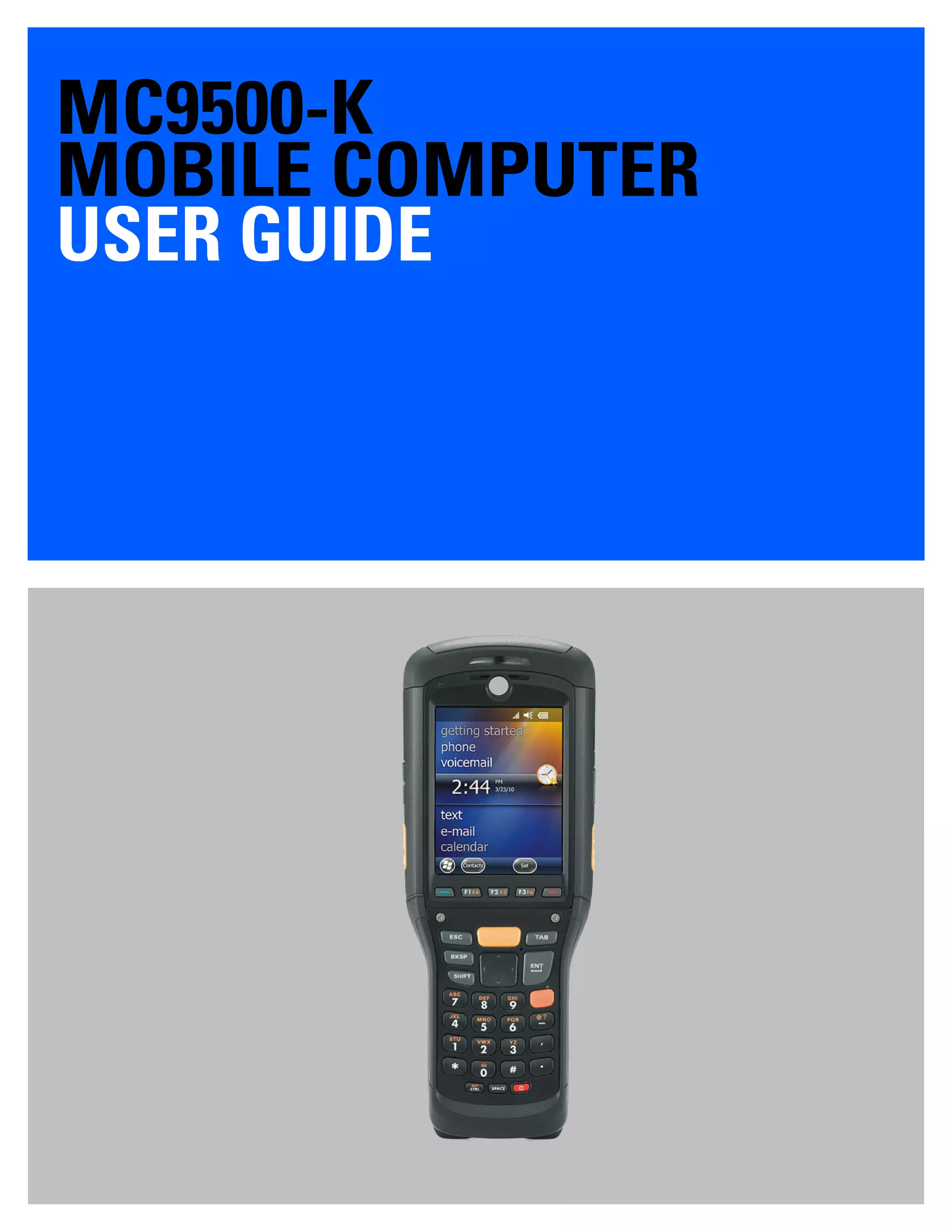
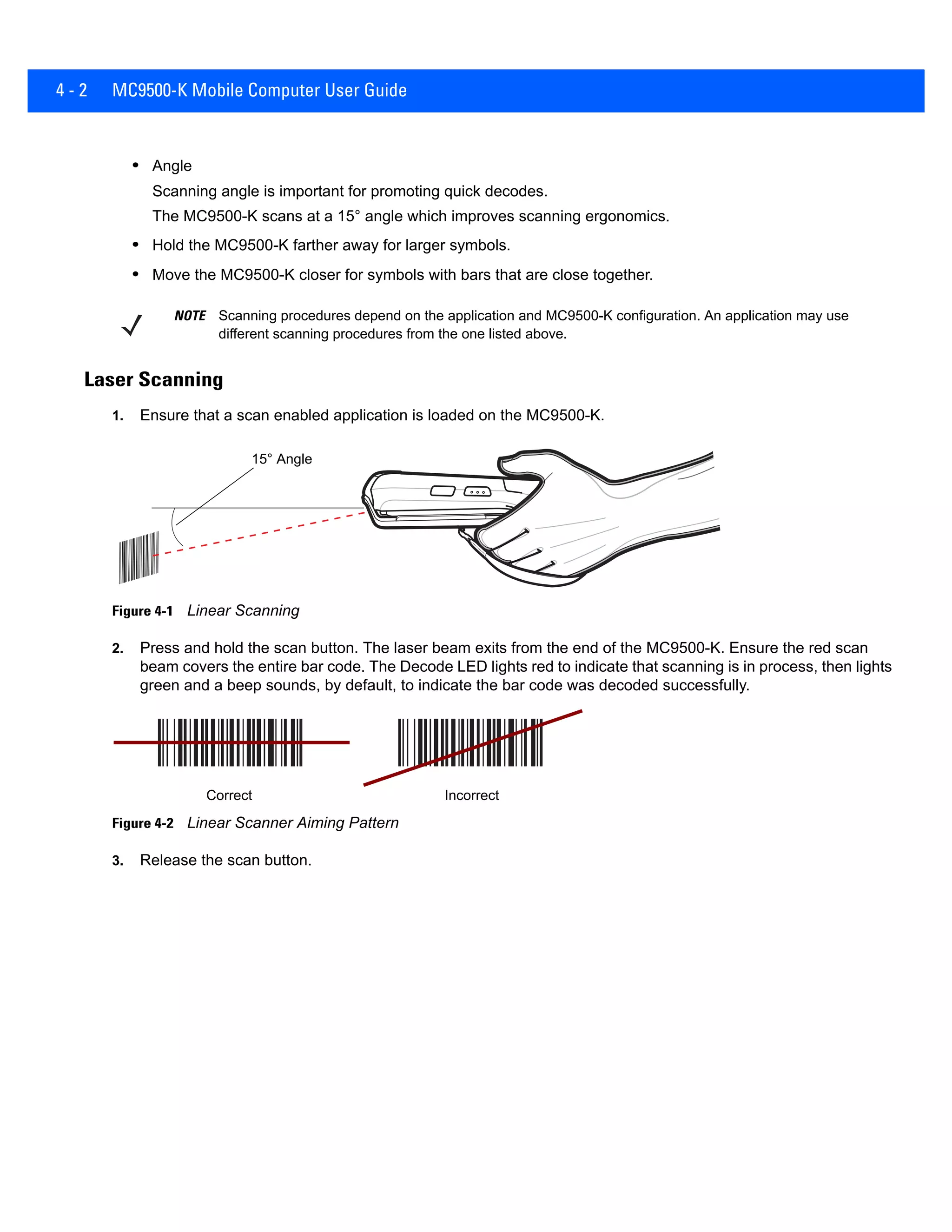
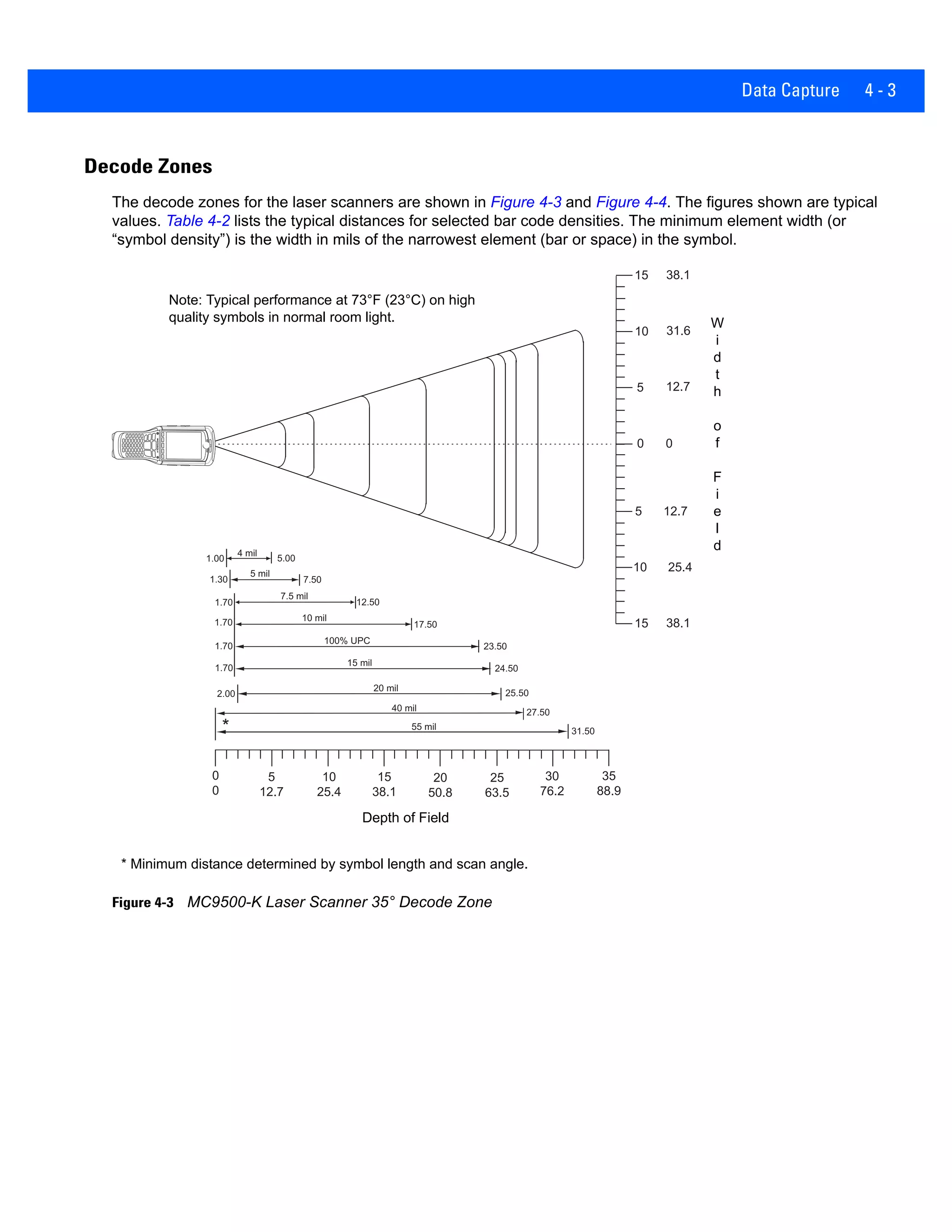
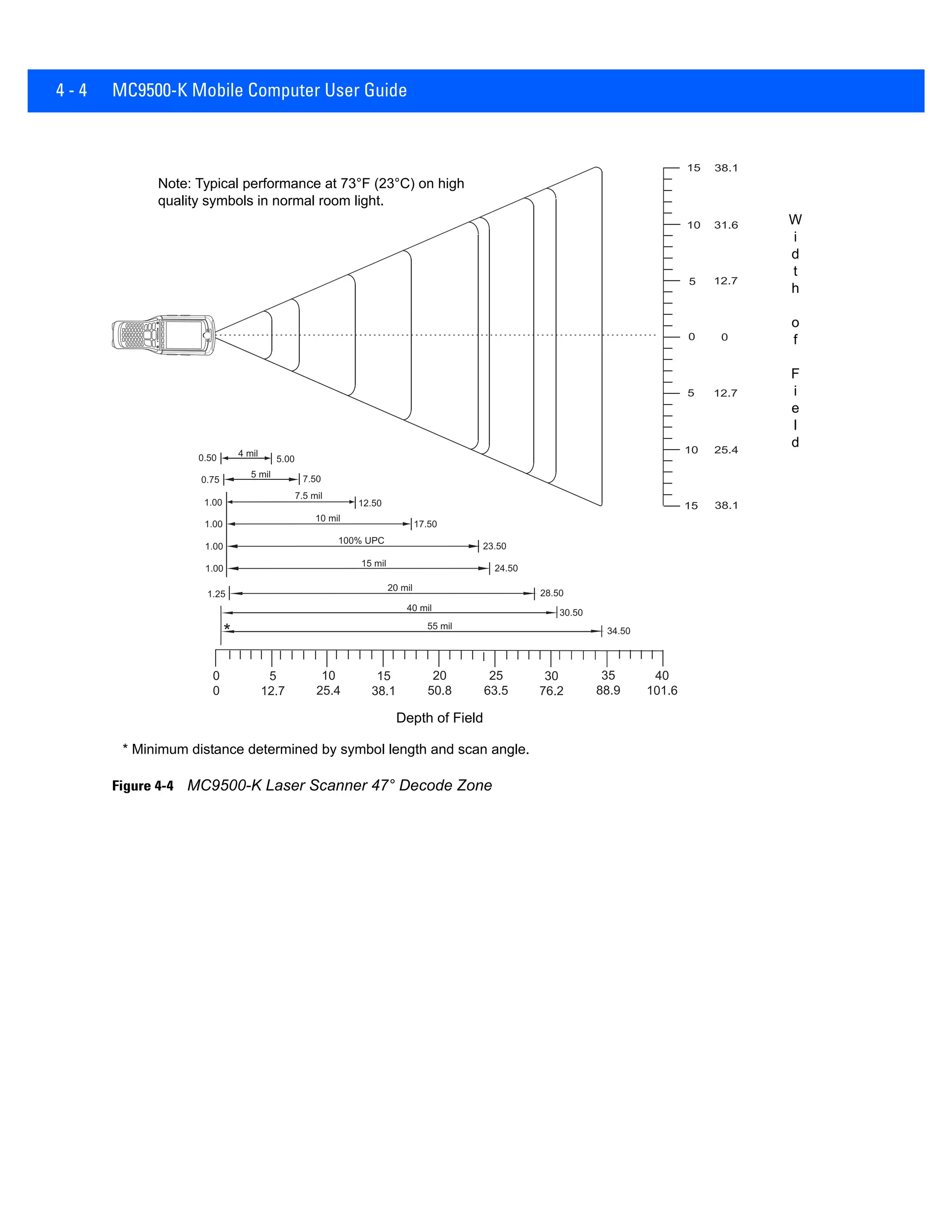
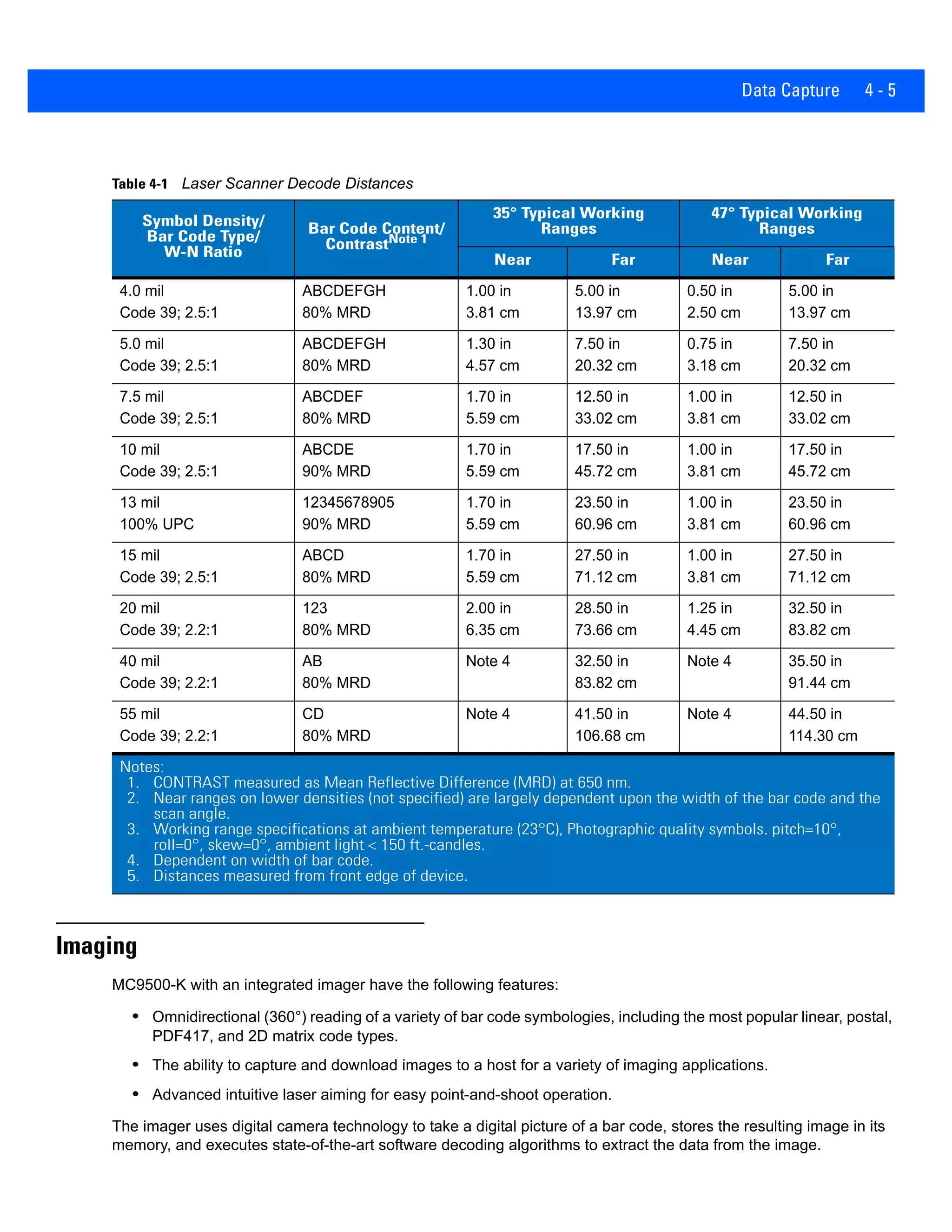
MC9500-K
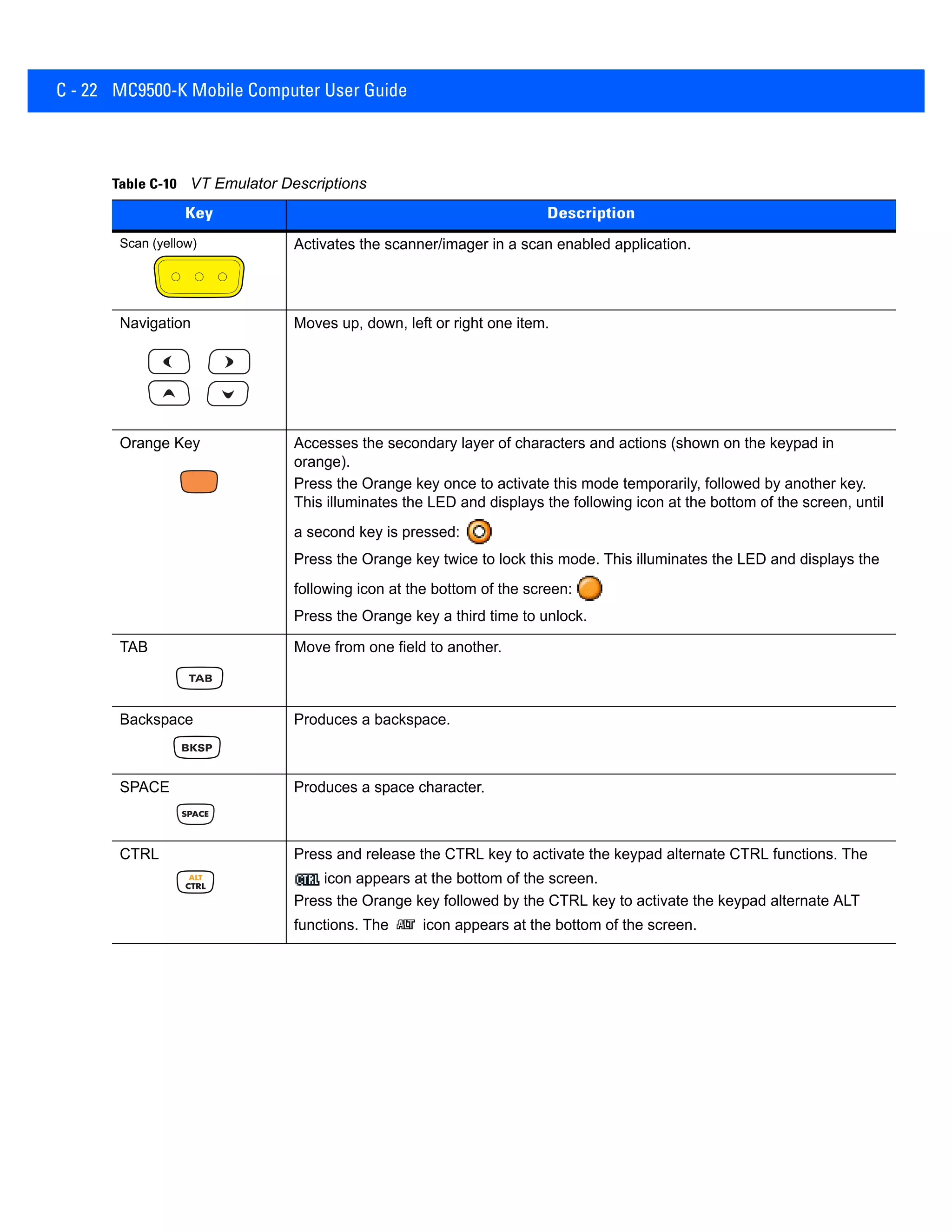
MOBILE COMPUTER
USER GUIDE
MC9500-K Mobile Computer
User Guide
72E-118501-05
Rev. A
April 2015
ii MC9500-K Mobile Computer User Guide
© 2015 ZIH Corp.
No part of this publication may be reproduced or used in any form, or by any electrical or mechanical means,
without permission in writing from Zebra. This includes electronic or mechanical means, such as photocopying,
recording, or information storage and retrieval systems. The material in this manual is subject to change
without notice.
The software is provided strictly on an “as is” basis. All software, including firmware, furnished to the user is on
a licensed basis. Zebra grants to the user a non-transferable and non-exclusive license to use each software
or firmware program delivered hereunder (licensed program). Except as noted below, such license may not be
assigned, sublicensed, or otherwise transferred by the user without prior written consent of Zebra. No right to
copy a licensed program in whole or in part is granted, except as permitted under copyright law. The user shall
not modify, merge, or incorporate any form or portion of a licensed program with other program material, create
a derivative work from a licensed program, or use a licensed program in a network without written permission
from Zebra. The user agrees to maintain Zebra’s copyright notice on the licensed programs delivered
hereunder, and to include the same on any authorized copies it makes, in whole or in part. The user agrees not
to decompile, disassemble, decode, or reverse engineer any licensed program delivered to the user or any
portion thereof.
Zebra reserves the right to make changes to any software or product to improve reliability, function, or design.
Zebra does not assume any product liability arising out of, or in connection with, the application or use of any
product, circuit, or application described herein.
No license is granted, either expressly or by implication, estoppel, or otherwise under any Zebra intellectual
property rights. An implied license only exists for equipment, circuits, and subsystems contained in Zebra
products.
iii
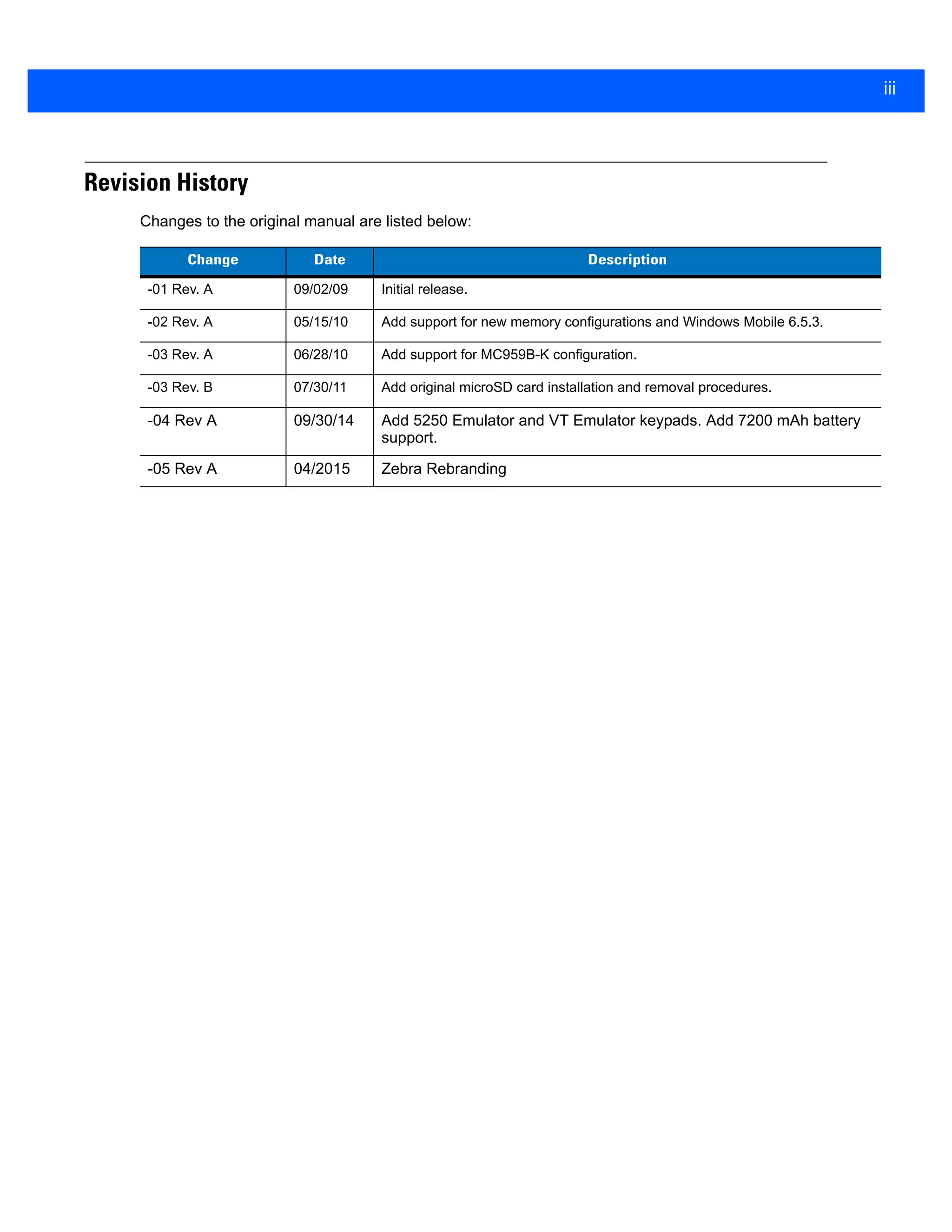
Revision History
Changes to the original manual are listed below:
Change Date Description
-01 Rev. A 09/02/09 Initial release.
-02 Rev. A 05/15/10 Add support for new memory configurations and Windows Mobile 6.5.3.
-03 Rev. A 06/28/10 Add support for MC959B-K configuration.
-03 Rev. B 07/30/11 Add original microSD card installation and removal procedures.
-04 Rev A 09/30/14 Add 5250 Emulator and VT Emulator keypads. Add 7200 mAh battery
support.
-05 Rev A 04/2015 Zebra Rebranding
iv MC9500-K Mobile Computer User Guide
Table of Contents
Revision History.................................................................................................................................... iii
About This Guide
Introduction........................................................................................................................................... xiii
Documentation Set ......................................................................................................................... xiii
Configurations....................................................................................................................................... xiv
Keypads.......................................................................................................................................... xiv
Software Versions........................................................................................................................... xiv
Chapter Descriptions ............................................................................................................................ xvii
Notational Conventions......................................................................................................................... xvii
Related Documents .............................................................................................................................. xviii
Service Information............................................................................................................................... xviii
Chapter 1: Getting Started
Introduction .......................................................................................................................................... 1-1
Unpacking ............................................................................................................................................ 1-1
Part of the MC9500-K .......................................................................................................................... 1-2
Getting Started ..................................................................................................................................... 1-3
Installing a microSD Card .............................................................................................................. 1-3
Version 1 .................................................................................................................................. 1-3
Version 2 .................................................................................................................................. 1-4
Installing the SIM Card ................................................................................................................... 1-5
Installing the Battery ...................................................................................................................... 1-7
Charging the Battery ...................................................................................................................... 1-7
Charging Temperature ............................................................................................................. 1-9
Powering On the MC9500-K .......................................................................................................... 1-9
Calibrating the Screen ............................................................................................................. 1-9
Replacing the Battery .......................................................................................................................... 1-9
Removing the microSD Card ............................................................................................................... 1-10
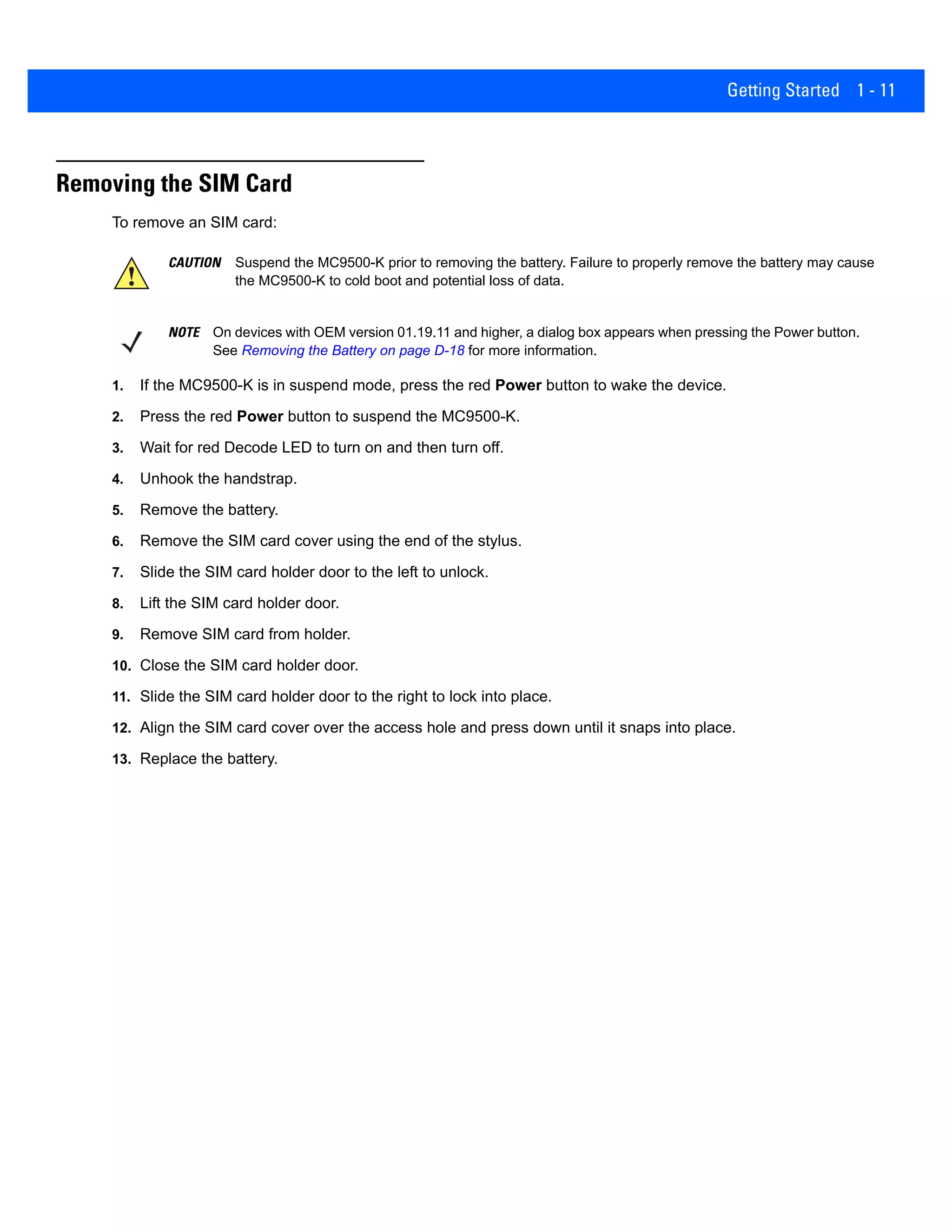
Removing the SIM Card ...................................................................................................................... 1-11
vi MC9500-K Mobile Computer User Guide
Chapter 2: Battery Management
Introduction .......................................................................................................................................... 2-1
Battery Functionality ............................................................................................................................ 2-1
Battery Health ................................................................................................................................ 2-2
Battery Status ...................................................................................................................................... 2-3
Installed in an MC9500-K ............................................................................................................... 2-3
In a Charger ................................................................................................................................... 2-5
Stand-alone .................................................................................................................................... 2-8
Charging the MC9500-K ...................................................................................................................... 2-9
Charging a Spare Battery .................................................................................................................... 2-11
Charging Temperature ................................................................................................................... 2-12
Power Saving Techniques ................................................................................................................... 2-13
Changing the Power Settings ........................................................................................................ 2-13
Changing the Backlight Settings .................................................................................................... 2-13
Changing the Keypad Backlight Settings ....................................................................................... 2-13
Turning Off the Radios ................................................................................................................... 2-13
Chapter 3: Using the MC9500-K
Introduction .......................................................................................................................................... 3-1
LED Indicators ..................................................................................................................................... 3-1
Resetting the MC9500-K ..................................................................................................................... 3-3
Performing a Warm Boot ............................................................................................................... 3-3
Performing a Cold Boot .................................................................................................................. 3-3
Waking the MC9500-K ......................................................................................................................... 3-3
Locking the MC9500-K ........................................................................................................................ 3-4
Keypad Locking ............................................................................................................................. 3-4
Password Locking .......................................................................................................................... 3-5
Keypads ............................................................................................................................................... 3-7
Function Buttons .................................................................................................................................. 3-7
Stylus ................................................................................................................................................... 3-7
Entering Data ....................................................................................................................................... 3-8
Interactive Sensor Technology ............................................................................................................ 3-9
Power Management ....................................................................................................................... 3-9
Display Orientation ......................................................................................................................... 3-9
Free Fall Detection ......................................................................................................................... 3-10
Today Screen ...................................................................................................................................... 3-11
Status Icons ......................................................................................................................................... 3-12
Programs ............................................................................................................................................. 3-14
Settings ................................................................................................................................................ 3-17
Adjusting Volume ................................................................................................................................. 3-20
Battery Status Indications .................................................................................................................... 3-21
Battery Reserve Options ................................................................................................................ 3-21
Main Battery Temperature Notifications ......................................................................................... 3-22
Using Voice-Over-IP ............................................................................................................................ 3-23
Infrared Connection ............................................................................................................................. 3-24
Exchanging Files using IR Connection .................................................................................... 3-24
Printing ................................................................................................................................................. 3-25
Table of Contents vii
Chapter 4: Data Capture
Introduction .......................................................................................................................................... 4-1
Laser Scanning .................................................................................................................................... 4-1
Scanning Considerations ............................................................................................................... 4-1
Laser Scanning .............................................................................................................................. 4-2
Decode Zones ................................................................................................................................ 4-3
Imaging ................................................................................................................................................ 4-5
Operational Modes ......................................................................................................................... 4-6
Imager Scanning ............................................................................................................................ 4-6
Imager Decode Ranges ................................................................................................................. 4-8
Color Digital Camera ........................................................................................................................... 4-9
Digital Camera Scanning ............................................................................................................... 4-9
Taking Photos ................................................................................................................................ 4-10
Recording Video ............................................................................................................................ 4-10
Viewing Photos and Videos ........................................................................................................... 4-11
Chapter 5: Using the Phone
Introduction .......................................................................................................................................... 5-1
Accessing the Phone Keypad .............................................................................................................. 5-1
Turning the Phone On and Off ............................................................................................................. 5-2
Audio Modes ........................................................................................................................................ 5-3
Using a Wired Headset .................................................................................................................. 5-3
Using a Bluetooth Headset ............................................................................................................ 5-4
Adjusting Audio Volume ................................................................................................................. 5-5
Hearing Aid Compatibility Setting ........................................................................................................ 5-5
Making a Call ....................................................................................................................................... 5-6
Using the Phone ............................................................................................................................ 5-6
Using Contacts ............................................................................................................................... 5-6
Creating an Outlook Contact .................................................................................................... 5-7
Editing an Outlook Contact ...................................................................................................... 5-7
Deleting a Contact ................................................................................................................... 5-8
Creating a SIM Contact ............................................................................................................ 5-8
Using Call History .......................................................................................................................... 5-8
Making a Speed Dial Call ............................................................................................................... 5-9
Making an Emergency Call .................................................................................................................. 5-10
Answering a Call .................................................................................................................................. 5-10
Incoming Call Features .................................................................................................................. 5-10
Smart Dialing ....................................................................................................................................... 5-11
Muting a Call ........................................................................................................................................ 5-12
Taking Notes ........................................................................................................................................ 5-12
Using Speed Dial ................................................................................................................................. 5-13
Adding a Speed Dial Entry ............................................................................................................. 5-13
Editing a Speed Dial Entry ............................................................................................................. 5-15
Deleting a Speed Dial Entry ........................................................................................................... 5-16
Using Call History ................................................................................................................................ 5-16
Managing Call History .................................................................................................................... 5-16
Changing the Call History View ............................................................................................... 5-17
Resetting the Recent Calls Counter ......................................................................................... 5-17
Deleting Call History Items by Call Date .................................................................................. 5-18
viii MC9500-K Mobile Computer User Guide
Deleting All Call History Items .................................................................................................. 5-18
Viewing Call Status .................................................................................................................. 5-18
Using the Call History Menu .................................................................................................... 5-19
Swapping Calls on an MC9596 ........................................................................................................... 5-20
Swapping Calls on an MC9598 ........................................................................................................... 5-20
Conference Calling on an MC9596 ...................................................................................................... 5-21
Three-way Calling on an MC9598 ....................................................................................................... 5-23
Text Messaging ................................................................................................................................... 5-24
Viewing Text Messages ................................................................................................................. 5-24
Sending a Text Message ............................................................................................................... 5-26
Establishing a GSM Data Connection (MC9596-K and MC959B-K) ................................................... 5-28
Ending a Data Connection ............................................................................................................. 5-29
Establishing an CDMA Data Connection (MC9598-K and MC959B-K) ............................................... 5-30
Ending a Data Connection ............................................................................................................. 5-31
Switching Carrier Networks ................................................................................................................. 5-31
Chapter 6: Using GPS Navigation
Introduction .......................................................................................................................................... 6-1
Software Installation ............................................................................................................................ 6-1
MC9500-K GPS Setup ......................................................................................................................... 6-1
Operation ............................................................................................................................................. 6-2
GPS Maps on microSD Cards ....................................................................................................... 6-2
Answering a Phone Call While Using GPS .................................................................................... 6-2
Losing the GPS Signal While in a Vehicle ..................................................................................... 6-2
Assisted GPS ....................................................................................................................................... 6-2
Chapter 7: Using Bluetooth
Introduction .......................................................................................................................................... 7-1
Adaptive Frequency Hopping .............................................................................................................. 7-1
Security ................................................................................................................................................ 7-2
Bluetooth Configuration ....................................................................................................................... 7-3
Bluetooth Power States ....................................................................................................................... 7-4
Cold Boot ................................................................................................................................. 7-4
Warm Boot ............................................................................................................................... 7-4
Suspend ................................................................................................................................... 7-4
Resume .................................................................................................................................... 7-5
Using Microsoft Bluetooth Stack .......................................................................................................... 7-5
Turning the Bluetooth Radio Mode On and Off .............................................................................. 7-5
Enabling Bluetooth ................................................................................................................... 7-5
Disabling Bluetooth .................................................................................................................. 7-6
Discovering Bluetooth Device(s) .................................................................................................... 7-6
Available Services .......................................................................................................................... 7-8
Object Push Services via Beam ............................................................................................... 7-9
Internet Sharing ....................................................................................................................... 7-10
Hands-free Services ................................................................................................................ 7-11
Serial Port Services ................................................................................................................. 7-12
ActiveSync Using Serial Port Services .................................................................................... 7-13
Phone Book Access Profile Services ....................................................................................... 7-14
Table of Contents ix
Dial-Up Networking Services ................................................................................................... 7-15
Connect to a HID Device ......................................................................................................... 7-15
A2DP/AVRCP Services ........................................................................................................... 7-15
Using StoneStreet One Bluetooth Stack .............................................................................................. 7-17
Turning the Bluetooth Radio Mode On and Off .............................................................................. 7-17
Disabling Bluetooth .................................................................................................................. 7-17
Enabling Bluetooth ................................................................................................................... 7-17
Modes ............................................................................................................................................ 7-17
Wizard Mode ............................................................................................................................ 7-18
Explorer Mode .......................................................................................................................... 7-18
Discovering Bluetooth Device(s) .................................................................................................... 7-18
Available Services .......................................................................................................................... 7-21
File Transfer Services .............................................................................................................. 7-22
Connecting to the Internet Using an Access Point ................................................................... 7-24
Dial-Up Networking Services ................................................................................................... 7-24
Object Exchange Push Services .............................................................................................. 7-25
Headset Services ..................................................................................................................... 7-29
Hands-free Services ................................................................................................................ 7-30
Serial Port Services ................................................................................................................. 7-30
ActiveSync Using Serial Port Services .................................................................................... 7-31
Personal Area Network Services ............................................................................................. 7-32
IrMC Synchronization Services ................................................................................................ 7-32
A2DP/AVRCP Services ........................................................................................................... 7-32
Connect to a HID Device ......................................................................................................... 7-33
Bonding with Discovered Device(s) ............................................................................................... 7-34
Bluetooth Settings .......................................................................................................................... 7-36
Device Info Tab ........................................................................................................................ 7-36
Services Tab ............................................................................................................................ 7-37
Security Tab ............................................................................................................................. 7-44
Discovery Tab .......................................................................................................................... 7-45
Virtual COM Port Tab ............................................................................................................... 7-45
HID Tab .................................................................................................................................... 7-46
Profiles Tab .............................................................................................................................. 7-47
System Parameters Tab .......................................................................................................... 7-48
Miscellaneous Tab ................................................................................................................... 7-48
Chapter 8: Accessories
Introduction .......................................................................................................................................... 8-1
Universal Accessory System ............................................................................................................... 8-3
Single Bay USB Cradle ........................................................................................................................ 8-4
Communication and Charging the MC9500-K Battery ................................................................... 8-4
Single Slot Battery Charger ................................................................................................................. 8-6
Charging the Battery ...................................................................................................................... 8-6
Four Bay Charge Only Cradle ............................................................................................................. 8-7
Charging ........................................................................................................................................ 8-7
Four Bay Ethernet Cradle .................................................................................................................... 8-9
Communication and Charging ....................................................................................................... 8-9
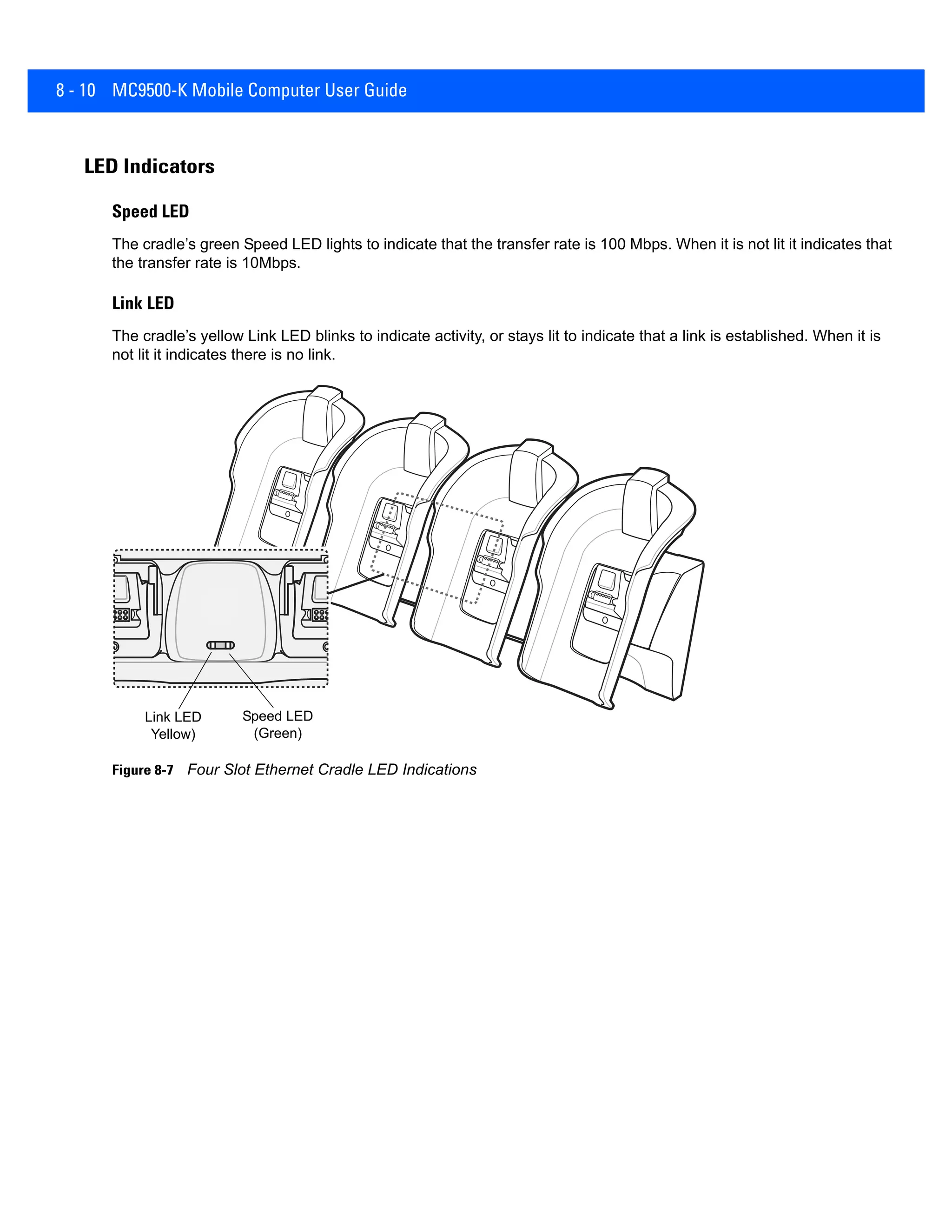
LED Indicators ............................................................................................................................... 8-10
Speed LED ............................................................................................................................... 8-10
x MC9500-K Mobile Computer User Guide
Link LED .................................................................................................................................. 8-10
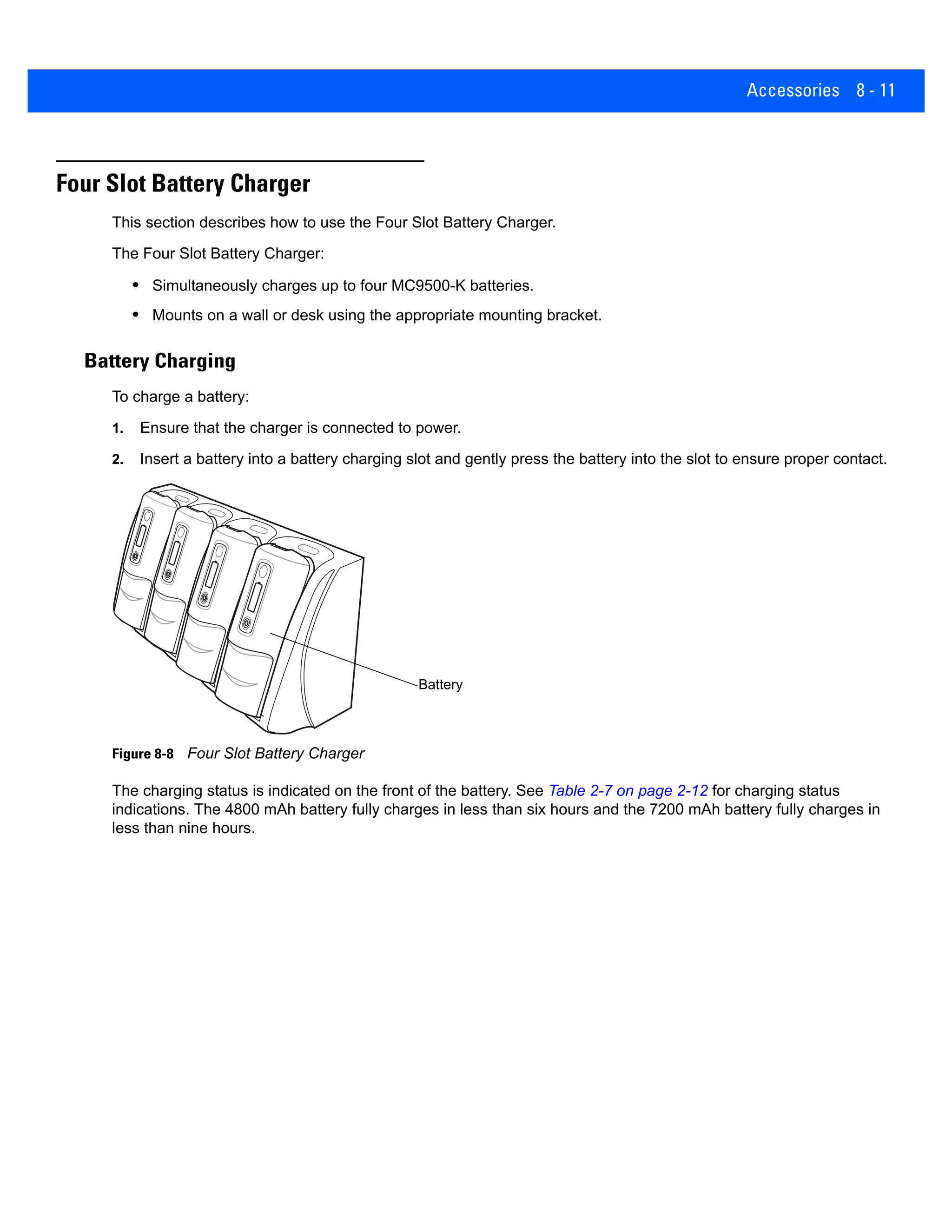
Four Slot Battery Charger .................................................................................................................... 8-11
Battery Charging ............................................................................................................................ 8-11
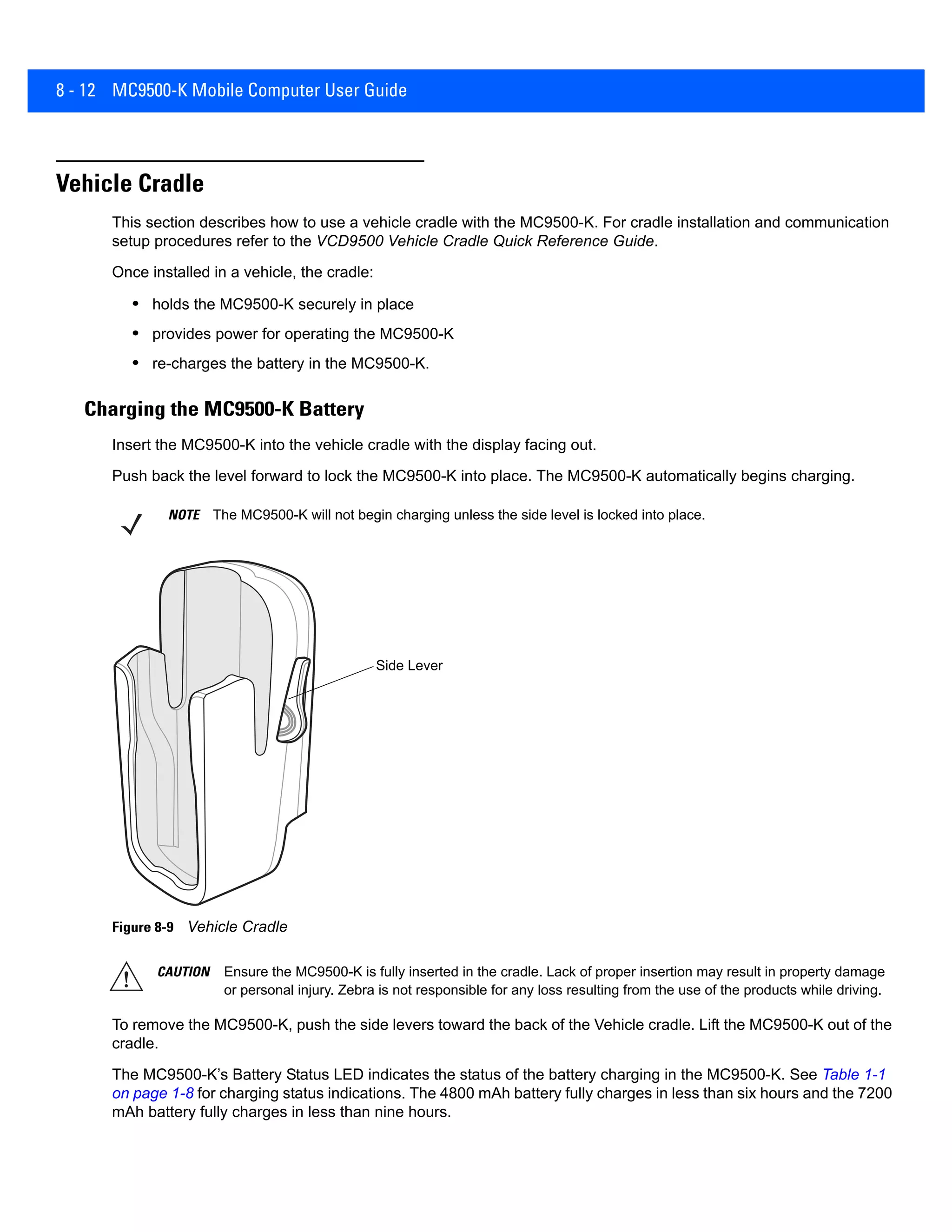
Vehicle Cradle ..................................................................................................................................... 8-12
Charging the MC9500-K Battery .................................................................................................... 8-12
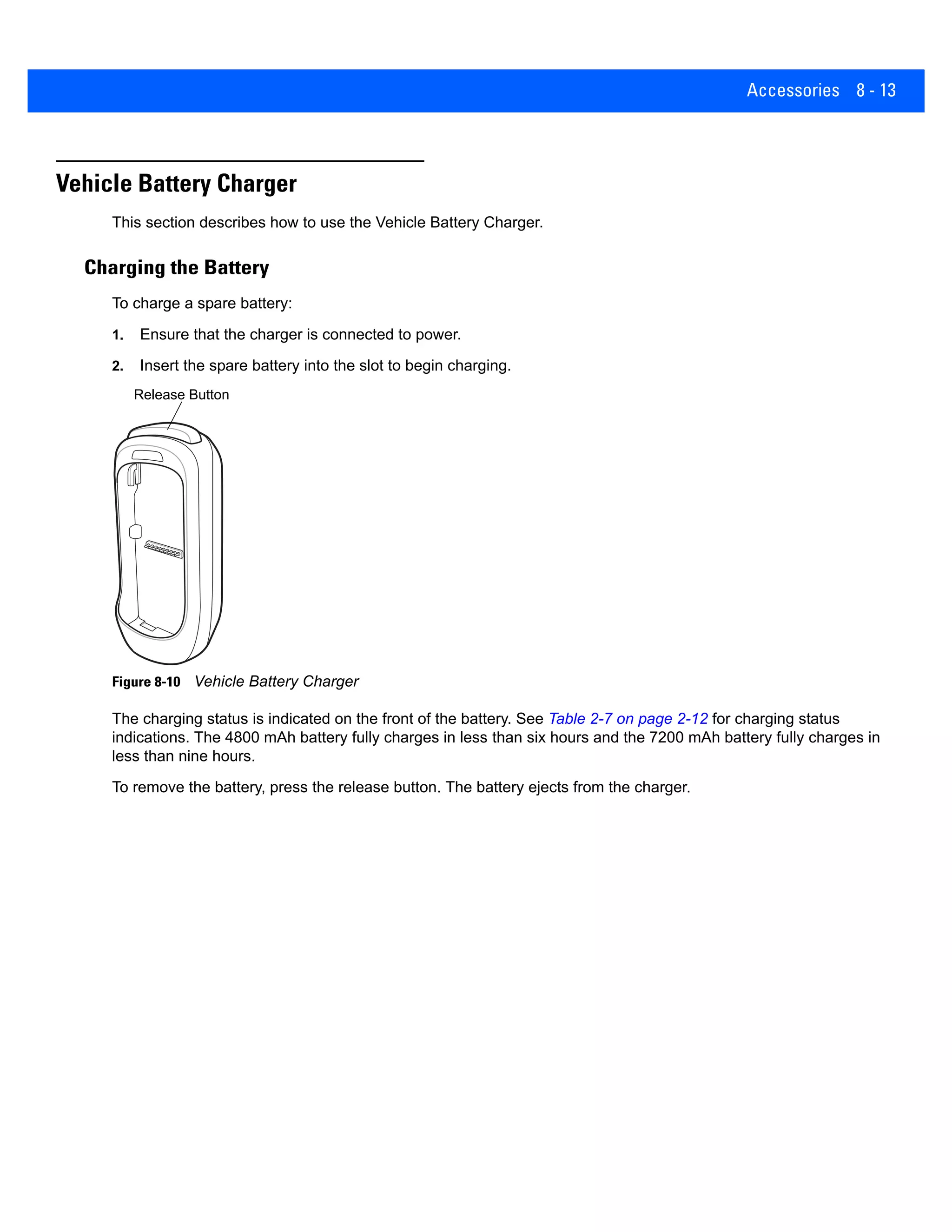
Vehicle Battery Charger ....................................................................................................................... 8-13
Charging the Battery ...................................................................................................................... 8-13
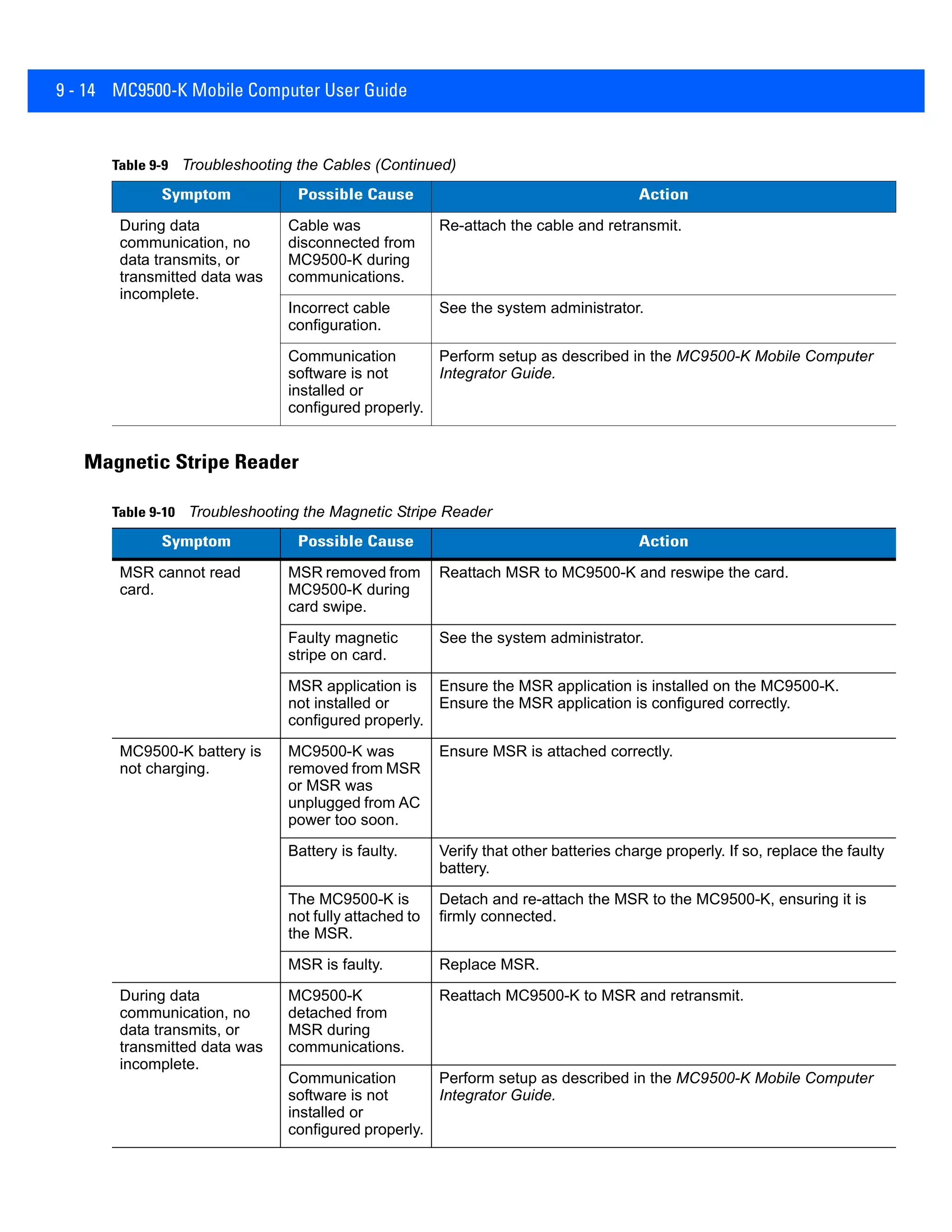
Magnetic Stripe Reader ....................................................................................................................... 8-14
Attaching and Removing the MSR ................................................................................................. 8-14
Using the MSR ............................................................................................................................... 8-14
Cables .................................................................................................................................................. 8-16
Battery Charging and Operating Power ......................................................................................... 8-17
Chapter 9: Maintenance & Troubleshooting
Introduction .......................................................................................................................................... 9-1
Maintaining the MC9500-K .................................................................................................................. 9-1
Removing the Screen Protector ........................................................................................................... 9-2
Battery Safety Guidelines .................................................................................................................... 9-2
Cleaning ............................................................................................................................................... 9-3
Materials Required ......................................................................................................................... 9-3
Cleaning the MC9500-K ................................................................................................................. 9-4
Housing .................................................................................................................................... 9-4
Display ..................................................................................................................................... 9-4
Scanner Exit Window ............................................................................................................... 9-4
Interface Connector ................................................................................................................. 9-4
Battery Contacts ...................................................................................................................... 9-4
Cleaning Cradle Connectors .......................................................................................................... 9-5
Cleaning Frequency ....................................................................................................................... 9-5
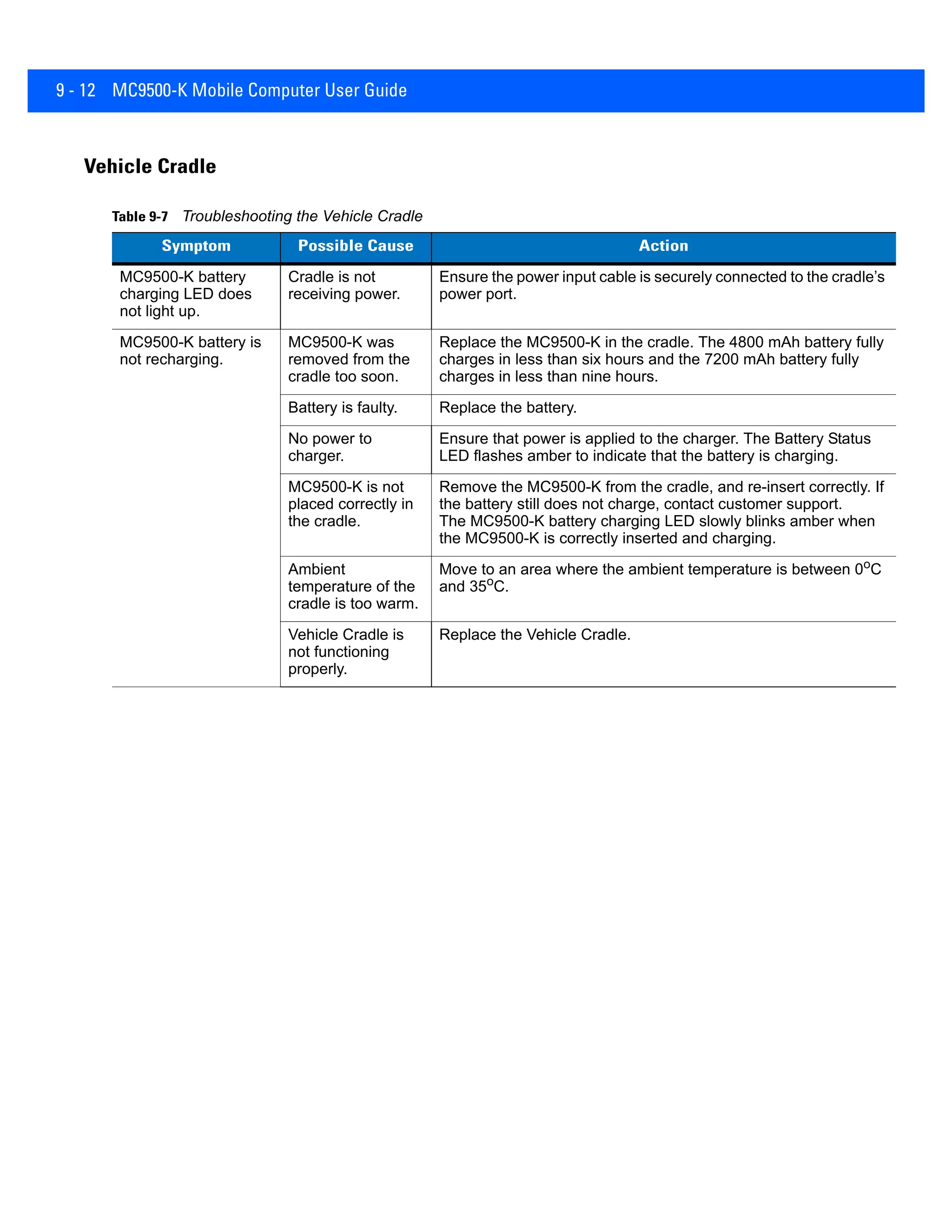
Troubleshooting ................................................................................................................................... 9-6
MC9500-K ...................................................................................................................................... 9-6
Bluetooth Connection ..................................................................................................................... 9-8
Single Bay USB Cradle ................................................................................................................. 9-9
Single Slot Battery Charger ........................................................................................................... 9-10
Four Bay Ethernet Cradle .............................................................................................................. 9-10
Four Bay Charge Only Cradle ........................................................................................................ 9-11
Vehicle Cradle ................................................................................................................................ 9-12
Four Slot Battery Charger .............................................................................................................. 9-13
Cables ............................................................................................................................................ 9-13
Magnetic Stripe Reader ................................................................................................................. 9-14
Appendix A: Technical Specifications
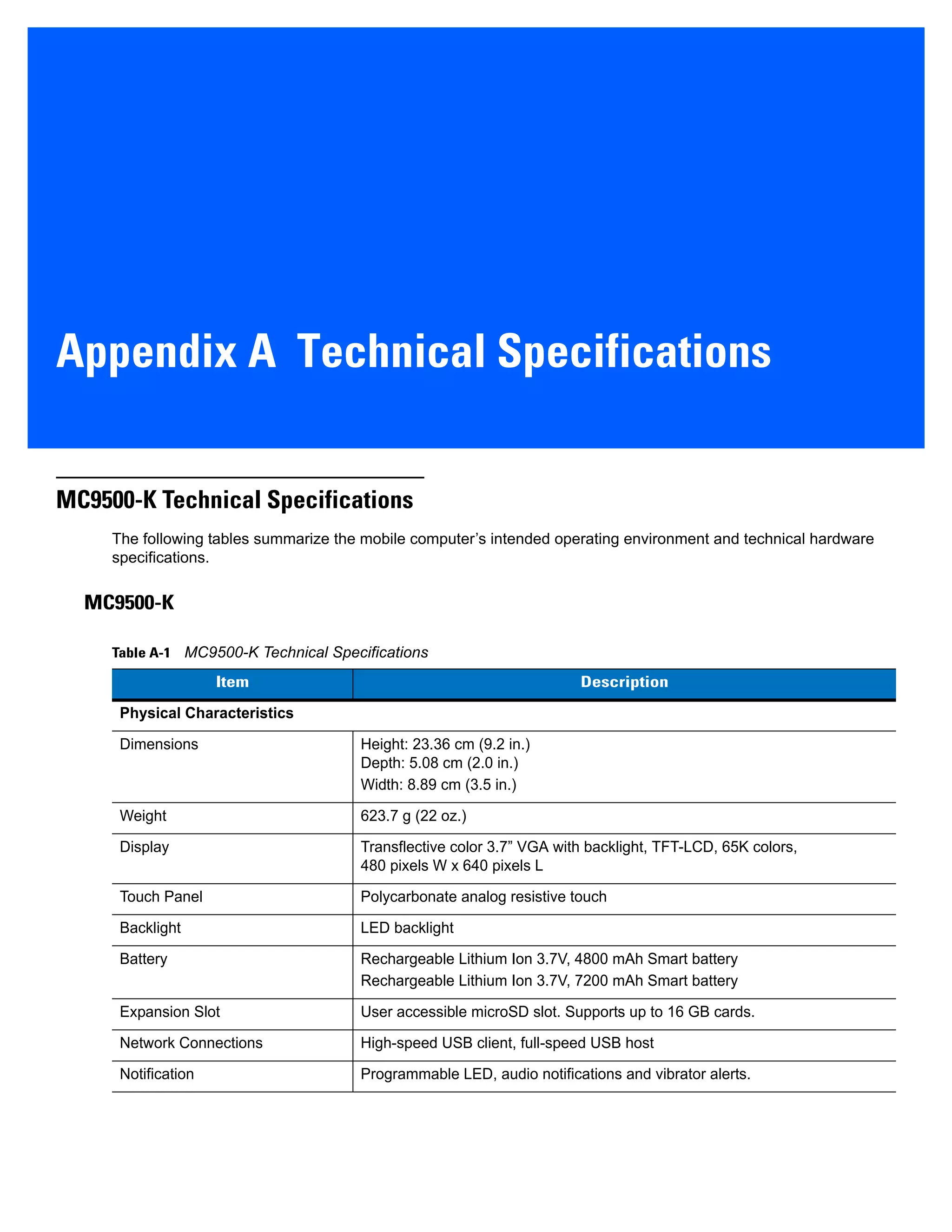
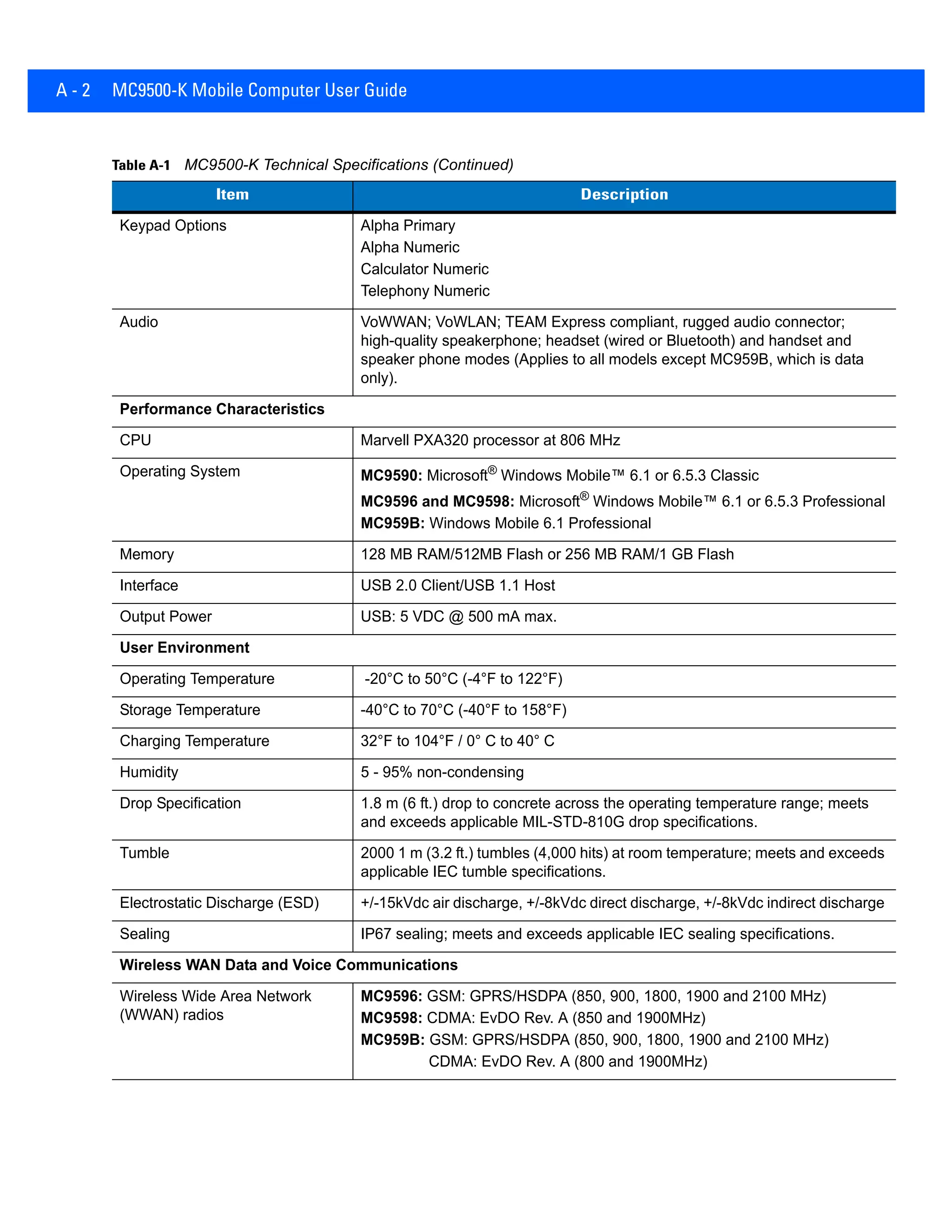
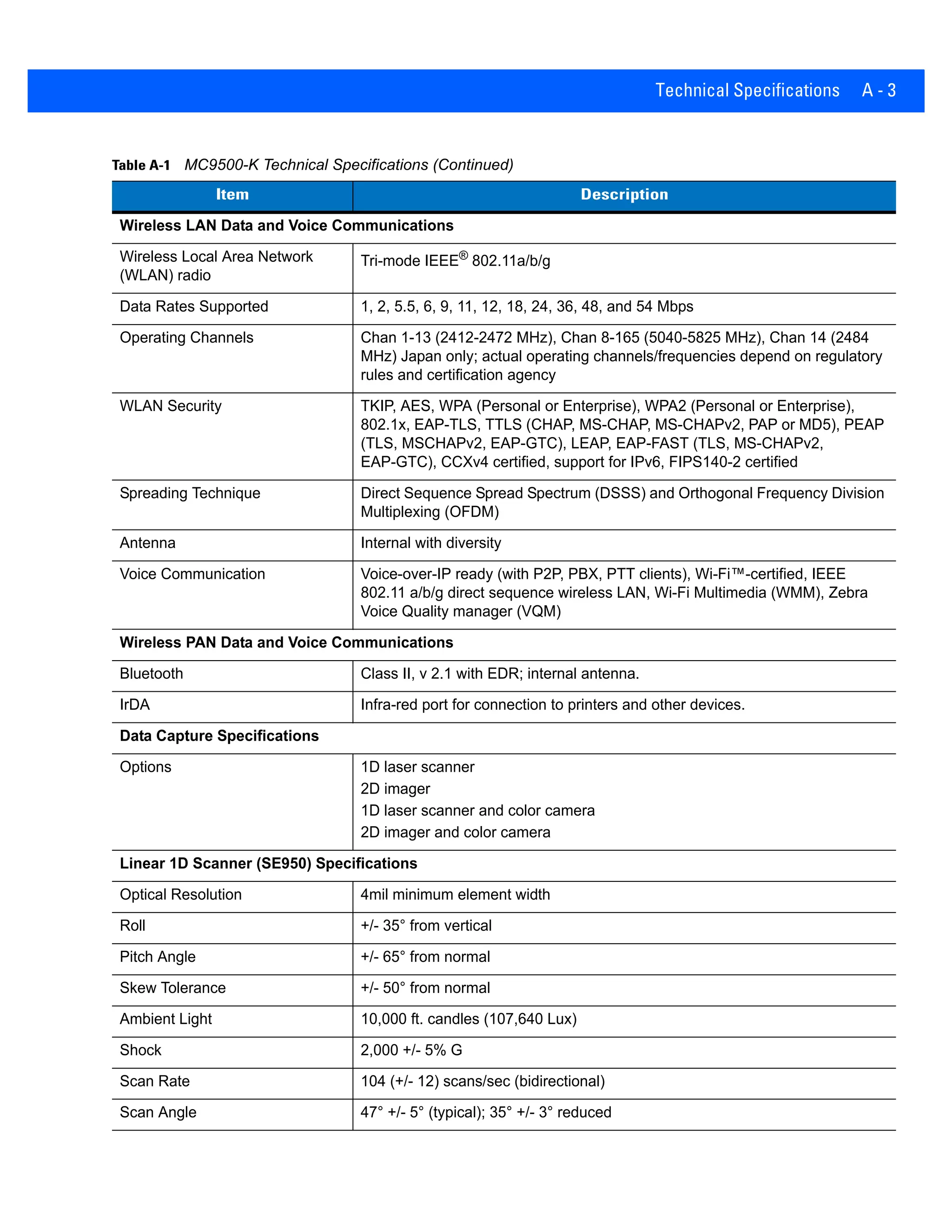
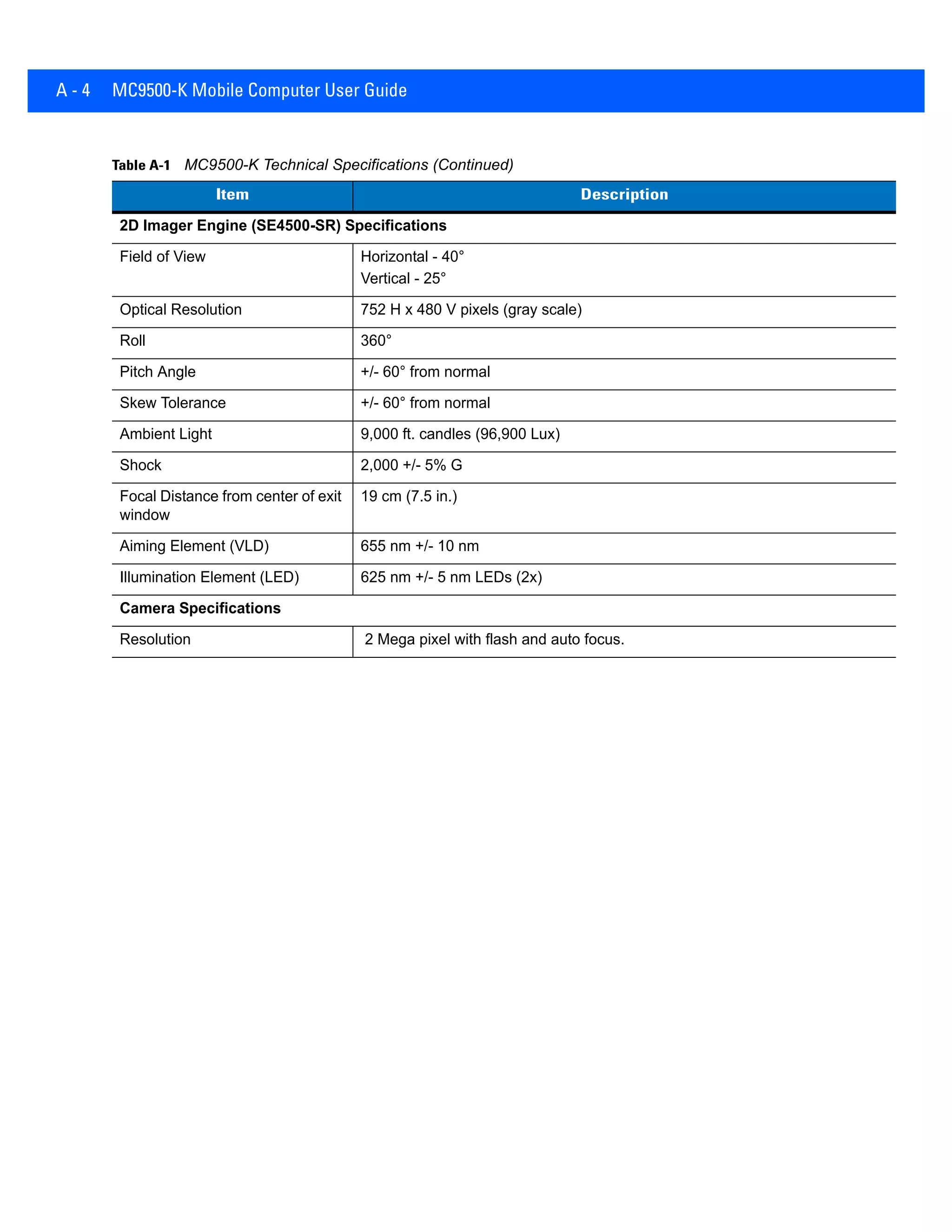
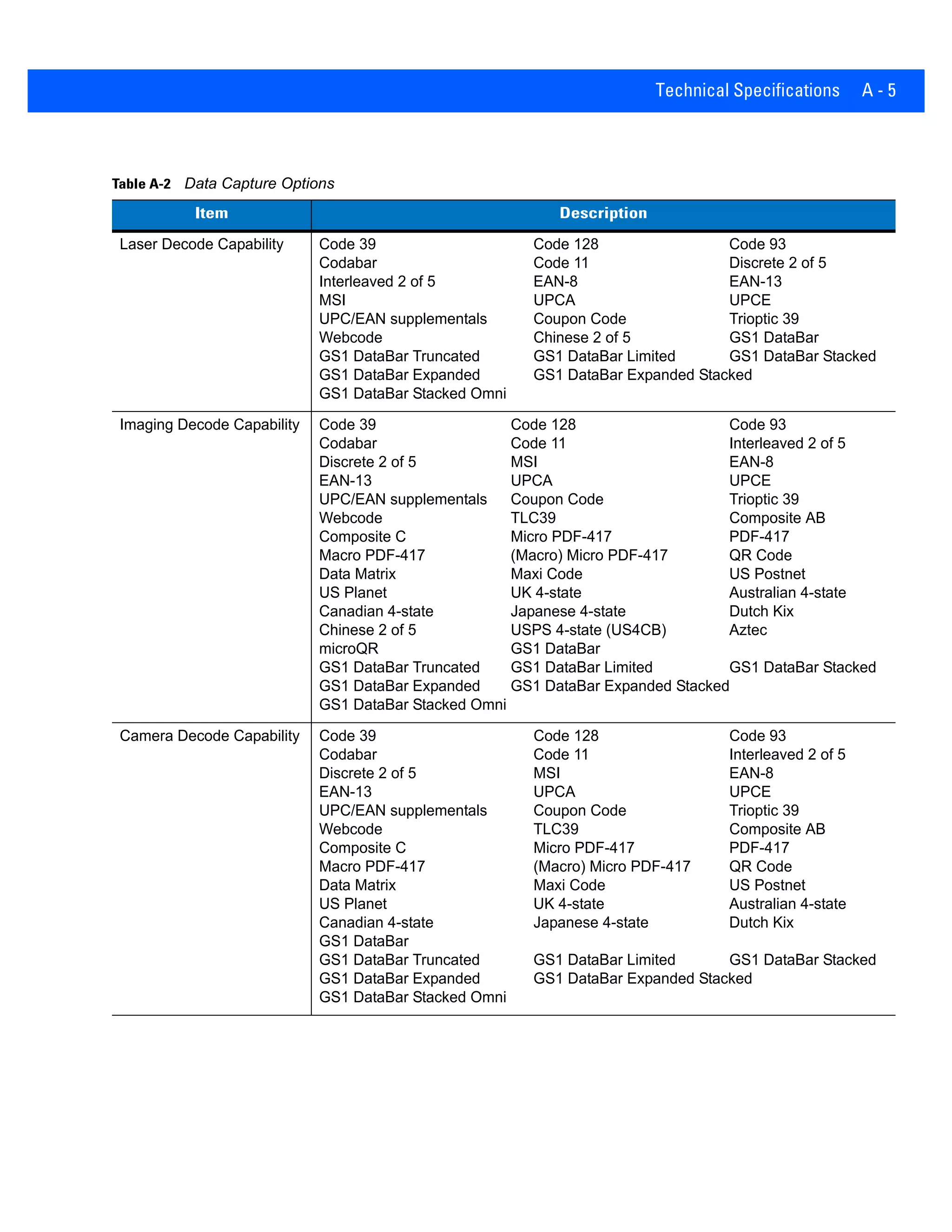
MC9500-K Technical Specifications .................................................................................................... A-1
MC9500-K ...................................................................................................................................... A-1
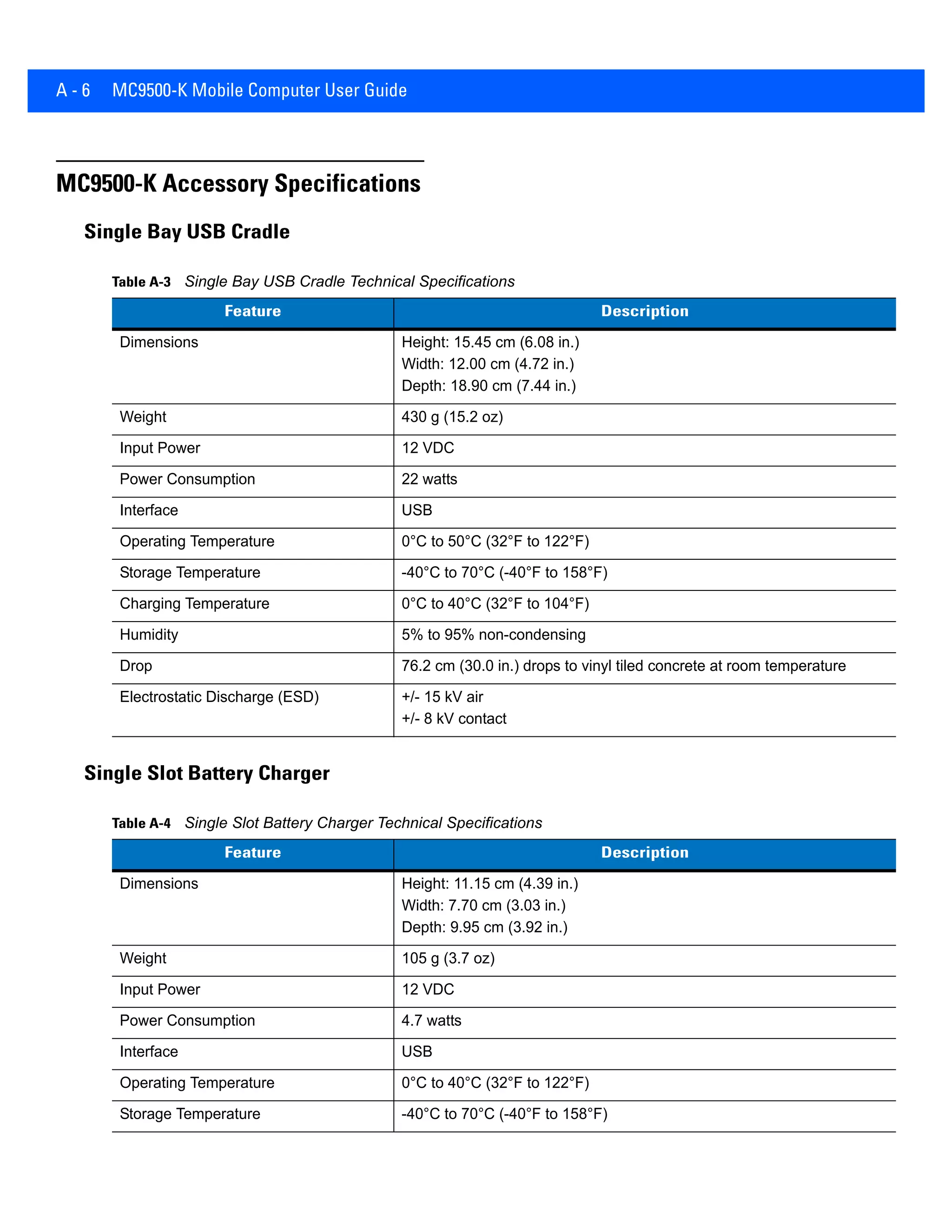
MC9500-K Accessory Specifications ................................................................................................... A-7
Single Bay USB Cradle .................................................................................................................. A-7
Single Slot Battery Charger ........................................................................................................... A-7
Four Bay Ethernet Cradle .............................................................................................................. A-8
Four Bay Charge Only Cradle ........................................................................................................ A-9
Table of Contents xi
Four Slot Battery Charger .............................................................................................................. A-9
Magnetic Stripe Reader ................................................................................................................. A-10
Vehicle Cradle ................................................................................................................................ A-11
Vehicle Battery Charger ................................................................................................................. A-11
Appendix B: Voice Quality Manager
Introduction .......................................................................................................................................... B-1
Features ............................................................................................................................................... B-1
Enabling VQM ...................................................................................................................................... B-1
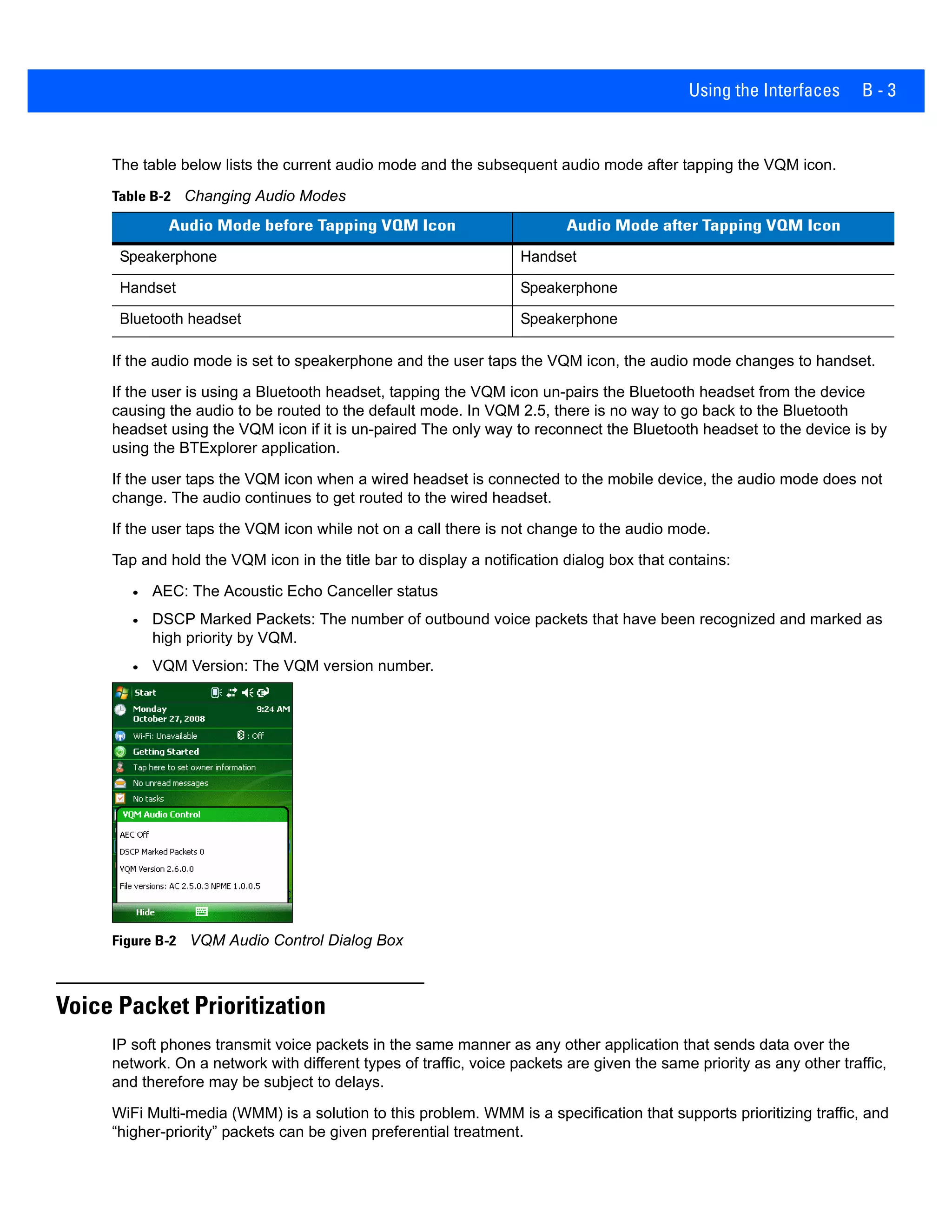
Audio Modes ........................................................................................................................................ B-2
Changing Audio Modes .................................................................................................................. B-2
Voice Packet Prioritization ................................................................................................................... B-3
Limitations ...................................................................................................................................... B-4
Acoustic Echo Cancellation ............................................................................................................ B-4
Disabling VQM ..................................................................................................................................... B-4
Appendix C: Keypads
Introduction .......................................................................................................................................... C-1
Alpha Primary Keypad ......................................................................................................................... C-2
Alpha Numeric Keypad ........................................................................................................................ C-6
Calculator Numeric Keypad ................................................................................................................. C-10
Telephony Numeric Keypad ................................................................................................................ C-14
Special Character Key ......................................................................................................................... C-18
Appendix D: Windows Mobile 6.5
Introduction .......................................................................................................................................... D-1
Finger Scrolling .................................................................................................................................... D-1
Home Screen ....................................................................................................................................... D-1
Classic Today Screen .................................................................................................................... D-3
Status Bar ...................................................................................................................................... D-5
Tile Bar ........................................................................................................................................... D-8
Start Screen ................................................................................................................................... D-8
Speaker Icon .................................................................................................................................. D-14
Battery Icons .................................................................................................................................. D-14
Connectivity Icon ............................................................................................................................ D-14
Locking the MC9500-K ........................................................................................................................ D-15
Microsoft Locking ........................................................................................................................... D-15
Password Locking .......................................................................................................................... D-16
Using the RS507 Hands-free Imager ................................................................................................... D-18
Removing the Battery .......................................................................................................................... D-18
Battery Removal ............................................................................................................................ D-18
Suspend Mode ............................................................................................................................... D-19
Assisted GPS ....................................................................................................................................... D-19
Glossary
xii MC9500-K Mobile Computer User Guide
Index
About This Guide
Introduction
This guide provides information about using the MC9500-K mobile computers and accessories.
Documentation Set
The documentation set for the MC9500-K provides information for specific user needs, and includes:
• MC9500-K Quick Start Guide - describes how to get the MC9500-K mobile computer up and running.
• MC9500-K Mobile Computer User Guide - describes how to use the MC9500-K mobile computer.
• MC9500-K Mobile Computer Integrator Guide - describes how to set up the MC9500-K mobile computer
and accessories.
• Microsoft®
Applications for Windows Mobile®
6 User Guide - describes how to use Microsoft developed
applications.
• Application Guide - describes how to use Enterprise Mobility developed sample applications.
• Enterprise Mobility Developer Kit (EMDK) Help File - provides API information for writing applications.
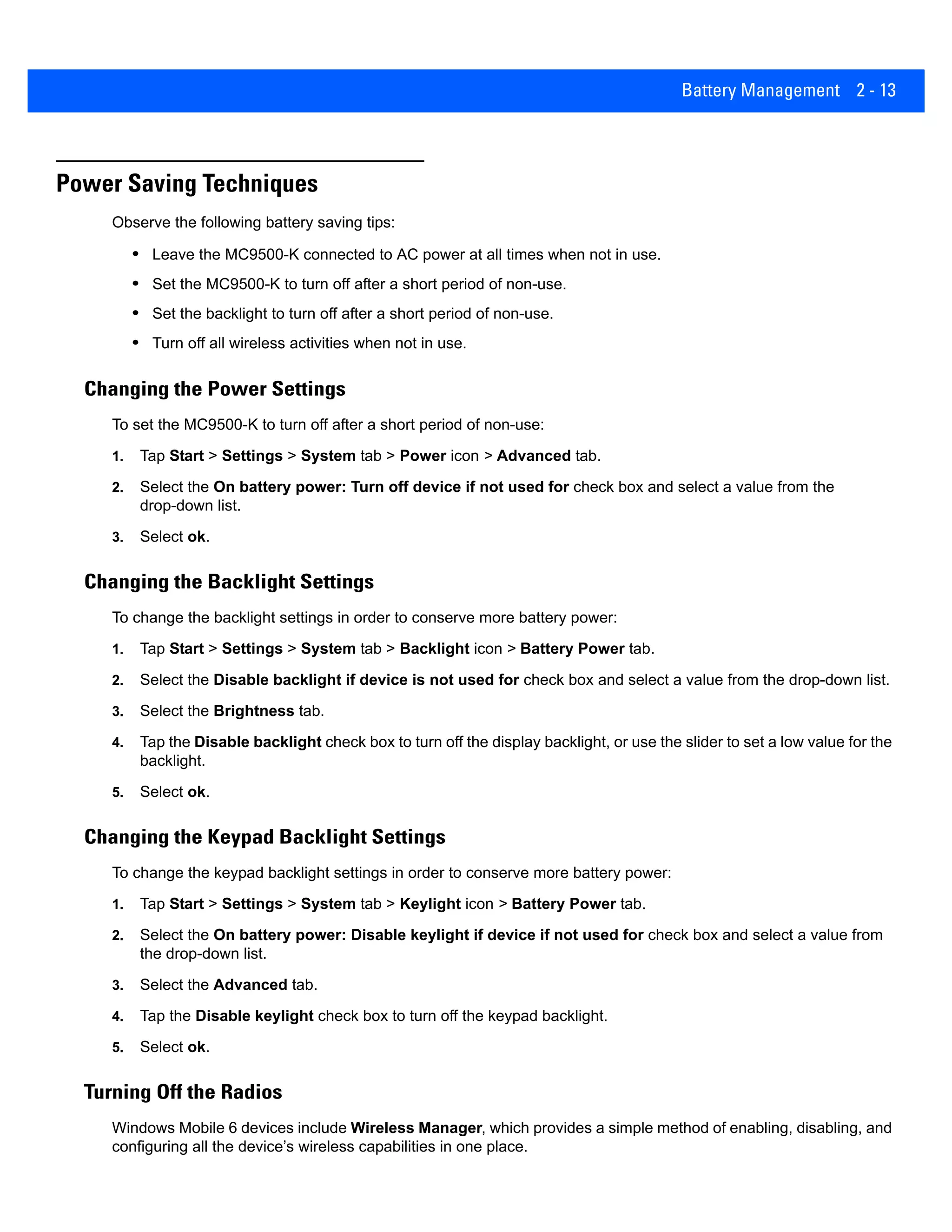
NOTE Screens and windows pictured in this guide are samples and can differ from actual screens.
For configurations with OEM version 02.27.000X and Windows Mobile 6.5 operating system, refer to
Appendix D, Windows Mobile 6.5 for information about new features.
xiv MC9500-K Mobile Computer User Guide
Configurations
This guide covers the following configurations:
Keypads
The following keypads are available:
• Alpha Primary
• Telephony Numeric
• Calculator Numeric
• Alpha Numeric
• 5350 Emulator
• VT Emulator.
See Appendix C, Keypads for specific keypad information.
Configuration Radios Display Memory
Data Capture
Options
Operating
System Keypads
MC9590 WLAN: 802.11 a/b/g
WPAN: Bluetooth
v2.1 with EDR
GPS: SiRF III
3.7” VGA
Color
128 MB RAM/
512 MB Flash
or 256 MB
RAM/1 GB
Flash
1D laser
scanner,
2D imager,
1D laser
scanner and
camera or
2D imager and
camera
Windows
Mobile®
6.X
Classic
See Keypads
below.
MC9596 WLAN: 802.11a/b/g
WPAN: Bluetooth
v2.1 with EDR
WWAN: HSDPA
GPS: SiRF III
3.7” VGA
Color
128 MB RAM/
512 MB Flash
or 256 MB
RAM/1 GB
Flash
1D laser
scanner,
2D imager,
1D laser
scanner and
camera or
2D imager and
camera
Windows
Mobile®
6.X
Professional
See Keypads
below.
MC9598 WLAN: 802.11a/b/g
WPAN: Bluetooth
v2.1 with EDR
WWAN: EvDO Rev.
A
GPS: SiRF III
3.7” VGA
Color
128 MB RAM/
512 MB Flash
or 256 MB
RAM/1 GB
Flash
1D laser
scanner,
2D imager,
1D laser
scanner and
camera or
2D imager and
camera
Windows
Mobile® 6.X
Professional
See Keypads
below.
MC959B WLAN: 802.11a/b/g
WPAN: Bluetooth
v2.1 with EDR
WWAN: CDMA or
GSM Data
GPS: SiRF III
3.7” VGA
Color
256 MB
RAM/1 GB
Flash
1D laser
scanner,
2D imager,
1D laser
scanner and
camera or
2D imager and
camera
Windows
Mobile®
6.1
Professional
See Keypads
below.
About This Guide xv
Software Versions
This guide covers various software configurations and references are made to operating system or software
versions for:
• Adaptation Kit Update (AKU) version
• OEM version
• BTExplorer version
• Fusion version
• Phone version.
AKU Version
To determine the Adaptation Kit Update (AKU) version:
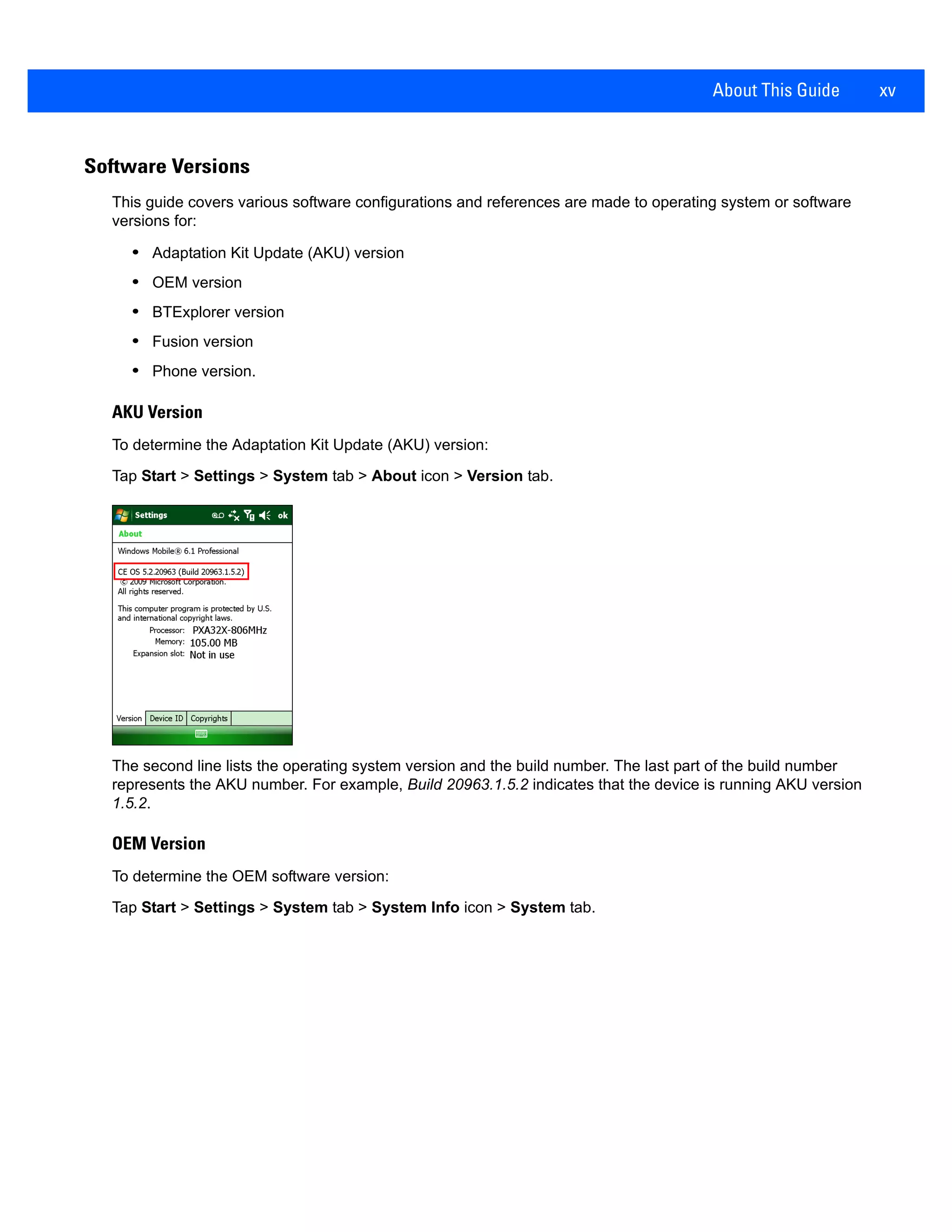
Tap Start > Settings > System tab > About icon > Version tab.
The second line lists the operating system version and the build number. The last part of the build number
represents the AKU number. For example, Build 20963.1.5.2 indicates that the device is running AKU version
1.5.2.
OEM Version
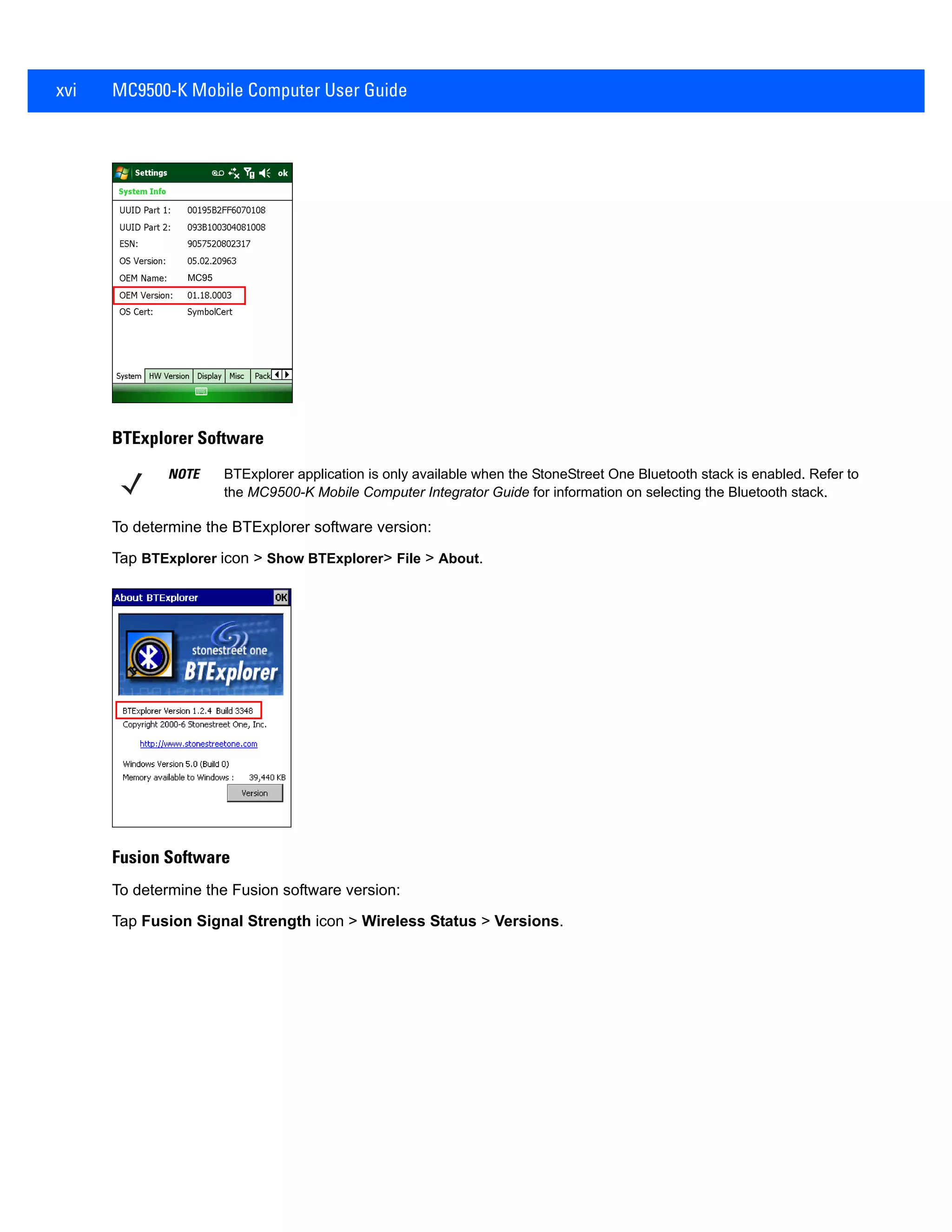
To determine the OEM software version:
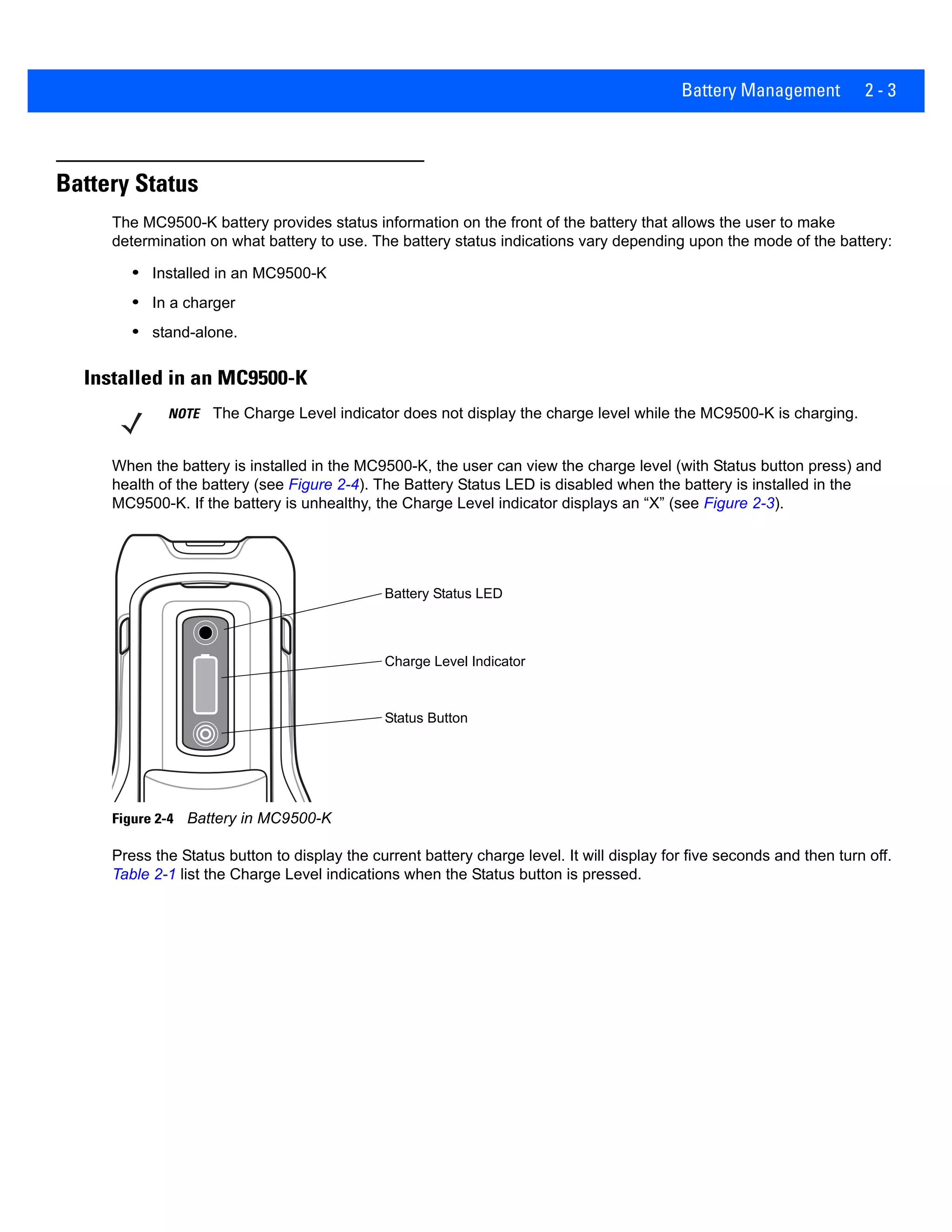
Tap Start > Settings > System tab > System Info icon > System tab.
xvi MC9500-K Mobile Computer User Guide
BTExplorer Software
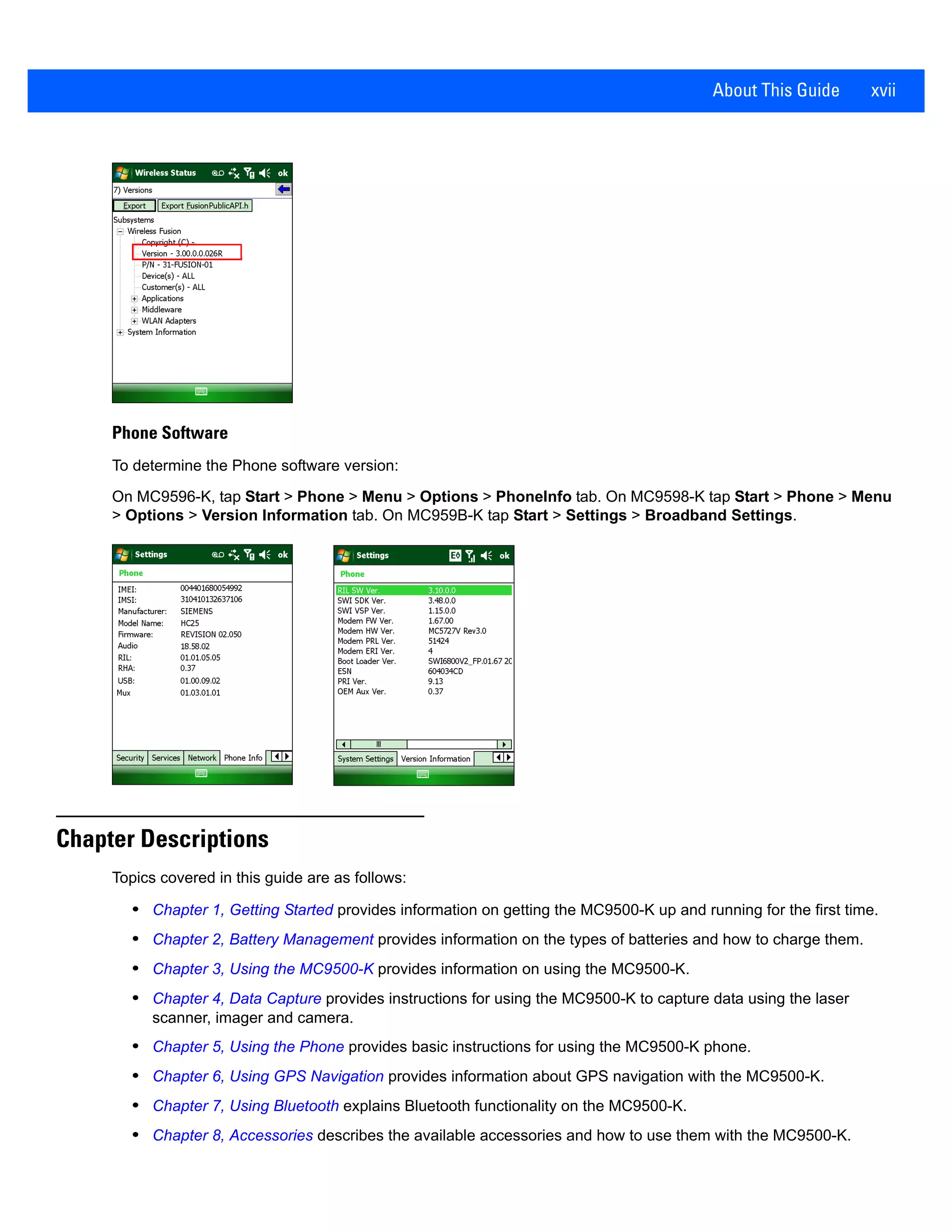
To determine the BTExplorer software version:
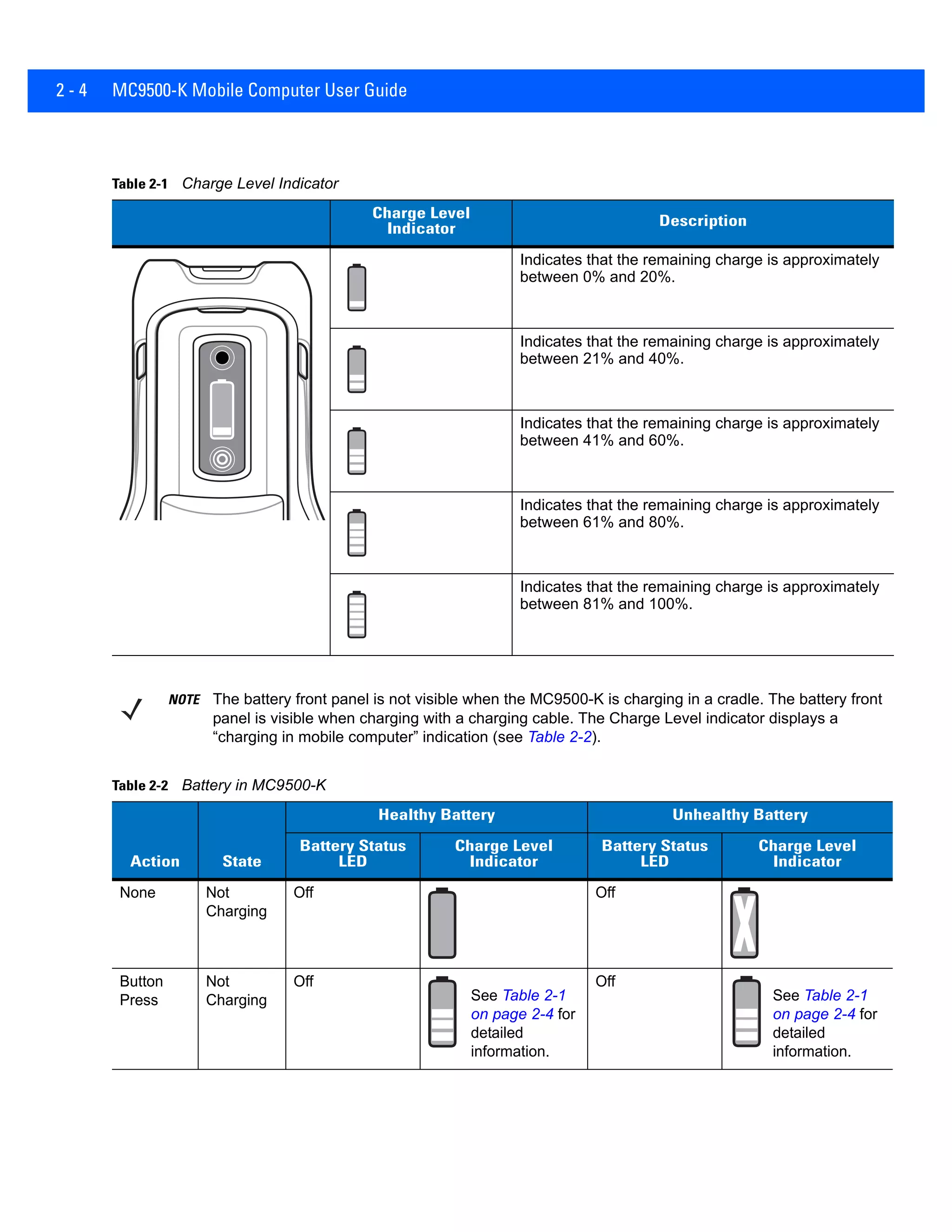
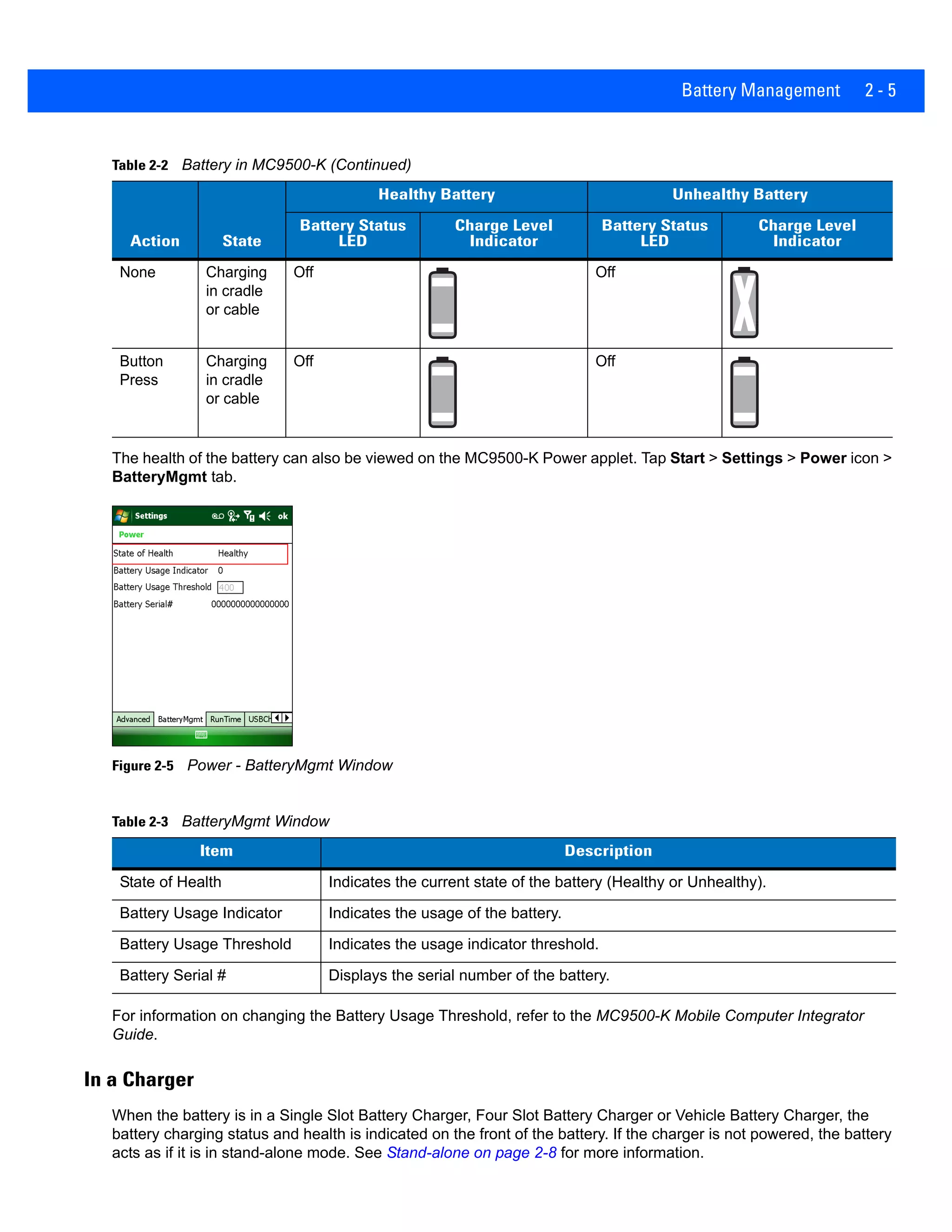
Tap BTExplorer icon > Show BTExplorer> File > About.
Fusion Software
To determine the Fusion software version:
Tap Fusion Signal Strength icon > Wireless Status > Versions.
MC95
NOTE BTExplorer application is only available when the StoneStreet One Bluetooth stack is enabled. Refer to
the MC9500-K Mobile Computer Integrator Guide for information on selecting the Bluetooth stack.
About This Guide xvii
Phone Software
To determine the Phone software version:
On MC9596-K, tap Start > Phone > Menu > Options > PhoneInfo tab. On MC9598-K tap Start > Phone > Menu
> Options > Version Information tab. On MC959B-K tap Start > Settings > Broadband Settings.
Chapter Descriptions
Topics covered in this guide are as follows:
• Chapter 1, Getting Started provides information on getting the MC9500-K up and running for the first time.
• Chapter 2, Battery Management provides information on the types of batteries and how to charge them.
• Chapter 3, Using the MC9500-K provides information on using the MC9500-K.
• Chapter 4, Data Capture provides instructions for using the MC9500-K to capture data using the laser
scanner, imager and camera.
• Chapter 5, Using the Phone provides basic instructions for using the MC9500-K phone.
• Chapter 6, Using GPS Navigation provides information about GPS navigation with the MC9500-K.
• Chapter 7, Using Bluetooth explains Bluetooth functionality on the MC9500-K.
• Chapter 8, Accessories describes the available accessories and how to use them with the MC9500-K.
xviii MC9500-K Mobile Computer User Guide
• Chapter 9, Maintenance & Troubleshooting includes instructions on cleaning and storing the MC9500-K, and
provides troubleshooting solutions for potential problems during MC9500-K operation.
• Appendix A, Technical Specifications provides the technical specifications for the MC9500-K.
• Appendix B, Voice Quality Manager provides information on Voice Quality Manager software.
• Appendix C, Keypads provides keypad layouts and operation.
• Appendix D, Windows Mobile 6.5 explains the new features in Windows Mobile 6.5.3.
Notational Conventions
The following conventions are used in this document:
• “Mobile computer” refers to the Zebra MC9500-K hand-held computer.
• Italics are used to highlight the following:
• Chapters and sections in this and related documents
• Icons on a screen.
• Bold text is used to highlight the following:
• Dialog box, window, and screen names
• Drop-down list and list box names
• Check box and radio button names
• Key names on a keypad
• Button names on a screen.
• Bullets (•) indicate:
• Action items
• Lists of alternatives
• Lists of required steps that are not necessarily sequential
• Sequential lists (e.g., those that describe step-by-step procedures) appear as numbered lists.
Related Documents
• MC9500-K Quick Start Guide, p/n 72-118504-xx.
• MC95XX Series Windows Mobile® 6.1 Regulatory Guide, p/n 72-118502-xx.
• MC9500-K Mobile Computer Integrator Guide, p/n 72E-118503-xx.
• Mobility Services Platform User Guide, p/n 72E-100158-xx.
• Wireless Fusion Enterprise Mobility Suite User Guide for Version 3.00, p/n 72E-122495-xx.
• Microsoft®
Applications for Windows Mobile®
6 User Guide, p/n 72E-108299-xx.
• Application Guide, p/n 72E-68901-xx.
• Enterprise Mobility Developer Kits (EMDKs), available at: http://www.zebra.com/support.
• Latest ActiveSync software, available at: http://www.microsoft.com.
About This Guide xix
For the latest version of this guide and all guides, go to: http://www.zebra.com/support.
Service Information
If you have a problem with your equipment, contact Zebra for your region. Contact information is available at:
http://www.zebra.com/support.
When contacting support, please have the following information available:
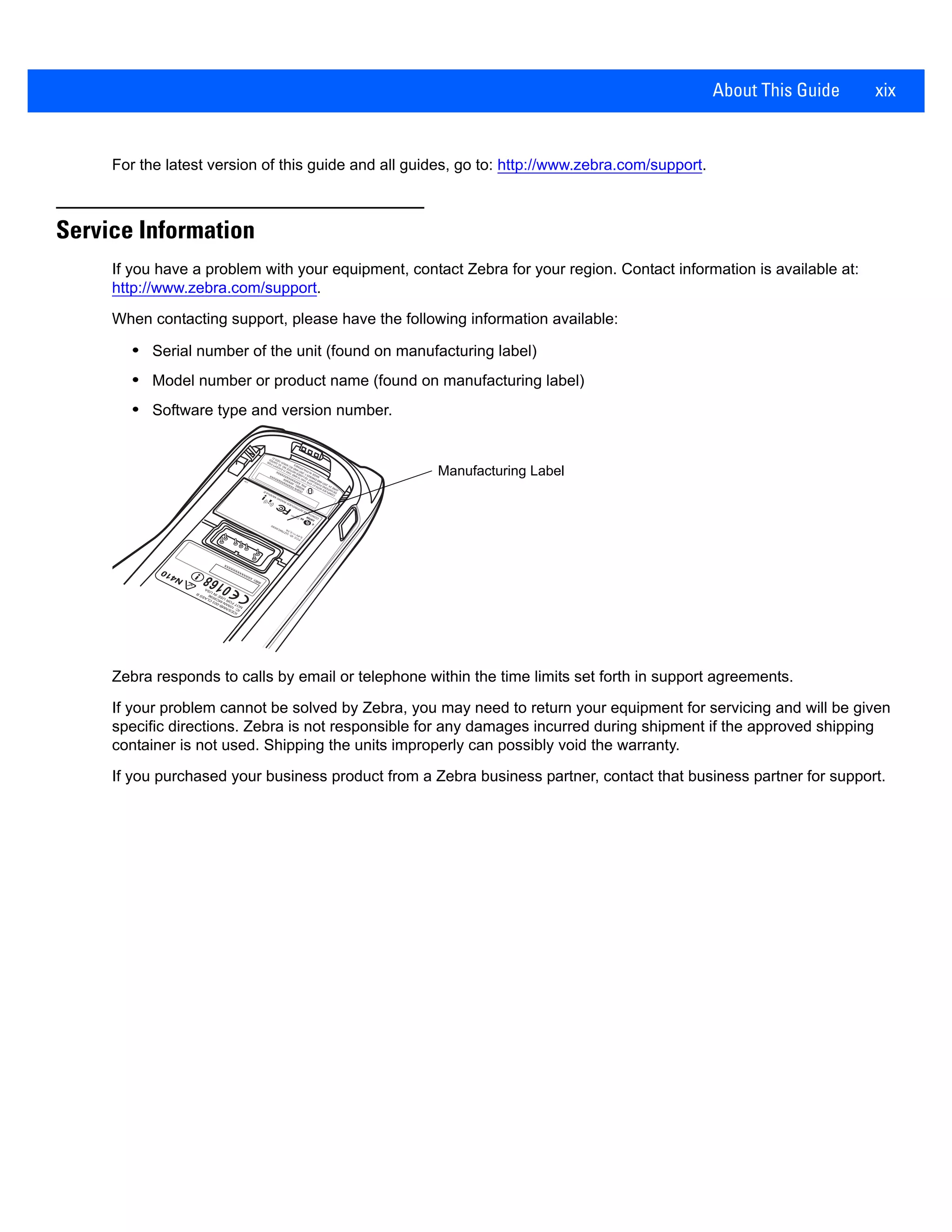
• Serial number of the unit (found on manufacturing label)
• Model number or product name (found on manufacturing label)
• Software type and version number.
Zebra responds to calls by email or telephone within the time limits set forth in support agreements.
If your problem cannot be solved by Zebra, you may need to return your equipment for servicing and will be given
specific directions. Zebra is not responsible for any damages incurred during shipment if the approved shipping
container is not used. Shipping the units improperly can possibly void the warranty.
If you purchased your business product from a Zebra business partner, contact that business partner for support.
(S)S/N
XXXXXXXXXXXXXX
MODEL:
XXXXXX
P/N:XXXXXXXXXXXXXX
Manufacturing Label
xx MC9500-K Mobile Computer User Guide
Chapter 1 Getting Started
Introduction
This chapter explains how to set up the MC9500-K for the first time.
Unpacking
Carefully remove all protective material from the MC9500-K and save the shipping container for later storage and
shipping.
Verify that you received the following:
• MC9500-K mobile computer
• 4800 mAh Lithium-ion battery
• Regulatory Guide
• Quick Start Guide.
Inspect the equipment for damage. If any equipment is missing or damaged, contact the Zebra center immediately.
See page xix for contact information.
Prior to using the MC9500-K for the first time, remove the protective shipping film that covers the keypad and
battery display.
1 - 2 MC9500-K Mobile Computer User Guide
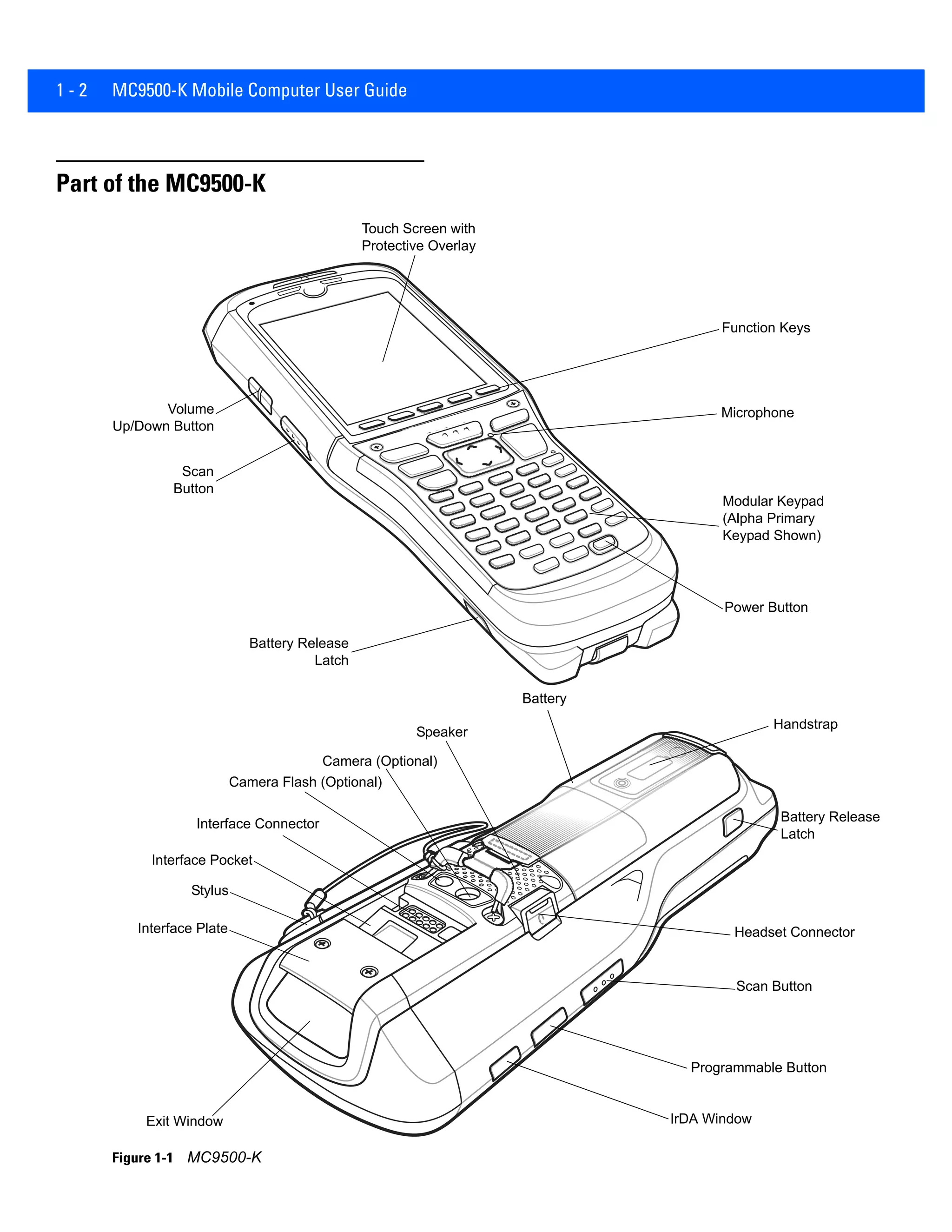
Part of the MC9500-K
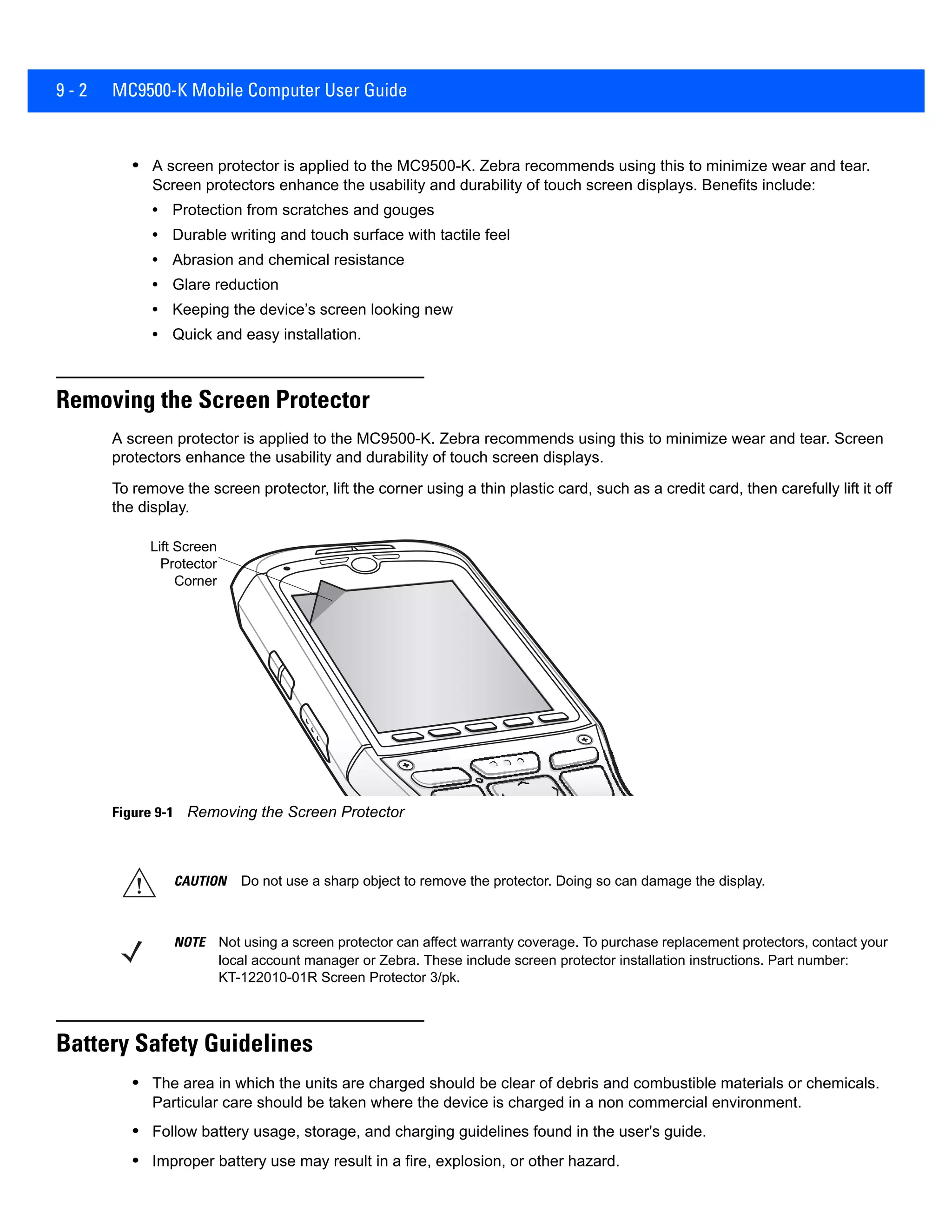
Figure 1-1 MC9500-K
Scan
Button
Modular Keypad
(Alpha Primary
Keypad Shown)
Power Button
Volume
Up/Down Button
Touch Screen with
Protective Overlay
Microphone
Function Keys
Battery
Camera Flash (Optional)
Exit Window
Headset Connector
Speaker
Interface Connector
Scan Button
Camera (Optional)
Programmable Button
IrDA Window
Battery Release
Latch
Stylus
Interface Pocket
Battery Release
Latch
Interface Plate
Handstrap
Getting Started 1 - 3
Getting Started
To start using the MC9500-K for the first time:
• Install a microSD card (optional)
• Install the SIM card (MC9596 only)
• Install the battery.
• Charge the MC9500-K.
Installing a microSD Card
The microSD card slot provides secondary non-volatile storage. The slot is located under the battery pack. Refer to
the documentation provided with the card for more information, and follow the manufacturer’s recommendations for
use.
Version 1
To install the microSD card:
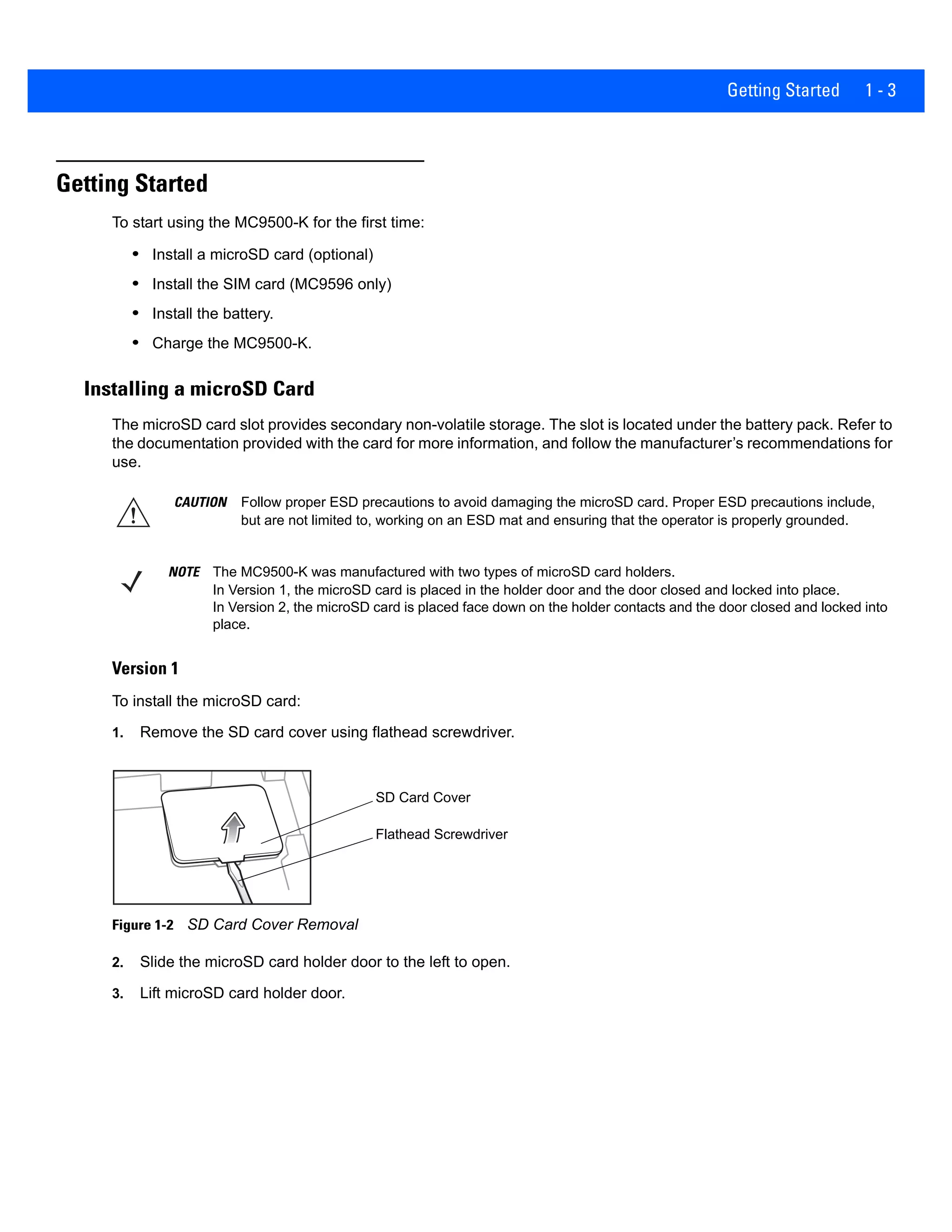
1. Remove the SD card cover using flathead screwdriver.
Figure 1-2 SD Card Cover Removal
2. Slide the microSD card holder door to the left to open.
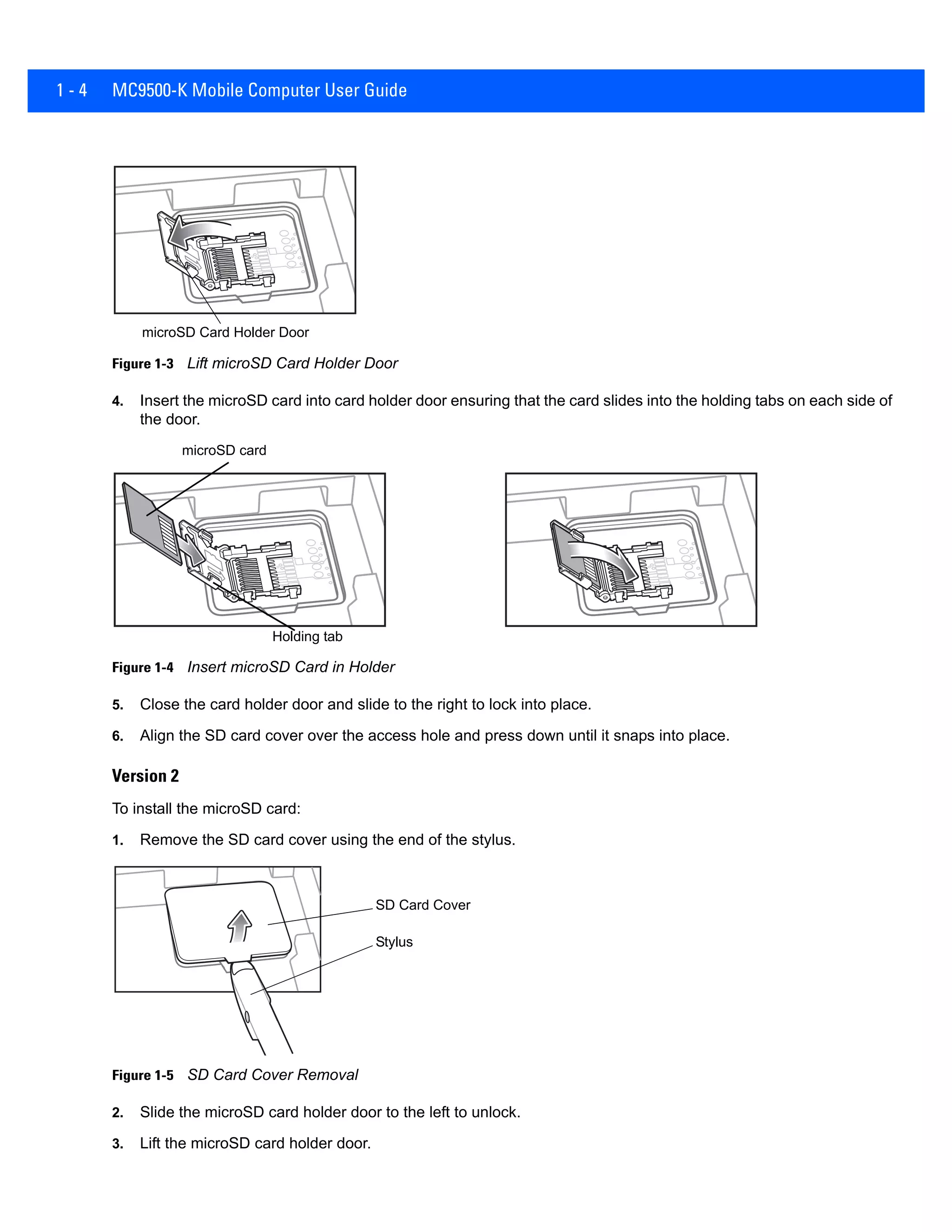
3. Lift microSD card holder door.
CAUTION Follow proper ESD precautions to avoid damaging the microSD card. Proper ESD precautions include,
but are not limited to, working on an ESD mat and ensuring that the operator is properly grounded.
NOTE The MC9500-K was manufactured with two types of microSD card holders.
In Version 1, the microSD card is placed in the holder door and the door closed and locked into place.
In Version 2, the microSD card is placed face down on the holder contacts and the door closed and locked into
place.
SD Card Cover
Flathead Screwdriver
1 - 4 MC9500-K Mobile Computer User Guide
Figure 1-3 Lift microSD Card Holder Door
4. Insert the microSD card into card holder door ensuring that the card slides into the holding tabs on each side of
the door.
Figure 1-4 Insert microSD Card in Holder
5. Close the card holder door and slide to the right to lock into place.
6. Align the SD card cover over the access hole and press down until it snaps into place.
Version 2
To install the microSD card:
1. Remove the SD card cover using the end of the stylus.
Figure 1-5 SD Card Cover Removal
2. Slide the microSD card holder door to the left to unlock.
3. Lift the microSD card holder door.
microSD Card Holder Door
microSD card
Holding tab
SD Card Cover
Stylus
Getting Started 1 - 5
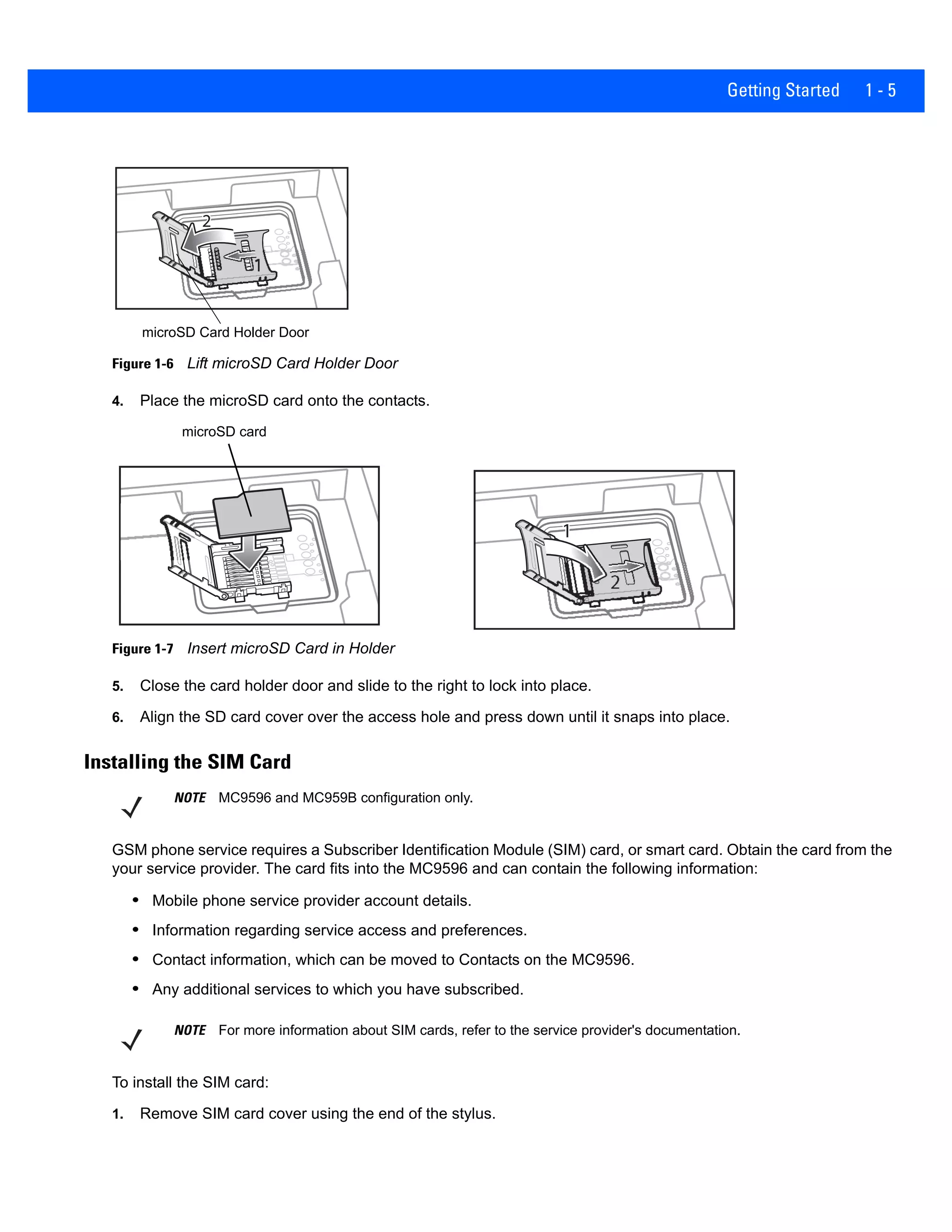
Figure 1-6 Lift microSD Card Holder Door
4. Place the microSD card onto the contacts.
Figure 1-7 Insert microSD Card in Holder
5. Close the card holder door and slide to the right to lock into place.
6. Align the SD card cover over the access hole and press down until it snaps into place.
Installing the SIM Card
GSM phone service requires a Subscriber Identification Module (SIM) card, or smart card. Obtain the card from the
your service provider. The card fits into the MC9596 and can contain the following information:
• Mobile phone service provider account details.
• Information regarding service access and preferences.
• Contact information, which can be moved to Contacts on the MC9596.
• Any additional services to which you have subscribed.
To install the SIM card:
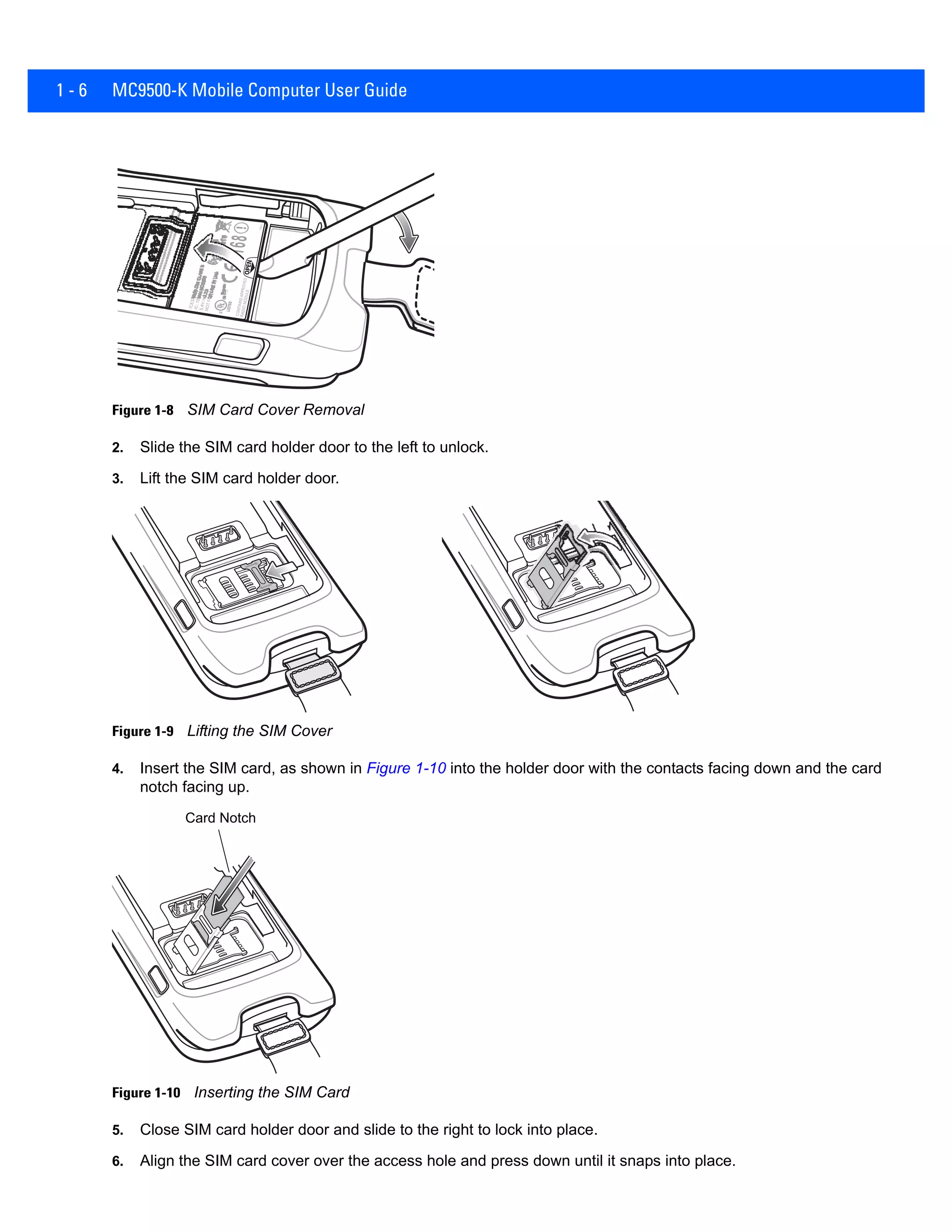
1. Remove SIM card cover using the end of the stylus.
microSD Card Holder Door
11
2
microSD card
NOTE MC9596 and MC959B configuration only.
NOTE For more information about SIM cards, refer to the service provider's documentation.
1 - 6 MC9500-K Mobile Computer User Guide
Figure 1-8 SIM Card Cover Removal
2. Slide the SIM card holder door to the left to unlock.
3. Lift the SIM card holder door.
Figure 1-9 Lifting the SIM Cover
4. Insert the SIM card, as shown in Figure 1-10 into the holder door with the contacts facing down and the card
notch facing up.
Figure 1-10 Inserting the SIM Card
5. Close SIM card holder door and slide to the right to lock into place.
6. Align the SIM card cover over the access hole and press down until it snaps into place.
Card Notch
Getting Started 1 - 7
7. Install the battery.
8. After completing initial MC9596 setup or after replacing a SIM card:
a. Press the red Power button.
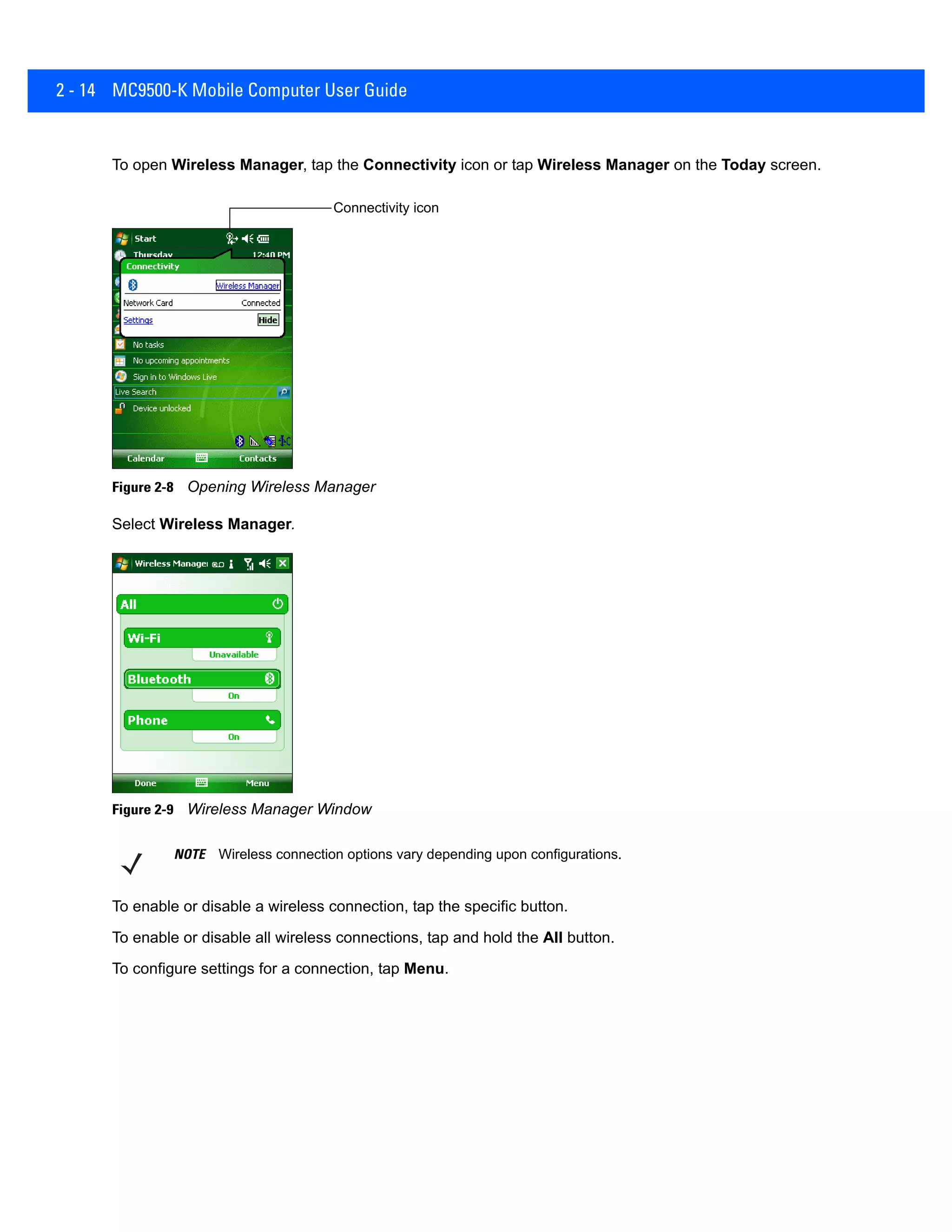
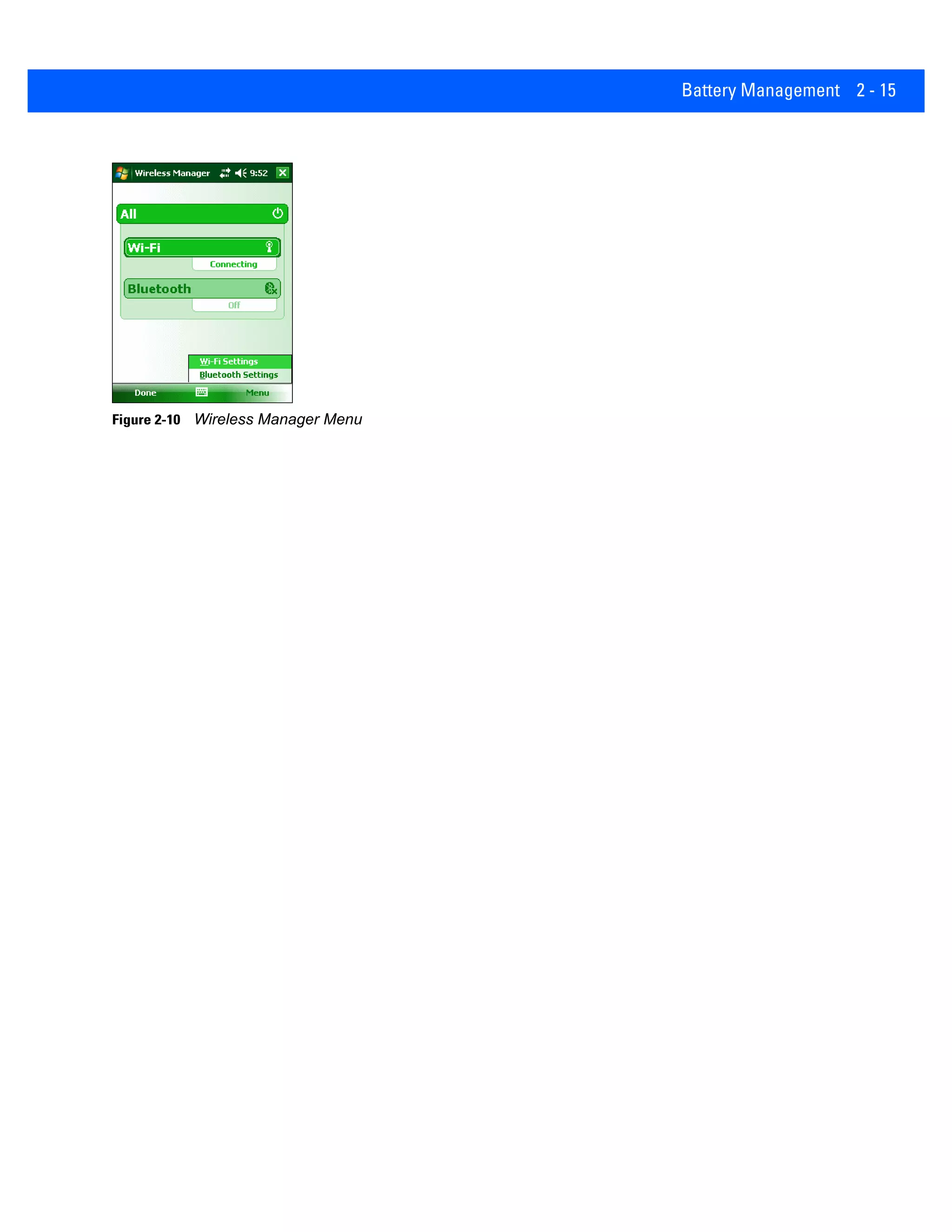
b. On the Today screen, tap Wireless Manager.
c. Ensure Phone is on.
d. Press the red Power button to suspend the MC9596.
e. Perform a warm boot. See Resetting the MC9500-K on page 3-3.
f. Make a call to verify cellular connection.
Installing the Battery
To install the battery:
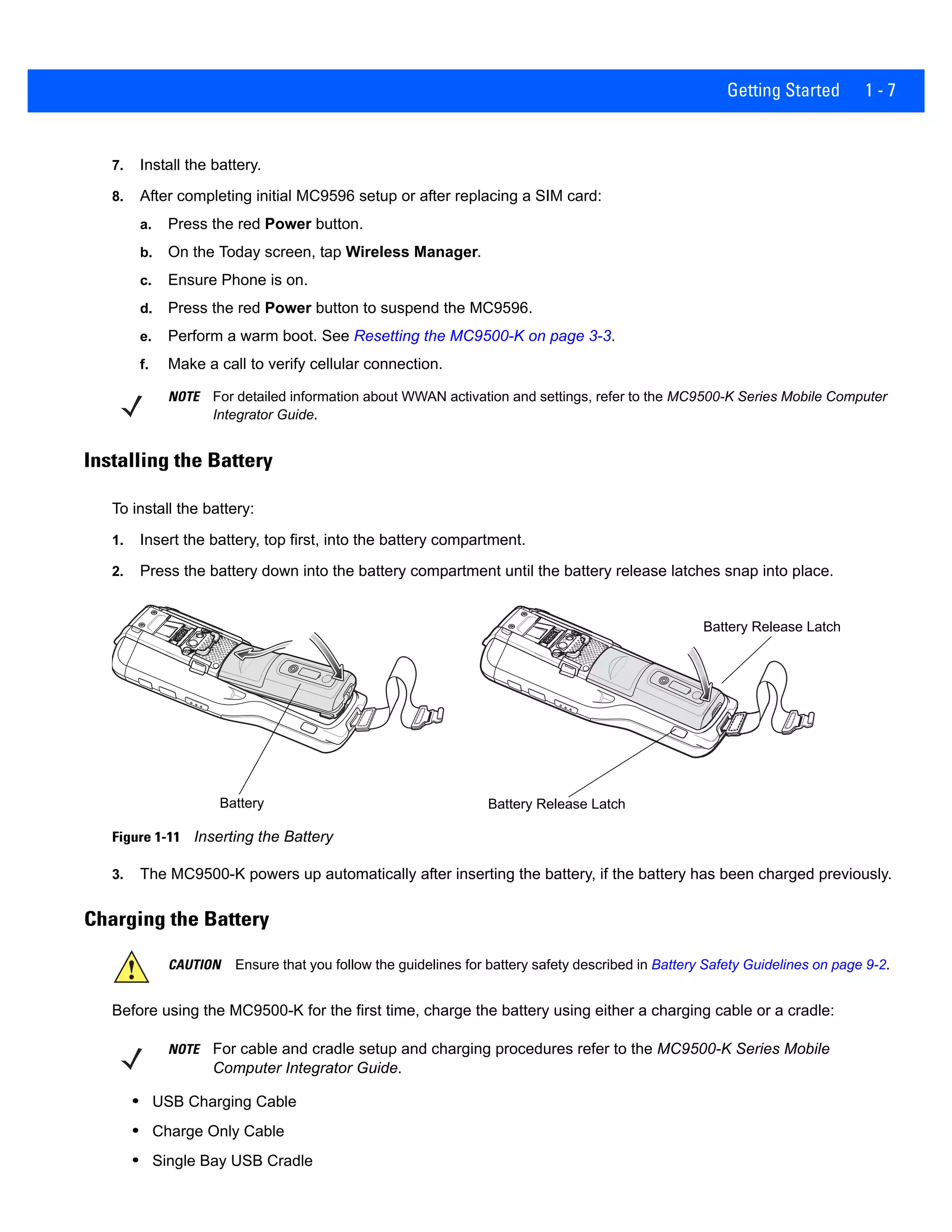
1. Insert the battery, top first, into the battery compartment.
2. Press the battery down into the battery compartment until the battery release latches snap into place.
Figure 1-11 Inserting the Battery
3. The MC9500-K powers up automatically after inserting the battery, if the battery has been charged previously.
Charging the Battery
Before using the MC9500-K for the first time, charge the battery using either a charging cable or a cradle:
• USB Charging Cable
• Charge Only Cable
• Single Bay USB Cradle
NOTE For detailed information about WWAN activation and settings, refer to the MC9500-K Series Mobile Computer
Integrator Guide.
Battery Battery Release Latch
Battery Release Latch
CAUTION Ensure that you follow the guidelines for battery safety described in Battery Safety Guidelines on page 9-2.
NOTE For cable and cradle setup and charging procedures refer to the MC9500-K Series Mobile
Computer Integrator Guide.
1 - 8 MC9500-K Mobile Computer User Guide
• Four Bay Charge Only Cradle
• Four Bay Ethernet Cradle.
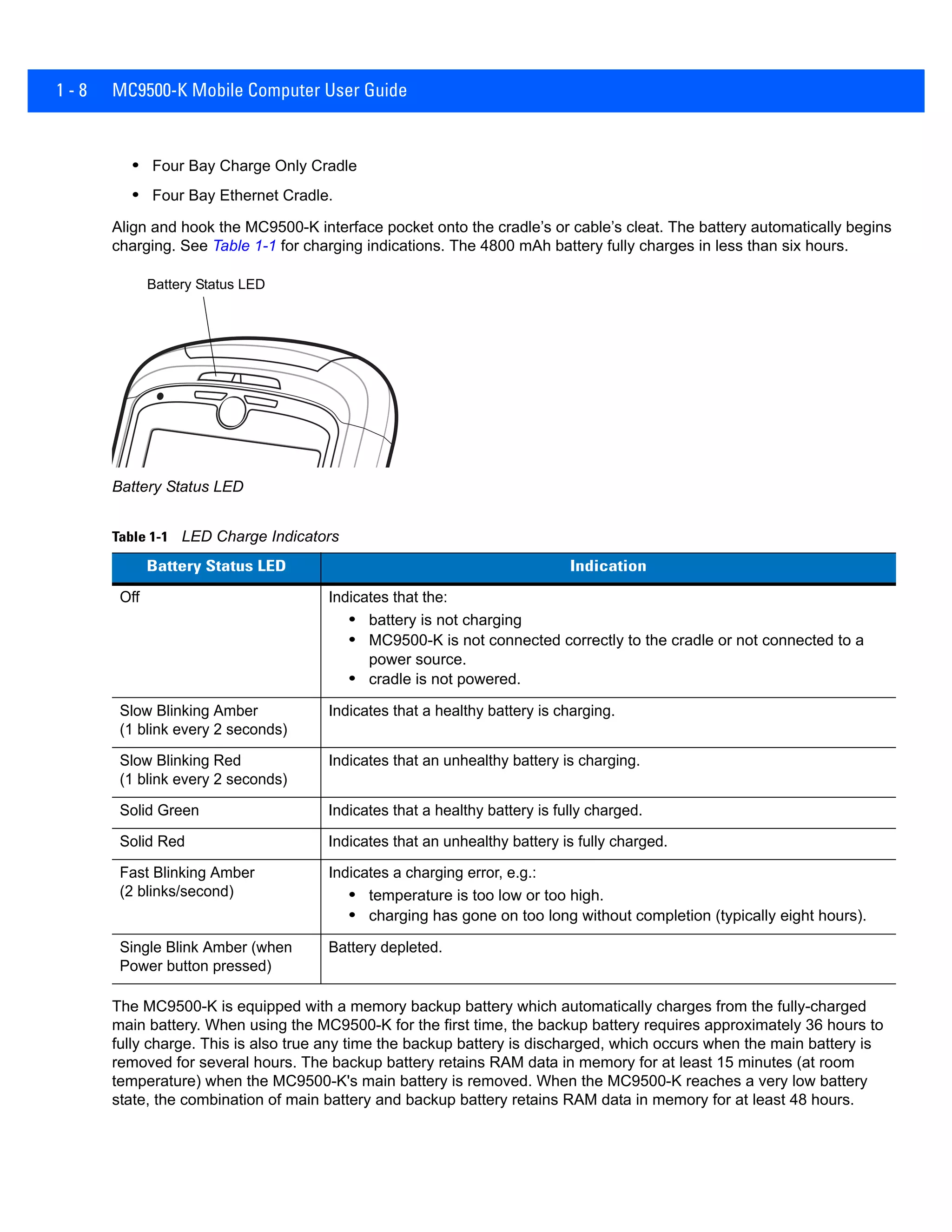
Align and hook the MC9500-K interface pocket onto the cradle’s or cable’s cleat. The battery automatically begins
charging. See Table 1-1 for charging indications. The 4800 mAh battery fully charges in less than six hours.
Battery Status LED
The MC9500-K is equipped with a memory backup battery which automatically charges from the fully-charged
main battery. When using the MC9500-K for the first time, the backup battery requires approximately 36 hours to
fully charge. This is also true any time the backup battery is discharged, which occurs when the main battery is
removed for several hours. The backup battery retains RAM data in memory for at least 15 minutes (at room
temperature) when the MC9500-K's main battery is removed. When the MC9500-K reaches a very low battery
state, the combination of main battery and backup battery retains RAM data in memory for at least 48 hours.
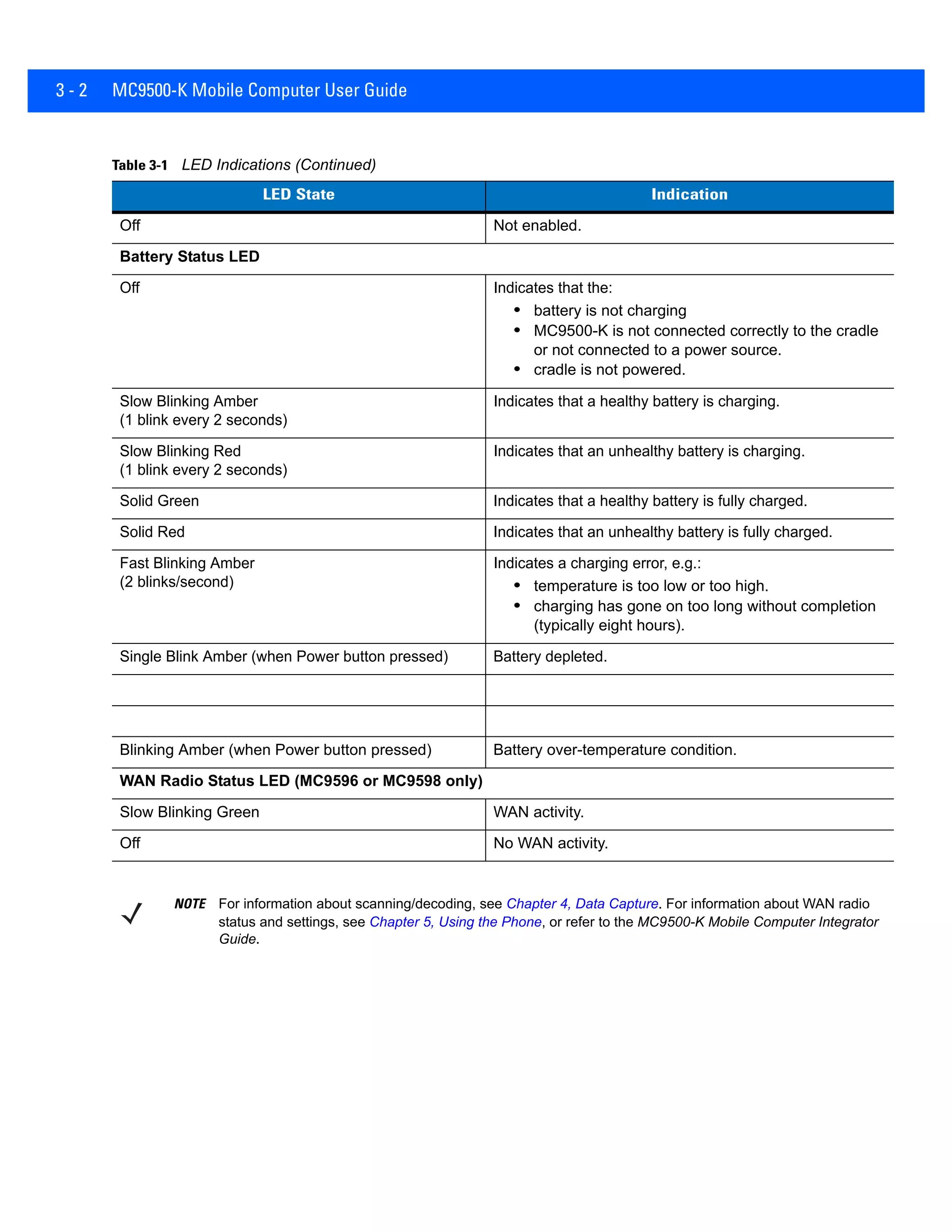
Table 1-1 LED Charge Indicators
Battery Status LED Indication
Off Indicates that the:
• battery is not charging
• MC9500-K is not connected correctly to the cradle or not connected to a
power source.
• cradle is not powered.
Slow Blinking Amber
(1 blink every 2 seconds)
Indicates that a healthy battery is charging.
Slow Blinking Red
(1 blink every 2 seconds)
Indicates that an unhealthy battery is charging.
Solid Green Indicates that a healthy battery is fully charged.
Solid Red Indicates that an unhealthy battery is fully charged.
Fast Blinking Amber
(2 blinks/second)
Indicates a charging error, e.g.:
• temperature is too low or too high.
• charging has gone on too long without completion (typically eight hours).
Single Blink Amber (when
Power button pressed)
Battery depleted.
Battery Status LED
Getting Started 1 - 9
Charging Temperature
Charge batteries in temperatures from 0°C to 40°C (32°F to 104°F). Note that charging is intelligently controlled by
the MC9500-K.
To accomplish this, for small periods of time, the MC9500-K alternately enables and disables battery charging to
keep the battery at acceptable temperatures. The MC9500-K indicates when charging is disabled due to abnormal
temperatures via its LED. See Table 1-1.
Powering On the MC9500-K
After the MC9500-K is connected to power the splash screen displays for about a minute as the MC9500-K
initializes its flash file system, then the calibration window appears.
Calibrating the Screen
To calibrate the screen so the cursor on the touch screen aligns with the tip of the stylus:
1. Remove the stylus from its holder on the side of the MC9500-K.
2. Carefully press and briefly hold the tip of stylus on the center of each target that appears on the screen.
3. Repeat as the target moves around the screen, then tap the screen to continue.
Replacing the Battery
To replace the battery:
1. If the MC9500-K is in suspend mode, press the red Power button to wake the device.
2. Press the red Power button to suspend the MC9500-K.
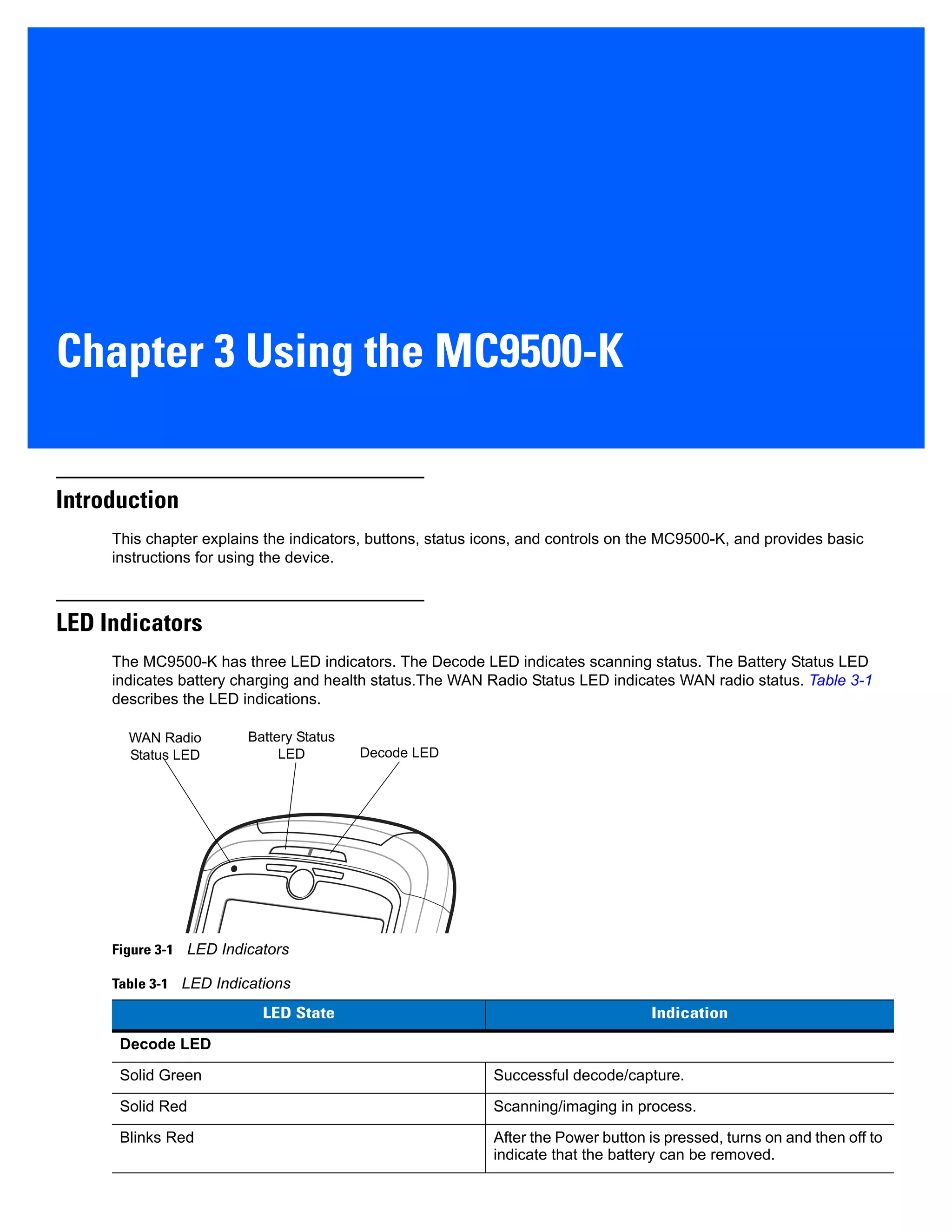
3. Wait for red Decode LED to turn on and then turn off.
4. Unhook the handstrap.
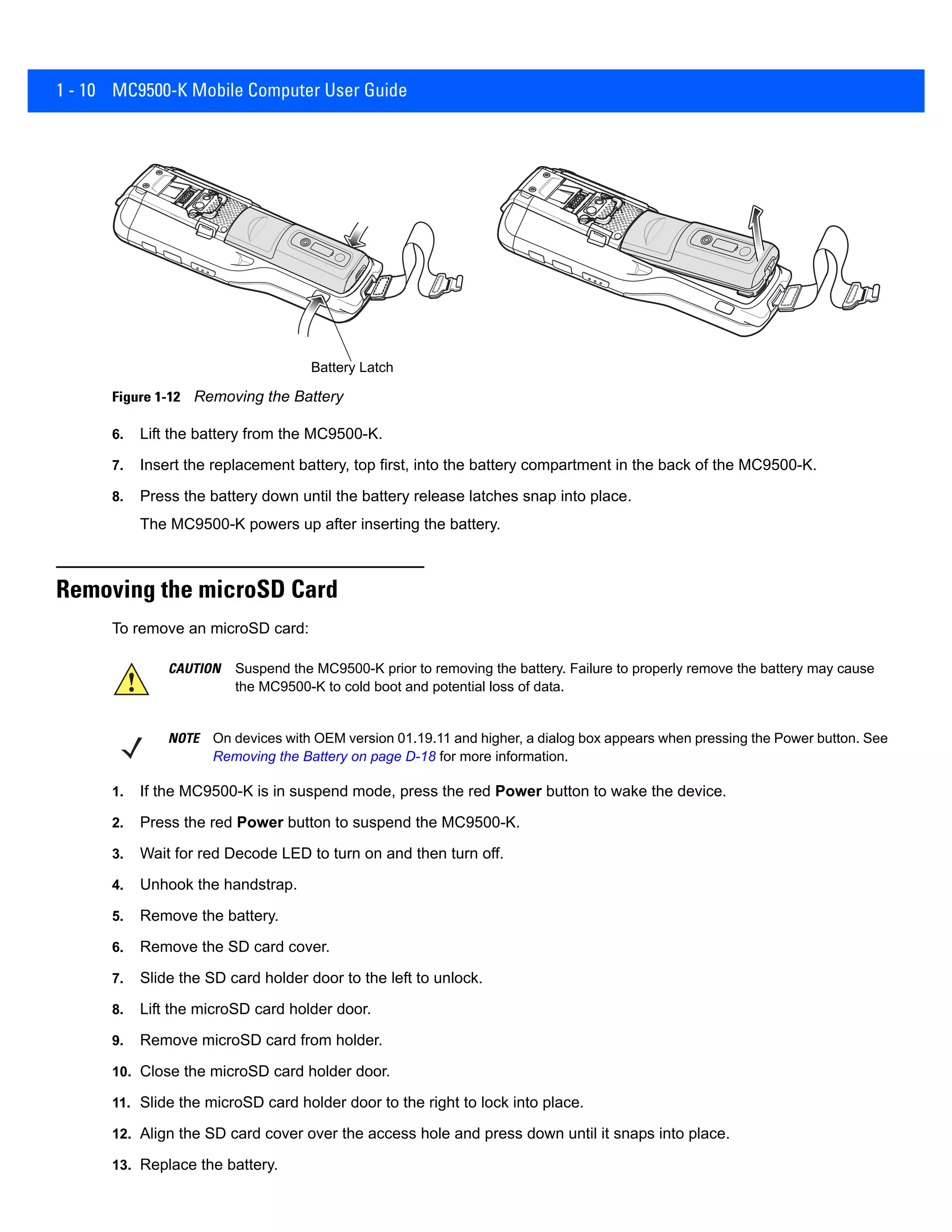
5. Press the two battery release latches to release the battery. The battery ejects slightly.
NOTE The Calibration screen can be accessed by pressing CTRL key - BKSP key or tapping Start > Settings >
Screen > Align Screen button.
CAUTION Suspend the MC9500-K prior to removing the battery. Failure to properly remove the battery may cause
the MC9500-K to cold boot and potential loss of data.
NOTE On devices with OEM version 01.19.11 and higher, a dialog box appears when pressing the Power button.
See Removing the Battery on page D-18 for more information.
1 - 10 MC9500-K Mobile Computer User Guide
Figure 1-12 Removing the Battery
6. Lift the battery from the MC9500-K.
7. Insert the replacement battery, top first, into the battery compartment in the back of the MC9500-K.
8. Press the battery down until the battery release latches snap into place.
The MC9500-K powers up after inserting the battery.
Removing the microSD Card
To remove an microSD card:
1. If the MC9500-K is in suspend mode, press the red Power button to wake the device.
2. Press the red Power button to suspend the MC9500-K.
3. Wait for red Decode LED to turn on and then turn off.
4. Unhook the handstrap.
5. Remove the battery.
6. Remove the SD card cover.
7. Slide the SD card holder door to the left to unlock.
8. Lift the microSD card holder door.
9. Remove microSD card from holder.
10. Close the microSD card holder door.
11. Slide the microSD card holder door to the right to lock into place.
12. Align the SD card cover over the access hole and press down until it snaps into place.
13. Replace the battery.
Battery Latch
CAUTION Suspend the MC9500-K prior to removing the battery. Failure to properly remove the battery may cause
the MC9500-K to cold boot and potential loss of data.
NOTE On devices with OEM version 01.19.11 and higher, a dialog box appears when pressing the Power button. See
Removing the Battery on page D-18 for more information.
Getting Started 1 - 11
Removing the SIM Card
To remove an SIM card:
1. If the MC9500-K is in suspend mode, press the red Power button to wake the device.
2. Press the red Power button to suspend the MC9500-K.
3. Wait for red Decode LED to turn on and then turn off.
4. Unhook the handstrap.
5. Remove the battery.
6. Remove the SIM card cover using the end of the stylus.
7. Slide the SIM card holder door to the left to unlock.
8. Lift the SIM card holder door.
9. Remove SIM card from holder.
10. Close the SIM card holder door.
11. Slide the SIM card holder door to the right to lock into place.
12. Align the SIM card cover over the access hole and press down until it snaps into place.
13. Replace the battery.
CAUTION Suspend the MC9500-K prior to removing the battery. Failure to properly remove the battery may cause
the MC9500-K to cold boot and potential loss of data.
NOTE On devices with OEM version 01.19.11 and higher, a dialog box appears when pressing the Power button.
See Removing the Battery on page D-18 for more information.
1 - 12 MC9500-K Mobile Computer User Guide
Chapter 2 Battery Management
Introduction
This chapter provides information on battery functionality, battery status indications, charging the MC9500-K,
charging spare batteries and power saving techniques.
Battery Functionality
The battery provides power to the MC9500-K and contains charging and status indications on the front of the
battery. The indicators function differently depending upon the battery mode and allow the user to determine the
health of the battery.
Figure 2-1 Battery
Charging Status LED indicates the charging status and health of the battery. The Charge Level Indicator indicates
an unhealthy battery and the charge level of the battery.
Charging Status LED
Charge Level Indicator
Status Button
2 - 2 MC9500-K Mobile Computer User Guide
Battery Health
A battery becomes unhealthy when the Battery Usage Indication reach a predefined threshold (end of usable
life).
The Battery Usage Threshold value can be changed. See the MC9500-K Mobile Computer Integrator Guide for
more information.
When the battery becomes unhealthy, a dialog box displays on the MC9500-K. When this appears, tap Dismiss.
Replace the battery as soon as possible. The battery Charge Level indicator display an “X” when the battery
becomes unhealthy (see Figure 2-3). When charging an unhealthy battery in the MC9500-K, the Battery Status
LED blinks red.
Figure 2-2 Battery Warning Dialog Box
Figure 2-3 Unhealthy Battery Indication
NOTE The point at which a battery becomes unhealthy may vary depending upon the environment and charging
conditions
Battery Management 2 - 3
Battery Status
The MC9500-K battery provides status information on the front of the battery that allows the user to make
determination on what battery to use. The battery status indications vary depending upon the mode of the battery:
• Installed in an MC9500-K
• In a charger
• stand-alone.
Installed in an MC9500-K
When the battery is installed in the MC9500-K, the user can view the charge level (with Status button press) and
health of the battery (see Figure 2-4). The Battery Status LED is disabled when the battery is installed in the
MC9500-K. If the battery is unhealthy, the Charge Level indicator displays an “X” (see Figure 2-3).
Figure 2-4 Battery in MC9500-K
Press the Status button to display the current battery charge level. It will display for five seconds and then turn off.
Table 2-1 list the Charge Level indications when the Status button is pressed.
NOTE The Charge Level indicator does not display the charge level while the MC9500-K is charging.
Battery Status LED
Charge Level Indicator
Status Button
2 - 4 MC9500-K Mobile Computer User Guide
Table 2-1 Charge Level Indicator
Charge Level
Indicator
Description
Indicates that the remaining charge is approximately
between 0% and 20%.
Indicates that the remaining charge is approximately
between 21% and 40%.
Indicates that the remaining charge is approximately
between 41% and 60%.
Indicates that the remaining charge is approximately
between 61% and 80%.
Indicates that the remaining charge is approximately
between 81% and 100%.
NOTE The battery front panel is not visible when the MC9500-K is charging in a cradle. The battery front
panel is visible when charging with a charging cable. The Charge Level indicator displays a
“charging in mobile computer” indication (see Table 2-2).
Table 2-2 Battery in MC9500-K
Action State
Healthy Battery Unhealthy Battery
Battery Status
LED
Charge Level
Indicator
Battery Status
LED
Charge Level
Indicator
None Not
Charging
Off Off
Button
Press
Not
Charging
Off
See Table 2-1
on page 2-4 for
detailed
information.
Off
See Table 2-1
on page 2-4 for
detailed
information.
Battery Management 2 - 5
The health of the battery can also be viewed on the MC9500-K Power applet. Tap Start > Settings > Power icon >
BatteryMgmt tab.
Figure 2-5 Power - BatteryMgmt Window
For information on changing the Battery Usage Threshold, refer to the MC9500-K Mobile Computer Integrator
Guide.
In a Charger
When the battery is in a Single Slot Battery Charger, Four Slot Battery Charger or Vehicle Battery Charger, the
battery charging status and health is indicated on the front of the battery. If the charger is not powered, the battery
acts as if it is in stand-alone mode. See Stand-alone on page 2-8 for more information.
None Charging
in cradle
or cable
Off Off
Button
Press
Charging
in cradle
or cable
Off Off
Table 2-3 BatteryMgmt Window
Item Description
State of Health Indicates the current state of the battery (Healthy or Unhealthy).
Battery Usage Indicator Indicates the usage of the battery.
Battery Usage Threshold Indicates the usage indicator threshold.
Battery Serial # Displays the serial number of the battery.
Table 2-2 Battery in MC9500-K (Continued)
Action State
Healthy Battery Unhealthy Battery
Battery Status
LED
Charge Level
Indicator
Battery Status
LED
Charge Level
Indicator
2 - 6 MC9500-K Mobile Computer User Guide
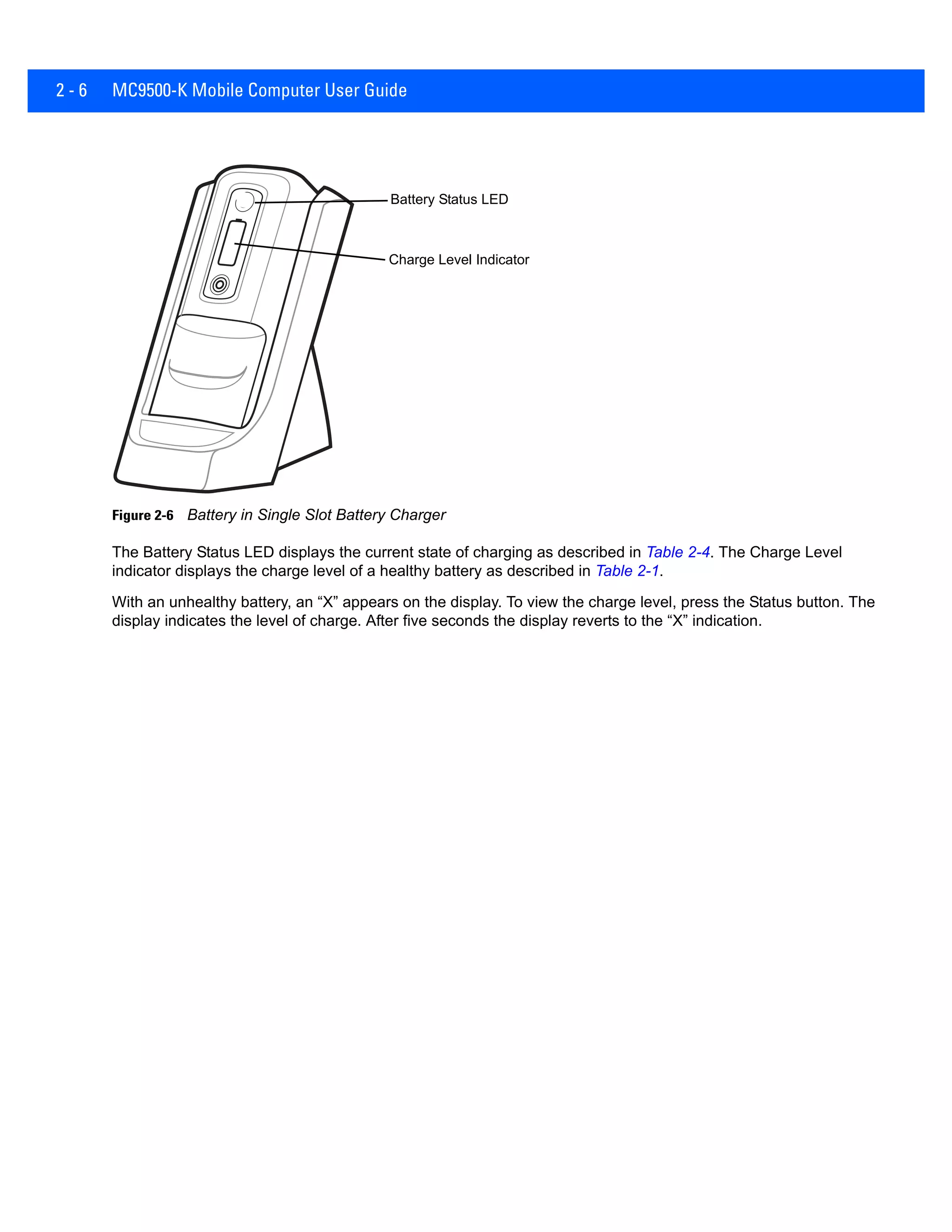
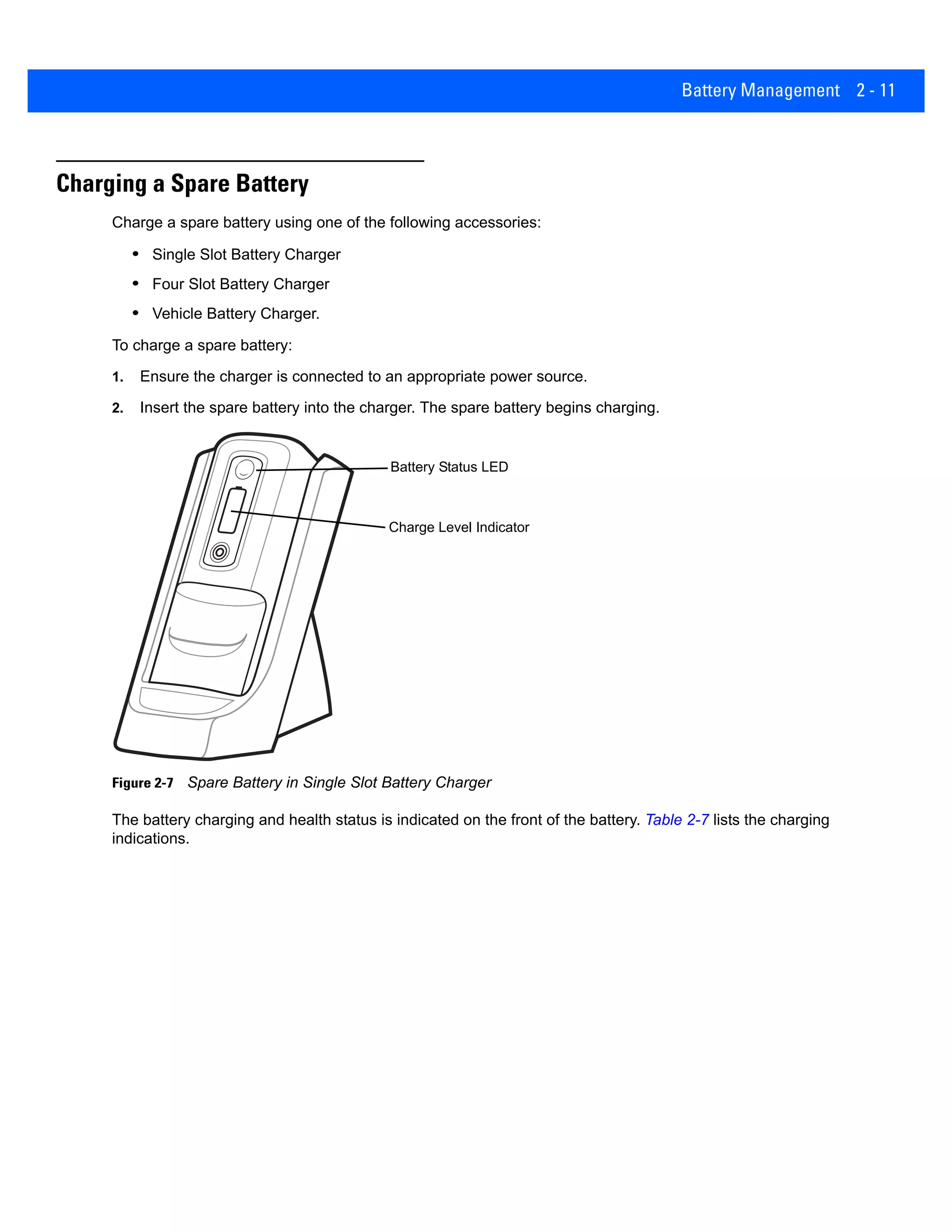
Figure 2-6 Battery in Single Slot Battery Charger
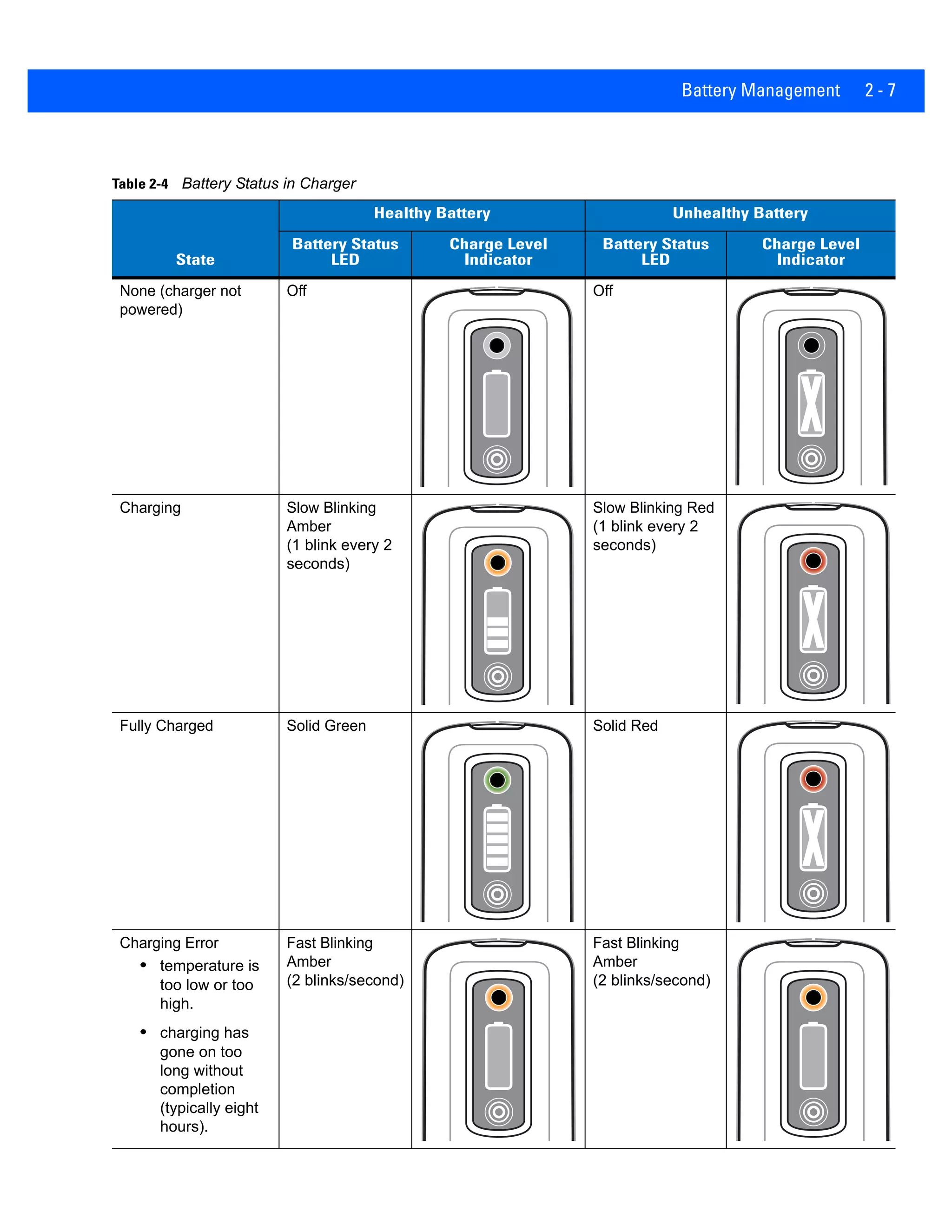
The Battery Status LED displays the current state of charging as described in Table 2-4. The Charge Level
indicator displays the charge level of a healthy battery as described in Table 2-1.
With an unhealthy battery, an “X” appears on the display. To view the charge level, press the Status button. The
display indicates the level of charge. After five seconds the display reverts to the “X” indication.
Battery Status LED
Charge Level Indicator
Battery Management 2 - 7
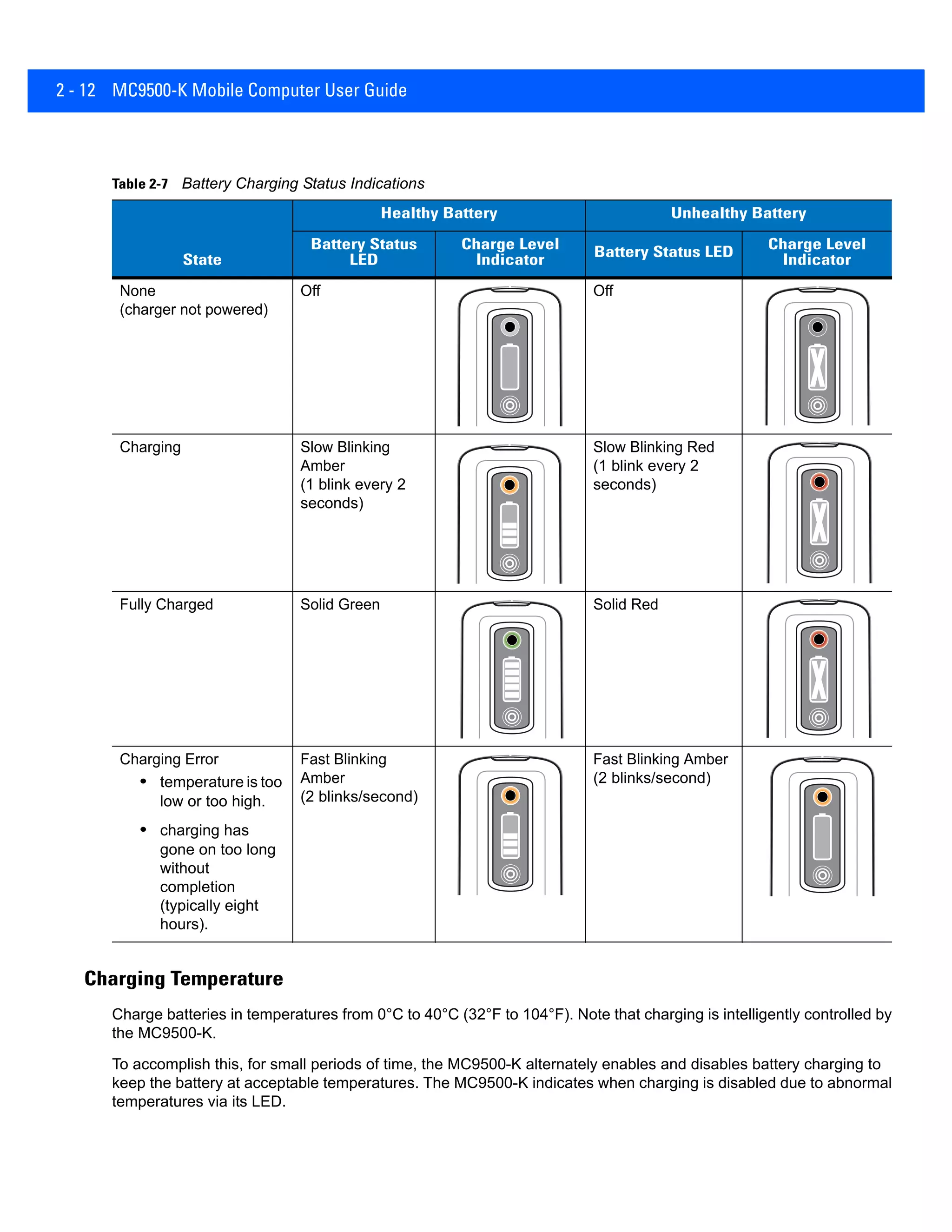
Table 2-4 Battery Status in Charger
State
Healthy Battery Unhealthy Battery
Battery Status
LED
Charge Level
Indicator
Battery Status
LED
Charge Level
Indicator
None (charger not
powered)
Off Off
Charging Slow Blinking
Amber
(1 blink every 2
seconds)
Slow Blinking Red
(1 blink every 2
seconds)
Fully Charged Solid Green Solid Red
Charging Error
• temperature is
too low or too
high.
• charging has
gone on too
long without
completion
(typically eight
hours).
Fast Blinking
Amber
(2 blinks/second)
Fast Blinking
Amber
(2 blinks/second)
2 - 8 MC9500-K Mobile Computer User Guide
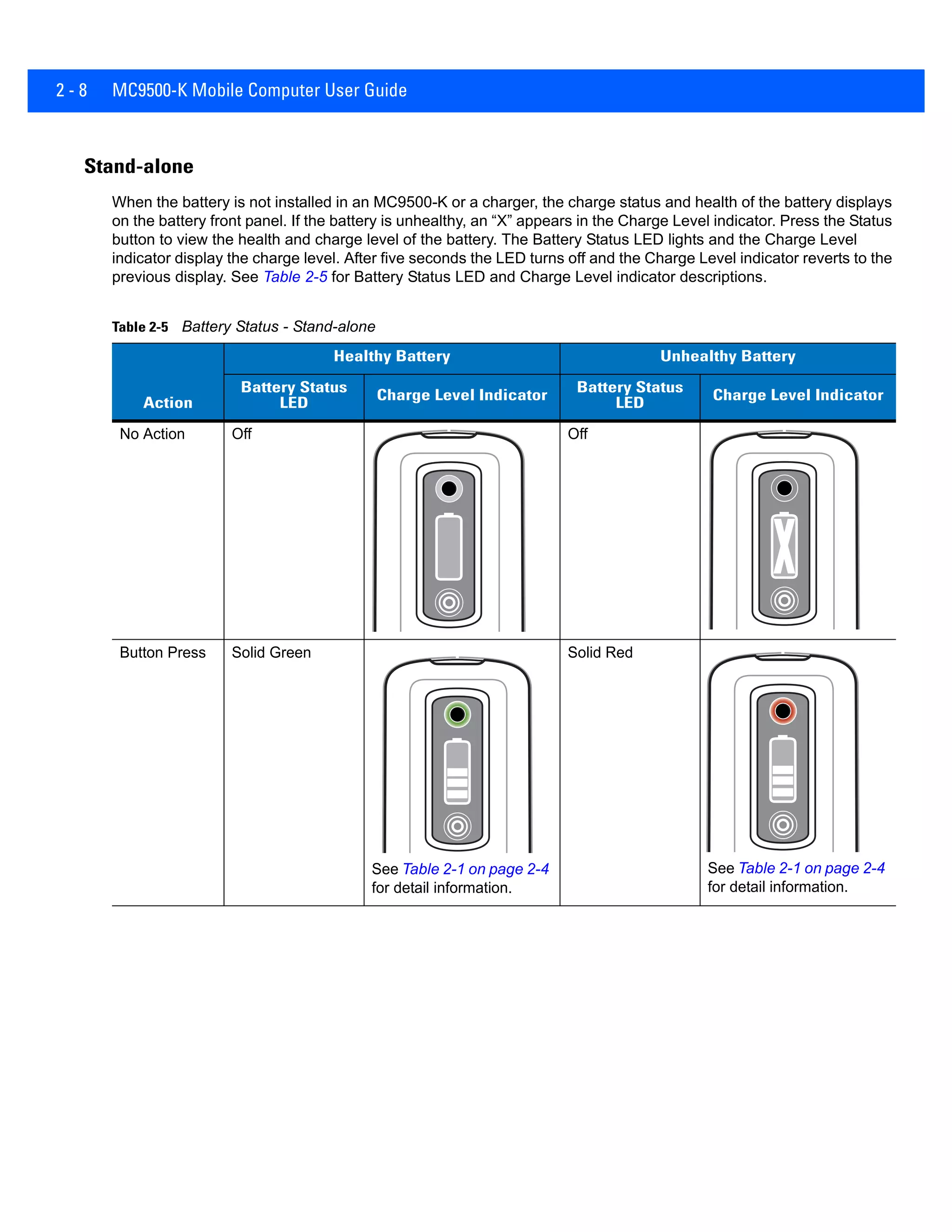
Stand-alone
When the battery is not installed in an MC9500-K or a charger, the charge status and health of the battery displays
on the battery front panel. If the battery is unhealthy, an “X” appears in the Charge Level indicator. Press the Status
button to view the health and charge level of the battery. The Battery Status LED lights and the Charge Level
indicator display the charge level. After five seconds the LED turns off and the Charge Level indicator reverts to the
previous display. See Table 2-5 for Battery Status LED and Charge Level indicator descriptions.
Table 2-5 Battery Status - Stand-alone
Action
Healthy Battery Unhealthy Battery
Battery Status
LED Charge Level Indicator
Battery Status
LED Charge Level Indicator
No Action Off Off
Button Press Solid Green
See Table 2-1 on page 2-4
for detail information.
Solid Red
See Table 2-1 on page 2-4
for detail information.
Battery Management 2 - 9
Charging the MC9500-K
The MC9500-K is equipped with a memory backup battery which automatically charges from the fully-charged
main battery. When using the MC9500-K for the first time, the backup battery requires approximately 36 hours to
fully charge. This is also true any time the backup battery is discharged, which occurs when the main battery is
removed for several hours. The backup battery retains RAM data in memory for at least 15 minutes (at room
temperature) when the MC9500-K's main battery is removed. When the MC9500-K reaches a very low battery
state, the combination of main battery and backup battery retains RAM data in memory for at least 36 hours.
To charge the battery, use either a cradle or charging cable. For cable and cradle setup and charging procedures
refer to the MC9500-K Mobile Computer Integrator Guide.
To charge the battery:
1. Connect the charging accessory to the appropriate power source. See MC9500-K Series Mobile Computer
Integrator Guide for setup information.
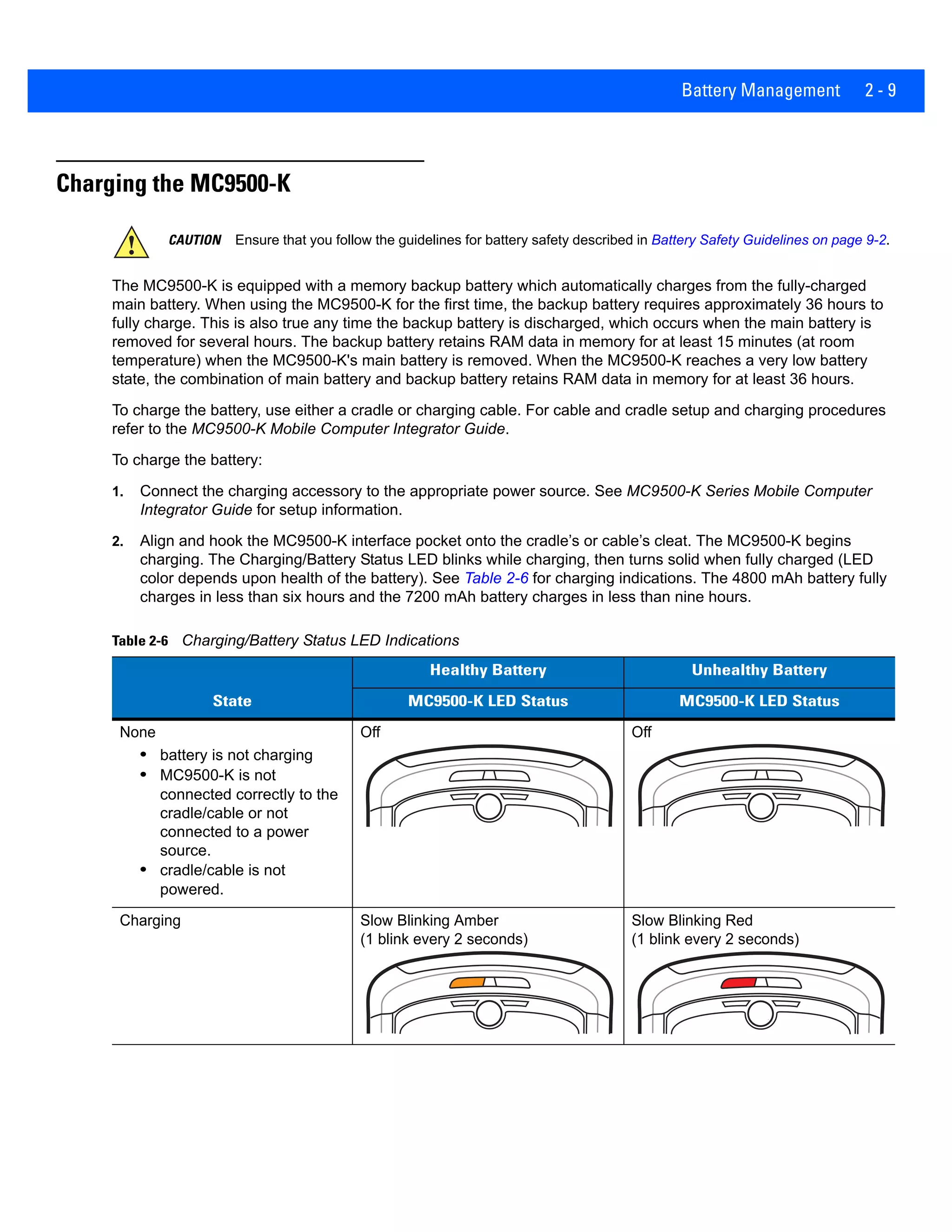
2. Align and hook the MC9500-K interface pocket onto the cradle’s or cable’s cleat. The MC9500-K begins
charging. The Charging/Battery Status LED blinks while charging, then turns solid when fully charged (LED
color depends upon health of the battery). See Table 2-6 for charging indications. The 4800 mAh battery fully
charges in less than six hours and the 7200 mAh battery charges in less than nine hours.
CAUTION Ensure that you follow the guidelines for battery safety described in Battery Safety Guidelines on page 9-2.
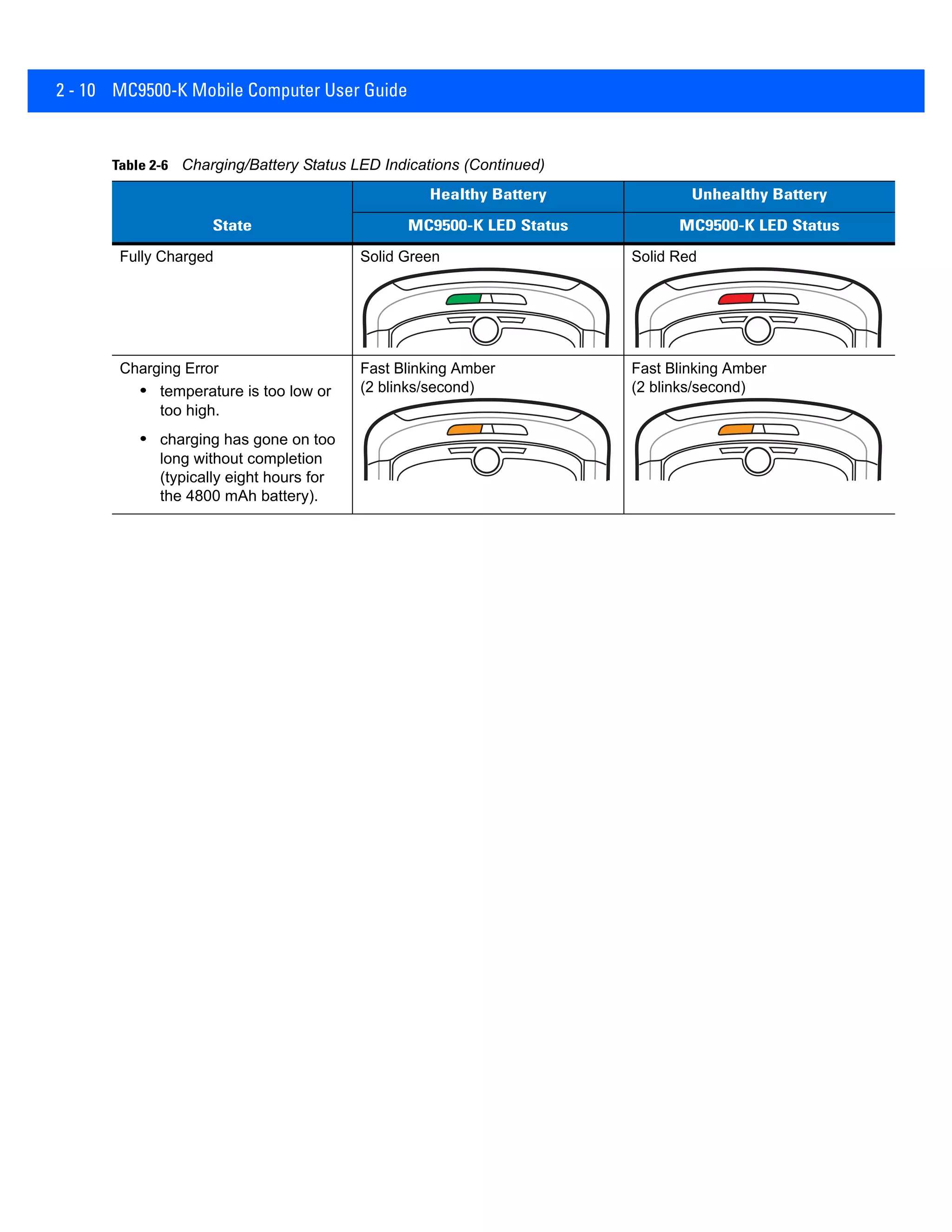
Table 2-6 Charging/Battery Status LED Indications
State
Healthy Battery Unhealthy Battery
MC9500-K LED Status MC9500-K LED Status
None
• battery is not charging
• MC9500-K is not
connected correctly to the
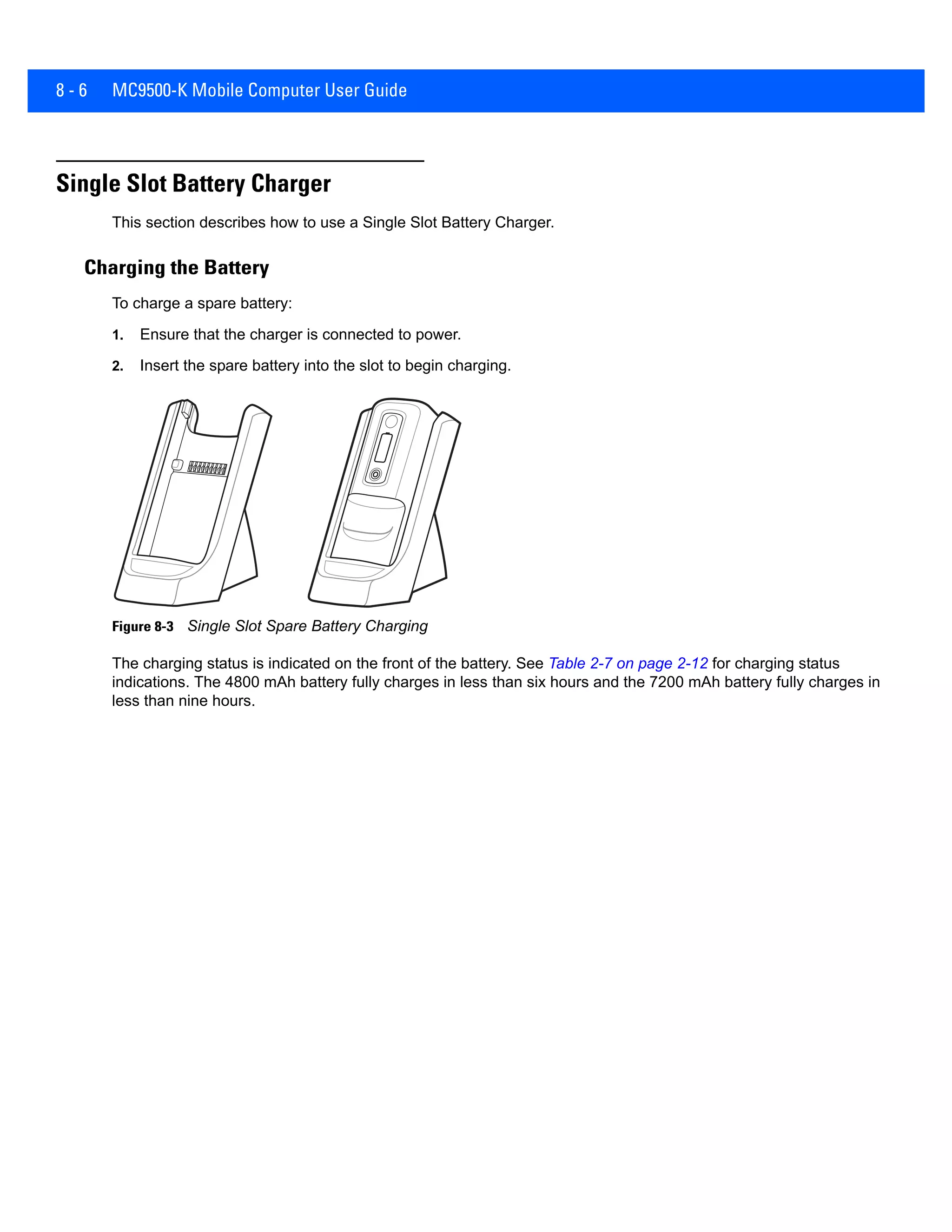
cradle/cable or not
connected to a power
source.
• cradle/cable is not
powered.
Off Off
Charging Slow Blinking Amber
(1 blink every 2 seconds)
Slow Blinking Red
(1 blink every 2 seconds)
2 - 10 MC9500-K Mobile Computer User Guide
Fully Charged Solid Green Solid Red
Charging Error
• temperature is too low or
too high.
• charging has gone on too
long without completion
(typically eight hours for
the 4800 mAh battery).
Fast Blinking Amber
(2 blinks/second)
Fast Blinking Amber
(2 blinks/second)
Table 2-6 Charging/Battery Status LED Indications (Continued)
State
Healthy Battery Unhealthy Battery
MC9500-K LED Status MC9500-K LED Status
Battery Management 2 - 11
Charging a Spare Battery
Charge a spare battery using one of the following accessories:
• Single Slot Battery Charger
• Four Slot Battery Charger
• Vehicle Battery Charger.
To charge a spare battery:
1. Ensure the charger is connected to an appropriate power source.
2. Insert the spare battery into the charger. The spare battery begins charging.
Figure 2-7 Spare Battery in Single Slot Battery Charger
The battery charging and health status is indicated on the front of the battery. Table 2-7 lists the charging
indications.
Battery Status LED
Charge Level Indicator
2 - 12 MC9500-K Mobile Computer User Guide
Charging Temperature
Charge batteries in temperatures from 0°C to 40°C (32°F to 104°F). Note that charging is intelligently controlled by
the MC9500-K.
To accomplish this, for small periods of time, the MC9500-K alternately enables and disables battery charging to
keep the battery at acceptable temperatures. The MC9500-K indicates when charging is disabled due to abnormal
temperatures via its LED.
Table 2-7 Battery Charging Status Indications
State
Healthy Battery Unhealthy Battery
Battery Status
LED
Charge Level
Indicator
Battery Status LED
Charge Level
Indicator
None
(charger not powered)
Off Off
Charging Slow Blinking
Amber
(1 blink every 2
seconds)
Slow Blinking Red
(1 blink every 2
seconds)
Fully Charged Solid Green Solid Red
Charging Error
• temperature is too
low or too high.
• charging has
gone on too long
without
completion
(typically eight
hours).
Fast Blinking
Amber
(2 blinks/second)
Fast Blinking Amber
(2 blinks/second)
Battery Management 2 - 13
Power Saving Techniques
Observe the following battery saving tips:
• Leave the MC9500-K connected to AC power at all times when not in use.
• Set the MC9500-K to turn off after a short period of non-use.
• Set the backlight to turn off after a short period of non-use.
• Turn off all wireless activities when not in use.
Changing the Power Settings
To set the MC9500-K to turn off after a short period of non-use:
1. Tap Start > Settings > System tab > Power icon > Advanced tab.
2. Select the On battery power: Turn off device if not used for check box and select a value from the
drop-down list.
3. Select ok.
Changing the Backlight Settings
To change the backlight settings in order to conserve more battery power:
1. Tap Start > Settings > System tab > Backlight icon > Battery Power tab.
2. Select the Disable backlight if device is not used for check box and select a value from the drop-down list.
3. Select the Brightness tab.
4. Tap the Disable backlight check box to turn off the display backlight, or use the slider to set a low value for the
backlight.
5. Select ok.
Changing the Keypad Backlight Settings
To change the keypad backlight settings in order to conserve more battery power:
1. Tap Start > Settings > System tab > Keylight icon > Battery Power tab.
2. Select the On battery power: Disable keylight if device if not used for check box and select a value from
the drop-down list.
3. Select the Advanced tab.
4. Tap the Disable keylight check box to turn off the keypad backlight.
5. Select ok.
Turning Off the Radios
Windows Mobile 6 devices include Wireless Manager, which provides a simple method of enabling, disabling, and
configuring all the device’s wireless capabilities in one place.
2 - 14 MC9500-K Mobile Computer User Guide
To open Wireless Manager, tap the Connectivity icon or tap Wireless Manager on the Today screen.
Figure 2-8 Opening Wireless Manager
Select Wireless Manager.
Figure 2-9 Wireless Manager Window
To enable or disable a wireless connection, tap the specific button.
To enable or disable all wireless connections, tap and hold the All button.
To configure settings for a connection, tap Menu.
Connectivity icon
NOTE Wireless connection options vary depending upon configurations.
Battery Management 2 - 15
Figure 2-10 Wireless Manager Menu
2 - 16 MC9500-K Mobile Computer User Guide
Chapter 3 Using the MC9500-K
Introduction
This chapter explains the indicators, buttons, status icons, and controls on the MC9500-K, and provides basic
instructions for using the device.
LED Indicators
The MC9500-K has three LED indicators. The Decode LED indicates scanning status. The Battery Status LED
indicates battery charging and health status.The WAN Radio Status LED indicates WAN radio status. Table 3-1
describes the LED indications.
Figure 3-1 LED Indicators
Table 3-1 LED Indications
LED State Indication
Decode LED
Solid Green Successful decode/capture.
Solid Red Scanning/imaging in process.
Blinks Red After the Power button is pressed, turns on and then off to
indicate that the battery can be removed.
Decode LED
Battery Status
LED
WAN Radio
Status LED
3 - 2 MC9500-K Mobile Computer User Guide
Off Not enabled.
Battery Status LED
Off Indicates that the:
• battery is not charging
• MC9500-K is not connected correctly to the cradle
or not connected to a power source.
• cradle is not powered.
Slow Blinking Amber
(1 blink every 2 seconds)
Indicates that a healthy battery is charging.
Slow Blinking Red
(1 blink every 2 seconds)
Indicates that an unhealthy battery is charging.
Solid Green Indicates that a healthy battery is fully charged.
Solid Red Indicates that an unhealthy battery is fully charged.
Fast Blinking Amber
(2 blinks/second)
Indicates a charging error, e.g.:
• temperature is too low or too high.
• charging has gone on too long without completion
(typically eight hours).
Single Blink Amber (when Power button pressed) Battery depleted.
Blinking Amber (when Power button pressed) Battery over-temperature condition.
WAN Radio Status LED (MC9596 or MC9598 only)
Slow Blinking Green WAN activity.
Off No WAN activity.
Table 3-1 LED Indications (Continued)
LED State Indication
NOTE For information about scanning/decoding, see Chapter 4, Data Capture. For information about WAN radio
status and settings, see Chapter 5, Using the Phone, or refer to the MC9500-K Mobile Computer Integrator
Guide.
Using the MC9500-K 3 - 3
Resetting the MC9500-K
There are two reset functions, warm boot and cold boot. A warm boot restarts the MC9500-K by closing all running
programs. A cold boot also restarts the MC9500-K, and also initializes some drivers. Data saved in flash memory
or a memory card is not lost.
If the MC9500-K is not functioning properly, perform a warm boot first. If the MC9500-K still does not respond,
perform a cold boot.
Performing a Warm Boot
Hold down the red Power button for approximately five seconds. As soon as the MC9500-K starts to boot release
the Power button.
Performing a Cold Boot
To perform a cold boot, simultaneously press the red Power button and the 1 and 9 keys.
Waking the MC9500-K
The wake-up conditions define what actions wake up the mobile computer after it has gone into suspend mode.
The mobile computer can go into suspend mode by either pressing the Power button or automatically by Control
Panel time-out settings. These settings are configurable and the factory default settings are shown in Table 3-2 are
subject to change/update.Tap Start > Setting > System > Power icon > Wakeup tab to configure these settings.
Table 3-2 Wake-up Default Settings
Condition for Wake-up Power Button Automatic Time-out
AC power is applied. No Yes
Mobile computer is inserted into a cradle. No Yes
Mobile computer is removed from a cradle. No Yes
Mobile computer is connected to a USB device. Yes Yes
A key is pressed. No Yes
The scan triggered is pressed. No Yes
The screen is touched. No No
Bluetooth communication Yes Yes
On motion No No
Incoming phone call (MC9596 and MC9598 only) Yes Yes
3 - 4 MC9500-K Mobile Computer User Guide
Figure 3-2 Power Settings Wakeup Tab
Locking the MC9500-K
You can lock the MC9500-K by disabling key presses and screen tap or by requiring a password.
Keypad Locking
Locking the MC9500-K turns off keyboard and touch screen functionality. This is helpful when the MC9500-K is
turned on and you want to prevent accidental key presses.
To lock the device, tap the Device unlocked icon. The icon changes to locked.
Figure 3-3 Device Locked/Unlocked Icons
To unlock the device and free it for use, tap Unlock.
NOTE On devices with Windows Mobile 6.5.3, the locking feature is different. See Locking the MC9500-K on page
D-15 for more information.
Device Unlocked Icon Device Locked Icon
Using the MC9500-K 3 - 5
Figure 3-4 Unlock Device Window
Tap Unlock on the Unlock window.
Password Locking
Use the Password window to set a password to disable unauthorized access to the MC9500-K.
1. Tap Start > Settings > Personal tab > Lock icon > Password tab.
Figure 3-5 Password Window - Password Tab
2. Select Prompt if device unused for check box to enable password protection.
3. From the drop-down list, select a time value for the protection to take affect after non-use.
4. From the Password type: drop-down list, select either Simple PIN or Strong alphanumeric.
5. For a simple password, enter a four-digit password in the Password field.
For a stronger password:
NOTE You can make emergency calls even when the MC9596-K or MC9598-K is locked. See Making an Emergency
Call on page 5-10 for more information.
NOTE If the device is configured to connect to a network, use a strong (difficult to figure out) password
to help protect network security. Password cracking tools continue to improve and the
computers used to crack passwords are more powerful than ever.
3 - 6 MC9500-K Mobile Computer User Guide
a. Enter a seven character password in the Password: field. A strong password must contain at least seven
characters and contain at least three of the following: uppercase and lowercase letters, numerals, and
punctuation.
b. Re-enter the password in the Confirm: field.
6. Tap ok.
7. To set a hint to remember the password, tap the Hint tab.
Figure 3-6 Password Window - Hint Tab
8. In the text box, enter a hint for a password reminder.
9. Tap ok.
When the MC9500-K is not used for a period of time and the user tries to access the device, the Password window
appears.
Figure 3-7 Enter Password Windows
Enter the password to un-lock the device.
Tap Unlock.
Using the MC9500-K 3 - 7
Keypads
The MC9500-K offers four types modular keypad configurations. See Appendix C, Keypads for keypad
functionality.
Function Buttons
The MC9500-K’s buttons perform certain functions.
• Power: Press the red Power button to place the MC9500-K into suspend mode or wake from suspend mode.
Also use the Power button to reset the MC9500-K by performing a warm or cold boot. See Resetting the
MC9500-K on page 3-3.
• Scan/Action: Press to scan bar codes or capture images. See Chapter 4, Data Capture.
Or, press to open an application or perform a function. See the Microsoft® Applications for Mobile 6 User
Guide to set an application to open.
• Volume Up/Down: Press to increase or decrease the MC9500-K’s volume.
• Action: Press to open an application or perform a function. See the Microsoft®
Applications for Windows
Mobile 6 User Guide to set an application to open.
• Green Key: Press to open the Phone Dialer window or answer an incoming call or place a call on hold.
• Red Key: Press to end a call.
• Function Keys: Programmable functions for performing specific applications.
• F1 - Left soft key
• F2 - Right soft key
• F3 - Talk (MC9596/8 only)
• F4 - End Call (MC9596/8 only)
• F5 - Refreshes the screen in Internet Explorer and File Explorer.
• F6 - Volume Up.
Stylus
Use the MC9500-K stylus to select items and enter information. The stylus functions as a mouse.
• Tap: Touch the screen once with the stylus to press option buttons and open menu items.
• Tap and Hold: Tap and hold the stylus on an item to see a list of actions available for that item. On the pop-up
menu that appears, tap the action to perform.
• Drag: Hold the stylus on the screen and drag across the screen to select text and images. Drag in a list to
select multiple items.
CAUTION To prevent damage to the screen, do not use any device other than the Zebra-provided stylus.
3 - 8 MC9500-K Mobile Computer User Guide
Entering Data
When entering data on the keypad, use either the single-hand method or the two-hand method as shown in Figure
3-8.
Figure 3-8 Entering Data on the Keypad
Single-hand Method Two-hand Method
Using the MC9500-K 3 - 9
Interactive Sensor Technology
This section describes the functionality of the Interactive Sensor Technology (IST) feature on the MC9500-K.
The IST supports the following features.
• Power Management – manage power by configuring IST to control switching on/off the backlight, control
suspend mode of the MC9500-K by monitoring motion and orientation.
• Display Orientation – switch the screen orientation to either landscape or portrait depending on the
MC9500-K orientation.
• Free Fall Detection – monitors free fall duration and records the time and type of the drop event.
Power Management
The MC9500-K orientation and motion sensitive data can be used as an indicator of MC9500-K usage and can be
used to manage the battery power of the mobile computer. For example, IST can be configured to control the
backlight on and off functionality or go into suspend according to a user gesture by placing screen facing down. It
can also be used to keep the MC9500-K active while it is in movement to prevent it from quickly going into suspend
mode while in use.
Display Orientation
The screen can be rotated between portrait and landscape modes automatically, depending on the physical
orientation of the MC9500-K. For example, if the MC9500-K is rotated 90° counterclockwise, IST rotates the
display counterclockwise 90° so that the screen display appears correct.
This functionality is achieved by monitoring screen angle and rotating the display to counter any changes. IST only
rotates the screen in multiples of 90°.
Figure 3-9 Display Orientation
3 - 10 MC9500-K Mobile Computer User Guide
Free Fall Detection
IST continuously monitors gravitational force on the MC9500-K according to its current position. When the
MC9500-K free falls, IST detects the absence of gravitational force and records the event data if it detects a free
fall more than 450 ms, which may indicates nearly a one meter drop. This data can be used as an indicator of
potential abuse or misuse.
IST features a log for recording the free fall events. This log records the date, time and the time period of the free
fall.
Figure 3-10 Free Fall Detection
Using the MC9500-K 3 - 11
Today Screen
The Today screen displays important information, such as upcoming appointments and status indicators. Tap a
section on the screen to open the associated program. Alternatively, tap Start > Today to display the Today
screen.
Figure 3-11 Today Screen
To customize the Today screen, tap Start > Settings > Today icon. Use the Appearance tab to customize the
background and the Items tab to change the list and order of items that appear on the screen.
NOTE On devices with Windows Mobile 6.5.3, the Today screen has changed. See Home Screen on page D-1 for
more information.
Open the Start Menu
Adjust volume
Change the date and time
Soft Keys
Battery Status
Command Bar
WAN Signal Strength
Turn on or off radios
Change the date and time, set up the alarm, and more
IST Configuration
Wireless Applications
Notification
Connectivity
3 - 12 MC9500-K Mobile Computer User Guide
Status Icons
The Navigation bar at the top of the screen can contain the status icons listed in Table 3-3.
NOTE On devices with Windows Mobile 6.5.3,the functionality of the Status bar has changed. See Status Bar on
page D-5 for more information.
Table 3-3 Status Icons
Icon Function Description
Notification Backup Battery Low.
Notification that one or more instant messages were received.
Notification that one or more e-mail/text messages were received.
Notification that one or more voice messages were received.
There are more notification icons than can be displayed. Tap to display
remaining icons.
Indicates a reminder of an upcoming calendar event.
Connectivity Connection is active.
Connection is not active.
Synchronization is occurring.
Wi-Fi available.
Wi-Fi in use.
HSDPA available. (MC9596 only)
HSDPA connecting. (MC9596 only)
3G available. (MC9596 only)
3G connecting. (MC9596 only)
GPRS available. (MC9596 only)
GPRS connecting. (MC9596 only)
EGPRS available. (MC9596 only)
EGPRS connecting. (MC9596 only)
EVDO connecting. (MC9598 only)
1xRTT available. (MC9598 only)
EVDO Rev. 0 available. (MC9598 only)
EVDO Rev. A available. (MC9598 only)
Dormant State - no data transmission during a 1x or EVDO connection.
(MC9598 only)
Using the MC9500-K 3 - 13
WAN Call missed.
Dialing while no SIM card is installed.
Voice call in progress.
Calls are forwarded.
Call on hold.
Speakerphone is on.
Antenna/signal icon: wireless on/good signal.
Antenna/signal icon: wireless off.
Antenna/signal icon: no service or searching.
HSDPA in use. (MC9596 only)
3G in use. (MC9596 only)
GPRS in use. (MC9596 only)
EGPRS in use. (MC9596 only)
EVDO in use. (MC9598 only)
Roaming.
SIM Card not installed. (MC9596 only)
Speaker All sounds are on.
All sounds are off.
Vibrate is on.
Battery Main battery is charging.
Battery power completely depleted.
Main battery is low.
Main battery level.
Time and Next
Appointment
Displays current time in analog or digital format.
Table 3-3 Status Icons (Continued)
Icon Function Description
3 - 14 MC9500-K Mobile Computer User Guide
The Command Bar at the bottom of the screen can contain the application icons listed in Table 3-4.
Programs
Table 3-5 lists the default programs on the Start menu.
Table 3-4 Command Bar Icons
Icon Description
Wireless connection
status
Indicates WLAN signal strength.
Out-of-network range
(not associated)
Indicates no wireless LAN network connection. Notify the network
administrator.
No wireless LAN
network card detected
Indicates Wireless LAN disabled or radio disabled. Notify the network
administrator.
Bluetooth Enabled Indicates the Bluetooth radio is on.
(Displays only if the StoneStreet One Bluetooth stack is enabled)
Bluetooth Disabled Indicates the Bluetooth radio is off.
(Displays only if the StoneStreet One Bluetooth stack is enabled)
Bluetooth Connection Indicates the Bluetooth radio is connected to another Bluetooth device.
(Displays only if the StoneStreet One Bluetooth stack is enabled)
ActiveSync Indicates an active serial connection between the MC9500-K and the host
computer.
IST icon Opens the IST settings menu.
NOTE On devices with Windows Mobile 6.5.3, the functionality of the Start Menu has changed. See Home Screen on
page D-1 for more information.
Table 3-5 Programs in the Start Menu
Icon Name Description
Office Mobile Use the complete suite of Microsoft® Office applications for your mobile
device.
Excel Mobile - Create new workbooks or view and edit Microsoft®
Excel®
workbooks.
OneNote Mobile - Create new notes or view existing notes.
PowerPoint Mobile - View Microsoft®
PowerPoint®
slides and
presentations.
Word Mobile - Create, view, and edit Microsoft® Word documents.
Refer to the Microsoft Applications for Windows Mobile 6 User Guide
for more information.
Calendar Keep track of appointments and create meeting requests. Refer to the
Microsoft Applications for Windows Mobile 6 User Guide for more
information.
Using the MC9500-K 3 - 15
Table 3-6 lists programs that are listed in the Programs window.
Contacts Keep track of friends and colleagues. Refer to the Microsoft
Applications for Windows Mobile 6 User Guide for more information.
Internet Explorer Mobile Browse Web and WAP sites as well as download new programs and
files from the Internet. Refer to the Microsoft Applications for Windows
Mobile 6 User Guide for more information.
Messaging Send and receive e-mail and text messages. Refer to the Microsoft
Applications for Windows Mobile 6 User Guide for more information.
Phone Make and receive calls, switch between calls, and set up conference
calling. See Chapter 5, Using the Phone for more information. MC9596
and MC9598 only.
Help See Help topics for the current screen or program.
Table 3-6 Programs in Program Window
Icon Name Description
ActiveSync Synchronize information between the MC9500-K and a host computer
or the Exchange Server. Refer to the MC9500-K Series Mobile
Computer Integrator Guide for more information.
AirBEAM Client Allows specially designed software packages to be transferred between
a host server and the MC9500-K. Refer to the MC9500-K Series Mobile
Computer Integrator Guide for more information.
BT Information Displays information about the Bluetooth radio. See Chapter 7, Using
Bluetooth.
BTExplorer Manages StoneStreet One Bluetooth connections. Refer to the
MC9500-K Series Mobile Computer Integrator Guide for more
information. Appears only if the StoneStreet One Bluetooth stack is
enabled.
Calculator Perform basic arithmetic and calculations, such as addition,
subtraction, multiplication, and division. Refer to the Microsoft
Applications for Windows Mobile 6 User Guide for more information.
File Explorer Organize and manage files on your device. Refer to the Microsoft
Applications for Windows Mobile 6 User Guide for more information.
Getting Started Provides quick links for setting the devices clock, setting up e-mail,
setting a device password, setting a background image and transferring
music. Refer to the Microsoft Applications for Windows Mobile 6 User
Guide for more information.
Table 3-5 Programs in the Start Menu (Continued)
Icon Name Description
3 - 16 MC9500-K Mobile Computer User Guide
Internet Sharing Connect a notebook computer to the Internet using the MC9500-K's
data connection.
Messenger Use this mobile version of Windows Live Messenger. Refer to the
Microsoft Applications for Windows Mobile 6 User Guide for more
information.
DEMO Provides a web link to Zebra’s featured demos for the MC9500-K.
Modem Link Enables the MC9500-K to be used as a modem.
MSP Agent Interacts with MSP agents to collect monitoring and asset information
to enable the configuration, provisioning, monitoring and
troubleshooting of the MC9500-K. Refer to the Mobility Services
Platform User Guide for more information.
Notes Create handwritten or typed notes, drawings, and voice recordings.
Refer to the Microsoft Applications for Windows Mobile 6 User Guide
for more information.
Pictures & Videos View and manage pictures, animated GIFs, and video files. Refer to the
Microsoft Applications for Windows Mobile 6 User Guide for more
information.
Rapid Deployment
Client
Facilitates software downloads from a Mobility Services Platform Console
FTP server to the MC9500-K. Refer to the MC9500-K Mobile Computer
Integrator Guide for more information.
Remote Desktop
Mobile
Log onto Windows NT server type computers and use all of the programs
that are available on that computer from the MC9500-K.
Search Search contacts, data, and other information on your MC9500-K. Refer
to the Microsoft Applications for Windows Mobile 6 User Guide for more
information.
SIM Toolkit Manage the contacts that are stored on your SIM card. Copy SIM
contents to Contacts on the MC9500-K. See Chapter 5, Using the
Phone for more information. MC9596 and MC9598 only.
SMS Staging SMS Staging - Receives and processes SMS messages from an MSP
Server and allows the user to stage an MC9500-K based on them.
Requires the purchase of an MSP client license per device.
Task Manager Enables viewing of memory and CPU allocations and stops running
processes. Refer to the Microsoft Applications for Windows Mobile 6
User Guide for more information.
Table 3-6 Programs in Program Window (Continued)
Icon Name Description
Using the MC9500-K 3 - 17
Settings
Table 3-7 lists control applications pre installed on the MC9500-K. Tap Start > Settings to open the Settings
window.
Tasks Keep track of your tasks. Refer to the Microsoft Applications for
Windows Mobile 6 User Guide for more information.
Windows Live Use this mobile version of Windows Live™ to find information on the
web. Refer to the Microsoft Applications for Windows Mobile 6 User
Guide for more information.
Windows Media Play back audio and video files. Refer to the Microsoft Applications for
Windows Mobile 6 User Guide for more information.
Table 3-6 Programs in Program Window (Continued)
Icon Name Description
Table 3-7 Settings in the Setting Window
Icon Name Description
Personal Tab
Buttons Assign a program to a button. Refer to the Microsoft Applications for
Windows Mobile 6 User Guide for more information.
Input Set options for each of the input methods. Refer to the Microsoft
Applications for Windows Mobile 6 User Guide for more information.
Lock Set a password for the MC9500-K.
Menus Set what programs appear in the Start menu. Refer to the Microsoft
Applications for Windows Mobile 6 User Guide for more information.
Owner Information Enter personal information on the MC9500-K. Refer to the Microsoft
Applications for Windows Mobile 6 User Guide for more information.
Phone Make and receive calls, switch between calls, and set up conference
calling. See Chapter 5, Using the Phone for more information. See
Chapter 5, Using the Phone for more information. MC9596 and
MC9598 only.
Sounds & Notifications Enable sounds for events, notifications, and more, and set the type of
notification for different events. Refer to the Microsoft Applications for
Windows Mobile 6 User Guide for more information.
3 - 18 MC9500-K Mobile Computer User Guide
Today Customize the appearance and the information to be displayed on the
Today screen. Refer to the Microsoft Applications for Windows Mobile 6
User Guide for more information.
System Tab
About View basic information such as the Windows Mobile®
version and type
of processor used on the MC9500-K. Refer to the Microsoft
Applications for Windows Mobile 6 User Guide for more information.
Backlight Set the display backlight time-out and adjust brightness. Refer to the
Microsoft Applications for Windows Mobile 6 User Guide for more
information.
Broadband Setting View radio information and select carrier. MC959B only. Refer to the
MC9500-K Mobile Computer Integrator Guide for more information.
Certificates See information about certificates installed on the MC9500-K. Refer to
the Microsoft Applications for Windows Mobile 6 User Guide for more
information.
Clock & Alarms Set the device clock to the date and time of your locale or to a visiting
time zone when you’re traveling. Alarms can also be set at specified
days and times of a week. Refer to the Microsoft Applications for
Windows Mobile 6 User Guide for more information.
Customer Feedback Submit feedback on the Windows Mobile 6.1 software. Refer to the
Microsoft Applications for Windows Mobile 6 User Guide for more
information.
Encryption Allow files on a storage card to be encrypted. Encrypted files are
readable only on your device.
Error Reporting Enable or disable the device's error reporting function. When this
function is enabled and a program error occurs, technical data about
the state of the program and your computer is logged in a text file and
delivered to Microsoft's technical support if you choose to send it. Refer
to the Microsoft Applications for Windows Mobile 6 User Guide for more
information.
External GPS Set the appropriate GPS communication ports, if required. You may
need to do this when there are programs on your device that access
GPS data or you have connected a GPS receiver to the MC9500-K.
GPS Setup View GPS & A-GPS SUPL information.
HAC Settings Enable or disable the Hearing Aid Compatibility (HAC) feature. See
Chapter 5, Using the Phone for more information. MC9596 and
MC9598 only.
Table 3-7 Settings in the Setting Window (Continued)
Icon Name Description
Using the MC9500-K 3 - 19
IST Settings Set the appropriate setting for configuring the device’s Interactive
Sensor Technology. See Interactive Sensor Technology on page 3-9 for
more information
Keylight Set the keypad backlight time-out. Refer to the Microsoft Applications
for Windows Mobile 6 User Guide for more information.
Managed Programs Lists applications that have been installed remotely by your system
administrator. Refer to the Microsoft Applications for Windows Mobile 6
User Guide for more information.
Memory Check the device memory allocation status and memory card
information. Refer to the Microsoft Applications for Windows Mobile 6
User Guide for more information.
Phone Info Displays the phone version information. MC9596 and MC9598 only.
Power Check battery power and set the time-out for turning off the display to
conserve battery power. Refer to the Microsoft Applications for
Windows Mobile 6 User Guide for more information.
Regional Settings Set the regional configuration to use, including the format for displaying
numbers, currency, date, and time on the MC9500-K. Refer to the
Microsoft Applications for Windows Mobile 6 User Guide for more
information.
Remove Programs Remove programs that you installed on the MC9500-K. Refer to the
Microsoft Applications for Windows Mobile 6 User Guide for more
information.
Screen Change the screen orientation, re-calibrate the screen, and change the
screen text size. Refer to the Microsoft Applications for Windows
Mobile 6 User Guide for more information.
System Info Displays the MC9500-K’s software and hardware information. Refer to
the Microsoft Applications for Windows Mobile 6 User Guide for more
information.
Task Manager Enables viewing of memory and CPU allocations and stops running
processes. Refer to the Microsoft Applications for Windows Mobile 6
User Guide for more information.
Windows Update Link to Microsoft's web site and update Windows Mobile® on your
device with the latest security patches or fixes. Do not use. Obtain
updates from Zebra. Refer to the Microsoft Applications for Windows
Mobile 6 User Guide for more information.
Connections Tab
Beam Set the device to receive incoming IrDA beams.
Table 3-7 Settings in the Setting Window (Continued)
Icon Name Description
3 - 20 MC9500-K Mobile Computer User Guide
Adjusting Volume
To adjust the system volume using the Speaker icon in the navigation bar:
1. Tap the Speaker icon. The Volume dialog box appears.
Figure 3-12 Volume Dialog Box
2. Tap and move the slide bar to adjust the volume.
3. Select the On or Off radio button to turn the volume on or off.
You can also adjust the system volume using the Sounds & Notifications window, or use the Up/Down button on
the side of the MC9500-K.
Bluetooth Enables Bluetooth radio and functionality. See Chapter 7, Using
Bluetooth for more information.
Connections Set up one or more types of modem connections for your device, such
as phone dial-up, GPRS, Bluetooth, and more, so that your device can
connect to the Internet or a private local network.
Domain Enroll Make your device an AD domain member for device management and
security. Refer to the Microsoft Applications for Windows Mobile 6 User
Guide for more information.
USB to PC Enables or disables the enhanced network connectivity. Refer to the
Microsoft Applications for Windows Mobile 6 User Guide for more
information.
Wi-Fi Setup wireless network connection and customize settings. Refer to the
Microsoft Applications for Windows Mobile 6 User Guide for more
information.
Wireless Manager Enables or disables the MC9500-K’s wireless radios and customizes
Wi-Fi and Bluetooth and Phone settings.
Table 3-7 Settings in the Setting Window (Continued)
Icon Name Description
Using the MC9500-K 3 - 21
Battery Status Indications
Battery icons appear on the navigation bar indicating the battery power level. When the main battery power falls
below a predetermined level the icon indicates the status and a battery dialog box appears indicating the status of
the battery.
Figure 3-13 Battery Status Dialog Box
The Battery icon always appears in the navigation bar when the Today screen is visible. The icon indicates the
battery power level. The message displays until the Dismiss button is pressed.
Figure 3-14 Battery Icon on the Title Bar
Also view the battery status using the Power window. Either:
• Tap the Battery icon
• Tap Start > Settings > System tab > Power icon.
Figure 3-15 Settings Power Window
Battery Reserve Options
If the charge of the battery reaches a critical threshold, the MC9500-K shuts down. This threshold can be changed
but affects the amount of time that data can be retained.
3 - 22 MC9500-K Mobile Computer User Guide
1. Tap Start > Settings > System tab > Power icon > RunTime tab. A warning message appears.
Figure 3-16 Warning Message
2. Read the warning message and tap ok.
Figure 3-17 RunTime Tab
3. Select one of the Battery Reserve Options.
• Option 1: Minimum - After a low battery shutdown, data will be retained for minimum amount of time.
Battery should be replaced immediately to avoid data loss.
• Option 2: Less - After a low battery shutdown, data will be retained for less than normal amount of time.
• Option 3: Normal - After a low battery shutdown, data will be retained for maximum amount of time.
4. Tap ok.
Main Battery Temperature Notifications
The temperature notification system implements three levels of notification when the temperature within the battery
exceeds specific temperature thresholds:
• Level 1: Temperature Watch; this level is similar to main battery low warning. It indicates that the battery
temperature has reached the first threshold level. The user should move to an environment within proper
operating temperature.
• Level 2: Temperature Warning; this level is similar to main battery very low warning. It indicates the battery
temperature has reached the second threshold level. The user should stop using the MC9500-K.
Using the MC9500-K 3 - 23
• Level 3: Temperature Error; this level indicates the battery has reached an unusable temperature threshold
and immediately suspends the MC9500-K. This level does not have any graphical notification associated
with it.
Figure 3-18 Main Battery Temperature Watch Dialog Box
Figure 3-19 Main Battery Temperature Warning Dialog Box
Using Voice-Over-IP
The MC9500-K supports Voice over IP over WLAN (VoWLAN) using Zebra or third party voice clients. The
MC9500-K can communicate using VoIP either using the MC9500-K supports several audio outputs, including
back speaker phone, front receiver or handset, and Bluetooth headset.
It is recommended that the wireless network use the 802.11a (5 GHz) band for voice applications. Using the 5 GHz
band avoids some noise sources that may occur on the 802.11b/g (2.4 GHz) band due to wireless interference.
When using a Bluetooth headset with the MC9500-K and VoWLAN, it is required to use the Bluetooth Headset
profile instead of Hands-free profile. Use the buttons on the MC9500-K to answer and end calls. See Chapter 7,
Using Bluetooth for information on setting up a Bluetooth Headset Profile.
NOTE The Temperature Warning dialog box remains visible until you tap Hide.
3 - 24 MC9500-K Mobile Computer User Guide
Infrared Connection
Using infrared, you can enable short-range file exchange between your MC9500-K and another IrDA device.
Exchanging Files using IR Connection
Ensure that the IrDA function on both the MC9500-K and the other device are enabled.
To send files via IrDA connection:
1. Switch to the program where you created the item you want to send and locate the item in the list.
2. Align the IrDA port of the MC9500-K with that of the IrDA device so that they are unobstructed and within a
close range.
Figure 3-20 Align MC9500-K with IrDA Device
3. Tap and hold the item, then tap Beam [type of item] on the pop-up menu.
4. Tap the device that you want to send the file to.
NOTE Do not cover or block the IrDA window.
Using the MC9500-K 3 - 25
Figure 3-21 Beam File
To receive files via IrDA connection:
1. Align the IrDA port of the MC9500-K with that of the other IrDA device so that they are unobstructed and within
a close range.
2. On the other device, send the file to the MC9500-K.
Figure 3-22 Receive File
3. When the Receiving Data dialog displays, tap Yes.
Printing
The MC9500-K supports printing to specific devices. The Zebra Print Manager, available from the Support Central
web site, provides support for printing to Bluetooth enabled printers.
3 - 26 MC9500-K Mobile Computer User Guide
Chapter 4 Data Capture
Introduction
The MC9500-K offers three types of data capture options:
• Laser scanning
• Imaging
• Color digital camera.
Laser Scanning
An MC9500-K with an integrated linear laser scanner has the following features:
• Reading of a variety of bar code symbologies, including the most popular 1-D code types.
• Intuitive aiming for easy point-and-shoot operation.
Scanning Considerations
Typically, scanning is a simple matter of aim, scan, and decode and a few quick trial efforts master it. However,
consider the following to optimize scanning performance:
• Range
Any scanning device decodes well over a particular working range — minimum and maximum distances from
the bar code. This range varies according to bar code density and scanning device optics.
Scanning within range brings quick and dependable decodes; scanning too close or too far away prevents
decodes. Move the scanner closer or further away to find the right working range for the bar codes being
scanned.
NOTE To read a bar code, a scanning enabled application must be installed on the MC9500-K. A sample scanning
application can be downloaded from the Zebra Support Central site at http://www.zebra.com/support.
4 - 2 MC9500-K Mobile Computer User Guide
• Angle
Scanning angle is important for promoting quick decodes.
The MC9500-K scans at a 15° angle which improves scanning ergonomics.
• Hold the MC9500-K farther away for larger symbols.
• Move the MC9500-K closer for symbols with bars that are close together.
Laser Scanning
1. Ensure that a scan enabled application is loaded on the MC9500-K.
Figure 4-1 Linear Scanning
2. Press and hold the scan button. The laser beam exits from the end of the MC9500-K. Ensure the red scan
beam covers the entire bar code. The Decode LED lights red to indicate that scanning is in process, then lights
green and a beep sounds, by default, to indicate the bar code was decoded successfully.
Figure 4-2 Linear Scanner Aiming Pattern
3. Release the scan button.
NOTE Scanning procedures depend on the application and MC9500-K configuration. An application may use
different scanning procedures from the one listed above.
15° Angle
Correct Incorrect
Data Capture 4 - 3
Decode Zones
The decode zones for the laser scanners are shown in Figure 4-3 and Figure 4-4. The figures shown are typical
values. Table 4-2 lists the typical distances for selected bar code densities. The minimum element width (or
“symbol density”) is the width in mils of the narrowest element (bar or space) in the symbol.
Figure 4-3 MC9500-K Laser Scanner 35° Decode Zone
0
0
5 mil
7.50
7.5 mil
100% UPC
12.50
23.50
25.50
27.50
31.50*
0
5
5
10
10
0
12.7
12.7
25.4
31.6
4 mil
5.00
10 mil
17.50
1.70
15 mil
24.50
30
76.2
35
88.9
15 38.1
15 38.1
20 mil
40 mil
55 mil
5
12.7
10
25.4
15
38.1
20
50.8
25
63.5
1.00
1.30
1.70
1.70
1.70
2.00
Note: Typical performance at 73°F (23°C) on high
quality symbols in normal room light.
Depth of Field
* Minimum distance determined by symbol length and scan angle.
W
i
d
t
h
o
f
F
i
e
l
d
4 - 4 MC9500-K Mobile Computer User Guide
Figure 4-4 MC9500-K Laser Scanner 47° Decode Zone
0
0
5 mil
0.75 7.50
7.5 mil
100% UPC
1.00 12.50
23.50
28.50
30.50
34.50*
5
5
10
10
12.7
12.7
25.44 mil0.50 5.00
10 mil
1.00 17.50
1.00
15 mil
24.501.00
1.25
30
76.2
35
88.9
40
101.6
15 38.1
15 38.1
20 mil
40 mil
55 mil
5
12.7
10
25.4
15
38.1
20
50.8
25
63.5
31.6
00
Note: Typical performance at 73°F (23°C) on high
quality symbols in normal room light.
Depth of Field
* Minimum distance determined by symbol length and scan angle.
W
i
d
t
h
o
f
F
i
e
l
d
Data Capture 4 - 5
Imaging
MC9500-K with an integrated imager have the following features:
• Omnidirectional (360°) reading of a variety of bar code symbologies, including the most popular linear, postal,
PDF417, and 2D matrix code types.
• The ability to capture and download images to a host for a variety of imaging applications.
• Advanced intuitive laser aiming for easy point-and-shoot operation.
The imager uses digital camera technology to take a digital picture of a bar code, stores the resulting image in its
memory, and executes state-of-the-art software decoding algorithms to extract the data from the image.
Table 4-1 Laser Scanner Decode Distances
Symbol Density/
Bar Code Type/
W-N Ratio
Bar Code Content/
ContrastNote 1
35° Typical Working
Ranges
47° Typical Working
Ranges
Near Far Near Far
4.0 mil
Code 39; 2.5:1
ABCDEFGH
80% MRD
1.00 in
3.81 cm
5.00 in
13.97 cm
0.50 in
2.50 cm
5.00 in
13.97 cm
5.0 mil
Code 39; 2.5:1
ABCDEFGH
80% MRD
1.30 in
4.57 cm
7.50 in
20.32 cm
0.75 in
3.18 cm
7.50 in
20.32 cm
7.5 mil
Code 39; 2.5:1
ABCDEF
80% MRD
1.70 in
5.59 cm
12.50 in
33.02 cm
1.00 in
3.81 cm
12.50 in
33.02 cm
10 mil
Code 39; 2.5:1
ABCDE
90% MRD
1.70 in
5.59 cm
17.50 in
45.72 cm
1.00 in
3.81 cm
17.50 in
45.72 cm
13 mil
100% UPC
12345678905
90% MRD
1.70 in
5.59 cm
23.50 in
60.96 cm
1.00 in
3.81 cm
23.50 in
60.96 cm
15 mil
Code 39; 2.5:1
ABCD
80% MRD
1.70 in
5.59 cm
27.50 in
71.12 cm
1.00 in
3.81 cm
27.50 in
71.12 cm
20 mil
Code 39; 2.2:1
123
80% MRD
2.00 in
6.35 cm
28.50 in
73.66 cm
1.25 in
4.45 cm
32.50 in
83.82 cm
40 mil
Code 39; 2.2:1
AB
80% MRD
Note 4 32.50 in
83.82 cm
Note 4 35.50 in
91.44 cm
55 mil
Code 39; 2.2:1
CD
80% MRD
Note 4 41.50 in
106.68 cm
Note 4 44.50 in
114.30 cm
Notes:
1. CONTRAST measured as Mean Reflective Difference (MRD) at 650 nm.
2. Near ranges on lower densities (not specified) are largely dependent upon the width of the bar code and the
scan angle.
3. Working range specifications at ambient temperature (23°C), Photographic quality symbols. pitch=10°,
roll=0°, skew=0°, ambient light < 150 ft.-candles.
4. Dependent on width of bar code.
5. Distances measured from front edge of device.
4 - 6 MC9500-K Mobile Computer User Guide
Operational Modes
MC9500-K with an integrated imager support three modes of operation, listed below. Activate each mode pressing
the Scan button.
• Decode Mode: In this mode, the MC9500-K attempts to locate and decode enabled bar codes within its field
of view. The imager remains in this mode as long as you hold the scan button, or until it decodes a bar code.
• Pick List Mode: This mode allows you to selectively decode a bar code when more than one bar code is in
the MC9500-K’s field of view. To accomplish this, move the aiming crosshair center dot over the required bar
code to decode only that bar code. This feature is ideal for pick lists containing multiple bar codes and
manufacturing or transport labels containing more than one bar code type (either 1D or 2D).
• Image Capture Mode: Use this mode to capture an image within the MC9500-K’s field of view. This is useful
for capturing signatures or images of items like damaged boxes.
Imager Scanning
1. Ensure that a scan-enabled application is loaded on the MC9500-K.
Figure 4-5 Image Capture Field of View
2. Press and hold the scan button.
The red laser aiming pattern turns on to assist in aiming. Ensure the cross-hair is on top of the bar code.
The Decode LED lights red to indicate that scanning is in process, then lights green and a beep sounds, by
default, to indicate the bar code was decoded successfully. Note that when the MC9500-K is in Pick List Mode,
the imager does not decode the bar code until the crosshair center dot touches the bar code.
NOTE To enable Pick List Mode, download the Control Panel applet from the Support Central web site at
http://www.zebra.com/support. Pick List can also be set in an application using a API command.
15° Angle
Vertical Field of
View
25.7° Angle
Horizontal Field of View
39.6° Angle
Data Capture 4 - 7
Figure 4-6 Imager Aiming Pattern
Figure 4-7 Pick List Mode with Multiple Bar Codes
3. Release the scan button.
NOTE Imager decoding usually occurs instantaneously. The MC9500-K repeats the steps required to take a digital
picture (image) of a poor or difficult bar code as long as the scan button remains pressed.
4 - 8 MC9500-K Mobile Computer User Guide
Imager Decode Ranges
The decode ranges provide the decode distances for bar codes of specified densities. Figure 4-8 shows the imager
decode ranges and Table 4-2 on page 4-9 lists the scan ranges for the selected bar code densities. The minimum
element width (or “symbol density”) is the width in mils of the narrowest element (bar or space) in the symbol. The
maximum usable length of a symbol at any given range is shown below.
Figure 4-8 MC9500-K Imager Decode Ranges
In.
cm
0
20 mil Code 39
24.2
5 10 15 20 25
0 12.7 25.4 38.1 50.8 63.5
13 mil (100% UPC)
14.2
1.1 15.0
15 mil PDF417
0
cm
0
4.5 11.4
9 22.9
22.9
*
*
9
11.4
in.
4.5
11.9
15 mil Data Matrix
2.3
9.6
10 mil PDF417
*
10.1
7.5 mil Code 39
*
6.67 mil PDF417
2.9 6.6
5 mil Code 39
1.6 7.0
Note: Typical performance at 73°F (23°C) on high
quality symbols in normal room light.
Depth of Field
* Minimum distance determined by symbol length and scan angle.
W
i
d
t
h
o
f
F
i
e
l
d
Data Capture 4 - 9
Color Digital Camera
MC9500-K with an integrated color digital camera have the following features:
• Photo capture
• Video capture
• Omnidirectional reading of a variety of bar code symbologies, including the most popular linear, postal,
PDF417, and 2D matrix code types.
• Advanced intuitive aiming for easy point-and-shoot operation.
Digital Camera Scanning
The camera uses digital camera technology to take a digital picture of a bar code, stores the resulting image in its
memory, and executes state-of-the-art software decoding algorithms to extract the data from the image.
1. Ensure that a scan-enabled application is loaded on the MC9500-K.
Table 4-2 MC9500-K Imager Decode Distances
Symbol Density/
Bar Code Type
Bar Code Content/
ContrastNote 2
Typical Working Ranges
Near Far
5.0 mil
Code 39
ABCDEFGH
80% MRD
1.6 in
4.06 cm
7.0 in
17.78 cm
6.67 mil
PDF417
4 Col, 20 Rows
80% MRD
2.9 in
7.37 cm
6.6 in
16.76 cm
7.5 mil
Code 39
ABCDEF
80% MRD
Note 1 10.1 in
25.65 cm
10 mil
PDF417
3 Col, 17 Rows
80% MRD
Note 1 9.6 in
24.38 cm
13 mil
UPC-A
012345678905
80% MRD
1.1 in
2.79 cm
15.0 in
38.10 cm
15 mil
PDF417
80% MRD Note 1 14.2 in
36.07 cm
15 mil
Data Matrix
18 x 18 Modules
80% MRD
2.3 in
5.84 cm
11.9 in
30.23 cm
20 mil
Code 39
123
80% MRD
Note 1 24.2 in
61.47 cm
Notes:
1. Near distances are field-of-view (FOV) limited.
2. Contrast is measured as Mean Reflective Difference (MRD) at 670 nm.
3. Working range specifications at temperature = 23°C, pitch=18°, roll=0°, skew=0°, photographic quality, ambient
light ~30 ft.-c, humidity 45-70% RH.
4 - 10 MC9500-K Mobile Computer User Guide
2. Aim the camera lens on the back of the MC9500-K at a bar code.
3. Press and hold the scan button. A preview window appears on the display window with a red aiming reticle in
the center. The Decode LED lights red to indicate that scanning is in process.
Figure 4-9 Sample Scan Application with Preview Window
4. Move the MC9500-K until the red aiming reticle is over the bar code to scan.
5. The Decode LED lights green and a beep sounds, by default, to indicate the bar code was decoded
successfully.
Taking Photos
To take a photo:
1. Tap Start > Programs > Pictures & Videos icon.
2. Tap Camera on the command bar.
3. Check the image on the view finder, adjust if necessary.
4. Press the Enter key to take the picture. Hold the MC9500-K still until the shutter sound is heard.
Recording Video
To record a video clip:
1. Tap Start > Programs > Pictures & Videos icon.
2. Tap Camera on the command bar.
3. Tap Menu > Video to set shooting mode to video.
The available recording time displays on the screen.
NOTE The camera decode feature is set by default to automatically decode the bar code when read. This feature
can be programmed to display a green aiming reticle upon good decode indicating that the bar code has
been successfully decoded and to that the scan button may be released.
NOTE Ensure that the scanning/imaging application is disabled prior to enabling the camera.
Data Capture 4 - 11
4. Press the Enter key to begin recording.
Recording stops when you press the Enter button again.
Viewing Photos and Videos
To view photos and video clips:
1. Tap Start > Programs > Pictures & Videos icon.
2. Tap the picture or video clip to view.
NOTE By default, the time limit for recording videos is set to 30 seconds.
4 - 12 MC9500-K Mobile Computer User Guide
Chapter 5 Using the Phone
Introduction
Use the MC9596 and MC9598 to make phone calls, set up speed dials, keep track of calls, and send text
messages. Your wireless service provider may also provide other services such as voice mail, call forwarding, and
caller ID.
Also use the integrated phone to connect to an ISP or work network in order to browse the Web and read e-mail.
Connect to the Internet or work network over High-Speed Downlink Packet Access (HSDPA) (MC9596 or MC959B)
or Evolution Data-Optimized (EvDO) (MC9598 or MC959B) using Cellular Line, or using the modem specified by
the mobile operator. For more information, or to customize the MC9500-K phone by changing phone settings, see
the MC9500-K Mobile Computer Integrator Guide.
Accessing the Phone Keypad
Access the keypad regardless of the program in use. Applications on the MC9500-K can be in use during a call.
NOTE The MC959B supports only data communication. Phone features are disabled.
NOTE Keypads vary depending on services and the state of the phone.
On the MC959B, the phone dialer (keypad) is disabled.
5 - 2 MC9500-K Mobile Computer User Guide
Figure 5-1 Phone Keypads
To access the phone keypad tap Start > Phone, press the F1 key or press the green key.
To receive calls when the MC9500-K is suspended, leave the phone radio turned on and ensure the MC9500-K is
set to wake with any key.
Turning the Phone On and Off
Windows Mobile 6.1 devices include Wireless Manager, which provides a simple method of enabling and
disabling the phone.
To open Wireless Manager, tap the Connectivity icon.
Figure 5-2 Opening Wireless Manager
Select Wireless Manager. The Wireless Manager window appears.
To toggle on or off the phone, tap Phone bar on the MC9596 or MC9598 or tap Broadband on the MC959B.
To configure settings for a connection, tap Menu > Phone Settings.
Antenna Signal
MC9598MC9596
NOTE To receive calls when your device is suspended, leave the phone turned on.
Using the Phone 5 - 3
Audio Modes
The MC9500-K offers three audio modes for use during phone calls:
• Handset Mode: Switches audio to the speaker at the top front of the MC9500-K, so you can use the
MC9500-K as a handset. This is the default mode.
• Speaker Mode: Use the MC9500-K as if on speaker phone. Tap the Speaker On button to activate this
mode. Tap the Speaker Off button to switch back to handset mode.
• Headset Mode: Connect a Bluetooth headset or a wired headset to automatically switch audio to the
headset.
The MC9500-K defaults to handset mode. When a wired headset is plugged into the MC9500-K headset connector
or a Bluetooth headset is configured for use with the MC9500-K, the earpiece and speakerphone are muted and
audio is heard through the headset.
Figure 5-3 Audio Modes
Using a Wired Headset
You can use a stereo headset for audio communication when using an audio-enabled application. To use a
headset, plug the headset jack of the Headset Adapter Cable into the headset connector on the side of the
MC9500-K. Plug the Headset connector into the connector on the Headset Adapter Cable. Set the MC9500-K’s
volume appropriately before putting the headset on. Plugging a headset into the jack mutes the speaker.
NOTE While using a Bluetooth headset during a call, the mobile computer will not go into suspend mode.
Headset ModeHandset Mode Speaker Mode
NOTE Remove the headset jack plug before connecting the Headset Adapter to the MC9500-K.
5 - 4 MC9500-K Mobile Computer User Guide
Figure 5-4 Using a Headset
Using a Bluetooth Headset
You can use a Bluetooth headset for audio communication when using an audio-enabled application. See Chapter
7, Using Bluetooth for information on connecting a Bluetooth headset to the MC9500-K. Set the MC9500-K’s
volume appropriately before putting the headset on. When a Bluetooth headset is connected the speakerphone is
muted.
It is recommended for phone conversations to use the Bluetooth Hands-free profile instead of the Headset profile.
See Chapter 7, Using Bluetooth for more information.
The following dialog box displays when a Bluetooth headset connection is established and the power button is
pressed.
Headset Adapter
Cable
Breakaway
Connectors
Headset
Connector
NOTE When using a Bluetooth headset, during a call, the MC9500-K power button is disabled and the MC9500-K
will not go into suspend mode. Once the call is completed, the power button functionality is enabled.
Using the Phone 5 - 5
Figure 5-5 WWAN Bluetooth Audio Notification Dialog Box
Adjusting Audio Volume
Use the Volume Control Slider or the keypad keys to adjust the volume of the ringer when not in a call and the
audio volume when in a call.
Figure 5-6 Phone Volume Slider
To adjust the volume tap the Speaker icon in the Title bar. Move the slider up or down to adjust the volume.
Hearing Aid Compatibility Setting
To set the Hearing Aid Compatibility (HAC) setting:
Tap Start > Settings> System > HAC Settings icon. The HAC Settings window appears.
Phone Volume Slider
NOTE Adjust the conversation phone volume during a call. Adjusting the volume while not in a call affects the ring
and notification sound levels.
NOTE Supported on MC9596-K and MC9598-K configurations only.
5 - 6 MC9500-K Mobile Computer User Guide
Figure 5-7 HAC Settings Window
To enable the HAC feature, tap the Enable HAC radio button.
To disable the HAC feature, tap the Disable HAC radio button.
Making a Call
With the MC9500-K, you can make a call from the phone, contacts, speed dial and call history.
Using the Phone
To make a call using the phone keypad:
1. Tap Start > Phone or press the green key.
2. From the Phone keypad, tap the number to call.
3. Tap Talk.
4. Tap End to stop dialing or end the call.
Using Contacts
Use Contacts to make a call without looking up or entering the phone number.
To make a call from Contacts:
1. Tap Start > Contacts.
2. From the contact list, tap and hold the contact name.
NOTE You can make emergency calls even when the MC9500-K is locked or when a SIM card is not installed. See
Making an Emergency Call on page 5-10 for more information.
NOTE Alternatively, use the green and red keys on the MC9500-K function key to dial (green) and end (red) calls.
If you tap a wrong number, tap Delete key to erase each subsequent digit of a number. To erase the entire
number, tap and hold the Delete key.
Using the Phone 5 - 7
3. Tap Call Work, Call Home or Call Mobile.
Creating an Outlook Contact
To create an Outlook contact:
1. Tap Start > Contacts.
2. Tap New.
3. If the Phone is on the Select Contact Type window displays. Select Outlook Contact.
Figure 5-8 Creating a Contact
4. Using the input panel, tap in each field and enter contact information as needed. Scroll down to see all fields.
5. Tap the arrow next to the Name: or Home addr: field to open a window for adding more details.
6. To assign the contact to a category, tap Categories.
7. To select one or more categories for the contact, select their check boxes. This allows displaying contacts by
category in the contact list.
8. Tap New to add a category.
9. Enter the name for the category in the text box, and tap ok.
10. Tap ok.
11. To add notes, tap the Notes tab and enter text, draw, or create a recording.
12. When finished, tap ok to return to the contact list.
Editing an Outlook Contact
To make changes to a contact:
1. Tap Start > Contacts.
NOTE To make a call from an open contact, tap the number to call. See On-Device Help for more information about
Contacts.
NOTE When entering a contact phone number that contains a star (*) character followed by a plus (+) character, save
the contact as an Outlook Contact. Do not save the contact to a SIM card.
Notes is a good place for
maps and directions
Scroll to see more fields
Tap to return to the contact list
(the contact is saved automatically)
5 - 8 MC9500-K Mobile Computer User Guide
2. Tap the contact in the contact list to open it.
3. Tap Menu > Edit and make the changes.
4. Tap ok.
Deleting a Contact
To delete a contact:
1. Tap Start > Contacts.
2. Tap and hold the contact in the contact list and select Delete Contact from the pop-up menu, or select the
contact and tap Menu > Delete Contact.
Creating a SIM Contact
To create a SIM contact:
1. Tap Start > Contacts.
2. Tap New.
3. Select SIM Contact.
Figure 5-9 Creating a SIM Contact
4. Using the input panel, tap in each field and enter contact information.
5. When finished, tap ok to return to the contact list.
Using Call History
To make a call using Call History:
1. Tap Start > Phone or press the green key.
2. From the Phone keypad, tap Call History.
NOTE When entering a contact phone number that contains a star (*) character followed by a plus (+) character, save
the contact as an Outlook Contact. Do not save the contact to a SIM card.
Using the Phone 5 - 9
Figure 5-10 Call History
3. Tap the phone icon next to the number to begin dialing and return to the phone keypad.
4. Tap End or press the red key to stop dialing or end the call.
Making a Speed Dial Call
Use Speed Dial to call someone saved in the speed dial directory.
To make a speed dial call:
1. Tap Start > Phone or press the green key.
2. From the Phone keypad, tap and hold the speed dial location number assigned to a contact. (To dial a one-digit
speed dial location number, tap and hold the speed dial number. To dial a two-digit speed dial location number,
tap the first digit and then tap and hold the second digit.)
or
From the Phone keypad, tap Speed Dial and tap the speed dial location number of the desired contact in the
list.
Figure 5-11 Speed Dial Contact List
3. To stop dialing or end the call, tap End or press the red key.
Phone icon
Speed Dial
Location Number
5 - 10 MC9500-K Mobile Computer User Guide
Making an Emergency Call
Your service provider programs one or more emergency phone numbers, such as 911 or 999, that you can call
under any circumstances, even when your phone is locked or the SIM card is not inserted. Your service provider
can program additional emergency numbers into your SIM card. However, your SIM card must be inserted in your
phone in order to use the numbers stored on it. See your service provider for additional information.
When the alpha primary keypad is locked, press the Orange key twice to set the keypad to numeric mode and then
enter the emergency number.
Answering a Call
A dialog box appears on the MC9500-K when it receives an incoming call. If the phone is set to ring, a ring tone
sounds. Answer or ignore the incoming call.
To answer an incoming call tap Answer on the Phone > Incoming... dialog or press the green key.
Figure 5-12 Incoming Call
To ignore the incoming call tap Ignore. This may send the caller to voice mail, depending on the service provider.
Otherwise, this presents Busy to the calling party.
To end the call tap End or press the red key.
Incoming Call Features
• If you receive a call while in a call, tap Wait to place the call in call waiting.
• You can use other programs on the MC9500-K during a call. To switch back to Phone, tap Talk or tap Start >
Phone. Tap End to end the call.
NOTE Supported on MC9596-K and MC9598-K configurations only.
NOTE Emergency numbers vary by country. Your phone’s pre-programmed emergency number(s) may not work in
all locations, and sometimes an emergency call cannot be placed due to network, environmental, or
interference issues.
Using the Phone 5 - 11
• If a caller isn't in your contact list, create a contact during the call or from Call History by tapping Menu >
Save to Contacts.
• To terminate a call when a second call comes in and answer the waiting call, tap End on the Phone keypad to
disconnect the active call, then tap Answer or press the Send key to answer the waiting call.
• To hold the current call and answer a waiting call, tap Answer or press the Send key to place the current call
on hold and answer the incoming call.
• To put a call on hold to call another number or answer an incoming call, tap Hold. To move from one call to
another, tap Swap.
Smart Dialing
Smart Dialing makes it easy to dial a phone number. When you start entering numbers or characters, Smart Dialing
automatically searches and sorts the contact entries on the SIM card, in Contacts, and the phone numbers in Call
History (including incoming, outgoing, and missed calls). You can then select the desired number or contact from
the filtered list to dial.
Open the Phone screen, then tap the keys on the Phone keypad that correspond to the phone number or contact to
call. The contact panel lists contacts that match the sequence that you entered.
Smart Dialing starts looking for numbers or contacts that match the sequence entered.
To find a phone number:
• Enter the first one or two digits to find a phone number in Call History.
• Enter the first three digits or more to find a phone number from the saved Contacts and SIM card.
To find a contact name:
• Enter the first letter of a contact’s first name or last name. Smart Dialing searches for the letter starting
from the first character of a contact name as well as from the character that appears after a space, dash,
or underscore in a contact name. For example, if you tap number “2” which is associated with [a, b, c] on
the Phone keypad, contact names such as the following will be considered matches: “Smith, Bernard”,
“Adams, John”, “Carlson, Eileen”, “Dillon, Albert”, “Childs, Larry”, “Cooper, Robert” and “Parks, Celine”.
• If the matching list is long narrow down the search further by entering another letter. Using the same
example above, tap “3” which is associated with (d, e, f), the matching list is narrowed down to the
following names: “Smith, Bernard”, “Adams, John”, and “Parks, Celine”.
Figure 5-13 Finding a Contact
5 - 12 MC9500-K Mobile Computer User Guide
To make a call or send a text message using Smart Dialing:
1. Begin entering the first few numbers or characters.
2. In the Smart Dialing panel, use the up and down arrows on the keypad to navigate to the desired contact or
phone number.
3. When the correct contact is selected, press TALK to make a voice call.
4. To send a text message to the selected contact, tap Menu > Send Text Message.
5. To call a different phone number associated with the selected contact, tap the contact name and select the
phone number to call.
Muting a Call
During a call, you can mute the microphone so you can hear the person on the line but he or she cannot hear
conversation from the microphone. This is useful when there is conversation or background noise on your end.
To mute or unmute a call:
1. Tap Start > Phone or press the green key.
2. Make a call.
3. Tap Mute on the display to mute the audio. The Mute icon appears.
Figure 5-14 Mute Button and Icon
Taking Notes
To create a note during a call, tap Note on the display, then enter the note. For more information about creating
notes see the Windows On-Device Help.
To access a note created during a call:
1. Tap Start > Phone or press the green key.
2. From the Phone keypad, tap Call History.
3. Tap and hold the number or the Note icon for the phone call entry containing the note.
Mute Icon
Using the Phone 5 - 13
Figure 5-15 Call History - Notes Menu
4. Tap View Note.
5. Tap ok to exit.
Using Speed Dial
Create speed dial numbers to dial frequently called numbers with a single tap. Before creating a speed dial entry,
ensure the phone number exists in Contacts.
Adding a Speed Dial Entry
To add a speed dial entry from the phone keypad:
1. Ensure the contact and phone number are in the Contacts list.
2. Tap Start > Phone or press the green key.
3. Tap Speed Dial > Menu > New.
Figure 5-16 Contacts
4. Tap the desired contact name and number in the list.
Note icon
NOTE Also access notes directly from the Notes application by tapping Start > Programs > Notes.
5 - 14 MC9500-K Mobile Computer User Guide
Figure 5-17 Speed Dial Contact Location
5. In the Location field, tap the up/down arrows to select an available location to assign as the new speed dial
entry. The first speed dial location is reserved for voice mail.
6. Tap ok to add the contact to the speed dial list.
7. Tap ok to exit the Speed Dial Contact List.
To add a speed dial entry from the Contacts window:
1. Tap Start > Contacts.
Figure 5-18 Contacts
2. Tap a contact name.
3. Tap Menu > Add to Speed Dial.
Using the Phone 5 - 15
Figure 5-19 Speed Dial Contact Location
4. Tap the up/down arrows to select an available location to assign as the new speed dial entry. The first speed
dial location is reserved for voice mail.
5. Tap ok.
Editing a Speed Dial Entry
1. Tap Start > Phone or press the green key.
2. Tap Speed Dial.
Figure 5-20 Speed Dial Contact List
3. Tap and hold the contact name.
4. Tap Edit... .
5. Change the name, phone number, or location information.
6. Tap ok.
NOTE Editing names and phone numbers in Speed Dial does not alter contact information in Contacts (Start >
Contacts).
5 - 16 MC9500-K Mobile Computer User Guide
Deleting a Speed Dial Entry
1. Tap Start > Phone or press the green key.
2. Tap Speed Dial.
3. Tap and hold the contact name.
Figure 5-21 Speed Dial Delete Menu
4. Tap Delete.
5. Tap Yes to confirm permanently deleting the speed dial entry.
Using Call History
Use Call History to call someone who was recently called, or recently called in. Call History provides the time and
duration of all incoming, outgoing, and missed calls. It also provides a summary of total calls and easy access to
notes taken during a call. Table 5-1 lists the call history icons that appear in the Call History window.
Managing Call History
Change views, reset the call timer, and delete calls to manage the calls stored in Call History.
NOTE Deleting names and phone numbers in Speed Dial does not delete the contact information in Contacts (Start
> Contacts).
Table 5-1 Call History Icons
Icon Description
This icon appears next to the contact information for all outgoing calls.
This icon appears next to the contact information for all incoming calls.
This icon appears next to the contact information for all missed calls.
Using the Phone 5 - 17
Changing the Call History View
1. Tap Start > Phone or press the green key to display the Phone keypad.
2. From the Phone keypad, tap Call History.
3. Tap Menu > Filter to show the menu.
Figure 5-22 Call History - All Calls/Show Menu
4. Select a view type from the menu to display only missed calls, outgoing calls, incoming calls, or calls listed
alphabetically by caller name.
5. Tap ok to exit the Call History window.
Resetting the Recent Calls Counter
1. Tap Start > Phone or press the green key to display the Phone keypad.
2. From the Phone keypad, tap Call History.
3. Tap Menu.
Figure 5-23 Call History - Tools Menu
4. Select Call Timers... .
5. Tap Reset. (The All Calls: counter cannot be reset.)
6. Tap ok to exit the Call Timers window.
5 - 18 MC9500-K Mobile Computer User Guide
Deleting Call History Items by Call Date
1. Tap Start > Phone or press the green key to display the Phone keypad.
2. From the Phone keypad, tap Call History.
3. Tap Menu > Call Timers... .
4. In the Delete call history items older than: drop-down list select a time period on which to base deletion of
stored items.
5. Tap ok to exit the Call Timers window.
Deleting All Call History Items
1. Tap Start > Phone or press the green key to display the Phone keypad.
2. From the Phone keypad, tap Call History.
3. Tap Menu.
Figure 5-24 Call History - Tools Menu
4. Select Delete all calls.
Figure 5-25 Call History - Delete All Dialog
5. Tap Yes.
6. Tap ok to exit the Call History window.
Viewing Call Status
1. Tap Start > Phone or press the green key to display the Phone keypad.
2. From the Phone keypad, tap Call History.
3. Tap an entry. The Call Status window appears.
Using the Phone 5 - 19
Figure 5-26 Call History - Detail
4. Tap ok and then ok to exit.
Using the Call History Menu
Use the Call History menu to dial voice mail, access the Activation Wizard, save to contacts, view a note, delete a
listing, send an SMS, and make a call.
1. Tap Start > Phone or press the green key to display the Phone keypad.
2. From the Phone keypad, tap Call History.
3. Tap and hold an item in the list.
Figure 5-27 Call History - Menu
4. Select an applicable item from the menu, as needed.
5. Depending on the item selected, the appropriate window displays. For example, select Send Text message to
display the Text Messages window.
6. Tap ok to exit the Call History window.
NOTE When more than one call is on the phone line, only the duration of the first call is recorded.
5 - 20 MC9500-K Mobile Computer User Guide
Swapping Calls on an MC9596
To move between two or more phone calls:
1. Tap Start > Phone or press the green key to display the Phone keypad.
2. Enter the first phone number and press Talk. When the call connects, Hold appears on the keypad.
Figure 5-28 Call Swapping - Hold
3. Tap Hold on to place the first number on hold.
4. Enter the second number and tap Talk.
Figure 5-29 Call Conferencing - Conferencing
5. Tap Swap to move from one call to the other.
6. Tap End or press the red key to end each call.
Swapping Calls on an MC9598
To swap between two incoming phone calls:
1. Tap Answer to connect to the first call.
Using the Phone 5 - 21
Figure 5-30 Answer a Call
2. When a second call arrives, tap Answer. The first call is placed on hold.
3. Tap Talk to swap from one call to the other.
Figure 5-31 Call Swapping
4. Tap End or press the red key to end active call. The remaining call re-connects, tap Answer to connect to the
call.
5. Tap End or press the red key to end the last call.
Conference Calling on an MC9596
To create a conference phone session with multiple people:
1. Tap Start > Phone or press the green key to display the Phone keypad.
2. Enter the first phone number and press Talk. When the call connects, Hold appears on the keypad.
NOTE Conference Calling and the number of conference calls allowed may not be available on all services. Please
check with your service provider for Conference Calling availability.
5 - 22 MC9500-K Mobile Computer User Guide
Figure 5-32 Conference Call - Hold
3. Tap Hold to place the first call on hold.
4. Enter the second phone number and tap Talk.
5. After the call is answered, tap Menu > Conference to place the calls in conference mode.
Figure 5-33 Creating a Conference Call
6. Tap Hold to place the conference on hold.
7. Enter another phone number and tap Talk.
8. After the call is answered, tap Menu > Conference to place all the calls in conference mode.
9. Repeat steps 6 through 8 for up to six phone numbers.
10. Tap End or press the red key to end the conference call.
NOTE To speak privately with one party during a conference call, tap Menu > Private. To include all parties again,
tap Menu > Conference.
Using the Phone 5 - 23
Figure 5-34 Creating a Private Call
Three-way Calling on an MC9598
To create a three-way phone session with two people and you as the initiator:
1. Tap Start > Phone or press the green key to display the Phone keypad.
2. Enter the first phone number and press Talk.
3. To call a second person, tap Keypad. Enter the second number and tap Talk.
Figure 5-35 Calling Another Person
4. When the second person answers the call, tap Talk to create a three-way calling session.
5. Tap Talk to drop the last call.
6. Tap End to drop the first call.
NOTE Three-way Calling may not be available on all services. Please check with your service provider for availability.
5 - 24 MC9500-K Mobile Computer User Guide
Text Messaging
Use the Text Messages window to send and receive text messages to and from mobile phones. The text can
contain words, numbers, or an alphanumeric combination no longer than 160 characters.
Short text messages delivered over mobile networks transmit from the sending MC9500-K, are stored in a central
short message center, then forwarded to the destination mobile device. If the recipient is not available, the
message is stored and can be sent later.
Viewing Text Messages
To view a text message:
You can view a text message whether the phone is on or off. When the phone is on, you can view a text message
from its notification callout. Tap the text message notification icon on the navigation bar to display the message.
Figure 5-36 New Text Message Notification
The Caller Identification feature matches incoming text message numbers with those stored in Contacts so you
know who is sending you a message. Furthermore, the New Text Message dialog box gives you the option to call
the sender or save, dismiss, or delete the message.
Figure 5-37 New Text Message Options
When the phone function is off, you can still view received text message in Messaging:
Text Message Notification Icon
Using the Phone 5 - 25
1. Tap Start > Messaging > Text Messages, or on the Today screen, tap Text Messages.
Figure 5-38 Text Messaging on Today Screen
The Text Messages window appears.
Figure 5-39 Messaging Window
2. In the message list, tap a text message. The window displays previous text conversations.
Figure 5-40 Text Message - Conversation
Tap Text Messages.
Tap to reply the message.
5 - 26 MC9500-K Mobile Computer User Guide
To reply, enter text in the reply field and tap Send.
Sending a Text Message
To create a text message:
1. On the Phone screen, select a contact name that you want to send a message to.
2. Tap Menu > Send Text Message.
Figure 5-41 Phone Screen Contact List
3. Compose your message.
Figure 5-42 Create Text Message
• The auto-correct feature automatically fixes common spelling errors as you type so your messages are
more accurate.
• The character counter lets you see and control the size of the message as you compose.
• If you want to know if your text message was received, tap Menu > Message Options, then select the
Request message delivery notification check box.
NOTE If the phone is turned off and you tried to call the sender, send a reply, or forward the message, you are
prompted to turn the phone function on.
Address Area
Message Area
Using the Phone 5 - 27
Figure 5-43 Message Options Window
4. Tap Send when you've finished the message.
If the phone is turned on, your text message is sent. If it’s off, you are prompted to turn on the phone. If you do
so, the message is sent; otherwise when you tap ok, the message is saved in the Drafts folder and sent when
the phone is turned on.
If you are out of coverage area, the message is saved in the Drafts folder and sent when you return to a
coverage area.
NOTE On the MC959X-K, the message remains in the Drafts folder and has to be manually re-sent when you return
to a coverage area.
5 - 28 MC9500-K Mobile Computer User Guide
Establishing a GSM Data Connection (MC9596-K and MC959B-K)
5. Ensure a SIM card is installed in the MC9500-K.
6. Configure a GPRS data connection. See MC9500-K Series Mobile Computer Integrator Guide.
7. Tap the connectivity icon , or at the top of the screen.
Figure 5-44 Connectivity Dialog Box
8. Tap Settings.
9. Tap Connections icon.
10. Tap Managing existing connections.
11. Tap and hold on the data connection until a menu appears.
NOTE Refer to the MC9500-K Series Mobile Computer Integrator Guide for information on configuring a data
connection.
On MC959B-K configurations, ensure that the correct carrier is configured appropriately on the Broadband
Settings window. See Switching Carrier Networks on page 5-31 for procedures for switching carriers. If an
AT&T SIM card is installed, ensure that ATT is selected on the Carrier Selection tab. All other GSM/UMTS
SIM cards should use Generic UMTS.
NOTE On devices with Windows Mobile 6.5.3, tap the Status Bar and then tap the Connectivity icon to display the
Connectivity dialog box.
Using the Phone 5 - 29
Figure 5-45 Data Connection
12. Select Connect.
Figure 5-46 Connecting Using GPRS
13. If the SIM card is protected with a Personal Identification Number (PIN), a dialog box pops up requesting the
appropriate PIN to unlock the SIM card. In this case, enter the PIN and tap ok.
14. When a connection is established, launch Internet Explorer to browse the Internet or launch an applicable
application.
Ending a Data Connection
To cancel a data connection in progress, tap Cancel in the Connecting... dialog window.
To end an established data connection:
1. Tap , or to display the Connectivity dialog box.
NOTE Place emergency calls at any time, without entering a PIN or a SIM card.
NOTE On devices with Windows Mobile 6.5.3, tap the Status Bar and then tap the Connectivity icon to display the
Connectivity dialog box.
5 - 30 MC9500-K Mobile Computer User Guide
Figure 5-47 Connectivity Dialog Box
2. Tap Disconnect.
Establishing an CDMA Data Connection (MC9598-K and MC959B-K)
A data connection allows Internet access across a wireless network. Data connection is pre-packaged with service
accounts.
To verify active data service:
1. Tap Start > Internet Explorer.
2. In the address bar, enter a URL for a web site.
3. Tap to display the Connectivity dialog. The dialog box displays the data connection information.
NOTE Tapping Disconnect during an active data transfer (e.g., downloading a web page) automatically reconnects
the connection. You cannot disconnect the connection until the data transfer is complete.
NOTE Ensure that you have data service activated with your service provider.
On MC959B-K configurations, ensure that the correct carrier is configured appropriately on the Broadband
Settings window. See Switching Carrier Networks on page 5-31 for procedures for switching carriers.
NOTE On devices with Windows Mobile 6.5.3, tap the Status Bar and then tap the Connectivity icon to display the
Connectivity dialog box.
Using the Phone 5 - 31
Figure 5-48 Data Connection
Ending a Data Connection
To cancel a data connection in progress, tap Cancel in the Connecting... dialog window.
To end an established data connection:
1. Tap to display the Connectivity dialog box.
Figure 5-49 Connectivity Dialog Box
2. Tap Disconnect.
Switching Carrier Networks
To switch from one carrier network to another:
1. Tap Start > Setting > System > Broadband Settings > Carrier Selection.
NOTE On devices with Windows Mobile 6.5.3, tap the Status Bar and then tap the Connectivity icon to display the
Connectivity dialog box.
NOTE Tapping Disconnect during an active data transfer (e.g., downloading a web page) automatically reconnects
the connection. You cannot disconnect the connection until the data transfer is complete.
5 - 32 MC9500-K Mobile Computer User Guide
2. Select a carrier/network from the Select New Carrier drop-down list.
3. Tap Switch.
4. The message “Carrier switch starting…” appears as the new carrier firmware is downloaded to the radio. When
the download is completed, the message “Upload Done” appears briefly.
5. Tap ok.
Chapter 6 Using GPS Navigation
Introduction
The MC9500-K includes Global Positioning System (GPS) technology using the SiRFstar III chipset. GPS
technology is based on a worldwide system of GPS satellites orbiting the earth that continuously transmit digital
radio signals. These radio signals contain data on the satellites’ locations and their exact clock time and are used
to determine your location on the earth.
Software Installation
Third-party GPS navigation software is required. Evaluation software is available from various suppliers. For
example; VisualGPS, visit: http://www.visualgps.net/VisualGPSce/
If interested in purchasing GPS navigation software check with the GPS software vendor (before purchasing,
downloading, or installing any software) to determine that the application is compatible with the MC9500-K. Refer
to the application’s user guide for application installation and setup information.
MC9500-K GPS Setup
The GPS-enabled MC9500-K uses Microsoft Windows Mobile 6, so the operating system automatically manages
access to the GPS receiver to allow multiple programs to simultaneously access GPS data.
By default, the MC9500-K has the following settings:
1. Tap Start > Settings > System > External GPS icon.
2. In the Programs tab, the GPS program port is set to None.
3. In the Hardware tab, the GPS hardware port is set to COM8.
WARNING! When using the MC9500-K in a vehicle, it is the user’s responsibility to place, secure and use in a
manner that will not cause accidents, personal injury or property damage or obstruct their view. It
is the responsibility of the driver to operate the vehicle in a safe manner, maintain observation of
all driving conditions at all times, and not become distracted by the device to the exclusion of safe
driving practices. It is unsafe to operate the controls of the device while driving.
6 - 2 MC9500-K Mobile Computer User Guide
To access the GPS receiver from multiple programs simultaneously, the user can either use the Microsoft GPS API
or change the GPS program port settings and access the GPS program port using multiplexing.
Operation
Acquiring satellite signals may take several seconds to a few minutes. It is best to be outside and have a clear,
unobstructed view of the sky. Without a clear view, acquisition takes much longer and could result in the MC9500-K
being unable to compute the initial position quickly. When operating the device indoors access to the GPS signals
may be limited or unavailable.
GPS Maps on microSD Cards
GPS navigation software vendors may sell maps on microSD cards. If using a microSD card with the GPS
navigation software install the microSD memory card using procedure in Installing a microSD Card on page 1-3.
Answering a Phone Call While Using GPS
If you receive a phone call while using your GPS navigation software:
1. Answer the phone call by pressing the Answer button.
2. Once you end the phone call, press the End Call button to resume the audio on the GPS software.
Losing the GPS Signal While in a Vehicle
GPS performance on the MC9500-K may be affected if the vehicle has thermal glass windows and windshields,
which can block the MC9500-K from receiving a GPS signal from satellites. To improve GPS signal strength, place
the MC9500-K where there is a clear view of the sky. A direct line of sight is required between the MC9500-K and
the GPS satellites to access information from the satellites.
The Global Positioning System (GPS) is a system that allows the user to track their position anywhere on the earth.
Assisted GPS
GPS can be used in stand-alone or Assisted GPS (A-GPS) modes. A Stand-alone GPS receiver downloads data
from GPS satellites. In certain environments, it can take several minutes to get a fix. By using GPS Location
servers, A-GPS dramatically reduces the TTFF (Time To First Fix) and improves the sensitivity of GPS receivers
by providing them with data that they would ordinarily have to download from the GPS satellites. With the A-GPS
data, GPS receivers can operate faster and more reliably.
NOTE When using a GPS navigation application, ensure that the MC9500-K does not go into suspend mode. If the
MC9500-K suspends then the power to the GPS radio is removed. Upon resume the GPS receiver must reacquire
a valid GPS signal, resulting in a a delay of positional information.
NOTE Anytime you are using GPS on the MC9500-K and you receive a phone call, the audio on the GPS navigation
software is muted until you finish the call.
NOTE Devices with Windows Mobile 6.5.3 contain an application that allows for connection to SUPL servers.
See Assisted GPS on page D-19 for more information.
Using GPS Navigation 6 - 3
A-GPS follows the Secure User Plane Location (SUPL) protocol which allows a mobile device to communicate with
a SUPL server. Refer to the EMDK Help file for information on setting up SUPL on the MC9500-K.
6 - 4 MC9500-K Mobile Computer User Guide
Chapter 7 Using Bluetooth
Introduction
Bluetooth-equipped devices can communicate without wires, using frequency-hopping spread spectrum (FHSS)
radio frequency (RF) to transmit and receive data in the 2.4 GHz Industry Scientific and Medical (ISM) band
(802.15.1). Bluetooth wireless technology is specifically designed for short-range (30 feet/10 meters)
communication and low power consumption.
MC9500-Ks with Bluetooth capabilities can exchange information (e.g., files, appointments, and tasks) with other
Bluetooth enabled devices such as phones, printers, access points, and other mobile computers. To use the
MC9500-K as a modem, create a dial-up modem connection between a computer and MC9500-K.
The MC9500-K with Bluetooth technology uses either the StoneStreet Bluetooth stack or the Microsoft Bluetooth
stack. To write an application that uses the StoneStreet One Bluetooth stack APIs, refer to the Enterprise Mobility
Developer Kit (EMDK) Help.
Adaptive Frequency Hopping
Adaptive Frequency Hopping (AFH) is a method of avoiding fixed frequency interferers, and can be used with
Bluetooth voice. All devices in the piconet (Bluetooth network) must be AFH-capable in order for AFH to work.
There is no AFH when connecting and discovering devices. Avoid making Bluetooth connections and discoveries
during critical 802.11b communications. AFH for Bluetooth consists of four main sections:
• Channel Classification - A method of detecting an interference on a channel-by-channel basis, or pre-defined
channel mask.
• Link Management - Coordinates and distributes the AFH information to the rest of the Bluetooth network.
• Hop Sequence Modification - Avoids interference by selectively reducing the number of hopping channels.
• Channel Maintenance - A method for periodically re-evaluating the channels.
When AFH is enabled, the Bluetooth radio “hops around” (instead of through) the 802.11b high-rate channels. AFH
coexistence allows Zebra mobile computers to operate in any infrastructure.
7 - 2 MC9500-K Mobile Computer User Guide
The Bluetooth radio in this MC9500-K operates as a Class 2 device power class. The maximum output power is
2.5mW and the expected range is 32.8 feet (10 meters). A definition of ranges based on power class is difficult to
obtain due to power and device differences, and whether one measures open space or closed office space.
Security
The current Bluetooth specification defines security at the link level. Application-level security is not specified. This
allows application developers to define security mechanisms tailored to their specific need. Link-level security
occurs between devices, not users, while application-level security can be implemented on a per-user basis. The
Bluetooth specification defines security algorithms and procedures needed to authenticate devices, and if needed,
encrypt the data flowing on the link between the devices. Device authentication is a mandatory feature of Bluetooth
while link encryption is optional.
Pairing of Bluetooth devices is accomplished by creating an initialization key that is used to authenticate the
devices and create a link key for them. Entering a common PIN number in the devices being paired generates the
initialization key. The PIN number is never sent over the air. By default, the Bluetooth stack responds with no key
when a key is requested (it is up to user to respond to the key request event). Authentication of Bluetooth devices
is based-upon a challenge-response transaction. Bluetooth allows for a PIN number or passkey that is used to
create other 128-bit keys used for security and encryption. The encryption key is derived from the link key used to
authenticate the pairing devices. Also worthy of note is the limited range and fast frequency hopping of the
Bluetooth radios that makes long-distance eavesdropping difficult.
Recommendations are:
• Perform pairing in a secure environment
• Keep PIN codes private and don't store the PIN codes in the mobile computer
• Implement application-level security.
The Microsoft stack supports Smart-pairing. For detailed information, refer to the Microsoft MSDN.
NOTE It is not recommended to perform Bluetooth wireless technology inquiry when high rate 802.11b operation is
required.
Using Bluetooth 7 - 3
Bluetooth Configuration
By default, the MC9500-K is configured to using the Microsoft Bluetooth stack. Refer to the MC9500-K Mobile
Computer Integrator Guide, Appendix B, for information on switching to the StoneStreet One Bluetooth stack.
If the MC9500-K is configured to use the StoneStreet One Bluetooth stack, the Bluetooth icon appears at the
bottom right corner of the Today screen. If the Microsoft Bluetooth stack is configured, the Bluetooth icon does not
appear.
Figure 7-1 Bluetooth Icon
Table 7-1 list the services supported by the StoneStreet One Bluetooth stack and the Microsoft Bluetooth stack.
NOTE On devices with Windows Mobile 6.5.3, the Bluetooth icon only appears when configured with the Classic
Home screen. See Classic Today Screen on page D-3 for more information.
Table 7-1 Bluetooth Services
Microsoft Bluetooth Stack StoneStreet One Bluetooth Stack
OBEX Object Push Services File Transfer Services
Hands-Free Audio Gateway Services 1
Dial-Up Networking Services 1,2
Serial Port Services OBEX Object Push Services
Personal Area Networking Services Headset Audio Gateway Services 1
PBAP Services 1
Hands-Free Audio Gateway Services 1
Dial-Up Networking Services 1,2
Serial Port Services
HID Client Services Personal Area Networking Services
A2DP/AVRCP Services 1
IrMC Services 1
HID Client Services
A2DP/AVRCP Services 1
Note 1: Only available on MC9596-K, MC9598-K and MC959B-K configurations.
Note 2: Only available on MC9596-K and MC9598-K configurations.
Bluetooth Icon
7 - 4 MC9500-K Mobile Computer User Guide
Table 7-2 list the COM ports available for the StoneStreet One Bluetooth stack and the Microsoft Bluetooth stack.
Bluetooth Power States
Cold Boot
With StoneStreet One Bluetooth Stack
Performing a cold boot on the MC9500-K turns off Bluetooth after initialization (which takes a few moments). It is
normal to see the Bluetooth icon appear and disappear, as well as a wait cursor, when initialization proceeds in all
modes.
With Microsoft Bluetooth Stack
Performing a cold boot retain the state of the Bluetooth radio prior to the cold boot.
Warm Boot
With StoneStreet One Bluetooth Stack
Performing a warm boot on the MC9500-K turns off Bluetooth.
With Microsoft Bluetooth Stack
Performing a warm boot retain the state of the Bluetooth radio prior to the warm boot.
Suspend
When there is an active Bluetooth connection, the Bluetooth radio goes into low power mode maintaining the active
connection. When there is no active connection, the Bluetooth radio turns off.
With StoneStreet One Bluetooth Stack
Table 7-2 COM Ports
Microsoft Bluetooth Stack StoneStreet One Bluetooth Stack
COM5 COM5
COM9 COM9
COM11
COM21
COM22
COM23
NOTE If there is an active Bluetooth connection between the MC9500-K and another Bluetooth device, the
MC9500-K will not timeout. However, if the user presses the Power button on the MC9500-K, the MC9500-K
will suspend (except when on a call) and upon receiving data from a remote Bluetooth device, the MC9500-K
will wake from suspend mode. For example, headset redial or Bluetooth scanner sending data to the
MC9500-K.
Using Bluetooth 7 - 5
With Microsoft Bluetooth Stack
Resume
When the MC9500-K resumes, Bluetooth turns on if it was on prior to suspend.
Using Microsoft Bluetooth Stack
The following sections provide information on using the Microsoft Bluetooth stack.
Turning the Bluetooth Radio Mode On and Off
Turn off the Bluetooth radio to save power or if entering an area with radio restrictions (e.g., an airplane). When the
radio is off, other Bluetooth devices cannot see or connect to the MC9500-K. Turn on the Bluetooth radio to
exchange information with other Bluetooth devices (within range). Communicate only with Bluetooth radios in close
proximity.
Enabling Bluetooth
To enable Bluetooth:
1. Tap Wireless Manager and then tap the Bluetooth bar or
Tap Start > Setting > Connections > Bluetooth icon > Mode tab.
Figure 7-2 Bluetooth Mode Tab
2. Check the Turn On Bluetooth checkbox.
3. Tap ok.
NOTE If there is an active Bluetooth connection between the MC9500-K and another Bluetooth device and there is
no data activity, the MC9500-K will timeout. However, if the user presses the Power button on the MC9500-K,
the MC9500-K will suspend (except when on a call) and upon receiving data from a remote Bluetooth device,
the MC9500-K will wake from suspend mode. For example, headset redial or Bluetooth scanner sending data
to the MC9500-K.
NOTE To achieve the best battery life turn off radios not in use.
7 - 6 MC9500-K Mobile Computer User Guide
Disabling Bluetooth
To disable Bluetooth:
1. Tap Wireless Manager and then tap the Bluetooth bar or
Tap Start > Setting > Connections > Bluetooth icon > Mode tab.
2. Un-check the Turn On Bluetooth checkbox.
3. Tap ok.
Discovering Bluetooth Device(s)
The MC9500-K can receive information from discovered devices without bonding. However, once bonded, the
MC9500-K and a bonded device exchange information automatically when you turn the Bluetooth radio on. See
Bonding with Discovered Device(s) on page 7-34 for more information.
To find Bluetooth devices in the area:
1. Ensure that Bluetooth is enabled on both devices.
2. Ensure that the Bluetooth device to discover is in discoverable and connectable modes.
3. Ensure that the two devices are within 30 feet (10 meters) of one another.
4. Tap Start > Settings > Connections tab > Bluetooth icon > Devices tab.
Figure 7-3 Bluetooth - Devices Tab
5. Tap Add new device. The MC9500-K begins searching for discoverable Bluetooth devices in the area.
Using Bluetooth 7 - 7
Figure 7-4 Searching for Bluetooth Devices
6. Select a device from the list.
Figure 7-5 Select a Bluetooth Device
7. Tap Next. The Enter Passcode window appears.
Figure 7-6 Enter Passcode
8. Enter the Passcode on the other device. The device is added to the Bluetooth list.
NOTE If Smart-pairing is configured and the device is requesting one of the pre-defined PINs, the Enter
Passcode window does not appear.
7 - 8 MC9500-K Mobile Computer User Guide
Figure 7-7 Bluetooth Connection Confirmation
You are prompted to enter a passcode. If the device has a specific passcode, enter it in the Passcode field and
tap Next. If the device does not have a specific passcode, enter a passcode in the Passcode field and tap
Next. The Bluetooth radio tries to connect with the device.
9. If you created a passcode, you will be prompted by the other device to enter the same passcode. Enter the
created passcode to establish a paired connection. (If you entered a passcode from the device, you shouldn’t
have to do anything on the other device.)
10. When the connection is complete, a list of matching and supported services on the device appears.
11. Select the services you want to use and tap Finish. The services on the new devices have to be selected or
else the pairing won’t include those services, even though the devices are paired. If services are not selected,
you will be continually reprompted for the passcode from the device.
12. The device appears in the list on the main window.
After the passcodes have been accepted on both sides, you have a trusted (“paired”) connection.
Available Services
The MC9500-K with Microsoft Bluetooth stack offers the following services:
• OBEX Object Push Services via Beam
• Hands-Free Audio Gateway Services
• Serial Port Services
• Personal Area Networking Services
• PBAP Services
• Dial-up Networking
• HID Client
• A2DP/AVRCP.
See the following sections for information on these services.
NOTE Some devices might not require a PIN. This depends upon the device’s authentication.
Using Bluetooth 7 - 9
Object Push Services via Beam
Use the OBEX Push Service to send files and contacts to another Bluetooth device. To transfer files between the
MC9500-K and another Bluetooth enabled device:
1. Ensure that Bluetooth is enabled and discoverable on both devices.
2. Ensure that the two devices are within 30 feet (10 meters) of one another.
3. Tap Start > Programs > File Explorer.
4. Navigate to the file to transfer.
5. Tap and hold on the filename until the pop-up menu appears.
Figure 7-8 File Explorer Window
6. Select Beam File. The MC9500-K searches for Bluetooth devices in the area.
7. Tap Tap to send next to the Bluetooth device to send the file to. The MC9500-K communicates with the device
and send the file. When completed, Tap to send changes to Done.
Figure 7-9 Beam File Window
To transfer a contact between the MC9500-K and another Bluetooth enabled device:
1. Ensure that Bluetooth is enabled and discoverable on both devices.
NOTE You can only send files to a remote device using the Beam function.
7 - 10 MC9500-K Mobile Computer User Guide
2. Ensure that the two devices are within 30 feet (10 meters) of one another.
3. Tap Start > Contacts
4. Navigate to the contact to transfer.
5. Tap and hold on the contact until the pop-up menu appears.
Figure 7-10 Contact Window
6. Select Send Contact > Beam. The MC9500-K searches for Bluetooth devices in the area.
7. Tap Tap to send next to the Bluetooth device to send the file to. The MC9500-K communicates with the device
and send the contact. When completed, Tap to send changes to Done.
Internet Sharing
Internet Sharing allows the user to connect a computer or laptop to the MC9500-K and use the MC9500-K as a
modem to connect to an office network or ISP.
To use MC9500-K as a modem using Bluetooth:
1. Ensure that the device is not connected to the computer or laptop.
2. On the MC9500-K, ensure that the Phone is on and a data connection is configured.
3. Tap > Start > Programs > Internet Sharing.
4. In the PC Connection list, select Bluetooth PAN.
5. In the Network Connection list, select the connection type.
Select the network connection that the device should use to connect to the Internet.
6. Tap Connect.
7. On the computer or laptop, setup a Bluetooth PAN with your device.
a. Select Start > Control Panel > Network Connections.
b. Under Personal Area Network, select Bluetooth Network Connection.
c. Right-click on Bluetooth Network Connection and select View Bluetooth network devices.
d. In the Bluetooth Personal Area Network Devices window select your device.
Using Bluetooth 7 - 11
e. Click Connect. The computer connects to the device via Bluetooth.
8. To verify, on the PC or laptop, launch Internet Explorer and open a web site.
9. To end dial-up networking, on the MC9500-K tap Disconnect.
Hands-free Services
To connect to a Bluetooth headset:
1. Ensure that Bluetooth is enabled and discoverable on both devices.
2. Ensure that the two devices are within 30 feet (10 meters) of one another.
3. Tap Start > Settings > Connections > Bluetooth icon.
4. Tap New device. The MC9500-K searches for Bluetooth devices in the area.
5. Select the headset name and tap Next. The Passcode window appears.
6. Enter the headset’s passcode.
7. Tap Next. The MC9500-K connects to the headset. Refer to the headset user manual for instructions on
communicating with a Bluetooth device.
NOTE If your computer is Bluetooth-enabled and you select Bluetooth as the PC connection, you must initiate and
complete the Bluetooth PAN partnership before Internet Sharing will work. For more information, refer to
Windows Help and Support.
NOTE Newer Bluetooth headsets are device dependant and remember the last device they connected to. If problems
occur while connecting to the headset, place the headset in discovery mode. Refer to the headset user manual
for more information.
Only WAN audio is routed to the headset. System audio is still emitted through the MC9500-K speaker.
You can accept calls and re-dial using the Hands-free profile.
Hands-free profile does not support 3-way calling.
NOTE During an active connection, the MC9500-K cannot go into suspend mode when the Power Button is
pressed. A message appears notifying the user.
Once the WAN call is disconnected (with Hands-free profile) the Power button is enabled.
7 - 12 MC9500-K Mobile Computer User Guide
Figure 7-11 WWAN Bluetooth Audio Notification Dialog Box
Serial Port Services
Use the wireless Bluetooth serial port connection as you would a physical serial cable connection. Configure the
application that will use the connection to the correct serial port.
To establish a serial port connection:
1. Ensure that Bluetooth is enabled and discoverable on both devices.
2. Ensure that the two devices are within 30 feet (10 meters) of one another.
3. Tap Start > Settings > Connections tab > Bluetooth icon > Devices tab.
4. Tap Add new device. The MC9500-K begins searching for discoverable Bluetooth devices in the area.
5. Select a device from the list.
6. Tap Next. The Enter Passcode window appears.
7. Enter the Passcode and the tap Next. The device is added to the Bluetooth list.
8. In the device list, tap the serial device. The Partnership Settings window displays.
9. Select the Serial Port checkbox.
10. Tap Save.
11. Tap COM Ports tab.
12. Tap New Outgoing Port. The add device window appears.
13. Select the serial device in the list and then tap Next.
14. Select a COM port from the drop-down list.
15. Tap Finish.
Headset icon
NOTE If Smart-pairing is configured and the device is requesting one of the pre-defined PINs, the Enter
Passcode window does not appear.
NOTE No connection is made at this point. An application must open the selected COM port to trigger Microsoft
Bluetooth stack to open the connection.
Using Bluetooth 7 - 13
ActiveSync Using Serial Port Services
Use the wireless Bluetooth serial port connection for ActiveSync just as you would a physical serial cable
connection. You must configure the application that will use the connection to the correct serial port.
To set up a Bluetooth ActiveSync connection:
Before setting up a Bluetooth ActiveSync connection, configure the Bluetooth function of your device.
1. Ensure that Bluetooth is enabled and discoverable on both devices.
2. Ensure that the two devices are within 30 feet (10 meters) of one another.
3. On the computer, click Start > Settings > Control Panel.
4. Double-click Bluetooth Devices.
5. On the Options tab, select the Turn discovery on and Allow Bluetooth devices to connect to this
computer checkboxes.
Figure 7-12 Computer Bluetooth Devices Window
6. On the COM Ports tab, click Add.
7. Select the Incoming (device initiates the connection) option, then click OK.
Note the number of the COM port that was added.
8. Click OK.
9. Click Start > All Programs > Microsoft ActiveSync.
10. Click File > Connection Settings.
NOTE For additional security, disable network bridging on the computer (specifically, bridging to a Remote NDIS
adapter) before connecting to the computer to pass though to the Internet or a network. For more information
on network bridging, see Windows Help on your computer.
The instructions below are for computers that support the Windows XP SP2 or later version operating system.
7 - 14 MC9500-K Mobile Computer User Guide
Figure 7-13 ActiveSync Connection Settings
11. On the Allow connections to one of the following drop-down list, select the COM port with the number you
noted earlier.
12. On the MC9500-K, tap Start > Programs > ActiveSync.
13. Tap Menu > Connect via Bluetooth.
Synchronization is automatically initiated. The ActiveSync icon appears on the lower right corner of the Today
screen.
If an Authentication is required, the Enter Passcode screen appears, type an alphanumeric passkey (PIN
code), then tap Next; enter the same passkey on the other device.
The passkey is recommended for enhanced security. Your passkey must be between 1 to 16 alphanumeric
characters.
If you do not want to use a passkey, tap Next.
14. To disconnect the ActiveSync connection, tap the ActiveSync icon on the Today screen.
15. Tap Disconnect.
Phone Book Access Profile Services
Phone Book Access profile (PBAP) is used to synchronize contacts between a remote device and the MC9500-K.
To establish an PBAP synchronization:
1. Ensure that Bluetooth is enabled and discoverable on both devices.
2. Ensure that the two devices are within 30 feet (10 meters) of one another.
3. Tap Start > Settings > Connection tab > Bluetooth icon > Devices tab.
4. Tap Add New Device.The MC9500-K searches for a Bluetooth device, such as a Car Kit.
5. Select a device from the list.
6. Tap Next. The Enter Passcode window appears.
7. Enter the Passcode and the tap Next. The device is added to the Bluetooth list.
NOTE If Smart-pairing is configured and the device is requesting one of the pre-defined PINs, the Enter Passcode
window does not appear.
Using Bluetooth 7 - 15
8. A dialog box appears requesting if you want to transfer contacts to the car kit.
9. Select Yes or No.
10. If Yes is selected, contacts from the MC9500-K are transferred to the car kit.
Dial-Up Networking Services
Dial-up networking allows the user to connect a PC or laptop to the MC9500-K and use the MC9500-K as a modem
to connect to an office network or ISP.
Before setting up dial-up networking, obtain dial-up information and other necessary settings (username, password
and domain name, if required) for the office network or ISP. To create a new Bluetooth connection:
1. Ensure the MC9500-K is discoverable and connectable.
2. On the PC or laptop, set up Bluetooth according to the manufacturer’s instructions.
3. On the PC or laptop Bluetooth software, search for the MC9500-K and select the Dial-up Networking service.
4. Using dial-up software on the PC or laptop, connect to the MC9500-K.
5. The MC9500-K phone function dials the ISP number and connects to the ISP.
6. To verify, on the PC or laptop, launch Internet Explorer and open a web site.
Connect to a HID Device
The MC9500-K can connect to an Human Interface Device (HID) device such as a Bluetooth keyboard or mouse:
1. Ensure that Bluetooth is enabled on both devices.
2. Ensure that the Bluetooth device to discover is in discoverable and connectable modes.
3. Ensure that the two devices are within 30 feet (10 meters) of one another.
4. Tap Start > Settings > Connections tab > Bluetooth icon > Devices tab.
5. Tap Add new device. The MC9500-K begins searching for discoverable Bluetooth devices in the area.
6. Select a HID device from the list.
7. Tap Next. The Enter Passcode window appears. Refer to the device’s User Manuals for more information.
8. Tap Connect. The MC9500-K connects to the HID device.
A2DP/AVRCP Services
A2DP/AVRCP is used to connect to a high-quality stereo headset:
1. Ensure that Bluetooth is enabled on both devices.
2. Ensure that the Bluetooth device to discover is in discoverable and connectable modes.
3. Ensure that the two devices are within 30 feet (10 meters) of one another.
4. Tap Start > Settings > Connections tab > Bluetooth icon > Devices tab.
NOTE If Smart-pairing is configured and the device is requesting one of the pre-defined PINs, the Enter
Passcode window does not appear.
7 - 16 MC9500-K Mobile Computer User Guide
5. Tap Add new device. The MC9500-K begins searching for discoverable Bluetooth devices in the area.
6. Select a stereo headset from the list.
7. Tap Next. The Enter Passcode window appears. Refer to the device’s User Manuals for more information.
8. Tap Connect. The MC9500-K connects to the stereo headset.
For stereo headsets that can use hands-free services, connect to the hands-free service after connecting to the
A2DP service:
1. Tap Start > Settings > Connections tab > Bluetooth icon > Devices tab.
2. Tap Add new device. The MC9500-K begins searching for discoverable Bluetooth devices in the area.
3. Select a stereo headset from the list.
4. Tap Next. The Enter Passcode window appears. Refer to the device’s User Manuals for more information.
5. Tap Connect. The MC9500-K connects to the stereo headset.
NOTE If Smart-pairing is configured and the device is requesting one of the pre-defined PINs, the Enter
Passcode window does not appear.
NOTE If Smart-pairing is configured and the device is requesting one of the pre-defined PINs, the Enter
Passcode window does not appear.
Using Bluetooth 7 - 17
Using StoneStreet One Bluetooth Stack
The following sections provide information on using the StoneStreet One Bluetooth stack.
Turning the Bluetooth Radio Mode On and Off
Turn off the Bluetooth radio to save power or if entering an area with radio restrictions (e.g., an airplane). When the
radio is off, other Bluetooth devices cannot see or connect to the MC9500-K. Turn on the Bluetooth radio to
exchange information with other Bluetooth devices (within range). Communicate only with Bluetooth radios in close
proximity.
Disabling Bluetooth
To disable Bluetooth, tap Bluetooth icon > Disable Bluetooth. The Bluetooth icon changes to indicate that
Bluetooth is disabled.
Figure 7-14 Disable Bluetooth
Enabling Bluetooth
To enable Bluetooth, tap Bluetooth icon > Enable Bluetooth. The Bluetooth icon changes to indicate that
Bluetooth is enabled.
Figure 7-15 Enable Bluetooth
Modes
The BTExplorer application has two modes for managing Bluetooth connections: Wizard Mode and Explorer Mode.
The Wizard Mode is for novice Bluetooth users and the Explorer Mode is for experienced Bluetooth users. To
switch between modes, select View > Wizard Mode or View > Explorer Mode.
NOTE To achieve the best battery life turn off radios not in use.
On devices with Windows Mobile 6.5.3, tap Start > Settings > Connections > Wireless Manager >
Bluetooth to turn Bluetooth radio on and off.
7 - 18 MC9500-K Mobile Computer User Guide
Wizard Mode
Wizard Mode provides a simple process for discovering and connecting to Bluetooth devices.
Wizard Mode shows the devices and services in a simple Favorites view created by following the step-by-step
wizard.
Explorer Mode
The Explorer Mode window is easy to navigate and provides greater control to users familiar with Bluetooth. The
menu bar provides quick access to the options and tools used to connect to devices. To access Explorer Mode, tap
View > Explorer Mode.
Figure 7-16 Explorer Mode Window
You can also use the “tap and hold” technique to view available options. Scroll bars and view options are similar to
those on the Windows desktop. The tree structure lists the following sub-items:
• Local Device - This device
• Remote Device - Other Bluetooth devices
• Trusted Devices - Bonded (paired) Bluetooth devices
• Untrusted Devices - Discovered devices that are not bonded
• Favorites - Selected services that are set as Favorite for quick access.
Discovering Bluetooth Device(s)
The MC9500-K can receive information from discovered devices without bonding. However, once bonded, the
MC9500-K and a bonded device exchange information automatically when you turn the Bluetooth radio on. See
Bonding with Discovered Device(s) on page 7-34 for more information.
To find Bluetooth devices in the area:
1. Ensure that Bluetooth is enabled on both devices.
2. Ensure that the Bluetooth device to discover is in discoverable and connectable modes.
NOTE Switching between Wizard Mode and Explorer Mode closes all active connections.
Using Bluetooth 7 - 19
3. Ensure that the require profile is enabled on the MC9500-K. See Profiles Tab on page 7-47 for more
information.
4. Ensure that the two devices are within 30 feet (10 meters) of one another.
5. Tap the Bluetooth icon and select Show BTExplorer. The BTExplorer window appears.
6. Tap Menu > New Connection.The New Connection Wizard appears.
Figure 7-17 BTExplorer Window
7. Select Explore Services on Remote Device or another from the drop-down list and tap Next.
The following actions are available in the drop-down list (actions may vary depending upon configurations):
• Explore Services on Remote Device
• Pair with a Remote Device
• Active Sync via Bluetooth
• Browse Files on Remote Device
• Connect to Headset
• Connect to Internet using Access Point
• Connect to Internet using Phone/Modem
• Connect to Personal Area Network
• Connect to Printer
• Send or Exchange Objects
• Associate Serial Port
• Connect to High-Quality Audio.
8. BTExplorer searches for Bluetooth devices in the area.
NOTE If favorite connections have already been created, the Favorites screen displays. If no favorite connections
have been created, the New Connection Wizard screen displays.
NOTE If a device discovery action has not been previously performed, a device discovery is automatically initiated. If
a device discovery has previously been performed, the device discovery process is skipped, and the
previously found list of devices displays. To start a new device discovery, tap and hold in the window and select
Discover Devices from the pop-up menu.
7 - 20 MC9500-K Mobile Computer User Guide
Figure 7-18 Discover Devices Dialog Box
The discovered devices display in the Select Remote Device window.
Figure 7-19 Select Remote Device Window
9. Select a device from the list and tap Next. The MC9500-K searches for services on the selected Bluetooth
device.
Figure 7-20 Device Services
NOTE If the MC9500-K discovers a service but the service is not supported, the service icon is grayed-out.
Using Bluetooth 7 - 21
10. Select a service from the list and press Next. The Connection Favorite Options window appears.
Figure 7-21 Connection Favorite Options Window
11. In the Favorite Name text box, enter a name for this service that will appear in the Favorite window.
12. Tap Next. The Connection Summary window appears.
13. Tap Connect to add the service to the Favorite window and connect to the service.
Figure 7-22 Favorites Window
Available Services
The MC9500-K offers the following services:
• File Transfer Services
• Dial-Up Networking Services
• OBEX Object Push Services
• Headset Audio Gateway Services
• Hands-Free Audio Gateway Services
• Serial Port Services
NOTE Some devices might not require a PIN. This depends upon the device’s authentication.
7 - 22 MC9500-K Mobile Computer User Guide
• Personal Area Networking Services
• IrMC Services
• A2DP/AVRCP.
See the following sections for information on these services.
File Transfer Services
To transfer files between the MC9500-K and another Bluetooth enabled device:
1. Ensure that OBEX File Transfer profile is enabled on the MC9500-K. See Profiles Tab on page 7-47 for more
information.
2. Use the Connection Wizard to search for a Bluetooth device.
3. Select the device and tap Next. The Select Remote Service window appears.
4. Tap Next. The Connection Favorite Options window appears.
5. Tap Next. The Connection Summary window appears.
6. Tap Connect. The remote device’s accessible folders appear.
Figure 7-23 File Transfer Window
7. Double-tap the file to copy. The Save Remote File window appears.
NOTE Shared folders are a security risk.
NOTE If favorite connections have already been created, the Favorites screen displays. If no favorite connections
have been created, the New Connection Wizard screen displays.
Using Bluetooth 7 - 23
Figure 7-24 Save Remote File Window
8. Tap and hold on the file. A pop-up menu appears.
9. Select the action to perform:
• New - create a new file or folder on the remote device
• Delete - delete the selected file on the remote device.
• Get File - copy the file from the remote device to the MC9500-K.
• Put File - copy a file from the MC9500-K to the remote device.
Creating a New File or Folder
To create a new folder or file on the remote device:
1. Tap and hold on the screen and select New > Folder or New > File. The Create New Folder or Create New
File window appears.
2. Enter the name for the new folder or file.
3. Tap OK to create the new folder or file on the remote device.
Deleting a File
To delete a file from the remote device:
1. Tap and hold on the file to delete and select Delete.
2. In the Delete Remote Device File dialog box tap Yes.
Getting a File
To copy a file from a remote device:
1. Double-tap or tap and hold on the file and select Get. The Save Remote File window appears.
2. Navigate to the directory to save the file.
3. Tap Save. The file is transferred from the remote device to the MC9500-K.
Copying a File
To copy a file to a remote device:
7 - 24 MC9500-K Mobile Computer User Guide
1. Tap Action > Put. The Send Local File window appears.
2. Navigate to the directory to save the file and select a file.
3. Tap Open. The file copies from the MC9500-K to the remote device.
Connecting to the Internet Using an Access Point
This section explains how to access a Bluetooth-enabled LAN access point (AP) for a network connection. Use
Internet Explorer to connect to a server.
1. Ensure the MC9500-K is discoverable and connectable. See Device Info Tab on page 7-36.
2. Ensure that the Personal Area Networking profile is enabled on the MC9500-K. See Profiles Tab on page
7-47 for more information.
3. Use the Connection Wizard to search for a Bluetooth AP.
4. Select the Personal Area Network or Network Access service and select Connect from the pop-up menu.
The MC9500-K connects with the access point.
5. Tap Start > Internet Explorer. The Internet Explorer window appears.
6. In the address field, enter an internet address and tap the Enter button. The web page loads.
Dial-Up Networking Services
Dial-up networking allows the user to connect a PC or laptop to the MC9500-K and use the MC9500-K as a modem
to connect to an office network or ISP.
Before setting up dial-up networking, obtain dial-up information and other necessary settings (username, password
and domain name, if required) for the office network or ISP. To create a new Bluetooth connection:
1. Ensure the MC9500-K is discoverable and connectable. See Device Info Tab on page 7-36.
2. Ensure that the Dial-Up Networking profile is enabled on the MC9500-K. See Profiles Tab on page 7-47 for
more information.
NOTE If favorite connections have already been created, the Favorites screen displays. If no favorite connections
have been created, the New Connection Wizard screen displays.
NOTE Network Access profile is not supported.
Using Bluetooth 7 - 25
3. Tap Menu > Settings > Services tab.
4. Tap Add button.
5. Select Dial-up networking Service.
6. Tap OK. The Edit Local Services window appears.
Figure 7-25 Edit Local Service Window
7. In the Local COM Port drop-down list, select DUN1 for GSM configurations or WMP9 for CDMA
configurations.
8. Tap OK twice.
9. On the PC or laptop, set up Bluetooth according to the manufacturer’s instructions.
10. On the PC or laptop Bluetooth software, search for the MC9500-K and select the Dial-up Networking service.
11. Using dial-up software on the PC or laptop, connect to the MC9500-K.
12. The MC9500-K phone function dials the ISP number and connects to the ISP.
13. To verify, on the PC or laptop, launch Internet Explorer and open a web site.
Object Exchange Push Services
Object Exchange (OBEX) is a set of protocols that allows sharing objects such as Contacts or pictures using
Bluetooth.
To exchange contact information with another Bluetooth enabled device:
1. Ensure the MC9500-K is discoverable and connectable. See Device Info Tab on page 7-36.
2. Ensure that the OBEX Object Push profile is enabled on the MC9500-K. See Profiles Tab on page 7-47 for
more information.
3. Use the Connection Wizard to search for a Bluetooth device.
4. Select the device and tap Next.
5. Select the OBEX Object Push service and select Connect. The OBEX Object Push window appears.
NOTE If favorite connections have already been created, the Favorites screen displays. If no favorite connections
have been created, the New Connection Wizard screen displays.
7 - 26 MC9500-K Mobile Computer User Guide
6. In the Action drop-down list, select one of the following options: Send Contact Information, Swap Contact
Information, Fetch Contact Information, or Send a Picture.
Sending a Contact
To send a contact to another device:
1. Tap and hold on OBEX Object Push and select Connect. The OBEX Object Push window appears.
Figure 7-26 OBEX Object Push Window
2. In the Action: drop-down list, select Send Contact Information.
3. Tap . The Select Contact Entry window appears.
Figure 7-27 Select Contact Entry Window
4. Select a contact to send to the other device.
5. Tap OK.
6. Tap OK to send the contact to the other device and display a confirmation dialog box on the other device to
accept the contact. A Send Contact dialog appears.
7. Tap Ok.
NOTE Prior to sending and receiving contacts, a default contact must be set up before attempting to send a
contact.
Using Bluetooth 7 - 27
Swapping Contacts
To swap contacts with another device:
1. Tap and hold on OBEX Object Push and select Connect. The OBEX Object Push window appears.
Figure 7-28 OBEX Object Push Window
2. In the Action: drop-down list, select Swap Contact Information.
3. Tap . The Select Contact Entry window appears.
Figure 7-29 Select Contact Entry Window
4. Select a contact to send to the other device.
5. Tap OK.
6. Tap OK to swap contacts with the other device and display a confirmation dialog box on the other device to
accept the contact.
7. Tap Ok.
NOTE Prior to swapping contacts, a default contact must be set up before attempting to send a contact.
Ensure that the MC9500-K is connectable.
7 - 28 MC9500-K Mobile Computer User Guide
Fetching a Contact
To fetch a contact from another device:
1. Tap and hold on OBEX Object Push and select Connect. The OBEX Object Push window appears.
Figure 7-30 OBEX Object Push Window
2. In the Action: drop-down list, select Fetch Contact information.
3. Tap OK. The contact on the other device is copied.
Sending a Picture
To send a picture to another device:
1. Tap and hold on OBEX Object Push and select Connect. The OBEX Object Push window appears.
Figure 7-31 OBEX Object Push Window
2. In the Action: drop-down list, select Send A Picture.
3. Tap . The Send Local Picture window appears.
NOTE Prior to sending and receiving contacts, a default contact must be set up before attempting to send a contact.
Ensure that the MC9500-K is connectable.
Using Bluetooth 7 - 29
Figure 7-32 Send Local Picture Window
4. Navigate to the picture to send to the other device.
5. Tap Open.
6. Tap OK to send the picture to the other device and display a confirmation dialog box on the other device to
accept the picture. A Send Picture dialog appears.
7. Tap Ok.
Headset Services
To connect to a Bluetooth headset:
1. Ensure the MC9500-K is connectable (required when automatic re-connect is initiated). See Device Info Tab
on page 7-36.
2. Ensure that the Headset Audio Gateway service is enabled on the MC9500-K (required when automatic
re-connect is initiated). See Services Tab on page 7-37 for more information.
3. Use the Connection Wizard to search for a Bluetooth headset.
4. Select the device and tap Next.
5. Select the Headset service name and select Connect. The MC9500-K connects to the headset. Refer to the
headset user manual for instructions on communicating with a Bluetooth device.
6. Press the communication button on the headset. This routes both system and WAN call audio to the headset.
7. When a call is received on the MC9500-K, tap the Accept button to answer the call.
8. Press the communication button on the headset to route the audio back to the MC9500-K.
NOTE Newer Bluetooth headsets are device dependant and remember the last device they connected to. If problems
occur while connecting to the headset, place the headset in discovery mode. Refer to the headset user manual
for more information.
NOTE The headset tries to initiates the connection. If a connection is not established, then the Headset service is not
enabled.
NOTE When using a Bluetooth headset with Headset Services, you cannot accept or end a call from the headset.
You must accept or end a call on the MC9500-K.
7 - 30 MC9500-K Mobile Computer User Guide
Hands-free Services
To connect to a Bluetooth headset:
1. Ensure the MC9500-K is connectable (required when automatic re-connect is initiated). See Device Info Tab
on page 7-36.
2. Ensure that the Hands Free profile is enabled on the MC9500-K. See Profiles Tab on page 7-47 for more
information.
3. Use the Connection Wizard to search for a Bluetooth hands-free headset.
4. Select the hand-free device and tap Next.
5. Select the Hands-free service name and select Connect. The MC9500-K connects to the headset. Refer to
the headset user manual for instructions on communicating with a Bluetooth device.
6. During an active connection, the MC9500-K cannot go into suspend mode when the Power Button is pressed.
A message appears notifying the user.
Once the WAN call is disconnected (with Hands-free profile) the Power button is enabled.
Figure 7-33 WWAN Bluetooth Audio Notification Dialog Box
Serial Port Services
Use the wireless Bluetooth serial port connection as you would a physical serial cable connection. Configure the
application that will use the connection to the correct serial port.
To establish a serial port connection:
1. Use the Connection Wizard to search for a Bluetooth serial device.
2. Select the device and tap Next. The Connection Favorite Options window appears.
NOTE Newer Bluetooth headsets are device dependant and remember the last device they connected to. If problems
occur while connecting to the headset, place the headset in discovery mode. Refer to the headset user manual
for more information.
Only WAN audio is routed to the headset. System audio is still emitted through the MC9500-K speaker.
You can accept calls and re-dial using the Hands-free profile.
Hands-free profile does not support 3-way calling.
Headset icon
Using Bluetooth 7 - 31
3. In the Local COM Port: drop-down list select a COM port.
4. Tap Finish.
ActiveSync Using Serial Port Services
Use the wireless Bluetooth serial port connection for ActiveSync just as you would a physical serial cable
connection. You must configure the application that will use the connection to the correct serial port.
Figure 7-34 ActiveSync Connection Settings Window on PC
To establish an ActiveSync connection:
1. Ensure that the Sync profile is enabled on the MC9500-K. See Profiles Tab on page 7-47 for more information.
2. Use the Connection Wizard to search for a Bluetooth device, such as a PC. In the drop-down list select
ActiveSync via Bluetooth.
3. Select the device and tap Next. The Connection Favorite Options window appears.
4. Tap Connect. The Remote Service Connection window appears.
Figure 7-35 Remote Service Connection Window
5. In the Service Type drop-down list, select Active Sync.
NOTE By default, COM ports COM5, COM9, COM11, COM21, COM22 and COM23 are Bluetooth virtual ports. If an
application opens one of these ports, the Bluetooth driver activates and guides you through a Bluetooth
connection.
7 - 32 MC9500-K Mobile Computer User Guide
6. Tap OK. The MC9500-K connects the PC and an ActiveSync session begins.
7. Tap Finish. The Connection Favorite Options window appears.
8. To end the session, tap the ActiveSync icon in the Favorite window and select Disconnect from the pop-up
window.
Personal Area Network Services
Connect two or more Bluetooth devices to share files, collaborate, or play multi-player games. To establish a
Personal Area Network connection:
1. Ensure that the Personal Area Networking profile is enabled on the MC9500-K. See Profiles Tab on page
7-47 for more information.
2. Use the Connection Wizard to search for a Bluetooth device.
3. Select the device and tap Next. The Connection Favorite Options window appears.
4. Tap Next. The Connection Summary window appears.
5. Tap Connect. The MC9500-K connects to the Bluetooth device.
IrMC Synchronization Services
IrMC Synchronization is used to synchronize PIM contacts between a remote device and the MC9500-K. To
establish an IrMC synchronization:
1. Ensure the MC9500-K is connectable (required when automatic re-connect is initiated). See Device Info Tab
on page 7-36.
2. Ensure that the Sync profile is enabled on the MC9500-K. See Profiles Tab on page 7-47 for more information.
3. Tap Menu > Settings > Services tab.
4. Tap Add button.
5. Select IrMC Synchronization.
6. Tap OK. The Edit Local Services window appears.
7. Tap OK twice.
8. Use the Connection Wizard to search for a Bluetooth device, such as a Car Kit.
9. Select the device and tap Next. The Connection Favorite Options window appears.
10. Tap and hold IrMA Synchronization and select Connect in the pop-up menu.
A2DP/AVRCP Services
A2DP/AVRCP is used to connect to a high-quality stereo headset:
NOTE This profile supports Ad-hoc and PAN User. Network Access Profile is not supported.
NOTE To automatically transfer contact with a Car Kit, ensure that the IrMC Synchronization service is enabled on
the MC9500-K.
Using Bluetooth 7 - 33
1. Ensure the MC9500-K is connectable (required when automatic re-connect is initiated). See Device Info Tab
on page 7-36.
2. Ensure that the remote Bluetooth device is in discoverable mode. See the devices user manual for
instructions.
3. Ensure that the A2DP/AVRCP profile is enabled on the MC9500-K. See Profiles Tab on page 7-47 for more
information.
4. Tap Menu > Settings > Services tab.
5. Tap Add button.
6. Select Advanced Audio Distribution Services.
7. Tap OK. The Edit Local Services window appears.
8. Tap OK twice.
9. Tap Menu > New Connection.
10. Select Connect to High-Quality Audio from the drop-down list.
11. Tap Next.
12. Select the device and tap Next.
13. Enter the PIN Code for the remote device and then tap OK. The Connection Favorite Options window
appears.
14. Tap Next.
15. Tap Connect. The MC9500-K connects to the high-quality audio headset.
For stereo headsets that can use hands-free services, connect to the hands-free service after connecting to the
A2DP service:
1. Tap Menu > New Connection.
2. Select Connect to Headset from the drop-down list.
3. Tap Next.
4. Select the stereo headset and tap Next.
5. Select the Hands-Free unit service and then tap Next.
6. Tap Next.
7. Tap Connect.
Connect to a HID Device
The MC9500-K can connect to an Human Interface Device (HID) device such as a Bluetooth keyboard:
1. Ensure the MC9500-K is connectable (required when automatic re-connect is initiated). See Device Info Tab
on page 7-36.
2. Ensure that the remote Bluetooth device is in discoverable mode. See the device user manual for instructions.
3. Ensure that the HID Client profile is enabled on the MC9500-K. See Profiles Tab on page 7-47 for more
information.
7 - 34 MC9500-K Mobile Computer User Guide
4. Tap Menu > New Connection.
5. Select Explore Services on Remote Device from the drop-down list.
6. Tap Next.
7. Select the device and tap Next.
8. Select the service and tap Next.
9. The Connection Favorite Options window appears.
10. Tap Next.
11. Tap Connect. The MC9500-K connects to the HID device.
Bonding with Discovered Device(s)
A bond is a relationship created between the MC9500-K and another Bluetooth device in order to exchange
information in a secure manner. Creating a bond involves entering the same PIN on the two devices. After creating
a bond and turning on the Bluetooth radios, the devices recognize the bond and can exchange information without
re-entering a PIN.
To bond with a discovered Bluetooth device:
1. Tap the Bluetooth icon and select Show BTExplorer. The BTExplorer window appears.
2. Tap Menu > New Connection. The New Connection Wizard window appears.
3. In the drop-down list, select Pair with Remote Device.
4. Tap Next. The Select Remote Device window appears.
Figure 7-36 Select Remote Device Window
5. Select a device from the list and tap Next. The PIN Code Request window appears.
NOTE If favorite connections have already been created, the Favorites screen displays. If no favorite connections
have been created, the New Connection Wizard screen displays.
NOTE Devices discovered previously are listed to save time. To start a new device discovery, tap and hold on the list
area and select Discover Devices from the pop-up menu.
Using Bluetooth 7 - 35
Figure 7-37 Connection Favorite Options Window
6. In the PIN Code field, enter the PIN code.
7. Tap OK. The Pairing Status window displays.
Figure 7-38 Pairing Status Window
8. Tap Finish. The devices are successfully paired. The device name moves to the Trusted Devices window.
Deleting a Bonded Device
To delete a device no longer needed:
1. Tap the Bluetooth icon and select Show BTExplorer. The BTExplorer window appears.
2. Tap Menu > Trusted Devices. The Trusted Devices window appears.
3. Tap and hold on the device select Delete Link Key in the pop-up menu.
4. A confirmation dialog appears. Tap Yes.
Accepting a Bond
When a remote device wants to bond with the MC9500-K, enter a PIN when requested to grant permission.
1. Ensure that the MC9500-K is set to discoverable and connectable. See Bluetooth Settings on page 7-36.
When prompted to bond with the remote device the PIN Code Request window appears.
7 - 36 MC9500-K Mobile Computer User Guide
Figure 7-39 PIN Code Request Window
2. In the PIN Code: text box, enter the same PIN entered on the device requesting the bond. The PIN must be
between 1 and 16 characters.
3. In the Device Name: text box, edit the name of the device requesting the bond, if desired.
4. Tap OK to create the bond. The MC9500-K can now exchange information with the other device.
Bluetooth Settings
Use the BTExplorer Settings window to configure the operation of the BTExplorer application. Tap Menu >
Settings. The BTExplorer Settings window appears.
Device Info Tab
Use the Device Info tab to configure the MC9500-K’s Bluetooth connection modes.
Figure 7-40 BTExplorer Settings - Device Info Tab
Table 7-3 Device Info Tab Data
Item Description
Device Name Displays the name of the MC9500-K.
Discoverable Mode Select whether or not the MC9500-K is discoverable by other Bluetooth devices.
Connectable Mode Select whether or not the MC9500-K is connectable by other Bluetooth devices.
Using Bluetooth 7 - 37
Services Tab
Use the Services tab to add or delete Bluetooth services.
Figure 7-41 BTExplorer Settings - Services Tab
To add a service:
1. Tap Add. The Add Local Service window displays.
Figure 7-42 Add Local Service Window
2. In the list, select a service to add.
3. Tap OK. The Edit Local Service window displays for the selected service.
4. Select the appropriate information and then tap OK. See the following sections for information on the available
services.
Dial-Up Networking Service
Dial-up Networking allows other Bluetooth devices to access a dial-up modem.
NOTE Ensure that the MC9500-K is discoverable and connectable when remote devices use MC9500-K
services.
7 - 38 MC9500-K Mobile Computer User Guide
Figure 7-43 BTExplorer Settings - Dial-up Networking Information
File Transfer Service
File transfer allows other Bluetooth devices to browse files.
Table 7-4 Dial-up Networking Information Data
Item Description
Service Name Displays the name of the service.
Service Security Select the type of security from the drop-down list. Options are None, Authenticate, or
Authenticate/Encrypt.
Local COM Port Select the COM port.
Local Baud Rate Select the communication baud rate.
Local Port Options Select the port option.
Using Bluetooth 7 - 39
Figure 7-44 BTExplorer Settings - File Transfer Information
Hands-Free Audio Gateway Service
Hands-Free Service Audio Gateway allows connection to hands-free devices.
Figure 7-45 BTExplorer Settings - Hands-Free Audio Gateway
Table 7-5 File Transfer Information Data
Item Description
Service Name Displays the name of the service.
Service Security Select the type of security from the drop-down list. Options are None, Authenticate,
or Authenticate/Encrypt.
Root Directory Select the directory that other Bluetooth devices can access.
File Permissions Select the file permissions for the selected directory. Check the appropriate box to
grant read access, write access, and delete access.
Table 7-6 Hands-Free Audio Gateway Data
item Description
Service Name Lists the name of the audio service.
7 - 40 MC9500-K Mobile Computer User Guide
Headset Audio Gateway Service
Headset Service Audio Gateway allows connection to headset devices.
Figure 7-46 BTExplorer Settings - Headset Audio Gateway
IrMC Synchronization Service
The IrMC Synchronization service used to synchronize PIM contacts between a remote device and the MC9500-K.
Figure 7-47 BTExplorer Settings - IrMC Synchronization
Table 7-7 Headset Audio Gateway Data
Item Description
Service Name Lists the name of the audio service.
Using Bluetooth 7 - 41
OBEX Object Push Service
OBEX Object Push allows other Bluetooth devices to push contacts, business cards, pictures, appointments, and
tasks to the MC9500-K.
Figure 7-48 BTExplorer Settings - OBEX Exchange Information
Personal Area Networking Service
Personal Area Networking hosts a Personal Area Network which allows communication with other Bluetooth
devices.
Table 7-8 IrMC Synchronization Data
Item Description
Service Name Displays the name of the service.
Service Security Select the type of security from the drop-down list. Options are None, Authenticate, or
Authenticate/Encrypt.
Phonebook Select the Phonebook checkbox to allow synchronization with the MC9500-K’s
contacts.
Select Read, Write, Create and/or Delete to allow phonebook permissions.
Table 7-9 OBEX Exchange Information Data
Item Description
Service Name Displays the name of the service.
Service Security Select the type of security from the drop-down list. Options are None,
Authenticate, or Authenticate/Encrypt.
Do not allow clients to push objects Disables clients from pushing objects to the MC9500-K.
Inbox Directory Select a directory where another Bluetooth device can store files.
7 - 42 MC9500-K Mobile Computer User Guide
Figure 7-49 BTExplorer Settings - Personal Area Networking
Serial Port Service
Serial port allows other Bluetooth devices to access COM ports.
Figure 7-50 BTExplorer Settings - Serial Port Services
Table 7-10 Personal Area Networking Data
Item Description
Service Name Displays the name of the service.
Service Security Select the type of security from the drop-down list. Options are None,
Authenticate, or Authenticate/Encrypt.
Support Group Ad-Hoc
Networking
Select to enable Ad-Hoc networking.
Using Bluetooth 7 - 43
Advanced Audio Distribution Service
Advanced Audio Distribution hosts connects from Bluetooth devices supporting high-quality stereo audio.
Figure 7-51 BTExplorer Settings - Advanced Audio Distribution
Table 7-11 Serial Port Services Data
Item Description
Service Name Displays the name of the service.
Service Security Select the type of security from the drop-down list. Options are None, Authenticate, or
Authenticate/Encrypt.
Local COM Port Select the COM port.
Local Baud Rate Select the communication baud rate.
Local Port Options Select the port option.
Table 7-12 Advanced Audio Distribution Data
Item Description
Service Name Lists the name of the audio service.
7 - 44 MC9500-K Mobile Computer User Guide
Audio Video Remote Control Service
Audio Video Remote Control hosts connections from Bluetooth devices supporting audio remote-control
functionality.
Figure 7-52 BTExplorer Settings - Audio Video Remote Control
Security Tab
Security settings allows you to set global security policies for Bluetooth. Note that these settings are only active on
local Services that are set to Authenticate or Authenticate/Encryption. You can set authentication on local Services
under the Services tab.
To adjust the security settings for an individual service, select the Services tab first, then select the individual
service, then Properties.
Figure 7-53 BTExplorer Settings - Security Tab
Table 7-13 Audio Video Remote Control Data
Item Description
Service Name Lists the name of the audio service.
NOTE To use PIN Code, select Authenticate or Authenticate/Encrypt from the Service Security drop-down
list on each local service.
Using Bluetooth 7 - 45
Discovery Tab
Use the Discovery tab to set and modify discovered devices.
Figure 7-54 BTExplorer Settings - Discovery Tab
Virtual COM Port Tab
Virtual COM Port defines which COM ports BTExplorer attempts to use for virtual COM ports. Check the
appropriate checkbox to use the port as a virtual COM port. When finished, choose Apply to enforce changes, or
Revert to restore the original settings.
Table 7-14 Security Tab Data
Item Description
Use PIN Code (Incoming
Connection)
Select for automatic use of the PIN code entered in the PIN Code text box.
It is recommended not to use this automatic PIN code feature. See Security
on page 7-2 for more information.
PIN Code Enter the PIN code.
Encrypt Link On All Outgoing
Connections
Select to enable or disable encryption on all outgoing connections to other
Bluetooth devices.
Table 7-15 Discovery Tab Data
Item Description
Inquiry Length Sets the amount of time the MC9500-K takes to discover Bluetooth devices
in the area.
Name Discovery Mode Select either Automatic or Manual to automatically attempt to discover a
Bluetooth device's name after finding the device.
Discovered Devices - Delete
Devices
Deletes all discovered devices and link keys from memory.
Discovered Devices - Delete
Linked Keys
Removes all pairing from remote Bluetooth devices, and makes them all
un-trusted.
7 - 46 MC9500-K Mobile Computer User Guide
Figure 7-55 BTExplorer Settings - Virtual COM Port Tab
HID Tab
Use the HID tab to select The Human Interface Device Profile programming interface defines the protocols and
procedures to be used to implement HID capabilities.
Provides support for devices such as mice, joysticks, keyboards.
Table 7-16 Virtual COM Port Tab Data
Item Description
COM5:Bluetooth Enable or disable COM Port 5.
COM9:Bluetooth Enable or disable COM Port 9.
COM11:Bluetooth Enable or disable COM Port 11.
COM21:Bluetooth Enable or disable COM Port 21.
COM22:Bluetooth Enable or disable COM Port 22.
COM23:Bluetooth Enable or disable COM Port 23.
Using Bluetooth 7 - 47
Figure 7-56 BTExplorer Settings - HID Tab
Profiles Tab
Use the Profile tab to load or remove Bluetooth services profiles. If a profile is not used, it can be removed to save
memory.
Figure 7-57 BTExplorer Settings - Profile Tab
1. Tap a check box next to the profile to load (activate).
The Serial Port profile is always active and cannot be removed.
2. Tap Select All to select all profiles or tap Deselect All to deselect all profiles.
3. Tap Apply to activate the profiles and then Close to exit the application.
Table 7-17 HID Tab Data
Item Description
Enable Key Repeat Enables key repeat functionality.
Delay To increase key repeat delay, drag the Delay slider to the right. To decrease
key repeat delay, drag the Delay slider to the left.
Rate To increase key repeat speed, drag the Rate slider to the left. To decrease
key repeat speed, drag the Rate slider to the right.
7 - 48 MC9500-K Mobile Computer User Guide
System Parameters Tab
Figure 7-58 BTExplorer Settings - System Parameters Tab
Miscellaneous Tab
Figure 7-59 BTExplorer Settings - Miscellaneous Tab
Table 7-18 System Parameters Tab Data
item Description
Page Timeout Sets the amount of time the MC9500-K searches for a device before moving
on the next device.
Link Supervision Timeout Sets the amount of time that the MC9500-K will wait for a device to come
back into range after it has gone out of range. If the device does not come
back into range by the set time, the MC9500-K drops the connection.
Using Bluetooth 7 - 49
Table 7-19 Miscellaneous tab Data
Item Description
Highlight Connections Select the connection type to highlight when connected. In the Wizard Mode,
the only options are Favorites or None. In the Explorer Mode the options are
None, Tree View Only, List View Only, or Tree and List View.
Apply Text Style Select the text style to apply to the connection text.
Apply Text Color Select the text color to apply to the connection text.
7 - 50 MC9500-K Mobile Computer User Guide
Chapter 8 Accessories
Introduction
Table 8-1 lists the accessories available for the MC9500-K Series mobile computer.
Table 8-1 MC9500-K Series Accessories
Accessory Part Number Description
Cradles
Single Bay USB Cradle CRD9500-1000UR Charges the MC9500-K main battery. Synchronizes the
MC9500-K with a host computer through a USB connection.
Four Bay Charge Only
Cradle
CRD9500-4000CR Charges up to four MC9500-K devices.
Four Bay Ethernet Cradle CRD9500-4000ER Charges up to four MC9500-K devices and connects the
MC9500-K with an Ethernet network.
Vehicle Cradle VCD9500-1000R Installs in a vehicle and charges the MC9500-K main
battery.
Chargers
Single Slot Battery
Charger
SAC9500-1000CR Charges one MC9500-K battery.
Four Slot Battery Charger SAC9500-4000CR Charges up to four MC9500-K batteries.
Vehicle Battery Charger VBC9500-1000R Charges one MC9500-K battery in a vehicle.
Miscellaneous
Modem Dongle MDM9000-100R Provides modem connectivity for the MC9500-K.
Magnetic Stripe Reader MSR9500-100R Snaps onto the MC9500-K and adds magstripe read
capabilities.
Spare 4800 mAh
lithium-ion battery
BTRY-MC95IABA0
BTRY-MC95IABA0-10
Replacement 4800 mAh battery.
Replacement 4800 mAh battery (10-pack).
8 - 2 MC9500-K Mobile Computer User Guide
Spare 7200 mAh
lithium-ion battery
BTRY-MC95IABA0
BTRY-MC95IABA0-10
Replacement 7200 mAh battery.
Replacement 7200 mAh battery (10-pack).
Belt Mounted Rigid Holster SG-MC9511110-01R Clips onto belt to hold the MC9500-K when not in use.
Fabric Holster SG-MC9521110-01R Soft holder for added protection.
Handstrap SG-MC9523043-01R Replacement handstrap (5-pack).
Cradle Guides KT-122014-01R Provides assistance for placing an MC9500-K onto a four
bay cradle (4-pack).
Screen Protector KT-122010-01R Package of 3 screen protectors.
Spare Stylus, 3 Pack KT-122016-03R Replacement stylus (3-pack).
Spare Stylus, 50 Pack KT-122018-50R Replacement stylus (50-pack).
Power Supply KT-14000-148R Supports the Single Bay USB Cradle, Single Slot Battery
Charger and Four Slot Battery Charger.
Power Supply 50-14000-241R Supports one Four Bay cradle or up to four (4) Four Slot
Battery Chargers.
Cables
USB/Charge Cable 25-116365-01R Provides power to the MC9500-K and USB communication
with a host computer.
Auto Charge Cable VCA9500-01R Charges the MC9500-K using a vehicle’s cigarette lighter.
DEX Cable 25-116366-01R Connects the MC9500-K to a vendor machine.
4-way DC cable 25-85992-01R Used to power up to four Four Slot Battery Chargers with
one power supply (50-14000-241R).
USB Sync Cable 25-124330-01R micro USB Client Communication Cable connects Single
Bay USB Cradle to the host system (micro USB B to USB
A).
Single Bay USB
Cradle/Charger Y-Cable
25-122026-01R Connect the Single Bay USB cradle and a Single Slot
Battery Charger to a single power supply.
Modem Adapter Cable 25-116367-01R Connect the MC9500-K to the Modem Dongle.
Headset Adapter Cable 21-116368-01R Connects a VX1 headset to the MC9500-K.
AC Line Cord 23844-00-00R Connects a power supply to an outlet (US only).
DC Cable 50-16002-029R Connects from the four bay cradle to a power supply.
Vehicle Battery Charger
Cable
25-122028-01R This 'jumper' cable connects the vehicle battery charger to
the vehicle cradle.
Brackets
Desk Mounting Bracket KT-116363-01R Use for mounting a four bay cradle or two four slot battery
chargers on a desk.
Table 8-1 MC9500-K Series Accessories (Continued)
Accessory Part Number Description
Accessories 8 - 3
Universal Accessory System
The Zebra Universal Accessory System is a portfolio of accessories that can be easily configured and
re-configured when the need arises. The system consists of cradles, chargers, power supplies, cables and
mounting brackets.
Universal Wall Mounting
Bracket
KT-116362-01R Use for mounting a four bay cradle or two four slot battery
chargers on a wall.
Vehicle Mounting Bracket KT-122012-01R Used for mounting the vehicle cradle and vehicle battery
charger in a vehicle.
Four Slot Battery Charger
Desk Mount Bracket
KT-116364-01R Used for mounting the Four Slot battery Charger on a
desktop.
Table 8-1 MC9500-K Series Accessories (Continued)
Accessory Part Number Description
8 - 4 MC9500-K Mobile Computer User Guide
Single Bay USB Cradle
This section describes how to use a Single Bay USB cradle with the MC9500-K. For power and USB
communication setup procedures refer to the MC9500-K Series Mobile Computer Integrator Guide.
The Single Bay USB Cradle:
• Provides 5.4 VDC power for operating the MC9500-K.
• Synchronizes information between the MC9500-K and a host computer. Refer to the MC9500-K Mobile
Computer Integrator Guide for information on setting up a partnership between the MC9500-K and a host
computer.
• Charges the MC9500-K’s battery.
Communication and Charging the MC9500-K Battery
To charge the MC9500-K battery and to communicate with a host computer:
1. Ensure that the cradle is connected to power and to a host computer.
2. Align and hook the MC9500-K interface pocket onto the cradle’s cleat.
Figure 8-1 Hooking the MC9500-K onto the Single Bay USB Cradle
1
2
1
2
Install
Remove
Accessories 8 - 5
Figure 8-2 MC9500-K Battery Charging
The MC9500-K’s Battery Status LED indicates the status of the battery charging in the MC9500-K. See Table 2-6
on page 2-9 for charging status indications. The 4800 mAh battery fully charges in less than six hours and the 7200
mAh battery fully charges in less than nine hours.
Battery Status LED
Cleat
Interface Pocket
8 - 6 MC9500-K Mobile Computer User Guide
Single Slot Battery Charger
This section describes how to use a Single Slot Battery Charger.
Charging the Battery
To charge a spare battery:
1. Ensure that the charger is connected to power.
2. Insert the spare battery into the slot to begin charging.
Figure 8-3 Single Slot Spare Battery Charging
The charging status is indicated on the front of the battery. See Table 2-7 on page 2-12 for charging status
indications. The 4800 mAh battery fully charges in less than six hours and the 7200 mAh battery fully charges in
less than nine hours.
Accessories 8 - 7
Four Bay Charge Only Cradle
This section describes how to use a Four Bay Charge Only cradle with the MC9500-K.
The Four Bay Charge Only cradle:
• Provides 5.4 VDC power for operating the MC9500-K.
• Simultaneously charges up to four MC9500-K devices.
• Mounts on a wall or desktop using the appropriate mounting bracket.
Charging
To charge the MC9500-K:
1. Ensure that the cradle is connected to power.
2. Align and hook the MC9500-K interface pocket onto the cradle’s cleat. Optional guide cups can be used to
assist in placement of the MC9500-K onto the cradle.
Figure 8-4 Hooking the MC9500-K onto a Four Slot Cradle
1
2
1
2
Install
Remove
8 - 8 MC9500-K Mobile Computer User Guide
Figure 8-5 MC9500-K Four Bay Charge Only Cradle with Optional Guide Cups
The MC9500-K’s Battery Status LED shows the status of the battery charging in the MC9500-K. See Table 1-1 on
page 1-8 for charging status indications. The 4800 mAh battery fully charges in less than six hours and the 7200
mAh battery fully charges in less than nine hours.
Accessories 8 - 9
Four Bay Ethernet Cradle
This section describes how to use a Four Bay Ethernet cradle with the MC9500-K. For setup and cradle
communication setup procedures refer to the MC9500-K Mobile Computer Integrator Guide.
The Four Bay Ethernet cradle:
• Provides 5.4 VDC power for operating the MC9500-K.
• Connects up to four MC9500-K devices to an Ethernet network.
• Simultaneously charges up to four MC9500-K devices.
• Mounts on a wall or desktop using the appropriate mounting bracket.
Communication and Charging
To charge the MC9500-K battery and communicate with a host computer:
1. Ensure that the cradle is connected to power and an Ethernet hub.
2. Align and hook the MC9500-K interface pocket onto the cradle’s cleat. If available, use the guide to assist in
placement of the MC9500-K onto the cradle. See Figure 8-4 on page 8-7.
Figure 8-6 Four Bay Ethernet Cradle with Optional Guide Cups
The MC9500-K’s Battery Status LED shows the status of the battery charging in the MC9500-K. See Table 1-1 on
page 1-8 for charging status indications. The 4800 mAh battery fully charges in less than six hours and the 7200
mAh battery fully charges in less than nine hours.
8 - 10 MC9500-K Mobile Computer User Guide
LED Indicators
Speed LED
The cradle’s green Speed LED lights to indicate that the transfer rate is 100 Mbps. When it is not lit it indicates that
the transfer rate is 10Mbps.
Link LED
The cradle’s yellow Link LED blinks to indicate activity, or stays lit to indicate that a link is established. When it is
not lit it indicates there is no link.
Figure 8-7 Four Slot Ethernet Cradle LED Indications
Link LED
Yellow)
Speed LED
(Green)
Accessories 8 - 11
Four Slot Battery Charger
This section describes how to use the Four Slot Battery Charger.
The Four Slot Battery Charger:
• Simultaneously charges up to four MC9500-K batteries.
• Mounts on a wall or desk using the appropriate mounting bracket.
Battery Charging
To charge a battery:
1. Ensure that the charger is connected to power.
2. Insert a battery into a battery charging slot and gently press the battery into the slot to ensure proper contact.
Figure 8-8 Four Slot Battery Charger
The charging status is indicated on the front of the battery. See Table 2-7 on page 2-12 for charging status
indications. The 4800 mAh battery fully charges in less than six hours and the 7200 mAh battery fully charges in
less than nine hours.
Battery
8 - 12 MC9500-K Mobile Computer User Guide
Vehicle Cradle
This section describes how to use a vehicle cradle with the MC9500-K. For cradle installation and communication
setup procedures refer to the VCD9500 Vehicle Cradle Quick Reference Guide.
Once installed in a vehicle, the cradle:
• holds the MC9500-K securely in place
• provides power for operating the MC9500-K
• re-charges the battery in the MC9500-K.
Charging the MC9500-K Battery
Insert the MC9500-K into the vehicle cradle with the display facing out.
Push back the level forward to lock the MC9500-K into place. The MC9500-K automatically begins charging.
Figure 8-9 Vehicle Cradle
To remove the MC9500-K, push the side levers toward the back of the Vehicle cradle. Lift the MC9500-K out of the
cradle.
The MC9500-K’s Battery Status LED indicates the status of the battery charging in the MC9500-K. See Table 1-1
on page 1-8 for charging status indications. The 4800 mAh battery fully charges in less than six hours and the 7200
mAh battery fully charges in less than nine hours.
NOTE The MC9500-K will not begin charging unless the side level is locked into place.
Side Lever
CAUTION Ensure the MC9500-K is fully inserted in the cradle. Lack of proper insertion may result in property damage
or personal injury. Zebra is not responsible for any loss resulting from the use of the products while driving.
Accessories 8 - 13
Vehicle Battery Charger
This section describes how to use the Vehicle Battery Charger.
Charging the Battery
To charge a spare battery:
1. Ensure that the charger is connected to power.
2. Insert the spare battery into the slot to begin charging.
Figure 8-10 Vehicle Battery Charger
The charging status is indicated on the front of the battery. See Table 2-7 on page 2-12 for charging status
indications. The 4800 mAh battery fully charges in less than six hours and the 7200 mAh battery fully charges in
less than nine hours.
To remove the battery, press the release button. The battery ejects from the charger.
Release Button
8 - 14 MC9500-K Mobile Computer User Guide
Magnetic Stripe Reader
This section describes how to set up and use the snap-on (Magnetic Stripe Reader (MSR) with the MC9500-K. The
MSR snaps on to the back of the MC9500-K and removes easily when not in use.
When attached to the MC9500-K, the MSR allows the MC9500-K to capture data from magnetic stripe cards. To
download sample MSR data capture software, visit the Support Central web site.
To charge to MC9500-K with the MSR attached,
Attaching and Removing the MSR
To attach, slide the cleat of the MSR into the interface pocket of the MC9500-K and snap into place.
Figure 8-11 MSR Installation
To remove the MSR, press the release button and lift off the MC9500-K.
Using the MSR
Install an MSR enabled application onto the MC9500-K.
To use the MSR:
1. Attach the MSR to the MC9500-K.
2. Power on the MC9500-K.
3. Launch the MSR application.
NOTE While the MC9500-K with MSR is attached to ta Single Bay USB Cradle, a Four Bay Ethernet Cradle or a
USB/Charging Cable, Operation of the MSR is disabled.
If attaching the MC9500-K with the MSR onto a Four Bay Cradle, remove the optional guide cup before
attaching the MC9500-K.
Release Button
Accessories 8 - 15
4. Swipe the magnetic stripe card through the MSR, with the magnetic stripe on the card facing away from the
MC9500-K. Swipe the card in either direction, up and down or down and up. For best results, gently press the
card against the back of the MSR while swiping to ensure contact with the reader.
Figure 8-12 Swipe Card through MSR
5. The application indicates if the data has been read correctly.
8 - 16 MC9500-K Mobile Computer User Guide
Cables
This section describes how to set up and use the cables. The cables are available with a variety of connection
capabilities.
The following communication/charge cables are available:
• USB/Charge cable
• Provide the MC9500-K with operating and charging power when used with the Zebra approved power
supply.
• Synchronize information between the MC9500-K and a host computer. With customized or third party
software, it can also synchronize the MC9500-K with corporate databases.
Figure 8-13 USB/Charge Cable
• Charge Only cable
• Provide the MC9500-K with operating and charging power when used with the Zebra approved power
supply.
• Single Bay Cradle/Charger Y Cable
• Provide the power to a Single Bay USB Cradle and Single Slot Battery Charger or two Single Slot Battery
Chargers off one power supply when used with the Zebra approved power supply.
Figure 8-14 Single Slot Cradle/Charger Y-Cable
• Auto Charge cable.
• Provides the MC9500-K or Vehicle Battery Charger with operating and charging power tough a cigarette
lighter.
Accessories 8 - 17
Figure 8-15 Auto Charge Cable
Figure 8-16 Cable Installation
Battery Charging and Operating Power
The communication/charge cables can charge the MC9500-K battery and supply operating power.
To charge the MC9500-K battery:
1. Connect the cable power input connector to the Zebra approved power source.
2. Align the cleat on the cable with the interface pocket on the back of the MC9500-K.
The MC9500-K amber Battery Status LED indicates the MC9500-K battery charging status. The 4800 mAh
battery charges in less than six hours and the 7200 mAh battery fully charges in less than nine hours. See
Table 1-1 on page 1-8 for charging status indications.
3. When charging is complete, press the release button up and remove the cable from the MC9500-K.
Vehicle Adapter Module
Release Button
8 - 18 MC9500-K Mobile Computer User Guide
Chapter 9 Maintenance & Troubleshooting
Introduction
This chapter includes instructions on cleaning and storing the MC9500-K, and provides troubleshooting solutions
for potential problems during MC9500-K operation.
Maintaining the MC9500-K
For trouble-free service, observe the following tips when using the MC9500-K:
• Do not scratch the screen of the MC9500-K. When working with the MC9500-K, use the supplied stylus or
plastic-tipped pens intended for use with a touch-sensitive screen. Never use an actual pen or pencil or other
sharp object on the surface of the MC9500-K screen.
Zebra recommends using a screen protector, p/n KT-122010-01R.
• The touch-sensitive screen of the MC9500-K is polycarbonate. Do not to drop the MC9500-K or subject it to
strong impact.
• Protect the MC9500-K from temperature extremes. Do not leave it on the dashboard of a car on a hot day,
and keep it away from heat sources.
• Do not store the MC9500-K in any location that is dusty, damp or wet.
• Use a soft lens cloth to clean the MC9500-K. If the surface of the MC9500-K screen becomes soiled, clean it
with a soft cloth moistened with a diluted window-cleaning solution.
• Periodically replace the rechargeable battery to ensure maximum battery life and product performance.
Battery life depends on individual usage patterns. The battery provides health status to assist in determining
useful battery life. See Chapter 2, Battery Management for more information.
• Do not scratch the exit window. Clean the window periodically. Dust, contamination, and scratches on the exit
window can cause visible blemishes in the images captured with the Imager.
9 - 2 MC9500-K Mobile Computer User Guide
• A screen protector is applied to the MC9500-K. Zebra recommends using this to minimize wear and tear.
Screen protectors enhance the usability and durability of touch screen displays. Benefits include:
• Protection from scratches and gouges
• Durable writing and touch surface with tactile feel
• Abrasion and chemical resistance
• Glare reduction
• Keeping the device’s screen looking new
• Quick and easy installation.
Removing the Screen Protector
A screen protector is applied to the MC9500-K. Zebra recommends using this to minimize wear and tear. Screen
protectors enhance the usability and durability of touch screen displays.
To remove the screen protector, lift the corner using a thin plastic card, such as a credit card, then carefully lift it off
the display.
Figure 9-1 Removing the Screen Protector
Battery Safety Guidelines
• The area in which the units are charged should be clear of debris and combustible materials or chemicals.
Particular care should be taken where the device is charged in a non commercial environment.
• Follow battery usage, storage, and charging guidelines found in the user's guide.
• Improper battery use may result in a fire, explosion, or other hazard.
Lift Screen
Protector
Corner
CAUTION Do not use a sharp object to remove the protector. Doing so can damage the display.
NOTE Not using a screen protector can affect warranty coverage. To purchase replacement protectors, contact your
local account manager or Zebra. These include screen protector installation instructions. Part number:
KT-122010-01R Screen Protector 3/pk.
Maintenance & Troubleshooting 9 - 3
• To charge the mobile device battery, the battery and charger temperatures must be between +32 ºF and
+104 ºF (0 ºC and +40 ºC)
• Do not use incompatible batteries and chargers. Use of an incompatible battery or charger may present a risk
of fire, explosion, leakage, or other hazard. If you have any questions about the compatibility of a battery or a
charger, contact Zebra support.
• For devices that utilize a USB port as a charging source, the device shall only be connected to products that
bear the USB-IF logo or have completed the USB-IF compliance program.
• To enable authentication of an approved battery, as required by IEEE1725 clause 10.2.1, all batteries will
carry a Zebra hologram. Do not fit any battery without checking it has the Zebra authentication hologram.
• Do not disassemble or open, crush, bend or deform, puncture, or shred.
• Severe impact from dropping any battery-operated device on a hard surface could cause the battery to
overheat.
• Do not short circuit a battery or allow metallic or conductive objects to contact the battery terminals.
• Do not modify or remanufacture, attempt to insert foreign objects into the battery, immerse or expose to water
or other liquids, or expose to fire, explosion, or other hazard.
• Do not leave or store the equipment in or near areas that might get very hot, such as in a parked vehicle or
near a radiator or other heat source. Do not place battery into a microwave oven or dryer.
• Battery usage by children should be supervised.
• Please follow local regulations to properly dispose of used re-chargeable batteries.
• Do not dispose of batteries in fire.
• In the event of a battery leak, do not allow the liquid to come in contact with the skin or eyes. If contact has
been made, wash the affected area with large amounts of water and seek medical advice.
• If you suspect damage to your equipment or battery, contact Zebra support to arrange for inspection.
Cleaning
Materials Required
• Alcohol wipes
• Lens tissue
• Cotton tipped applicators
• Isopropyl alcohol
CAUTION Always wear eye protection.
Read warning label on compressed air and alcohol product before using.
If you have to use any other solution for medical reasons please contact Zebra for more information.
WARNING! Avoid exposing this product to contact with hot oil or other flammable liquids. If such exposure
occurs, unplug the device and clean the product immediately in accordance with these guidelines.
9 - 4 MC9500-K Mobile Computer User Guide
• Can of compressed air with a tube.
Cleaning the MC9500-K
Housing
Using the alcohol wipes, wipe the housing including keys and in-between keys.
Display
The display can be wiped down with the alcohol wipes, but care should be taken not to allow any pooling of liquid
around the edges of the display. Immediately dry the display with a soft, non-abrasive cloth to prevent streaking.
Scanner Exit Window
Wipe the scanner exit window periodically with a lens tissue or other material suitable for cleaning optical material
such as eyeglasses.
Interface Connector
1. Remove the battery from MC9500-K. See Replacing the Battery on page 1-9.
2. Dip the cotton portion of the cotton tipped applicator in isopropyl alcohol.
3. Rub the cotton portion of the cotton tipped applicator back-and-forth across the interface connector on the
back of the MC9500-K. Do not leave any cotton residue on the connector.
4. Repeat at least three times.
5. Use the cotton tipped applicator dipped in alcohol to remove any grease and dirt near the connector area.
6. Use a dry cotton tipped applicator and repeat steps 3 through 5.
7. Spray compressed air on the connector area by pointing the tube/nozzle about ½ inch away from the surface.
CAUTION: Do not point nozzle at yourself and others, ensure the nozzle or tube is away from your face.
8. Inspect the area for any grease or dirt, repeat if required.
9. Replace the battery.
Battery Contacts
1. Remove the battery from MC9500-K. See Replacing the Battery on page 1-9.
2. Dip the cotton portion of the cotton tipped applicator in isopropyl alcohol.
3. Rub the cotton portion of the cotton tipped applicator back-and-forth across the battery contacts on the back of
the battery. Do not leave any cotton residue on the contacts.
4. Repeat at least three times.
5. Use the cotton tipped applicator dipped in alcohol to remove any grease and dirt near the contact area.
6. Use a dry cotton tipped applicator and repeat steps 3 through 5.
7. Spray compressed air on the contact area by pointing the tube/nozzle about ½ inch away from the surface.
CAUTION: Do not point nozzle at yourself and others, ensure the nozzle or tube is away from your face.
8. Inspect the area for any grease or dirt, repeat if required.
Maintenance & Troubleshooting 9 - 5
9. Replace the battery in the MC9500-K.
Cleaning Cradle Connectors
To clean the connectors on a cradle:
1. Remove the DC power cable from the cradle.
2. Dip the cotton portion of the cotton tipped applicator in isopropyl alcohol.
3. Rub the cotton portion of the cotton tipped applicator along the pins of the connector(s). Slowly move the
applicator back-and-forth from one side of the connector to the other. Do not let any cotton residue on the
connector.
4. All sides of the connector should also be rubbed with the cotton tipped applicator.
5. Spray compressed air in the connector area by pointing the tube/nozzle about ½ inch away from the surface.
CAUTION: do not point nozzle at yourself and others, ensure the nozzle or tube is pointed away from your
face.
6. Ensure that there is no lint left by the cotton tipped applicator, remove lint if found.
7. If grease and other dirt can be found on other areas of the cradle, use lint free cloth and alcohol to remove.
8. Allow at least 10 to 30 minutes (depending on ambient temperature and humidity) for the alcohol to air dry
before applying power to cradle.
If the temperature is low and humidity is high, longer drying time is required. Warm temperature and dry
humidity requires less drying time.
Cleaning Frequency
The cleaning frequency is up to the customer’s discretion due to the varied environments in which the mobile
devices are used. They may be cleaned as frequently as required. However when used in dirty environments it
may be advisable to periodically clean the scanner exit window to ensure optimum scanning performance.
9 - 6 MC9500-K Mobile Computer User Guide
Troubleshooting
MC9500-K
Table 9-1 Troubleshooting the MC9500-K
Problem Cause Solution
MC9500-K does not
turn on.
Battery not
charged.
Charge or replace the battery in the MC9500-K.
Battery not installed
properly.
Install the battery properly. See Installing the Battery on page 1-7.
System crash. Perform a warm boot. If the MC9500-K still does not turn on,
perform a cold boot. See Resetting the MC9500-K on page 3-3.
Battery did not
charge.
Battery failed. Replace battery. If the MC9500-K still does not operate, perform a
warm boot, then a cold boot. See Resetting the MC9500-K on
page 3-3.
No power to cradle
or cable.
Ensure that power is applied to the cradle or cable. The Battery
Status LED flashes amber to indicate that the MC9500-K is
charging.
MC9500-K
removed from
cradle while battery
was charging.
Hook the MC9500-K onto the cradle. The 4800 mAh battery fully
charges in less than six hours and the 7200 mAh battery fully
charges in less than nine hours.
Extreme battery
temperature.
Battery does not charge if ambient temperature is below 0°C
(32°F) or above 40°C (104°F).
MC9500-K not
functioning.
Perform a warm boot. If the MC9500-K still does not turn on,
perform a cold boot. See Resetting the MC9500-K on page 3-3.
Cannot see
characters on display.
MC9500-K not
powered on.
Press the Power button.
During data
communication, no
data transmitted, or
transmitted data was
incomplete.
MC9500-K
removed from
cradle or
disconnected from
host computer
during
communication.
Replace the MC9500-K onto the cradle, or reattach the
communication cable and re-transmit.
Incorrect cable
configuration.
See the system administrator.
Communication
software was
incorrectly installed
or configured.
Perform setup. Refer to the MC9500-K Mobile Computer
Integrator Guide for details.
No sound. Volume setting is
low or turned off.
Adjust the volume. See Adjusting Volume on page 3-20.
Maintenance & Troubleshooting 9 - 7
MC9500-K shuts off. MC9500-K is
inactive.
The MC9500-K turns off after a period of inactivity. If the
MC9500-K is running on battery power, set this period from 1 to 5
minutes, in one-minute intervals. If the MC9500-K is running on
external power, set this period to 1, 2, 5, 10, 15, or 30 minutes.
Check the Power window by selecting Start > Settings > System
tab and tapping the Power icon. Select the Advanced tab and
change the setting for a longer delay before the automatic shutoff
feature activates.
Battery is depleted. Replace the battery.
Battery is not
inserted properly.
Insert the battery properly. See Installing the Battery on page 1-7.
Tapping the window
buttons or icons does
not activate the
corresponding
feature.
Screen is not
calibrated correctly.
Re-calibrate the screen. Tap Start > Settings > System tab >
Screen icon > Align Screen button.
The MC9500-K is
not responding.
Warm boot the MC9500-K. See Resetting the MC9500-K on page
3-3.
A message appears
stating that the
MC9500-K memory is
full.
Too many files
stored on the
MC9500-K.
Delete unused memos and records. If necessary, save these
records on the host computer (or use an microSD card for
additional memory).
Too many
applications
installed on the
MC9500-K.
Remove user-installed applications on the MC9500-K to recover
memory. Select Start > Settings > System tab and tap the
Remove Programs icon. Select the unused program and tap
Remove.
The Battery Status
LED flashes with the
Power button is
pressed and the
MC9500-K does not
turn on.
The MC9500-K’s
battery is low.
Recharge the battery.
Camera application
does not launch.
DataWedge
application running.
Stop DataWedge application. Tap Start > Settings > System >
Task Manager. Select DataWedge application and tap End Task.
Table 9-1 Troubleshooting the MC9500-K (Continued)
Problem Cause Solution
9 - 8 MC9500-K Mobile Computer User Guide
Bluetooth Connection
The MC9500-K does
not decode with
reading bar code.
Scanning
application is not
loaded.
Load a scanning application on the MC9500-K. See your system
administrator.
Unreadable bar
code.
Ensure the symbol is not defaced.
Distance between
exit window and bar
code is incorrect.
Place the MC9500-K within proper scanning range.
MC9500-K is not
programmed for the
bar code.
Program the MC9500-K to accept the type of bar code being
scanned. Refer to the EMDK or Control Panel application.
MC9500-K is not
programmed to
generate a beep.
If the MC9500-K does not beep on a good decode, set the
application to generate a beep on good decode.
Battery is low. If the scanner stops emitting a laser beam upon a trigger press,
check the battery level. When the battery is low, the scanner shuts
off before the MC9500-K low battery condition notification.
Note: If the scanner is still not reading symbols, contact the
distributor or Zebra.
Table 9-1 Troubleshooting the MC9500-K (Continued)
Problem Cause Solution
Table 9-2 Troubleshooting Bluetooth Connection
Problem Cause Solution
MC9500-K cannot
find any Bluetooth
devices nearby.
Too far from other
Bluetooth devices.
Move closer to the other Bluetooth device(s), within a range of 10
meters.
The Bluetooth
device(s) nearby
are not turned on.
Turn on the Bluetooth device(s) to find.
The Bluetooth
device(s) are not in
discoverable mode.
Set the Bluetooth device(s) to discoverable mode. If needed, refer
to the device’s user documentation for help.
When trying to
connect a Bluetooth
phone and
MC9500-K, the
phone thinks a
previously paired
MC9500-K is used.
The phone
remembers the
name and address
of the MC9500-K it
last paired with via
the Bluetooth radio.
Manually delete the pairing device and name from the phone. Refer
to the phone’s user documentation for instructions.
Maintenance & Troubleshooting 9 - 9
Single Bay USB Cradle
Table 9-3 Troubleshooting the Single Bay USB Cradle
Symptom Possible Cause Action
MC9500-K battery is
not charging.
MC9500-K was
removed from
cradle or cradle
was unplugged
from AC power too
soon.
Ensure cradle is receiving power. Ensure MC9500-K is seated
correctly. Confirm main battery is charging under Start > Settings
> System > Power. The 4800 mAh battery fully charges in less than
six hours and the 7200 mAh battery fully charges in less than nine
hours.
Battery is faulty. Verify that other batteries charge properly. If so, replace the faulty
battery.
No power to cradle. Ensure that power is applied to the cradle. The Battery Status LED
flashes amber to indicate that the MC9500-K is charging.
The MC9500-K is
not fully seated in
the cradle.
Remove and re-insert the MC9500-K onto the cradle properly.
Extreme battery
temperature.
Battery does not charge if ambient temperature is below 0°C
(32°F) or above 40°C (104°F).
Single Bay USB
Cradle is not
functioning
properly.
Replace the Single Bay USB Cradle.
During data
communication, no
data transmits, or
transmitted data was
incomplete.
MC9500-K
removed from
cradle during
communications.
Replace MC9500-K in cradle and retransmit.
Communication
software is not
installed or
configured properly.
Perform setup as described in the MC9500-K Mobile Computer
Integrator Guide.
9 - 10 MC9500-K Mobile Computer User Guide
Single Slot Battery Charger
Four Bay Ethernet Cradle
Table 9-4 Single Slot Battery Charger
Symptom Possible Cause Action
Spare battery is not
charging.
Battery not fully
seated in charging
slot.
Remove and re-insert the spare battery in the cradle, ensuring it is
properly seated.
Battery inserted
incorrectly.
Re-insert the battery so the charging contacts on the battery align
with the contacts on the cradle.
Battery is faulty. Verify that other batteries charge properly. If so, replace the faulty
battery.
No power to
charger.
Ensure that power is applied to the charger. The Battery Status
LED flashes amber to indicate that the battery is charging.
Single Slot Battery
Charger is not
functioning
properly.
Replace the Single Slot Battery Charger.
Table 9-5 Troubleshooting the Four Bay Ethernet Cradle
Symptom Cause Solution
During
communication, no
data transmits, or
transmitted data was
incomplete.
MC9500-K removed
from cradle during
communications.
Replace MC9500-K in cradle and retransmit.
MC9500-K has no
active connection.
The Link LED flashes yellow if there is an active connection. See
Four Bay Ethernet Cradle on page 8-9.
Maintenance & Troubleshooting 9 - 11
Four Bay Charge Only Cradle
Battery is not
charging.
MC9500-K removed
from the cradle too
soon.
Replace the MC9500-K in the cradle. The 4800 mAh battery fully
charges in less than six hours and the 7200 mAh battery fully
charges in less than nine hours. Tap Start > Settings > System >
Power to view battery status.
Battery is faulty. Verify that other batteries charge properly. If so, replace the faulty
battery.
No power to cradle. Ensure that power is applied to the cradle. The Battery Status LED
flashes amber to indicate that the MC9500-K is charging.
MC9500-K is not
inserted correctly in
the cradle.
Remove the MC9500-K and reinsert it correctly. Verify charging is
active. Tap Start > Settings > System > Power to view battery
status.
Ambient
temperature of the
cradle is too warm.
Move the cradle to an area where the ambient temperature is
between 0°C (32°F) and 35°C (95°F).
Single Four Bay
Ethernet Cradle is
not functioning
properly.
Replace the Four Bay Ethernet Cradle.
Table 9-5 Troubleshooting the Four Bay Ethernet Cradle (Continued)
Symptom Cause Solution
Table 9-6 Troubleshooting the Four Bay Ethernet Cradle
Symptom Cause Solution
Battery is not
charging.
MC9500-K removed
from the cradle too
soon.
Replace the MC9500-K in the cradle. The 4800 mAh battery fully
charges in less than six hours and the 7200 mAh battery fully
charges in less than nine hours. Tap Start > Settings > System >
Power to view battery status.
Battery is faulty. Verify that other batteries charge properly. If so, replace the faulty
battery.
No power to cradle. Ensure that power is applied to the cradle. The Battery Status LED
flashes amber to indicate that the MC9500-K is charging.
MC9500-K is not
inserted correctly in
the cradle.
Remove the MC9500-K and reinsert it correctly. Verify charging is
active. Tap Start > Settings > System > Power to view battery
status.
Ambient
temperature of the
cradle is too warm.
Move the cradle to an area where the ambient temperature is
between 0°C (32°F) and 35°C (95°F).
Four Bay Charge
Only Cradle is not
functioning
properly.
Replace the Four Bay Charge Only Cradle.
9 - 12 MC9500-K Mobile Computer User Guide
Vehicle Cradle
Table 9-7 Troubleshooting the Vehicle Cradle
Symptom Possible Cause Action
MC9500-K battery
charging LED does
not light up.
Cradle is not
receiving power.
Ensure the power input cable is securely connected to the cradle’s
power port.
MC9500-K battery is
not recharging.
MC9500-K was
removed from the
cradle too soon.
Replace the MC9500-K in the cradle. The 4800 mAh battery fully
charges in less than six hours and the 7200 mAh battery fully
charges in less than nine hours.
Battery is faulty. Replace the battery.
No power to
charger.
Ensure that power is applied to the charger. The Battery Status
LED flashes amber to indicate that the battery is charging.
MC9500-K is not
placed correctly in
the cradle.
Remove the MC9500-K from the cradle, and re-insert correctly. If
the battery still does not charge, contact customer support.
The MC9500-K battery charging LED slowly blinks amber when
the MC9500-K is correctly inserted and charging.
Ambient
temperature of the
cradle is too warm.
Move to an area where the ambient temperature is between 0oC
and 35o
C.
Vehicle Cradle is
not functioning
properly.
Replace the Vehicle Cradle.
Maintenance & Troubleshooting 9 - 13
Four Slot Battery Charger
r
Cables
Table 9-8 Troubleshooting The Four Slot Battery Charger
Symptom Possible Cause Action
Battery not charging. Battery was
removed from the
charger or charger
was unplugged
from AC power too
soon.
Re-insert the battery in the charger or re-connect the charger’s
power supply. The 4800 mAh battery fully charges in less than six
hours and the 7200 mAh battery fully charges in less than nine
hours.
Battery is faulty. Verify that other batteries charge properly. If so, replace the faulty
battery.
No power to
charger.
Ensure that power is applied to the charger. The Battery Status
LED flashes amber to indicate that the battery is charging.
Battery contacts not
connected to
charger.
Verify that the battery is seated in the battery well correctly with the
contacts facing down.
Four Slot Battery
Charger is not
functioning
properly.
Replace the Four Slot Battery Charger.
Table 9-9 Troubleshooting the Cables
Symptom Possible Cause Action
MC9500-K battery is
not charging.
MC9500-K was
disconnected from
AC power too soon.
Connect the power cable correctly. Confirm main battery is
charging under Start > Settings > System > Power. The 4800 mAh
battery fully charges in less than six hours and the 7200 mAh
battery fully charges in less than nine hours.
Battery is faulty. Verify that other batteries charge properly. If so, replace the faulty
battery.
No power to cable. Ensure that power is applied to the cable. The Battery Status LED
flashes amber to indicate that the battery is charging.
The MC9500-K is
not fully attached to
power.
Detach and re-attach the power cable to the MC9500-K, ensuring
it is firmly connected.
Cable is not
functioning
properly.
Replace the cable.
9 - 14 MC9500-K Mobile Computer User Guide
Magnetic Stripe Reader
During data
communication, no
data transmits, or
transmitted data was
incomplete.
Cable was
disconnected from
MC9500-K during
communications.
Re-attach the cable and retransmit.
Incorrect cable
configuration.
See the system administrator.
Communication
software is not
installed or
configured properly.
Perform setup as described in the MC9500-K Mobile Computer
Integrator Guide.
Table 9-9 Troubleshooting the Cables (Continued)
Symptom Possible Cause Action
Table 9-10 Troubleshooting the Magnetic Stripe Reader
Symptom Possible Cause Action
MSR cannot read
card.
MSR removed from
MC9500-K during
card swipe.
Reattach MSR to MC9500-K and reswipe the card.
Faulty magnetic
stripe on card.
See the system administrator.
MSR application is
not installed or
configured properly.
Ensure the MSR application is installed on the MC9500-K.
Ensure the MSR application is configured correctly.
MC9500-K battery is
not charging.
MC9500-K was
removed from MSR
or MSR was
unplugged from AC
power too soon.
Ensure MSR is attached correctly.
Battery is faulty. Verify that other batteries charge properly. If so, replace the faulty
battery.
The MC9500-K is
not fully attached to
the MSR.
Detach and re-attach the MSR to the MC9500-K, ensuring it is
firmly connected.
MSR is faulty. Replace MSR.
During data
communication, no
data transmits, or
transmitted data was
incomplete.
MC9500-K
detached from
MSR during
communications.
Reattach MC9500-K to MSR and retransmit.
Communication
software is not
installed or
configured properly.
Perform setup as described in the MC9500-K Mobile Computer
Integrator Guide.
Appendix A Technical Specifications
MC9500-K Technical Specifications
The following tables summarize the mobile computer’s intended operating environment and technical hardware
specifications.
MC9500-K
Table A-1 MC9500-K Technical Specifications
Item Description
Physical Characteristics
Dimensions Height: 23.36 cm (9.2 in.)
Depth: 5.08 cm (2.0 in.)
Width: 8.89 cm (3.5 in.)
Weight 623.7 g (22 oz.)
Display Transflective color 3.7” VGA with backlight, TFT-LCD, 65K colors,
480 pixels W x 640 pixels L
Touch Panel Polycarbonate analog resistive touch
Backlight LED backlight
Battery Rechargeable Lithium Ion 3.7V, 4800 mAh Smart battery
Rechargeable Lithium Ion 3.7V, 7200 mAh Smart battery
Expansion Slot User accessible microSD slot. Supports up to 16 GB cards.
Network Connections High-speed USB client, full-speed USB host
Notification Programmable LED, audio notifications and vibrator alerts.
A - 2 MC9500-K Mobile Computer User Guide
Keypad Options Alpha Primary
Alpha Numeric
Calculator Numeric
Telephony Numeric
Audio VoWWAN; VoWLAN; TEAM Express compliant, rugged audio connector;
high-quality speakerphone; headset (wired or Bluetooth) and handset and
speaker phone modes (Applies to all models except MC959B, which is data
only).
Performance Characteristics
CPU Marvell PXA320 processor at 806 MHz
Operating System MC9590: Microsoft®
Windows Mobile™ 6.1 or 6.5.3 Classic
MC9596 and MC9598: Microsoft®
Windows Mobile™ 6.1 or 6.5.3 Professional
MC959B: Windows Mobile 6.1 Professional
Memory 128 MB RAM/512MB Flash or 256 MB RAM/1 GB Flash
Interface USB 2.0 Client/USB 1.1 Host
Output Power USB: 5 VDC @ 500 mA max.
User Environment
Operating Temperature -20°C to 50°C (-4°F to 122°F)
Storage Temperature -40°C to 70°C (-40°F to 158°F)
Charging Temperature 32°F to 104°F / 0° C to 40° C
Humidity 5 - 95% non-condensing
Drop Specification 1.8 m (6 ft.) drop to concrete across the operating temperature range; meets
and exceeds applicable MIL-STD-810G drop specifications.
Tumble 2000 1 m (3.2 ft.) tumbles (4,000 hits) at room temperature; meets and exceeds
applicable IEC tumble specifications.
Electrostatic Discharge (ESD) +/-15kVdc air discharge, +/-8kVdc direct discharge, +/-8kVdc indirect discharge
Sealing IP67 sealing; meets and exceeds applicable IEC sealing specifications.
Wireless WAN Data and Voice Communications
Wireless Wide Area Network
(WWAN) radios
MC9596: GSM: GPRS/HSDPA (850, 900, 1800, 1900 and 2100 MHz)
MC9598: CDMA: EvDO Rev. A (850 and 1900MHz)
MC959B: GSM: GPRS/HSDPA (850, 900, 1800, 1900 and 2100 MHz)
CDMA: EvDO Rev. A (800 and 1900MHz)
Table A-1 MC9500-K Technical Specifications (Continued)
Item Description
Technical Specifications A - 3
Wireless LAN Data and Voice Communications
Wireless Local Area Network
(WLAN) radio
Tri-mode IEEE®
802.11a/b/g
Data Rates Supported 1, 2, 5.5, 6, 9, 11, 12, 18, 24, 36, 48, and 54 Mbps
Operating Channels Chan 1-13 (2412-2472 MHz), Chan 8-165 (5040-5825 MHz), Chan 14 (2484
MHz) Japan only; actual operating channels/frequencies depend on regulatory
rules and certification agency
WLAN Security TKIP, AES, WPA (Personal or Enterprise), WPA2 (Personal or Enterprise),
802.1x, EAP-TLS, TTLS (CHAP, MS-CHAP, MS-CHAPv2, PAP or MD5), PEAP
(TLS, MSCHAPv2, EAP-GTC), LEAP, EAP-FAST (TLS, MS-CHAPv2,
EAP-GTC), CCXv4 certified, support for IPv6, FIPS140-2 certified
Spreading Technique Direct Sequence Spread Spectrum (DSSS) and Orthogonal Frequency Division
Multiplexing (OFDM)
Antenna Internal with diversity
Voice Communication Voice-over-IP ready (with P2P, PBX, PTT clients), Wi-Fi™-certified, IEEE
802.11 a/b/g direct sequence wireless LAN, Wi-Fi Multimedia (WMM), Zebra
Voice Quality manager (VQM)
Wireless PAN Data and Voice Communications
Bluetooth Class II, v 2.1 with EDR; internal antenna.
IrDA Infra-red port for connection to printers and other devices.
Data Capture Specifications
Options 1D laser scanner
2D imager
1D laser scanner and color camera
2D imager and color camera
Linear 1D Scanner (SE950) Specifications
Optical Resolution 4mil minimum element width
Roll +/- 35° from vertical
Pitch Angle +/- 65° from normal
Skew Tolerance +/- 50° from normal
Ambient Light 10,000 ft. candles (107,640 Lux)
Shock 2,000 +/- 5% G
Scan Rate 104 (+/- 12) scans/sec (bidirectional)
Scan Angle 47° +/- 5° (typical); 35° +/- 3° reduced
Table A-1 MC9500-K Technical Specifications (Continued)
Item Description
A - 4 MC9500-K Mobile Computer User Guide
2D Imager Engine (SE4500-SR) Specifications
Field of View Horizontal - 40°
Vertical - 25°
Optical Resolution 752 H x 480 V pixels (gray scale)
Roll 360°
Pitch Angle +/- 60° from normal
Skew Tolerance +/- 60° from normal
Ambient Light 9,000 ft. candles (96,900 Lux)
Shock 2,000 +/- 5% G
Focal Distance from center of exit
window
19 cm (7.5 in.)
Aiming Element (VLD) 655 nm +/- 10 nm
Illumination Element (LED) 625 nm +/- 5 nm LEDs (2x)
Camera Specifications
Resolution 2 Mega pixel with flash and auto focus.
Table A-1 MC9500-K Technical Specifications (Continued)
Item Description
Technical Specifications A - 5
Table A-2 Data Capture Options
Item Description
Laser Decode Capability Code 39 Code 128 Code 93
Codabar Code 11 Discrete 2 of 5
Interleaved 2 of 5 EAN-8 EAN-13
MSI UPCA UPCE
UPC/EAN supplementals Coupon Code Trioptic 39
Webcode Chinese 2 of 5 GS1 DataBar
GS1 DataBar Truncated GS1 DataBar Limited GS1 DataBar Stacked
GS1 DataBar Expanded GS1 DataBar Expanded Stacked
GS1 DataBar Stacked Omni
Imaging Decode Capability Code 39 Code 128 Code 93
Codabar Code 11 Interleaved 2 of 5
Discrete 2 of 5 MSI EAN-8
EAN-13 UPCA UPCE
UPC/EAN supplementals Coupon Code Trioptic 39
Webcode TLC39 Composite AB
Composite C Micro PDF-417 PDF-417
Macro PDF-417 (Macro) Micro PDF-417 QR Code
Data Matrix Maxi Code US Postnet
US Planet UK 4-state Australian 4-state
Canadian 4-state Japanese 4-state Dutch Kix
Chinese 2 of 5 USPS 4-state (US4CB) Aztec
microQR GS1 DataBar
GS1 DataBar Truncated GS1 DataBar Limited GS1 DataBar Stacked
GS1 DataBar Expanded GS1 DataBar Expanded Stacked
GS1 DataBar Stacked Omni
Camera Decode Capability Code 39 Code 128 Code 93
Codabar Code 11 Interleaved 2 of 5
Discrete 2 of 5 MSI EAN-8
EAN-13 UPCA UPCE
UPC/EAN supplementals Coupon Code Trioptic 39
Webcode TLC39 Composite AB
Composite C Micro PDF-417 PDF-417
Macro PDF-417 (Macro) Micro PDF-417 QR Code
Data Matrix Maxi Code US Postnet
US Planet UK 4-state Australian 4-state
Canadian 4-state Japanese 4-state Dutch Kix
GS1 DataBar
GS1 DataBar Truncated GS1 DataBar Limited GS1 DataBar Stacked
GS1 DataBar Expanded GS1 DataBar Expanded Stacked
GS1 DataBar Stacked Omni
A - 6 MC9500-K Mobile Computer User Guide
MC9500-K Accessory Specifications
Single Bay USB Cradle
Single Slot Battery Charger
Table A-3 Single Bay USB Cradle Technical Specifications
Feature Description
Dimensions Height: 15.45 cm (6.08 in.)
Width: 12.00 cm (4.72 in.)
Depth: 18.90 cm (7.44 in.)
Weight 430 g (15.2 oz)
Input Power 12 VDC
Power Consumption 22 watts
Interface USB
Operating Temperature 0°C to 50°C (32°F to 122°F)
Storage Temperature -40°C to 70°C (-40°F to 158°F)
Charging Temperature 0°C to 40°C (32°F to 104°F)
Humidity 5% to 95% non-condensing
Drop 76.2 cm (30.0 in.) drops to vinyl tiled concrete at room temperature
Electrostatic Discharge (ESD) +/- 15 kV air
+/- 8 kV contact
Table A-4 Single Slot Battery Charger Technical Specifications
Feature Description
Dimensions Height: 11.15 cm (4.39 in.)
Width: 7.70 cm (3.03 in.)
Depth: 9.95 cm (3.92 in.)
Weight 105 g (3.7 oz)
Input Power 12 VDC
Power Consumption 4.7 watts
Interface USB
Operating Temperature 0°C to 40°C (32°F to 122°F)
Storage Temperature -40°C to 70°C (-40°F to 158°F)
Technical Specifications A - 7
Four Bay Ethernet Cradle
Charging Temperature 0°C to 40°C (32°F to 104°F)
Humidity 5% to 95% non-condensing
Drop 76.2 cm (30.0 in.) drops to vinyl tiled concrete at room temperature
Electrostatic Discharge (ESD) +/- 15 kV air
+/- 8 kV contact
Table A-4 Single Slot Battery Charger Technical Specifications (Continued)
Feature Description
Table A-5 Four Bay Ethernet Cradle Technical Specifications
Feature Description
Dimensions Height: 11.3 cm (4.45 in.)
Width: 45.7 cm (18.00 in.)
Depth:5.6 cm (2.20 in.)
Weight 735 g (1.47 lb)
Input Power 12 VDC
Power Consumption 88 watts
Interface Ethernet
Operating Temperature 0°C to 50°C (32°F to 122°F)
Storage Temperature -40°C to 70°C (-40°F to 158°F)
Charging Temperature 0°C to 40°C (32°F to 104°F)
Humidity 5% to 95% non-condensing
Drop 76.2 cm (30.0 in.) drops to vinyl tiled concrete at room temperature
Electrostatic Discharge (ESD) +/- 15 kV air
+/- 8 kV contact
A - 8 MC9500-K Mobile Computer User Guide
Four Bay Charge Only Cradle
Four Slot Battery Charger
Table A-6 Four Bay Charge Only Cradle Technical Specifications
Feature Description
Dimensions Height: 11.3 cm (4.45 in.)
Width: 45.7 cm (18.00 in.)
Depth:5.6 cm (2.20 in.)
Weight 705 g (1.41 lb)
Input Power 12 VDC
Power Consumption 88 watts
Operating Temperature 0°C to 50°C (32°F to 122°F)
Storage Temperature -40°C to 70°C (-40°F to 158°F)
Charging Temperature 0°C to 40°C (32°F to 104°F)
Humidity 5% to 95% non-condensing
Drop 76.2 cm (30.0 in.) drops to vinyl tiled concrete at room temperature
Electrostatic Discharge (ESD) +/- 15 kV air
+/- 8 kV contact
Table A-7 Four Slot Battery Charger Technical Specifications
Feature Description
Dimensions Height: 3.47 cm (1.37 in.)
Width: 15.50 cm (6.10 in.)
Depth: 21.00 cm (8.27 in.)
Weight 386 g (13.6 oz)
Input Power 12 VDC
Power Consumption 19 watts
Operating Temperature 0°C to 40°C (32°F to 122°F)
Storage Temperature -40°C to 70°C (-40°F to 158°F)
Charging Temperature 0°C to 40°C (32°F to 104°F)
Technical Specifications A - 9
Magnetic Stripe Reader
Humidity 5% to 95% non-condensing
Drop 76.2 cm (30.0 in.) drops to vinyl tiled concrete at room temperature
Electrostatic Discharge (ESD) +/- 15 kV air
+/- 8 kV contact
Table A-7 Four Slot Battery Charger Technical Specifications (Continued)
Feature Description
Table A-8 Magnetic Stripe Reader (MSR) Technical Specifications
Feature Description
Dimensions Height: 3.56 cm (1.4 in.)
Width: 8.38 cm (3.3 in.)
Depth: 7.87 cm (3.1 in.)
Weight 48 g (1.7 oz)
Interface Serial with baud rate up to 19,200
Format ANSI, ISO, AAMVA, CA DMV, user-configurable generic format
Swipe Speed 5 to 50 in. (127 to 1270 mm) /sec, bi-directional
Decoders Generic, Raw Data
Mode Buffered, unbuffered
Track Reading Capabilities Tracks 1 and 3: 210 bpi
Track 2: 75 and 210 bpi, autodetect
Operating Temperature 0°C to 50°C (32°F to 122°F)
Storage Temperature -40°C to 70°C (-40°F to 158°F)
Humidity 5% to 95% non-condensing
Drop 1.22 m (4 ft.) drops to concrete
Electrostatic Discharge (ESD) +/- 15 kV air
+/- 8 kV contact
A - 10 MC9500-K Mobile Computer User Guide
Vehicle Cradle
Vehicle Battery Charger
Table A-9 Vehicle Cradle Technical Specifications
Feature Description
Dimensions Height: 22.25 cm (8.76 in.)
Width:15.40 cm (6.06 in.)
Depth: 9.75 cm (3.84 in.)
Weight 805 g (28.4 oz)
Input Power 12/24 VDC
Power Consumption 22 watts
Operating Temperature 0°C to 50°C (32°F to 122°F)
Storage Temperature -40°C to 70°C (-40°F to 158°F)
Charging Temperature 0°C to 40°C (32°F to 104°F)
Humidity 10% to 95% non-condensing
Drop 76.2 cm (30.0 in.) drops to vinyl tiled concrete at room temperature
Electrostatic Discharge (ESD) +/- 15 kV air
+/- 8 kV contact
Table A-10 Vehicle Battery Charger Technical Specifications
Feature Description
Dimensions Height: 14.70 cm (5.79 in.)
Width:6.75 cm (2.66 in.)
Depth:4.75 cm (1.87 in.)
Weight 130 g (4.6 oz)
Input Power 5.4 VDC
Power Consumption 4.7 watts
Operating Temperature 0°C to 40°C (32°F to 122°F)
Storage Temperature -40°C to 70°C (-40°F to 158°F)
Charging Temperature 0°C to 40°C (32°F to 104°F)
Technical Specifications A - 11
Humidity 10% to 95% non-condensing
Drop 76.2 cm (30.0 in.) drops to vinyl tiled concrete at room temperature
Electrostatic Discharge (ESD) +/- 15 kV air
+/- 8 kV contact
Table A-10 Vehicle Battery Charger Technical Specifications (Continued)
Feature Description
A - 12 MC9500-K Mobile Computer User Guide
Appendix B Voice Quality Manager
Introduction
The Voice Quality Manager (VQM) is a software package that resides on the MC9500-K. VQM enables a set of
features for Voice over WiFi (VoWiFi) calls, and a sub-set of those features for cellular line calls. The VQM user
interface is designed to be intuitive and easy to use, so complex tasks such as enabling the Acoustic Echo
Canceller (AEC) while a call is in progress are done with very little or no user intervention.
Features
The VQM software:
• Improves the voice transmission quality without using additional battery power.
• Turns on the AEC for VoWiFi calls automatically, without user intervention.
• Prioritizes the outgoing audio IP packets.
• Provides user-selectable audio modes (speakerphone and handset) with a single tap of the VQM icon. A
VQM icon in the title bar of the device indicates the audio mode currently in use.
• NDIS 5.1 compliant.
Enabling VQM
To enable VQM:
1. Tap Start > Programs > File Explorer.
2. Navigate to the Windows folder.
3. Locate the file VQMAudioNotify.
4. Tap the filename to enable VQM.
B - 2 MC9500-K Mobile Computer User Guide
Audio Modes
The MC9500-K can be in any one of the seven different audio modes. The mode is visually indicated by the VQM
icon on the title bar.
Figure B-1 VQM Icon in Title Bar
The VQM icon indicates that the device is in speakerphone mode without Acoustic Echo Cancellation (indicated by
the gray VQM icon). The audio modes and their corresponding VQM title bar icons are:
Changing Audio Modes
Depending upon the audio mode being used, the mode can be changed by tapping the VQM icon in the title bar.
The audio mode can only be changed only while the user is on a call.
Table B-1 VQM Icons
Icon Description
Speakerphone with Acoustic Echo Cancellation.
Speakerphone without Acoustic Echo Cancellation.
Handset with Acoustic Echo Cancellation (device is in handset mode only while on
a call).
Headset while on a call (Acoustic Echo Cancellation is not enabled for Bluetooth
headsets).
Headset while not on a call.
Bluetooth headset while on a call (Acoustic Echo Cancellation is not enabled for
Bluetooth headsets). White icon.
Bluetooth headset while not on a call. Gray icon.
VQM icon
Using the Interfaces B - 3
The table below lists the current audio mode and the subsequent audio mode after tapping the VQM icon.
If the audio mode is set to speakerphone and the user taps the VQM icon, the audio mode changes to handset.
If the user is using a Bluetooth headset, tapping the VQM icon un-pairs the Bluetooth headset from the device
causing the audio to be routed to the default mode. In VQM 2.5, there is no way to go back to the Bluetooth
headset using the VQM icon if it is un-paired The only way to reconnect the Bluetooth headset to the device is by
using the BTExplorer application.
If the user taps the VQM icon when a wired headset is connected to the mobile device, the audio mode does not
change. The audio continues to get routed to the wired headset.
If the user taps the VQM icon while not on a call there is not change to the audio mode.
Tap and hold the VQM icon in the title bar to display a notification dialog box that contains:
• AEC: The Acoustic Echo Canceller status
• DSCP Marked Packets: The number of outbound voice packets that have been recognized and marked as
high priority by VQM.
• VQM Version: The VQM version number.
Figure B-2 VQM Audio Control Dialog Box
Voice Packet Prioritization
IP soft phones transmit voice packets in the same manner as any other application that sends data over the
network. On a network with different types of traffic, voice packets are given the same priority as any other traffic,
and therefore may be subject to delays.
WiFi Multi-media (WMM) is a solution to this problem. WMM is a specification that supports prioritizing traffic, and
“higher-priority” packets can be given preferential treatment.
Table B-2 Changing Audio Modes
Audio Mode before Tapping VQM Icon Audio Mode after Tapping VQM Icon
Speakerphone Handset
Handset Speakerphone
Bluetooth headset Speakerphone
B - 4 MC9500-K Mobile Computer User Guide
To make use of WMM, the devices that generate traffic must mark their packets as high or normal priority in a field
in the IP packet called Differentiated Services Code-Point (DSCP). The wireless infrastructure, which must be
configured to support WMM, gives a higher priority to packets that have been marked as high priority through
DSCP marking by the devices that generate traffic.
VQM detects if there is an ongoing Voice over WiFi (VoWiFi) call, and if so, marks outgoing voice packets (Only
outgoing voice packets can be marked. The incoming voice packets have already been through the network, so it
makes no sense to mark them.) as high-priority using DSCP. This enables WMM-compatible wireless infrastructure
to treat the voice packets preferentially. This results in fewer delays for voice packets, which in turn improves the
call quality.
Limitations
• There is no VPN support in VQM.
• Only the Avaya softphone is currently supported.
Acoustic Echo Cancellation
Acoustic Echo occurs during a voice call when the audio from the earpiece enters the microphone of the same
device. This results in the person at the other end hearing back a delayed version of his/her own voice (“Echo”).
Needless to say, “Echo” is not desirable, and needs to be suppressed. This is the functionality performed by the
Acoustic Echo Canceller (AEC). There are two approaches to suppressing the Echo:
• Turn the Acoustic Echo Canceller (AEC) on permanently. This approach is not very efficient because the
device consumes more power when the AEC is on.
• Turn the Acoustic Echo Canceller (AEC) on only when there is an ongoing call.
VQM follows the second of the two approaches mentioned above.
VQM automatically turns on the Acoustic Echo Canceller (AEC) when the mobile device is in a VoWiFi call. When
the call is terminated, VQM turns the AEC off. Note that the AEC is turned on for speakerphone and handset
modes and does not get turned on for wired headset and Bluetooth headset modes. The AEC is not required for
wired headset because the audio volume is quite low (because of the proximity of the earpiece to the ear), and
therefore it is very unlikely for the audio from the earpiece to go in to the mouthpiece. Bluetooth headsets typically
have an Echo Canceller built in. Turning the AEC on only while on a call saves battery power, compared to leaving
the AEC turned on permanently.
The AEC is not turned on for Cellular calls because the WWAN phone application has a built-in echo canceller.
Disabling VQM
To disable VQM perform a warm boot.
Appendix C Keypads
Introduction
The MC9500-K offers six types modular keypad configurations:
• Alpha Primary
• Alpha Numeric
• Calculator Numeric
• Telephony Numeric
• 5250 Emulator
• VT Emulator.
C - 2 MC9500-K Mobile Computer User Guide
Alpha Primary Keypad
The Alpha Primary keypad produces the 26-character alphabet (A-Z, both lowercase and uppercase), numbers
(0-9), and assorted characters. The keypad is color-coded to indicate which modifier key to press to produce a
particular character or action. The keypad default is lowercase alpha characters. See Table C-1 for key and button
descriptions and Table C-11 on page C-24 for the keypad’s special functions.
Figure C-1 Alpha Primary Keypad Configuration
Orange Key LED
Keypads C - 3
Table C-1 Alpha Primary Keypad Descriptions
Key Action
Orange Key Accesses the secondary layer of characters and actions (shown on the keypad in
orange).
Press the Orange key once to activate this mode temporarily, followed by another key.
This illuminates the LED and displays the following icon at the bottom of the screen, until
a second key is pressed:
Press the Orange key twice to lock this mode. This illuminates the LED and displays the
following icon at the bottom of the screen:
Press the Orange key a third time to unlock.
Scan Activates the scanner/imager in a scan enabled application.
Navigation Moves up one item.
Moves left one item when pressed with the Orange key.
Moves down one item.
Moves right one item when pressed with the Orange key.
Shift Changes the state of the alpha characters from lowercase to uppercase.
• Press the Shift key to activate this mode temporarily, followed by another key.
This displays the following icon at the bottom of the screen, until a second key is
pressed:
• Press the Shift key twice to lock this mode. This displays the following icon at the
bottom of the screen:
Press the Shift key a third time to unlock.
Backspace Produces a backspace.
Enter Executes a selected item or function.
CTRL Press and release the CTRL key to activate the keypad alternate CTRL functions. The
icon appears at the bottom of the screen.
Press the Orange key followed by the CTRL key to activate the keypad alternate ALT
functions. The icon appears at the bottom of the screen.
C - 4 MC9500-K Mobile Computer User Guide
SPACE Produces a space character.
ESC Exits the current operation.
TAB Move from one field to another.
Table C-2 Alpha Primary Keypad Input Modes
Key Normal Shift + Key Orange + Key
A a A a
B b B 1
C c C 2
D d D 3
E e E e
F f F 4
G g G 5
H h H 6
I i I i
J j J 7
K k K 8
L l L 9
M m M m
N n N *
O o O 0
P p P #
Q q Q q
R r R au
Note: An application can change the key functions. The keypad may not function exactly as described.
Table C-1 Alpha Primary Keypad Descriptions (Continued)
Key Action
Keypads C - 5
S s S @
T t T /
U u U ?
V v V v
W w W w
X x X x
Y y Y y
Z z Z z
- - _ -
‘ ‘ < ‘
. . > .
ENTER Enter Enter Enter
TAB Tab Tab Tab
SPACE Space Space Space
BKSP Backspace Backspace Backspace
Table C-2 Alpha Primary Keypad Input Modes (Continued)
Key Normal Shift + Key Orange + Key
Note: An application can change the key functions. The keypad may not function exactly as described.
C - 6 MC9500-K Mobile Computer User Guide
Alpha Numeric Keypad
The Alpha Numeric keypad produces the 26-character alphabet (A-Z, both lowercase and uppercase), numbers
(0-9), and assorted characters. The keypad is color-coded to indicate which modifier key to press to produce a
particular character or action. The keypad default is lowercase alpha characters and numerics. See Table C-3 for
key and button descriptions and Table C-11 on page C-24 for the keypad’s special functions.
Figure C-2 Alpha Numeric Keypad Configuration
Orange Key LED
Keypads C - 7
Table C-3 Alpha Numeric Keypad Descriptions
Key Action
Orange Key Accesses the secondary layer of characters and actions (shown on the keypad in
orange).
Press the Orange key once to activate this mode temporarily, followed by another key.
This illuminates the LED and displays the following icon at the bottom of the screen, until
a second key is pressed:
Press the Orange key twice to lock this mode. This illuminates the LED and displays the
following icon at the bottom of the screen:
Press the Orange key a third time to unlock.
Scan Activates the scanner/imager in a scan enabled application.
Navigation Moves up, down, left or right one item.
Shift Changes the state of the alpha characters from lowercase to uppercase.
• Press the Shift key to activate this mode temporarily, followed by another key.
This displays the following icon at the bottom of the screen, until a second key is
pressed:
• Press the Shift key twice to lock this mode. This displays the following icon at the
bottom of the screen:
Press the Shift key a third time to unlock.
Backspace Produces a backspace.
Enter Executes a selected item or function.
CTRL Press and release the CTRL key to activate the keypad alternate CTRL functions. The
icon appears at the bottom of the screen.
Press the Orange key followed by the CTRL key to activate the keypad alternate ALT
functions. The icon appears at the bottom of the screen.
C - 8 MC9500-K Mobile Computer User Guide
SPACE Produces a space character.
ESC Exits the current operation.
TAB Move from one field to another.
Table C-4 Alpha Numeric Keypad Input Modes
Key Normal Shift + Key Orange + Key
1 1 ! 1
2 2 @ 2
3 3 # 3
4 4 $ 4
5 5 % 5
6 6 ^ 6
7 7 & 7
8 8 * 8
9 9 ( 9
0 0 ) 0
, , < ,
. . > .
A a A ?
B b B +
C c C -
D d D *
E e E /
F f F =
G g G !
Note: An application can change the key functions. The keypad may not function exactly as described.
Table C-3 Alpha Numeric Keypad Descriptions (Continued)
Key Action
Keypads C - 9
H h H @
I i I #
J j J $
K k K %
L l L &
M m M :
N n N (
O o O )
P p P ‘
Q q Q “
R r R au
S s S s
T t T t
U u U u
V v V v
W w W w
X x X x
Y y Y y
Z z Z z
ENTER Enter Enter Enter
TAB Tab Tab Tab
SPACE Space Space Space
BKSP Backspace Backspace Backspace
Table C-4 Alpha Numeric Keypad Input Modes (Continued)
Key Normal Shift + Key Orange + Key
Note: An application can change the key functions. The keypad may not function exactly as described.
C - 10 MC9500-K Mobile Computer User Guide
Calculator Numeric Keypad
The Calculator Numeric keypad produces the numbers (0-9), 26-character alphabet (A-Z, both lowercase and
uppercase), and assorted characters. The keypad is color-coded to indicate which modifier key to press to produce
a particular character or action. The keypad default is numeric. See Table C-5 for key and button descriptions and
Table C-11 on page C-24 for the keypad’s special functions.
Figure C-3 Calculator Numeric Keypad Configuration
Orange Key LED
Keypads C - 11
Table C-5 Calculator Numeric Keypad Descriptions
Key Description
Orange Key Use this key to access the secondary layer of characters and actions (shown on the keypad
in orange). Press the Orange key once to lock the keypad into Alpha state.
A single press illuminates the LED and displays the following icon at the bottom of the
screen:
Press the Orange key a second time to return to the normal state.
Press the Orange key, then the Shift key to add a temporary shift (that applies only to the
next key pressed) to the orange lock state. This displays the following icon at the bottom of
the screen:
Scan Activates the scanner/imager in a scan enabled application.
Navigation Moves up, down, left or right one item.
Alphanumeric In default state, produces the numeric value on the key.
In Alpha state, produces the lower case alphabetic characters on the key. Each key press
produces the next alphabetic character in the sequence. For example, press and release the
Orange key and then press the ‘4’ key once to produce the letter ‘j’; press and release the
Orange key and then press the ‘4’ key three times to produce the letter ‘l’.
Press the SHIFT key in Alpha state to produce the upper case alphabetic characters on the
key. For example, press and release the Orange key, press and release the SHIFT key, and
then press the ‘4’ key once to produce the letter ‘J’; press and release the Orange key, press
and release the SHIFT key and then press the ‘4’ key three times to produce the letter ‘L’.
Backspace Produces a backspace.
SHIFT Press and release the SHIFT key to activate the keypad alternate SHIFT functions.
A single press displays the following icon at the bottom of the screen, until a second key is
pressed:
Press the Orange key, then the Shift key to add a temporary shift (that applies only to the
next key pressed) to the orange lock state. This displays the following icon at the bottom of
the screen:
C - 12 MC9500-K Mobile Computer User Guide
Enter Executes a selected item or function.
CTRL Press and release the CTRL key to activate the keypad alternate CTRL functions. The
icon appears at the bottom of the screen.
Press the Orange key followed by the CTRL key to activate the keypad alternate ALT
functions. The icon appears at the bottom of the screen.
SPACE Produces a space character.
ESC Exits the current operation.
TAB Move from one field to another.
Table C-6 Calculator Numeric Keypad Input Modes
Key
Numeric Mode
Orange Key
(Alpha Lowercase Mode)
Orange + Shift Keys
(Alpha Uppercase Mode)
SHIFT
+ Key
1st
Press
2nd
Press
3rd
Press
4th
Press
1st
Press
2nd
Press
3rd
Press
4th
Press
1 1 ! s t u S T U
2 2 @ v w x V W X
3 3 # y z Y Z
4 4 $ j k l J K L
5 5 % m n o M N O
6 6 ^ p q r P Q R
7 7 & a b c A B C
8 8 * d e f D E F
9 9 ( g h i G H I
Note: An application can change the key functions. The keypad may not function exactly as described.
Table C-5 Calculator Numeric Keypad Descriptions (Continued)
Key Description
Keypads C - 13
0 0 ) au au
- - _ @ ? @ ?
, , < < <
. . > . >
* * * * *
Table C-6 Calculator Numeric Keypad Input Modes (Continued)
Key
Numeric Mode Orange Key
(Alpha Lowercase Mode)
Orange + Shift Keys
(Alpha Uppercase Mode)
SHIFT
+ Key
1st
Press
2nd
Press
3rd
Press
4th
Press
1st
Press
2nd
Press
3rd
Press
4th
Press
Note: An application can change the key functions. The keypad may not function exactly as described.
C - 14 MC9500-K Mobile Computer User Guide
Telephony Numeric Keypad
The Telephony Numeric keypad produces the numbers (0-9), 26-character alphabet (A-Z, both lowercase and
uppercase), and assorted characters. The keypad is color-coded to indicate which modifier key to press to produce
a particular character or action. The keypad default is numeric. See Table C-7 for key and button descriptions and
Table C-11 on page C-24 for the keypad’s special functions.
Figure C-4 Telephony Numeric Keypad Configuration
Orange Key LED
Keypads C - 15
Table C-7 Telephony Numeric Keypad Descriptions
Key Description
Orange Key Use this key to access the secondary layer of characters and actions (shown on the keypad
in orange). Press the Orange key once to lock the keypad into Alpha state.
A single press illuminates the LED and displays the following icon at the bottom of the
screen:
Press the Orange key a second time to return to the normal state.
Press the Orange key, then the Shift key to add a temporary shift (that applies only to the
next key pressed) to the orange lock state. This displays the following icon at the bottom of
the screen:
Scan Activates the scanner/imager in a scan enabled application.
Navigation Moves up, down, left or right one item.
Alphanumeric In default state, produces the numeric value on the key.
In Alpha state, produces the lower case alphabetic characters on the key. Each key press
produces the next alphabetic character in sequence. For example, press and release the
Orange key and then press the ‘4’ key once to produce the letter ‘g’; press and release the
Orange key and then press the ‘4’ key three times to produce the letter ‘i’.
Press the SHIFT key in Alpha state to produce the upper case alphabetic characters on the
key. For example, press and release the Orange key, press and release the SHIFT key, and
then press the ‘4’ key once to produce the letter ‘G’; press and release the Orange key,
press and release the SHIFT key and then press the ‘4’ key three times to produce the letter
‘I’.
Backspace Produces a backspace.
SHIFT Press and release the SHIFT key to activate the keypad alternate SHIFT functions.
A single press displays the following icon at the bottom of the screen, until a second key is
pressed:
Press the Orange key, then the Shift key to add a temporary shift (that applies only to the
next key pressed) to the orange lock state. This displays the following icon at the bottom of
the screen:
C - 16 MC9500-K Mobile Computer User Guide
Enter Executes a selected item or function.
CTRL Press and release the CTRL key to activate the keypad alternate CTRL functions. The
icon appears at the bottom of the screen.
Press the Orange key followed by the CTRL key to activate the keypad alternate ALT
functions. The icon appears at the bottom of the screen.
SPACE Produces a space character.
ESC Exits the current operation.
TAB Move from one field to another.
Table C-8 Telephony Numeric Keypad Input Modes
Key
Numeric Mode
Orange Key
(Alpha Lowercase Mode)
Orange + Shift Keys
(Alpha Uppercase Mode)
SHIFT
+ Key
1st
Press
2nd
Press
3rd
Press
4th
Press
1st
Press
2nd
Press
3rd
Press
4th
Press
1 1 ! @ ? @ ?
2 2 @ a b c A B C
3 3 # d e f D E F
4 4 $ g h i G H I
5 5 % j k l J K L
6 6 ^ m n o M N O
7 7 & p q r s P Q R S
8 8 * t u v T U V
9 9 ( w x y z W X Y Z
Note: An application can change the key functions. The keypad may not function exactly as described.
Table C-7 Telephony Numeric Keypad Descriptions (Continued)
Key Description
Keypads C - 17
0 0 ) au au
, , < , <
. . > . >
* * * * *
- - _ - _
Table C-8 Telephony Numeric Keypad Input Modes (Continued)
Key
Numeric Mode Orange Key
(Alpha Lowercase Mode)
Orange + Shift Keys
(Alpha Uppercase Mode)
SHIFT
+ Key
1st
Press
2nd
Press
3rd
Press
4th
Press
1st
Press
2nd
Press
3rd
Press
4th
Press
Note: An application can change the key functions. The keypad may not function exactly as described.
C - 18 MC9500-K Mobile Computer User Guide
5250 Emulator Keypad
The 5250 emulator keypad contains a Power button, application keys, scroll keys and a function key. The keypad is
color-coded to indicate the alternate function key (blue) values. Note that keypad functions can be changed by an
application so the MC9500’s keypad may not function exactly as described. See Table C-9 on page C-19 for key
and button descriptions and Table C-11 on page C-24 for the keypad’s special functions.
Figure C-5 5250 Emulator Keypad
VW-UPVW-L VW-DN VW-R
F3
NOTE The 5250 emulator configuration is only used when the MC9500 is running the 5250 emulation software.
When the MC9500 is not running the 5250 emulation software, the 5250 keypad functions are the same as a
Alpha Numeric keypad.
Keypads C - 19
Table C-9 5250 Emulator Descriptions
Key Description
Scan (yellow) Activates the scanner/imager in a scan enabled application.
Scroll Up and Down Moves up and down from one item to another.
Scroll Left and Right Moves left and right from one item to another.
Orange Key Accesses the secondary layer of characters and actions (shown on the keypad in
orange).
Press the Orange key once to activate this mode temporarily, followed by another key.
This illuminates the LED and displays the following icon at the bottom of the screen,
until a second key is pressed:
Press the Orange key twice to lock this mode. This illuminates the LED and displays
the following icon at the bottom of the screen:
Press the Orange key a third time to unlock.
TAB Move from one field to another.
Backspace Produces a backspace.
SPACE Produces a space character.
CTRL Press and release the CTRL key to activate the keypad alternate CTRL functions. The
icon appears at the bottom of the screen.
Press the Orange key followed by the CTRL key to activate the keypad alternate ALT
functions. The icon appears at the bottom of the screen.
VW-UP VW-DN
VW-L VW-R
C - 20 MC9500-K Mobile Computer User Guide
Shift Press and release the SHIFT key to activate the keypad alternate SHIFT functions. The
icon appears on the bottom of the screen. After pressing another key, the keypad
returns to the non-shift state. Refer to the MC9500 Integrator Guide for instructions to
set the Shift key to enable the Shift Lock state.
ESC Exits the current operation.
Enter Executes a selected item or function.
Table C-9 5250 Emulator Descriptions (Continued)
Key Description
Keypads C - 21
VT Emulator Keypad
The VT emulator keypad contains a Power button, application keys, scroll keys and a function key. The keypad is
color-coded to indicate the alternate function key (blue) values. Note that keypad functions can be changed by an
application so the MC9500’s keypad may not function exactly as described. See Table C-10 on page C-22 for key
and button descriptions and Table C-11 on page C-24 for the keypad’s special functions.
Figure C-6 VT Emulator Keypad
NOTE The VT emulator configuration is only used when the MC9500 is running the VT emulation software. When
the MC9500 is not running the VT emulation software, the VT keypad functions are the same as a Alpha
Numeric keypad.
C - 22 MC9500-K Mobile Computer User Guide
Table C-10 VT Emulator Descriptions
Key Description
Scan (yellow) Activates the scanner/imager in a scan enabled application.
Navigation Moves up, down, left or right one item.
Orange Key Accesses the secondary layer of characters and actions (shown on the keypad in
orange).
Press the Orange key once to activate this mode temporarily, followed by another key.
This illuminates the LED and displays the following icon at the bottom of the screen, until
a second key is pressed:
Press the Orange key twice to lock this mode. This illuminates the LED and displays the
following icon at the bottom of the screen:
Press the Orange key a third time to unlock.
TAB Move from one field to another.
Backspace Produces a backspace.
SPACE Produces a space character.
CTRL Press and release the CTRL key to activate the keypad alternate CTRL functions. The
icon appears at the bottom of the screen.
Press the Orange key followed by the CTRL key to activate the keypad alternate ALT
functions. The icon appears at the bottom of the screen.
Keypads C - 23
Shift Changes the state of the alpha characters from lowercase to uppercase.
• Press the Shift key to activate this mode temporarily, followed by another key.
This displays the following icon at the bottom of the screen, until a second key is
pressed:
• Press the Shift key twice to lock this mode. This displays the following icon at the
bottom of the screen:
Press the Shift key a third time to unlock.
ESC Exits the current operation.
Enter Executes a selected item or function.
Table C-10 VT Emulator Descriptions (Continued)
Key Description
C - 24 MC9500-K Mobile Computer User Guide
Special Character Key
To add special characters using the MC950-K áü key, type the related character first, then press the Orange twice
followed by the áü key. Continue pressing the áü key until the special character displays. To modify an existing
character, move the cursor to the right of the character then press the Orange key twice and then press the áü key
until the special character replaces the original character. Table C-11 lists the special characters you can generate.
NOTE Special characters are only available on the alpha-numeric keypad configurations.
Table C-11 Special Characters
Key Special Characters Key Special Characters
a A
c C
d D
e E
i I
l L
n N
o O
p P
r R
s S
t T
u U
y Y
z Z
$ /
“ (
) +
! .
* @
% ,
# &
Keypads C - 25
_ ‘
? :
-
Table C-11 Special Characters (Continued)
Key Special Characters Key Special Characters
C - 26 MC9500-K Mobile Computer User Guide
Appendix D Windows Mobile 6.5
Introduction
This chapter describes the new features in the latest version of the operating system OEM version with Windows
Mobile 6.5. These include:
• Finger scrolling functionality
• New Home screen
• New Start menu
• New Lock screen
• RS507 support
• Battery Swapping
• USB Configuration.
Finger Scrolling
Windows Mobile 6.5 adds finger scrolling capabilities to the display. Finger scrolling can be used to scroll up and
down web pages, documents, and lists such as the contacts list, file list, message list, calendar appointments list,
and more.
When finger scrolling, swipe or flick your finger on the screen.
To scroll down, swipe your finger upward on the screen. To scroll up, swipe your finger downward on the screen.
To auto-scroll, flick your finger upward or downward on the screen. Touch the screen to stop scrolling.
Home Screen
The default home screen on the MC9500-K is the Windows Mobile Home screen. The Home screen contains a
Status Bar at the top of the screen and a Tile Bar at the bottom of the screen.
The Home screen is scrollable and contains a list of application plug-ins and an Information Status bar. The
Information Status bar highlights the application plug-in that is under it and provides additional information.
D - 2 MC9500-K Mobile Computer User Guide
Figure D-1 Windows Mobile Home Screen
Touch and hold the screen with your finger and move the Home screen up and down. As the application names
move under the Information Status bar, information relevant to that application appear in the bar.
Figure D-2 Moving Today Screen
You can also touch and hold the Information Status bar and move it up and down over an application name.
Remove your finger and the Information Status bar and application name center in the screen.
Open the Start Menu Tiles
Status Bar
Today Screen
Tile Bar
Windows Mobile 6.5 D - 3
Figure D-3 Moving Information Status Bar
Figure D-4 Information Bar Example
To customize the Home screen, tap > Settings > Today. On the horizontal scroll, use Appearance to customize
the background and the Items to change the display format.
Classic Today Screen
The user can change to the classic Today screen layout that is used in Windows Mobile 6.1.
Application Icon
Application Information
D - 4 MC9500-K Mobile Computer User Guide
Figure D-5 Classic Today Screen
To change to the classic view tap > Settings > Home > Items.
Figure D-6 Home Screen Settings
Deselect the Windows Default checkbox and select any of the other checkboxes.
Tap .
The task bar at the bottom of the screen can contain the task tray icons listed in Table D-1.
Tile Bar
Status Bar
Today Screen
Task Tray
Windows Mobile 6.5 D - 5
Status Bar
The Status Bar at the top of the screen displays the status icons listed in Table D-2.
Figure D-7 Status Bar Icons
Table D-1 Task Tray Icons
Icon Name Description
Wireless connection
status
Wireless connection status icon. Indicates WLAN signal strength and opens the
Wireless Applications menu.
Bluetooth Enabled The Bluetooth Enabled icon appears in the task tray and indicates that the
Bluetooth radio is on (Displays only if the StoneStreet One Bluetooth stack is
enabled).
Bluetooth Disabled The Bluetooth Disabled icon appears in the task tray and indicates that the
Bluetooth radio is off (Displays only if the StoneStreet One Bluetooth stack is
enabled).
Bluetooth
Communication
The Bluetooth Communication icon appears in the task tray and indicates that
the mobile computer is communicating with another Bluetooth device (Displays
only if the StoneStreet One Bluetooth stack is enabled).
IST Opens the IST control panel.
ActiveSync The ActiveSync icon appears in the task tray and indicates an active serial
connection between the mobile computer and the development computer.
Battery
Audio
Connectivity
Notifications
Signal Strength
Battery
Clock
D - 6 MC9500-K Mobile Computer User Guide
Table D-2 Status Bar Icons
Icon Description Icon Description
Notifications
Indicates a reminder of an upcoming calendar
event.
Notification that one or more instant messages
were received.
Notification that one or more e-mail/text
messages were received.
Notification that one or more voice messages
were received.
There are more notification icons than can be
displayed.
Connectivity
Connection is active. Connection is not active.
Synchronization is occurring. Wi-Fi available.
Wi-Fi in use. HSDPA available. (GSM only)
3G available. (GSM only) GPRS available. (GSM only)
EGPRS available. (GSM only) 1xRTT available. (CDMA only)
EVDO Rev. 0 available. (CDMA only) EVDO Rev. A available. (CDMA only)
Dormant State - no data transmission during a
1x or EVDO connection. (CDMA only)
Roaming.
WAN
Call missed. Dialing while no SIM card is installed.
Voice call in progress. Calls are forwarded.
Call on hold. Speakerphone is on.
Wi-Fi on/good signal. Wi-fi off.
No Wi-Fi service or searching. HSDPA connecting. (GSM only)
HSDPA in use. (GSM only) 3G connecting. (GSM only)
Windows Mobile 6.5 D - 7
Tap the Status Bar to display an icon bar. Tap an icon to get additional notification or status information.
Figure D-8 Icon Bar
3G in use. (GSM only) GPRS connecting. (GSM only)
GPRS in use. (GSM only) EGPRS connecting. (GSM only)
EGPRS in use. (GSM only) EVDO connecting. (CDMA only)
EVDO in use. (CDMA only) SIM Card not installed. (GSM only)
Audio
All sounds are on. All sounds are off.
Vibrate is on.
Battery
Battery is charging. Battery has a full charge.
Battery has a high charge. Battery has a medium charge.
Battery has a low charge. Battery has a very low charge.
Table D-2 Status Bar Icons (Continued)
Icon Description Icon Description
Icon Bar
D - 8 MC9500-K Mobile Computer User Guide
Tile Bar
The Tile Bar, located at the bottom of the screen, contains the Start tile to open the Start Menu. It also
displays tiles that vary depending upon the open application.
Figure D-9 Tile Bar Examples
Start Screen
To open the Start screen, tap at the bottom left corner of the screen, or press the START key on the keypad.
Swipe upward to view more program and folder icons.
You can move often-used program and folder icons anywhere on the Start screen for easy access. Press and hold
the icon that you want to move. Drag the icon to a new location and release.
Table D-4 lists the default icons available on the Start screen.
Table D-3 Task Tray Icons
Icon Name Description
Magnify Enlarges the screen.
Connectivity Displays the Connectivity dialog box.
Phone Displays the Phone dialog box.
Volume Displays the Volume dialog box.
Power Displays the Power window.
Clock & Alarms Opens the Clocks & Alarms window.
Windows Mobile 6.5 D - 9
Table D-4 Programs on the Start Screen
Icon Name Description Icon Name Description
Home Displays the Home screen. Text Send an SMS text message.
Phone Make calls. E-mail Send an Email.
Contacts Keep track of friends and
colleagues.
Battery Swap Assists when suspending
the MC9500-K or when
removing the battery.
Internet
Explorer
Browse Web and WAP sites
as well as download new
programs and files from the
Internet.
Settings Open the Settings folder.
Table D-4 lists the default
icons available on the
Settings folder.
Calendar Keep track of appointments
and create meeting
requests.
Getting
Started
Launch the Getting Started
application.
Pictures &
Videos
View and manage pictures,
animated GIFs, and video
files.
Alarms Set the device clock to the
date and time of your locale.
Alarms can also be set at
specified days and times of
a week.
Windows
Media
Play back audio and video
files.
Messenger Use this mobile version of
Windows Live Messenger.
Marketplace Purchase applications from
the Marketplace.
Microsoft My
Phone
Synchronizes the
MC9500-K’s contacts,
calendar, tasks, text
messages, music, photos
videos and documents with
a Microsoft My Phone
account.
Windows Live Use this mobile version of
Windows Live™ to find
information on the web.
MSN
Weather
Check the local weather.
MSN Money Keep track of your finances. Games Play games.
Calculator Perform basic arithmetic and
calculations, such as
addition, subtraction,
multiplication, and division.
Notes Create handwritten or typed
notes, drawings, and voice
recordings.
D - 10 MC9500-K Mobile Computer User Guide
Office Mobile Use the complete suite of
Microsoft® Office
applications for your mobile
device.
Tasks Keep track of your tasks.
File Explorer Organize and manage files
on your device.
Internet
Sharing
Connect a notebook
computer to the Internet
using the MC9500-K's data
connection.
ActiveSync Synchronize information
between the MC9500-K and
a host computer or the
Exchange Server.
Task
Manager
Enables viewing of memory
and CPU allocations and
stops running processes.
Refer to the Microsoft
Applications for Windows
Mobile 6 User Guide for
more information.
Help Access on-line Help topics. Search
Phone
Search contacts, data, and
other information on the
MC9500-K. Refer to the
Microsoft Applications for
Windows Mobile 6 User
Guide for more information.
Wireless
Companion
Folder
Open the Wireless
Companion folder.
BT
Information
Display information about
the Bluetooth radio and
generate a Bluetooth
address bar code.
AirBEAM
Client
Allows specially designed
software packages to be
transferred between a host
server and the MC9500-K.
Refer to the MC9500-K
Integrator Guide for more
information.
BTScanner
CtlPanel
Set com port to use with a
Bluetooth scanner.
Modem Link Enables the MC9500-K to
be used as a modem.
DEMO Install Zebra MAX demos
onto the MC9500-K.
Table D-4 Programs on the Start Screen
Icon Name Description Icon Name Description
Windows Mobile 6.5 D - 11
MSP Agent Interacts with MSP agents to
collect monitoring and asset
information to enable the
configuration, provisioning,
monitoring and
troubleshooting of the
MC9500-K. Refer to the
MC9500-K Integrator Guide
for more information.
Remote
Desktop
Mobile
Log onto Windows NT server
type computers and use all of
the programs that are
available on that computer
from the MC9500-K.
Rapid
Deployment
Client
Facilitates software
downloads from a Mobility
Services Platform Console
FTP server to the MC9500-K.
Refer to the MC9500-K
Integrator Guide for more
information.
SIM Toolkit Manage the contacts that
are stored on your SIM card.
Copy SIM contents to
Contacts on the MC9500-K.
SMS Staging Intercepts SMS Staging
messages and reassembles
them into the original
Staging Profile.
BTExplorer Manages StoneStreet One
Bluetooth connections.
Refer to the MC9500-K
Series Mobile Computer
Integrator Guide for more
information. Appears only if
the StoneStreet One
Bluetooth stack is enabled.
Table D-5 Setting Applications
Icon Name Description Icon Name Description
Clock &
Alarms
Set the device clock to the
date and time of your locale.
Alarms can also be set at
specified days and times of
a week.
Lock Set a password for the
MC9500-K.
Home Customize the appearance
of the Home screen and the
information to display on it.
Sounds &
Notifications
Enable sounds for events,
notifications, and more, and
set the type of notification for
different events.
Personal
Folder
Contains personal setting
applications.
Connections
Folder
Contains connection setting
applications.
Table D-4 Programs on the Start Screen
Icon Name Description Icon Name Description
D - 12 MC9500-K Mobile Computer User Guide
System Folder Contains system setting
applications.
Microsoft My
Phone
Synchronizes the phone’s
contacts, calendar, tasks, text
messages, music, photos,
videos and other documents
with your My Phone account
at www.microsoft.com.
Connections Folder
Beam Set the MC9500-K to
receive incoming IrDA
beams.
Connections Set up one or more types of
modem connections for your
device, such as phone
dial-up, GPRS, Bluetooth,
and more, so that your device
can connect to the Internet or
a private local network.
Bluetooth Open the Bluetooth
application, set the
MC9500-K to visible mode
and scan for other
Bluetooth devices in the
area.
Domain Enroll Make your device an AD
domain member for device
management and security.
Refer to the Microsoft
Applications for Windows
Mobile 6 User Guide for more
information.
Wi-Fi Setup wireless network
connection and customize
settings.
USB to PC Enables or disables the
enhanced network
connectivity.
Wireless
Manager
Enables or disables the
MC9500-K’s wireless radios
and customizes Wi-Fi,
Bluetooth and Phone
settings.
Personal Folder
Buttons Assign a program to a
button.
Phone Configure the phone.
Owner
Information
Enter personal information
on the MC9500-K.
System Folder
About View basic information such
as the Windows Mobile®
version and type of
processor used on the
MC9500-K.
Certificates See information about
certificates installed on the
MC9500-K.
Table D-5 Setting Applications (Continued)
Icon Name Description Icon Name Description
Windows Mobile 6.5 D - 13
Backlight &
Keylight
Set backlight and keylight
settings.
Customer
Feedback
Submit feedback on the
Windows Mobile 6 software.
Error
Reporting
Enable or disable the
Microsoft’s error reporting
function.
Encryption Allow files on a storage card
to be encrypted. Encrypted
files are readable only on
your device.
External GPS Set the appropriate GPS
communication ports, if
required. Refer to
MC9500-K GPS Setup on
page 6-1.
HAC Settings Control the phone’s HAC
feature.
GPS Setup View GPS SUPL
information.
IST Settings Set the appropriate setting
for configuring the device’s
interactive Sensor
Technology.
Managed
Programs
Displays the programs that
were installed on the
MC9500-K using Mobile
Device Manager.
Keylight Set the keypad backlight
time-out.
Memory Check the device memory
allocation status and
memory card information
and stop currently running
programs.
Power Check battery power and set
the time-out for turning off the
display to conserve battery
power.
Phone Info View phone information. Regional
Settings
Set the regional configuration
to use, including the format
for displaying numbers,
currency, date, and time on
the MC9500-K.
Screen Change the screen
orientation, re-calibrate the
screen, and change the
screen text size.
Remove
Programs
Remove programs that you
installed on the MC9500-K.
System Info Displays the MC9500-K’s
software and hardware
information.
USBConfig Configure the MC9500-K
USB port.
Task Manager Stop running programs.
Table D-5 Setting Applications (Continued)
Icon Name Description Icon Name Description
D - 14 MC9500-K Mobile Computer User Guide
Speaker Icon
You can adjust the system volume using the Speaker icon.
1. Tap the Status Bar and then tap the Speaker icon. The Volume dialog box appears.
Figure D-10 Volume Dialog Box
2. Tap and move the slide bar to adjust the volume.
3. Select the On or Off radio button to turn the volume on or off.
Battery Icons
The Main Battery icon appears in the Title Bar when the Today screen is visible. The icon indicates the battery
power level.
Figure D-11 Battery Icon on the Title Bar
Connectivity Icon
The Connectivity icon indicates the communication status of the terminal when it’s connecting to the internet or
host computer.
NOTE Use can also adjust the system volume using the Sounds & Notifications window or by using the keypad.
Windows Mobile 6.5 D - 15
Figure D-12 Connectivity Dialog Box
Locking the MC9500-K
You can lock the MC9500-K by disabling key presses and screen tap or by requiring a password or finger swipe.
There are two types of locking features available; the standard Microsoft lock and the Zebra lock.
Microsoft Locking
Locking the MC9500-K turns off keyboard and touch screen functionality. This is helpful when the MC9500-K is
turned on and you want to prevent accidental key presses.
To lock the device, tap > .
The lock screen appears.
Figure D-13 Lock Screen
Drag to either the right or left side of the screen.
If a password is set up, enter the password and then tap to unlock and display the Home screen, tap
to unlock and display the Contacts window, tap to unlock and display the Messaging window.
NOTE You can make emergency calls even when the MC9500-K is locked.
D - 16 MC9500-K Mobile Computer User Guide
Figure D-14 Password Window
Password Locking
Use the Password window to set a password to disable unauthorized access to the MC9500-K.
1. Tap > Settings > Lock > Password.
Figure D-15 Password Window
2. Select Prompt if device unused for check box to enable password protection.
3. From the drop-down list, select a time value for the protection to take affect after non-use.
4. From the Password type: drop-down list, select either Simple PIN or Strong alphanumeric.
5. For a simple password, enter a four-digit password in the Password field.
For a stronger password:
a. Enter a seven character password in the Password: field. A strong password must contain at least seven
characters and contain at least three of the following: uppercase and lowercase letters, numerals, and
punctuation.
NOTE If the device is configured to connect to a network, use a strong (difficult to figure out) password
to help protect network security. Password cracking tools continue to improve and the
computers used to crack passwords are more powerful than ever.
Windows Mobile 6.5 D - 17
b. Re-enter the password in the Confirm: field.
6. Tap .
7. In the horizontal scroll, select Hint. Enter a hint to remember the password if you forget it.
8. Tap .
9. In the text box, enter a hint for a password reminder.
10. Tap .
When the MC9500-K is not used for a period of time and the user tries to access the device, the Lock window
appears.
Figure D-16 Lock Window
1. Slide the Lock button to the left or right.
2. Enter the password to un-lock the device.
Figure D-17 Enter Password Window
3. Tap the Unlock icon.
D - 18 MC9500-K Mobile Computer User Guide
Using the RS507 Hands-free Imager
An RS507 Hands-free Imager can be used with the MC9500-K to capture bar code data.
To set up the RS507:
1. Tap Start > Programs > BTScannerCtlPanel icon.
2. If required, select the BT Scanner checkbox and then select the appropriate Com port from the drop-down list.
3. Tap Save and Exit.
4. Tap Start > Programs > BD Address icon. A bar code displays.
5. Point the RS507 to the bar code. The RS507 reads the bar code and begins pairing with the MC55.
Refer to the RS507 Hands-free Imager Product Reference Guide for more information.
Removing the Battery
The OEM version 01.19.11and higher provides an application that assists when suspending the MC9500-K or
when removing the battery.
Battery Removal
To remove the battery:
1. If the MC9500-K is in suspend mode, press the red Power button to wake the device.
2. Press the red Power button to suspend the MC9500-K. The Power Key Action screen appears.
Figure D-18 PowerKey Action Window
3. Tap Safe Battery Swap icon.
4. Wait for the red decode LEDs to turn on and then turn off.
5. Remove the battery.
Windows Mobile 6.5 D - 19
Suspend Mode
To place the MC9500-K in suspend mode:
1. Press the red Power button to suspend the MC9500-K. The Power Key Action screen appears.
Figure D-19 PowerKey Action Window
2. Tap Suspend icon.
3. The MC9500-K goes into suspend mode.
Assisted GPS
GPS can be used in stand-alone or Assisted GPS (A-GPS) modes. A Stand-alone GPS receiver downloads data
from GPS satellites. It can take several minutes to get a fix. By using GPS Location servers, A-GPS dramatically
improves the performance of the Time To First Fix (TTFF) of GPS receivers by providing them with data that they
would ordinarily have to download from the GPS satellites and other aiding data that helps the acquisition. With the
A-GPS data, GPS receivers can operate faster and more reliably.
A-GPS follows the Secure User Plane Location (SUPL) protocol which allows the MC9500-K to communicate with
a location server.
To configure SUPL on the MC9500-K:
1. Tap Start > Settings > System > GPS Setup icon.
D - 20 MC9500-K Mobile Computer User Guide
Figure D-20 SUPL Setup Tab
2. Select Enable SET Initiated SUPL on Opening to enable the MC9500-K to initiate SUPL upon opening the
GPS port.
3. Select Enable Network Initiated SUPL to enable the network to initiate SUPL.
4. Select Generate Server IP from IMSI to automatically generate the server IP address from the IMSI (on GSM
WAN devices only) or select Using Motorola Server to use the Motorola SUPL server.
5. Enter the SUPL Server IP address in the Server IP field. The server IP address is not required when
generating the server IP address from the IMSI or when using the Motorola server.
6. Enter the SUPL Server port number in the Port field. The port number is not required when using the Motorola
server.
7. Select Secure Connection to enable the TLS connection between the MC9500-K and the server. This option
is not available when using the Motorola server.
8. User ID type is to choose which ID type to use during the SUPL session. This option is not available when
using the Motorola server.
Use the MISC tab to enable Smart Re-aiding and Timing Control on Opening. These options are only available
when Enable SET Initiated SUPL on Opening is enabled on the SUPL Setup tab.
Figure D-21 MISC Tab
Windows Mobile 6.5 D - 21
Smart Re-Aiding causes the MC9500-K to reconnect to the SUPL server and download new A-GPS data if there
are satellites in view and the number of satellites in use fall below the SVLimit value and the length of time passed
since the last SUPL session is more than the value set in the Interval field.
Timing Control on Opening determines whether a SUPL session is established when the GPS port is opened. If
the length of time passed since the last successful SUPL session is less than the set interval, a SUPL session is
not established when the GPS port is opened.
Tap the Factory Reset button to perform a factory reset on the GPS chip.
D - 22 MC9500-K Mobile Computer User Guide
Glossary
A
API. An interface by means of which one software component communicates with or controls another. Usually used to refer
to services provided by one software component to another, usually via software interrupts or function calls.
Aperture. The opening in an optical system defined by a lens or baffle that establishes the field of view.
Application Programming Interface. See API.
ANSI Terminal. A display terminal that follows commands in the ANSI standard terminal language. For example, it uses
escape sequences to control the cursor, clear the screen and set colors. Communications programs support the ANSI
terminal mode and often default to this terminal emulation for dial-up connections to online services.
ASCII. American Standard Code for Information Interchange. A 7 bit-plus-parity code representing 128 letters, numerals,
punctuation marks and control characters. It is a standard data transmission code in the U.S.
Autodiscrimination. The ability of an interface controller to determine the code type of a scanned bar code. After this
determination is made, the information content is decoded.
B
Bar. The dark element in a printed bar code symbol.
Bar Code. A pattern of variable-width bars and spaces which represents numeric or alphanumeric data in machine-readable
form. The general format of a bar code symbol consists of a leading margin, start character, data or message character,
check character (if any), stop character, and trailing margin. Within this framework, each recognizable symbology uses
its own unique format. See Symbology.
Bar Code Density. The number of characters represented per unit of measurement (e.g., characters per inch).
Bar Height. The dimension of a bar measured perpendicular to the bar width.
Glossary - 2 MC9500-K Mobile Computer User Guide
Bar Width. Thickness of a bar measured from the edge closest to the symbol start character to the trailing edge of the same
bar.
BIOS. Basic Input Output System. A collection of ROM-based code with a standard API used to interface with standard PC
hardware.
Bit. Binary digit. One bit is the basic unit of binary information. Generally, eight consecutive bits compose one byte of data.
The pattern of 0 and 1 values within the byte determines its meaning.
Bits per Second (bps). Bits transmitted or received.
BOOTP. A protocol for remote booting of diskless devices. Assigns an IP address to a machine and may specify a boot file.
The client sends a bootp request as a broadcast to the bootp server port (67) and the bootp server responds using the
bootp client port (68). The bootp server must have a table of all devices, associated MAC addresses and IP addresses.
boot or boot-up. The process a computer goes through when it starts. During boot-up, the computer can run self-diagnostic
tests and configure hardware and software.
bps. See Bits Per Second.
Byte. On an addressable boundary, eight adjacent binary digits (0 and 1) combined in a pattern to represent a specific
character or numeric value. Bits are numbered from the right, 0 through 7, with bit 0 the low-order bit. One byte in
memory is used to store one ASCII character.
C
CDRH. Center for Devices and Radiological Health. A federal agency responsible for regulating laser product safety. This
agency specifies various laser operation classes based on power output during operation.
CDRH Class 1. This is the lowest power CDRH laser classification. This class is considered intrinsically safe, even if all laser
output were directed into the eye's pupil. There are no special operating procedures for this class.
CDRH Class 2. No additional software mechanisms are needed to conform to this limit. Laser operation in this class poses
no danger for unintentional direct human exposure.
Character. A pattern of bars and spaces which either directly represents data or indicates a control function, such as a
number, letter, punctuation mark, or communications control contained in a message.
Character Set. Those characters available for encoding in a particular bar code symbology.
Check Digit. A digit used to verify a correct symbol decode. The scanner inserts the decoded data into an arithmetic formula
and checks that the resulting number matches the encoded check digit. Check digits are required for UPC but are
optional for other symbologies. Using check digits decreases the chance of substitution errors when a symbol is
decoded.
Codabar. A discrete self-checking code with a character set consisting of digits 0 to 9 and six additional characters: (“-”, “$”,
“:”, “/”, “,”, “+”).
Code 128. A high density symbology which allows the controller to encode all 128 ASCII characters without adding extra
symbol elements.
Glossary - 3
Code 3 of 9 (Code 39). A versatile and widely used alphanumeric bar code symbology with a set of 43 character types,
including all uppercase letters, numerals from 0 to 9 and 7 special characters (“-”, “.”, “/”, “+”, “%”, “$” and space). The
code name is derived from the fact that 3 of 9 elements representing a character are wide, while the remaining 6 are
narrow.
Code 93. An industrial symbology compatible with Code 39 but offering a full character ASCII set and a higher coding
density than Code 39.
Code Length. Number of data characters in a bar code between the start and stop characters, not including those
characters.
Cold Boot. A cold boot restarts the mobile computer and erases all user stored records and entries.
COM port. Communication port; ports are identified by number, e.g., COM1, COM2.
Continuous Code. A bar code or symbol in which all spaces within the symbol are parts of characters. There are no
intercharacter gaps in a continuous code. The absence of gaps allows for greater information density.
Cradle. A cradle is used for charging the terminal battery and for communicating with a host computer, and provides a
storage place for the terminal when not in use.
D
Data Communications Equipment (DCE). A device (such as a modem) which is designed to attach directly to a DTE (Data
Terminal Equipment) device.
DCE. See Data Communications Equipment.
DCP. See Device Configuration Package.
Dead Zone. An area within a scanner's field of view, in which specular reflection may prevent a successful decode.
Decode. To recognize a bar code symbology (e.g., UPC/EAN) and then analyze the content of the specific bar code
scanned.
Decode Algorithm. A decoding scheme that converts pulse widths into data representation of the letters or numbers
encoded within a bar code symbol.
Decryption. Decryption is the decoding and unscrambling of received encrypted data. Also see, Encryption and Key.
Depth of Field. The range between minimum and maximum distances at which a scanner can read a symbol with a certain
minimum element width.
Device Configuration Package. The Device Configuration Package provides the Product Reference Guide (PRG),
flash partitions, Terminal Configuration Manager (TCM) and the associated TCM scripts. With this package hex images
that represent flash partitions can be created and downloaded to the mobile computer.
Discrete Code. A bar code or symbol in which the spaces between characters (intercharacter gaps) are not part of the code.
Glossary - 4 MC9500-K Mobile Computer User Guide
Discrete 2 of 5. A binary bar code symbology representing each character by a group of five bars, two of which are wide.
The location of wide bars in the group determines which character is encoded; spaces are insignificant. Only numeric
characters (0 to 9) and START/STOP characters may be encoded.
DRAM. Dynamic random access memory.
DTE. See Data Terminal Equipment.
E
EAN. European Article Number. This European/International version of the UPC provides its own coding format and
symbology standards. Element dimensions are specified metrically. EAN is used primarily in retail.
Element. Generic term for a bar or space.
Encoded Area. Total linear dimension occupied by all characters of a code pattern, including start/stop characters and data.
ENQ (RS-232). ENQ software handshaking is also supported for the data sent to the host.
ESD. Electro-Static Discharge
F
File Transfer Protocol (FTP). A TCP/IP application protocol governing file transfer via network or telephone lines. See
TCP/IP.
Flash Disk. Additional non-volatile memory for storing application and configuration files.
Flash Memory. Flash memory is nonvolatile, semi-permanent storage that can be electronically erased in the circuit and
reprogrammed. Series 9000 mobile computers use Flash memory to store the operating system (ROM-DOS), the
terminal emulators, and the Citrix ICA Client for DOS.
FTP. See File Transfer Protocol.
H
Hard Reset. See Cold Boot.
Hz. Hertz; A unit of frequency equal to one cycle per second.
Host Computer. A computer that serves other terminals in a network, providing such services as computation, database
access, supervisory programs and network control.
Glossary - 5
I
IDE. Intelligent drive electronics. Refers to the solid-state hard drive type.
IEC. International Electrotechnical Commission. This international agency regulates laser safety by specifying various laser
operation classes based on power output during operation.
IEC (825) Class 1. This is the lowest power IEC laser classification. Conformity is ensured through a software restriction of
120 seconds of laser operation within any 1000 second window and an automatic laser shutdown if the scanner's
oscillating mirror fails.
IEEE Address. See MAC Address.
Input/Output Ports. I/O ports are primarily dedicated to passing information into or out of the mobile computer’s memory.
Series 9500 mobile computers include a USB port.
Interleaved 2 of 5. A binary bar code symbology representing character pairs in groups of five bars and five interleaved
spaces. Interleaving provides for greater information density. The location of wide elements (bar/spaces) within each
group determines which characters are encoded. This continuous code type uses no intercharacter spaces. Only
numeric (0 to 9) and START/STOP characters may be encoded.
Intercharacter Gap. The space between two adjacent bar code characters in a discrete code.
Interleaved Bar Code. A bar code in which characters are paired together, using bars to represent the first character and
the intervening spaces to represent the second.
Internet Protocol Address. See IP.
IOCTL. Input/Output Control.
I/O Ports. interface The connection between two devices, defined by common physical characteristics, signal
characteristics, and signal meanings. Types of interfaces include RS-232 and PCMCIA.
IP. Internet Protocol. The IP part of the TCP/IP communications protocol. IP implements the network layer (layer 3) of the
protocol, which contains a network address and is used to route a message to a different network or subnetwork. IP
accepts “packets” from the layer 4 transport protocol (TCP or UDP), adds its own header to it and delivers a “datagram”
to the layer 2 data link protocol. It may also break the packet into fragments to support the maximum transmission unit
(MTU) of the network.
IP Address. (Internet Protocol address) The address of a computer attached to an IP network. Every client and server
station must have a unique IP address. A 32-bit address used by a computer on a IP network. Client workstations have
either a permanent address or one that is dynamically assigned to them each session. IP addresses are written as four
sets of numbers separated by periods; for example, 204.171.64.2.
IPX/SPX. Internet Package Exchange/Sequential Packet Exchange. A communications protocol for Novell. IPX is Novell’s
Layer 3 protocol, similar to XNS and IP, and used in NetWare networks. SPX is Novell's version of the Xerox SPP
protocol.
IS-95. Interim Standard 95. The EIA/TIA standard that governs the operation of CDMA cellular service. Versions include
IS-95A and IS-95B. See CDMA.
Glossary - 6 MC9500-K Mobile Computer User Guide
K
Key. A key is the specific code used by the algorithm to encrypt or decrypt the data. Also see, Encryption and Decrypting.
L
LASER. Light Amplification by Stimulated Emission of Radiation.The laser is an intense light source. Light from a laser is
all the same frequency, unlike the output of an incandescent bulb. Laser light is typically coherent and has a high energy
density.
Laser Diode. A semiconductor type of laser connected to a power source to generate a laser beam. This laser type is a
compact source of coherent light.
laser scanner. A type of bar code reader that uses a beam of laser light.
LCD. See Liquid Crystal Display.
LED Indicator. A semiconductor diode (LED - Light Emitting Diode) used as an indicator, often in digital displays. The
semiconductor uses applied voltage to produce light of a certain frequency determined by the semiconductor's particular
chemical composition.
Light Emitting Diode. See LED.
Liquid Crystal Display (LCD). A display that uses liquid crystal sealed between two glass plates. The crystals are excited
by precise electrical charges, causing them to reflect light outside according to their bias. They use little electricity and
react relatively quickly. They require external light to reflect their information to the user.
M
MC. Mobile Computer.
MDN. Mobile Directory Number. The directory listing telephone number that is dialed (generally using POTS) to reach a
mobile unit. The MDN is usually associated with a MIN in a cellular telephone -- in the US and Canada, the MDN and
MIN are the same value for voice cellular users. International roaming considerations often result in the MDN being
different from the MIN.
MIL. 1 mil = 1 thousandth of an inch.
MIN. Mobile Identification Number. The unique account number associated with a cellular device. It is broadcast by the
cellular device when accessing the cellular system.
Misread (Misdecode). A condition which occurs when the data output of a reader or interface controller does not agree with
the data encoded within a bar code symbol.
Mobile Computer. In this text, mobile computer refers to the Zebra Series 9000 wireless portable computer. It can be set
up to run as a stand-alone device, or it can be set up to communicate with a network, using wireless radio technology.
Glossary - 7
N
Nominal. The exact (or ideal) intended value for a specified parameter. Tolerances are specified as positive and negative
deviations from this value.
Nominal Size. Standard size for a bar code symbol. Most UPC/EAN codes are used over a range of magnifications (e.g.,
from 0.80 to 2.00 of nominal).
NVM. Non-Volatile Memory.
O
ODI. See Open Data-Link Interface.
Open Data-Link Interface (ODI). Novell’s driver specification for an interface between network hardware and higher-level
protocols. It supports multiple protocols on a single NIC (Network Interface Controller). It is capable of understanding
and translating any network information or request sent by any other ODI-compatible protocol into something a NetWare
client can understand and process.
Open System Authentication. Open System authentication is a null authentication algorithm.
P
PAN . Personal area network. Using Bluetooth wireless technology, PANs enable devices to communicate wirelessly.
Generally, a wireless PAN consists of a dynamic group of less than 255 devices that communicate within about a 33-foot
range. Only devices within this limited area typically participate in the network.
Parameter. A variable that can have different values assigned to it.
PC Card. A plug-in expansion card for laptop computers and other devices, also called a PCMCIA card. PC Cards are
85.6mm long x 54 mm wide, and have a 68 pin connector. There are several different kinds:
Type I; 3.3 mm high; use - RAM or Flash RAM
Type II; 5 mm high; use - modems, LAN adaptors
Type III; 10.5 high; use - Hard Disks
PCMCIA. Personal Computer Memory Card Interface Association. See PC Card.
Percent Decode. The average probability that a single scan of a bar code would result in a successful decode. In a
well-designed bar code scanning system, that probability should approach near 100%.
PING. (Packet Internet Groper) An Internet utility used to determine whether a particular IP address is online. It is used to
test and debug a network by sending out a packet and waiting for a response.
Glossary - 8 MC9500-K Mobile Computer User Guide
Print Contrast Signal (PCS). Measurement of the contrast (brightness difference) between the bars and spaces of a
symbol. A minimum PCS value is needed for a bar code symbol to be scannable. PCS = (RL - RD) / RL, where RL is
the reflectance factor of the background and RD the reflectance factor of the dark bars.
Programming Mode. The state in which a scanner is configured for parameter values. See Scanning Mode.
Q
Quiet Zone. A clear space, containing no dark marks, which precedes the start character of a bar code symbol and follows
the stop character.
QWERTY. A standard keyboard commonly used on North American and some European PC keyboards. “QWERTY” refers
to the arrangement of keys on the left side of the third row of keys.
R
RAM. Random Access Memory. Data in RAM can be accessed in random order, and quickly written and read.
Reflectance. Amount of light returned from an illuminated surface.
Resolution. The narrowest element dimension which is distinguished by a particular reading device or printed with a
particular device or method.
RF. Radio Frequency.
ROM. Read-Only Memory. Data stored in ROM cannot be changed or removed.
Router. A device that connects networks and supports the required protocols for packet filtering. Routers are typically used
to extend the range of cabling and to organize the topology of a network into subnets. See Subnet.
RS-232. An Electronic Industries Association (EIA) standard that defines the connector, connector pins, and signals used to
transfer data serially from one device to another.
S
Scan Area. Area intended to contain a symbol.
Scanner. An electronic device used to scan bar code symbols and produce a digitized pattern that corresponds to the bars
and spaces of the symbol. Its three main components are: 1) Light source (laser or photoelectric cell) - illuminates a bar
code,; 2) Photodetector - registers the difference in reflected light (more light reflected from spaces); 3) Signal
conditioning circuit - transforms optical detector output into a digitized bar pattern.
Scanning Mode. The scanner is energized, programmed and ready to read a bar code.
Scanning Sequence. A method of programming or configuring parameters for a bar code reading system by scanning bar
code menus.
Glossary - 9
SDK. Software Development Kit
Self-Checking Code. A symbology that uses a checking algorithm to detect encoding errors within the characters of a bar
code symbol.
Shared Key. Shared Key authentication is an algorithm where both the AP and the MU share an authentication key.
SHIP. Symbol Host Interface Program.
SID. System Identification code. An identifier issued by the FCC for each market. It is also broadcast by the cellular carriers
to allow cellular devices to distinguish between the home and roaming service.
SMDK. Symbol Mobility Developer’s Kit.
Soft Reset. See Warm Boot.
Space. The lighter element of a bar code formed by the background between bars.
Specular Reflection. The mirror-like direct reflection of light from a surface, which can cause difficulty decoding a bar code.
Start/Stop Character. A pattern of bars and spaces that provides the scanner with start and stop reading instructions and
scanning direction. The start and stop characters are normally to the left and right margins of a horizontal code.
STEP. Symbol Terminal Enabler Program.
Subnet. A subset of nodes on a network that are serviced by the same router. See Router.
Subnet Mask. A 32-bit number used to separate the network and host sections of an IP address. A custom subnet mask
subdivides an IP network into smaller subsections. The mask is a binary pattern that is matched up with the IP address
to turn part of the host ID address field into a field for subnets. Default is often 255.255.255.0.
Substrate. A foundation material on which a substance or image is placed.
SVTP. Symbol Virtual Terminal Program.
Symbol. A scannable unit that encodes data within the conventions of a certain symbology, usually including start/stop
characters, quiet zones, data characters and check characters.
Symbol Aspect Ratio. The ratio of symbol height to symbol width.
Symbol Height. The distance between the outside edges of the quiet zones of the first row and the last row.
Symbol Length. Length of symbol measured from the beginning of the quiet zone (margin) adjacent to the start character
to the end of the quiet zone (margin) adjacent to a stop character.
Symbology. The structural rules and conventions for representing data within a particular bar code type (e.g. UPC/EAN,
Code 39, PDF417, etc.).
Glossary - 10 MC9500-K Mobile Computer User Guide
T
TCP/IP. (Transmission Control Protocol/Internet Protocol) A communications protocol used to internetwork dissimilar
systems. This standard is the protocol of the Internet and has become the global standard for communications. TCP
provides transport functions, which ensures that the total amount of bytes sent is received correctly at the other end.
UDP is an alternate transport that does not guarantee delivery. It is widely used for real-time voice and video
transmissions where erroneous packets are not retransmitted. IP provides the routing mechanism. TCP/IP is a routable
protocol, which means that all messages contain not only the address of the destination station, but the address of a
destination network. This allows TCP/IP messages to be sent to multiple networks within an organization or around the
world, hence its use in the worldwide Internet. Every client and server in a TCP/IP network requires an IP address, which
is either permanently assigned or dynamically assigned at startup.
Telnet. A terminal emulation protocol commonly used on the Internet and TCP/IP-based networks. It allows a user at a
terminal or computer to log onto a remote device and run a program.
Terminal. See Mobile Computer.
Terminal Emulation. A “terminal emulation” emulates a character-based mainframe session on a remote non-mainframe
terminal, including all display features, commands and function keys. The VC5000 Series supports Terminal Emulations
in 3270, 5250 and VT220.
Terminate and Stay Resident (TSR). A program under DOS that ends its foreground execution to remain resident in
memory to service hardware/software interrupts, providing background operation. It remains in memory and may
provide services on behalf of other DOS programs.
TFTP. (Trivial File Transfer Protocol) A version of the TCP/IP FTP (File Transfer Protocol) protocol that has no directory or
password capability. It is the protocol used for upgrading firmware, downloading software and remote booting of diskless
devices.
Tolerance. Allowable deviation from the nominal bar or space width.
Transmission Control Protocol/Internet Protocol. See TCP/IP.
Trivial File Transfer Protocol. See TFTP.
TSR. See Terminate and Stay Resident.
U
UDP. User Datagram Protocol. A protocol within the IP protocol suite that is used in place of TCP when a reliable delivery
is not required. For example, UDP is used for real-time audio and video traffic where lost packets are simply ignored,
because there is no time to retransmit. If UDP is used and a reliable delivery is required, packet sequence checking and
error notification must be written into the applications.
UPC. Universal Product Code. A relatively complex numeric symbology. Each character consists of two bars and two
spaces, each of which is any of four widths. The standard symbology for retail food packages in the United States.
Glossary - 11
V
Visible Laser Diode (VLD). A solid state device which produces visible laser light.
W
Warm Boot. A warm boot restarts the mobile computer by closing all running programs. All data that is not saved to flash
memory is lost.
Glossary - 12 MC9500-K Mobile Computer User Guide
Index
Numerics
1-D bar codes . . . . . . . . . . . . . . . . . . . . . . . . . . . . . . 4-1
2-D bar codes . . . . . . . . . . . . . . . . . . . . . . . . . . . . . . 4-5
A
accessories
auto charge cable . . . . . . . . . . . . . . . . . . . . . . . . 8-2
cables . . . . . . . . . . . . . . . . . . . . . . . . . . . . . . . . 8-16
communication/charge cables
battery charging . . . . . . . . . . . . . . . . . . . . . 8-17
DEX cable . . . . . . . . . . . . . . . . . . . . . . . . . . . . . . 8-2
four bay charge only cradle . . . . . . . . . . . . . .8-1, 8-7
four bay Ethernet cradle . . . . . . . . . . . . . . . .8-1, 8-9
four slot spare battery charger . . . . . . . . . .8-1, 8-11
holster . . . . . . . . . . . . . . . . . . . . . . . . . . . . . . . . . 8-2
magnetic stripe reader . . . . . . . . . . . . . . . . . . . 8-14
microSD . . . . . . . . . . . . . . . . . . . . . . . . . . . . . . . 1-3
MSR . . . . . . . . . . . . . . . . . . . . . . . . . . . . . . . . . 8-14
installation . . . . . . . . . . . . . . . . . . . . . . . . . . 8-14
magnetic stripe reading . . . . . . . . . . . . . . . 8-14
SIM card . . . . . . . . . . . . . . . . . . . . . . . . . . . . . . . 1-5
single bay USB cradle . . . . . . . . . . . . . . . . . .8-1, 8-4
spare battery . . . . . . . . . . . . . . . . . . . . . . . . . . . . 8-1
specifications . . . . . . . . . . . . . . . . . . . . . . . . . . . A-7
universal wall mounting bracket, cradle . . . . . . . 8-2
vehicle cradle . . . . . . . . . . . . . . . . . . . . . . . . . . 8-12
Acoustic Echo Cancellation . . . . . . . . . . . . . . . . . . . . B-2
action button . . . . . . . . . . . . . . . . . . . . . . . . . . . . . . . 3-7
ActiveSync . . . . . . . . . . . . . . . . . . . . . . . . . . . . . . . . D-10
icon . . . . . . . . . . . . . . . . . . . . . . . . . . . . . . 3-14, D-5
adaptive frequency hopping . . . . . . . . . . . . . . . . . . . 7-1
adjusting volume . . . . . . . . . . . . . . . . . . . . . . . . . . . 3-20
AFH . . . . . . . . . . . . . . . . . . . . . . . . . . . . . . . . . . . . . . 7-1
AirBEAM . . . . . . . . . . . . . . . . . . . . . . . . . . . . . . . . . D-10
alpha numeric keypad . . . . . . . . . . . . . . . . . . . . . . . . C-6
input modes . . . . . . . . . . . . . . . . . . . . . . . . . . . . C-8
key descriptions . . . . . . . . . . . . . . . . . . . . . . . . . C-7
alpha primary keypad . . . . . . . . . . . . . . . . . . . . . . . . C-2
input modes . . . . . . . . . . . . . . . . . . . . . . . . . . . . C-4
key descriptions . . . . . . . . . . . . . . . . . . . . . . . . . C-3
answering a call . . . . . . . . . . . . . . . . . . . . . . . . . . . 5-10
assisted GPS . . . . . . . . . . . . . . . . . . . . . . . . . . . . . D-19
auto charge cable . . . . . . . . . . . . . . . . . . . . . . . 8-2, 8-16
B
bar codes
one dimensional . . . . . . . . . . . . . . . . . . . . . . . . . 4-1
two dimensional . . . . . . . . . . . . . . . . . . . . . . . . . 4-5
battery
charging . . . . . . . . 1-7, 8-4, 8-6, 8-7, 8-9, 8-11, 8-12
installing . . . . . . . . . . . . . . . . . . . . . . . . . . . . . . . 1-7
removing . . . . . . . . . . . . . . . . . . . . . . . . . . . . . . . 1-9
battery chargers
communication/charge cables . . . . . . . . . . . . . 8-17
four slot . . . . . . . . . . . . . . . . . . . . . . . . . . . . . . . 8-11
battery charging . . . . . . . . . . . . . . . . . . . . . . . . . . . . 1-7
communication/charge cables . . . . . . . . . . . . . 8-17
using four bay charge only cradle . . . . . . . . . . . . 8-7
using four bay Ethernet cradle . . . . . . . . . . . . . . 8-9
using four slot spare battery charger . . . . . . . . 8-11
using single bay USB cradle . . . . . . . . . . . . . 8-4, 8-6
using vehicle cradle . . . . . . . . . . . . . . . . . . . . . 8-12
battery functionality . . . . . . . . . . . . . . . . . . . . . . . . . . 2-1
battery icon . . . . . . . . . . . . . . . . . . . . . . . 3-13, 3-21, D-7
battery status LED . . . . . . . . . . . . . . . . . . . . . . . . 1-8, 3-1
Bluetooth . . . . . . . . . . . . . . . . . . . . . . . . . . . . . . . . . . 7-1
adaptive frequency hopping . . . . . . . . . . . . . . . . 7-1
bonding . . . . . . . . . . . . . . . . . . . . . . . . . . . . . . . 7-34
deleting bonded device . . . . . . . . . . . . . . . . . . . 7-35
security . . . . . . . . . . . . . . . . . . . . . . . . . . . . . . . . 7-2
turning off . . . . . . . . . . . . . . . . . . . . . . . . . . 7-6, 7-17
Index - 2 MC9500-K Mobile Computer User Guide
turning on . . . . . . . . . . . . . . . . . . . . . . . . . .7-5, 7-17
bluetooth
communicating icon . . . . . . . . . . . . . . . . . . . . . . D-5
disabled icon . . . . . . . . . . . . . . . . . . . . . . . . . . . . D-5
discovering devices . . . . . . . . . . . . . . . . . . .7-6, 7-18
enabled icon . . . . . . . . . . . . . . . . . . . . . . . . . . . . D-5
icon . . . . . . . . . . . . . . . . . . . . . . . . . . . . . . . . . . 3-14
turning on and off . . . . . . . . . . . . . . . . . . . .7-5, 7-17
bonding
Bluetooth . . . . . . . . . . . . . . . . . . . . . . . . . . . . . . 7-34
boot
cold . . . . . . . . . . . . . . . . . . . . . . . . . . . . . . . .3-3, 7-4
warm . . . . . . . . . . . . . . . . . . . . . . . . . . . . . . .3-3, 7-4
bullets . . . . . . . . . . . . . . . . . . . . . . . . . . . . . . . . . . . . xviii
buttons
action . . . . . . . . . . . . . . . . . . . . . . . . . . . . . . . . . 3-7
function . . . . . . . . . . . . . . . . . . . . . . . . . . . . . . . . 3-7
power . . . . . . . . . . . . . . . . . . . . . . . . . . . . . .3-3, 3-7
scan . . . . . . . . . . . . . . . . . . . . . . . . . . . . . . . . . . 3-7
up and down . . . . . . . . . . . . . . . . . . . . . . . . . . . . 3-7
C
cables . . . . . . . . . . . . . . . . . . . . . . . . . . . . . . . . . . . 8-16
auto charge cable . . . . . . . . . . . . . . . . . . . . . . . . 8-2
connecting . . . . . . . . . . . . . . . . . . . . . . . . . . . . . 8-17
DEX cable . . . . . . . . . . . . . . . . . . . . . . . . . . . . . . 8-2
calculator . . . . . . . . . . . . . . . . . . . . . . . . . . . . . . . . . . D-9
calculator numeric keypad . . . . . . . . . . . . . . . . . . . . C-10
input modes . . . . . . . . . . . . . . . . . . . . . . . . . . . C-12
key descriptions . . . . . . . . . . . . . . . . . . . . . . . . C-11
calendar . . . . . . . . . . . . . . . . . . . . . . . . . . . . . . . . . . . D-9
calibrating the screen . . . . . . . . . . . . . . . . . . . . . . . . 1-9
call history . . . . . . . . . . . . . . . . . . . . . . . . . . . .5-12, 5-16
CDMA
data connection . . . . . . . . . . . . . . . . . . . . . . . . . 5-30
charge only cradle . . . . . . . . . . . . . . . . . . . . . . . . . . . 8-1
charging
spare batteries . . . . . . . . . . . . . . . . . . . . .2-11, 8-11
using four bay charge only cradle . . . . . . . . . . . . 8-7
using four bay Ethernet cradle . . . . . . . . . . . . . . 8-9
using four slot spare battery charger . . . . . . . . 8-11
using single bay USB cradle . . . . . . . . . . . . .8-4, 8-6
using vehicle cradle . . . . . . . . . . . . . . . . . . . . . 8-12
charging error . . . . . . . . . . . . . . . . . . . . . . . . . . . . . . 1-8
charging indicators . . . . . . . . . . . . . . . . . . . . . . . . . . 3-1
charging temperature . . . . . . . . . . . 1-9, 2-12, 8-6, 8-13
charging the battery
vehicle battery charger . . . . . . . . . . . . . . . . . . . 8-13
cleaning . . . . . . . . . . . . . . . . . . . . . . . . . . . . . . . . . . . 9-1
clock & alarms . . . . . . . . . . . . . . . . . . . . . . . . . . . . . D-11
cold boot . . . . . . . . . . . . . . . . . . . . . . . . . . . . . . .3-3, 7-4
command bar . . . . . . . . . . . . . . . . . . . . . . . . . . . . . . 3-14
icons . . . . . . . . . . . . . . . . . . . . . . . . . 3-14, D-5, D-8
communication . . . . . . . . . . . . . . . . . . . . . . . . . . . . . 8-16
communication/charge cables . . . . . . . . . . . . . . . . . 8-16
battery charging . . . . . . . . . . . . . . . . . . . . . . . . . 8-17
conference call . . . . . . . . . . . . . . . . . . . . . . . . 5-21, 5-23
configuration . . . . . . . . . . . . . . . . . . . . . . . . . . . . . . . xiv
connectivity icon . . . . . . . . . . . . . . . . . . . . . . . . . . . . 3-12
Contacts . . . . . . . . . . . . . . . . . . . . . . . . . . . . . . . . . . .D-9
contacts . . . . . . . . . . . . . . . . . . . . . . . . . . . . . . . . . . .D-9
creating a contact . . . . . . . . . . . . . . . . . . . . 5-7, 5-8
deleting a contact . . . . . . . . . . . . . . . . . . . . . . . . 5-8
editing a contact . . . . . . . . . . . . . . . . . . . . . . . . . 5-7
contacts application . . . . . . . . . . . . . . . . . . . . . . . . . . 5-6
conventions
notational . . . . . . . . . . . . . . . . . . . . . . . . . . . . . . . xvii
cradles
four bay charge only . . . . . . . . . . . . . . . . . . 8-1, 8-7
four bay Ethernet . . . . . . . . . . . . . . . . . . . . . 8-1, 8-9
four slot spare battery charger . . . . . . . . . . . . . 8-11
single bay USB . . . . . . . . . . . . . . . . . . . . . . . . . . 8-4
vehicle . . . . . . . . . . . . . . . . . . . . . . . . . . . . . . . . 8-12
D
data capture . . . . . . . . . . . . . . . . . . . . . . . . . . . . . . . . xiv
imager operational modes
decode mode . . . . . . . . . . . . . . . . . . . . . . . . 4-6
image capture mode . . . . . . . . . . . . . . . . . . . 4-6
pick list mode . . . . . . . . . . . . . . . . . . . . . . . . 4-6
imaging . . . . . . . . . . . . . . . . . . . . . . . . . . . . . . . . 4-5
laser scanning . . . . . . . . . . . . . . . . . . . . . . . . . . . 4-1
one dimensional bar codes . . . . . . . . . . . . . . . . . 4-1
scan angle . . . . . . . . . . . . . . . . . . . . . . . . . . . . . . 4-2
scan button . . . . . . . . . . . . . . . . . . . . . . . . . . . . . 3-7
scan range . . . . . . . . . . . . . . . . . . . . . . . . . . . . . . 4-1
scanning . . . . . . . . . . . . . . . . . . . . . . . . 4-2, 4-6, 4-9
two dimensional bar codes . . . . . . . . . . . . . . . . . 4-5
data connection . . . . . . . . . . . . . . . . . . . . . . . . . . . . 5-30
decode distances
imager . . . . . . . . . . . . . . . . . . . . . . . . . . . . . . . . . 4-9
laser scanner . . . . . . . . . . . . . . . . . . . . . . . . . . . . 4-5
decode LED . . . . . . . . . . . . . . . . . . . . . . . . . . . . . . . . 3-1
decode ranges . . . . . . . . . . . . . . . . . . . . . . . . . . . . . . 4-8
decode zone
laser scanner 35° . . . . . . . . . . . . . . . . . . . . . . . . 4-3
laser scanner 47° . . . . . . . . . . . . . . . . . . . . . . . . 4-4
deleting Bluetooth bond . . . . . . . . . . . . . . . . . . . . . . 7-35
DEX cable . . . . . . . . . . . . . . . . . . . . . . . . . . . . . . . . . 8-2
disconnecting . . . . . . . . . . . . . . . . . . . . . . . . . 5-29, 5-31
display . . . . . . . . . . . . . . . . . . . . . . . . . . . . . . . . . . . . xiv
E
emergency calls . . . . . . . . . . . . . . . . . . . . . . . . . . . . 5-10
ESD . . . . . . . . . . . . . . . . . . . . . . . . . . . . . . . . . . . . . . 1-3
Index - 3
Ethernet cradle . . . . . . . . . . . . . . . . . . . . . . . . . .8-1, 8-9
Evolution Data-Optimized . . . . . . . . . . . . . . . . . . . . . 5-1
F
file explorer . . . . . . . . . . . . . . . . . . . . . . . . . . . . . . . D-10
four bay charge only cradle . . . . . . . . . . . . . . . . . . . . 8-7
charging . . . . . . . . . . . . . . . . . . . . . . . . . . . . . . . 8-7
four bay Ethernet cradle . . . . . . . . . . . . . . . . . . . . . . 8-9
charging . . . . . . . . . . . . . . . . . . . . . . . . . . . . . . . 8-9
link indicator . . . . . . . . . . . . . . . . . . . . . . . . . . . 8-10
speed indicator . . . . . . . . . . . . . . . . . . . . . . . . . 8-10
four slot spare battery charger . . . . . . . . . . . . . .8-1, 8-11
charging . . . . . . . . . . . . . . . . . . . . . . . . . . . . . . 8-11
setup . . . . . . . . . . . . . . . . . . . . . . . . . . . . . . . . . 8-11
function buttons . . . . . . . . . . . . . . . . . . . . . . . . . . . . . 3-7
G
GPRS
data connection . . . . . . . . . . . . . . . . . . . . . . . . . 5-28
data disconnect . . . . . . . . . . . . . . . . . . . . .5-29, 5-31
GSM
GPRS data connection . . . . . . . . . . . . . . . . . . . 5-28
H
HAC . . . . . . . . . . . . . . . . . . . . . . . . . . . . . . . . . . . . . . 5-5
handset . . . . . . . . . . . . . . . . . . . . . . . . . . . . . . . . . . . B-2
hard reset . . . . . . . . . . . . . . . . . . . . . . . . . . . . . .3-3, 7-4
headset . . . . . . . . . . . . . . . . . . . . . . . . . . . . . . . .5-3, 5-4
hearing aid compatibility . . . . . . . . . . . . . . . . . . . . . . 5-5
High-Speed Downlink Packet Access . . . . . . . . . . . . 5-1
holster . . . . . . . . . . . . . . . . . . . . . . . . . . . . . . . . . . . . 8-2
I
icons
ActiveSync . . . . . . . . . . . . . . . . . . . . . . . . 3-14, D-5
battery . . . . . . . . . . . . . . . . . . . . . . . .3-13, 3-21, D-7
bluetooth . . . . . . . . . . . . . . . . . . . . . . . . . . . . . . 3-14
bluetooth communicating . . . . . . . . . . . . . . . . . . D-5
bluetooth disabled . . . . . . . . . . . . . . . . . . . . . . . . D-5
bluetooth enabled . . . . . . . . . . . . . . . . . . . . . . . . D-5
connectivity . . . . . . . . . . . . . . . . . . . . . . . . . . . . 3-12
phone . . . . . . . . . . . . . . . . . . . . . . . . . . . . . . . . 3-13
speaker . . . . . . . . . . . . . . . . . . . . . . . . . . .3-13, 3-20
status . . . . . . . . . . . . . . . . . . . . . . . . . . . . 3-12, D-6
task tray . . . . . . . . . . . . . . . . . . . . . . 3-14, D-5, D-8
time and appointment . . . . . . . . . . . . . . . . . . . . 3-13
wireless applications . . . . . . . . . . . . . . . . . . . . . . D-5
wireless status . . . . . . . . . . . . . . . . . . . . . 3-14, D-5
imager decode distances . . . . . . . . . . . . . . . . . . . . . . 4-9
imager. See data capture, imaging
imaging . . . . . . . . . . . . . . . . . . . . . . . . . . . . . . . . . . . 4-5
information, service . . . . . . . . . . . . . . . . . . . . . . . . . .xviii
installing battery . . . . . . . . . . . . . . . . . . . . . . . . . . . . . 1-7
installing microSD card . . . . . . . . . . . . . . . . . . . . . . . 1-3
internet
disconnecting GPRS . . . . . . . . . . . . . . . . 5-29, 5-31
via GPRS . . . . . . . . . . . . . . . . . . . . . . . . . . . . . . 5-28
wireless connection . . . . . . . . . . . . . . . . . . . . . . 5-30
Internet Explorer Mobile . . . . . . . . . . . . . . . . . . . . . . .D-9
internet sharing . . . . . . . . . . . . . . . . . . . . . . . . . . . .D-10
IrDA . . . . . . . . . . . . . . . . . . . . . . . . . . . . . . . . . . . . .D-12
K
key descriptions
alpha numeric keypad . . . . . . . . . . . . . . . . . . . . .C-7
alpha primary keypad . . . . . . . . . . . . . . . . . . . . .C-3
calculator numeric keypad . . . . . . . . . . . . . . . . .C-11
telephony numeric keypad . . . . . . . . . . . . . . . .C-15
keypads . . . . . . . . . . . . . . . . . . . . . . . . . . . . . . . . . . . xiv
alpha numeric . . . . . . . . . . . . . . . . . . . . . . . . . . .C-6
alpha primary . . . . . . . . . . . . . . . . . . . . . . . . . . . .C-2
calculator numeric . . . . . . . . . . . . . . . . . . . . . . .C-10
input modes . . . . . . . . . . . . . . . C-4, C-8, C-12, C-16
key descriptions . . . . . . . . . . . . C-3, C-7, C-11, C-15
phone . . . . . . . . . . . . . . . . . . . . . . . . . . . . . . . . . 5-1
special character key . . . . . . . . . . . . . . . . . . . . .C-18
telephony numeric . . . . . . . . . . . . . . . . . . . . . . .C-14
types . . . . . . . . . . . . . . . . . . . . . . . . . . . . . . 3-7, C-1
L
LEDs . . . . . . . . . . . . . . . . . . . . . . . . . . . . . . . . . . . . . 3-1
battery status . . . . . . . . . . . . . . . . . . . . . . . . . . . . 3-2
charging . . . . . . . . . . . . . . . . . . . . . . . . . . . . . . . . 3-2
radio status . . . . . . . . . . . . . . . . . . . . . . . . . . . . . 3-2
scan and decode . . . . . . . . . . . . . 3-1, 4-2, 4-6, 4-10
lithium-ion battery . . . . . . . . . . . . . . . . . . . . . . . . . . . . 1-1
locking the MC9500-K keypad . . . . . . . . . . . . . . . . . . 3-4
M
magnetic stripe reader . . . . . . . . . . . . . . . . . . . . . . . 8-14
installation . . . . . . . . . . . . . . . . . . . . . . . . . . . . . 8-14
magnetic stripe reading . . . . . . . . . . . . . . . . . . . 8-14
main battery
charging . . . . . . . . . . . . . . . . . . . . . . . . . . . . . . . . 1-3
installing . . . . . . . . . . . . . . . . . . . . . . . . . . . . . . . 1-3
maintenance . . . . . . . . . . . . . . . . . . . . . . . . . . . . . . . 9-1
Media Player . . . . . . . . . . . . . . . . . . . . . . . . . . . . . . .D-9
memory . . . . . . . . . . . . . . . . . . . . . . . . . . . . . . . . . . . xiv
messaging . . . . . . . . . . . . . . . . . . . . . . . . . . . . . . . . .D-9
microSD . . . . . . . . . . . . . . . . . . . . . . . . . . . . . . . . . . . 1-3
microSD card . . . . . . . . . . . . . . . . . . . . . . . . . . 1-3, 1-10
Index - 4 MC9500-K Mobile Computer User Guide
installation . . . . . . . . . . . . . . . . . . . . . . . . . . . . . . 1-3
removal . . . . . . . . . . . . . . . . . . . . . . . . . . . . . . . 1-10
MSP Agent . . . . . . . . . . . . . . . . . . . . . . . . . . . . . . . D-11
MSR . . . . . . . . . . . . . . . . . . . . . . . . . . . . . . . . . . . . . 8-14
installation . . . . . . . . . . . . . . . . . . . . . . . . . . . . . 8-14
magnetic stripe reading . . . . . . . . . . . . . . . . . . . 8-14
muting a call . . . . . . . . . . . . . . . . . . . . . . . . . . . . . . 5-12
N
navigation bar
icons . . . . . . . . . . . . . . . . . . . . . . . . . . . . . 3-12, D-6
notational conventions . . . . . . . . . . . . . . . . . . . . . . . . xvii
notes . . . . . . . . . . . . . . . . . . . . . . . . . . . . . . . . . . . . . D-9
notes application . . . . . . . . . . . . . . . . . . . . . . . . . . . 5-12
notification icons . . . . . . . . . . . . . . . . . . . . . . . . . . . 3-12
O
operating environment . . . . . . . . . . . . . . . . . . . . . . . . A-1
operating system . . . . . . . . . . . . . . . . . . . . . . . . . . . . .xiv
P
passwords . . . . . . . . . . . . . . . . . . . . . . . . . . . . 3-5, D-16
hint . . . . . . . . . . . . . . . . . . . . . . . . . . . . . . . . . . . 3-6
phone
answering a call . . . . . . . . . . . . . . . . . . . . . . . . 5-10
call history . . . . . . . . . . . . . . . . . . . . . . . . . . . . . 5-16
call swapping . . . . . . . . . . . . . . . . . . . . . . . . . . 5-20
conference call . . . . . . . . . . . . . . . . . . . . .5-21, 5-23
contacts . . . . . . . . . . . . . . . . . . . . . . . . . . . . . . . . 5-6
keypad . . . . . . . . . . . . . . . . . . . . . . . . . . . . . . . . 5-1
muting a call . . . . . . . . . . . . . . . . . . . . . . . . . . . 5-12
speed dial
adding entry . . . . . . . . . . . . . . . . . . . . . . . . 5-13
calling . . . . . . . . . . . . . . . . . . . . . . . . . . . . . . 5-9
deleting entry . . . . . . . . . . . . . . . . . . . . . . . 5-16
editing entry . . . . . . . . . . . . . . . . . . . . . . . . 5-15
taking notes . . . . . . . . . . . . . . . . . . . . . . . . . . . . 5-12
text messaging . . . . . . . . . . . . . . . . . . . . . . . . . 5-24
three-way call . . . . . . . . . . . . . . . . . . . . . .5-21, 5-23
using keypad . . . . . . . . . . . . . . . . . . . . . . . . . . . . 5-6
phone icon . . . . . . . . . . . . . . . . . . . . . . . . . . . . . . . . 3-13
pictures . . . . . . . . . . . . . . . . . . . . . . . . . . . . . . . . . . . D-9
power button . . . . . . . . . . . . . . . . . . . . . . . . . . . .3-3, 3-7
R
radios . . . . . . . . . . . . . . . . . . . . . . . . . . . . . . . . . . . . . .xiv
rapid deployment . . . . . . . . . . . . . . . . . . . . . . . . . . . D-11
removing main battery . . . . . . . . . . . . . . . . . . . . . . . . 1-9
reset . . . . . . . . . . . . . . . . . . . . . . . . . . . . . . . . . . . . . . 3-3
hard . . . . . . . . . . . . . . . . . . . . . . . . . . . . . . . .3-3, 7-4
soft . . . . . . . . . . . . . . . . . . . . . . . . . . . . . . . . 3-3, 7-4
resume . . . . . . . . . . . . . . . . . . . . . . . . . . . . . . . . . . . . 7-5
rigid holster . . . . . . . . . . . . . . . . . . . . . . . . . . . . . . . . 8-2
S
scan button . . . . . . . . . . . . . . . . . . . . . . . . . . . . . . . . 3-7
scanning
button . . . . . . . . . . . . . . . . . . . . . . . . . . . . . . . . . 3-7
imaging . . . . . . . . . . . . . . . . . . . . . . . . . . . . . . . . 4-5
scanning with digital camera . . . . . . . . . . . . . . . . . . . 4-9
screen
calibration . . . . . . . . . . . . . . . . . . . . . . . . . . . . . . 1-9
security
Bluetooth . . . . . . . . . . . . . . . . . . . . . . . . . . . . . . . 7-2
service information . . . . . . . . . . . . . . . . . . . . . . . . . . .xviii
settings
about . . . . . . . . . . . . . . . . . . . . . . . . . . . . . . . . .D-12
beam . . . . . . . . . . . . . . . . . . . . . . . . . . . . . . . . .D-12
buttons . . . . . . . . . . . . . . . . . . . . . . . . . . . . . . . .D-12
certificates . . . . . . . . . . . . . . . . . . . . . . . . . . . . .D-12
connections . . . . . . . . . . . . . . . . . . . . . . . . . . . .D-12
customer feedback . . . . . . . . . . . . . . . . . . . . . .D-13
encryption . . . . . . . . . . . . . . . . . . . . . . . . . . . . .D-13
error reporting . . . . . . . . . . . . . . . . . . . . . . . . . .D-13
external GPS . . . . . . . . . . . . . . . . . . . . . . . . . . .D-13
keylight . . . . . . . . . . . . . . . . . . . . . . . . . . . . . . .D-13
lock . . . . . . . . . . . . . . . . . . . . . . . . . . . . . . . . . .D-11
memory . . . . . . . . . . . . . . . . . . . . . . . . . . . . . . .D-13
owner information . . . . . . . . . . . . . . . . . . . . . . .D-12
power . . . . . . . . . . . . . . . . . . . . . . . . . . . . . . . . .D-13
regional settings . . . . . . . . . . . . . . . . . . . . . . . .D-13
remove programs . . . . . . . . . . . . . . . . . . . . . . .D-13
screen . . . . . . . . . . . . . . . . . . . . . . . . . . . . . . . .D-13
sounds & notifications . . . . . . . . . . . . . . . . . . . .D-11
system info . . . . . . . . . . . . . . . . . . . . . . . . . . . .D-13
USB to PC . . . . . . . . . . . . . . . . . . . . . . . . . . . . .D-12
Wi-Fi . . . . . . . . . . . . . . . . . . . . . . . . . . . . . . . . .D-12
wireless manager . . . . . . . . . . . . . . . . . . . . . . .D-12
SIM card . . . . . . . . . . . . . . . . . . . . . . . . . . . . . . . . . 1-11
accessories . . . . . . . . . . . . . . . . . . . . . . . . . . . . . 1-5
installation . . . . . . . . . . . . . . . . . . . . . . . . . . . . . . 1-5
removal . . . . . . . . . . . . . . . . . . . . . . . . . . . . . . . 1-11
SIM Toolkit . . . . . . . . . . . . . . . . . . . . . . . . . . . . . . . .D-11
single bay USB cradle . . . . . . . . . . . . . . . . . . . . 8-1, 8-4
charging . . . . . . . . . . . . . . . . . . . . . . . . . . . . 8-4, 8-6
soft reset . . . . . . . . . . . . . . . . . . . . . . . . . . . . . . 3-3, 7-4
spare battery . . . . . . . . . . . . . . . . . . . . . . . . . . . . . . . 8-1
charging . . . . . . . . . . . . . . . . . . . . . . . . . . 2-11, 8-11
spare battery charger
charging . . . . . . . . . . . . . . . . . . . . . . . . . . . . . . . 8-11
setup . . . . . . . . . . . . . . . . . . . . . . . . . . . . . . . . . 8-11
speaker icon . . . . . . . . . . . . . . . . . . . . . . . . . 3-13, 3-20
special character key . . . . . . . . . . . . . . . . . . . . . . . .C-18
Index - 5
speed dial . . . . . . . . . . . . . . . . . . . . . . . . . . . . .5-9, 5-13
starting the MC9500-K . . . . . . . . . . . . . . . . . . . . . . . . 1-9
status icon . . . . . . . . . . . . . . . . . . . . . . . . . . . . 3-12, D-6
battery . . . . . . . . . . . . . . . . . . . . . . . .3-13, 3-21, D-7
connectivity . . . . . . . . . . . . . . . . . . . . . . . . . . . . 3-12
phone . . . . . . . . . . . . . . . . . . . . . . . . . . . . . . . . 3-13
speaker . . . . . . . . . . . . . . . . . . . . . . . . . . .3-13, 3-20
time and appointment . . . . . . . . . . . . . . . . . . . . 3-13
strap . . . . . . . . . . . . . . . . . . . . . . . . . . . . . . . . . . . . . . 1-1
stylus . . . . . . . . . . . . . . . . . . . . . . . . . . . . . . . . . .1-1, 3-7
subscriber identification module . . . . . . . . . . . . . . . . 1-5
suspend . . . . . . . . . . . . . . . . . . . . . . . . . . . . . . . .1-9, 7-4
synchronize with PC
using Bluetooth . . . . . . . . . . . . . . . . . . . . . . . . . 7-13
T
task tray icons . . . . . . . . . . . . . . . . . . . . . . . . . 3-14, D-4
tasks . . . . . . . . . . . . . . . . . . . . . . . . . . . . . . . . . . . . D-10
technical specifications . . . . . . . . . . . . . . . . . . . . . . . A-1
accessories . . . . . . . . . . . . . . . . . . . . . . . . . . . . . A-7
telephony numeric keypad . . . . . . . . . . . . . . . . . . . . C-14
input modes . . . . . . . . . . . . . . . . . . . . . . . . . . . C-16
key descriptions . . . . . . . . . . . . . . . . . . . . . . . . C-15
temperature . . . . . . . . . . . . . . . . . . . . . . . . . . . . . . . . A-2
charging . . . . . . . . . . . . . . . . . . 1-9, 2-12, 8-6, 8-13
three-way call . . . . . . . . . . . . . . . . . . . . . . . . .5-21, 5-23
time and appointment icon . . . . . . . . . . . . . . . . . . . 3-13
Time To First Fix . . . . . . . . . . . . . . . . . . . . . . . . . . . D-19
Today screen . . . . . . . . . . . . . . . . . . . . . . . . . . . . . . 3-11
troubleshooting . . . . . . . . . . . . . . . . . . . . . . . . . . . . . 9-6
turn off radios . . . . . . . . . . . . . . . . . . . . . . . . . . . . . . 2-13
U
universal wall mounting bracket, cradle . . . . . . . . . . . 8-2
unpacking . . . . . . . . . . . . . . . . . . . . . . . . . . . . . . . . . 1-1
up and down button . . . . . . . . . . . . . . . . . . . . . . . . . . 3-7
USB charging cable . . . . . . . . . . . . . . . . . . . . . . . . . 8-16
USB client charge cable . . . . . . . . . . . . . . . . . . . . . 8-16
using stylus . . . . . . . . . . . . . . . . . . . . . . . . . . . . . . . . 3-7
using wired headset . . . . . . . . . . . . . . . . . . . . . . .5-3, 5-4
V
vehicle battery charger . . . . . . . . . . . . . . . . . . . . . . 8-13
vehicle cradle . . . . . . . . . . . . . . . . . . . . . . . . . . . . . . 8-12
videos . . . . . . . . . . . . . . . . . . . . . . . . . . . . . . . . . . . . D-9
Voice Quality Manager . . . . . . . . . . . . . . . . . . . . . . . B-1
VQM . . . . . . . . . . . . . . . . . . . . . . . . . . . . . . . . . . . . . B-1
disabling . . . . . . . . . . . . . . . . . . . . . . . . . . . . . . . B-4
enabling . . . . . . . . . . . . . . . . . . . . . . . . . . . . . . . B-1
W
wakeup conditions . . . . . . . . . . . . . . . . . . . . . . . . . . . 3-3
waking MC9500-K . . . . . . . . . . . . . . . . . . . . . . . . . . . 3-3
WAN radio status LED . . . . . . . . . . . . . . . . . . . . . . . . 3-1
warm boot . . . . . . . . . . . . . . . . . . . . . . . . . . . . . 3-3, 7-4
Windows Live . . . . . . . . . . . . . . . . . . . . . . . . . . . . . . .D-9
Windows Live Messenger . . . . . . . . . . . . . . . . . . . . .D-9
wired headset . . . . . . . . . . . . . . . . . . . . . . . . . . 5-3, 5-4
Wireless . . . . . . . . . . . . . . . . . . . . . . . . . . . . . . 2-13, 5-2
wireless
internet . . . . . . . . . . . . . . . . . . . . . . . . . . . . . . . 5-30
Wireless Manager . . . . . . . . . . . . . . . . . . . . . . 2-13, 5-2
wireless manager . . . . . . . . . . . . . . . . . . . . . . . . . . .D-12
wireless status . . . . . . . . . . . . . . . . . . . . . . . . . 3-14, D-5
WLAN 802.11a/b/g . . . . . . . . . . . . . . . . . . . . . . . . . . xiv
WPAN Bluetooth . . . . . . . . . . . . . . . . . . . . . . . . . . . . xiv
Index - 6 MC9500-K Mobile Computer User Guide
72E-118501-05 Revision A - April 2015
Zebra Technologies Corporation
Lincolnshire, IL U.S.A
http://www.zebra.com
Zebra and the Zebra head graphic are registered trademarks of ZIH Corp. The Symbol logo is a
registered trademark of Symbol Technologies, Inc., a Zebra Technologies company.
© 2015 Symbol Technologies, Inc.

지브라PDA Zebra MC9500-K 2D 산업용PDA 바코드PDA 매뉴얼

  • 1.
  • 3.
    MC9500-K Mobile Computer UserGuide 72E-118501-05 Rev. A April 2015
  • 4.
    ii MC9500-K MobileComputer User Guide © 2015 ZIH Corp. No part of this publication may be reproduced or used in any form, or by any electrical or mechanical means, without permission in writing from Zebra. This includes electronic or mechanical means, such as photocopying, recording, or information storage and retrieval systems. The material in this manual is subject to change without notice. The software is provided strictly on an “as is” basis. All software, including firmware, furnished to the user is on a licensed basis. Zebra grants to the user a non-transferable and non-exclusive license to use each software or firmware program delivered hereunder (licensed program). Except as noted below, such license may not be assigned, sublicensed, or otherwise transferred by the user without prior written consent of Zebra. No right to copy a licensed program in whole or in part is granted, except as permitted under copyright law. The user shall not modify, merge, or incorporate any form or portion of a licensed program with other program material, create a derivative work from a licensed program, or use a licensed program in a network without written permission from Zebra. The user agrees to maintain Zebra’s copyright notice on the licensed programs delivered hereunder, and to include the same on any authorized copies it makes, in whole or in part. The user agrees not to decompile, disassemble, decode, or reverse engineer any licensed program delivered to the user or any portion thereof. Zebra reserves the right to make changes to any software or product to improve reliability, function, or design. Zebra does not assume any product liability arising out of, or in connection with, the application or use of any product, circuit, or application described herein. No license is granted, either expressly or by implication, estoppel, or otherwise under any Zebra intellectual property rights. An implied license only exists for equipment, circuits, and subsystems contained in Zebra products.
  • 5.
    iii Revision History Changes tothe original manual are listed below: Change Date Description -01 Rev. A 09/02/09 Initial release. -02 Rev. A 05/15/10 Add support for new memory configurations and Windows Mobile 6.5.3. -03 Rev. A 06/28/10 Add support for MC959B-K configuration. -03 Rev. B 07/30/11 Add original microSD card installation and removal procedures. -04 Rev A 09/30/14 Add 5250 Emulator and VT Emulator keypads. Add 7200 mAh battery support. -05 Rev A 04/2015 Zebra Rebranding
  • 6.
    iv MC9500-K MobileComputer User Guide
  • 7.
    Table of Contents RevisionHistory.................................................................................................................................... iii About This Guide Introduction........................................................................................................................................... xiii Documentation Set ......................................................................................................................... xiii Configurations....................................................................................................................................... xiv Keypads.......................................................................................................................................... xiv Software Versions........................................................................................................................... xiv Chapter Descriptions ............................................................................................................................ xvii Notational Conventions......................................................................................................................... xvii Related Documents .............................................................................................................................. xviii Service Information............................................................................................................................... xviii Chapter 1: Getting Started Introduction .......................................................................................................................................... 1-1 Unpacking ............................................................................................................................................ 1-1 Part of the MC9500-K .......................................................................................................................... 1-2 Getting Started ..................................................................................................................................... 1-3 Installing a microSD Card .............................................................................................................. 1-3 Version 1 .................................................................................................................................. 1-3 Version 2 .................................................................................................................................. 1-4 Installing the SIM Card ................................................................................................................... 1-5 Installing the Battery ...................................................................................................................... 1-7 Charging the Battery ...................................................................................................................... 1-7 Charging Temperature ............................................................................................................. 1-9 Powering On the MC9500-K .......................................................................................................... 1-9 Calibrating the Screen ............................................................................................................. 1-9 Replacing the Battery .......................................................................................................................... 1-9 Removing the microSD Card ............................................................................................................... 1-10 Removing the SIM Card ...................................................................................................................... 1-11
  • 8.
    vi MC9500-K MobileComputer User Guide Chapter 2: Battery Management Introduction .......................................................................................................................................... 2-1 Battery Functionality ............................................................................................................................ 2-1 Battery Health ................................................................................................................................ 2-2 Battery Status ...................................................................................................................................... 2-3 Installed in an MC9500-K ............................................................................................................... 2-3 In a Charger ................................................................................................................................... 2-5 Stand-alone .................................................................................................................................... 2-8 Charging the MC9500-K ...................................................................................................................... 2-9 Charging a Spare Battery .................................................................................................................... 2-11 Charging Temperature ................................................................................................................... 2-12 Power Saving Techniques ................................................................................................................... 2-13 Changing the Power Settings ........................................................................................................ 2-13 Changing the Backlight Settings .................................................................................................... 2-13 Changing the Keypad Backlight Settings ....................................................................................... 2-13 Turning Off the Radios ................................................................................................................... 2-13 Chapter 3: Using the MC9500-K Introduction .......................................................................................................................................... 3-1 LED Indicators ..................................................................................................................................... 3-1 Resetting the MC9500-K ..................................................................................................................... 3-3 Performing a Warm Boot ............................................................................................................... 3-3 Performing a Cold Boot .................................................................................................................. 3-3 Waking the MC9500-K ......................................................................................................................... 3-3 Locking the MC9500-K ........................................................................................................................ 3-4 Keypad Locking ............................................................................................................................. 3-4 Password Locking .......................................................................................................................... 3-5 Keypads ............................................................................................................................................... 3-7 Function Buttons .................................................................................................................................. 3-7 Stylus ................................................................................................................................................... 3-7 Entering Data ....................................................................................................................................... 3-8 Interactive Sensor Technology ............................................................................................................ 3-9 Power Management ....................................................................................................................... 3-9 Display Orientation ......................................................................................................................... 3-9 Free Fall Detection ......................................................................................................................... 3-10 Today Screen ...................................................................................................................................... 3-11 Status Icons ......................................................................................................................................... 3-12 Programs ............................................................................................................................................. 3-14 Settings ................................................................................................................................................ 3-17 Adjusting Volume ................................................................................................................................. 3-20 Battery Status Indications .................................................................................................................... 3-21 Battery Reserve Options ................................................................................................................ 3-21 Main Battery Temperature Notifications ......................................................................................... 3-22 Using Voice-Over-IP ............................................................................................................................ 3-23 Infrared Connection ............................................................................................................................. 3-24 Exchanging Files using IR Connection .................................................................................... 3-24 Printing ................................................................................................................................................. 3-25
  • 9.
    Table of Contentsvii Chapter 4: Data Capture Introduction .......................................................................................................................................... 4-1 Laser Scanning .................................................................................................................................... 4-1 Scanning Considerations ............................................................................................................... 4-1 Laser Scanning .............................................................................................................................. 4-2 Decode Zones ................................................................................................................................ 4-3 Imaging ................................................................................................................................................ 4-5 Operational Modes ......................................................................................................................... 4-6 Imager Scanning ............................................................................................................................ 4-6 Imager Decode Ranges ................................................................................................................. 4-8 Color Digital Camera ........................................................................................................................... 4-9 Digital Camera Scanning ............................................................................................................... 4-9 Taking Photos ................................................................................................................................ 4-10 Recording Video ............................................................................................................................ 4-10 Viewing Photos and Videos ........................................................................................................... 4-11 Chapter 5: Using the Phone Introduction .......................................................................................................................................... 5-1 Accessing the Phone Keypad .............................................................................................................. 5-1 Turning the Phone On and Off ............................................................................................................. 5-2 Audio Modes ........................................................................................................................................ 5-3 Using a Wired Headset .................................................................................................................. 5-3 Using a Bluetooth Headset ............................................................................................................ 5-4 Adjusting Audio Volume ................................................................................................................. 5-5 Hearing Aid Compatibility Setting ........................................................................................................ 5-5 Making a Call ....................................................................................................................................... 5-6 Using the Phone ............................................................................................................................ 5-6 Using Contacts ............................................................................................................................... 5-6 Creating an Outlook Contact .................................................................................................... 5-7 Editing an Outlook Contact ...................................................................................................... 5-7 Deleting a Contact ................................................................................................................... 5-8 Creating a SIM Contact ............................................................................................................ 5-8 Using Call History .......................................................................................................................... 5-8 Making a Speed Dial Call ............................................................................................................... 5-9 Making an Emergency Call .................................................................................................................. 5-10 Answering a Call .................................................................................................................................. 5-10 Incoming Call Features .................................................................................................................. 5-10 Smart Dialing ....................................................................................................................................... 5-11 Muting a Call ........................................................................................................................................ 5-12 Taking Notes ........................................................................................................................................ 5-12 Using Speed Dial ................................................................................................................................. 5-13 Adding a Speed Dial Entry ............................................................................................................. 5-13 Editing a Speed Dial Entry ............................................................................................................. 5-15 Deleting a Speed Dial Entry ........................................................................................................... 5-16 Using Call History ................................................................................................................................ 5-16 Managing Call History .................................................................................................................... 5-16 Changing the Call History View ............................................................................................... 5-17 Resetting the Recent Calls Counter ......................................................................................... 5-17 Deleting Call History Items by Call Date .................................................................................. 5-18
  • 10.
    viii MC9500-K MobileComputer User Guide Deleting All Call History Items .................................................................................................. 5-18 Viewing Call Status .................................................................................................................. 5-18 Using the Call History Menu .................................................................................................... 5-19 Swapping Calls on an MC9596 ........................................................................................................... 5-20 Swapping Calls on an MC9598 ........................................................................................................... 5-20 Conference Calling on an MC9596 ...................................................................................................... 5-21 Three-way Calling on an MC9598 ....................................................................................................... 5-23 Text Messaging ................................................................................................................................... 5-24 Viewing Text Messages ................................................................................................................. 5-24 Sending a Text Message ............................................................................................................... 5-26 Establishing a GSM Data Connection (MC9596-K and MC959B-K) ................................................... 5-28 Ending a Data Connection ............................................................................................................. 5-29 Establishing an CDMA Data Connection (MC9598-K and MC959B-K) ............................................... 5-30 Ending a Data Connection ............................................................................................................. 5-31 Switching Carrier Networks ................................................................................................................. 5-31 Chapter 6: Using GPS Navigation Introduction .......................................................................................................................................... 6-1 Software Installation ............................................................................................................................ 6-1 MC9500-K GPS Setup ......................................................................................................................... 6-1 Operation ............................................................................................................................................. 6-2 GPS Maps on microSD Cards ....................................................................................................... 6-2 Answering a Phone Call While Using GPS .................................................................................... 6-2 Losing the GPS Signal While in a Vehicle ..................................................................................... 6-2 Assisted GPS ....................................................................................................................................... 6-2 Chapter 7: Using Bluetooth Introduction .......................................................................................................................................... 7-1 Adaptive Frequency Hopping .............................................................................................................. 7-1 Security ................................................................................................................................................ 7-2 Bluetooth Configuration ....................................................................................................................... 7-3 Bluetooth Power States ....................................................................................................................... 7-4 Cold Boot ................................................................................................................................. 7-4 Warm Boot ............................................................................................................................... 7-4 Suspend ................................................................................................................................... 7-4 Resume .................................................................................................................................... 7-5 Using Microsoft Bluetooth Stack .......................................................................................................... 7-5 Turning the Bluetooth Radio Mode On and Off .............................................................................. 7-5 Enabling Bluetooth ................................................................................................................... 7-5 Disabling Bluetooth .................................................................................................................. 7-6 Discovering Bluetooth Device(s) .................................................................................................... 7-6 Available Services .......................................................................................................................... 7-8 Object Push Services via Beam ............................................................................................... 7-9 Internet Sharing ....................................................................................................................... 7-10 Hands-free Services ................................................................................................................ 7-11 Serial Port Services ................................................................................................................. 7-12 ActiveSync Using Serial Port Services .................................................................................... 7-13 Phone Book Access Profile Services ....................................................................................... 7-14
  • 11.
    Table of Contentsix Dial-Up Networking Services ................................................................................................... 7-15 Connect to a HID Device ......................................................................................................... 7-15 A2DP/AVRCP Services ........................................................................................................... 7-15 Using StoneStreet One Bluetooth Stack .............................................................................................. 7-17 Turning the Bluetooth Radio Mode On and Off .............................................................................. 7-17 Disabling Bluetooth .................................................................................................................. 7-17 Enabling Bluetooth ................................................................................................................... 7-17 Modes ............................................................................................................................................ 7-17 Wizard Mode ............................................................................................................................ 7-18 Explorer Mode .......................................................................................................................... 7-18 Discovering Bluetooth Device(s) .................................................................................................... 7-18 Available Services .......................................................................................................................... 7-21 File Transfer Services .............................................................................................................. 7-22 Connecting to the Internet Using an Access Point ................................................................... 7-24 Dial-Up Networking Services ................................................................................................... 7-24 Object Exchange Push Services .............................................................................................. 7-25 Headset Services ..................................................................................................................... 7-29 Hands-free Services ................................................................................................................ 7-30 Serial Port Services ................................................................................................................. 7-30 ActiveSync Using Serial Port Services .................................................................................... 7-31 Personal Area Network Services ............................................................................................. 7-32 IrMC Synchronization Services ................................................................................................ 7-32 A2DP/AVRCP Services ........................................................................................................... 7-32 Connect to a HID Device ......................................................................................................... 7-33 Bonding with Discovered Device(s) ............................................................................................... 7-34 Bluetooth Settings .......................................................................................................................... 7-36 Device Info Tab ........................................................................................................................ 7-36 Services Tab ............................................................................................................................ 7-37 Security Tab ............................................................................................................................. 7-44 Discovery Tab .......................................................................................................................... 7-45 Virtual COM Port Tab ............................................................................................................... 7-45 HID Tab .................................................................................................................................... 7-46 Profiles Tab .............................................................................................................................. 7-47 System Parameters Tab .......................................................................................................... 7-48 Miscellaneous Tab ................................................................................................................... 7-48 Chapter 8: Accessories Introduction .......................................................................................................................................... 8-1 Universal Accessory System ............................................................................................................... 8-3 Single Bay USB Cradle ........................................................................................................................ 8-4 Communication and Charging the MC9500-K Battery ................................................................... 8-4 Single Slot Battery Charger ................................................................................................................. 8-6 Charging the Battery ...................................................................................................................... 8-6 Four Bay Charge Only Cradle ............................................................................................................. 8-7 Charging ........................................................................................................................................ 8-7 Four Bay Ethernet Cradle .................................................................................................................... 8-9 Communication and Charging ....................................................................................................... 8-9 LED Indicators ............................................................................................................................... 8-10 Speed LED ............................................................................................................................... 8-10
  • 12.
    x MC9500-K MobileComputer User Guide Link LED .................................................................................................................................. 8-10 Four Slot Battery Charger .................................................................................................................... 8-11 Battery Charging ............................................................................................................................ 8-11 Vehicle Cradle ..................................................................................................................................... 8-12 Charging the MC9500-K Battery .................................................................................................... 8-12 Vehicle Battery Charger ....................................................................................................................... 8-13 Charging the Battery ...................................................................................................................... 8-13 Magnetic Stripe Reader ....................................................................................................................... 8-14 Attaching and Removing the MSR ................................................................................................. 8-14 Using the MSR ............................................................................................................................... 8-14 Cables .................................................................................................................................................. 8-16 Battery Charging and Operating Power ......................................................................................... 8-17 Chapter 9: Maintenance & Troubleshooting Introduction .......................................................................................................................................... 9-1 Maintaining the MC9500-K .................................................................................................................. 9-1 Removing the Screen Protector ........................................................................................................... 9-2 Battery Safety Guidelines .................................................................................................................... 9-2 Cleaning ............................................................................................................................................... 9-3 Materials Required ......................................................................................................................... 9-3 Cleaning the MC9500-K ................................................................................................................. 9-4 Housing .................................................................................................................................... 9-4 Display ..................................................................................................................................... 9-4 Scanner Exit Window ............................................................................................................... 9-4 Interface Connector ................................................................................................................. 9-4 Battery Contacts ...................................................................................................................... 9-4 Cleaning Cradle Connectors .......................................................................................................... 9-5 Cleaning Frequency ....................................................................................................................... 9-5 Troubleshooting ................................................................................................................................... 9-6 MC9500-K ...................................................................................................................................... 9-6 Bluetooth Connection ..................................................................................................................... 9-8 Single Bay USB Cradle ................................................................................................................. 9-9 Single Slot Battery Charger ........................................................................................................... 9-10 Four Bay Ethernet Cradle .............................................................................................................. 9-10 Four Bay Charge Only Cradle ........................................................................................................ 9-11 Vehicle Cradle ................................................................................................................................ 9-12 Four Slot Battery Charger .............................................................................................................. 9-13 Cables ............................................................................................................................................ 9-13 Magnetic Stripe Reader ................................................................................................................. 9-14 Appendix A: Technical Specifications MC9500-K Technical Specifications .................................................................................................... A-1 MC9500-K ...................................................................................................................................... A-1 MC9500-K Accessory Specifications ................................................................................................... A-7 Single Bay USB Cradle .................................................................................................................. A-7 Single Slot Battery Charger ........................................................................................................... A-7 Four Bay Ethernet Cradle .............................................................................................................. A-8 Four Bay Charge Only Cradle ........................................................................................................ A-9
  • 13.
    Table of Contentsxi Four Slot Battery Charger .............................................................................................................. A-9 Magnetic Stripe Reader ................................................................................................................. A-10 Vehicle Cradle ................................................................................................................................ A-11 Vehicle Battery Charger ................................................................................................................. A-11 Appendix B: Voice Quality Manager Introduction .......................................................................................................................................... B-1 Features ............................................................................................................................................... B-1 Enabling VQM ...................................................................................................................................... B-1 Audio Modes ........................................................................................................................................ B-2 Changing Audio Modes .................................................................................................................. B-2 Voice Packet Prioritization ................................................................................................................... B-3 Limitations ...................................................................................................................................... B-4 Acoustic Echo Cancellation ............................................................................................................ B-4 Disabling VQM ..................................................................................................................................... B-4 Appendix C: Keypads Introduction .......................................................................................................................................... C-1 Alpha Primary Keypad ......................................................................................................................... C-2 Alpha Numeric Keypad ........................................................................................................................ C-6 Calculator Numeric Keypad ................................................................................................................. C-10 Telephony Numeric Keypad ................................................................................................................ C-14 Special Character Key ......................................................................................................................... C-18 Appendix D: Windows Mobile 6.5 Introduction .......................................................................................................................................... D-1 Finger Scrolling .................................................................................................................................... D-1 Home Screen ....................................................................................................................................... D-1 Classic Today Screen .................................................................................................................... D-3 Status Bar ...................................................................................................................................... D-5 Tile Bar ........................................................................................................................................... D-8 Start Screen ................................................................................................................................... D-8 Speaker Icon .................................................................................................................................. D-14 Battery Icons .................................................................................................................................. D-14 Connectivity Icon ............................................................................................................................ D-14 Locking the MC9500-K ........................................................................................................................ D-15 Microsoft Locking ........................................................................................................................... D-15 Password Locking .......................................................................................................................... D-16 Using the RS507 Hands-free Imager ................................................................................................... D-18 Removing the Battery .......................................................................................................................... D-18 Battery Removal ............................................................................................................................ D-18 Suspend Mode ............................................................................................................................... D-19 Assisted GPS ....................................................................................................................................... D-19 Glossary
  • 14.
    xii MC9500-K MobileComputer User Guide Index
  • 15.
    About This Guide Introduction Thisguide provides information about using the MC9500-K mobile computers and accessories. Documentation Set The documentation set for the MC9500-K provides information for specific user needs, and includes: • MC9500-K Quick Start Guide - describes how to get the MC9500-K mobile computer up and running. • MC9500-K Mobile Computer User Guide - describes how to use the MC9500-K mobile computer. • MC9500-K Mobile Computer Integrator Guide - describes how to set up the MC9500-K mobile computer and accessories. • Microsoft® Applications for Windows Mobile® 6 User Guide - describes how to use Microsoft developed applications. • Application Guide - describes how to use Enterprise Mobility developed sample applications. • Enterprise Mobility Developer Kit (EMDK) Help File - provides API information for writing applications. NOTE Screens and windows pictured in this guide are samples and can differ from actual screens. For configurations with OEM version 02.27.000X and Windows Mobile 6.5 operating system, refer to Appendix D, Windows Mobile 6.5 for information about new features.
  • 16.
    xiv MC9500-K MobileComputer User Guide Configurations This guide covers the following configurations: Keypads The following keypads are available: • Alpha Primary • Telephony Numeric • Calculator Numeric • Alpha Numeric • 5350 Emulator • VT Emulator. See Appendix C, Keypads for specific keypad information. Configuration Radios Display Memory Data Capture Options Operating System Keypads MC9590 WLAN: 802.11 a/b/g WPAN: Bluetooth v2.1 with EDR GPS: SiRF III 3.7” VGA Color 128 MB RAM/ 512 MB Flash or 256 MB RAM/1 GB Flash 1D laser scanner, 2D imager, 1D laser scanner and camera or 2D imager and camera Windows Mobile® 6.X Classic See Keypads below. MC9596 WLAN: 802.11a/b/g WPAN: Bluetooth v2.1 with EDR WWAN: HSDPA GPS: SiRF III 3.7” VGA Color 128 MB RAM/ 512 MB Flash or 256 MB RAM/1 GB Flash 1D laser scanner, 2D imager, 1D laser scanner and camera or 2D imager and camera Windows Mobile® 6.X Professional See Keypads below. MC9598 WLAN: 802.11a/b/g WPAN: Bluetooth v2.1 with EDR WWAN: EvDO Rev. A GPS: SiRF III 3.7” VGA Color 128 MB RAM/ 512 MB Flash or 256 MB RAM/1 GB Flash 1D laser scanner, 2D imager, 1D laser scanner and camera or 2D imager and camera Windows Mobile® 6.X Professional See Keypads below. MC959B WLAN: 802.11a/b/g WPAN: Bluetooth v2.1 with EDR WWAN: CDMA or GSM Data GPS: SiRF III 3.7” VGA Color 256 MB RAM/1 GB Flash 1D laser scanner, 2D imager, 1D laser scanner and camera or 2D imager and camera Windows Mobile® 6.1 Professional See Keypads below.
  • 17.
    About This Guidexv Software Versions This guide covers various software configurations and references are made to operating system or software versions for: • Adaptation Kit Update (AKU) version • OEM version • BTExplorer version • Fusion version • Phone version. AKU Version To determine the Adaptation Kit Update (AKU) version: Tap Start > Settings > System tab > About icon > Version tab. The second line lists the operating system version and the build number. The last part of the build number represents the AKU number. For example, Build 20963.1.5.2 indicates that the device is running AKU version 1.5.2. OEM Version To determine the OEM software version: Tap Start > Settings > System tab > System Info icon > System tab.
  • 18.
    xvi MC9500-K MobileComputer User Guide BTExplorer Software To determine the BTExplorer software version: Tap BTExplorer icon > Show BTExplorer> File > About. Fusion Software To determine the Fusion software version: Tap Fusion Signal Strength icon > Wireless Status > Versions. MC95 NOTE BTExplorer application is only available when the StoneStreet One Bluetooth stack is enabled. Refer to the MC9500-K Mobile Computer Integrator Guide for information on selecting the Bluetooth stack.
  • 19.
    About This Guidexvii Phone Software To determine the Phone software version: On MC9596-K, tap Start > Phone > Menu > Options > PhoneInfo tab. On MC9598-K tap Start > Phone > Menu > Options > Version Information tab. On MC959B-K tap Start > Settings > Broadband Settings. Chapter Descriptions Topics covered in this guide are as follows: • Chapter 1, Getting Started provides information on getting the MC9500-K up and running for the first time. • Chapter 2, Battery Management provides information on the types of batteries and how to charge them. • Chapter 3, Using the MC9500-K provides information on using the MC9500-K. • Chapter 4, Data Capture provides instructions for using the MC9500-K to capture data using the laser scanner, imager and camera. • Chapter 5, Using the Phone provides basic instructions for using the MC9500-K phone. • Chapter 6, Using GPS Navigation provides information about GPS navigation with the MC9500-K. • Chapter 7, Using Bluetooth explains Bluetooth functionality on the MC9500-K. • Chapter 8, Accessories describes the available accessories and how to use them with the MC9500-K.
  • 20.
    xviii MC9500-K MobileComputer User Guide • Chapter 9, Maintenance & Troubleshooting includes instructions on cleaning and storing the MC9500-K, and provides troubleshooting solutions for potential problems during MC9500-K operation. • Appendix A, Technical Specifications provides the technical specifications for the MC9500-K. • Appendix B, Voice Quality Manager provides information on Voice Quality Manager software. • Appendix C, Keypads provides keypad layouts and operation. • Appendix D, Windows Mobile 6.5 explains the new features in Windows Mobile 6.5.3. Notational Conventions The following conventions are used in this document: • “Mobile computer” refers to the Zebra MC9500-K hand-held computer. • Italics are used to highlight the following: • Chapters and sections in this and related documents • Icons on a screen. • Bold text is used to highlight the following: • Dialog box, window, and screen names • Drop-down list and list box names • Check box and radio button names • Key names on a keypad • Button names on a screen. • Bullets (•) indicate: • Action items • Lists of alternatives • Lists of required steps that are not necessarily sequential • Sequential lists (e.g., those that describe step-by-step procedures) appear as numbered lists. Related Documents • MC9500-K Quick Start Guide, p/n 72-118504-xx. • MC95XX Series Windows Mobile® 6.1 Regulatory Guide, p/n 72-118502-xx. • MC9500-K Mobile Computer Integrator Guide, p/n 72E-118503-xx. • Mobility Services Platform User Guide, p/n 72E-100158-xx. • Wireless Fusion Enterprise Mobility Suite User Guide for Version 3.00, p/n 72E-122495-xx. • Microsoft® Applications for Windows Mobile® 6 User Guide, p/n 72E-108299-xx. • Application Guide, p/n 72E-68901-xx. • Enterprise Mobility Developer Kits (EMDKs), available at: http://www.zebra.com/support. • Latest ActiveSync software, available at: http://www.microsoft.com.
  • 21.
    About This Guidexix For the latest version of this guide and all guides, go to: http://www.zebra.com/support. Service Information If you have a problem with your equipment, contact Zebra for your region. Contact information is available at: http://www.zebra.com/support. When contacting support, please have the following information available: • Serial number of the unit (found on manufacturing label) • Model number or product name (found on manufacturing label) • Software type and version number. Zebra responds to calls by email or telephone within the time limits set forth in support agreements. If your problem cannot be solved by Zebra, you may need to return your equipment for servicing and will be given specific directions. Zebra is not responsible for any damages incurred during shipment if the approved shipping container is not used. Shipping the units improperly can possibly void the warranty. If you purchased your business product from a Zebra business partner, contact that business partner for support. (S)S/N XXXXXXXXXXXXXX MODEL: XXXXXX P/N:XXXXXXXXXXXXXX Manufacturing Label
  • 22.
    xx MC9500-K MobileComputer User Guide
  • 23.
    Chapter 1 GettingStarted Introduction This chapter explains how to set up the MC9500-K for the first time. Unpacking Carefully remove all protective material from the MC9500-K and save the shipping container for later storage and shipping. Verify that you received the following: • MC9500-K mobile computer • 4800 mAh Lithium-ion battery • Regulatory Guide • Quick Start Guide. Inspect the equipment for damage. If any equipment is missing or damaged, contact the Zebra center immediately. See page xix for contact information. Prior to using the MC9500-K for the first time, remove the protective shipping film that covers the keypad and battery display.
  • 24.
    1 - 2MC9500-K Mobile Computer User Guide Part of the MC9500-K Figure 1-1 MC9500-K Scan Button Modular Keypad (Alpha Primary Keypad Shown) Power Button Volume Up/Down Button Touch Screen with Protective Overlay Microphone Function Keys Battery Camera Flash (Optional) Exit Window Headset Connector Speaker Interface Connector Scan Button Camera (Optional) Programmable Button IrDA Window Battery Release Latch Stylus Interface Pocket Battery Release Latch Interface Plate Handstrap
  • 25.
    Getting Started 1- 3 Getting Started To start using the MC9500-K for the first time: • Install a microSD card (optional) • Install the SIM card (MC9596 only) • Install the battery. • Charge the MC9500-K. Installing a microSD Card The microSD card slot provides secondary non-volatile storage. The slot is located under the battery pack. Refer to the documentation provided with the card for more information, and follow the manufacturer’s recommendations for use. Version 1 To install the microSD card: 1. Remove the SD card cover using flathead screwdriver. Figure 1-2 SD Card Cover Removal 2. Slide the microSD card holder door to the left to open. 3. Lift microSD card holder door. CAUTION Follow proper ESD precautions to avoid damaging the microSD card. Proper ESD precautions include, but are not limited to, working on an ESD mat and ensuring that the operator is properly grounded. NOTE The MC9500-K was manufactured with two types of microSD card holders. In Version 1, the microSD card is placed in the holder door and the door closed and locked into place. In Version 2, the microSD card is placed face down on the holder contacts and the door closed and locked into place. SD Card Cover Flathead Screwdriver
  • 26.
    1 - 4MC9500-K Mobile Computer User Guide Figure 1-3 Lift microSD Card Holder Door 4. Insert the microSD card into card holder door ensuring that the card slides into the holding tabs on each side of the door. Figure 1-4 Insert microSD Card in Holder 5. Close the card holder door and slide to the right to lock into place. 6. Align the SD card cover over the access hole and press down until it snaps into place. Version 2 To install the microSD card: 1. Remove the SD card cover using the end of the stylus. Figure 1-5 SD Card Cover Removal 2. Slide the microSD card holder door to the left to unlock. 3. Lift the microSD card holder door. microSD Card Holder Door microSD card Holding tab SD Card Cover Stylus
  • 27.
    Getting Started 1- 5 Figure 1-6 Lift microSD Card Holder Door 4. Place the microSD card onto the contacts. Figure 1-7 Insert microSD Card in Holder 5. Close the card holder door and slide to the right to lock into place. 6. Align the SD card cover over the access hole and press down until it snaps into place. Installing the SIM Card GSM phone service requires a Subscriber Identification Module (SIM) card, or smart card. Obtain the card from the your service provider. The card fits into the MC9596 and can contain the following information: • Mobile phone service provider account details. • Information regarding service access and preferences. • Contact information, which can be moved to Contacts on the MC9596. • Any additional services to which you have subscribed. To install the SIM card: 1. Remove SIM card cover using the end of the stylus. microSD Card Holder Door 11 2 microSD card NOTE MC9596 and MC959B configuration only. NOTE For more information about SIM cards, refer to the service provider's documentation.
  • 28.
    1 - 6MC9500-K Mobile Computer User Guide Figure 1-8 SIM Card Cover Removal 2. Slide the SIM card holder door to the left to unlock. 3. Lift the SIM card holder door. Figure 1-9 Lifting the SIM Cover 4. Insert the SIM card, as shown in Figure 1-10 into the holder door with the contacts facing down and the card notch facing up. Figure 1-10 Inserting the SIM Card 5. Close SIM card holder door and slide to the right to lock into place. 6. Align the SIM card cover over the access hole and press down until it snaps into place. Card Notch
  • 29.
    Getting Started 1- 7 7. Install the battery. 8. After completing initial MC9596 setup or after replacing a SIM card: a. Press the red Power button. b. On the Today screen, tap Wireless Manager. c. Ensure Phone is on. d. Press the red Power button to suspend the MC9596. e. Perform a warm boot. See Resetting the MC9500-K on page 3-3. f. Make a call to verify cellular connection. Installing the Battery To install the battery: 1. Insert the battery, top first, into the battery compartment. 2. Press the battery down into the battery compartment until the battery release latches snap into place. Figure 1-11 Inserting the Battery 3. The MC9500-K powers up automatically after inserting the battery, if the battery has been charged previously. Charging the Battery Before using the MC9500-K for the first time, charge the battery using either a charging cable or a cradle: • USB Charging Cable • Charge Only Cable • Single Bay USB Cradle NOTE For detailed information about WWAN activation and settings, refer to the MC9500-K Series Mobile Computer Integrator Guide. Battery Battery Release Latch Battery Release Latch CAUTION Ensure that you follow the guidelines for battery safety described in Battery Safety Guidelines on page 9-2. NOTE For cable and cradle setup and charging procedures refer to the MC9500-K Series Mobile Computer Integrator Guide.
  • 30.
    1 - 8MC9500-K Mobile Computer User Guide • Four Bay Charge Only Cradle • Four Bay Ethernet Cradle. Align and hook the MC9500-K interface pocket onto the cradle’s or cable’s cleat. The battery automatically begins charging. See Table 1-1 for charging indications. The 4800 mAh battery fully charges in less than six hours. Battery Status LED The MC9500-K is equipped with a memory backup battery which automatically charges from the fully-charged main battery. When using the MC9500-K for the first time, the backup battery requires approximately 36 hours to fully charge. This is also true any time the backup battery is discharged, which occurs when the main battery is removed for several hours. The backup battery retains RAM data in memory for at least 15 minutes (at room temperature) when the MC9500-K's main battery is removed. When the MC9500-K reaches a very low battery state, the combination of main battery and backup battery retains RAM data in memory for at least 48 hours. Table 1-1 LED Charge Indicators Battery Status LED Indication Off Indicates that the: • battery is not charging • MC9500-K is not connected correctly to the cradle or not connected to a power source. • cradle is not powered. Slow Blinking Amber (1 blink every 2 seconds) Indicates that a healthy battery is charging. Slow Blinking Red (1 blink every 2 seconds) Indicates that an unhealthy battery is charging. Solid Green Indicates that a healthy battery is fully charged. Solid Red Indicates that an unhealthy battery is fully charged. Fast Blinking Amber (2 blinks/second) Indicates a charging error, e.g.: • temperature is too low or too high. • charging has gone on too long without completion (typically eight hours). Single Blink Amber (when Power button pressed) Battery depleted. Battery Status LED
  • 31.
    Getting Started 1- 9 Charging Temperature Charge batteries in temperatures from 0°C to 40°C (32°F to 104°F). Note that charging is intelligently controlled by the MC9500-K. To accomplish this, for small periods of time, the MC9500-K alternately enables and disables battery charging to keep the battery at acceptable temperatures. The MC9500-K indicates when charging is disabled due to abnormal temperatures via its LED. See Table 1-1. Powering On the MC9500-K After the MC9500-K is connected to power the splash screen displays for about a minute as the MC9500-K initializes its flash file system, then the calibration window appears. Calibrating the Screen To calibrate the screen so the cursor on the touch screen aligns with the tip of the stylus: 1. Remove the stylus from its holder on the side of the MC9500-K. 2. Carefully press and briefly hold the tip of stylus on the center of each target that appears on the screen. 3. Repeat as the target moves around the screen, then tap the screen to continue. Replacing the Battery To replace the battery: 1. If the MC9500-K is in suspend mode, press the red Power button to wake the device. 2. Press the red Power button to suspend the MC9500-K. 3. Wait for red Decode LED to turn on and then turn off. 4. Unhook the handstrap. 5. Press the two battery release latches to release the battery. The battery ejects slightly. NOTE The Calibration screen can be accessed by pressing CTRL key - BKSP key or tapping Start > Settings > Screen > Align Screen button. CAUTION Suspend the MC9500-K prior to removing the battery. Failure to properly remove the battery may cause the MC9500-K to cold boot and potential loss of data. NOTE On devices with OEM version 01.19.11 and higher, a dialog box appears when pressing the Power button. See Removing the Battery on page D-18 for more information.
  • 32.
    1 - 10MC9500-K Mobile Computer User Guide Figure 1-12 Removing the Battery 6. Lift the battery from the MC9500-K. 7. Insert the replacement battery, top first, into the battery compartment in the back of the MC9500-K. 8. Press the battery down until the battery release latches snap into place. The MC9500-K powers up after inserting the battery. Removing the microSD Card To remove an microSD card: 1. If the MC9500-K is in suspend mode, press the red Power button to wake the device. 2. Press the red Power button to suspend the MC9500-K. 3. Wait for red Decode LED to turn on and then turn off. 4. Unhook the handstrap. 5. Remove the battery. 6. Remove the SD card cover. 7. Slide the SD card holder door to the left to unlock. 8. Lift the microSD card holder door. 9. Remove microSD card from holder. 10. Close the microSD card holder door. 11. Slide the microSD card holder door to the right to lock into place. 12. Align the SD card cover over the access hole and press down until it snaps into place. 13. Replace the battery. Battery Latch CAUTION Suspend the MC9500-K prior to removing the battery. Failure to properly remove the battery may cause the MC9500-K to cold boot and potential loss of data. NOTE On devices with OEM version 01.19.11 and higher, a dialog box appears when pressing the Power button. See Removing the Battery on page D-18 for more information.
  • 33.
    Getting Started 1- 11 Removing the SIM Card To remove an SIM card: 1. If the MC9500-K is in suspend mode, press the red Power button to wake the device. 2. Press the red Power button to suspend the MC9500-K. 3. Wait for red Decode LED to turn on and then turn off. 4. Unhook the handstrap. 5. Remove the battery. 6. Remove the SIM card cover using the end of the stylus. 7. Slide the SIM card holder door to the left to unlock. 8. Lift the SIM card holder door. 9. Remove SIM card from holder. 10. Close the SIM card holder door. 11. Slide the SIM card holder door to the right to lock into place. 12. Align the SIM card cover over the access hole and press down until it snaps into place. 13. Replace the battery. CAUTION Suspend the MC9500-K prior to removing the battery. Failure to properly remove the battery may cause the MC9500-K to cold boot and potential loss of data. NOTE On devices with OEM version 01.19.11 and higher, a dialog box appears when pressing the Power button. See Removing the Battery on page D-18 for more information.
  • 34.
    1 - 12MC9500-K Mobile Computer User Guide
  • 35.
    Chapter 2 BatteryManagement Introduction This chapter provides information on battery functionality, battery status indications, charging the MC9500-K, charging spare batteries and power saving techniques. Battery Functionality The battery provides power to the MC9500-K and contains charging and status indications on the front of the battery. The indicators function differently depending upon the battery mode and allow the user to determine the health of the battery. Figure 2-1 Battery Charging Status LED indicates the charging status and health of the battery. The Charge Level Indicator indicates an unhealthy battery and the charge level of the battery. Charging Status LED Charge Level Indicator Status Button
  • 36.
    2 - 2MC9500-K Mobile Computer User Guide Battery Health A battery becomes unhealthy when the Battery Usage Indication reach a predefined threshold (end of usable life). The Battery Usage Threshold value can be changed. See the MC9500-K Mobile Computer Integrator Guide for more information. When the battery becomes unhealthy, a dialog box displays on the MC9500-K. When this appears, tap Dismiss. Replace the battery as soon as possible. The battery Charge Level indicator display an “X” when the battery becomes unhealthy (see Figure 2-3). When charging an unhealthy battery in the MC9500-K, the Battery Status LED blinks red. Figure 2-2 Battery Warning Dialog Box Figure 2-3 Unhealthy Battery Indication NOTE The point at which a battery becomes unhealthy may vary depending upon the environment and charging conditions
  • 37.
    Battery Management 2- 3 Battery Status The MC9500-K battery provides status information on the front of the battery that allows the user to make determination on what battery to use. The battery status indications vary depending upon the mode of the battery: • Installed in an MC9500-K • In a charger • stand-alone. Installed in an MC9500-K When the battery is installed in the MC9500-K, the user can view the charge level (with Status button press) and health of the battery (see Figure 2-4). The Battery Status LED is disabled when the battery is installed in the MC9500-K. If the battery is unhealthy, the Charge Level indicator displays an “X” (see Figure 2-3). Figure 2-4 Battery in MC9500-K Press the Status button to display the current battery charge level. It will display for five seconds and then turn off. Table 2-1 list the Charge Level indications when the Status button is pressed. NOTE The Charge Level indicator does not display the charge level while the MC9500-K is charging. Battery Status LED Charge Level Indicator Status Button
  • 38.
    2 - 4MC9500-K Mobile Computer User Guide Table 2-1 Charge Level Indicator Charge Level Indicator Description Indicates that the remaining charge is approximately between 0% and 20%. Indicates that the remaining charge is approximately between 21% and 40%. Indicates that the remaining charge is approximately between 41% and 60%. Indicates that the remaining charge is approximately between 61% and 80%. Indicates that the remaining charge is approximately between 81% and 100%. NOTE The battery front panel is not visible when the MC9500-K is charging in a cradle. The battery front panel is visible when charging with a charging cable. The Charge Level indicator displays a “charging in mobile computer” indication (see Table 2-2). Table 2-2 Battery in MC9500-K Action State Healthy Battery Unhealthy Battery Battery Status LED Charge Level Indicator Battery Status LED Charge Level Indicator None Not Charging Off Off Button Press Not Charging Off See Table 2-1 on page 2-4 for detailed information. Off See Table 2-1 on page 2-4 for detailed information.
  • 39.
    Battery Management 2- 5 The health of the battery can also be viewed on the MC9500-K Power applet. Tap Start > Settings > Power icon > BatteryMgmt tab. Figure 2-5 Power - BatteryMgmt Window For information on changing the Battery Usage Threshold, refer to the MC9500-K Mobile Computer Integrator Guide. In a Charger When the battery is in a Single Slot Battery Charger, Four Slot Battery Charger or Vehicle Battery Charger, the battery charging status and health is indicated on the front of the battery. If the charger is not powered, the battery acts as if it is in stand-alone mode. See Stand-alone on page 2-8 for more information. None Charging in cradle or cable Off Off Button Press Charging in cradle or cable Off Off Table 2-3 BatteryMgmt Window Item Description State of Health Indicates the current state of the battery (Healthy or Unhealthy). Battery Usage Indicator Indicates the usage of the battery. Battery Usage Threshold Indicates the usage indicator threshold. Battery Serial # Displays the serial number of the battery. Table 2-2 Battery in MC9500-K (Continued) Action State Healthy Battery Unhealthy Battery Battery Status LED Charge Level Indicator Battery Status LED Charge Level Indicator
  • 40.
    2 - 6MC9500-K Mobile Computer User Guide Figure 2-6 Battery in Single Slot Battery Charger The Battery Status LED displays the current state of charging as described in Table 2-4. The Charge Level indicator displays the charge level of a healthy battery as described in Table 2-1. With an unhealthy battery, an “X” appears on the display. To view the charge level, press the Status button. The display indicates the level of charge. After five seconds the display reverts to the “X” indication. Battery Status LED Charge Level Indicator
  • 41.
    Battery Management 2- 7 Table 2-4 Battery Status in Charger State Healthy Battery Unhealthy Battery Battery Status LED Charge Level Indicator Battery Status LED Charge Level Indicator None (charger not powered) Off Off Charging Slow Blinking Amber (1 blink every 2 seconds) Slow Blinking Red (1 blink every 2 seconds) Fully Charged Solid Green Solid Red Charging Error • temperature is too low or too high. • charging has gone on too long without completion (typically eight hours). Fast Blinking Amber (2 blinks/second) Fast Blinking Amber (2 blinks/second)
  • 42.
    2 - 8MC9500-K Mobile Computer User Guide Stand-alone When the battery is not installed in an MC9500-K or a charger, the charge status and health of the battery displays on the battery front panel. If the battery is unhealthy, an “X” appears in the Charge Level indicator. Press the Status button to view the health and charge level of the battery. The Battery Status LED lights and the Charge Level indicator display the charge level. After five seconds the LED turns off and the Charge Level indicator reverts to the previous display. See Table 2-5 for Battery Status LED and Charge Level indicator descriptions. Table 2-5 Battery Status - Stand-alone Action Healthy Battery Unhealthy Battery Battery Status LED Charge Level Indicator Battery Status LED Charge Level Indicator No Action Off Off Button Press Solid Green See Table 2-1 on page 2-4 for detail information. Solid Red See Table 2-1 on page 2-4 for detail information.
  • 43.
    Battery Management 2- 9 Charging the MC9500-K The MC9500-K is equipped with a memory backup battery which automatically charges from the fully-charged main battery. When using the MC9500-K for the first time, the backup battery requires approximately 36 hours to fully charge. This is also true any time the backup battery is discharged, which occurs when the main battery is removed for several hours. The backup battery retains RAM data in memory for at least 15 minutes (at room temperature) when the MC9500-K's main battery is removed. When the MC9500-K reaches a very low battery state, the combination of main battery and backup battery retains RAM data in memory for at least 36 hours. To charge the battery, use either a cradle or charging cable. For cable and cradle setup and charging procedures refer to the MC9500-K Mobile Computer Integrator Guide. To charge the battery: 1. Connect the charging accessory to the appropriate power source. See MC9500-K Series Mobile Computer Integrator Guide for setup information. 2. Align and hook the MC9500-K interface pocket onto the cradle’s or cable’s cleat. The MC9500-K begins charging. The Charging/Battery Status LED blinks while charging, then turns solid when fully charged (LED color depends upon health of the battery). See Table 2-6 for charging indications. The 4800 mAh battery fully charges in less than six hours and the 7200 mAh battery charges in less than nine hours. CAUTION Ensure that you follow the guidelines for battery safety described in Battery Safety Guidelines on page 9-2. Table 2-6 Charging/Battery Status LED Indications State Healthy Battery Unhealthy Battery MC9500-K LED Status MC9500-K LED Status None • battery is not charging • MC9500-K is not connected correctly to the cradle/cable or not connected to a power source. • cradle/cable is not powered. Off Off Charging Slow Blinking Amber (1 blink every 2 seconds) Slow Blinking Red (1 blink every 2 seconds)
  • 44.
    2 - 10MC9500-K Mobile Computer User Guide Fully Charged Solid Green Solid Red Charging Error • temperature is too low or too high. • charging has gone on too long without completion (typically eight hours for the 4800 mAh battery). Fast Blinking Amber (2 blinks/second) Fast Blinking Amber (2 blinks/second) Table 2-6 Charging/Battery Status LED Indications (Continued) State Healthy Battery Unhealthy Battery MC9500-K LED Status MC9500-K LED Status
  • 45.
    Battery Management 2- 11 Charging a Spare Battery Charge a spare battery using one of the following accessories: • Single Slot Battery Charger • Four Slot Battery Charger • Vehicle Battery Charger. To charge a spare battery: 1. Ensure the charger is connected to an appropriate power source. 2. Insert the spare battery into the charger. The spare battery begins charging. Figure 2-7 Spare Battery in Single Slot Battery Charger The battery charging and health status is indicated on the front of the battery. Table 2-7 lists the charging indications. Battery Status LED Charge Level Indicator
  • 46.
    2 - 12MC9500-K Mobile Computer User Guide Charging Temperature Charge batteries in temperatures from 0°C to 40°C (32°F to 104°F). Note that charging is intelligently controlled by the MC9500-K. To accomplish this, for small periods of time, the MC9500-K alternately enables and disables battery charging to keep the battery at acceptable temperatures. The MC9500-K indicates when charging is disabled due to abnormal temperatures via its LED. Table 2-7 Battery Charging Status Indications State Healthy Battery Unhealthy Battery Battery Status LED Charge Level Indicator Battery Status LED Charge Level Indicator None (charger not powered) Off Off Charging Slow Blinking Amber (1 blink every 2 seconds) Slow Blinking Red (1 blink every 2 seconds) Fully Charged Solid Green Solid Red Charging Error • temperature is too low or too high. • charging has gone on too long without completion (typically eight hours). Fast Blinking Amber (2 blinks/second) Fast Blinking Amber (2 blinks/second)
  • 47.
    Battery Management 2- 13 Power Saving Techniques Observe the following battery saving tips: • Leave the MC9500-K connected to AC power at all times when not in use. • Set the MC9500-K to turn off after a short period of non-use. • Set the backlight to turn off after a short period of non-use. • Turn off all wireless activities when not in use. Changing the Power Settings To set the MC9500-K to turn off after a short period of non-use: 1. Tap Start > Settings > System tab > Power icon > Advanced tab. 2. Select the On battery power: Turn off device if not used for check box and select a value from the drop-down list. 3. Select ok. Changing the Backlight Settings To change the backlight settings in order to conserve more battery power: 1. Tap Start > Settings > System tab > Backlight icon > Battery Power tab. 2. Select the Disable backlight if device is not used for check box and select a value from the drop-down list. 3. Select the Brightness tab. 4. Tap the Disable backlight check box to turn off the display backlight, or use the slider to set a low value for the backlight. 5. Select ok. Changing the Keypad Backlight Settings To change the keypad backlight settings in order to conserve more battery power: 1. Tap Start > Settings > System tab > Keylight icon > Battery Power tab. 2. Select the On battery power: Disable keylight if device if not used for check box and select a value from the drop-down list. 3. Select the Advanced tab. 4. Tap the Disable keylight check box to turn off the keypad backlight. 5. Select ok. Turning Off the Radios Windows Mobile 6 devices include Wireless Manager, which provides a simple method of enabling, disabling, and configuring all the device’s wireless capabilities in one place.
  • 48.
    2 - 14MC9500-K Mobile Computer User Guide To open Wireless Manager, tap the Connectivity icon or tap Wireless Manager on the Today screen. Figure 2-8 Opening Wireless Manager Select Wireless Manager. Figure 2-9 Wireless Manager Window To enable or disable a wireless connection, tap the specific button. To enable or disable all wireless connections, tap and hold the All button. To configure settings for a connection, tap Menu. Connectivity icon NOTE Wireless connection options vary depending upon configurations.
  • 49.
    Battery Management 2- 15 Figure 2-10 Wireless Manager Menu
  • 50.
    2 - 16MC9500-K Mobile Computer User Guide
  • 51.
    Chapter 3 Usingthe MC9500-K Introduction This chapter explains the indicators, buttons, status icons, and controls on the MC9500-K, and provides basic instructions for using the device. LED Indicators The MC9500-K has three LED indicators. The Decode LED indicates scanning status. The Battery Status LED indicates battery charging and health status.The WAN Radio Status LED indicates WAN radio status. Table 3-1 describes the LED indications. Figure 3-1 LED Indicators Table 3-1 LED Indications LED State Indication Decode LED Solid Green Successful decode/capture. Solid Red Scanning/imaging in process. Blinks Red After the Power button is pressed, turns on and then off to indicate that the battery can be removed. Decode LED Battery Status LED WAN Radio Status LED
  • 52.
    3 - 2MC9500-K Mobile Computer User Guide Off Not enabled. Battery Status LED Off Indicates that the: • battery is not charging • MC9500-K is not connected correctly to the cradle or not connected to a power source. • cradle is not powered. Slow Blinking Amber (1 blink every 2 seconds) Indicates that a healthy battery is charging. Slow Blinking Red (1 blink every 2 seconds) Indicates that an unhealthy battery is charging. Solid Green Indicates that a healthy battery is fully charged. Solid Red Indicates that an unhealthy battery is fully charged. Fast Blinking Amber (2 blinks/second) Indicates a charging error, e.g.: • temperature is too low or too high. • charging has gone on too long without completion (typically eight hours). Single Blink Amber (when Power button pressed) Battery depleted. Blinking Amber (when Power button pressed) Battery over-temperature condition. WAN Radio Status LED (MC9596 or MC9598 only) Slow Blinking Green WAN activity. Off No WAN activity. Table 3-1 LED Indications (Continued) LED State Indication NOTE For information about scanning/decoding, see Chapter 4, Data Capture. For information about WAN radio status and settings, see Chapter 5, Using the Phone, or refer to the MC9500-K Mobile Computer Integrator Guide.
  • 53.
    Using the MC9500-K3 - 3 Resetting the MC9500-K There are two reset functions, warm boot and cold boot. A warm boot restarts the MC9500-K by closing all running programs. A cold boot also restarts the MC9500-K, and also initializes some drivers. Data saved in flash memory or a memory card is not lost. If the MC9500-K is not functioning properly, perform a warm boot first. If the MC9500-K still does not respond, perform a cold boot. Performing a Warm Boot Hold down the red Power button for approximately five seconds. As soon as the MC9500-K starts to boot release the Power button. Performing a Cold Boot To perform a cold boot, simultaneously press the red Power button and the 1 and 9 keys. Waking the MC9500-K The wake-up conditions define what actions wake up the mobile computer after it has gone into suspend mode. The mobile computer can go into suspend mode by either pressing the Power button or automatically by Control Panel time-out settings. These settings are configurable and the factory default settings are shown in Table 3-2 are subject to change/update.Tap Start > Setting > System > Power icon > Wakeup tab to configure these settings. Table 3-2 Wake-up Default Settings Condition for Wake-up Power Button Automatic Time-out AC power is applied. No Yes Mobile computer is inserted into a cradle. No Yes Mobile computer is removed from a cradle. No Yes Mobile computer is connected to a USB device. Yes Yes A key is pressed. No Yes The scan triggered is pressed. No Yes The screen is touched. No No Bluetooth communication Yes Yes On motion No No Incoming phone call (MC9596 and MC9598 only) Yes Yes
  • 54.
    3 - 4MC9500-K Mobile Computer User Guide Figure 3-2 Power Settings Wakeup Tab Locking the MC9500-K You can lock the MC9500-K by disabling key presses and screen tap or by requiring a password. Keypad Locking Locking the MC9500-K turns off keyboard and touch screen functionality. This is helpful when the MC9500-K is turned on and you want to prevent accidental key presses. To lock the device, tap the Device unlocked icon. The icon changes to locked. Figure 3-3 Device Locked/Unlocked Icons To unlock the device and free it for use, tap Unlock. NOTE On devices with Windows Mobile 6.5.3, the locking feature is different. See Locking the MC9500-K on page D-15 for more information. Device Unlocked Icon Device Locked Icon
  • 55.
    Using the MC9500-K3 - 5 Figure 3-4 Unlock Device Window Tap Unlock on the Unlock window. Password Locking Use the Password window to set a password to disable unauthorized access to the MC9500-K. 1. Tap Start > Settings > Personal tab > Lock icon > Password tab. Figure 3-5 Password Window - Password Tab 2. Select Prompt if device unused for check box to enable password protection. 3. From the drop-down list, select a time value for the protection to take affect after non-use. 4. From the Password type: drop-down list, select either Simple PIN or Strong alphanumeric. 5. For a simple password, enter a four-digit password in the Password field. For a stronger password: NOTE You can make emergency calls even when the MC9596-K or MC9598-K is locked. See Making an Emergency Call on page 5-10 for more information. NOTE If the device is configured to connect to a network, use a strong (difficult to figure out) password to help protect network security. Password cracking tools continue to improve and the computers used to crack passwords are more powerful than ever.
  • 56.
    3 - 6MC9500-K Mobile Computer User Guide a. Enter a seven character password in the Password: field. A strong password must contain at least seven characters and contain at least three of the following: uppercase and lowercase letters, numerals, and punctuation. b. Re-enter the password in the Confirm: field. 6. Tap ok. 7. To set a hint to remember the password, tap the Hint tab. Figure 3-6 Password Window - Hint Tab 8. In the text box, enter a hint for a password reminder. 9. Tap ok. When the MC9500-K is not used for a period of time and the user tries to access the device, the Password window appears. Figure 3-7 Enter Password Windows Enter the password to un-lock the device. Tap Unlock.
  • 57.
    Using the MC9500-K3 - 7 Keypads The MC9500-K offers four types modular keypad configurations. See Appendix C, Keypads for keypad functionality. Function Buttons The MC9500-K’s buttons perform certain functions. • Power: Press the red Power button to place the MC9500-K into suspend mode or wake from suspend mode. Also use the Power button to reset the MC9500-K by performing a warm or cold boot. See Resetting the MC9500-K on page 3-3. • Scan/Action: Press to scan bar codes or capture images. See Chapter 4, Data Capture. Or, press to open an application or perform a function. See the Microsoft® Applications for Mobile 6 User Guide to set an application to open. • Volume Up/Down: Press to increase or decrease the MC9500-K’s volume. • Action: Press to open an application or perform a function. See the Microsoft® Applications for Windows Mobile 6 User Guide to set an application to open. • Green Key: Press to open the Phone Dialer window or answer an incoming call or place a call on hold. • Red Key: Press to end a call. • Function Keys: Programmable functions for performing specific applications. • F1 - Left soft key • F2 - Right soft key • F3 - Talk (MC9596/8 only) • F4 - End Call (MC9596/8 only) • F5 - Refreshes the screen in Internet Explorer and File Explorer. • F6 - Volume Up. Stylus Use the MC9500-K stylus to select items and enter information. The stylus functions as a mouse. • Tap: Touch the screen once with the stylus to press option buttons and open menu items. • Tap and Hold: Tap and hold the stylus on an item to see a list of actions available for that item. On the pop-up menu that appears, tap the action to perform. • Drag: Hold the stylus on the screen and drag across the screen to select text and images. Drag in a list to select multiple items. CAUTION To prevent damage to the screen, do not use any device other than the Zebra-provided stylus.
  • 58.
    3 - 8MC9500-K Mobile Computer User Guide Entering Data When entering data on the keypad, use either the single-hand method or the two-hand method as shown in Figure 3-8. Figure 3-8 Entering Data on the Keypad Single-hand Method Two-hand Method
  • 59.
    Using the MC9500-K3 - 9 Interactive Sensor Technology This section describes the functionality of the Interactive Sensor Technology (IST) feature on the MC9500-K. The IST supports the following features. • Power Management – manage power by configuring IST to control switching on/off the backlight, control suspend mode of the MC9500-K by monitoring motion and orientation. • Display Orientation – switch the screen orientation to either landscape or portrait depending on the MC9500-K orientation. • Free Fall Detection – monitors free fall duration and records the time and type of the drop event. Power Management The MC9500-K orientation and motion sensitive data can be used as an indicator of MC9500-K usage and can be used to manage the battery power of the mobile computer. For example, IST can be configured to control the backlight on and off functionality or go into suspend according to a user gesture by placing screen facing down. It can also be used to keep the MC9500-K active while it is in movement to prevent it from quickly going into suspend mode while in use. Display Orientation The screen can be rotated between portrait and landscape modes automatically, depending on the physical orientation of the MC9500-K. For example, if the MC9500-K is rotated 90° counterclockwise, IST rotates the display counterclockwise 90° so that the screen display appears correct. This functionality is achieved by monitoring screen angle and rotating the display to counter any changes. IST only rotates the screen in multiples of 90°. Figure 3-9 Display Orientation
  • 60.
    3 - 10MC9500-K Mobile Computer User Guide Free Fall Detection IST continuously monitors gravitational force on the MC9500-K according to its current position. When the MC9500-K free falls, IST detects the absence of gravitational force and records the event data if it detects a free fall more than 450 ms, which may indicates nearly a one meter drop. This data can be used as an indicator of potential abuse or misuse. IST features a log for recording the free fall events. This log records the date, time and the time period of the free fall. Figure 3-10 Free Fall Detection
  • 61.
    Using the MC9500-K3 - 11 Today Screen The Today screen displays important information, such as upcoming appointments and status indicators. Tap a section on the screen to open the associated program. Alternatively, tap Start > Today to display the Today screen. Figure 3-11 Today Screen To customize the Today screen, tap Start > Settings > Today icon. Use the Appearance tab to customize the background and the Items tab to change the list and order of items that appear on the screen. NOTE On devices with Windows Mobile 6.5.3, the Today screen has changed. See Home Screen on page D-1 for more information. Open the Start Menu Adjust volume Change the date and time Soft Keys Battery Status Command Bar WAN Signal Strength Turn on or off radios Change the date and time, set up the alarm, and more IST Configuration Wireless Applications Notification Connectivity
  • 62.
    3 - 12MC9500-K Mobile Computer User Guide Status Icons The Navigation bar at the top of the screen can contain the status icons listed in Table 3-3. NOTE On devices with Windows Mobile 6.5.3,the functionality of the Status bar has changed. See Status Bar on page D-5 for more information. Table 3-3 Status Icons Icon Function Description Notification Backup Battery Low. Notification that one or more instant messages were received. Notification that one or more e-mail/text messages were received. Notification that one or more voice messages were received. There are more notification icons than can be displayed. Tap to display remaining icons. Indicates a reminder of an upcoming calendar event. Connectivity Connection is active. Connection is not active. Synchronization is occurring. Wi-Fi available. Wi-Fi in use. HSDPA available. (MC9596 only) HSDPA connecting. (MC9596 only) 3G available. (MC9596 only) 3G connecting. (MC9596 only) GPRS available. (MC9596 only) GPRS connecting. (MC9596 only) EGPRS available. (MC9596 only) EGPRS connecting. (MC9596 only) EVDO connecting. (MC9598 only) 1xRTT available. (MC9598 only) EVDO Rev. 0 available. (MC9598 only) EVDO Rev. A available. (MC9598 only) Dormant State - no data transmission during a 1x or EVDO connection. (MC9598 only)
  • 63.
    Using the MC9500-K3 - 13 WAN Call missed. Dialing while no SIM card is installed. Voice call in progress. Calls are forwarded. Call on hold. Speakerphone is on. Antenna/signal icon: wireless on/good signal. Antenna/signal icon: wireless off. Antenna/signal icon: no service or searching. HSDPA in use. (MC9596 only) 3G in use. (MC9596 only) GPRS in use. (MC9596 only) EGPRS in use. (MC9596 only) EVDO in use. (MC9598 only) Roaming. SIM Card not installed. (MC9596 only) Speaker All sounds are on. All sounds are off. Vibrate is on. Battery Main battery is charging. Battery power completely depleted. Main battery is low. Main battery level. Time and Next Appointment Displays current time in analog or digital format. Table 3-3 Status Icons (Continued) Icon Function Description
  • 64.
    3 - 14MC9500-K Mobile Computer User Guide The Command Bar at the bottom of the screen can contain the application icons listed in Table 3-4. Programs Table 3-5 lists the default programs on the Start menu. Table 3-4 Command Bar Icons Icon Description Wireless connection status Indicates WLAN signal strength. Out-of-network range (not associated) Indicates no wireless LAN network connection. Notify the network administrator. No wireless LAN network card detected Indicates Wireless LAN disabled or radio disabled. Notify the network administrator. Bluetooth Enabled Indicates the Bluetooth radio is on. (Displays only if the StoneStreet One Bluetooth stack is enabled) Bluetooth Disabled Indicates the Bluetooth radio is off. (Displays only if the StoneStreet One Bluetooth stack is enabled) Bluetooth Connection Indicates the Bluetooth radio is connected to another Bluetooth device. (Displays only if the StoneStreet One Bluetooth stack is enabled) ActiveSync Indicates an active serial connection between the MC9500-K and the host computer. IST icon Opens the IST settings menu. NOTE On devices with Windows Mobile 6.5.3, the functionality of the Start Menu has changed. See Home Screen on page D-1 for more information. Table 3-5 Programs in the Start Menu Icon Name Description Office Mobile Use the complete suite of Microsoft® Office applications for your mobile device. Excel Mobile - Create new workbooks or view and edit Microsoft® Excel® workbooks. OneNote Mobile - Create new notes or view existing notes. PowerPoint Mobile - View Microsoft® PowerPoint® slides and presentations. Word Mobile - Create, view, and edit Microsoft® Word documents. Refer to the Microsoft Applications for Windows Mobile 6 User Guide for more information. Calendar Keep track of appointments and create meeting requests. Refer to the Microsoft Applications for Windows Mobile 6 User Guide for more information.
  • 65.
    Using the MC9500-K3 - 15 Table 3-6 lists programs that are listed in the Programs window. Contacts Keep track of friends and colleagues. Refer to the Microsoft Applications for Windows Mobile 6 User Guide for more information. Internet Explorer Mobile Browse Web and WAP sites as well as download new programs and files from the Internet. Refer to the Microsoft Applications for Windows Mobile 6 User Guide for more information. Messaging Send and receive e-mail and text messages. Refer to the Microsoft Applications for Windows Mobile 6 User Guide for more information. Phone Make and receive calls, switch between calls, and set up conference calling. See Chapter 5, Using the Phone for more information. MC9596 and MC9598 only. Help See Help topics for the current screen or program. Table 3-6 Programs in Program Window Icon Name Description ActiveSync Synchronize information between the MC9500-K and a host computer or the Exchange Server. Refer to the MC9500-K Series Mobile Computer Integrator Guide for more information. AirBEAM Client Allows specially designed software packages to be transferred between a host server and the MC9500-K. Refer to the MC9500-K Series Mobile Computer Integrator Guide for more information. BT Information Displays information about the Bluetooth radio. See Chapter 7, Using Bluetooth. BTExplorer Manages StoneStreet One Bluetooth connections. Refer to the MC9500-K Series Mobile Computer Integrator Guide for more information. Appears only if the StoneStreet One Bluetooth stack is enabled. Calculator Perform basic arithmetic and calculations, such as addition, subtraction, multiplication, and division. Refer to the Microsoft Applications for Windows Mobile 6 User Guide for more information. File Explorer Organize and manage files on your device. Refer to the Microsoft Applications for Windows Mobile 6 User Guide for more information. Getting Started Provides quick links for setting the devices clock, setting up e-mail, setting a device password, setting a background image and transferring music. Refer to the Microsoft Applications for Windows Mobile 6 User Guide for more information. Table 3-5 Programs in the Start Menu (Continued) Icon Name Description
  • 66.
    3 - 16MC9500-K Mobile Computer User Guide Internet Sharing Connect a notebook computer to the Internet using the MC9500-K's data connection. Messenger Use this mobile version of Windows Live Messenger. Refer to the Microsoft Applications for Windows Mobile 6 User Guide for more information. DEMO Provides a web link to Zebra’s featured demos for the MC9500-K. Modem Link Enables the MC9500-K to be used as a modem. MSP Agent Interacts with MSP agents to collect monitoring and asset information to enable the configuration, provisioning, monitoring and troubleshooting of the MC9500-K. Refer to the Mobility Services Platform User Guide for more information. Notes Create handwritten or typed notes, drawings, and voice recordings. Refer to the Microsoft Applications for Windows Mobile 6 User Guide for more information. Pictures & Videos View and manage pictures, animated GIFs, and video files. Refer to the Microsoft Applications for Windows Mobile 6 User Guide for more information. Rapid Deployment Client Facilitates software downloads from a Mobility Services Platform Console FTP server to the MC9500-K. Refer to the MC9500-K Mobile Computer Integrator Guide for more information. Remote Desktop Mobile Log onto Windows NT server type computers and use all of the programs that are available on that computer from the MC9500-K. Search Search contacts, data, and other information on your MC9500-K. Refer to the Microsoft Applications for Windows Mobile 6 User Guide for more information. SIM Toolkit Manage the contacts that are stored on your SIM card. Copy SIM contents to Contacts on the MC9500-K. See Chapter 5, Using the Phone for more information. MC9596 and MC9598 only. SMS Staging SMS Staging - Receives and processes SMS messages from an MSP Server and allows the user to stage an MC9500-K based on them. Requires the purchase of an MSP client license per device. Task Manager Enables viewing of memory and CPU allocations and stops running processes. Refer to the Microsoft Applications for Windows Mobile 6 User Guide for more information. Table 3-6 Programs in Program Window (Continued) Icon Name Description
  • 67.
    Using the MC9500-K3 - 17 Settings Table 3-7 lists control applications pre installed on the MC9500-K. Tap Start > Settings to open the Settings window. Tasks Keep track of your tasks. Refer to the Microsoft Applications for Windows Mobile 6 User Guide for more information. Windows Live Use this mobile version of Windows Live™ to find information on the web. Refer to the Microsoft Applications for Windows Mobile 6 User Guide for more information. Windows Media Play back audio and video files. Refer to the Microsoft Applications for Windows Mobile 6 User Guide for more information. Table 3-6 Programs in Program Window (Continued) Icon Name Description Table 3-7 Settings in the Setting Window Icon Name Description Personal Tab Buttons Assign a program to a button. Refer to the Microsoft Applications for Windows Mobile 6 User Guide for more information. Input Set options for each of the input methods. Refer to the Microsoft Applications for Windows Mobile 6 User Guide for more information. Lock Set a password for the MC9500-K. Menus Set what programs appear in the Start menu. Refer to the Microsoft Applications for Windows Mobile 6 User Guide for more information. Owner Information Enter personal information on the MC9500-K. Refer to the Microsoft Applications for Windows Mobile 6 User Guide for more information. Phone Make and receive calls, switch between calls, and set up conference calling. See Chapter 5, Using the Phone for more information. See Chapter 5, Using the Phone for more information. MC9596 and MC9598 only. Sounds & Notifications Enable sounds for events, notifications, and more, and set the type of notification for different events. Refer to the Microsoft Applications for Windows Mobile 6 User Guide for more information.
  • 68.
    3 - 18MC9500-K Mobile Computer User Guide Today Customize the appearance and the information to be displayed on the Today screen. Refer to the Microsoft Applications for Windows Mobile 6 User Guide for more information. System Tab About View basic information such as the Windows Mobile® version and type of processor used on the MC9500-K. Refer to the Microsoft Applications for Windows Mobile 6 User Guide for more information. Backlight Set the display backlight time-out and adjust brightness. Refer to the Microsoft Applications for Windows Mobile 6 User Guide for more information. Broadband Setting View radio information and select carrier. MC959B only. Refer to the MC9500-K Mobile Computer Integrator Guide for more information. Certificates See information about certificates installed on the MC9500-K. Refer to the Microsoft Applications for Windows Mobile 6 User Guide for more information. Clock & Alarms Set the device clock to the date and time of your locale or to a visiting time zone when you’re traveling. Alarms can also be set at specified days and times of a week. Refer to the Microsoft Applications for Windows Mobile 6 User Guide for more information. Customer Feedback Submit feedback on the Windows Mobile 6.1 software. Refer to the Microsoft Applications for Windows Mobile 6 User Guide for more information. Encryption Allow files on a storage card to be encrypted. Encrypted files are readable only on your device. Error Reporting Enable or disable the device's error reporting function. When this function is enabled and a program error occurs, technical data about the state of the program and your computer is logged in a text file and delivered to Microsoft's technical support if you choose to send it. Refer to the Microsoft Applications for Windows Mobile 6 User Guide for more information. External GPS Set the appropriate GPS communication ports, if required. You may need to do this when there are programs on your device that access GPS data or you have connected a GPS receiver to the MC9500-K. GPS Setup View GPS & A-GPS SUPL information. HAC Settings Enable or disable the Hearing Aid Compatibility (HAC) feature. See Chapter 5, Using the Phone for more information. MC9596 and MC9598 only. Table 3-7 Settings in the Setting Window (Continued) Icon Name Description
  • 69.
    Using the MC9500-K3 - 19 IST Settings Set the appropriate setting for configuring the device’s Interactive Sensor Technology. See Interactive Sensor Technology on page 3-9 for more information Keylight Set the keypad backlight time-out. Refer to the Microsoft Applications for Windows Mobile 6 User Guide for more information. Managed Programs Lists applications that have been installed remotely by your system administrator. Refer to the Microsoft Applications for Windows Mobile 6 User Guide for more information. Memory Check the device memory allocation status and memory card information. Refer to the Microsoft Applications for Windows Mobile 6 User Guide for more information. Phone Info Displays the phone version information. MC9596 and MC9598 only. Power Check battery power and set the time-out for turning off the display to conserve battery power. Refer to the Microsoft Applications for Windows Mobile 6 User Guide for more information. Regional Settings Set the regional configuration to use, including the format for displaying numbers, currency, date, and time on the MC9500-K. Refer to the Microsoft Applications for Windows Mobile 6 User Guide for more information. Remove Programs Remove programs that you installed on the MC9500-K. Refer to the Microsoft Applications for Windows Mobile 6 User Guide for more information. Screen Change the screen orientation, re-calibrate the screen, and change the screen text size. Refer to the Microsoft Applications for Windows Mobile 6 User Guide for more information. System Info Displays the MC9500-K’s software and hardware information. Refer to the Microsoft Applications for Windows Mobile 6 User Guide for more information. Task Manager Enables viewing of memory and CPU allocations and stops running processes. Refer to the Microsoft Applications for Windows Mobile 6 User Guide for more information. Windows Update Link to Microsoft's web site and update Windows Mobile® on your device with the latest security patches or fixes. Do not use. Obtain updates from Zebra. Refer to the Microsoft Applications for Windows Mobile 6 User Guide for more information. Connections Tab Beam Set the device to receive incoming IrDA beams. Table 3-7 Settings in the Setting Window (Continued) Icon Name Description
  • 70.
    3 - 20MC9500-K Mobile Computer User Guide Adjusting Volume To adjust the system volume using the Speaker icon in the navigation bar: 1. Tap the Speaker icon. The Volume dialog box appears. Figure 3-12 Volume Dialog Box 2. Tap and move the slide bar to adjust the volume. 3. Select the On or Off radio button to turn the volume on or off. You can also adjust the system volume using the Sounds & Notifications window, or use the Up/Down button on the side of the MC9500-K. Bluetooth Enables Bluetooth radio and functionality. See Chapter 7, Using Bluetooth for more information. Connections Set up one or more types of modem connections for your device, such as phone dial-up, GPRS, Bluetooth, and more, so that your device can connect to the Internet or a private local network. Domain Enroll Make your device an AD domain member for device management and security. Refer to the Microsoft Applications for Windows Mobile 6 User Guide for more information. USB to PC Enables or disables the enhanced network connectivity. Refer to the Microsoft Applications for Windows Mobile 6 User Guide for more information. Wi-Fi Setup wireless network connection and customize settings. Refer to the Microsoft Applications for Windows Mobile 6 User Guide for more information. Wireless Manager Enables or disables the MC9500-K’s wireless radios and customizes Wi-Fi and Bluetooth and Phone settings. Table 3-7 Settings in the Setting Window (Continued) Icon Name Description
  • 71.
    Using the MC9500-K3 - 21 Battery Status Indications Battery icons appear on the navigation bar indicating the battery power level. When the main battery power falls below a predetermined level the icon indicates the status and a battery dialog box appears indicating the status of the battery. Figure 3-13 Battery Status Dialog Box The Battery icon always appears in the navigation bar when the Today screen is visible. The icon indicates the battery power level. The message displays until the Dismiss button is pressed. Figure 3-14 Battery Icon on the Title Bar Also view the battery status using the Power window. Either: • Tap the Battery icon • Tap Start > Settings > System tab > Power icon. Figure 3-15 Settings Power Window Battery Reserve Options If the charge of the battery reaches a critical threshold, the MC9500-K shuts down. This threshold can be changed but affects the amount of time that data can be retained.
  • 72.
    3 - 22MC9500-K Mobile Computer User Guide 1. Tap Start > Settings > System tab > Power icon > RunTime tab. A warning message appears. Figure 3-16 Warning Message 2. Read the warning message and tap ok. Figure 3-17 RunTime Tab 3. Select one of the Battery Reserve Options. • Option 1: Minimum - After a low battery shutdown, data will be retained for minimum amount of time. Battery should be replaced immediately to avoid data loss. • Option 2: Less - After a low battery shutdown, data will be retained for less than normal amount of time. • Option 3: Normal - After a low battery shutdown, data will be retained for maximum amount of time. 4. Tap ok. Main Battery Temperature Notifications The temperature notification system implements three levels of notification when the temperature within the battery exceeds specific temperature thresholds: • Level 1: Temperature Watch; this level is similar to main battery low warning. It indicates that the battery temperature has reached the first threshold level. The user should move to an environment within proper operating temperature. • Level 2: Temperature Warning; this level is similar to main battery very low warning. It indicates the battery temperature has reached the second threshold level. The user should stop using the MC9500-K.
  • 73.
    Using the MC9500-K3 - 23 • Level 3: Temperature Error; this level indicates the battery has reached an unusable temperature threshold and immediately suspends the MC9500-K. This level does not have any graphical notification associated with it. Figure 3-18 Main Battery Temperature Watch Dialog Box Figure 3-19 Main Battery Temperature Warning Dialog Box Using Voice-Over-IP The MC9500-K supports Voice over IP over WLAN (VoWLAN) using Zebra or third party voice clients. The MC9500-K can communicate using VoIP either using the MC9500-K supports several audio outputs, including back speaker phone, front receiver or handset, and Bluetooth headset. It is recommended that the wireless network use the 802.11a (5 GHz) band for voice applications. Using the 5 GHz band avoids some noise sources that may occur on the 802.11b/g (2.4 GHz) band due to wireless interference. When using a Bluetooth headset with the MC9500-K and VoWLAN, it is required to use the Bluetooth Headset profile instead of Hands-free profile. Use the buttons on the MC9500-K to answer and end calls. See Chapter 7, Using Bluetooth for information on setting up a Bluetooth Headset Profile. NOTE The Temperature Warning dialog box remains visible until you tap Hide.
  • 74.
    3 - 24MC9500-K Mobile Computer User Guide Infrared Connection Using infrared, you can enable short-range file exchange between your MC9500-K and another IrDA device. Exchanging Files using IR Connection Ensure that the IrDA function on both the MC9500-K and the other device are enabled. To send files via IrDA connection: 1. Switch to the program where you created the item you want to send and locate the item in the list. 2. Align the IrDA port of the MC9500-K with that of the IrDA device so that they are unobstructed and within a close range. Figure 3-20 Align MC9500-K with IrDA Device 3. Tap and hold the item, then tap Beam [type of item] on the pop-up menu. 4. Tap the device that you want to send the file to. NOTE Do not cover or block the IrDA window.
  • 75.
    Using the MC9500-K3 - 25 Figure 3-21 Beam File To receive files via IrDA connection: 1. Align the IrDA port of the MC9500-K with that of the other IrDA device so that they are unobstructed and within a close range. 2. On the other device, send the file to the MC9500-K. Figure 3-22 Receive File 3. When the Receiving Data dialog displays, tap Yes. Printing The MC9500-K supports printing to specific devices. The Zebra Print Manager, available from the Support Central web site, provides support for printing to Bluetooth enabled printers.
  • 76.
    3 - 26MC9500-K Mobile Computer User Guide
  • 77.
    Chapter 4 DataCapture Introduction The MC9500-K offers three types of data capture options: • Laser scanning • Imaging • Color digital camera. Laser Scanning An MC9500-K with an integrated linear laser scanner has the following features: • Reading of a variety of bar code symbologies, including the most popular 1-D code types. • Intuitive aiming for easy point-and-shoot operation. Scanning Considerations Typically, scanning is a simple matter of aim, scan, and decode and a few quick trial efforts master it. However, consider the following to optimize scanning performance: • Range Any scanning device decodes well over a particular working range — minimum and maximum distances from the bar code. This range varies according to bar code density and scanning device optics. Scanning within range brings quick and dependable decodes; scanning too close or too far away prevents decodes. Move the scanner closer or further away to find the right working range for the bar codes being scanned. NOTE To read a bar code, a scanning enabled application must be installed on the MC9500-K. A sample scanning application can be downloaded from the Zebra Support Central site at http://www.zebra.com/support.
  • 78.
    4 - 2MC9500-K Mobile Computer User Guide • Angle Scanning angle is important for promoting quick decodes. The MC9500-K scans at a 15° angle which improves scanning ergonomics. • Hold the MC9500-K farther away for larger symbols. • Move the MC9500-K closer for symbols with bars that are close together. Laser Scanning 1. Ensure that a scan enabled application is loaded on the MC9500-K. Figure 4-1 Linear Scanning 2. Press and hold the scan button. The laser beam exits from the end of the MC9500-K. Ensure the red scan beam covers the entire bar code. The Decode LED lights red to indicate that scanning is in process, then lights green and a beep sounds, by default, to indicate the bar code was decoded successfully. Figure 4-2 Linear Scanner Aiming Pattern 3. Release the scan button. NOTE Scanning procedures depend on the application and MC9500-K configuration. An application may use different scanning procedures from the one listed above. 15° Angle Correct Incorrect
  • 79.
    Data Capture 4- 3 Decode Zones The decode zones for the laser scanners are shown in Figure 4-3 and Figure 4-4. The figures shown are typical values. Table 4-2 lists the typical distances for selected bar code densities. The minimum element width (or “symbol density”) is the width in mils of the narrowest element (bar or space) in the symbol. Figure 4-3 MC9500-K Laser Scanner 35° Decode Zone 0 0 5 mil 7.50 7.5 mil 100% UPC 12.50 23.50 25.50 27.50 31.50* 0 5 5 10 10 0 12.7 12.7 25.4 31.6 4 mil 5.00 10 mil 17.50 1.70 15 mil 24.50 30 76.2 35 88.9 15 38.1 15 38.1 20 mil 40 mil 55 mil 5 12.7 10 25.4 15 38.1 20 50.8 25 63.5 1.00 1.30 1.70 1.70 1.70 2.00 Note: Typical performance at 73°F (23°C) on high quality symbols in normal room light. Depth of Field * Minimum distance determined by symbol length and scan angle. W i d t h o f F i e l d
  • 80.
    4 - 4MC9500-K Mobile Computer User Guide Figure 4-4 MC9500-K Laser Scanner 47° Decode Zone 0 0 5 mil 0.75 7.50 7.5 mil 100% UPC 1.00 12.50 23.50 28.50 30.50 34.50* 5 5 10 10 12.7 12.7 25.44 mil0.50 5.00 10 mil 1.00 17.50 1.00 15 mil 24.501.00 1.25 30 76.2 35 88.9 40 101.6 15 38.1 15 38.1 20 mil 40 mil 55 mil 5 12.7 10 25.4 15 38.1 20 50.8 25 63.5 31.6 00 Note: Typical performance at 73°F (23°C) on high quality symbols in normal room light. Depth of Field * Minimum distance determined by symbol length and scan angle. W i d t h o f F i e l d
  • 81.
    Data Capture 4- 5 Imaging MC9500-K with an integrated imager have the following features: • Omnidirectional (360°) reading of a variety of bar code symbologies, including the most popular linear, postal, PDF417, and 2D matrix code types. • The ability to capture and download images to a host for a variety of imaging applications. • Advanced intuitive laser aiming for easy point-and-shoot operation. The imager uses digital camera technology to take a digital picture of a bar code, stores the resulting image in its memory, and executes state-of-the-art software decoding algorithms to extract the data from the image. Table 4-1 Laser Scanner Decode Distances Symbol Density/ Bar Code Type/ W-N Ratio Bar Code Content/ ContrastNote 1 35° Typical Working Ranges 47° Typical Working Ranges Near Far Near Far 4.0 mil Code 39; 2.5:1 ABCDEFGH 80% MRD 1.00 in 3.81 cm 5.00 in 13.97 cm 0.50 in 2.50 cm 5.00 in 13.97 cm 5.0 mil Code 39; 2.5:1 ABCDEFGH 80% MRD 1.30 in 4.57 cm 7.50 in 20.32 cm 0.75 in 3.18 cm 7.50 in 20.32 cm 7.5 mil Code 39; 2.5:1 ABCDEF 80% MRD 1.70 in 5.59 cm 12.50 in 33.02 cm 1.00 in 3.81 cm 12.50 in 33.02 cm 10 mil Code 39; 2.5:1 ABCDE 90% MRD 1.70 in 5.59 cm 17.50 in 45.72 cm 1.00 in 3.81 cm 17.50 in 45.72 cm 13 mil 100% UPC 12345678905 90% MRD 1.70 in 5.59 cm 23.50 in 60.96 cm 1.00 in 3.81 cm 23.50 in 60.96 cm 15 mil Code 39; 2.5:1 ABCD 80% MRD 1.70 in 5.59 cm 27.50 in 71.12 cm 1.00 in 3.81 cm 27.50 in 71.12 cm 20 mil Code 39; 2.2:1 123 80% MRD 2.00 in 6.35 cm 28.50 in 73.66 cm 1.25 in 4.45 cm 32.50 in 83.82 cm 40 mil Code 39; 2.2:1 AB 80% MRD Note 4 32.50 in 83.82 cm Note 4 35.50 in 91.44 cm 55 mil Code 39; 2.2:1 CD 80% MRD Note 4 41.50 in 106.68 cm Note 4 44.50 in 114.30 cm Notes: 1. CONTRAST measured as Mean Reflective Difference (MRD) at 650 nm. 2. Near ranges on lower densities (not specified) are largely dependent upon the width of the bar code and the scan angle. 3. Working range specifications at ambient temperature (23°C), Photographic quality symbols. pitch=10°, roll=0°, skew=0°, ambient light < 150 ft.-candles. 4. Dependent on width of bar code. 5. Distances measured from front edge of device.
  • 82.
    4 - 6MC9500-K Mobile Computer User Guide Operational Modes MC9500-K with an integrated imager support three modes of operation, listed below. Activate each mode pressing the Scan button. • Decode Mode: In this mode, the MC9500-K attempts to locate and decode enabled bar codes within its field of view. The imager remains in this mode as long as you hold the scan button, or until it decodes a bar code. • Pick List Mode: This mode allows you to selectively decode a bar code when more than one bar code is in the MC9500-K’s field of view. To accomplish this, move the aiming crosshair center dot over the required bar code to decode only that bar code. This feature is ideal for pick lists containing multiple bar codes and manufacturing or transport labels containing more than one bar code type (either 1D or 2D). • Image Capture Mode: Use this mode to capture an image within the MC9500-K’s field of view. This is useful for capturing signatures or images of items like damaged boxes. Imager Scanning 1. Ensure that a scan-enabled application is loaded on the MC9500-K. Figure 4-5 Image Capture Field of View 2. Press and hold the scan button. The red laser aiming pattern turns on to assist in aiming. Ensure the cross-hair is on top of the bar code. The Decode LED lights red to indicate that scanning is in process, then lights green and a beep sounds, by default, to indicate the bar code was decoded successfully. Note that when the MC9500-K is in Pick List Mode, the imager does not decode the bar code until the crosshair center dot touches the bar code. NOTE To enable Pick List Mode, download the Control Panel applet from the Support Central web site at http://www.zebra.com/support. Pick List can also be set in an application using a API command. 15° Angle Vertical Field of View 25.7° Angle Horizontal Field of View 39.6° Angle
  • 83.
    Data Capture 4- 7 Figure 4-6 Imager Aiming Pattern Figure 4-7 Pick List Mode with Multiple Bar Codes 3. Release the scan button. NOTE Imager decoding usually occurs instantaneously. The MC9500-K repeats the steps required to take a digital picture (image) of a poor or difficult bar code as long as the scan button remains pressed.
  • 84.
    4 - 8MC9500-K Mobile Computer User Guide Imager Decode Ranges The decode ranges provide the decode distances for bar codes of specified densities. Figure 4-8 shows the imager decode ranges and Table 4-2 on page 4-9 lists the scan ranges for the selected bar code densities. The minimum element width (or “symbol density”) is the width in mils of the narrowest element (bar or space) in the symbol. The maximum usable length of a symbol at any given range is shown below. Figure 4-8 MC9500-K Imager Decode Ranges In. cm 0 20 mil Code 39 24.2 5 10 15 20 25 0 12.7 25.4 38.1 50.8 63.5 13 mil (100% UPC) 14.2 1.1 15.0 15 mil PDF417 0 cm 0 4.5 11.4 9 22.9 22.9 * * 9 11.4 in. 4.5 11.9 15 mil Data Matrix 2.3 9.6 10 mil PDF417 * 10.1 7.5 mil Code 39 * 6.67 mil PDF417 2.9 6.6 5 mil Code 39 1.6 7.0 Note: Typical performance at 73°F (23°C) on high quality symbols in normal room light. Depth of Field * Minimum distance determined by symbol length and scan angle. W i d t h o f F i e l d
  • 85.
    Data Capture 4- 9 Color Digital Camera MC9500-K with an integrated color digital camera have the following features: • Photo capture • Video capture • Omnidirectional reading of a variety of bar code symbologies, including the most popular linear, postal, PDF417, and 2D matrix code types. • Advanced intuitive aiming for easy point-and-shoot operation. Digital Camera Scanning The camera uses digital camera technology to take a digital picture of a bar code, stores the resulting image in its memory, and executes state-of-the-art software decoding algorithms to extract the data from the image. 1. Ensure that a scan-enabled application is loaded on the MC9500-K. Table 4-2 MC9500-K Imager Decode Distances Symbol Density/ Bar Code Type Bar Code Content/ ContrastNote 2 Typical Working Ranges Near Far 5.0 mil Code 39 ABCDEFGH 80% MRD 1.6 in 4.06 cm 7.0 in 17.78 cm 6.67 mil PDF417 4 Col, 20 Rows 80% MRD 2.9 in 7.37 cm 6.6 in 16.76 cm 7.5 mil Code 39 ABCDEF 80% MRD Note 1 10.1 in 25.65 cm 10 mil PDF417 3 Col, 17 Rows 80% MRD Note 1 9.6 in 24.38 cm 13 mil UPC-A 012345678905 80% MRD 1.1 in 2.79 cm 15.0 in 38.10 cm 15 mil PDF417 80% MRD Note 1 14.2 in 36.07 cm 15 mil Data Matrix 18 x 18 Modules 80% MRD 2.3 in 5.84 cm 11.9 in 30.23 cm 20 mil Code 39 123 80% MRD Note 1 24.2 in 61.47 cm Notes: 1. Near distances are field-of-view (FOV) limited. 2. Contrast is measured as Mean Reflective Difference (MRD) at 670 nm. 3. Working range specifications at temperature = 23°C, pitch=18°, roll=0°, skew=0°, photographic quality, ambient light ~30 ft.-c, humidity 45-70% RH.
  • 86.
    4 - 10MC9500-K Mobile Computer User Guide 2. Aim the camera lens on the back of the MC9500-K at a bar code. 3. Press and hold the scan button. A preview window appears on the display window with a red aiming reticle in the center. The Decode LED lights red to indicate that scanning is in process. Figure 4-9 Sample Scan Application with Preview Window 4. Move the MC9500-K until the red aiming reticle is over the bar code to scan. 5. The Decode LED lights green and a beep sounds, by default, to indicate the bar code was decoded successfully. Taking Photos To take a photo: 1. Tap Start > Programs > Pictures & Videos icon. 2. Tap Camera on the command bar. 3. Check the image on the view finder, adjust if necessary. 4. Press the Enter key to take the picture. Hold the MC9500-K still until the shutter sound is heard. Recording Video To record a video clip: 1. Tap Start > Programs > Pictures & Videos icon. 2. Tap Camera on the command bar. 3. Tap Menu > Video to set shooting mode to video. The available recording time displays on the screen. NOTE The camera decode feature is set by default to automatically decode the bar code when read. This feature can be programmed to display a green aiming reticle upon good decode indicating that the bar code has been successfully decoded and to that the scan button may be released. NOTE Ensure that the scanning/imaging application is disabled prior to enabling the camera. NOTE Ensure that the scanning/imaging application is disabled prior to enabling the camera.
  • 87.
    Data Capture 4- 11 4. Press the Enter key to begin recording. Recording stops when you press the Enter button again. Viewing Photos and Videos To view photos and video clips: 1. Tap Start > Programs > Pictures & Videos icon. 2. Tap the picture or video clip to view. NOTE By default, the time limit for recording videos is set to 30 seconds.
  • 88.
    4 - 12MC9500-K Mobile Computer User Guide
  • 89.
    Chapter 5 Usingthe Phone Introduction Use the MC9596 and MC9598 to make phone calls, set up speed dials, keep track of calls, and send text messages. Your wireless service provider may also provide other services such as voice mail, call forwarding, and caller ID. Also use the integrated phone to connect to an ISP or work network in order to browse the Web and read e-mail. Connect to the Internet or work network over High-Speed Downlink Packet Access (HSDPA) (MC9596 or MC959B) or Evolution Data-Optimized (EvDO) (MC9598 or MC959B) using Cellular Line, or using the modem specified by the mobile operator. For more information, or to customize the MC9500-K phone by changing phone settings, see the MC9500-K Mobile Computer Integrator Guide. Accessing the Phone Keypad Access the keypad regardless of the program in use. Applications on the MC9500-K can be in use during a call. NOTE The MC959B supports only data communication. Phone features are disabled. NOTE Keypads vary depending on services and the state of the phone. On the MC959B, the phone dialer (keypad) is disabled.
  • 90.
    5 - 2MC9500-K Mobile Computer User Guide Figure 5-1 Phone Keypads To access the phone keypad tap Start > Phone, press the F1 key or press the green key. To receive calls when the MC9500-K is suspended, leave the phone radio turned on and ensure the MC9500-K is set to wake with any key. Turning the Phone On and Off Windows Mobile 6.1 devices include Wireless Manager, which provides a simple method of enabling and disabling the phone. To open Wireless Manager, tap the Connectivity icon. Figure 5-2 Opening Wireless Manager Select Wireless Manager. The Wireless Manager window appears. To toggle on or off the phone, tap Phone bar on the MC9596 or MC9598 or tap Broadband on the MC959B. To configure settings for a connection, tap Menu > Phone Settings. Antenna Signal MC9598MC9596 NOTE To receive calls when your device is suspended, leave the phone turned on.
  • 91.
    Using the Phone5 - 3 Audio Modes The MC9500-K offers three audio modes for use during phone calls: • Handset Mode: Switches audio to the speaker at the top front of the MC9500-K, so you can use the MC9500-K as a handset. This is the default mode. • Speaker Mode: Use the MC9500-K as if on speaker phone. Tap the Speaker On button to activate this mode. Tap the Speaker Off button to switch back to handset mode. • Headset Mode: Connect a Bluetooth headset or a wired headset to automatically switch audio to the headset. The MC9500-K defaults to handset mode. When a wired headset is plugged into the MC9500-K headset connector or a Bluetooth headset is configured for use with the MC9500-K, the earpiece and speakerphone are muted and audio is heard through the headset. Figure 5-3 Audio Modes Using a Wired Headset You can use a stereo headset for audio communication when using an audio-enabled application. To use a headset, plug the headset jack of the Headset Adapter Cable into the headset connector on the side of the MC9500-K. Plug the Headset connector into the connector on the Headset Adapter Cable. Set the MC9500-K’s volume appropriately before putting the headset on. Plugging a headset into the jack mutes the speaker. NOTE While using a Bluetooth headset during a call, the mobile computer will not go into suspend mode. Headset ModeHandset Mode Speaker Mode NOTE Remove the headset jack plug before connecting the Headset Adapter to the MC9500-K.
  • 92.
    5 - 4MC9500-K Mobile Computer User Guide Figure 5-4 Using a Headset Using a Bluetooth Headset You can use a Bluetooth headset for audio communication when using an audio-enabled application. See Chapter 7, Using Bluetooth for information on connecting a Bluetooth headset to the MC9500-K. Set the MC9500-K’s volume appropriately before putting the headset on. When a Bluetooth headset is connected the speakerphone is muted. It is recommended for phone conversations to use the Bluetooth Hands-free profile instead of the Headset profile. See Chapter 7, Using Bluetooth for more information. The following dialog box displays when a Bluetooth headset connection is established and the power button is pressed. Headset Adapter Cable Breakaway Connectors Headset Connector NOTE When using a Bluetooth headset, during a call, the MC9500-K power button is disabled and the MC9500-K will not go into suspend mode. Once the call is completed, the power button functionality is enabled.
  • 93.
    Using the Phone5 - 5 Figure 5-5 WWAN Bluetooth Audio Notification Dialog Box Adjusting Audio Volume Use the Volume Control Slider or the keypad keys to adjust the volume of the ringer when not in a call and the audio volume when in a call. Figure 5-6 Phone Volume Slider To adjust the volume tap the Speaker icon in the Title bar. Move the slider up or down to adjust the volume. Hearing Aid Compatibility Setting To set the Hearing Aid Compatibility (HAC) setting: Tap Start > Settings> System > HAC Settings icon. The HAC Settings window appears. Phone Volume Slider NOTE Adjust the conversation phone volume during a call. Adjusting the volume while not in a call affects the ring and notification sound levels. NOTE Supported on MC9596-K and MC9598-K configurations only.
  • 94.
    5 - 6MC9500-K Mobile Computer User Guide Figure 5-7 HAC Settings Window To enable the HAC feature, tap the Enable HAC radio button. To disable the HAC feature, tap the Disable HAC radio button. Making a Call With the MC9500-K, you can make a call from the phone, contacts, speed dial and call history. Using the Phone To make a call using the phone keypad: 1. Tap Start > Phone or press the green key. 2. From the Phone keypad, tap the number to call. 3. Tap Talk. 4. Tap End to stop dialing or end the call. Using Contacts Use Contacts to make a call without looking up or entering the phone number. To make a call from Contacts: 1. Tap Start > Contacts. 2. From the contact list, tap and hold the contact name. NOTE You can make emergency calls even when the MC9500-K is locked or when a SIM card is not installed. See Making an Emergency Call on page 5-10 for more information. NOTE Alternatively, use the green and red keys on the MC9500-K function key to dial (green) and end (red) calls. If you tap a wrong number, tap Delete key to erase each subsequent digit of a number. To erase the entire number, tap and hold the Delete key.
  • 95.
    Using the Phone5 - 7 3. Tap Call Work, Call Home or Call Mobile. Creating an Outlook Contact To create an Outlook contact: 1. Tap Start > Contacts. 2. Tap New. 3. If the Phone is on the Select Contact Type window displays. Select Outlook Contact. Figure 5-8 Creating a Contact 4. Using the input panel, tap in each field and enter contact information as needed. Scroll down to see all fields. 5. Tap the arrow next to the Name: or Home addr: field to open a window for adding more details. 6. To assign the contact to a category, tap Categories. 7. To select one or more categories for the contact, select their check boxes. This allows displaying contacts by category in the contact list. 8. Tap New to add a category. 9. Enter the name for the category in the text box, and tap ok. 10. Tap ok. 11. To add notes, tap the Notes tab and enter text, draw, or create a recording. 12. When finished, tap ok to return to the contact list. Editing an Outlook Contact To make changes to a contact: 1. Tap Start > Contacts. NOTE To make a call from an open contact, tap the number to call. See On-Device Help for more information about Contacts. NOTE When entering a contact phone number that contains a star (*) character followed by a plus (+) character, save the contact as an Outlook Contact. Do not save the contact to a SIM card. Notes is a good place for maps and directions Scroll to see more fields Tap to return to the contact list (the contact is saved automatically)
  • 96.
    5 - 8MC9500-K Mobile Computer User Guide 2. Tap the contact in the contact list to open it. 3. Tap Menu > Edit and make the changes. 4. Tap ok. Deleting a Contact To delete a contact: 1. Tap Start > Contacts. 2. Tap and hold the contact in the contact list and select Delete Contact from the pop-up menu, or select the contact and tap Menu > Delete Contact. Creating a SIM Contact To create a SIM contact: 1. Tap Start > Contacts. 2. Tap New. 3. Select SIM Contact. Figure 5-9 Creating a SIM Contact 4. Using the input panel, tap in each field and enter contact information. 5. When finished, tap ok to return to the contact list. Using Call History To make a call using Call History: 1. Tap Start > Phone or press the green key. 2. From the Phone keypad, tap Call History. NOTE When entering a contact phone number that contains a star (*) character followed by a plus (+) character, save the contact as an Outlook Contact. Do not save the contact to a SIM card.
  • 97.
    Using the Phone5 - 9 Figure 5-10 Call History 3. Tap the phone icon next to the number to begin dialing and return to the phone keypad. 4. Tap End or press the red key to stop dialing or end the call. Making a Speed Dial Call Use Speed Dial to call someone saved in the speed dial directory. To make a speed dial call: 1. Tap Start > Phone or press the green key. 2. From the Phone keypad, tap and hold the speed dial location number assigned to a contact. (To dial a one-digit speed dial location number, tap and hold the speed dial number. To dial a two-digit speed dial location number, tap the first digit and then tap and hold the second digit.) or From the Phone keypad, tap Speed Dial and tap the speed dial location number of the desired contact in the list. Figure 5-11 Speed Dial Contact List 3. To stop dialing or end the call, tap End or press the red key. Phone icon Speed Dial Location Number
  • 98.
    5 - 10MC9500-K Mobile Computer User Guide Making an Emergency Call Your service provider programs one or more emergency phone numbers, such as 911 or 999, that you can call under any circumstances, even when your phone is locked or the SIM card is not inserted. Your service provider can program additional emergency numbers into your SIM card. However, your SIM card must be inserted in your phone in order to use the numbers stored on it. See your service provider for additional information. When the alpha primary keypad is locked, press the Orange key twice to set the keypad to numeric mode and then enter the emergency number. Answering a Call A dialog box appears on the MC9500-K when it receives an incoming call. If the phone is set to ring, a ring tone sounds. Answer or ignore the incoming call. To answer an incoming call tap Answer on the Phone > Incoming... dialog or press the green key. Figure 5-12 Incoming Call To ignore the incoming call tap Ignore. This may send the caller to voice mail, depending on the service provider. Otherwise, this presents Busy to the calling party. To end the call tap End or press the red key. Incoming Call Features • If you receive a call while in a call, tap Wait to place the call in call waiting. • You can use other programs on the MC9500-K during a call. To switch back to Phone, tap Talk or tap Start > Phone. Tap End to end the call. NOTE Supported on MC9596-K and MC9598-K configurations only. NOTE Emergency numbers vary by country. Your phone’s pre-programmed emergency number(s) may not work in all locations, and sometimes an emergency call cannot be placed due to network, environmental, or interference issues.
  • 99.
    Using the Phone5 - 11 • If a caller isn't in your contact list, create a contact during the call or from Call History by tapping Menu > Save to Contacts. • To terminate a call when a second call comes in and answer the waiting call, tap End on the Phone keypad to disconnect the active call, then tap Answer or press the Send key to answer the waiting call. • To hold the current call and answer a waiting call, tap Answer or press the Send key to place the current call on hold and answer the incoming call. • To put a call on hold to call another number or answer an incoming call, tap Hold. To move from one call to another, tap Swap. Smart Dialing Smart Dialing makes it easy to dial a phone number. When you start entering numbers or characters, Smart Dialing automatically searches and sorts the contact entries on the SIM card, in Contacts, and the phone numbers in Call History (including incoming, outgoing, and missed calls). You can then select the desired number or contact from the filtered list to dial. Open the Phone screen, then tap the keys on the Phone keypad that correspond to the phone number or contact to call. The contact panel lists contacts that match the sequence that you entered. Smart Dialing starts looking for numbers or contacts that match the sequence entered. To find a phone number: • Enter the first one or two digits to find a phone number in Call History. • Enter the first three digits or more to find a phone number from the saved Contacts and SIM card. To find a contact name: • Enter the first letter of a contact’s first name or last name. Smart Dialing searches for the letter starting from the first character of a contact name as well as from the character that appears after a space, dash, or underscore in a contact name. For example, if you tap number “2” which is associated with [a, b, c] on the Phone keypad, contact names such as the following will be considered matches: “Smith, Bernard”, “Adams, John”, “Carlson, Eileen”, “Dillon, Albert”, “Childs, Larry”, “Cooper, Robert” and “Parks, Celine”. • If the matching list is long narrow down the search further by entering another letter. Using the same example above, tap “3” which is associated with (d, e, f), the matching list is narrowed down to the following names: “Smith, Bernard”, “Adams, John”, and “Parks, Celine”. Figure 5-13 Finding a Contact
  • 100.
    5 - 12MC9500-K Mobile Computer User Guide To make a call or send a text message using Smart Dialing: 1. Begin entering the first few numbers or characters. 2. In the Smart Dialing panel, use the up and down arrows on the keypad to navigate to the desired contact or phone number. 3. When the correct contact is selected, press TALK to make a voice call. 4. To send a text message to the selected contact, tap Menu > Send Text Message. 5. To call a different phone number associated with the selected contact, tap the contact name and select the phone number to call. Muting a Call During a call, you can mute the microphone so you can hear the person on the line but he or she cannot hear conversation from the microphone. This is useful when there is conversation or background noise on your end. To mute or unmute a call: 1. Tap Start > Phone or press the green key. 2. Make a call. 3. Tap Mute on the display to mute the audio. The Mute icon appears. Figure 5-14 Mute Button and Icon Taking Notes To create a note during a call, tap Note on the display, then enter the note. For more information about creating notes see the Windows On-Device Help. To access a note created during a call: 1. Tap Start > Phone or press the green key. 2. From the Phone keypad, tap Call History. 3. Tap and hold the number or the Note icon for the phone call entry containing the note. Mute Icon
  • 101.
    Using the Phone5 - 13 Figure 5-15 Call History - Notes Menu 4. Tap View Note. 5. Tap ok to exit. Using Speed Dial Create speed dial numbers to dial frequently called numbers with a single tap. Before creating a speed dial entry, ensure the phone number exists in Contacts. Adding a Speed Dial Entry To add a speed dial entry from the phone keypad: 1. Ensure the contact and phone number are in the Contacts list. 2. Tap Start > Phone or press the green key. 3. Tap Speed Dial > Menu > New. Figure 5-16 Contacts 4. Tap the desired contact name and number in the list. Note icon NOTE Also access notes directly from the Notes application by tapping Start > Programs > Notes.
  • 102.
    5 - 14MC9500-K Mobile Computer User Guide Figure 5-17 Speed Dial Contact Location 5. In the Location field, tap the up/down arrows to select an available location to assign as the new speed dial entry. The first speed dial location is reserved for voice mail. 6. Tap ok to add the contact to the speed dial list. 7. Tap ok to exit the Speed Dial Contact List. To add a speed dial entry from the Contacts window: 1. Tap Start > Contacts. Figure 5-18 Contacts 2. Tap a contact name. 3. Tap Menu > Add to Speed Dial.
  • 103.
    Using the Phone5 - 15 Figure 5-19 Speed Dial Contact Location 4. Tap the up/down arrows to select an available location to assign as the new speed dial entry. The first speed dial location is reserved for voice mail. 5. Tap ok. Editing a Speed Dial Entry 1. Tap Start > Phone or press the green key. 2. Tap Speed Dial. Figure 5-20 Speed Dial Contact List 3. Tap and hold the contact name. 4. Tap Edit... . 5. Change the name, phone number, or location information. 6. Tap ok. NOTE Editing names and phone numbers in Speed Dial does not alter contact information in Contacts (Start > Contacts).
  • 104.
    5 - 16MC9500-K Mobile Computer User Guide Deleting a Speed Dial Entry 1. Tap Start > Phone or press the green key. 2. Tap Speed Dial. 3. Tap and hold the contact name. Figure 5-21 Speed Dial Delete Menu 4. Tap Delete. 5. Tap Yes to confirm permanently deleting the speed dial entry. Using Call History Use Call History to call someone who was recently called, or recently called in. Call History provides the time and duration of all incoming, outgoing, and missed calls. It also provides a summary of total calls and easy access to notes taken during a call. Table 5-1 lists the call history icons that appear in the Call History window. Managing Call History Change views, reset the call timer, and delete calls to manage the calls stored in Call History. NOTE Deleting names and phone numbers in Speed Dial does not delete the contact information in Contacts (Start > Contacts). Table 5-1 Call History Icons Icon Description This icon appears next to the contact information for all outgoing calls. This icon appears next to the contact information for all incoming calls. This icon appears next to the contact information for all missed calls.
  • 105.
    Using the Phone5 - 17 Changing the Call History View 1. Tap Start > Phone or press the green key to display the Phone keypad. 2. From the Phone keypad, tap Call History. 3. Tap Menu > Filter to show the menu. Figure 5-22 Call History - All Calls/Show Menu 4. Select a view type from the menu to display only missed calls, outgoing calls, incoming calls, or calls listed alphabetically by caller name. 5. Tap ok to exit the Call History window. Resetting the Recent Calls Counter 1. Tap Start > Phone or press the green key to display the Phone keypad. 2. From the Phone keypad, tap Call History. 3. Tap Menu. Figure 5-23 Call History - Tools Menu 4. Select Call Timers... . 5. Tap Reset. (The All Calls: counter cannot be reset.) 6. Tap ok to exit the Call Timers window.
  • 106.
    5 - 18MC9500-K Mobile Computer User Guide Deleting Call History Items by Call Date 1. Tap Start > Phone or press the green key to display the Phone keypad. 2. From the Phone keypad, tap Call History. 3. Tap Menu > Call Timers... . 4. In the Delete call history items older than: drop-down list select a time period on which to base deletion of stored items. 5. Tap ok to exit the Call Timers window. Deleting All Call History Items 1. Tap Start > Phone or press the green key to display the Phone keypad. 2. From the Phone keypad, tap Call History. 3. Tap Menu. Figure 5-24 Call History - Tools Menu 4. Select Delete all calls. Figure 5-25 Call History - Delete All Dialog 5. Tap Yes. 6. Tap ok to exit the Call History window. Viewing Call Status 1. Tap Start > Phone or press the green key to display the Phone keypad. 2. From the Phone keypad, tap Call History. 3. Tap an entry. The Call Status window appears.
  • 107.
    Using the Phone5 - 19 Figure 5-26 Call History - Detail 4. Tap ok and then ok to exit. Using the Call History Menu Use the Call History menu to dial voice mail, access the Activation Wizard, save to contacts, view a note, delete a listing, send an SMS, and make a call. 1. Tap Start > Phone or press the green key to display the Phone keypad. 2. From the Phone keypad, tap Call History. 3. Tap and hold an item in the list. Figure 5-27 Call History - Menu 4. Select an applicable item from the menu, as needed. 5. Depending on the item selected, the appropriate window displays. For example, select Send Text message to display the Text Messages window. 6. Tap ok to exit the Call History window. NOTE When more than one call is on the phone line, only the duration of the first call is recorded.
  • 108.
    5 - 20MC9500-K Mobile Computer User Guide Swapping Calls on an MC9596 To move between two or more phone calls: 1. Tap Start > Phone or press the green key to display the Phone keypad. 2. Enter the first phone number and press Talk. When the call connects, Hold appears on the keypad. Figure 5-28 Call Swapping - Hold 3. Tap Hold on to place the first number on hold. 4. Enter the second number and tap Talk. Figure 5-29 Call Conferencing - Conferencing 5. Tap Swap to move from one call to the other. 6. Tap End or press the red key to end each call. Swapping Calls on an MC9598 To swap between two incoming phone calls: 1. Tap Answer to connect to the first call.
  • 109.
    Using the Phone5 - 21 Figure 5-30 Answer a Call 2. When a second call arrives, tap Answer. The first call is placed on hold. 3. Tap Talk to swap from one call to the other. Figure 5-31 Call Swapping 4. Tap End or press the red key to end active call. The remaining call re-connects, tap Answer to connect to the call. 5. Tap End or press the red key to end the last call. Conference Calling on an MC9596 To create a conference phone session with multiple people: 1. Tap Start > Phone or press the green key to display the Phone keypad. 2. Enter the first phone number and press Talk. When the call connects, Hold appears on the keypad. NOTE Conference Calling and the number of conference calls allowed may not be available on all services. Please check with your service provider for Conference Calling availability.
  • 110.
    5 - 22MC9500-K Mobile Computer User Guide Figure 5-32 Conference Call - Hold 3. Tap Hold to place the first call on hold. 4. Enter the second phone number and tap Talk. 5. After the call is answered, tap Menu > Conference to place the calls in conference mode. Figure 5-33 Creating a Conference Call 6. Tap Hold to place the conference on hold. 7. Enter another phone number and tap Talk. 8. After the call is answered, tap Menu > Conference to place all the calls in conference mode. 9. Repeat steps 6 through 8 for up to six phone numbers. 10. Tap End or press the red key to end the conference call. NOTE To speak privately with one party during a conference call, tap Menu > Private. To include all parties again, tap Menu > Conference.
  • 111.
    Using the Phone5 - 23 Figure 5-34 Creating a Private Call Three-way Calling on an MC9598 To create a three-way phone session with two people and you as the initiator: 1. Tap Start > Phone or press the green key to display the Phone keypad. 2. Enter the first phone number and press Talk. 3. To call a second person, tap Keypad. Enter the second number and tap Talk. Figure 5-35 Calling Another Person 4. When the second person answers the call, tap Talk to create a three-way calling session. 5. Tap Talk to drop the last call. 6. Tap End to drop the first call. NOTE Three-way Calling may not be available on all services. Please check with your service provider for availability.
  • 112.
    5 - 24MC9500-K Mobile Computer User Guide Text Messaging Use the Text Messages window to send and receive text messages to and from mobile phones. The text can contain words, numbers, or an alphanumeric combination no longer than 160 characters. Short text messages delivered over mobile networks transmit from the sending MC9500-K, are stored in a central short message center, then forwarded to the destination mobile device. If the recipient is not available, the message is stored and can be sent later. Viewing Text Messages To view a text message: You can view a text message whether the phone is on or off. When the phone is on, you can view a text message from its notification callout. Tap the text message notification icon on the navigation bar to display the message. Figure 5-36 New Text Message Notification The Caller Identification feature matches incoming text message numbers with those stored in Contacts so you know who is sending you a message. Furthermore, the New Text Message dialog box gives you the option to call the sender or save, dismiss, or delete the message. Figure 5-37 New Text Message Options When the phone function is off, you can still view received text message in Messaging: Text Message Notification Icon
  • 113.
    Using the Phone5 - 25 1. Tap Start > Messaging > Text Messages, or on the Today screen, tap Text Messages. Figure 5-38 Text Messaging on Today Screen The Text Messages window appears. Figure 5-39 Messaging Window 2. In the message list, tap a text message. The window displays previous text conversations. Figure 5-40 Text Message - Conversation Tap Text Messages. Tap to reply the message.
  • 114.
    5 - 26MC9500-K Mobile Computer User Guide To reply, enter text in the reply field and tap Send. Sending a Text Message To create a text message: 1. On the Phone screen, select a contact name that you want to send a message to. 2. Tap Menu > Send Text Message. Figure 5-41 Phone Screen Contact List 3. Compose your message. Figure 5-42 Create Text Message • The auto-correct feature automatically fixes common spelling errors as you type so your messages are more accurate. • The character counter lets you see and control the size of the message as you compose. • If you want to know if your text message was received, tap Menu > Message Options, then select the Request message delivery notification check box. NOTE If the phone is turned off and you tried to call the sender, send a reply, or forward the message, you are prompted to turn the phone function on. Address Area Message Area
  • 115.
    Using the Phone5 - 27 Figure 5-43 Message Options Window 4. Tap Send when you've finished the message. If the phone is turned on, your text message is sent. If it’s off, you are prompted to turn on the phone. If you do so, the message is sent; otherwise when you tap ok, the message is saved in the Drafts folder and sent when the phone is turned on. If you are out of coverage area, the message is saved in the Drafts folder and sent when you return to a coverage area. NOTE On the MC959X-K, the message remains in the Drafts folder and has to be manually re-sent when you return to a coverage area.
  • 116.
    5 - 28MC9500-K Mobile Computer User Guide Establishing a GSM Data Connection (MC9596-K and MC959B-K) 5. Ensure a SIM card is installed in the MC9500-K. 6. Configure a GPRS data connection. See MC9500-K Series Mobile Computer Integrator Guide. 7. Tap the connectivity icon , or at the top of the screen. Figure 5-44 Connectivity Dialog Box 8. Tap Settings. 9. Tap Connections icon. 10. Tap Managing existing connections. 11. Tap and hold on the data connection until a menu appears. NOTE Refer to the MC9500-K Series Mobile Computer Integrator Guide for information on configuring a data connection. On MC959B-K configurations, ensure that the correct carrier is configured appropriately on the Broadband Settings window. See Switching Carrier Networks on page 5-31 for procedures for switching carriers. If an AT&T SIM card is installed, ensure that ATT is selected on the Carrier Selection tab. All other GSM/UMTS SIM cards should use Generic UMTS. NOTE On devices with Windows Mobile 6.5.3, tap the Status Bar and then tap the Connectivity icon to display the Connectivity dialog box.
  • 117.
    Using the Phone5 - 29 Figure 5-45 Data Connection 12. Select Connect. Figure 5-46 Connecting Using GPRS 13. If the SIM card is protected with a Personal Identification Number (PIN), a dialog box pops up requesting the appropriate PIN to unlock the SIM card. In this case, enter the PIN and tap ok. 14. When a connection is established, launch Internet Explorer to browse the Internet or launch an applicable application. Ending a Data Connection To cancel a data connection in progress, tap Cancel in the Connecting... dialog window. To end an established data connection: 1. Tap , or to display the Connectivity dialog box. NOTE Place emergency calls at any time, without entering a PIN or a SIM card. NOTE On devices with Windows Mobile 6.5.3, tap the Status Bar and then tap the Connectivity icon to display the Connectivity dialog box.
  • 118.
    5 - 30MC9500-K Mobile Computer User Guide Figure 5-47 Connectivity Dialog Box 2. Tap Disconnect. Establishing an CDMA Data Connection (MC9598-K and MC959B-K) A data connection allows Internet access across a wireless network. Data connection is pre-packaged with service accounts. To verify active data service: 1. Tap Start > Internet Explorer. 2. In the address bar, enter a URL for a web site. 3. Tap to display the Connectivity dialog. The dialog box displays the data connection information. NOTE Tapping Disconnect during an active data transfer (e.g., downloading a web page) automatically reconnects the connection. You cannot disconnect the connection until the data transfer is complete. NOTE Ensure that you have data service activated with your service provider. On MC959B-K configurations, ensure that the correct carrier is configured appropriately on the Broadband Settings window. See Switching Carrier Networks on page 5-31 for procedures for switching carriers. NOTE On devices with Windows Mobile 6.5.3, tap the Status Bar and then tap the Connectivity icon to display the Connectivity dialog box.
  • 119.
    Using the Phone5 - 31 Figure 5-48 Data Connection Ending a Data Connection To cancel a data connection in progress, tap Cancel in the Connecting... dialog window. To end an established data connection: 1. Tap to display the Connectivity dialog box. Figure 5-49 Connectivity Dialog Box 2. Tap Disconnect. Switching Carrier Networks To switch from one carrier network to another: 1. Tap Start > Setting > System > Broadband Settings > Carrier Selection. NOTE On devices with Windows Mobile 6.5.3, tap the Status Bar and then tap the Connectivity icon to display the Connectivity dialog box. NOTE Tapping Disconnect during an active data transfer (e.g., downloading a web page) automatically reconnects the connection. You cannot disconnect the connection until the data transfer is complete.
  • 120.
    5 - 32MC9500-K Mobile Computer User Guide 2. Select a carrier/network from the Select New Carrier drop-down list. 3. Tap Switch. 4. The message “Carrier switch starting…” appears as the new carrier firmware is downloaded to the radio. When the download is completed, the message “Upload Done” appears briefly. 5. Tap ok.
  • 121.
    Chapter 6 UsingGPS Navigation Introduction The MC9500-K includes Global Positioning System (GPS) technology using the SiRFstar III chipset. GPS technology is based on a worldwide system of GPS satellites orbiting the earth that continuously transmit digital radio signals. These radio signals contain data on the satellites’ locations and their exact clock time and are used to determine your location on the earth. Software Installation Third-party GPS navigation software is required. Evaluation software is available from various suppliers. For example; VisualGPS, visit: http://www.visualgps.net/VisualGPSce/ If interested in purchasing GPS navigation software check with the GPS software vendor (before purchasing, downloading, or installing any software) to determine that the application is compatible with the MC9500-K. Refer to the application’s user guide for application installation and setup information. MC9500-K GPS Setup The GPS-enabled MC9500-K uses Microsoft Windows Mobile 6, so the operating system automatically manages access to the GPS receiver to allow multiple programs to simultaneously access GPS data. By default, the MC9500-K has the following settings: 1. Tap Start > Settings > System > External GPS icon. 2. In the Programs tab, the GPS program port is set to None. 3. In the Hardware tab, the GPS hardware port is set to COM8. WARNING! When using the MC9500-K in a vehicle, it is the user’s responsibility to place, secure and use in a manner that will not cause accidents, personal injury or property damage or obstruct their view. It is the responsibility of the driver to operate the vehicle in a safe manner, maintain observation of all driving conditions at all times, and not become distracted by the device to the exclusion of safe driving practices. It is unsafe to operate the controls of the device while driving.
  • 122.
    6 - 2MC9500-K Mobile Computer User Guide To access the GPS receiver from multiple programs simultaneously, the user can either use the Microsoft GPS API or change the GPS program port settings and access the GPS program port using multiplexing. Operation Acquiring satellite signals may take several seconds to a few minutes. It is best to be outside and have a clear, unobstructed view of the sky. Without a clear view, acquisition takes much longer and could result in the MC9500-K being unable to compute the initial position quickly. When operating the device indoors access to the GPS signals may be limited or unavailable. GPS Maps on microSD Cards GPS navigation software vendors may sell maps on microSD cards. If using a microSD card with the GPS navigation software install the microSD memory card using procedure in Installing a microSD Card on page 1-3. Answering a Phone Call While Using GPS If you receive a phone call while using your GPS navigation software: 1. Answer the phone call by pressing the Answer button. 2. Once you end the phone call, press the End Call button to resume the audio on the GPS software. Losing the GPS Signal While in a Vehicle GPS performance on the MC9500-K may be affected if the vehicle has thermal glass windows and windshields, which can block the MC9500-K from receiving a GPS signal from satellites. To improve GPS signal strength, place the MC9500-K where there is a clear view of the sky. A direct line of sight is required between the MC9500-K and the GPS satellites to access information from the satellites. The Global Positioning System (GPS) is a system that allows the user to track their position anywhere on the earth. Assisted GPS GPS can be used in stand-alone or Assisted GPS (A-GPS) modes. A Stand-alone GPS receiver downloads data from GPS satellites. In certain environments, it can take several minutes to get a fix. By using GPS Location servers, A-GPS dramatically reduces the TTFF (Time To First Fix) and improves the sensitivity of GPS receivers by providing them with data that they would ordinarily have to download from the GPS satellites. With the A-GPS data, GPS receivers can operate faster and more reliably. NOTE When using a GPS navigation application, ensure that the MC9500-K does not go into suspend mode. If the MC9500-K suspends then the power to the GPS radio is removed. Upon resume the GPS receiver must reacquire a valid GPS signal, resulting in a a delay of positional information. NOTE Anytime you are using GPS on the MC9500-K and you receive a phone call, the audio on the GPS navigation software is muted until you finish the call. NOTE Devices with Windows Mobile 6.5.3 contain an application that allows for connection to SUPL servers. See Assisted GPS on page D-19 for more information.
  • 123.
    Using GPS Navigation6 - 3 A-GPS follows the Secure User Plane Location (SUPL) protocol which allows a mobile device to communicate with a SUPL server. Refer to the EMDK Help file for information on setting up SUPL on the MC9500-K.
  • 124.
    6 - 4MC9500-K Mobile Computer User Guide
  • 125.
    Chapter 7 UsingBluetooth Introduction Bluetooth-equipped devices can communicate without wires, using frequency-hopping spread spectrum (FHSS) radio frequency (RF) to transmit and receive data in the 2.4 GHz Industry Scientific and Medical (ISM) band (802.15.1). Bluetooth wireless technology is specifically designed for short-range (30 feet/10 meters) communication and low power consumption. MC9500-Ks with Bluetooth capabilities can exchange information (e.g., files, appointments, and tasks) with other Bluetooth enabled devices such as phones, printers, access points, and other mobile computers. To use the MC9500-K as a modem, create a dial-up modem connection between a computer and MC9500-K. The MC9500-K with Bluetooth technology uses either the StoneStreet Bluetooth stack or the Microsoft Bluetooth stack. To write an application that uses the StoneStreet One Bluetooth stack APIs, refer to the Enterprise Mobility Developer Kit (EMDK) Help. Adaptive Frequency Hopping Adaptive Frequency Hopping (AFH) is a method of avoiding fixed frequency interferers, and can be used with Bluetooth voice. All devices in the piconet (Bluetooth network) must be AFH-capable in order for AFH to work. There is no AFH when connecting and discovering devices. Avoid making Bluetooth connections and discoveries during critical 802.11b communications. AFH for Bluetooth consists of four main sections: • Channel Classification - A method of detecting an interference on a channel-by-channel basis, or pre-defined channel mask. • Link Management - Coordinates and distributes the AFH information to the rest of the Bluetooth network. • Hop Sequence Modification - Avoids interference by selectively reducing the number of hopping channels. • Channel Maintenance - A method for periodically re-evaluating the channels. When AFH is enabled, the Bluetooth radio “hops around” (instead of through) the 802.11b high-rate channels. AFH coexistence allows Zebra mobile computers to operate in any infrastructure.
  • 126.
    7 - 2MC9500-K Mobile Computer User Guide The Bluetooth radio in this MC9500-K operates as a Class 2 device power class. The maximum output power is 2.5mW and the expected range is 32.8 feet (10 meters). A definition of ranges based on power class is difficult to obtain due to power and device differences, and whether one measures open space or closed office space. Security The current Bluetooth specification defines security at the link level. Application-level security is not specified. This allows application developers to define security mechanisms tailored to their specific need. Link-level security occurs between devices, not users, while application-level security can be implemented on a per-user basis. The Bluetooth specification defines security algorithms and procedures needed to authenticate devices, and if needed, encrypt the data flowing on the link between the devices. Device authentication is a mandatory feature of Bluetooth while link encryption is optional. Pairing of Bluetooth devices is accomplished by creating an initialization key that is used to authenticate the devices and create a link key for them. Entering a common PIN number in the devices being paired generates the initialization key. The PIN number is never sent over the air. By default, the Bluetooth stack responds with no key when a key is requested (it is up to user to respond to the key request event). Authentication of Bluetooth devices is based-upon a challenge-response transaction. Bluetooth allows for a PIN number or passkey that is used to create other 128-bit keys used for security and encryption. The encryption key is derived from the link key used to authenticate the pairing devices. Also worthy of note is the limited range and fast frequency hopping of the Bluetooth radios that makes long-distance eavesdropping difficult. Recommendations are: • Perform pairing in a secure environment • Keep PIN codes private and don't store the PIN codes in the mobile computer • Implement application-level security. The Microsoft stack supports Smart-pairing. For detailed information, refer to the Microsoft MSDN. NOTE It is not recommended to perform Bluetooth wireless technology inquiry when high rate 802.11b operation is required.
  • 127.
    Using Bluetooth 7- 3 Bluetooth Configuration By default, the MC9500-K is configured to using the Microsoft Bluetooth stack. Refer to the MC9500-K Mobile Computer Integrator Guide, Appendix B, for information on switching to the StoneStreet One Bluetooth stack. If the MC9500-K is configured to use the StoneStreet One Bluetooth stack, the Bluetooth icon appears at the bottom right corner of the Today screen. If the Microsoft Bluetooth stack is configured, the Bluetooth icon does not appear. Figure 7-1 Bluetooth Icon Table 7-1 list the services supported by the StoneStreet One Bluetooth stack and the Microsoft Bluetooth stack. NOTE On devices with Windows Mobile 6.5.3, the Bluetooth icon only appears when configured with the Classic Home screen. See Classic Today Screen on page D-3 for more information. Table 7-1 Bluetooth Services Microsoft Bluetooth Stack StoneStreet One Bluetooth Stack OBEX Object Push Services File Transfer Services Hands-Free Audio Gateway Services 1 Dial-Up Networking Services 1,2 Serial Port Services OBEX Object Push Services Personal Area Networking Services Headset Audio Gateway Services 1 PBAP Services 1 Hands-Free Audio Gateway Services 1 Dial-Up Networking Services 1,2 Serial Port Services HID Client Services Personal Area Networking Services A2DP/AVRCP Services 1 IrMC Services 1 HID Client Services A2DP/AVRCP Services 1 Note 1: Only available on MC9596-K, MC9598-K and MC959B-K configurations. Note 2: Only available on MC9596-K and MC9598-K configurations. Bluetooth Icon
  • 128.
    7 - 4MC9500-K Mobile Computer User Guide Table 7-2 list the COM ports available for the StoneStreet One Bluetooth stack and the Microsoft Bluetooth stack. Bluetooth Power States Cold Boot With StoneStreet One Bluetooth Stack Performing a cold boot on the MC9500-K turns off Bluetooth after initialization (which takes a few moments). It is normal to see the Bluetooth icon appear and disappear, as well as a wait cursor, when initialization proceeds in all modes. With Microsoft Bluetooth Stack Performing a cold boot retain the state of the Bluetooth radio prior to the cold boot. Warm Boot With StoneStreet One Bluetooth Stack Performing a warm boot on the MC9500-K turns off Bluetooth. With Microsoft Bluetooth Stack Performing a warm boot retain the state of the Bluetooth radio prior to the warm boot. Suspend When there is an active Bluetooth connection, the Bluetooth radio goes into low power mode maintaining the active connection. When there is no active connection, the Bluetooth radio turns off. With StoneStreet One Bluetooth Stack Table 7-2 COM Ports Microsoft Bluetooth Stack StoneStreet One Bluetooth Stack COM5 COM5 COM9 COM9 COM11 COM21 COM22 COM23 NOTE If there is an active Bluetooth connection between the MC9500-K and another Bluetooth device, the MC9500-K will not timeout. However, if the user presses the Power button on the MC9500-K, the MC9500-K will suspend (except when on a call) and upon receiving data from a remote Bluetooth device, the MC9500-K will wake from suspend mode. For example, headset redial or Bluetooth scanner sending data to the MC9500-K.
  • 129.
    Using Bluetooth 7- 5 With Microsoft Bluetooth Stack Resume When the MC9500-K resumes, Bluetooth turns on if it was on prior to suspend. Using Microsoft Bluetooth Stack The following sections provide information on using the Microsoft Bluetooth stack. Turning the Bluetooth Radio Mode On and Off Turn off the Bluetooth radio to save power or if entering an area with radio restrictions (e.g., an airplane). When the radio is off, other Bluetooth devices cannot see or connect to the MC9500-K. Turn on the Bluetooth radio to exchange information with other Bluetooth devices (within range). Communicate only with Bluetooth radios in close proximity. Enabling Bluetooth To enable Bluetooth: 1. Tap Wireless Manager and then tap the Bluetooth bar or Tap Start > Setting > Connections > Bluetooth icon > Mode tab. Figure 7-2 Bluetooth Mode Tab 2. Check the Turn On Bluetooth checkbox. 3. Tap ok. NOTE If there is an active Bluetooth connection between the MC9500-K and another Bluetooth device and there is no data activity, the MC9500-K will timeout. However, if the user presses the Power button on the MC9500-K, the MC9500-K will suspend (except when on a call) and upon receiving data from a remote Bluetooth device, the MC9500-K will wake from suspend mode. For example, headset redial or Bluetooth scanner sending data to the MC9500-K. NOTE To achieve the best battery life turn off radios not in use.
  • 130.
    7 - 6MC9500-K Mobile Computer User Guide Disabling Bluetooth To disable Bluetooth: 1. Tap Wireless Manager and then tap the Bluetooth bar or Tap Start > Setting > Connections > Bluetooth icon > Mode tab. 2. Un-check the Turn On Bluetooth checkbox. 3. Tap ok. Discovering Bluetooth Device(s) The MC9500-K can receive information from discovered devices without bonding. However, once bonded, the MC9500-K and a bonded device exchange information automatically when you turn the Bluetooth radio on. See Bonding with Discovered Device(s) on page 7-34 for more information. To find Bluetooth devices in the area: 1. Ensure that Bluetooth is enabled on both devices. 2. Ensure that the Bluetooth device to discover is in discoverable and connectable modes. 3. Ensure that the two devices are within 30 feet (10 meters) of one another. 4. Tap Start > Settings > Connections tab > Bluetooth icon > Devices tab. Figure 7-3 Bluetooth - Devices Tab 5. Tap Add new device. The MC9500-K begins searching for discoverable Bluetooth devices in the area.
  • 131.
    Using Bluetooth 7- 7 Figure 7-4 Searching for Bluetooth Devices 6. Select a device from the list. Figure 7-5 Select a Bluetooth Device 7. Tap Next. The Enter Passcode window appears. Figure 7-6 Enter Passcode 8. Enter the Passcode on the other device. The device is added to the Bluetooth list. NOTE If Smart-pairing is configured and the device is requesting one of the pre-defined PINs, the Enter Passcode window does not appear.
  • 132.
    7 - 8MC9500-K Mobile Computer User Guide Figure 7-7 Bluetooth Connection Confirmation You are prompted to enter a passcode. If the device has a specific passcode, enter it in the Passcode field and tap Next. If the device does not have a specific passcode, enter a passcode in the Passcode field and tap Next. The Bluetooth radio tries to connect with the device. 9. If you created a passcode, you will be prompted by the other device to enter the same passcode. Enter the created passcode to establish a paired connection. (If you entered a passcode from the device, you shouldn’t have to do anything on the other device.) 10. When the connection is complete, a list of matching and supported services on the device appears. 11. Select the services you want to use and tap Finish. The services on the new devices have to be selected or else the pairing won’t include those services, even though the devices are paired. If services are not selected, you will be continually reprompted for the passcode from the device. 12. The device appears in the list on the main window. After the passcodes have been accepted on both sides, you have a trusted (“paired”) connection. Available Services The MC9500-K with Microsoft Bluetooth stack offers the following services: • OBEX Object Push Services via Beam • Hands-Free Audio Gateway Services • Serial Port Services • Personal Area Networking Services • PBAP Services • Dial-up Networking • HID Client • A2DP/AVRCP. See the following sections for information on these services. NOTE Some devices might not require a PIN. This depends upon the device’s authentication.
  • 133.
    Using Bluetooth 7- 9 Object Push Services via Beam Use the OBEX Push Service to send files and contacts to another Bluetooth device. To transfer files between the MC9500-K and another Bluetooth enabled device: 1. Ensure that Bluetooth is enabled and discoverable on both devices. 2. Ensure that the two devices are within 30 feet (10 meters) of one another. 3. Tap Start > Programs > File Explorer. 4. Navigate to the file to transfer. 5. Tap and hold on the filename until the pop-up menu appears. Figure 7-8 File Explorer Window 6. Select Beam File. The MC9500-K searches for Bluetooth devices in the area. 7. Tap Tap to send next to the Bluetooth device to send the file to. The MC9500-K communicates with the device and send the file. When completed, Tap to send changes to Done. Figure 7-9 Beam File Window To transfer a contact between the MC9500-K and another Bluetooth enabled device: 1. Ensure that Bluetooth is enabled and discoverable on both devices. NOTE You can only send files to a remote device using the Beam function.
  • 134.
    7 - 10MC9500-K Mobile Computer User Guide 2. Ensure that the two devices are within 30 feet (10 meters) of one another. 3. Tap Start > Contacts 4. Navigate to the contact to transfer. 5. Tap and hold on the contact until the pop-up menu appears. Figure 7-10 Contact Window 6. Select Send Contact > Beam. The MC9500-K searches for Bluetooth devices in the area. 7. Tap Tap to send next to the Bluetooth device to send the file to. The MC9500-K communicates with the device and send the contact. When completed, Tap to send changes to Done. Internet Sharing Internet Sharing allows the user to connect a computer or laptop to the MC9500-K and use the MC9500-K as a modem to connect to an office network or ISP. To use MC9500-K as a modem using Bluetooth: 1. Ensure that the device is not connected to the computer or laptop. 2. On the MC9500-K, ensure that the Phone is on and a data connection is configured. 3. Tap > Start > Programs > Internet Sharing. 4. In the PC Connection list, select Bluetooth PAN. 5. In the Network Connection list, select the connection type. Select the network connection that the device should use to connect to the Internet. 6. Tap Connect. 7. On the computer or laptop, setup a Bluetooth PAN with your device. a. Select Start > Control Panel > Network Connections. b. Under Personal Area Network, select Bluetooth Network Connection. c. Right-click on Bluetooth Network Connection and select View Bluetooth network devices. d. In the Bluetooth Personal Area Network Devices window select your device.
  • 135.
    Using Bluetooth 7- 11 e. Click Connect. The computer connects to the device via Bluetooth. 8. To verify, on the PC or laptop, launch Internet Explorer and open a web site. 9. To end dial-up networking, on the MC9500-K tap Disconnect. Hands-free Services To connect to a Bluetooth headset: 1. Ensure that Bluetooth is enabled and discoverable on both devices. 2. Ensure that the two devices are within 30 feet (10 meters) of one another. 3. Tap Start > Settings > Connections > Bluetooth icon. 4. Tap New device. The MC9500-K searches for Bluetooth devices in the area. 5. Select the headset name and tap Next. The Passcode window appears. 6. Enter the headset’s passcode. 7. Tap Next. The MC9500-K connects to the headset. Refer to the headset user manual for instructions on communicating with a Bluetooth device. NOTE If your computer is Bluetooth-enabled and you select Bluetooth as the PC connection, you must initiate and complete the Bluetooth PAN partnership before Internet Sharing will work. For more information, refer to Windows Help and Support. NOTE Newer Bluetooth headsets are device dependant and remember the last device they connected to. If problems occur while connecting to the headset, place the headset in discovery mode. Refer to the headset user manual for more information. Only WAN audio is routed to the headset. System audio is still emitted through the MC9500-K speaker. You can accept calls and re-dial using the Hands-free profile. Hands-free profile does not support 3-way calling. NOTE During an active connection, the MC9500-K cannot go into suspend mode when the Power Button is pressed. A message appears notifying the user. Once the WAN call is disconnected (with Hands-free profile) the Power button is enabled.
  • 136.
    7 - 12MC9500-K Mobile Computer User Guide Figure 7-11 WWAN Bluetooth Audio Notification Dialog Box Serial Port Services Use the wireless Bluetooth serial port connection as you would a physical serial cable connection. Configure the application that will use the connection to the correct serial port. To establish a serial port connection: 1. Ensure that Bluetooth is enabled and discoverable on both devices. 2. Ensure that the two devices are within 30 feet (10 meters) of one another. 3. Tap Start > Settings > Connections tab > Bluetooth icon > Devices tab. 4. Tap Add new device. The MC9500-K begins searching for discoverable Bluetooth devices in the area. 5. Select a device from the list. 6. Tap Next. The Enter Passcode window appears. 7. Enter the Passcode and the tap Next. The device is added to the Bluetooth list. 8. In the device list, tap the serial device. The Partnership Settings window displays. 9. Select the Serial Port checkbox. 10. Tap Save. 11. Tap COM Ports tab. 12. Tap New Outgoing Port. The add device window appears. 13. Select the serial device in the list and then tap Next. 14. Select a COM port from the drop-down list. 15. Tap Finish. Headset icon NOTE If Smart-pairing is configured and the device is requesting one of the pre-defined PINs, the Enter Passcode window does not appear. NOTE No connection is made at this point. An application must open the selected COM port to trigger Microsoft Bluetooth stack to open the connection.
  • 137.
    Using Bluetooth 7- 13 ActiveSync Using Serial Port Services Use the wireless Bluetooth serial port connection for ActiveSync just as you would a physical serial cable connection. You must configure the application that will use the connection to the correct serial port. To set up a Bluetooth ActiveSync connection: Before setting up a Bluetooth ActiveSync connection, configure the Bluetooth function of your device. 1. Ensure that Bluetooth is enabled and discoverable on both devices. 2. Ensure that the two devices are within 30 feet (10 meters) of one another. 3. On the computer, click Start > Settings > Control Panel. 4. Double-click Bluetooth Devices. 5. On the Options tab, select the Turn discovery on and Allow Bluetooth devices to connect to this computer checkboxes. Figure 7-12 Computer Bluetooth Devices Window 6. On the COM Ports tab, click Add. 7. Select the Incoming (device initiates the connection) option, then click OK. Note the number of the COM port that was added. 8. Click OK. 9. Click Start > All Programs > Microsoft ActiveSync. 10. Click File > Connection Settings. NOTE For additional security, disable network bridging on the computer (specifically, bridging to a Remote NDIS adapter) before connecting to the computer to pass though to the Internet or a network. For more information on network bridging, see Windows Help on your computer. The instructions below are for computers that support the Windows XP SP2 or later version operating system.
  • 138.
    7 - 14MC9500-K Mobile Computer User Guide Figure 7-13 ActiveSync Connection Settings 11. On the Allow connections to one of the following drop-down list, select the COM port with the number you noted earlier. 12. On the MC9500-K, tap Start > Programs > ActiveSync. 13. Tap Menu > Connect via Bluetooth. Synchronization is automatically initiated. The ActiveSync icon appears on the lower right corner of the Today screen. If an Authentication is required, the Enter Passcode screen appears, type an alphanumeric passkey (PIN code), then tap Next; enter the same passkey on the other device. The passkey is recommended for enhanced security. Your passkey must be between 1 to 16 alphanumeric characters. If you do not want to use a passkey, tap Next. 14. To disconnect the ActiveSync connection, tap the ActiveSync icon on the Today screen. 15. Tap Disconnect. Phone Book Access Profile Services Phone Book Access profile (PBAP) is used to synchronize contacts between a remote device and the MC9500-K. To establish an PBAP synchronization: 1. Ensure that Bluetooth is enabled and discoverable on both devices. 2. Ensure that the two devices are within 30 feet (10 meters) of one another. 3. Tap Start > Settings > Connection tab > Bluetooth icon > Devices tab. 4. Tap Add New Device.The MC9500-K searches for a Bluetooth device, such as a Car Kit. 5. Select a device from the list. 6. Tap Next. The Enter Passcode window appears. 7. Enter the Passcode and the tap Next. The device is added to the Bluetooth list. NOTE If Smart-pairing is configured and the device is requesting one of the pre-defined PINs, the Enter Passcode window does not appear.
  • 139.
    Using Bluetooth 7- 15 8. A dialog box appears requesting if you want to transfer contacts to the car kit. 9. Select Yes or No. 10. If Yes is selected, contacts from the MC9500-K are transferred to the car kit. Dial-Up Networking Services Dial-up networking allows the user to connect a PC or laptop to the MC9500-K and use the MC9500-K as a modem to connect to an office network or ISP. Before setting up dial-up networking, obtain dial-up information and other necessary settings (username, password and domain name, if required) for the office network or ISP. To create a new Bluetooth connection: 1. Ensure the MC9500-K is discoverable and connectable. 2. On the PC or laptop, set up Bluetooth according to the manufacturer’s instructions. 3. On the PC or laptop Bluetooth software, search for the MC9500-K and select the Dial-up Networking service. 4. Using dial-up software on the PC or laptop, connect to the MC9500-K. 5. The MC9500-K phone function dials the ISP number and connects to the ISP. 6. To verify, on the PC or laptop, launch Internet Explorer and open a web site. Connect to a HID Device The MC9500-K can connect to an Human Interface Device (HID) device such as a Bluetooth keyboard or mouse: 1. Ensure that Bluetooth is enabled on both devices. 2. Ensure that the Bluetooth device to discover is in discoverable and connectable modes. 3. Ensure that the two devices are within 30 feet (10 meters) of one another. 4. Tap Start > Settings > Connections tab > Bluetooth icon > Devices tab. 5. Tap Add new device. The MC9500-K begins searching for discoverable Bluetooth devices in the area. 6. Select a HID device from the list. 7. Tap Next. The Enter Passcode window appears. Refer to the device’s User Manuals for more information. 8. Tap Connect. The MC9500-K connects to the HID device. A2DP/AVRCP Services A2DP/AVRCP is used to connect to a high-quality stereo headset: 1. Ensure that Bluetooth is enabled on both devices. 2. Ensure that the Bluetooth device to discover is in discoverable and connectable modes. 3. Ensure that the two devices are within 30 feet (10 meters) of one another. 4. Tap Start > Settings > Connections tab > Bluetooth icon > Devices tab. NOTE If Smart-pairing is configured and the device is requesting one of the pre-defined PINs, the Enter Passcode window does not appear.
  • 140.
    7 - 16MC9500-K Mobile Computer User Guide 5. Tap Add new device. The MC9500-K begins searching for discoverable Bluetooth devices in the area. 6. Select a stereo headset from the list. 7. Tap Next. The Enter Passcode window appears. Refer to the device’s User Manuals for more information. 8. Tap Connect. The MC9500-K connects to the stereo headset. For stereo headsets that can use hands-free services, connect to the hands-free service after connecting to the A2DP service: 1. Tap Start > Settings > Connections tab > Bluetooth icon > Devices tab. 2. Tap Add new device. The MC9500-K begins searching for discoverable Bluetooth devices in the area. 3. Select a stereo headset from the list. 4. Tap Next. The Enter Passcode window appears. Refer to the device’s User Manuals for more information. 5. Tap Connect. The MC9500-K connects to the stereo headset. NOTE If Smart-pairing is configured and the device is requesting one of the pre-defined PINs, the Enter Passcode window does not appear. NOTE If Smart-pairing is configured and the device is requesting one of the pre-defined PINs, the Enter Passcode window does not appear.
  • 141.
    Using Bluetooth 7- 17 Using StoneStreet One Bluetooth Stack The following sections provide information on using the StoneStreet One Bluetooth stack. Turning the Bluetooth Radio Mode On and Off Turn off the Bluetooth radio to save power or if entering an area with radio restrictions (e.g., an airplane). When the radio is off, other Bluetooth devices cannot see or connect to the MC9500-K. Turn on the Bluetooth radio to exchange information with other Bluetooth devices (within range). Communicate only with Bluetooth radios in close proximity. Disabling Bluetooth To disable Bluetooth, tap Bluetooth icon > Disable Bluetooth. The Bluetooth icon changes to indicate that Bluetooth is disabled. Figure 7-14 Disable Bluetooth Enabling Bluetooth To enable Bluetooth, tap Bluetooth icon > Enable Bluetooth. The Bluetooth icon changes to indicate that Bluetooth is enabled. Figure 7-15 Enable Bluetooth Modes The BTExplorer application has two modes for managing Bluetooth connections: Wizard Mode and Explorer Mode. The Wizard Mode is for novice Bluetooth users and the Explorer Mode is for experienced Bluetooth users. To switch between modes, select View > Wizard Mode or View > Explorer Mode. NOTE To achieve the best battery life turn off radios not in use. On devices with Windows Mobile 6.5.3, tap Start > Settings > Connections > Wireless Manager > Bluetooth to turn Bluetooth radio on and off.
  • 142.
    7 - 18MC9500-K Mobile Computer User Guide Wizard Mode Wizard Mode provides a simple process for discovering and connecting to Bluetooth devices. Wizard Mode shows the devices and services in a simple Favorites view created by following the step-by-step wizard. Explorer Mode The Explorer Mode window is easy to navigate and provides greater control to users familiar with Bluetooth. The menu bar provides quick access to the options and tools used to connect to devices. To access Explorer Mode, tap View > Explorer Mode. Figure 7-16 Explorer Mode Window You can also use the “tap and hold” technique to view available options. Scroll bars and view options are similar to those on the Windows desktop. The tree structure lists the following sub-items: • Local Device - This device • Remote Device - Other Bluetooth devices • Trusted Devices - Bonded (paired) Bluetooth devices • Untrusted Devices - Discovered devices that are not bonded • Favorites - Selected services that are set as Favorite for quick access. Discovering Bluetooth Device(s) The MC9500-K can receive information from discovered devices without bonding. However, once bonded, the MC9500-K and a bonded device exchange information automatically when you turn the Bluetooth radio on. See Bonding with Discovered Device(s) on page 7-34 for more information. To find Bluetooth devices in the area: 1. Ensure that Bluetooth is enabled on both devices. 2. Ensure that the Bluetooth device to discover is in discoverable and connectable modes. NOTE Switching between Wizard Mode and Explorer Mode closes all active connections. NOTE Switching between Wizard Mode and Explorer Mode closes all active connections.
  • 143.
    Using Bluetooth 7- 19 3. Ensure that the require profile is enabled on the MC9500-K. See Profiles Tab on page 7-47 for more information. 4. Ensure that the two devices are within 30 feet (10 meters) of one another. 5. Tap the Bluetooth icon and select Show BTExplorer. The BTExplorer window appears. 6. Tap Menu > New Connection.The New Connection Wizard appears. Figure 7-17 BTExplorer Window 7. Select Explore Services on Remote Device or another from the drop-down list and tap Next. The following actions are available in the drop-down list (actions may vary depending upon configurations): • Explore Services on Remote Device • Pair with a Remote Device • Active Sync via Bluetooth • Browse Files on Remote Device • Connect to Headset • Connect to Internet using Access Point • Connect to Internet using Phone/Modem • Connect to Personal Area Network • Connect to Printer • Send or Exchange Objects • Associate Serial Port • Connect to High-Quality Audio. 8. BTExplorer searches for Bluetooth devices in the area. NOTE If favorite connections have already been created, the Favorites screen displays. If no favorite connections have been created, the New Connection Wizard screen displays. NOTE If a device discovery action has not been previously performed, a device discovery is automatically initiated. If a device discovery has previously been performed, the device discovery process is skipped, and the previously found list of devices displays. To start a new device discovery, tap and hold in the window and select Discover Devices from the pop-up menu.
  • 144.
    7 - 20MC9500-K Mobile Computer User Guide Figure 7-18 Discover Devices Dialog Box The discovered devices display in the Select Remote Device window. Figure 7-19 Select Remote Device Window 9. Select a device from the list and tap Next. The MC9500-K searches for services on the selected Bluetooth device. Figure 7-20 Device Services NOTE If the MC9500-K discovers a service but the service is not supported, the service icon is grayed-out.
  • 145.
    Using Bluetooth 7- 21 10. Select a service from the list and press Next. The Connection Favorite Options window appears. Figure 7-21 Connection Favorite Options Window 11. In the Favorite Name text box, enter a name for this service that will appear in the Favorite window. 12. Tap Next. The Connection Summary window appears. 13. Tap Connect to add the service to the Favorite window and connect to the service. Figure 7-22 Favorites Window Available Services The MC9500-K offers the following services: • File Transfer Services • Dial-Up Networking Services • OBEX Object Push Services • Headset Audio Gateway Services • Hands-Free Audio Gateway Services • Serial Port Services NOTE Some devices might not require a PIN. This depends upon the device’s authentication.
  • 146.
    7 - 22MC9500-K Mobile Computer User Guide • Personal Area Networking Services • IrMC Services • A2DP/AVRCP. See the following sections for information on these services. File Transfer Services To transfer files between the MC9500-K and another Bluetooth enabled device: 1. Ensure that OBEX File Transfer profile is enabled on the MC9500-K. See Profiles Tab on page 7-47 for more information. 2. Use the Connection Wizard to search for a Bluetooth device. 3. Select the device and tap Next. The Select Remote Service window appears. 4. Tap Next. The Connection Favorite Options window appears. 5. Tap Next. The Connection Summary window appears. 6. Tap Connect. The remote device’s accessible folders appear. Figure 7-23 File Transfer Window 7. Double-tap the file to copy. The Save Remote File window appears. NOTE Shared folders are a security risk. NOTE If favorite connections have already been created, the Favorites screen displays. If no favorite connections have been created, the New Connection Wizard screen displays.
  • 147.
    Using Bluetooth 7- 23 Figure 7-24 Save Remote File Window 8. Tap and hold on the file. A pop-up menu appears. 9. Select the action to perform: • New - create a new file or folder on the remote device • Delete - delete the selected file on the remote device. • Get File - copy the file from the remote device to the MC9500-K. • Put File - copy a file from the MC9500-K to the remote device. Creating a New File or Folder To create a new folder or file on the remote device: 1. Tap and hold on the screen and select New > Folder or New > File. The Create New Folder or Create New File window appears. 2. Enter the name for the new folder or file. 3. Tap OK to create the new folder or file on the remote device. Deleting a File To delete a file from the remote device: 1. Tap and hold on the file to delete and select Delete. 2. In the Delete Remote Device File dialog box tap Yes. Getting a File To copy a file from a remote device: 1. Double-tap or tap and hold on the file and select Get. The Save Remote File window appears. 2. Navigate to the directory to save the file. 3. Tap Save. The file is transferred from the remote device to the MC9500-K. Copying a File To copy a file to a remote device:
  • 148.
    7 - 24MC9500-K Mobile Computer User Guide 1. Tap Action > Put. The Send Local File window appears. 2. Navigate to the directory to save the file and select a file. 3. Tap Open. The file copies from the MC9500-K to the remote device. Connecting to the Internet Using an Access Point This section explains how to access a Bluetooth-enabled LAN access point (AP) for a network connection. Use Internet Explorer to connect to a server. 1. Ensure the MC9500-K is discoverable and connectable. See Device Info Tab on page 7-36. 2. Ensure that the Personal Area Networking profile is enabled on the MC9500-K. See Profiles Tab on page 7-47 for more information. 3. Use the Connection Wizard to search for a Bluetooth AP. 4. Select the Personal Area Network or Network Access service and select Connect from the pop-up menu. The MC9500-K connects with the access point. 5. Tap Start > Internet Explorer. The Internet Explorer window appears. 6. In the address field, enter an internet address and tap the Enter button. The web page loads. Dial-Up Networking Services Dial-up networking allows the user to connect a PC or laptop to the MC9500-K and use the MC9500-K as a modem to connect to an office network or ISP. Before setting up dial-up networking, obtain dial-up information and other necessary settings (username, password and domain name, if required) for the office network or ISP. To create a new Bluetooth connection: 1. Ensure the MC9500-K is discoverable and connectable. See Device Info Tab on page 7-36. 2. Ensure that the Dial-Up Networking profile is enabled on the MC9500-K. See Profiles Tab on page 7-47 for more information. NOTE If favorite connections have already been created, the Favorites screen displays. If no favorite connections have been created, the New Connection Wizard screen displays. NOTE Network Access profile is not supported.
  • 149.
    Using Bluetooth 7- 25 3. Tap Menu > Settings > Services tab. 4. Tap Add button. 5. Select Dial-up networking Service. 6. Tap OK. The Edit Local Services window appears. Figure 7-25 Edit Local Service Window 7. In the Local COM Port drop-down list, select DUN1 for GSM configurations or WMP9 for CDMA configurations. 8. Tap OK twice. 9. On the PC or laptop, set up Bluetooth according to the manufacturer’s instructions. 10. On the PC or laptop Bluetooth software, search for the MC9500-K and select the Dial-up Networking service. 11. Using dial-up software on the PC or laptop, connect to the MC9500-K. 12. The MC9500-K phone function dials the ISP number and connects to the ISP. 13. To verify, on the PC or laptop, launch Internet Explorer and open a web site. Object Exchange Push Services Object Exchange (OBEX) is a set of protocols that allows sharing objects such as Contacts or pictures using Bluetooth. To exchange contact information with another Bluetooth enabled device: 1. Ensure the MC9500-K is discoverable and connectable. See Device Info Tab on page 7-36. 2. Ensure that the OBEX Object Push profile is enabled on the MC9500-K. See Profiles Tab on page 7-47 for more information. 3. Use the Connection Wizard to search for a Bluetooth device. 4. Select the device and tap Next. 5. Select the OBEX Object Push service and select Connect. The OBEX Object Push window appears. NOTE If favorite connections have already been created, the Favorites screen displays. If no favorite connections have been created, the New Connection Wizard screen displays.
  • 150.
    7 - 26MC9500-K Mobile Computer User Guide 6. In the Action drop-down list, select one of the following options: Send Contact Information, Swap Contact Information, Fetch Contact Information, or Send a Picture. Sending a Contact To send a contact to another device: 1. Tap and hold on OBEX Object Push and select Connect. The OBEX Object Push window appears. Figure 7-26 OBEX Object Push Window 2. In the Action: drop-down list, select Send Contact Information. 3. Tap . The Select Contact Entry window appears. Figure 7-27 Select Contact Entry Window 4. Select a contact to send to the other device. 5. Tap OK. 6. Tap OK to send the contact to the other device and display a confirmation dialog box on the other device to accept the contact. A Send Contact dialog appears. 7. Tap Ok. NOTE Prior to sending and receiving contacts, a default contact must be set up before attempting to send a contact.
  • 151.
    Using Bluetooth 7- 27 Swapping Contacts To swap contacts with another device: 1. Tap and hold on OBEX Object Push and select Connect. The OBEX Object Push window appears. Figure 7-28 OBEX Object Push Window 2. In the Action: drop-down list, select Swap Contact Information. 3. Tap . The Select Contact Entry window appears. Figure 7-29 Select Contact Entry Window 4. Select a contact to send to the other device. 5. Tap OK. 6. Tap OK to swap contacts with the other device and display a confirmation dialog box on the other device to accept the contact. 7. Tap Ok. NOTE Prior to swapping contacts, a default contact must be set up before attempting to send a contact. Ensure that the MC9500-K is connectable.
  • 152.
    7 - 28MC9500-K Mobile Computer User Guide Fetching a Contact To fetch a contact from another device: 1. Tap and hold on OBEX Object Push and select Connect. The OBEX Object Push window appears. Figure 7-30 OBEX Object Push Window 2. In the Action: drop-down list, select Fetch Contact information. 3. Tap OK. The contact on the other device is copied. Sending a Picture To send a picture to another device: 1. Tap and hold on OBEX Object Push and select Connect. The OBEX Object Push window appears. Figure 7-31 OBEX Object Push Window 2. In the Action: drop-down list, select Send A Picture. 3. Tap . The Send Local Picture window appears. NOTE Prior to sending and receiving contacts, a default contact must be set up before attempting to send a contact. Ensure that the MC9500-K is connectable.
  • 153.
    Using Bluetooth 7- 29 Figure 7-32 Send Local Picture Window 4. Navigate to the picture to send to the other device. 5. Tap Open. 6. Tap OK to send the picture to the other device and display a confirmation dialog box on the other device to accept the picture. A Send Picture dialog appears. 7. Tap Ok. Headset Services To connect to a Bluetooth headset: 1. Ensure the MC9500-K is connectable (required when automatic re-connect is initiated). See Device Info Tab on page 7-36. 2. Ensure that the Headset Audio Gateway service is enabled on the MC9500-K (required when automatic re-connect is initiated). See Services Tab on page 7-37 for more information. 3. Use the Connection Wizard to search for a Bluetooth headset. 4. Select the device and tap Next. 5. Select the Headset service name and select Connect. The MC9500-K connects to the headset. Refer to the headset user manual for instructions on communicating with a Bluetooth device. 6. Press the communication button on the headset. This routes both system and WAN call audio to the headset. 7. When a call is received on the MC9500-K, tap the Accept button to answer the call. 8. Press the communication button on the headset to route the audio back to the MC9500-K. NOTE Newer Bluetooth headsets are device dependant and remember the last device they connected to. If problems occur while connecting to the headset, place the headset in discovery mode. Refer to the headset user manual for more information. NOTE The headset tries to initiates the connection. If a connection is not established, then the Headset service is not enabled. NOTE When using a Bluetooth headset with Headset Services, you cannot accept or end a call from the headset. You must accept or end a call on the MC9500-K.
  • 154.
    7 - 30MC9500-K Mobile Computer User Guide Hands-free Services To connect to a Bluetooth headset: 1. Ensure the MC9500-K is connectable (required when automatic re-connect is initiated). See Device Info Tab on page 7-36. 2. Ensure that the Hands Free profile is enabled on the MC9500-K. See Profiles Tab on page 7-47 for more information. 3. Use the Connection Wizard to search for a Bluetooth hands-free headset. 4. Select the hand-free device and tap Next. 5. Select the Hands-free service name and select Connect. The MC9500-K connects to the headset. Refer to the headset user manual for instructions on communicating with a Bluetooth device. 6. During an active connection, the MC9500-K cannot go into suspend mode when the Power Button is pressed. A message appears notifying the user. Once the WAN call is disconnected (with Hands-free profile) the Power button is enabled. Figure 7-33 WWAN Bluetooth Audio Notification Dialog Box Serial Port Services Use the wireless Bluetooth serial port connection as you would a physical serial cable connection. Configure the application that will use the connection to the correct serial port. To establish a serial port connection: 1. Use the Connection Wizard to search for a Bluetooth serial device. 2. Select the device and tap Next. The Connection Favorite Options window appears. NOTE Newer Bluetooth headsets are device dependant and remember the last device they connected to. If problems occur while connecting to the headset, place the headset in discovery mode. Refer to the headset user manual for more information. Only WAN audio is routed to the headset. System audio is still emitted through the MC9500-K speaker. You can accept calls and re-dial using the Hands-free profile. Hands-free profile does not support 3-way calling. Headset icon
  • 155.
    Using Bluetooth 7- 31 3. In the Local COM Port: drop-down list select a COM port. 4. Tap Finish. ActiveSync Using Serial Port Services Use the wireless Bluetooth serial port connection for ActiveSync just as you would a physical serial cable connection. You must configure the application that will use the connection to the correct serial port. Figure 7-34 ActiveSync Connection Settings Window on PC To establish an ActiveSync connection: 1. Ensure that the Sync profile is enabled on the MC9500-K. See Profiles Tab on page 7-47 for more information. 2. Use the Connection Wizard to search for a Bluetooth device, such as a PC. In the drop-down list select ActiveSync via Bluetooth. 3. Select the device and tap Next. The Connection Favorite Options window appears. 4. Tap Connect. The Remote Service Connection window appears. Figure 7-35 Remote Service Connection Window 5. In the Service Type drop-down list, select Active Sync. NOTE By default, COM ports COM5, COM9, COM11, COM21, COM22 and COM23 are Bluetooth virtual ports. If an application opens one of these ports, the Bluetooth driver activates and guides you through a Bluetooth connection.
  • 156.
    7 - 32MC9500-K Mobile Computer User Guide 6. Tap OK. The MC9500-K connects the PC and an ActiveSync session begins. 7. Tap Finish. The Connection Favorite Options window appears. 8. To end the session, tap the ActiveSync icon in the Favorite window and select Disconnect from the pop-up window. Personal Area Network Services Connect two or more Bluetooth devices to share files, collaborate, or play multi-player games. To establish a Personal Area Network connection: 1. Ensure that the Personal Area Networking profile is enabled on the MC9500-K. See Profiles Tab on page 7-47 for more information. 2. Use the Connection Wizard to search for a Bluetooth device. 3. Select the device and tap Next. The Connection Favorite Options window appears. 4. Tap Next. The Connection Summary window appears. 5. Tap Connect. The MC9500-K connects to the Bluetooth device. IrMC Synchronization Services IrMC Synchronization is used to synchronize PIM contacts between a remote device and the MC9500-K. To establish an IrMC synchronization: 1. Ensure the MC9500-K is connectable (required when automatic re-connect is initiated). See Device Info Tab on page 7-36. 2. Ensure that the Sync profile is enabled on the MC9500-K. See Profiles Tab on page 7-47 for more information. 3. Tap Menu > Settings > Services tab. 4. Tap Add button. 5. Select IrMC Synchronization. 6. Tap OK. The Edit Local Services window appears. 7. Tap OK twice. 8. Use the Connection Wizard to search for a Bluetooth device, such as a Car Kit. 9. Select the device and tap Next. The Connection Favorite Options window appears. 10. Tap and hold IrMA Synchronization and select Connect in the pop-up menu. A2DP/AVRCP Services A2DP/AVRCP is used to connect to a high-quality stereo headset: NOTE This profile supports Ad-hoc and PAN User. Network Access Profile is not supported. NOTE To automatically transfer contact with a Car Kit, ensure that the IrMC Synchronization service is enabled on the MC9500-K.
  • 157.
    Using Bluetooth 7- 33 1. Ensure the MC9500-K is connectable (required when automatic re-connect is initiated). See Device Info Tab on page 7-36. 2. Ensure that the remote Bluetooth device is in discoverable mode. See the devices user manual for instructions. 3. Ensure that the A2DP/AVRCP profile is enabled on the MC9500-K. See Profiles Tab on page 7-47 for more information. 4. Tap Menu > Settings > Services tab. 5. Tap Add button. 6. Select Advanced Audio Distribution Services. 7. Tap OK. The Edit Local Services window appears. 8. Tap OK twice. 9. Tap Menu > New Connection. 10. Select Connect to High-Quality Audio from the drop-down list. 11. Tap Next. 12. Select the device and tap Next. 13. Enter the PIN Code for the remote device and then tap OK. The Connection Favorite Options window appears. 14. Tap Next. 15. Tap Connect. The MC9500-K connects to the high-quality audio headset. For stereo headsets that can use hands-free services, connect to the hands-free service after connecting to the A2DP service: 1. Tap Menu > New Connection. 2. Select Connect to Headset from the drop-down list. 3. Tap Next. 4. Select the stereo headset and tap Next. 5. Select the Hands-Free unit service and then tap Next. 6. Tap Next. 7. Tap Connect. Connect to a HID Device The MC9500-K can connect to an Human Interface Device (HID) device such as a Bluetooth keyboard: 1. Ensure the MC9500-K is connectable (required when automatic re-connect is initiated). See Device Info Tab on page 7-36. 2. Ensure that the remote Bluetooth device is in discoverable mode. See the device user manual for instructions. 3. Ensure that the HID Client profile is enabled on the MC9500-K. See Profiles Tab on page 7-47 for more information.
  • 158.
    7 - 34MC9500-K Mobile Computer User Guide 4. Tap Menu > New Connection. 5. Select Explore Services on Remote Device from the drop-down list. 6. Tap Next. 7. Select the device and tap Next. 8. Select the service and tap Next. 9. The Connection Favorite Options window appears. 10. Tap Next. 11. Tap Connect. The MC9500-K connects to the HID device. Bonding with Discovered Device(s) A bond is a relationship created between the MC9500-K and another Bluetooth device in order to exchange information in a secure manner. Creating a bond involves entering the same PIN on the two devices. After creating a bond and turning on the Bluetooth radios, the devices recognize the bond and can exchange information without re-entering a PIN. To bond with a discovered Bluetooth device: 1. Tap the Bluetooth icon and select Show BTExplorer. The BTExplorer window appears. 2. Tap Menu > New Connection. The New Connection Wizard window appears. 3. In the drop-down list, select Pair with Remote Device. 4. Tap Next. The Select Remote Device window appears. Figure 7-36 Select Remote Device Window 5. Select a device from the list and tap Next. The PIN Code Request window appears. NOTE If favorite connections have already been created, the Favorites screen displays. If no favorite connections have been created, the New Connection Wizard screen displays. NOTE Devices discovered previously are listed to save time. To start a new device discovery, tap and hold on the list area and select Discover Devices from the pop-up menu.
  • 159.
    Using Bluetooth 7- 35 Figure 7-37 Connection Favorite Options Window 6. In the PIN Code field, enter the PIN code. 7. Tap OK. The Pairing Status window displays. Figure 7-38 Pairing Status Window 8. Tap Finish. The devices are successfully paired. The device name moves to the Trusted Devices window. Deleting a Bonded Device To delete a device no longer needed: 1. Tap the Bluetooth icon and select Show BTExplorer. The BTExplorer window appears. 2. Tap Menu > Trusted Devices. The Trusted Devices window appears. 3. Tap and hold on the device select Delete Link Key in the pop-up menu. 4. A confirmation dialog appears. Tap Yes. Accepting a Bond When a remote device wants to bond with the MC9500-K, enter a PIN when requested to grant permission. 1. Ensure that the MC9500-K is set to discoverable and connectable. See Bluetooth Settings on page 7-36. When prompted to bond with the remote device the PIN Code Request window appears.
  • 160.
    7 - 36MC9500-K Mobile Computer User Guide Figure 7-39 PIN Code Request Window 2. In the PIN Code: text box, enter the same PIN entered on the device requesting the bond. The PIN must be between 1 and 16 characters. 3. In the Device Name: text box, edit the name of the device requesting the bond, if desired. 4. Tap OK to create the bond. The MC9500-K can now exchange information with the other device. Bluetooth Settings Use the BTExplorer Settings window to configure the operation of the BTExplorer application. Tap Menu > Settings. The BTExplorer Settings window appears. Device Info Tab Use the Device Info tab to configure the MC9500-K’s Bluetooth connection modes. Figure 7-40 BTExplorer Settings - Device Info Tab Table 7-3 Device Info Tab Data Item Description Device Name Displays the name of the MC9500-K. Discoverable Mode Select whether or not the MC9500-K is discoverable by other Bluetooth devices. Connectable Mode Select whether or not the MC9500-K is connectable by other Bluetooth devices.
  • 161.
    Using Bluetooth 7- 37 Services Tab Use the Services tab to add or delete Bluetooth services. Figure 7-41 BTExplorer Settings - Services Tab To add a service: 1. Tap Add. The Add Local Service window displays. Figure 7-42 Add Local Service Window 2. In the list, select a service to add. 3. Tap OK. The Edit Local Service window displays for the selected service. 4. Select the appropriate information and then tap OK. See the following sections for information on the available services. Dial-Up Networking Service Dial-up Networking allows other Bluetooth devices to access a dial-up modem. NOTE Ensure that the MC9500-K is discoverable and connectable when remote devices use MC9500-K services.
  • 162.
    7 - 38MC9500-K Mobile Computer User Guide Figure 7-43 BTExplorer Settings - Dial-up Networking Information File Transfer Service File transfer allows other Bluetooth devices to browse files. Table 7-4 Dial-up Networking Information Data Item Description Service Name Displays the name of the service. Service Security Select the type of security from the drop-down list. Options are None, Authenticate, or Authenticate/Encrypt. Local COM Port Select the COM port. Local Baud Rate Select the communication baud rate. Local Port Options Select the port option.
  • 163.
    Using Bluetooth 7- 39 Figure 7-44 BTExplorer Settings - File Transfer Information Hands-Free Audio Gateway Service Hands-Free Service Audio Gateway allows connection to hands-free devices. Figure 7-45 BTExplorer Settings - Hands-Free Audio Gateway Table 7-5 File Transfer Information Data Item Description Service Name Displays the name of the service. Service Security Select the type of security from the drop-down list. Options are None, Authenticate, or Authenticate/Encrypt. Root Directory Select the directory that other Bluetooth devices can access. File Permissions Select the file permissions for the selected directory. Check the appropriate box to grant read access, write access, and delete access. Table 7-6 Hands-Free Audio Gateway Data item Description Service Name Lists the name of the audio service.
  • 164.
    7 - 40MC9500-K Mobile Computer User Guide Headset Audio Gateway Service Headset Service Audio Gateway allows connection to headset devices. Figure 7-46 BTExplorer Settings - Headset Audio Gateway IrMC Synchronization Service The IrMC Synchronization service used to synchronize PIM contacts between a remote device and the MC9500-K. Figure 7-47 BTExplorer Settings - IrMC Synchronization Table 7-7 Headset Audio Gateway Data Item Description Service Name Lists the name of the audio service.
  • 165.
    Using Bluetooth 7- 41 OBEX Object Push Service OBEX Object Push allows other Bluetooth devices to push contacts, business cards, pictures, appointments, and tasks to the MC9500-K. Figure 7-48 BTExplorer Settings - OBEX Exchange Information Personal Area Networking Service Personal Area Networking hosts a Personal Area Network which allows communication with other Bluetooth devices. Table 7-8 IrMC Synchronization Data Item Description Service Name Displays the name of the service. Service Security Select the type of security from the drop-down list. Options are None, Authenticate, or Authenticate/Encrypt. Phonebook Select the Phonebook checkbox to allow synchronization with the MC9500-K’s contacts. Select Read, Write, Create and/or Delete to allow phonebook permissions. Table 7-9 OBEX Exchange Information Data Item Description Service Name Displays the name of the service. Service Security Select the type of security from the drop-down list. Options are None, Authenticate, or Authenticate/Encrypt. Do not allow clients to push objects Disables clients from pushing objects to the MC9500-K. Inbox Directory Select a directory where another Bluetooth device can store files.
  • 166.
    7 - 42MC9500-K Mobile Computer User Guide Figure 7-49 BTExplorer Settings - Personal Area Networking Serial Port Service Serial port allows other Bluetooth devices to access COM ports. Figure 7-50 BTExplorer Settings - Serial Port Services Table 7-10 Personal Area Networking Data Item Description Service Name Displays the name of the service. Service Security Select the type of security from the drop-down list. Options are None, Authenticate, or Authenticate/Encrypt. Support Group Ad-Hoc Networking Select to enable Ad-Hoc networking.
  • 167.
    Using Bluetooth 7- 43 Advanced Audio Distribution Service Advanced Audio Distribution hosts connects from Bluetooth devices supporting high-quality stereo audio. Figure 7-51 BTExplorer Settings - Advanced Audio Distribution Table 7-11 Serial Port Services Data Item Description Service Name Displays the name of the service. Service Security Select the type of security from the drop-down list. Options are None, Authenticate, or Authenticate/Encrypt. Local COM Port Select the COM port. Local Baud Rate Select the communication baud rate. Local Port Options Select the port option. Table 7-12 Advanced Audio Distribution Data Item Description Service Name Lists the name of the audio service.
  • 168.
    7 - 44MC9500-K Mobile Computer User Guide Audio Video Remote Control Service Audio Video Remote Control hosts connections from Bluetooth devices supporting audio remote-control functionality. Figure 7-52 BTExplorer Settings - Audio Video Remote Control Security Tab Security settings allows you to set global security policies for Bluetooth. Note that these settings are only active on local Services that are set to Authenticate or Authenticate/Encryption. You can set authentication on local Services under the Services tab. To adjust the security settings for an individual service, select the Services tab first, then select the individual service, then Properties. Figure 7-53 BTExplorer Settings - Security Tab Table 7-13 Audio Video Remote Control Data Item Description Service Name Lists the name of the audio service. NOTE To use PIN Code, select Authenticate or Authenticate/Encrypt from the Service Security drop-down list on each local service.
  • 169.
    Using Bluetooth 7- 45 Discovery Tab Use the Discovery tab to set and modify discovered devices. Figure 7-54 BTExplorer Settings - Discovery Tab Virtual COM Port Tab Virtual COM Port defines which COM ports BTExplorer attempts to use for virtual COM ports. Check the appropriate checkbox to use the port as a virtual COM port. When finished, choose Apply to enforce changes, or Revert to restore the original settings. Table 7-14 Security Tab Data Item Description Use PIN Code (Incoming Connection) Select for automatic use of the PIN code entered in the PIN Code text box. It is recommended not to use this automatic PIN code feature. See Security on page 7-2 for more information. PIN Code Enter the PIN code. Encrypt Link On All Outgoing Connections Select to enable or disable encryption on all outgoing connections to other Bluetooth devices. Table 7-15 Discovery Tab Data Item Description Inquiry Length Sets the amount of time the MC9500-K takes to discover Bluetooth devices in the area. Name Discovery Mode Select either Automatic or Manual to automatically attempt to discover a Bluetooth device's name after finding the device. Discovered Devices - Delete Devices Deletes all discovered devices and link keys from memory. Discovered Devices - Delete Linked Keys Removes all pairing from remote Bluetooth devices, and makes them all un-trusted.
  • 170.
    7 - 46MC9500-K Mobile Computer User Guide Figure 7-55 BTExplorer Settings - Virtual COM Port Tab HID Tab Use the HID tab to select The Human Interface Device Profile programming interface defines the protocols and procedures to be used to implement HID capabilities. Provides support for devices such as mice, joysticks, keyboards. Table 7-16 Virtual COM Port Tab Data Item Description COM5:Bluetooth Enable or disable COM Port 5. COM9:Bluetooth Enable or disable COM Port 9. COM11:Bluetooth Enable or disable COM Port 11. COM21:Bluetooth Enable or disable COM Port 21. COM22:Bluetooth Enable or disable COM Port 22. COM23:Bluetooth Enable or disable COM Port 23.
  • 171.
    Using Bluetooth 7- 47 Figure 7-56 BTExplorer Settings - HID Tab Profiles Tab Use the Profile tab to load or remove Bluetooth services profiles. If a profile is not used, it can be removed to save memory. Figure 7-57 BTExplorer Settings - Profile Tab 1. Tap a check box next to the profile to load (activate). The Serial Port profile is always active and cannot be removed. 2. Tap Select All to select all profiles or tap Deselect All to deselect all profiles. 3. Tap Apply to activate the profiles and then Close to exit the application. Table 7-17 HID Tab Data Item Description Enable Key Repeat Enables key repeat functionality. Delay To increase key repeat delay, drag the Delay slider to the right. To decrease key repeat delay, drag the Delay slider to the left. Rate To increase key repeat speed, drag the Rate slider to the left. To decrease key repeat speed, drag the Rate slider to the right.
  • 172.
    7 - 48MC9500-K Mobile Computer User Guide System Parameters Tab Figure 7-58 BTExplorer Settings - System Parameters Tab Miscellaneous Tab Figure 7-59 BTExplorer Settings - Miscellaneous Tab Table 7-18 System Parameters Tab Data item Description Page Timeout Sets the amount of time the MC9500-K searches for a device before moving on the next device. Link Supervision Timeout Sets the amount of time that the MC9500-K will wait for a device to come back into range after it has gone out of range. If the device does not come back into range by the set time, the MC9500-K drops the connection.
  • 173.
    Using Bluetooth 7- 49 Table 7-19 Miscellaneous tab Data Item Description Highlight Connections Select the connection type to highlight when connected. In the Wizard Mode, the only options are Favorites or None. In the Explorer Mode the options are None, Tree View Only, List View Only, or Tree and List View. Apply Text Style Select the text style to apply to the connection text. Apply Text Color Select the text color to apply to the connection text.
  • 174.
    7 - 50MC9500-K Mobile Computer User Guide
  • 175.
    Chapter 8 Accessories Introduction Table8-1 lists the accessories available for the MC9500-K Series mobile computer. Table 8-1 MC9500-K Series Accessories Accessory Part Number Description Cradles Single Bay USB Cradle CRD9500-1000UR Charges the MC9500-K main battery. Synchronizes the MC9500-K with a host computer through a USB connection. Four Bay Charge Only Cradle CRD9500-4000CR Charges up to four MC9500-K devices. Four Bay Ethernet Cradle CRD9500-4000ER Charges up to four MC9500-K devices and connects the MC9500-K with an Ethernet network. Vehicle Cradle VCD9500-1000R Installs in a vehicle and charges the MC9500-K main battery. Chargers Single Slot Battery Charger SAC9500-1000CR Charges one MC9500-K battery. Four Slot Battery Charger SAC9500-4000CR Charges up to four MC9500-K batteries. Vehicle Battery Charger VBC9500-1000R Charges one MC9500-K battery in a vehicle. Miscellaneous Modem Dongle MDM9000-100R Provides modem connectivity for the MC9500-K. Magnetic Stripe Reader MSR9500-100R Snaps onto the MC9500-K and adds magstripe read capabilities. Spare 4800 mAh lithium-ion battery BTRY-MC95IABA0 BTRY-MC95IABA0-10 Replacement 4800 mAh battery. Replacement 4800 mAh battery (10-pack).
  • 176.
    8 - 2MC9500-K Mobile Computer User Guide Spare 7200 mAh lithium-ion battery BTRY-MC95IABA0 BTRY-MC95IABA0-10 Replacement 7200 mAh battery. Replacement 7200 mAh battery (10-pack). Belt Mounted Rigid Holster SG-MC9511110-01R Clips onto belt to hold the MC9500-K when not in use. Fabric Holster SG-MC9521110-01R Soft holder for added protection. Handstrap SG-MC9523043-01R Replacement handstrap (5-pack). Cradle Guides KT-122014-01R Provides assistance for placing an MC9500-K onto a four bay cradle (4-pack). Screen Protector KT-122010-01R Package of 3 screen protectors. Spare Stylus, 3 Pack KT-122016-03R Replacement stylus (3-pack). Spare Stylus, 50 Pack KT-122018-50R Replacement stylus (50-pack). Power Supply KT-14000-148R Supports the Single Bay USB Cradle, Single Slot Battery Charger and Four Slot Battery Charger. Power Supply 50-14000-241R Supports one Four Bay cradle or up to four (4) Four Slot Battery Chargers. Cables USB/Charge Cable 25-116365-01R Provides power to the MC9500-K and USB communication with a host computer. Auto Charge Cable VCA9500-01R Charges the MC9500-K using a vehicle’s cigarette lighter. DEX Cable 25-116366-01R Connects the MC9500-K to a vendor machine. 4-way DC cable 25-85992-01R Used to power up to four Four Slot Battery Chargers with one power supply (50-14000-241R). USB Sync Cable 25-124330-01R micro USB Client Communication Cable connects Single Bay USB Cradle to the host system (micro USB B to USB A). Single Bay USB Cradle/Charger Y-Cable 25-122026-01R Connect the Single Bay USB cradle and a Single Slot Battery Charger to a single power supply. Modem Adapter Cable 25-116367-01R Connect the MC9500-K to the Modem Dongle. Headset Adapter Cable 21-116368-01R Connects a VX1 headset to the MC9500-K. AC Line Cord 23844-00-00R Connects a power supply to an outlet (US only). DC Cable 50-16002-029R Connects from the four bay cradle to a power supply. Vehicle Battery Charger Cable 25-122028-01R This 'jumper' cable connects the vehicle battery charger to the vehicle cradle. Brackets Desk Mounting Bracket KT-116363-01R Use for mounting a four bay cradle or two four slot battery chargers on a desk. Table 8-1 MC9500-K Series Accessories (Continued) Accessory Part Number Description
  • 177.
    Accessories 8 -3 Universal Accessory System The Zebra Universal Accessory System is a portfolio of accessories that can be easily configured and re-configured when the need arises. The system consists of cradles, chargers, power supplies, cables and mounting brackets. Universal Wall Mounting Bracket KT-116362-01R Use for mounting a four bay cradle or two four slot battery chargers on a wall. Vehicle Mounting Bracket KT-122012-01R Used for mounting the vehicle cradle and vehicle battery charger in a vehicle. Four Slot Battery Charger Desk Mount Bracket KT-116364-01R Used for mounting the Four Slot battery Charger on a desktop. Table 8-1 MC9500-K Series Accessories (Continued) Accessory Part Number Description
  • 178.
    8 - 4MC9500-K Mobile Computer User Guide Single Bay USB Cradle This section describes how to use a Single Bay USB cradle with the MC9500-K. For power and USB communication setup procedures refer to the MC9500-K Series Mobile Computer Integrator Guide. The Single Bay USB Cradle: • Provides 5.4 VDC power for operating the MC9500-K. • Synchronizes information between the MC9500-K and a host computer. Refer to the MC9500-K Mobile Computer Integrator Guide for information on setting up a partnership between the MC9500-K and a host computer. • Charges the MC9500-K’s battery. Communication and Charging the MC9500-K Battery To charge the MC9500-K battery and to communicate with a host computer: 1. Ensure that the cradle is connected to power and to a host computer. 2. Align and hook the MC9500-K interface pocket onto the cradle’s cleat. Figure 8-1 Hooking the MC9500-K onto the Single Bay USB Cradle 1 2 1 2 Install Remove
  • 179.
    Accessories 8 -5 Figure 8-2 MC9500-K Battery Charging The MC9500-K’s Battery Status LED indicates the status of the battery charging in the MC9500-K. See Table 2-6 on page 2-9 for charging status indications. The 4800 mAh battery fully charges in less than six hours and the 7200 mAh battery fully charges in less than nine hours. Battery Status LED Cleat Interface Pocket
  • 180.
    8 - 6MC9500-K Mobile Computer User Guide Single Slot Battery Charger This section describes how to use a Single Slot Battery Charger. Charging the Battery To charge a spare battery: 1. Ensure that the charger is connected to power. 2. Insert the spare battery into the slot to begin charging. Figure 8-3 Single Slot Spare Battery Charging The charging status is indicated on the front of the battery. See Table 2-7 on page 2-12 for charging status indications. The 4800 mAh battery fully charges in less than six hours and the 7200 mAh battery fully charges in less than nine hours.
  • 181.
    Accessories 8 -7 Four Bay Charge Only Cradle This section describes how to use a Four Bay Charge Only cradle with the MC9500-K. The Four Bay Charge Only cradle: • Provides 5.4 VDC power for operating the MC9500-K. • Simultaneously charges up to four MC9500-K devices. • Mounts on a wall or desktop using the appropriate mounting bracket. Charging To charge the MC9500-K: 1. Ensure that the cradle is connected to power. 2. Align and hook the MC9500-K interface pocket onto the cradle’s cleat. Optional guide cups can be used to assist in placement of the MC9500-K onto the cradle. Figure 8-4 Hooking the MC9500-K onto a Four Slot Cradle 1 2 1 2 Install Remove
  • 182.
    8 - 8MC9500-K Mobile Computer User Guide Figure 8-5 MC9500-K Four Bay Charge Only Cradle with Optional Guide Cups The MC9500-K’s Battery Status LED shows the status of the battery charging in the MC9500-K. See Table 1-1 on page 1-8 for charging status indications. The 4800 mAh battery fully charges in less than six hours and the 7200 mAh battery fully charges in less than nine hours.
  • 183.
    Accessories 8 -9 Four Bay Ethernet Cradle This section describes how to use a Four Bay Ethernet cradle with the MC9500-K. For setup and cradle communication setup procedures refer to the MC9500-K Mobile Computer Integrator Guide. The Four Bay Ethernet cradle: • Provides 5.4 VDC power for operating the MC9500-K. • Connects up to four MC9500-K devices to an Ethernet network. • Simultaneously charges up to four MC9500-K devices. • Mounts on a wall or desktop using the appropriate mounting bracket. Communication and Charging To charge the MC9500-K battery and communicate with a host computer: 1. Ensure that the cradle is connected to power and an Ethernet hub. 2. Align and hook the MC9500-K interface pocket onto the cradle’s cleat. If available, use the guide to assist in placement of the MC9500-K onto the cradle. See Figure 8-4 on page 8-7. Figure 8-6 Four Bay Ethernet Cradle with Optional Guide Cups The MC9500-K’s Battery Status LED shows the status of the battery charging in the MC9500-K. See Table 1-1 on page 1-8 for charging status indications. The 4800 mAh battery fully charges in less than six hours and the 7200 mAh battery fully charges in less than nine hours.
  • 184.
    8 - 10MC9500-K Mobile Computer User Guide LED Indicators Speed LED The cradle’s green Speed LED lights to indicate that the transfer rate is 100 Mbps. When it is not lit it indicates that the transfer rate is 10Mbps. Link LED The cradle’s yellow Link LED blinks to indicate activity, or stays lit to indicate that a link is established. When it is not lit it indicates there is no link. Figure 8-7 Four Slot Ethernet Cradle LED Indications Link LED Yellow) Speed LED (Green)
  • 185.
    Accessories 8 -11 Four Slot Battery Charger This section describes how to use the Four Slot Battery Charger. The Four Slot Battery Charger: • Simultaneously charges up to four MC9500-K batteries. • Mounts on a wall or desk using the appropriate mounting bracket. Battery Charging To charge a battery: 1. Ensure that the charger is connected to power. 2. Insert a battery into a battery charging slot and gently press the battery into the slot to ensure proper contact. Figure 8-8 Four Slot Battery Charger The charging status is indicated on the front of the battery. See Table 2-7 on page 2-12 for charging status indications. The 4800 mAh battery fully charges in less than six hours and the 7200 mAh battery fully charges in less than nine hours. Battery
  • 186.
    8 - 12MC9500-K Mobile Computer User Guide Vehicle Cradle This section describes how to use a vehicle cradle with the MC9500-K. For cradle installation and communication setup procedures refer to the VCD9500 Vehicle Cradle Quick Reference Guide. Once installed in a vehicle, the cradle: • holds the MC9500-K securely in place • provides power for operating the MC9500-K • re-charges the battery in the MC9500-K. Charging the MC9500-K Battery Insert the MC9500-K into the vehicle cradle with the display facing out. Push back the level forward to lock the MC9500-K into place. The MC9500-K automatically begins charging. Figure 8-9 Vehicle Cradle To remove the MC9500-K, push the side levers toward the back of the Vehicle cradle. Lift the MC9500-K out of the cradle. The MC9500-K’s Battery Status LED indicates the status of the battery charging in the MC9500-K. See Table 1-1 on page 1-8 for charging status indications. The 4800 mAh battery fully charges in less than six hours and the 7200 mAh battery fully charges in less than nine hours. NOTE The MC9500-K will not begin charging unless the side level is locked into place. Side Lever CAUTION Ensure the MC9500-K is fully inserted in the cradle. Lack of proper insertion may result in property damage or personal injury. Zebra is not responsible for any loss resulting from the use of the products while driving.
  • 187.
    Accessories 8 -13 Vehicle Battery Charger This section describes how to use the Vehicle Battery Charger. Charging the Battery To charge a spare battery: 1. Ensure that the charger is connected to power. 2. Insert the spare battery into the slot to begin charging. Figure 8-10 Vehicle Battery Charger The charging status is indicated on the front of the battery. See Table 2-7 on page 2-12 for charging status indications. The 4800 mAh battery fully charges in less than six hours and the 7200 mAh battery fully charges in less than nine hours. To remove the battery, press the release button. The battery ejects from the charger. Release Button
  • 188.
    8 - 14MC9500-K Mobile Computer User Guide Magnetic Stripe Reader This section describes how to set up and use the snap-on (Magnetic Stripe Reader (MSR) with the MC9500-K. The MSR snaps on to the back of the MC9500-K and removes easily when not in use. When attached to the MC9500-K, the MSR allows the MC9500-K to capture data from magnetic stripe cards. To download sample MSR data capture software, visit the Support Central web site. To charge to MC9500-K with the MSR attached, Attaching and Removing the MSR To attach, slide the cleat of the MSR into the interface pocket of the MC9500-K and snap into place. Figure 8-11 MSR Installation To remove the MSR, press the release button and lift off the MC9500-K. Using the MSR Install an MSR enabled application onto the MC9500-K. To use the MSR: 1. Attach the MSR to the MC9500-K. 2. Power on the MC9500-K. 3. Launch the MSR application. NOTE While the MC9500-K with MSR is attached to ta Single Bay USB Cradle, a Four Bay Ethernet Cradle or a USB/Charging Cable, Operation of the MSR is disabled. If attaching the MC9500-K with the MSR onto a Four Bay Cradle, remove the optional guide cup before attaching the MC9500-K. Release Button
  • 189.
    Accessories 8 -15 4. Swipe the magnetic stripe card through the MSR, with the magnetic stripe on the card facing away from the MC9500-K. Swipe the card in either direction, up and down or down and up. For best results, gently press the card against the back of the MSR while swiping to ensure contact with the reader. Figure 8-12 Swipe Card through MSR 5. The application indicates if the data has been read correctly.
  • 190.
    8 - 16MC9500-K Mobile Computer User Guide Cables This section describes how to set up and use the cables. The cables are available with a variety of connection capabilities. The following communication/charge cables are available: • USB/Charge cable • Provide the MC9500-K with operating and charging power when used with the Zebra approved power supply. • Synchronize information between the MC9500-K and a host computer. With customized or third party software, it can also synchronize the MC9500-K with corporate databases. Figure 8-13 USB/Charge Cable • Charge Only cable • Provide the MC9500-K with operating and charging power when used with the Zebra approved power supply. • Single Bay Cradle/Charger Y Cable • Provide the power to a Single Bay USB Cradle and Single Slot Battery Charger or two Single Slot Battery Chargers off one power supply when used with the Zebra approved power supply. Figure 8-14 Single Slot Cradle/Charger Y-Cable • Auto Charge cable. • Provides the MC9500-K or Vehicle Battery Charger with operating and charging power tough a cigarette lighter.
  • 191.
    Accessories 8 -17 Figure 8-15 Auto Charge Cable Figure 8-16 Cable Installation Battery Charging and Operating Power The communication/charge cables can charge the MC9500-K battery and supply operating power. To charge the MC9500-K battery: 1. Connect the cable power input connector to the Zebra approved power source. 2. Align the cleat on the cable with the interface pocket on the back of the MC9500-K. The MC9500-K amber Battery Status LED indicates the MC9500-K battery charging status. The 4800 mAh battery charges in less than six hours and the 7200 mAh battery fully charges in less than nine hours. See Table 1-1 on page 1-8 for charging status indications. 3. When charging is complete, press the release button up and remove the cable from the MC9500-K. Vehicle Adapter Module Release Button
  • 192.
    8 - 18MC9500-K Mobile Computer User Guide
  • 193.
    Chapter 9 Maintenance& Troubleshooting Introduction This chapter includes instructions on cleaning and storing the MC9500-K, and provides troubleshooting solutions for potential problems during MC9500-K operation. Maintaining the MC9500-K For trouble-free service, observe the following tips when using the MC9500-K: • Do not scratch the screen of the MC9500-K. When working with the MC9500-K, use the supplied stylus or plastic-tipped pens intended for use with a touch-sensitive screen. Never use an actual pen or pencil or other sharp object on the surface of the MC9500-K screen. Zebra recommends using a screen protector, p/n KT-122010-01R. • The touch-sensitive screen of the MC9500-K is polycarbonate. Do not to drop the MC9500-K or subject it to strong impact. • Protect the MC9500-K from temperature extremes. Do not leave it on the dashboard of a car on a hot day, and keep it away from heat sources. • Do not store the MC9500-K in any location that is dusty, damp or wet. • Use a soft lens cloth to clean the MC9500-K. If the surface of the MC9500-K screen becomes soiled, clean it with a soft cloth moistened with a diluted window-cleaning solution. • Periodically replace the rechargeable battery to ensure maximum battery life and product performance. Battery life depends on individual usage patterns. The battery provides health status to assist in determining useful battery life. See Chapter 2, Battery Management for more information. • Do not scratch the exit window. Clean the window periodically. Dust, contamination, and scratches on the exit window can cause visible blemishes in the images captured with the Imager.
  • 194.
    9 - 2MC9500-K Mobile Computer User Guide • A screen protector is applied to the MC9500-K. Zebra recommends using this to minimize wear and tear. Screen protectors enhance the usability and durability of touch screen displays. Benefits include: • Protection from scratches and gouges • Durable writing and touch surface with tactile feel • Abrasion and chemical resistance • Glare reduction • Keeping the device’s screen looking new • Quick and easy installation. Removing the Screen Protector A screen protector is applied to the MC9500-K. Zebra recommends using this to minimize wear and tear. Screen protectors enhance the usability and durability of touch screen displays. To remove the screen protector, lift the corner using a thin plastic card, such as a credit card, then carefully lift it off the display. Figure 9-1 Removing the Screen Protector Battery Safety Guidelines • The area in which the units are charged should be clear of debris and combustible materials or chemicals. Particular care should be taken where the device is charged in a non commercial environment. • Follow battery usage, storage, and charging guidelines found in the user's guide. • Improper battery use may result in a fire, explosion, or other hazard. Lift Screen Protector Corner CAUTION Do not use a sharp object to remove the protector. Doing so can damage the display. NOTE Not using a screen protector can affect warranty coverage. To purchase replacement protectors, contact your local account manager or Zebra. These include screen protector installation instructions. Part number: KT-122010-01R Screen Protector 3/pk.
  • 195.
    Maintenance & Troubleshooting9 - 3 • To charge the mobile device battery, the battery and charger temperatures must be between +32 ºF and +104 ºF (0 ºC and +40 ºC) • Do not use incompatible batteries and chargers. Use of an incompatible battery or charger may present a risk of fire, explosion, leakage, or other hazard. If you have any questions about the compatibility of a battery or a charger, contact Zebra support. • For devices that utilize a USB port as a charging source, the device shall only be connected to products that bear the USB-IF logo or have completed the USB-IF compliance program. • To enable authentication of an approved battery, as required by IEEE1725 clause 10.2.1, all batteries will carry a Zebra hologram. Do not fit any battery without checking it has the Zebra authentication hologram. • Do not disassemble or open, crush, bend or deform, puncture, or shred. • Severe impact from dropping any battery-operated device on a hard surface could cause the battery to overheat. • Do not short circuit a battery or allow metallic or conductive objects to contact the battery terminals. • Do not modify or remanufacture, attempt to insert foreign objects into the battery, immerse or expose to water or other liquids, or expose to fire, explosion, or other hazard. • Do not leave or store the equipment in or near areas that might get very hot, such as in a parked vehicle or near a radiator or other heat source. Do not place battery into a microwave oven or dryer. • Battery usage by children should be supervised. • Please follow local regulations to properly dispose of used re-chargeable batteries. • Do not dispose of batteries in fire. • In the event of a battery leak, do not allow the liquid to come in contact with the skin or eyes. If contact has been made, wash the affected area with large amounts of water and seek medical advice. • If you suspect damage to your equipment or battery, contact Zebra support to arrange for inspection. Cleaning Materials Required • Alcohol wipes • Lens tissue • Cotton tipped applicators • Isopropyl alcohol CAUTION Always wear eye protection. Read warning label on compressed air and alcohol product before using. If you have to use any other solution for medical reasons please contact Zebra for more information. WARNING! Avoid exposing this product to contact with hot oil or other flammable liquids. If such exposure occurs, unplug the device and clean the product immediately in accordance with these guidelines.
  • 196.
    9 - 4MC9500-K Mobile Computer User Guide • Can of compressed air with a tube. Cleaning the MC9500-K Housing Using the alcohol wipes, wipe the housing including keys and in-between keys. Display The display can be wiped down with the alcohol wipes, but care should be taken not to allow any pooling of liquid around the edges of the display. Immediately dry the display with a soft, non-abrasive cloth to prevent streaking. Scanner Exit Window Wipe the scanner exit window periodically with a lens tissue or other material suitable for cleaning optical material such as eyeglasses. Interface Connector 1. Remove the battery from MC9500-K. See Replacing the Battery on page 1-9. 2. Dip the cotton portion of the cotton tipped applicator in isopropyl alcohol. 3. Rub the cotton portion of the cotton tipped applicator back-and-forth across the interface connector on the back of the MC9500-K. Do not leave any cotton residue on the connector. 4. Repeat at least three times. 5. Use the cotton tipped applicator dipped in alcohol to remove any grease and dirt near the connector area. 6. Use a dry cotton tipped applicator and repeat steps 3 through 5. 7. Spray compressed air on the connector area by pointing the tube/nozzle about ½ inch away from the surface. CAUTION: Do not point nozzle at yourself and others, ensure the nozzle or tube is away from your face. 8. Inspect the area for any grease or dirt, repeat if required. 9. Replace the battery. Battery Contacts 1. Remove the battery from MC9500-K. See Replacing the Battery on page 1-9. 2. Dip the cotton portion of the cotton tipped applicator in isopropyl alcohol. 3. Rub the cotton portion of the cotton tipped applicator back-and-forth across the battery contacts on the back of the battery. Do not leave any cotton residue on the contacts. 4. Repeat at least three times. 5. Use the cotton tipped applicator dipped in alcohol to remove any grease and dirt near the contact area. 6. Use a dry cotton tipped applicator and repeat steps 3 through 5. 7. Spray compressed air on the contact area by pointing the tube/nozzle about ½ inch away from the surface. CAUTION: Do not point nozzle at yourself and others, ensure the nozzle or tube is away from your face. 8. Inspect the area for any grease or dirt, repeat if required.
  • 197.
    Maintenance & Troubleshooting9 - 5 9. Replace the battery in the MC9500-K. Cleaning Cradle Connectors To clean the connectors on a cradle: 1. Remove the DC power cable from the cradle. 2. Dip the cotton portion of the cotton tipped applicator in isopropyl alcohol. 3. Rub the cotton portion of the cotton tipped applicator along the pins of the connector(s). Slowly move the applicator back-and-forth from one side of the connector to the other. Do not let any cotton residue on the connector. 4. All sides of the connector should also be rubbed with the cotton tipped applicator. 5. Spray compressed air in the connector area by pointing the tube/nozzle about ½ inch away from the surface. CAUTION: do not point nozzle at yourself and others, ensure the nozzle or tube is pointed away from your face. 6. Ensure that there is no lint left by the cotton tipped applicator, remove lint if found. 7. If grease and other dirt can be found on other areas of the cradle, use lint free cloth and alcohol to remove. 8. Allow at least 10 to 30 minutes (depending on ambient temperature and humidity) for the alcohol to air dry before applying power to cradle. If the temperature is low and humidity is high, longer drying time is required. Warm temperature and dry humidity requires less drying time. Cleaning Frequency The cleaning frequency is up to the customer’s discretion due to the varied environments in which the mobile devices are used. They may be cleaned as frequently as required. However when used in dirty environments it may be advisable to periodically clean the scanner exit window to ensure optimum scanning performance.
  • 198.
    9 - 6MC9500-K Mobile Computer User Guide Troubleshooting MC9500-K Table 9-1 Troubleshooting the MC9500-K Problem Cause Solution MC9500-K does not turn on. Battery not charged. Charge or replace the battery in the MC9500-K. Battery not installed properly. Install the battery properly. See Installing the Battery on page 1-7. System crash. Perform a warm boot. If the MC9500-K still does not turn on, perform a cold boot. See Resetting the MC9500-K on page 3-3. Battery did not charge. Battery failed. Replace battery. If the MC9500-K still does not operate, perform a warm boot, then a cold boot. See Resetting the MC9500-K on page 3-3. No power to cradle or cable. Ensure that power is applied to the cradle or cable. The Battery Status LED flashes amber to indicate that the MC9500-K is charging. MC9500-K removed from cradle while battery was charging. Hook the MC9500-K onto the cradle. The 4800 mAh battery fully charges in less than six hours and the 7200 mAh battery fully charges in less than nine hours. Extreme battery temperature. Battery does not charge if ambient temperature is below 0°C (32°F) or above 40°C (104°F). MC9500-K not functioning. Perform a warm boot. If the MC9500-K still does not turn on, perform a cold boot. See Resetting the MC9500-K on page 3-3. Cannot see characters on display. MC9500-K not powered on. Press the Power button. During data communication, no data transmitted, or transmitted data was incomplete. MC9500-K removed from cradle or disconnected from host computer during communication. Replace the MC9500-K onto the cradle, or reattach the communication cable and re-transmit. Incorrect cable configuration. See the system administrator. Communication software was incorrectly installed or configured. Perform setup. Refer to the MC9500-K Mobile Computer Integrator Guide for details. No sound. Volume setting is low or turned off. Adjust the volume. See Adjusting Volume on page 3-20.
  • 199.
    Maintenance & Troubleshooting9 - 7 MC9500-K shuts off. MC9500-K is inactive. The MC9500-K turns off after a period of inactivity. If the MC9500-K is running on battery power, set this period from 1 to 5 minutes, in one-minute intervals. If the MC9500-K is running on external power, set this period to 1, 2, 5, 10, 15, or 30 minutes. Check the Power window by selecting Start > Settings > System tab and tapping the Power icon. Select the Advanced tab and change the setting for a longer delay before the automatic shutoff feature activates. Battery is depleted. Replace the battery. Battery is not inserted properly. Insert the battery properly. See Installing the Battery on page 1-7. Tapping the window buttons or icons does not activate the corresponding feature. Screen is not calibrated correctly. Re-calibrate the screen. Tap Start > Settings > System tab > Screen icon > Align Screen button. The MC9500-K is not responding. Warm boot the MC9500-K. See Resetting the MC9500-K on page 3-3. A message appears stating that the MC9500-K memory is full. Too many files stored on the MC9500-K. Delete unused memos and records. If necessary, save these records on the host computer (or use an microSD card for additional memory). Too many applications installed on the MC9500-K. Remove user-installed applications on the MC9500-K to recover memory. Select Start > Settings > System tab and tap the Remove Programs icon. Select the unused program and tap Remove. The Battery Status LED flashes with the Power button is pressed and the MC9500-K does not turn on. The MC9500-K’s battery is low. Recharge the battery. Camera application does not launch. DataWedge application running. Stop DataWedge application. Tap Start > Settings > System > Task Manager. Select DataWedge application and tap End Task. Table 9-1 Troubleshooting the MC9500-K (Continued) Problem Cause Solution
  • 200.
    9 - 8MC9500-K Mobile Computer User Guide Bluetooth Connection The MC9500-K does not decode with reading bar code. Scanning application is not loaded. Load a scanning application on the MC9500-K. See your system administrator. Unreadable bar code. Ensure the symbol is not defaced. Distance between exit window and bar code is incorrect. Place the MC9500-K within proper scanning range. MC9500-K is not programmed for the bar code. Program the MC9500-K to accept the type of bar code being scanned. Refer to the EMDK or Control Panel application. MC9500-K is not programmed to generate a beep. If the MC9500-K does not beep on a good decode, set the application to generate a beep on good decode. Battery is low. If the scanner stops emitting a laser beam upon a trigger press, check the battery level. When the battery is low, the scanner shuts off before the MC9500-K low battery condition notification. Note: If the scanner is still not reading symbols, contact the distributor or Zebra. Table 9-1 Troubleshooting the MC9500-K (Continued) Problem Cause Solution Table 9-2 Troubleshooting Bluetooth Connection Problem Cause Solution MC9500-K cannot find any Bluetooth devices nearby. Too far from other Bluetooth devices. Move closer to the other Bluetooth device(s), within a range of 10 meters. The Bluetooth device(s) nearby are not turned on. Turn on the Bluetooth device(s) to find. The Bluetooth device(s) are not in discoverable mode. Set the Bluetooth device(s) to discoverable mode. If needed, refer to the device’s user documentation for help. When trying to connect a Bluetooth phone and MC9500-K, the phone thinks a previously paired MC9500-K is used. The phone remembers the name and address of the MC9500-K it last paired with via the Bluetooth radio. Manually delete the pairing device and name from the phone. Refer to the phone’s user documentation for instructions.
  • 201.
    Maintenance & Troubleshooting9 - 9 Single Bay USB Cradle Table 9-3 Troubleshooting the Single Bay USB Cradle Symptom Possible Cause Action MC9500-K battery is not charging. MC9500-K was removed from cradle or cradle was unplugged from AC power too soon. Ensure cradle is receiving power. Ensure MC9500-K is seated correctly. Confirm main battery is charging under Start > Settings > System > Power. The 4800 mAh battery fully charges in less than six hours and the 7200 mAh battery fully charges in less than nine hours. Battery is faulty. Verify that other batteries charge properly. If so, replace the faulty battery. No power to cradle. Ensure that power is applied to the cradle. The Battery Status LED flashes amber to indicate that the MC9500-K is charging. The MC9500-K is not fully seated in the cradle. Remove and re-insert the MC9500-K onto the cradle properly. Extreme battery temperature. Battery does not charge if ambient temperature is below 0°C (32°F) or above 40°C (104°F). Single Bay USB Cradle is not functioning properly. Replace the Single Bay USB Cradle. During data communication, no data transmits, or transmitted data was incomplete. MC9500-K removed from cradle during communications. Replace MC9500-K in cradle and retransmit. Communication software is not installed or configured properly. Perform setup as described in the MC9500-K Mobile Computer Integrator Guide.
  • 202.
    9 - 10MC9500-K Mobile Computer User Guide Single Slot Battery Charger Four Bay Ethernet Cradle Table 9-4 Single Slot Battery Charger Symptom Possible Cause Action Spare battery is not charging. Battery not fully seated in charging slot. Remove and re-insert the spare battery in the cradle, ensuring it is properly seated. Battery inserted incorrectly. Re-insert the battery so the charging contacts on the battery align with the contacts on the cradle. Battery is faulty. Verify that other batteries charge properly. If so, replace the faulty battery. No power to charger. Ensure that power is applied to the charger. The Battery Status LED flashes amber to indicate that the battery is charging. Single Slot Battery Charger is not functioning properly. Replace the Single Slot Battery Charger. Table 9-5 Troubleshooting the Four Bay Ethernet Cradle Symptom Cause Solution During communication, no data transmits, or transmitted data was incomplete. MC9500-K removed from cradle during communications. Replace MC9500-K in cradle and retransmit. MC9500-K has no active connection. The Link LED flashes yellow if there is an active connection. See Four Bay Ethernet Cradle on page 8-9.
  • 203.
    Maintenance & Troubleshooting9 - 11 Four Bay Charge Only Cradle Battery is not charging. MC9500-K removed from the cradle too soon. Replace the MC9500-K in the cradle. The 4800 mAh battery fully charges in less than six hours and the 7200 mAh battery fully charges in less than nine hours. Tap Start > Settings > System > Power to view battery status. Battery is faulty. Verify that other batteries charge properly. If so, replace the faulty battery. No power to cradle. Ensure that power is applied to the cradle. The Battery Status LED flashes amber to indicate that the MC9500-K is charging. MC9500-K is not inserted correctly in the cradle. Remove the MC9500-K and reinsert it correctly. Verify charging is active. Tap Start > Settings > System > Power to view battery status. Ambient temperature of the cradle is too warm. Move the cradle to an area where the ambient temperature is between 0°C (32°F) and 35°C (95°F). Single Four Bay Ethernet Cradle is not functioning properly. Replace the Four Bay Ethernet Cradle. Table 9-5 Troubleshooting the Four Bay Ethernet Cradle (Continued) Symptom Cause Solution Table 9-6 Troubleshooting the Four Bay Ethernet Cradle Symptom Cause Solution Battery is not charging. MC9500-K removed from the cradle too soon. Replace the MC9500-K in the cradle. The 4800 mAh battery fully charges in less than six hours and the 7200 mAh battery fully charges in less than nine hours. Tap Start > Settings > System > Power to view battery status. Battery is faulty. Verify that other batteries charge properly. If so, replace the faulty battery. No power to cradle. Ensure that power is applied to the cradle. The Battery Status LED flashes amber to indicate that the MC9500-K is charging. MC9500-K is not inserted correctly in the cradle. Remove the MC9500-K and reinsert it correctly. Verify charging is active. Tap Start > Settings > System > Power to view battery status. Ambient temperature of the cradle is too warm. Move the cradle to an area where the ambient temperature is between 0°C (32°F) and 35°C (95°F). Four Bay Charge Only Cradle is not functioning properly. Replace the Four Bay Charge Only Cradle.
  • 204.
    9 - 12MC9500-K Mobile Computer User Guide Vehicle Cradle Table 9-7 Troubleshooting the Vehicle Cradle Symptom Possible Cause Action MC9500-K battery charging LED does not light up. Cradle is not receiving power. Ensure the power input cable is securely connected to the cradle’s power port. MC9500-K battery is not recharging. MC9500-K was removed from the cradle too soon. Replace the MC9500-K in the cradle. The 4800 mAh battery fully charges in less than six hours and the 7200 mAh battery fully charges in less than nine hours. Battery is faulty. Replace the battery. No power to charger. Ensure that power is applied to the charger. The Battery Status LED flashes amber to indicate that the battery is charging. MC9500-K is not placed correctly in the cradle. Remove the MC9500-K from the cradle, and re-insert correctly. If the battery still does not charge, contact customer support. The MC9500-K battery charging LED slowly blinks amber when the MC9500-K is correctly inserted and charging. Ambient temperature of the cradle is too warm. Move to an area where the ambient temperature is between 0oC and 35o C. Vehicle Cradle is not functioning properly. Replace the Vehicle Cradle.
  • 205.
    Maintenance & Troubleshooting9 - 13 Four Slot Battery Charger r Cables Table 9-8 Troubleshooting The Four Slot Battery Charger Symptom Possible Cause Action Battery not charging. Battery was removed from the charger or charger was unplugged from AC power too soon. Re-insert the battery in the charger or re-connect the charger’s power supply. The 4800 mAh battery fully charges in less than six hours and the 7200 mAh battery fully charges in less than nine hours. Battery is faulty. Verify that other batteries charge properly. If so, replace the faulty battery. No power to charger. Ensure that power is applied to the charger. The Battery Status LED flashes amber to indicate that the battery is charging. Battery contacts not connected to charger. Verify that the battery is seated in the battery well correctly with the contacts facing down. Four Slot Battery Charger is not functioning properly. Replace the Four Slot Battery Charger. Table 9-9 Troubleshooting the Cables Symptom Possible Cause Action MC9500-K battery is not charging. MC9500-K was disconnected from AC power too soon. Connect the power cable correctly. Confirm main battery is charging under Start > Settings > System > Power. The 4800 mAh battery fully charges in less than six hours and the 7200 mAh battery fully charges in less than nine hours. Battery is faulty. Verify that other batteries charge properly. If so, replace the faulty battery. No power to cable. Ensure that power is applied to the cable. The Battery Status LED flashes amber to indicate that the battery is charging. The MC9500-K is not fully attached to power. Detach and re-attach the power cable to the MC9500-K, ensuring it is firmly connected. Cable is not functioning properly. Replace the cable.
  • 206.
    9 - 14MC9500-K Mobile Computer User Guide Magnetic Stripe Reader During data communication, no data transmits, or transmitted data was incomplete. Cable was disconnected from MC9500-K during communications. Re-attach the cable and retransmit. Incorrect cable configuration. See the system administrator. Communication software is not installed or configured properly. Perform setup as described in the MC9500-K Mobile Computer Integrator Guide. Table 9-9 Troubleshooting the Cables (Continued) Symptom Possible Cause Action Table 9-10 Troubleshooting the Magnetic Stripe Reader Symptom Possible Cause Action MSR cannot read card. MSR removed from MC9500-K during card swipe. Reattach MSR to MC9500-K and reswipe the card. Faulty magnetic stripe on card. See the system administrator. MSR application is not installed or configured properly. Ensure the MSR application is installed on the MC9500-K. Ensure the MSR application is configured correctly. MC9500-K battery is not charging. MC9500-K was removed from MSR or MSR was unplugged from AC power too soon. Ensure MSR is attached correctly. Battery is faulty. Verify that other batteries charge properly. If so, replace the faulty battery. The MC9500-K is not fully attached to the MSR. Detach and re-attach the MSR to the MC9500-K, ensuring it is firmly connected. MSR is faulty. Replace MSR. During data communication, no data transmits, or transmitted data was incomplete. MC9500-K detached from MSR during communications. Reattach MC9500-K to MSR and retransmit. Communication software is not installed or configured properly. Perform setup as described in the MC9500-K Mobile Computer Integrator Guide.
  • 207.
    Appendix A TechnicalSpecifications MC9500-K Technical Specifications The following tables summarize the mobile computer’s intended operating environment and technical hardware specifications. MC9500-K Table A-1 MC9500-K Technical Specifications Item Description Physical Characteristics Dimensions Height: 23.36 cm (9.2 in.) Depth: 5.08 cm (2.0 in.) Width: 8.89 cm (3.5 in.) Weight 623.7 g (22 oz.) Display Transflective color 3.7” VGA with backlight, TFT-LCD, 65K colors, 480 pixels W x 640 pixels L Touch Panel Polycarbonate analog resistive touch Backlight LED backlight Battery Rechargeable Lithium Ion 3.7V, 4800 mAh Smart battery Rechargeable Lithium Ion 3.7V, 7200 mAh Smart battery Expansion Slot User accessible microSD slot. Supports up to 16 GB cards. Network Connections High-speed USB client, full-speed USB host Notification Programmable LED, audio notifications and vibrator alerts.
  • 208.
    A - 2MC9500-K Mobile Computer User Guide Keypad Options Alpha Primary Alpha Numeric Calculator Numeric Telephony Numeric Audio VoWWAN; VoWLAN; TEAM Express compliant, rugged audio connector; high-quality speakerphone; headset (wired or Bluetooth) and handset and speaker phone modes (Applies to all models except MC959B, which is data only). Performance Characteristics CPU Marvell PXA320 processor at 806 MHz Operating System MC9590: Microsoft® Windows Mobile™ 6.1 or 6.5.3 Classic MC9596 and MC9598: Microsoft® Windows Mobile™ 6.1 or 6.5.3 Professional MC959B: Windows Mobile 6.1 Professional Memory 128 MB RAM/512MB Flash or 256 MB RAM/1 GB Flash Interface USB 2.0 Client/USB 1.1 Host Output Power USB: 5 VDC @ 500 mA max. User Environment Operating Temperature -20°C to 50°C (-4°F to 122°F) Storage Temperature -40°C to 70°C (-40°F to 158°F) Charging Temperature 32°F to 104°F / 0° C to 40° C Humidity 5 - 95% non-condensing Drop Specification 1.8 m (6 ft.) drop to concrete across the operating temperature range; meets and exceeds applicable MIL-STD-810G drop specifications. Tumble 2000 1 m (3.2 ft.) tumbles (4,000 hits) at room temperature; meets and exceeds applicable IEC tumble specifications. Electrostatic Discharge (ESD) +/-15kVdc air discharge, +/-8kVdc direct discharge, +/-8kVdc indirect discharge Sealing IP67 sealing; meets and exceeds applicable IEC sealing specifications. Wireless WAN Data and Voice Communications Wireless Wide Area Network (WWAN) radios MC9596: GSM: GPRS/HSDPA (850, 900, 1800, 1900 and 2100 MHz) MC9598: CDMA: EvDO Rev. A (850 and 1900MHz) MC959B: GSM: GPRS/HSDPA (850, 900, 1800, 1900 and 2100 MHz) CDMA: EvDO Rev. A (800 and 1900MHz) Table A-1 MC9500-K Technical Specifications (Continued) Item Description
  • 209.
    Technical Specifications A- 3 Wireless LAN Data and Voice Communications Wireless Local Area Network (WLAN) radio Tri-mode IEEE® 802.11a/b/g Data Rates Supported 1, 2, 5.5, 6, 9, 11, 12, 18, 24, 36, 48, and 54 Mbps Operating Channels Chan 1-13 (2412-2472 MHz), Chan 8-165 (5040-5825 MHz), Chan 14 (2484 MHz) Japan only; actual operating channels/frequencies depend on regulatory rules and certification agency WLAN Security TKIP, AES, WPA (Personal or Enterprise), WPA2 (Personal or Enterprise), 802.1x, EAP-TLS, TTLS (CHAP, MS-CHAP, MS-CHAPv2, PAP or MD5), PEAP (TLS, MSCHAPv2, EAP-GTC), LEAP, EAP-FAST (TLS, MS-CHAPv2, EAP-GTC), CCXv4 certified, support for IPv6, FIPS140-2 certified Spreading Technique Direct Sequence Spread Spectrum (DSSS) and Orthogonal Frequency Division Multiplexing (OFDM) Antenna Internal with diversity Voice Communication Voice-over-IP ready (with P2P, PBX, PTT clients), Wi-Fi™-certified, IEEE 802.11 a/b/g direct sequence wireless LAN, Wi-Fi Multimedia (WMM), Zebra Voice Quality manager (VQM) Wireless PAN Data and Voice Communications Bluetooth Class II, v 2.1 with EDR; internal antenna. IrDA Infra-red port for connection to printers and other devices. Data Capture Specifications Options 1D laser scanner 2D imager 1D laser scanner and color camera 2D imager and color camera Linear 1D Scanner (SE950) Specifications Optical Resolution 4mil minimum element width Roll +/- 35° from vertical Pitch Angle +/- 65° from normal Skew Tolerance +/- 50° from normal Ambient Light 10,000 ft. candles (107,640 Lux) Shock 2,000 +/- 5% G Scan Rate 104 (+/- 12) scans/sec (bidirectional) Scan Angle 47° +/- 5° (typical); 35° +/- 3° reduced Table A-1 MC9500-K Technical Specifications (Continued) Item Description
  • 210.
    A - 4MC9500-K Mobile Computer User Guide 2D Imager Engine (SE4500-SR) Specifications Field of View Horizontal - 40° Vertical - 25° Optical Resolution 752 H x 480 V pixels (gray scale) Roll 360° Pitch Angle +/- 60° from normal Skew Tolerance +/- 60° from normal Ambient Light 9,000 ft. candles (96,900 Lux) Shock 2,000 +/- 5% G Focal Distance from center of exit window 19 cm (7.5 in.) Aiming Element (VLD) 655 nm +/- 10 nm Illumination Element (LED) 625 nm +/- 5 nm LEDs (2x) Camera Specifications Resolution 2 Mega pixel with flash and auto focus. Table A-1 MC9500-K Technical Specifications (Continued) Item Description
  • 211.
    Technical Specifications A- 5 Table A-2 Data Capture Options Item Description Laser Decode Capability Code 39 Code 128 Code 93 Codabar Code 11 Discrete 2 of 5 Interleaved 2 of 5 EAN-8 EAN-13 MSI UPCA UPCE UPC/EAN supplementals Coupon Code Trioptic 39 Webcode Chinese 2 of 5 GS1 DataBar GS1 DataBar Truncated GS1 DataBar Limited GS1 DataBar Stacked GS1 DataBar Expanded GS1 DataBar Expanded Stacked GS1 DataBar Stacked Omni Imaging Decode Capability Code 39 Code 128 Code 93 Codabar Code 11 Interleaved 2 of 5 Discrete 2 of 5 MSI EAN-8 EAN-13 UPCA UPCE UPC/EAN supplementals Coupon Code Trioptic 39 Webcode TLC39 Composite AB Composite C Micro PDF-417 PDF-417 Macro PDF-417 (Macro) Micro PDF-417 QR Code Data Matrix Maxi Code US Postnet US Planet UK 4-state Australian 4-state Canadian 4-state Japanese 4-state Dutch Kix Chinese 2 of 5 USPS 4-state (US4CB) Aztec microQR GS1 DataBar GS1 DataBar Truncated GS1 DataBar Limited GS1 DataBar Stacked GS1 DataBar Expanded GS1 DataBar Expanded Stacked GS1 DataBar Stacked Omni Camera Decode Capability Code 39 Code 128 Code 93 Codabar Code 11 Interleaved 2 of 5 Discrete 2 of 5 MSI EAN-8 EAN-13 UPCA UPCE UPC/EAN supplementals Coupon Code Trioptic 39 Webcode TLC39 Composite AB Composite C Micro PDF-417 PDF-417 Macro PDF-417 (Macro) Micro PDF-417 QR Code Data Matrix Maxi Code US Postnet US Planet UK 4-state Australian 4-state Canadian 4-state Japanese 4-state Dutch Kix GS1 DataBar GS1 DataBar Truncated GS1 DataBar Limited GS1 DataBar Stacked GS1 DataBar Expanded GS1 DataBar Expanded Stacked GS1 DataBar Stacked Omni
  • 212.
    A - 6MC9500-K Mobile Computer User Guide MC9500-K Accessory Specifications Single Bay USB Cradle Single Slot Battery Charger Table A-3 Single Bay USB Cradle Technical Specifications Feature Description Dimensions Height: 15.45 cm (6.08 in.) Width: 12.00 cm (4.72 in.) Depth: 18.90 cm (7.44 in.) Weight 430 g (15.2 oz) Input Power 12 VDC Power Consumption 22 watts Interface USB Operating Temperature 0°C to 50°C (32°F to 122°F) Storage Temperature -40°C to 70°C (-40°F to 158°F) Charging Temperature 0°C to 40°C (32°F to 104°F) Humidity 5% to 95% non-condensing Drop 76.2 cm (30.0 in.) drops to vinyl tiled concrete at room temperature Electrostatic Discharge (ESD) +/- 15 kV air +/- 8 kV contact Table A-4 Single Slot Battery Charger Technical Specifications Feature Description Dimensions Height: 11.15 cm (4.39 in.) Width: 7.70 cm (3.03 in.) Depth: 9.95 cm (3.92 in.) Weight 105 g (3.7 oz) Input Power 12 VDC Power Consumption 4.7 watts Interface USB Operating Temperature 0°C to 40°C (32°F to 122°F) Storage Temperature -40°C to 70°C (-40°F to 158°F)
  • 213.
    Technical Specifications A- 7 Four Bay Ethernet Cradle Charging Temperature 0°C to 40°C (32°F to 104°F) Humidity 5% to 95% non-condensing Drop 76.2 cm (30.0 in.) drops to vinyl tiled concrete at room temperature Electrostatic Discharge (ESD) +/- 15 kV air +/- 8 kV contact Table A-4 Single Slot Battery Charger Technical Specifications (Continued) Feature Description Table A-5 Four Bay Ethernet Cradle Technical Specifications Feature Description Dimensions Height: 11.3 cm (4.45 in.) Width: 45.7 cm (18.00 in.) Depth:5.6 cm (2.20 in.) Weight 735 g (1.47 lb) Input Power 12 VDC Power Consumption 88 watts Interface Ethernet Operating Temperature 0°C to 50°C (32°F to 122°F) Storage Temperature -40°C to 70°C (-40°F to 158°F) Charging Temperature 0°C to 40°C (32°F to 104°F) Humidity 5% to 95% non-condensing Drop 76.2 cm (30.0 in.) drops to vinyl tiled concrete at room temperature Electrostatic Discharge (ESD) +/- 15 kV air +/- 8 kV contact
  • 214.
    A - 8MC9500-K Mobile Computer User Guide Four Bay Charge Only Cradle Four Slot Battery Charger Table A-6 Four Bay Charge Only Cradle Technical Specifications Feature Description Dimensions Height: 11.3 cm (4.45 in.) Width: 45.7 cm (18.00 in.) Depth:5.6 cm (2.20 in.) Weight 705 g (1.41 lb) Input Power 12 VDC Power Consumption 88 watts Operating Temperature 0°C to 50°C (32°F to 122°F) Storage Temperature -40°C to 70°C (-40°F to 158°F) Charging Temperature 0°C to 40°C (32°F to 104°F) Humidity 5% to 95% non-condensing Drop 76.2 cm (30.0 in.) drops to vinyl tiled concrete at room temperature Electrostatic Discharge (ESD) +/- 15 kV air +/- 8 kV contact Table A-7 Four Slot Battery Charger Technical Specifications Feature Description Dimensions Height: 3.47 cm (1.37 in.) Width: 15.50 cm (6.10 in.) Depth: 21.00 cm (8.27 in.) Weight 386 g (13.6 oz) Input Power 12 VDC Power Consumption 19 watts Operating Temperature 0°C to 40°C (32°F to 122°F) Storage Temperature -40°C to 70°C (-40°F to 158°F) Charging Temperature 0°C to 40°C (32°F to 104°F)
  • 215.
    Technical Specifications A- 9 Magnetic Stripe Reader Humidity 5% to 95% non-condensing Drop 76.2 cm (30.0 in.) drops to vinyl tiled concrete at room temperature Electrostatic Discharge (ESD) +/- 15 kV air +/- 8 kV contact Table A-7 Four Slot Battery Charger Technical Specifications (Continued) Feature Description Table A-8 Magnetic Stripe Reader (MSR) Technical Specifications Feature Description Dimensions Height: 3.56 cm (1.4 in.) Width: 8.38 cm (3.3 in.) Depth: 7.87 cm (3.1 in.) Weight 48 g (1.7 oz) Interface Serial with baud rate up to 19,200 Format ANSI, ISO, AAMVA, CA DMV, user-configurable generic format Swipe Speed 5 to 50 in. (127 to 1270 mm) /sec, bi-directional Decoders Generic, Raw Data Mode Buffered, unbuffered Track Reading Capabilities Tracks 1 and 3: 210 bpi Track 2: 75 and 210 bpi, autodetect Operating Temperature 0°C to 50°C (32°F to 122°F) Storage Temperature -40°C to 70°C (-40°F to 158°F) Humidity 5% to 95% non-condensing Drop 1.22 m (4 ft.) drops to concrete Electrostatic Discharge (ESD) +/- 15 kV air +/- 8 kV contact
  • 216.
    A - 10MC9500-K Mobile Computer User Guide Vehicle Cradle Vehicle Battery Charger Table A-9 Vehicle Cradle Technical Specifications Feature Description Dimensions Height: 22.25 cm (8.76 in.) Width:15.40 cm (6.06 in.) Depth: 9.75 cm (3.84 in.) Weight 805 g (28.4 oz) Input Power 12/24 VDC Power Consumption 22 watts Operating Temperature 0°C to 50°C (32°F to 122°F) Storage Temperature -40°C to 70°C (-40°F to 158°F) Charging Temperature 0°C to 40°C (32°F to 104°F) Humidity 10% to 95% non-condensing Drop 76.2 cm (30.0 in.) drops to vinyl tiled concrete at room temperature Electrostatic Discharge (ESD) +/- 15 kV air +/- 8 kV contact Table A-10 Vehicle Battery Charger Technical Specifications Feature Description Dimensions Height: 14.70 cm (5.79 in.) Width:6.75 cm (2.66 in.) Depth:4.75 cm (1.87 in.) Weight 130 g (4.6 oz) Input Power 5.4 VDC Power Consumption 4.7 watts Operating Temperature 0°C to 40°C (32°F to 122°F) Storage Temperature -40°C to 70°C (-40°F to 158°F) Charging Temperature 0°C to 40°C (32°F to 104°F)
  • 217.
    Technical Specifications A- 11 Humidity 10% to 95% non-condensing Drop 76.2 cm (30.0 in.) drops to vinyl tiled concrete at room temperature Electrostatic Discharge (ESD) +/- 15 kV air +/- 8 kV contact Table A-10 Vehicle Battery Charger Technical Specifications (Continued) Feature Description
  • 218.
    A - 12MC9500-K Mobile Computer User Guide
  • 219.
    Appendix B VoiceQuality Manager Introduction The Voice Quality Manager (VQM) is a software package that resides on the MC9500-K. VQM enables a set of features for Voice over WiFi (VoWiFi) calls, and a sub-set of those features for cellular line calls. The VQM user interface is designed to be intuitive and easy to use, so complex tasks such as enabling the Acoustic Echo Canceller (AEC) while a call is in progress are done with very little or no user intervention. Features The VQM software: • Improves the voice transmission quality without using additional battery power. • Turns on the AEC for VoWiFi calls automatically, without user intervention. • Prioritizes the outgoing audio IP packets. • Provides user-selectable audio modes (speakerphone and handset) with a single tap of the VQM icon. A VQM icon in the title bar of the device indicates the audio mode currently in use. • NDIS 5.1 compliant. Enabling VQM To enable VQM: 1. Tap Start > Programs > File Explorer. 2. Navigate to the Windows folder. 3. Locate the file VQMAudioNotify. 4. Tap the filename to enable VQM.
  • 220.
    B - 2MC9500-K Mobile Computer User Guide Audio Modes The MC9500-K can be in any one of the seven different audio modes. The mode is visually indicated by the VQM icon on the title bar. Figure B-1 VQM Icon in Title Bar The VQM icon indicates that the device is in speakerphone mode without Acoustic Echo Cancellation (indicated by the gray VQM icon). The audio modes and their corresponding VQM title bar icons are: Changing Audio Modes Depending upon the audio mode being used, the mode can be changed by tapping the VQM icon in the title bar. The audio mode can only be changed only while the user is on a call. Table B-1 VQM Icons Icon Description Speakerphone with Acoustic Echo Cancellation. Speakerphone without Acoustic Echo Cancellation. Handset with Acoustic Echo Cancellation (device is in handset mode only while on a call). Headset while on a call (Acoustic Echo Cancellation is not enabled for Bluetooth headsets). Headset while not on a call. Bluetooth headset while on a call (Acoustic Echo Cancellation is not enabled for Bluetooth headsets). White icon. Bluetooth headset while not on a call. Gray icon. VQM icon
  • 221.
    Using the InterfacesB - 3 The table below lists the current audio mode and the subsequent audio mode after tapping the VQM icon. If the audio mode is set to speakerphone and the user taps the VQM icon, the audio mode changes to handset. If the user is using a Bluetooth headset, tapping the VQM icon un-pairs the Bluetooth headset from the device causing the audio to be routed to the default mode. In VQM 2.5, there is no way to go back to the Bluetooth headset using the VQM icon if it is un-paired The only way to reconnect the Bluetooth headset to the device is by using the BTExplorer application. If the user taps the VQM icon when a wired headset is connected to the mobile device, the audio mode does not change. The audio continues to get routed to the wired headset. If the user taps the VQM icon while not on a call there is not change to the audio mode. Tap and hold the VQM icon in the title bar to display a notification dialog box that contains: • AEC: The Acoustic Echo Canceller status • DSCP Marked Packets: The number of outbound voice packets that have been recognized and marked as high priority by VQM. • VQM Version: The VQM version number. Figure B-2 VQM Audio Control Dialog Box Voice Packet Prioritization IP soft phones transmit voice packets in the same manner as any other application that sends data over the network. On a network with different types of traffic, voice packets are given the same priority as any other traffic, and therefore may be subject to delays. WiFi Multi-media (WMM) is a solution to this problem. WMM is a specification that supports prioritizing traffic, and “higher-priority” packets can be given preferential treatment. Table B-2 Changing Audio Modes Audio Mode before Tapping VQM Icon Audio Mode after Tapping VQM Icon Speakerphone Handset Handset Speakerphone Bluetooth headset Speakerphone
  • 222.
    B - 4MC9500-K Mobile Computer User Guide To make use of WMM, the devices that generate traffic must mark their packets as high or normal priority in a field in the IP packet called Differentiated Services Code-Point (DSCP). The wireless infrastructure, which must be configured to support WMM, gives a higher priority to packets that have been marked as high priority through DSCP marking by the devices that generate traffic. VQM detects if there is an ongoing Voice over WiFi (VoWiFi) call, and if so, marks outgoing voice packets (Only outgoing voice packets can be marked. The incoming voice packets have already been through the network, so it makes no sense to mark them.) as high-priority using DSCP. This enables WMM-compatible wireless infrastructure to treat the voice packets preferentially. This results in fewer delays for voice packets, which in turn improves the call quality. Limitations • There is no VPN support in VQM. • Only the Avaya softphone is currently supported. Acoustic Echo Cancellation Acoustic Echo occurs during a voice call when the audio from the earpiece enters the microphone of the same device. This results in the person at the other end hearing back a delayed version of his/her own voice (“Echo”). Needless to say, “Echo” is not desirable, and needs to be suppressed. This is the functionality performed by the Acoustic Echo Canceller (AEC). There are two approaches to suppressing the Echo: • Turn the Acoustic Echo Canceller (AEC) on permanently. This approach is not very efficient because the device consumes more power when the AEC is on. • Turn the Acoustic Echo Canceller (AEC) on only when there is an ongoing call. VQM follows the second of the two approaches mentioned above. VQM automatically turns on the Acoustic Echo Canceller (AEC) when the mobile device is in a VoWiFi call. When the call is terminated, VQM turns the AEC off. Note that the AEC is turned on for speakerphone and handset modes and does not get turned on for wired headset and Bluetooth headset modes. The AEC is not required for wired headset because the audio volume is quite low (because of the proximity of the earpiece to the ear), and therefore it is very unlikely for the audio from the earpiece to go in to the mouthpiece. Bluetooth headsets typically have an Echo Canceller built in. Turning the AEC on only while on a call saves battery power, compared to leaving the AEC turned on permanently. The AEC is not turned on for Cellular calls because the WWAN phone application has a built-in echo canceller. Disabling VQM To disable VQM perform a warm boot.
  • 223.
    Appendix C Keypads Introduction TheMC9500-K offers six types modular keypad configurations: • Alpha Primary • Alpha Numeric • Calculator Numeric • Telephony Numeric • 5250 Emulator • VT Emulator.
  • 224.
    C - 2MC9500-K Mobile Computer User Guide Alpha Primary Keypad The Alpha Primary keypad produces the 26-character alphabet (A-Z, both lowercase and uppercase), numbers (0-9), and assorted characters. The keypad is color-coded to indicate which modifier key to press to produce a particular character or action. The keypad default is lowercase alpha characters. See Table C-1 for key and button descriptions and Table C-11 on page C-24 for the keypad’s special functions. Figure C-1 Alpha Primary Keypad Configuration Orange Key LED
  • 225.
    Keypads C -3 Table C-1 Alpha Primary Keypad Descriptions Key Action Orange Key Accesses the secondary layer of characters and actions (shown on the keypad in orange). Press the Orange key once to activate this mode temporarily, followed by another key. This illuminates the LED and displays the following icon at the bottom of the screen, until a second key is pressed: Press the Orange key twice to lock this mode. This illuminates the LED and displays the following icon at the bottom of the screen: Press the Orange key a third time to unlock. Scan Activates the scanner/imager in a scan enabled application. Navigation Moves up one item. Moves left one item when pressed with the Orange key. Moves down one item. Moves right one item when pressed with the Orange key. Shift Changes the state of the alpha characters from lowercase to uppercase. • Press the Shift key to activate this mode temporarily, followed by another key. This displays the following icon at the bottom of the screen, until a second key is pressed: • Press the Shift key twice to lock this mode. This displays the following icon at the bottom of the screen: Press the Shift key a third time to unlock. Backspace Produces a backspace. Enter Executes a selected item or function. CTRL Press and release the CTRL key to activate the keypad alternate CTRL functions. The icon appears at the bottom of the screen. Press the Orange key followed by the CTRL key to activate the keypad alternate ALT functions. The icon appears at the bottom of the screen.
  • 226.
    C - 4MC9500-K Mobile Computer User Guide SPACE Produces a space character. ESC Exits the current operation. TAB Move from one field to another. Table C-2 Alpha Primary Keypad Input Modes Key Normal Shift + Key Orange + Key A a A a B b B 1 C c C 2 D d D 3 E e E e F f F 4 G g G 5 H h H 6 I i I i J j J 7 K k K 8 L l L 9 M m M m N n N * O o O 0 P p P # Q q Q q R r R au Note: An application can change the key functions. The keypad may not function exactly as described. Table C-1 Alpha Primary Keypad Descriptions (Continued) Key Action
  • 227.
    Keypads C -5 S s S @ T t T / U u U ? V v V v W w W w X x X x Y y Y y Z z Z z - - _ - ‘ ‘ < ‘ . . > . ENTER Enter Enter Enter TAB Tab Tab Tab SPACE Space Space Space BKSP Backspace Backspace Backspace Table C-2 Alpha Primary Keypad Input Modes (Continued) Key Normal Shift + Key Orange + Key Note: An application can change the key functions. The keypad may not function exactly as described.
  • 228.
    C - 6MC9500-K Mobile Computer User Guide Alpha Numeric Keypad The Alpha Numeric keypad produces the 26-character alphabet (A-Z, both lowercase and uppercase), numbers (0-9), and assorted characters. The keypad is color-coded to indicate which modifier key to press to produce a particular character or action. The keypad default is lowercase alpha characters and numerics. See Table C-3 for key and button descriptions and Table C-11 on page C-24 for the keypad’s special functions. Figure C-2 Alpha Numeric Keypad Configuration Orange Key LED
  • 229.
    Keypads C -7 Table C-3 Alpha Numeric Keypad Descriptions Key Action Orange Key Accesses the secondary layer of characters and actions (shown on the keypad in orange). Press the Orange key once to activate this mode temporarily, followed by another key. This illuminates the LED and displays the following icon at the bottom of the screen, until a second key is pressed: Press the Orange key twice to lock this mode. This illuminates the LED and displays the following icon at the bottom of the screen: Press the Orange key a third time to unlock. Scan Activates the scanner/imager in a scan enabled application. Navigation Moves up, down, left or right one item. Shift Changes the state of the alpha characters from lowercase to uppercase. • Press the Shift key to activate this mode temporarily, followed by another key. This displays the following icon at the bottom of the screen, until a second key is pressed: • Press the Shift key twice to lock this mode. This displays the following icon at the bottom of the screen: Press the Shift key a third time to unlock. Backspace Produces a backspace. Enter Executes a selected item or function. CTRL Press and release the CTRL key to activate the keypad alternate CTRL functions. The icon appears at the bottom of the screen. Press the Orange key followed by the CTRL key to activate the keypad alternate ALT functions. The icon appears at the bottom of the screen.
  • 230.
    C - 8MC9500-K Mobile Computer User Guide SPACE Produces a space character. ESC Exits the current operation. TAB Move from one field to another. Table C-4 Alpha Numeric Keypad Input Modes Key Normal Shift + Key Orange + Key 1 1 ! 1 2 2 @ 2 3 3 # 3 4 4 $ 4 5 5 % 5 6 6 ^ 6 7 7 & 7 8 8 * 8 9 9 ( 9 0 0 ) 0 , , < , . . > . A a A ? B b B + C c C - D d D * E e E / F f F = G g G ! Note: An application can change the key functions. The keypad may not function exactly as described. Table C-3 Alpha Numeric Keypad Descriptions (Continued) Key Action
  • 231.
    Keypads C -9 H h H @ I i I # J j J $ K k K % L l L & M m M : N n N ( O o O ) P p P ‘ Q q Q “ R r R au S s S s T t T t U u U u V v V v W w W w X x X x Y y Y y Z z Z z ENTER Enter Enter Enter TAB Tab Tab Tab SPACE Space Space Space BKSP Backspace Backspace Backspace Table C-4 Alpha Numeric Keypad Input Modes (Continued) Key Normal Shift + Key Orange + Key Note: An application can change the key functions. The keypad may not function exactly as described.
  • 232.
    C - 10MC9500-K Mobile Computer User Guide Calculator Numeric Keypad The Calculator Numeric keypad produces the numbers (0-9), 26-character alphabet (A-Z, both lowercase and uppercase), and assorted characters. The keypad is color-coded to indicate which modifier key to press to produce a particular character or action. The keypad default is numeric. See Table C-5 for key and button descriptions and Table C-11 on page C-24 for the keypad’s special functions. Figure C-3 Calculator Numeric Keypad Configuration Orange Key LED
  • 233.
    Keypads C -11 Table C-5 Calculator Numeric Keypad Descriptions Key Description Orange Key Use this key to access the secondary layer of characters and actions (shown on the keypad in orange). Press the Orange key once to lock the keypad into Alpha state. A single press illuminates the LED and displays the following icon at the bottom of the screen: Press the Orange key a second time to return to the normal state. Press the Orange key, then the Shift key to add a temporary shift (that applies only to the next key pressed) to the orange lock state. This displays the following icon at the bottom of the screen: Scan Activates the scanner/imager in a scan enabled application. Navigation Moves up, down, left or right one item. Alphanumeric In default state, produces the numeric value on the key. In Alpha state, produces the lower case alphabetic characters on the key. Each key press produces the next alphabetic character in the sequence. For example, press and release the Orange key and then press the ‘4’ key once to produce the letter ‘j’; press and release the Orange key and then press the ‘4’ key three times to produce the letter ‘l’. Press the SHIFT key in Alpha state to produce the upper case alphabetic characters on the key. For example, press and release the Orange key, press and release the SHIFT key, and then press the ‘4’ key once to produce the letter ‘J’; press and release the Orange key, press and release the SHIFT key and then press the ‘4’ key three times to produce the letter ‘L’. Backspace Produces a backspace. SHIFT Press and release the SHIFT key to activate the keypad alternate SHIFT functions. A single press displays the following icon at the bottom of the screen, until a second key is pressed: Press the Orange key, then the Shift key to add a temporary shift (that applies only to the next key pressed) to the orange lock state. This displays the following icon at the bottom of the screen:
  • 234.
    C - 12MC9500-K Mobile Computer User Guide Enter Executes a selected item or function. CTRL Press and release the CTRL key to activate the keypad alternate CTRL functions. The icon appears at the bottom of the screen. Press the Orange key followed by the CTRL key to activate the keypad alternate ALT functions. The icon appears at the bottom of the screen. SPACE Produces a space character. ESC Exits the current operation. TAB Move from one field to another. Table C-6 Calculator Numeric Keypad Input Modes Key Numeric Mode Orange Key (Alpha Lowercase Mode) Orange + Shift Keys (Alpha Uppercase Mode) SHIFT + Key 1st Press 2nd Press 3rd Press 4th Press 1st Press 2nd Press 3rd Press 4th Press 1 1 ! s t u S T U 2 2 @ v w x V W X 3 3 # y z Y Z 4 4 $ j k l J K L 5 5 % m n o M N O 6 6 ^ p q r P Q R 7 7 & a b c A B C 8 8 * d e f D E F 9 9 ( g h i G H I Note: An application can change the key functions. The keypad may not function exactly as described. Table C-5 Calculator Numeric Keypad Descriptions (Continued) Key Description
  • 235.
    Keypads C -13 0 0 ) au au - - _ @ ? @ ? , , < < < . . > . > * * * * * Table C-6 Calculator Numeric Keypad Input Modes (Continued) Key Numeric Mode Orange Key (Alpha Lowercase Mode) Orange + Shift Keys (Alpha Uppercase Mode) SHIFT + Key 1st Press 2nd Press 3rd Press 4th Press 1st Press 2nd Press 3rd Press 4th Press Note: An application can change the key functions. The keypad may not function exactly as described.
  • 236.
    C - 14MC9500-K Mobile Computer User Guide Telephony Numeric Keypad The Telephony Numeric keypad produces the numbers (0-9), 26-character alphabet (A-Z, both lowercase and uppercase), and assorted characters. The keypad is color-coded to indicate which modifier key to press to produce a particular character or action. The keypad default is numeric. See Table C-7 for key and button descriptions and Table C-11 on page C-24 for the keypad’s special functions. Figure C-4 Telephony Numeric Keypad Configuration Orange Key LED
  • 237.
    Keypads C -15 Table C-7 Telephony Numeric Keypad Descriptions Key Description Orange Key Use this key to access the secondary layer of characters and actions (shown on the keypad in orange). Press the Orange key once to lock the keypad into Alpha state. A single press illuminates the LED and displays the following icon at the bottom of the screen: Press the Orange key a second time to return to the normal state. Press the Orange key, then the Shift key to add a temporary shift (that applies only to the next key pressed) to the orange lock state. This displays the following icon at the bottom of the screen: Scan Activates the scanner/imager in a scan enabled application. Navigation Moves up, down, left or right one item. Alphanumeric In default state, produces the numeric value on the key. In Alpha state, produces the lower case alphabetic characters on the key. Each key press produces the next alphabetic character in sequence. For example, press and release the Orange key and then press the ‘4’ key once to produce the letter ‘g’; press and release the Orange key and then press the ‘4’ key three times to produce the letter ‘i’. Press the SHIFT key in Alpha state to produce the upper case alphabetic characters on the key. For example, press and release the Orange key, press and release the SHIFT key, and then press the ‘4’ key once to produce the letter ‘G’; press and release the Orange key, press and release the SHIFT key and then press the ‘4’ key three times to produce the letter ‘I’. Backspace Produces a backspace. SHIFT Press and release the SHIFT key to activate the keypad alternate SHIFT functions. A single press displays the following icon at the bottom of the screen, until a second key is pressed: Press the Orange key, then the Shift key to add a temporary shift (that applies only to the next key pressed) to the orange lock state. This displays the following icon at the bottom of the screen:
  • 238.
    C - 16MC9500-K Mobile Computer User Guide Enter Executes a selected item or function. CTRL Press and release the CTRL key to activate the keypad alternate CTRL functions. The icon appears at the bottom of the screen. Press the Orange key followed by the CTRL key to activate the keypad alternate ALT functions. The icon appears at the bottom of the screen. SPACE Produces a space character. ESC Exits the current operation. TAB Move from one field to another. Table C-8 Telephony Numeric Keypad Input Modes Key Numeric Mode Orange Key (Alpha Lowercase Mode) Orange + Shift Keys (Alpha Uppercase Mode) SHIFT + Key 1st Press 2nd Press 3rd Press 4th Press 1st Press 2nd Press 3rd Press 4th Press 1 1 ! @ ? @ ? 2 2 @ a b c A B C 3 3 # d e f D E F 4 4 $ g h i G H I 5 5 % j k l J K L 6 6 ^ m n o M N O 7 7 & p q r s P Q R S 8 8 * t u v T U V 9 9 ( w x y z W X Y Z Note: An application can change the key functions. The keypad may not function exactly as described. Table C-7 Telephony Numeric Keypad Descriptions (Continued) Key Description
  • 239.
    Keypads C -17 0 0 ) au au , , < , < . . > . > * * * * * - - _ - _ Table C-8 Telephony Numeric Keypad Input Modes (Continued) Key Numeric Mode Orange Key (Alpha Lowercase Mode) Orange + Shift Keys (Alpha Uppercase Mode) SHIFT + Key 1st Press 2nd Press 3rd Press 4th Press 1st Press 2nd Press 3rd Press 4th Press Note: An application can change the key functions. The keypad may not function exactly as described.
  • 240.
    C - 18MC9500-K Mobile Computer User Guide 5250 Emulator Keypad The 5250 emulator keypad contains a Power button, application keys, scroll keys and a function key. The keypad is color-coded to indicate the alternate function key (blue) values. Note that keypad functions can be changed by an application so the MC9500’s keypad may not function exactly as described. See Table C-9 on page C-19 for key and button descriptions and Table C-11 on page C-24 for the keypad’s special functions. Figure C-5 5250 Emulator Keypad VW-UPVW-L VW-DN VW-R F3 NOTE The 5250 emulator configuration is only used when the MC9500 is running the 5250 emulation software. When the MC9500 is not running the 5250 emulation software, the 5250 keypad functions are the same as a Alpha Numeric keypad.
  • 241.
    Keypads C -19 Table C-9 5250 Emulator Descriptions Key Description Scan (yellow) Activates the scanner/imager in a scan enabled application. Scroll Up and Down Moves up and down from one item to another. Scroll Left and Right Moves left and right from one item to another. Orange Key Accesses the secondary layer of characters and actions (shown on the keypad in orange). Press the Orange key once to activate this mode temporarily, followed by another key. This illuminates the LED and displays the following icon at the bottom of the screen, until a second key is pressed: Press the Orange key twice to lock this mode. This illuminates the LED and displays the following icon at the bottom of the screen: Press the Orange key a third time to unlock. TAB Move from one field to another. Backspace Produces a backspace. SPACE Produces a space character. CTRL Press and release the CTRL key to activate the keypad alternate CTRL functions. The icon appears at the bottom of the screen. Press the Orange key followed by the CTRL key to activate the keypad alternate ALT functions. The icon appears at the bottom of the screen. VW-UP VW-DN VW-L VW-R
  • 242.
    C - 20MC9500-K Mobile Computer User Guide Shift Press and release the SHIFT key to activate the keypad alternate SHIFT functions. The icon appears on the bottom of the screen. After pressing another key, the keypad returns to the non-shift state. Refer to the MC9500 Integrator Guide for instructions to set the Shift key to enable the Shift Lock state. ESC Exits the current operation. Enter Executes a selected item or function. Table C-9 5250 Emulator Descriptions (Continued) Key Description
  • 243.
    Keypads C -21 VT Emulator Keypad The VT emulator keypad contains a Power button, application keys, scroll keys and a function key. The keypad is color-coded to indicate the alternate function key (blue) values. Note that keypad functions can be changed by an application so the MC9500’s keypad may not function exactly as described. See Table C-10 on page C-22 for key and button descriptions and Table C-11 on page C-24 for the keypad’s special functions. Figure C-6 VT Emulator Keypad NOTE The VT emulator configuration is only used when the MC9500 is running the VT emulation software. When the MC9500 is not running the VT emulation software, the VT keypad functions are the same as a Alpha Numeric keypad.
  • 244.
    C - 22MC9500-K Mobile Computer User Guide Table C-10 VT Emulator Descriptions Key Description Scan (yellow) Activates the scanner/imager in a scan enabled application. Navigation Moves up, down, left or right one item. Orange Key Accesses the secondary layer of characters and actions (shown on the keypad in orange). Press the Orange key once to activate this mode temporarily, followed by another key. This illuminates the LED and displays the following icon at the bottom of the screen, until a second key is pressed: Press the Orange key twice to lock this mode. This illuminates the LED and displays the following icon at the bottom of the screen: Press the Orange key a third time to unlock. TAB Move from one field to another. Backspace Produces a backspace. SPACE Produces a space character. CTRL Press and release the CTRL key to activate the keypad alternate CTRL functions. The icon appears at the bottom of the screen. Press the Orange key followed by the CTRL key to activate the keypad alternate ALT functions. The icon appears at the bottom of the screen.
  • 245.
    Keypads C -23 Shift Changes the state of the alpha characters from lowercase to uppercase. • Press the Shift key to activate this mode temporarily, followed by another key. This displays the following icon at the bottom of the screen, until a second key is pressed: • Press the Shift key twice to lock this mode. This displays the following icon at the bottom of the screen: Press the Shift key a third time to unlock. ESC Exits the current operation. Enter Executes a selected item or function. Table C-10 VT Emulator Descriptions (Continued) Key Description
  • 246.
    C - 24MC9500-K Mobile Computer User Guide Special Character Key To add special characters using the MC950-K áü key, type the related character first, then press the Orange twice followed by the áü key. Continue pressing the áü key until the special character displays. To modify an existing character, move the cursor to the right of the character then press the Orange key twice and then press the áü key until the special character replaces the original character. Table C-11 lists the special characters you can generate. NOTE Special characters are only available on the alpha-numeric keypad configurations. Table C-11 Special Characters Key Special Characters Key Special Characters a A c C d D e E i I l L n N o O p P r R s S t T u U y Y z Z $ / “ ( ) + ! . * @ % , # &
  • 247.
    Keypads C -25 _ ‘ ? : - Table C-11 Special Characters (Continued) Key Special Characters Key Special Characters
  • 248.
    C - 26MC9500-K Mobile Computer User Guide
  • 249.
    Appendix D WindowsMobile 6.5 Introduction This chapter describes the new features in the latest version of the operating system OEM version with Windows Mobile 6.5. These include: • Finger scrolling functionality • New Home screen • New Start menu • New Lock screen • RS507 support • Battery Swapping • USB Configuration. Finger Scrolling Windows Mobile 6.5 adds finger scrolling capabilities to the display. Finger scrolling can be used to scroll up and down web pages, documents, and lists such as the contacts list, file list, message list, calendar appointments list, and more. When finger scrolling, swipe or flick your finger on the screen. To scroll down, swipe your finger upward on the screen. To scroll up, swipe your finger downward on the screen. To auto-scroll, flick your finger upward or downward on the screen. Touch the screen to stop scrolling. Home Screen The default home screen on the MC9500-K is the Windows Mobile Home screen. The Home screen contains a Status Bar at the top of the screen and a Tile Bar at the bottom of the screen. The Home screen is scrollable and contains a list of application plug-ins and an Information Status bar. The Information Status bar highlights the application plug-in that is under it and provides additional information.
  • 250.
    D - 2MC9500-K Mobile Computer User Guide Figure D-1 Windows Mobile Home Screen Touch and hold the screen with your finger and move the Home screen up and down. As the application names move under the Information Status bar, information relevant to that application appear in the bar. Figure D-2 Moving Today Screen You can also touch and hold the Information Status bar and move it up and down over an application name. Remove your finger and the Information Status bar and application name center in the screen. Open the Start Menu Tiles Status Bar Today Screen Tile Bar
  • 251.
    Windows Mobile 6.5D - 3 Figure D-3 Moving Information Status Bar Figure D-4 Information Bar Example To customize the Home screen, tap > Settings > Today. On the horizontal scroll, use Appearance to customize the background and the Items to change the display format. Classic Today Screen The user can change to the classic Today screen layout that is used in Windows Mobile 6.1. Application Icon Application Information
  • 252.
    D - 4MC9500-K Mobile Computer User Guide Figure D-5 Classic Today Screen To change to the classic view tap > Settings > Home > Items. Figure D-6 Home Screen Settings Deselect the Windows Default checkbox and select any of the other checkboxes. Tap . The task bar at the bottom of the screen can contain the task tray icons listed in Table D-1. Tile Bar Status Bar Today Screen Task Tray
  • 253.
    Windows Mobile 6.5D - 5 Status Bar The Status Bar at the top of the screen displays the status icons listed in Table D-2. Figure D-7 Status Bar Icons Table D-1 Task Tray Icons Icon Name Description Wireless connection status Wireless connection status icon. Indicates WLAN signal strength and opens the Wireless Applications menu. Bluetooth Enabled The Bluetooth Enabled icon appears in the task tray and indicates that the Bluetooth radio is on (Displays only if the StoneStreet One Bluetooth stack is enabled). Bluetooth Disabled The Bluetooth Disabled icon appears in the task tray and indicates that the Bluetooth radio is off (Displays only if the StoneStreet One Bluetooth stack is enabled). Bluetooth Communication The Bluetooth Communication icon appears in the task tray and indicates that the mobile computer is communicating with another Bluetooth device (Displays only if the StoneStreet One Bluetooth stack is enabled). IST Opens the IST control panel. ActiveSync The ActiveSync icon appears in the task tray and indicates an active serial connection between the mobile computer and the development computer. Battery Audio Connectivity Notifications Signal Strength Battery Clock
  • 254.
    D - 6MC9500-K Mobile Computer User Guide Table D-2 Status Bar Icons Icon Description Icon Description Notifications Indicates a reminder of an upcoming calendar event. Notification that one or more instant messages were received. Notification that one or more e-mail/text messages were received. Notification that one or more voice messages were received. There are more notification icons than can be displayed. Connectivity Connection is active. Connection is not active. Synchronization is occurring. Wi-Fi available. Wi-Fi in use. HSDPA available. (GSM only) 3G available. (GSM only) GPRS available. (GSM only) EGPRS available. (GSM only) 1xRTT available. (CDMA only) EVDO Rev. 0 available. (CDMA only) EVDO Rev. A available. (CDMA only) Dormant State - no data transmission during a 1x or EVDO connection. (CDMA only) Roaming. WAN Call missed. Dialing while no SIM card is installed. Voice call in progress. Calls are forwarded. Call on hold. Speakerphone is on. Wi-Fi on/good signal. Wi-fi off. No Wi-Fi service or searching. HSDPA connecting. (GSM only) HSDPA in use. (GSM only) 3G connecting. (GSM only)
  • 255.
    Windows Mobile 6.5D - 7 Tap the Status Bar to display an icon bar. Tap an icon to get additional notification or status information. Figure D-8 Icon Bar 3G in use. (GSM only) GPRS connecting. (GSM only) GPRS in use. (GSM only) EGPRS connecting. (GSM only) EGPRS in use. (GSM only) EVDO connecting. (CDMA only) EVDO in use. (CDMA only) SIM Card not installed. (GSM only) Audio All sounds are on. All sounds are off. Vibrate is on. Battery Battery is charging. Battery has a full charge. Battery has a high charge. Battery has a medium charge. Battery has a low charge. Battery has a very low charge. Table D-2 Status Bar Icons (Continued) Icon Description Icon Description Icon Bar
  • 256.
    D - 8MC9500-K Mobile Computer User Guide Tile Bar The Tile Bar, located at the bottom of the screen, contains the Start tile to open the Start Menu. It also displays tiles that vary depending upon the open application. Figure D-9 Tile Bar Examples Start Screen To open the Start screen, tap at the bottom left corner of the screen, or press the START key on the keypad. Swipe upward to view more program and folder icons. You can move often-used program and folder icons anywhere on the Start screen for easy access. Press and hold the icon that you want to move. Drag the icon to a new location and release. Table D-4 lists the default icons available on the Start screen. Table D-3 Task Tray Icons Icon Name Description Magnify Enlarges the screen. Connectivity Displays the Connectivity dialog box. Phone Displays the Phone dialog box. Volume Displays the Volume dialog box. Power Displays the Power window. Clock & Alarms Opens the Clocks & Alarms window.
  • 257.
    Windows Mobile 6.5D - 9 Table D-4 Programs on the Start Screen Icon Name Description Icon Name Description Home Displays the Home screen. Text Send an SMS text message. Phone Make calls. E-mail Send an Email. Contacts Keep track of friends and colleagues. Battery Swap Assists when suspending the MC9500-K or when removing the battery. Internet Explorer Browse Web and WAP sites as well as download new programs and files from the Internet. Settings Open the Settings folder. Table D-4 lists the default icons available on the Settings folder. Calendar Keep track of appointments and create meeting requests. Getting Started Launch the Getting Started application. Pictures & Videos View and manage pictures, animated GIFs, and video files. Alarms Set the device clock to the date and time of your locale. Alarms can also be set at specified days and times of a week. Windows Media Play back audio and video files. Messenger Use this mobile version of Windows Live Messenger. Marketplace Purchase applications from the Marketplace. Microsoft My Phone Synchronizes the MC9500-K’s contacts, calendar, tasks, text messages, music, photos videos and documents with a Microsoft My Phone account. Windows Live Use this mobile version of Windows Live™ to find information on the web. MSN Weather Check the local weather. MSN Money Keep track of your finances. Games Play games. Calculator Perform basic arithmetic and calculations, such as addition, subtraction, multiplication, and division. Notes Create handwritten or typed notes, drawings, and voice recordings.
  • 258.
    D - 10MC9500-K Mobile Computer User Guide Office Mobile Use the complete suite of Microsoft® Office applications for your mobile device. Tasks Keep track of your tasks. File Explorer Organize and manage files on your device. Internet Sharing Connect a notebook computer to the Internet using the MC9500-K's data connection. ActiveSync Synchronize information between the MC9500-K and a host computer or the Exchange Server. Task Manager Enables viewing of memory and CPU allocations and stops running processes. Refer to the Microsoft Applications for Windows Mobile 6 User Guide for more information. Help Access on-line Help topics. Search Phone Search contacts, data, and other information on the MC9500-K. Refer to the Microsoft Applications for Windows Mobile 6 User Guide for more information. Wireless Companion Folder Open the Wireless Companion folder. BT Information Display information about the Bluetooth radio and generate a Bluetooth address bar code. AirBEAM Client Allows specially designed software packages to be transferred between a host server and the MC9500-K. Refer to the MC9500-K Integrator Guide for more information. BTScanner CtlPanel Set com port to use with a Bluetooth scanner. Modem Link Enables the MC9500-K to be used as a modem. DEMO Install Zebra MAX demos onto the MC9500-K. Table D-4 Programs on the Start Screen Icon Name Description Icon Name Description
  • 259.
    Windows Mobile 6.5D - 11 MSP Agent Interacts with MSP agents to collect monitoring and asset information to enable the configuration, provisioning, monitoring and troubleshooting of the MC9500-K. Refer to the MC9500-K Integrator Guide for more information. Remote Desktop Mobile Log onto Windows NT server type computers and use all of the programs that are available on that computer from the MC9500-K. Rapid Deployment Client Facilitates software downloads from a Mobility Services Platform Console FTP server to the MC9500-K. Refer to the MC9500-K Integrator Guide for more information. SIM Toolkit Manage the contacts that are stored on your SIM card. Copy SIM contents to Contacts on the MC9500-K. SMS Staging Intercepts SMS Staging messages and reassembles them into the original Staging Profile. BTExplorer Manages StoneStreet One Bluetooth connections. Refer to the MC9500-K Series Mobile Computer Integrator Guide for more information. Appears only if the StoneStreet One Bluetooth stack is enabled. Table D-5 Setting Applications Icon Name Description Icon Name Description Clock & Alarms Set the device clock to the date and time of your locale. Alarms can also be set at specified days and times of a week. Lock Set a password for the MC9500-K. Home Customize the appearance of the Home screen and the information to display on it. Sounds & Notifications Enable sounds for events, notifications, and more, and set the type of notification for different events. Personal Folder Contains personal setting applications. Connections Folder Contains connection setting applications. Table D-4 Programs on the Start Screen Icon Name Description Icon Name Description
  • 260.
    D - 12MC9500-K Mobile Computer User Guide System Folder Contains system setting applications. Microsoft My Phone Synchronizes the phone’s contacts, calendar, tasks, text messages, music, photos, videos and other documents with your My Phone account at www.microsoft.com. Connections Folder Beam Set the MC9500-K to receive incoming IrDA beams. Connections Set up one or more types of modem connections for your device, such as phone dial-up, GPRS, Bluetooth, and more, so that your device can connect to the Internet or a private local network. Bluetooth Open the Bluetooth application, set the MC9500-K to visible mode and scan for other Bluetooth devices in the area. Domain Enroll Make your device an AD domain member for device management and security. Refer to the Microsoft Applications for Windows Mobile 6 User Guide for more information. Wi-Fi Setup wireless network connection and customize settings. USB to PC Enables or disables the enhanced network connectivity. Wireless Manager Enables or disables the MC9500-K’s wireless radios and customizes Wi-Fi, Bluetooth and Phone settings. Personal Folder Buttons Assign a program to a button. Phone Configure the phone. Owner Information Enter personal information on the MC9500-K. System Folder About View basic information such as the Windows Mobile® version and type of processor used on the MC9500-K. Certificates See information about certificates installed on the MC9500-K. Table D-5 Setting Applications (Continued) Icon Name Description Icon Name Description
  • 261.
    Windows Mobile 6.5D - 13 Backlight & Keylight Set backlight and keylight settings. Customer Feedback Submit feedback on the Windows Mobile 6 software. Error Reporting Enable or disable the Microsoft’s error reporting function. Encryption Allow files on a storage card to be encrypted. Encrypted files are readable only on your device. External GPS Set the appropriate GPS communication ports, if required. Refer to MC9500-K GPS Setup on page 6-1. HAC Settings Control the phone’s HAC feature. GPS Setup View GPS SUPL information. IST Settings Set the appropriate setting for configuring the device’s interactive Sensor Technology. Managed Programs Displays the programs that were installed on the MC9500-K using Mobile Device Manager. Keylight Set the keypad backlight time-out. Memory Check the device memory allocation status and memory card information and stop currently running programs. Power Check battery power and set the time-out for turning off the display to conserve battery power. Phone Info View phone information. Regional Settings Set the regional configuration to use, including the format for displaying numbers, currency, date, and time on the MC9500-K. Screen Change the screen orientation, re-calibrate the screen, and change the screen text size. Remove Programs Remove programs that you installed on the MC9500-K. System Info Displays the MC9500-K’s software and hardware information. USBConfig Configure the MC9500-K USB port. Task Manager Stop running programs. Table D-5 Setting Applications (Continued) Icon Name Description Icon Name Description
  • 262.
    D - 14MC9500-K Mobile Computer User Guide Speaker Icon You can adjust the system volume using the Speaker icon. 1. Tap the Status Bar and then tap the Speaker icon. The Volume dialog box appears. Figure D-10 Volume Dialog Box 2. Tap and move the slide bar to adjust the volume. 3. Select the On or Off radio button to turn the volume on or off. Battery Icons The Main Battery icon appears in the Title Bar when the Today screen is visible. The icon indicates the battery power level. Figure D-11 Battery Icon on the Title Bar Connectivity Icon The Connectivity icon indicates the communication status of the terminal when it’s connecting to the internet or host computer. NOTE Use can also adjust the system volume using the Sounds & Notifications window or by using the keypad.
  • 263.
    Windows Mobile 6.5D - 15 Figure D-12 Connectivity Dialog Box Locking the MC9500-K You can lock the MC9500-K by disabling key presses and screen tap or by requiring a password or finger swipe. There are two types of locking features available; the standard Microsoft lock and the Zebra lock. Microsoft Locking Locking the MC9500-K turns off keyboard and touch screen functionality. This is helpful when the MC9500-K is turned on and you want to prevent accidental key presses. To lock the device, tap > . The lock screen appears. Figure D-13 Lock Screen Drag to either the right or left side of the screen. If a password is set up, enter the password and then tap to unlock and display the Home screen, tap to unlock and display the Contacts window, tap to unlock and display the Messaging window. NOTE You can make emergency calls even when the MC9500-K is locked.
  • 264.
    D - 16MC9500-K Mobile Computer User Guide Figure D-14 Password Window Password Locking Use the Password window to set a password to disable unauthorized access to the MC9500-K. 1. Tap > Settings > Lock > Password. Figure D-15 Password Window 2. Select Prompt if device unused for check box to enable password protection. 3. From the drop-down list, select a time value for the protection to take affect after non-use. 4. From the Password type: drop-down list, select either Simple PIN or Strong alphanumeric. 5. For a simple password, enter a four-digit password in the Password field. For a stronger password: a. Enter a seven character password in the Password: field. A strong password must contain at least seven characters and contain at least three of the following: uppercase and lowercase letters, numerals, and punctuation. NOTE If the device is configured to connect to a network, use a strong (difficult to figure out) password to help protect network security. Password cracking tools continue to improve and the computers used to crack passwords are more powerful than ever.
  • 265.
    Windows Mobile 6.5D - 17 b. Re-enter the password in the Confirm: field. 6. Tap . 7. In the horizontal scroll, select Hint. Enter a hint to remember the password if you forget it. 8. Tap . 9. In the text box, enter a hint for a password reminder. 10. Tap . When the MC9500-K is not used for a period of time and the user tries to access the device, the Lock window appears. Figure D-16 Lock Window 1. Slide the Lock button to the left or right. 2. Enter the password to un-lock the device. Figure D-17 Enter Password Window 3. Tap the Unlock icon.
  • 266.
    D - 18MC9500-K Mobile Computer User Guide Using the RS507 Hands-free Imager An RS507 Hands-free Imager can be used with the MC9500-K to capture bar code data. To set up the RS507: 1. Tap Start > Programs > BTScannerCtlPanel icon. 2. If required, select the BT Scanner checkbox and then select the appropriate Com port from the drop-down list. 3. Tap Save and Exit. 4. Tap Start > Programs > BD Address icon. A bar code displays. 5. Point the RS507 to the bar code. The RS507 reads the bar code and begins pairing with the MC55. Refer to the RS507 Hands-free Imager Product Reference Guide for more information. Removing the Battery The OEM version 01.19.11and higher provides an application that assists when suspending the MC9500-K or when removing the battery. Battery Removal To remove the battery: 1. If the MC9500-K is in suspend mode, press the red Power button to wake the device. 2. Press the red Power button to suspend the MC9500-K. The Power Key Action screen appears. Figure D-18 PowerKey Action Window 3. Tap Safe Battery Swap icon. 4. Wait for the red decode LEDs to turn on and then turn off. 5. Remove the battery.
  • 267.
    Windows Mobile 6.5D - 19 Suspend Mode To place the MC9500-K in suspend mode: 1. Press the red Power button to suspend the MC9500-K. The Power Key Action screen appears. Figure D-19 PowerKey Action Window 2. Tap Suspend icon. 3. The MC9500-K goes into suspend mode. Assisted GPS GPS can be used in stand-alone or Assisted GPS (A-GPS) modes. A Stand-alone GPS receiver downloads data from GPS satellites. It can take several minutes to get a fix. By using GPS Location servers, A-GPS dramatically improves the performance of the Time To First Fix (TTFF) of GPS receivers by providing them with data that they would ordinarily have to download from the GPS satellites and other aiding data that helps the acquisition. With the A-GPS data, GPS receivers can operate faster and more reliably. A-GPS follows the Secure User Plane Location (SUPL) protocol which allows the MC9500-K to communicate with a location server. To configure SUPL on the MC9500-K: 1. Tap Start > Settings > System > GPS Setup icon.
  • 268.
    D - 20MC9500-K Mobile Computer User Guide Figure D-20 SUPL Setup Tab 2. Select Enable SET Initiated SUPL on Opening to enable the MC9500-K to initiate SUPL upon opening the GPS port. 3. Select Enable Network Initiated SUPL to enable the network to initiate SUPL. 4. Select Generate Server IP from IMSI to automatically generate the server IP address from the IMSI (on GSM WAN devices only) or select Using Motorola Server to use the Motorola SUPL server. 5. Enter the SUPL Server IP address in the Server IP field. The server IP address is not required when generating the server IP address from the IMSI or when using the Motorola server. 6. Enter the SUPL Server port number in the Port field. The port number is not required when using the Motorola server. 7. Select Secure Connection to enable the TLS connection between the MC9500-K and the server. This option is not available when using the Motorola server. 8. User ID type is to choose which ID type to use during the SUPL session. This option is not available when using the Motorola server. Use the MISC tab to enable Smart Re-aiding and Timing Control on Opening. These options are only available when Enable SET Initiated SUPL on Opening is enabled on the SUPL Setup tab. Figure D-21 MISC Tab
  • 269.
    Windows Mobile 6.5D - 21 Smart Re-Aiding causes the MC9500-K to reconnect to the SUPL server and download new A-GPS data if there are satellites in view and the number of satellites in use fall below the SVLimit value and the length of time passed since the last SUPL session is more than the value set in the Interval field. Timing Control on Opening determines whether a SUPL session is established when the GPS port is opened. If the length of time passed since the last successful SUPL session is less than the set interval, a SUPL session is not established when the GPS port is opened. Tap the Factory Reset button to perform a factory reset on the GPS chip.
  • 270.
    D - 22MC9500-K Mobile Computer User Guide
  • 271.
    Glossary A API. An interfaceby means of which one software component communicates with or controls another. Usually used to refer to services provided by one software component to another, usually via software interrupts or function calls. Aperture. The opening in an optical system defined by a lens or baffle that establishes the field of view. Application Programming Interface. See API. ANSI Terminal. A display terminal that follows commands in the ANSI standard terminal language. For example, it uses escape sequences to control the cursor, clear the screen and set colors. Communications programs support the ANSI terminal mode and often default to this terminal emulation for dial-up connections to online services. ASCII. American Standard Code for Information Interchange. A 7 bit-plus-parity code representing 128 letters, numerals, punctuation marks and control characters. It is a standard data transmission code in the U.S. Autodiscrimination. The ability of an interface controller to determine the code type of a scanned bar code. After this determination is made, the information content is decoded. B Bar. The dark element in a printed bar code symbol. Bar Code. A pattern of variable-width bars and spaces which represents numeric or alphanumeric data in machine-readable form. The general format of a bar code symbol consists of a leading margin, start character, data or message character, check character (if any), stop character, and trailing margin. Within this framework, each recognizable symbology uses its own unique format. See Symbology. Bar Code Density. The number of characters represented per unit of measurement (e.g., characters per inch). Bar Height. The dimension of a bar measured perpendicular to the bar width.
  • 272.
    Glossary - 2MC9500-K Mobile Computer User Guide Bar Width. Thickness of a bar measured from the edge closest to the symbol start character to the trailing edge of the same bar. BIOS. Basic Input Output System. A collection of ROM-based code with a standard API used to interface with standard PC hardware. Bit. Binary digit. One bit is the basic unit of binary information. Generally, eight consecutive bits compose one byte of data. The pattern of 0 and 1 values within the byte determines its meaning. Bits per Second (bps). Bits transmitted or received. BOOTP. A protocol for remote booting of diskless devices. Assigns an IP address to a machine and may specify a boot file. The client sends a bootp request as a broadcast to the bootp server port (67) and the bootp server responds using the bootp client port (68). The bootp server must have a table of all devices, associated MAC addresses and IP addresses. boot or boot-up. The process a computer goes through when it starts. During boot-up, the computer can run self-diagnostic tests and configure hardware and software. bps. See Bits Per Second. Byte. On an addressable boundary, eight adjacent binary digits (0 and 1) combined in a pattern to represent a specific character or numeric value. Bits are numbered from the right, 0 through 7, with bit 0 the low-order bit. One byte in memory is used to store one ASCII character. C CDRH. Center for Devices and Radiological Health. A federal agency responsible for regulating laser product safety. This agency specifies various laser operation classes based on power output during operation. CDRH Class 1. This is the lowest power CDRH laser classification. This class is considered intrinsically safe, even if all laser output were directed into the eye's pupil. There are no special operating procedures for this class. CDRH Class 2. No additional software mechanisms are needed to conform to this limit. Laser operation in this class poses no danger for unintentional direct human exposure. Character. A pattern of bars and spaces which either directly represents data or indicates a control function, such as a number, letter, punctuation mark, or communications control contained in a message. Character Set. Those characters available for encoding in a particular bar code symbology. Check Digit. A digit used to verify a correct symbol decode. The scanner inserts the decoded data into an arithmetic formula and checks that the resulting number matches the encoded check digit. Check digits are required for UPC but are optional for other symbologies. Using check digits decreases the chance of substitution errors when a symbol is decoded. Codabar. A discrete self-checking code with a character set consisting of digits 0 to 9 and six additional characters: (“-”, “$”, “:”, “/”, “,”, “+”). Code 128. A high density symbology which allows the controller to encode all 128 ASCII characters without adding extra symbol elements.
  • 273.
    Glossary - 3 Code3 of 9 (Code 39). A versatile and widely used alphanumeric bar code symbology with a set of 43 character types, including all uppercase letters, numerals from 0 to 9 and 7 special characters (“-”, “.”, “/”, “+”, “%”, “$” and space). The code name is derived from the fact that 3 of 9 elements representing a character are wide, while the remaining 6 are narrow. Code 93. An industrial symbology compatible with Code 39 but offering a full character ASCII set and a higher coding density than Code 39. Code Length. Number of data characters in a bar code between the start and stop characters, not including those characters. Cold Boot. A cold boot restarts the mobile computer and erases all user stored records and entries. COM port. Communication port; ports are identified by number, e.g., COM1, COM2. Continuous Code. A bar code or symbol in which all spaces within the symbol are parts of characters. There are no intercharacter gaps in a continuous code. The absence of gaps allows for greater information density. Cradle. A cradle is used for charging the terminal battery and for communicating with a host computer, and provides a storage place for the terminal when not in use. D Data Communications Equipment (DCE). A device (such as a modem) which is designed to attach directly to a DTE (Data Terminal Equipment) device. DCE. See Data Communications Equipment. DCP. See Device Configuration Package. Dead Zone. An area within a scanner's field of view, in which specular reflection may prevent a successful decode. Decode. To recognize a bar code symbology (e.g., UPC/EAN) and then analyze the content of the specific bar code scanned. Decode Algorithm. A decoding scheme that converts pulse widths into data representation of the letters or numbers encoded within a bar code symbol. Decryption. Decryption is the decoding and unscrambling of received encrypted data. Also see, Encryption and Key. Depth of Field. The range between minimum and maximum distances at which a scanner can read a symbol with a certain minimum element width. Device Configuration Package. The Device Configuration Package provides the Product Reference Guide (PRG), flash partitions, Terminal Configuration Manager (TCM) and the associated TCM scripts. With this package hex images that represent flash partitions can be created and downloaded to the mobile computer. Discrete Code. A bar code or symbol in which the spaces between characters (intercharacter gaps) are not part of the code.
  • 274.
    Glossary - 4MC9500-K Mobile Computer User Guide Discrete 2 of 5. A binary bar code symbology representing each character by a group of five bars, two of which are wide. The location of wide bars in the group determines which character is encoded; spaces are insignificant. Only numeric characters (0 to 9) and START/STOP characters may be encoded. DRAM. Dynamic random access memory. DTE. See Data Terminal Equipment. E EAN. European Article Number. This European/International version of the UPC provides its own coding format and symbology standards. Element dimensions are specified metrically. EAN is used primarily in retail. Element. Generic term for a bar or space. Encoded Area. Total linear dimension occupied by all characters of a code pattern, including start/stop characters and data. ENQ (RS-232). ENQ software handshaking is also supported for the data sent to the host. ESD. Electro-Static Discharge F File Transfer Protocol (FTP). A TCP/IP application protocol governing file transfer via network or telephone lines. See TCP/IP. Flash Disk. Additional non-volatile memory for storing application and configuration files. Flash Memory. Flash memory is nonvolatile, semi-permanent storage that can be electronically erased in the circuit and reprogrammed. Series 9000 mobile computers use Flash memory to store the operating system (ROM-DOS), the terminal emulators, and the Citrix ICA Client for DOS. FTP. See File Transfer Protocol. H Hard Reset. See Cold Boot. Hz. Hertz; A unit of frequency equal to one cycle per second. Host Computer. A computer that serves other terminals in a network, providing such services as computation, database access, supervisory programs and network control.
  • 275.
    Glossary - 5 I IDE.Intelligent drive electronics. Refers to the solid-state hard drive type. IEC. International Electrotechnical Commission. This international agency regulates laser safety by specifying various laser operation classes based on power output during operation. IEC (825) Class 1. This is the lowest power IEC laser classification. Conformity is ensured through a software restriction of 120 seconds of laser operation within any 1000 second window and an automatic laser shutdown if the scanner's oscillating mirror fails. IEEE Address. See MAC Address. Input/Output Ports. I/O ports are primarily dedicated to passing information into or out of the mobile computer’s memory. Series 9500 mobile computers include a USB port. Interleaved 2 of 5. A binary bar code symbology representing character pairs in groups of five bars and five interleaved spaces. Interleaving provides for greater information density. The location of wide elements (bar/spaces) within each group determines which characters are encoded. This continuous code type uses no intercharacter spaces. Only numeric (0 to 9) and START/STOP characters may be encoded. Intercharacter Gap. The space between two adjacent bar code characters in a discrete code. Interleaved Bar Code. A bar code in which characters are paired together, using bars to represent the first character and the intervening spaces to represent the second. Internet Protocol Address. See IP. IOCTL. Input/Output Control. I/O Ports. interface The connection between two devices, defined by common physical characteristics, signal characteristics, and signal meanings. Types of interfaces include RS-232 and PCMCIA. IP. Internet Protocol. The IP part of the TCP/IP communications protocol. IP implements the network layer (layer 3) of the protocol, which contains a network address and is used to route a message to a different network or subnetwork. IP accepts “packets” from the layer 4 transport protocol (TCP or UDP), adds its own header to it and delivers a “datagram” to the layer 2 data link protocol. It may also break the packet into fragments to support the maximum transmission unit (MTU) of the network. IP Address. (Internet Protocol address) The address of a computer attached to an IP network. Every client and server station must have a unique IP address. A 32-bit address used by a computer on a IP network. Client workstations have either a permanent address or one that is dynamically assigned to them each session. IP addresses are written as four sets of numbers separated by periods; for example, 204.171.64.2. IPX/SPX. Internet Package Exchange/Sequential Packet Exchange. A communications protocol for Novell. IPX is Novell’s Layer 3 protocol, similar to XNS and IP, and used in NetWare networks. SPX is Novell's version of the Xerox SPP protocol. IS-95. Interim Standard 95. The EIA/TIA standard that governs the operation of CDMA cellular service. Versions include IS-95A and IS-95B. See CDMA.
  • 276.
    Glossary - 6MC9500-K Mobile Computer User Guide K Key. A key is the specific code used by the algorithm to encrypt or decrypt the data. Also see, Encryption and Decrypting. L LASER. Light Amplification by Stimulated Emission of Radiation.The laser is an intense light source. Light from a laser is all the same frequency, unlike the output of an incandescent bulb. Laser light is typically coherent and has a high energy density. Laser Diode. A semiconductor type of laser connected to a power source to generate a laser beam. This laser type is a compact source of coherent light. laser scanner. A type of bar code reader that uses a beam of laser light. LCD. See Liquid Crystal Display. LED Indicator. A semiconductor diode (LED - Light Emitting Diode) used as an indicator, often in digital displays. The semiconductor uses applied voltage to produce light of a certain frequency determined by the semiconductor's particular chemical composition. Light Emitting Diode. See LED. Liquid Crystal Display (LCD). A display that uses liquid crystal sealed between two glass plates. The crystals are excited by precise electrical charges, causing them to reflect light outside according to their bias. They use little electricity and react relatively quickly. They require external light to reflect their information to the user. M MC. Mobile Computer. MDN. Mobile Directory Number. The directory listing telephone number that is dialed (generally using POTS) to reach a mobile unit. The MDN is usually associated with a MIN in a cellular telephone -- in the US and Canada, the MDN and MIN are the same value for voice cellular users. International roaming considerations often result in the MDN being different from the MIN. MIL. 1 mil = 1 thousandth of an inch. MIN. Mobile Identification Number. The unique account number associated with a cellular device. It is broadcast by the cellular device when accessing the cellular system. Misread (Misdecode). A condition which occurs when the data output of a reader or interface controller does not agree with the data encoded within a bar code symbol. Mobile Computer. In this text, mobile computer refers to the Zebra Series 9000 wireless portable computer. It can be set up to run as a stand-alone device, or it can be set up to communicate with a network, using wireless radio technology.
  • 277.
    Glossary - 7 N Nominal.The exact (or ideal) intended value for a specified parameter. Tolerances are specified as positive and negative deviations from this value. Nominal Size. Standard size for a bar code symbol. Most UPC/EAN codes are used over a range of magnifications (e.g., from 0.80 to 2.00 of nominal). NVM. Non-Volatile Memory. O ODI. See Open Data-Link Interface. Open Data-Link Interface (ODI). Novell’s driver specification for an interface between network hardware and higher-level protocols. It supports multiple protocols on a single NIC (Network Interface Controller). It is capable of understanding and translating any network information or request sent by any other ODI-compatible protocol into something a NetWare client can understand and process. Open System Authentication. Open System authentication is a null authentication algorithm. P PAN . Personal area network. Using Bluetooth wireless technology, PANs enable devices to communicate wirelessly. Generally, a wireless PAN consists of a dynamic group of less than 255 devices that communicate within about a 33-foot range. Only devices within this limited area typically participate in the network. Parameter. A variable that can have different values assigned to it. PC Card. A plug-in expansion card for laptop computers and other devices, also called a PCMCIA card. PC Cards are 85.6mm long x 54 mm wide, and have a 68 pin connector. There are several different kinds: Type I; 3.3 mm high; use - RAM or Flash RAM Type II; 5 mm high; use - modems, LAN adaptors Type III; 10.5 high; use - Hard Disks PCMCIA. Personal Computer Memory Card Interface Association. See PC Card. Percent Decode. The average probability that a single scan of a bar code would result in a successful decode. In a well-designed bar code scanning system, that probability should approach near 100%. PING. (Packet Internet Groper) An Internet utility used to determine whether a particular IP address is online. It is used to test and debug a network by sending out a packet and waiting for a response.
  • 278.
    Glossary - 8MC9500-K Mobile Computer User Guide Print Contrast Signal (PCS). Measurement of the contrast (brightness difference) between the bars and spaces of a symbol. A minimum PCS value is needed for a bar code symbol to be scannable. PCS = (RL - RD) / RL, where RL is the reflectance factor of the background and RD the reflectance factor of the dark bars. Programming Mode. The state in which a scanner is configured for parameter values. See Scanning Mode. Q Quiet Zone. A clear space, containing no dark marks, which precedes the start character of a bar code symbol and follows the stop character. QWERTY. A standard keyboard commonly used on North American and some European PC keyboards. “QWERTY” refers to the arrangement of keys on the left side of the third row of keys. R RAM. Random Access Memory. Data in RAM can be accessed in random order, and quickly written and read. Reflectance. Amount of light returned from an illuminated surface. Resolution. The narrowest element dimension which is distinguished by a particular reading device or printed with a particular device or method. RF. Radio Frequency. ROM. Read-Only Memory. Data stored in ROM cannot be changed or removed. Router. A device that connects networks and supports the required protocols for packet filtering. Routers are typically used to extend the range of cabling and to organize the topology of a network into subnets. See Subnet. RS-232. An Electronic Industries Association (EIA) standard that defines the connector, connector pins, and signals used to transfer data serially from one device to another. S Scan Area. Area intended to contain a symbol. Scanner. An electronic device used to scan bar code symbols and produce a digitized pattern that corresponds to the bars and spaces of the symbol. Its three main components are: 1) Light source (laser or photoelectric cell) - illuminates a bar code,; 2) Photodetector - registers the difference in reflected light (more light reflected from spaces); 3) Signal conditioning circuit - transforms optical detector output into a digitized bar pattern. Scanning Mode. The scanner is energized, programmed and ready to read a bar code. Scanning Sequence. A method of programming or configuring parameters for a bar code reading system by scanning bar code menus.
  • 279.
    Glossary - 9 SDK.Software Development Kit Self-Checking Code. A symbology that uses a checking algorithm to detect encoding errors within the characters of a bar code symbol. Shared Key. Shared Key authentication is an algorithm where both the AP and the MU share an authentication key. SHIP. Symbol Host Interface Program. SID. System Identification code. An identifier issued by the FCC for each market. It is also broadcast by the cellular carriers to allow cellular devices to distinguish between the home and roaming service. SMDK. Symbol Mobility Developer’s Kit. Soft Reset. See Warm Boot. Space. The lighter element of a bar code formed by the background between bars. Specular Reflection. The mirror-like direct reflection of light from a surface, which can cause difficulty decoding a bar code. Start/Stop Character. A pattern of bars and spaces that provides the scanner with start and stop reading instructions and scanning direction. The start and stop characters are normally to the left and right margins of a horizontal code. STEP. Symbol Terminal Enabler Program. Subnet. A subset of nodes on a network that are serviced by the same router. See Router. Subnet Mask. A 32-bit number used to separate the network and host sections of an IP address. A custom subnet mask subdivides an IP network into smaller subsections. The mask is a binary pattern that is matched up with the IP address to turn part of the host ID address field into a field for subnets. Default is often 255.255.255.0. Substrate. A foundation material on which a substance or image is placed. SVTP. Symbol Virtual Terminal Program. Symbol. A scannable unit that encodes data within the conventions of a certain symbology, usually including start/stop characters, quiet zones, data characters and check characters. Symbol Aspect Ratio. The ratio of symbol height to symbol width. Symbol Height. The distance between the outside edges of the quiet zones of the first row and the last row. Symbol Length. Length of symbol measured from the beginning of the quiet zone (margin) adjacent to the start character to the end of the quiet zone (margin) adjacent to a stop character. Symbology. The structural rules and conventions for representing data within a particular bar code type (e.g. UPC/EAN, Code 39, PDF417, etc.).
  • 280.
    Glossary - 10MC9500-K Mobile Computer User Guide T TCP/IP. (Transmission Control Protocol/Internet Protocol) A communications protocol used to internetwork dissimilar systems. This standard is the protocol of the Internet and has become the global standard for communications. TCP provides transport functions, which ensures that the total amount of bytes sent is received correctly at the other end. UDP is an alternate transport that does not guarantee delivery. It is widely used for real-time voice and video transmissions where erroneous packets are not retransmitted. IP provides the routing mechanism. TCP/IP is a routable protocol, which means that all messages contain not only the address of the destination station, but the address of a destination network. This allows TCP/IP messages to be sent to multiple networks within an organization or around the world, hence its use in the worldwide Internet. Every client and server in a TCP/IP network requires an IP address, which is either permanently assigned or dynamically assigned at startup. Telnet. A terminal emulation protocol commonly used on the Internet and TCP/IP-based networks. It allows a user at a terminal or computer to log onto a remote device and run a program. Terminal. See Mobile Computer. Terminal Emulation. A “terminal emulation” emulates a character-based mainframe session on a remote non-mainframe terminal, including all display features, commands and function keys. The VC5000 Series supports Terminal Emulations in 3270, 5250 and VT220. Terminate and Stay Resident (TSR). A program under DOS that ends its foreground execution to remain resident in memory to service hardware/software interrupts, providing background operation. It remains in memory and may provide services on behalf of other DOS programs. TFTP. (Trivial File Transfer Protocol) A version of the TCP/IP FTP (File Transfer Protocol) protocol that has no directory or password capability. It is the protocol used for upgrading firmware, downloading software and remote booting of diskless devices. Tolerance. Allowable deviation from the nominal bar or space width. Transmission Control Protocol/Internet Protocol. See TCP/IP. Trivial File Transfer Protocol. See TFTP. TSR. See Terminate and Stay Resident. U UDP. User Datagram Protocol. A protocol within the IP protocol suite that is used in place of TCP when a reliable delivery is not required. For example, UDP is used for real-time audio and video traffic where lost packets are simply ignored, because there is no time to retransmit. If UDP is used and a reliable delivery is required, packet sequence checking and error notification must be written into the applications. UPC. Universal Product Code. A relatively complex numeric symbology. Each character consists of two bars and two spaces, each of which is any of four widths. The standard symbology for retail food packages in the United States.
  • 281.
    Glossary - 11 V VisibleLaser Diode (VLD). A solid state device which produces visible laser light. W Warm Boot. A warm boot restarts the mobile computer by closing all running programs. All data that is not saved to flash memory is lost.
  • 282.
    Glossary - 12MC9500-K Mobile Computer User Guide
  • 283.
    Index Numerics 1-D bar codes. . . . . . . . . . . . . . . . . . . . . . . . . . . . . . 4-1 2-D bar codes . . . . . . . . . . . . . . . . . . . . . . . . . . . . . . 4-5 A accessories auto charge cable . . . . . . . . . . . . . . . . . . . . . . . . 8-2 cables . . . . . . . . . . . . . . . . . . . . . . . . . . . . . . . . 8-16 communication/charge cables battery charging . . . . . . . . . . . . . . . . . . . . . 8-17 DEX cable . . . . . . . . . . . . . . . . . . . . . . . . . . . . . . 8-2 four bay charge only cradle . . . . . . . . . . . . . .8-1, 8-7 four bay Ethernet cradle . . . . . . . . . . . . . . . .8-1, 8-9 four slot spare battery charger . . . . . . . . . .8-1, 8-11 holster . . . . . . . . . . . . . . . . . . . . . . . . . . . . . . . . . 8-2 magnetic stripe reader . . . . . . . . . . . . . . . . . . . 8-14 microSD . . . . . . . . . . . . . . . . . . . . . . . . . . . . . . . 1-3 MSR . . . . . . . . . . . . . . . . . . . . . . . . . . . . . . . . . 8-14 installation . . . . . . . . . . . . . . . . . . . . . . . . . . 8-14 magnetic stripe reading . . . . . . . . . . . . . . . 8-14 SIM card . . . . . . . . . . . . . . . . . . . . . . . . . . . . . . . 1-5 single bay USB cradle . . . . . . . . . . . . . . . . . .8-1, 8-4 spare battery . . . . . . . . . . . . . . . . . . . . . . . . . . . . 8-1 specifications . . . . . . . . . . . . . . . . . . . . . . . . . . . A-7 universal wall mounting bracket, cradle . . . . . . . 8-2 vehicle cradle . . . . . . . . . . . . . . . . . . . . . . . . . . 8-12 Acoustic Echo Cancellation . . . . . . . . . . . . . . . . . . . . B-2 action button . . . . . . . . . . . . . . . . . . . . . . . . . . . . . . . 3-7 ActiveSync . . . . . . . . . . . . . . . . . . . . . . . . . . . . . . . . D-10 icon . . . . . . . . . . . . . . . . . . . . . . . . . . . . . . 3-14, D-5 adaptive frequency hopping . . . . . . . . . . . . . . . . . . . 7-1 adjusting volume . . . . . . . . . . . . . . . . . . . . . . . . . . . 3-20 AFH . . . . . . . . . . . . . . . . . . . . . . . . . . . . . . . . . . . . . . 7-1 AirBEAM . . . . . . . . . . . . . . . . . . . . . . . . . . . . . . . . . D-10 alpha numeric keypad . . . . . . . . . . . . . . . . . . . . . . . . C-6 input modes . . . . . . . . . . . . . . . . . . . . . . . . . . . . C-8 key descriptions . . . . . . . . . . . . . . . . . . . . . . . . . C-7 alpha primary keypad . . . . . . . . . . . . . . . . . . . . . . . . C-2 input modes . . . . . . . . . . . . . . . . . . . . . . . . . . . . C-4 key descriptions . . . . . . . . . . . . . . . . . . . . . . . . . C-3 answering a call . . . . . . . . . . . . . . . . . . . . . . . . . . . 5-10 assisted GPS . . . . . . . . . . . . . . . . . . . . . . . . . . . . . D-19 auto charge cable . . . . . . . . . . . . . . . . . . . . . . . 8-2, 8-16 B bar codes one dimensional . . . . . . . . . . . . . . . . . . . . . . . . . 4-1 two dimensional . . . . . . . . . . . . . . . . . . . . . . . . . 4-5 battery charging . . . . . . . . 1-7, 8-4, 8-6, 8-7, 8-9, 8-11, 8-12 installing . . . . . . . . . . . . . . . . . . . . . . . . . . . . . . . 1-7 removing . . . . . . . . . . . . . . . . . . . . . . . . . . . . . . . 1-9 battery chargers communication/charge cables . . . . . . . . . . . . . 8-17 four slot . . . . . . . . . . . . . . . . . . . . . . . . . . . . . . . 8-11 battery charging . . . . . . . . . . . . . . . . . . . . . . . . . . . . 1-7 communication/charge cables . . . . . . . . . . . . . 8-17 using four bay charge only cradle . . . . . . . . . . . . 8-7 using four bay Ethernet cradle . . . . . . . . . . . . . . 8-9 using four slot spare battery charger . . . . . . . . 8-11 using single bay USB cradle . . . . . . . . . . . . . 8-4, 8-6 using vehicle cradle . . . . . . . . . . . . . . . . . . . . . 8-12 battery functionality . . . . . . . . . . . . . . . . . . . . . . . . . . 2-1 battery icon . . . . . . . . . . . . . . . . . . . . . . . 3-13, 3-21, D-7 battery status LED . . . . . . . . . . . . . . . . . . . . . . . . 1-8, 3-1 Bluetooth . . . . . . . . . . . . . . . . . . . . . . . . . . . . . . . . . . 7-1 adaptive frequency hopping . . . . . . . . . . . . . . . . 7-1 bonding . . . . . . . . . . . . . . . . . . . . . . . . . . . . . . . 7-34 deleting bonded device . . . . . . . . . . . . . . . . . . . 7-35 security . . . . . . . . . . . . . . . . . . . . . . . . . . . . . . . . 7-2 turning off . . . . . . . . . . . . . . . . . . . . . . . . . . 7-6, 7-17
  • 284.
    Index - 2MC9500-K Mobile Computer User Guide turning on . . . . . . . . . . . . . . . . . . . . . . . . . .7-5, 7-17 bluetooth communicating icon . . . . . . . . . . . . . . . . . . . . . . D-5 disabled icon . . . . . . . . . . . . . . . . . . . . . . . . . . . . D-5 discovering devices . . . . . . . . . . . . . . . . . . .7-6, 7-18 enabled icon . . . . . . . . . . . . . . . . . . . . . . . . . . . . D-5 icon . . . . . . . . . . . . . . . . . . . . . . . . . . . . . . . . . . 3-14 turning on and off . . . . . . . . . . . . . . . . . . . .7-5, 7-17 bonding Bluetooth . . . . . . . . . . . . . . . . . . . . . . . . . . . . . . 7-34 boot cold . . . . . . . . . . . . . . . . . . . . . . . . . . . . . . . .3-3, 7-4 warm . . . . . . . . . . . . . . . . . . . . . . . . . . . . . . .3-3, 7-4 bullets . . . . . . . . . . . . . . . . . . . . . . . . . . . . . . . . . . . . xviii buttons action . . . . . . . . . . . . . . . . . . . . . . . . . . . . . . . . . 3-7 function . . . . . . . . . . . . . . . . . . . . . . . . . . . . . . . . 3-7 power . . . . . . . . . . . . . . . . . . . . . . . . . . . . . .3-3, 3-7 scan . . . . . . . . . . . . . . . . . . . . . . . . . . . . . . . . . . 3-7 up and down . . . . . . . . . . . . . . . . . . . . . . . . . . . . 3-7 C cables . . . . . . . . . . . . . . . . . . . . . . . . . . . . . . . . . . . 8-16 auto charge cable . . . . . . . . . . . . . . . . . . . . . . . . 8-2 connecting . . . . . . . . . . . . . . . . . . . . . . . . . . . . . 8-17 DEX cable . . . . . . . . . . . . . . . . . . . . . . . . . . . . . . 8-2 calculator . . . . . . . . . . . . . . . . . . . . . . . . . . . . . . . . . . D-9 calculator numeric keypad . . . . . . . . . . . . . . . . . . . . C-10 input modes . . . . . . . . . . . . . . . . . . . . . . . . . . . C-12 key descriptions . . . . . . . . . . . . . . . . . . . . . . . . C-11 calendar . . . . . . . . . . . . . . . . . . . . . . . . . . . . . . . . . . . D-9 calibrating the screen . . . . . . . . . . . . . . . . . . . . . . . . 1-9 call history . . . . . . . . . . . . . . . . . . . . . . . . . . . .5-12, 5-16 CDMA data connection . . . . . . . . . . . . . . . . . . . . . . . . . 5-30 charge only cradle . . . . . . . . . . . . . . . . . . . . . . . . . . . 8-1 charging spare batteries . . . . . . . . . . . . . . . . . . . . .2-11, 8-11 using four bay charge only cradle . . . . . . . . . . . . 8-7 using four bay Ethernet cradle . . . . . . . . . . . . . . 8-9 using four slot spare battery charger . . . . . . . . 8-11 using single bay USB cradle . . . . . . . . . . . . .8-4, 8-6 using vehicle cradle . . . . . . . . . . . . . . . . . . . . . 8-12 charging error . . . . . . . . . . . . . . . . . . . . . . . . . . . . . . 1-8 charging indicators . . . . . . . . . . . . . . . . . . . . . . . . . . 3-1 charging temperature . . . . . . . . . . . 1-9, 2-12, 8-6, 8-13 charging the battery vehicle battery charger . . . . . . . . . . . . . . . . . . . 8-13 cleaning . . . . . . . . . . . . . . . . . . . . . . . . . . . . . . . . . . . 9-1 clock & alarms . . . . . . . . . . . . . . . . . . . . . . . . . . . . . D-11 cold boot . . . . . . . . . . . . . . . . . . . . . . . . . . . . . . .3-3, 7-4 command bar . . . . . . . . . . . . . . . . . . . . . . . . . . . . . . 3-14 icons . . . . . . . . . . . . . . . . . . . . . . . . . 3-14, D-5, D-8 communication . . . . . . . . . . . . . . . . . . . . . . . . . . . . . 8-16 communication/charge cables . . . . . . . . . . . . . . . . . 8-16 battery charging . . . . . . . . . . . . . . . . . . . . . . . . . 8-17 conference call . . . . . . . . . . . . . . . . . . . . . . . . 5-21, 5-23 configuration . . . . . . . . . . . . . . . . . . . . . . . . . . . . . . . xiv connectivity icon . . . . . . . . . . . . . . . . . . . . . . . . . . . . 3-12 Contacts . . . . . . . . . . . . . . . . . . . . . . . . . . . . . . . . . . .D-9 contacts . . . . . . . . . . . . . . . . . . . . . . . . . . . . . . . . . . .D-9 creating a contact . . . . . . . . . . . . . . . . . . . . 5-7, 5-8 deleting a contact . . . . . . . . . . . . . . . . . . . . . . . . 5-8 editing a contact . . . . . . . . . . . . . . . . . . . . . . . . . 5-7 contacts application . . . . . . . . . . . . . . . . . . . . . . . . . . 5-6 conventions notational . . . . . . . . . . . . . . . . . . . . . . . . . . . . . . . xvii cradles four bay charge only . . . . . . . . . . . . . . . . . . 8-1, 8-7 four bay Ethernet . . . . . . . . . . . . . . . . . . . . . 8-1, 8-9 four slot spare battery charger . . . . . . . . . . . . . 8-11 single bay USB . . . . . . . . . . . . . . . . . . . . . . . . . . 8-4 vehicle . . . . . . . . . . . . . . . . . . . . . . . . . . . . . . . . 8-12 D data capture . . . . . . . . . . . . . . . . . . . . . . . . . . . . . . . . xiv imager operational modes decode mode . . . . . . . . . . . . . . . . . . . . . . . . 4-6 image capture mode . . . . . . . . . . . . . . . . . . . 4-6 pick list mode . . . . . . . . . . . . . . . . . . . . . . . . 4-6 imaging . . . . . . . . . . . . . . . . . . . . . . . . . . . . . . . . 4-5 laser scanning . . . . . . . . . . . . . . . . . . . . . . . . . . . 4-1 one dimensional bar codes . . . . . . . . . . . . . . . . . 4-1 scan angle . . . . . . . . . . . . . . . . . . . . . . . . . . . . . . 4-2 scan button . . . . . . . . . . . . . . . . . . . . . . . . . . . . . 3-7 scan range . . . . . . . . . . . . . . . . . . . . . . . . . . . . . . 4-1 scanning . . . . . . . . . . . . . . . . . . . . . . . . 4-2, 4-6, 4-9 two dimensional bar codes . . . . . . . . . . . . . . . . . 4-5 data connection . . . . . . . . . . . . . . . . . . . . . . . . . . . . 5-30 decode distances imager . . . . . . . . . . . . . . . . . . . . . . . . . . . . . . . . . 4-9 laser scanner . . . . . . . . . . . . . . . . . . . . . . . . . . . . 4-5 decode LED . . . . . . . . . . . . . . . . . . . . . . . . . . . . . . . . 3-1 decode ranges . . . . . . . . . . . . . . . . . . . . . . . . . . . . . . 4-8 decode zone laser scanner 35° . . . . . . . . . . . . . . . . . . . . . . . . 4-3 laser scanner 47° . . . . . . . . . . . . . . . . . . . . . . . . 4-4 deleting Bluetooth bond . . . . . . . . . . . . . . . . . . . . . . 7-35 DEX cable . . . . . . . . . . . . . . . . . . . . . . . . . . . . . . . . . 8-2 disconnecting . . . . . . . . . . . . . . . . . . . . . . . . . 5-29, 5-31 display . . . . . . . . . . . . . . . . . . . . . . . . . . . . . . . . . . . . xiv E emergency calls . . . . . . . . . . . . . . . . . . . . . . . . . . . . 5-10 ESD . . . . . . . . . . . . . . . . . . . . . . . . . . . . . . . . . . . . . . 1-3
  • 285.
    Index - 3 Ethernetcradle . . . . . . . . . . . . . . . . . . . . . . . . . .8-1, 8-9 Evolution Data-Optimized . . . . . . . . . . . . . . . . . . . . . 5-1 F file explorer . . . . . . . . . . . . . . . . . . . . . . . . . . . . . . . D-10 four bay charge only cradle . . . . . . . . . . . . . . . . . . . . 8-7 charging . . . . . . . . . . . . . . . . . . . . . . . . . . . . . . . 8-7 four bay Ethernet cradle . . . . . . . . . . . . . . . . . . . . . . 8-9 charging . . . . . . . . . . . . . . . . . . . . . . . . . . . . . . . 8-9 link indicator . . . . . . . . . . . . . . . . . . . . . . . . . . . 8-10 speed indicator . . . . . . . . . . . . . . . . . . . . . . . . . 8-10 four slot spare battery charger . . . . . . . . . . . . . .8-1, 8-11 charging . . . . . . . . . . . . . . . . . . . . . . . . . . . . . . 8-11 setup . . . . . . . . . . . . . . . . . . . . . . . . . . . . . . . . . 8-11 function buttons . . . . . . . . . . . . . . . . . . . . . . . . . . . . . 3-7 G GPRS data connection . . . . . . . . . . . . . . . . . . . . . . . . . 5-28 data disconnect . . . . . . . . . . . . . . . . . . . . .5-29, 5-31 GSM GPRS data connection . . . . . . . . . . . . . . . . . . . 5-28 H HAC . . . . . . . . . . . . . . . . . . . . . . . . . . . . . . . . . . . . . . 5-5 handset . . . . . . . . . . . . . . . . . . . . . . . . . . . . . . . . . . . B-2 hard reset . . . . . . . . . . . . . . . . . . . . . . . . . . . . . .3-3, 7-4 headset . . . . . . . . . . . . . . . . . . . . . . . . . . . . . . . .5-3, 5-4 hearing aid compatibility . . . . . . . . . . . . . . . . . . . . . . 5-5 High-Speed Downlink Packet Access . . . . . . . . . . . . 5-1 holster . . . . . . . . . . . . . . . . . . . . . . . . . . . . . . . . . . . . 8-2 I icons ActiveSync . . . . . . . . . . . . . . . . . . . . . . . . 3-14, D-5 battery . . . . . . . . . . . . . . . . . . . . . . . .3-13, 3-21, D-7 bluetooth . . . . . . . . . . . . . . . . . . . . . . . . . . . . . . 3-14 bluetooth communicating . . . . . . . . . . . . . . . . . . D-5 bluetooth disabled . . . . . . . . . . . . . . . . . . . . . . . . D-5 bluetooth enabled . . . . . . . . . . . . . . . . . . . . . . . . D-5 connectivity . . . . . . . . . . . . . . . . . . . . . . . . . . . . 3-12 phone . . . . . . . . . . . . . . . . . . . . . . . . . . . . . . . . 3-13 speaker . . . . . . . . . . . . . . . . . . . . . . . . . . .3-13, 3-20 status . . . . . . . . . . . . . . . . . . . . . . . . . . . . 3-12, D-6 task tray . . . . . . . . . . . . . . . . . . . . . . 3-14, D-5, D-8 time and appointment . . . . . . . . . . . . . . . . . . . . 3-13 wireless applications . . . . . . . . . . . . . . . . . . . . . . D-5 wireless status . . . . . . . . . . . . . . . . . . . . . 3-14, D-5 imager decode distances . . . . . . . . . . . . . . . . . . . . . . 4-9 imager. See data capture, imaging imaging . . . . . . . . . . . . . . . . . . . . . . . . . . . . . . . . . . . 4-5 information, service . . . . . . . . . . . . . . . . . . . . . . . . . .xviii installing battery . . . . . . . . . . . . . . . . . . . . . . . . . . . . . 1-7 installing microSD card . . . . . . . . . . . . . . . . . . . . . . . 1-3 internet disconnecting GPRS . . . . . . . . . . . . . . . . 5-29, 5-31 via GPRS . . . . . . . . . . . . . . . . . . . . . . . . . . . . . . 5-28 wireless connection . . . . . . . . . . . . . . . . . . . . . . 5-30 Internet Explorer Mobile . . . . . . . . . . . . . . . . . . . . . . .D-9 internet sharing . . . . . . . . . . . . . . . . . . . . . . . . . . . .D-10 IrDA . . . . . . . . . . . . . . . . . . . . . . . . . . . . . . . . . . . . .D-12 K key descriptions alpha numeric keypad . . . . . . . . . . . . . . . . . . . . .C-7 alpha primary keypad . . . . . . . . . . . . . . . . . . . . .C-3 calculator numeric keypad . . . . . . . . . . . . . . . . .C-11 telephony numeric keypad . . . . . . . . . . . . . . . .C-15 keypads . . . . . . . . . . . . . . . . . . . . . . . . . . . . . . . . . . . xiv alpha numeric . . . . . . . . . . . . . . . . . . . . . . . . . . .C-6 alpha primary . . . . . . . . . . . . . . . . . . . . . . . . . . . .C-2 calculator numeric . . . . . . . . . . . . . . . . . . . . . . .C-10 input modes . . . . . . . . . . . . . . . C-4, C-8, C-12, C-16 key descriptions . . . . . . . . . . . . C-3, C-7, C-11, C-15 phone . . . . . . . . . . . . . . . . . . . . . . . . . . . . . . . . . 5-1 special character key . . . . . . . . . . . . . . . . . . . . .C-18 telephony numeric . . . . . . . . . . . . . . . . . . . . . . .C-14 types . . . . . . . . . . . . . . . . . . . . . . . . . . . . . . 3-7, C-1 L LEDs . . . . . . . . . . . . . . . . . . . . . . . . . . . . . . . . . . . . . 3-1 battery status . . . . . . . . . . . . . . . . . . . . . . . . . . . . 3-2 charging . . . . . . . . . . . . . . . . . . . . . . . . . . . . . . . . 3-2 radio status . . . . . . . . . . . . . . . . . . . . . . . . . . . . . 3-2 scan and decode . . . . . . . . . . . . . 3-1, 4-2, 4-6, 4-10 lithium-ion battery . . . . . . . . . . . . . . . . . . . . . . . . . . . . 1-1 locking the MC9500-K keypad . . . . . . . . . . . . . . . . . . 3-4 M magnetic stripe reader . . . . . . . . . . . . . . . . . . . . . . . 8-14 installation . . . . . . . . . . . . . . . . . . . . . . . . . . . . . 8-14 magnetic stripe reading . . . . . . . . . . . . . . . . . . . 8-14 main battery charging . . . . . . . . . . . . . . . . . . . . . . . . . . . . . . . . 1-3 installing . . . . . . . . . . . . . . . . . . . . . . . . . . . . . . . 1-3 maintenance . . . . . . . . . . . . . . . . . . . . . . . . . . . . . . . 9-1 Media Player . . . . . . . . . . . . . . . . . . . . . . . . . . . . . . .D-9 memory . . . . . . . . . . . . . . . . . . . . . . . . . . . . . . . . . . . xiv messaging . . . . . . . . . . . . . . . . . . . . . . . . . . . . . . . . .D-9 microSD . . . . . . . . . . . . . . . . . . . . . . . . . . . . . . . . . . . 1-3 microSD card . . . . . . . . . . . . . . . . . . . . . . . . . . 1-3, 1-10
  • 286.
    Index - 4MC9500-K Mobile Computer User Guide installation . . . . . . . . . . . . . . . . . . . . . . . . . . . . . . 1-3 removal . . . . . . . . . . . . . . . . . . . . . . . . . . . . . . . 1-10 MSP Agent . . . . . . . . . . . . . . . . . . . . . . . . . . . . . . . D-11 MSR . . . . . . . . . . . . . . . . . . . . . . . . . . . . . . . . . . . . . 8-14 installation . . . . . . . . . . . . . . . . . . . . . . . . . . . . . 8-14 magnetic stripe reading . . . . . . . . . . . . . . . . . . . 8-14 muting a call . . . . . . . . . . . . . . . . . . . . . . . . . . . . . . 5-12 N navigation bar icons . . . . . . . . . . . . . . . . . . . . . . . . . . . . . 3-12, D-6 notational conventions . . . . . . . . . . . . . . . . . . . . . . . . xvii notes . . . . . . . . . . . . . . . . . . . . . . . . . . . . . . . . . . . . . D-9 notes application . . . . . . . . . . . . . . . . . . . . . . . . . . . 5-12 notification icons . . . . . . . . . . . . . . . . . . . . . . . . . . . 3-12 O operating environment . . . . . . . . . . . . . . . . . . . . . . . . A-1 operating system . . . . . . . . . . . . . . . . . . . . . . . . . . . . .xiv P passwords . . . . . . . . . . . . . . . . . . . . . . . . . . . . 3-5, D-16 hint . . . . . . . . . . . . . . . . . . . . . . . . . . . . . . . . . . . 3-6 phone answering a call . . . . . . . . . . . . . . . . . . . . . . . . 5-10 call history . . . . . . . . . . . . . . . . . . . . . . . . . . . . . 5-16 call swapping . . . . . . . . . . . . . . . . . . . . . . . . . . 5-20 conference call . . . . . . . . . . . . . . . . . . . . .5-21, 5-23 contacts . . . . . . . . . . . . . . . . . . . . . . . . . . . . . . . . 5-6 keypad . . . . . . . . . . . . . . . . . . . . . . . . . . . . . . . . 5-1 muting a call . . . . . . . . . . . . . . . . . . . . . . . . . . . 5-12 speed dial adding entry . . . . . . . . . . . . . . . . . . . . . . . . 5-13 calling . . . . . . . . . . . . . . . . . . . . . . . . . . . . . . 5-9 deleting entry . . . . . . . . . . . . . . . . . . . . . . . 5-16 editing entry . . . . . . . . . . . . . . . . . . . . . . . . 5-15 taking notes . . . . . . . . . . . . . . . . . . . . . . . . . . . . 5-12 text messaging . . . . . . . . . . . . . . . . . . . . . . . . . 5-24 three-way call . . . . . . . . . . . . . . . . . . . . . .5-21, 5-23 using keypad . . . . . . . . . . . . . . . . . . . . . . . . . . . . 5-6 phone icon . . . . . . . . . . . . . . . . . . . . . . . . . . . . . . . . 3-13 pictures . . . . . . . . . . . . . . . . . . . . . . . . . . . . . . . . . . . D-9 power button . . . . . . . . . . . . . . . . . . . . . . . . . . . .3-3, 3-7 R radios . . . . . . . . . . . . . . . . . . . . . . . . . . . . . . . . . . . . . .xiv rapid deployment . . . . . . . . . . . . . . . . . . . . . . . . . . . D-11 removing main battery . . . . . . . . . . . . . . . . . . . . . . . . 1-9 reset . . . . . . . . . . . . . . . . . . . . . . . . . . . . . . . . . . . . . . 3-3 hard . . . . . . . . . . . . . . . . . . . . . . . . . . . . . . . .3-3, 7-4 soft . . . . . . . . . . . . . . . . . . . . . . . . . . . . . . . . 3-3, 7-4 resume . . . . . . . . . . . . . . . . . . . . . . . . . . . . . . . . . . . . 7-5 rigid holster . . . . . . . . . . . . . . . . . . . . . . . . . . . . . . . . 8-2 S scan button . . . . . . . . . . . . . . . . . . . . . . . . . . . . . . . . 3-7 scanning button . . . . . . . . . . . . . . . . . . . . . . . . . . . . . . . . . 3-7 imaging . . . . . . . . . . . . . . . . . . . . . . . . . . . . . . . . 4-5 scanning with digital camera . . . . . . . . . . . . . . . . . . . 4-9 screen calibration . . . . . . . . . . . . . . . . . . . . . . . . . . . . . . 1-9 security Bluetooth . . . . . . . . . . . . . . . . . . . . . . . . . . . . . . . 7-2 service information . . . . . . . . . . . . . . . . . . . . . . . . . . .xviii settings about . . . . . . . . . . . . . . . . . . . . . . . . . . . . . . . . .D-12 beam . . . . . . . . . . . . . . . . . . . . . . . . . . . . . . . . .D-12 buttons . . . . . . . . . . . . . . . . . . . . . . . . . . . . . . . .D-12 certificates . . . . . . . . . . . . . . . . . . . . . . . . . . . . .D-12 connections . . . . . . . . . . . . . . . . . . . . . . . . . . . .D-12 customer feedback . . . . . . . . . . . . . . . . . . . . . .D-13 encryption . . . . . . . . . . . . . . . . . . . . . . . . . . . . .D-13 error reporting . . . . . . . . . . . . . . . . . . . . . . . . . .D-13 external GPS . . . . . . . . . . . . . . . . . . . . . . . . . . .D-13 keylight . . . . . . . . . . . . . . . . . . . . . . . . . . . . . . .D-13 lock . . . . . . . . . . . . . . . . . . . . . . . . . . . . . . . . . .D-11 memory . . . . . . . . . . . . . . . . . . . . . . . . . . . . . . .D-13 owner information . . . . . . . . . . . . . . . . . . . . . . .D-12 power . . . . . . . . . . . . . . . . . . . . . . . . . . . . . . . . .D-13 regional settings . . . . . . . . . . . . . . . . . . . . . . . .D-13 remove programs . . . . . . . . . . . . . . . . . . . . . . .D-13 screen . . . . . . . . . . . . . . . . . . . . . . . . . . . . . . . .D-13 sounds & notifications . . . . . . . . . . . . . . . . . . . .D-11 system info . . . . . . . . . . . . . . . . . . . . . . . . . . . .D-13 USB to PC . . . . . . . . . . . . . . . . . . . . . . . . . . . . .D-12 Wi-Fi . . . . . . . . . . . . . . . . . . . . . . . . . . . . . . . . .D-12 wireless manager . . . . . . . . . . . . . . . . . . . . . . .D-12 SIM card . . . . . . . . . . . . . . . . . . . . . . . . . . . . . . . . . 1-11 accessories . . . . . . . . . . . . . . . . . . . . . . . . . . . . . 1-5 installation . . . . . . . . . . . . . . . . . . . . . . . . . . . . . . 1-5 removal . . . . . . . . . . . . . . . . . . . . . . . . . . . . . . . 1-11 SIM Toolkit . . . . . . . . . . . . . . . . . . . . . . . . . . . . . . . .D-11 single bay USB cradle . . . . . . . . . . . . . . . . . . . . 8-1, 8-4 charging . . . . . . . . . . . . . . . . . . . . . . . . . . . . 8-4, 8-6 soft reset . . . . . . . . . . . . . . . . . . . . . . . . . . . . . . 3-3, 7-4 spare battery . . . . . . . . . . . . . . . . . . . . . . . . . . . . . . . 8-1 charging . . . . . . . . . . . . . . . . . . . . . . . . . . 2-11, 8-11 spare battery charger charging . . . . . . . . . . . . . . . . . . . . . . . . . . . . . . . 8-11 setup . . . . . . . . . . . . . . . . . . . . . . . . . . . . . . . . . 8-11 speaker icon . . . . . . . . . . . . . . . . . . . . . . . . . 3-13, 3-20 special character key . . . . . . . . . . . . . . . . . . . . . . . .C-18
  • 287.
    Index - 5 speeddial . . . . . . . . . . . . . . . . . . . . . . . . . . . . .5-9, 5-13 starting the MC9500-K . . . . . . . . . . . . . . . . . . . . . . . . 1-9 status icon . . . . . . . . . . . . . . . . . . . . . . . . . . . . 3-12, D-6 battery . . . . . . . . . . . . . . . . . . . . . . . .3-13, 3-21, D-7 connectivity . . . . . . . . . . . . . . . . . . . . . . . . . . . . 3-12 phone . . . . . . . . . . . . . . . . . . . . . . . . . . . . . . . . 3-13 speaker . . . . . . . . . . . . . . . . . . . . . . . . . . .3-13, 3-20 time and appointment . . . . . . . . . . . . . . . . . . . . 3-13 strap . . . . . . . . . . . . . . . . . . . . . . . . . . . . . . . . . . . . . . 1-1 stylus . . . . . . . . . . . . . . . . . . . . . . . . . . . . . . . . . .1-1, 3-7 subscriber identification module . . . . . . . . . . . . . . . . 1-5 suspend . . . . . . . . . . . . . . . . . . . . . . . . . . . . . . . .1-9, 7-4 synchronize with PC using Bluetooth . . . . . . . . . . . . . . . . . . . . . . . . . 7-13 T task tray icons . . . . . . . . . . . . . . . . . . . . . . . . . 3-14, D-4 tasks . . . . . . . . . . . . . . . . . . . . . . . . . . . . . . . . . . . . D-10 technical specifications . . . . . . . . . . . . . . . . . . . . . . . A-1 accessories . . . . . . . . . . . . . . . . . . . . . . . . . . . . . A-7 telephony numeric keypad . . . . . . . . . . . . . . . . . . . . C-14 input modes . . . . . . . . . . . . . . . . . . . . . . . . . . . C-16 key descriptions . . . . . . . . . . . . . . . . . . . . . . . . C-15 temperature . . . . . . . . . . . . . . . . . . . . . . . . . . . . . . . . A-2 charging . . . . . . . . . . . . . . . . . . 1-9, 2-12, 8-6, 8-13 three-way call . . . . . . . . . . . . . . . . . . . . . . . . .5-21, 5-23 time and appointment icon . . . . . . . . . . . . . . . . . . . 3-13 Time To First Fix . . . . . . . . . . . . . . . . . . . . . . . . . . . D-19 Today screen . . . . . . . . . . . . . . . . . . . . . . . . . . . . . . 3-11 troubleshooting . . . . . . . . . . . . . . . . . . . . . . . . . . . . . 9-6 turn off radios . . . . . . . . . . . . . . . . . . . . . . . . . . . . . . 2-13 U universal wall mounting bracket, cradle . . . . . . . . . . . 8-2 unpacking . . . . . . . . . . . . . . . . . . . . . . . . . . . . . . . . . 1-1 up and down button . . . . . . . . . . . . . . . . . . . . . . . . . . 3-7 USB charging cable . . . . . . . . . . . . . . . . . . . . . . . . . 8-16 USB client charge cable . . . . . . . . . . . . . . . . . . . . . 8-16 using stylus . . . . . . . . . . . . . . . . . . . . . . . . . . . . . . . . 3-7 using wired headset . . . . . . . . . . . . . . . . . . . . . . .5-3, 5-4 V vehicle battery charger . . . . . . . . . . . . . . . . . . . . . . 8-13 vehicle cradle . . . . . . . . . . . . . . . . . . . . . . . . . . . . . . 8-12 videos . . . . . . . . . . . . . . . . . . . . . . . . . . . . . . . . . . . . D-9 Voice Quality Manager . . . . . . . . . . . . . . . . . . . . . . . B-1 VQM . . . . . . . . . . . . . . . . . . . . . . . . . . . . . . . . . . . . . B-1 disabling . . . . . . . . . . . . . . . . . . . . . . . . . . . . . . . B-4 enabling . . . . . . . . . . . . . . . . . . . . . . . . . . . . . . . B-1 W wakeup conditions . . . . . . . . . . . . . . . . . . . . . . . . . . . 3-3 waking MC9500-K . . . . . . . . . . . . . . . . . . . . . . . . . . . 3-3 WAN radio status LED . . . . . . . . . . . . . . . . . . . . . . . . 3-1 warm boot . . . . . . . . . . . . . . . . . . . . . . . . . . . . . 3-3, 7-4 Windows Live . . . . . . . . . . . . . . . . . . . . . . . . . . . . . . .D-9 Windows Live Messenger . . . . . . . . . . . . . . . . . . . . .D-9 wired headset . . . . . . . . . . . . . . . . . . . . . . . . . . 5-3, 5-4 Wireless . . . . . . . . . . . . . . . . . . . . . . . . . . . . . . 2-13, 5-2 wireless internet . . . . . . . . . . . . . . . . . . . . . . . . . . . . . . . 5-30 Wireless Manager . . . . . . . . . . . . . . . . . . . . . . 2-13, 5-2 wireless manager . . . . . . . . . . . . . . . . . . . . . . . . . . .D-12 wireless status . . . . . . . . . . . . . . . . . . . . . . . . . 3-14, D-5 WLAN 802.11a/b/g . . . . . . . . . . . . . . . . . . . . . . . . . . xiv WPAN Bluetooth . . . . . . . . . . . . . . . . . . . . . . . . . . . . xiv
  • 288.
    Index - 6MC9500-K Mobile Computer User Guide
  • 290.
    72E-118501-05 Revision A- April 2015 Zebra Technologies Corporation Lincolnshire, IL U.S.A http://www.zebra.com Zebra and the Zebra head graphic are registered trademarks of ZIH Corp. The Symbol logo is a registered trademark of Symbol Technologies, Inc., a Zebra Technologies company. © 2015 Symbol Technologies, Inc.