
TMT Supervisors Conference, 13th July 2013
Hung The Nguyen,
hunguyen250369@gmail.comInterculturalTeaching
“That’s because you are Aussie;
it is harder for us.
”
Can you see the glitches?
The Matrix, 1999 from Tech Noir
CULTURE in the
teaching space is
underestimated.
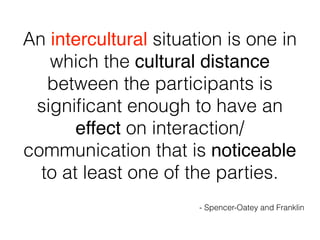
An intercultural situation is one in
which the cultural distance
between the participants is
significant enough to have an
effect on interaction/
communication that is noticeable
to at least one of the parties.
- Spencer-Oatey and Franklin
➡ Multicultural Australia
➡ International Medical Graduates
➡ Overseas Students
➡ Aboriginal and Torres Strait Islander Students
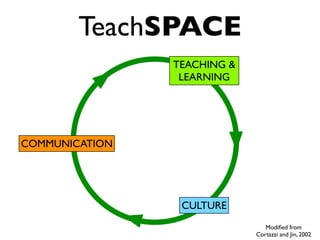
TeachSPACE
COMMUNICATION
CULTURE
TEACHING &
LEARNING
Modified from
Cortazzi and Jin, 2002
TeachSPACE
CULTURE
Culture is a
blueprint for action
- Laksiri Jayasuriya
Image from Μηχανικός1,
Wikimedia Commons
Culture works precisely because
participants do not have to think
about making it work, one simply
does what is expected.
Cortazzi and Jin, 2002
Culture is complex
but not chaotic.
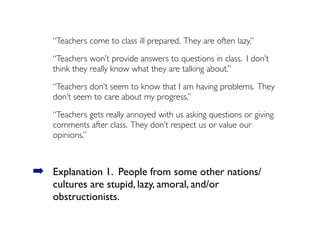
“Teachers come to class ill prepared. They are often lazy.”
“Teachers won’t provide answers to questions in class. I don’t
think they really know what they are talking about.”
“Teachers don’t seem to know that I am having problems. They
don’t seem to care about my progress.”
“Teachers gets really annoyed with us asking questions or giving
comments after class. They don’t respect us or value our
opinions.”
➡ Explanation 1. People from some other nations/
cultures are stupid, lazy, amoral, and/or
obstructionists.
We perceive the values of
our culture in moral terms
and therefore we tend to
view other peoples values as
morally inferior.
➡ Explanation 2. People from some other nations/
cultures differ in cognition in ways that result in
different perceptions, judgments, decision making and
behaviours.
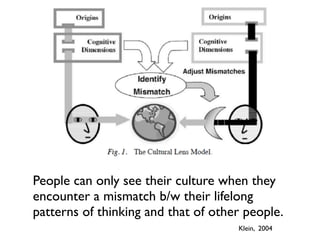
People can only see their culture when they
encounter a mismatch b/w their lifelong
patterns of thinking and that of other people.
Klein, 2004
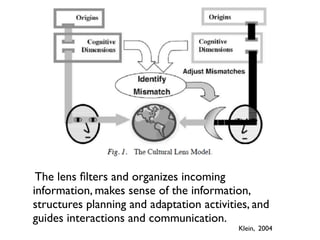
Klein, 2004
People cannot adjust mismatches by altering
their underlying cognitive processes i.e. how
they think about the world.
The lens filters and organizes incoming
information, makes sense of the information,
structures planning and adaptation activities, and
guides interactions and communication.
Klein, 2004
Cultural dimensions
high vs low power distance
short vs long term time orientation
mastery vs fatalism
masculinity vs femininity
high vs low tolerance for uncertainty
hypothetical vs concrete reasoning
root cause vs systems approach
individualist vs collectivist
Individualism Collectivism
Individualism
http://geert-hofstede.com/australia.html
cultureLEARNING
Safe
culturally
White, 2009
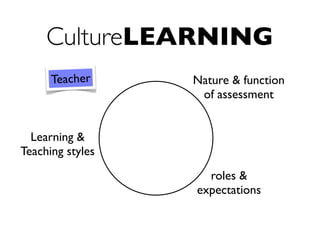
CultureLEARNING
learning &
teaching styles
nature & function
of assessment
roles &
expectations
Learner
Learning &
Teaching styles
Nature & function
of assessment
roles &
expectations
Teacher
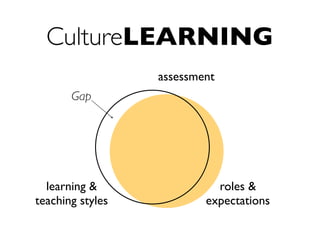
CultureLEARNING
learning &
teaching styles
assessment
roles &
expectations
Gap
CultureLEARNING
rolesEXPECTATIONS
Student view of teacher roles Teacher view of teacher roles
★be authority, expert
★be a model: knowing and
knowing how to
★be a parent, friend
★know students’ problems
★give answer, clear guidance:
teach us what to do
✦be a facilitator, organiser
✦be a model of how to find
out
✦be a friendly critic
Cortazzi and Jin, 2002
Student view of student roles Teacher view of student roles
★develop receptivity, collective
harmony, apprenticeship,
deductive reasoning
★respect teacher: learn by
listening and reflection
★learn methods, technical
advances
★focus on product, results
✦develop independence,
individuality, creativity, inductive
learning
✦participate: engage in dialogue
✦develop critical thinking
✦focus on process of learning,
research skills
✦ask if there is a problem
✦find own answers
✦should know what to do or work
it out
rolesEXPECTATIONS
learningSTYLE
Learning style is an individual
natural or habitual pattern of
acquiring, processing and
delivering information in teaching/
learning situations.
learningSTYLE
Learning style are influenced by
personality, motivation, cultural
preferences and the physical
environments.
learningSTYLE
Sensory Learners
concrete
practical
procedural
They look for FACTS.
Intuitive Learners
conceptual
innovative
theoretical
They look for MEANING.
From Felder and Silverman’s Index of Learning Styles, 2002
learningSTYLE
Visual Learners
graphs
pictures
diagrams
They look forVISUAL
representation of the
information.
Verbal Learners
audio
recordings
lectures
discussions
They look for explanations
with WORDS.
learningSTYLE
Active Learners
manipulate
experiment
explore
They look for SMALL
GROUP DIRECTED
activities.
Reflective Learners
think
evaluate
analyse/
synthesise
They look for SELF-
DIRECTED activities.
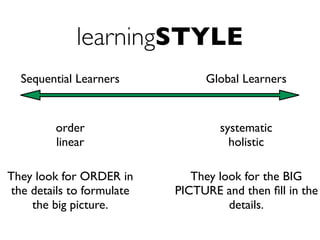
learningSTYLE
Sequential Learners
order
linear
They look for ORDER in
the details to formulate
the big picture.
Global Learners
systematic
holistic
They look for the BIG
PICTURE and then fill in the
details.
learningSTYLE
Everyone has a mix of learning styles.
➡Bring your learning (teaching) style into
balance.
learningSTYLE
Learning styles are not fixed.
➡Expand the way you learn
(teach).
NatureASSESSMENT
“This exam is racist.
”
overseas student reflecting on the OSCE
NatureASSESSMENT
Exam
time pressure
Language
panic
Cultural
preferences
skill of estimation
time pressure
Language
panic
Cultural
preferences
kill of estimation
‣misread words,
instructions, questions, tasks
‣language mixed up
‣only communicate points
they can express in English
‣attempt all questions
in a hurry
or
‣answer only some
questions properly
‣skills and attitudes to guess,
estimate, try out possible
solutions and ideas, make
judgements about possible
alternatives or not
Ballard & Clanchy, 1991
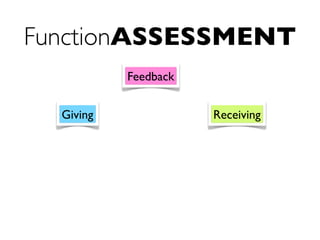
FunctionASSESSMENT
Feedback
Giving Receiving
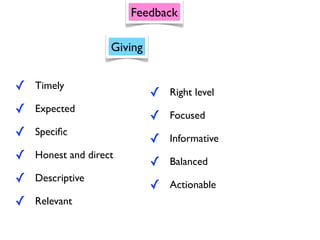
Feedback
Giving
✓ Timely
✓ Expected
✓ Specific
✓ Honest and direct
✓ Descriptive
✓ Relevant
✓ Right level
✓ Focused
✓ Informative
✓ Balanced
✓ Actionable
Feedback
Receiving
Help them:
๏ be explicit of the kind of feedback they want
๏ be aware of their reaction emotionally and
intellectually
๏ actively listen
๏ seek clarification
๏ summarise what they are hearing
๏ reflect and evaluate the information provided
๏ explore possible actions for change
๏ embrace feedback
learning &
teaching styles
assessment
roles &
expectations
Gap
CultureLEARNING
cultureCOMMUNICATION
➡ Rapport is the relative harmony and
smoothness of relations between
people
➡ Rapport management is the
management (or mismanagement)
of relations between people.
Spencer-Oatey, 2005
ManagingRAPPORT
➡ Rapport orientations:
✓enhancement (strengthen)
✓maintenance (protect)
‣ neglect (lack interest or
concern)
‣ challenge (impair)
Spencer-Oatey, 2005
ManagingRAPPORT
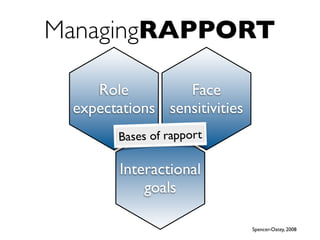
Spencer-Oatey, 2008
Interactional
goals
Face
sensitivities
Role
expectations
Bases of rapport
ManagingRAPPORT
FACE
➡concerned with people sense of
worth, dignity and identity
➡associated with concerns for
respect, honour, status, reputation
and competence
Spencer-Oatey, 2005
ManagingRAPPORT
Face
FACE
➡self as an individual - abilities,
appearance, ethics, confidence
➡self as a group member - family,
ethnic, professional, national, religious
➡self in relation to others - father,
doctor, teacher, leader
Spencer-Oatey, 2005
ManagingRAPPORT
Face
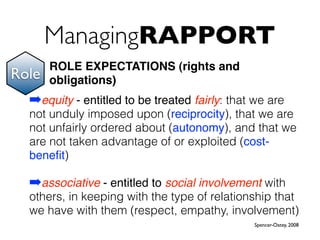
ROLE EXPECTATIONS (rights and
obligations)
➡equity - entitled to be treated fairly: that we are
not unduly imposed upon (reciprocity), that we are
not unfairly ordered about (autonomy), and that we
are not taken advantage of or exploited (cost-
benefit)
➡associative - entitled to social involvement with
others, in keeping with the type of relationship that
we have with them (respect, empathy, involvement)
Spencer-Oatey, 2008
ManagingRAPPORT
Role
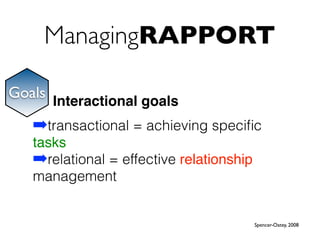
Interactional goals
➡transactional = achieving specific
tasks
➡relational = effective relationship
management
Spencer-Oatey, 2008
ManagingRAPPORT
Goals
Managing rapport:
๏understanding domains of politeness
๏handling speech acts
๏degree of (in)directness
๏type and frequency of down/up-graders
๏understanding authority and respect in
teaching space
๏using wait time
Spencer-Oatey, 2008
ManagingRAPPORT
Spencer-Oatey, 2008
Interactional
goals
Face
sensitivities
Role
expectations
Bases of rapport
activity type
number of
participants
context
-power
-distance
rapport
orientation
cultural
dimensions
pragmalinguistic
conventions
COMMUNICATION
CULTURE
TEACHING &
LEARNING
Intercultural teaching space
Intercultural
competence
Self-awareness
Cultural lens tools
Orientation (roles
& expectations)
Teaching methods
Learning styles
Feedback
Assessment
Language
Managing rapport
Communication
skills
Can you see the glitches?
The Matrix, 1999 from Tech Noir

Intercultural Teaching_TMT2013