Case-Based ECG
Hung The Nguyen
hung@hmvtteachingspace.com
Outline
‣10 Steps ECG
‣2 cases from the bush
Ten Steps ECG
‣name, age, sex
‣time performed
‣chest pain?
‣BP
‣digoxin?
1.Importantbasicinformation
‣300/number of big
squares
2.Rate Ten Steps ECG
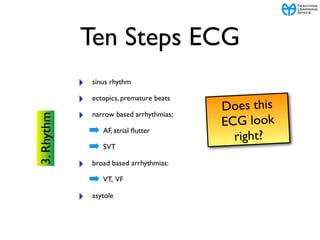
‣ sinus rhythm
‣ ectopics, premature beats
‣ narrow based arrhythmias;
➡ AF, atrial flutter
➡ SVT
‣ broad based arrhythmias:
➡ VT, VF
‣ asytole
3.Rhythm Ten Steps ECG
Does this
ECG look
right?
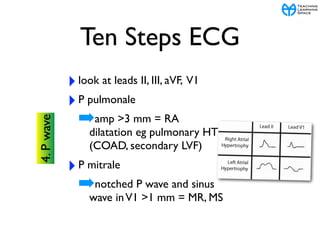
‣look at leads II, III, aVF, V1
‣P pulmonale
➡amp >3 mm = RA
dilatation eg pulmonary HT
(COAD, secondary LVF)
‣P mitrale
➡notched P wave and sinus
wave inV1 >1 mm = MR, MS
4.Pwave Ten Steps ECG
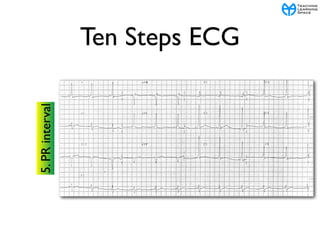
‣AV node conduction,
normally 3-5 mm (0.12 to
0.2 sec)
‣shortened
➡accessory pathway =
WPW (delta wave)
➡Digoxin,
➡hyper Ca, K, Mg
5.PRinterval Ten Steps ECG
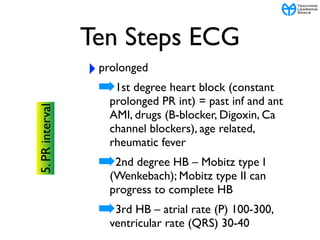
‣prolonged
➡1st degree heart block (constant
prolonged PR int) = past inf and ant
AMI, drugs (B-blocker, Digoxin, Ca
channel blockers), age related,
rheumatic fever
➡2nd degree HB – Mobitz type I
(Wenkebach); Mobitz type II can
progress to complete HB
➡3rd HB – atrial rate (P) 100-300,
ventricular rate (QRS) 30-40
5.PRinterval Ten Steps ECG
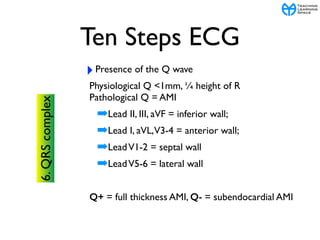
‣Presence of the Q wave
Physiological Q <1mm, ¼ height of R
Pathological Q = AMI
➡Lead II, III, aVF = inferior wall;
➡Lead I, aVL,V3-4 = anterior wall;
➡LeadV1-2 = septal wall
➡LeadV5-6 = lateral wall
Q+ = full thickness AMI, Q- = subendocardial AMI
6.QRScomplex Ten Steps ECG
‣Amplitude
<10 mm inV leads;
V1 R = RV, S = LV;
V6 Q = septum, R = LV, S = RV
determined by amount of fluid (pericardial
effusion), fat (breast, obesity), air
(emphysema);
determined by strength of signal (heart failure)
➡LVH =V1orV2 S plusV6 orV5 > 35 mm
➡RVH R>S inV1 plus prominent S inV6
➡Prominent R wave in V1 = post AMI, RVH,
WPW, RBBB, PE
6.QRScomplex Ten Steps ECG
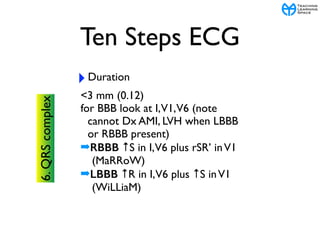
‣Duration
<3 mm (0.12)
for BBB look at I,V1,V6 (note
cannot Dx AMI, LVH when LBBB
or RBBB present)
➡RBBB ↑S in I,V6 plus rSR’ inV1
(MaRRoW)
➡LBBB ↑R in I,V6 plus ↑S inV1
(WiLLiaM)
6.QRScomplex Ten Steps ECG
‣Axis deviation
Physiological = pregnant, tall and
thin (short and obese)
Pathological
➡ant fascicular damage, left ant
hemiblock (LAXD);
➡post fascicular damage, left post
hemiblock (RAXD);
➡MI (necrosis),
➡HT (hypertrophy)
6.QRScomplex
N LAXD RAXD
I ↑ ↑ ↓
II ↑ ↓ ↓
III ↓ ↓ ↑
Ten Steps ECG
Absolute refractory period
‣Depression
➡Angina
Exercise stress test – peak performance HR 200-age, SBP
+60, DBP stay the same or ↓, monitorV5 + when >1 mm
depression 2 mm after the J point;
2/3 women have + exercise stress with normal coronary
arteries
➡LV strain
Severe LVH; signs of LVH with ST ↓ in anterolat leads = HT
➡LBBB
➡Digoxin
‣ST sag
7.STsegment Ten Steps ECG
Elevated
‣AMI
‣Ant
‣Inf – RCA 95%, CXA 5% →1st degree
HB (AV nodal art)
➡Variant angina – ST↑ without ↑cardiac
enzymes
➡LV aneurysm – persistent ↑ST
➡Pericarditis – widespread ST↑, saddled
shaped
7.STsegment Ten Steps ECG
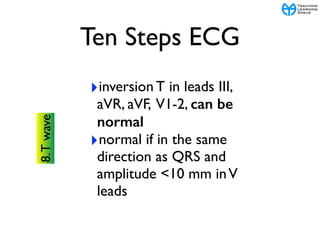
‣inversion T in leads III,
aVR, aVF, V1-2, can be
normal
‣normal if in the same
direction as QRS and
amplitude <10 mm inV
leads
8.Twave Ten Steps ECG
Repol of septum/papillary
muscle inV2-V4 septal
leads
9.Uwave Ten Steps ECG
Depol and repol time
<1/2 RR interval
QTc = QT/√RR <0.44 sec
‣Prolonged
➡↑risk ofVT (torsade de point)
➡familial,
➡electrolyte imbalance (K. Mg, Ca),
➡drugs (phenothiazines,TCA, ventricular
anti-arrhythmic drugs = 10% risk of pro-
arrhythmia)
‣Shortened
No clinical significance
10.QTinterval Ten Steps ECG
Thomasina
‣ Thomasina is a 10 year old girl presenting
with her grandmother. She is visiting a
Community Health Clinic in a remote
Aboriginal community.
‣ The grandmother says to you in broken
English that she is very worried about
Thomasina who is having strange
movements of her hands. “She’s going mad!”
Thomasina
‣ with further questioning she is feeling
unwell, lethargic and has a mild fever.
‣ she complained of sore elbows and wrists.
she also had sore knees as few days ago but
it has abated.
‣ she never had this before
Thomasina
‣ When you examine her, she was short of breath (RR
20), HR= 92
‣ she has jerky and uncoordinated movements of her
right upper limb. She says that she cannot control it.
‣ her elbow and wrist joints are tender but not
swollen
‣ she had no rash
‣ she does not have a heart murmur
Thomasina
‣ you did the following tests according to the
CARPA Standard Treatment Manual:
‣ throat swab MCS
‣ bloods for ASOT, ANTiDNAse B, CRP,
FBC, ESR, blood cultures
‣ ECG
Thomasina
Thomasina
6 mm
Thomasina
‣ you give her paracetamol
Thomasina
‣ you call the DMO and discussed the case
‣ Thomasina will be evacuated by plane
Thomasina
‣ when she returned to the community, you instruct
the health staff to put her on the rheumatic fever,
heart disease list
‣ Thomosina will have Bicillin LA 2 ml IM every 4
weeks until she is 21 years of age
‣ she will need to see a doctor every year for review
‣ she is to have pneumococcal and flu vaccines
‣ she is to see the dentist once a year
Frank
‣ You are having a restful Friday afternoon in
remote Aboriginal Community Health
Centre. This is quite unusual but
welcomed.
‣ Frank came in wondering if the clinic is
opened. He said that he is the pilot of the
mail plane that just arrived and he is having
trouble breathing.
Frank
‣ Frank is a 40 year old pilot for 20 years.
‣ he is healthy and fit.
‣ he says that he suddenly developed short of
breath and palpitations just before he
landed the plane in your community. He
feels faint and worries that he is having a
heart attack.
Frank
‣ he does not have chest pain.
‣ he has no reasons to be stressed or
anxious.
‣ he drinks coffee 4 times a day
‣ takes no alcohol nor does he smoke
Frank
‣ you examine him and found that he is short
of breath (RR 24) and tachycardic (HR
150), afebrile, with a BP = 130/80
‣ his cardiac examination is normal and he is
not in heart failure
Frank
‣ you asked the nurse to do a 12 lead ECG
Frank
Frank
‣ you tell Frank that he has SVT and that you
will need him to help you slow the heart
rate down
‣ you ask him to perform a valsalva
manoeuvre
‣ after a few goes, it did not work
Frank
‣ you tell Frank that there is something else
you can try called the “carotid sinus
massage”
‣ he asks “What happens if that doesn’t
work?”
Frank
‣ you tell him that there are drugs that can
slow the heart down.“Lets not think about
those until we have to,” you said to him.
‣ you proceed to perform the carotid sinus
massage
Frank
‣ his heart rate is now in sinus rhythm!
Frank
‣ He thanks you for an exceptional job, asked
whether he needs to pay for anything and
proceeded to walk out the of the clinic.
Frank
‣ unfortunately for Frank, you stopped him
and told him that he cannot fly today and
you have to let the authorities know about
his condition
‣ you arranged for another plane to fly him
home.
Close
‣10 Steps ECG
‣2 cases from the bush
hung@hmvtteachingspace.com

Case-Based ECG

  • 1.
    Case-Based ECG Hung TheNguyen hung@hmvtteachingspace.com
  • 2.
    Outline ‣10 Steps ECG ‣2cases from the bush
  • 3.
    Ten Steps ECG ‣name,age, sex ‣time performed ‣chest pain? ‣BP ‣digoxin? 1.Importantbasicinformation
  • 4.
  • 5.
    ‣ sinus rhythm ‣ectopics, premature beats ‣ narrow based arrhythmias; ➡ AF, atrial flutter ➡ SVT ‣ broad based arrhythmias: ➡ VT, VF ‣ asytole 3.Rhythm Ten Steps ECG Does this ECG look right?
  • 6.
    ‣look at leadsII, III, aVF, V1 ‣P pulmonale ➡amp >3 mm = RA dilatation eg pulmonary HT (COAD, secondary LVF) ‣P mitrale ➡notched P wave and sinus wave inV1 >1 mm = MR, MS 4.Pwave Ten Steps ECG
  • 7.
    ‣AV node conduction, normally3-5 mm (0.12 to 0.2 sec) ‣shortened ➡accessory pathway = WPW (delta wave) ➡Digoxin, ➡hyper Ca, K, Mg 5.PRinterval Ten Steps ECG
  • 8.
  • 9.
    ‣prolonged ➡1st degree heartblock (constant prolonged PR int) = past inf and ant AMI, drugs (B-blocker, Digoxin, Ca channel blockers), age related, rheumatic fever ➡2nd degree HB – Mobitz type I (Wenkebach); Mobitz type II can progress to complete HB ➡3rd HB – atrial rate (P) 100-300, ventricular rate (QRS) 30-40 5.PRinterval Ten Steps ECG
  • 10.
    ‣Presence of theQ wave Physiological Q <1mm, ¼ height of R Pathological Q = AMI ➡Lead II, III, aVF = inferior wall; ➡Lead I, aVL,V3-4 = anterior wall; ➡LeadV1-2 = septal wall ➡LeadV5-6 = lateral wall Q+ = full thickness AMI, Q- = subendocardial AMI 6.QRScomplex Ten Steps ECG
  • 11.
    ‣Amplitude <10 mm inVleads; V1 R = RV, S = LV; V6 Q = septum, R = LV, S = RV determined by amount of fluid (pericardial effusion), fat (breast, obesity), air (emphysema); determined by strength of signal (heart failure) ➡LVH =V1orV2 S plusV6 orV5 > 35 mm ➡RVH R>S inV1 plus prominent S inV6 ➡Prominent R wave in V1 = post AMI, RVH, WPW, RBBB, PE 6.QRScomplex Ten Steps ECG
  • 12.
    ‣Duration <3 mm (0.12) forBBB look at I,V1,V6 (note cannot Dx AMI, LVH when LBBB or RBBB present) ➡RBBB ↑S in I,V6 plus rSR’ inV1 (MaRRoW) ➡LBBB ↑R in I,V6 plus ↑S inV1 (WiLLiaM) 6.QRScomplex Ten Steps ECG
  • 13.
    ‣Axis deviation Physiological =pregnant, tall and thin (short and obese) Pathological ➡ant fascicular damage, left ant hemiblock (LAXD); ➡post fascicular damage, left post hemiblock (RAXD); ➡MI (necrosis), ➡HT (hypertrophy) 6.QRScomplex N LAXD RAXD I ↑ ↑ ↓ II ↑ ↓ ↓ III ↓ ↓ ↑ Ten Steps ECG
  • 14.
    Absolute refractory period ‣Depression ➡Angina Exercisestress test – peak performance HR 200-age, SBP +60, DBP stay the same or ↓, monitorV5 + when >1 mm depression 2 mm after the J point; 2/3 women have + exercise stress with normal coronary arteries ➡LV strain Severe LVH; signs of LVH with ST ↓ in anterolat leads = HT ➡LBBB ➡Digoxin ‣ST sag 7.STsegment Ten Steps ECG
  • 15.
    Elevated ‣AMI ‣Ant ‣Inf – RCA95%, CXA 5% →1st degree HB (AV nodal art) ➡Variant angina – ST↑ without ↑cardiac enzymes ➡LV aneurysm – persistent ↑ST ➡Pericarditis – widespread ST↑, saddled shaped 7.STsegment Ten Steps ECG
  • 16.
    ‣inversion T inleads III, aVR, aVF, V1-2, can be normal ‣normal if in the same direction as QRS and amplitude <10 mm inV leads 8.Twave Ten Steps ECG
  • 17.
    Repol of septum/papillary muscleinV2-V4 septal leads 9.Uwave Ten Steps ECG
  • 18.
    Depol and repoltime <1/2 RR interval QTc = QT/√RR <0.44 sec ‣Prolonged ➡↑risk ofVT (torsade de point) ➡familial, ➡electrolyte imbalance (K. Mg, Ca), ➡drugs (phenothiazines,TCA, ventricular anti-arrhythmic drugs = 10% risk of pro- arrhythmia) ‣Shortened No clinical significance 10.QTinterval Ten Steps ECG
  • 19.
    Thomasina ‣ Thomasina isa 10 year old girl presenting with her grandmother. She is visiting a Community Health Clinic in a remote Aboriginal community. ‣ The grandmother says to you in broken English that she is very worried about Thomasina who is having strange movements of her hands. “She’s going mad!”
  • 20.
    Thomasina ‣ with furtherquestioning she is feeling unwell, lethargic and has a mild fever. ‣ she complained of sore elbows and wrists. she also had sore knees as few days ago but it has abated. ‣ she never had this before
  • 21.
    Thomasina ‣ When youexamine her, she was short of breath (RR 20), HR= 92 ‣ she has jerky and uncoordinated movements of her right upper limb. She says that she cannot control it. ‣ her elbow and wrist joints are tender but not swollen ‣ she had no rash ‣ she does not have a heart murmur
  • 22.
    Thomasina ‣ you didthe following tests according to the CARPA Standard Treatment Manual: ‣ throat swab MCS ‣ bloods for ASOT, ANTiDNAse B, CRP, FBC, ESR, blood cultures ‣ ECG
  • 23.
  • 24.
  • 25.
    Thomasina ‣ you giveher paracetamol
  • 26.
    Thomasina ‣ you callthe DMO and discussed the case ‣ Thomasina will be evacuated by plane
  • 27.
    Thomasina ‣ when shereturned to the community, you instruct the health staff to put her on the rheumatic fever, heart disease list ‣ Thomosina will have Bicillin LA 2 ml IM every 4 weeks until she is 21 years of age ‣ she will need to see a doctor every year for review ‣ she is to have pneumococcal and flu vaccines ‣ she is to see the dentist once a year
  • 28.
    Frank ‣ You arehaving a restful Friday afternoon in remote Aboriginal Community Health Centre. This is quite unusual but welcomed. ‣ Frank came in wondering if the clinic is opened. He said that he is the pilot of the mail plane that just arrived and he is having trouble breathing.
  • 29.
    Frank ‣ Frank isa 40 year old pilot for 20 years. ‣ he is healthy and fit. ‣ he says that he suddenly developed short of breath and palpitations just before he landed the plane in your community. He feels faint and worries that he is having a heart attack.
  • 30.
    Frank ‣ he doesnot have chest pain. ‣ he has no reasons to be stressed or anxious. ‣ he drinks coffee 4 times a day ‣ takes no alcohol nor does he smoke
  • 31.
    Frank ‣ you examinehim and found that he is short of breath (RR 24) and tachycardic (HR 150), afebrile, with a BP = 130/80 ‣ his cardiac examination is normal and he is not in heart failure
  • 32.
    Frank ‣ you askedthe nurse to do a 12 lead ECG
  • 33.
  • 34.
    Frank ‣ you tellFrank that he has SVT and that you will need him to help you slow the heart rate down ‣ you ask him to perform a valsalva manoeuvre ‣ after a few goes, it did not work
  • 35.
    Frank ‣ you tellFrank that there is something else you can try called the “carotid sinus massage” ‣ he asks “What happens if that doesn’t work?”
  • 36.
    Frank ‣ you tellhim that there are drugs that can slow the heart down.“Lets not think about those until we have to,” you said to him. ‣ you proceed to perform the carotid sinus massage
  • 37.
    Frank ‣ his heartrate is now in sinus rhythm!
  • 38.
    Frank ‣ He thanksyou for an exceptional job, asked whether he needs to pay for anything and proceeded to walk out the of the clinic.
  • 39.
    Frank ‣ unfortunately forFrank, you stopped him and told him that he cannot fly today and you have to let the authorities know about his condition ‣ you arranged for another plane to fly him home.
  • 40.
    Close ‣10 Steps ECG ‣2cases from the bush
  • 41.