LESSON 2: Learning principle on Developmental, Social, and Individual Differences
1.
LESSON 2: LEARNING
PRINCIPLESON
DEVELOPMENT, SOCIAL,
AND INDIVIDUAL
DIFFERENCES
Presented By : Ma. Nieves Sofia E. Amorin
2.
OBJECTIVES
1
Explain the developmentaland social factors
Recognize classroom instances that apply learning
principles related to development and social
factors
Apply the principles learned in classroom-specific
situation
3.
What factors doyou think influence the way
you learn best?
2
As individuals develop,there are different opportunities and
constraints for learning.
1
Learning is most effective when differential
development within and across physical, intellectual,
emotional, and social domains is taken into account.
Teachers are persons and professionals who should be
knowledgeable of the various developmental
milestones of learners.
4
6.
Why do youthink some students learn faster
than others? How can teachers help?
5
7.
Learning is influencedby social interactions, interpersonal
relations, and communication with others.
2
Collaboration is a 21st century skill. All learners
should learn the skill of working with others in an
instructional setting. This ability will prepare them
for the real world where they are expected to interact
effectively. When learners work with their peers and
classmates, they learn to appreciate and respect
diversity.
6
8.
How do thepeople around you influence the
way you learn?
7
9.
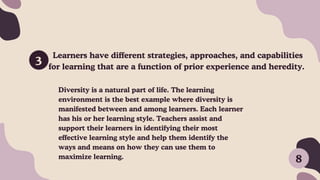
Learners have differentstrategies, approaches, and capabilities
for learning that are a function of prior experience and heredity.
3
Diversity is a natural part of life. The learning
environment is the best example where diversity is
manifested between and among learners. Each learner
has his or her learning style. Teachers assist and
support their learners in identifying their most
effective learning style and help them identify the
ways and means on how they can use them to
maximize learning. 8
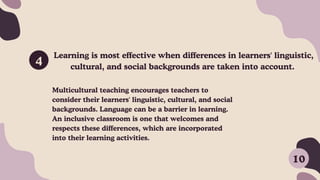
Learning is mosteffective when differences in learners' linguistic,
cultural, and social backgrounds are taken into account.
4
Multicultural teaching encourages teachers to
consider their learners' linguistic, cultural, and social
backgrounds. Language can be a barrier in learning.
An inclusive classroom is one that welcomes and
respects these differences, which are incorporated
into their learning activities.
10
12.
How can teachersmake learning fair for
students from different backgrounds?
11
13.
Setting appropriately highand challenging standards and
assessing the learner as well as the learning progress including
diagnostic, process, and outcome assessment-are integral parts of
the learning process
5
Assessment and evaluation are essential parts of the
teaching and learning process. Teachers can also
determine what kind of support and scaffold the
learners need. Assessment should be an ongoing
process. Whether it was formative or summative,
results should be used as a means of improving the
teachers' strategies and techniques in teaching.
12
14.
Why do youthink it’s important to have
challenging goals in learning?
13