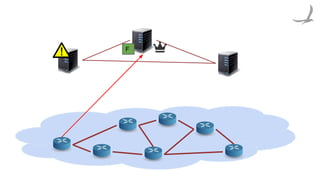
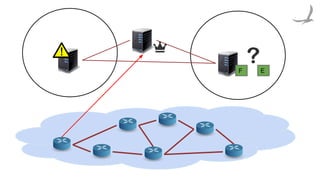
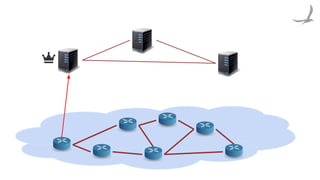
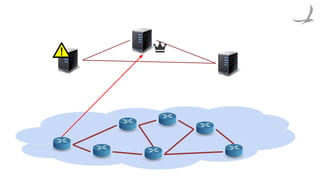
ONOS
Building a Distributed, Network Operating System
Madan Jampani & Brian O'Connor
BANV Meetup
3/16/2015
Outline
● A simple example as motivation
● ONOS Architecture
● Distributed primitives for managing state
● APIs and a template for implementation
● Intent Framework
● Live Demo
● Q/A
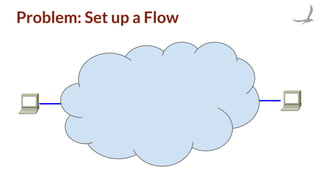
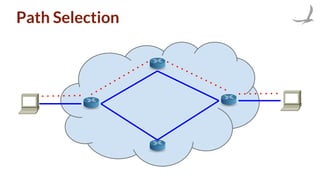
Problem: Set up a Flow
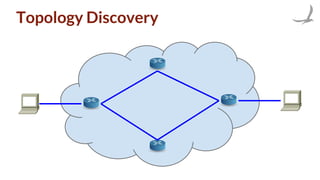
Topology Discovery
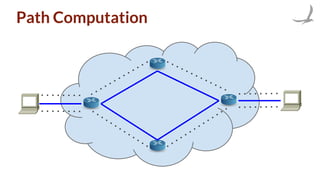
Path Computation
Path Selection
Switch FlowEntry
S1 ...
S2 ...
S3 ...
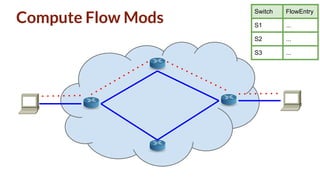
Compute Flow Mods
Switch FlowEntry
S1 ...
S2 ...
S3 ...
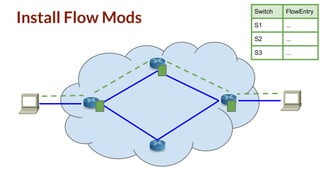
Install Flow Mods
Switch FlowEntry
S1 ...
S2 ...
S3 ...
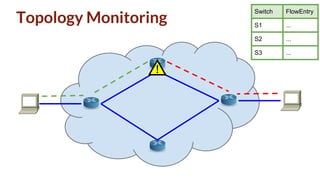
Topology Monitoring
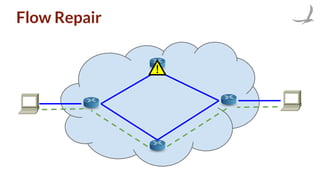
Flow Repair
Wishlist
● Global Network View
● Path Computation
● Flow Mod Computation / Installation
● Monitor and React to network events
Do all this with...
● High Availability
● At Scale
Wishlist
● Global Network View
● Path Computation
● Flow Mod Computation / Installation
● Monitor and React to network events
● High Availability and Scale
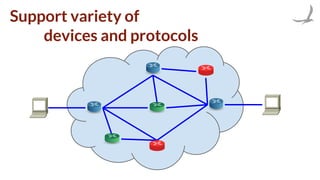
Support variety of
devices and protocols
Wishlist
● Global Network View
● Path Computation
● Flow Mod Computation/Installation
● Monitor and React to events
● High Availability and Scale
● Extensible and Abstracted Southbound
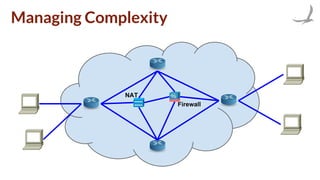
Managing Complexity
NAT
Firewall
Wishlist
● Global Network View
● Path Computation
● Flow Mod Computation/Installation
● Monitor and React to events
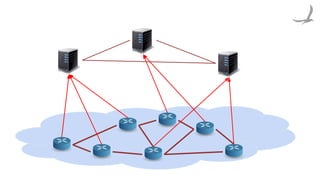
● High Availability and Scale
● Pluggable Southbound
● Modularity and Customizability
Note: We've also done this exercise on more complex, real-world use cases.
You can read more about them in the wiki: https://wiki.onosproject.org/display/ONOS/ONOS+Use+Cases
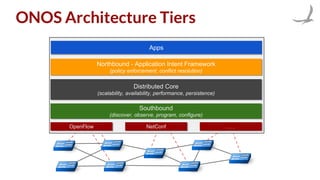
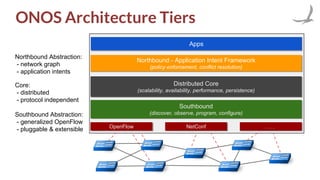
ONOS Architecture Tiers
Northbound - Application Intent Framework
(policy enforcement, conflict resolution)
OpenFlow NetConf . . .
AppsApps
Distributed Core
(scalability, availability, performance, persistence)
Southbound
(discover, observe, program, configure)
Distributed Core
● Distributed state management framework
○ built for high availability and scale-out
● Different types of state require different handling
○ fully replicated and eventually consistent
○ partitioned and strongly consistent
Distributed Core
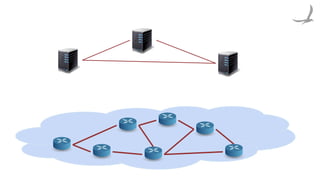
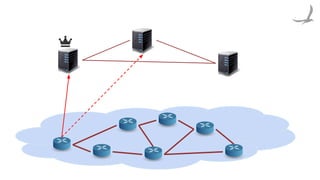
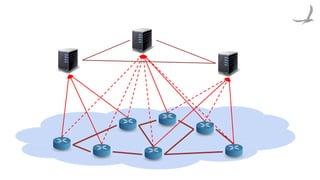
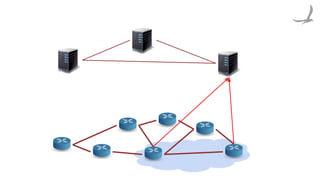
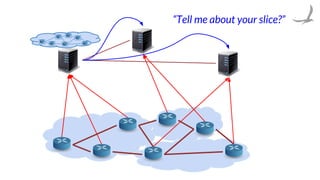
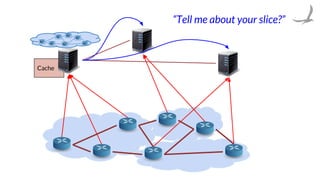
● Global Network View
● Scaling strong consistency
“Tell me about your slice?”
Cache
“Tell me about your slice?”
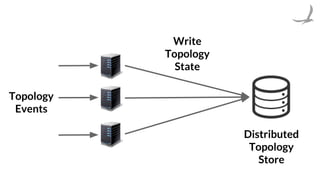
Topology
Events
Distributed
Topology
Store
Write
Topology
State
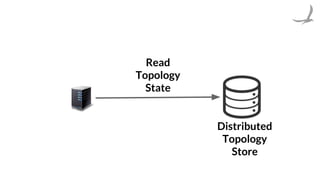
Distributed
Topology
Store
Read
Topology
State
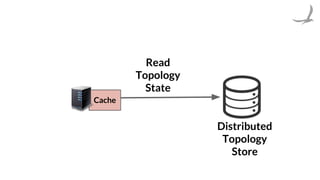
Cache
Distributed
Topology
Store
Read
Topology
State
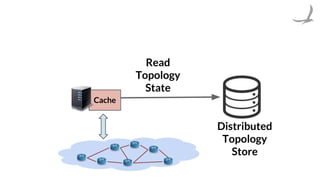
Cache
Distributed
Topology
Store
Read
Topology
State
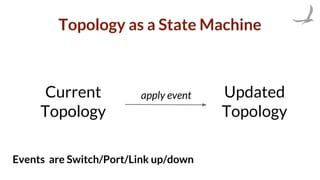
Topology as a State Machine
Events are Switch/Port/Link up/down
Current
Topology
Updated
Topology
apply event
E
E E
E
E
F
F E
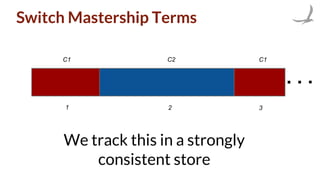
C1C2C1
1 2 3
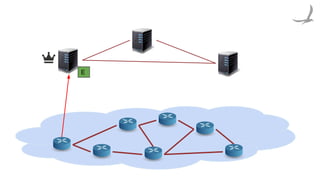
Switch Mastership Terms
We track this in a strongly
consistent store
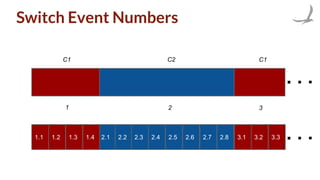
2.1 2.2 2.3 2.4 2.5 2.61.41.2 1.31.1 3.2 3.33.12.7 2.8
C1C2C1
1 2 3
Switch Event Numbers
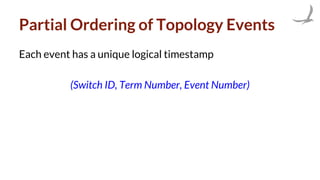
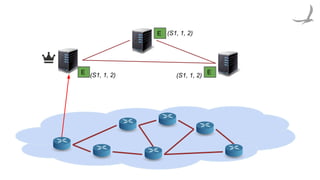
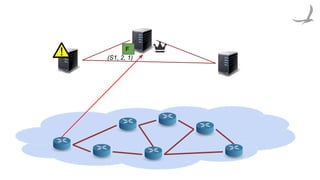
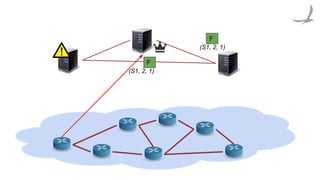
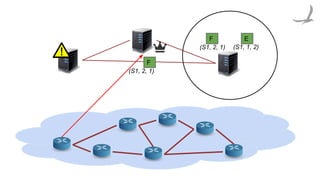
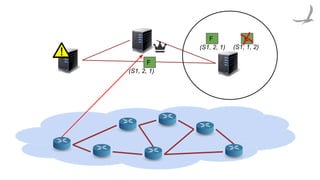
Partial Ordering of Topology Events
Each event has a unique logical timestamp
(Switch ID, Term Number, Event Number)
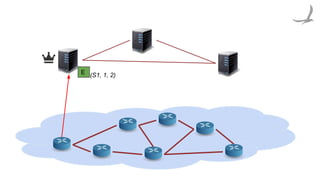
E (S1, 1, 2)
E E
E
(S1, 1, 2)
(S1, 1, 2)
(S1, 1, 2)
F
(S1, 2, 1)
F
F
(S1, 2, 1)
(S1, 2, 1)
F
F
(S1, 2, 1)
(S1, 2, 1) (S1, 1, 2)
E
F
F
(S1, 2, 1)
(S1, 2, 1) (S1, 1, 2)
E
To summarize
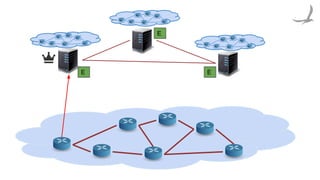
● Each instance has a full copy of network topology
● Events are timestamped on arrival and broadcasted
● Stale events are dropped on receipt
There is one additional step...
What about dropped messages?
Anti-Entropy
Lightweight, Gossip style, peer-to-peer
Quickly bootstraps newly joined nodes
A model for state tracking
If you are the observer, Eventual Consistency is the best
option
View should be consistent with the network, not with other
views
Hiding the complexity
EventuallyConsistentMap<K, V, T>
Plugin your own timestamp generation
Other Control Plane state...
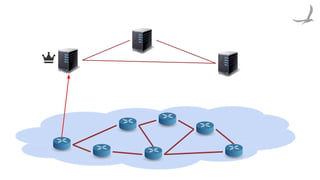
● Switch to Controller mapping
● Resource Allocations
● Flows
● Various application generated state
In all case strong consistency is either required or highly
desirable
Consistency => Coordination
2PC
All participants need to be available
Consensus
Only a majority need to participate
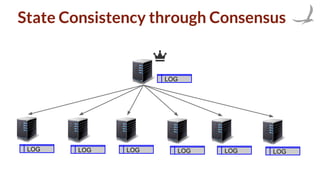
State Consistency through Consensus
LOG
LOG LOG LOG LOG LOG LOG
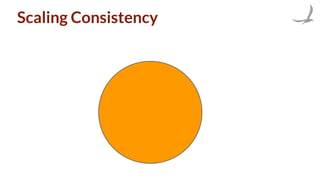
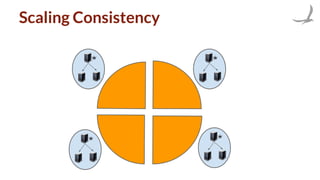
Scaling Consistency
Scaling Consistency
Scaling Consistency
Consistency Cost
● Atomic updates within a shard are “cheap”
● Atomic updates spanning shards use 2PC
Hiding Complexity
ConsistentMap<K, V>
Outline
● A simple example as motivation
● ONOS Architecture
● Distributed primitives for managing state
● APIs and a template for implementation
● Intent Framework
● Live Demo
● Q/A
ONOS Architecture Tiers
Northbound - Application Intent Framework
(policy enforcement, conflict resolution)
OpenFlow NetConf . . .
AppsApps
Distributed Core
(scalability, availability, performance, persistence)
Southbound
(discover, observe, program, configure)
Northbound Abstraction:
- network graph
- application intents
Core:
- distributed
- protocol independent
Southbound Abstraction:
- generalized OpenFlow
- pluggable & extensible
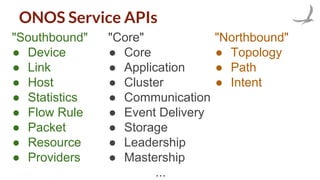
ONOS Service APIs
"Southbound"
● Device
● Link
● Host
● Statistics
● Flow Rule
● Packet
● Resource
● Providers
"Northbound"
● Topology
● Path
● Intent
"Core"
● Core
● Application
● Cluster
● Communication
● Event Delivery
● Storage
● Leadership
● Mastership
...
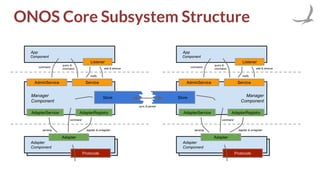
Manager
Component
ONOS Core Subsystem Structure
Adapter
Component
Adapter
Component
App
Component
ServiceAdminService
Listener
notify
command
command
sync & persist
add & remove
query &
command
App
Component
Adapter
Component
Manager
Component
AdapterRegistry
Adapter
AdapterService
ServiceAdminService
Listener
notify
register & unregister
command
command
sensing
add & remove
query &
command
Store Store
Protocols
sync & persist
Adapter
Component
AdapterRegistry
Adapter
AdapterService
register & unregistersensing
Protocols
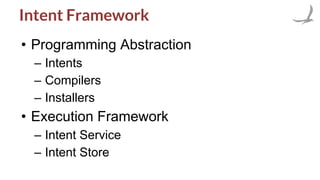
Intent Framework
• Programming Abstraction
– Intents
– Compilers
– Installers
• Execution Framework
– Intent Service
– Intent Store
Intents
• Provide high-level interface that focuses on what
should be done rather than how it is specifically
programmed
• Abstract network complexity from applications
• Extend easily to produce more complex
functionality through combinations of other
intents
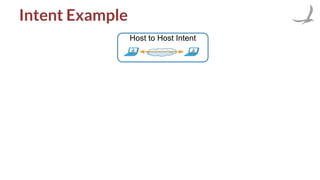
Intent Example
Host to Host Intent
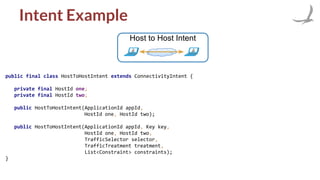
Intent Example
Host to Host Intent
public final class HostToHostIntent extends ConnectivityIntent {
private final HostId one;
private final HostId two;
public HostToHostIntent(ApplicationId appId,
HostId one, HostId two);
public HostToHostIntent(ApplicationId appId, Key key,
HostId one, HostId two,
TrafficSelector selector,
TrafficTreatment treatment,
List<Constraint> constraints);
}
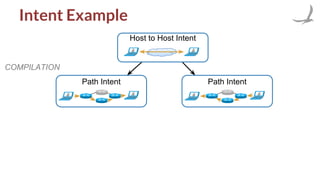
Intent Example
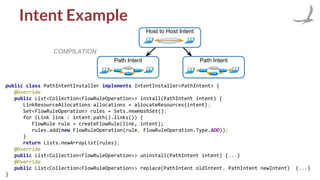
COMPILATION
Path IntentPath Intent
Host to Host Intent
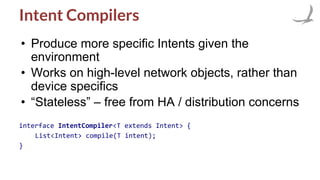
Intent Compilers
• Produce more specific Intents given the
environment
• Works on high-level network objects, rather than
device specifics
• “Stateless” – free from HA / distribution concerns
interface IntentCompiler<T extends Intent> {
List<Intent> compile(T intent);
}
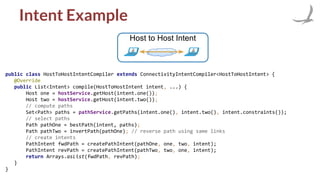
Intent Example
Host to Host Intent
public class HostToHostIntentCompiler extends ConnectivityIntentCompiler<HostToHostIntent> {
@Override
public List<Intent> compile(HostToHostIntent intent, ...) {
Host one = hostService.getHost(intent.one());
Host two = hostService.getHost(intent.two());
// compute paths
Set<Path> paths = pathService.getPaths(intent.one(), intent.two(), intent.constraints());
// select paths
Path pathOne = bestPath(intent, paths);
Path pathTwo = invertPath(pathOne); // reverse path using same links
// create intents
PathIntent fwdPath = createPathIntent(pathOne, one, two, intent);
PathIntent revPath = createPathIntent(pathTwo, two, one, intent);
return Arrays.asList(fwdPath, revPath);
}
}
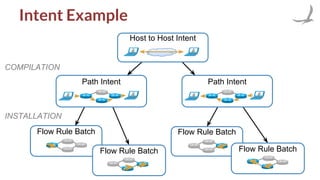
Intent Example
COMPILATION
INSTALLATION
Flow Rule Batch Flow Rule Batch
Flow Rule BatchFlow Rule Batch
Path IntentPath Intent
Host to Host Intent
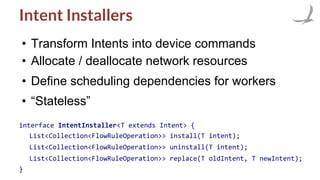
Intent Installers
• Transform Intents into device commands
• Allocate / deallocate network resources
• Define scheduling dependencies for workers
• “Stateless”
interface IntentInstaller<T extends Intent> {
List<Collection<FlowRuleOperation>> install(T intent);
List<Collection<FlowRuleOperation>> uninstall(T intent);
List<Collection<FlowRuleOperation>> replace(T oldIntent, T newIntent);
}
Intent Example
COMPILATION
Path IntentPath Intent
Host to Host Intent
public class PathIntentInstaller implements IntentInstaller<PathIntent> {
@Override
public List<Collection<FlowRuleOperation>> install(PathIntent intent) {
LinkResourceAllocations allocations = allocateResources(intent);
Set<FlowRuleOperation> rules = Sets.newHashSet();
for (Link link : intent.path().links()) {
FlowRule rule = createFlowRule(link, intent);
rules.add(new FlowRuleOperation(rule, FlowRuleOperation.Type.ADD));
}
return Lists.newArrayList(rules);
@Override
public List<Collection<FlowRuleOperation>> uninstall(PathIntent intent) {...}
@Override
public List<Collection<FlowRuleOperation>> replace(PathIntent oldIntent, PathIntent newIntent) {...}
}
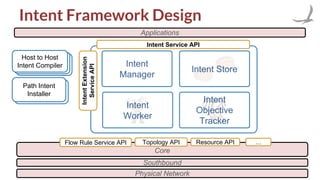
Intent Framework Design
Southbound
Physical Network
Host to Host
Intent Compiler
Path Intent
Installer
Path Intent
Installer
Applications
Intent Service API
IntentExtension
ServiceAPI
Intent
Manager
Intent Store
Intent
Objective
Tracker
Intent
Worker
Core
Topology API Resource API …Flow Rule Service API
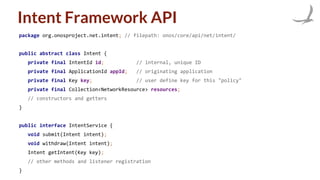
Intent Framework API
package org.onosproject.net.intent; // filepath: onos/core/api/net/intent/
public abstract class Intent {
private final IntentId id; // internal, unique ID
private final ApplicationId appId; // originating application
private final Key key; // user define key for this "policy"
private final Collection<NetworkResource> resources;
// constructors and getters
}
public interface IntentService {
void submit(Intent intent);
void withdraw(Intent intent);
Intent getIntent(Key key);
// other methods and listener registration
}
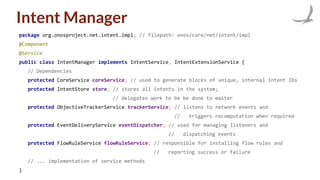
Intent Manager
package org.onosproject.net.intent.impl; // filepath: onos/core/net/intent/impl
@Component
@Service
public class IntentManager implements IntentService, IntentExtensionService {
// Dependencies
protected CoreService coreService; // used to generate blocks of unique, internal intent IDs
protected IntentStore store; // stores all intents in the system;
// delegates work to be be done to master
protected ObjectiveTrackerService trackerService; // listens to network events and
// triggers recomputation when required
protected EventDeliveryService eventDispatcher; // used for managing listeners and
// dispatching events
protected FlowRuleService flowRuleService; // responsible for installing flow rules and
// reporting success or failure
// ... implementation of service methods
}
Intent Store
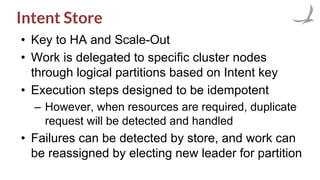
• Key to HA and Scale-Out
• Work is delegated to specific cluster nodes
through logical partitions based on Intent key
• Execution steps designed to be idempotent
– However, when resources are required, duplicate
request will be detected and handled
• Failures can be detected by store, and work can
be reassigned by electing new leader for partition
Intent Store
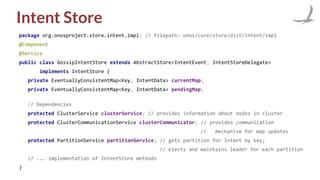
package org.onosproject.store.intent.impl; // filepath: onos/core/store/dist/intent/impl
@Component
@Service
public class GossipIntentStore extends AbstractStore<IntentEvent, IntentStoreDelegate>
implements IntentStore {
private EventuallyConsistentMap<Key, IntentData> currentMap;
private EventuallyConsistentMap<Key, IntentData> pendingMap;
// Dependencies
protected ClusterService clusterService; // provides information about nodes in cluster
protected ClusterCommunicationService clusterCommunicator; // provides communication
// mechanism for map updates
protected PartitionService partitionService; // gets partition for Intent by key;
// elects and maintains leader for each partition
// ... implementation of IntentStore methods
}
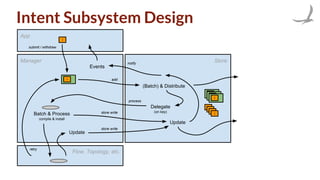
Intent Subsystem Design
i
i
ii ii ii
(Batch) & Distribute
Delegate
(on key)
Batch & Process
compile & install
Update
submit / withdraw
add
process
Update
store write
store write
notify
i
i
i
i
App
StoreManager
Flow, Topology, etc.
Events
retry
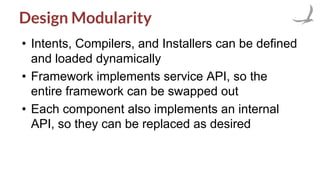
Design Modularity
• Intents, Compilers, and Installers can be defined
and loaded dynamically
• Framework implements service API, so the
entire framework can be swapped out
• Each component also implements an internal
API, so they can be replaced as desired
What's Next?
● Join ONOS mailing lists
○ https://wiki.onosproject.org/display/ONOS/ONOS+Mailing+Lists
○ Don’t hesitate to engage with ONOS developers & community
● Try some of the tutorials
○ https://wiki.onosproject.org/display/ONOS/Tutorials+and+Walkthroughs
● Download the source code:
○ https://gerrit.onosproject.org/ (main developer repository)
○ https://github.com/opennetworkinglab/onos (read-only mirror)
● Check out the ONOS API Javadoc
○ http://api.onosproject.org/
● Fix (or file) a bug
○ https://jira.onosproject.org/
● Visit the main project page and wiki
○ http://onosproject.org/ and https://wiki.onosproject.org/
Outline
● A simple example as motivation
● ONOS Architecture
● Distributed primitives for managing state
● APIs and a template for implementation
● Intent Framework
● Live Demo
● Q/A
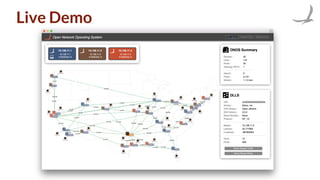
Live Demo
Outline
● A simple example as motivation
● ONOS Architecture
● Distributed primitives for managing state
● APIs and a template for implementation
● Intent Framework
● Live Demo
● Q/A

Tech Talk: ONOS- A Distributed SDN Network Operating System

  • 1.
    ONOS Building a Distributed,Network Operating System Madan Jampani & Brian O'Connor BANV Meetup 3/16/2015
  • 2.
    Outline ● A simpleexample as motivation ● ONOS Architecture ● Distributed primitives for managing state ● APIs and a template for implementation ● Intent Framework ● Live Demo ● Q/A
  • 3.
  • 4.
  • 5.
  • 6.
  • 7.
    Switch FlowEntry S1 ... S2... S3 ... Compute Flow Mods
  • 8.
    Switch FlowEntry S1 ... S2... S3 ... Install Flow Mods
  • 9.
    Switch FlowEntry S1 ... S2... S3 ... Topology Monitoring
  • 10.
  • 11.
    Wishlist ● Global NetworkView ● Path Computation ● Flow Mod Computation / Installation ● Monitor and React to network events
  • 12.
    Do all thiswith... ● High Availability ● At Scale
  • 13.
    Wishlist ● Global NetworkView ● Path Computation ● Flow Mod Computation / Installation ● Monitor and React to network events ● High Availability and Scale
  • 14.
  • 15.
    Wishlist ● Global NetworkView ● Path Computation ● Flow Mod Computation/Installation ● Monitor and React to events ● High Availability and Scale ● Extensible and Abstracted Southbound
  • 16.
  • 17.
    Wishlist ● Global NetworkView ● Path Computation ● Flow Mod Computation/Installation ● Monitor and React to events ● High Availability and Scale ● Pluggable Southbound ● Modularity and Customizability Note: We've also done this exercise on more complex, real-world use cases. You can read more about them in the wiki: https://wiki.onosproject.org/display/ONOS/ONOS+Use+Cases
  • 18.
    ONOS Architecture Tiers Northbound- Application Intent Framework (policy enforcement, conflict resolution) OpenFlow NetConf . . . AppsApps Distributed Core (scalability, availability, performance, persistence) Southbound (discover, observe, program, configure)
  • 19.
    Distributed Core ● Distributedstate management framework ○ built for high availability and scale-out ● Different types of state require different handling ○ fully replicated and eventually consistent ○ partitioned and strongly consistent
  • 20.
    Distributed Core ● GlobalNetwork View ● Scaling strong consistency
  • 29.
    “Tell me aboutyour slice?”
  • 30.
    Cache “Tell me aboutyour slice?”
  • 31.
  • 32.
  • 33.
  • 34.
  • 35.
    Topology as aState Machine Events are Switch/Port/Link up/down Current Topology Updated Topology apply event
  • 38.
  • 39.
  • 40.
  • 41.
  • 42.
  • 45.
    C1C2C1 1 2 3 SwitchMastership Terms We track this in a strongly consistent store
  • 46.
    2.1 2.2 2.32.4 2.5 2.61.41.2 1.31.1 3.2 3.33.12.7 2.8 C1C2C1 1 2 3 Switch Event Numbers
  • 47.
    Partial Ordering ofTopology Events Each event has a unique logical timestamp (Switch ID, Term Number, Event Number)
  • 48.
  • 49.
    E E E (S1, 1,2) (S1, 1, 2) (S1, 1, 2)
  • 50.
  • 51.
  • 52.
    F F (S1, 2, 1) (S1,2, 1) (S1, 1, 2) E
  • 53.
    F F (S1, 2, 1) (S1,2, 1) (S1, 1, 2) E
  • 54.
    To summarize ● Eachinstance has a full copy of network topology ● Events are timestamped on arrival and broadcasted ● Stale events are dropped on receipt
  • 55.
    There is oneadditional step... What about dropped messages?
  • 56.
    Anti-Entropy Lightweight, Gossip style,peer-to-peer Quickly bootstraps newly joined nodes
  • 57.
    A model forstate tracking If you are the observer, Eventual Consistency is the best option View should be consistent with the network, not with other views
  • 58.
    Hiding the complexity EventuallyConsistentMap<K,V, T> Plugin your own timestamp generation
  • 59.
    Other Control Planestate... ● Switch to Controller mapping ● Resource Allocations ● Flows ● Various application generated state In all case strong consistency is either required or highly desirable
  • 60.
    Consistency => Coordination 2PC Allparticipants need to be available Consensus Only a majority need to participate
  • 61.
    State Consistency throughConsensus LOG LOG LOG LOG LOG LOG LOG
  • 62.
  • 63.
  • 64.
  • 65.
    Consistency Cost ● Atomicupdates within a shard are “cheap” ● Atomic updates spanning shards use 2PC
  • 66.
  • 67.
    Outline ● A simpleexample as motivation ● ONOS Architecture ● Distributed primitives for managing state ● APIs and a template for implementation ● Intent Framework ● Live Demo ● Q/A
  • 68.
    ONOS Architecture Tiers Northbound- Application Intent Framework (policy enforcement, conflict resolution) OpenFlow NetConf . . . AppsApps Distributed Core (scalability, availability, performance, persistence) Southbound (discover, observe, program, configure) Northbound Abstraction: - network graph - application intents Core: - distributed - protocol independent Southbound Abstraction: - generalized OpenFlow - pluggable & extensible
  • 69.
    ONOS Service APIs "Southbound" ●Device ● Link ● Host ● Statistics ● Flow Rule ● Packet ● Resource ● Providers "Northbound" ● Topology ● Path ● Intent "Core" ● Core ● Application ● Cluster ● Communication ● Event Delivery ● Storage ● Leadership ● Mastership ...
  • 70.
    Manager Component ONOS Core SubsystemStructure Adapter Component Adapter Component App Component ServiceAdminService Listener notify command command sync & persist add & remove query & command App Component Adapter Component Manager Component AdapterRegistry Adapter AdapterService ServiceAdminService Listener notify register & unregister command command sensing add & remove query & command Store Store Protocols sync & persist Adapter Component AdapterRegistry Adapter AdapterService register & unregistersensing Protocols
  • 71.
    Intent Framework • ProgrammingAbstraction – Intents – Compilers – Installers • Execution Framework – Intent Service – Intent Store
  • 72.
    Intents • Provide high-levelinterface that focuses on what should be done rather than how it is specifically programmed • Abstract network complexity from applications • Extend easily to produce more complex functionality through combinations of other intents
  • 73.
  • 74.
    Intent Example Host toHost Intent public final class HostToHostIntent extends ConnectivityIntent { private final HostId one; private final HostId two; public HostToHostIntent(ApplicationId appId, HostId one, HostId two); public HostToHostIntent(ApplicationId appId, Key key, HostId one, HostId two, TrafficSelector selector, TrafficTreatment treatment, List<Constraint> constraints); }
  • 75.
  • 76.
    Intent Compilers • Producemore specific Intents given the environment • Works on high-level network objects, rather than device specifics • “Stateless” – free from HA / distribution concerns interface IntentCompiler<T extends Intent> { List<Intent> compile(T intent); }
  • 77.
    Intent Example Host toHost Intent public class HostToHostIntentCompiler extends ConnectivityIntentCompiler<HostToHostIntent> { @Override public List<Intent> compile(HostToHostIntent intent, ...) { Host one = hostService.getHost(intent.one()); Host two = hostService.getHost(intent.two()); // compute paths Set<Path> paths = pathService.getPaths(intent.one(), intent.two(), intent.constraints()); // select paths Path pathOne = bestPath(intent, paths); Path pathTwo = invertPath(pathOne); // reverse path using same links // create intents PathIntent fwdPath = createPathIntent(pathOne, one, two, intent); PathIntent revPath = createPathIntent(pathTwo, two, one, intent); return Arrays.asList(fwdPath, revPath); } }
  • 78.
    Intent Example COMPILATION INSTALLATION Flow RuleBatch Flow Rule Batch Flow Rule BatchFlow Rule Batch Path IntentPath Intent Host to Host Intent
  • 79.
    Intent Installers • TransformIntents into device commands • Allocate / deallocate network resources • Define scheduling dependencies for workers • “Stateless” interface IntentInstaller<T extends Intent> { List<Collection<FlowRuleOperation>> install(T intent); List<Collection<FlowRuleOperation>> uninstall(T intent); List<Collection<FlowRuleOperation>> replace(T oldIntent, T newIntent); }
  • 80.
    Intent Example COMPILATION Path IntentPathIntent Host to Host Intent public class PathIntentInstaller implements IntentInstaller<PathIntent> { @Override public List<Collection<FlowRuleOperation>> install(PathIntent intent) { LinkResourceAllocations allocations = allocateResources(intent); Set<FlowRuleOperation> rules = Sets.newHashSet(); for (Link link : intent.path().links()) { FlowRule rule = createFlowRule(link, intent); rules.add(new FlowRuleOperation(rule, FlowRuleOperation.Type.ADD)); } return Lists.newArrayList(rules); @Override public List<Collection<FlowRuleOperation>> uninstall(PathIntent intent) {...} @Override public List<Collection<FlowRuleOperation>> replace(PathIntent oldIntent, PathIntent newIntent) {...} }
  • 81.
    Intent Framework Design Southbound PhysicalNetwork Host to Host Intent Compiler Path Intent Installer Path Intent Installer Applications Intent Service API IntentExtension ServiceAPI Intent Manager Intent Store Intent Objective Tracker Intent Worker Core Topology API Resource API …Flow Rule Service API
  • 82.
    Intent Framework API packageorg.onosproject.net.intent; // filepath: onos/core/api/net/intent/ public abstract class Intent { private final IntentId id; // internal, unique ID private final ApplicationId appId; // originating application private final Key key; // user define key for this "policy" private final Collection<NetworkResource> resources; // constructors and getters } public interface IntentService { void submit(Intent intent); void withdraw(Intent intent); Intent getIntent(Key key); // other methods and listener registration }
  • 83.
    Intent Manager package org.onosproject.net.intent.impl;// filepath: onos/core/net/intent/impl @Component @Service public class IntentManager implements IntentService, IntentExtensionService { // Dependencies protected CoreService coreService; // used to generate blocks of unique, internal intent IDs protected IntentStore store; // stores all intents in the system; // delegates work to be be done to master protected ObjectiveTrackerService trackerService; // listens to network events and // triggers recomputation when required protected EventDeliveryService eventDispatcher; // used for managing listeners and // dispatching events protected FlowRuleService flowRuleService; // responsible for installing flow rules and // reporting success or failure // ... implementation of service methods }
  • 84.
    Intent Store • Keyto HA and Scale-Out • Work is delegated to specific cluster nodes through logical partitions based on Intent key • Execution steps designed to be idempotent – However, when resources are required, duplicate request will be detected and handled • Failures can be detected by store, and work can be reassigned by electing new leader for partition
  • 85.
    Intent Store package org.onosproject.store.intent.impl;// filepath: onos/core/store/dist/intent/impl @Component @Service public class GossipIntentStore extends AbstractStore<IntentEvent, IntentStoreDelegate> implements IntentStore { private EventuallyConsistentMap<Key, IntentData> currentMap; private EventuallyConsistentMap<Key, IntentData> pendingMap; // Dependencies protected ClusterService clusterService; // provides information about nodes in cluster protected ClusterCommunicationService clusterCommunicator; // provides communication // mechanism for map updates protected PartitionService partitionService; // gets partition for Intent by key; // elects and maintains leader for each partition // ... implementation of IntentStore methods }
  • 86.
    Intent Subsystem Design i i iiii ii (Batch) & Distribute Delegate (on key) Batch & Process compile & install Update submit / withdraw add process Update store write store write notify i i i i App StoreManager Flow, Topology, etc. Events retry
  • 87.
    Design Modularity • Intents,Compilers, and Installers can be defined and loaded dynamically • Framework implements service API, so the entire framework can be swapped out • Each component also implements an internal API, so they can be replaced as desired
  • 88.
    What's Next? ● JoinONOS mailing lists ○ https://wiki.onosproject.org/display/ONOS/ONOS+Mailing+Lists ○ Don’t hesitate to engage with ONOS developers & community ● Try some of the tutorials ○ https://wiki.onosproject.org/display/ONOS/Tutorials+and+Walkthroughs ● Download the source code: ○ https://gerrit.onosproject.org/ (main developer repository) ○ https://github.com/opennetworkinglab/onos (read-only mirror) ● Check out the ONOS API Javadoc ○ http://api.onosproject.org/ ● Fix (or file) a bug ○ https://jira.onosproject.org/ ● Visit the main project page and wiki ○ http://onosproject.org/ and https://wiki.onosproject.org/
  • 89.
    Outline ● A simpleexample as motivation ● ONOS Architecture ● Distributed primitives for managing state ● APIs and a template for implementation ● Intent Framework ● Live Demo ● Q/A
  • 90.
  • 91.
    Outline ● A simpleexample as motivation ● ONOS Architecture ● Distributed primitives for managing state ● APIs and a template for implementation ● Intent Framework ● Live Demo ● Q/A