
ONOS-based VIM
implementation
XongYan Tang China Unicom
Patrick Liu Huawei Technologies Inc
Brian O’Connor ON.LAB
2
Overview
Requirement and Use Case
Architecture
ONOS
VTN
SFC
Demo
Next Steps
3
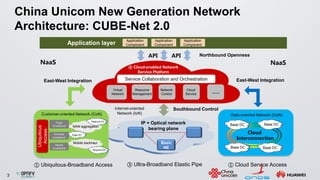
China Unicom New Generation Network
Architecture: CUBE-Net 2.0
Application
ComponentApplication layer
API
Data-oriented Network (DoN)
Cloud
Interconnection
Customer-oriented Network (CoN)
NaaS
……
NaaS
API
Service Collaboration and Orchestration
Application
Component
Application
Component
Basic
NE
Southbound Control
East-West Integration
Northbound Openness
East-West Integration
Internet-oriented
Network (IoN)
IP + Optical network
bearing plane
① Cloud Service Access① Ubiquitous-Broadband Access ③ Ultra-Broadband Elastic Pipe
Base DC Base DC
Base DC Base DC
Regional DC
Regional DC
MAN aggregation
Mobile backhaul
Edge DC
Fixed
broadband
Ubiquitous
Access
Wireless
broadband
Mobile
broadband
④ Cloud-enabled Network
Service Platform
Virtual
Network
Resource
Management
Network
Control
Cloud
Service
4
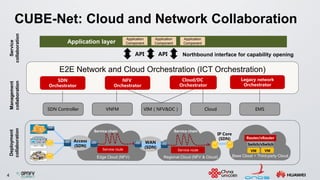
CUBE-Net: Cloud and Network Collaboration
E2E Network and Cloud Orchestration (ICT Orchestration)
SDN
Orchestrator
NFV
Orchestrator
Cloud/DC
Orchestrator
Legacy network
Orchestrator
SDN Controller VNFM VIM(NFV&DC) EMSCloud
VM
Switch/vSwitch
Router/vRouter
Service route
Access
(SDN)
Service route
WAN
(SDN)
IP Core
(SDN)
VM
API API
Application
ComponentApplication layer
Application
Component
Application
Component
Northbound interface for capability opening
Deployment
collaboration
Management
collaboration
Service
collaboration
Service chain Service chain
Edge Cloud (NFV) Regional Cloud (NFV & Cloud) Base Cloud + Third-party Cloud
5
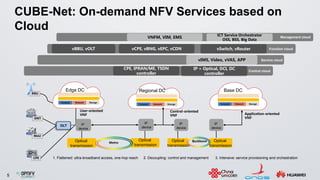
CUBE-Net: On-demand NFV Services based on
Cloud
vCPE, vBNG, vEPC, vCDN
vIMS, Video, vVAS, APP
vBBU, vOLT
VNFM, VIM, EMS
IP
device
Backbone
IP
device
IP
device
Base DC
Optical
transmission
Metro
Regional DC
Compute Network Storage
CPE
MxU
ONT
RRU
OLT
User-oriented
VNF
Control-oriented
VNF Application-oriented
VNF
Edge DC
Management cloud
Function cloud
Service cloud
Control cloud
vSwitch, vRouter
ICT Service Orchestrator
OSS, BSS, Big Data
CPE, IPRAN/ME, TSDN
controller
IP + Optical, DCI, DC
controller
1. Flattened: ultra-broadband access, one-hop reach 3. Intensive: service provisioning and orchestration2. Decoupling: control and management
Optical
transmission
Optical
transmission
Optical
transmission
IP
device
Compute Network Storage
6
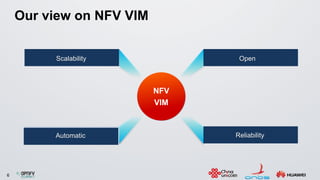
Our view on NFV VIM
NFV
VIM
Scalability Open
ReliabilityAutomatic
7
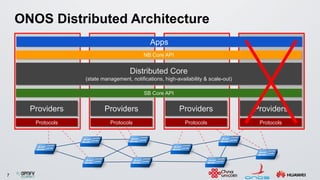
ONOS Distributed Architecture
NB Core API
Distributed Core
(state management, notifications, high-availability & scale-out)
SB Core API
Protocols
Providers
Protocols
Providers
Protocols
Providers
Protocols
Providers
AppsApps
8
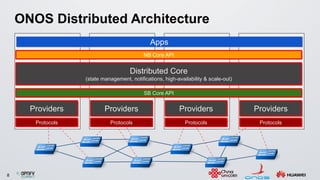
ONOS Distributed Architecture
NB Core API
Distributed Core
(state management, notifications, high-availability & scale-out)
SB Core API
Protocols
Providers
Protocols
Providers
Protocols
Providers
Protocols
Providers
AppsApps
Distributed Core
(state management, notifications, high-availability & scale-out)
SB Core API
NB Core API
Providers Providers Providers Providers
Protocols Protocols Protocols Protocols
9
Architectural Tenets
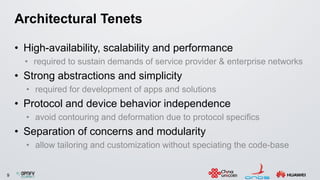
• High-availability, scalability and performance
• required to sustain demands of service provider & enterprise networks
• Strong abstractions and simplicity
• required for development of apps and solutions
• Protocol and device behavior independence
• avoid contouring and deformation due to protocol specifics
• Separation of concerns and modularity
• allow tailoring and customization without speciating the code-base
10
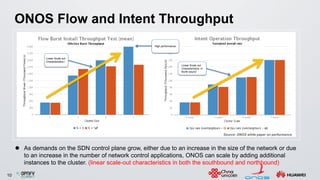
ONOS Flow and Intent Throughput
Linear Scale out
Characteristics i
Linear Scale out
Characteristics in
North bound
Source: ONOS white paper on performance
High performance
 As demands on the SDN control plane grow, either due to an increase in the size of the network or due
to an increase in the number of network control applications, ONOS can scale by adding additional
instances to the cluster. (linear scale-out characteristics in both the southbound and northbound)
11
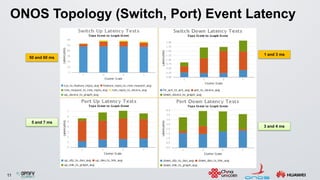
ONOS Topology (Switch, Port) Event Latency
50 and 60 ms
1 and 3 ms
5 and 7 ms
3 and 4 ms
12
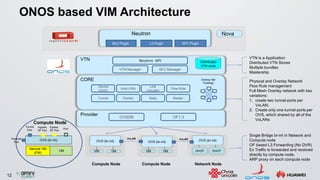
ONOS based VIM Architecture
OVS (br-int)
Service VM
(FW)
VM
Compute Node
OVS (br-int)
VMVM
Compute Node
OVS (br-int)
VMVM
Compute Node
Neutron
ML2 Plugin L3 Plugin
Nova
OVSDB OF1.3
SFC Manager
Neutron API
SFC Plugin
VTN Manager
Distributed
VTN store
VTN
Overlay Net
Topology
Device
(OVS)
Host (VM)
Link
(VxLAN)
Flow Rule
Tunnel Packet Stats Master
OVS (br-int)
DHCP
Network Node
DHCP
VxLAN VxLAN
Tunnel
Port
Ingress
SF Port
CORE
Provider
Egress
SF Port
Single Bridge br-int in Network and
Compute node
OF based L3 Forwarding (No DVR)
Ex Traffic is forwarded and received
directly by compute node.
ARP proxy on each compute node
Physical and Overlay Network
Flow Rule management
Full Mesh Overlay network with two
variations:
1. create two tunnel-ports per
VxLAN;
2. Create only one tunnel-ports per
OVS, which shared by all of the
VxLANs
VTN is a Application
Distributed VTN Stores
Multiple bundles
Mastership
Port
External
Port
13
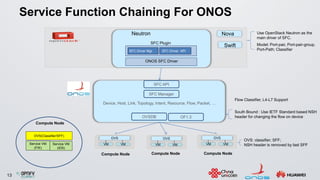
Service Function Chaining For ONOS
OVS(Classifier/SFF)
Service VM
(FW)
Service VM
(IDS)
Compute Node
OVS
VMVM
Compute Node
OVS
VMVM
Compute Node
OVS
VMVM
Compute Node
Swift
Neutron
SFC Driver Mgr SFC Driver API
ONOS SFC Driver
Nova
SFC Plugin
OVSDB
South Bound : Use IETF Standard based NSH
header for changing the flow on device
Device, Host, Link, Topology, Intent, Resource, Flow, Packet, …
OF1.3
SFC Manager
Flow Classifier, L4-L7 Support
SFC API
Model: Port-pair, Port-pair-group,
Port-Path; Classifier
Use OpenStack Neutron as the
main driver of SFC.
OVS: classifier; SFF;
NSH header is removed by last SFF
14
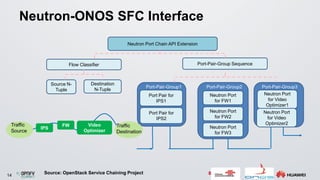
Flow Classifier
Destination
N-Tuple
Port-Pair-Group Sequence
Neutron Port Chain API Extension
Source N-
Tuple
Port Pair for
IPS1
Neutron Port
for FW1
Neutron Port
for Video
Optimizer1
Neutron Port
for FW2
Neutron Port
for FW3
Traffic
Destination
Video
Optimizer
FW
IPS
Traffic
Source
Port Pair for
IPS2
Neutron Port
for Video
Optimizer2
Port-Pair-Group1 Port-Pair-Group2 Port-Pair-Group3
Neutron-ONOS SFC Interface
Source: OpenStack Service Chaining Project
15
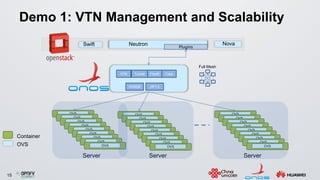
Demo 1: VTN Management and Scalability
Swift Neutron Plugins
Nova
OVS
OVS
OVS
OVS
OVS
OVS
OVS
OVS
OVS
OVS
OVS
OVS
OVS
OVS
OVS
OVS
OVS
OVS
OVS
OVS
OVS
OVS
OVS
OVS
OVS
OVS
OVS
Server Server Server
Full Mesh
Container
OVS
VTN Tunnel FlowR
OVSDB OF1.3
Topo
16
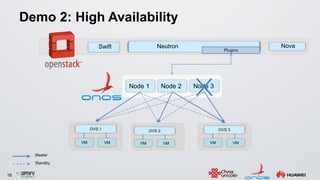
Demo 2: High Availability
Swift Neutron
Plugins
Nova
OVS 1
VMVM
OVS 2
VMVM
OVS 3
VMVM
Node 1 Node 2 Node 3
Master
Standby
17
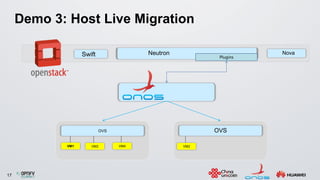
Demo 3: Host Live Migration
OVSOVS
VM2VM3 VM4VM1
Swift Neutron
Plugins
Nova
CopyrightŠ2015 Huawei Technologies Co., Ltd. All Rights Reserved.
The information in this document may contain predictive statements including, without limitation,
statements regarding the future financial and operating results, future product portfolio, new technology,
etc. There are a number of factors that could cause actual results and developments to differ materially
from those expressed or implied in the predictive statements. Therefore, such information is provided
for reference purpose only and constitutes neither an offer nor an acceptance. Huawei may change the
information at any time without notice.

ONOS-Based VIM Implementation

  • 1.
    ONOS-based VIM implementation XongYan TangChina Unicom Patrick Liu Huawei Technologies Inc Brian O’Connor ON.LAB
  • 2.
    2 Overview Requirement and UseCase Architecture ONOS VTN SFC Demo Next Steps
  • 3.
    3 China Unicom NewGeneration Network Architecture: CUBE-Net 2.0 Application ComponentApplication layer API Data-oriented Network (DoN) Cloud Interconnection Customer-oriented Network (CoN) NaaS …… NaaS API Service Collaboration and Orchestration Application Component Application Component Basic NE Southbound Control East-West Integration Northbound Openness East-West Integration Internet-oriented Network (IoN) IP + Optical network bearing plane ① Cloud Service Access① Ubiquitous-Broadband Access ③ Ultra-Broadband Elastic Pipe Base DC Base DC Base DC Base DC Regional DC Regional DC MAN aggregation Mobile backhaul Edge DC Fixed broadband Ubiquitous Access Wireless broadband Mobile broadband ④ Cloud-enabled Network Service Platform Virtual Network Resource Management Network Control Cloud Service
  • 4.
    4 CUBE-Net: Cloud andNetwork Collaboration E2E Network and Cloud Orchestration (ICT Orchestration) SDN Orchestrator NFV Orchestrator Cloud/DC Orchestrator Legacy network Orchestrator SDN Controller VNFM VIM(NFV&DC) EMSCloud VM Switch/vSwitch Router/vRouter Service route Access (SDN) Service route WAN (SDN) IP Core (SDN) VM API API Application ComponentApplication layer Application Component Application Component Northbound interface for capability opening Deployment collaboration Management collaboration Service collaboration Service chain Service chain Edge Cloud (NFV) Regional Cloud (NFV & Cloud) Base Cloud + Third-party Cloud
  • 5.
    5 CUBE-Net: On-demand NFVServices based on Cloud vCPE, vBNG, vEPC, vCDN vIMS, Video, vVAS, APP vBBU, vOLT VNFM, VIM, EMS IP device Backbone IP device IP device Base DC Optical transmission Metro Regional DC Compute Network Storage CPE MxU ONT RRU OLT User-oriented VNF Control-oriented VNF Application-oriented VNF Edge DC Management cloud Function cloud Service cloud Control cloud vSwitch, vRouter ICT Service Orchestrator OSS, BSS, Big Data CPE, IPRAN/ME, TSDN controller IP + Optical, DCI, DC controller 1. Flattened: ultra-broadband access, one-hop reach 3. Intensive: service provisioning and orchestration2. Decoupling: control and management Optical transmission Optical transmission Optical transmission IP device Compute Network Storage Compute Network Storage
  • 6.
    6 Our view onNFV VIM NFV VIM Scalability Open ReliabilityAutomatic
  • 7.
    7 ONOS Distributed Architecture NBCore API Distributed Core (state management, notifications, high-availability & scale-out) SB Core API Protocols Providers Protocols Providers Protocols Providers Protocols Providers AppsApps
  • 8.
    8 ONOS Distributed Architecture NBCore API Distributed Core (state management, notifications, high-availability & scale-out) SB Core API Protocols Providers Protocols Providers Protocols Providers Protocols Providers AppsApps Distributed Core (state management, notifications, high-availability & scale-out) SB Core API NB Core API Providers Providers Providers Providers Protocols Protocols Protocols Protocols
  • 9.
    9 Architectural Tenets • High-availability,scalability and performance • required to sustain demands of service provider & enterprise networks • Strong abstractions and simplicity • required for development of apps and solutions • Protocol and device behavior independence • avoid contouring and deformation due to protocol specifics • Separation of concerns and modularity • allow tailoring and customization without speciating the code-base
  • 10.
    10 ONOS Flow andIntent Throughput Linear Scale out Characteristics i Linear Scale out Characteristics in North bound Source: ONOS white paper on performance High performance  As demands on the SDN control plane grow, either due to an increase in the size of the network or due to an increase in the number of network control applications, ONOS can scale by adding additional instances to the cluster. (linear scale-out characteristics in both the southbound and northbound)
  • 11.
    11 ONOS Topology (Switch,Port) Event Latency 50 and 60 ms 1 and 3 ms 5 and 7 ms 3 and 4 ms
  • 12.
    12 ONOS based VIMArchitecture OVS (br-int) Service VM (FW) VM Compute Node OVS (br-int) VMVM Compute Node OVS (br-int) VMVM Compute Node Neutron ML2 Plugin L3 Plugin Nova OVSDB OF1.3 SFC Manager Neutron API SFC Plugin VTN Manager Distributed VTN store VTN Overlay Net Topology Device (OVS) Host (VM) Link (VxLAN) Flow Rule Tunnel Packet Stats Master OVS (br-int) DHCP Network Node DHCP VxLAN VxLAN Tunnel Port Ingress SF Port CORE Provider Egress SF Port Single Bridge br-int in Network and Compute node OF based L3 Forwarding (No DVR) Ex Traffic is forwarded and received directly by compute node. ARP proxy on each compute node Physical and Overlay Network Flow Rule management Full Mesh Overlay network with two variations: 1. create two tunnel-ports per VxLAN; 2. Create only one tunnel-ports per OVS, which shared by all of the VxLANs VTN is a Application Distributed VTN Stores Multiple bundles Mastership Port External Port
  • 13.
    13 Service Function ChainingFor ONOS OVS(Classifier/SFF) Service VM (FW) Service VM (IDS) Compute Node OVS VMVM Compute Node OVS VMVM Compute Node OVS VMVM Compute Node Swift Neutron SFC Driver Mgr SFC Driver API ONOS SFC Driver Nova SFC Plugin OVSDB South Bound : Use IETF Standard based NSH header for changing the flow on device Device, Host, Link, Topology, Intent, Resource, Flow, Packet, … OF1.3 SFC Manager Flow Classifier, L4-L7 Support SFC API Model: Port-pair, Port-pair-group, Port-Path; Classifier Use OpenStack Neutron as the main driver of SFC. OVS: classifier; SFF; NSH header is removed by last SFF
  • 14.
    14 Flow Classifier Destination N-Tuple Port-Pair-Group Sequence NeutronPort Chain API Extension Source N- Tuple Port Pair for IPS1 Neutron Port for FW1 Neutron Port for Video Optimizer1 Neutron Port for FW2 Neutron Port for FW3 Traffic Destination Video Optimizer FW IPS Traffic Source Port Pair for IPS2 Neutron Port for Video Optimizer2 Port-Pair-Group1 Port-Pair-Group2 Port-Pair-Group3 Neutron-ONOS SFC Interface Source: OpenStack Service Chaining Project
  • 15.
    15 Demo 1: VTNManagement and Scalability Swift Neutron Plugins Nova OVS OVS OVS OVS OVS OVS OVS OVS OVS OVS OVS OVS OVS OVS OVS OVS OVS OVS OVS OVS OVS OVS OVS OVS OVS OVS OVS Server Server Server Full Mesh Container OVS VTN Tunnel FlowR OVSDB OF1.3 Topo
  • 16.
    16 Demo 2: HighAvailability Swift Neutron Plugins Nova OVS 1 VMVM OVS 2 VMVM OVS 3 VMVM Node 1 Node 2 Node 3 Master Standby
  • 17.
    17 Demo 3: HostLive Migration OVSOVS VM2VM3 VM4VM1 Swift Neutron Plugins Nova
  • 18.
    CopyrightŠ2015 Huawei TechnologiesCo., Ltd. All Rights Reserved. The information in this document may contain predictive statements including, without limitation, statements regarding the future financial and operating results, future product portfolio, new technology, etc. There are a number of factors that could cause actual results and developments to differ materially from those expressed or implied in the predictive statements. Therefore, such information is provided for reference purpose only and constitutes neither an offer nor an acceptance. Huawei may change the information at any time without notice.