The Role of Inter-Controller Traffic in
SDN Controllers Placement
Tianzhu Zhang, Andrea Bianco, Paolo Giaccone
IEEE NFV-SDN: Palo Alto, CA
November 8th, 2016 1
Software Defined Networking
• programmability
• enabled by centralized view of the
network state
Advantages
• scalability for large networks
One relevant challenge
2
Distributed controllers
• fault-tolerance and resilience
• load balancing, thus higher scalability
Motivation
• how the network state is distributed across
the controllers to allow a centralized logical
view
Critical issue
3
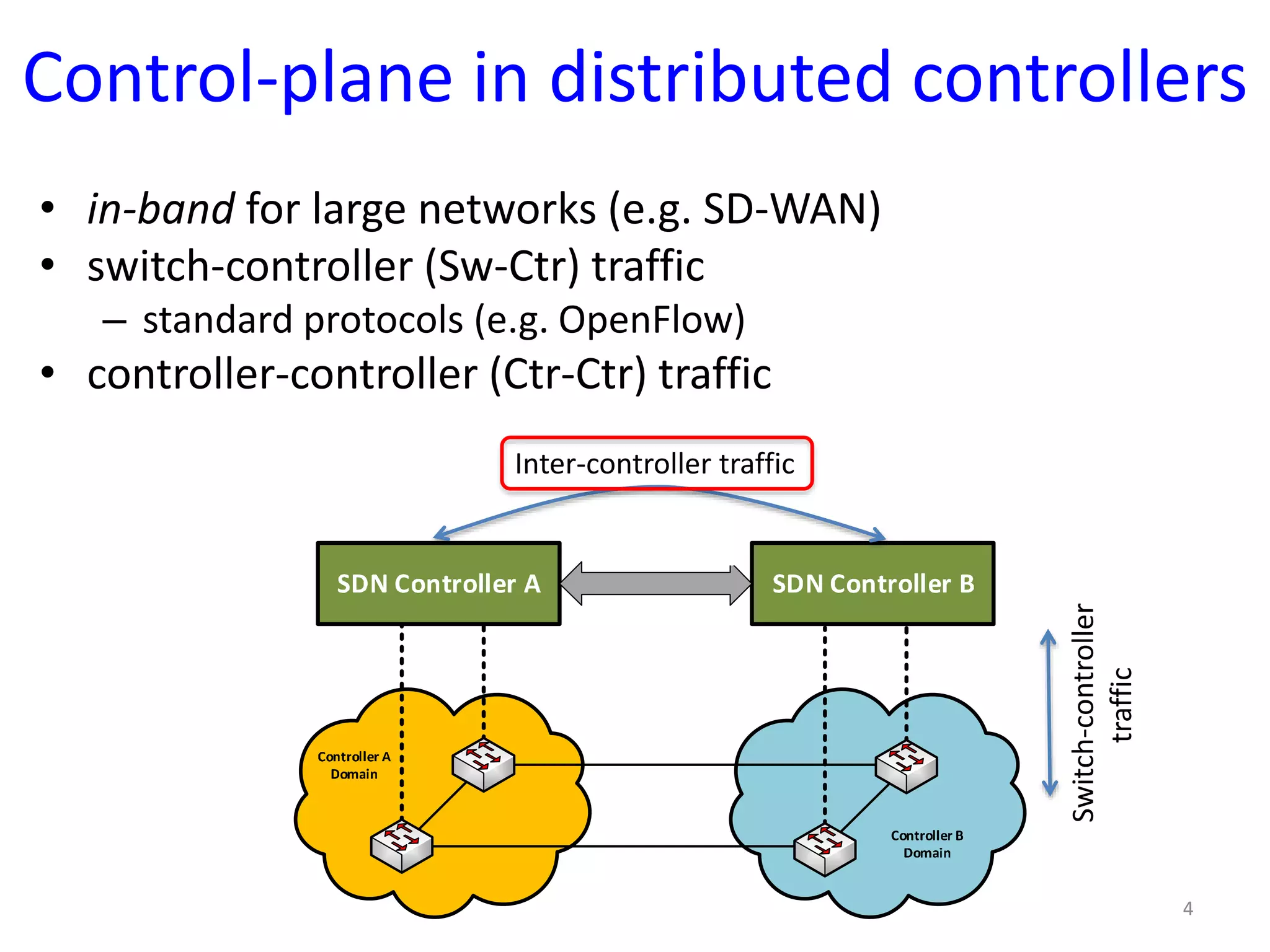
Control-plane in distributed controllers
• in-band for large networks (e.g. SD-WAN)
• switch-controller (Sw-Ctr) traffic
– standard protocols (e.g. OpenFlow)
• controller-controller (Ctr-Ctr) traffic
4
Switch-controller
traffic
Inter-controller traffic
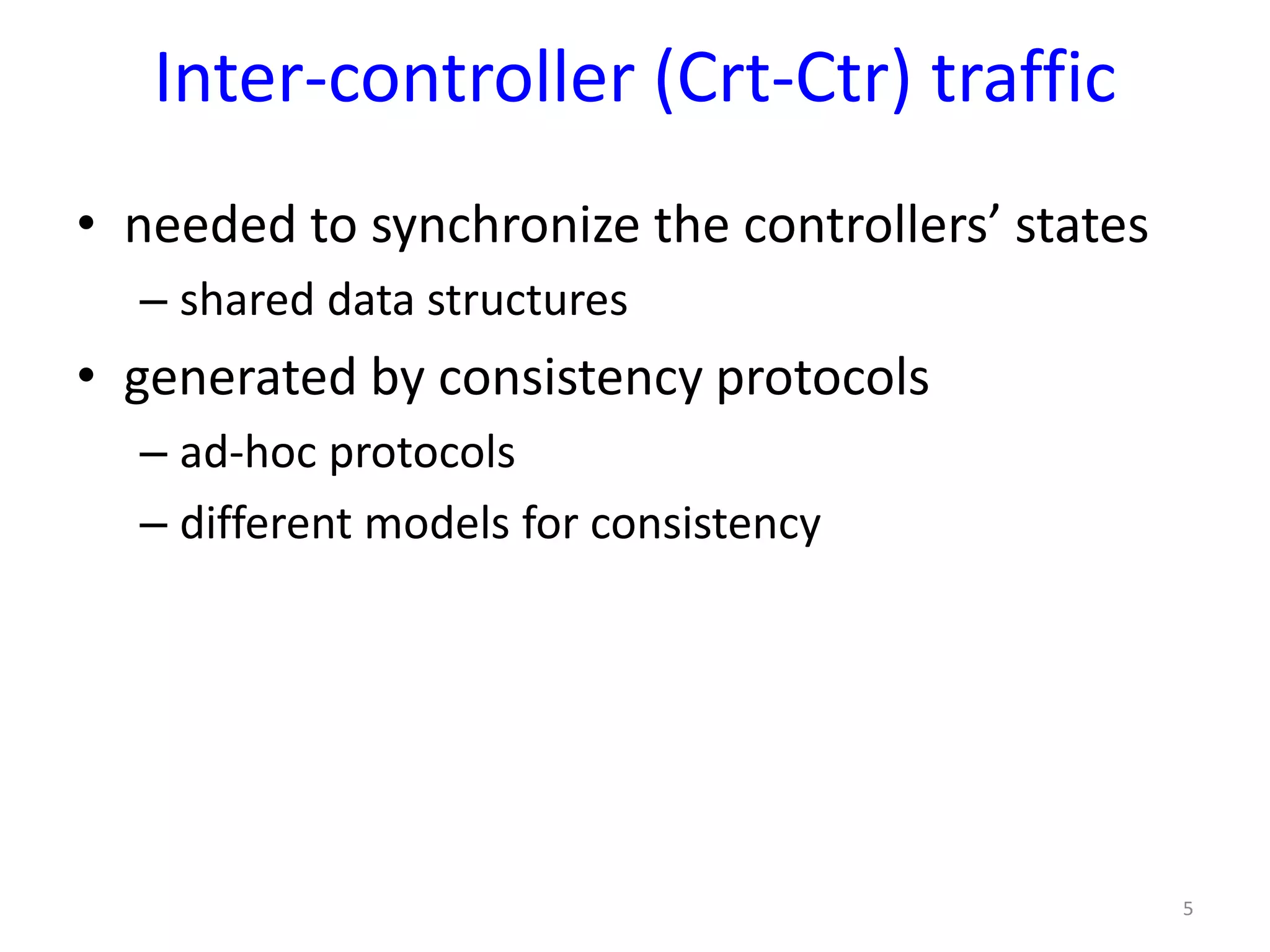
Inter-controller (Crt-Ctr) traffic
• needed to synchronize the controllers’ states
– shared data structures
• generated by consistency protocols
– ad-hoc protocols
– different models for consistency
5
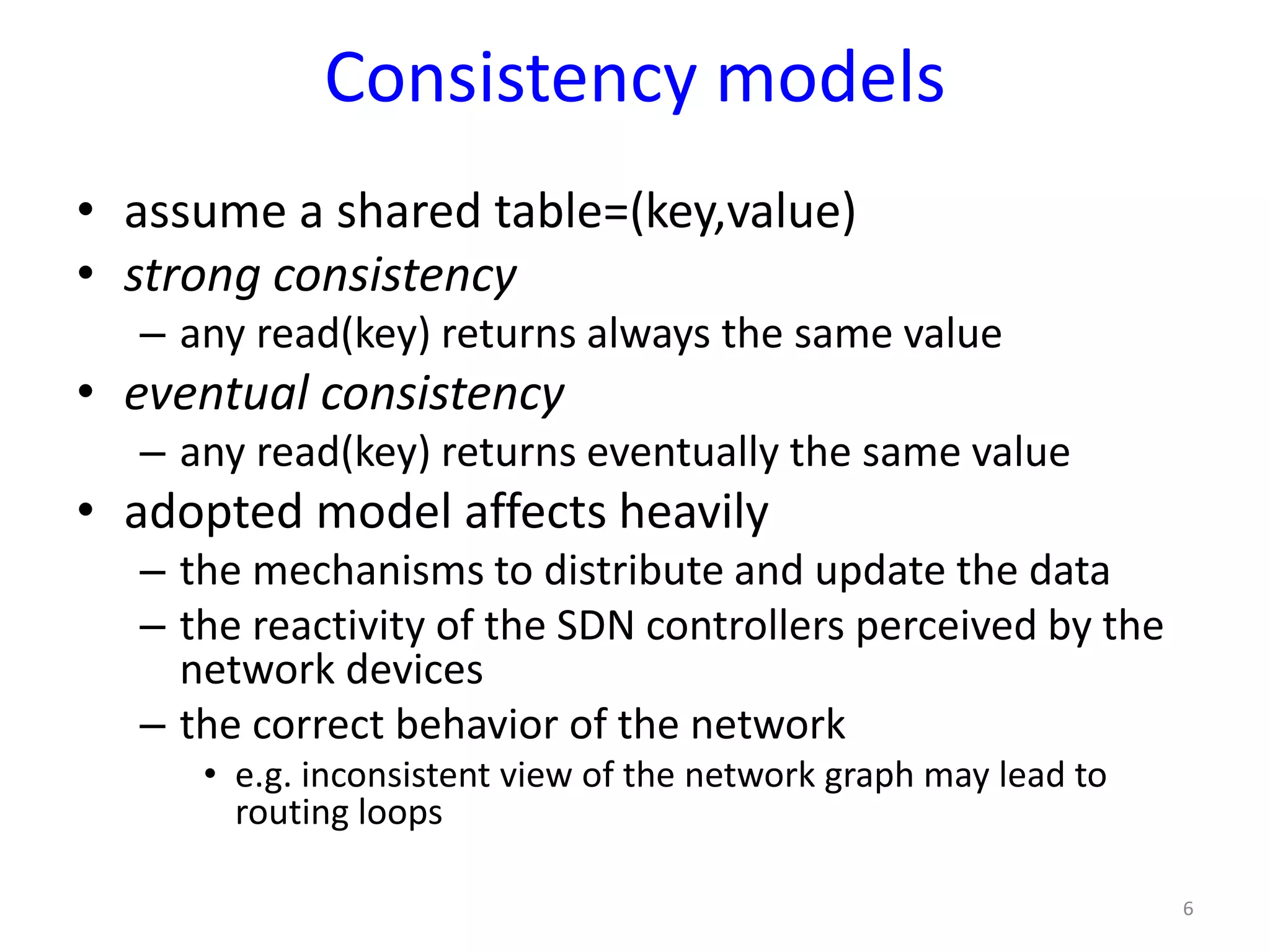
Consistency models
• assume a shared table=(key,value)
• strong consistency
– any read(key) returns always the same value
• eventual consistency
– any read(key) returns eventually the same value
• adopted model affects heavily
– the mechanisms to distribute and update the data
– the reactivity of the SDN controllers perceived by the
network devices
– the correct behavior of the network
• e.g. inconsistent view of the network graph may lead to
routing loops
6
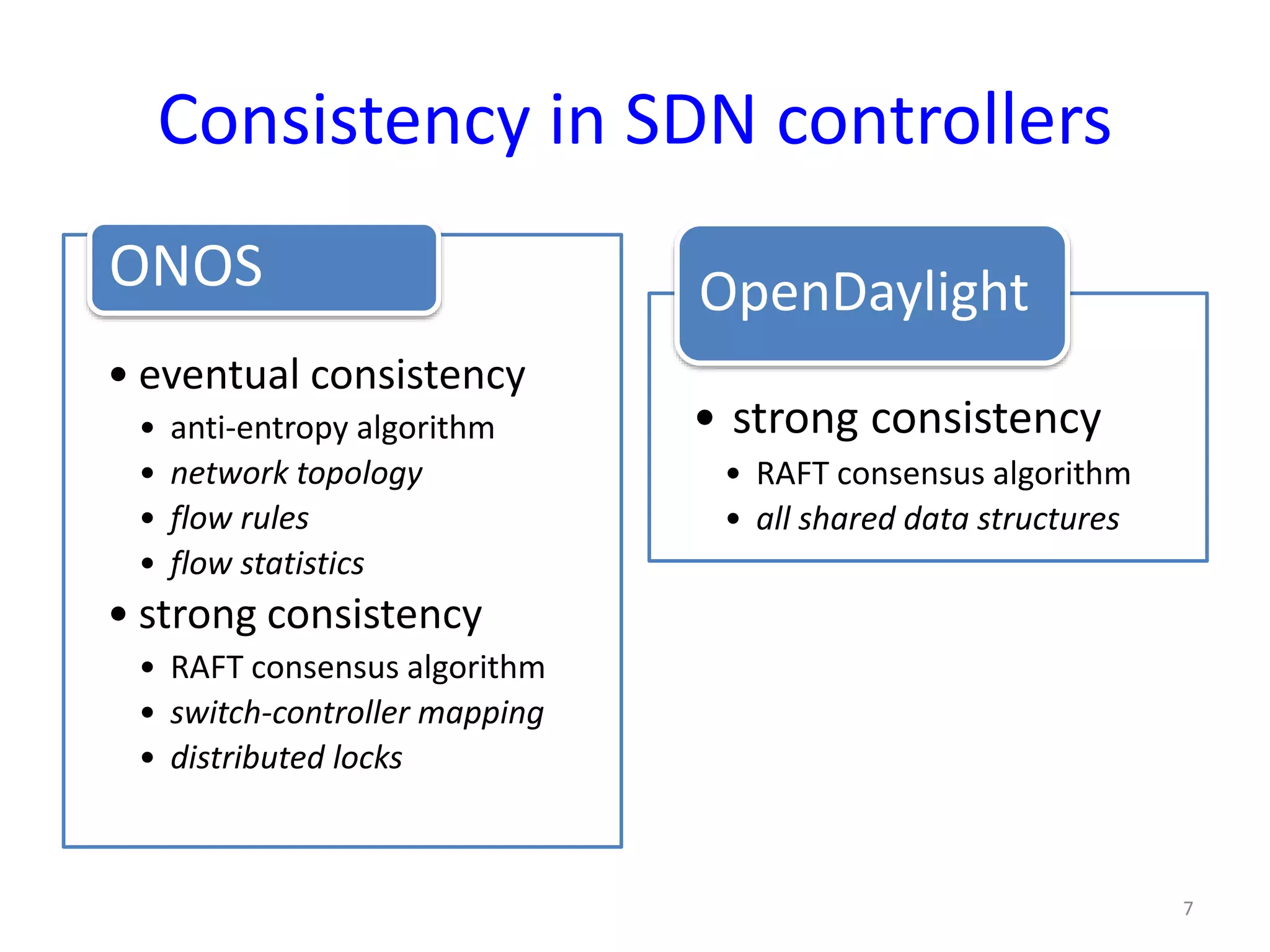
Consistency in SDN controllers
• eventual consistency
• anti-entropy algorithm
• network topology
• flow rules
• flow statistics
• strong consistency
• RAFT consensus algorithm
• switch-controller mapping
• distributed locks
ONOS
• strong consistency
• RAFT consensus algorithm
• all shared data structures
OpenDaylight
7
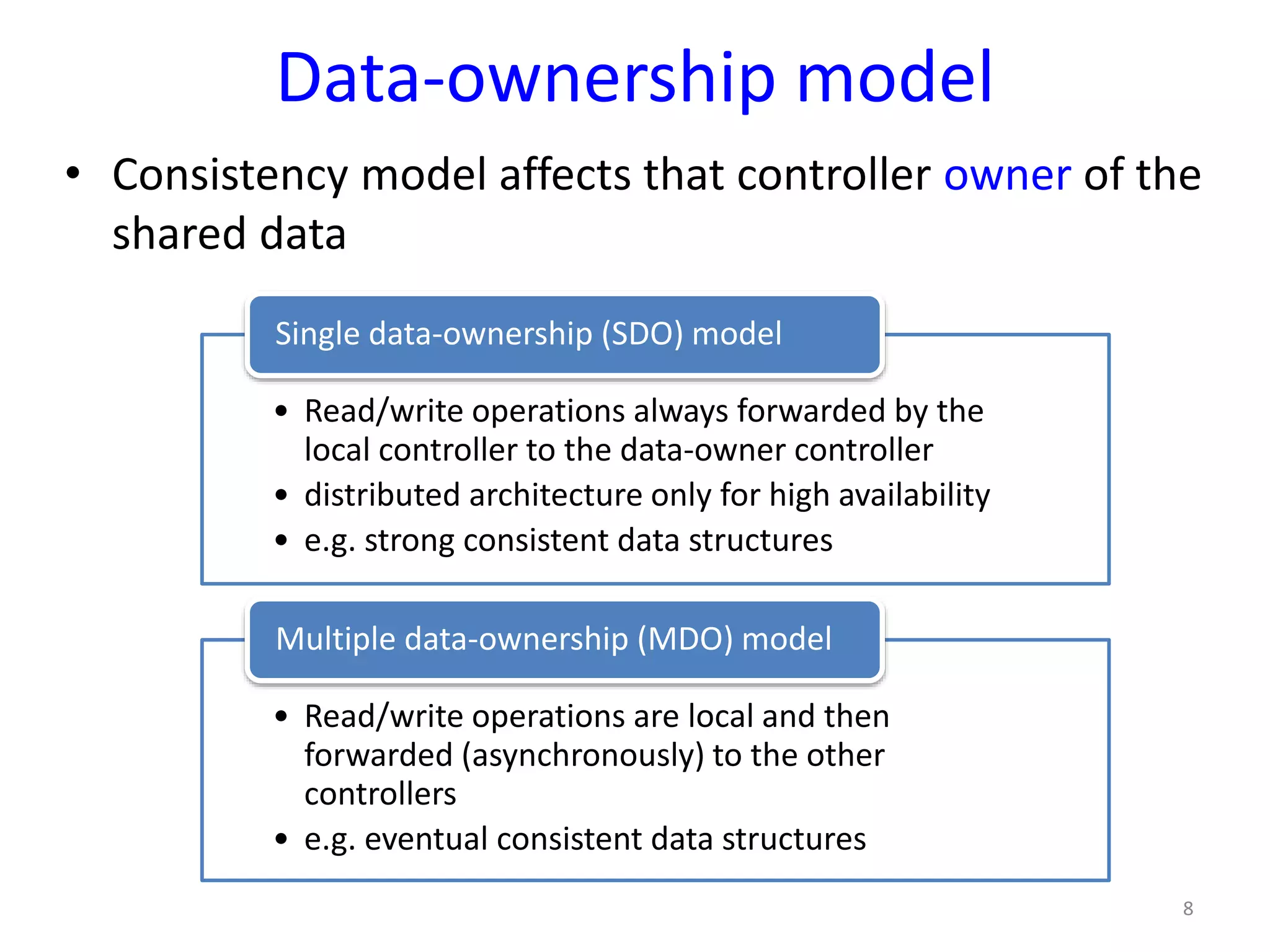
Data-ownership model
• Consistency model affects that controller owner of the
shared data
8
• Read/write operations always forwarded by the
local controller to the data-owner controller
• distributed architecture only for high availability
• e.g. strong consistent data structures
Single data-ownership (SDO) model
• Read/write operations are local and then
forwarded (asynchronously) to the other
controllers
• e.g. eventual consistent data structures
Multiple data-ownership (MDO) model
Our main contributions
• we provide formulas to estimate the reactivity
perceived at the switch due to the Sw-Ctr and
Ctr-Ctr interactions
• we show the performance tradeoffs for the
controller placement problem
9
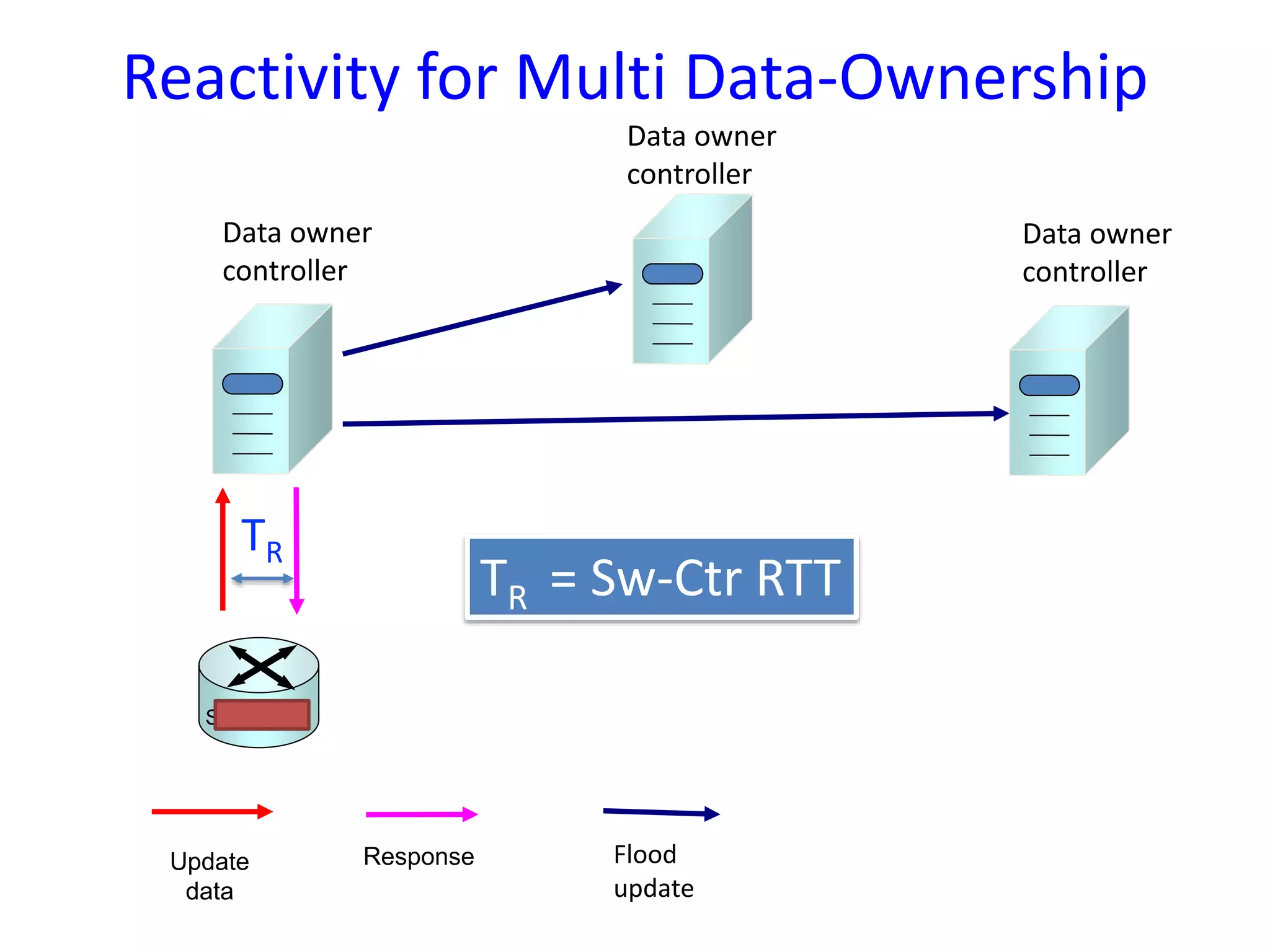
Reactivity for Multi Data-Ownership
Switch S1
ResponseUpdate
data
Flood
update
Data owner
controller
TR
TR = Sw-Ctr RTT
Data owner
controller
Data owner
controller
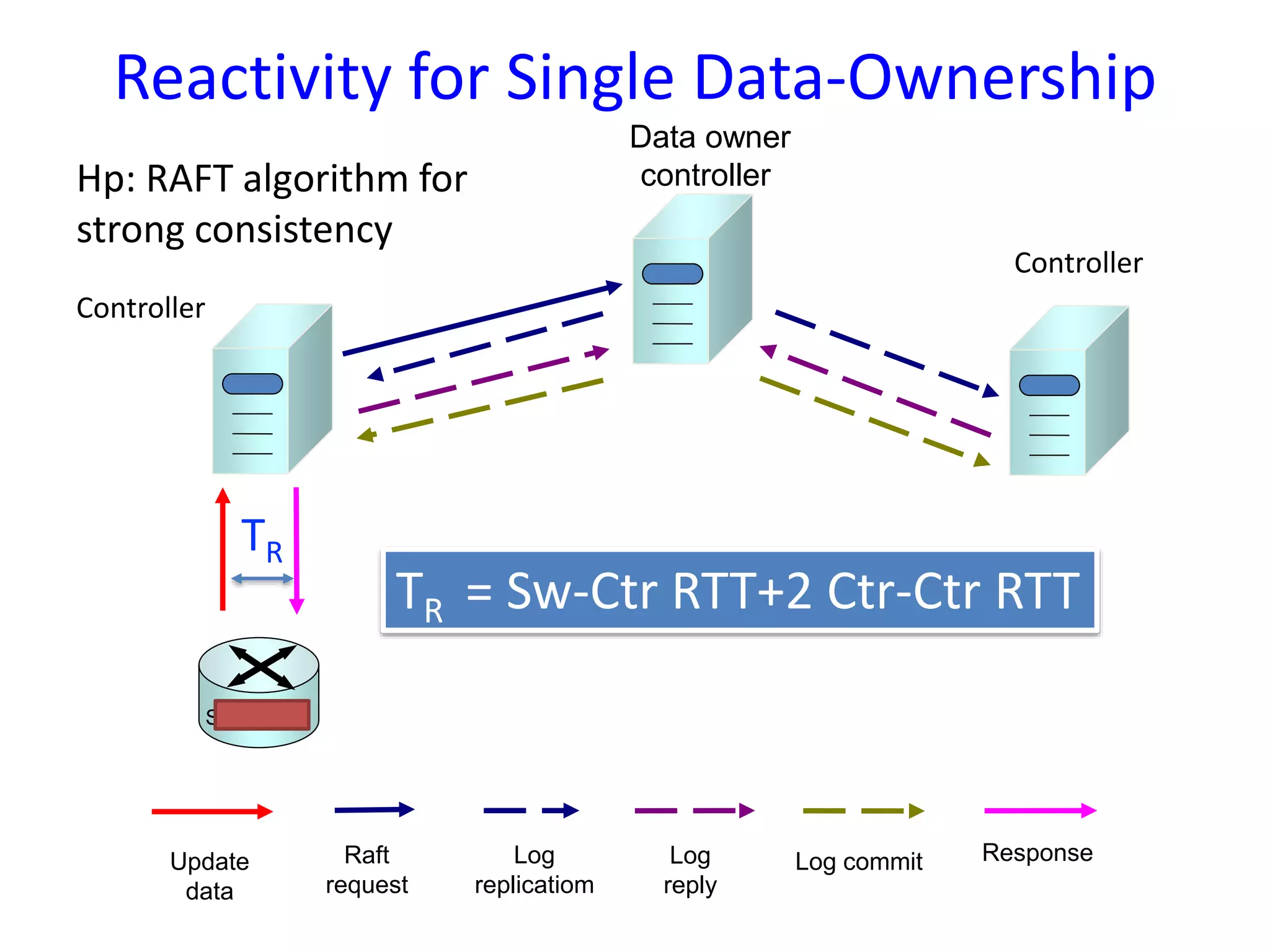
Reactivity for Single Data-Ownership
Data owner
controller
Switch S1
Raft
request
Log
replicatiom
ResponseUpdate
data
Log
reply
Log commit
Controller
Controller
Hp: RAFT algorithm for
strong consistency
TR
TR = Sw-Ctr RTT+2 Ctr-Ctr RTT
Optimal controller placements
13
0
10
20
30
40
50
60
70
050100150200250300350400
Reaction time for MDO [ms]
ReactiontimeforSDO[ms]
OptimalSDOplacement
OptimalMDOplacement
3 controllers in large ISP
For Single Data-Ownership (SDO), 3 possible data owners
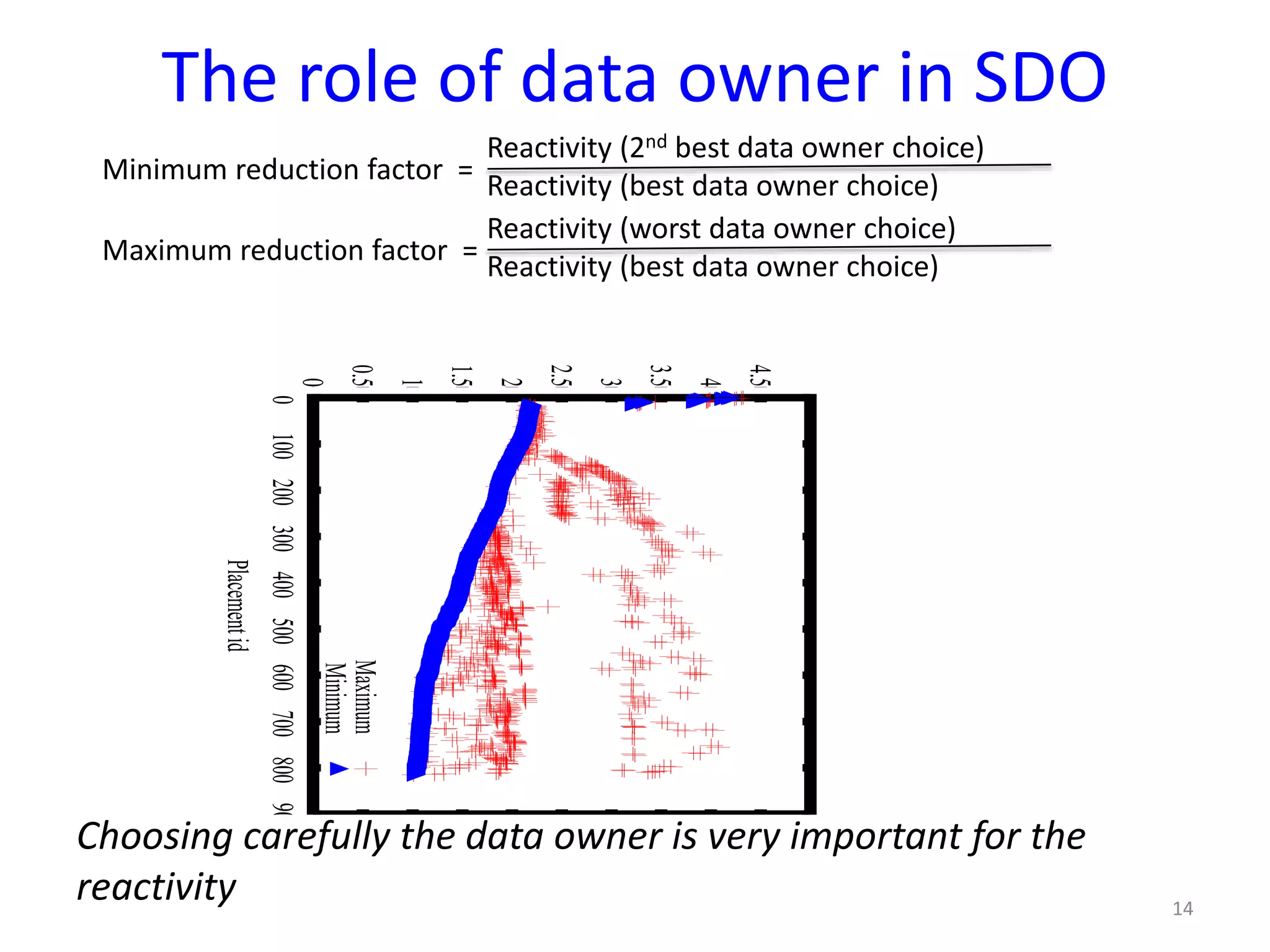
The role of data owner in SDO
Choosing carefully the data owner is very important for the
reactivity 14
0
0.5
1
1.5
2
2.5
3
3.5
4
4.5
0100200300400500600700800900
Reduction factor
Placementid
Maximum
Minimum
Minimum reduction factor =
Reactivity (2nd best data owner choice)
Reactivity (best data owner choice)
Maximum reduction factor =
Reactivity (worst data owner choice)
Reactivity (best data owner choice)
Conclusions
• single/multiple data-ownership models adopted
by real SDN controllers affect strongly the
performance perceived at the network devices
• reactivity formulas allow to devise the optimal
placement of the controllers
– the latencies among controllers are crucial in SDO
model
• in the SDO model the choice of the data owner is
crucial
• accurate validation of the given formulas in a
large SD-WAN controlled by OpenDaylight
– available on extended version [1] on arxiv
15

The Role of Inter-Controller Traffic in SDN Controllers Placement

  • 1.
    The Role ofInter-Controller Traffic in SDN Controllers Placement Tianzhu Zhang, Andrea Bianco, Paolo Giaccone IEEE NFV-SDN: Palo Alto, CA November 8th, 2016 1
  • 2.
    Software Defined Networking •programmability • enabled by centralized view of the network state Advantages • scalability for large networks One relevant challenge 2
  • 3.
    Distributed controllers • fault-toleranceand resilience • load balancing, thus higher scalability Motivation • how the network state is distributed across the controllers to allow a centralized logical view Critical issue 3
  • 4.
    Control-plane in distributedcontrollers • in-band for large networks (e.g. SD-WAN) • switch-controller (Sw-Ctr) traffic – standard protocols (e.g. OpenFlow) • controller-controller (Ctr-Ctr) traffic 4 Switch-controller traffic Inter-controller traffic
  • 5.
    Inter-controller (Crt-Ctr) traffic •needed to synchronize the controllers’ states – shared data structures • generated by consistency protocols – ad-hoc protocols – different models for consistency 5
  • 6.
    Consistency models • assumea shared table=(key,value) • strong consistency – any read(key) returns always the same value • eventual consistency – any read(key) returns eventually the same value • adopted model affects heavily – the mechanisms to distribute and update the data – the reactivity of the SDN controllers perceived by the network devices – the correct behavior of the network • e.g. inconsistent view of the network graph may lead to routing loops 6
  • 7.
    Consistency in SDNcontrollers • eventual consistency • anti-entropy algorithm • network topology • flow rules • flow statistics • strong consistency • RAFT consensus algorithm • switch-controller mapping • distributed locks ONOS • strong consistency • RAFT consensus algorithm • all shared data structures OpenDaylight 7
  • 8.
    Data-ownership model • Consistencymodel affects that controller owner of the shared data 8 • Read/write operations always forwarded by the local controller to the data-owner controller • distributed architecture only for high availability • e.g. strong consistent data structures Single data-ownership (SDO) model • Read/write operations are local and then forwarded (asynchronously) to the other controllers • e.g. eventual consistent data structures Multiple data-ownership (MDO) model
  • 9.
    Our main contributions •we provide formulas to estimate the reactivity perceived at the switch due to the Sw-Ctr and Ctr-Ctr interactions • we show the performance tradeoffs for the controller placement problem 9
  • 10.
    Reactivity for MultiData-Ownership Switch S1 ResponseUpdate data Flood update Data owner controller TR TR = Sw-Ctr RTT Data owner controller Data owner controller
  • 11.
    Reactivity for SingleData-Ownership Data owner controller Switch S1 Raft request Log replicatiom ResponseUpdate data Log reply Log commit Controller Controller Hp: RAFT algorithm for strong consistency TR TR = Sw-Ctr RTT+2 Ctr-Ctr RTT
  • 12.
    Optimal controller placements 13 0 10 20 30 40 50 60 70 050100150200250300350400 Reactiontime for MDO [ms] ReactiontimeforSDO[ms] OptimalSDOplacement OptimalMDOplacement 3 controllers in large ISP For Single Data-Ownership (SDO), 3 possible data owners
  • 13.
    The role ofdata owner in SDO Choosing carefully the data owner is very important for the reactivity 14 0 0.5 1 1.5 2 2.5 3 3.5 4 4.5 0100200300400500600700800900 Reduction factor Placementid Maximum Minimum Minimum reduction factor = Reactivity (2nd best data owner choice) Reactivity (best data owner choice) Maximum reduction factor = Reactivity (worst data owner choice) Reactivity (best data owner choice)
  • 14.
    Conclusions • single/multiple data-ownershipmodels adopted by real SDN controllers affect strongly the performance perceived at the network devices • reactivity formulas allow to devise the optimal placement of the controllers – the latencies among controllers are crucial in SDO model • in the SDO model the choice of the data owner is crucial • accurate validation of the given formulas in a large SD-WAN controlled by OpenDaylight – available on extended version [1] on arxiv 15