Bounding Volume
Hierarchy
Lesson 10
Blender Terms
Bounding Volume Hierarchy (BVH) is a
hierarchical data structure used in
computer graphics and computational
geometry. Its primary purpose is to
accelerate ray tracing and collision
detection algorithms by organizing
objects in a scene into a tree structure,
optimizing the search for intersections
and improving rendering efficiency. BVH
is widely employed in applications like
Introduction to Bounding
Volume Hierarchy
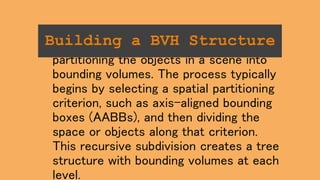
Constructing a BVH involves recursively
partitioning the objects in a scene into
bounding volumes. The process typically
begins by selecting a spatial partitioning
criterion, such as axis-aligned bounding
boxes (AABBs), and then dividing the
space or objects along that criterion.
This recursive subdivision creates a tree
structure with bounding volumes at each
level.
Building a BVH Structure
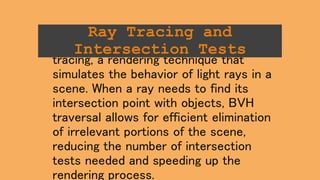
BVH is particularly effective in ray
tracing, a rendering technique that
simulates the behavior of light rays in a
scene. When a ray needs to find its
intersection point with objects, BVH
traversal allows for efficient elimination
of irrelevant portions of the scene,
reducing the number of intersection
tests needed and speeding up the
rendering process.
Ray Tracing and
Intersection Tests
BVHs can be categorized as either
dynamic or static. Dynamic BVHs are
updated when objects in the scene
move, while static BVHs remain
unchanged throughout rendering.
Dynamic BVHs are crucial for real-time
applications, such as video games,
where object positions change
frequently, while static BVHs are
suitable for scenes with mostly
Dynamic and Static BVHs
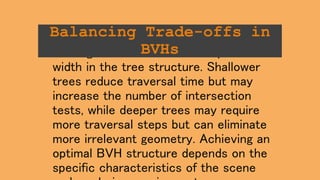
Designing an efficient BVH involves
striking a balance between depth and
width in the tree structure. Shallower
trees reduce traversal time but may
increase the number of intersection
tests, while deeper trees may require
more traversal steps but can eliminate
more irrelevant geometry. Achieving an
optimal BVH structure depends on the
specific characteristics of the scene
Balancing Trade-offs in
BVHs
Beyond ray tracing, BVHs find
applications in various algorithms
requiring spatial partitioning and collision
detection. Their efficiency makes them
valuable in fields like computer-aided
design (CAD), physics simulations, and
gaming. The adaptability of BVHs to
different scenarios underscores their
versatility as a fundamental data
structure in computer graphics and
BVH in Accelerating
Algorithms

Bounding Volume Hierarchy.pptx

  • 1.
  • 2.
    Bounding Volume Hierarchy(BVH) is a hierarchical data structure used in computer graphics and computational geometry. Its primary purpose is to accelerate ray tracing and collision detection algorithms by organizing objects in a scene into a tree structure, optimizing the search for intersections and improving rendering efficiency. BVH is widely employed in applications like Introduction to Bounding Volume Hierarchy
  • 3.
    Constructing a BVHinvolves recursively partitioning the objects in a scene into bounding volumes. The process typically begins by selecting a spatial partitioning criterion, such as axis-aligned bounding boxes (AABBs), and then dividing the space or objects along that criterion. This recursive subdivision creates a tree structure with bounding volumes at each level. Building a BVH Structure
  • 4.
    BVH is particularlyeffective in ray tracing, a rendering technique that simulates the behavior of light rays in a scene. When a ray needs to find its intersection point with objects, BVH traversal allows for efficient elimination of irrelevant portions of the scene, reducing the number of intersection tests needed and speeding up the rendering process. Ray Tracing and Intersection Tests
  • 5.
    BVHs can becategorized as either dynamic or static. Dynamic BVHs are updated when objects in the scene move, while static BVHs remain unchanged throughout rendering. Dynamic BVHs are crucial for real-time applications, such as video games, where object positions change frequently, while static BVHs are suitable for scenes with mostly Dynamic and Static BVHs
  • 6.
    Designing an efficientBVH involves striking a balance between depth and width in the tree structure. Shallower trees reduce traversal time but may increase the number of intersection tests, while deeper trees may require more traversal steps but can eliminate more irrelevant geometry. Achieving an optimal BVH structure depends on the specific characteristics of the scene Balancing Trade-offs in BVHs
  • 7.
    Beyond ray tracing,BVHs find applications in various algorithms requiring spatial partitioning and collision detection. Their efficiency makes them valuable in fields like computer-aided design (CAD), physics simulations, and gaming. The adaptability of BVHs to different scenarios underscores their versatility as a fundamental data structure in computer graphics and BVH in Accelerating Algorithms