BAB II
E-Commerce Business
Model and Concept
Heru Wijayanto, M.M, M.BA, M.MT
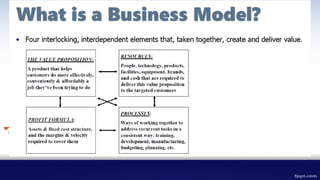
DEFINISI MODEL BISNIS
• “Method of doing business by which a company can
sustain itself – that is generated revenue.” Michael Rappa
Slide 2-4
E-commerce Business Models—Definitions
 Business model: set of planned activities designed to result in
a profit in a marketplace
 Business plan: document that describes a firm’s business
model
 E-commerce business model: aims to use and leverage the
unique qualities of Internet and Web
Slide 2-5
Slide 2-6
Value Proposition
 Defines how a company’s product or service fulfills
the needs of customers
 Questions to ask:
 Why will customers choose to do business with
your firm instead of another?
 What will your firm provide that others do not or
cannot?
 Examples of successful value propositions:
 Personalization/customization
 Reduction of product search costs
 Reduction of price discover costs
 Facilitation of transactions by managing product
delivery
Slide 2-7
Revenue Model
 Describes how the firm will earn revenue,
generate profits, and produce a superior
return on invested capital
 Major types:
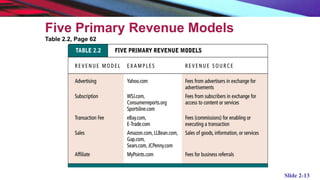
1. Advertising revenue model
2. Subscription revenue model
3. Transaction fee revenue model
4. Sales revenue model
5. Affiliate revenue model
Slide 2-8
1. Advertising Revenue Model
 Web site that offers content,
services and/or products also
provides a forum for
advertisements and receives
fees from advertisers.
 Common model used for high
traffic Web sites.
 It includes selling banner ads,
classified ads, sponsor ads,
pop-up ads, etc. Revenue at
Yahoo, Webcrawler, and
Geocities is generated this
way.
Personals
Finance
Ad Server
ISP
Advertiser
Exposures
$
Advertising Revenue Model
http://www.demingcenter.com/html_files/roi/pdf_2annual/Higbie_Pricing.ppt#5
Sports
Slide 2-9
2. Subscription Revenue Model
 Web site that offers
users content or
services charges a
subscription fee for
access to some or all
of its offerings
 Examples:
 Consumer Reports
Online
 Yahoo! Platinum
Subscription Revenue Model
ISP
$
Messaging
Financial News
Email
http://www.demingcenter.com/html_files/roi/pdf_2annual/Higbie_Pricing.ppt#5
Slide 2-10
3. Transaction Fee Revenue Model
 Company that receives a fee (commission) for enabling or
executing a transaction.
 eg. In auction sites when a seller is successful in auctioning
off a product site receives transaction fee
 eg. Online stock broker receives fees each time it executes
a transaction on behalf of customers
 Examples:
 eBay.com
 E-Trade.com
 Visa
 Schwab
Slide 2-11
4. Sales Revenue Model
 Company derives revenue by selling goods,
information, or services to customers
 Examples:
 Amazon.com
 LLBean.com
 Gap.com
Slide 2-12
5. Affiliate Revenue Model
 Sites that steer business to an “affiliate” receive
a referral fee or percentage of the revenue from
any resulting sales
 Example:
 MyPoints.com
 Google
Slide 2-13
Five Primary Revenue Models
Table 2.2, Page 62
Slide 2-14
Market Opportunity
 Refers to a company’s intended marketspace
and the overall potential financial opportunities
available to the firm in that marketspace
 Marketspace: the area of actual or potential
commercial value in which a company intends
to operate
 Realistic market opportunity is defined by
revenue potential in each of market niches in
which company hopes to compete
Slide 2-17
Market Strategy
 A plan that details how a company intends to
enter a new market and attract customers
 Best business concepts will fail if not properly
marketed to potential customers
Slide 2-18
Organizational Development
 Describes how the company will organize the
work that needs to be accomplished
 Work is typically divided into functional
departments
 Move from generalists to specialists as the
company grows
Slide 2-19
Management Team
 Employees of the company responsible for
making the business model work
 Strong management team gives instant
credibility to outside investors
 A strong management team may not be able
to salvage a weak business model, but
should be able to change the model and
redefine the business as it becomes
necessary
Slide 2-20
Slide 2-21
Slide 2-22
Categorizing E-commerce Business Models:
Some Difficulties
 No one correct way
 We categorize business models according to e-commerce
sector (B2C, B2B, C2C)
 Type of e-commerce technology used can also affect
classification of a business model
 Some companies use multiple business models
Slide 2-23
How the
Internet
Influences
Industry
Structure
SOURCE: Porter.
Questions ?
Tugas Individu I
• Tugas Individu
• Pilihlah sebuah E-Commerce yang ada di Indonesia
(Tidak boleh ada yang sama, silahkan saling koordinasi).
• Analisalah berdasarkan Komponen dari E-Commerce
Business Model (Seperti pada tabel disamping).
• Jangan lupa cantumkan sumber datanya.
• Desainlah laporan anda semenarik mungkin.
• Akan ada tambahan nilai bagi desain laporan yang
menarik.
Tugas Individu BLOG (II)
• Tema Blog Minggu ini adalah : “KEGAGALAN E-COMMERCE”
• Carilah sebuah e-commerce, baik yang ada di Indonesia maupun di dunia,
yang mengalami kegagalan.
• Kegagalan yang dimaksud disini adalah bisa berupa (1) Ecommerce
tersebut merugi, (2) Penurunan Omzet besar-besaran, (3) Ecommerce
tesebut Tutup.
• Bahaslah e-commerce tersebut, disertai dengan analisa mengapa/alasan
e-commerce tersebut mengalami kegagalan.
DEADLINE TUGAS INDIVIDU DAN BLOG
21 Maret 2020
23.00
SOFT COPY (PDF) - EDMODO

E-Commerce Business Model and Concept

  • 1.
    BAB II E-Commerce Business Modeland Concept Heru Wijayanto, M.M, M.BA, M.MT
  • 3.
    DEFINISI MODEL BISNIS •“Method of doing business by which a company can sustain itself – that is generated revenue.” Michael Rappa
  • 4.
    Slide 2-4 E-commerce BusinessModels—Definitions  Business model: set of planned activities designed to result in a profit in a marketplace  Business plan: document that describes a firm’s business model  E-commerce business model: aims to use and leverage the unique qualities of Internet and Web
  • 5.
  • 6.
    Slide 2-6 Value Proposition Defines how a company’s product or service fulfills the needs of customers  Questions to ask:  Why will customers choose to do business with your firm instead of another?  What will your firm provide that others do not or cannot?  Examples of successful value propositions:  Personalization/customization  Reduction of product search costs  Reduction of price discover costs  Facilitation of transactions by managing product delivery
  • 7.
    Slide 2-7 Revenue Model Describes how the firm will earn revenue, generate profits, and produce a superior return on invested capital  Major types: 1. Advertising revenue model 2. Subscription revenue model 3. Transaction fee revenue model 4. Sales revenue model 5. Affiliate revenue model
  • 8.
    Slide 2-8 1. AdvertisingRevenue Model  Web site that offers content, services and/or products also provides a forum for advertisements and receives fees from advertisers.  Common model used for high traffic Web sites.  It includes selling banner ads, classified ads, sponsor ads, pop-up ads, etc. Revenue at Yahoo, Webcrawler, and Geocities is generated this way. Personals Finance Ad Server ISP Advertiser Exposures $ Advertising Revenue Model http://www.demingcenter.com/html_files/roi/pdf_2annual/Higbie_Pricing.ppt#5 Sports
  • 9.
    Slide 2-9 2. SubscriptionRevenue Model  Web site that offers users content or services charges a subscription fee for access to some or all of its offerings  Examples:  Consumer Reports Online  Yahoo! Platinum Subscription Revenue Model ISP $ Messaging Financial News Email http://www.demingcenter.com/html_files/roi/pdf_2annual/Higbie_Pricing.ppt#5
  • 10.
    Slide 2-10 3. TransactionFee Revenue Model  Company that receives a fee (commission) for enabling or executing a transaction.  eg. In auction sites when a seller is successful in auctioning off a product site receives transaction fee  eg. Online stock broker receives fees each time it executes a transaction on behalf of customers  Examples:  eBay.com  E-Trade.com  Visa  Schwab
  • 11.
    Slide 2-11 4. SalesRevenue Model  Company derives revenue by selling goods, information, or services to customers  Examples:  Amazon.com  LLBean.com  Gap.com
  • 12.
    Slide 2-12 5. AffiliateRevenue Model  Sites that steer business to an “affiliate” receive a referral fee or percentage of the revenue from any resulting sales  Example:  MyPoints.com  Google
  • 13.
    Slide 2-13 Five PrimaryRevenue Models Table 2.2, Page 62
  • 14.
    Slide 2-14 Market Opportunity Refers to a company’s intended marketspace and the overall potential financial opportunities available to the firm in that marketspace  Marketspace: the area of actual or potential commercial value in which a company intends to operate  Realistic market opportunity is defined by revenue potential in each of market niches in which company hopes to compete
  • 15.
    Slide 2-17 Market Strategy A plan that details how a company intends to enter a new market and attract customers  Best business concepts will fail if not properly marketed to potential customers
  • 16.
    Slide 2-18 Organizational Development Describes how the company will organize the work that needs to be accomplished  Work is typically divided into functional departments  Move from generalists to specialists as the company grows
  • 17.
    Slide 2-19 Management Team Employees of the company responsible for making the business model work  Strong management team gives instant credibility to outside investors  A strong management team may not be able to salvage a weak business model, but should be able to change the model and redefine the business as it becomes necessary
  • 18.
  • 19.
  • 20.
    Slide 2-22 Categorizing E-commerceBusiness Models: Some Difficulties  No one correct way  We categorize business models according to e-commerce sector (B2C, B2B, C2C)  Type of e-commerce technology used can also affect classification of a business model  Some companies use multiple business models
  • 21.
  • 22.
  • 23.
    Tugas Individu I •Tugas Individu • Pilihlah sebuah E-Commerce yang ada di Indonesia (Tidak boleh ada yang sama, silahkan saling koordinasi). • Analisalah berdasarkan Komponen dari E-Commerce Business Model (Seperti pada tabel disamping). • Jangan lupa cantumkan sumber datanya. • Desainlah laporan anda semenarik mungkin. • Akan ada tambahan nilai bagi desain laporan yang menarik.
  • 24.
    Tugas Individu BLOG(II) • Tema Blog Minggu ini adalah : “KEGAGALAN E-COMMERCE” • Carilah sebuah e-commerce, baik yang ada di Indonesia maupun di dunia, yang mengalami kegagalan. • Kegagalan yang dimaksud disini adalah bisa berupa (1) Ecommerce tersebut merugi, (2) Penurunan Omzet besar-besaran, (3) Ecommerce tesebut Tutup. • Bahaslah e-commerce tersebut, disertai dengan analisa mengapa/alasan e-commerce tersebut mengalami kegagalan.
  • 25.
    DEADLINE TUGAS INDIVIDUDAN BLOG 21 Maret 2020 23.00 SOFT COPY (PDF) - EDMODO