VIVEKANANDA INSTITUTE OFTECHNOLOGY
AN INSTITUTE OF JANATHA SOCIETY
Recognized by GOK, affiliated to VTU and approved by AICTE, New Delhi
TECHNICAL SEMINAR PHASE - 1
Nithin Ganesh
1VK21CV001
8th SEMESTER,
B.E Civil
Engineering
Under the Guidance of
HARISH T.S
Assistant Professor
Dept. of Civil Engineering
2.
CONTENTS
• INTRODUCTION
• LITERATURESURVEY
• OBJECTIVES
• CAUSES OF ROAD ACCIDENTS
• INTELLIGENT TRANSPORTATION TECHNOLOGIES
• ADVANTAGES AND DISADVANTAGES
• CASE STUDY
CONCLUSION
3.
INTRODUCTION
WHAT IS I.T.S?
1.AnIntelligent Transport System (ITS) is a smart way to manage traffic
and transportation using technology.
2.It uses things like cameras, sensors, GPS, and software to help reduce traffic
jams, improve road safety, give real-time travel info, and make driving and public
transport more efficient.
3.Basically, it's about making travel faster, safer, and easier with the help of smart
tech.
4.To improve safety and reduce vehicle wear, transportation times, and fuel
consumption.
4.
LITREATURE REVIEW
LITREATURE REVIEW
LITREATUREREVIEW
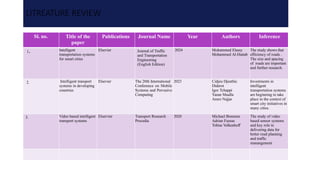
Sl. no. Title of the
paper
Publications Journal Name Year Authors Inference
1. Intelligent
transportation systems
for smart cities
Elsevier Journal of Traffic
and Transportation
Engineering
(English Edition)
2024 Mohammed Elassy
Mohammed Al-Hattab
The study shows that
efficiency of roads .
The size and spacing
of roads are important
and further research.
2. Intelligent transport
systems in developing
countries
Elsevier The 20th International
Conference on Mobile
Systems and Pervasive
Computing
2023 Cidjeu Djeuthic
Diderot
Igor Tchappi
Yazan Mualla
Amro Najjar
Investments in
intelligent
transportation systems
are beginning to take
place in the context of
smart city initiatives in
many cities.
3. Video based intelligent
transport systems
Elservier Transport Research
Procedia
2020 Michael Bommes
Adrian Fazeas
Tobias Volkenhoff
The study of video
based sensor systems
and key role in
delivering data for
better road planning
and traffic
manangement
5.
4. AI enabledapplications towards
intelligent transportation
Elsevier B.V. Transportation Engineering 2021 Lakshmi shankar iyer to study Artificial intelligence
ability of machine to perform
connitive functions like preceiving.
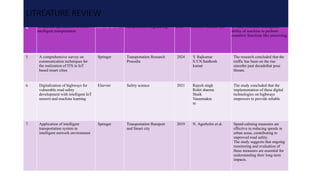
5. A comprehensive survey on
communication techniques for
the realization of ITS in IoT
based smart cities
Springer Transportation Research
Procedia
2024 Y. Rajkumar
S.V.N.Santhosh
kumar
The research concluded that the
traffic has been on the rise
sincethe past decadethat pose
threats.
6. Digitalization of highways for
vulnerable road safety
development with intelligent IoT
sensors and machine learning
Elsevier Safety science 2021 Rajesh singh
Rohit sharma
Shaik
Vaseemakra
m
The study concluded that the
implementation of these digital
technologies on highways
empowers to provide reliable
7. Application of intelligent
transportation system in
intelligent network environment
Springer Transportation Ransport
and Smart city
2019 N. Agerholm et al. Speed-calming measures are
effective in reducing speeds in
urban areas, contributing to
improved road safety.
The study suggests that ongoing
monitoring and evaluation of
these measures are essential for
understanding their long-term
impacts.
LITREATURE REVIEW
6.
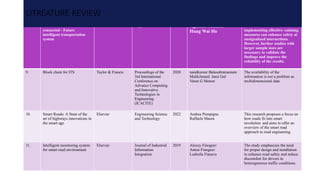
8. Smarter andmore
connected - Future
intelligent transportation
system
IATSS Research Applied Sciences 2018 Agachai Sumalee
Hung Wai Ho
The research concludes that
implementing effective -calming
measures can enhance safety at
unsignalized intersections.
However, further studies with
larger sample sizes are
necessary to validate the
findings and improve the
reliability of the results.
9. Block chain for ITS Taylor & Francis Proceedings of the
3rd International
Conference on
Advance Computing
and Innovative
Technologies in
Engineering
(ICACITE)
2020 nandkumar Balasubramaniam
MalikJunaid Jami Gul
Varun G Menon
The availability of the
information is not a problem as
multidimensional data
10. Smart Roads: A State of the
art of highways innovations in
the smart age
Elsevier Engineering Science
and Technology
2022 Andrea Pompigna
Raffaele Maura
This research proposes a focus on
how roads fit into smart
revolution and aims to offer an
overview of the smart road
approach in road engineering
11. Intelligent monitoring system
for smart road environment
Elsevier Journal of Industrial
Information
Integration
2019 Alexey Finogeev
Anton Finogeev
Ludmila Fianava
The study emphasizes the need
for proper design and installation
to enhance road safety and reduce
discomfort for drivers in
heterogeneous traffic conditions.
LITREATURE REVIEW
7.
OBJECTIVES
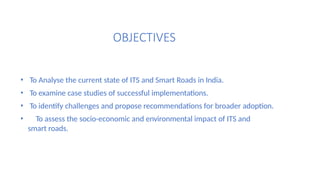
• To Analysethe current state of ITS and Smart Roads in India.
• To examine case studies of successful implementations.
• To identify challenges and propose recommendations for broader adoption.
• To assess the socio-economic and environmental impact of ITS and
smart roads.
8.
CAUSES OF ROADACCIDENTS
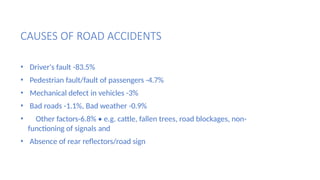
• Driver's fault -83.5%
• Pedestrian fault/fault of passengers -4.7%
• Mechanical defect in vehicles -3%
• Bad roads -1.1%, Bad weather -0.9%
• Other factors-6.8% • e.g. cattle, fallen trees, road blockages, non-
functioning of signals and
• Absence of rear reflectors/road sign
9.
INTELLIGENT TRANSPORTATION
TECHNOLOGIES
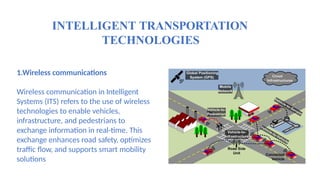
1.Wireless communications
Wirelesscommunication in Intelligent
Systems (ITS) refers to the use of wireless
technologies to enable vehicles,
infrastructure, and pedestrians to
exchange information in real-time. This
exchange enhances road safety, optimizes
traffic flow, and supports smart mobility
solutions.
10.
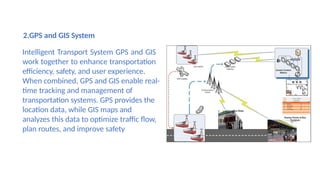
2.GPS and GISSystem
Intelligent Transport System GPS and GIS
work together to enhance transportation
efficiency, safety, and user experience.
When combined, GPS and GIS enable real-
time tracking and management of
transportation systems. GPS provides the
location data, while GIS maps and
analyzes this data to optimize traffic flow,
plan routes, and improve safety.
11.
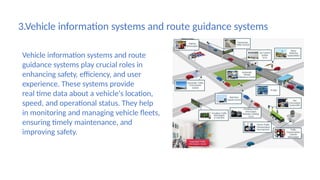
3.Vehicle information systemsand route guidance systems
Vehicle information systems and route
guidance systems play crucial roles in
enhancing safety, efficiency, and user
experience. These systems provide
real time data about a vehicle's location,
speed, and operational status. They help
in monitoring and managing vehicle fleets,
ensuring timely maintenance, and
improving safety.
DISADVANTAGES
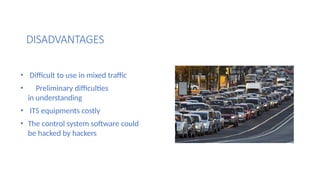
• Difficult touse in mixed traffic
• Preliminary difficulties
in understanding
• ITS equipments costly
• The control system software could
be hacked by hackers
14.
CASE STUDIES
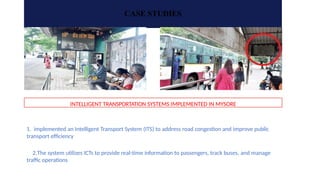
INTELLIGENT TRANSPORTATIONSYSTEMS IMPLEMENTED IN MYSORE
1. implemented an Intelligent Transport System (ITS) to address road congestion and improve public
transport efficiency
2.The system utilizes ICTs to provide real-time information to passengers, track buses, and manage
traffic operations
15.
3. Key componentsinclude a real-time passenger information system, in-vehicle displays, automated voice
announcements, a central control station, and an automatic vehicle location system.
Key Benefits of the Mysore ITS:
1. Reduced Waiting Time : The system provides real-time information on bus locations and estimated
arrival times, allowing commuters to plan their trips more effectively and reduce waiting times.
2. Enhanced Safety : The system provides real-time tracking of buses, allowing for faster response times
in case of incidents like accidents or breakdowns.
3. Increased Efficiency : Optimized bus routes, reduced congestion, and improved scheduling lead to
increased bus and crew utilization, as well as overall operational efficiency.
16.
CONCLUSION
• Road safetyhas become a pressing issue in India.* The number of
deaths has
•reached up to 80,0000
• The rapid increase in e Safety is in growing demand to the day.
• The making of new vehicles should be well equipped with necessary
technologies.
• To change the road user culture. This includes stronger levels of traffic
regulation and
•enforcement.



![Intelligent transport system (its) [autosaved]](https://cdn.slidesharecdn.com/ss_thumbnails/intelligenttransportsystemitsautosaved-180424014548-thumbnail.jpg?width=640&height=640&fit=bounds)


