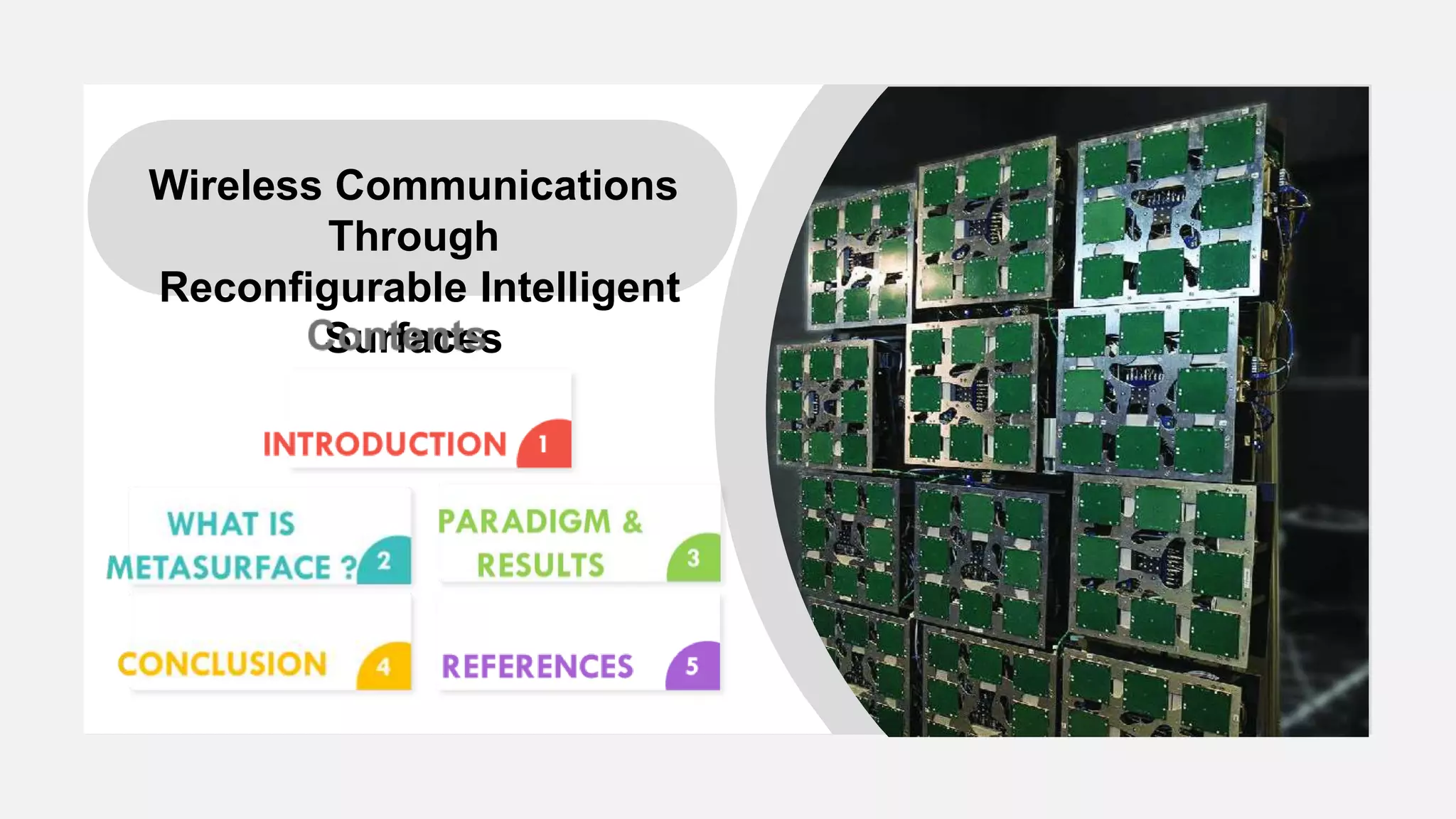
Wireless Communications
Through
Reconfigurable Intelligent
Surfaces
1.
Introduction
• UM-MIMO and THz suffer from high
cost and hardware complexity.
• Two prospective paradigms:
1. RF chain-free Transmitter.
2. Down-conversion Receiver.
• We will introduce the basic concept of
programmable Metasurfaces
• Wireless communication enabled by
programmable Metasurfaces to
address the above issues.
• Experimental results and advantages of
these new paradigms and their
challenges toward 6G with low hardware
complexity, low cost, and high energy
efficiency.
Metal
plate
Ideal
Metasurface
Practical
Metasurface
2. What is a Reconfigurable Intelligent Surface (RIS)?
Altering surface
impedance to
phase-shift
reflection
Constant
surface
impedance
Approximation
with discrete
elements
𝜃₁ 𝜃₂
e.g.
λ
5
x
λ
5
(Snell’s law) (Generalized Snell’s
law)
(Discretization)
Evolution of the concept
1. Fixed reflect array
3. Software controlled Metasurface
4. Real-time software controlled
Metasurfaces
2. Reconfigurable reflect array/
Metasurface
Intelligent Propagation Environments
We conventionally control
1) Transmitter
2) Receiver
Now we can control the
channel!
Comparison of conventional wireless transmitter and metasurface
transmitter.
02. Programmable
Metasurface Reduce the
hardware complexity targeting
UM-MIMO and THz
communications. When the
programmable metasurface is
01. Conventional Wireless
Transmitter
Hardware cost and power
consumption when applied in
UM-MIMO & suffers from low
transmission rate due to the slow
1
The incident EM wave
is converted into the
reflected EM wave, with
its amplitude and
phase adjusted by the
external control signals
Reflection Type
2
Programmable
Metasurface, the
incident EM wave is
mainly converted into
the transmitted wave.
Transmission
Type.
Types of Programmable Metasurfaces
50%
22%
28%
3. Space down conversion using Reconfigurable Intelligent Surface
Captured by the Antenna
array
It works such as Filters, LNAs, Mixers and
local Oscillators
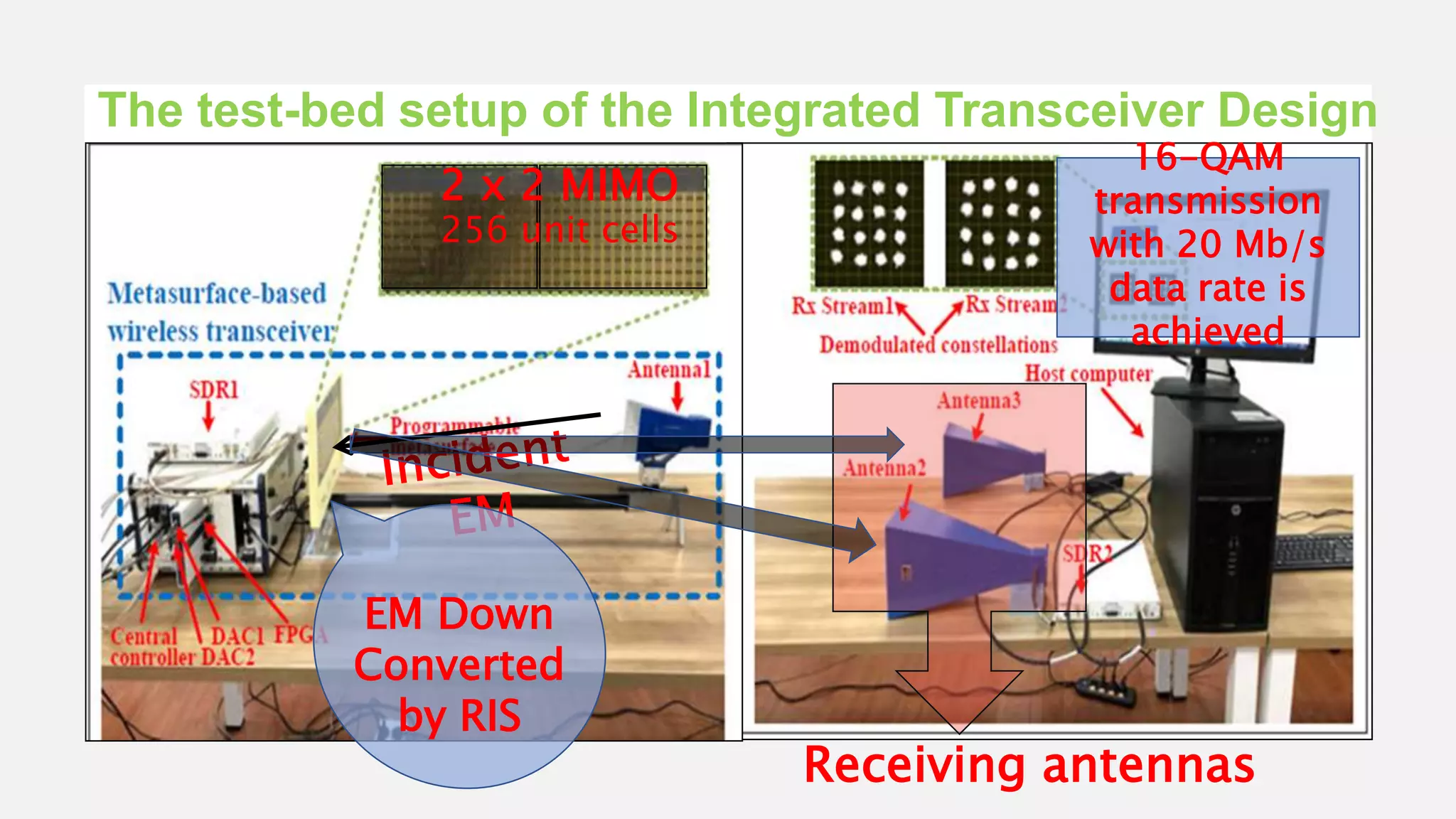
The test-bed setup of the Integrated Transceiver Design
EM Down
Converted
by RIS
2 x 2 MIMO
256 unit cells
Receiving antennas
16-QAM
transmission
with 20 Mb/s
data rate is
achieved
5 MHz space-down-conversion
 This result verifies the feasibility of the metasurface-based space-
down-conversion receiver paradigm.
The test-bed setup of the metasurface-based transceiver Advantages :
1. Simplify the architecture hardware, cost of future wireless
transceivers.
2. Open the door toward ultra-massive 6G communications with low
hardware complexity, low cost, and high energy efficiency.
3. If each unit cell can be controlled independently by (DAC), the RF
chain-free transmitter can generate multi-channel RF signals
simultaneously, which consequently enables advanced signal
processing methods such as space-time modulation and beam
steering for MIMO and the future UM-MIMO technologies.
At the moment, only 5 MHz frequency down conversion is realized, as
the sampling rate of the DAC modules used in the experiment is only
can reach 5 MHz .
the programmable metasurface is fast enough in GHz and even THz
level space-down-conversion can be potentially implemented in the
future,
which will greatly reduce the hardware complexity and the cost of the
UM-MIMO or THz receiver in the 6G era.
INTERESTED
4.CONCLUSION
In this presentation we have introduced
1. Overview about Metasurface and Reconfigurable
Intelligent Surfaces & its types.
2. Comparison of programmable Metasurface &
conventional communication system
3. Two paradigms to utilize the programmable
Metasurfaces as RF chain-free transmitter and space-
down-conversion receiver.
4. advantages of these novel paradigms are presented.
It is demonstrated that programmable Metasurfaces
may bring a paradigm shift in wireless transceiver
design, due to their superior capability of manipulating
the EM waves
5. Future Research directions.
Received power increases as 𝑁.
Is it better than Massive MIMO
where it grows as 𝑁 !
Reality: An IRS always has worse
SNR.
The gap reduces but remains as 𝑁
→ ∞
A Large Surface is Needed to Beat Relays
Additional Slides :-
200 Elements needed to beat relay
But can be fitted in 1x1.5 m²
80 m
10 m 𝒅𝟏
Source Destination
Additional Slides :-
IRS is Not a Mirror But a Lens!
5.REFERENCES
2. E. Björnson, Ö. Özdogan and E. G. Larsson, "Intelligent Reflecting Surface Versus
Decode-and-Forward: How Large Surfaces are Needed to Beat Relaying?," in IEEE
Wireless Communications Letters, vol. 9, no. 2, pp. 244-248, Feb. 2020, doi:
10.1109/LWC.2019.2950624.
3. Björnson, E., Sanguinetti, L., Wymeersch, H., Hoydis, J., & Marzetta, T. L. (2019).
Massive MIMO is a reality—What is next? Digital Signal Processing.
doi:10.1016/j.dsp.2019.06.007
1. W. Tang et al., "Wireless Communications with Programmable Metasurface: New
Paradigms, Opportunities, and Challenges on Transceiver Design," in IEEE Wireless
Communications, vol. 27, no. 2, pp. 180-187, April 2020, doi:
10.1109/MWC.001.1900308.
THANKS

Wireless Communications through reconfigurable intellegent surfaces final presentation.pptx

  • 1.
  • 2.
    1. Introduction • UM-MIMO andTHz suffer from high cost and hardware complexity. • Two prospective paradigms: 1. RF chain-free Transmitter. 2. Down-conversion Receiver. • We will introduce the basic concept of programmable Metasurfaces • Wireless communication enabled by programmable Metasurfaces to address the above issues. • Experimental results and advantages of these new paradigms and their challenges toward 6G with low hardware complexity, low cost, and high energy efficiency.
  • 3.
    Metal plate Ideal Metasurface Practical Metasurface 2. What isa Reconfigurable Intelligent Surface (RIS)? Altering surface impedance to phase-shift reflection Constant surface impedance Approximation with discrete elements 𝜃₁ 𝜃₂ e.g. λ 5 x λ 5 (Snell’s law) (Generalized Snell’s law) (Discretization)
  • 4.
    Evolution of theconcept 1. Fixed reflect array 3. Software controlled Metasurface 4. Real-time software controlled Metasurfaces 2. Reconfigurable reflect array/ Metasurface
  • 5.
    Intelligent Propagation Environments Weconventionally control 1) Transmitter 2) Receiver Now we can control the channel!
  • 6.
    Comparison of conventionalwireless transmitter and metasurface transmitter. 02. Programmable Metasurface Reduce the hardware complexity targeting UM-MIMO and THz communications. When the programmable metasurface is 01. Conventional Wireless Transmitter Hardware cost and power consumption when applied in UM-MIMO & suffers from low transmission rate due to the slow
  • 7.
    1 The incident EMwave is converted into the reflected EM wave, with its amplitude and phase adjusted by the external control signals Reflection Type 2 Programmable Metasurface, the incident EM wave is mainly converted into the transmitted wave. Transmission Type. Types of Programmable Metasurfaces 50% 22% 28%
  • 8.
    3. Space downconversion using Reconfigurable Intelligent Surface Captured by the Antenna array It works such as Filters, LNAs, Mixers and local Oscillators
  • 9.
    The test-bed setupof the Integrated Transceiver Design EM Down Converted by RIS 2 x 2 MIMO 256 unit cells Receiving antennas 16-QAM transmission with 20 Mb/s data rate is achieved
  • 10.
    5 MHz space-down-conversion This result verifies the feasibility of the metasurface-based space- down-conversion receiver paradigm.
  • 11.
    The test-bed setupof the metasurface-based transceiver Advantages : 1. Simplify the architecture hardware, cost of future wireless transceivers. 2. Open the door toward ultra-massive 6G communications with low hardware complexity, low cost, and high energy efficiency. 3. If each unit cell can be controlled independently by (DAC), the RF chain-free transmitter can generate multi-channel RF signals simultaneously, which consequently enables advanced signal processing methods such as space-time modulation and beam steering for MIMO and the future UM-MIMO technologies. At the moment, only 5 MHz frequency down conversion is realized, as the sampling rate of the DAC modules used in the experiment is only can reach 5 MHz . the programmable metasurface is fast enough in GHz and even THz level space-down-conversion can be potentially implemented in the future, which will greatly reduce the hardware complexity and the cost of the UM-MIMO or THz receiver in the 6G era.
  • 12.
    INTERESTED 4.CONCLUSION In this presentationwe have introduced 1. Overview about Metasurface and Reconfigurable Intelligent Surfaces & its types. 2. Comparison of programmable Metasurface & conventional communication system 3. Two paradigms to utilize the programmable Metasurfaces as RF chain-free transmitter and space- down-conversion receiver. 4. advantages of these novel paradigms are presented. It is demonstrated that programmable Metasurfaces may bring a paradigm shift in wireless transceiver design, due to their superior capability of manipulating the EM waves 5. Future Research directions.
  • 13.
    Received power increasesas 𝑁. Is it better than Massive MIMO where it grows as 𝑁 ! Reality: An IRS always has worse SNR. The gap reduces but remains as 𝑁 → ∞ A Large Surface is Needed to Beat Relays Additional Slides :- 200 Elements needed to beat relay But can be fitted in 1x1.5 m² 80 m 10 m 𝒅𝟏 Source Destination
  • 14.
    Additional Slides :- IRSis Not a Mirror But a Lens!
  • 15.
    5.REFERENCES 2. E. Björnson,Ö. Özdogan and E. G. Larsson, "Intelligent Reflecting Surface Versus Decode-and-Forward: How Large Surfaces are Needed to Beat Relaying?," in IEEE Wireless Communications Letters, vol. 9, no. 2, pp. 244-248, Feb. 2020, doi: 10.1109/LWC.2019.2950624. 3. Björnson, E., Sanguinetti, L., Wymeersch, H., Hoydis, J., & Marzetta, T. L. (2019). Massive MIMO is a reality—What is next? Digital Signal Processing. doi:10.1016/j.dsp.2019.06.007 1. W. Tang et al., "Wireless Communications with Programmable Metasurface: New Paradigms, Opportunities, and Challenges on Transceiver Design," in IEEE Wireless Communications, vol. 27, no. 2, pp. 180-187, April 2020, doi: 10.1109/MWC.001.1900308.
  • 16.