https://corelab.ku.edu.tr/
Wireless Communications with
Reconfigurable Intelligent Surfaces
September 2020
Dr. Ertugrul Basar
Associate Professor,
Department of Electrical and Electronics Engineering
Koç University, Turkey
Director, CoreLab
Young Member, Turkish Academy of Sciences
Senior Member, IEEE & IEEE ComSoc
Senior Editor, IEEE Communications Letters
Editor, IEEE Transcactions on Communications
Editor, Physical Communication (Elsevier)
Editor, Frontiers in Communications and Networks
Outline
 A Perspective on Beyond 5G and 6G
 Reconfigurable Intelligent Surfaces: A New Frontier in Wireless
 State-of-the-Art in Intelligent Communication Environments
 Potential Applications of Intelligent Surfaces towards 6G
 Future Directions & Conclusions
2
The Era of 5G
 3GPP 5G Standalone Release (June 2018)  Release 16: July 2020.
 5G PHY Layer: Above 6 GHz, massive MIMO, multiple OFDM
numerologies.
 One thing has become certain
during standardization of 5G:
There is no single enabling
technology that can achieve
all the applications being
promised by 5G networking.
 The necessity of more flexible,
new spectrum- and energy-
efficient physical layer
techniques for beyond 5G
wireless networks.
3
First 5G NR Specs Approved. http://www.3gpp.org/news-events/3gpp-news/1929-nsa nr 5g
A Vision for 6G Wireless (2030 and Beyond)
4
W. Saad, M. Bennis, ‘’A Vision of 6G Wireless Systems: Applications, Trends, Technologies, and Open Research
Problems’’, IEEE Netw., July 2019.
Requirements of 6G
5
‘’The Vision of 6G,’’ Samsung Research, 14 July 2020. https://news.samsung.com/global/samsungs-6g-white-paper-
lays-out-the-companys-vision-for-the-next-generation-of-communications-technology
Main Problems in Wireless and
Modern PHY Solutions
 What is currently slowing down wireless network operators from
building truly pervasive wireless networks that can provide
uninterrupted connectivity and high quality-of-service (QoS) to
multiple users and devices in harsh environments.
 Main problems:
 Deep fading, severe attenuation, inter-symbol/user interference,
Doppler effect, evasdropping, blocked line-of-sight
 random channel
 Existing modern physical layer solutions are not enough and the
overall progress is still relatively slow!
 Adaptive modulation and coding, multi-carrier modulation, non-
orthogonal multiple access, relaying, dynamic spectrum
allocation, beamforming, and reconfigurable antennas
 New and radical solutions are required in the physical layer !
6
Radical PHY Solutions for Beyond 5G
 A growing interest in novel communication paradigms that exploit
the implicit randomness of the propagation environment.
 Two design targets:
 Simplifying the transceiver architecture and/or
 Increasing the quality-of-service (QoS).
 Two emerging PHY solutions for beyond 5G/6G
 Index modulation (IM) technologies
 Smart radio environments with reconfigurable intelligent surfaces
7
What is Index Modulation?
 IM is a novel transmission technique
 utilizes the indices of the building blocks of corresponding
communication systems to convey information.
 Building blocks: transmit antennas, subcarriers, antenna patterns,
time slots, transmit LEDs, relays, modulation types, spreading
codes, dispersion matrices, loads etc.
 IM techniques
 consider innovative ways to convey information compared to
traditional communication systems of the past 50 years
 offer attractive advantages in terms of spectrum efficiency,
energy efficiency, and hardware simplicity
 There has been a tremendous interest in IM schemes over the
past few years.
8
E. Basar, ‘’Index modulation techniques for 5G wireless networks’’, IEEE Commun. Mag., 2016.
E. Basar et al., ‘’Index modulation techniques for next-generation wireless networks", IEEE Access, 2017.
Spatial Modulation  A New MIMO Mode
9
R. Mesleh et al., ‘’Spatial modulation’’, IEEE Trans. Veh. Technol., 2008.  ~2000 citations!
Di Renzo et al., ‘’Spatial modulation for generalized MIMO: Challenges, opportunities, and implementation’’, Proc.
IEEE, 2014.
Single RF chain!
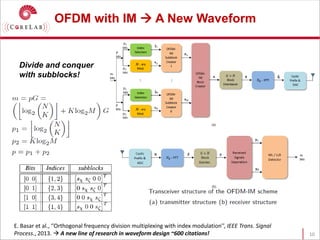
OFDM with IM  A New Waveform
10
E. Basar et al., ‘’Orthogonal frequency division multiplexing with index modulation’’, IEEE Trans. Signal
Process., 2013.  A new line of research in waveform design ~600 citations!
Divide and conquer
with subblocks!
MBM A New Virtual MIMO Solution
 Media-based modulation (MBM), which can be implemented by
reconfigurable antennas, offers a completely new dimension for
the transmission of digital information
 the realizations of wireless channels themselves.
11
A. K. Khandani, ‘’Media-based modulation: A new approach to wireless transmission’’, ISIT 2013.
E. Basar, ‘’Media-Based Modulation for Future Wireless Systems: A Tutorial’’, IEEE Wireless Commun., Nov. 2019.
Again single RF chain but indexing through antenna patterns!
Wireless 2.0: Intelligent Radio Environments
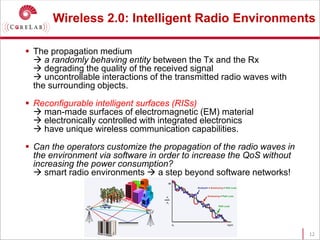
 The propagation medium
 a randomly behaving entity between the Tx and the Rx
 degrading the quality of the received signal
 uncontrollable interactions of the transmitted radio waves with
the surrounding objects.
 Reconfigurable intelligent surfaces (RISs)
 man-made surfaces of electromagnetic (EM) material
 electronically controlled with integrated electronics
 have unique wireless communication capabilities.
 Can the operators customize the propagation of the radio waves in
the environment via software in order to increase the QoS without
increasing the power consumption?
 smart radio environments  a step beyond software networks!
12
Reconfigurable Intelligent Surfaces (RISs)
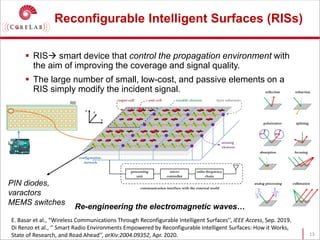
 RIS smart device that control the propagation environment with
the aim of improving the coverage and signal quality.
 The large number of small, low-cost, and passive elements on a
RIS simply modify the incident signal.
13
Re-engineering the electromagnetic waves…
E. Basar et al., “Wireless Communications Through Reconfigurable Intelligent Surfaces’’, IEEE Access, Sep. 2019.
Di Renzo et al., ‘’ Smart Radio Environments Empowered by Reconfigurable Intelligent Surfaces: How it Works,
State of Research, and Road Ahead’’, arXiv:2004.09352, Apr. 2020.
PIN diodes,
varactors
MEMS switches
Emerging Applications and Use-Cases
14
Can we cover all walls with RISs? How feasible? How costly? How effective?
 An interesting optimization problem
Unique Features of RISs
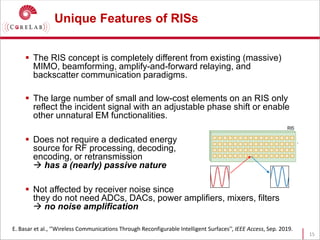
 The RIS concept is completely different from existing (massive)
MIMO, beamforming, amplify-and-forward relaying, and
backscatter communication paradigms.
 The large number of small and low-cost elements on an RIS only
reflect the incident signal with an adjustable phase shift or enable
other unnatural EM functionalities.
 Does not require a dedicated energy
source for RF processing, decoding,
encoding, or retransmission
 has a (nearly) passive nature
 Not affected by receiver noise since
they do not need ADCs, DACs, power amplifiers, mixers, filters
 no noise amplification
15
E. Basar et al., ‘’Wireless Communications Through Reconfigurable Intelligent Surfaces’’, IEEE Access, Sep. 2019.
RISs vs Relaying
16
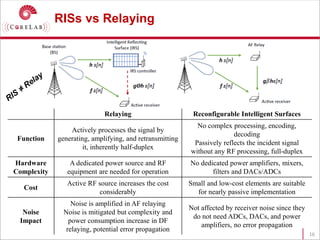
Relaying Reconfigurable Intelligent Surfaces
Function
Actively processes the signal by
generating, amplifying, and retransmitting
it, inherently half-duplex
No complex processing, encoding,
decoding
Passively reflects the incident signal
without any RF processing, full-duplex
Hardware
Complexity
A dedicated power source and RF
equipment are needed for operation
No dedicated power amplifiers, mixers,
filters and DACs/ADCs
Cost
Active RF source increases the cost
considerably
Small and low-cost elements are suitable
for nearly passive implementation
Noise
Impact
Noise is amplified in AF relaying
Noise is mitigated but complexity and
power consumption increase in DF
relaying, potential error propagation
Not affected by receiver noise since they
do not need ADCs, DACs, and power
amplifiers, no error propagation
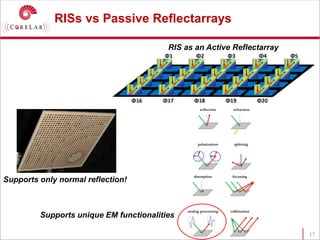
RISs vs Passive Reflectarrays
17
Supports unique EM functionalities
RIS as an Active Reflectarray
Supports only normal reflection!
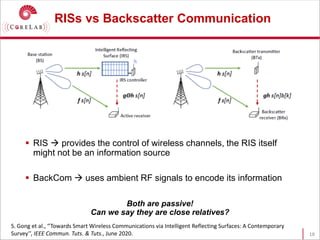
RISs vs Backscatter Communication
18
 RIS  provides the control of wireless channels, the RIS itself
might not be an information source
 BackCom  uses ambient RF signals to encode its information
Both are passive!
Can we say they are close relatives?
S. Gong et al., ‘’Towards Smart Wireless Communications via Intelligent Reflecting Surfaces: A Contemporary
Survey’’, IEEE Commun. Tuts. & Tuts., June 2020.
Ground Reflection vs Free-Space Propagation
With ground reflection:
Without ground reflection:
With intelligent reflection:
E. Basar et al., ‘’Wireless Communications Through Reconfigurable Intelligent Surfaces’’, IEEE Access, Sep. 2019.
19
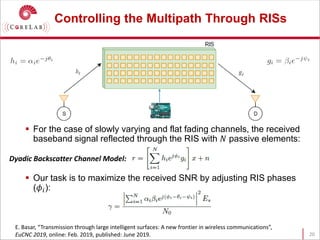
Controlling the Multipath Through RISs
 For the case of slowly varying and flat fading channels, the received
baseband signal reflected through the RIS with 𝑁𝑁 passive elements:
 Our task is to maximize the received SNR by adjusting RIS phases
(𝜙𝜙𝑖𝑖):
20
E. Basar, “Transmission through large intelligent surfaces: A new frontier in wireless communications”,
EuCNC 2019, online: Feb. 2019, published: June 2019.
Dyadic Backscatter Channel Model:
Theoretical Bit Error Probability
21
Without
path loss!
We need channel phases knowledge at the RIS Not easy but feasible!
Increasing the Number of Reflectors
Doubling 𝑵𝑵 provides ~6 dB improvement
(four-fold decrease) in the required SNR
22
The
received
SNR is a
function of
N2
Origins of Intelligent Surfaces
23
L. Subrt and P. Pechac, “Controlling propagation environments using intelligent walls,” EuCAP 2012.
N. Kaina et al., “Shaping complex microwave fields in reverberating media with binary tunable metasurfaces,” Sci. Rep.,
2014.
T. J. Cui et al., “Coding metamaterials, digital metamaterials and programmable metamaterials,” Light: Sci. & App.,2014.
H. Yang et al., “A programmable metasurface with dynamic polarization, scattering and focusing control,” Sci. Rep. 2016.
J. Jornet et al., “Increasing indoor spectrum sharing capacity using smart reflect-array,” ICC 2016.
S. Hu et al., “The potential of using large antenna arrays on intelligent surfaces,” VTC-Spring 2017.
C. Liaskos et al., “A new wireless communication paradigm through software-controlled metasurfaces”, IEEE
Commun. Mag., 2018.
State-of-the Art Schemes
 In the past year, several studies and innovative solutions related
to RISs have been done.
 Different terms to denote the RISs: reconfigurable intelligent
surfaces, large intelligent surfaces, smart reflect-arrays,
intelligent reflecting surfaces, passive intelligent mirrors,
hypersurfaces, programmable metasurfaces, and so on.
 Researchers focused on:
 theoretical SNR, outage, and error probability derivations
 channel estimation problems and effective protocols
 signal-to-interference-ratio (SINR) maximization
 joint active and passive beamforming optimization problems
 practical implementations (harware) and testing
 physical layer security solutions, cognitive radio applications
 the potential of intelligent surfaces for application to mmWave/THz,
free space optical, IM, OFDM, UAV, NOMA, and VLC systems
 artificial intelligence solutions (deep learning)
24
Our Active Research on RISs @ CoreLab
 Channel Modeling for Indoors and Outdoors
 Novel MIMO System Designs and IM-Based Systems
 NOMA-Based Solutions for Multi-User Systems
 Applications for Vehicular and UAV Networks
 Solutions for COVID-19 (RISs and backscatter communications)?
25
E. Basar, I. Yildirim, ’’Indoor and Outdoor Physical Channel Modeling and Efficient Positioning for Reconfigurable
Intelligent Surfaces in mmWave Bands’’, arXiv:2006.02240, May. 2020.
E. Basar, ‘’Reconfigurable Intelligent Surface-Based Index Modulation: A New Beyond MIMO Paradigm for 6G’’, IEEE
Trans. Commun., May 2020.
Z. Yigit, E. Basar, I. Altunbas, ‘’Low Complexity Adaptation for Reconfigurable Intelligent Surface-Based MIMO
Systems‘’, IEEE Commun. Lett. (to appear), Aug. 2020.
I. Yildirim, A. Uyrus, E. Basar, ‘’Modeling and Analysis of Reconfigurable Intelligent Surfaces for Indoor and Outdoor
Applications in Future Wireless Networks’’, arXiv:1912.07350, Dec. 2019.
J. Zuo, Y. Liu, E. Basar, O. A. Dobre, ‘’ Intelligent Reflecting Surface Enhanced Millimeter-Wave NOMA Systems‘’, IEEE
Commun. Lett., June 2020.
A. Khaleel, E. Basar, ‘’Reconfigurable Intelligent Surface-Assisted MIMO Communications’’, IEEE Systems J. (to
appear), July 2020.
A. Canbilen, E. Basar, S. Ikki, ‘’Reconfigurable Intelligent Surface-Assisted Space Shift Keying’’, IEEE Wireless Commun.
Lett. , Apr. 2020.
E. Basar, ‘’Reconfigurable Intelligent Surfaces for Doppler Effect and Multipath Fading Mitigation’’, arXiv:1912.04080,
Nov. 2019.
 Unified narrowband channel model for RIS-assisted systems in
indoor and outdoor environments for the first time
 Considers the 5G mmWave (3D) channel model with random
number of clusters/scatterers
 Includes many physical characteristics : LOS probability (modified
wrt RIS height), shadowing effects, shared clusters, realistic gains
and array responses
E. Basar, I. Yildirim, ’’Indoor and Outdoor Physical Channel Modeling and Efficient Positioning for Reconfigurable
Intelligent Surfaces in mmWave Bands’’, arXiv:2006.02240, May. 2020.
Physical Channel Modeling for mmWave
Communication Systems
Indoors
26
 Useful insights from the perspective of potential RIS use-cases
and their efficient positioning.
 Guidelines towards the effective use of RISs
Physical Channel Modeling mmWave
Communication Systems – cont’d
Outdoors
27
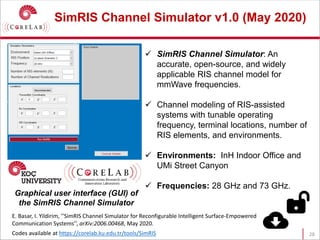
 SimRIS Channel Simulator: An
accurate, open-source, and widely
applicable RIS channel model for
mmWave frequencies.
 Channel modeling of RIS-assisted
systems with tunable operating
frequency, terminal locations, number of
RIS elements, and environments.
 Environments: InH Indoor Office and
UMi Street Canyon
 Frequencies: 28 GHz and 73 GHz.
Graphical user interface (GUI) of
the SimRIS Channel Simulator
E. Basar, I. Yildirim, ’’SimRIS Channel Simulator for Reconfigurable Intelligent Surface-Empowered
Communication Systems’’, arXiv:2006.00468, May 2020.
Codes available at https://corelab.ku.edu.tr/tools/SimRIS
SimRIS Channel Simulator v1.0 (May 2020)
28
The closer to the RIS the better!
LOS paths are decisive!
Indoor Physical Channel Modeling:
Achievable Rate Analysis
29
Indoors
(top view)
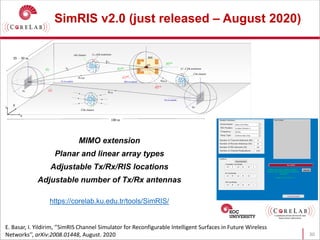
SimRIS v2.0 (just released – August 2020)
30
MIMO extension
Planar and linear array types
Adjustable Tx/Rx/RIS locations
Adjustable number of Tx/Rx antennas
https://corelab.ku.edu.tr/tools/SimRIS/
E. Basar, I. Yildirim, ‘’SimRIS Channel Simulator for Reconfigurable Intelligent Surfaces in Future Wireless
Networks’’, arXiv:2008.01448, August. 2020
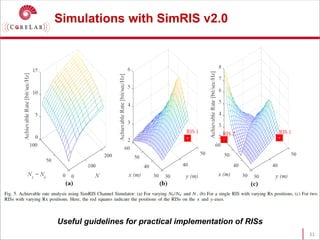
Simulations with SimRIS v2.0
31
Useful guidelines for practical implementation of RISs
Practical Issues: Path Loss for RISs
32
When, if ever, is it is appropriate to interpret far case
RIS scattering as specular reflection?
The short answer is “never”
Specular reflection
path loss:
S.W. Ellingson, “Path Loss in Reconfigurable Intelligent Surface-Enabled Channels”, arXiv:1912.06759, Dec. 2019.
Fortunately N2 appears in path gain  We need compact RIS design
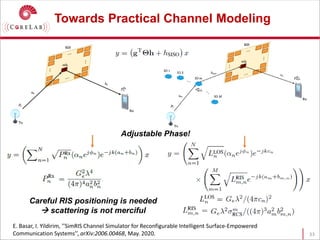
Towards Practical Channel Modeling
33
E. Basar, I. Yildirim, ’’SimRIS Channel Simulator for Reconfigurable Intelligent Surface-Empowered
Communication Systems’’, arXiv:2006.00468, May. 2020.
Adjustable Phase!
Careful RIS positioning is needed
 scattering is not merciful
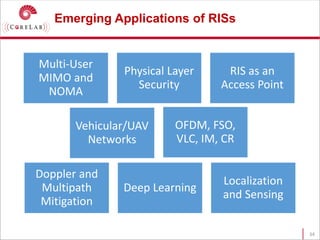
Emerging Applications of RISs
Multi-User
MIMO and
NOMA
Physical Layer
Security
RIS as an
Access Point
Doppler and
Multipath
Mitigation
Deep Learning
Localization
and Sensing
Vehicular/UAV
Networks
OFDM, FSO,
VLC, IM, CR
34
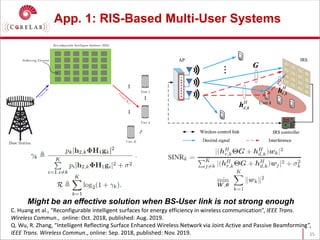
App. 1: RIS-Based Multi-User Systems
35
C. Huang et al., “Reconfigurable intelligent surfaces for energy efficiency in wireless communication”, IEEE Trans.
Wireless Commun., online: Oct. 2018, published: Aug. 2019.
Q. Wu, R. Zhang, “Intelligent Reflecting Surface Enhanced Wireless Network via Joint Active and Passive Beamforming”,
IEEE Trans. Wireless Commun., online: Sep. 2018, published: Nov. 2019.
Might be an effective solution when BS-User link is not strong enough
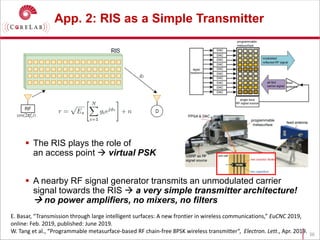
App. 2: RIS as a Simple Transmitter
 The RIS plays the role of
an access point  virtual PSK
 A nearby RF signal generator transmits an unmodulated carrier
signal towards the RIS  a very simple transmitter architecture!
 no power amplifiers, no mixers, no filters
36
E. Basar, “Transmission through large intelligent surfaces: A new frontier in wireless communications,” EuCNC 2019,
online: Feb. 2019, published: June 2019.
W. Tang et al., “Programmable metasurface-based RF chain-free 8PSK wireless transmitter“, Electron. Lett., Apr. 2019.
App. 3: Index Modulation
RIS meets spatial modulation at both Rx and Tx sides
 a massive MIMO alternative?
37
E. Basar, ‘’Reconfigurable Intelligent Surface-Based Index Modulation: A New Beyond MIMO Paradigm for 6G’’, IEEE
Trans. Commun., online: Apr. 2019, published: May 2020.
A. Canbilen, E. Basar, S. Ikki, ‘’Reconfigurable Intelligent Surface-Assisted Space Shift Keying’’, IEEE Wireless Commun.
Lett., Apr. 2020.
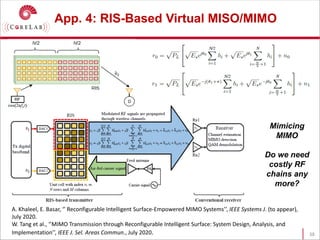
App. 4: RIS-Based Virtual MISO/MIMO
38
A. Khaleel, E. Basar, ‘’ Reconfigurable Intelligent Surface-Empowered MIMO Systems’’, IEEE Systems J. (to appear),
July 2020.
W. Tang et al., ‘’MIMO Transmission through Reconfigurable Intelligent Surface: System Design, Analysis, and
Implementation’’, IEEE J. Sel. Areas Commun., July 2020.
Mimicing
MIMO
Do we need
costly RF
chains any
more?
App. 5: Physical Layer Security
39
R. Zhang et al., ‘’Secure Wireless Communication via Intelligent Reflecting Surface’’, IEEE Wireless Commun. Lett.,
May. 2019.
R. Schober et al., ‘’Enabling Secure Wireless Communications via Intelligent Reflecting Surfaces’’, GLOBECOM 2019.
Another dimension for PHY security (an important missing feature in 5G)
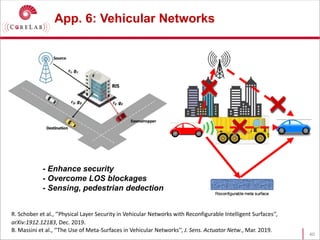
App. 6: Vehicular Networks
40
R. Schober et al., ‘’Physical Layer Security in Vehicular Networks with Reconfigurable Intelligent Surfaces’’,
arXiv:1912.12183, Dec. 2019.
B. Massini et al., ‘’The Use of Meta-Surfaces in Vehicular Networks’’, J. Sens. Actuator Netw., Mar. 2019.
- Enhance security
- Overcome LOS blockages
- Sensing, pedestrian dedection
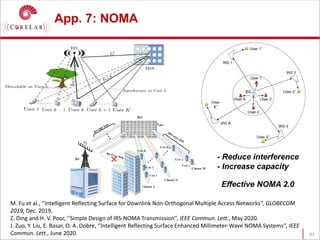
App. 7: NOMA
41
M. Fu et al., ‘’Intelligent Reflecting Surface for Downlink Non-Orthogonal Multiple Access Networks’’, GLOBECOM
2019, Dec. 2019.
Z. Ding and H. V. Poor, ‘’Simple Design of IRS-NOMA Transmission’’, IEEE Commun. Lett., May 2020.
J. Zuo, Y. Liu, E. Basar, O. A. Dobre, ‘’Intelligent Reflecting Surface Enhanced Millimeter-Wave NOMA Systems‘’, IEEE
Commun. Lett., June 2020.
- Reduce interference
- Increase capacity
Effective NOMA 2.0
App. 8: Low-Complexity MIMO
42
No convex
optimization!
Z. Yigit, E. Basar, I. Altunbas, ‘’Low Complexity Adaptation for Reconfigurable Intelligent Surface-Based MIMO
Systems‘’, IEEE Commun. Lett. (to appear), Aug. 2020.
L. Hanzo et al., ‘’MIMO Assisted Networks Relying on Large Intelligent Surfaces: A Stochastic Geometry Model’’,
arXiv:1910.00959, Oct. 2019.
App. 9: Non-Terrestrial Networks
43
M. Bennis et al., ‘’Reflections in the Sky: Millimeter Wave Communication with UAV-Carried Intelligent Reflectors’’,
arXiv:1908.03271, Aug. 2019.
S. Alfattani et al., ‘’ Aerial Platforms with Reconfigurable Smart Surfaces for 5G and Beyond’’, arXiv:2006.09328,
June 2020.
- Overcome LOS blockages
- Support terrestrial networks
- Support aerial users
- Backhauling support
How practical?
RIS at the
ground or air?
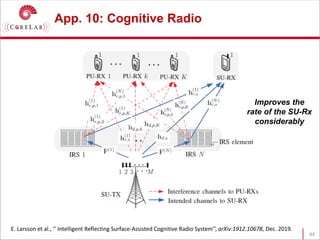
App. 10: Cognitive Radio
44
E. Larsson et al., ‘’ Intelligent Reflecting Surface-Assisted Cognitive Radio System’’, arXiv:1912.10678, Dec. 2019.
Improves the
rate of the SU-Rx
considerably
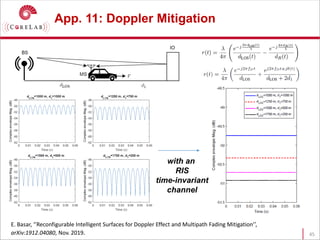
App. 11: Doppler Mitigation
45
E. Basar, ‘’Reconfigurable Intelligent Surfaces for Doppler Effect and Multipath Fading Mitigation’’,
arXiv:1912.04080, Nov. 2019.
with an
RIS
time-invariant
channel
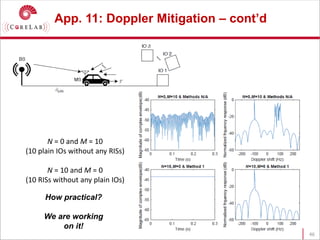
App. 11: Doppler Mitigation – cont’d
46
N = 0 and M = 10
(10 plain IOs without any RISs)
N = 10 and M = 0
(10 RISs without any plain IOs)
How practical?
We are working
on it!
App. 12: Coverage Extension towards 6G
47
I. Yildirim, A. Uyrus, E. Basar, ‘’ Modeling and Analysis of Reconfigurable Intelligent Surfaces for Indoor and Outdoor
Applications in Future Wireless Networks’’, arXiv:1912.07350, Dec. 2019.
- Extend the coverage with multiple RISs
- Optimum RIS selection and positioning
App. 13: OFDM Systems
48
R. Zhang et al., ‘’ Intelligent Reflecting Surface Meets OFDM: Protocol Design and Rate Maximization’’,
arXiv:1906.09956, June 2019.
Can I use RISs
with Wi-Fi?
App. 14: Posture Recognition
49
H. V. Poor et al., ‘’ Reconfigurable Intelligent Surfaces based RF Sensing: Design, Optimization, and Implementation’’,
arXiv:1912.09198, Dec. 2019.
App. 15: Radio Localization
50
H. Wymeersch et al., ‘’Radio Localization and Mapping with Reconfigurable Intelligent Surfaces’’, arXiv:1912.09401,
Dec. 2019.
A very interesting
application beyond
communications
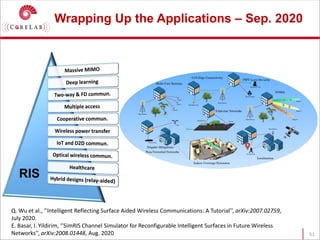
Wrapping Up the Applications – Sep. 2020
51
RIS
Q. Wu et al., ‘’Intelligent Reflecting Surface Aided Wireless Communications: A Tutorial’’, arXiv:2007.02759,
July 2020.
E. Basar, I. Yildirim, ‘’SimRIS Channel Simulator for Reconfigurable Intelligent Surfaces in Future Wireless
Networks’’, arXiv:2008.01448, Aug. 2020
Recent Interesting Studies
 Near-field issues & Correlation matrices
52
E. Björnson, L. Sanguinetti, ‘’Power Scaling Laws and Near-Field Behaviors of Massive MIMO and Intelligent
Reflecting Surfaces’’, IEEE Open J. Commun. Society, Aug. 2020.
E. Björnson, L. Sanguinetti, ‘’Rayleigh Fading Modeling and Channel Hardening for Reconfigurable Intelligent
Surfaces’’, arXiv:2009.04723, Sep. 2020.
Recent Interesting Studies – cont’d
 RIS with active elements/relays
53
G. C. Alexandropoulos and E. Vlachos, ‘’ A Hardware Architecture for Reconfigurable Intelligent Surfaces with
Minimal Active Elements for Explicit Channel Estimation’’, arXiv:2002.10371, Feb. 2020.
Z. Wan et al., ‘’Terahertz Massive MIMO with Holographic Reconfigurable Intelligent Surfaces’’, arXiv:2009.10963,
Sep. 2020.
A. Alkhateeb et al., ‘’ Relay Aided Intelligent Reconfigurable Surfaces: Achieving the Potential Without So Many
Antennas’’, arXiv:2006.06644, June 2020.
Intelligent Metasurface: How it Works?
54
Tretyakov et al., “Intelligent Metasurfaces with Continuously Tunable Local Surface Impedance for Multiple
Reconfigurable Functions”, Phys. Rev. Applied, Apr. 2019
HyperSurface @ VisorSurf
55
C. Liaskos et al., ‘’A new wireless communication paradigm through software-controlled metasurfaces’’, IEEE
Commun. Mag., Sep. 2018.
Their prototype is ready after 3 years of R&D
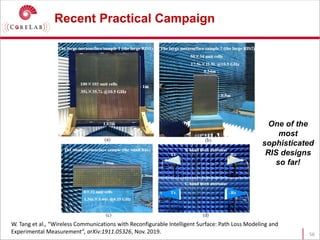
Recent Practical Campaign
56
W. Tang et al., “Wireless Communications with Reconfigurable Intelligent Surface: Path Loss Modeling and
Experimental Measurement”, arXiv:1911.05326, Nov. 2019.
One of the
most
sophisticated
RIS designs
so far!
Recent Practical Campaign – cont’d
57
L. Dai et al., “Reconfigurable Intelligent Surface-Based Wireless Communication: Antenna Design, Prototyping and
Experimental Results”, arXiv:1912.03620, Dec. 2019.
21.7 dBi antenna gain
@ 2.3 GHz
Recent Practical Campaign – cont’d
58
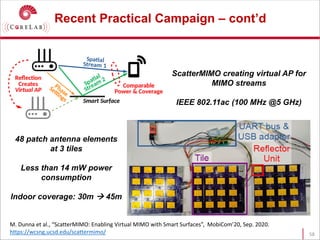
M. Dunna et al., “ScatterMIMO: Enabling Virtual MIMO with Smart Surfaces”, MobiCom’20, Sep. 2020.
https://wcsng.ucsd.edu/scattermimo/
ScatterMIMO creating virtual AP for
MIMO streams
IEEE 802.11ac (100 MHz @5 GHz)
48 patch antenna elements
at 3 tiles
Less than 14 mW power
consumption
Indoor coverage: 30m  45m
Our Intelligent Reflectarray Prototype - 2020
59
Better than nothing!
First tests are ongoing @ CoreLab using Adalm-Pluto SDRs 
Recent Interest from Industry
 NTT DOCOMO
 Pivotal Commware
 Metawave
 Greenerwave
 A working group on RIS @ IMT-2030
60
Open Research Issues towards 6G
 Determination of convincing use-cases in which the RISs might
have a huge potential to boost the communication QoS.
 Assessment of practical protocols for reconfigurability of RISs
 Practical path-loss/channel modeling and real-time testing of
large-scale RISs in different propagating environments
61
Bridging the gap between
theoretical analysis and
real-world deployments
Open Research Issues towards 6G – cont’d
 Determination of fundamental performance limits of RIS-assisted
networks
 Robust optimization & resource allocation issues (space/time/freq.)
 Optimal placement of RISs and optimization of the overall network
 Development of EM-based RIS models and hardware effects
 Exploration of effective mmWave and THz communication systems
with RISs
 Exploration of the potential of RISs for beyond communication
(sensing, radar, localization etc.)
62
Open Research Issues towards 6G – cont’d
 AI-driven tools for designing/optimizing/reconfiguring surfaces
 Deployment of multiple RISs and their coordination/optimization
 Exploration of futuristic scenarios (very high number of devices,
eMBB + URRLC, very high mobility)
 Standardization and integration into existing wireless commu-
nication networks (5G, 6G, IoT, IEEE 802.11x)
 joint effort of academia and industry is required
63
Conclusions
 Perfect time to do research on 6G.
 We need out-of-the-box PHY solutions!
 Two possible uses to exploit RISs in the first place:
i) shaping the radio waves in order to control, in a deterministic
fashion, the multipath propagation
ii) realizing low-complexity and energy efficient transmitters that
require only one RF chain.
 Interesting potential use-cases & open research problems for RISs
 Is it the secret remedy we are looking for 6G?
 Effective collaboration of academia and industry:
 Potential new scientific proposals/studies
 Potential new patents towards 6G
 Potential standardization activities
64
Our New ETI on RISs @ IEEE ComSoc
 Up and running
Please follow the website of this ETI for its future activities:
https://www.comsoc.org/about/committees/emerging-technologies-
initiatives/reconfigurable-intelligent-surfaces
Mailing-list: etiris@comsoc.org
Subscription: Please send an email to LISTSERV@comsoc-
listserv.ieee.org with the following command in the BODY of the
message: JOIN ETIRIS
65
Our New Special Issue @ IEEE OJ-COMS
https://www.comsoc.org/publications/journals/ieee-ojcoms/cfp/reconfigurable-
intelligent-surface-based-communications-6g
66
Our Feature Topic at IEEE COMMAG
67
https://www.comsoc.org/publications/magazines/ieee-communications-
magazine/cfp/reconfigurable-intelligent-surfaces-design
Our Feature Topic at Frontiers
68
https://www.frontiersin.org/research-topics/16017/wireless-communications-
with-reconfigurable-intelligent-surfaces-fundamentals-experimentation-and-ap
Strong
EDITORIAL BOARD
2020
LAUNCH
Best Readings on RIS
69
https://www.comsoc.org/publications/best-readings/reconfigurable-intelligent-
surfaces
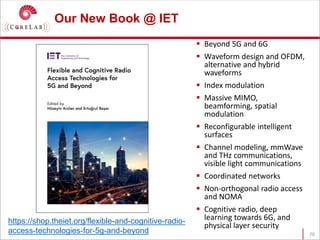
Our New Book @ IET
 Beyond 5G and 6G
 Waveform design and OFDM,
alternative and hybrid
waveforms
 Index modulation
 Massive MIMO,
beamforming, spatial
modulation
 Reconfigurable intelligent
surfaces
 Channel modeling, mmWave
and THz communications,
visible light communications
 Coordinated networks
 Non-orthogonal radio access
and NOMA
 Cognitive radio, deep
learning towards 6G, and
physical layer security
70
https://shop.theiet.org/flexible-and-cognitive-radio-
access-technologies-for-5g-and-beyond
THANK YOU!
for further questions: ebasar@ku.edu.tr
71

++WirelessCommunicationswithReconfigurableIntelligentSurfaces.pdf

  • 1.
    https://corelab.ku.edu.tr/ Wireless Communications with ReconfigurableIntelligent Surfaces September 2020 Dr. Ertugrul Basar Associate Professor, Department of Electrical and Electronics Engineering Koç University, Turkey Director, CoreLab Young Member, Turkish Academy of Sciences Senior Member, IEEE & IEEE ComSoc Senior Editor, IEEE Communications Letters Editor, IEEE Transcactions on Communications Editor, Physical Communication (Elsevier) Editor, Frontiers in Communications and Networks
  • 2.
    Outline  A Perspectiveon Beyond 5G and 6G  Reconfigurable Intelligent Surfaces: A New Frontier in Wireless  State-of-the-Art in Intelligent Communication Environments  Potential Applications of Intelligent Surfaces towards 6G  Future Directions & Conclusions 2
  • 3.
    The Era of5G  3GPP 5G Standalone Release (June 2018)  Release 16: July 2020.  5G PHY Layer: Above 6 GHz, massive MIMO, multiple OFDM numerologies.  One thing has become certain during standardization of 5G: There is no single enabling technology that can achieve all the applications being promised by 5G networking.  The necessity of more flexible, new spectrum- and energy- efficient physical layer techniques for beyond 5G wireless networks. 3 First 5G NR Specs Approved. http://www.3gpp.org/news-events/3gpp-news/1929-nsa nr 5g
  • 4.
    A Vision for6G Wireless (2030 and Beyond) 4 W. Saad, M. Bennis, ‘’A Vision of 6G Wireless Systems: Applications, Trends, Technologies, and Open Research Problems’’, IEEE Netw., July 2019.
  • 5.
    Requirements of 6G 5 ‘’TheVision of 6G,’’ Samsung Research, 14 July 2020. https://news.samsung.com/global/samsungs-6g-white-paper- lays-out-the-companys-vision-for-the-next-generation-of-communications-technology
  • 6.
    Main Problems inWireless and Modern PHY Solutions  What is currently slowing down wireless network operators from building truly pervasive wireless networks that can provide uninterrupted connectivity and high quality-of-service (QoS) to multiple users and devices in harsh environments.  Main problems:  Deep fading, severe attenuation, inter-symbol/user interference, Doppler effect, evasdropping, blocked line-of-sight  random channel  Existing modern physical layer solutions are not enough and the overall progress is still relatively slow!  Adaptive modulation and coding, multi-carrier modulation, non- orthogonal multiple access, relaying, dynamic spectrum allocation, beamforming, and reconfigurable antennas  New and radical solutions are required in the physical layer ! 6
  • 7.
    Radical PHY Solutionsfor Beyond 5G  A growing interest in novel communication paradigms that exploit the implicit randomness of the propagation environment.  Two design targets:  Simplifying the transceiver architecture and/or  Increasing the quality-of-service (QoS).  Two emerging PHY solutions for beyond 5G/6G  Index modulation (IM) technologies  Smart radio environments with reconfigurable intelligent surfaces 7
  • 8.
    What is IndexModulation?  IM is a novel transmission technique  utilizes the indices of the building blocks of corresponding communication systems to convey information.  Building blocks: transmit antennas, subcarriers, antenna patterns, time slots, transmit LEDs, relays, modulation types, spreading codes, dispersion matrices, loads etc.  IM techniques  consider innovative ways to convey information compared to traditional communication systems of the past 50 years  offer attractive advantages in terms of spectrum efficiency, energy efficiency, and hardware simplicity  There has been a tremendous interest in IM schemes over the past few years. 8 E. Basar, ‘’Index modulation techniques for 5G wireless networks’’, IEEE Commun. Mag., 2016. E. Basar et al., ‘’Index modulation techniques for next-generation wireless networks", IEEE Access, 2017.
  • 9.
    Spatial Modulation A New MIMO Mode 9 R. Mesleh et al., ‘’Spatial modulation’’, IEEE Trans. Veh. Technol., 2008.  ~2000 citations! Di Renzo et al., ‘’Spatial modulation for generalized MIMO: Challenges, opportunities, and implementation’’, Proc. IEEE, 2014. Single RF chain!
  • 10.
    OFDM with IM A New Waveform 10 E. Basar et al., ‘’Orthogonal frequency division multiplexing with index modulation’’, IEEE Trans. Signal Process., 2013.  A new line of research in waveform design ~600 citations! Divide and conquer with subblocks!
  • 11.
    MBM A NewVirtual MIMO Solution  Media-based modulation (MBM), which can be implemented by reconfigurable antennas, offers a completely new dimension for the transmission of digital information  the realizations of wireless channels themselves. 11 A. K. Khandani, ‘’Media-based modulation: A new approach to wireless transmission’’, ISIT 2013. E. Basar, ‘’Media-Based Modulation for Future Wireless Systems: A Tutorial’’, IEEE Wireless Commun., Nov. 2019. Again single RF chain but indexing through antenna patterns!
  • 12.
    Wireless 2.0: IntelligentRadio Environments  The propagation medium  a randomly behaving entity between the Tx and the Rx  degrading the quality of the received signal  uncontrollable interactions of the transmitted radio waves with the surrounding objects.  Reconfigurable intelligent surfaces (RISs)  man-made surfaces of electromagnetic (EM) material  electronically controlled with integrated electronics  have unique wireless communication capabilities.  Can the operators customize the propagation of the radio waves in the environment via software in order to increase the QoS without increasing the power consumption?  smart radio environments  a step beyond software networks! 12
  • 13.
    Reconfigurable Intelligent Surfaces(RISs)  RIS smart device that control the propagation environment with the aim of improving the coverage and signal quality.  The large number of small, low-cost, and passive elements on a RIS simply modify the incident signal. 13 Re-engineering the electromagnetic waves… E. Basar et al., “Wireless Communications Through Reconfigurable Intelligent Surfaces’’, IEEE Access, Sep. 2019. Di Renzo et al., ‘’ Smart Radio Environments Empowered by Reconfigurable Intelligent Surfaces: How it Works, State of Research, and Road Ahead’’, arXiv:2004.09352, Apr. 2020. PIN diodes, varactors MEMS switches
  • 14.
    Emerging Applications andUse-Cases 14 Can we cover all walls with RISs? How feasible? How costly? How effective?  An interesting optimization problem
  • 15.
    Unique Features ofRISs  The RIS concept is completely different from existing (massive) MIMO, beamforming, amplify-and-forward relaying, and backscatter communication paradigms.  The large number of small and low-cost elements on an RIS only reflect the incident signal with an adjustable phase shift or enable other unnatural EM functionalities.  Does not require a dedicated energy source for RF processing, decoding, encoding, or retransmission  has a (nearly) passive nature  Not affected by receiver noise since they do not need ADCs, DACs, power amplifiers, mixers, filters  no noise amplification 15 E. Basar et al., ‘’Wireless Communications Through Reconfigurable Intelligent Surfaces’’, IEEE Access, Sep. 2019.
  • 16.
    RISs vs Relaying 16 RelayingReconfigurable Intelligent Surfaces Function Actively processes the signal by generating, amplifying, and retransmitting it, inherently half-duplex No complex processing, encoding, decoding Passively reflects the incident signal without any RF processing, full-duplex Hardware Complexity A dedicated power source and RF equipment are needed for operation No dedicated power amplifiers, mixers, filters and DACs/ADCs Cost Active RF source increases the cost considerably Small and low-cost elements are suitable for nearly passive implementation Noise Impact Noise is amplified in AF relaying Noise is mitigated but complexity and power consumption increase in DF relaying, potential error propagation Not affected by receiver noise since they do not need ADCs, DACs, and power amplifiers, no error propagation
  • 17.
    RISs vs PassiveReflectarrays 17 Supports unique EM functionalities RIS as an Active Reflectarray Supports only normal reflection!
  • 18.
    RISs vs BackscatterCommunication 18  RIS  provides the control of wireless channels, the RIS itself might not be an information source  BackCom  uses ambient RF signals to encode its information Both are passive! Can we say they are close relatives? S. Gong et al., ‘’Towards Smart Wireless Communications via Intelligent Reflecting Surfaces: A Contemporary Survey’’, IEEE Commun. Tuts. & Tuts., June 2020.
  • 19.
    Ground Reflection vsFree-Space Propagation With ground reflection: Without ground reflection: With intelligent reflection: E. Basar et al., ‘’Wireless Communications Through Reconfigurable Intelligent Surfaces’’, IEEE Access, Sep. 2019. 19
  • 20.
    Controlling the MultipathThrough RISs  For the case of slowly varying and flat fading channels, the received baseband signal reflected through the RIS with 𝑁𝑁 passive elements:  Our task is to maximize the received SNR by adjusting RIS phases (𝜙𝜙𝑖𝑖): 20 E. Basar, “Transmission through large intelligent surfaces: A new frontier in wireless communications”, EuCNC 2019, online: Feb. 2019, published: June 2019. Dyadic Backscatter Channel Model:
  • 21.
    Theoretical Bit ErrorProbability 21 Without path loss! We need channel phases knowledge at the RIS Not easy but feasible!
  • 22.
    Increasing the Numberof Reflectors Doubling 𝑵𝑵 provides ~6 dB improvement (four-fold decrease) in the required SNR 22 The received SNR is a function of N2
  • 23.
    Origins of IntelligentSurfaces 23 L. Subrt and P. Pechac, “Controlling propagation environments using intelligent walls,” EuCAP 2012. N. Kaina et al., “Shaping complex microwave fields in reverberating media with binary tunable metasurfaces,” Sci. Rep., 2014. T. J. Cui et al., “Coding metamaterials, digital metamaterials and programmable metamaterials,” Light: Sci. & App.,2014. H. Yang et al., “A programmable metasurface with dynamic polarization, scattering and focusing control,” Sci. Rep. 2016. J. Jornet et al., “Increasing indoor spectrum sharing capacity using smart reflect-array,” ICC 2016. S. Hu et al., “The potential of using large antenna arrays on intelligent surfaces,” VTC-Spring 2017. C. Liaskos et al., “A new wireless communication paradigm through software-controlled metasurfaces”, IEEE Commun. Mag., 2018.
  • 24.
    State-of-the Art Schemes In the past year, several studies and innovative solutions related to RISs have been done.  Different terms to denote the RISs: reconfigurable intelligent surfaces, large intelligent surfaces, smart reflect-arrays, intelligent reflecting surfaces, passive intelligent mirrors, hypersurfaces, programmable metasurfaces, and so on.  Researchers focused on:  theoretical SNR, outage, and error probability derivations  channel estimation problems and effective protocols  signal-to-interference-ratio (SINR) maximization  joint active and passive beamforming optimization problems  practical implementations (harware) and testing  physical layer security solutions, cognitive radio applications  the potential of intelligent surfaces for application to mmWave/THz, free space optical, IM, OFDM, UAV, NOMA, and VLC systems  artificial intelligence solutions (deep learning) 24
  • 25.
    Our Active Researchon RISs @ CoreLab  Channel Modeling for Indoors and Outdoors  Novel MIMO System Designs and IM-Based Systems  NOMA-Based Solutions for Multi-User Systems  Applications for Vehicular and UAV Networks  Solutions for COVID-19 (RISs and backscatter communications)? 25 E. Basar, I. Yildirim, ’’Indoor and Outdoor Physical Channel Modeling and Efficient Positioning for Reconfigurable Intelligent Surfaces in mmWave Bands’’, arXiv:2006.02240, May. 2020. E. Basar, ‘’Reconfigurable Intelligent Surface-Based Index Modulation: A New Beyond MIMO Paradigm for 6G’’, IEEE Trans. Commun., May 2020. Z. Yigit, E. Basar, I. Altunbas, ‘’Low Complexity Adaptation for Reconfigurable Intelligent Surface-Based MIMO Systems‘’, IEEE Commun. Lett. (to appear), Aug. 2020. I. Yildirim, A. Uyrus, E. Basar, ‘’Modeling and Analysis of Reconfigurable Intelligent Surfaces for Indoor and Outdoor Applications in Future Wireless Networks’’, arXiv:1912.07350, Dec. 2019. J. Zuo, Y. Liu, E. Basar, O. A. Dobre, ‘’ Intelligent Reflecting Surface Enhanced Millimeter-Wave NOMA Systems‘’, IEEE Commun. Lett., June 2020. A. Khaleel, E. Basar, ‘’Reconfigurable Intelligent Surface-Assisted MIMO Communications’’, IEEE Systems J. (to appear), July 2020. A. Canbilen, E. Basar, S. Ikki, ‘’Reconfigurable Intelligent Surface-Assisted Space Shift Keying’’, IEEE Wireless Commun. Lett. , Apr. 2020. E. Basar, ‘’Reconfigurable Intelligent Surfaces for Doppler Effect and Multipath Fading Mitigation’’, arXiv:1912.04080, Nov. 2019.
  • 26.
     Unified narrowbandchannel model for RIS-assisted systems in indoor and outdoor environments for the first time  Considers the 5G mmWave (3D) channel model with random number of clusters/scatterers  Includes many physical characteristics : LOS probability (modified wrt RIS height), shadowing effects, shared clusters, realistic gains and array responses E. Basar, I. Yildirim, ’’Indoor and Outdoor Physical Channel Modeling and Efficient Positioning for Reconfigurable Intelligent Surfaces in mmWave Bands’’, arXiv:2006.02240, May. 2020. Physical Channel Modeling for mmWave Communication Systems Indoors 26
  • 27.
     Useful insightsfrom the perspective of potential RIS use-cases and their efficient positioning.  Guidelines towards the effective use of RISs Physical Channel Modeling mmWave Communication Systems – cont’d Outdoors 27
  • 28.
     SimRIS ChannelSimulator: An accurate, open-source, and widely applicable RIS channel model for mmWave frequencies.  Channel modeling of RIS-assisted systems with tunable operating frequency, terminal locations, number of RIS elements, and environments.  Environments: InH Indoor Office and UMi Street Canyon  Frequencies: 28 GHz and 73 GHz. Graphical user interface (GUI) of the SimRIS Channel Simulator E. Basar, I. Yildirim, ’’SimRIS Channel Simulator for Reconfigurable Intelligent Surface-Empowered Communication Systems’’, arXiv:2006.00468, May 2020. Codes available at https://corelab.ku.edu.tr/tools/SimRIS SimRIS Channel Simulator v1.0 (May 2020) 28
  • 29.
    The closer tothe RIS the better! LOS paths are decisive! Indoor Physical Channel Modeling: Achievable Rate Analysis 29 Indoors (top view)
  • 30.
    SimRIS v2.0 (justreleased – August 2020) 30 MIMO extension Planar and linear array types Adjustable Tx/Rx/RIS locations Adjustable number of Tx/Rx antennas https://corelab.ku.edu.tr/tools/SimRIS/ E. Basar, I. Yildirim, ‘’SimRIS Channel Simulator for Reconfigurable Intelligent Surfaces in Future Wireless Networks’’, arXiv:2008.01448, August. 2020
  • 31.
    Simulations with SimRISv2.0 31 Useful guidelines for practical implementation of RISs
  • 32.
    Practical Issues: PathLoss for RISs 32 When, if ever, is it is appropriate to interpret far case RIS scattering as specular reflection? The short answer is “never” Specular reflection path loss: S.W. Ellingson, “Path Loss in Reconfigurable Intelligent Surface-Enabled Channels”, arXiv:1912.06759, Dec. 2019. Fortunately N2 appears in path gain  We need compact RIS design
  • 33.
    Towards Practical ChannelModeling 33 E. Basar, I. Yildirim, ’’SimRIS Channel Simulator for Reconfigurable Intelligent Surface-Empowered Communication Systems’’, arXiv:2006.00468, May. 2020. Adjustable Phase! Careful RIS positioning is needed  scattering is not merciful
  • 34.
    Emerging Applications ofRISs Multi-User MIMO and NOMA Physical Layer Security RIS as an Access Point Doppler and Multipath Mitigation Deep Learning Localization and Sensing Vehicular/UAV Networks OFDM, FSO, VLC, IM, CR 34
  • 35.
    App. 1: RIS-BasedMulti-User Systems 35 C. Huang et al., “Reconfigurable intelligent surfaces for energy efficiency in wireless communication”, IEEE Trans. Wireless Commun., online: Oct. 2018, published: Aug. 2019. Q. Wu, R. Zhang, “Intelligent Reflecting Surface Enhanced Wireless Network via Joint Active and Passive Beamforming”, IEEE Trans. Wireless Commun., online: Sep. 2018, published: Nov. 2019. Might be an effective solution when BS-User link is not strong enough
  • 36.
    App. 2: RISas a Simple Transmitter  The RIS plays the role of an access point  virtual PSK  A nearby RF signal generator transmits an unmodulated carrier signal towards the RIS  a very simple transmitter architecture!  no power amplifiers, no mixers, no filters 36 E. Basar, “Transmission through large intelligent surfaces: A new frontier in wireless communications,” EuCNC 2019, online: Feb. 2019, published: June 2019. W. Tang et al., “Programmable metasurface-based RF chain-free 8PSK wireless transmitter“, Electron. Lett., Apr. 2019.
  • 37.
    App. 3: IndexModulation RIS meets spatial modulation at both Rx and Tx sides  a massive MIMO alternative? 37 E. Basar, ‘’Reconfigurable Intelligent Surface-Based Index Modulation: A New Beyond MIMO Paradigm for 6G’’, IEEE Trans. Commun., online: Apr. 2019, published: May 2020. A. Canbilen, E. Basar, S. Ikki, ‘’Reconfigurable Intelligent Surface-Assisted Space Shift Keying’’, IEEE Wireless Commun. Lett., Apr. 2020.
  • 38.
    App. 4: RIS-BasedVirtual MISO/MIMO 38 A. Khaleel, E. Basar, ‘’ Reconfigurable Intelligent Surface-Empowered MIMO Systems’’, IEEE Systems J. (to appear), July 2020. W. Tang et al., ‘’MIMO Transmission through Reconfigurable Intelligent Surface: System Design, Analysis, and Implementation’’, IEEE J. Sel. Areas Commun., July 2020. Mimicing MIMO Do we need costly RF chains any more?
  • 39.
    App. 5: PhysicalLayer Security 39 R. Zhang et al., ‘’Secure Wireless Communication via Intelligent Reflecting Surface’’, IEEE Wireless Commun. Lett., May. 2019. R. Schober et al., ‘’Enabling Secure Wireless Communications via Intelligent Reflecting Surfaces’’, GLOBECOM 2019. Another dimension for PHY security (an important missing feature in 5G)
  • 40.
    App. 6: VehicularNetworks 40 R. Schober et al., ‘’Physical Layer Security in Vehicular Networks with Reconfigurable Intelligent Surfaces’’, arXiv:1912.12183, Dec. 2019. B. Massini et al., ‘’The Use of Meta-Surfaces in Vehicular Networks’’, J. Sens. Actuator Netw., Mar. 2019. - Enhance security - Overcome LOS blockages - Sensing, pedestrian dedection
  • 41.
    App. 7: NOMA 41 M.Fu et al., ‘’Intelligent Reflecting Surface for Downlink Non-Orthogonal Multiple Access Networks’’, GLOBECOM 2019, Dec. 2019. Z. Ding and H. V. Poor, ‘’Simple Design of IRS-NOMA Transmission’’, IEEE Commun. Lett., May 2020. J. Zuo, Y. Liu, E. Basar, O. A. Dobre, ‘’Intelligent Reflecting Surface Enhanced Millimeter-Wave NOMA Systems‘’, IEEE Commun. Lett., June 2020. - Reduce interference - Increase capacity Effective NOMA 2.0
  • 42.
    App. 8: Low-ComplexityMIMO 42 No convex optimization! Z. Yigit, E. Basar, I. Altunbas, ‘’Low Complexity Adaptation for Reconfigurable Intelligent Surface-Based MIMO Systems‘’, IEEE Commun. Lett. (to appear), Aug. 2020. L. Hanzo et al., ‘’MIMO Assisted Networks Relying on Large Intelligent Surfaces: A Stochastic Geometry Model’’, arXiv:1910.00959, Oct. 2019.
  • 43.
    App. 9: Non-TerrestrialNetworks 43 M. Bennis et al., ‘’Reflections in the Sky: Millimeter Wave Communication with UAV-Carried Intelligent Reflectors’’, arXiv:1908.03271, Aug. 2019. S. Alfattani et al., ‘’ Aerial Platforms with Reconfigurable Smart Surfaces for 5G and Beyond’’, arXiv:2006.09328, June 2020. - Overcome LOS blockages - Support terrestrial networks - Support aerial users - Backhauling support How practical? RIS at the ground or air?
  • 44.
    App. 10: CognitiveRadio 44 E. Larsson et al., ‘’ Intelligent Reflecting Surface-Assisted Cognitive Radio System’’, arXiv:1912.10678, Dec. 2019. Improves the rate of the SU-Rx considerably
  • 45.
    App. 11: DopplerMitigation 45 E. Basar, ‘’Reconfigurable Intelligent Surfaces for Doppler Effect and Multipath Fading Mitigation’’, arXiv:1912.04080, Nov. 2019. with an RIS time-invariant channel
  • 46.
    App. 11: DopplerMitigation – cont’d 46 N = 0 and M = 10 (10 plain IOs without any RISs) N = 10 and M = 0 (10 RISs without any plain IOs) How practical? We are working on it!
  • 47.
    App. 12: CoverageExtension towards 6G 47 I. Yildirim, A. Uyrus, E. Basar, ‘’ Modeling and Analysis of Reconfigurable Intelligent Surfaces for Indoor and Outdoor Applications in Future Wireless Networks’’, arXiv:1912.07350, Dec. 2019. - Extend the coverage with multiple RISs - Optimum RIS selection and positioning
  • 48.
    App. 13: OFDMSystems 48 R. Zhang et al., ‘’ Intelligent Reflecting Surface Meets OFDM: Protocol Design and Rate Maximization’’, arXiv:1906.09956, June 2019. Can I use RISs with Wi-Fi?
  • 49.
    App. 14: PostureRecognition 49 H. V. Poor et al., ‘’ Reconfigurable Intelligent Surfaces based RF Sensing: Design, Optimization, and Implementation’’, arXiv:1912.09198, Dec. 2019.
  • 50.
    App. 15: RadioLocalization 50 H. Wymeersch et al., ‘’Radio Localization and Mapping with Reconfigurable Intelligent Surfaces’’, arXiv:1912.09401, Dec. 2019. A very interesting application beyond communications
  • 51.
    Wrapping Up theApplications – Sep. 2020 51 RIS Q. Wu et al., ‘’Intelligent Reflecting Surface Aided Wireless Communications: A Tutorial’’, arXiv:2007.02759, July 2020. E. Basar, I. Yildirim, ‘’SimRIS Channel Simulator for Reconfigurable Intelligent Surfaces in Future Wireless Networks’’, arXiv:2008.01448, Aug. 2020
  • 52.
    Recent Interesting Studies Near-field issues & Correlation matrices 52 E. Björnson, L. Sanguinetti, ‘’Power Scaling Laws and Near-Field Behaviors of Massive MIMO and Intelligent Reflecting Surfaces’’, IEEE Open J. Commun. Society, Aug. 2020. E. Björnson, L. Sanguinetti, ‘’Rayleigh Fading Modeling and Channel Hardening for Reconfigurable Intelligent Surfaces’’, arXiv:2009.04723, Sep. 2020.
  • 53.
    Recent Interesting Studies– cont’d  RIS with active elements/relays 53 G. C. Alexandropoulos and E. Vlachos, ‘’ A Hardware Architecture for Reconfigurable Intelligent Surfaces with Minimal Active Elements for Explicit Channel Estimation’’, arXiv:2002.10371, Feb. 2020. Z. Wan et al., ‘’Terahertz Massive MIMO with Holographic Reconfigurable Intelligent Surfaces’’, arXiv:2009.10963, Sep. 2020. A. Alkhateeb et al., ‘’ Relay Aided Intelligent Reconfigurable Surfaces: Achieving the Potential Without So Many Antennas’’, arXiv:2006.06644, June 2020.
  • 54.
    Intelligent Metasurface: Howit Works? 54 Tretyakov et al., “Intelligent Metasurfaces with Continuously Tunable Local Surface Impedance for Multiple Reconfigurable Functions”, Phys. Rev. Applied, Apr. 2019
  • 55.
    HyperSurface @ VisorSurf 55 C.Liaskos et al., ‘’A new wireless communication paradigm through software-controlled metasurfaces’’, IEEE Commun. Mag., Sep. 2018. Their prototype is ready after 3 years of R&D
  • 56.
    Recent Practical Campaign 56 W.Tang et al., “Wireless Communications with Reconfigurable Intelligent Surface: Path Loss Modeling and Experimental Measurement”, arXiv:1911.05326, Nov. 2019. One of the most sophisticated RIS designs so far!
  • 57.
    Recent Practical Campaign– cont’d 57 L. Dai et al., “Reconfigurable Intelligent Surface-Based Wireless Communication: Antenna Design, Prototyping and Experimental Results”, arXiv:1912.03620, Dec. 2019. 21.7 dBi antenna gain @ 2.3 GHz
  • 58.
    Recent Practical Campaign– cont’d 58 M. Dunna et al., “ScatterMIMO: Enabling Virtual MIMO with Smart Surfaces”, MobiCom’20, Sep. 2020. https://wcsng.ucsd.edu/scattermimo/ ScatterMIMO creating virtual AP for MIMO streams IEEE 802.11ac (100 MHz @5 GHz) 48 patch antenna elements at 3 tiles Less than 14 mW power consumption Indoor coverage: 30m  45m
  • 59.
    Our Intelligent ReflectarrayPrototype - 2020 59 Better than nothing! First tests are ongoing @ CoreLab using Adalm-Pluto SDRs 
  • 60.
    Recent Interest fromIndustry  NTT DOCOMO  Pivotal Commware  Metawave  Greenerwave  A working group on RIS @ IMT-2030 60
  • 61.
    Open Research Issuestowards 6G  Determination of convincing use-cases in which the RISs might have a huge potential to boost the communication QoS.  Assessment of practical protocols for reconfigurability of RISs  Practical path-loss/channel modeling and real-time testing of large-scale RISs in different propagating environments 61 Bridging the gap between theoretical analysis and real-world deployments
  • 62.
    Open Research Issuestowards 6G – cont’d  Determination of fundamental performance limits of RIS-assisted networks  Robust optimization & resource allocation issues (space/time/freq.)  Optimal placement of RISs and optimization of the overall network  Development of EM-based RIS models and hardware effects  Exploration of effective mmWave and THz communication systems with RISs  Exploration of the potential of RISs for beyond communication (sensing, radar, localization etc.) 62
  • 63.
    Open Research Issuestowards 6G – cont’d  AI-driven tools for designing/optimizing/reconfiguring surfaces  Deployment of multiple RISs and their coordination/optimization  Exploration of futuristic scenarios (very high number of devices, eMBB + URRLC, very high mobility)  Standardization and integration into existing wireless commu- nication networks (5G, 6G, IoT, IEEE 802.11x)  joint effort of academia and industry is required 63
  • 64.
    Conclusions  Perfect timeto do research on 6G.  We need out-of-the-box PHY solutions!  Two possible uses to exploit RISs in the first place: i) shaping the radio waves in order to control, in a deterministic fashion, the multipath propagation ii) realizing low-complexity and energy efficient transmitters that require only one RF chain.  Interesting potential use-cases & open research problems for RISs  Is it the secret remedy we are looking for 6G?  Effective collaboration of academia and industry:  Potential new scientific proposals/studies  Potential new patents towards 6G  Potential standardization activities 64
  • 65.
    Our New ETIon RISs @ IEEE ComSoc  Up and running Please follow the website of this ETI for its future activities: https://www.comsoc.org/about/committees/emerging-technologies- initiatives/reconfigurable-intelligent-surfaces Mailing-list: etiris@comsoc.org Subscription: Please send an email to LISTSERV@comsoc- listserv.ieee.org with the following command in the BODY of the message: JOIN ETIRIS 65
  • 66.
    Our New SpecialIssue @ IEEE OJ-COMS https://www.comsoc.org/publications/journals/ieee-ojcoms/cfp/reconfigurable- intelligent-surface-based-communications-6g 66
  • 67.
    Our Feature Topicat IEEE COMMAG 67 https://www.comsoc.org/publications/magazines/ieee-communications- magazine/cfp/reconfigurable-intelligent-surfaces-design
  • 68.
    Our Feature Topicat Frontiers 68 https://www.frontiersin.org/research-topics/16017/wireless-communications- with-reconfigurable-intelligent-surfaces-fundamentals-experimentation-and-ap Strong EDITORIAL BOARD 2020 LAUNCH
  • 69.
    Best Readings onRIS 69 https://www.comsoc.org/publications/best-readings/reconfigurable-intelligent- surfaces
  • 70.
    Our New Book@ IET  Beyond 5G and 6G  Waveform design and OFDM, alternative and hybrid waveforms  Index modulation  Massive MIMO, beamforming, spatial modulation  Reconfigurable intelligent surfaces  Channel modeling, mmWave and THz communications, visible light communications  Coordinated networks  Non-orthogonal radio access and NOMA  Cognitive radio, deep learning towards 6G, and physical layer security 70 https://shop.theiet.org/flexible-and-cognitive-radio- access-technologies-for-5g-and-beyond
  • 71.
    THANK YOU! for furtherquestions: ebasar@ku.edu.tr 71