IntelFlow: Toward adding Cyber Threat
Intelligence To Software Defined Networks
Ponente: Javier Richard Quinto Ancieta
Orientador: Prof. Dr. Christian Esteve Rothenberg
11 de Setembro 2015
XV SIMPÓSIO BRASILEIRO EM
SEGURANÇA DA INFORMAÇÃO E
DE SISTEMAS COMPUTACIONAIS
1
Outline
1.Motivation & Background
2.Problem Definition & Research Objectives
3.Proposed Architecture: IntelFlow
4.Proof of Concept Implementation
5.Experimental Evaluation
6.Final Conclusions
7.Future work
2
Motivation
3
Source [2]: Cisco
Source: [3]: niiconsulting.com
Source [1]: Exchangewire.com
Background
What is Intruder Detection System ?
4
Background
What is Intruder Detection System ?
IDS is a security device that monitor network or computer in
order to analyze and detect malicious attacks within a
networking system.
Fig: Components IDS
5
IDS Firewall
Monitorin
g
Analysis
Response
Notification
Background
What is Intruder Detection System ?
IDS is a security device that monitor network or computer in
order to analyze and detect malicious attacks within a
networking system.
Detection Techniques of the IDSs
Anomaly: Identifies events unexpected. However, new rules
are difficult to create.
Signature: Compare events with strings known. However, new
attacks are not detected.
Stateful: Compare profiles previously created for each protocol
with observed events, identifying some types of unusual
activities. However, these profiles vary depending of the vendor.
Fig: Components IDS
6
IDS Firewall
Monitorin
g
Analysis
Response
Notification
Background
What is Intruder Detection System ?
IDS is a security device that monitor network or computer in
order to analyze and detect malicious attacks within a
networking system.
Detection Techniques of the IDSs
Anomaly: Identifies events unexpected. However, new rules
are difficult to create.
Signature: Compare events with strings known. However, new
attacks are not detected.
Stateful: Compare profiles previously created for each protocol
with observed events, identifying some types of unusual
activities. However, these profiles vary depending of the vendor.
Bro is a type of IDS powerful network analysis framework that is
much different from the typical IDS. Bro is adaptable, efficient,
flexible, forensics, in-depth analysis, highly stateful, open
source.
Fig: Components IDS
7
IDS Firewall
Monitorin
g
Analysis
Response
Notification
Fig: Architecture BRO IDS
Source: [4]
Motivation
Raw Information
Source: [5]
Intelligence Data
Source: [6]
8
Information vs Intelligence
Background
What is Cyber Threat Intelligence ?
Cyber Threat Intelligence (CTI) is an emerging
methodology of evidence-based knowledge, that
organizations identifies and successfully responds
to a cyber attack.
Fig: Cyber Threat Intelligence
Source: [7]
9
Background
What is Cyber Threat Intelligence ?
Cyber Threat Intelligence (CTI) is an emerging
methodology of evidence-based knowledge, that
organizations identifies and successfully responds
to a cyber attack.
Collective Intelligence Framework (CIF) is a
cyber threat intelligence management system that
allows you to combine known malicious threat
information from many sources and use that
information for identification (incident response),
detection (IDS) and mitigation (null route).
Fig: Process of the CIF
Fig: Cyber Threat Intelligence
Source: [7]
10
Problem Definition & Research Objectives
Problem Definition
•General: How to enhance network defense technologies?
•More specific: How to integrate Cyber Threat Intelligence into
(software-defined) networking management and control systems?
11
Problem Definition & Research Objectives
Problem Definition
•General: How to enhance network defense technologies?
•More specific: How to integrate Cyber Threat Intelligence into
(software-defined) networking management and control systems?
Scope and Objectives:
a) Leverage Collective Intelligence Framework (CIF) to add security
service to Software Defined Networking (SDN).
b) Integrate the Bro’s Intel framework to acquire intelligence data from
reliable sources.
c) Evaluate the IntelFlow architecture for different scenarios, validating it
with a proof-of-concept implementation and experiments to assess
effectiveness and performance.
12
Background
What is Software Defined Networking ?
•The control and data planes are decoupled.
•Forwarding decisions are flow-based, instead
of destination-based.
•Control logic is moved to an external entity,
the SDN controller located on Network
Operating System (NOS).
•The network is programmable through
software applications running on top of the
NOS that interacts with the underlying data
plane devices.
Fig: SDN architecture
Source: [8]
13
Background
What is OpenFlow?
OpenFlow is the first standard
communications interface defined between
the control and forwarding layers of an SDN
architecture.
The protocol allows direct access to and
manipulation of the forwarding plane of
network devices such as switches and
routers.
This allows moving network control out of the
networking switches to logically centralized
control software.
Fig: SDN / OpenFlow
Source: [9]
14
Proposed Architecture: IntelFlow
Main idea: Introducing a Knowledge Plane (KP)
• KP receives as input sources of threat intelligence.
• KP allows queries from Bro IDS about the acquired intelligence data.
• KP exports the generated OpenFlow rules.
15
Proposed Architecture: IntelFlow
16
Proposed Architecture: IntelFlow
17
Proposed Architecture: IntelFlow
18
Proposed Architecture: IntelFlow
19
- IP address
- Domain
- URL
- Software
- Email Address
- User_Name
- File_Hash
- File_Name
- Cert_Hash
Intelligence Types (Indicators of Compromise)
- IP address
- Domain
- URL
- Software
- Email Address
- User_Name
- File_Hash
- File_Name
- Cert_Hash
Intelligence Types (Indicators of Compromise)
Indicator types used by IntelFlow
Algorithm for Indicator Type = “Intel::ADDR”
If (seen.where == Conn::IN_RESP)
seen.indicator = id.resp_h
if (seen.indicator) ϵ KP
Nothing to do
else if
{ actions: Drop(nw_dst) and forward it to a HoneyPot, then Includes the indicator to KP }
else if (seen.where == Conn::IN_ORIG)
seen.indicator = id.orig_h
if (seen.indicator) ϵ KP
Nothing to do
else if
{ actions: Drop(nw_src) and forward it to a HoneyPot, then Includes the indicator to KP }
22
Intelligence
Algorithm
If (seen.where == HTTP::IN_HOST_HEADER || HTTP::IN_URL)
seen.indicator = malicious_domain
inverse (seen.indicator) = malicious_IP
if (seen.indicator) ϵ KP
Nothing to do
else if
{ actions: Drop(malicious_IP) and forward it to HoneyPot
then Including the indicator to KP }
23
Intelligence
Algorithm
Algorithm for Indicator Type = “Intel::DOMAIN,URL”
Algorithm for Indicator Type = “Notice”
If (note == Scan::Port_Scan)
src = suspicious_IP
function (src)
if -> false_positive
return 0; // end
else if
mapping (src) = nw_src
actions: Drop(nw_src) and forward it to HoneyPot
else If (note == Scan::Password_Guessing)
src = malicious_IP
mapping (src) = nw_src
actions: Drop(nw_src) and forward it to HoneyPop
24
Notice
Algorithm
Proof of Concept Implementation
(Testbed)
25
Proof of Concept Implementation
(Testbed)
26
Experimental Evaluation 1
Methodology to counter Distributed Denial of Service (DDoS) attacks
Victim
Server
SDN
controller
T pkts. 2500 pps.
Knowledge Plane
Indicator found!
(Spamhaus)
r = 500 pps.
Tpkts. = 2500 pps.
2500 pps.
+ 5 rtns.
RST
Experimental Evaluation 1
Methodology to counter Distributed Denial of Service (DDoS) attacks
Victim
Server
SDN
controller
T pkts. 2500 pps.
r = 500 pps.
Tpkts. = 2500 pps.
2500 pps.
+ 5 rtns.
RST
RESTful
protocol
OpenFlow
protocol
Response time: + Intelligence <= ~ 2 x (- Intelligence)
Unanalyzed packets: + Intelligence <= ~ 1.4 x (- Intelligence)
% Memory usage: + Intelligence <= ~ 2 x (- Intelligence)
% CPU usage: + Intelligence <= 2 ~ x (- Intelligence)
29
Comparison of the response time varying the rate of packet per second
30
Comparison of the response time varying the rate of packet per second
Comparison of the unanalyzed packets varying the rate of packets per second
31
Comparison of the memory usage varying the rate of packet per second
32
Comparison of the memory usage varying the rate of packet per second
Comparison of the CPU usage varying the rate of packets per second
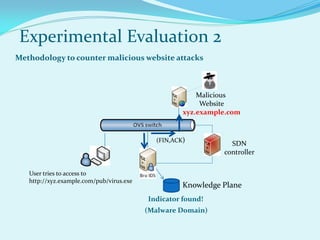
Experimental Evaluation 2
Methodology to counter malicious website attacks
Malicious
Website
xyz.example.com
SDN
controller
Knowledge Plane
Indicator found!
(Malware Domain)
(FIN,ACK)
User tries to access to
http://xyz.example.com/pub/virus.exe
Experimental Evaluation 2
Methodology to counter malicious website attacks
Malicious
Website
xyz.example.com
SDN
controller
(FIN,ACK)
User tries to access to
http://xyz.example.com/pub/virus.exe
RESTful
protocol
OpenFlow
protocol
There are different malicious websites as well as malicious domains
+ Intelligence: 0.07 seconds
- Intelligence: N/A
Conclusions
• Malicious users are innovating their attacks techniques much faster than
defenders have been findings ways to avoid them.
• The conventional approaches such as anomaly-based or signature-
based detections are not enough to counter these new threats.
• Taking advantage of CTI, we can protect the network in less time that
other proposals, by using Bro IDS intelligence framework and SDN.
•For a massive botnet attack (rate of 104 pps.), we get a response time
near to one third compared with the another methodology.
• For malicious website, we get mitigate the attack in 0.07 seconds.
35
Future Work
• Explore the correlation between the information obtained from reliable
sources, and from IDS sensors strategically located in different public
networks (i.e. real data of attacks received in real time).
• Use OpenFlow statistics to identify zero-day attacks and detect different
threats (using machine learning techniques?).
• Better understanding of the costs in terms of required state and its
implications in software-and hardware-based OpenFlow switches..
(Investigate OpenFlow state optimization options).
36
References
[Tianyi Xing 2013]
T. Xing, D. Huang, L. Xu, C.-J. Chung, and P. Khatkar, Snortow: A openflow-based
intrusion prevention system in cloud environment," in Proceedings of the 2013 Second
GENI Research and Educational Experiment Workshop, GREE '13, (Washington, DC,
USA), pp. 89{92, IEEE Computer Society, 2013.
[Tianyi Xing 2014]
T. Xing, Z. X., D. Huang, and D. M., Sdnips: Enabling software-defined networking
based intrusion prevention system in clouds," 10th International Conference on Network
and Service Management, 2014.
[Martin Lopez 2014]
M. A. Lopez, U. Figueiredo, A. P. Lobato, and O. C. M. B. DUARTE, Broflow: Um
sistema eficiente de deteccao e prevencao de intrusao em redes definidas por software,"
in XXXIV Congresso da Sociedade Brasileira de Computacao { CSBC 2014, (Centro de
Convencoes Brasil 21), CSBC2014, 2014.
37
References
[Antonio Lobato 2014]
A. P. Lobato, U. Figueiredo, M. A. Lopez, and O. C. M. B. DUARTE, Uma arquitetura
elastica para prevencao de intrusao em redes virtuais usando redes definidas por software,"
in Anais do XXXII Simposio Brasileiro de Redes de Computadores e Sistemas Distribudos
{ SBRC 2014, (Florianopolis, SC, Brazil), SBRC 2014, 2014.
[Fábio Nagahama 2014]
F. Y. Nagahama, F. Farias, E. Aguiar, G. Luciano, L. Granville, E. Cerqueira, and
A. Antonio, Ipsflow{uma proposta de sistema de prevencao de intrusao baseado no framework
openflow," in III WPEIF-SBRC, vol. 12, pp. 42{47, 2012.
[Radware 2014]
RADWARE, Defenseflow: The sdn application that programs networks for dos security,"
tech. rep., RADWARE.
38
References
List of Figures:
Source [1]: www.icp.ge.ch
Source [2]: www.cisco.com
Source [3]: www.niiconsulting.com
Source [4]: www.cloudsecurityalliance.org
Source [5]: www.bro.org
Source [6]: www.blog.cyveillance.com
Source [7]: www.secureworks.com
Source [8]: semiengineering.com
Source [9]: Article: “Software-Defined Networking: A Comprehensive
Survey,” Proceeding of the IEEE
Source [10]: www.opennetworking.org
39
Thank you!
Questions?
40
Related Work
•SnortFlow: Proposes a flexible IPS system in cloud virtual networking
environments, based on the performance evaluation of the virtual
machines, reconfiguring the network in case of any abnormal activity
[Tianyi Xing 2013].
•BroFlow: Proposes a system capable of reacting against DoS attacks
in real time, combining an IDS and an OpenFlow application
programming interface. BroFlow is an extension of the Bro architecture
with two additional modules, one for the security policies and the other
for message countermeasure. If there is a threat, a POX application
either drops packets to eliminate malicious events or uses an output to
forward packets to a specific target [Martín Lopez 2014].
•Elastic Architecture for IPS: Proposes methods to detect anomalies
in an intra-domain network with multiples virtual networks and
protection to the Deep Packet Inspection (DPI) monitoring tools as well
a load balancing of the same, distributing flows in a suitable manner
[Antonio Lobato 2014].
41
Related Work
•IPSFlow: Proposes a solution of IPS based on SDN/OpenFlow with
automatized block of the malicious traffic. One of the advantages is the
selective and distributed capture of the traffic in switches for the
analyzing of one of more IDSs [Fabio Nagahama 2012].
•Radware: Provides a DDoS attack defense solution that leverages
SDN technology taking actions of reconfiguration forwarding devices
against DDoS attacks [DefenseFlow 2013]
•SDNIPS: Compares the SDN-based IPS solution with the traditional
IPS approach from both mechanism analysis and evaluation. The
network reconfiguration are designed and implemented based on POX
controller to enhance its flexibility. Evaluations of SDNIPS
demonstrated its feasibility and efficiency over traditional approaches
[Tianyi Xing 2014].
42
Related Work
43

IntelFlow: Toward adding Cyber Threat Intelligence to Software Defined Networking

  • 1.
    IntelFlow: Toward addingCyber Threat Intelligence To Software Defined Networks Ponente: Javier Richard Quinto Ancieta Orientador: Prof. Dr. Christian Esteve Rothenberg 11 de Setembro 2015 XV SIMPÓSIO BRASILEIRO EM SEGURANÇA DA INFORMAÇÃO E DE SISTEMAS COMPUTACIONAIS 1
  • 2.
    Outline 1.Motivation & Background 2.ProblemDefinition & Research Objectives 3.Proposed Architecture: IntelFlow 4.Proof of Concept Implementation 5.Experimental Evaluation 6.Final Conclusions 7.Future work 2
  • 3.
    Motivation 3 Source [2]: Cisco Source:[3]: niiconsulting.com Source [1]: Exchangewire.com
  • 4.
    Background What is IntruderDetection System ? 4
  • 5.
    Background What is IntruderDetection System ? IDS is a security device that monitor network or computer in order to analyze and detect malicious attacks within a networking system. Fig: Components IDS 5 IDS Firewall Monitorin g Analysis Response Notification
  • 6.
    Background What is IntruderDetection System ? IDS is a security device that monitor network or computer in order to analyze and detect malicious attacks within a networking system. Detection Techniques of the IDSs Anomaly: Identifies events unexpected. However, new rules are difficult to create. Signature: Compare events with strings known. However, new attacks are not detected. Stateful: Compare profiles previously created for each protocol with observed events, identifying some types of unusual activities. However, these profiles vary depending of the vendor. Fig: Components IDS 6 IDS Firewall Monitorin g Analysis Response Notification
  • 7.
    Background What is IntruderDetection System ? IDS is a security device that monitor network or computer in order to analyze and detect malicious attacks within a networking system. Detection Techniques of the IDSs Anomaly: Identifies events unexpected. However, new rules are difficult to create. Signature: Compare events with strings known. However, new attacks are not detected. Stateful: Compare profiles previously created for each protocol with observed events, identifying some types of unusual activities. However, these profiles vary depending of the vendor. Bro is a type of IDS powerful network analysis framework that is much different from the typical IDS. Bro is adaptable, efficient, flexible, forensics, in-depth analysis, highly stateful, open source. Fig: Components IDS 7 IDS Firewall Monitorin g Analysis Response Notification Fig: Architecture BRO IDS Source: [4]
  • 8.
    Motivation Raw Information Source: [5] IntelligenceData Source: [6] 8 Information vs Intelligence
  • 9.
    Background What is CyberThreat Intelligence ? Cyber Threat Intelligence (CTI) is an emerging methodology of evidence-based knowledge, that organizations identifies and successfully responds to a cyber attack. Fig: Cyber Threat Intelligence Source: [7] 9
  • 10.
    Background What is CyberThreat Intelligence ? Cyber Threat Intelligence (CTI) is an emerging methodology of evidence-based knowledge, that organizations identifies and successfully responds to a cyber attack. Collective Intelligence Framework (CIF) is a cyber threat intelligence management system that allows you to combine known malicious threat information from many sources and use that information for identification (incident response), detection (IDS) and mitigation (null route). Fig: Process of the CIF Fig: Cyber Threat Intelligence Source: [7] 10
  • 11.
    Problem Definition &Research Objectives Problem Definition •General: How to enhance network defense technologies? •More specific: How to integrate Cyber Threat Intelligence into (software-defined) networking management and control systems? 11
  • 12.
    Problem Definition &Research Objectives Problem Definition •General: How to enhance network defense technologies? •More specific: How to integrate Cyber Threat Intelligence into (software-defined) networking management and control systems? Scope and Objectives: a) Leverage Collective Intelligence Framework (CIF) to add security service to Software Defined Networking (SDN). b) Integrate the Bro’s Intel framework to acquire intelligence data from reliable sources. c) Evaluate the IntelFlow architecture for different scenarios, validating it with a proof-of-concept implementation and experiments to assess effectiveness and performance. 12
  • 13.
    Background What is SoftwareDefined Networking ? •The control and data planes are decoupled. •Forwarding decisions are flow-based, instead of destination-based. •Control logic is moved to an external entity, the SDN controller located on Network Operating System (NOS). •The network is programmable through software applications running on top of the NOS that interacts with the underlying data plane devices. Fig: SDN architecture Source: [8] 13
  • 14.
    Background What is OpenFlow? OpenFlowis the first standard communications interface defined between the control and forwarding layers of an SDN architecture. The protocol allows direct access to and manipulation of the forwarding plane of network devices such as switches and routers. This allows moving network control out of the networking switches to logically centralized control software. Fig: SDN / OpenFlow Source: [9] 14
  • 15.
    Proposed Architecture: IntelFlow Mainidea: Introducing a Knowledge Plane (KP) • KP receives as input sources of threat intelligence. • KP allows queries from Bro IDS about the acquired intelligence data. • KP exports the generated OpenFlow rules. 15
  • 16.
  • 17.
  • 18.
  • 19.
  • 20.
    - IP address -Domain - URL - Software - Email Address - User_Name - File_Hash - File_Name - Cert_Hash Intelligence Types (Indicators of Compromise)
  • 21.
    - IP address -Domain - URL - Software - Email Address - User_Name - File_Hash - File_Name - Cert_Hash Intelligence Types (Indicators of Compromise) Indicator types used by IntelFlow
  • 22.
    Algorithm for IndicatorType = “Intel::ADDR” If (seen.where == Conn::IN_RESP) seen.indicator = id.resp_h if (seen.indicator) ϵ KP Nothing to do else if { actions: Drop(nw_dst) and forward it to a HoneyPot, then Includes the indicator to KP } else if (seen.where == Conn::IN_ORIG) seen.indicator = id.orig_h if (seen.indicator) ϵ KP Nothing to do else if { actions: Drop(nw_src) and forward it to a HoneyPot, then Includes the indicator to KP } 22 Intelligence Algorithm
  • 23.
    If (seen.where ==HTTP::IN_HOST_HEADER || HTTP::IN_URL) seen.indicator = malicious_domain inverse (seen.indicator) = malicious_IP if (seen.indicator) ϵ KP Nothing to do else if { actions: Drop(malicious_IP) and forward it to HoneyPot then Including the indicator to KP } 23 Intelligence Algorithm Algorithm for Indicator Type = “Intel::DOMAIN,URL”
  • 24.
    Algorithm for IndicatorType = “Notice” If (note == Scan::Port_Scan) src = suspicious_IP function (src) if -> false_positive return 0; // end else if mapping (src) = nw_src actions: Drop(nw_src) and forward it to HoneyPot else If (note == Scan::Password_Guessing) src = malicious_IP mapping (src) = nw_src actions: Drop(nw_src) and forward it to HoneyPop 24 Notice Algorithm
  • 25.
    Proof of ConceptImplementation (Testbed) 25
  • 26.
    Proof of ConceptImplementation (Testbed) 26
  • 27.
    Experimental Evaluation 1 Methodologyto counter Distributed Denial of Service (DDoS) attacks Victim Server SDN controller T pkts. 2500 pps. Knowledge Plane Indicator found! (Spamhaus) r = 500 pps. Tpkts. = 2500 pps. 2500 pps. + 5 rtns. RST
  • 28.
    Experimental Evaluation 1 Methodologyto counter Distributed Denial of Service (DDoS) attacks Victim Server SDN controller T pkts. 2500 pps. r = 500 pps. Tpkts. = 2500 pps. 2500 pps. + 5 rtns. RST RESTful protocol OpenFlow protocol Response time: + Intelligence <= ~ 2 x (- Intelligence) Unanalyzed packets: + Intelligence <= ~ 1.4 x (- Intelligence) % Memory usage: + Intelligence <= ~ 2 x (- Intelligence) % CPU usage: + Intelligence <= 2 ~ x (- Intelligence)
  • 29.
    29 Comparison of theresponse time varying the rate of packet per second
  • 30.
    30 Comparison of theresponse time varying the rate of packet per second Comparison of the unanalyzed packets varying the rate of packets per second
  • 31.
    31 Comparison of thememory usage varying the rate of packet per second
  • 32.
    32 Comparison of thememory usage varying the rate of packet per second Comparison of the CPU usage varying the rate of packets per second
  • 33.
    Experimental Evaluation 2 Methodologyto counter malicious website attacks Malicious Website xyz.example.com SDN controller Knowledge Plane Indicator found! (Malware Domain) (FIN,ACK) User tries to access to http://xyz.example.com/pub/virus.exe
  • 34.
    Experimental Evaluation 2 Methodologyto counter malicious website attacks Malicious Website xyz.example.com SDN controller (FIN,ACK) User tries to access to http://xyz.example.com/pub/virus.exe RESTful protocol OpenFlow protocol There are different malicious websites as well as malicious domains + Intelligence: 0.07 seconds - Intelligence: N/A
  • 35.
    Conclusions • Malicious usersare innovating their attacks techniques much faster than defenders have been findings ways to avoid them. • The conventional approaches such as anomaly-based or signature- based detections are not enough to counter these new threats. • Taking advantage of CTI, we can protect the network in less time that other proposals, by using Bro IDS intelligence framework and SDN. •For a massive botnet attack (rate of 104 pps.), we get a response time near to one third compared with the another methodology. • For malicious website, we get mitigate the attack in 0.07 seconds. 35
  • 36.
    Future Work • Explorethe correlation between the information obtained from reliable sources, and from IDS sensors strategically located in different public networks (i.e. real data of attacks received in real time). • Use OpenFlow statistics to identify zero-day attacks and detect different threats (using machine learning techniques?). • Better understanding of the costs in terms of required state and its implications in software-and hardware-based OpenFlow switches.. (Investigate OpenFlow state optimization options). 36
  • 37.
    References [Tianyi Xing 2013] T.Xing, D. Huang, L. Xu, C.-J. Chung, and P. Khatkar, Snortow: A openflow-based intrusion prevention system in cloud environment," in Proceedings of the 2013 Second GENI Research and Educational Experiment Workshop, GREE '13, (Washington, DC, USA), pp. 89{92, IEEE Computer Society, 2013. [Tianyi Xing 2014] T. Xing, Z. X., D. Huang, and D. M., Sdnips: Enabling software-defined networking based intrusion prevention system in clouds," 10th International Conference on Network and Service Management, 2014. [Martin Lopez 2014] M. A. Lopez, U. Figueiredo, A. P. Lobato, and O. C. M. B. DUARTE, Broflow: Um sistema eficiente de deteccao e prevencao de intrusao em redes definidas por software," in XXXIV Congresso da Sociedade Brasileira de Computacao { CSBC 2014, (Centro de Convencoes Brasil 21), CSBC2014, 2014. 37
  • 38.
    References [Antonio Lobato 2014] A.P. Lobato, U. Figueiredo, M. A. Lopez, and O. C. M. B. DUARTE, Uma arquitetura elastica para prevencao de intrusao em redes virtuais usando redes definidas por software," in Anais do XXXII Simposio Brasileiro de Redes de Computadores e Sistemas Distribudos { SBRC 2014, (Florianopolis, SC, Brazil), SBRC 2014, 2014. [Fábio Nagahama 2014] F. Y. Nagahama, F. Farias, E. Aguiar, G. Luciano, L. Granville, E. Cerqueira, and A. Antonio, Ipsflow{uma proposta de sistema de prevencao de intrusao baseado no framework openflow," in III WPEIF-SBRC, vol. 12, pp. 42{47, 2012. [Radware 2014] RADWARE, Defenseflow: The sdn application that programs networks for dos security," tech. rep., RADWARE. 38
  • 39.
    References List of Figures: Source[1]: www.icp.ge.ch Source [2]: www.cisco.com Source [3]: www.niiconsulting.com Source [4]: www.cloudsecurityalliance.org Source [5]: www.bro.org Source [6]: www.blog.cyveillance.com Source [7]: www.secureworks.com Source [8]: semiengineering.com Source [9]: Article: “Software-Defined Networking: A Comprehensive Survey,” Proceeding of the IEEE Source [10]: www.opennetworking.org 39
  • 40.
  • 41.
    Related Work •SnortFlow: Proposesa flexible IPS system in cloud virtual networking environments, based on the performance evaluation of the virtual machines, reconfiguring the network in case of any abnormal activity [Tianyi Xing 2013]. •BroFlow: Proposes a system capable of reacting against DoS attacks in real time, combining an IDS and an OpenFlow application programming interface. BroFlow is an extension of the Bro architecture with two additional modules, one for the security policies and the other for message countermeasure. If there is a threat, a POX application either drops packets to eliminate malicious events or uses an output to forward packets to a specific target [Martín Lopez 2014]. •Elastic Architecture for IPS: Proposes methods to detect anomalies in an intra-domain network with multiples virtual networks and protection to the Deep Packet Inspection (DPI) monitoring tools as well a load balancing of the same, distributing flows in a suitable manner [Antonio Lobato 2014]. 41
  • 42.
    Related Work •IPSFlow: Proposesa solution of IPS based on SDN/OpenFlow with automatized block of the malicious traffic. One of the advantages is the selective and distributed capture of the traffic in switches for the analyzing of one of more IDSs [Fabio Nagahama 2012]. •Radware: Provides a DDoS attack defense solution that leverages SDN technology taking actions of reconfiguration forwarding devices against DDoS attacks [DefenseFlow 2013] •SDNIPS: Compares the SDN-based IPS solution with the traditional IPS approach from both mechanism analysis and evaluation. The network reconfiguration are designed and implemented based on POX controller to enhance its flexibility. Evaluations of SDNIPS demonstrated its feasibility and efficiency over traditional approaches [Tianyi Xing 2014]. 42
  • 43.