COPYRIGHT
This thesis is copyright materials protected under the Berne
Convection, the copyright Act 1999 and other international and
national enactments in that behalf, on intellectual property. It
may not be reproduced by any means in full or in part except for
short extracts in fair dealing so for research or private study,
critical scholarly review or discourse with acknowledgment,
with written permission of the Dean School of Graduate Studies
on behalf of both the author and XXX XXX
University.ABSTRACT
With Fast growing internet world the risk of intrusion has also
increased, as a result Intrusion Detection System (IDS) is the
admired key research field. IDS are used to identify any
suspicious activity or patterns in the network or machine, which
endeavors the security features or compromise the machine. IDS
majorly use all the features of the data. It is a keen observation
that all the features are not of equal relevance for the detection
of attacks. Moreover every feature does not contribute in
enhancing the system performance significantly. The main aim
of the work done is to develop an efficient denial of service
network intrusion classification model. The specific objectives
included: to analyse existing literature in intrusion detection
systems; what are the techniques used to model IDS, types of
network attacks, performance of various machine learning tools,
how are network intrusion detection systems assessed; to find
out top network traffic attributes that can be used to model
denial of service intrusion detection; to develop a machine
learning model for detection of denial of service network
intrusion.Methods: The research design was experimental and
data was collected by simulation using NSL-KDD dataset. By
implementing Correlation Feature Selection (CFS) mechanism
using three search algorithms, a smallest set of features is
selected with all the features that are selected very frequently.
Findings: The smallest subset of features chosen is the most
nominal among all the feature subset found. Further, the
performances using Artificial neural networks(ANN), decision
trees, Support Vector Machines (SVM) and K-Nearest
Neighbour (KNN) classifiers is compared for 7 subsets found by
filter model and 41 attributes. Results: The outcome indicates a
remarkable improvement in the performance metrics used for
comparison of the two classifiers. The results show that using
17/18 selected features improves DOS types classification
accuracies as compared to using the 41 features in the NSL-
KDD dataset. It was further observed that using an ensemble of
three classifiers with decision fusion performs better as
compared to using a single classifier for DOS type’s
classification. Among machine learning tools experimented,
ANN achieved best classification accuracies followed by SVM
and DT. KNN registered the lowest classification accuracies.
Application: The proposed work with such an improved
detection rate and lesser classification time and larger merits of
the minimal subset found will play a vital role for the network
administrator in choosing efficient IDS.
1.0 Overview
This chapter presents the background information to the study,
the research problem statement to be solved, the objectives to
be achieved and the research questions. Additionally, the
motivations behind the works are outlined in the problem
justification and finally the scope to be covered is presented.
2.1.1 Network Behaviour Anomaly Detection (NBAD)
NBAD provides one approach to network security threat
detection which is a complementary technology to systems that
detect security threats based on packet signatures.
A NBAD approach will thus comprise of two stages namely the
training and testing phases. The training phase entails training
the classifier using the available data that is labelled whereas,
the testing phase instances are classified as anomaly or normal
using classification algorithm. The central premise of anomaly
detection is that intrusive activity is a subset of anomalous
activity[32]. An intruder who lacks the idea of the authenticated
user’s patterns activities, getting an access to the host computer
or system, the highest probability is that the activity of an
unauthenticated user is detected as anomalous[33]. This means
that, the set of anomalous activities will be the same as the set
of intrusive activities. In such a case, flagging all anomalous
activities as intrusive activities results in no false positives and
no false negatives. However, intrusive activity does not always
coincide with anomalous activity which may dupe the anomaly
detection algorithm.
Routinely Network staff are challenged with a wide range of
events that are unusual. Some of these events may or may not be
malicious[34]. The network operators are required to detect and
classify some of these anomalies as they occur and choose the
right response. A general anomaly diagnosis system should
therefore be able to detect a range of anomalies with diverse
structure, distinguish between different types of anomalies and
group similar anomalies[5]. This goal is indeed ambitious
though at the same time this goal is coming into focus because
network operators are finding it practical to harvest network-
wide views of traffic in the form of sampled flow data[35]. An
important challenge therefore is to determine how best to
extract understanding about the presence and nature of traffic
anomalies from the potentially overwhelming mass of network-
wide traffic data[36]. In the case of malicious anomalies, it is
difficult to permanently and clearly define a given set of
network anomalies. Over the time the new network anomalies
will continue to raise and therefore, an anomaly detection
system should avoid being restricted to any predefined set of
anomalies.
Network traffic analysis is the process of reviewing, recording
and analyzing network traffic for the purpose of general
network management, operations, security and performance. It
is a process of using automated and manual techniques to
review the statistics within network traffic and granular-level
details[37].
2.1.3 Traffic Analysis for Network Operations
Since network operation is more technical, traffic classification
is pertinent to understanding the network. The main objective of
classification is to aid in identifying the types of applications
that are used by the end users and the percentage of the share
traffic generated by various application in the total traffic
mix[51]. Moreover, the communication between IP network
nodes can be organized into flows, and traffic classification can
assign a specific application to each individual flow. A flow is
defined as a collection of IP packets emanating from a given
port [52][53] at one IP address to a given port at another IP
address using a specific protocol. A flow is thus identified
using its five-tuple flow identifier: destination IP address,
protocol identifier, destination port, source IP address and
source port[54].
2.2.2 Small - World Networks
As the name suggests, this type of networks are characterized
by relatively small average path length between any pair of
nodes in the network. Watts and Strogatz[71] define them as
"highly clustered, like regular lattices, yet have small
characteristic path lengths, like random graphs”. Formally, they
are defined as networks in which the distance L between any
two randomly selected nodes is directly proportional to the
logarithm of the number of nodes, N in the network,
2.3.1 Intrusion detection systems
Most IDS use machine learning (ML) tools to achieve detection
capability that is high for automation to ease user from task of
constructing signatures of attacks and novel attacks[82].
Theoretically, it is possible for a ML algorithm to achieve the
best performance, that is, it can maximize detection accuracy
and minimize the false alarm rate. The commonly used
supervised learning algorithm in IDS are decision trees due to
its accuracy, simplicity, fast adaption and high detection.
Artificial Neural Networks (ANN) is another method that
models linear and non-linear patterns and performs highly
well[83]. The resulting model can generate a probability
estimate of whether given data matches the characteristics that
it has been trained to recognize. IDS that are based on ANN
usually achieve a lot in detecting difficult tasks.
Support Vector Machines (SVMs) has a capability of dealing
with large dimensionality of data and provision of real-time
detection. Through nonlinear mapping and labeling each vector
by its class, SVMs is capable of plotting the training vectors in
high dimensional feature space[84]. The data is then classified
by determining a set of support vectors, which are members of
the set of training inputs that outline a hyperplane in the feature
space. SVMs are relatively insensitive making them scalable to
the number of data points.
2.3.2.1 Artificial intelligence (AI) based techniques
Artificial intelligence (AI) based IDS techniques involves
establishment of an explicit or implicit model that allows the
patterns to be categorized. Ponce has listed many advantages of
using AI based techniques over other conventional approach.
The major advantages include Flexibility (vs. threshold
definition of conventional technique); Adaptability (vs. specific
rules of conventional technique); Pattern recognition (and
detection of new patterns); Fast computing (faster than humans,
actually) and Learning abilities.
2.3.3.1 Artificial Neural Networks
MLP has made ANN IDS tools more efficient and accurate in
terms of normal and detection communication. Compared to the
traditional mechanisms, MLP-ANN shows detection outcomes
better and overcomes the limitation of low-frequency
attacks[87]. MLP-ANN can easily define the type of attacks and
classify them. This feature allows system to predefine actions
against similar future attacks. 2.3.3.2 Support Vector Machines
(SVM)
The SVM is a classifier based on finding a separating
hyperplane in the feature space between two classes in such a
way that the distance between the hyperplane and the closest
data points of each class is maximized[88]. The approach is
based on a minimized classification risk rather than on optimal
classification. SVMs are well known for their generalization
ability and are particularly useful when the number of features,
m, is high and the number of data points, n, is low (m >> n)
[89].
When the two classes are not separable, slack variables are
added and a cost parameter is assigned for the overlapping data
points. The maximum margin and the place of the hyperplane is
determined by a quadratic optimization with a practical runtime
of O (n2), placing the SVM among fast algorithms even when
the number of attributes is high. Various types of dividing
classification surfaces can be realized by applying a kernel,
such as linear, polynomial, Gaussian Radial Basis Function
(RBF), or hyperbolic tangent[90]. SVMs are binary classifiers
and multi-class classification is realized by developing an SVM
for each pair of classes.2.3.3.3 J48
It is an extension of the algorithm, the most common classifier
used to manage the database for supervised learning that gives a
prediction about new unlabeled data, J48 creates Univariate
Decision Trees[91]. J48 based used attribute correlation based
on entropy and information gain for each attributes. J48 has
been utilized in various field of study that includes; pattern
recognition, machine learning, information extraction and data
mining. J48 is capable of dealing with various data types’
inputs; nominal, numerical and textual. It can build small trees
and follows depth-first strategy, and a divide-and conquer
approach[92].
Tools that are popular and powerful for prediction and
classification are Decision trees. It has three main components
namely; arcs, leaves and nodes. Each arc out of a node is
labeled with a feature value for the node’s feature, each leaf is
labeled with a category or class and each node is labeled with a
feature attribute. J48 can be used in classification of data point
by beginning at the root of the tree and proceed until a leaf node
is reached and then the leaf node give data point
classification.2.3.3.4 K-Nearest Neighbour
K-Nearest Neighbors (KNN) is an algorithms used in Machine
Learning for regression and classification problem. It utilizes a
data and classifies new data points based on a similarity
measures. For example, distance function. Classification is done
by a majority vote to its neighbors. It uses data. It is one of the
most simple and traditional nonparametric technique to classify
samples.
It computes the approximate distances between different points
on the input vectors, and then as signs the unlabeled point to the
class of its K-nearest neighbors. In the process of create k-NN
classifier, k is an important parameter and different k values
will cause different performances. If k is considerably huge, the
neighbors which used for prediction will make large
classification time and influence the accuracy of prediction. K-
NN is called instance based learning, and it is different from the
inductive learning approach. Thus, it does not contain the model
training stage, but only searches the examples of input vectors
and classifies new instances. Therefore, k-NN‘‘on-line” trains
the examples and finds out k-nearest neighbor of the new
instance.
2.3.4.1 Denial of Service
DoS attack are the activities that, attackers, which are also
computers connected to the network, try to exhaust computer
resources or network bandwidth of a targeted victim system, in
order to prevent it from providing services to legitimate users.
The resulting effect of DoS attack mainly depends on its impact
on the target and its similarity to legitimate traffics[101].
The attributes of the DOS includes; increased traffic flow,
where several unauthorized users send a huge amount of service
requests which are legitimate to the targets per time unit to
finish up their capacities. Effective DoS attacks usually lead to
traffic flows with a lot of different source IP addresses but only
very few different destination IP addresses[102]. For this
reason, they are called Distributed DoS (DDoS) attacks. In
addition, like scanning, other properties of the flows are usually
the same or very similar. 2.3.4.2 Flash Crowds
Flash crowd is very similar to DDoS. It is characterized by an
unusually high amount of traffic from a set of IPs. Contrary to
DDoS, however, a flash crowd is not a result of malicious
activity[103]. With the rise of social network sites and websites
where users can share interesting hyperlinks with each
other[104]. Basic botnet architecture are situations where
people from all over the world access a particular site during
the same time interval. This effect can cause websites to load
very slowly or even go down entirely[105]. Flash crowds differs
from DDoS in the amount of different IPs observed in the
anomaly. While a botnet used for DDoS attacks can be of a very
large size, they are normally eclipsed by sheer amount of IPs
present in a flash crowd. It is distinguished by an increase of a
particular kind of traffic flows (e.g. FTP flows). There are
several approaches that have been proposed for anomaly
detection. These include: machine learning based techniques,
statistical anomaly detection and data-mining based
methods.2.3.5.3 Decision Table
A decision table is an organizational or programming tool for
the representation of discrete functions[124]. It can be viewed
as a matrix where the upper rows specify sets of conditions and
the lower ones sets of actions to be taken when the
corresponding conditions are satisfied; thus each column called
a rule, describes a procedure of the type if conditions, then
actions[125].
Given an unlabeled instance, decision table classifier searches
for exact matches in the decision table using only the features in
the schema (it is to be noted that there may be many matching
instances in the table). If no instances are found, the majority
class of the decision table is returned; otherwise, the majority
class of all matching instances is returned[126].
If the training dataset size is, say D and test data set size is, say
d with N attributes, The complexity of predicting one instance
will be O (D*N). So, the underlying data structure used for
bringing down the complexity is Universal Hash table[127]. The
time to compute the hash function is O (n’) where n’ is the
number of features used as schema in decision table. So
complexity will become lookup operation for n’ attribute
multiplied by l, number of classes that is O (n’ + l).
To build a decision table, the induction algorithm must decide
which features to include in the schema and which instances to
store in the body[128]. More details can be found in. We use
CFS algorithm as induction algorithm for our experiment.
3.2.2 DoS dataset
DoS attacks are classified in to two categories namely; high-
level or low-level variations. High-volume attacks are
characterized by high volume of application-layer requests
transmitted to a victim. Low-volume DoS attacks are
characterized by small amounts of attack traffic transmitted to a
victim strategically. Since one-shot attacks generally exploit a
specific weakness or vulnerability in application level
protocol/service, in this study we will focus our attention on
more universal type of application DoS slow-rate attacks that
are often seen in two variations: slow send and slow read. The
lack of data with application layer DoS attacks prompted us to
create an evaluation dataset. The set up was testbed
environment with a victim web server running Apache Linux
v.2.2.22, PHP5 and Drupal v.7 as a content management system.
The attack was selected to represent the most common types of
application layer DoS.
Form 4562
Department of the Treasury
Internal Revenue Service (99)
Depreciation and Amortization
(Including Information on Listed Property)
▶ Attach to your tax return.
▶ Go to www.irs.gov/Form4562 for instructions and the latest
information.
OMB No. 1545-0172
2018
Attachment
Sequence No. 179
Name(s) shown on return Business or activity to which this
form relates Identifying number
Part I Election To Expense Certain Property Under Section 179
Note: If you have any listed property, complete Part V before
you complete Part I.
1 Maximum amount (see instructions) . . . . . . . . . . . . . . . . . . .
. . . . 1
2 Total cost of section 179 property placed in service (see
instructions) . . . . . . . . . . . 2
3 Threshold cost of section 179 property before reduction in
limitation (see instructions) . . . . . . 3
4 Reduction in limitation. Subtract line 3 from line 2. If zero or
less, enter -0- . . . . . . . . . . 4
5 Dollar limitation for tax year. Subtract line 4 from line 1. If
zero or less, enter -0-. If married filing
separately, see instructions . . . . . . . . . . . . . . . . . . . . . . . . . 5
6 (a) Description of property (b) Cost (business use only) (c)
Elected cost
7 Listed property. Enter the amount from line 29 . . . . . . . . . 7
8 Total elected cost of section 179 property. Add amounts in
column (c), lines 6 and 7 . . . . . . 8
9 Tentative deduction. Enter the smaller of line 5 or line 8 . . . .
. . . . . . . . . . . . 9
10 Carryover of disallowed deduction from line 13 of your 2017
Form 4562 . . . . . . . . . . . 10
11 Business income limitation. Enter the smaller of business
income (not less than zero) or line 5. See instructions . 11
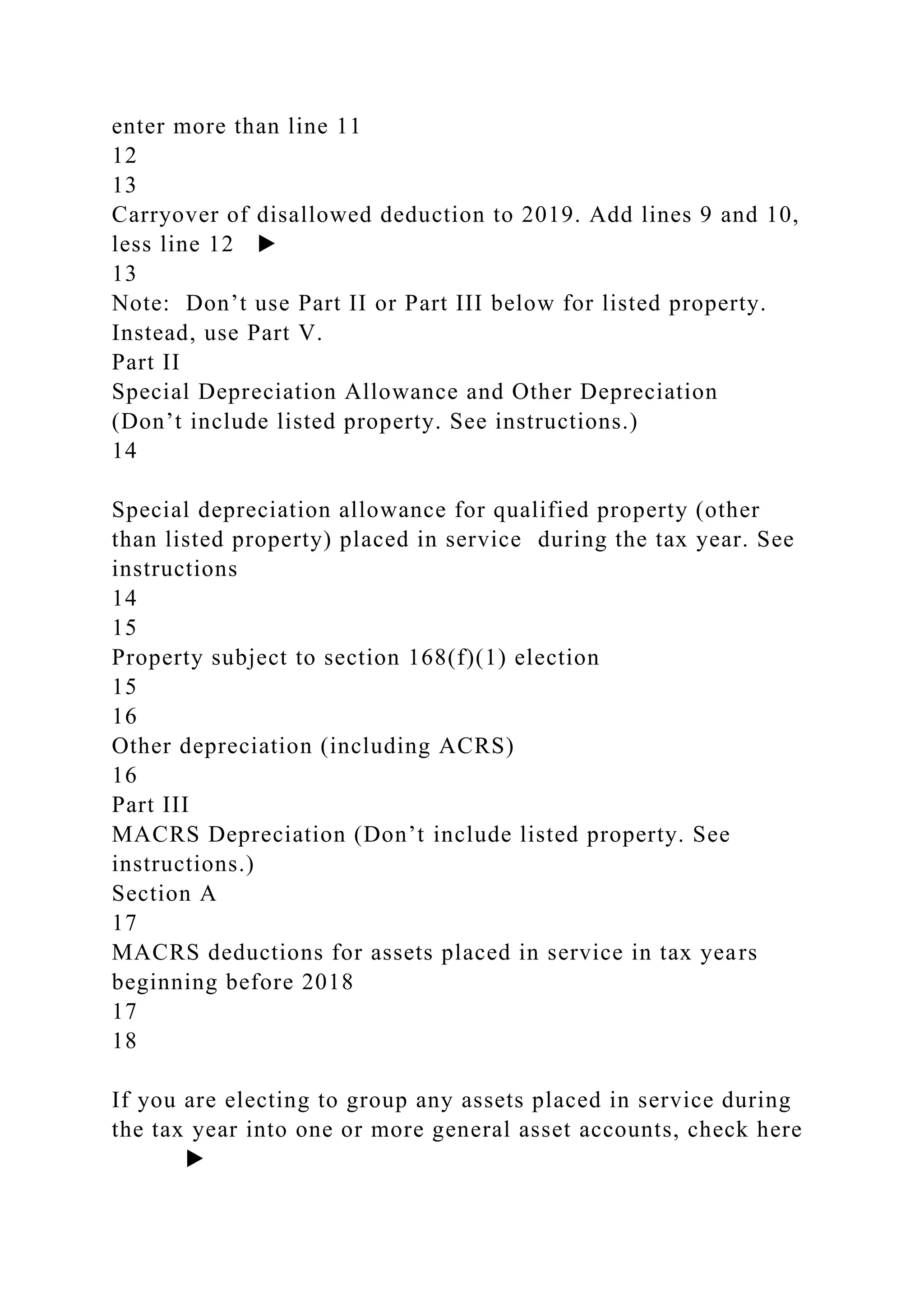
12 Section 179 expense deduction. Add lines 9 and 10, but don’t
enter more than line 11 . . . . . . 12
13 Carryover of disallowed deduction to 2019. Add lines 9 and
10, less line 12 ▶ 13
Note: Don’t use Part II or Part III below for listed property.
Instead, use Part V.
Part II Special Depreciation Allowance and Other Depreciation
(Don’t include listed property. See instructions.)
14 Special depreciation allowance for qualified property (other
than listed property) placed in service
during the tax year. See instructions . . . . . . . . . . . . . . . . . . . .
. . . 14
15 Property subject to section 168(f)(1) election . . . . . . . . . . . .
. . . . . . . . 15
16 Other depreciation (including ACRS) . . . . . . . . . . . . . . . . .
. . . . . 16
Part III MACRS Depreciation (Don’t include listed property.
See instructions.)
Section A
17 MACRS deductions for assets placed in service in tax years
beginning before 2018 . . . . . . . 17
18 If you are electing to group any assets placed in service
during the tax year into one or more general
asset accounts, check here . . . . . . . . . . . . . . . . . . . . . . ▶
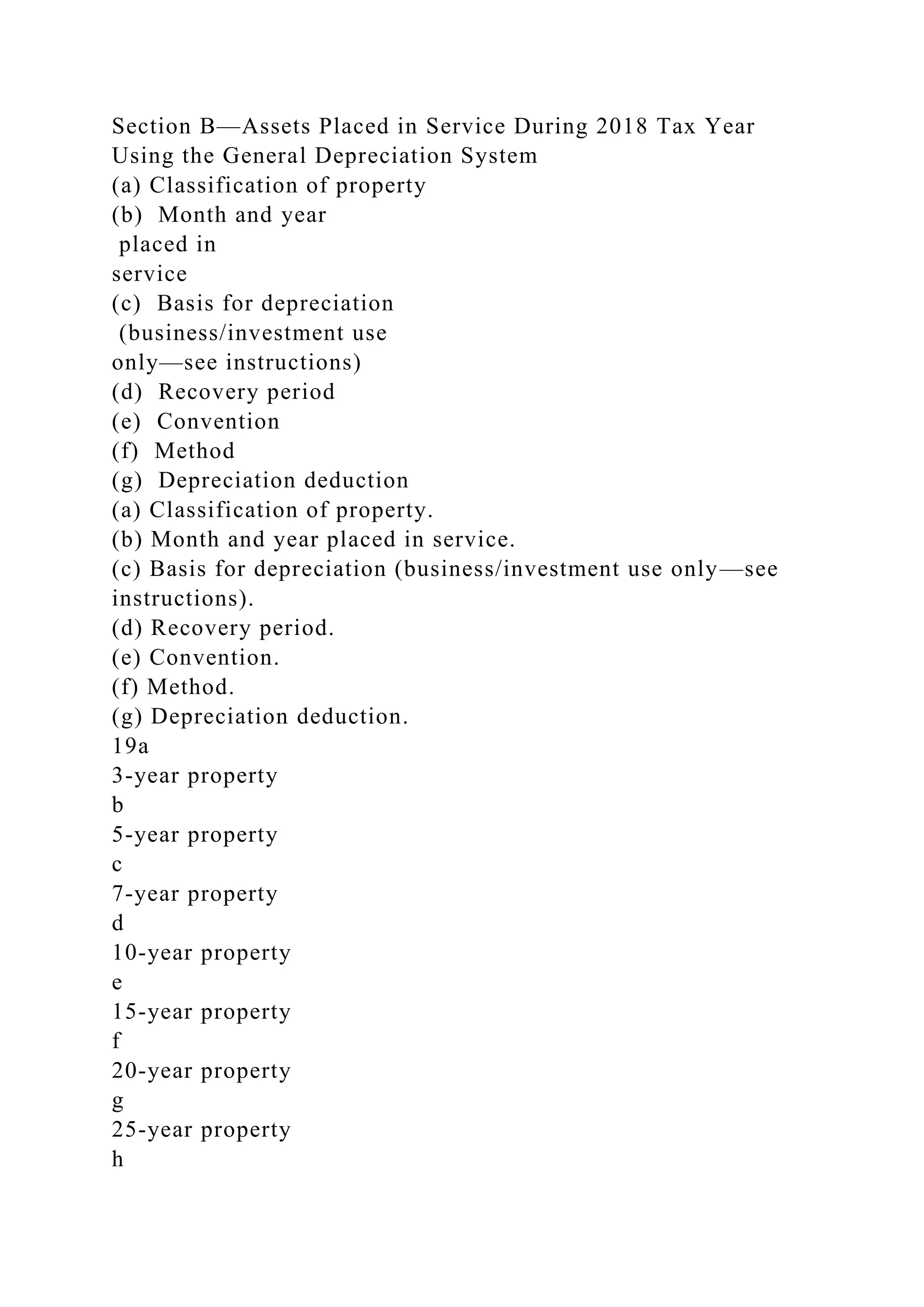
Section B—Assets Placed in Service During 2018 Tax Year
Using the General Depreciation System
(a) Classification of property
(b) Month and year
placed in
service
(c) Basis for depreciation
(business/investment use
only—see instructions)
(d) Recovery
period
(e) Convention (f) Method (g) Depreciation deduction
19a 3-year property
b 5-year property
c 7-year property
d 10-year property
e 15-year property
f 20-year property
g 25-year property
h Residential rental
property
i Nonresidential real
property
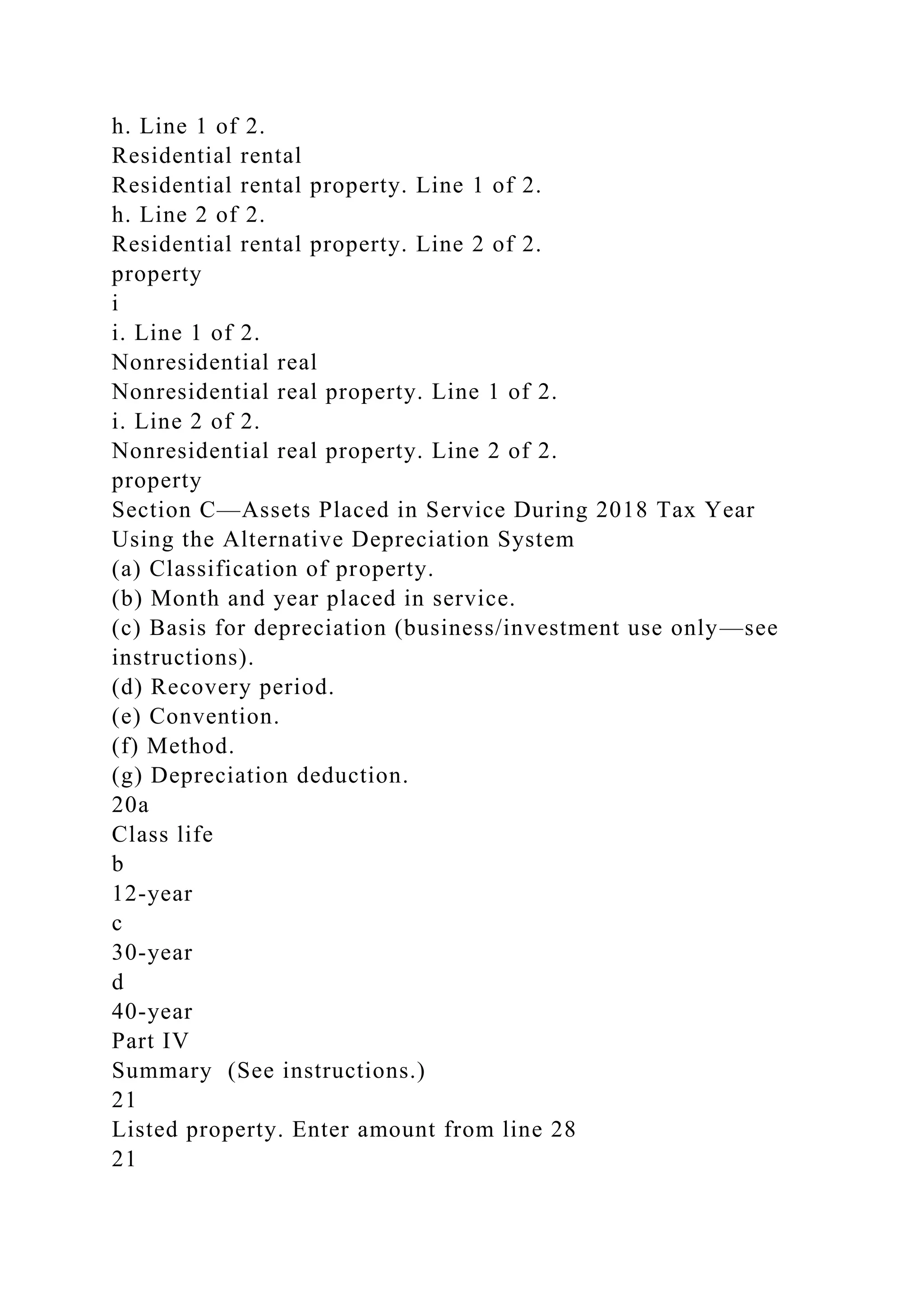
Section C—Assets Placed in Service During 2018 Tax Year
Using the Alternative Depreciation System
20a Class life
b 12-year
c 30-year
d 40-year
Part IV Summary (See instructions.)
21 Listed property. Enter amount from line 28 . . . . . . . . . . . . .
. . . . . . . 21
22 Total. Add amounts from line 12, lines 14 through 17, lines
19 and 20 in column (g), and line 21. Enter
here and on the appropriate lines of your return. Partnerships
and S corporations—see instructions . 22
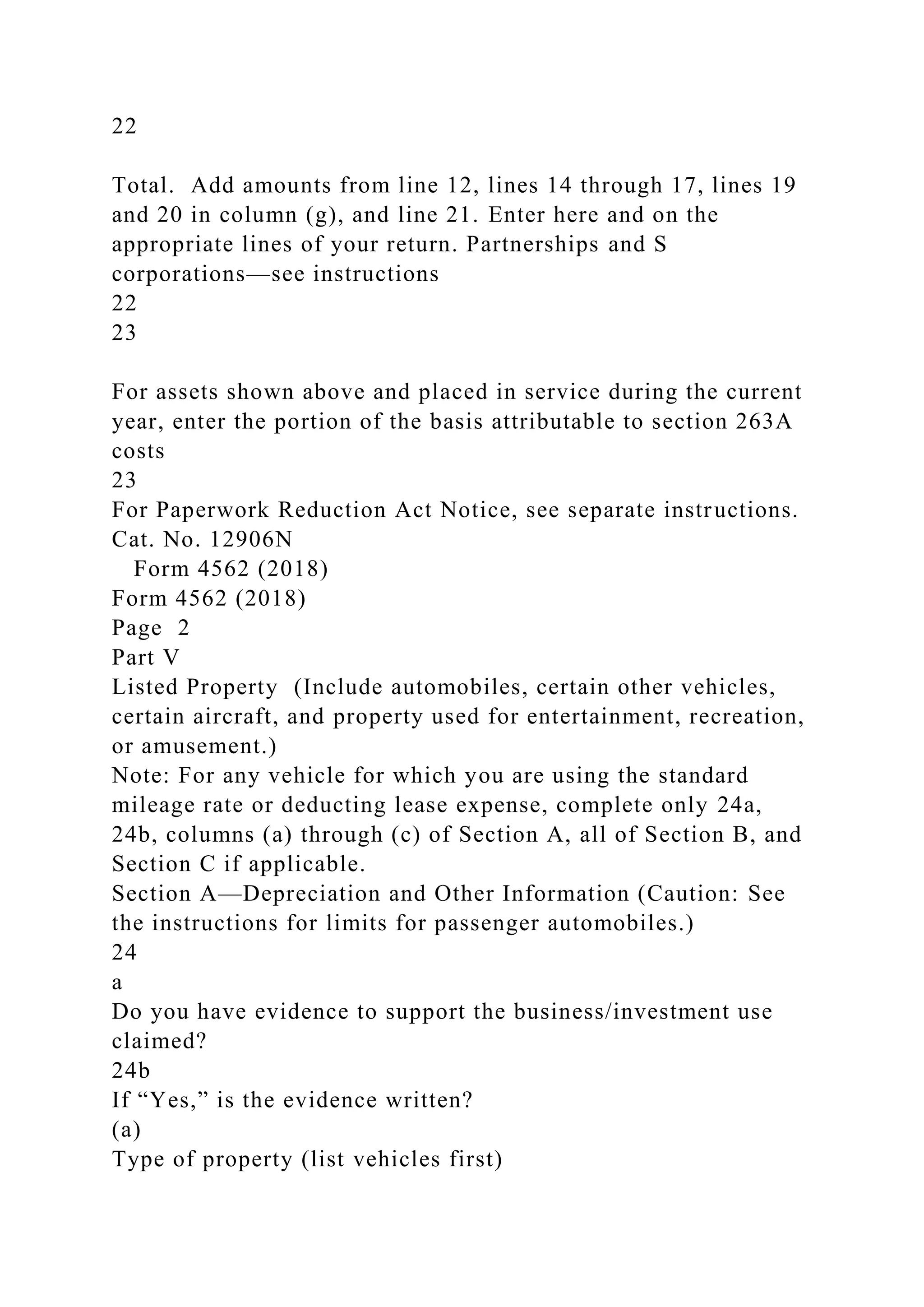
23 For assets shown above and placed in service during the
current year, enter the
portion of the basis attributable to section 263A costs . . . . . . . .
23
For Paperwork Reduction Act Notice, see separate instructions.
Cat. No. 12906N Form 4562 (2018)
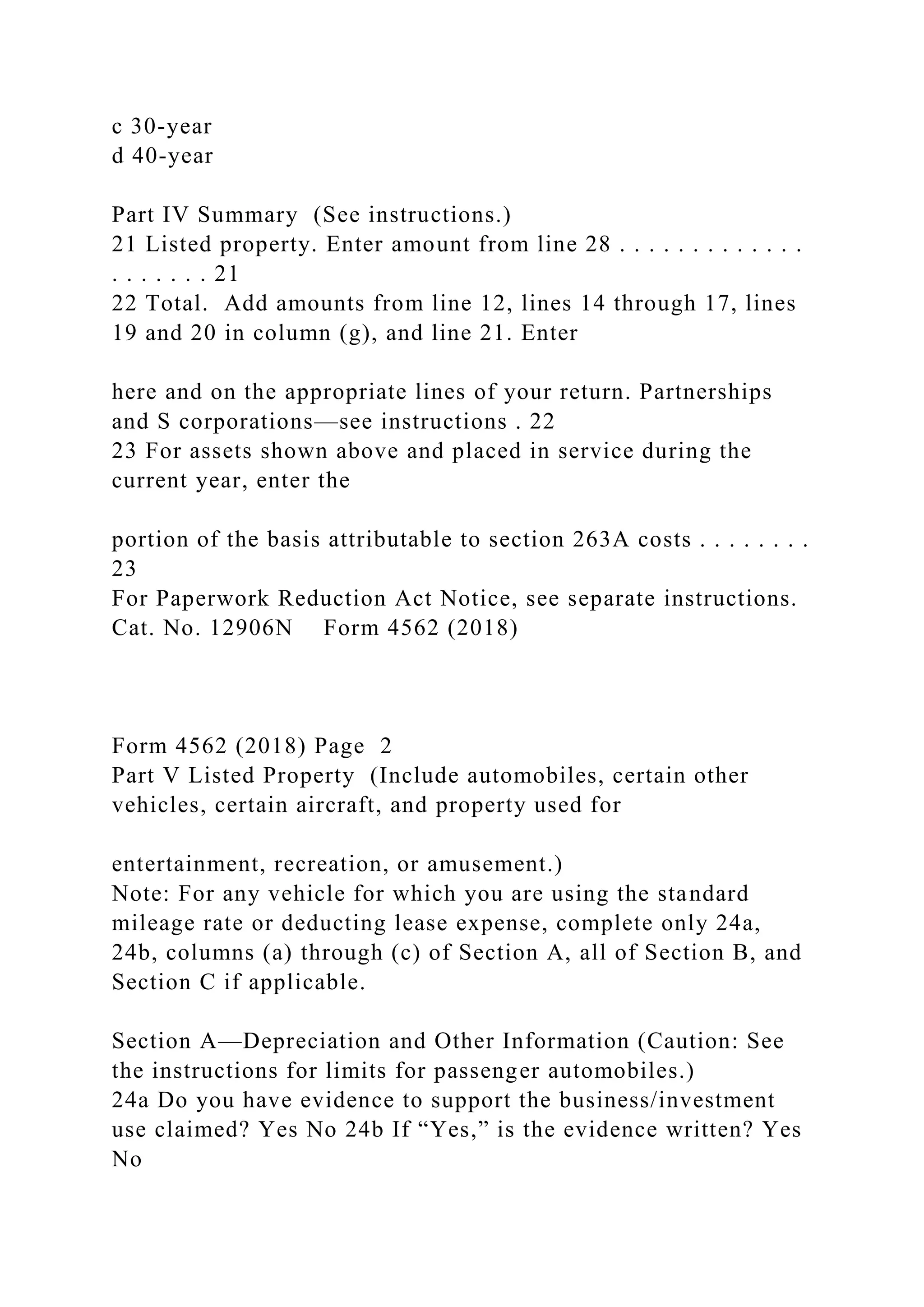
Form 4562 (2018) Page 2
Part V Listed Property (Include automobiles, certain other
vehicles, certain aircraft, and property used for
entertainment, recreation, or amusement.)
Note: For any vehicle for which you are using the standard
mileage rate or deducting lease expense, complete only 24a,
24b, columns (a) through (c) of Section A, all of Section B, and
Section C if applicable.
Section A—Depreciation and Other Information (Caution: See
the instructions for limits for passenger automobiles.)
24a Do you have evidence to support the business/investment
use claimed? Yes No 24b If “Yes,” is the evidence written? Yes
No
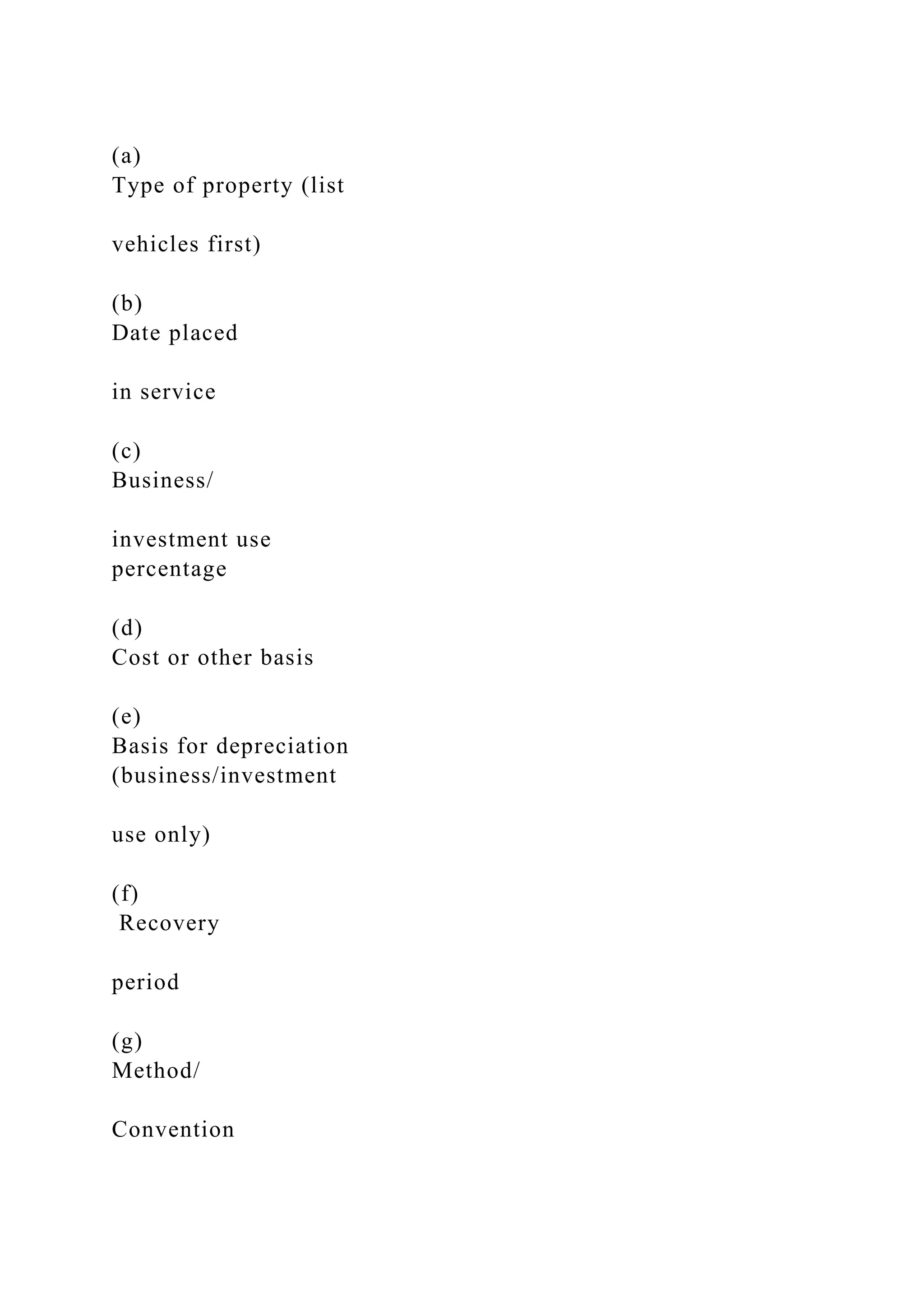
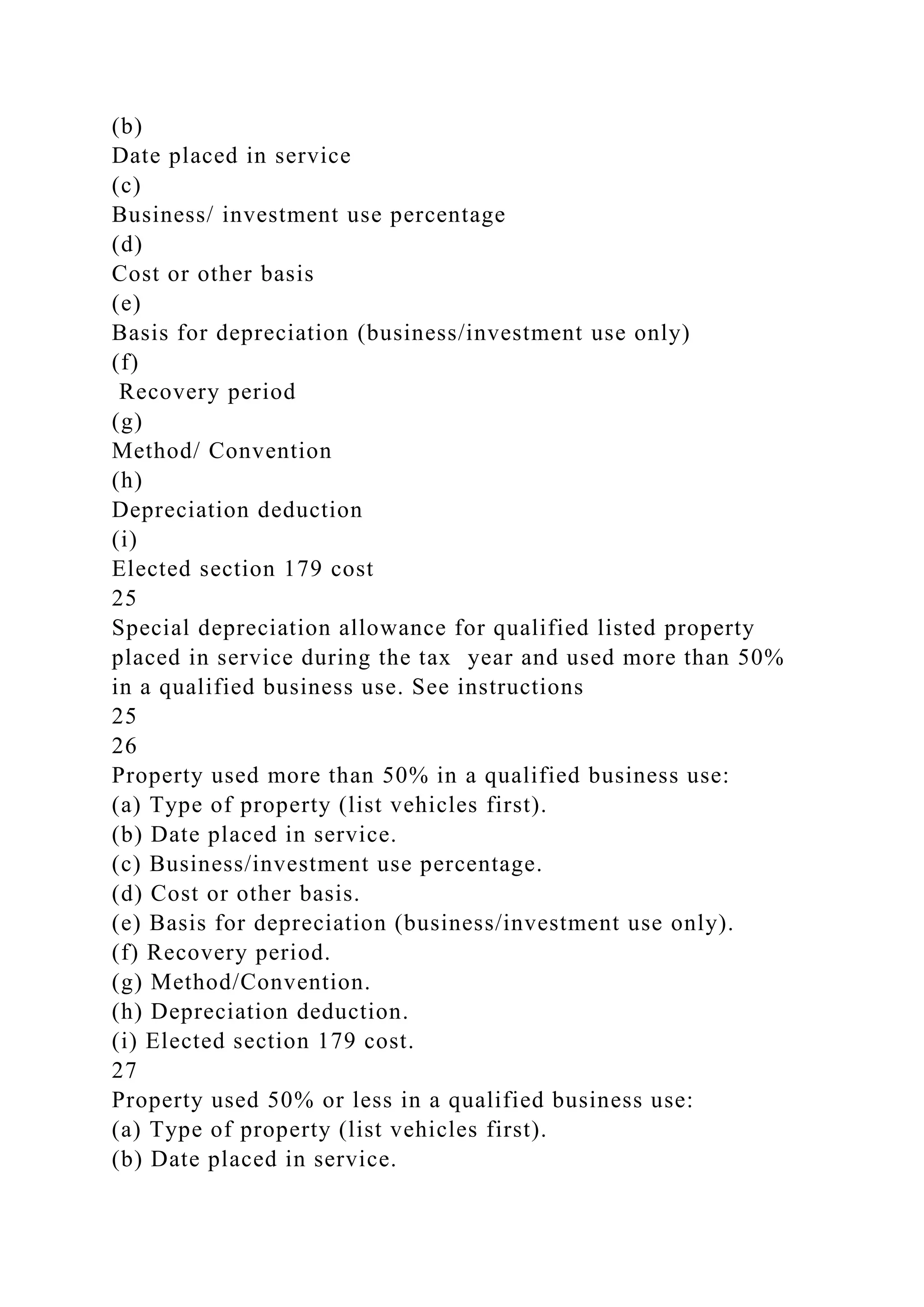
(a)
Type of property (list
vehicles first)
(b)
Date placed
in service
(c)
Business/
investment use
percentage
(d)
Cost or other basis
(e)
Basis for depreciation
(business/investment
use only)
(f)
Recovery
period
(g)
Method/
Convention
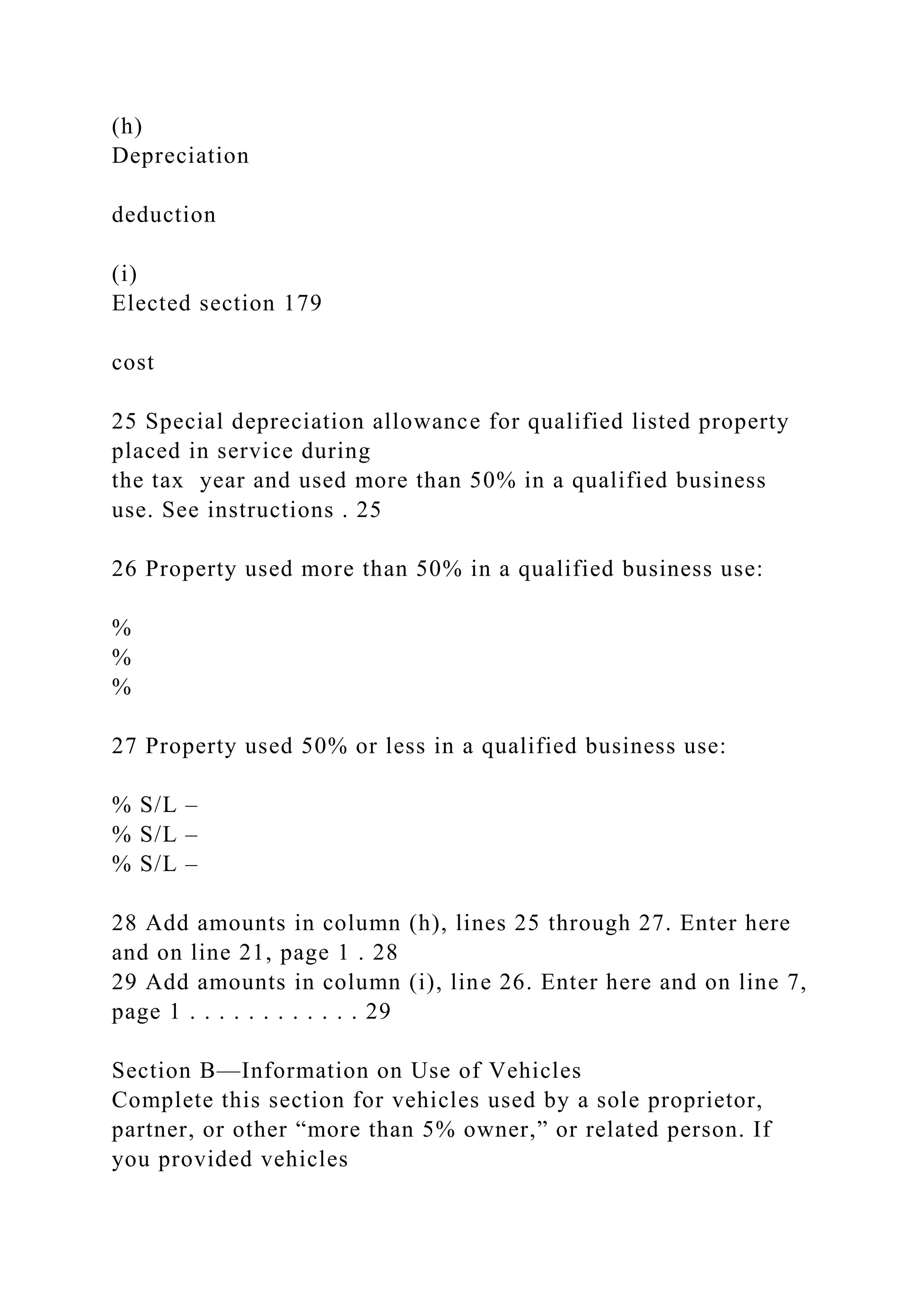
(h)
Depreciation
deduction
(i)
Elected section 179
cost
25 Special depreciation allowance for qualified listed property
placed in service during
the tax year and used more than 50% in a qualified business
use. See instructions . 25
26 Property used more than 50% in a qualified business use:
%
%
%
27 Property used 50% or less in a qualified business use:
% S/L –
% S/L –
% S/L –
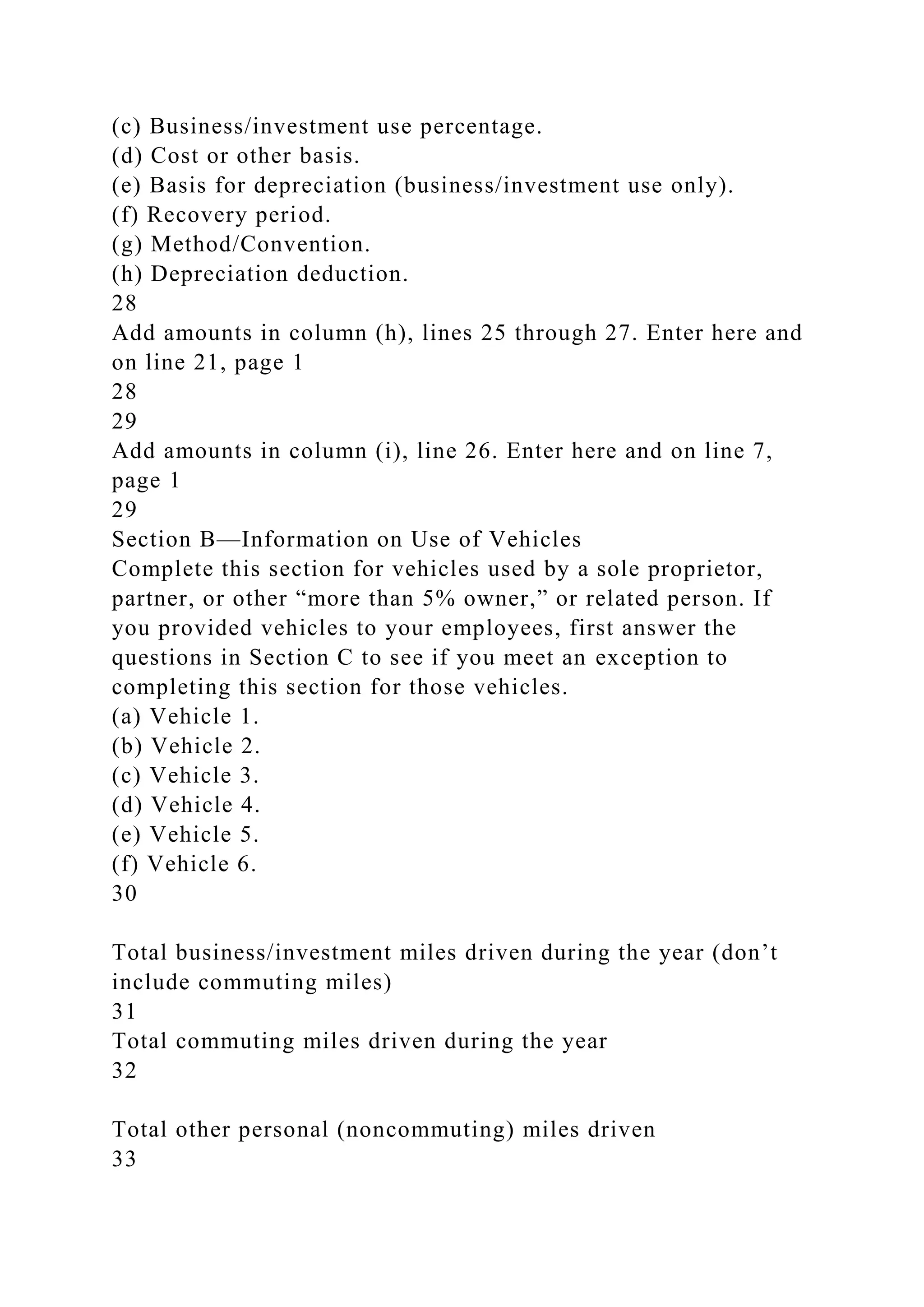
28 Add amounts in column (h), lines 25 through 27. Enter here
and on line 21, page 1 . 28
29 Add amounts in column (i), line 26. Enter here and on line 7,
page 1 . . . . . . . . . . . . 29
Section B—Information on Use of Vehicles
Complete this section for vehicles used by a sole proprietor,
partner, or other “more than 5% owner,” or related person. If
you provided vehicles
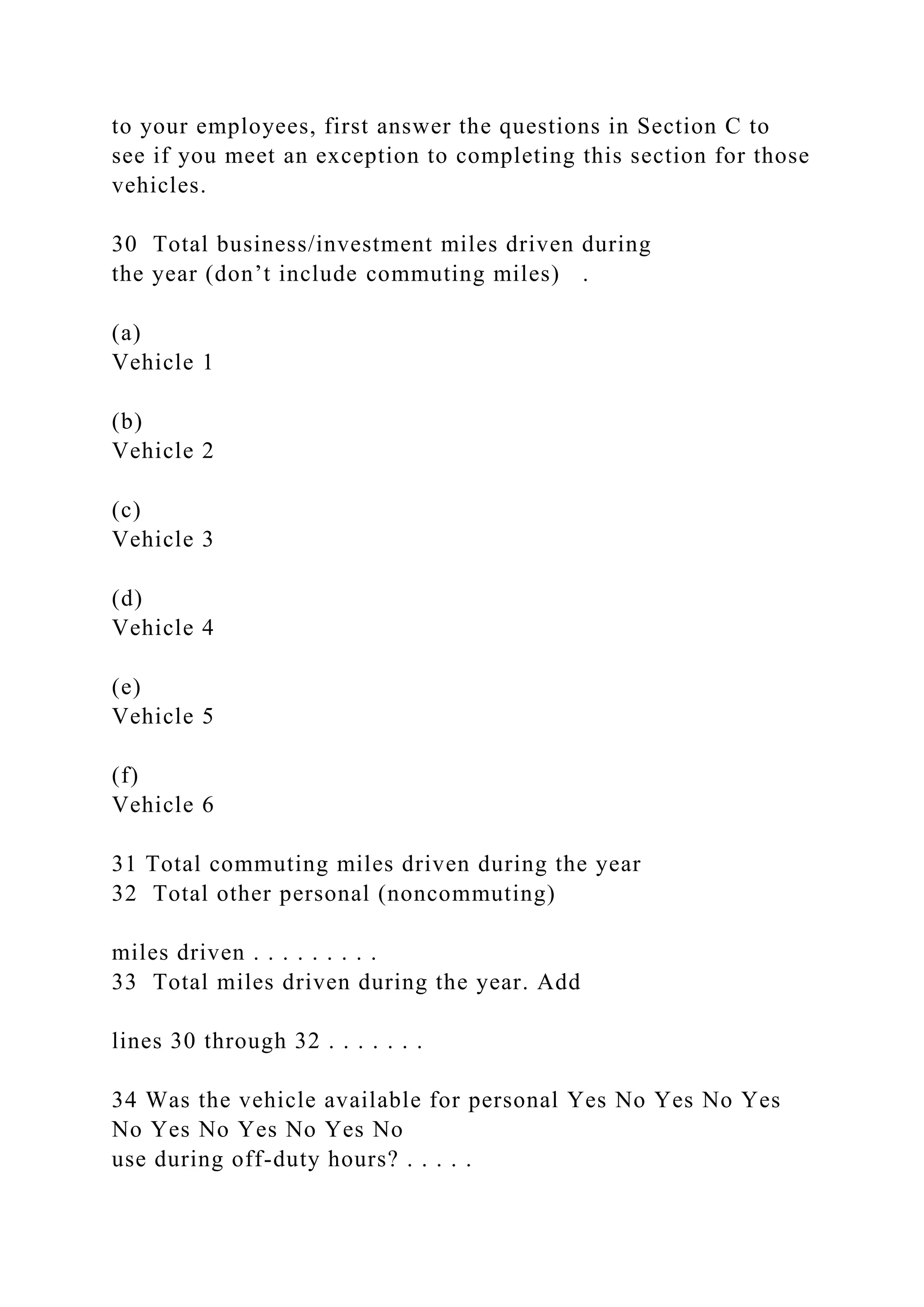
to your employees, first answer the questions in Section C to
see if you meet an exception to completing this section for those
vehicles.
30 Total business/investment miles driven during
the year (don’t include commuting miles) .
(a)
Vehicle 1
(b)
Vehicle 2
(c)
Vehicle 3
(d)
Vehicle 4
(e)
Vehicle 5
(f)
Vehicle 6
31 Total commuting miles driven during the year
32 Total other personal (noncommuting)
miles driven . . . . . . . . .
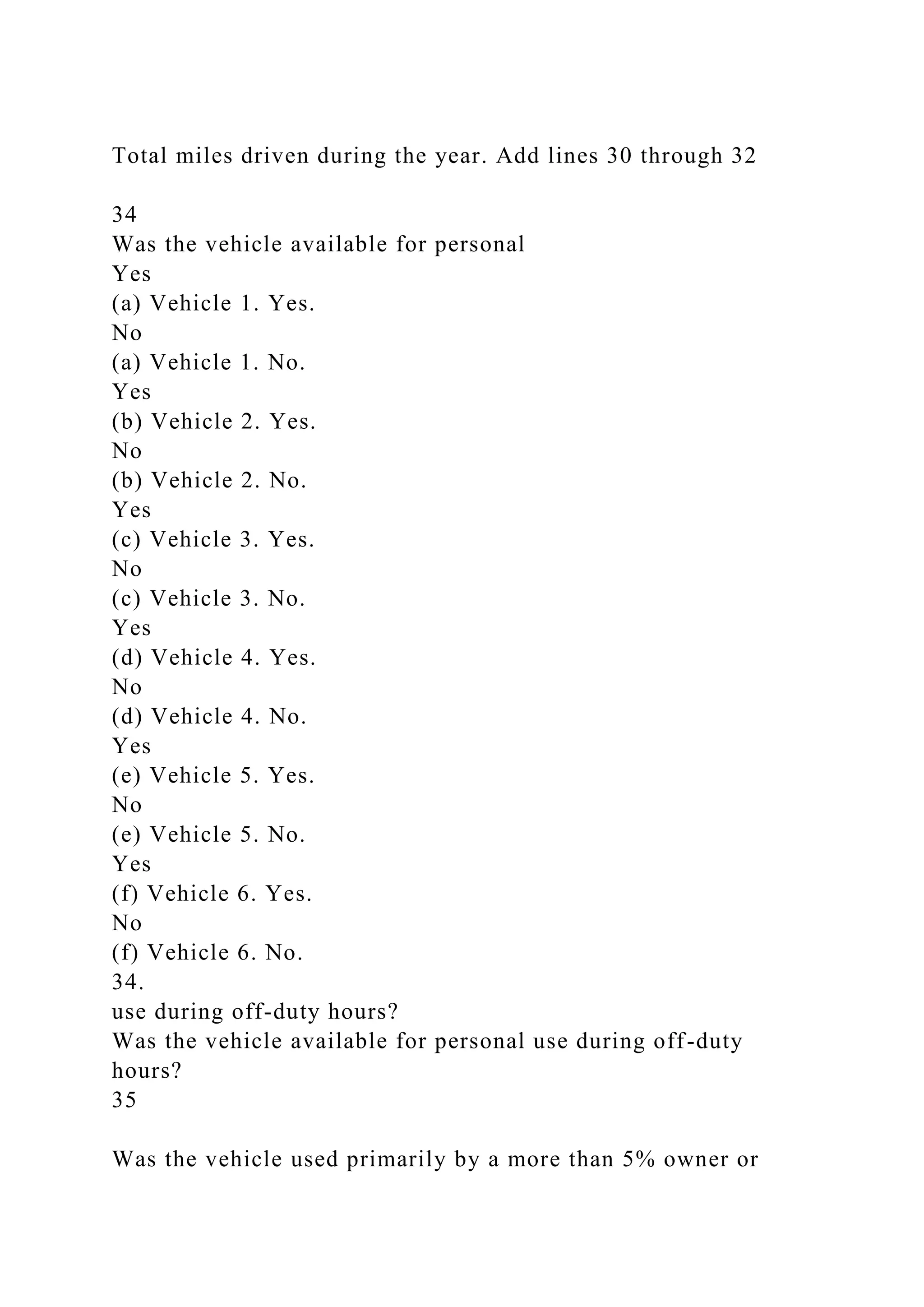
33 Total miles driven during the year. Add
lines 30 through 32 . . . . . . .
34 Was the vehicle available for personal Yes No Yes No Yes
No Yes No Yes No Yes No
use during off-duty hours? . . . . .
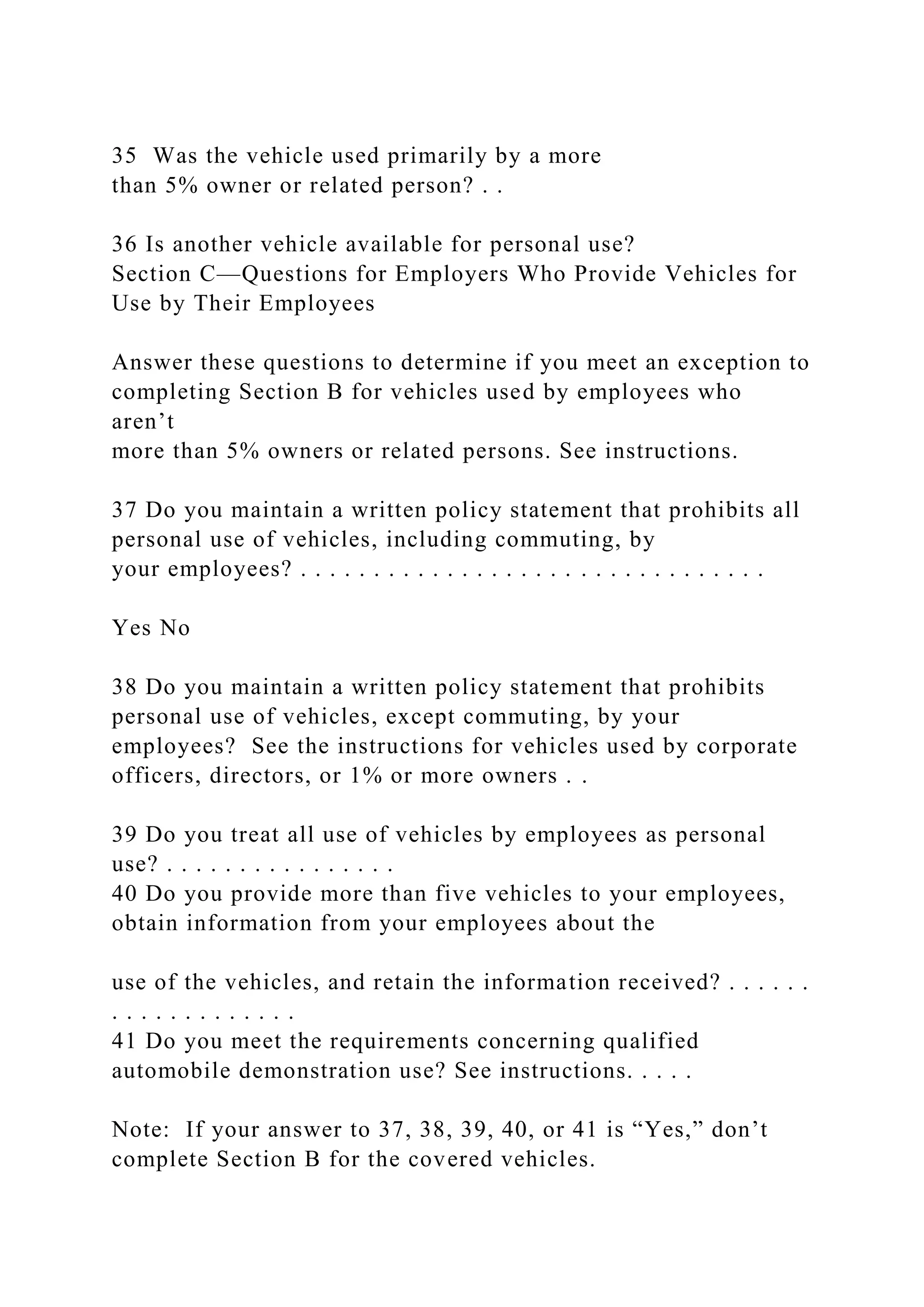
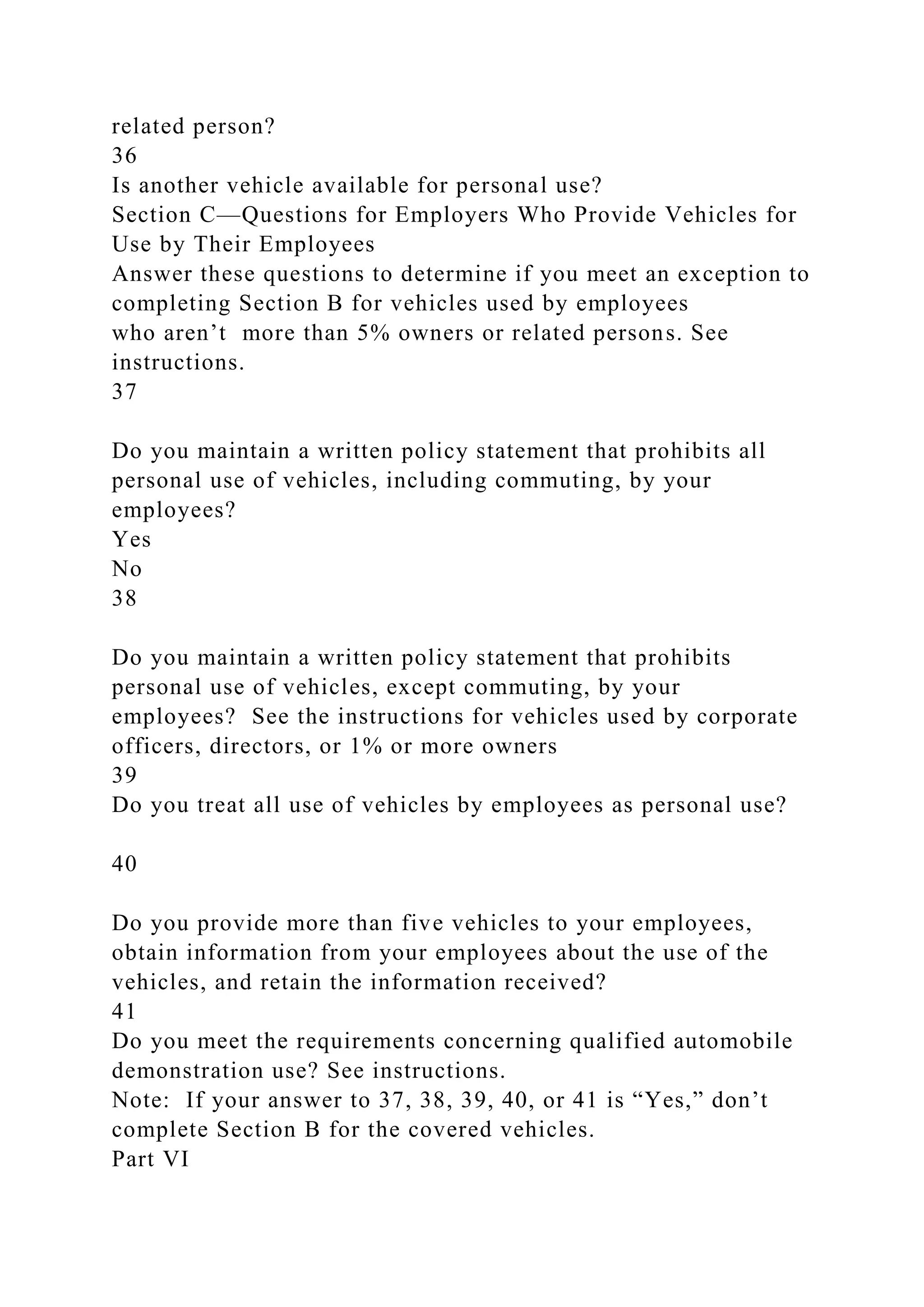
35 Was the vehicle used primarily by a more
than 5% owner or related person? . .
36 Is another vehicle available for personal use?
Section C—Questions for Employers Who Provide Vehicles for
Use by Their Employees
Answer these questions to determine if you meet an exception to
completing Section B for vehicles used by employees who
aren’t
more than 5% owners or related persons. See instructions.
37 Do you maintain a written policy statement that prohibits all
personal use of vehicles, including commuting, by
your employees? . . . . . . . . . . . . . . . . . . . . . . . . . . . . . . . .
Yes No
38 Do you maintain a written policy statement that prohibits
personal use of vehicles, except commuting, by your
employees? See the instructions for vehicles used by corporate
officers, directors, or 1% or more owners . .
39 Do you treat all use of vehicles by employees as personal
use? . . . . . . . . . . . . . . . .
40 Do you provide more than five vehicles to your employees,
obtain information from your employees about the
use of the vehicles, and retain the information received? . . . . . .
. . . . . . . . . . . . .
41 Do you meet the requirements concerning qualified
automobile demonstration use? See instructions. . . . .
Note: If your answer to 37, 38, 39, 40, or 41 is “Yes,” don’t
complete Section B for the covered vehicles.
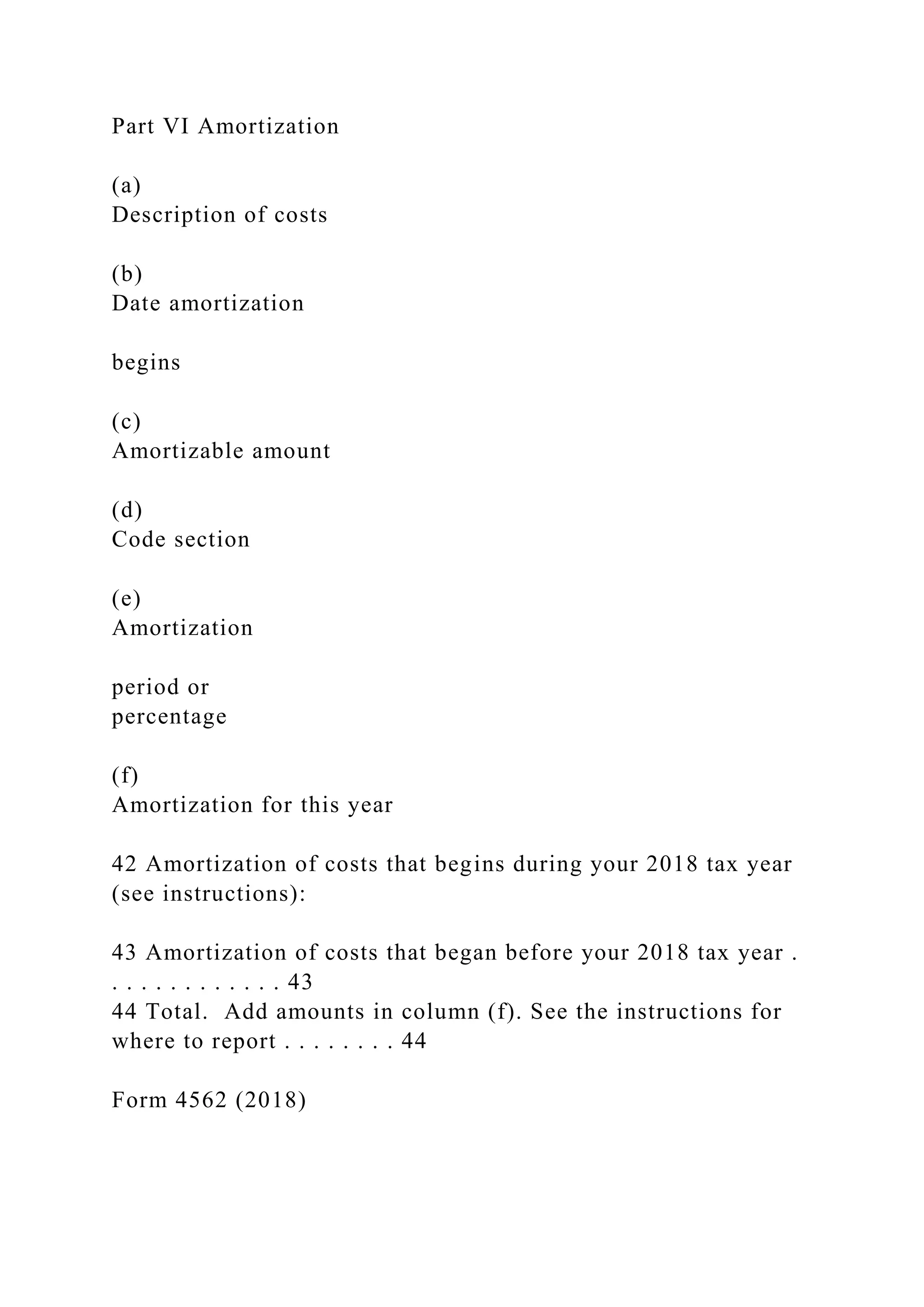
Part VI Amortization
(a)
Description of costs
(b)
Date amortization
begins
(c)
Amortizable amount
(d)
Code section
(e)
Amortization
period or
percentage
(f)
Amortization for this year
42 Amortization of costs that begins during your 2018 tax year
(see instructions):
43 Amortization of costs that began before your 2018 tax year .
. . . . . . . . . . . . 43
44 Total. Add amounts in column (f). See the instructions for
where to report . . . . . . . . 44
Form 4562 (2018)
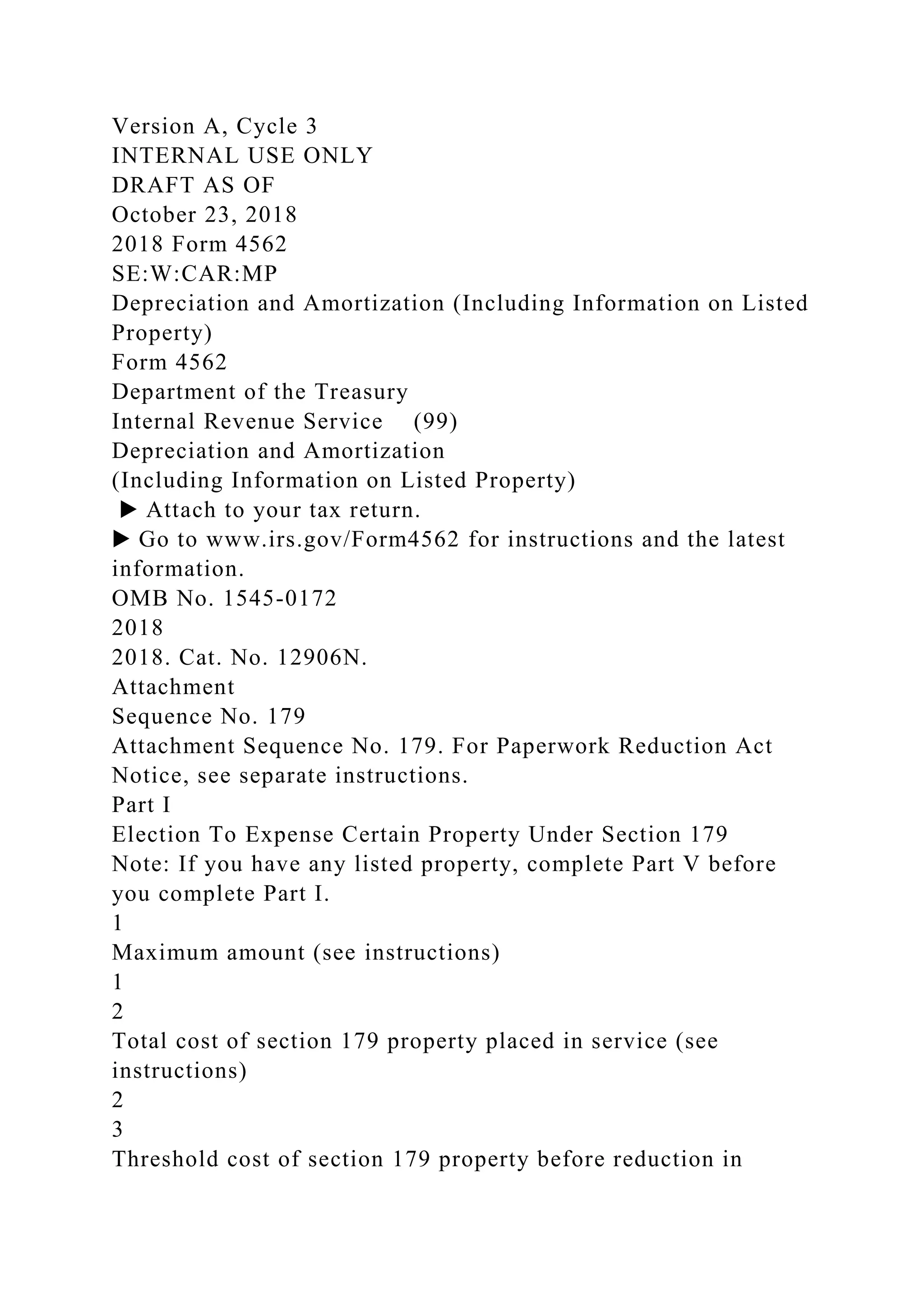
Version A, Cycle 3
INTERNAL USE ONLY
DRAFT AS OF
October 23, 2018
2018 Form 4562
SE:W:CAR:MP
Depreciation and Amortization (Including Information on Listed
Property)
Form 4562
Department of the Treasury
Internal Revenue Service (99)
Depreciation and Amortization
(Including Information on Listed Property)
▶ Attach to your tax return.
▶ Go to www.irs.gov/Form4562 for instructions and the latest
information.
OMB No. 1545-0172
2018
2018. Cat. No. 12906N.
Attachment
Sequence No. 179
Attachment Sequence No. 179. For Paperwork Reduction Act
Notice, see separate instructions.
Part I
Election To Expense Certain Property Under Section 179
Note: If you have any listed property, complete Part V before
you complete Part I.
1
Maximum amount (see instructions)
1
2
Total cost of section 179 property placed in service (see
instructions)
2
3
Threshold cost of section 179 property before reduction in
limitation (see instructions)
3
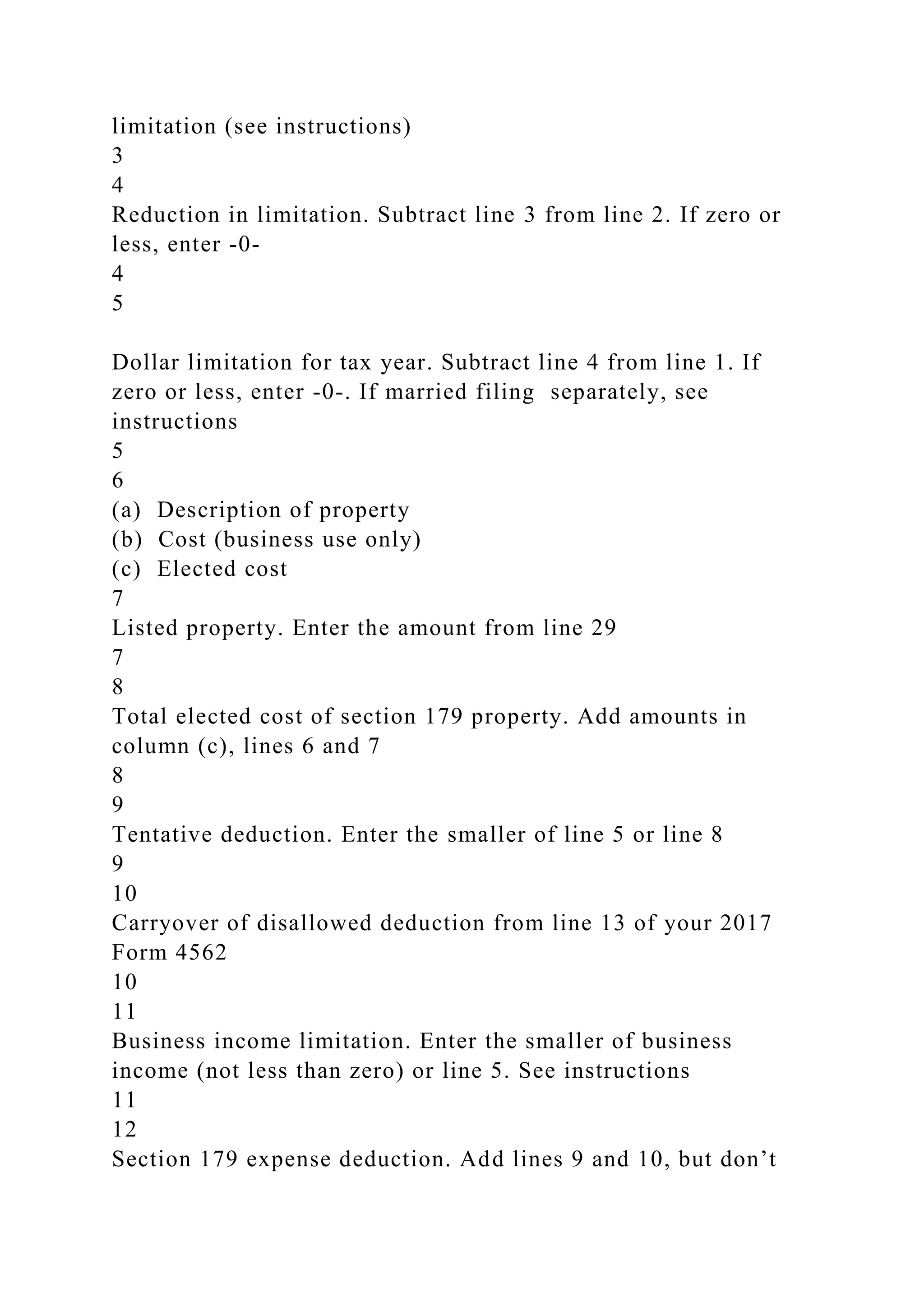
4
Reduction in limitation. Subtract line 3 from line 2. If zero or
less, enter -0-
4
5
Dollar limitation for tax year. Subtract line 4 from line 1. If
zero or less, enter -0-. If married filing separately, see
instructions
5
6
(a) Description of property
(b) Cost (business use only)
(c) Elected cost
7
Listed property. Enter the amount from line 29
7
8
Total elected cost of section 179 property. Add amounts in
column (c), lines 6 and 7
8
9
Tentative deduction. Enter the smaller of line 5 or line 8
9
10
Carryover of disallowed deduction from line 13 of your 2017
Form 4562
10
11
Business income limitation. Enter the smaller of business
income (not less than zero) or line 5. See instructions
11
12
Section 179 expense deduction. Add lines 9 and 10, but don’t
enter more than line 11
12
13
Carryover of disallowed deduction to 2019. Add lines 9 and 10,
less line 12 ▶
13
Note: Don’t use Part II or Part III below for listed property.
Instead, use Part V.
Part II
Special Depreciation Allowance and Other Depreciation
(Don’t include listed property. See instructions.)
14
Special depreciation allowance for qualified property (other
than listed property) placed in service during the tax year. See
instructions
14
15
Property subject to section 168(f)(1) election
15
16
Other depreciation (including ACRS)
16
Part III
MACRS Depreciation (Don’t include listed property. See
instructions.)
Section A
17
MACRS deductions for assets placed in service in tax years
beginning before 2018
17
18
If you are electing to group any assets placed in service during
the tax year into one or more general asset accounts, check here
▶
Section B—Assets Placed in Service During 2018 Tax Year
Using the General Depreciation System
(a) Classification of property
(b) Month and year
placed in
service
(c) Basis for depreciation
(business/investment use
only—see instructions)
(d) Recovery period
(e) Convention
(f) Method
(g) Depreciation deduction
(a) Classification of property.
(b) Month and year placed in service.
(c) Basis for depreciation (business/investment use only—see
instructions).
(d) Recovery period.
(e) Convention.
(f) Method.
(g) Depreciation deduction.
19a
3-year property
b
5-year property
c
7-year property
d
10-year property
e
15-year property
f
20-year property
g
25-year property
h
h. Line 1 of 2.
Residential rental
Residential rental property. Line 1 of 2.
h. Line 2 of 2.
Residential rental property. Line 2 of 2.
property
i
i. Line 1 of 2.
Nonresidential real
Nonresidential real property. Line 1 of 2.
i. Line 2 of 2.
Nonresidential real property. Line 2 of 2.
property
Section C—Assets Placed in Service During 2018 Tax Year
Using the Alternative Depreciation System
(a) Classification of property.
(b) Month and year placed in service.
(c) Basis for depreciation (business/investment use only—see
instructions).
(d) Recovery period.
(e) Convention.
(f) Method.
(g) Depreciation deduction.
20a
Class life
b
12-year
c
30-year
d
40-year
Part IV
Summary (See instructions.)
21
Listed property. Enter amount from line 28
21
22
Total. Add amounts from line 12, lines 14 through 17, lines 19
and 20 in column (g), and line 21. Enter here and on the
appropriate lines of your return. Partnerships and S
corporations—see instructions
22
23
For assets shown above and placed in service during the current
year, enter the portion of the basis attributable to section 263A
costs
23
For Paperwork Reduction Act Notice, see separate instructions.
Cat. No. 12906N
Form 4562 (2018)
Form 4562 (2018)
Page 2
Part V
Listed Property (Include automobiles, certain other vehicles,
certain aircraft, and property used for entertainment, recreation,
or amusement.)
Note: For any vehicle for which you are using the standard
mileage rate or deducting lease expense, complete only 24a,
24b, columns (a) through (c) of Section A, all of Section B, and
Section C if applicable.
Section A—Depreciation and Other Information (Caution: See
the instructions for limits for passenger automobiles.)
24
a
Do you have evidence to support the business/investment use
claimed?
24b
If “Yes,” is the evidence written?
(a)
Type of property (list vehicles first)
(b)
Date placed in service
(c)
Business/ investment use percentage
(d)
Cost or other basis
(e)
Basis for depreciation (business/investment use only)
(f)
Recovery period
(g)
Method/ Convention
(h)
Depreciation deduction
(i)
Elected section 179 cost
25
Special depreciation allowance for qualified listed property
placed in service during the tax year and used more than 50%
in a qualified business use. See instructions
25
26
Property used more than 50% in a qualified business use:
(a) Type of property (list vehicles first).
(b) Date placed in service.
(c) Business/investment use percentage.
(d) Cost or other basis.
(e) Basis for depreciation (business/investment use only).
(f) Recovery period.
(g) Method/Convention.
(h) Depreciation deduction.
(i) Elected section 179 cost.
27
Property used 50% or less in a qualified business use:
(a) Type of property (list vehicles first).
(b) Date placed in service.
(c) Business/investment use percentage.
(d) Cost or other basis.
(e) Basis for depreciation (business/investment use only).
(f) Recovery period.
(g) Method/Convention.
(h) Depreciation deduction.
28
Add amounts in column (h), lines 25 through 27. Enter here and
on line 21, page 1
28
29
Add amounts in column (i), line 26. Enter here and on line 7,
page 1
29
Section B—Information on Use of Vehicles
Complete this section for vehicles used by a sole proprietor,
partner, or other “more than 5% owner,” or related person. If
you provided vehicles to your employees, first answer the
questions in Section C to see if you meet an exception to
completing this section for those vehicles.
(a) Vehicle 1.
(b) Vehicle 2.
(c) Vehicle 3.
(d) Vehicle 4.
(e) Vehicle 5.
(f) Vehicle 6.
30
Total business/investment miles driven during the year (don’t
include commuting miles)
31
Total commuting miles driven during the year
32
Total other personal (noncommuting) miles driven
33
Total miles driven during the year. Add lines 30 through 32
34
Was the vehicle available for personal
Yes
(a) Vehicle 1. Yes.
No
(a) Vehicle 1. No.
Yes
(b) Vehicle 2. Yes.
No
(b) Vehicle 2. No.
Yes
(c) Vehicle 3. Yes.
No
(c) Vehicle 3. No.
Yes
(d) Vehicle 4. Yes.
No
(d) Vehicle 4. No.
Yes
(e) Vehicle 5. Yes.
No
(e) Vehicle 5. No.
Yes
(f) Vehicle 6. Yes.
No
(f) Vehicle 6. No.
34.
use during off-duty hours?
Was the vehicle available for personal use during off-duty
hours?
35
Was the vehicle used primarily by a more than 5% owner or
related person?
36
Is another vehicle available for personal use?
Section C—Questions for Employers Who Provide Vehicles for
Use by Their Employees
Answer these questions to determine if you meet an exception to
completing Section B for vehicles used by employees
who aren’t more than 5% owners or related persons. See
instructions.
37
Do you maintain a written policy statement that prohibits all
personal use of vehicles, including commuting, by your
employees?
Yes
No
38
Do you maintain a written policy statement that prohibits
personal use of vehicles, except commuting, by your
employees? See the instructions for vehicles used by corporate
officers, directors, or 1% or more owners
39
Do you treat all use of vehicles by employees as personal use?
40
Do you provide more than five vehicles to your employees,
obtain information from your employees about the use of the
vehicles, and retain the information received?
41
Do you meet the requirements concerning qualified automobile
demonstration use? See instructions.
Note: If your answer to 37, 38, 39, 40, or 41 is “Yes,” don’t
complete Section B for the covered vehicles.
Part VI
Amortization
(a)
Description of costs
(b)
Date amortization begins
(c)
Amortizable amount
(d)
Code section
(e)
Amortization period or percentage
(f)
Amortization for this year
42
Amortization of costs that begins during your 2018 tax year (see
instructions):
(a) Description of costs
(b) Date amortization begins.
(c) Amortizable amount.
(d) Code section.
(e) Amortization period or percentage.
(f) Amortization for this year.
43
Amortization of costs that began before your 2018 tax year
43
44
Total. Add amounts in column (f). See the instructions for
where to report
44
Form 4562 (2018)
f1_1: f1_2: f1_3: f1_4: f1_5: f1_6: f1_7: f1_8: f1_9: f1_10:
f1_11: f1_12: f1_13: f1_14: f1_15: f1_16: f1_17: f1_18: f1_19:
f1_20: f1_21: f1_22: f1_23: f1_24: f1_25: c1_1: 0R4: f1_26:
f1_27: f1_28: f1_29: f1_30: R5: f1_31: f1_32: f1_33: f1_34:
f1_35: R6: f1_36: f1_37: f1_38: f1_39: f1_40: R7: f1_41:
f1_42: f1_43: f1_44: f1_45: R8: f1_46: f1_47: f1_48: f1_49:
f1_50: R9: f1_51: f1_52: f1_53: f1_54: f1_55: R10: f1_56:
Line19g_d: 25 yrs.f1_58: Line19g_f: S/Lf1_60: f1_61: f1_62:
Line19h_d: 27.5 yrs.Line19h_e: MMLine19h_f: S/Lf1_66:
f1_67: f1_68: Line19h_d2: 27.5 yrs.Line19h_e2:
MMLine19h_f2: S/Lf1_72: f1_73: f1_74: Line19i_d: 39
yrs.Line19i_e: MMLine19i_f: S/Lf1_78: f1_79: f1_80: f1_81:
Line19i_f2: S/Lf1_84: R11: f1_85: f1_86: f1_87: Line20a_f:
S/Lf1_89: R12: f1_90: Line20b_d: 12 yrs.f1_92: Line20b_f:
S/Lf1_94: f1_95: f1_96: Line20c_d: 30 yrs.Line20c_e:
MMLine20c_f: S/Lf1_100: f1_101: f1_102: Line20d_d: 40
yrs.Line20d_e: MMLine20d_f: S/Lf1_106: f1_107: f1_108:
f1_109: c2_1: 0c2_2: 0f2_1: f2_2: f2_3: f2_4: f2_5: f2_6: f2_7:
f2_8: f2_9: f2_10: f2_11: f2_12: f2_13: f2_14: f2_15: f2_16:
f2_17: f2_18: f2_19: f2_20: f2_21: f2_22: f2_23: f2_24: f2_25:
f2_26: f2_27: f2_28: f2_29: f2_30: f2_31: f2_32: f2_33: f2_34:
f2_35: f2_36: f2_37: f2_38: f2_39: f2_40: f2_41: f2_42: f2_43:
f2_44: f2_45: f2_46: f2_47: f2_48: f2_49: f2_50: f2_51: f2_52:
f2_53: f2_54: f2_55: f2_56: f2_57: f2_58: f2_59: f2_60: f2_61:
f2_62: f2_63: f2_64: f2_65: f2_66: f2_67: f2_68: f2_69: f2_70:
f2_71: f2_72: f2_73: f2_74: f2_75: f2_76: f2_77: f2_78: c2_3:
0c2_4: 0c2_5: 0c2_6: 0c2_7: 0c2_8: 0c2_9: 0c2_10: 0c2_11:
0c2_12: 0c2_13: 0c2_14: 0c2_15: 0c2_16: 0c2_17: 0c2_18:
0c2_19: 0c2_20: 0c2_21: 0c2_22: 0c2_23: 0c2_24: 0c2_25:
0f2_81: f2_82: f2_83: f2_84: f2_85: f2_86: f2_87: f2_88:
f2_89: f2_90: f2_91: f2_92: f2_79: f2_80:
SCHEDULE SE
(Form 1040)
Department of the Treasury
Internal Revenue Service (99)
Self-Employment Tax
▶ Go to www.irs.gov/ScheduleSE for instructions and the latest
information.
▶ Attach to Form 1040 or Form 1040NR.
OMB No. 1545-0074
2018
Attachment
Sequence No. 17
Name of person with self-employment income (as shown on
Form 1040 or Form 1040NR) Social security number of person
with self-employment income ▶
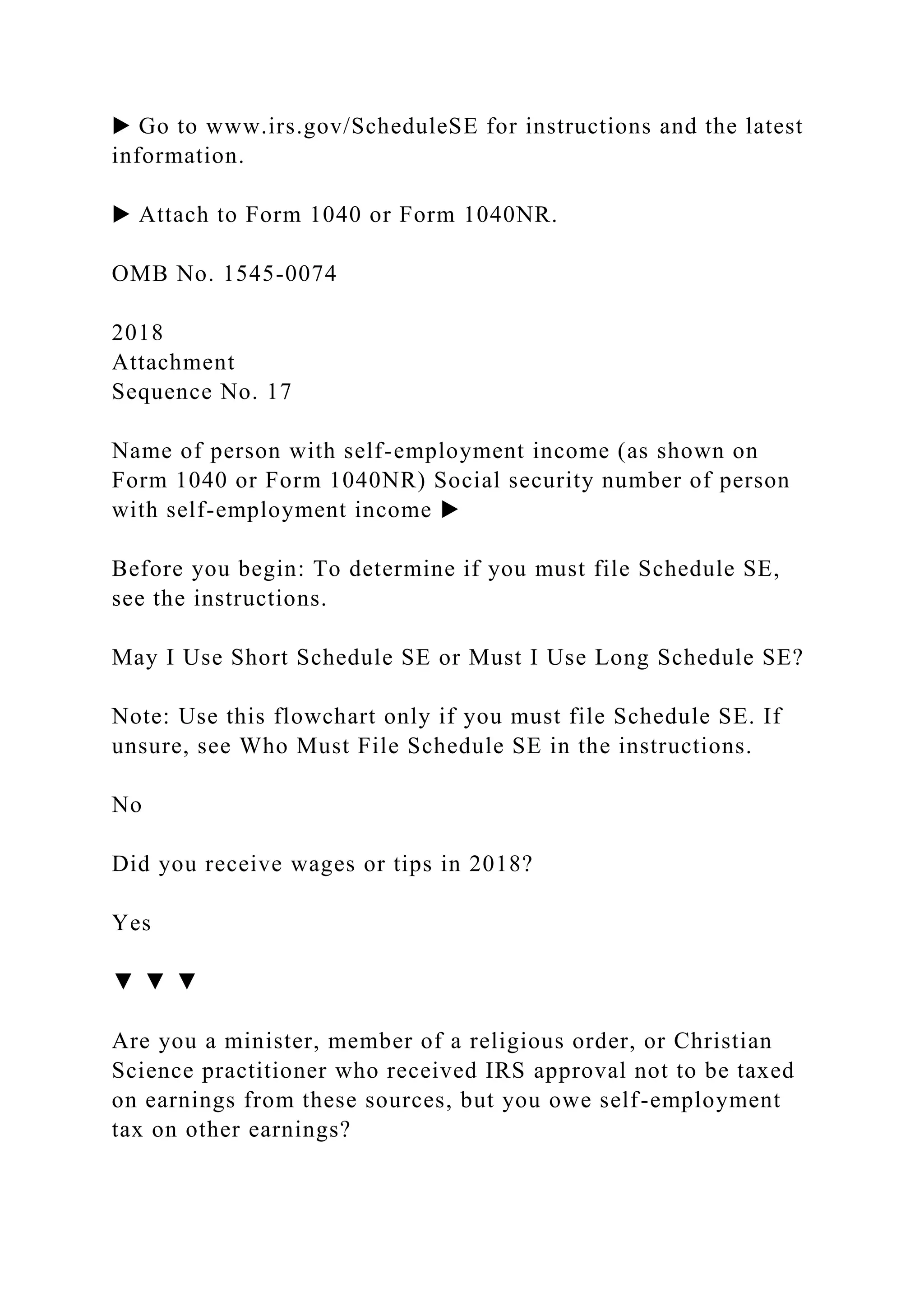
Before you begin: To determine if you must file Schedule SE,
see the instructions.
May I Use Short Schedule SE or Must I Use Long Schedule SE?
Note: Use this flowchart only if you must file Schedule SE. If
unsure, see Who Must File Schedule SE in the instructions.
No
Did you receive wages or tips in 2018?
Yes
▼ ▼ ▼
Are you a minister, member of a religious order, or Christian
Science practitioner who received IRS approval not to be taxed
on earnings from these sources, but you owe self-employment
tax on other earnings?
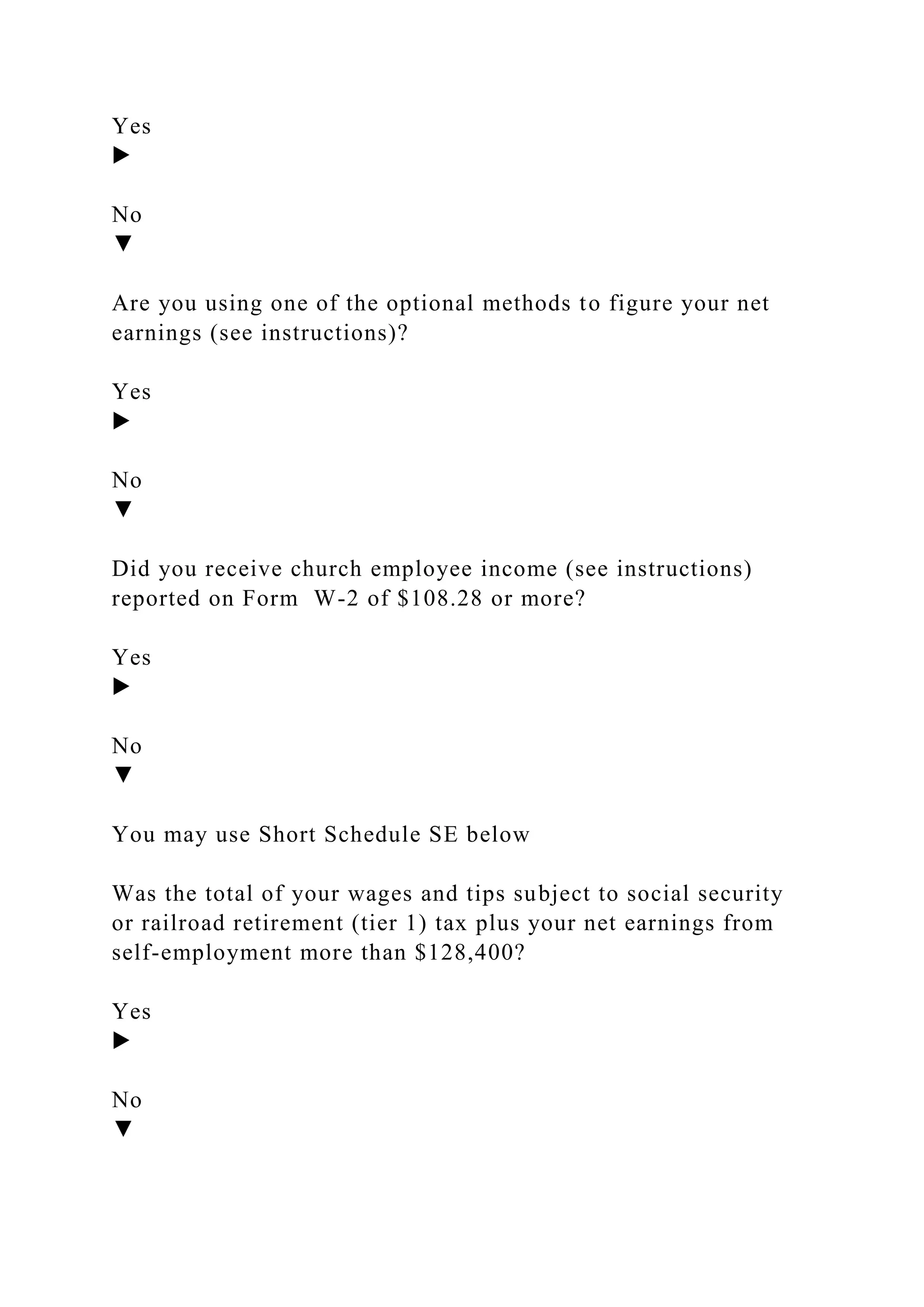
Yes
▶
No
▼
Are you using one of the optional methods to figure your net
earnings (see instructions)?
Yes
▶
No
▼
Did you receive church employee income (see instructions)
reported on Form W-2 of $108.28 or more?
Yes
▶
No
▼
You may use Short Schedule SE below
Was the total of your wages and tips subject to social security
or railroad retirement (tier 1) tax plus your net earnings from
self-employment more than $128,400?
Yes
▶
No
▼
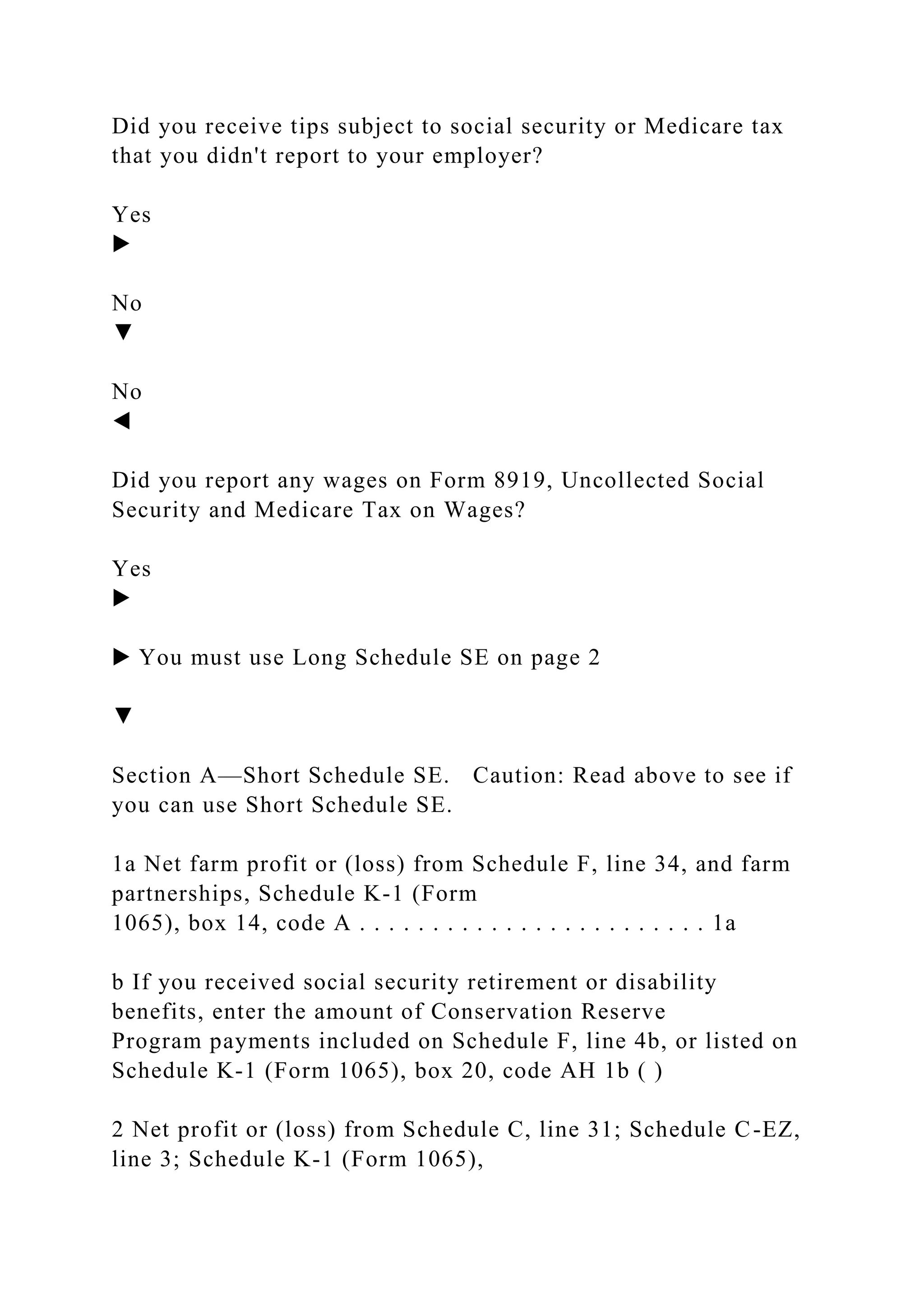
Did you receive tips subject to social security or Medicare tax
that you didn't report to your employer?
Yes
▶
No
▼
No
◀
Did you report any wages on Form 8919, Uncollected Social
Security and Medicare Tax on Wages?
Yes
▶
▶ You must use Long Schedule SE on page 2
▼
Section A—Short Schedule SE. Caution: Read above to see if
you can use Short Schedule SE.
1a Net farm profit or (loss) from Schedule F, line 34, and farm
partnerships, Schedule K-1 (Form
1065), box 14, code A . . . . . . . . . . . . . . . . . . . . . . . . 1a
b If you received social security retirement or disability
benefits, enter the amount of Conservation Reserve
Program payments included on Schedule F, line 4b, or listed on
Schedule K-1 (Form 1065), box 20, code AH 1b ( )
2 Net profit or (loss) from Schedule C, line 31; Schedule C-EZ,
line 3; Schedule K-1 (Form 1065),
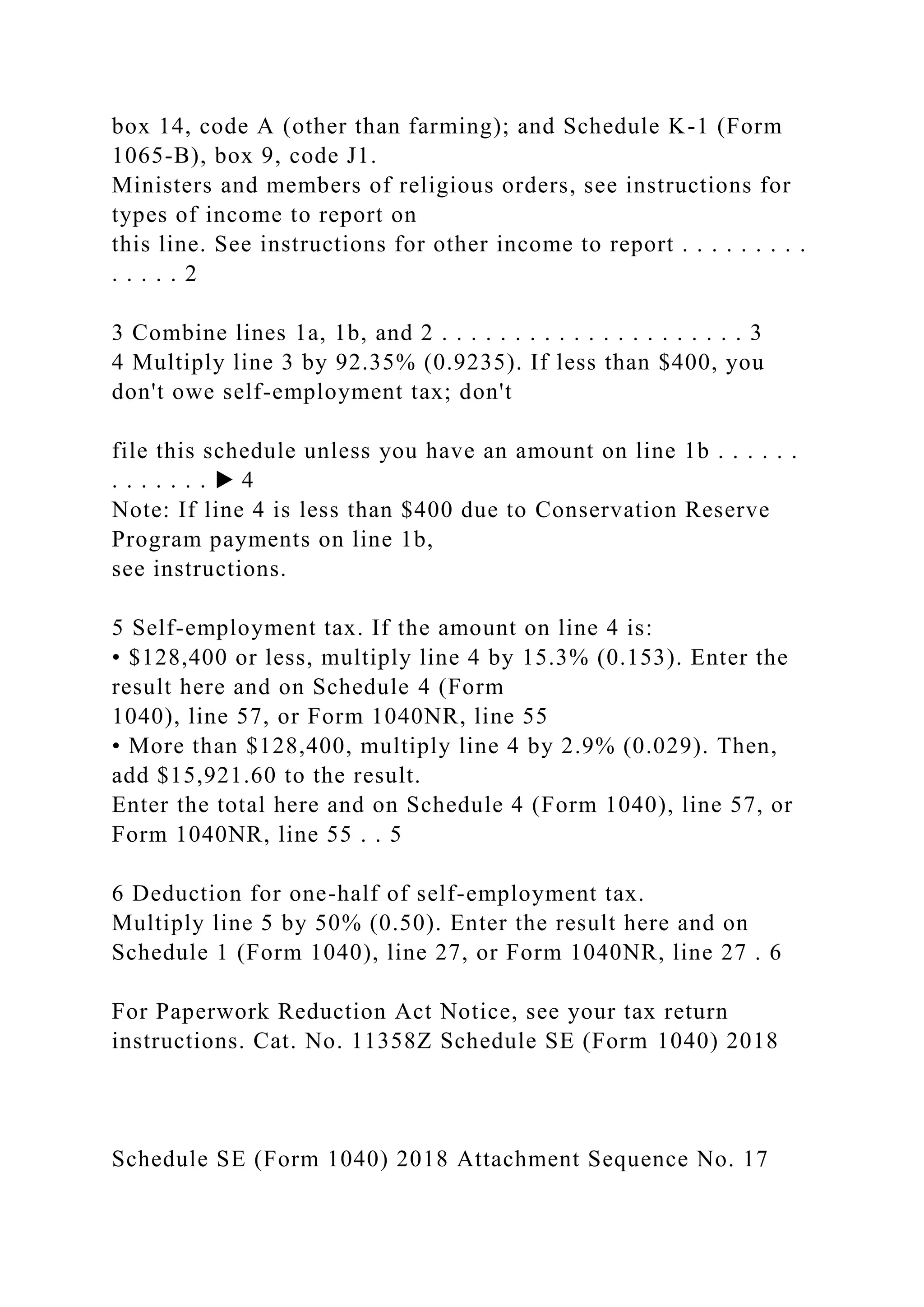
box 14, code A (other than farming); and Schedule K-1 (Form
1065-B), box 9, code J1.
Ministers and members of religious orders, see instructions for
types of income to report on
this line. See instructions for other income to report . . . . . . . . .
. . . . . 2
3 Combine lines 1a, 1b, and 2 . . . . . . . . . . . . . . . . . . . . . 3
4 Multiply line 3 by 92.35% (0.9235). If less than $400, you
don't owe self-employment tax; don't
file this schedule unless you have an amount on line 1b . . . . . .
. . . . . . . ▶ 4
Note: If line 4 is less than $400 due to Conservation Reserve
Program payments on line 1b,
see instructions.
5 Self-employment tax. If the amount on line 4 is:
• $128,400 or less, multiply line 4 by 15.3% (0.153). Enter the
result here and on Schedule 4 (Form
1040), line 57, or Form 1040NR, line 55
• More than $128,400, multiply line 4 by 2.9% (0.029). Then,
add $15,921.60 to the result.
Enter the total here and on Schedule 4 (Form 1040), line 57, or
Form 1040NR, line 55 . . 5
6 Deduction for one-half of self-employment tax.
Multiply line 5 by 50% (0.50). Enter the result here and on
Schedule 1 (Form 1040), line 27, or Form 1040NR, line 27 . 6
For Paperwork Reduction Act Notice, see your tax return
instructions. Cat. No. 11358Z Schedule SE (Form 1040) 2018
Schedule SE (Form 1040) 2018 Attachment Sequence No. 17
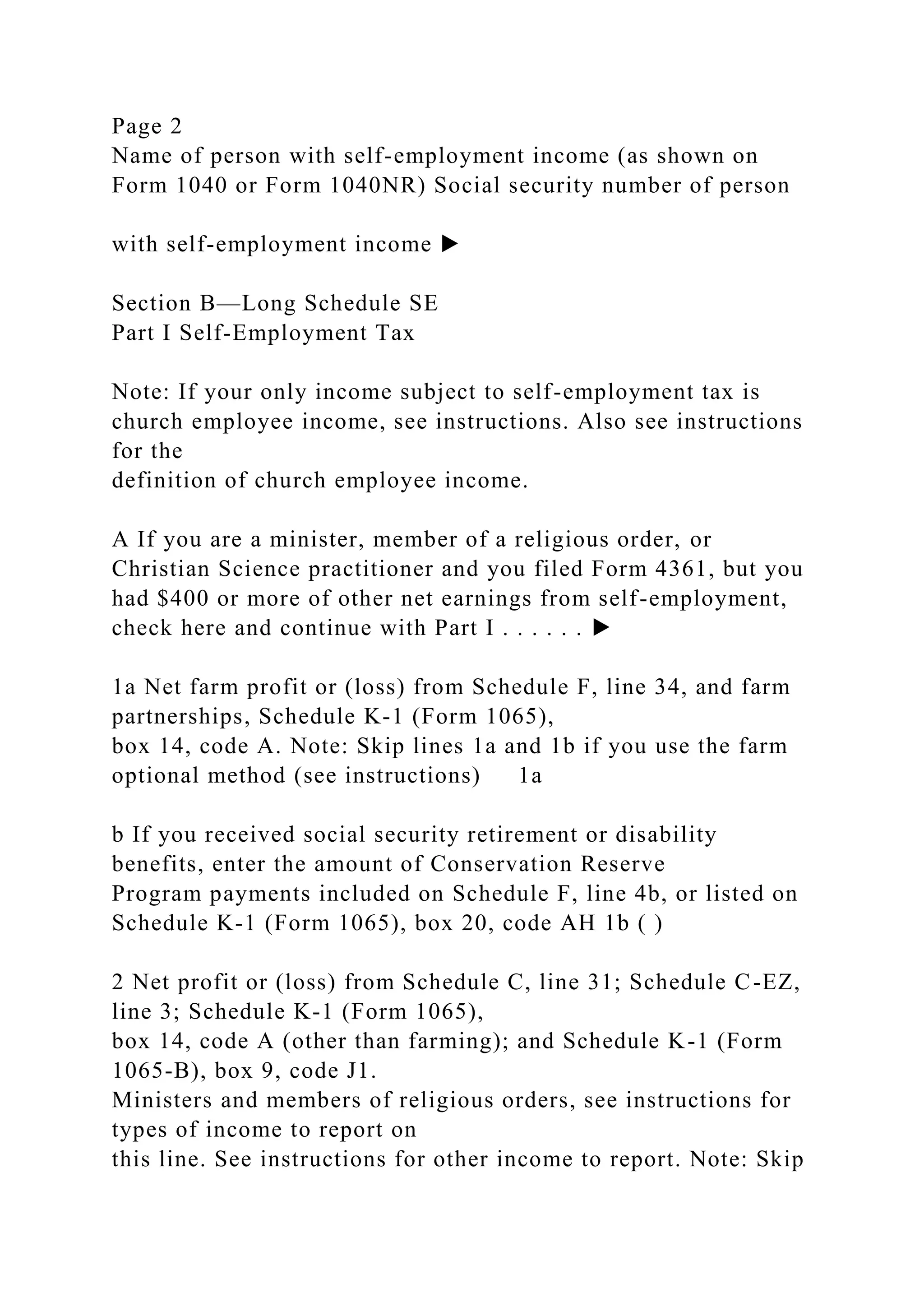
Page 2
Name of person with self-employment income (as shown on
Form 1040 or Form 1040NR) Social security number of person
with self-employment income ▶
Section B—Long Schedule SE
Part I Self-Employment Tax
Note: If your only income subject to self-employment tax is
church employee income, see instructions. Also see instructions
for the
definition of church employee income.
A If you are a minister, member of a religious order, or
Christian Science practitioner and you filed Form 4361, but you
had $400 or more of other net earnings from self-employment,
check here and continue with Part I . . . . . . ▶
1a Net farm profit or (loss) from Schedule F, line 34, and farm
partnerships, Schedule K-1 (Form 1065),
box 14, code A. Note: Skip lines 1a and 1b if you use the farm
optional method (see instructions) 1a
b If you received social security retirement or disability
benefits, enter the amount of Conservation Reserve
Program payments included on Schedule F, line 4b, or listed on
Schedule K-1 (Form 1065), box 20, code AH 1b ( )
2 Net profit or (loss) from Schedule C, line 31; Schedule C-EZ,
line 3; Schedule K-1 (Form 1065),
box 14, code A (other than farming); and Schedule K-1 (Form
1065-B), box 9, code J1.
Ministers and members of religious orders, see instructions for
types of income to report on
this line. See instructions for other income to report. Note: Skip
this line if you use the nonfarm
optional method (see instructions) . . . . . . . . . . . . . . . . . . . . 2
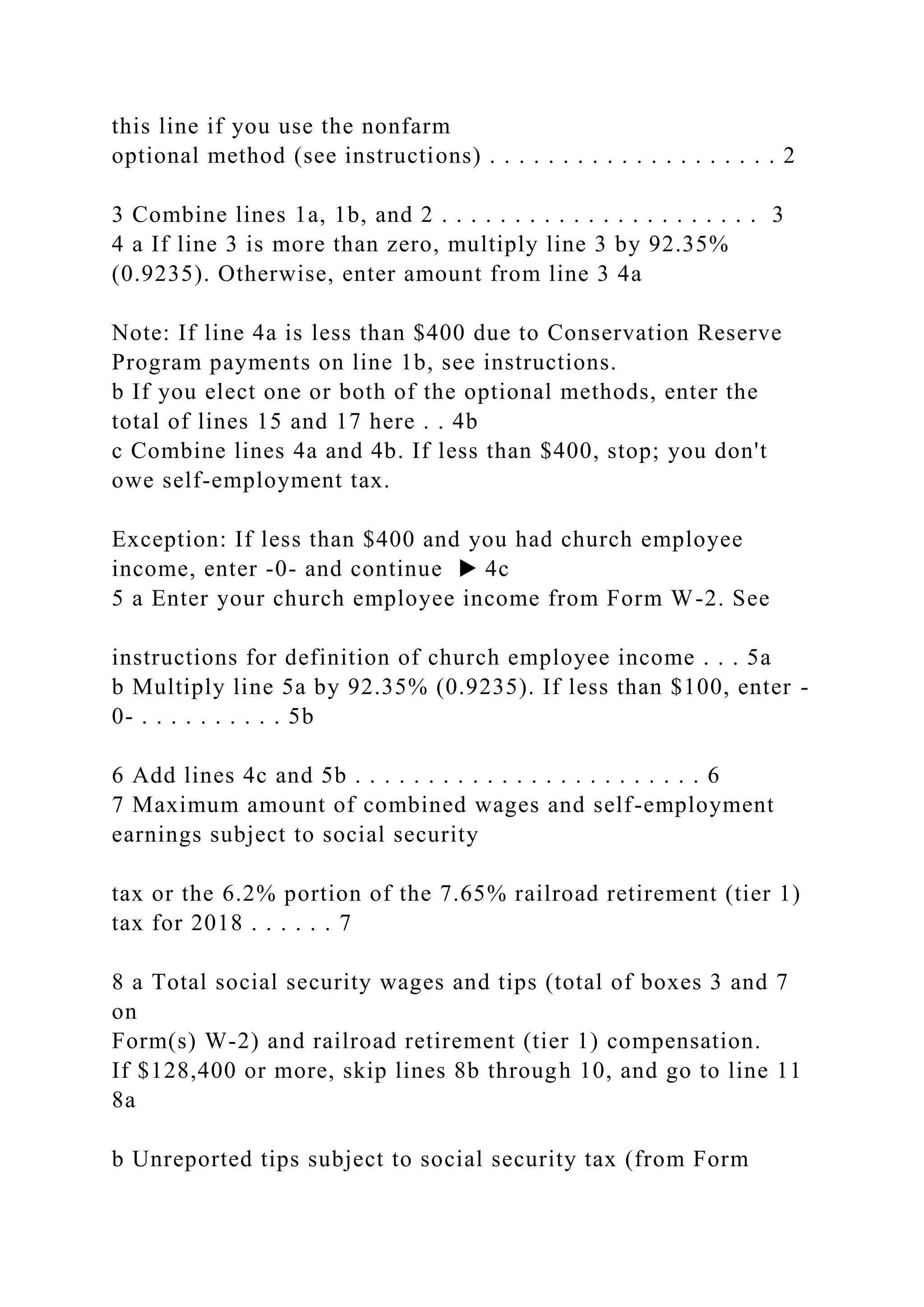
3 Combine lines 1a, 1b, and 2 . . . . . . . . . . . . . . . . . . . . . . 3
4 a If line 3 is more than zero, multiply line 3 by 92.35%
(0.9235). Otherwise, enter amount from line 3 4a
Note: If line 4a is less than $400 due to Conservation Reserve
Program payments on line 1b, see instructions.
b If you elect one or both of the optional methods, enter the
total of lines 15 and 17 here . . 4b
c Combine lines 4a and 4b. If less than $400, stop; you don't
owe self-employment tax.
Exception: If less than $400 and you had church employee
income, enter -0- and continue ▶ 4c
5 a Enter your church employee income from Form W-2. See
instructions for definition of church employee income . . . 5a
b Multiply line 5a by 92.35% (0.9235). If less than $100, enter -
0- . . . . . . . . . . 5b
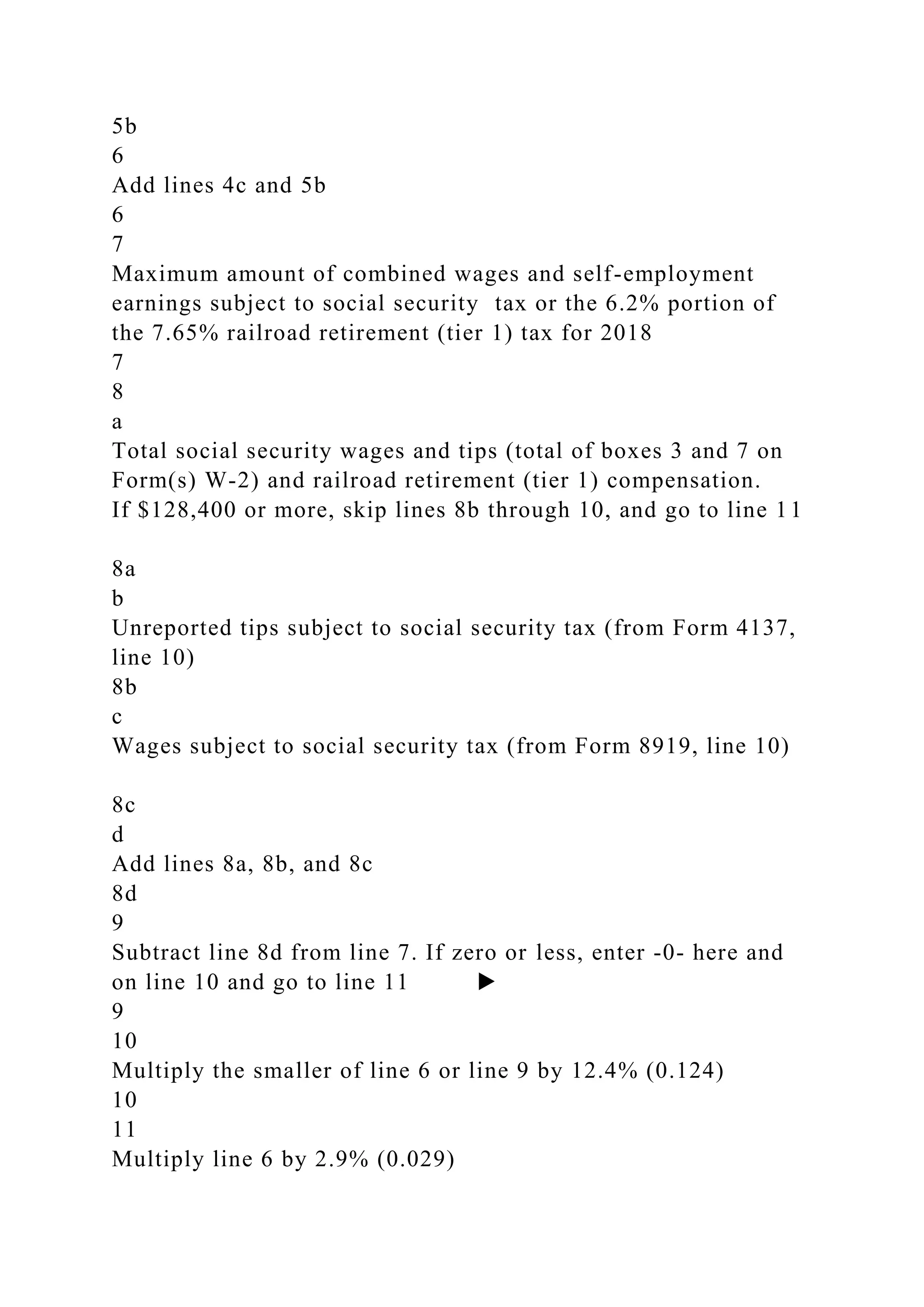
6 Add lines 4c and 5b . . . . . . . . . . . . . . . . . . . . . . . . 6
7 Maximum amount of combined wages and self-employment
earnings subject to social security
tax or the 6.2% portion of the 7.65% railroad retirement (tier 1)
tax for 2018 . . . . . . 7
8 a Total social security wages and tips (total of boxes 3 and 7
on
Form(s) W-2) and railroad retirement (tier 1) compensation.
If $128,400 or more, skip lines 8b through 10, and go to line 11
8a
b Unreported tips subject to social security tax (from Form
4137, line 10) 8b
c Wages subject to social security tax (from Form 8919, line 10)
8c
d Add lines 8a, 8b, and 8c . . . . . . . . . . . . . . . . . . . . . . . 8d
9 Subtract line 8d from line 7. If zero or less, enter -0- here and
on line 10 and go to line 11 . ▶ 9
10 Multiply the smaller of line 6 or line 9 by 12.4% (0.124) . . .
. . . . . . . . . . 10
11 Multiply line 6 by 2.9% (0.029) . . . . . . . . . . . . . . . . . . . . .
11
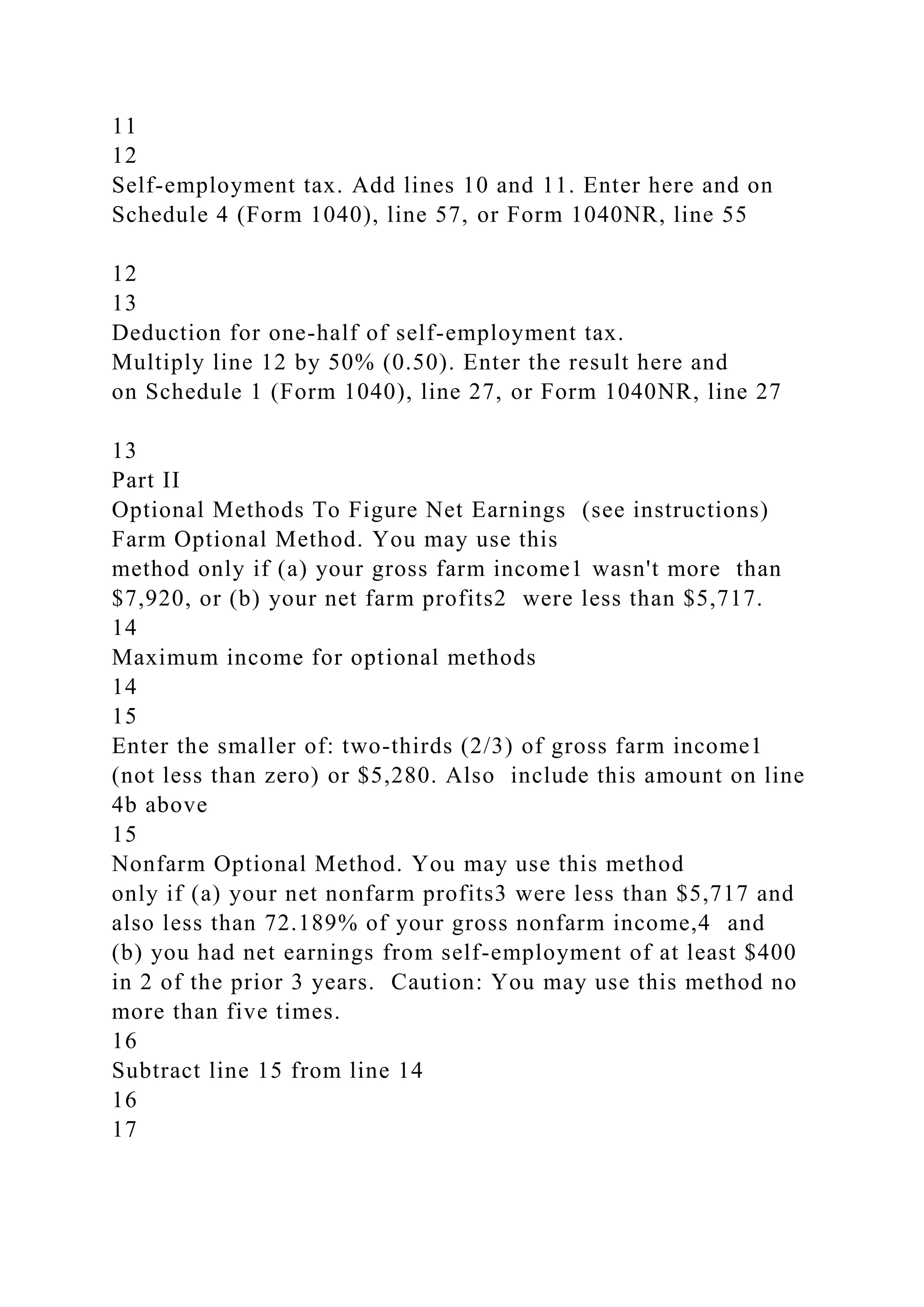
12 Self-employment tax. Add lines 10 and 11. Enter here and on
Schedule 4 (Form 1040), line
57, or Form 1040NR, line 55 . . . . . . . . . . . . . . . . . . . . . 12
13 Deduction for one-half of self-employment tax.
Multiply line 12 by 50% (0.50). Enter the result here and on
Schedule 1 (Form 1040), line 27, or Form 1040NR, line 27 . 13
Part II Optional Methods To Figure Net Earnings (see
instructions)
Farm Optional Method. You may use this method only if (a)
your gross farm income1 wasn't more
than $7,920, or (b) your net farm profits2 were less than
$5,717.
14 Maximum income for optional methods . . . . . . . . . . . . . . . .
. . 14
15 Enter the smaller of: two-thirds (2/3) of gross farm income1
(not less than zero) or $5,280. Also
include this amount on line 4b above . . . . . . . . . . . . . . . . . . .
15
Nonfarm Optional Method. You may use this method only if (a)
your net nonfarm profits3 were less than $5,717
and also less than 72.189% of your gross nonfarm income,4 and
(b) you had net earnings from self-employment
of at least $400 in 2 of the prior 3 years. Caution: You may use
this method no more than five times.
16 Subtract line 15 from line 14 . . . . . . . . . . . . . . . . . . . . . .
16
17
Enter the smaller of: two-thirds (2/3) of gross nonfarm income4
(not less than zero) or the
amount on line 16. Also include this amount on line 4b above . .
. . . . . . . . . 17
1 From Sch. F, line 9, and Sch. K-1 (Form 1065), box 14, code
B.
2 From Sch. F, line 34, and Sch. K-1 (Form 1065), box 14, code
A—minus the
amount you would have entered on line 1b had you not used the
optional
method.
3 From Sch. C, line 31; Sch. C-EZ, line 3; Sch. K-1 (Form
1065), box 14, code
A; and Sch. K-1 (Form 1065-B), box 9, code J1.
4 From Sch. C, line 7; Sch. C-EZ, line 1; Sch. K-1 (Form 1065),
box 14, code
C; and Sch. K-1 (Form 1065-B), box 9, code J2.
Schedule SE (Form 1040) 2018
Version A Cycle 8
INTERNAL USE ONLY
DRAFT AS OF
October 3, 2018
2018 Schedule SE (Form 1040)
SE:W:CAR:MP
Self-Employment Tax
SCHEDULE SE (Form 1040)
Department of the Treasury Internal Revenue Service (99)
Self-Employment Tax
▶ Go to www.irs.gov/ScheduleSE for instructions and the latest
information.
▶ Attach to Form 1040 or Form 1040NR.
OMB No. 1545-0074
2018
2018. Cat. No. 11358Z.
Attachment
Sequence No. 17
Attachment Sequence No. 17. For Paperwork Reduction Act
Notice, see your tax return instructions.
Before you begin: To determine if you must file Schedule SE,
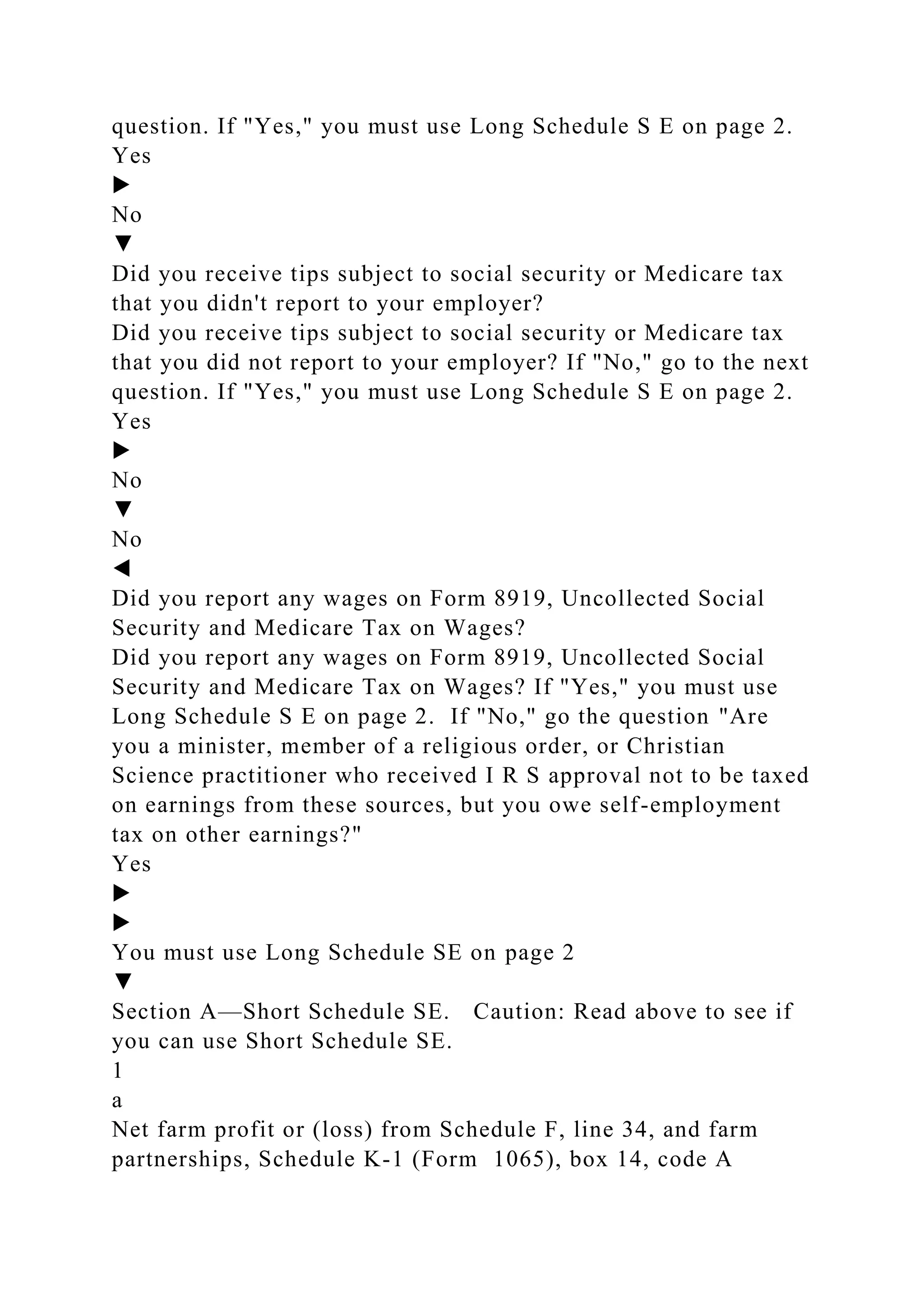
see the instructions.
May I Use Short Schedule SE or Must I Use Long Schedule SE?
Note: Use this flowchart only if you must file Schedule SE. If
unsure, see Who Must File Schedule SE in the instructions.
No
Did you receive wages or tips in 2015? If "No," go to the next
question.
Did you receive wages or tips in 2018?
Yes
Did you receive wages or tips in 2015? If "Yes," go to the next
question.
▼
▼
▼
Are you a minister, member of a religious order, or Christian
Science practitioner who received IRS approval not to be taxed
on earnings from these sources, but you owe self-employment
tax on other earnings?
Are you a minister, member of a religious order, or Christian
Science practitioner who received I R S approval not to be taxed
on earnings from these sources, but you owe self-employment
tax on other earnings? If "No," go to the next question. If
"Yes," You must use Long Schedule S E on page 2.
Yes
▶
No
▼
Are you using one of the optional methods to figure your net
earnings (see instructions)?
Are you using one of the optional methods to figure your net
earnings (see instructions)? If "No," go to the next question. If
"Yes," you must use Long Schedule S E on page 2.
Yes
▶
No
▼
Did you receive church employee income (see instructions)
reported on Form W-2 of $108.28 or more?
Did you receive church employee income (see instructions)
reported on Form W-2 of $108.28 or more? If "No," you may
use Short Schedule S E below. If "Yes," you must use Long
Schedule S E on page 2.
Yes
▶
No
▼
You may use Short Schedule SE below
Was the total of your wages and tips subject to social security
or railroad retirement (tier 1) tax plus your net earnings from
self-employment more than $128,400?
Was the total of your wages and tips subject to social security
or railroad retirement (tier 1) tax plus your net earnings from
self-employment more than $128,400? If "No," go to the next
question. If "Yes," you must use Long Schedule S E on page 2.
Yes
▶
No
▼
Did you receive tips subject to social security or Medicare tax
that you didn't report to your employer?
Did you receive tips subject to social security or Medicare tax
that you did not report to your employer? If "No," go to the next
question. If "Yes," you must use Long Schedule S E on page 2.
Yes
▶
No
▼
No
◀
Did you report any wages on Form 8919, Uncollected Social
Security and Medicare Tax on Wages?
Did you report any wages on Form 8919, Uncollected Social
Security and Medicare Tax on Wages? If "Yes," you must use
Long Schedule S E on page 2. If "No," go the question "Are
you a minister, member of a religious order, or Christian
Science practitioner who received I R S approval not to be taxed
on earnings from these sources, but you owe self-employment
tax on other earnings?"
Yes
▶
▶
You must use Long Schedule SE on page 2
▼
Section A—Short Schedule SE. Caution: Read above to see if
you can use Short Schedule SE.
1
a
Net farm profit or (loss) from Schedule F, line 34, and farm
partnerships, Schedule K-1 (Form 1065), box 14, code A
1a
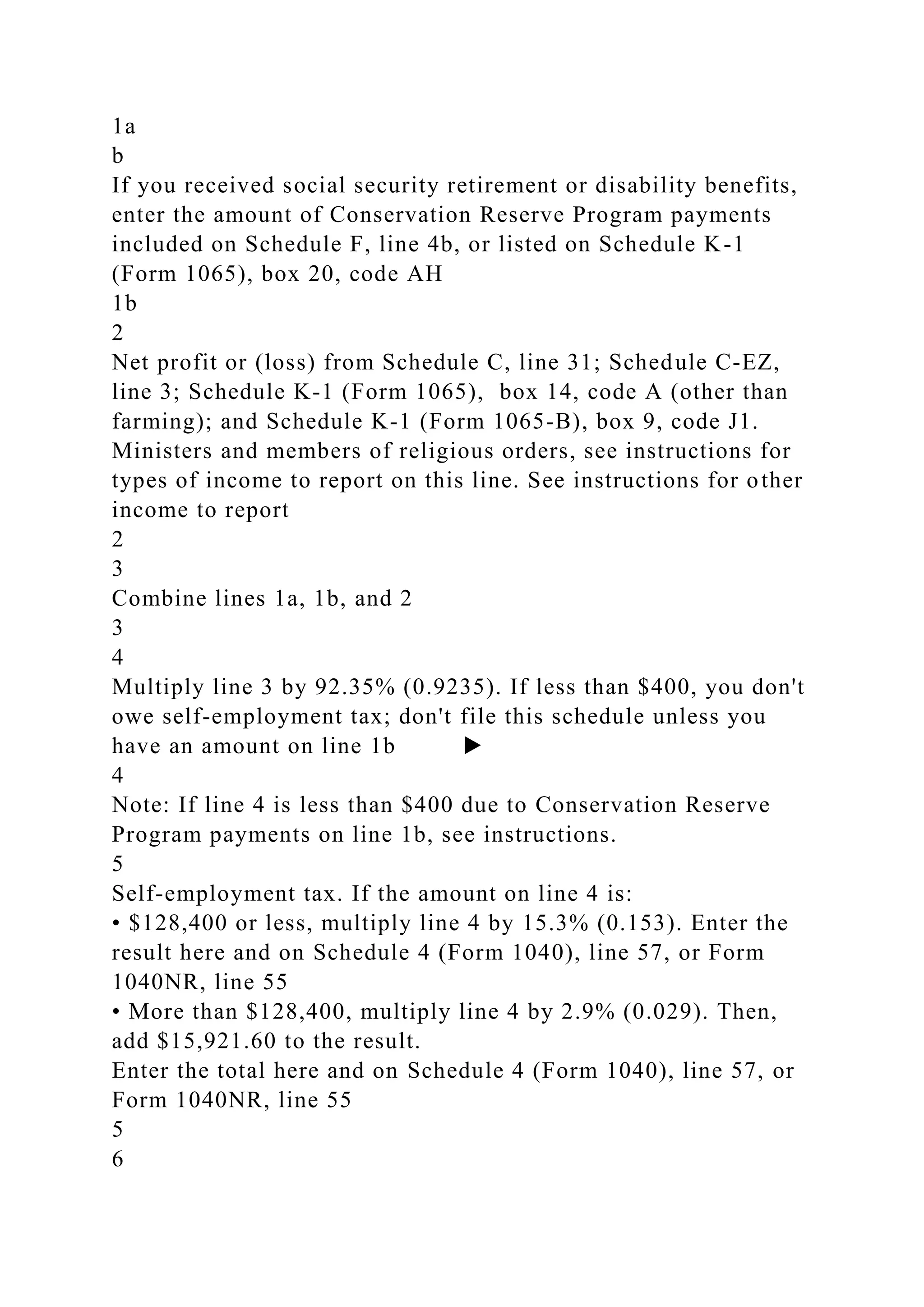
b
If you received social security retirement or disability benefits,
enter the amount of Conservation Reserve Program payments
included on Schedule F, line 4b, or listed on Schedule K-1
(Form 1065), box 20, code AH
1b
2
Net profit or (loss) from Schedule C, line 31; Schedule C-EZ,
line 3; Schedule K-1 (Form 1065), box 14, code A (other than
farming); and Schedule K-1 (Form 1065-B), box 9, code J1.
Ministers and members of religious orders, see instructions for
types of income to report on this line. See instructions for other
income to report
2
3
Combine lines 1a, 1b, and 2
3
4
Multiply line 3 by 92.35% (0.9235). If less than $400, you don't
owe self-employment tax; don't file this schedule unless you
have an amount on line 1b ▶
4
Note: If line 4 is less than $400 due to Conservation Reserve
Program payments on line 1b, see instructions.
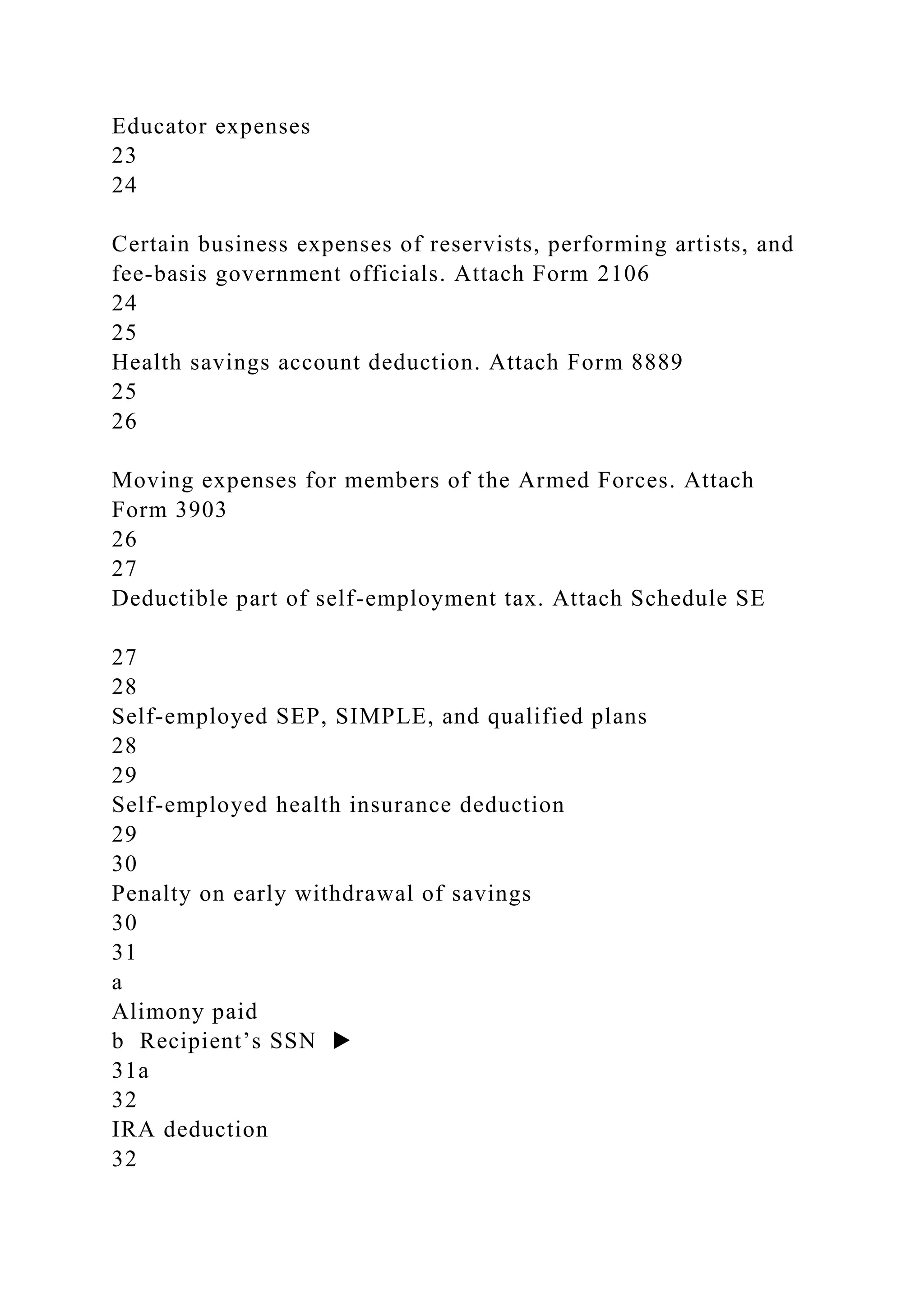
5
Self-employment tax. If the amount on line 4 is:
• $128,400 or less, multiply line 4 by 15.3% (0.153). Enter the
result here and on Schedule 4 (Form 1040), line 57, or Form
1040NR, line 55
• More than $128,400, multiply line 4 by 2.9% (0.029). Then,
add $15,921.60 to the result.
Enter the total here and on Schedule 4 (Form 1040), line 57, or
Form 1040NR, line 55
5
6
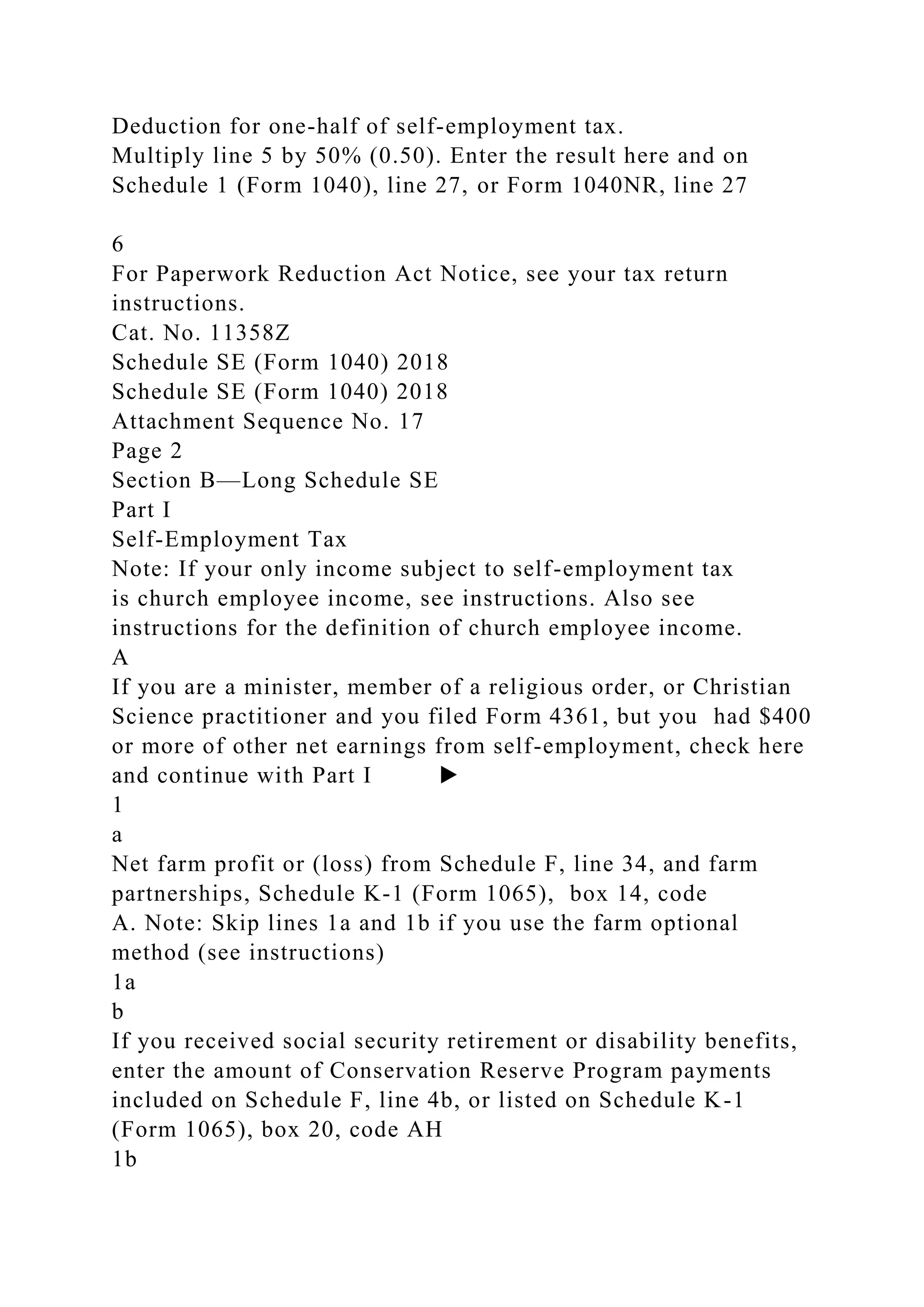
Deduction for one-half of self-employment tax.
Multiply line 5 by 50% (0.50). Enter the result here and on
Schedule 1 (Form 1040), line 27, or Form 1040NR, line 27
6
For Paperwork Reduction Act Notice, see your tax return
instructions.
Cat. No. 11358Z
Schedule SE (Form 1040) 2018
Attachment Sequence No. 17
Page 2
Section B—Long Schedule SE
Part I
Self-Employment Tax
Note: If your only income subject to self-employment tax
is church employee income, see instructions. Also see
instructions for the definition of church employee income.
A
If you are a minister, member of a religious order, or Christian
Science practitioner and you filed Form 4361, but you had $400
or more of other net earnings from self-employment, check here
and continue with Part I ▶
1
a
Net farm profit or (loss) from Schedule F, line 34, and farm
partnerships, Schedule K-1 (Form 1065), box 14, code
A. Note: Skip lines 1a and 1b if you use the farm optional
method (see instructions)
1a
b
If you received social security retirement or disability benefits,
enter the amount of Conservation Reserve Program payments
included on Schedule F, line 4b, or listed on Schedule K-1
(Form 1065), box 20, code AH
1b
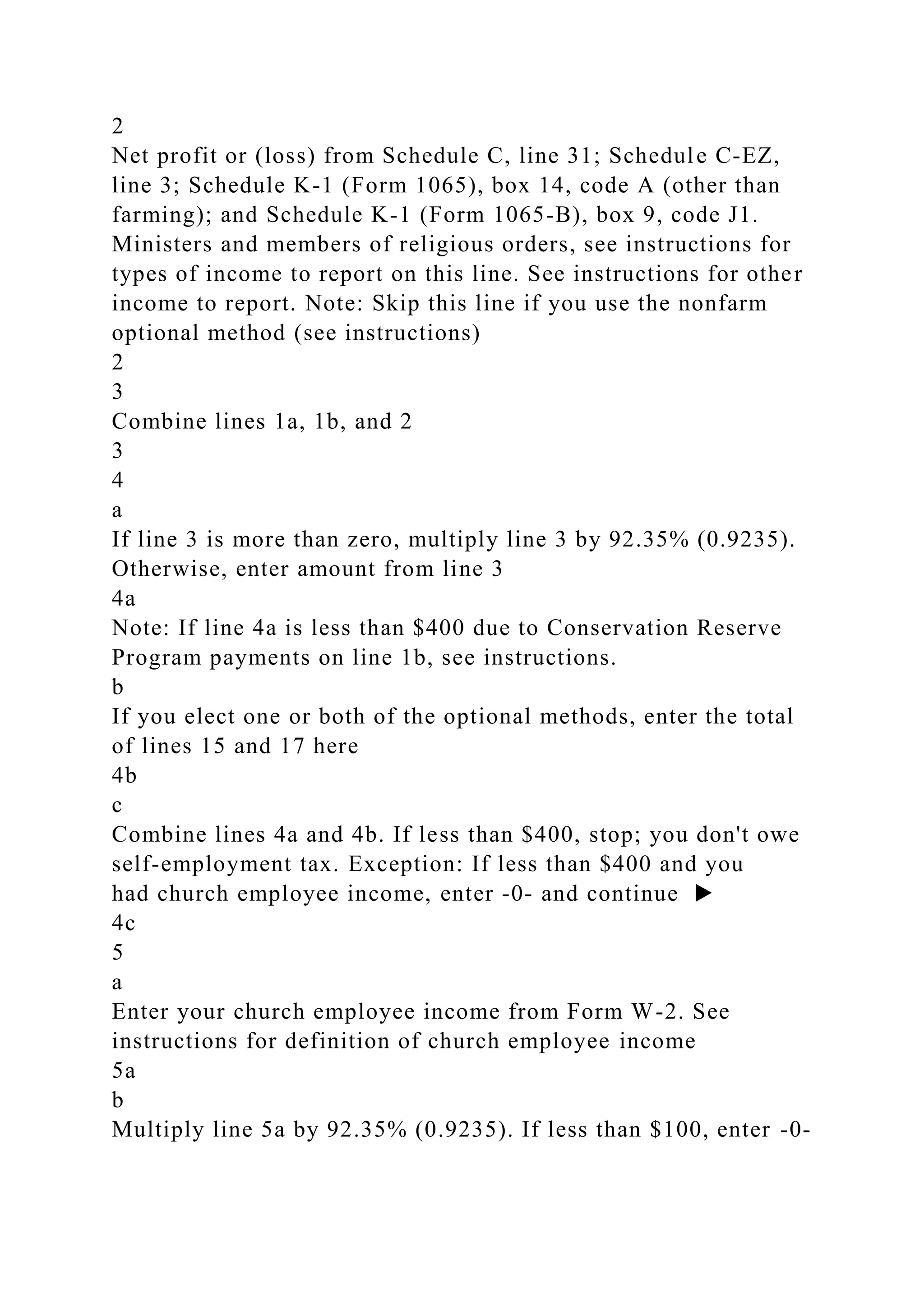
2
Net profit or (loss) from Schedule C, line 31; Schedule C-EZ,
line 3; Schedule K-1 (Form 1065), box 14, code A (other than
farming); and Schedule K-1 (Form 1065-B), box 9, code J1.
Ministers and members of religious orders, see instructions for
types of income to report on this line. See instructions for other
income to report. Note: Skip this line if you use the nonfarm
optional method (see instructions)
2
3
Combine lines 1a, 1b, and 2
3
4
a
If line 3 is more than zero, multiply line 3 by 92.35% (0.9235).
Otherwise, enter amount from line 3
4a
Note: If line 4a is less than $400 due to Conservation Reserve
Program payments on line 1b, see instructions.
b
If you elect one or both of the optional methods, enter the total
of lines 15 and 17 here
4b
c
Combine lines 4a and 4b. If less than $400, stop; you don't owe
self-employment tax. Exception: If less than $400 and you
had church employee income, enter -0- and continue ▶
4c
5
a
Enter your church employee income from Form W-2. See
instructions for definition of church employee income
5a
b
Multiply line 5a by 92.35% (0.9235). If less than $100, enter -0-
5b
6
Add lines 4c and 5b
6
7
Maximum amount of combined wages and self-employment
earnings subject to social security tax or the 6.2% portion of
the 7.65% railroad retirement (tier 1) tax for 2018
7
8
a
Total social security wages and tips (total of boxes 3 and 7 on
Form(s) W-2) and railroad retirement (tier 1) compensation.
If $128,400 or more, skip lines 8b through 10, and go to line 11
8a
b
Unreported tips subject to social security tax (from Form 4137,
line 10)
8b
c
Wages subject to social security tax (from Form 8919, line 10)
8c
d
Add lines 8a, 8b, and 8c
8d
9
Subtract line 8d from line 7. If zero or less, enter -0- here and
on line 10 and go to line 11 ▶
9
10
Multiply the smaller of line 6 or line 9 by 12.4% (0.124)
10
11
Multiply line 6 by 2.9% (0.029)
11
12
Self-employment tax. Add lines 10 and 11. Enter here and on
Schedule 4 (Form 1040), line 57, or Form 1040NR, line 55
12
13
Deduction for one-half of self-employment tax.
Multiply line 12 by 50% (0.50). Enter the result here and
on Schedule 1 (Form 1040), line 27, or Form 1040NR, line 27
13
Part II
Optional Methods To Figure Net Earnings (see instructions)
Farm Optional Method. You may use this
method only if (a) your gross farm income1 wasn't more than
$7,920, or (b) your net farm profits2 were less than $5,717.
14
Maximum income for optional methods
14
15
Enter the smaller of: two-thirds (2/3) of gross farm income1
(not less than zero) or $5,280. Also include this amount on line
4b above
15
Nonfarm Optional Method. You may use this method
only if (a) your net nonfarm profits3 were less than $5,717 and
also less than 72.189% of your gross nonfarm income,4 and
(b) you had net earnings from self-employment of at least $400
in 2 of the prior 3 years. Caution: You may use this method no
more than five times.
16
Subtract line 15 from line 14
16
17
Enter the smaller of: two-thirds (2/3) of gross nonfarm income4
(not less than zero) or the amount on line 16. Also include this
amount on line 4b above
17
1 From Sch. F, line 9, and Sch. K-1 (Form 1065), box 14, code
B.
2 From Sch. F, line 34, and Sch. K-1 (Form 1065), box 14,
code A—minus the amount you would have entered on line 1b
had you not used the optional method.
3 From Sch. C, line 31; Sch. C-EZ, line 3; Sch. K-1 (Form
1065), box 14, code A; and Sch. K-1 (Form 1065-B), box 9,
code J1.
4 From Sch. C, line 7; Sch. C-EZ, line 1; Sch. K-1 (Form 1065),
box 14, code C; and Sch. K-1 (Form 1065-B), box 9, code J2.
Schedule SE (Form 1040) 2018
f1_1: f1_2: f1_3: f1_4: f1_5: f1_6: f1_7: f1_8: f1_9: f1_10:
f1_11: f1_12: f1_13: f1_14: f1_15: f1_16: f2_1: f2_2: c2_1:
0f2_3: f2_4: f2_5: f2_6: f2_7: f2_8: f2_9: f2_10: f2_11: f2_12:
f2_13: f2_14: f2_15: f2_16: f2_17: f2_18: f2_19: f2_20: f2_21:
f2_22: Line7Dollars: 128,400Line7Cents: 00f2_25: f2_26:
f2_27: f2_28: f2_29: f2_30: f2_31: f2_32: f2_33: f2_34: f2_35:
f2_36: f2_37: f2_38: f2_39: f2_40: f2_41: f2_42:
Line14Dollars: 5,280Line14Cents: 00f2_45: f2_46: f2_47:
f2_48: f2_49: f2_50:
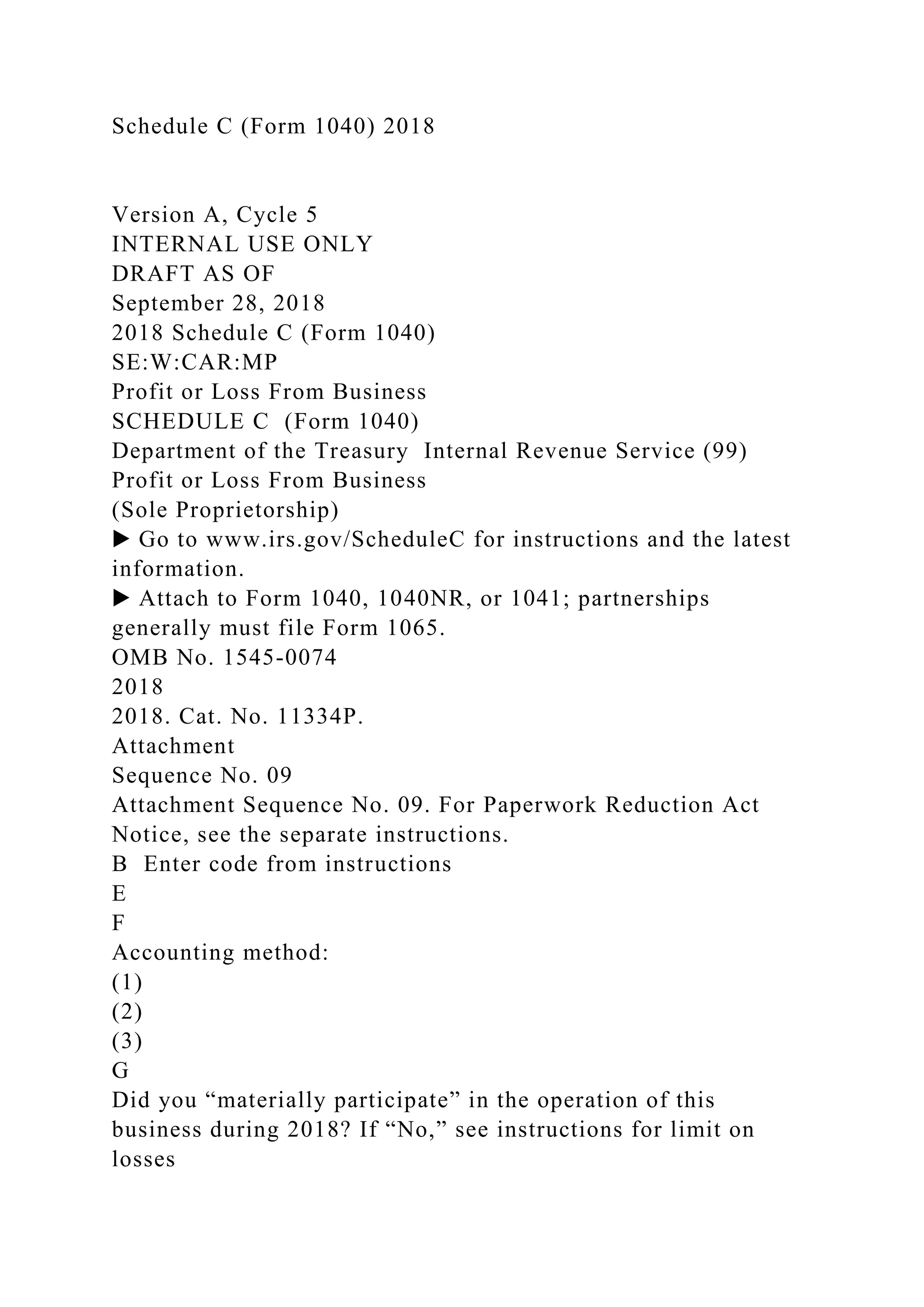
SCHEDULE C
(Form 1040)
Department of the Treasury
Internal Revenue Service (99)
Profit or Loss From Business
(Sole Proprietorship)
▶ Go to www.irs.gov/ScheduleC for instructions and the latest
information.
▶ Attach to Form 1040, 1040NR, or 1041; partnerships
generally must file Form 1065.
OMB No. 1545-0074
2018
Attachment
Sequence No. 09
Name of proprietor Social security number (SSN)
A Principal business or profession, including product or
service (see instructions) B Enter code from instructions
▶
C Business name. If no separate business name, leave
blank. D Employer ID number (EIN) (see instr.)
E Business address (including suite or room no.) ▶
City, town or post office, state, and ZIP code
F Accounting method: (1) Cash (2) Accrual (3) Other (specify)
▶
G Did you “materially participate” in the operation of this
business during 2018? If “No,” see instructions for limit on
losses . Yes No
H If you started or acquired this business during 2018, check
here . . . . . . . . . . . . . . . . . ▶
I Did you make any payments in 2018 that would require you to
file Form(s) 1099? (see instructions) . . . . . . . . Yes No
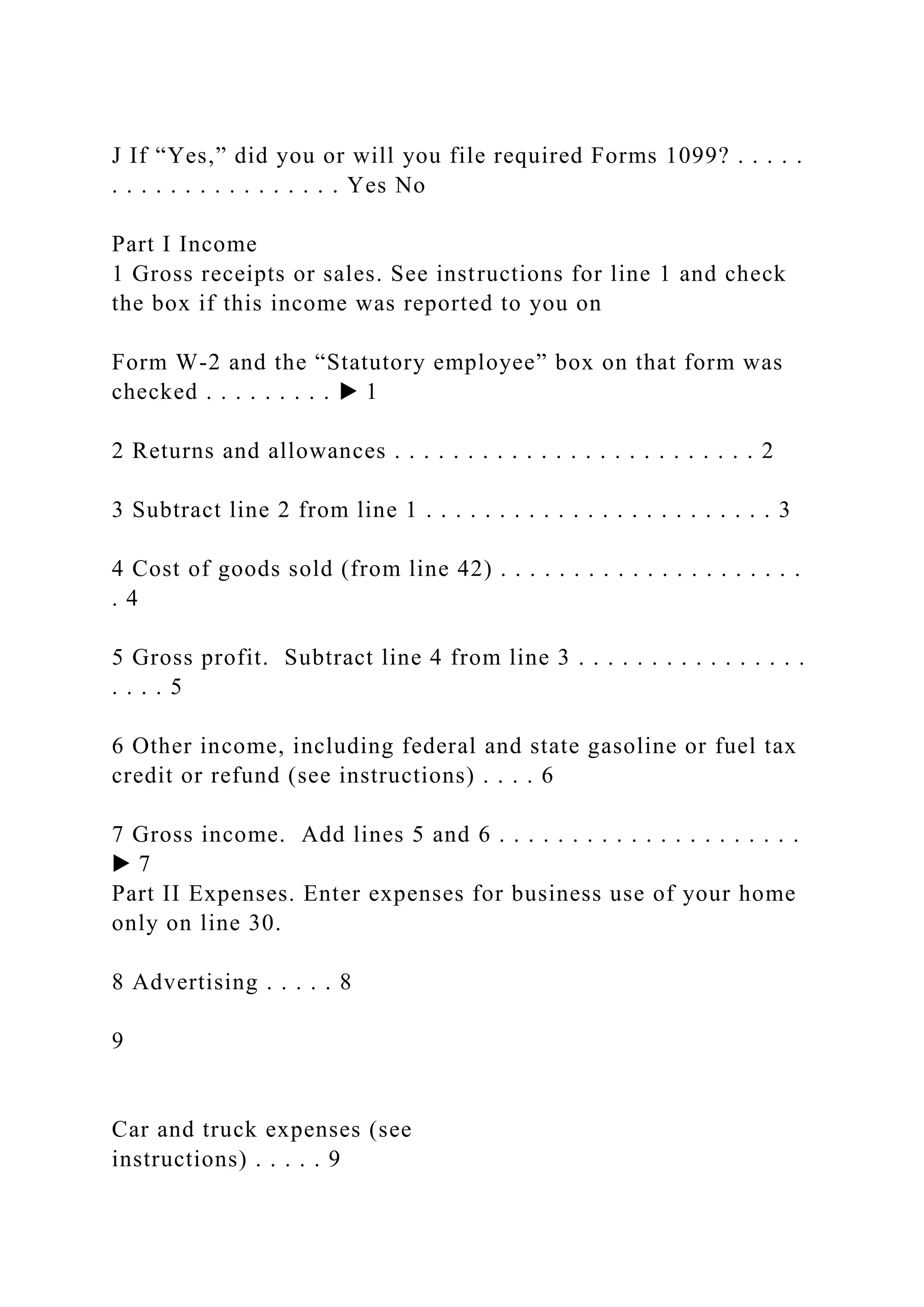
J If “Yes,” did you or will you file required Forms 1099? . . . . .
. . . . . . . . . . . . . . . . Yes No
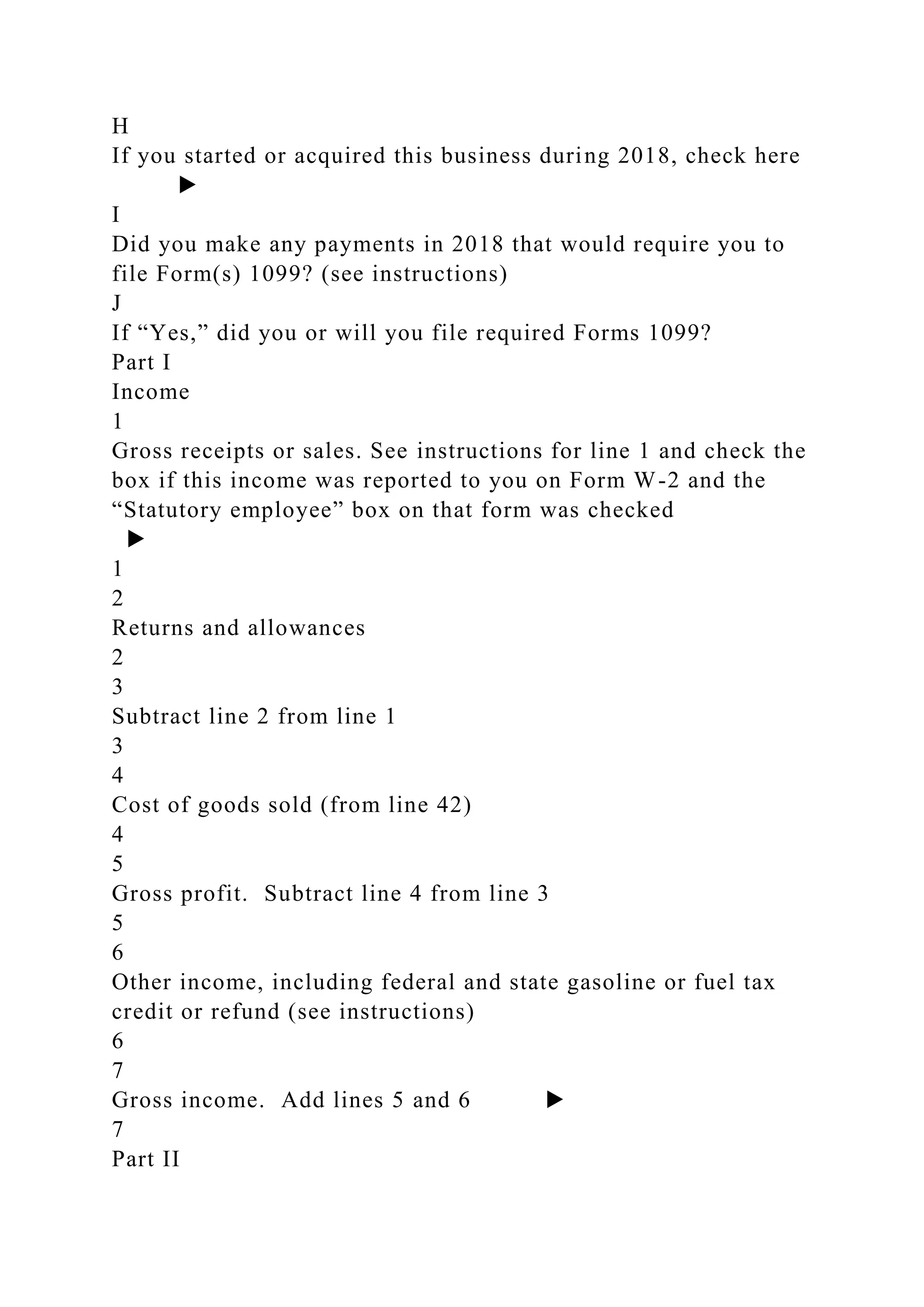
Part I Income
1 Gross receipts or sales. See instructions for line 1 and check
the box if this income was reported to you on
Form W-2 and the “Statutory employee” box on that form was
checked . . . . . . . . . ▶ 1
2 Returns and allowances . . . . . . . . . . . . . . . . . . . . . . . . . 2
3 Subtract line 2 from line 1 . . . . . . . . . . . . . . . . . . . . . . . . 3
4 Cost of goods sold (from line 42) . . . . . . . . . . . . . . . . . . . . .
. 4
5 Gross profit. Subtract line 4 from line 3 . . . . . . . . . . . . . . . .
. . . . 5
6 Other income, including federal and state gasoline or fuel tax
credit or refund (see instructions) . . . . 6
7 Gross income. Add lines 5 and 6 . . . . . . . . . . . . . . . . . . . . .
▶ 7
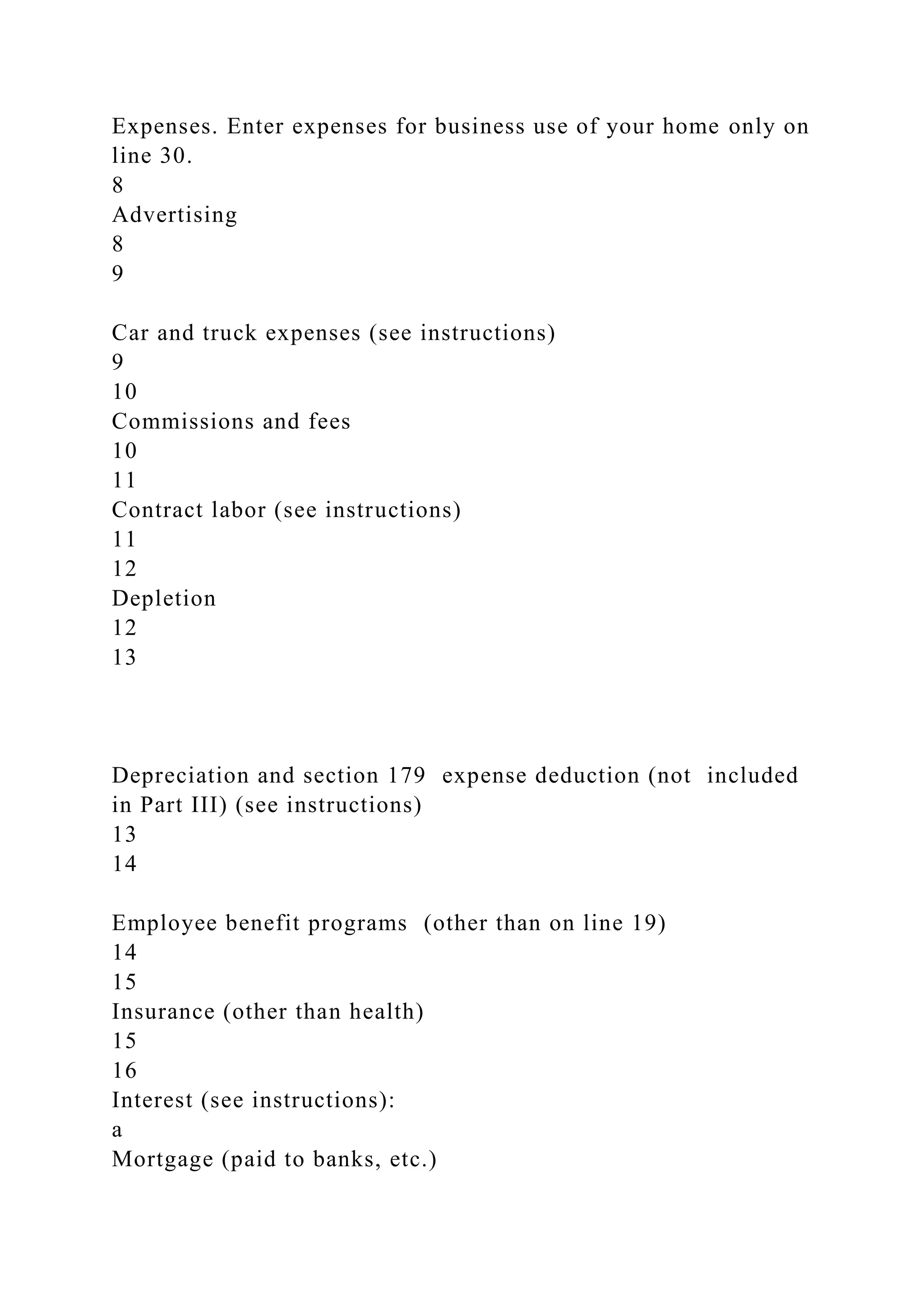
Part II Expenses. Enter expenses for business use of your home
only on line 30.
8 Advertising . . . . . 8
9
Car and truck expenses (see
instructions) . . . . . 9
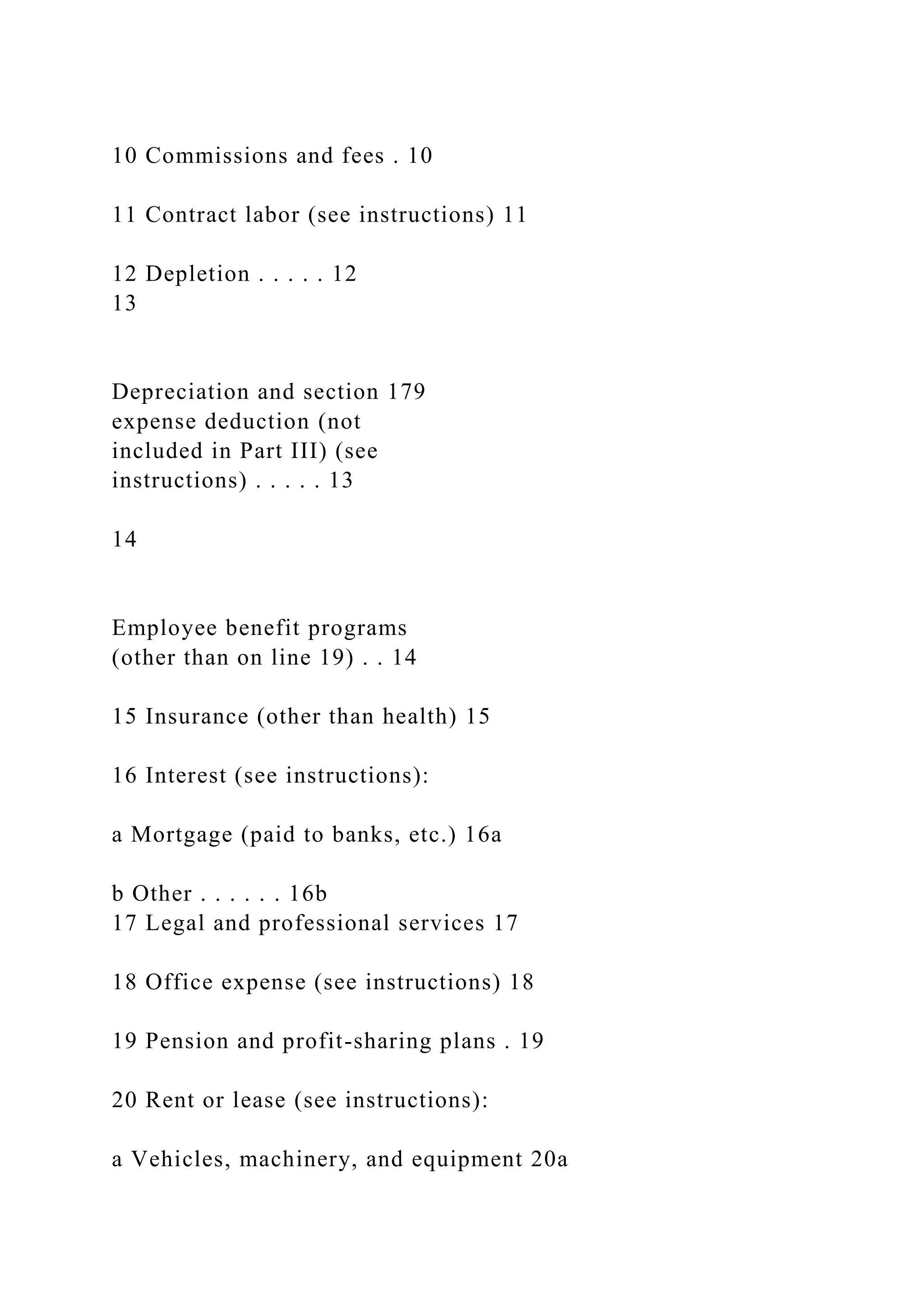
10 Commissions and fees . 10
11 Contract labor (see instructions) 11
12 Depletion . . . . . 12
13
Depreciation and section 179
expense deduction (not
included in Part III) (see
instructions) . . . . . 13
14
Employee benefit programs
(other than on line 19) . . 14
15 Insurance (other than health) 15
16 Interest (see instructions):
a Mortgage (paid to banks, etc.) 16a
b Other . . . . . . 16b
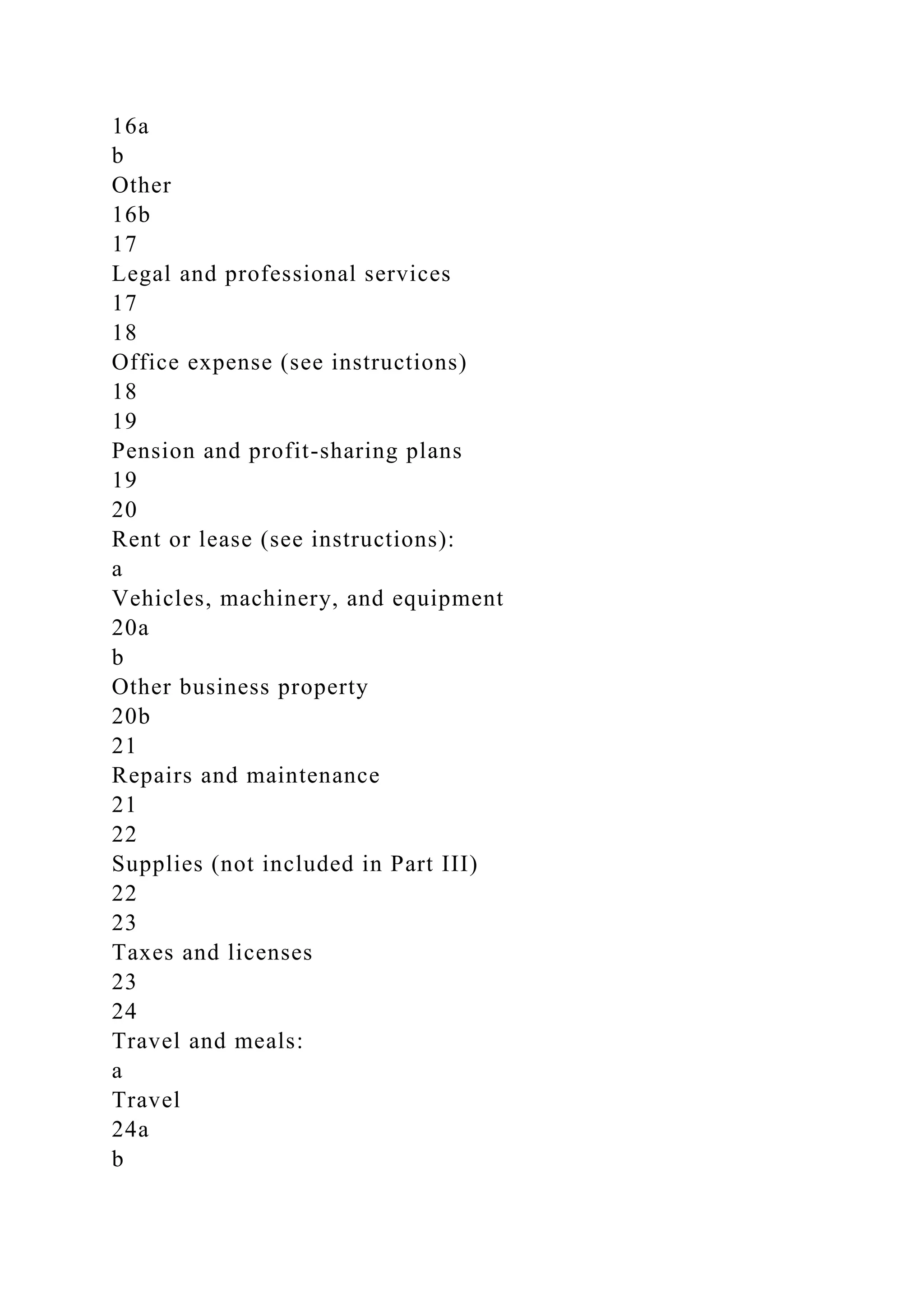
17 Legal and professional services 17
18 Office expense (see instructions) 18
19 Pension and profit-sharing plans . 19
20 Rent or lease (see instructions):
a Vehicles, machinery, and equipment 20a
b Other business property . . . 20b
21 Repairs and maintenance . . . 21
22 Supplies (not included in Part III) . 22
23 Taxes and licenses . . . . . 23
24 Travel and meals:
a Travel . . . . . . . . . 24a
b
Deductible meals (see
instructions) . . . . . . . 24b
25 Utilities . . . . . . . . 25
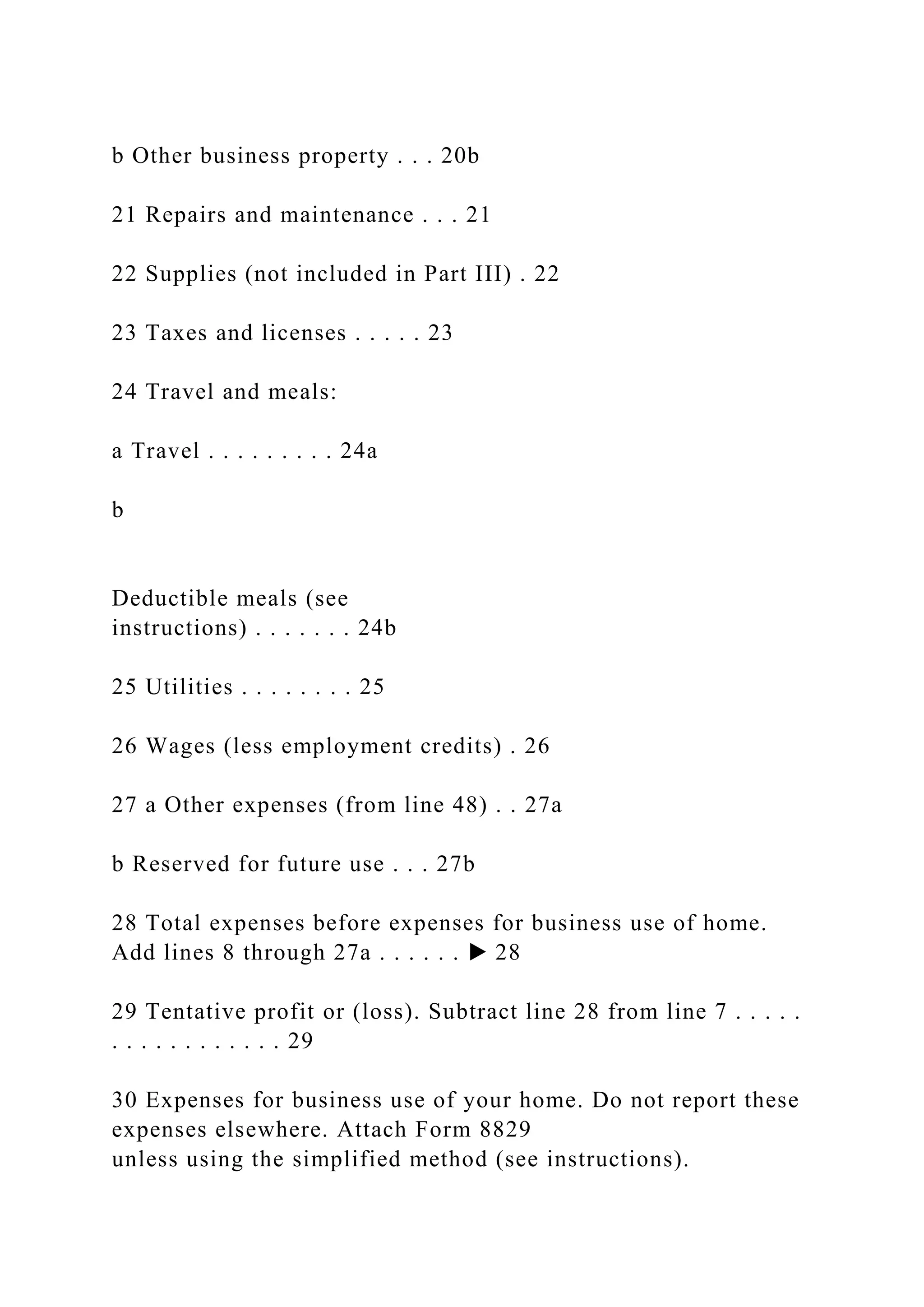
26 Wages (less employment credits) . 26
27 a Other expenses (from line 48) . . 27a
b Reserved for future use . . . 27b
28 Total expenses before expenses for business use of home.
Add lines 8 through 27a . . . . . . ▶ 28
29 Tentative profit or (loss). Subtract line 28 from line 7 . . . . .
. . . . . . . . . . . . 29
30 Expenses for business use of your home. Do not report these
expenses elsewhere. Attach Form 8829
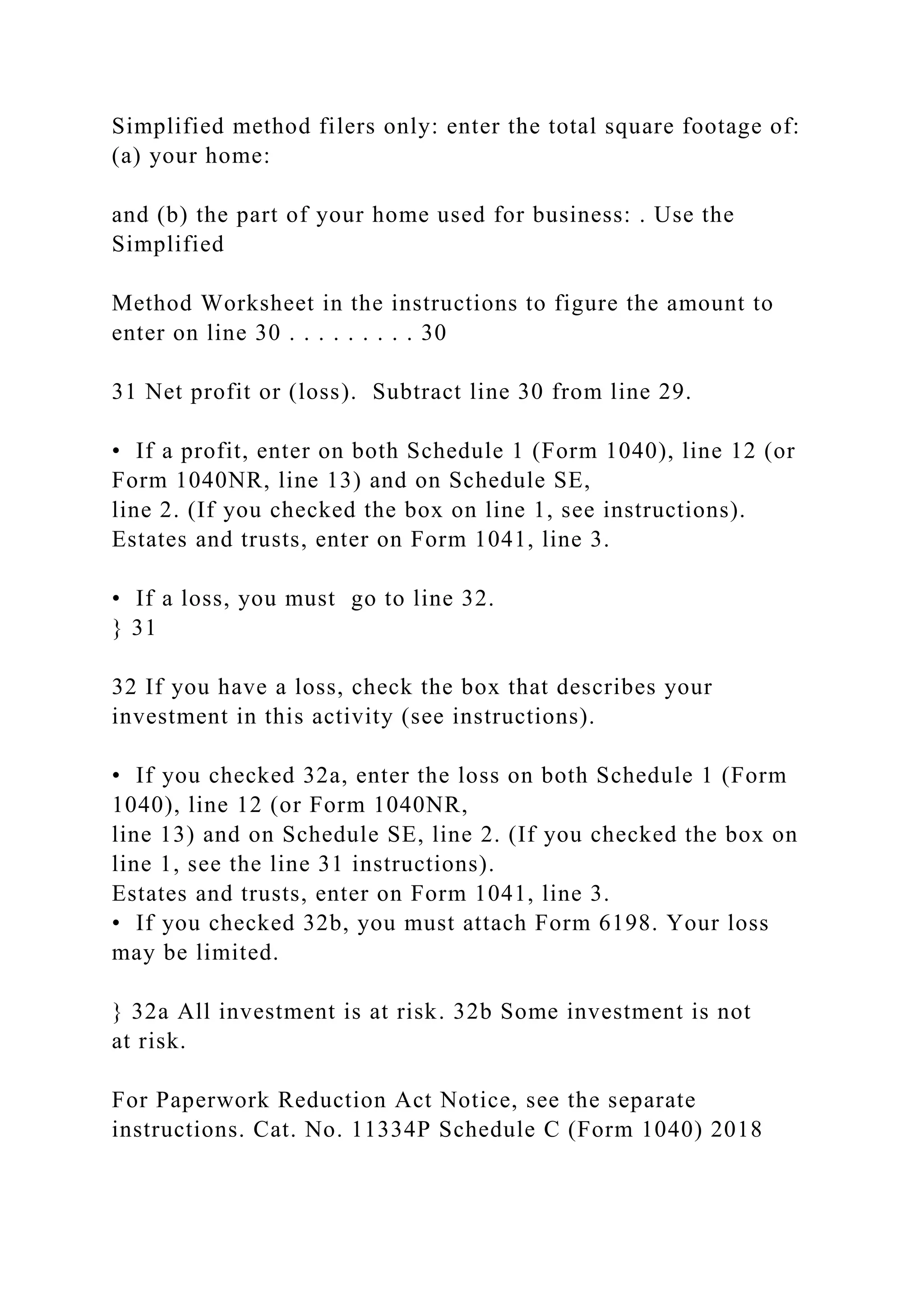
unless using the simplified method (see instructions).
Simplified method filers only: enter the total square footage of:
(a) your home:
and (b) the part of your home used for business: . Use the
Simplified
Method Worksheet in the instructions to figure the amount to
enter on line 30 . . . . . . . . . 30
31 Net profit or (loss). Subtract line 30 from line 29.
• If a profit, enter on both Schedule 1 (Form 1040), line 12 (or
Form 1040NR, line 13) and on Schedule SE,
line 2. (If you checked the box on line 1, see instructions).
Estates and trusts, enter on Form 1041, line 3.
• If a loss, you must go to line 32.
} 31
32 If you have a loss, check the box that describes your
investment in this activity (see instructions).
• If you checked 32a, enter the loss on both Schedule 1 (Form
1040), line 12 (or Form 1040NR,
line 13) and on Schedule SE, line 2. (If you checked the box on
line 1, see the line 31 instructions).
Estates and trusts, enter on Form 1041, line 3.
• If you checked 32b, you must attach Form 6198. Your loss
may be limited.
} 32a All investment is at risk. 32b Some investment is not
at risk.
For Paperwork Reduction Act Notice, see the separate
instructions. Cat. No. 11334P Schedule C (Form 1040) 2018
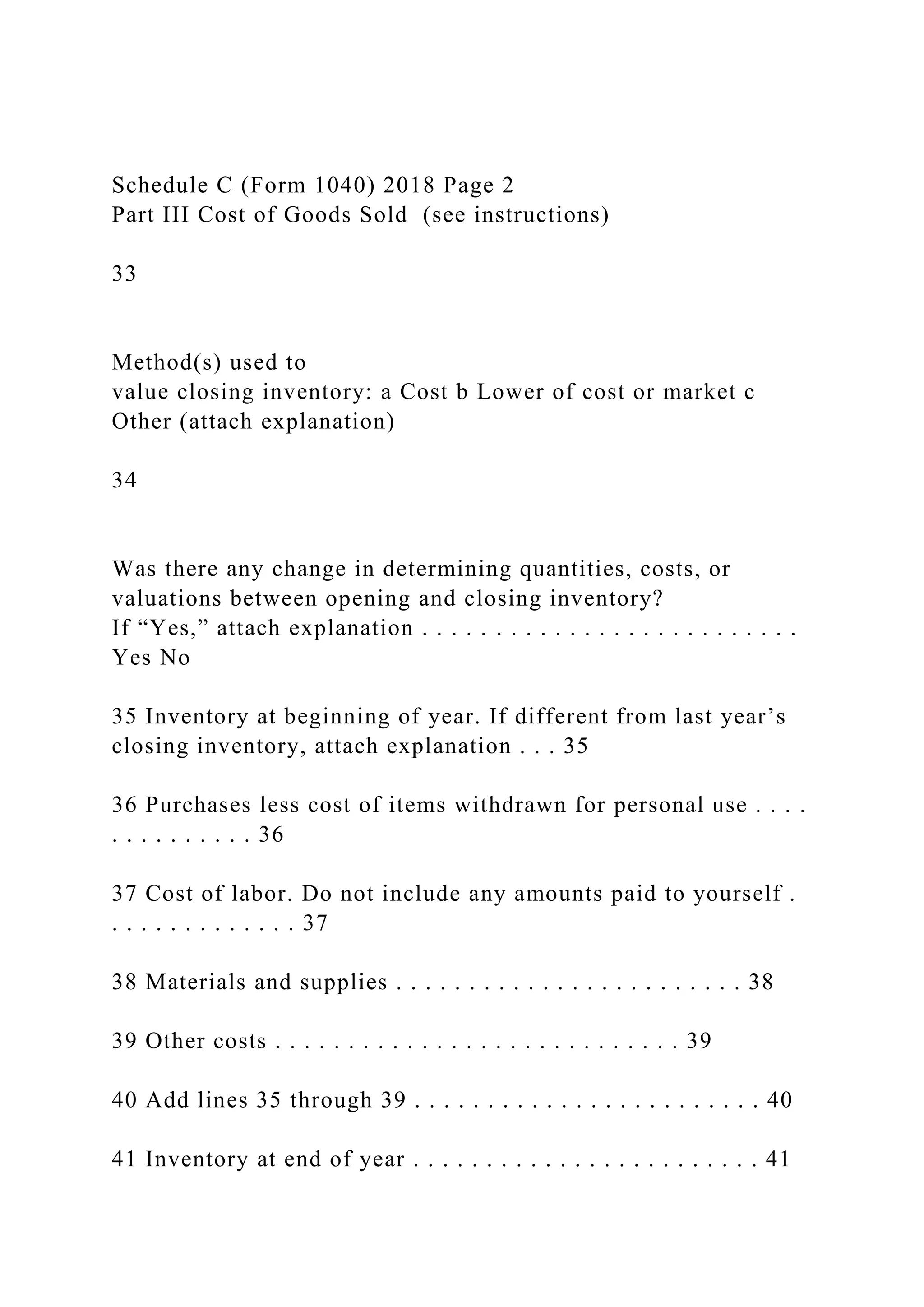
Schedule C (Form 1040) 2018 Page 2
Part III Cost of Goods Sold (see instructions)
33
Method(s) used to
value closing inventory: a Cost b Lower of cost or market c
Other (attach explanation)
34
Was there any change in determining quantities, costs, or
valuations between opening and closing inventory?
If “Yes,” attach explanation . . . . . . . . . . . . . . . . . . . . . . . . . .
Yes No
35 Inventory at beginning of year. If different from last year’s
closing inventory, attach explanation . . . 35
36 Purchases less cost of items withdrawn for personal use . . . .
. . . . . . . . . . 36
37 Cost of labor. Do not include any amounts paid to yourself .
. . . . . . . . . . . . . 37
38 Materials and supplies . . . . . . . . . . . . . . . . . . . . . . . . 38
39 Other costs . . . . . . . . . . . . . . . . . . . . . . . . . . . . 39
40 Add lines 35 through 39 . . . . . . . . . . . . . . . . . . . . . . . . 40
41 Inventory at end of year . . . . . . . . . . . . . . . . . . . . . . . . 41
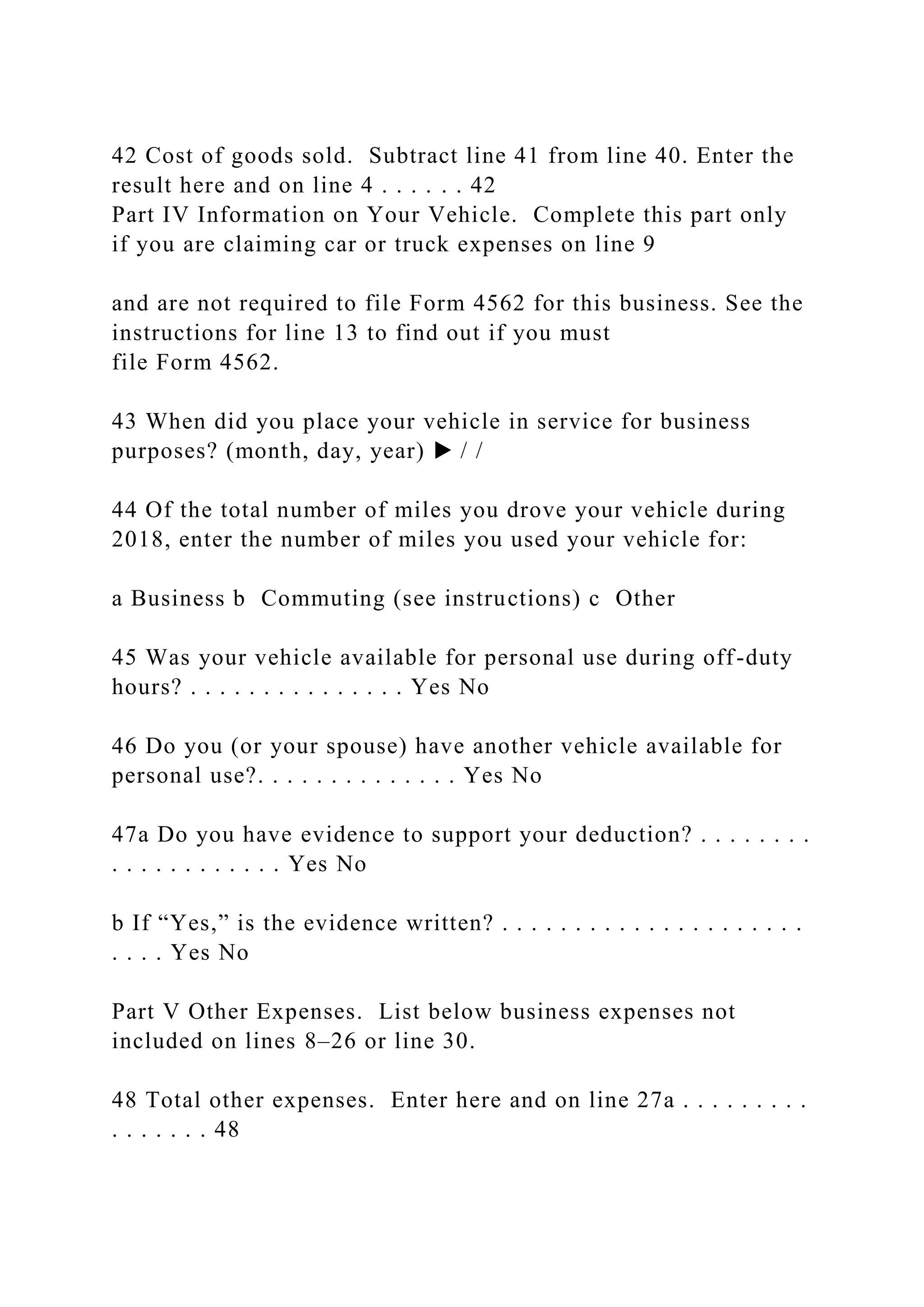
42 Cost of goods sold. Subtract line 41 from line 40. Enter the
result here and on line 4 . . . . . . 42
Part IV Information on Your Vehicle. Complete this part only
if you are claiming car or truck expenses on line 9
and are not required to file Form 4562 for this business. See the
instructions for line 13 to find out if you must
file Form 4562.
43 When did you place your vehicle in service for business
purposes? (month, day, year) ▶ / /
44 Of the total number of miles you drove your vehicle during
2018, enter the number of miles you used your vehicle for:
a Business b Commuting (see instructions) c Other
45 Was your vehicle available for personal use during off-duty
hours? . . . . . . . . . . . . . . . Yes No
46 Do you (or your spouse) have another vehicle available for
personal use?. . . . . . . . . . . . . . Yes No
47a Do you have evidence to support your deduction? . . . . . . . .
. . . . . . . . . . . . Yes No
b If “Yes,” is the evidence written? . . . . . . . . . . . . . . . . . . . . .
. . . . Yes No
Part V Other Expenses. List below business expenses not
included on lines 8–26 or line 30.
48 Total other expenses. Enter here and on line 27a . . . . . . . . .
. . . . . . . 48
Schedule C (Form 1040) 2018
Version A, Cycle 5
INTERNAL USE ONLY
DRAFT AS OF
September 28, 2018
2018 Schedule C (Form 1040)
SE:W:CAR:MP
Profit or Loss From Business
SCHEDULE C (Form 1040)
Department of the Treasury Internal Revenue Service (99)
Profit or Loss From Business
(Sole Proprietorship)
▶ Go to www.irs.gov/ScheduleC for instructions and the latest
information.
▶ Attach to Form 1040, 1040NR, or 1041; partnerships
generally must file Form 1065.
OMB No. 1545-0074
2018
2018. Cat. No. 11334P.
Attachment
Sequence No. 09
Attachment Sequence No. 09. For Paperwork Reduction Act
Notice, see the separate instructions.
B Enter code from instructions
E
F
Accounting method:
(1)
(2)
(3)
G
Did you “materially participate” in the operation of this
business during 2018? If “No,” see instructions for limit on
losses
H
If you started or acquired this business during 2018, check here
▶
I
Did you make any payments in 2018 that would require you to
file Form(s) 1099? (see instructions)
J
If “Yes,” did you or will you file required Forms 1099?
Part I
Income
1
Gross receipts or sales. See instructions for line 1 and check the
box if this income was reported to you on Form W-2 and the
“Statutory employee” box on that form was checked
▶
1
2
Returns and allowances
2
3
Subtract line 2 from line 1
3
4
Cost of goods sold (from line 42)
4
5
Gross profit. Subtract line 4 from line 3
5
6
Other income, including federal and state gasoline or fuel tax
credit or refund (see instructions)
6
7
Gross income. Add lines 5 and 6 ▶
7
Part II
Expenses. Enter expenses for business use of your home only on
line 30.
8
Advertising
8
9
Car and truck expenses (see instructions)
9
10
Commissions and fees
10
11
Contract labor (see instructions)
11
12
Depletion
12
13
Depreciation and section 179 expense deduction (not included
in Part III) (see instructions)
13
14
Employee benefit programs (other than on line 19)
14
15
Insurance (other than health)
15
16
Interest (see instructions):
a
Mortgage (paid to banks, etc.)
16a
b
Other
16b
17
Legal and professional services
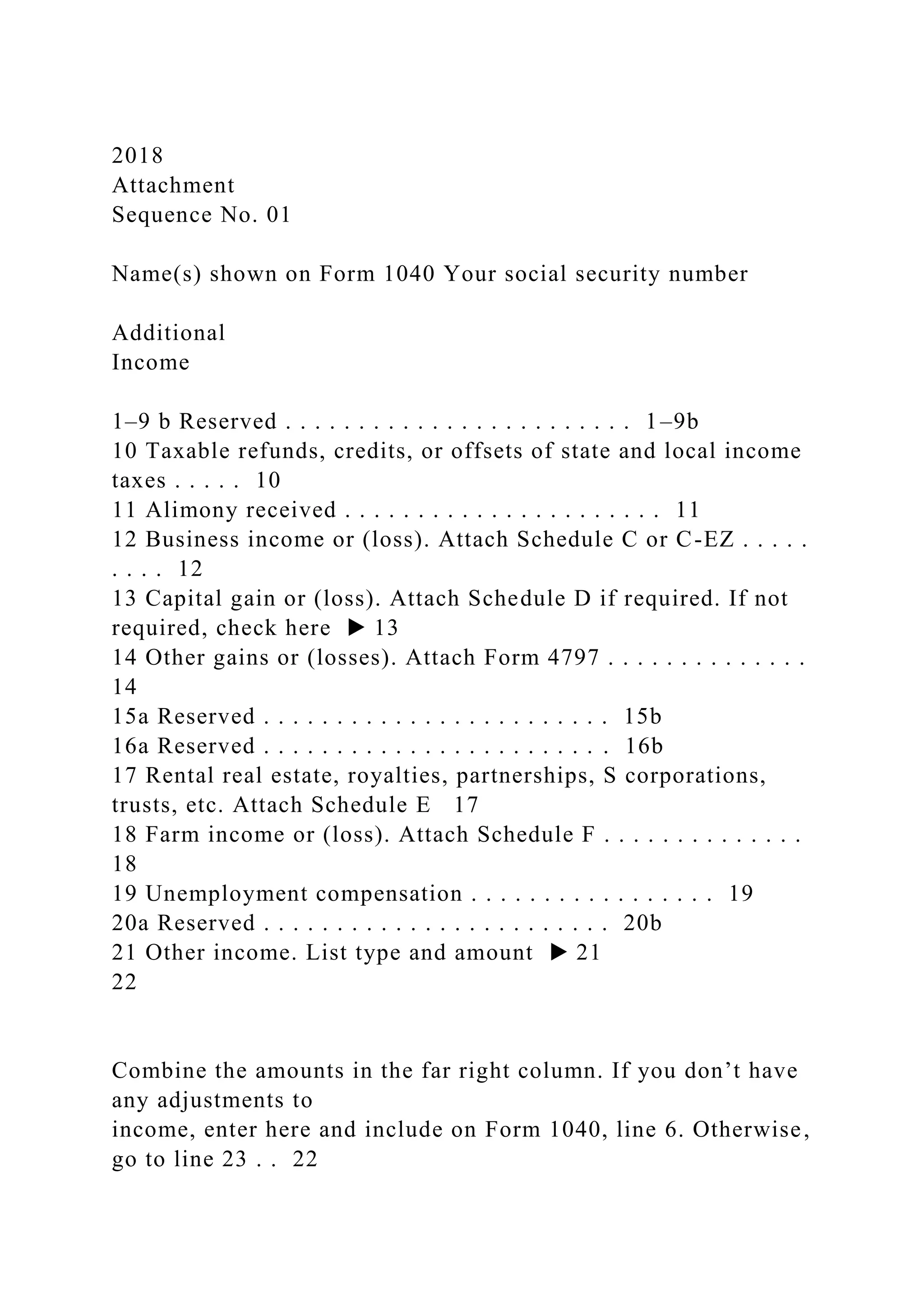
17
18
Office expense (see instructions)
18
19
Pension and profit-sharing plans
19
20
Rent or lease (see instructions):
a
Vehicles, machinery, and equipment
20a
b
Other business property
20b
21
Repairs and maintenance
21
22
Supplies (not included in Part III)
22
23
Taxes and licenses
23
24
Travel and meals:
a
Travel
24a
b
Deductible meals (see instructions)
24b
25
Utilities
25
26
Wages (less employment credits)
26
27
a
Other expenses (from line 48)
27a
b
Reserved for future use
27b
28
Total expenses before expenses for business use of home. Add
lines 8 through 27a ▶
28
29
Tentative profit or (loss). Subtract line 28 from line 7
29
30
Expenses for business use of your home. Do not report these
expenses elsewhere. Attach Form 8829 unless using the
simplified method (see instructions).
. Use the Simplified
Method Worksheet in the instructions to figure the amount to
enter on line 30
30
31
Net profit or (loss). Subtract line 30 from line 29.
• If a profit, enter on both Schedule 1 (Form 1040), line
12 (or Form 1040NR, line 13) and on Schedule SE, line 2. (If
you checked the box on line 1, see instructions). Estates and
trusts, enter on Form 1041, line 3.
• If a loss, you must go to line 32.
}
31
32
If you have a loss, check the box that describes your investment
in this activity (see instructions).
• If you checked 32a, enter the loss on both Schedule 1 (Form
1040), line 12 (or Form 1040NR, line 13) and on Schedule SE,
line 2. (If you checked the box on line 1, see the line 31
instructions). Estates and trusts, enter on Form 1041, line 3.
• If you checked 32b, you must attach Form 6198. Your loss
may be limited.
}
32a
32b
For Paperwork Reduction Act Notice, see the separate
instructions.
Cat. No. 11334P
Schedule C (Form 1040) 2018
Page 2
Part III
Cost of Goods Sold (see instructions)
33
Method(s) used to
value closing inventory:
a
b
c
34
Was there any change in determining quantities, costs, or
valuations between opening and closing inventory?
If “Yes,” attach explanation
35
Inventory at beginning of year. If different from last year’s
closing inventory, attach explanation
35
36
Purchases less cost of items withdrawn for personal use
36
37
Cost of labor. Do not include any amounts paid to yourself
37
38
Materials and supplies
38
39
Other costs
39
40
Add lines 35 through 39
40
41
Inventory at end of year
41
42
Cost of goods sold. Subtract line 41 from line 40. Enter the
result here and on line 4
42
Part IV
Information on Your Vehicle. Complete this part only if you
are claiming car or truck expenses on line 9 and are not required
to file Form 4562 for this business. See the instructions for line
13 to find out if you must file Form 4562.
43
When did you place your vehicle in service for business
purposes? (month, day, year)
44
Of the total number of miles you drove your vehicle during
2018, enter the number of miles you used your vehicle for:
a
45
Was your vehicle available for personal use during off-duty
hours?
46
Do you (or your spouse) have another vehicle available for
personal use?
47
a
Do you have evidence to support your deduction?
b
If “Yes,” is the evidence written?
Part V
Other Expenses. List below business expenses not included on
lines 8–26 or line 30.
48
Total other expenses. Enter here and on line 27a
48
Schedule C (Form 1040) 2018
f1_1: f1_2: f1_3: f1_4: f1_5: f1_6: f1_7: f1_8: c1_1: Offf1_9:
c1_2: c1_3: 0c1_4: c1_5: c1_6: f1_10: f1_11: f1_12: f1_13:
f1_14: f1_15: f1_16: f1_17: f1_18: f1_19: f1_20: f1_21: f1_22:
f1_23: f1_24: f1_25: f1_26: f1_27: f1_28: f1_29: f1_30: f1_31:
f1_32: f1_33: f1_34: f1_35: f1_36: f1_37: f1_38: f1_39: f1_40:
f1_41: f1_42: f1_43: f1_44: f1_45: f1_46: f1_47: f1_48: f1_49:
f1_50: f1_51: f1_52: f1_53: f1_54: f1_55: f1_56: f1_57: f1_58:
f1_59: f1_60: f1_61: f1_62: f1_63: f1_64: f1_65: f1_66: f1_67:
f1_68: f1_69: f1_70: f1_71: f1_72: f1_73: f1_74: f1_75: f1_76:
f1_77: f1_78: f1_79: f1_80: f1_81: c1_7: 0c2_1: c2_2: c2_3:
c2_4: f2_1: f2_2: f2_3: f2_4: f2_5: f2_6: f2_7: f2_8: f2_9:
f2_10: f2_11: f2_12: f2_13: f2_14: f2_15: f2_16: f2_17: f2_18:
f2_19: f2_20: f2_21: f2_22: c2_5: c2_6: c2_7: c2_8: f2_23:
f2_24: f2_25: f2_26: f2_27: f2_28: f2_29: f2_30: f2_31: f2_32:
f2_33: f2_34: f2_35: f2_36: f2_37: f2_38: f2_39: f2_40: f2_41:
f2_42: f2_43: f2_44: f2_45: f2_46: f2_47: f2_48: f2_49: f2_50:
f2_51:
SCHEDULE B
(Form 1040)
Department of the Treasury
Internal Revenue Service (99)
Interest and Ordinary Dividends
▶ Go to www.irs.gov/ScheduleB for instructions and the latest
information.
▶ Attach to Form 1040.
OMB No. 1545-0074
2018
Attachment
Sequence No. 08
Name(s) shown on return Your social security number
Part I
Interest
(See instructions
and the
instructions for
Form 1040,
line 2b.)
Note: If you
received a Form
1099-INT, Form
1099-OID, or
substitute
statement from
a brokerage firm,
list the firm’s
name as the
payer and enter
the total interest
shown on that
form.
1
List name of payer. If any interest is from a seller-financed
mortgage and the
buyer used the property as a personal residence, see the
instructions and list this
interest first. Also, show that buyer’s social security number
and address ▶
1
Amount
2 Add the amounts on line 1 . . . . . . . . . . . . . . . . . . . 2
3
Excludable interest on series EE and I U.S. savings bonds
issued after 1989.
Attach Form 8815 . . . . . . . . . . . . . . . . . . . . . . 3
4
Subtract line 3 from line 2. Enter the result here and on Form
1040, line 2b . . ▶ 4
Note: If line 4 is over $1,500, you must complete Part III.
Amount
Part II
Ordinary
Dividends
(See instructions
and the
instructions for
Form 1040,
line 3b.)
Note: If you
received a Form
1099-DIV or
substitute
statement from
a brokerage firm,
list the firm’s
name as the
payer and enter
the ordinary
dividends shown
on that form.
5 List name of payer ▶
5
6
Add the amounts on line 5. Enter the total here and on Form
1040, line 3b . . ▶ 6
Note: If line 6 is over $1,500, you must complete Part III.
Part III
Foreign
Accounts
and Trusts
(See instructions.)
You must complete this part if you (a) had over $1,500 of
taxable interest or ordinary dividends; (b) had a
foreign account; or (c) received a distribution from, or were a
grantor of, or a transferor to, a foreign trust. Yes No
7
a
At any time during 2018, did you have a financial interest in or
signature authority over a financial
account (such as a bank account, securities account, or
brokerage account) located in a foreign
country? See instructions . . . . . . . . . . . . . . . . . . . . . . . .
If “Yes,” are you required to file FinCEN Form 114, Report of
Foreign Bank and Financial
Accounts (FBAR), to report that financial interest or signature
authority? See FinCEN Form 114
and its instructions for filing requirements and exceptions to
those requirements . . . . . .
b
If you are required to file FinCEN Form 114, enter the name of
the foreign country where the
financial account is located ▶
8
During 2018, did you receive a distribution from, or were you
the grantor of, or transferor to, a
foreign trust? If “Yes,” you may have to file Form 3520. See
instructions . . . . . . . . .
For Paperwork Reduction Act Notice, see your tax return
instructions. Cat. No. 17146N Schedule B (Form 1040) 2018
Version A, Cycle 5
INTERNAL USE ONLY
DRAFT AS OF
October 4, 2018
SCHEDULE B
(Form 1040)
Department of the Treasury Internal Revenue Service (99)
Interest and Ordinary Dividends
▶ Go to www.irs.gov/ScheduleB for instructions and the latest
information.
▶ Attach to Form 1040.
Attach to Form 1040A or 1040. Information about Schedule B
and its instructions is at ww.irs.gov/scheduleb.
OMB No. 1545-0074
2018
2018. Cat. No. 17146N.
Attachment
Sequence No. 08
Attachment Sequence No. 08. For Paperwork Reduction Act
Notice, see your tax return instructions.
Part I
Interest
(See instructions and the instructions for Form 1040,
line 2b.)
Note: If you received a Form 1099-INT, Form 1099-OID,
or substitute statement froma brokerage firm, list the firm’s
name as thepayer and enter the total interest shown on that
form.
1
List name of payer. If any interest is from a seller-financed
mortgage and the buyer used the property as a personal
residence, see the instructions and list this interest first. Also,
show that buyer’s social security number and address ▶
1
Amount
2
Add the amounts on line 1
2
3
Excludable interest on series EE and I U.S. savings bonds
issued after 1989. Attach Form 8815
3
4
Subtract line 3 from line 2. Enter the result here and on Form
1040, line 2b ▶
4
Note: If line 4 is over $1,500, you must complete Part III.
Amount
Part II
Ordinary Dividends
(See instructions and theinstructions for Form 1040,
line 3b.)
Note: If youreceived a Form1099-DIV orsubstitutestatement
froma brokerage firm,list the firm’sname as thepayer and
enterthe ordinarydividends shownon that form.
5
5
6
Add the amounts on line 5. Enter the total here and on Form
1040, line 3b ▶
6
Note: If line 6 is over $1,500, you must complete Part III.
Part III
Foreign Accounts and Trusts
(See instructions.)
You must complete this part if you (a) had over $1,500 of
taxable interest or ordinary dividends; (b) had a foreign
account; or (c) received a distribution from, or were a grantor
of, or a transferor to, a foreign trust.
Yes
No
7
a
At any time during 2018, did you have a financial interest in or
signature authority over a financial account (such as a bank
account, securities account, or brokerage account) located in a
foreign country? See instructions
If “Yes,” are you required to file FinCEN Form 114, Report of
Foreign Bank and Financial Accounts (FBAR), to report that
financial interest or signature authority? See FinCEN Form 114
and its instructions for filing requirements and exceptions to
those requirements
b
If you are required to file FinCEN Form 114, enter the name of
the foreign country where the financial account is located ▶
8
During 2018, did you receive a distribution from, or were you
the grantor of, or transferor to, a foreign trust? If “Yes,” you
may have to file Form 3520. See instructions
For Paperwork Reduction Act Notice, see your tax return
instructions.
Cat. No. 17146N
Schedule B (Form 1040) 2018
8.2.1.3144.1.471865.466429
Interest and Ordinary Dividends
SE:W:CAR:MP
2018 Schedule B (Form 1040)
f1_01: f1_02: f1_03: f1_04: f1_05: f1_06: f1_07: f1_08: f1_09:
f1_10: f1_11: f1_12: f1_13: f1_14: f1_15: f1_16: f1_17: f1_18:
f1_19: f1_20: f1_21: f1_22: f1_23: f1_24: f1_25: f1_26: f1_27:
f1_28: f1_29: f1_30: f1_31: f1_32: f1_33: f1_34: f1_35: f1_36:
f1_37: f1_38: f1_39: f1_40: f1_41: f1_42: f1_43: f1_44: f1_45:
f1_46: f1_47: f1_48: f1_49: f1_50: f1_51: f1_52: f1_53: f1_54:
f1_55: f1_56: f1_57: f1_58: f1_59: f1_60: f1_61: f1_62: f1_63:
f1_64: f1_65: f1_66: f1_67: f1_68: f1_69: f1_70: f1_71: f1_72:
f1_73: f1_74: f1_75: f1_76: f1_77: f1_78: f1_79: f1_80: f1_81:
f1_82: f1_83: f1_84: f1_85: f1_86: f1_87: f1_88: f1_89: f1_90:
f1_91: f1_92: f1_93: f1_94: f1_95: f1_96: f1_97: f1_98: f1_99:
f1_100: c1_1: 0c1_2: 0f1_101: c1_3: 0
SCHEDULE A
(Form 1040)
Department of the Treasury
Internal Revenue Service (99)
Itemized Deductions
▶ Go to www.irs.gov/ScheduleA for instructions and the latest
information.
▶ Attach to Form 1040.
Caution: If you are claiming a net qualified disaster loss on
Form 4684, see the instructions for line 16.
OMB No. 1545-0074
2018
Attachment
Sequence No. 07
Name(s) shown on Form 1040 Your social security number
Medical
and
Dental
Expenses
Caution: Do not include expenses reimbursed or paid by others.
1 Medical and dental expenses (see instructions) . . . . . 1
2 Enter amount from Form 1040, line 7 2
3 Multiply line 2 by 7.5% (0.075) . . . . . . . . . . . 3
4 Subtract line 3 from line 1. If line 3 is more than line 1, enter
-0- . . . . . . . . 4
Taxes You
Paid
5 State and local taxes.
a
State and local income taxes or general sales taxes. You may
include either income taxes or general sales taxes on line 5a,
but not both. If you elect to include general sales taxes instead
of income taxes, check this box . . . . . . . . ▶ 5a
b State and local real estate taxes (see instructions) . . . . . 5b
c State and local personal property taxes . . . . . . . . 5c
d Add lines 5a through 5c . . . . . . . . . . . . . 5d
e Enter the smaller of line 5d or $10,000 ($5,000 if married
filing
separately) . . . . . . . . . . . . . . . . . 5e
6 Other taxes. List type and amount ▶
6
7 Add lines 5e and 6 . . . . . . . . . . . . . . . . . . . . . . 7
Interest You
Paid
Caution: Your
mortgage interest
deduction may be
limited (see
instructions).
8
Home mortgage interest and points. If you didn't use all of your
home mortgage loan(s) to buy, build, or improve your home,
see instructions and check this box . . . . . . . ▶
a
Home mortgage interest and points reported to you on Form
1098 . . . . . . . . . . . . . . . . . . . 8a
b
Home mortgage interest not reported to you on Form 1098. If
paid to the person from whom you bought the home, see
instructions and show that person's name, identifying no., and
address ▶
8b
c Points not reported to you on Form 1098. See instructions for
special rules . . . . . . . . . . . . . . . . . 8c
d Reserved . . . . . . . . . . . . . . . . . . 8d
e Add lines 8a through 8c . . . . . . . . . . . . . 8e
9
Investment interest. Attach Form 4952 if required. See
instructions . . . . . . . . . . . . . . . . . 9
10 Add lines 8e and 9 . . . . . . . . . . . . . . . . . . . . . . 10
Gifts to
Charity
11 Gifts by cash or check. If you made any gift of $250 or
more,
see instructions . . . . . . . . . . . . . . .
If you made a
gift and got a
benefit for it,
see instructions.
11
12
Other than by cash or check. If any gift of $250 or more, see
instructions. You must attach Form 8283 if over $500 . . . 12
13 Carryover from prior year . . . . . . . . . . . . 13
14 Add lines 11 through 13 . . . . . . . . . . . . . . . . . . . . . 14
Casualty and
Theft Losses
15
Casualty and theft loss(es) from a federally declared disaster
(other than net qualified
disaster losses). Attach Form 4684 and enter the amount from
line 18 of that form. See
instructions . . . . . . . . . . . . . . . . . . . . . . . . . 15
Other
Itemized
Deductions
16 Other—from list in instructions. List type and amount ▶
16
Total
Itemized
Deductions
17
Add the amounts in the far right column for lines 4 through 16.
Also, enter this amount on
Form 1040, line 8 . . . . . . . . . . . . . . . . . . . . . . . 17
18
If you elect to itemize deductions even though they are less than
your standard
deduction, check here . . . . . . . . . . . . . . . . . . . ▶
For Paperwork Reduction Act Notice, see the Instructions for
Form 1040. Cat. No. 17145C Schedule A (Form 1040) 2018
Version B, Cycle 13
IINTERNAL USE ONLY
DRAFT AS OF
November 15, 2018
2018 Schedule A (Form 1040)
SE:W:CAR:MP
Itemized Deductions
SCHEDULE A (Form 1040)
Department of the Treasury Internal Revenue Service (99)
Itemized Deductions
▶ Go to www.irs.gov/ScheduleA for instructions and the latest
information.
▶ Attach to Form 1040.
Caution: If you are claiming a net qualified disaster loss on
Form 4684, see the instructions for line 16.
OMB No. 1545-0074
2018
2018. Cat. No. 17145C.
Attachment
Sequence No. 07
Attachment Sequence No. 07. For Paperwork Reduction Act
Notice, see the instructions for Form 1040 instructions.
Medical
and
Dental Expenses
Caution: Do not include expenses reimbursed or paid by others.
1
Medical and dental expenses (see instructions)
1
2
Enter amount from Form 1040, line 7
2
3
Multiply line 2 by 7.5% (0.075)
3
4
Subtract line 3 from line 1. If line 3 is more than line 1, enter -
0-
4
Taxes You Paid
5
State and local taxes.
a
State and local income taxes or general sales taxes. You may
include either income taxes or general sales taxes on line 5a,
but not both. If you elect to include general sales taxes instead
of income taxes, check this box ▶
5a
b
State and local real estate taxes (see instructions)
5b
c
State and local personal property taxes
5c
d
Add lines 5a through 5c
5d
e
Enter the smaller of line 5d or $10,000 ($5,000 if married filing
separately)
5e
6
6
7
Add lines 5e and 6
7
Interest You Paid
Caution: Your mortgage interest deduction may be limited (see
instructions).
8
Home mortgage interest and points. If you didn't use all of your
home mortgage loan(s) to buy, build, or improve your home, see
instructions and check this box ▶
a
Home mortgage interest and points reported to you on Form
1098
8a
b
Home mortgage interest not reported to you on Form 1098. If
paid to the person from whom you bought the home, see
instructions and show that person's name, identifying no., and
8b
c
Points not reported to you on Form 1098. See instructions for
special rules
8c
d
Reserved
8d
e
Add lines 8a through 8c
8e
9
Investment interest. Attach Form 4952 if required. See
instructions
9
10
Add lines 8e and 9
10
Gifts to Charity
11
Gifts by cash or check. If you made any gift of $250 or more,
see instructions
If you made agift and got abenefit for it,see instructions.
11
12
Other than by cash or check. If any gift of $250 or more, see
instructions. You must attach Form 8283 if over $500
12
13
Carryover from prior year
13
14
Add lines 11 through 13
14
Casualty and
Theft Losses
15
Casualty and theft loss(es) from a federally declared disaster
(other than net qualified disaster losses). Attach Form 4684 and
enter the amount from line 18 of that form. See instructions
15
Other Itemized Deductions
16
16
Total
Itemized Deductions
17
Add the amounts in the far right column for lines 4 through 16.
Also, enter this amount on Form 1040, line 8
17
18
If you elect to itemize deductions even though they are less than
your standard deduction, check here ▶
For Paperwork Reduction Act Notice, see the Instructions for
Form 1040.
Cat. No. 17145C
Schedule A (Form 1040) 2018
f1_1: f1_2: f1_3: f1_4: f1_5: f1_6: f1_7: f1_8: f1_9: f1_10:
c1_1: f1_11: f1_12: f1_13: f1_14: f1_15: f1_16: f1_17: f1_18:
f1_19: f1_20: f1_21: f1_22: f1_23: f1_24: f1_25: f1_26: c1_2:
f1_27: f1_28: f1_29: f1_30: f1_31: f1_32: f1_33: f1_34: f1_35:
f1_36: f1_37: f1_38: f1_39: f1_40: f1_41: f1_42: f1_43: f1_44:
f1_45: f1_46: f1_47: f1_48: f1_49: f1_50: f1_51: f1_52: f1_53:
f1_54: f1_55: f1_56: f1_57: f1_58: f1_59: c1_3:
SCHEDULE 5
(Form 1040)
Department of the Treasury
Internal Revenue Service
Other Payments and Refundable Credits
▶ Attach to Form 1040.
▶ Go to www.irs.gov/Form1040 for instructions and the latest
information.
OMB No. 1545-0074
2018
Attachment
Sequence No. 05
Name(s) shown on Form 1040 Your social security number
Other
Payments
and
Refundable
Credits
65 Reserved . . . . . . . . . . . . . . . . . . . . . . . . 65
66 2018 estimated tax payments and amount applied from 2017
return . . . . 66
67a Reserved . . . . . . . . . . . . . . . . . . . . . . . . 67a
b Reserved . . . . . . . . . . . . . . . . . . . . . . . . 67b
68–69 Reserved . . . . . . . . . . . . . . . . . . . . . . . . 68–69
70 Net premium tax credit. Attach Form 8962 . . . . . . . . . . . . .
70
71 Amount paid with request for extension to file (see
instructions) . . . . . . 71
72 Excess social security and tier 1 RRTA tax withheld . . . . . .
. . . . 72
73 Credit for federal tax on fuels. Attach Form 4136 . . . . . . . .
. . . 73
74 Credits from Form: a 2439 b Reserved c 8885 d 74
75 Add the amounts in the far right column. These are your total
other payments
and refundable credits. Enter here and include on Form 1040,
line 17 . . . . 75
For Paperwork Reduction Act Notice, see your tax return
instructions. Cat. No. 71482C Schedule 5 (Form 1040) 2018
Version B, Cycle 6
INTERNAL USE ONLY
DRAFT AS OF
October 5, 2018
SCHEDULE 5
(Form 1040)
Department of the Treasury Internal Revenue Service
Other Payments and Refundable Credits
▶ Attach to Form 1040.
▶ Go to www.irs.gov/Form1040 for instructions and the latest
information.
OMB No. 1545-0074
2018
2018. Cat. Number 71482C.
Attachment
Sequence No. 05
Attachment Sequence No. 05. For Paperwork Reduction Act
Notice, see your tax return instructions.
Other
Payments and Refundable Credits
65
Reserved
65
66
2018 estimated tax payments and amount applied from 2017
return
66
67
a
Reserved
67a
b
Reserved
67b
68–69
Reserved
68–69
70
Net premium tax credit. Attach Form 8962
70
71
Amount paid with request for extension to file (see instructions)
71
72
Excess social security and tier 1 RRTA tax withheld
72
73
Credit for federal tax on fuels. Attach Form 4136
73
74
Credits from Form:
a
2439
b
Reserved
c
8885
d
74
75
Add the amounts in the far right column. These are your
total other payments and refundable credits. Enter here and
include on Form 1040, line 17
75
For Paperwork Reduction Act Notice, see your tax return
instructions.
Cat. No. 71482C
Schedule 5 (Form 1040) 2018
8.2.1.3144.1.471865.466429
Other Payments and Refundable Credits
SE:W:CAR:MP
2018 Schedule 5 (Form 1040)
f1_1: f1_2: f1_3: f1_4: f1_5: f1_6: f1_7: f1_8: f1_9: f1_10:
f1_11: f1_12: f1_13: f1_14: f1_15: f1_16: f1_17: f1_18: f1_19:
f1_20: c1_1: f1_21: f1_22: f1_23: f1_24: f1_25:
SCHEDULE 4
(Form 1040)
Department of the Treasury
Internal Revenue Service
Other Taxes
▶ Attach to Form 1040.
▶ Go to www.irs.gov/Form1040 for instructions and the latest
information.
OMB No. 1545-0074
2018
Attachment
Sequence No. 04
Name(s) shown on Form 1040 Your social security number
Other
Taxes
57 Self-employment tax. Attach Schedule SE . . . . . . . . . . . .
57
58 Unreported social security and Medicare tax from: Form a
4137 b 8919 58
59
Additional tax on IRAs, other qualified retirement plans, and
other tax-favored
accounts. Attach Form 5329 if required . . . . . . . . . . . . . 59
60a Household employment taxes. Attach Schedule H . . . . . . . .
. . 60a
b Repayment of first-time homebuyer credit from Form 5405.
Attach Form 5405 if
required . . . . . . . . . . . . . . . . . . . . . . . . 60b
61 Health care: individual responsibility (see instructions) . . . .
. . . . . 61
62 Taxes from: a Form 8959 b Form 8960
c Instructions; enter code(s) 62
63
Section 965 net tax liability installment from Form
965-A . . . . . . . . . . . . . . 63
64 Add the amounts in the far right column. These are your total
other taxes. Enter
here and on Form 1040, line 14 . . . . . . . . . . . . . . . . 64
For Paperwork Reduction Act Notice, see your tax return
instructions. Cat. No. 71481R Schedule 4 (Form 1040) 2018
Version B, Cycle 4
INTERNAL USE ONLY
DRAFT AS OF
October 9, 2018
SCHEDULE 4
(Form 1040)
Department of the Treasury Internal Revenue Service
Other Taxes
▶ Attach to Form 1040.
▶ Go to www.irs.gov/Form1040 for instructions and the latest
information.
OMB No. 1545-0074
2018
2018. Cat. No. 71481R.
Attachment
Sequence No. 04
Attachment Sequence No. 04. For Paperwork Reduction Act
Notice, see your tax return instructions.
Other Taxes
57
Self-employment tax. Attach Schedule SE
57
58
Unreported social security and Medicare tax from: Form a
58
59
Additional tax on IRAs, other qualified retirement plans, and
other tax-favored accounts. Attach Form 5329 if required
59
60
a
Household employment taxes. Attach Schedule H
60a
b
Repayment of first-time homebuyer credit from Form 5405.
Attach Form 5405 if required
60b
61
Health care: individual responsibility (see instructions)
61
62
Taxes from: a
c
62
63
Section 965 net tax liability installment from Form 965-A
63
64
Add the amounts in the far right column. These are your total
other taxes. Enter here and on Form 1040, line 14
64
For Paperwork Reduction Act Notice, see your tax return
instructions.
Cat. No. 71481R
Schedule 4 (Form 1040) 2018
8.2.1.3144.1.471865.466429
Other Taxes
SE:W:CAR:MP
2018 Schedule 4 (Form 1040)
f1_1: f1_2: f1_3: f1_4: c1_1: 0f1_5: f1_6: f1_7: f1_8: f1_9:
f1_10: f1_11: f1_12: f1_13: f1_14: c1_2: 0f1_15: f1_16: f1_17:
f1_18: f1_19: f1_20: f1_21:
SCHEDULE 1
(Form 1040)
Department of the Treasury
Internal Revenue Service
Additional Income and Adjustments to Income
▶ Attach to Form 1040.
▶ Go to www.irs.gov/Form1040 for instructions and the latest
information.
OMB No. 1545-0074
2018
Attachment
Sequence No. 01
Name(s) shown on Form 1040 Your social security number
Additional
Income
1–9 b Reserved . . . . . . . . . . . . . . . . . . . . . . . . 1–9b
10 Taxable refunds, credits, or offsets of state and local income
taxes . . . . . 10
11 Alimony received . . . . . . . . . . . . . . . . . . . . . . 11
12 Business income or (loss). Attach Schedule C or C-EZ . . . . .
. . . . 12
13 Capital gain or (loss). Attach Schedule D if required. If not
required, check here ▶ 13
14 Other gains or (losses). Attach Form 4797 . . . . . . . . . . . . . .
14
15a Reserved . . . . . . . . . . . . . . . . . . . . . . . . 15b
16a Reserved . . . . . . . . . . . . . . . . . . . . . . . . 16b
17 Rental real estate, royalties, partnerships, S corporations,
trusts, etc. Attach Schedule E 17
18 Farm income or (loss). Attach Schedule F . . . . . . . . . . . . . .
18
19 Unemployment compensation . . . . . . . . . . . . . . . . . 19
20a Reserved . . . . . . . . . . . . . . . . . . . . . . . . 20b
21 Other income. List type and amount ▶ 21
22
Combine the amounts in the far right column. If you don’t have
any adjustments to
income, enter here and include on Form 1040, line 6. Otherwise,
go to line 23 . . 22
Adjustments
to Income
23 Educator expenses . . . . . . . . . . . . 23
24
Certain business expenses of reservists, performing artists,
and fee-basis government officials. Attach Form 2106 . . 24
25 Health savings account deduction. Attach Form 8889 . 25
26
Moving expenses for members of the Armed Forces.
Attach Form 3903 . . . . . . . . . . . . 26
27 Deductible part of self-employment tax. Attach Schedule SE
27
28 Self-employed SEP, SIMPLE, and qualified plans . . 28
29 Self-employed health insurance deduction . . . . 29
30 Penalty on early withdrawal of savings . . . . . . 30
31a Alimony paid b Recipient’s SSN ▶ 31a
32 IRA deduction . . . . . . . . . . . . . . 32
33 Student loan interest deduction . . . . . . . . 33
34 Reserved . . . . . . . . . . . . . . . 34
35 Reserved . . . . . . . . . . . . . . . 35
36 Add lines 23 through 35 . . . . . . . . . . . . . . . . . . . 36
For Paperwork Reduction Act Notice, see your tax return
instructions. Cat. No. 71479F Schedule 1 (Form 1040) 2018
Version B, Cycle 5
INTERNAL USE ONLY
DRAFT AS OF
October 5, 2018
SCHEDULE 1
(Form 1040)
Department of the Treasury Internal Revenue Service
Additional Income and Adjustments to Income
▶ Attach to Form 1040.
▶ Go to www.irs.gov/Form1040 for instructions and the latest
information.
OMB No. 1545-0074
2018
2018. Cat. No. 71479F.
Attachment
Sequence No. 01
Attachment Sequence No. 01. For Paperwork Reduction Act
Notice, see your tax return instructions.
Additional
Income
1–9
b
Reserved
1–9b
10
Taxable refunds, credits, or offsets of state and local income
taxes
10
11
Alimony received
11
12
Business income or (loss). Attach Schedule C or C-EZ
12
13
Capital gain or (loss). Attach Schedule D if required. If not
required, check here ▶
13
14
Other gains or (losses). Attach Form 4797
14
15
a
Reserved
15b
16
a
Reserved
16b
17
Rental real estate, royalties, partnerships, S corporations, trusts,
etc. Attach Schedule E
17
18
Farm income or (loss). Attach Schedule F
18
19
Unemployment compensation
19
20
a
Reserved
20b
21
21
22
Combine the amounts in the far right column. If you don’t have
any adjustments to income, enter here and include on Form
1040, line 6. Otherwise, go to line 23
22
Adjustments
to Income
23
Educator expenses
23
24
Certain business expenses of reservists, performing artists, and
fee-basis government officials. Attach Form 2106
24
25
Health savings account deduction. Attach Form 8889
25
26
Moving expenses for members of the Armed Forces. Attach
Form 3903
26
27
Deductible part of self-employment tax. Attach Schedule SE
27
28
Self-employed SEP, SIMPLE, and qualified plans
28
29
Self-employed health insurance deduction
29
30
Penalty on early withdrawal of savings
30
31
a
Alimony paid
b Recipient’s SSN ▶
31a
32
IRA deduction
32
33
Student loan interest deduction
33
34
Reserved
34
35
Reserved
35
36
Add lines 23 through 35
36
For Paperwork Reduction Act Notice, see your tax return
instructions.
Cat. No. 71479F
Schedule 1 (Form 1040) 2018
8.2.1.3144.1.471865.466429
Additional Income and Adjustments to Income
SE:W:CAR:MP
2018 Schedule 1 (Form 1040)
f1_1: f1_2: f1_3: f1_4: f1_5: f1_6: f1_7: f1_8: f1_9: f1_10:
c1_3: f1_11: f1_12: f1_13: f1_14: f1_15: f1_16: f1_17: f1_18:
f1_19: f1_20: f1_21: f1_22: f1_23: f1_24: f1_25: f1_26: f1_27:
f1_28: f1_29: f1_30: f1_31: f1_32: f1_33: f1_34: f1_35: f1_36:
f1_37: f1_38: f1_39: f1_40: f1_41: f1_42: f1_43: f1_44: f1_45:
f1_46: f1_47: f1_48: f1_49: f1_50: f1_51: f1_52: f1_53: f1_54:
f1_55: f1_56: f1_57: f1_58: f1_59: f1_60:
F
o
rm 1040 Department of the Treasury—Internal Revenue Service
U.S. Individual Income Tax Return 2018 OMB No. 1545-0074
IRS Use Only—Do not write or staple in this space. (99)
Filing status: Single Married filing jointly Married filing
separately Head of household Qualifying widow(er)
Your first name and initial Last name Your social security
number
Your standard deduction: Someone can claim you as a
dependent You were born before January 2, 1954 You are blind
If joint return, spouse's first name and initial Last name
Spouse’s social security number
Spouse standard deduction: Someone can claim your spouse as a
dependent Spouse was born before January 2, 1954
Spouse is blind Spouse itemizes on a separate return or you
were dual-status alien
Home address (number and street). If you have a P.O. box, see
instructions. Apt. no.
City, town or post office, state, and ZIP code. If you have a
foreign address, attach Schedule 6.
Full-year health care coverage
or exempt (see inst.)
Presidential Election Campaign
(see inst.) You Spouse
If more than four dependents,
see inst. and ✓ here ▶
Dependents (see instructions): (2) Social security number (3)
Relationship to you (4) ✓ if qualifies for (see inst.):
(1) First name Last
name Child tax credit Credit for other dependents
Sign
Here
Joint return?
See instructions.
Keep a copy for
your records.
Under penalties of perjury, I declare that I have examined this
return and accompanying schedules and statements, and to the
best of my knowledge and belief, they are true,
correct, and complete. Declaration of preparer (other than
taxpayer) is based on all information of which preparer has any
knowledge.
▲ Your signature Date Your occupation If the IRS sent you an
Identity Protection
PIN, enter it
here (see inst.)
Spouse’s signature. If a joint return, both must sign. Date
Spouse’s occupation If the IRS sent you an Identity Protection
PIN, enter it
here (see inst.)
Paid
Preparer
Use Only
Preparer’s name Preparer’s signature PTIN Firm’s EIN
Firm’s name ▶ Phone no.
Check if:
3rd Party Designee
Self-employed
Firm’s address ▶
For Disclosure, Privacy Act, and Paperwork Reduction Act
Notice, see separate instructions. Cat. No. 11320B Form 1040
(2018)
Form 1040 (2018) Page 2
Attach Form(s)
W-2. Also attach
Form(s) W-2G and
1099-R if tax was
withheld.
1 Wages, salaries, tips, etc. Attach Form(s) W-2 . . . . . . . . . . . .
. . . . 1
2a Tax-exempt interest . . . 2a b Taxable interest . . . 2b
3a Qualified dividends . . . 3a b Ordinary dividends . . 3b
4a IRAs, pensions, and annuities . 4a b Taxable amount . . . 4b
5a Social security benefits . . 5a b Taxable amount . . . 5b
6 Total income. Add lines 1 through 5. Add any amount from
Schedule 1, line 22 . . . . . 6
7
Adjusted gross income. If you have no adjustments to income,
enter the amount from line 6; otherwise,
subtract Schedule 1, line 36, from line 6 . . . . . . . . . . . . . . . . .
7Standard
Deduction for—
• Single or married
filing separately,
$12,000
• Married filing
jointly or Qualifying
widow(er),
$24,000
• Head of
household,
$18,000
• If you checked
any box under
Standard
deduction,
see instructions.
8 Standard deduction or itemized deductions (from Schedule A)
. . . . . . . . . . . . 8
9 Qualified business income deduction (see instructions) . . . . .
. . . . . . . . . 9
10 Taxable income. Subtract lines 8 and 9 from line 7. If zero or
less, enter -0- . . . . . . . . 10
11 a Tax (see inst.) (check if any from: 1 Form(s) 8814 2 Form
4972 3
b Add any amount from Schedule 2 and check here . . . . . . . . . .
. . ▶
)
11
12 a Child tax credit/credit for other dependents b Add any
amount from Schedule 3 and check here ▶ 12
13 Subtract line 12 from line 11. If zero or less, enter -0- . . . . .
. . . . . . . . . 13
14 Other taxes. Attach Schedule 4 . . . . . . . . . . . . . . . . . . . . 14
15 Total tax. Add lines 13 and 14 . . . . . . . . . . . . . . . . . . . . 15
16 Federal income tax withheld from Forms W-2 and 1099 . . . .
. . . . . . . . . 16
17 Refundable credits: a EIC (see inst.) b Sch. 8812 c Form
8863
Add any amount from Schedule 5 . . . . . . . . . . . . . . 17
18 Add lines 16 and 17. These are your total payments . . . . . . .
. . . . . . . 18
Refund
Direct deposit?
See instructions.
19 If line 18 is more than line 15, subtract line 15 from line 18.
This is the amount you overpaid . . . . 19
20a Amount of line 19 you want refunded to you. If Form 8888
is attached, check here . . . . ▶ 20a
▶ b Routing number ▶ c Type: Checking Savings
▶ d Account number
21 Amount of line 19 you want applied to your 2019 estimated
tax . . ▶ 21
Amount You Owe 22 Amount you owe. Subtract line 18 from
line 15. For details on how to pay, see instructions . . . ▶ 22
23 Estimated tax penalty (see instructions) . . . . . . . . ▶ 23
Go to www.irs.gov/Form1040 for instructions and the latest
information. Form 1040 (2018)
Version H, Cycle 9
INTERNAL USE ONLY
DRAFT AS OF
October 17, 2018
Version H, Cycle 9
INTERNAL USE ONLY
DRAFT AS OF
October 17, 2018
2018 Form 1040
SE:W:CAR:MP
U.S. Individual Income Tax Return
Form
1040
Department of the Treasury—Internal Revenue Service
U.S. Individual Income Tax Return
2018
2018. Catalog Number 11320B.
OMB No. 1545-0074
O M B No. 1545-0074. For Disclosure, Privacy Act, and
Paperwork Reduction Act Notice, see separate instructions.
IRS Use Only—Do not write or staple in this space.
(99)
Filing status:
Single
Married filing jointly
Married filing separately
Head of household
Qualifying widow(er)
Your standard deduction:
Someone can claim you as a dependent
You were born before January 2, 1954
You are blind
Spouse standard deduction:
Someone can claim your spouse as a dependent
Spouse was born before January 2, 1954
Spouse is blind
Spouse itemizes on a separate return or you were dual-status
alien
Full-year health care coverage or exempt (see inst.)
Presidential Election Campaign(see inst.)
If more than four dependents, see inst. and ✓ here ▶
Dependents (see instructions):
(2) Social security number
(3) Relationship to you
(4) ✓ if qualifies for (see inst.):
(1) First name Last
name
Dependents (see instructions): (1) First name. Last name.
(2) Social security number.
(3) Relationship to you.
Child tax credit
(4) ✓ if qualifies for (see inst.): Child tax credit.
Credit for other dependents
(4) ✓ if qualifies for (see inst.): Credit for other dependents.
Sign Here
Joint return?
See instructions. Keep a copy for your records.
Under penalties of perjury, I declare that I have examined this
return and accompanying schedules and statements, and to the
best of my knowledge and belief, they are true, correct, and
complete. Declaration of preparer (other than taxpayer) is based
on all information of which preparer has any knowledge.
▲
Your signature
Date
If the IRS sent you an Identity Protection PIN, enter it
here (see inst.)
Spouse’s signature. If a joint return, both must sign.
Date
If the IRS sent you an Identity Protection PIN, enter it
here (see inst.)
Paid Preparer Use Only
Preparer’s signature
Check if:
For Disclosure, Privacy Act, and Paperwork Reduction Act
Notice, see separate instructions.
Cat. No. 11320B
Form 1040 (2018)
Form 1040 (2018)
Page 2
Attach Form(s) W-2. Also attach Form(s) W-2G and 1099-R if
tax was withheld.
1
Wages, salaries, tips, etc. Attach Form(s) W-2
1
2
a
Tax-exempt interest
2a
b Taxable interest
2b
3
a
Qualified dividends
3a
b Ordinary dividends
3b
4
a
IRAs, pensions, and annuities
4a
b Taxable amount
4b
5
a
Social security benefits
5a
b Taxable amount
5b
6
Total income. Add lines 1 through 5. Add any amount from
Schedule 1, line 22
6
7
Adjusted gross income. If you have no adjustments to income,
enter the amount from line 6; otherwise, subtract Schedule 1,
line 36, from line 6
7
Standard Deduction for—
• Single or married filing separately, $12,000
• Married filing jointly or Qualifying widow(er), $24,000
• Head of household, $18,000
• If you checked any box under Standard deduction,see
instructions.
8
Standard deduction or itemized deductions (from Schedule A)
8. Enter the standard deduction; otherwise, attach Schedule A.
Dollars.
8
9
Qualified business income deduction (see instructions)
9
10
Taxable income. Subtract lines 8 and 9 from line 7. If zero or
less, enter -0-
10
11
a Tax (see inst.)
(check if any from:
1
2
3
b Add any amount from Schedule 2 and check here ▶
)
11
12
a Child tax credit/credit for other dependents
b Add any amount from Schedule 3 and check here ▶
12
13
Subtract line 12 from line 11. If zero or less, enter -0-
13
14
Other taxes. Attach Schedule 4
14
15
Total tax. Add lines 13 and 14
15
16
Federal income tax withheld from Forms W-2 and 1099
16
17
Refundable credits: a EIC (see inst.)
b Sch. 8812
c Form 8863
Add any amount from Schedule 5
17
18
Add lines 16 and 17. These are your total payments
18
Refund
Direct deposit? See instructions.
19
If line 18 is more than line 15, subtract line 15 from line 18.
This is the amount you overpaid
19
20
a
Amount of line 19 you want refunded to you. If Form 8888 is
attached, check here ▶
20a
▶
b
Routing number
▶ c Type:
▶
d
Account number
21
Amount of line 19 you want applied to your 2019 estimated tax
▶
21
Amount You Owe
22
Amount you owe. Subtract line 18 from line 15. For details on
how to pay, see instructions ▶
22
23
Estimated tax penalty (see instructions) ▶
23
Go to www.irs.gov/Form1040 for instructions and the latest
information.
Form 1040 (2018)
c1_01: 0f1_01: f1_02: f1_03: f1_04: c1_02: 0c1_03: 0c1_04:
0f1_05: f1_06: f1_07: c1_05: 0c1_06: 0c1_07: 0c1_08: 0f1_08:
f1_09: f1_10: c1_09: 0c1_10: 0c1_11: 0c1_12: 0f1_11: f1_12:
f1_13: c1_13: 0c1_14: 0f1_14: f1_15: f1_16: c1_15: 0c1_16:
0f1_17: f1_18: f1_19: c1_17: 0c1_18: 0f1_20: f1_21: f1_22:
c1_19: 0c1_20: 0f1_23: f1_24: f1_25: f1_26: f1_27: f1_28:
f1_39: f1_30: f1_32: c1_21: 0c1_22: 0f1_31: f2_01: f2_02:
f2_03: f2_04: f2_05: f2_06: f2_07: f2_08: f2_09: f2_10: f2_11:
f2_12: f2_13: f2_14: f2_15: f2_16: f2_17: f2_18: f2_19: f2_20:
f2_21: f2_22: f2_23: f2_24: f2_25: f2_26: f2_27: f2_28: f2_29:
f2_30: c2_01: c2_02: c2_03: f2_31: c2_04: 0f2_32: f2_33:
f2_34: c2_05: 0f2_35: f2_36: f2_37: f2_38: f2_39: f2_40:
f2_41: f2_42: f2_43: f2_44: f2_45: f2_46: f2_47: f2_48: f2_49:
f2_50: f2_51: f2_52: f2_53: f2_54: c2_06: 0f2_55: f2_56:
f2_57: c2_07: 0f2_58: f2_59: f2_60: f2_61: f2_62: f2_63:
f2_64:
2017 Tax Rate Schedules
Single—Schedule X Head of household—Schedule Z
If taxable
income is:
Over—
But not
over— The tax is:
of the
amount
over—
If taxable
income is:
Over—
But not
over— The tax is:
of the
amount
over—
$ 0 $ 9,325 ………10% $ 0 $ 0 $
13,350 ………10% $ 0
9,325 37,950 $ 932.50 1 15% 9,325 13,350 50,800 $
1,335.00 1 15% 13,350
37,950 91,900 5,226.25 1 25% 37,950 50,800 131,200 6,952.50
1 25% 50,800
91,900 191,650 18,713.75 1 28% 91,900 131,200 212,500
27,052.50 1 28% 131,200
191,650 416,700 46,643.75 1 33% 191,650 212,500 416,700
49,816.50 1 33% 212,500
416,700 418,400 120,910.25 1 35% 416,700 416,700 444,550
117,202.50 1 35% 416,700
418,400 ……… 121,505.25 1 39.6% 418,400 444,550 ………
126,950.00 1 39.6% 444,550
Married filing jointly or Qualifying widow(er)—
Schedule Y–1
Married filing separately—Schedule Y–2
If taxable
income is:
Over—
But not
over— The tax is:
of the
amount
over—
If taxable
income is:
Over—
But not
over— The tax is:
of the
amount
over—
$ 0 $ 18,650 ………10% $ 0 $ 0 $
9,325 ………10% $ 0
18,650 75,900 $ 1,865.00 1 15% 18,650 9,325 37,950 $
932.50 1 15% 9,325
75,900 153,100 10,452.50 1 25% 75,900 37,950 76,550 5,226.25
1 25% 37,950
153,100 233,350 29,752.50 1 28% 153,100 76,550 116,675
14,876.25 1 28% 76,550
233,350 416,700 52,222.50 1 33% 233,350 116,675 208,350
26,111.25 1 33% 116,675
416,700 470,700 112,728.00 1 35% 416,700 208,350 235,350
56,364.00 1 35% 208,350
470,700 ……… 131,628.00 1 39.6% 470,700 235,350 ………
65,814.00 1 39.6% 235,350
2018 Tax Rate Schedules
Single—Schedule X Head of household—Schedule Z
If taxable
income is:
Over—
But not
over— The tax is:
of the
amount
over—
If taxable
income is:
Over—
But not
over— The tax is:
of the
amount
over—
$ 0 $ 9,525 ………10% $ 0 $ 0 $
13,600 ………10% $ 0
9,525 38,700 $ 952.50 1 12% 9,525 13,600 51,800 $
1,360.00 1 12% 13,600
38,700 82,500 4,453.50 1 22% 38,700 51,800 82,500 5,944.00 1
22% 51,800
82,500 157,500 14,089.50 1 24% 82,500 82,500 157,500
12,698.00 1 24% 82,500
157,500 200,000 32,089.50 1 32% 157,500 157,500 200,000
30,698.00 1 32% 157,500
200,000 500,000 45,689.50 1 35% 200,000 200,000 500,000
44,298.00 1 35% 200,000
500,000 ……… 150,689.50 1 37% 500,000 500,000 ………
149,298.00 1 37% 500,000
Married filing jointly or Qualifying widow(er)—
Schedule Y–1
Married filing separately—Schedule Y–2
If taxable
income is:
Over—
But not
over— The tax is:
of the
amount
over—
If taxable
income is:
Over—
But not
over— The tax is:
of the
amount
over—
$ 0 $ 19,050 ………10% $ 0 $ 0 $
9,525 ………10% $ 0
19,050 77,400 $ 1,905.00 1 12% 19,050 9,525 38,700 $
952.50 1 12% 9,525
77,400 165,000 8,907.00 1 22% 77,400 38,700 82,500 4,453.50
1 22% 38,700
165,000 315,000 28,179.00 1 24% 165,000 82,500 157,500
14,089.50 1 24% 82,500
315,000 400,000 64,179.00 1 32% 315,000 157,500 200,000
32,089.50 1 32% 157,500
400,000 600,000 91,379.00 1 35% 400,000 200,000 300,000
45,689.50 1 35% 200,000
600,000 ……… 161,379.00 1 37% 600,000 300,000 ………
80,689.50 1 37% 300,000
03017_em_end_hr_002-007.indd 2 12/06/18 3:32 pm
Tax Formula for Individuals
Income (broadly defined). . . . . . . . . . . . . . . . . . . . . . . . . . . . .
. . . . . . . . . . . . . . . . . . . . . . . . . . . . $xx,xxx
Less: Exclusions. . . . . . . . . . . . . . . . . . . . . . . . . . . . . . . . . . .
. . . . . . . . . . . . . . . . . . . . . . . . . . . . . . . . (x,xxx)
Gross income. . . . . . . . . . . . . . . . . . . . . . . . . . . . . . . . . . . . . .
. . . . . . . . . . . . . . . . . . . . . . . . . . . . . . . $xx,xxx
Less: Deductions for adjusted gross income. . . . . . . . . . . . . . . .
. . . . . . . . . . . . . . . . . . . . . . . (x,xxx)
Adjusted gross income. . . . . . . . . . . . . . . . . . . . . . . . . . . . . . .
. . . . . . . . . . . . . . . . . . . . . . . . . . . . $xx,xxx
Less: The greater of—
Total itemized deductions
or standard deduction . . . . . . . . . . . . . . . . . . . . . . . . . . . . . . .
. . . . . . . . . . . . . . . . . . . . . . . . (x,xxx)
Less: Personal and dependency exemptions*. . . . . . . . . . . . . . .
. . . . . . . . . . . . . . . . . . . . . . . (x,xxx)
Deduction for qualified business income** . . . . . . . . . . . . . . . .
. . . . . . . . . . . . . . . . . . . (x,xxx)
Taxable income. . . . . . . . . . . . . . . . . . . . . . . . . . . . . . . . . . . .
. . . . . . . . . . . . . . . . . . . . . . . . . . . . . . . $xx,xxx
Tax on taxable income. . . . . . . . . . . . . . . . . . . . . . . . . . . . . . .
. . . . . . . . . . . . . . . . . . . . . . . . . . . . . $ x,xxx
Less: Tax credits (including Federal income tax
withheld and prepaid). . . . . . . . . . . . . . . . . . . . . . . . . . . . . . .
. . . . . . . . . . . . . . . . . . . . . . . . (xxx)
Tax due (or refund). . . . . . . . . . . . . . . . . . . . . . . . . . . . . . . . .
. . . . . . . . . . . . . . . . . . . . . . . . . . . . . . $ xxx
*Exemption deductions are not allowed from 2018 through
2025.
**Only applies from 2018 through 2025.
Basic Standard Deduction Amounts
Filing Status 2017 2018
Single $ 6,350 $12,000
Married, filing jointly 12,700 24,000
Surviving spouse 12,700 24,000
Head of household 9,350 18,000
Married, filing separately 6,350 12,000
Amount of Each Additional Standard Deduction
Filing Status 2017 2018
Single $1,550 $1,600
Married, filing jointly 1,250 1,300
Surviving spouse 1,250 1,300
Head of household 1,550 1,600
Married, filing separately 1,250 1,300
Personal and Dependency Exemption
2017 2018*
$4,050 $4,150
* Note: Exemption deductions have been
suspended from 2018 through 2025.
03017_em_end_hr_002-007.indd 3 12/06/18 3:32 pm
With Becker Professional Education, you get a fully integrated
CPA Exam Review course that helps you:
MOVE BEYOND MEMORIZATION TO APPLICATION
Interactive simulations and videos move you beyond
memorization,
helping you apply concepts — a critical component of the CPA
Exam.
CPA SkillMaster Videos
Tackle Task-Based Simulations
with confidence. Our
expert instructors take you
through the most complex
questions step-by-step.
It’s like having your
own CPA coach!
STUDY SMART
Adapt2U pre-assessment provides you a recommended study
path.
TRACK PROGRESS AND BUILD CONFIDENCE
Mock exams, progress tests and a study planner help you focus
on where you need the most help.
LEARN WHAT’S NEEDED
Study with a course that replicates the CPA Exam.
CHOOSE FROM 3 FLEXIBLE COURSE FORMATS
Choose from Self-Study, LiveOnline or Live Classroom
formats.
the CPA review
L e a r n m o r e a t b e c k e r . c o m
Powerful preparation.
Maximum confidence.
The right tools to help prepare you for the Exam
© 2018 Becker Professional Education Corporation. All rights
reserved.
Becker Professional Education, 3005 Highland Parkway,
Downers Grove, IL 60515-5799
149063_Cengage_TextbookAd.indd 1 5/18/18 11:12 AM
03017_em_end_hr_002-007.indd 4 12/06/18 3:32 pm
03017_em_end_hr_002-007.indd 5 12/06/18 3:32 pm
AMT Formula for Individuals
Taxable income (increased by any standard deduction taken)
Plus or minus: Adjustments
Plus: Preferences
Equals: Alternative minimum taxable income (AMTI)
Minus: Exemption
Equals: Alternative minimum tax (AMT) base
Multiplied by: 26% or 28% rate
Equals: Tentative minimum tax before foreign tax credit
Minus: AMT foreign tax credit
Equals: Tentative minimum tax (TMT)
Minus: Regular tax liability (less any foreign tax credit)
Equals: AMT (if TMT > regular tax liability)
03017_em_end_hr_002-007.indd 6 12/06/18 3:32 pm
Income Tax Rates—Estates and Trusts
Tax Year 2018
Taxable Income The Tax Is:
Over—
But not
Over—
Of the
Amount
Over—
$ 0 $ 2,550 10% $ 0
2,550 9,150 $ 255.00 1 24% 2,550
9,150 12,500 1839.00 1 35% 9,150
12,500 ……… 3,011.50 1 37% 12,500
Income Tax Rates—C Corporations,
2018 and after
For all income levels, the tax rate is 21%.
03017_em_end_hr_002-007.indd 7 12/06/18 3:32 pm
COPYRIGHTThis thesis is copyright materials protected under the .docx

COPYRIGHTThis thesis is copyright materials protected under the .docx

  • 1.
    COPYRIGHT This thesis iscopyright materials protected under the Berne Convection, the copyright Act 1999 and other international and national enactments in that behalf, on intellectual property. It may not be reproduced by any means in full or in part except for short extracts in fair dealing so for research or private study, critical scholarly review or discourse with acknowledgment, with written permission of the Dean School of Graduate Studies on behalf of both the author and XXX XXX University.ABSTRACT With Fast growing internet world the risk of intrusion has also increased, as a result Intrusion Detection System (IDS) is the admired key research field. IDS are used to identify any suspicious activity or patterns in the network or machine, which endeavors the security features or compromise the machine. IDS majorly use all the features of the data. It is a keen observation that all the features are not of equal relevance for the detection of attacks. Moreover every feature does not contribute in enhancing the system performance significantly. The main aim of the work done is to develop an efficient denial of service network intrusion classification model. The specific objectives included: to analyse existing literature in intrusion detection systems; what are the techniques used to model IDS, types of network attacks, performance of various machine learning tools, how are network intrusion detection systems assessed; to find out top network traffic attributes that can be used to model denial of service intrusion detection; to develop a machine learning model for detection of denial of service network intrusion.Methods: The research design was experimental and data was collected by simulation using NSL-KDD dataset. By implementing Correlation Feature Selection (CFS) mechanism using three search algorithms, a smallest set of features is selected with all the features that are selected very frequently. Findings: The smallest subset of features chosen is the most
  • 2.
    nominal among allthe feature subset found. Further, the performances using Artificial neural networks(ANN), decision trees, Support Vector Machines (SVM) and K-Nearest Neighbour (KNN) classifiers is compared for 7 subsets found by filter model and 41 attributes. Results: The outcome indicates a remarkable improvement in the performance metrics used for comparison of the two classifiers. The results show that using 17/18 selected features improves DOS types classification accuracies as compared to using the 41 features in the NSL- KDD dataset. It was further observed that using an ensemble of three classifiers with decision fusion performs better as compared to using a single classifier for DOS type’s classification. Among machine learning tools experimented, ANN achieved best classification accuracies followed by SVM and DT. KNN registered the lowest classification accuracies. Application: The proposed work with such an improved detection rate and lesser classification time and larger merits of the minimal subset found will play a vital role for the network administrator in choosing efficient IDS. 1.0 Overview This chapter presents the background information to the study, the research problem statement to be solved, the objectives to be achieved and the research questions. Additionally, the motivations behind the works are outlined in the problem justification and finally the scope to be covered is presented. 2.1.1 Network Behaviour Anomaly Detection (NBAD) NBAD provides one approach to network security threat detection which is a complementary technology to systems that detect security threats based on packet signatures. A NBAD approach will thus comprise of two stages namely the training and testing phases. The training phase entails training the classifier using the available data that is labelled whereas, the testing phase instances are classified as anomaly or normal using classification algorithm. The central premise of anomaly detection is that intrusive activity is a subset of anomalous activity[32]. An intruder who lacks the idea of the authenticated
  • 3.
    user’s patterns activities,getting an access to the host computer or system, the highest probability is that the activity of an unauthenticated user is detected as anomalous[33]. This means that, the set of anomalous activities will be the same as the set of intrusive activities. In such a case, flagging all anomalous activities as intrusive activities results in no false positives and no false negatives. However, intrusive activity does not always coincide with anomalous activity which may dupe the anomaly detection algorithm. Routinely Network staff are challenged with a wide range of events that are unusual. Some of these events may or may not be malicious[34]. The network operators are required to detect and classify some of these anomalies as they occur and choose the right response. A general anomaly diagnosis system should therefore be able to detect a range of anomalies with diverse structure, distinguish between different types of anomalies and group similar anomalies[5]. This goal is indeed ambitious though at the same time this goal is coming into focus because network operators are finding it practical to harvest network- wide views of traffic in the form of sampled flow data[35]. An important challenge therefore is to determine how best to extract understanding about the presence and nature of traffic anomalies from the potentially overwhelming mass of network- wide traffic data[36]. In the case of malicious anomalies, it is difficult to permanently and clearly define a given set of network anomalies. Over the time the new network anomalies will continue to raise and therefore, an anomaly detection system should avoid being restricted to any predefined set of anomalies. Network traffic analysis is the process of reviewing, recording and analyzing network traffic for the purpose of general network management, operations, security and performance. It is a process of using automated and manual techniques to review the statistics within network traffic and granular-level details[37]. 2.1.3 Traffic Analysis for Network Operations
  • 4.
    Since network operationis more technical, traffic classification is pertinent to understanding the network. The main objective of classification is to aid in identifying the types of applications that are used by the end users and the percentage of the share traffic generated by various application in the total traffic mix[51]. Moreover, the communication between IP network nodes can be organized into flows, and traffic classification can assign a specific application to each individual flow. A flow is defined as a collection of IP packets emanating from a given port [52][53] at one IP address to a given port at another IP address using a specific protocol. A flow is thus identified using its five-tuple flow identifier: destination IP address, protocol identifier, destination port, source IP address and source port[54]. 2.2.2 Small - World Networks As the name suggests, this type of networks are characterized by relatively small average path length between any pair of nodes in the network. Watts and Strogatz[71] define them as "highly clustered, like regular lattices, yet have small characteristic path lengths, like random graphs”. Formally, they are defined as networks in which the distance L between any two randomly selected nodes is directly proportional to the logarithm of the number of nodes, N in the network, 2.3.1 Intrusion detection systems Most IDS use machine learning (ML) tools to achieve detection capability that is high for automation to ease user from task of constructing signatures of attacks and novel attacks[82]. Theoretically, it is possible for a ML algorithm to achieve the best performance, that is, it can maximize detection accuracy and minimize the false alarm rate. The commonly used supervised learning algorithm in IDS are decision trees due to its accuracy, simplicity, fast adaption and high detection. Artificial Neural Networks (ANN) is another method that models linear and non-linear patterns and performs highly well[83]. The resulting model can generate a probability estimate of whether given data matches the characteristics that
  • 5.
    it has beentrained to recognize. IDS that are based on ANN usually achieve a lot in detecting difficult tasks. Support Vector Machines (SVMs) has a capability of dealing with large dimensionality of data and provision of real-time detection. Through nonlinear mapping and labeling each vector by its class, SVMs is capable of plotting the training vectors in high dimensional feature space[84]. The data is then classified by determining a set of support vectors, which are members of the set of training inputs that outline a hyperplane in the feature space. SVMs are relatively insensitive making them scalable to the number of data points. 2.3.2.1 Artificial intelligence (AI) based techniques Artificial intelligence (AI) based IDS techniques involves establishment of an explicit or implicit model that allows the patterns to be categorized. Ponce has listed many advantages of using AI based techniques over other conventional approach. The major advantages include Flexibility (vs. threshold definition of conventional technique); Adaptability (vs. specific rules of conventional technique); Pattern recognition (and detection of new patterns); Fast computing (faster than humans, actually) and Learning abilities. 2.3.3.1 Artificial Neural Networks MLP has made ANN IDS tools more efficient and accurate in terms of normal and detection communication. Compared to the traditional mechanisms, MLP-ANN shows detection outcomes better and overcomes the limitation of low-frequency attacks[87]. MLP-ANN can easily define the type of attacks and classify them. This feature allows system to predefine actions against similar future attacks. 2.3.3.2 Support Vector Machines (SVM) The SVM is a classifier based on finding a separating hyperplane in the feature space between two classes in such a way that the distance between the hyperplane and the closest data points of each class is maximized[88]. The approach is based on a minimized classification risk rather than on optimal classification. SVMs are well known for their generalization
  • 6.
    ability and areparticularly useful when the number of features, m, is high and the number of data points, n, is low (m >> n) [89]. When the two classes are not separable, slack variables are added and a cost parameter is assigned for the overlapping data points. The maximum margin and the place of the hyperplane is determined by a quadratic optimization with a practical runtime of O (n2), placing the SVM among fast algorithms even when the number of attributes is high. Various types of dividing classification surfaces can be realized by applying a kernel, such as linear, polynomial, Gaussian Radial Basis Function (RBF), or hyperbolic tangent[90]. SVMs are binary classifiers and multi-class classification is realized by developing an SVM for each pair of classes.2.3.3.3 J48 It is an extension of the algorithm, the most common classifier used to manage the database for supervised learning that gives a prediction about new unlabeled data, J48 creates Univariate Decision Trees[91]. J48 based used attribute correlation based on entropy and information gain for each attributes. J48 has been utilized in various field of study that includes; pattern recognition, machine learning, information extraction and data mining. J48 is capable of dealing with various data types’ inputs; nominal, numerical and textual. It can build small trees and follows depth-first strategy, and a divide-and conquer approach[92]. Tools that are popular and powerful for prediction and classification are Decision trees. It has three main components namely; arcs, leaves and nodes. Each arc out of a node is labeled with a feature value for the node’s feature, each leaf is labeled with a category or class and each node is labeled with a feature attribute. J48 can be used in classification of data point by beginning at the root of the tree and proceed until a leaf node is reached and then the leaf node give data point classification.2.3.3.4 K-Nearest Neighbour K-Nearest Neighbors (KNN) is an algorithms used in Machine Learning for regression and classification problem. It utilizes a
  • 7.
    data and classifiesnew data points based on a similarity measures. For example, distance function. Classification is done by a majority vote to its neighbors. It uses data. It is one of the most simple and traditional nonparametric technique to classify samples. It computes the approximate distances between different points on the input vectors, and then as signs the unlabeled point to the class of its K-nearest neighbors. In the process of create k-NN classifier, k is an important parameter and different k values will cause different performances. If k is considerably huge, the neighbors which used for prediction will make large classification time and influence the accuracy of prediction. K- NN is called instance based learning, and it is different from the inductive learning approach. Thus, it does not contain the model training stage, but only searches the examples of input vectors and classifies new instances. Therefore, k-NN‘‘on-line” trains the examples and finds out k-nearest neighbor of the new instance. 2.3.4.1 Denial of Service DoS attack are the activities that, attackers, which are also computers connected to the network, try to exhaust computer resources or network bandwidth of a targeted victim system, in order to prevent it from providing services to legitimate users. The resulting effect of DoS attack mainly depends on its impact on the target and its similarity to legitimate traffics[101]. The attributes of the DOS includes; increased traffic flow, where several unauthorized users send a huge amount of service requests which are legitimate to the targets per time unit to finish up their capacities. Effective DoS attacks usually lead to traffic flows with a lot of different source IP addresses but only very few different destination IP addresses[102]. For this reason, they are called Distributed DoS (DDoS) attacks. In addition, like scanning, other properties of the flows are usually the same or very similar. 2.3.4.2 Flash Crowds Flash crowd is very similar to DDoS. It is characterized by an
  • 8.
    unusually high amountof traffic from a set of IPs. Contrary to DDoS, however, a flash crowd is not a result of malicious activity[103]. With the rise of social network sites and websites where users can share interesting hyperlinks with each other[104]. Basic botnet architecture are situations where people from all over the world access a particular site during the same time interval. This effect can cause websites to load very slowly or even go down entirely[105]. Flash crowds differs from DDoS in the amount of different IPs observed in the anomaly. While a botnet used for DDoS attacks can be of a very large size, they are normally eclipsed by sheer amount of IPs present in a flash crowd. It is distinguished by an increase of a particular kind of traffic flows (e.g. FTP flows). There are several approaches that have been proposed for anomaly detection. These include: machine learning based techniques, statistical anomaly detection and data-mining based methods.2.3.5.3 Decision Table A decision table is an organizational or programming tool for the representation of discrete functions[124]. It can be viewed as a matrix where the upper rows specify sets of conditions and the lower ones sets of actions to be taken when the corresponding conditions are satisfied; thus each column called a rule, describes a procedure of the type if conditions, then actions[125]. Given an unlabeled instance, decision table classifier searches for exact matches in the decision table using only the features in the schema (it is to be noted that there may be many matching instances in the table). If no instances are found, the majority class of the decision table is returned; otherwise, the majority class of all matching instances is returned[126]. If the training dataset size is, say D and test data set size is, say d with N attributes, The complexity of predicting one instance will be O (D*N). So, the underlying data structure used for bringing down the complexity is Universal Hash table[127]. The time to compute the hash function is O (n’) where n’ is the
  • 9.
    number of featuresused as schema in decision table. So complexity will become lookup operation for n’ attribute multiplied by l, number of classes that is O (n’ + l). To build a decision table, the induction algorithm must decide which features to include in the schema and which instances to store in the body[128]. More details can be found in. We use CFS algorithm as induction algorithm for our experiment. 3.2.2 DoS dataset DoS attacks are classified in to two categories namely; high- level or low-level variations. High-volume attacks are characterized by high volume of application-layer requests transmitted to a victim. Low-volume DoS attacks are characterized by small amounts of attack traffic transmitted to a victim strategically. Since one-shot attacks generally exploit a specific weakness or vulnerability in application level protocol/service, in this study we will focus our attention on more universal type of application DoS slow-rate attacks that are often seen in two variations: slow send and slow read. The lack of data with application layer DoS attacks prompted us to create an evaluation dataset. The set up was testbed environment with a victim web server running Apache Linux v.2.2.22, PHP5 and Drupal v.7 as a content management system. The attack was selected to represent the most common types of application layer DoS. Form 4562 Department of the Treasury Internal Revenue Service (99) Depreciation and Amortization (Including Information on Listed Property)
  • 10.
    ▶ Attach toyour tax return. ▶ Go to www.irs.gov/Form4562 for instructions and the latest information. OMB No. 1545-0172 2018 Attachment Sequence No. 179 Name(s) shown on return Business or activity to which this form relates Identifying number Part I Election To Expense Certain Property Under Section 179 Note: If you have any listed property, complete Part V before you complete Part I. 1 Maximum amount (see instructions) . . . . . . . . . . . . . . . . . . . . . . . 1 2 Total cost of section 179 property placed in service (see instructions) . . . . . . . . . . . 2 3 Threshold cost of section 179 property before reduction in limitation (see instructions) . . . . . . 3 4 Reduction in limitation. Subtract line 3 from line 2. If zero or less, enter -0- . . . . . . . . . . 4 5 Dollar limitation for tax year. Subtract line 4 from line 1. If zero or less, enter -0-. If married filing separately, see instructions . . . . . . . . . . . . . . . . . . . . . . . . . 5 6 (a) Description of property (b) Cost (business use only) (c) Elected cost 7 Listed property. Enter the amount from line 29 . . . . . . . . . 7 8 Total elected cost of section 179 property. Add amounts in column (c), lines 6 and 7 . . . . . . 8
  • 11.
    9 Tentative deduction.Enter the smaller of line 5 or line 8 . . . . . . . . . . . . . . . . 9 10 Carryover of disallowed deduction from line 13 of your 2017 Form 4562 . . . . . . . . . . . 10 11 Business income limitation. Enter the smaller of business income (not less than zero) or line 5. See instructions . 11 12 Section 179 expense deduction. Add lines 9 and 10, but don’t enter more than line 11 . . . . . . 12 13 Carryover of disallowed deduction to 2019. Add lines 9 and 10, less line 12 ▶ 13 Note: Don’t use Part II or Part III below for listed property. Instead, use Part V. Part II Special Depreciation Allowance and Other Depreciation (Don’t include listed property. See instructions.) 14 Special depreciation allowance for qualified property (other than listed property) placed in service during the tax year. See instructions . . . . . . . . . . . . . . . . . . . . . . . 14 15 Property subject to section 168(f)(1) election . . . . . . . . . . . . . . . . . . . . 15 16 Other depreciation (including ACRS) . . . . . . . . . . . . . . . . . . . . . . 16 Part III MACRS Depreciation (Don’t include listed property. See instructions.) Section A 17 MACRS deductions for assets placed in service in tax years beginning before 2018 . . . . . . . 17 18 If you are electing to group any assets placed in service during the tax year into one or more general asset accounts, check here . . . . . . . . . . . . . . . . . . . . . . ▶
  • 12.
    Section B—Assets Placedin Service During 2018 Tax Year Using the General Depreciation System (a) Classification of property (b) Month and year placed in service (c) Basis for depreciation (business/investment use only—see instructions) (d) Recovery period (e) Convention (f) Method (g) Depreciation deduction 19a 3-year property b 5-year property c 7-year property d 10-year property e 15-year property f 20-year property g 25-year property h Residential rental property i Nonresidential real property Section C—Assets Placed in Service During 2018 Tax Year Using the Alternative Depreciation System 20a Class life b 12-year
  • 13.
    c 30-year d 40-year PartIV Summary (See instructions.) 21 Listed property. Enter amount from line 28 . . . . . . . . . . . . . . . . . . . . 21 22 Total. Add amounts from line 12, lines 14 through 17, lines 19 and 20 in column (g), and line 21. Enter here and on the appropriate lines of your return. Partnerships and S corporations—see instructions . 22 23 For assets shown above and placed in service during the current year, enter the portion of the basis attributable to section 263A costs . . . . . . . . 23 For Paperwork Reduction Act Notice, see separate instructions. Cat. No. 12906N Form 4562 (2018) Form 4562 (2018) Page 2 Part V Listed Property (Include automobiles, certain other vehicles, certain aircraft, and property used for entertainment, recreation, or amusement.) Note: For any vehicle for which you are using the standard mileage rate or deducting lease expense, complete only 24a, 24b, columns (a) through (c) of Section A, all of Section B, and Section C if applicable. Section A—Depreciation and Other Information (Caution: See the instructions for limits for passenger automobiles.) 24a Do you have evidence to support the business/investment use claimed? Yes No 24b If “Yes,” is the evidence written? Yes No
  • 14.
    (a) Type of property(list vehicles first) (b) Date placed in service (c) Business/ investment use percentage (d) Cost or other basis (e) Basis for depreciation (business/investment use only) (f) Recovery period (g) Method/ Convention
  • 15.
    (h) Depreciation deduction (i) Elected section 179 cost 25Special depreciation allowance for qualified listed property placed in service during the tax year and used more than 50% in a qualified business use. See instructions . 25 26 Property used more than 50% in a qualified business use: % % % 27 Property used 50% or less in a qualified business use: % S/L – % S/L – % S/L – 28 Add amounts in column (h), lines 25 through 27. Enter here and on line 21, page 1 . 28 29 Add amounts in column (i), line 26. Enter here and on line 7, page 1 . . . . . . . . . . . . 29 Section B—Information on Use of Vehicles Complete this section for vehicles used by a sole proprietor, partner, or other “more than 5% owner,” or related person. If you provided vehicles
  • 16.
    to your employees,first answer the questions in Section C to see if you meet an exception to completing this section for those vehicles. 30 Total business/investment miles driven during the year (don’t include commuting miles) . (a) Vehicle 1 (b) Vehicle 2 (c) Vehicle 3 (d) Vehicle 4 (e) Vehicle 5 (f) Vehicle 6 31 Total commuting miles driven during the year 32 Total other personal (noncommuting) miles driven . . . . . . . . . 33 Total miles driven during the year. Add lines 30 through 32 . . . . . . . 34 Was the vehicle available for personal Yes No Yes No Yes No Yes No Yes No Yes No use during off-duty hours? . . . . .
  • 17.
    35 Was thevehicle used primarily by a more than 5% owner or related person? . . 36 Is another vehicle available for personal use? Section C—Questions for Employers Who Provide Vehicles for Use by Their Employees Answer these questions to determine if you meet an exception to completing Section B for vehicles used by employees who aren’t more than 5% owners or related persons. See instructions. 37 Do you maintain a written policy statement that prohibits all personal use of vehicles, including commuting, by your employees? . . . . . . . . . . . . . . . . . . . . . . . . . . . . . . . . Yes No 38 Do you maintain a written policy statement that prohibits personal use of vehicles, except commuting, by your employees? See the instructions for vehicles used by corporate officers, directors, or 1% or more owners . . 39 Do you treat all use of vehicles by employees as personal use? . . . . . . . . . . . . . . . . 40 Do you provide more than five vehicles to your employees, obtain information from your employees about the use of the vehicles, and retain the information received? . . . . . . . . . . . . . . . . . . . 41 Do you meet the requirements concerning qualified automobile demonstration use? See instructions. . . . . Note: If your answer to 37, 38, 39, 40, or 41 is “Yes,” don’t complete Section B for the covered vehicles.
  • 18.
    Part VI Amortization (a) Descriptionof costs (b) Date amortization begins (c) Amortizable amount (d) Code section (e) Amortization period or percentage (f) Amortization for this year 42 Amortization of costs that begins during your 2018 tax year (see instructions): 43 Amortization of costs that began before your 2018 tax year . . . . . . . . . . . . . 43 44 Total. Add amounts in column (f). See the instructions for where to report . . . . . . . . 44 Form 4562 (2018)
  • 19.
    Version A, Cycle3 INTERNAL USE ONLY DRAFT AS OF October 23, 2018 2018 Form 4562 SE:W:CAR:MP Depreciation and Amortization (Including Information on Listed Property) Form 4562 Department of the Treasury Internal Revenue Service (99) Depreciation and Amortization (Including Information on Listed Property) ▶ Attach to your tax return. ▶ Go to www.irs.gov/Form4562 for instructions and the latest information. OMB No. 1545-0172 2018 2018. Cat. No. 12906N. Attachment Sequence No. 179 Attachment Sequence No. 179. For Paperwork Reduction Act Notice, see separate instructions. Part I Election To Expense Certain Property Under Section 179 Note: If you have any listed property, complete Part V before you complete Part I. 1 Maximum amount (see instructions) 1 2 Total cost of section 179 property placed in service (see instructions) 2 3 Threshold cost of section 179 property before reduction in
  • 20.
    limitation (see instructions) 3 4 Reductionin limitation. Subtract line 3 from line 2. If zero or less, enter -0- 4 5 Dollar limitation for tax year. Subtract line 4 from line 1. If zero or less, enter -0-. If married filing separately, see instructions 5 6 (a) Description of property (b) Cost (business use only) (c) Elected cost 7 Listed property. Enter the amount from line 29 7 8 Total elected cost of section 179 property. Add amounts in column (c), lines 6 and 7 8 9 Tentative deduction. Enter the smaller of line 5 or line 8 9 10 Carryover of disallowed deduction from line 13 of your 2017 Form 4562 10 11 Business income limitation. Enter the smaller of business income (not less than zero) or line 5. See instructions 11 12 Section 179 expense deduction. Add lines 9 and 10, but don’t
  • 21.
    enter more thanline 11 12 13 Carryover of disallowed deduction to 2019. Add lines 9 and 10, less line 12 ▶ 13 Note: Don’t use Part II or Part III below for listed property. Instead, use Part V. Part II Special Depreciation Allowance and Other Depreciation (Don’t include listed property. See instructions.) 14 Special depreciation allowance for qualified property (other than listed property) placed in service during the tax year. See instructions 14 15 Property subject to section 168(f)(1) election 15 16 Other depreciation (including ACRS) 16 Part III MACRS Depreciation (Don’t include listed property. See instructions.) Section A 17 MACRS deductions for assets placed in service in tax years beginning before 2018 17 18 If you are electing to group any assets placed in service during the tax year into one or more general asset accounts, check here ▶
  • 22.
    Section B—Assets Placedin Service During 2018 Tax Year Using the General Depreciation System (a) Classification of property (b) Month and year placed in service (c) Basis for depreciation (business/investment use only—see instructions) (d) Recovery period (e) Convention (f) Method (g) Depreciation deduction (a) Classification of property. (b) Month and year placed in service. (c) Basis for depreciation (business/investment use only—see instructions). (d) Recovery period. (e) Convention. (f) Method. (g) Depreciation deduction. 19a 3-year property b 5-year property c 7-year property d 10-year property e 15-year property f 20-year property g 25-year property h
  • 23.
    h. Line 1of 2. Residential rental Residential rental property. Line 1 of 2. h. Line 2 of 2. Residential rental property. Line 2 of 2. property i i. Line 1 of 2. Nonresidential real Nonresidential real property. Line 1 of 2. i. Line 2 of 2. Nonresidential real property. Line 2 of 2. property Section C—Assets Placed in Service During 2018 Tax Year Using the Alternative Depreciation System (a) Classification of property. (b) Month and year placed in service. (c) Basis for depreciation (business/investment use only—see instructions). (d) Recovery period. (e) Convention. (f) Method. (g) Depreciation deduction. 20a Class life b 12-year c 30-year d 40-year Part IV Summary (See instructions.) 21 Listed property. Enter amount from line 28 21
  • 24.
    22 Total. Add amountsfrom line 12, lines 14 through 17, lines 19 and 20 in column (g), and line 21. Enter here and on the appropriate lines of your return. Partnerships and S corporations—see instructions 22 23 For assets shown above and placed in service during the current year, enter the portion of the basis attributable to section 263A costs 23 For Paperwork Reduction Act Notice, see separate instructions. Cat. No. 12906N Form 4562 (2018) Form 4562 (2018) Page 2 Part V Listed Property (Include automobiles, certain other vehicles, certain aircraft, and property used for entertainment, recreation, or amusement.) Note: For any vehicle for which you are using the standard mileage rate or deducting lease expense, complete only 24a, 24b, columns (a) through (c) of Section A, all of Section B, and Section C if applicable. Section A—Depreciation and Other Information (Caution: See the instructions for limits for passenger automobiles.) 24 a Do you have evidence to support the business/investment use claimed? 24b If “Yes,” is the evidence written? (a) Type of property (list vehicles first)
  • 25.
    (b) Date placed inservice (c) Business/ investment use percentage (d) Cost or other basis (e) Basis for depreciation (business/investment use only) (f) Recovery period (g) Method/ Convention (h) Depreciation deduction (i) Elected section 179 cost 25 Special depreciation allowance for qualified listed property placed in service during the tax year and used more than 50% in a qualified business use. See instructions 25 26 Property used more than 50% in a qualified business use: (a) Type of property (list vehicles first). (b) Date placed in service. (c) Business/investment use percentage. (d) Cost or other basis. (e) Basis for depreciation (business/investment use only). (f) Recovery period. (g) Method/Convention. (h) Depreciation deduction. (i) Elected section 179 cost. 27 Property used 50% or less in a qualified business use: (a) Type of property (list vehicles first). (b) Date placed in service.
  • 26.
    (c) Business/investment usepercentage. (d) Cost or other basis. (e) Basis for depreciation (business/investment use only). (f) Recovery period. (g) Method/Convention. (h) Depreciation deduction. 28 Add amounts in column (h), lines 25 through 27. Enter here and on line 21, page 1 28 29 Add amounts in column (i), line 26. Enter here and on line 7, page 1 29 Section B—Information on Use of Vehicles Complete this section for vehicles used by a sole proprietor, partner, or other “more than 5% owner,” or related person. If you provided vehicles to your employees, first answer the questions in Section C to see if you meet an exception to completing this section for those vehicles. (a) Vehicle 1. (b) Vehicle 2. (c) Vehicle 3. (d) Vehicle 4. (e) Vehicle 5. (f) Vehicle 6. 30 Total business/investment miles driven during the year (don’t include commuting miles) 31 Total commuting miles driven during the year 32 Total other personal (noncommuting) miles driven 33
  • 27.
    Total miles drivenduring the year. Add lines 30 through 32 34 Was the vehicle available for personal Yes (a) Vehicle 1. Yes. No (a) Vehicle 1. No. Yes (b) Vehicle 2. Yes. No (b) Vehicle 2. No. Yes (c) Vehicle 3. Yes. No (c) Vehicle 3. No. Yes (d) Vehicle 4. Yes. No (d) Vehicle 4. No. Yes (e) Vehicle 5. Yes. No (e) Vehicle 5. No. Yes (f) Vehicle 6. Yes. No (f) Vehicle 6. No. 34. use during off-duty hours? Was the vehicle available for personal use during off-duty hours? 35 Was the vehicle used primarily by a more than 5% owner or
  • 28.
    related person? 36 Is anothervehicle available for personal use? Section C—Questions for Employers Who Provide Vehicles for Use by Their Employees Answer these questions to determine if you meet an exception to completing Section B for vehicles used by employees who aren’t more than 5% owners or related persons. See instructions. 37 Do you maintain a written policy statement that prohibits all personal use of vehicles, including commuting, by your employees? Yes No 38 Do you maintain a written policy statement that prohibits personal use of vehicles, except commuting, by your employees? See the instructions for vehicles used by corporate officers, directors, or 1% or more owners 39 Do you treat all use of vehicles by employees as personal use? 40 Do you provide more than five vehicles to your employees, obtain information from your employees about the use of the vehicles, and retain the information received? 41 Do you meet the requirements concerning qualified automobile demonstration use? See instructions. Note: If your answer to 37, 38, 39, 40, or 41 is “Yes,” don’t complete Section B for the covered vehicles. Part VI
  • 29.
    Amortization (a) Description of costs (b) Dateamortization begins (c) Amortizable amount (d) Code section (e) Amortization period or percentage (f) Amortization for this year 42 Amortization of costs that begins during your 2018 tax year (see instructions): (a) Description of costs (b) Date amortization begins. (c) Amortizable amount. (d) Code section. (e) Amortization period or percentage. (f) Amortization for this year. 43 Amortization of costs that began before your 2018 tax year 43 44 Total. Add amounts in column (f). See the instructions for where to report 44 Form 4562 (2018) f1_1: f1_2: f1_3: f1_4: f1_5: f1_6: f1_7: f1_8: f1_9: f1_10: f1_11: f1_12: f1_13: f1_14: f1_15: f1_16: f1_17: f1_18: f1_19: f1_20: f1_21: f1_22: f1_23: f1_24: f1_25: c1_1: 0R4: f1_26: f1_27: f1_28: f1_29: f1_30: R5: f1_31: f1_32: f1_33: f1_34: f1_35: R6: f1_36: f1_37: f1_38: f1_39: f1_40: R7: f1_41:
  • 30.
    f1_42: f1_43: f1_44:f1_45: R8: f1_46: f1_47: f1_48: f1_49: f1_50: R9: f1_51: f1_52: f1_53: f1_54: f1_55: R10: f1_56: Line19g_d: 25 yrs.f1_58: Line19g_f: S/Lf1_60: f1_61: f1_62: Line19h_d: 27.5 yrs.Line19h_e: MMLine19h_f: S/Lf1_66: f1_67: f1_68: Line19h_d2: 27.5 yrs.Line19h_e2: MMLine19h_f2: S/Lf1_72: f1_73: f1_74: Line19i_d: 39 yrs.Line19i_e: MMLine19i_f: S/Lf1_78: f1_79: f1_80: f1_81: Line19i_f2: S/Lf1_84: R11: f1_85: f1_86: f1_87: Line20a_f: S/Lf1_89: R12: f1_90: Line20b_d: 12 yrs.f1_92: Line20b_f: S/Lf1_94: f1_95: f1_96: Line20c_d: 30 yrs.Line20c_e: MMLine20c_f: S/Lf1_100: f1_101: f1_102: Line20d_d: 40 yrs.Line20d_e: MMLine20d_f: S/Lf1_106: f1_107: f1_108: f1_109: c2_1: 0c2_2: 0f2_1: f2_2: f2_3: f2_4: f2_5: f2_6: f2_7: f2_8: f2_9: f2_10: f2_11: f2_12: f2_13: f2_14: f2_15: f2_16: f2_17: f2_18: f2_19: f2_20: f2_21: f2_22: f2_23: f2_24: f2_25: f2_26: f2_27: f2_28: f2_29: f2_30: f2_31: f2_32: f2_33: f2_34: f2_35: f2_36: f2_37: f2_38: f2_39: f2_40: f2_41: f2_42: f2_43: f2_44: f2_45: f2_46: f2_47: f2_48: f2_49: f2_50: f2_51: f2_52: f2_53: f2_54: f2_55: f2_56: f2_57: f2_58: f2_59: f2_60: f2_61: f2_62: f2_63: f2_64: f2_65: f2_66: f2_67: f2_68: f2_69: f2_70: f2_71: f2_72: f2_73: f2_74: f2_75: f2_76: f2_77: f2_78: c2_3: 0c2_4: 0c2_5: 0c2_6: 0c2_7: 0c2_8: 0c2_9: 0c2_10: 0c2_11: 0c2_12: 0c2_13: 0c2_14: 0c2_15: 0c2_16: 0c2_17: 0c2_18: 0c2_19: 0c2_20: 0c2_21: 0c2_22: 0c2_23: 0c2_24: 0c2_25: 0f2_81: f2_82: f2_83: f2_84: f2_85: f2_86: f2_87: f2_88: f2_89: f2_90: f2_91: f2_92: f2_79: f2_80: SCHEDULE SE (Form 1040) Department of the Treasury Internal Revenue Service (99) Self-Employment Tax
  • 31.
    ▶ Go towww.irs.gov/ScheduleSE for instructions and the latest information. ▶ Attach to Form 1040 or Form 1040NR. OMB No. 1545-0074 2018 Attachment Sequence No. 17 Name of person with self-employment income (as shown on Form 1040 or Form 1040NR) Social security number of person with self-employment income ▶ Before you begin: To determine if you must file Schedule SE, see the instructions. May I Use Short Schedule SE or Must I Use Long Schedule SE? Note: Use this flowchart only if you must file Schedule SE. If unsure, see Who Must File Schedule SE in the instructions. No Did you receive wages or tips in 2018? Yes ▼ ▼ ▼ Are you a minister, member of a religious order, or Christian Science practitioner who received IRS approval not to be taxed on earnings from these sources, but you owe self-employment tax on other earnings?
  • 32.
    Yes ▶ No ▼ Are you usingone of the optional methods to figure your net earnings (see instructions)? Yes ▶ No ▼ Did you receive church employee income (see instructions) reported on Form W-2 of $108.28 or more? Yes ▶ No ▼ You may use Short Schedule SE below Was the total of your wages and tips subject to social security or railroad retirement (tier 1) tax plus your net earnings from self-employment more than $128,400? Yes ▶ No ▼
  • 33.
    Did you receivetips subject to social security or Medicare tax that you didn't report to your employer? Yes ▶ No ▼ No ◀ Did you report any wages on Form 8919, Uncollected Social Security and Medicare Tax on Wages? Yes ▶ ▶ You must use Long Schedule SE on page 2 ▼ Section A—Short Schedule SE. Caution: Read above to see if you can use Short Schedule SE. 1a Net farm profit or (loss) from Schedule F, line 34, and farm partnerships, Schedule K-1 (Form 1065), box 14, code A . . . . . . . . . . . . . . . . . . . . . . . . 1a b If you received social security retirement or disability benefits, enter the amount of Conservation Reserve Program payments included on Schedule F, line 4b, or listed on Schedule K-1 (Form 1065), box 20, code AH 1b ( ) 2 Net profit or (loss) from Schedule C, line 31; Schedule C-EZ, line 3; Schedule K-1 (Form 1065),
  • 34.
    box 14, codeA (other than farming); and Schedule K-1 (Form 1065-B), box 9, code J1. Ministers and members of religious orders, see instructions for types of income to report on this line. See instructions for other income to report . . . . . . . . . . . . . . 2 3 Combine lines 1a, 1b, and 2 . . . . . . . . . . . . . . . . . . . . . 3 4 Multiply line 3 by 92.35% (0.9235). If less than $400, you don't owe self-employment tax; don't file this schedule unless you have an amount on line 1b . . . . . . . . . . . . . ▶ 4 Note: If line 4 is less than $400 due to Conservation Reserve Program payments on line 1b, see instructions. 5 Self-employment tax. If the amount on line 4 is: • $128,400 or less, multiply line 4 by 15.3% (0.153). Enter the result here and on Schedule 4 (Form 1040), line 57, or Form 1040NR, line 55 • More than $128,400, multiply line 4 by 2.9% (0.029). Then, add $15,921.60 to the result. Enter the total here and on Schedule 4 (Form 1040), line 57, or Form 1040NR, line 55 . . 5 6 Deduction for one-half of self-employment tax. Multiply line 5 by 50% (0.50). Enter the result here and on Schedule 1 (Form 1040), line 27, or Form 1040NR, line 27 . 6 For Paperwork Reduction Act Notice, see your tax return instructions. Cat. No. 11358Z Schedule SE (Form 1040) 2018 Schedule SE (Form 1040) 2018 Attachment Sequence No. 17
  • 35.
    Page 2 Name ofperson with self-employment income (as shown on Form 1040 or Form 1040NR) Social security number of person with self-employment income ▶ Section B—Long Schedule SE Part I Self-Employment Tax Note: If your only income subject to self-employment tax is church employee income, see instructions. Also see instructions for the definition of church employee income. A If you are a minister, member of a religious order, or Christian Science practitioner and you filed Form 4361, but you had $400 or more of other net earnings from self-employment, check here and continue with Part I . . . . . . ▶ 1a Net farm profit or (loss) from Schedule F, line 34, and farm partnerships, Schedule K-1 (Form 1065), box 14, code A. Note: Skip lines 1a and 1b if you use the farm optional method (see instructions) 1a b If you received social security retirement or disability benefits, enter the amount of Conservation Reserve Program payments included on Schedule F, line 4b, or listed on Schedule K-1 (Form 1065), box 20, code AH 1b ( ) 2 Net profit or (loss) from Schedule C, line 31; Schedule C-EZ, line 3; Schedule K-1 (Form 1065), box 14, code A (other than farming); and Schedule K-1 (Form 1065-B), box 9, code J1. Ministers and members of religious orders, see instructions for types of income to report on this line. See instructions for other income to report. Note: Skip
  • 36.
    this line ifyou use the nonfarm optional method (see instructions) . . . . . . . . . . . . . . . . . . . . 2 3 Combine lines 1a, 1b, and 2 . . . . . . . . . . . . . . . . . . . . . . 3 4 a If line 3 is more than zero, multiply line 3 by 92.35% (0.9235). Otherwise, enter amount from line 3 4a Note: If line 4a is less than $400 due to Conservation Reserve Program payments on line 1b, see instructions. b If you elect one or both of the optional methods, enter the total of lines 15 and 17 here . . 4b c Combine lines 4a and 4b. If less than $400, stop; you don't owe self-employment tax. Exception: If less than $400 and you had church employee income, enter -0- and continue ▶ 4c 5 a Enter your church employee income from Form W-2. See instructions for definition of church employee income . . . 5a b Multiply line 5a by 92.35% (0.9235). If less than $100, enter - 0- . . . . . . . . . . 5b 6 Add lines 4c and 5b . . . . . . . . . . . . . . . . . . . . . . . . 6 7 Maximum amount of combined wages and self-employment earnings subject to social security tax or the 6.2% portion of the 7.65% railroad retirement (tier 1) tax for 2018 . . . . . . 7 8 a Total social security wages and tips (total of boxes 3 and 7 on Form(s) W-2) and railroad retirement (tier 1) compensation. If $128,400 or more, skip lines 8b through 10, and go to line 11 8a b Unreported tips subject to social security tax (from Form
  • 37.
    4137, line 10)8b c Wages subject to social security tax (from Form 8919, line 10) 8c d Add lines 8a, 8b, and 8c . . . . . . . . . . . . . . . . . . . . . . . 8d 9 Subtract line 8d from line 7. If zero or less, enter -0- here and on line 10 and go to line 11 . ▶ 9 10 Multiply the smaller of line 6 or line 9 by 12.4% (0.124) . . . . . . . . . . . . . 10 11 Multiply line 6 by 2.9% (0.029) . . . . . . . . . . . . . . . . . . . . . 11 12 Self-employment tax. Add lines 10 and 11. Enter here and on Schedule 4 (Form 1040), line 57, or Form 1040NR, line 55 . . . . . . . . . . . . . . . . . . . . . 12 13 Deduction for one-half of self-employment tax. Multiply line 12 by 50% (0.50). Enter the result here and on Schedule 1 (Form 1040), line 27, or Form 1040NR, line 27 . 13 Part II Optional Methods To Figure Net Earnings (see instructions) Farm Optional Method. You may use this method only if (a) your gross farm income1 wasn't more than $7,920, or (b) your net farm profits2 were less than $5,717. 14 Maximum income for optional methods . . . . . . . . . . . . . . . . . . 14 15 Enter the smaller of: two-thirds (2/3) of gross farm income1 (not less than zero) or $5,280. Also include this amount on line 4b above . . . . . . . . . . . . . . . . . . . 15 Nonfarm Optional Method. You may use this method only if (a) your net nonfarm profits3 were less than $5,717 and also less than 72.189% of your gross nonfarm income,4 and
  • 38.
    (b) you hadnet earnings from self-employment of at least $400 in 2 of the prior 3 years. Caution: You may use this method no more than five times. 16 Subtract line 15 from line 14 . . . . . . . . . . . . . . . . . . . . . . 16 17 Enter the smaller of: two-thirds (2/3) of gross nonfarm income4 (not less than zero) or the amount on line 16. Also include this amount on line 4b above . . . . . . . . . . . 17 1 From Sch. F, line 9, and Sch. K-1 (Form 1065), box 14, code B. 2 From Sch. F, line 34, and Sch. K-1 (Form 1065), box 14, code A—minus the amount you would have entered on line 1b had you not used the optional method. 3 From Sch. C, line 31; Sch. C-EZ, line 3; Sch. K-1 (Form 1065), box 14, code A; and Sch. K-1 (Form 1065-B), box 9, code J1. 4 From Sch. C, line 7; Sch. C-EZ, line 1; Sch. K-1 (Form 1065), box 14, code C; and Sch. K-1 (Form 1065-B), box 9, code J2. Schedule SE (Form 1040) 2018 Version A Cycle 8 INTERNAL USE ONLY
  • 39.
    DRAFT AS OF October3, 2018 2018 Schedule SE (Form 1040) SE:W:CAR:MP Self-Employment Tax SCHEDULE SE (Form 1040) Department of the Treasury Internal Revenue Service (99) Self-Employment Tax ▶ Go to www.irs.gov/ScheduleSE for instructions and the latest information. ▶ Attach to Form 1040 or Form 1040NR. OMB No. 1545-0074 2018 2018. Cat. No. 11358Z. Attachment Sequence No. 17 Attachment Sequence No. 17. For Paperwork Reduction Act Notice, see your tax return instructions. Before you begin: To determine if you must file Schedule SE, see the instructions. May I Use Short Schedule SE or Must I Use Long Schedule SE? Note: Use this flowchart only if you must file Schedule SE. If unsure, see Who Must File Schedule SE in the instructions. No Did you receive wages or tips in 2015? If "No," go to the next question. Did you receive wages or tips in 2018? Yes Did you receive wages or tips in 2015? If "Yes," go to the next question. ▼ ▼ ▼ Are you a minister, member of a religious order, or Christian Science practitioner who received IRS approval not to be taxed on earnings from these sources, but you owe self-employment
  • 40.
    tax on otherearnings? Are you a minister, member of a religious order, or Christian Science practitioner who received I R S approval not to be taxed on earnings from these sources, but you owe self-employment tax on other earnings? If "No," go to the next question. If "Yes," You must use Long Schedule S E on page 2. Yes ▶ No ▼ Are you using one of the optional methods to figure your net earnings (see instructions)? Are you using one of the optional methods to figure your net earnings (see instructions)? If "No," go to the next question. If "Yes," you must use Long Schedule S E on page 2. Yes ▶ No ▼ Did you receive church employee income (see instructions) reported on Form W-2 of $108.28 or more? Did you receive church employee income (see instructions) reported on Form W-2 of $108.28 or more? If "No," you may use Short Schedule S E below. If "Yes," you must use Long Schedule S E on page 2. Yes ▶ No ▼ You may use Short Schedule SE below Was the total of your wages and tips subject to social security or railroad retirement (tier 1) tax plus your net earnings from self-employment more than $128,400? Was the total of your wages and tips subject to social security or railroad retirement (tier 1) tax plus your net earnings from self-employment more than $128,400? If "No," go to the next
  • 41.
    question. If "Yes,"you must use Long Schedule S E on page 2. Yes ▶ No ▼ Did you receive tips subject to social security or Medicare tax that you didn't report to your employer? Did you receive tips subject to social security or Medicare tax that you did not report to your employer? If "No," go to the next question. If "Yes," you must use Long Schedule S E on page 2. Yes ▶ No ▼ No ◀ Did you report any wages on Form 8919, Uncollected Social Security and Medicare Tax on Wages? Did you report any wages on Form 8919, Uncollected Social Security and Medicare Tax on Wages? If "Yes," you must use Long Schedule S E on page 2. If "No," go the question "Are you a minister, member of a religious order, or Christian Science practitioner who received I R S approval not to be taxed on earnings from these sources, but you owe self-employment tax on other earnings?" Yes ▶ ▶ You must use Long Schedule SE on page 2 ▼ Section A—Short Schedule SE. Caution: Read above to see if you can use Short Schedule SE. 1 a Net farm profit or (loss) from Schedule F, line 34, and farm partnerships, Schedule K-1 (Form 1065), box 14, code A
  • 42.
    1a b If you receivedsocial security retirement or disability benefits, enter the amount of Conservation Reserve Program payments included on Schedule F, line 4b, or listed on Schedule K-1 (Form 1065), box 20, code AH 1b 2 Net profit or (loss) from Schedule C, line 31; Schedule C-EZ, line 3; Schedule K-1 (Form 1065), box 14, code A (other than farming); and Schedule K-1 (Form 1065-B), box 9, code J1. Ministers and members of religious orders, see instructions for types of income to report on this line. See instructions for other income to report 2 3 Combine lines 1a, 1b, and 2 3 4 Multiply line 3 by 92.35% (0.9235). If less than $400, you don't owe self-employment tax; don't file this schedule unless you have an amount on line 1b ▶ 4 Note: If line 4 is less than $400 due to Conservation Reserve Program payments on line 1b, see instructions. 5 Self-employment tax. If the amount on line 4 is: • $128,400 or less, multiply line 4 by 15.3% (0.153). Enter the result here and on Schedule 4 (Form 1040), line 57, or Form 1040NR, line 55 • More than $128,400, multiply line 4 by 2.9% (0.029). Then, add $15,921.60 to the result. Enter the total here and on Schedule 4 (Form 1040), line 57, or Form 1040NR, line 55 5 6
  • 43.
    Deduction for one-halfof self-employment tax. Multiply line 5 by 50% (0.50). Enter the result here and on Schedule 1 (Form 1040), line 27, or Form 1040NR, line 27 6 For Paperwork Reduction Act Notice, see your tax return instructions. Cat. No. 11358Z Schedule SE (Form 1040) 2018 Schedule SE (Form 1040) 2018 Attachment Sequence No. 17 Page 2 Section B—Long Schedule SE Part I Self-Employment Tax Note: If your only income subject to self-employment tax is church employee income, see instructions. Also see instructions for the definition of church employee income. A If you are a minister, member of a religious order, or Christian Science practitioner and you filed Form 4361, but you had $400 or more of other net earnings from self-employment, check here and continue with Part I ▶ 1 a Net farm profit or (loss) from Schedule F, line 34, and farm partnerships, Schedule K-1 (Form 1065), box 14, code A. Note: Skip lines 1a and 1b if you use the farm optional method (see instructions) 1a b If you received social security retirement or disability benefits, enter the amount of Conservation Reserve Program payments included on Schedule F, line 4b, or listed on Schedule K-1 (Form 1065), box 20, code AH 1b
  • 44.
    2 Net profit or(loss) from Schedule C, line 31; Schedule C-EZ, line 3; Schedule K-1 (Form 1065), box 14, code A (other than farming); and Schedule K-1 (Form 1065-B), box 9, code J1. Ministers and members of religious orders, see instructions for types of income to report on this line. See instructions for other income to report. Note: Skip this line if you use the nonfarm optional method (see instructions) 2 3 Combine lines 1a, 1b, and 2 3 4 a If line 3 is more than zero, multiply line 3 by 92.35% (0.9235). Otherwise, enter amount from line 3 4a Note: If line 4a is less than $400 due to Conservation Reserve Program payments on line 1b, see instructions. b If you elect one or both of the optional methods, enter the total of lines 15 and 17 here 4b c Combine lines 4a and 4b. If less than $400, stop; you don't owe self-employment tax. Exception: If less than $400 and you had church employee income, enter -0- and continue ▶ 4c 5 a Enter your church employee income from Form W-2. See instructions for definition of church employee income 5a b Multiply line 5a by 92.35% (0.9235). If less than $100, enter -0-
  • 45.
    5b 6 Add lines 4cand 5b 6 7 Maximum amount of combined wages and self-employment earnings subject to social security tax or the 6.2% portion of the 7.65% railroad retirement (tier 1) tax for 2018 7 8 a Total social security wages and tips (total of boxes 3 and 7 on Form(s) W-2) and railroad retirement (tier 1) compensation. If $128,400 or more, skip lines 8b through 10, and go to line 11 8a b Unreported tips subject to social security tax (from Form 4137, line 10) 8b c Wages subject to social security tax (from Form 8919, line 10) 8c d Add lines 8a, 8b, and 8c 8d 9 Subtract line 8d from line 7. If zero or less, enter -0- here and on line 10 and go to line 11 ▶ 9 10 Multiply the smaller of line 6 or line 9 by 12.4% (0.124) 10 11 Multiply line 6 by 2.9% (0.029)
  • 46.
    11 12 Self-employment tax. Addlines 10 and 11. Enter here and on Schedule 4 (Form 1040), line 57, or Form 1040NR, line 55 12 13 Deduction for one-half of self-employment tax. Multiply line 12 by 50% (0.50). Enter the result here and on Schedule 1 (Form 1040), line 27, or Form 1040NR, line 27 13 Part II Optional Methods To Figure Net Earnings (see instructions) Farm Optional Method. You may use this method only if (a) your gross farm income1 wasn't more than $7,920, or (b) your net farm profits2 were less than $5,717. 14 Maximum income for optional methods 14 15 Enter the smaller of: two-thirds (2/3) of gross farm income1 (not less than zero) or $5,280. Also include this amount on line 4b above 15 Nonfarm Optional Method. You may use this method only if (a) your net nonfarm profits3 were less than $5,717 and also less than 72.189% of your gross nonfarm income,4 and (b) you had net earnings from self-employment of at least $400 in 2 of the prior 3 years. Caution: You may use this method no more than five times. 16 Subtract line 15 from line 14 16 17
  • 47.
    Enter the smallerof: two-thirds (2/3) of gross nonfarm income4 (not less than zero) or the amount on line 16. Also include this amount on line 4b above 17 1 From Sch. F, line 9, and Sch. K-1 (Form 1065), box 14, code B. 2 From Sch. F, line 34, and Sch. K-1 (Form 1065), box 14, code A—minus the amount you would have entered on line 1b had you not used the optional method. 3 From Sch. C, line 31; Sch. C-EZ, line 3; Sch. K-1 (Form 1065), box 14, code A; and Sch. K-1 (Form 1065-B), box 9, code J1. 4 From Sch. C, line 7; Sch. C-EZ, line 1; Sch. K-1 (Form 1065), box 14, code C; and Sch. K-1 (Form 1065-B), box 9, code J2. Schedule SE (Form 1040) 2018 f1_1: f1_2: f1_3: f1_4: f1_5: f1_6: f1_7: f1_8: f1_9: f1_10: f1_11: f1_12: f1_13: f1_14: f1_15: f1_16: f2_1: f2_2: c2_1: 0f2_3: f2_4: f2_5: f2_6: f2_7: f2_8: f2_9: f2_10: f2_11: f2_12: f2_13: f2_14: f2_15: f2_16: f2_17: f2_18: f2_19: f2_20: f2_21: f2_22: Line7Dollars: 128,400Line7Cents: 00f2_25: f2_26: f2_27: f2_28: f2_29: f2_30: f2_31: f2_32: f2_33: f2_34: f2_35: f2_36: f2_37: f2_38: f2_39: f2_40: f2_41: f2_42: Line14Dollars: 5,280Line14Cents: 00f2_45: f2_46: f2_47: f2_48: f2_49: f2_50: SCHEDULE C (Form 1040) Department of the Treasury Internal Revenue Service (99) Profit or Loss From Business (Sole Proprietorship)
  • 48.
    ▶ Go towww.irs.gov/ScheduleC for instructions and the latest information. ▶ Attach to Form 1040, 1040NR, or 1041; partnerships generally must file Form 1065. OMB No. 1545-0074 2018 Attachment Sequence No. 09 Name of proprietor Social security number (SSN) A Principal business or profession, including product or service (see instructions) B Enter code from instructions ▶ C Business name. If no separate business name, leave blank. D Employer ID number (EIN) (see instr.) E Business address (including suite or room no.) ▶ City, town or post office, state, and ZIP code F Accounting method: (1) Cash (2) Accrual (3) Other (specify) ▶ G Did you “materially participate” in the operation of this business during 2018? If “No,” see instructions for limit on losses . Yes No H If you started or acquired this business during 2018, check here . . . . . . . . . . . . . . . . . ▶ I Did you make any payments in 2018 that would require you to file Form(s) 1099? (see instructions) . . . . . . . . Yes No
  • 49.
    J If “Yes,”did you or will you file required Forms 1099? . . . . . . . . . . . . . . . . . . . . . Yes No Part I Income 1 Gross receipts or sales. See instructions for line 1 and check the box if this income was reported to you on Form W-2 and the “Statutory employee” box on that form was checked . . . . . . . . . ▶ 1 2 Returns and allowances . . . . . . . . . . . . . . . . . . . . . . . . . 2 3 Subtract line 2 from line 1 . . . . . . . . . . . . . . . . . . . . . . . . 3 4 Cost of goods sold (from line 42) . . . . . . . . . . . . . . . . . . . . . . 4 5 Gross profit. Subtract line 4 from line 3 . . . . . . . . . . . . . . . . . . . . 5 6 Other income, including federal and state gasoline or fuel tax credit or refund (see instructions) . . . . 6 7 Gross income. Add lines 5 and 6 . . . . . . . . . . . . . . . . . . . . . ▶ 7 Part II Expenses. Enter expenses for business use of your home only on line 30. 8 Advertising . . . . . 8 9 Car and truck expenses (see instructions) . . . . . 9
  • 50.
    10 Commissions andfees . 10 11 Contract labor (see instructions) 11 12 Depletion . . . . . 12 13 Depreciation and section 179 expense deduction (not included in Part III) (see instructions) . . . . . 13 14 Employee benefit programs (other than on line 19) . . 14 15 Insurance (other than health) 15 16 Interest (see instructions): a Mortgage (paid to banks, etc.) 16a b Other . . . . . . 16b 17 Legal and professional services 17 18 Office expense (see instructions) 18 19 Pension and profit-sharing plans . 19 20 Rent or lease (see instructions): a Vehicles, machinery, and equipment 20a
  • 51.
    b Other businessproperty . . . 20b 21 Repairs and maintenance . . . 21 22 Supplies (not included in Part III) . 22 23 Taxes and licenses . . . . . 23 24 Travel and meals: a Travel . . . . . . . . . 24a b Deductible meals (see instructions) . . . . . . . 24b 25 Utilities . . . . . . . . 25 26 Wages (less employment credits) . 26 27 a Other expenses (from line 48) . . 27a b Reserved for future use . . . 27b 28 Total expenses before expenses for business use of home. Add lines 8 through 27a . . . . . . ▶ 28 29 Tentative profit or (loss). Subtract line 28 from line 7 . . . . . . . . . . . . . . . . . 29 30 Expenses for business use of your home. Do not report these expenses elsewhere. Attach Form 8829 unless using the simplified method (see instructions).
  • 52.
    Simplified method filersonly: enter the total square footage of: (a) your home: and (b) the part of your home used for business: . Use the Simplified Method Worksheet in the instructions to figure the amount to enter on line 30 . . . . . . . . . 30 31 Net profit or (loss). Subtract line 30 from line 29. • If a profit, enter on both Schedule 1 (Form 1040), line 12 (or Form 1040NR, line 13) and on Schedule SE, line 2. (If you checked the box on line 1, see instructions). Estates and trusts, enter on Form 1041, line 3. • If a loss, you must go to line 32. } 31 32 If you have a loss, check the box that describes your investment in this activity (see instructions). • If you checked 32a, enter the loss on both Schedule 1 (Form 1040), line 12 (or Form 1040NR, line 13) and on Schedule SE, line 2. (If you checked the box on line 1, see the line 31 instructions). Estates and trusts, enter on Form 1041, line 3. • If you checked 32b, you must attach Form 6198. Your loss may be limited. } 32a All investment is at risk. 32b Some investment is not at risk. For Paperwork Reduction Act Notice, see the separate instructions. Cat. No. 11334P Schedule C (Form 1040) 2018
  • 53.
    Schedule C (Form1040) 2018 Page 2 Part III Cost of Goods Sold (see instructions) 33 Method(s) used to value closing inventory: a Cost b Lower of cost or market c Other (attach explanation) 34 Was there any change in determining quantities, costs, or valuations between opening and closing inventory? If “Yes,” attach explanation . . . . . . . . . . . . . . . . . . . . . . . . . . Yes No 35 Inventory at beginning of year. If different from last year’s closing inventory, attach explanation . . . 35 36 Purchases less cost of items withdrawn for personal use . . . . . . . . . . . . . . 36 37 Cost of labor. Do not include any amounts paid to yourself . . . . . . . . . . . . . . 37 38 Materials and supplies . . . . . . . . . . . . . . . . . . . . . . . . 38 39 Other costs . . . . . . . . . . . . . . . . . . . . . . . . . . . . 39 40 Add lines 35 through 39 . . . . . . . . . . . . . . . . . . . . . . . . 40 41 Inventory at end of year . . . . . . . . . . . . . . . . . . . . . . . . 41
  • 54.
    42 Cost ofgoods sold. Subtract line 41 from line 40. Enter the result here and on line 4 . . . . . . 42 Part IV Information on Your Vehicle. Complete this part only if you are claiming car or truck expenses on line 9 and are not required to file Form 4562 for this business. See the instructions for line 13 to find out if you must file Form 4562. 43 When did you place your vehicle in service for business purposes? (month, day, year) ▶ / / 44 Of the total number of miles you drove your vehicle during 2018, enter the number of miles you used your vehicle for: a Business b Commuting (see instructions) c Other 45 Was your vehicle available for personal use during off-duty hours? . . . . . . . . . . . . . . . Yes No 46 Do you (or your spouse) have another vehicle available for personal use?. . . . . . . . . . . . . . Yes No 47a Do you have evidence to support your deduction? . . . . . . . . . . . . . . . . . . . . Yes No b If “Yes,” is the evidence written? . . . . . . . . . . . . . . . . . . . . . . . . . Yes No Part V Other Expenses. List below business expenses not included on lines 8–26 or line 30. 48 Total other expenses. Enter here and on line 27a . . . . . . . . . . . . . . . . 48
  • 55.
    Schedule C (Form1040) 2018 Version A, Cycle 5 INTERNAL USE ONLY DRAFT AS OF September 28, 2018 2018 Schedule C (Form 1040) SE:W:CAR:MP Profit or Loss From Business SCHEDULE C (Form 1040) Department of the Treasury Internal Revenue Service (99) Profit or Loss From Business (Sole Proprietorship) ▶ Go to www.irs.gov/ScheduleC for instructions and the latest information. ▶ Attach to Form 1040, 1040NR, or 1041; partnerships generally must file Form 1065. OMB No. 1545-0074 2018 2018. Cat. No. 11334P. Attachment Sequence No. 09 Attachment Sequence No. 09. For Paperwork Reduction Act Notice, see the separate instructions. B Enter code from instructions E F Accounting method: (1) (2) (3) G Did you “materially participate” in the operation of this business during 2018? If “No,” see instructions for limit on losses
  • 56.
    H If you startedor acquired this business during 2018, check here ▶ I Did you make any payments in 2018 that would require you to file Form(s) 1099? (see instructions) J If “Yes,” did you or will you file required Forms 1099? Part I Income 1 Gross receipts or sales. See instructions for line 1 and check the box if this income was reported to you on Form W-2 and the “Statutory employee” box on that form was checked ▶ 1 2 Returns and allowances 2 3 Subtract line 2 from line 1 3 4 Cost of goods sold (from line 42) 4 5 Gross profit. Subtract line 4 from line 3 5 6 Other income, including federal and state gasoline or fuel tax credit or refund (see instructions) 6 7 Gross income. Add lines 5 and 6 ▶ 7 Part II
  • 57.
    Expenses. Enter expensesfor business use of your home only on line 30. 8 Advertising 8 9 Car and truck expenses (see instructions) 9 10 Commissions and fees 10 11 Contract labor (see instructions) 11 12 Depletion 12 13 Depreciation and section 179 expense deduction (not included in Part III) (see instructions) 13 14 Employee benefit programs (other than on line 19) 14 15 Insurance (other than health) 15 16 Interest (see instructions): a Mortgage (paid to banks, etc.)
  • 58.
    16a b Other 16b 17 Legal and professionalservices 17 18 Office expense (see instructions) 18 19 Pension and profit-sharing plans 19 20 Rent or lease (see instructions): a Vehicles, machinery, and equipment 20a b Other business property 20b 21 Repairs and maintenance 21 22 Supplies (not included in Part III) 22 23 Taxes and licenses 23 24 Travel and meals: a Travel 24a b
  • 59.
    Deductible meals (seeinstructions) 24b 25 Utilities 25 26 Wages (less employment credits) 26 27 a Other expenses (from line 48) 27a b Reserved for future use 27b 28 Total expenses before expenses for business use of home. Add lines 8 through 27a ▶ 28 29 Tentative profit or (loss). Subtract line 28 from line 7 29 30 Expenses for business use of your home. Do not report these expenses elsewhere. Attach Form 8829 unless using the simplified method (see instructions). . Use the Simplified Method Worksheet in the instructions to figure the amount to enter on line 30 30 31 Net profit or (loss). Subtract line 30 from line 29. • If a profit, enter on both Schedule 1 (Form 1040), line 12 (or Form 1040NR, line 13) and on Schedule SE, line 2. (If you checked the box on line 1, see instructions). Estates and
  • 60.
    trusts, enter onForm 1041, line 3. • If a loss, you must go to line 32. } 31 32 If you have a loss, check the box that describes your investment in this activity (see instructions). • If you checked 32a, enter the loss on both Schedule 1 (Form 1040), line 12 (or Form 1040NR, line 13) and on Schedule SE, line 2. (If you checked the box on line 1, see the line 31 instructions). Estates and trusts, enter on Form 1041, line 3. • If you checked 32b, you must attach Form 6198. Your loss may be limited. } 32a 32b For Paperwork Reduction Act Notice, see the separate instructions. Cat. No. 11334P Schedule C (Form 1040) 2018 Schedule C (Form 1040) 2018 Page 2 Part III Cost of Goods Sold (see instructions) 33 Method(s) used to value closing inventory: a b c 34 Was there any change in determining quantities, costs, or valuations between opening and closing inventory? If “Yes,” attach explanation
  • 61.
    35 Inventory at beginningof year. If different from last year’s closing inventory, attach explanation 35 36 Purchases less cost of items withdrawn for personal use 36 37 Cost of labor. Do not include any amounts paid to yourself 37 38 Materials and supplies 38 39 Other costs 39 40 Add lines 35 through 39 40 41 Inventory at end of year 41 42 Cost of goods sold. Subtract line 41 from line 40. Enter the result here and on line 4 42 Part IV Information on Your Vehicle. Complete this part only if you are claiming car or truck expenses on line 9 and are not required to file Form 4562 for this business. See the instructions for line 13 to find out if you must file Form 4562. 43 When did you place your vehicle in service for business purposes? (month, day, year) 44
  • 62.
    Of the totalnumber of miles you drove your vehicle during 2018, enter the number of miles you used your vehicle for: a 45 Was your vehicle available for personal use during off-duty hours? 46 Do you (or your spouse) have another vehicle available for personal use? 47 a Do you have evidence to support your deduction? b If “Yes,” is the evidence written? Part V Other Expenses. List below business expenses not included on lines 8–26 or line 30. 48 Total other expenses. Enter here and on line 27a 48 Schedule C (Form 1040) 2018 f1_1: f1_2: f1_3: f1_4: f1_5: f1_6: f1_7: f1_8: c1_1: Offf1_9: c1_2: c1_3: 0c1_4: c1_5: c1_6: f1_10: f1_11: f1_12: f1_13: f1_14: f1_15: f1_16: f1_17: f1_18: f1_19: f1_20: f1_21: f1_22: f1_23: f1_24: f1_25: f1_26: f1_27: f1_28: f1_29: f1_30: f1_31: f1_32: f1_33: f1_34: f1_35: f1_36: f1_37: f1_38: f1_39: f1_40: f1_41: f1_42: f1_43: f1_44: f1_45: f1_46: f1_47: f1_48: f1_49: f1_50: f1_51: f1_52: f1_53: f1_54: f1_55: f1_56: f1_57: f1_58: f1_59: f1_60: f1_61: f1_62: f1_63: f1_64: f1_65: f1_66: f1_67: f1_68: f1_69: f1_70: f1_71: f1_72: f1_73: f1_74: f1_75: f1_76: f1_77: f1_78: f1_79: f1_80: f1_81: c1_7: 0c2_1: c2_2: c2_3: c2_4: f2_1: f2_2: f2_3: f2_4: f2_5: f2_6: f2_7: f2_8: f2_9: f2_10: f2_11: f2_12: f2_13: f2_14: f2_15: f2_16: f2_17: f2_18: f2_19: f2_20: f2_21: f2_22: c2_5: c2_6: c2_7: c2_8: f2_23: f2_24: f2_25: f2_26: f2_27: f2_28: f2_29: f2_30: f2_31: f2_32: f2_33: f2_34: f2_35: f2_36: f2_37: f2_38: f2_39: f2_40: f2_41:
  • 63.
    f2_42: f2_43: f2_44:f2_45: f2_46: f2_47: f2_48: f2_49: f2_50: f2_51: SCHEDULE B (Form 1040) Department of the Treasury Internal Revenue Service (99) Interest and Ordinary Dividends ▶ Go to www.irs.gov/ScheduleB for instructions and the latest information. ▶ Attach to Form 1040. OMB No. 1545-0074 2018 Attachment Sequence No. 08 Name(s) shown on return Your social security number Part I Interest (See instructions and the instructions for Form 1040, line 2b.) Note: If you
  • 64.
    received a Form 1099-INT,Form 1099-OID, or substitute statement from a brokerage firm, list the firm’s name as the payer and enter the total interest shown on that form. 1 List name of payer. If any interest is from a seller-financed mortgage and the buyer used the property as a personal residence, see the instructions and list this interest first. Also, show that buyer’s social security number and address ▶ 1 Amount 2 Add the amounts on line 1 . . . . . . . . . . . . . . . . . . . 2 3 Excludable interest on series EE and I U.S. savings bonds issued after 1989. Attach Form 8815 . . . . . . . . . . . . . . . . . . . . . . 3
  • 65.
    4 Subtract line 3from line 2. Enter the result here and on Form 1040, line 2b . . ▶ 4 Note: If line 4 is over $1,500, you must complete Part III. Amount Part II Ordinary Dividends (See instructions and the instructions for Form 1040, line 3b.) Note: If you received a Form 1099-DIV or substitute statement from a brokerage firm, list the firm’s name as the payer and enter the ordinary dividends shown on that form. 5 List name of payer ▶ 5
  • 66.
    6 Add the amountson line 5. Enter the total here and on Form 1040, line 3b . . ▶ 6 Note: If line 6 is over $1,500, you must complete Part III. Part III Foreign Accounts and Trusts (See instructions.) You must complete this part if you (a) had over $1,500 of taxable interest or ordinary dividends; (b) had a foreign account; or (c) received a distribution from, or were a grantor of, or a transferor to, a foreign trust. Yes No 7 a At any time during 2018, did you have a financial interest in or signature authority over a financial account (such as a bank account, securities account, or brokerage account) located in a foreign country? See instructions . . . . . . . . . . . . . . . . . . . . . . . . If “Yes,” are you required to file FinCEN Form 114, Report of Foreign Bank and Financial
  • 67.
    Accounts (FBAR), toreport that financial interest or signature authority? See FinCEN Form 114 and its instructions for filing requirements and exceptions to those requirements . . . . . . b If you are required to file FinCEN Form 114, enter the name of the foreign country where the financial account is located ▶ 8 During 2018, did you receive a distribution from, or were you the grantor of, or transferor to, a foreign trust? If “Yes,” you may have to file Form 3520. See instructions . . . . . . . . . For Paperwork Reduction Act Notice, see your tax return instructions. Cat. No. 17146N Schedule B (Form 1040) 2018 Version A, Cycle 5 INTERNAL USE ONLY DRAFT AS OF October 4, 2018 SCHEDULE B (Form 1040) Department of the Treasury Internal Revenue Service (99) Interest and Ordinary Dividends ▶ Go to www.irs.gov/ScheduleB for instructions and the latest information. ▶ Attach to Form 1040. Attach to Form 1040A or 1040. Information about Schedule B
  • 68.
    and its instructionsis at ww.irs.gov/scheduleb. OMB No. 1545-0074 2018 2018. Cat. No. 17146N. Attachment Sequence No. 08 Attachment Sequence No. 08. For Paperwork Reduction Act Notice, see your tax return instructions. Part I Interest (See instructions and the instructions for Form 1040, line 2b.) Note: If you received a Form 1099-INT, Form 1099-OID, or substitute statement froma brokerage firm, list the firm’s name as thepayer and enter the total interest shown on that form. 1 List name of payer. If any interest is from a seller-financed mortgage and the buyer used the property as a personal residence, see the instructions and list this interest first. Also, show that buyer’s social security number and address ▶ 1 Amount 2 Add the amounts on line 1 2 3 Excludable interest on series EE and I U.S. savings bonds issued after 1989. Attach Form 8815 3 4
  • 69.
    Subtract line 3from line 2. Enter the result here and on Form 1040, line 2b ▶ 4 Note: If line 4 is over $1,500, you must complete Part III. Amount Part II Ordinary Dividends (See instructions and theinstructions for Form 1040, line 3b.) Note: If youreceived a Form1099-DIV orsubstitutestatement froma brokerage firm,list the firm’sname as thepayer and enterthe ordinarydividends shownon that form. 5 5 6 Add the amounts on line 5. Enter the total here and on Form 1040, line 3b ▶ 6 Note: If line 6 is over $1,500, you must complete Part III. Part III Foreign Accounts and Trusts (See instructions.) You must complete this part if you (a) had over $1,500 of taxable interest or ordinary dividends; (b) had a foreign account; or (c) received a distribution from, or were a grantor of, or a transferor to, a foreign trust. Yes No 7
  • 70.
    a At any timeduring 2018, did you have a financial interest in or signature authority over a financial account (such as a bank account, securities account, or brokerage account) located in a foreign country? See instructions If “Yes,” are you required to file FinCEN Form 114, Report of Foreign Bank and Financial Accounts (FBAR), to report that financial interest or signature authority? See FinCEN Form 114 and its instructions for filing requirements and exceptions to those requirements b If you are required to file FinCEN Form 114, enter the name of the foreign country where the financial account is located ▶ 8 During 2018, did you receive a distribution from, or were you the grantor of, or transferor to, a foreign trust? If “Yes,” you may have to file Form 3520. See instructions For Paperwork Reduction Act Notice, see your tax return instructions. Cat. No. 17146N Schedule B (Form 1040) 2018 8.2.1.3144.1.471865.466429 Interest and Ordinary Dividends SE:W:CAR:MP 2018 Schedule B (Form 1040) f1_01: f1_02: f1_03: f1_04: f1_05: f1_06: f1_07: f1_08: f1_09: f1_10: f1_11: f1_12: f1_13: f1_14: f1_15: f1_16: f1_17: f1_18: f1_19: f1_20: f1_21: f1_22: f1_23: f1_24: f1_25: f1_26: f1_27: f1_28: f1_29: f1_30: f1_31: f1_32: f1_33: f1_34: f1_35: f1_36: f1_37: f1_38: f1_39: f1_40: f1_41: f1_42: f1_43: f1_44: f1_45: f1_46: f1_47: f1_48: f1_49: f1_50: f1_51: f1_52: f1_53: f1_54: f1_55: f1_56: f1_57: f1_58: f1_59: f1_60: f1_61: f1_62: f1_63:
  • 71.
    f1_64: f1_65: f1_66:f1_67: f1_68: f1_69: f1_70: f1_71: f1_72: f1_73: f1_74: f1_75: f1_76: f1_77: f1_78: f1_79: f1_80: f1_81: f1_82: f1_83: f1_84: f1_85: f1_86: f1_87: f1_88: f1_89: f1_90: f1_91: f1_92: f1_93: f1_94: f1_95: f1_96: f1_97: f1_98: f1_99: f1_100: c1_1: 0c1_2: 0f1_101: c1_3: 0 SCHEDULE A (Form 1040) Department of the Treasury Internal Revenue Service (99) Itemized Deductions ▶ Go to www.irs.gov/ScheduleA for instructions and the latest information. ▶ Attach to Form 1040. Caution: If you are claiming a net qualified disaster loss on Form 4684, see the instructions for line 16. OMB No. 1545-0074 2018 Attachment Sequence No. 07 Name(s) shown on Form 1040 Your social security number Medical and Dental Expenses Caution: Do not include expenses reimbursed or paid by others.
  • 72.
    1 Medical anddental expenses (see instructions) . . . . . 1 2 Enter amount from Form 1040, line 7 2 3 Multiply line 2 by 7.5% (0.075) . . . . . . . . . . . 3 4 Subtract line 3 from line 1. If line 3 is more than line 1, enter -0- . . . . . . . . 4 Taxes You Paid 5 State and local taxes. a State and local income taxes or general sales taxes. You may include either income taxes or general sales taxes on line 5a, but not both. If you elect to include general sales taxes instead of income taxes, check this box . . . . . . . . ▶ 5a b State and local real estate taxes (see instructions) . . . . . 5b c State and local personal property taxes . . . . . . . . 5c d Add lines 5a through 5c . . . . . . . . . . . . . 5d e Enter the smaller of line 5d or $10,000 ($5,000 if married filing separately) . . . . . . . . . . . . . . . . . 5e 6 Other taxes. List type and amount ▶ 6 7 Add lines 5e and 6 . . . . . . . . . . . . . . . . . . . . . . 7 Interest You Paid Caution: Your
  • 73.
    mortgage interest deduction maybe limited (see instructions). 8 Home mortgage interest and points. If you didn't use all of your home mortgage loan(s) to buy, build, or improve your home, see instructions and check this box . . . . . . . ▶ a Home mortgage interest and points reported to you on Form 1098 . . . . . . . . . . . . . . . . . . . 8a b Home mortgage interest not reported to you on Form 1098. If paid to the person from whom you bought the home, see instructions and show that person's name, identifying no., and address ▶ 8b c Points not reported to you on Form 1098. See instructions for special rules . . . . . . . . . . . . . . . . . 8c d Reserved . . . . . . . . . . . . . . . . . . 8d e Add lines 8a through 8c . . . . . . . . . . . . . 8e 9
  • 74.
    Investment interest. AttachForm 4952 if required. See instructions . . . . . . . . . . . . . . . . . 9 10 Add lines 8e and 9 . . . . . . . . . . . . . . . . . . . . . . 10 Gifts to Charity 11 Gifts by cash or check. If you made any gift of $250 or more, see instructions . . . . . . . . . . . . . . . If you made a gift and got a benefit for it, see instructions. 11 12 Other than by cash or check. If any gift of $250 or more, see instructions. You must attach Form 8283 if over $500 . . . 12 13 Carryover from prior year . . . . . . . . . . . . 13 14 Add lines 11 through 13 . . . . . . . . . . . . . . . . . . . . . 14 Casualty and Theft Losses 15 Casualty and theft loss(es) from a federally declared disaster
  • 75.
    (other than netqualified disaster losses). Attach Form 4684 and enter the amount from line 18 of that form. See instructions . . . . . . . . . . . . . . . . . . . . . . . . . 15 Other Itemized Deductions 16 Other—from list in instructions. List type and amount ▶ 16 Total Itemized Deductions 17 Add the amounts in the far right column for lines 4 through 16. Also, enter this amount on Form 1040, line 8 . . . . . . . . . . . . . . . . . . . . . . . 17 18 If you elect to itemize deductions even though they are less than your standard deduction, check here . . . . . . . . . . . . . . . . . . . ▶ For Paperwork Reduction Act Notice, see the Instructions for Form 1040. Cat. No. 17145C Schedule A (Form 1040) 2018 Version B, Cycle 13 IINTERNAL USE ONLY
  • 76.
    DRAFT AS OF November15, 2018 2018 Schedule A (Form 1040) SE:W:CAR:MP Itemized Deductions SCHEDULE A (Form 1040) Department of the Treasury Internal Revenue Service (99) Itemized Deductions ▶ Go to www.irs.gov/ScheduleA for instructions and the latest information. ▶ Attach to Form 1040. Caution: If you are claiming a net qualified disaster loss on Form 4684, see the instructions for line 16. OMB No. 1545-0074 2018 2018. Cat. No. 17145C. Attachment Sequence No. 07 Attachment Sequence No. 07. For Paperwork Reduction Act Notice, see the instructions for Form 1040 instructions. Medical and Dental Expenses Caution: Do not include expenses reimbursed or paid by others. 1 Medical and dental expenses (see instructions) 1 2 Enter amount from Form 1040, line 7 2 3 Multiply line 2 by 7.5% (0.075) 3 4 Subtract line 3 from line 1. If line 3 is more than line 1, enter - 0-
  • 77.
    4 Taxes You Paid 5 Stateand local taxes. a State and local income taxes or general sales taxes. You may include either income taxes or general sales taxes on line 5a, but not both. If you elect to include general sales taxes instead of income taxes, check this box ▶ 5a b State and local real estate taxes (see instructions) 5b c State and local personal property taxes 5c d Add lines 5a through 5c 5d e Enter the smaller of line 5d or $10,000 ($5,000 if married filing separately) 5e 6 6 7 Add lines 5e and 6 7 Interest You Paid Caution: Your mortgage interest deduction may be limited (see instructions). 8
  • 78.
    Home mortgage interestand points. If you didn't use all of your home mortgage loan(s) to buy, build, or improve your home, see instructions and check this box ▶ a Home mortgage interest and points reported to you on Form 1098 8a b Home mortgage interest not reported to you on Form 1098. If paid to the person from whom you bought the home, see instructions and show that person's name, identifying no., and 8b c Points not reported to you on Form 1098. See instructions for special rules 8c d Reserved 8d e Add lines 8a through 8c 8e 9 Investment interest. Attach Form 4952 if required. See instructions 9 10 Add lines 8e and 9 10 Gifts to Charity 11
  • 79.
    Gifts by cashor check. If you made any gift of $250 or more, see instructions If you made agift and got abenefit for it,see instructions. 11 12 Other than by cash or check. If any gift of $250 or more, see instructions. You must attach Form 8283 if over $500 12 13 Carryover from prior year 13 14 Add lines 11 through 13 14 Casualty and Theft Losses 15 Casualty and theft loss(es) from a federally declared disaster (other than net qualified disaster losses). Attach Form 4684 and enter the amount from line 18 of that form. See instructions 15 Other Itemized Deductions 16 16 Total Itemized Deductions 17 Add the amounts in the far right column for lines 4 through 16. Also, enter this amount on Form 1040, line 8 17 18
  • 80.
    If you electto itemize deductions even though they are less than your standard deduction, check here ▶ For Paperwork Reduction Act Notice, see the Instructions for Form 1040. Cat. No. 17145C Schedule A (Form 1040) 2018 f1_1: f1_2: f1_3: f1_4: f1_5: f1_6: f1_7: f1_8: f1_9: f1_10: c1_1: f1_11: f1_12: f1_13: f1_14: f1_15: f1_16: f1_17: f1_18: f1_19: f1_20: f1_21: f1_22: f1_23: f1_24: f1_25: f1_26: c1_2: f1_27: f1_28: f1_29: f1_30: f1_31: f1_32: f1_33: f1_34: f1_35: f1_36: f1_37: f1_38: f1_39: f1_40: f1_41: f1_42: f1_43: f1_44: f1_45: f1_46: f1_47: f1_48: f1_49: f1_50: f1_51: f1_52: f1_53: f1_54: f1_55: f1_56: f1_57: f1_58: f1_59: c1_3: SCHEDULE 5 (Form 1040) Department of the Treasury Internal Revenue Service Other Payments and Refundable Credits ▶ Attach to Form 1040. ▶ Go to www.irs.gov/Form1040 for instructions and the latest information. OMB No. 1545-0074 2018 Attachment Sequence No. 05 Name(s) shown on Form 1040 Your social security number
  • 81.
    Other Payments and Refundable Credits 65 Reserved .. . . . . . . . . . . . . . . . . . . . . . . 65 66 2018 estimated tax payments and amount applied from 2017 return . . . . 66 67a Reserved . . . . . . . . . . . . . . . . . . . . . . . . 67a b Reserved . . . . . . . . . . . . . . . . . . . . . . . . 67b 68–69 Reserved . . . . . . . . . . . . . . . . . . . . . . . . 68–69 70 Net premium tax credit. Attach Form 8962 . . . . . . . . . . . . . 70 71 Amount paid with request for extension to file (see instructions) . . . . . . 71 72 Excess social security and tier 1 RRTA tax withheld . . . . . . . . . . 72 73 Credit for federal tax on fuels. Attach Form 4136 . . . . . . . . . . . 73 74 Credits from Form: a 2439 b Reserved c 8885 d 74 75 Add the amounts in the far right column. These are your total other payments and refundable credits. Enter here and include on Form 1040, line 17 . . . . 75 For Paperwork Reduction Act Notice, see your tax return instructions. Cat. No. 71482C Schedule 5 (Form 1040) 2018 Version B, Cycle 6 INTERNAL USE ONLY DRAFT AS OF October 5, 2018
  • 82.
    SCHEDULE 5 (Form 1040) Departmentof the Treasury Internal Revenue Service Other Payments and Refundable Credits ▶ Attach to Form 1040. ▶ Go to www.irs.gov/Form1040 for instructions and the latest information. OMB No. 1545-0074 2018 2018. Cat. Number 71482C. Attachment Sequence No. 05 Attachment Sequence No. 05. For Paperwork Reduction Act Notice, see your tax return instructions. Other Payments and Refundable Credits 65 Reserved 65 66 2018 estimated tax payments and amount applied from 2017 return 66 67 a Reserved 67a b Reserved 67b 68–69 Reserved 68–69 70 Net premium tax credit. Attach Form 8962 70
  • 83.
    71 Amount paid withrequest for extension to file (see instructions) 71 72 Excess social security and tier 1 RRTA tax withheld 72 73 Credit for federal tax on fuels. Attach Form 4136 73 74 Credits from Form: a 2439 b Reserved c 8885 d 74 75 Add the amounts in the far right column. These are your total other payments and refundable credits. Enter here and include on Form 1040, line 17 75 For Paperwork Reduction Act Notice, see your tax return instructions. Cat. No. 71482C Schedule 5 (Form 1040) 2018 8.2.1.3144.1.471865.466429 Other Payments and Refundable Credits SE:W:CAR:MP 2018 Schedule 5 (Form 1040) f1_1: f1_2: f1_3: f1_4: f1_5: f1_6: f1_7: f1_8: f1_9: f1_10: f1_11: f1_12: f1_13: f1_14: f1_15: f1_16: f1_17: f1_18: f1_19: f1_20: c1_1: f1_21: f1_22: f1_23: f1_24: f1_25:
  • 84.
    SCHEDULE 4 (Form 1040) Departmentof the Treasury Internal Revenue Service Other Taxes ▶ Attach to Form 1040. ▶ Go to www.irs.gov/Form1040 for instructions and the latest information. OMB No. 1545-0074 2018 Attachment Sequence No. 04 Name(s) shown on Form 1040 Your social security number Other Taxes 57 Self-employment tax. Attach Schedule SE . . . . . . . . . . . . 57 58 Unreported social security and Medicare tax from: Form a 4137 b 8919 58 59 Additional tax on IRAs, other qualified retirement plans, and other tax-favored accounts. Attach Form 5329 if required . . . . . . . . . . . . . 59
  • 85.
    60a Household employmenttaxes. Attach Schedule H . . . . . . . . . . 60a b Repayment of first-time homebuyer credit from Form 5405. Attach Form 5405 if required . . . . . . . . . . . . . . . . . . . . . . . . 60b 61 Health care: individual responsibility (see instructions) . . . . . . . . . 61 62 Taxes from: a Form 8959 b Form 8960 c Instructions; enter code(s) 62 63 Section 965 net tax liability installment from Form 965-A . . . . . . . . . . . . . . 63 64 Add the amounts in the far right column. These are your total other taxes. Enter here and on Form 1040, line 14 . . . . . . . . . . . . . . . . 64 For Paperwork Reduction Act Notice, see your tax return instructions. Cat. No. 71481R Schedule 4 (Form 1040) 2018 Version B, Cycle 4 INTERNAL USE ONLY DRAFT AS OF October 9, 2018 SCHEDULE 4 (Form 1040) Department of the Treasury Internal Revenue Service Other Taxes ▶ Attach to Form 1040. ▶ Go to www.irs.gov/Form1040 for instructions and the latest
  • 86.
    information. OMB No. 1545-0074 2018 2018.Cat. No. 71481R. Attachment Sequence No. 04 Attachment Sequence No. 04. For Paperwork Reduction Act Notice, see your tax return instructions. Other Taxes 57 Self-employment tax. Attach Schedule SE 57 58 Unreported social security and Medicare tax from: Form a 58 59 Additional tax on IRAs, other qualified retirement plans, and other tax-favored accounts. Attach Form 5329 if required 59 60 a Household employment taxes. Attach Schedule H 60a b Repayment of first-time homebuyer credit from Form 5405. Attach Form 5405 if required 60b 61 Health care: individual responsibility (see instructions) 61 62 Taxes from: a c 62
  • 87.
    63 Section 965 nettax liability installment from Form 965-A 63 64 Add the amounts in the far right column. These are your total other taxes. Enter here and on Form 1040, line 14 64 For Paperwork Reduction Act Notice, see your tax return instructions. Cat. No. 71481R Schedule 4 (Form 1040) 2018 8.2.1.3144.1.471865.466429 Other Taxes SE:W:CAR:MP 2018 Schedule 4 (Form 1040) f1_1: f1_2: f1_3: f1_4: c1_1: 0f1_5: f1_6: f1_7: f1_8: f1_9: f1_10: f1_11: f1_12: f1_13: f1_14: c1_2: 0f1_15: f1_16: f1_17: f1_18: f1_19: f1_20: f1_21: SCHEDULE 1 (Form 1040) Department of the Treasury Internal Revenue Service Additional Income and Adjustments to Income ▶ Attach to Form 1040. ▶ Go to www.irs.gov/Form1040 for instructions and the latest information. OMB No. 1545-0074
  • 88.
    2018 Attachment Sequence No. 01 Name(s)shown on Form 1040 Your social security number Additional Income 1–9 b Reserved . . . . . . . . . . . . . . . . . . . . . . . . 1–9b 10 Taxable refunds, credits, or offsets of state and local income taxes . . . . . 10 11 Alimony received . . . . . . . . . . . . . . . . . . . . . . 11 12 Business income or (loss). Attach Schedule C or C-EZ . . . . . . . . . 12 13 Capital gain or (loss). Attach Schedule D if required. If not required, check here ▶ 13 14 Other gains or (losses). Attach Form 4797 . . . . . . . . . . . . . . 14 15a Reserved . . . . . . . . . . . . . . . . . . . . . . . . 15b 16a Reserved . . . . . . . . . . . . . . . . . . . . . . . . 16b 17 Rental real estate, royalties, partnerships, S corporations, trusts, etc. Attach Schedule E 17 18 Farm income or (loss). Attach Schedule F . . . . . . . . . . . . . . 18 19 Unemployment compensation . . . . . . . . . . . . . . . . . 19 20a Reserved . . . . . . . . . . . . . . . . . . . . . . . . 20b 21 Other income. List type and amount ▶ 21 22 Combine the amounts in the far right column. If you don’t have any adjustments to income, enter here and include on Form 1040, line 6. Otherwise, go to line 23 . . 22
  • 89.
    Adjustments to Income 23 Educatorexpenses . . . . . . . . . . . . 23 24 Certain business expenses of reservists, performing artists, and fee-basis government officials. Attach Form 2106 . . 24 25 Health savings account deduction. Attach Form 8889 . 25 26 Moving expenses for members of the Armed Forces. Attach Form 3903 . . . . . . . . . . . . 26 27 Deductible part of self-employment tax. Attach Schedule SE 27 28 Self-employed SEP, SIMPLE, and qualified plans . . 28 29 Self-employed health insurance deduction . . . . 29 30 Penalty on early withdrawal of savings . . . . . . 30 31a Alimony paid b Recipient’s SSN ▶ 31a 32 IRA deduction . . . . . . . . . . . . . . 32 33 Student loan interest deduction . . . . . . . . 33 34 Reserved . . . . . . . . . . . . . . . 34 35 Reserved . . . . . . . . . . . . . . . 35 36 Add lines 23 through 35 . . . . . . . . . . . . . . . . . . . 36 For Paperwork Reduction Act Notice, see your tax return instructions. Cat. No. 71479F Schedule 1 (Form 1040) 2018 Version B, Cycle 5 INTERNAL USE ONLY
  • 90.
    DRAFT AS OF October5, 2018 SCHEDULE 1 (Form 1040) Department of the Treasury Internal Revenue Service Additional Income and Adjustments to Income ▶ Attach to Form 1040. ▶ Go to www.irs.gov/Form1040 for instructions and the latest information. OMB No. 1545-0074 2018 2018. Cat. No. 71479F. Attachment Sequence No. 01 Attachment Sequence No. 01. For Paperwork Reduction Act Notice, see your tax return instructions. Additional Income 1–9 b Reserved 1–9b 10 Taxable refunds, credits, or offsets of state and local income taxes 10 11 Alimony received 11 12 Business income or (loss). Attach Schedule C or C-EZ 12 13 Capital gain or (loss). Attach Schedule D if required. If not required, check here ▶ 13
  • 91.
    14 Other gains or(losses). Attach Form 4797 14 15 a Reserved 15b 16 a Reserved 16b 17 Rental real estate, royalties, partnerships, S corporations, trusts, etc. Attach Schedule E 17 18 Farm income or (loss). Attach Schedule F 18 19 Unemployment compensation 19 20 a Reserved 20b 21 21 22 Combine the amounts in the far right column. If you don’t have any adjustments to income, enter here and include on Form 1040, line 6. Otherwise, go to line 23 22 Adjustments to Income 23
  • 92.
    Educator expenses 23 24 Certain businessexpenses of reservists, performing artists, and fee-basis government officials. Attach Form 2106 24 25 Health savings account deduction. Attach Form 8889 25 26 Moving expenses for members of the Armed Forces. Attach Form 3903 26 27 Deductible part of self-employment tax. Attach Schedule SE 27 28 Self-employed SEP, SIMPLE, and qualified plans 28 29 Self-employed health insurance deduction 29 30 Penalty on early withdrawal of savings 30 31 a Alimony paid b Recipient’s SSN ▶ 31a 32 IRA deduction 32
  • 93.
    33 Student loan interestdeduction 33 34 Reserved 34 35 Reserved 35 36 Add lines 23 through 35 36 For Paperwork Reduction Act Notice, see your tax return instructions. Cat. No. 71479F Schedule 1 (Form 1040) 2018 8.2.1.3144.1.471865.466429 Additional Income and Adjustments to Income SE:W:CAR:MP 2018 Schedule 1 (Form 1040) f1_1: f1_2: f1_3: f1_4: f1_5: f1_6: f1_7: f1_8: f1_9: f1_10: c1_3: f1_11: f1_12: f1_13: f1_14: f1_15: f1_16: f1_17: f1_18: f1_19: f1_20: f1_21: f1_22: f1_23: f1_24: f1_25: f1_26: f1_27: f1_28: f1_29: f1_30: f1_31: f1_32: f1_33: f1_34: f1_35: f1_36: f1_37: f1_38: f1_39: f1_40: f1_41: f1_42: f1_43: f1_44: f1_45: f1_46: f1_47: f1_48: f1_49: f1_50: f1_51: f1_52: f1_53: f1_54: f1_55: f1_56: f1_57: f1_58: f1_59: f1_60: F o rm 1040 Department of the Treasury—Internal Revenue Service U.S. Individual Income Tax Return 2018 OMB No. 1545-0074 IRS Use Only—Do not write or staple in this space. (99)
  • 94.
    Filing status: SingleMarried filing jointly Married filing separately Head of household Qualifying widow(er) Your first name and initial Last name Your social security number Your standard deduction: Someone can claim you as a dependent You were born before January 2, 1954 You are blind If joint return, spouse's first name and initial Last name Spouse’s social security number Spouse standard deduction: Someone can claim your spouse as a dependent Spouse was born before January 2, 1954 Spouse is blind Spouse itemizes on a separate return or you were dual-status alien Home address (number and street). If you have a P.O. box, see instructions. Apt. no. City, town or post office, state, and ZIP code. If you have a foreign address, attach Schedule 6. Full-year health care coverage or exempt (see inst.) Presidential Election Campaign (see inst.) You Spouse If more than four dependents, see inst. and ✓ here ▶ Dependents (see instructions): (2) Social security number (3) Relationship to you (4) ✓ if qualifies for (see inst.): (1) First name Last name Child tax credit Credit for other dependents
  • 95.
    Sign Here Joint return? See instructions. Keepa copy for your records. Under penalties of perjury, I declare that I have examined this return and accompanying schedules and statements, and to the best of my knowledge and belief, they are true, correct, and complete. Declaration of preparer (other than taxpayer) is based on all information of which preparer has any knowledge. ▲ Your signature Date Your occupation If the IRS sent you an Identity Protection PIN, enter it here (see inst.) Spouse’s signature. If a joint return, both must sign. Date Spouse’s occupation If the IRS sent you an Identity Protection PIN, enter it here (see inst.) Paid Preparer Use Only Preparer’s name Preparer’s signature PTIN Firm’s EIN Firm’s name ▶ Phone no. Check if: 3rd Party Designee
  • 96.
    Self-employed Firm’s address ▶ ForDisclosure, Privacy Act, and Paperwork Reduction Act Notice, see separate instructions. Cat. No. 11320B Form 1040 (2018) Form 1040 (2018) Page 2 Attach Form(s) W-2. Also attach Form(s) W-2G and 1099-R if tax was withheld. 1 Wages, salaries, tips, etc. Attach Form(s) W-2 . . . . . . . . . . . . . . . . 1 2a Tax-exempt interest . . . 2a b Taxable interest . . . 2b 3a Qualified dividends . . . 3a b Ordinary dividends . . 3b 4a IRAs, pensions, and annuities . 4a b Taxable amount . . . 4b 5a Social security benefits . . 5a b Taxable amount . . . 5b 6 Total income. Add lines 1 through 5. Add any amount from Schedule 1, line 22 . . . . . 6 7 Adjusted gross income. If you have no adjustments to income,
  • 97.
    enter the amountfrom line 6; otherwise, subtract Schedule 1, line 36, from line 6 . . . . . . . . . . . . . . . . . 7Standard Deduction for— • Single or married filing separately, $12,000 • Married filing jointly or Qualifying widow(er), $24,000 • Head of household, $18,000 • If you checked any box under Standard deduction, see instructions. 8 Standard deduction or itemized deductions (from Schedule A) . . . . . . . . . . . . 8 9 Qualified business income deduction (see instructions) . . . . . . . . . . . . . . 9 10 Taxable income. Subtract lines 8 and 9 from line 7. If zero or less, enter -0- . . . . . . . . 10 11 a Tax (see inst.) (check if any from: 1 Form(s) 8814 2 Form 4972 3
  • 98.
    b Add anyamount from Schedule 2 and check here . . . . . . . . . . . . ▶ ) 11 12 a Child tax credit/credit for other dependents b Add any amount from Schedule 3 and check here ▶ 12 13 Subtract line 12 from line 11. If zero or less, enter -0- . . . . . . . . . . . . . . 13 14 Other taxes. Attach Schedule 4 . . . . . . . . . . . . . . . . . . . . 14 15 Total tax. Add lines 13 and 14 . . . . . . . . . . . . . . . . . . . . 15 16 Federal income tax withheld from Forms W-2 and 1099 . . . . . . . . . . . . . 16 17 Refundable credits: a EIC (see inst.) b Sch. 8812 c Form 8863 Add any amount from Schedule 5 . . . . . . . . . . . . . . 17 18 Add lines 16 and 17. These are your total payments . . . . . . . . . . . . . . 18 Refund Direct deposit? See instructions. 19 If line 18 is more than line 15, subtract line 15 from line 18. This is the amount you overpaid . . . . 19
  • 99.
    20a Amount ofline 19 you want refunded to you. If Form 8888 is attached, check here . . . . ▶ 20a ▶ b Routing number ▶ c Type: Checking Savings ▶ d Account number 21 Amount of line 19 you want applied to your 2019 estimated tax . . ▶ 21 Amount You Owe 22 Amount you owe. Subtract line 18 from line 15. For details on how to pay, see instructions . . . ▶ 22 23 Estimated tax penalty (see instructions) . . . . . . . . ▶ 23 Go to www.irs.gov/Form1040 for instructions and the latest information. Form 1040 (2018) Version H, Cycle 9 INTERNAL USE ONLY DRAFT AS OF October 17, 2018 Version H, Cycle 9 INTERNAL USE ONLY DRAFT AS OF October 17, 2018 2018 Form 1040 SE:W:CAR:MP U.S. Individual Income Tax Return Form 1040 Department of the Treasury—Internal Revenue Service U.S. Individual Income Tax Return 2018 2018. Catalog Number 11320B. OMB No. 1545-0074
  • 100.
    O M BNo. 1545-0074. For Disclosure, Privacy Act, and Paperwork Reduction Act Notice, see separate instructions. IRS Use Only—Do not write or staple in this space. (99) Filing status: Single Married filing jointly Married filing separately Head of household Qualifying widow(er) Your standard deduction: Someone can claim you as a dependent You were born before January 2, 1954 You are blind Spouse standard deduction: Someone can claim your spouse as a dependent Spouse was born before January 2, 1954 Spouse is blind Spouse itemizes on a separate return or you were dual-status alien Full-year health care coverage or exempt (see inst.) Presidential Election Campaign(see inst.) If more than four dependents, see inst. and ✓ here ▶ Dependents (see instructions): (2) Social security number (3) Relationship to you (4) ✓ if qualifies for (see inst.): (1) First name Last name Dependents (see instructions): (1) First name. Last name. (2) Social security number. (3) Relationship to you. Child tax credit (4) ✓ if qualifies for (see inst.): Child tax credit. Credit for other dependents (4) ✓ if qualifies for (see inst.): Credit for other dependents.
  • 101.
    Sign Here Joint return? Seeinstructions. Keep a copy for your records. Under penalties of perjury, I declare that I have examined this return and accompanying schedules and statements, and to the best of my knowledge and belief, they are true, correct, and complete. Declaration of preparer (other than taxpayer) is based on all information of which preparer has any knowledge. ▲ Your signature Date If the IRS sent you an Identity Protection PIN, enter it here (see inst.) Spouse’s signature. If a joint return, both must sign. Date If the IRS sent you an Identity Protection PIN, enter it here (see inst.) Paid Preparer Use Only Preparer’s signature Check if: For Disclosure, Privacy Act, and Paperwork Reduction Act Notice, see separate instructions. Cat. No. 11320B Form 1040 (2018) Form 1040 (2018) Page 2 Attach Form(s) W-2. Also attach Form(s) W-2G and 1099-R if tax was withheld. 1 Wages, salaries, tips, etc. Attach Form(s) W-2 1 2 a Tax-exempt interest 2a b Taxable interest
  • 102.
    2b 3 a Qualified dividends 3a b Ordinarydividends 3b 4 a IRAs, pensions, and annuities 4a b Taxable amount 4b 5 a Social security benefits 5a b Taxable amount 5b 6 Total income. Add lines 1 through 5. Add any amount from Schedule 1, line 22 6 7 Adjusted gross income. If you have no adjustments to income, enter the amount from line 6; otherwise, subtract Schedule 1, line 36, from line 6 7 Standard Deduction for— • Single or married filing separately, $12,000 • Married filing jointly or Qualifying widow(er), $24,000 • Head of household, $18,000 • If you checked any box under Standard deduction,see instructions.
  • 103.
    8 Standard deduction oritemized deductions (from Schedule A) 8. Enter the standard deduction; otherwise, attach Schedule A. Dollars. 8 9 Qualified business income deduction (see instructions) 9 10 Taxable income. Subtract lines 8 and 9 from line 7. If zero or less, enter -0- 10 11 a Tax (see inst.) (check if any from: 1 2 3 b Add any amount from Schedule 2 and check here ▶ ) 11 12 a Child tax credit/credit for other dependents b Add any amount from Schedule 3 and check here ▶ 12 13 Subtract line 12 from line 11. If zero or less, enter -0- 13 14 Other taxes. Attach Schedule 4 14 15 Total tax. Add lines 13 and 14 15 16
  • 104.
    Federal income taxwithheld from Forms W-2 and 1099 16 17 Refundable credits: a EIC (see inst.) b Sch. 8812 c Form 8863 Add any amount from Schedule 5 17 18 Add lines 16 and 17. These are your total payments 18 Refund Direct deposit? See instructions. 19 If line 18 is more than line 15, subtract line 15 from line 18. This is the amount you overpaid 19 20 a Amount of line 19 you want refunded to you. If Form 8888 is attached, check here ▶ 20a ▶ b Routing number ▶ c Type: ▶ d Account number 21 Amount of line 19 you want applied to your 2019 estimated tax ▶ 21 Amount You Owe 22
  • 105.
    Amount you owe.Subtract line 18 from line 15. For details on how to pay, see instructions ▶ 22 23 Estimated tax penalty (see instructions) ▶ 23 Go to www.irs.gov/Form1040 for instructions and the latest information. Form 1040 (2018) c1_01: 0f1_01: f1_02: f1_03: f1_04: c1_02: 0c1_03: 0c1_04: 0f1_05: f1_06: f1_07: c1_05: 0c1_06: 0c1_07: 0c1_08: 0f1_08: f1_09: f1_10: c1_09: 0c1_10: 0c1_11: 0c1_12: 0f1_11: f1_12: f1_13: c1_13: 0c1_14: 0f1_14: f1_15: f1_16: c1_15: 0c1_16: 0f1_17: f1_18: f1_19: c1_17: 0c1_18: 0f1_20: f1_21: f1_22: c1_19: 0c1_20: 0f1_23: f1_24: f1_25: f1_26: f1_27: f1_28: f1_39: f1_30: f1_32: c1_21: 0c1_22: 0f1_31: f2_01: f2_02: f2_03: f2_04: f2_05: f2_06: f2_07: f2_08: f2_09: f2_10: f2_11: f2_12: f2_13: f2_14: f2_15: f2_16: f2_17: f2_18: f2_19: f2_20: f2_21: f2_22: f2_23: f2_24: f2_25: f2_26: f2_27: f2_28: f2_29: f2_30: c2_01: c2_02: c2_03: f2_31: c2_04: 0f2_32: f2_33: f2_34: c2_05: 0f2_35: f2_36: f2_37: f2_38: f2_39: f2_40: f2_41: f2_42: f2_43: f2_44: f2_45: f2_46: f2_47: f2_48: f2_49: f2_50: f2_51: f2_52: f2_53: f2_54: c2_06: 0f2_55: f2_56: f2_57: c2_07: 0f2_58: f2_59: f2_60: f2_61: f2_62: f2_63: f2_64: 2017 Tax Rate Schedules Single—Schedule X Head of household—Schedule Z If taxable income is: Over— But not
  • 106.
    over— The taxis: of the amount over— If taxable income is: Over— But not over— The tax is: of the amount over— $ 0 $ 9,325 ………10% $ 0 $ 0 $ 13,350 ………10% $ 0 9,325 37,950 $ 932.50 1 15% 9,325 13,350 50,800 $ 1,335.00 1 15% 13,350 37,950 91,900 5,226.25 1 25% 37,950 50,800 131,200 6,952.50 1 25% 50,800 91,900 191,650 18,713.75 1 28% 91,900 131,200 212,500 27,052.50 1 28% 131,200 191,650 416,700 46,643.75 1 33% 191,650 212,500 416,700 49,816.50 1 33% 212,500 416,700 418,400 120,910.25 1 35% 416,700 416,700 444,550 117,202.50 1 35% 416,700 418,400 ……… 121,505.25 1 39.6% 418,400 444,550 ………
  • 107.
    126,950.00 1 39.6%444,550 Married filing jointly or Qualifying widow(er)— Schedule Y–1 Married filing separately—Schedule Y–2 If taxable income is: Over— But not over— The tax is: of the amount over— If taxable income is: Over— But not over— The tax is: of the amount over— $ 0 $ 18,650 ………10% $ 0 $ 0 $ 9,325 ………10% $ 0 18,650 75,900 $ 1,865.00 1 15% 18,650 9,325 37,950 $ 932.50 1 15% 9,325 75,900 153,100 10,452.50 1 25% 75,900 37,950 76,550 5,226.25
  • 108.
    1 25% 37,950 153,100233,350 29,752.50 1 28% 153,100 76,550 116,675 14,876.25 1 28% 76,550 233,350 416,700 52,222.50 1 33% 233,350 116,675 208,350 26,111.25 1 33% 116,675 416,700 470,700 112,728.00 1 35% 416,700 208,350 235,350 56,364.00 1 35% 208,350 470,700 ……… 131,628.00 1 39.6% 470,700 235,350 ……… 65,814.00 1 39.6% 235,350 2018 Tax Rate Schedules Single—Schedule X Head of household—Schedule Z If taxable income is: Over— But not over— The tax is: of the amount over— If taxable income is: Over— But not over— The tax is:
  • 109.
    of the amount over— $ 0$ 9,525 ………10% $ 0 $ 0 $ 13,600 ………10% $ 0 9,525 38,700 $ 952.50 1 12% 9,525 13,600 51,800 $ 1,360.00 1 12% 13,600 38,700 82,500 4,453.50 1 22% 38,700 51,800 82,500 5,944.00 1 22% 51,800 82,500 157,500 14,089.50 1 24% 82,500 82,500 157,500 12,698.00 1 24% 82,500 157,500 200,000 32,089.50 1 32% 157,500 157,500 200,000 30,698.00 1 32% 157,500 200,000 500,000 45,689.50 1 35% 200,000 200,000 500,000 44,298.00 1 35% 200,000 500,000 ……… 150,689.50 1 37% 500,000 500,000 ……… 149,298.00 1 37% 500,000 Married filing jointly or Qualifying widow(er)— Schedule Y–1 Married filing separately—Schedule Y–2 If taxable income is: Over— But not over— The tax is:
  • 110.
    of the amount over— If taxable incomeis: Over— But not over— The tax is: of the amount over— $ 0 $ 19,050 ………10% $ 0 $ 0 $ 9,525 ………10% $ 0 19,050 77,400 $ 1,905.00 1 12% 19,050 9,525 38,700 $ 952.50 1 12% 9,525 77,400 165,000 8,907.00 1 22% 77,400 38,700 82,500 4,453.50 1 22% 38,700 165,000 315,000 28,179.00 1 24% 165,000 82,500 157,500 14,089.50 1 24% 82,500 315,000 400,000 64,179.00 1 32% 315,000 157,500 200,000 32,089.50 1 32% 157,500 400,000 600,000 91,379.00 1 35% 400,000 200,000 300,000 45,689.50 1 35% 200,000 600,000 ……… 161,379.00 1 37% 600,000 300,000 ……… 80,689.50 1 37% 300,000
  • 111.
    03017_em_end_hr_002-007.indd 2 12/06/183:32 pm Tax Formula for Individuals Income (broadly defined). . . . . . . . . . . . . . . . . . . . . . . . . . . . . . . . . . . . . . . . . . . . . . . . . . . . . . . . . $xx,xxx Less: Exclusions. . . . . . . . . . . . . . . . . . . . . . . . . . . . . . . . . . . . . . . . . . . . . . . . . . . . . . . . . . . . . . . . . . . (x,xxx) Gross income. . . . . . . . . . . . . . . . . . . . . . . . . . . . . . . . . . . . . . . . . . . . . . . . . . . . . . . . . . . . . . . . . . . . . $xx,xxx Less: Deductions for adjusted gross income. . . . . . . . . . . . . . . . . . . . . . . . . . . . . . . . . . . . . . . (x,xxx) Adjusted gross income. . . . . . . . . . . . . . . . . . . . . . . . . . . . . . . . . . . . . . . . . . . . . . . . . . . . . . . . . . . $xx,xxx Less: The greater of— Total itemized deductions or standard deduction . . . . . . . . . . . . . . . . . . . . . . . . . . . . . . . . . . . . . . . . . . . . . . . . . . . . . . . (x,xxx) Less: Personal and dependency exemptions*. . . . . . . . . . . . . . . . . . . . . . . . . . . . . . . . . . . . . . (x,xxx) Deduction for qualified business income** . . . . . . . . . . . . . . . . . . . . . . . . . . . . . . . . . . . (x,xxx) Taxable income. . . . . . . . . . . . . . . . . . . . . . . . . . . . . . . . . . . . . . . . . . . . . . . . . . . . . . . . . . . . . . . . . . . $xx,xxx Tax on taxable income. . . . . . . . . . . . . . . . . . . . . . . . . . . . . . . . . . . . . . . . . . . . . . . . . . . . . . . . . . . . $ x,xxx Less: Tax credits (including Federal income tax withheld and prepaid). . . . . . . . . . . . . . . . . . . . . . . . . . . . . . . . . . . . . . . . . . . . . . . . . . . . . . . (xxx) Tax due (or refund). . . . . . . . . . . . . . . . . . . . . . . . . . . . . . . . .
  • 112.
    . . .. . . . . . . . . . . . . . . . . . . . . . . . . . . $ xxx *Exemption deductions are not allowed from 2018 through 2025. **Only applies from 2018 through 2025. Basic Standard Deduction Amounts Filing Status 2017 2018 Single $ 6,350 $12,000 Married, filing jointly 12,700 24,000 Surviving spouse 12,700 24,000 Head of household 9,350 18,000 Married, filing separately 6,350 12,000 Amount of Each Additional Standard Deduction Filing Status 2017 2018 Single $1,550 $1,600 Married, filing jointly 1,250 1,300 Surviving spouse 1,250 1,300 Head of household 1,550 1,600 Married, filing separately 1,250 1,300 Personal and Dependency Exemption 2017 2018* $4,050 $4,150 * Note: Exemption deductions have been suspended from 2018 through 2025. 03017_em_end_hr_002-007.indd 3 12/06/18 3:32 pm
  • 113.
    With Becker ProfessionalEducation, you get a fully integrated CPA Exam Review course that helps you: MOVE BEYOND MEMORIZATION TO APPLICATION Interactive simulations and videos move you beyond memorization, helping you apply concepts — a critical component of the CPA Exam. CPA SkillMaster Videos Tackle Task-Based Simulations with confidence. Our expert instructors take you through the most complex questions step-by-step. It’s like having your own CPA coach! STUDY SMART Adapt2U pre-assessment provides you a recommended study path. TRACK PROGRESS AND BUILD CONFIDENCE Mock exams, progress tests and a study planner help you focus on where you need the most help. LEARN WHAT’S NEEDED Study with a course that replicates the CPA Exam. CHOOSE FROM 3 FLEXIBLE COURSE FORMATS Choose from Self-Study, LiveOnline or Live Classroom formats. the CPA review L e a r n m o r e a t b e c k e r . c o m
  • 114.
    Powerful preparation. Maximum confidence. Theright tools to help prepare you for the Exam © 2018 Becker Professional Education Corporation. All rights reserved. Becker Professional Education, 3005 Highland Parkway, Downers Grove, IL 60515-5799 149063_Cengage_TextbookAd.indd 1 5/18/18 11:12 AM 03017_em_end_hr_002-007.indd 4 12/06/18 3:32 pm 03017_em_end_hr_002-007.indd 5 12/06/18 3:32 pm AMT Formula for Individuals Taxable income (increased by any standard deduction taken) Plus or minus: Adjustments Plus: Preferences Equals: Alternative minimum taxable income (AMTI) Minus: Exemption Equals: Alternative minimum tax (AMT) base Multiplied by: 26% or 28% rate Equals: Tentative minimum tax before foreign tax credit Minus: AMT foreign tax credit Equals: Tentative minimum tax (TMT) Minus: Regular tax liability (less any foreign tax credit) Equals: AMT (if TMT > regular tax liability) 03017_em_end_hr_002-007.indd 6 12/06/18 3:32 pm
  • 115.
    Income Tax Rates—Estatesand Trusts Tax Year 2018 Taxable Income The Tax Is: Over— But not Over— Of the Amount Over— $ 0 $ 2,550 10% $ 0 2,550 9,150 $ 255.00 1 24% 2,550 9,150 12,500 1839.00 1 35% 9,150 12,500 ……… 3,011.50 1 37% 12,500 Income Tax Rates—C Corporations, 2018 and after For all income levels, the tax rate is 21%. 03017_em_end_hr_002-007.indd 7 12/06/18 3:32 pm