Intel’s Machine Learning Strategy
Gary Paek, HPC Marketing Manager, Intel Americas
HPC User Forum, Tucson, AZ
April 12, 2016
2
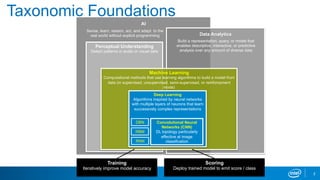
Taxonomic Foundations
AI
Data Analytics
Build a representation, query, or model that
enables descriptive, interactive, or predictive
analysis over any amount of diverse data
Sense, learn, reason, act, and adapt to the
real world without explicit programming
Perceptual Understanding
Detect patterns in audio or visual data
Machine Learning
Computational methods that use learning algorithms to build a model from
data (in supervised, unsupervised, semi-supervised, or reinforcement
mode)
Deep Learning
Algorithms inspired by neural networks
with multiple layers of neurons that learn
successively complex representations
Convolutional Neural
Networks (CNN)
DL topology particularly
effective at image
classification
Training
Iteratively improve model accuracy
Scoring
Deploy trained model to emit score / class
RBM
DBN
RNN
Data Acquisition
3
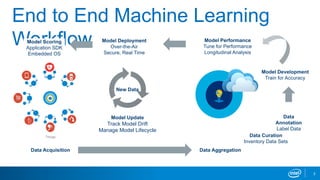
End to End Machine Learning
Workflow
Data
Annotation
Label Data
Model Deployment
Over-the-Air
Secure, Real Time
Model Performance
Tune for Performance
Longitudinal Analysis
Model Scoring
Application SDK
Embedded OS
Model Update
Track Model Drift
Manage Model Lifecycle
New Data
Data Aggregation
Data Curation
Inventory Data Sets
Model Development
Train for Accuracy
Things
4
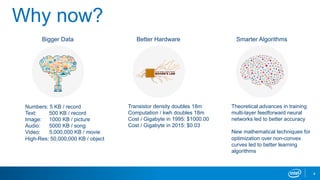
Why now?
Bigger Data Better Hardware Smarter Algorithms
Numbers: 5 KB / record
Text: 500 KB / record
Image: 1000 KB / picture
Audio: 5000 KB / song
Video: 5,000,000 KB / movie
High-Res: 50,000,000 KB / object
Transistor density doubles 18m
Computation / kwh doubles 18m
Cost / Gigabyte in 1995: $1000.00
Cost / Gigabyte in 2015: $0.03
Theoretical advances in training
multi-layer feedforward neural
networks led to better accuracy
New mathematical techniques for
optimization over non-convex
curves led to better learning
algorithms
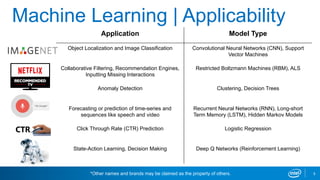
Machine Learning | Applicability
Application Model Type
Object Localization and Image Classification Convolutional Neural Networks (CNN), Support
Vector Machines
Collaborative Filtering, Recommendation Engines,
Inputting Missing Interactions
Restricted Boltzmann Machines (RBM), ALS
Anomaly Detection Clustering, Decision Trees
Forecasting or prediction of time-series and
sequences like speech and video
Recurrent Neural Networks (RNN), Long-short
Term Memory (LSTM), Hidden Markov Models
Click Through Rate (CTR) Prediction Logistic Regression
State-Action Learning, Decision Making Deep Q Networks (Reinforcement Learning)
5*Other names and brands may be claimed as the property of others.
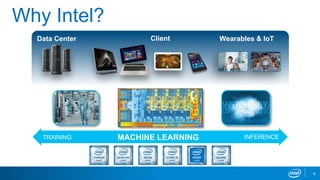
Why Intel?
Data Center Client Wearables & IoT
6
MACHINE LEARNINGTRAINING INFERENCE
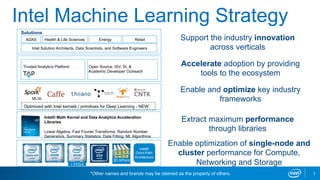
Intel Machine Learning Strategy
3D XPoint
Intel® Math Kernel and Data Analytics Acceleration
Libraries
Linear Algebra, Fast Fourier Transforms, Random Number
Generators, Summary Statistics, Data Fitting, ML Algorithms
Optimized with Intel kernels / primitives for Deep Learning - NEW
Trusted Analytics Platform Open Source, ISV, SI, &
Academic Developer Outreach
Intel Solution Architects, Data Scientists, and Software Engineers
ADAS Health & Life Sciences Energy Retail
Solutions
Enable optimization of single-node and
cluster performance for Compute,
Networking and Storage
Extract maximum performance
through libraries
Enable and optimize key industry
frameworks
Accelerate adoption by providing
tools to the ecosystem
7
Intel®
Omni-Path
Architecture
+ FPGA
Support the industry innovation
across verticals
*Other names and brands may be claimed as the property of others.
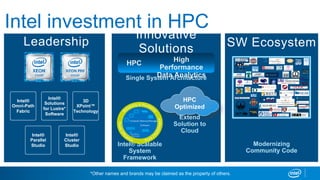
Intel investment in HPC
Leadership
Intel®
Omni-Path
Fabric
Intel®
Solutions
for Lustre*
Software
3D
XPoint™
Technology
Innovative
Solutions
HPC High
Performance
Data AnalyticsSingle System Architecture
Intel® Scalable
System
Framework
HPC
Optimized
Extend
Solution to
Cloud
SW Ecosystem
Modernizing
Community Code
Intel®
Parallel
Studio
Intel®
Cluster
Studio
*Other names and brands may be claimed as the property of others.
10
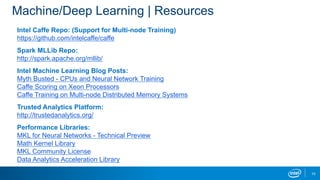
Machine/Deep Learning | Resources
Intel Caffe Repo: (Support for Multi-node Training)
https://github.com/intelcaffe/caffe
Spark MLLib Repo:
http://spark.apache.org/mllib/
Intel Machine Learning Blog Posts:
Myth Busted - CPUs and Neural Network Training
Caffe Scoring on Xeon Processors
Caffe Training on Multi-node Distributed Memory Systems
Trusted Analytics Platform:
http://trustedanalytics.org/
Performance Libraries:
MKL for Neural Networks - Technical Preview
Math Kernel Library
MKL Community License
Data Analytics Acceleration Library
11
Legal Disclaimers
Software and workloads used in performance tests may have been optimized for performance only on Intel
microprocessors. Performance tests, such as SYSmark and MobileMark, are measured using specific
computer systems, components, software, operations and functions. Any change to any of those factors may
cause the results to vary. You should consult other information and performance tests to assist you in fully
evaluating your contemplated purchases, including the performance of that product when combined with
other products. For more complete information visit http://www.intel.com/performance.
Intel technologies’ features and benefits depend on system configuration and may require enabled
hardware, software or service activation. Performance varies depending on system configuration. No
computer system can be absolutely secure. Check with your system manufacturer or retailer or learn more
at {most relevant URL to your product}.
Intel, the Intel logo, {List the Intel trademarks in your document} are trademarks of Intel Corporation in the
U.S. and/or other countries.
*Other names and brands may be claimed as the property of others.
© 2016 Intel Corporation.

Intel's Machine Learning Strategy

  • 1.
    Intel’s Machine LearningStrategy Gary Paek, HPC Marketing Manager, Intel Americas HPC User Forum, Tucson, AZ April 12, 2016
  • 2.
    2 Taxonomic Foundations AI Data Analytics Builda representation, query, or model that enables descriptive, interactive, or predictive analysis over any amount of diverse data Sense, learn, reason, act, and adapt to the real world without explicit programming Perceptual Understanding Detect patterns in audio or visual data Machine Learning Computational methods that use learning algorithms to build a model from data (in supervised, unsupervised, semi-supervised, or reinforcement mode) Deep Learning Algorithms inspired by neural networks with multiple layers of neurons that learn successively complex representations Convolutional Neural Networks (CNN) DL topology particularly effective at image classification Training Iteratively improve model accuracy Scoring Deploy trained model to emit score / class RBM DBN RNN
  • 3.
    Data Acquisition 3 End toEnd Machine Learning Workflow Data Annotation Label Data Model Deployment Over-the-Air Secure, Real Time Model Performance Tune for Performance Longitudinal Analysis Model Scoring Application SDK Embedded OS Model Update Track Model Drift Manage Model Lifecycle New Data Data Aggregation Data Curation Inventory Data Sets Model Development Train for Accuracy Things
  • 4.
    4 Why now? Bigger DataBetter Hardware Smarter Algorithms Numbers: 5 KB / record Text: 500 KB / record Image: 1000 KB / picture Audio: 5000 KB / song Video: 5,000,000 KB / movie High-Res: 50,000,000 KB / object Transistor density doubles 18m Computation / kwh doubles 18m Cost / Gigabyte in 1995: $1000.00 Cost / Gigabyte in 2015: $0.03 Theoretical advances in training multi-layer feedforward neural networks led to better accuracy New mathematical techniques for optimization over non-convex curves led to better learning algorithms
  • 5.
    Machine Learning |Applicability Application Model Type Object Localization and Image Classification Convolutional Neural Networks (CNN), Support Vector Machines Collaborative Filtering, Recommendation Engines, Inputting Missing Interactions Restricted Boltzmann Machines (RBM), ALS Anomaly Detection Clustering, Decision Trees Forecasting or prediction of time-series and sequences like speech and video Recurrent Neural Networks (RNN), Long-short Term Memory (LSTM), Hidden Markov Models Click Through Rate (CTR) Prediction Logistic Regression State-Action Learning, Decision Making Deep Q Networks (Reinforcement Learning) 5*Other names and brands may be claimed as the property of others.
  • 6.
    Why Intel? Data CenterClient Wearables & IoT 6 MACHINE LEARNINGTRAINING INFERENCE
  • 7.
    Intel Machine LearningStrategy 3D XPoint Intel® Math Kernel and Data Analytics Acceleration Libraries Linear Algebra, Fast Fourier Transforms, Random Number Generators, Summary Statistics, Data Fitting, ML Algorithms Optimized with Intel kernels / primitives for Deep Learning - NEW Trusted Analytics Platform Open Source, ISV, SI, & Academic Developer Outreach Intel Solution Architects, Data Scientists, and Software Engineers ADAS Health & Life Sciences Energy Retail Solutions Enable optimization of single-node and cluster performance for Compute, Networking and Storage Extract maximum performance through libraries Enable and optimize key industry frameworks Accelerate adoption by providing tools to the ecosystem 7 Intel® Omni-Path Architecture + FPGA Support the industry innovation across verticals *Other names and brands may be claimed as the property of others.
  • 8.
    Intel investment inHPC Leadership Intel® Omni-Path Fabric Intel® Solutions for Lustre* Software 3D XPoint™ Technology Innovative Solutions HPC High Performance Data AnalyticsSingle System Architecture Intel® Scalable System Framework HPC Optimized Extend Solution to Cloud SW Ecosystem Modernizing Community Code Intel® Parallel Studio Intel® Cluster Studio *Other names and brands may be claimed as the property of others.
  • 10.
    10 Machine/Deep Learning |Resources Intel Caffe Repo: (Support for Multi-node Training) https://github.com/intelcaffe/caffe Spark MLLib Repo: http://spark.apache.org/mllib/ Intel Machine Learning Blog Posts: Myth Busted - CPUs and Neural Network Training Caffe Scoring on Xeon Processors Caffe Training on Multi-node Distributed Memory Systems Trusted Analytics Platform: http://trustedanalytics.org/ Performance Libraries: MKL for Neural Networks - Technical Preview Math Kernel Library MKL Community License Data Analytics Acceleration Library
  • 11.
    11 Legal Disclaimers Software andworkloads used in performance tests may have been optimized for performance only on Intel microprocessors. Performance tests, such as SYSmark and MobileMark, are measured using specific computer systems, components, software, operations and functions. Any change to any of those factors may cause the results to vary. You should consult other information and performance tests to assist you in fully evaluating your contemplated purchases, including the performance of that product when combined with other products. For more complete information visit http://www.intel.com/performance. Intel technologies’ features and benefits depend on system configuration and may require enabled hardware, software or service activation. Performance varies depending on system configuration. No computer system can be absolutely secure. Check with your system manufacturer or retailer or learn more at {most relevant URL to your product}. Intel, the Intel logo, {List the Intel trademarks in your document} are trademarks of Intel Corporation in the U.S. and/or other countries. *Other names and brands may be claimed as the property of others. © 2016 Intel Corporation.