Nell Eckersley
Literacy Assistance Center
Deb Hargrove
Texas Center for
Advancement of Literacy and
Learning
http://bit.ly/ccrsCOABE2016
WiFi
TCALLCOABE2016
Power Point
http://bit.ly/ccrsCOABE2016
2
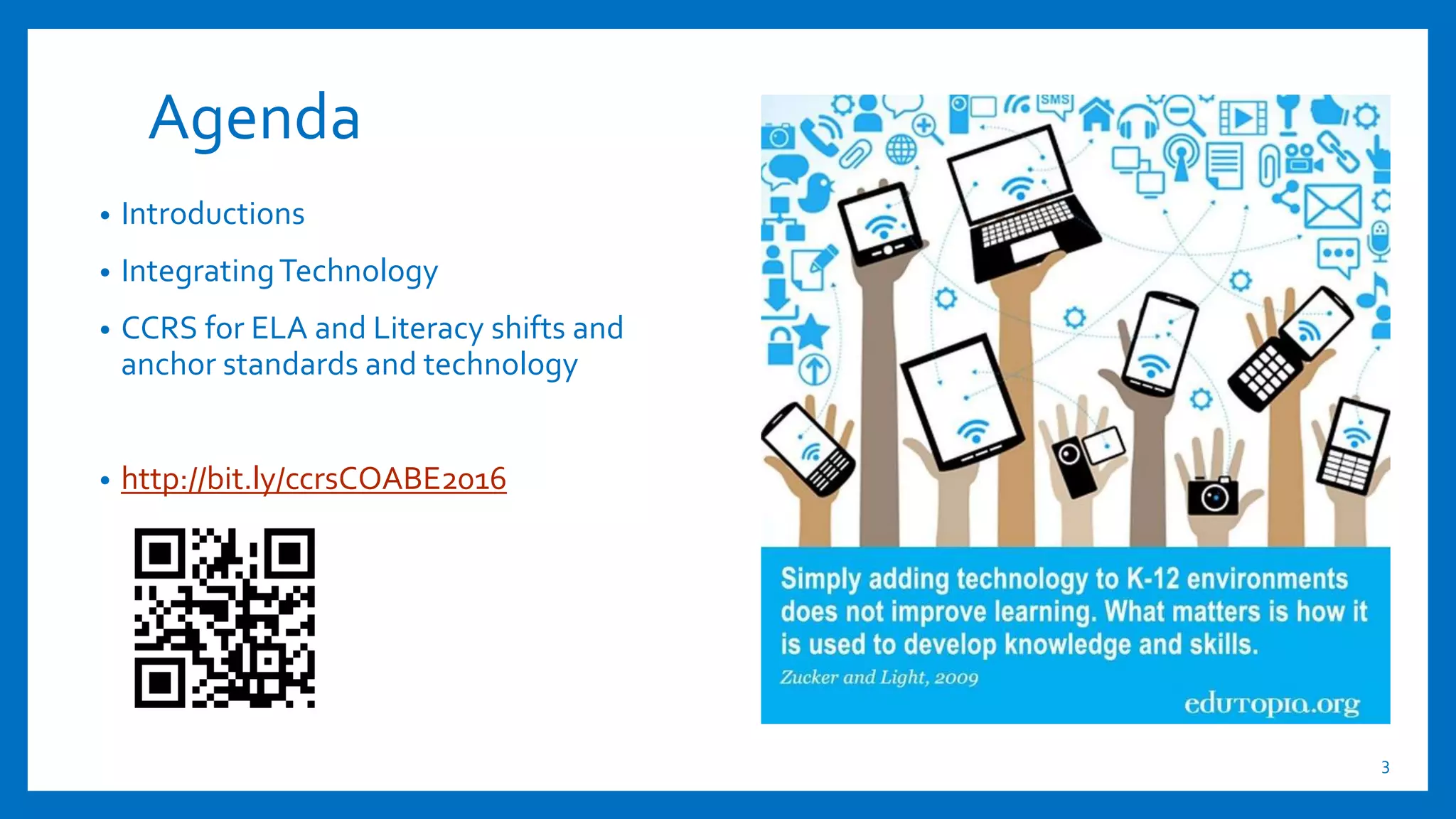
Agenda
• Introductions
• IntegratingTechnology
• CCRS for ELA and Literacy shifts and
anchor standards and technology
• http://bit.ly/ccrsCOABE2016
3
4
http://bit.ly/ccrsCOABE2016
WIOA
5
definition of
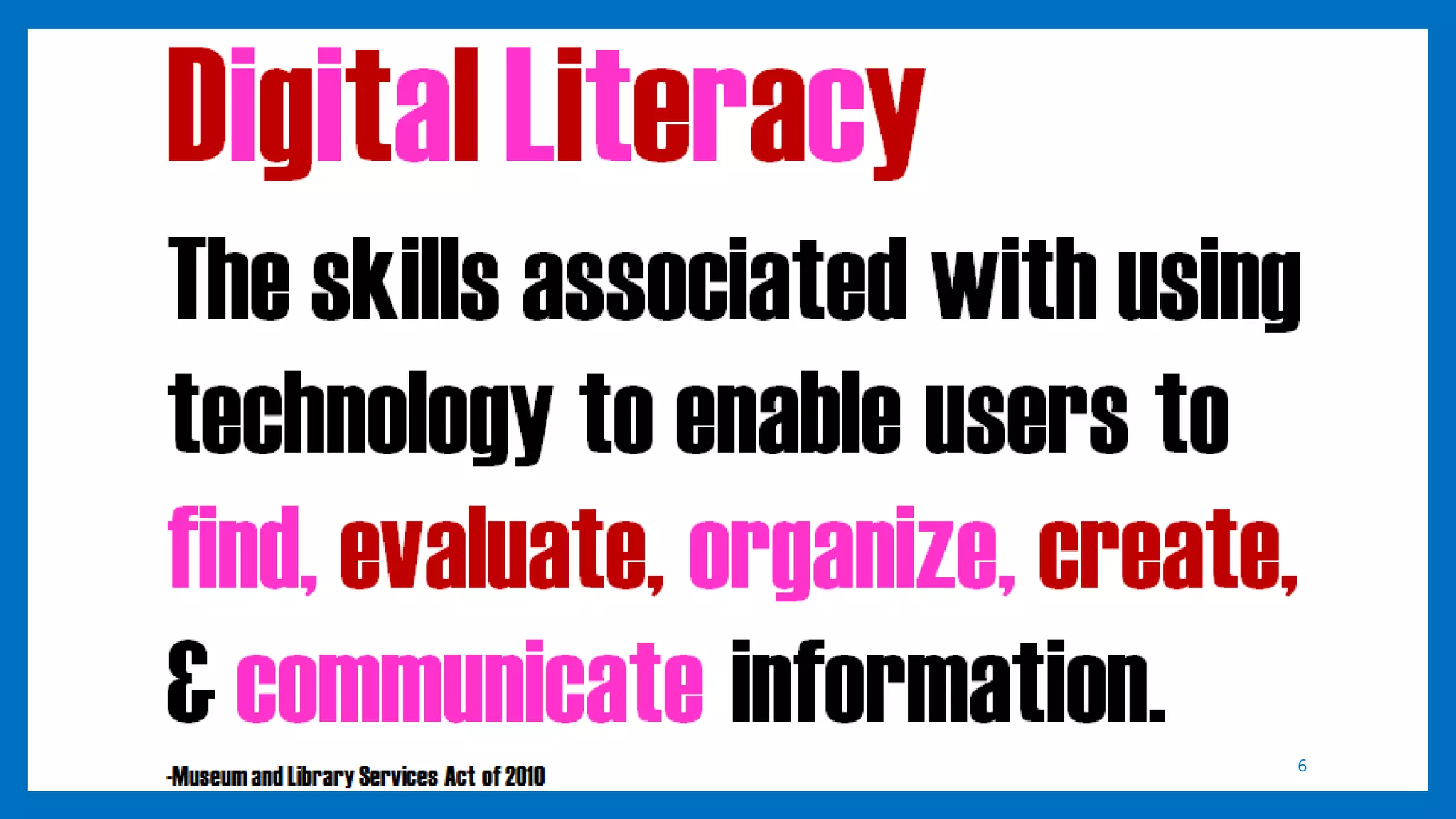
Digital Literacy
6
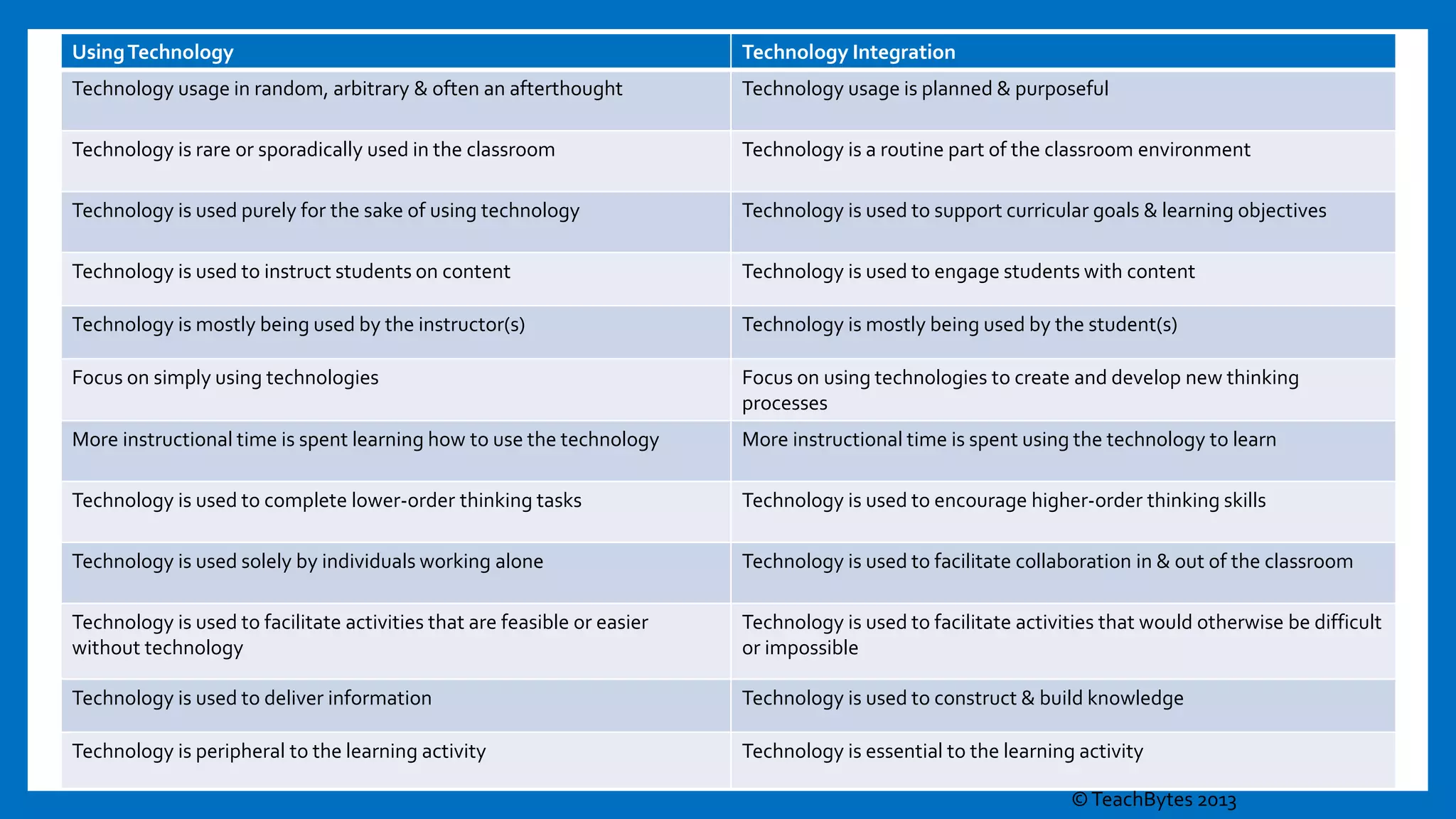
UsingTechnology Technology Integration
Technology usage in random, arbitrary & often an afterthought Technology usage is planned & purposeful
Technology is rare or sporadically used in the classroom Technology is a routine part of the classroom environment
Technology is used purely for the sake of using technology Technology is used to support curricular goals & learning objectives
Technology is used to instruct students on content Technology is used to engage students with content
Technology is mostly being used by the instructor(s) Technology is mostly being used by the student(s)
Focus on simply using technologies Focus on using technologies to create and develop new thinking
processes
More instructional time is spent learning how to use the technology More instructional time is spent using the technology to learn
Technology is used to complete lower-order thinking tasks Technology is used to encourage higher-order thinking skills
Technology is used solely by individuals working alone Technology is used to facilitate collaboration in & out of the classroom
Technology is used to facilitate activities that are feasible or easier
without technology
Technology is used to facilitate activities that would otherwise be difficult
or impossible
Technology is used to deliver information Technology is used to construct & build knowledge
Technology is peripheral to the learning activity Technology is essential to the learning activity
©TeachBytes 2013
IntegratingTechnology
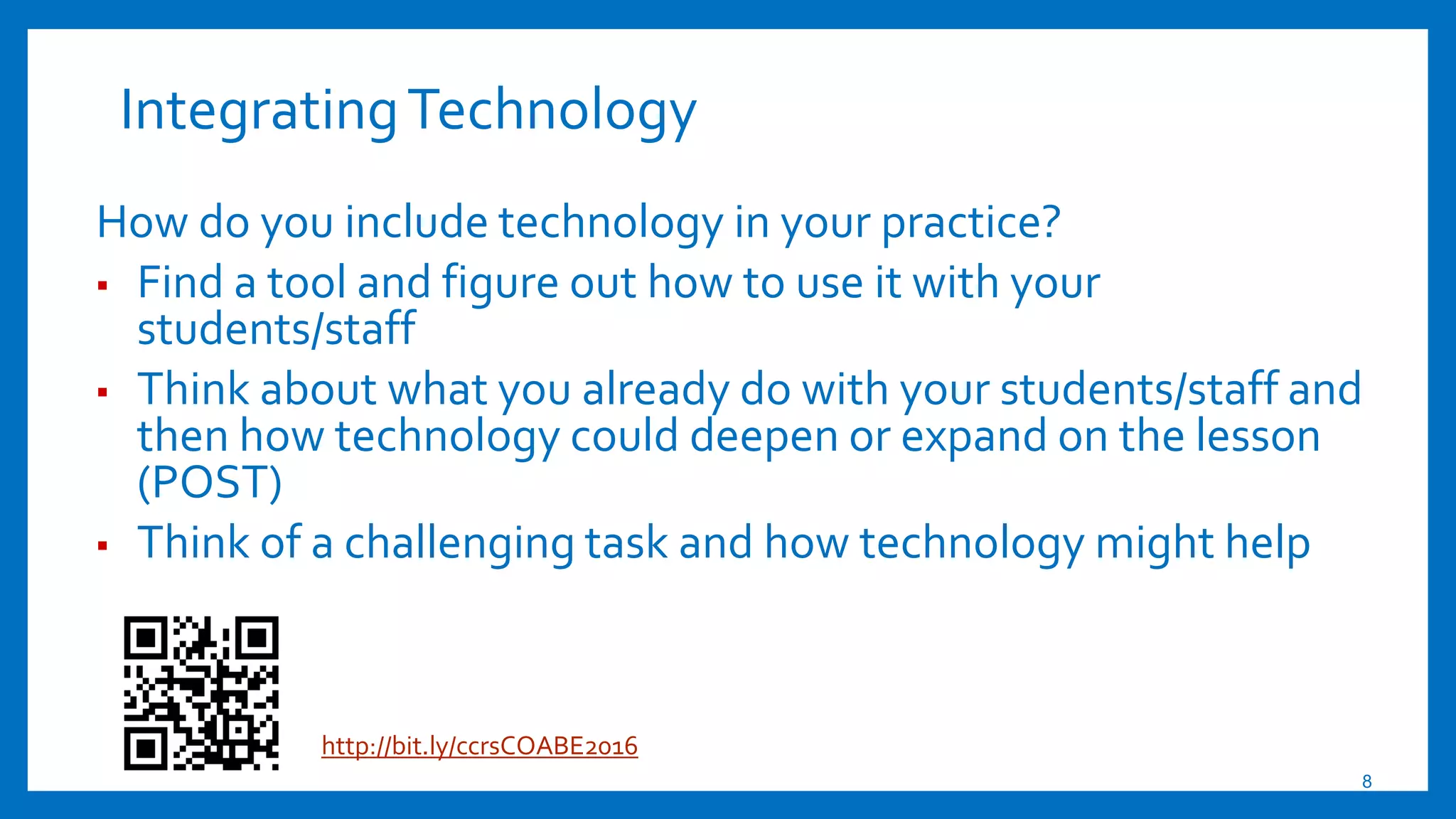
How do you include technology in your practice?
▪ Find a tool and figure out how to use it with your
students/staff
▪ Think about what you already do with your students/staff and
then how technology could deepen or expand on the lesson
(POST)
▪ Think of a challenging task and how technology might help
8
http://bit.ly/ccrsCOABE2016
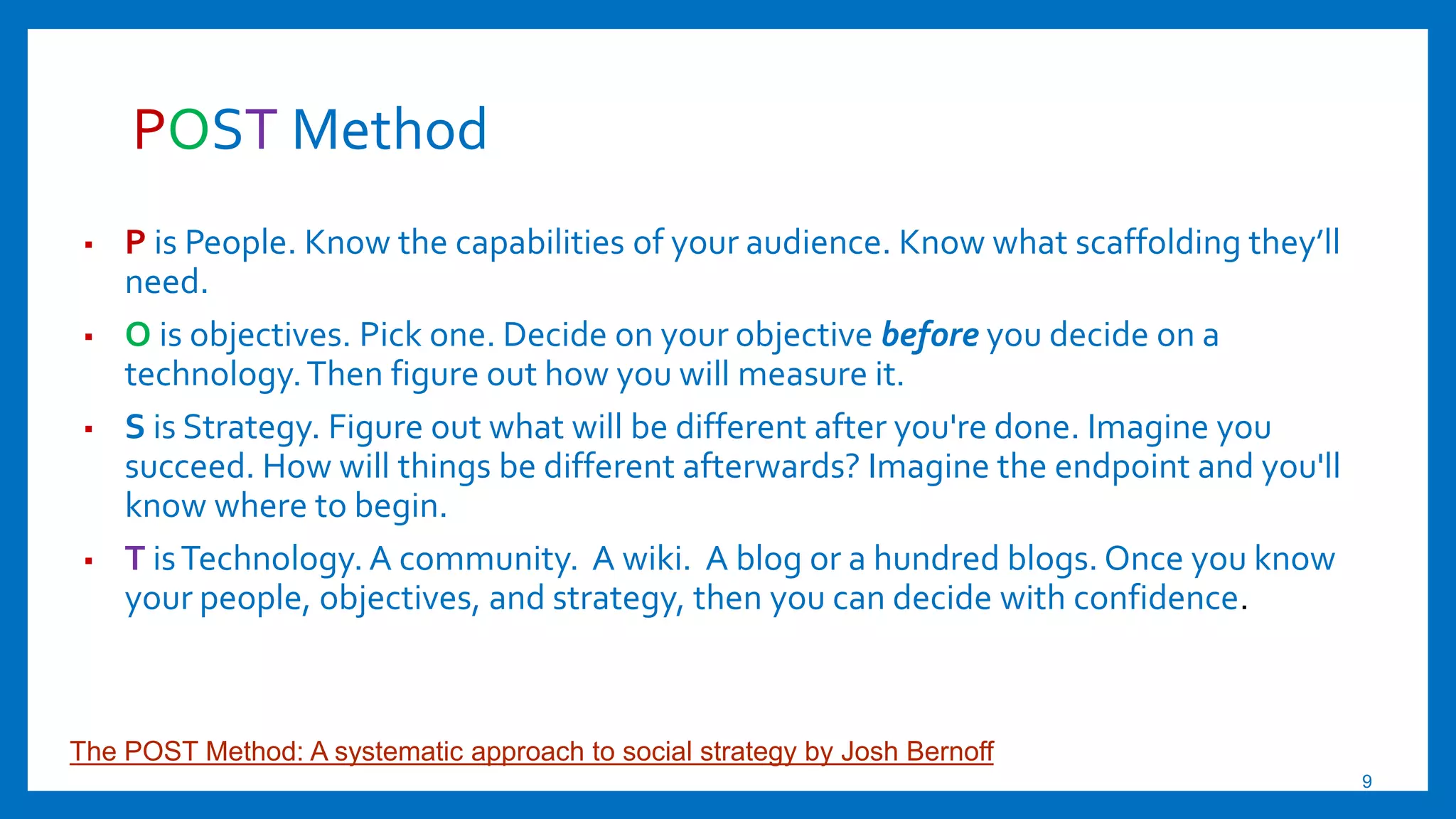
POST Method
▪ P is People. Know the capabilities of your audience. Know what scaffolding they’ll
need.
▪ O is objectives. Pick one. Decide on your objective before you decide on a
technology.Then figure out how you will measure it.
▪ S is Strategy. Figure out what will be different after you're done. Imagine you
succeed. How will things be different afterwards? Imagine the endpoint and you'll
know where to begin.
▪ T isTechnology. A community. A wiki. A blog or a hundred blogs. Once you know
your people, objectives, and strategy, then you can decide with confidence.
The POST Method: A systematic approach to social strategy by Josh Bernoff
9
10
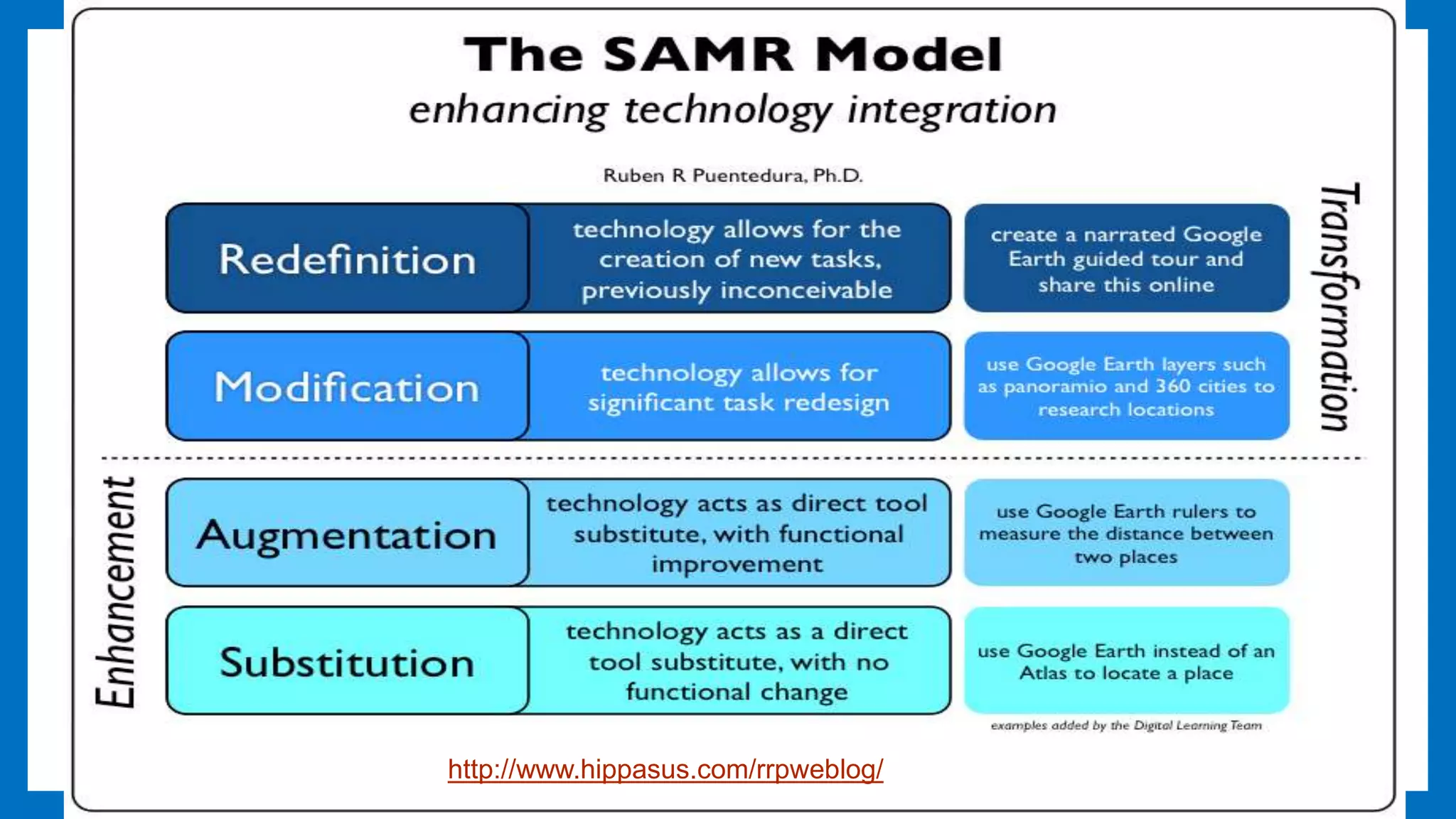
http://www.hippasus.com/rrpweblog/
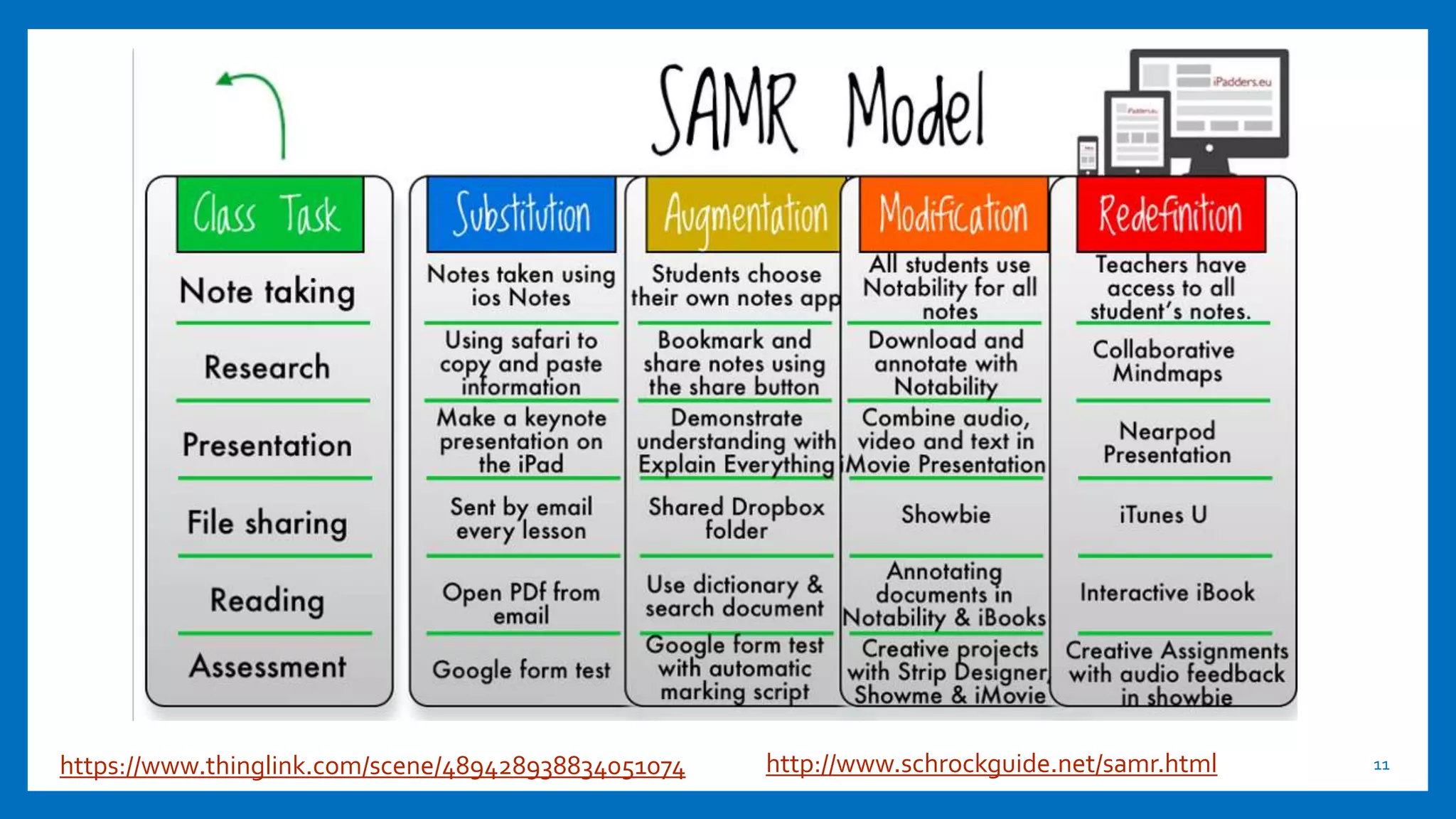
11https://www.thinglink.com/scene/489428938834051074 http://www.schrockguide.net/samr.html
12
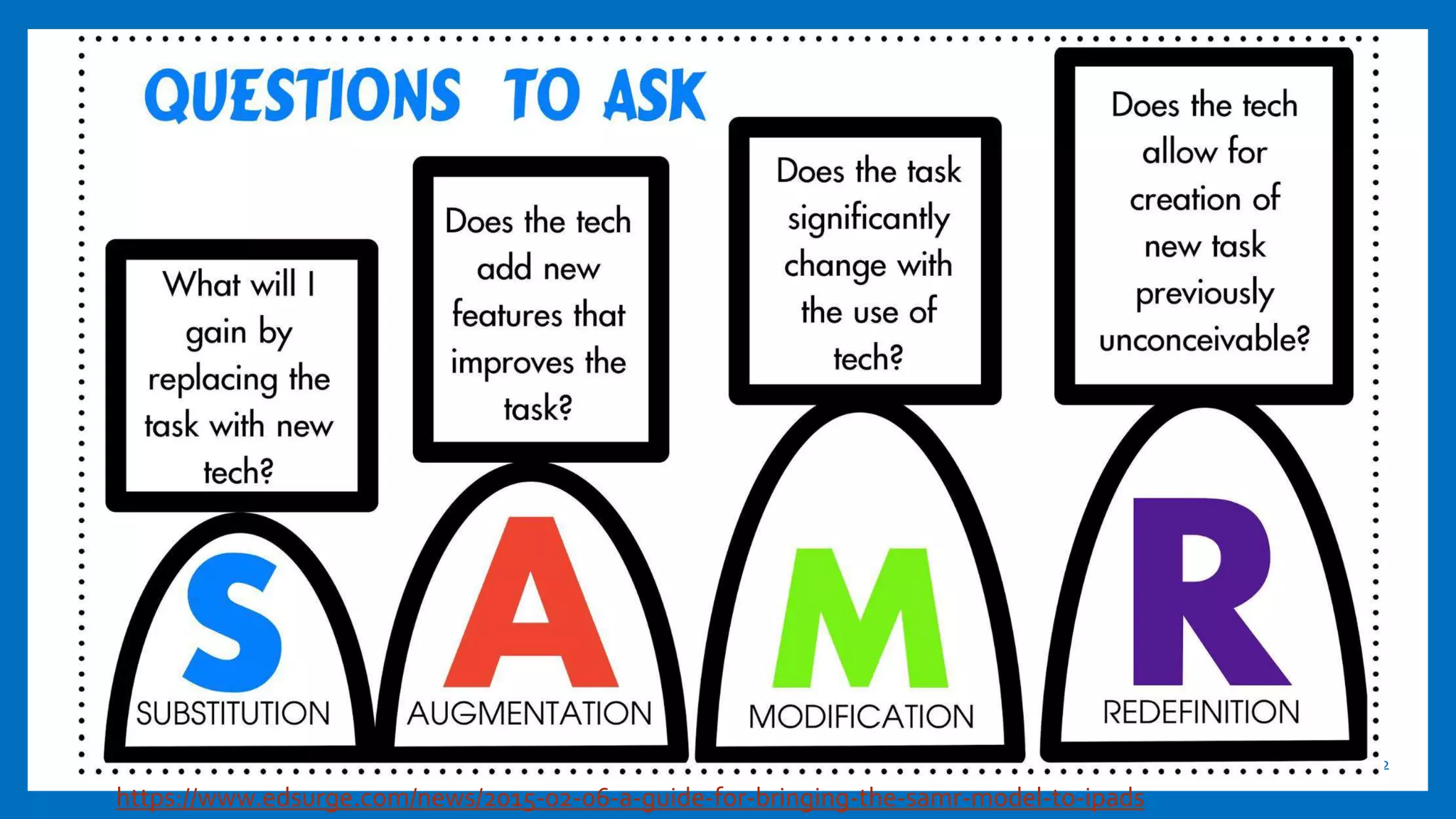
https://www.edsurge.com/news/2015-02-06-a-guide-for-bringing-the-samr-model-to-ipads
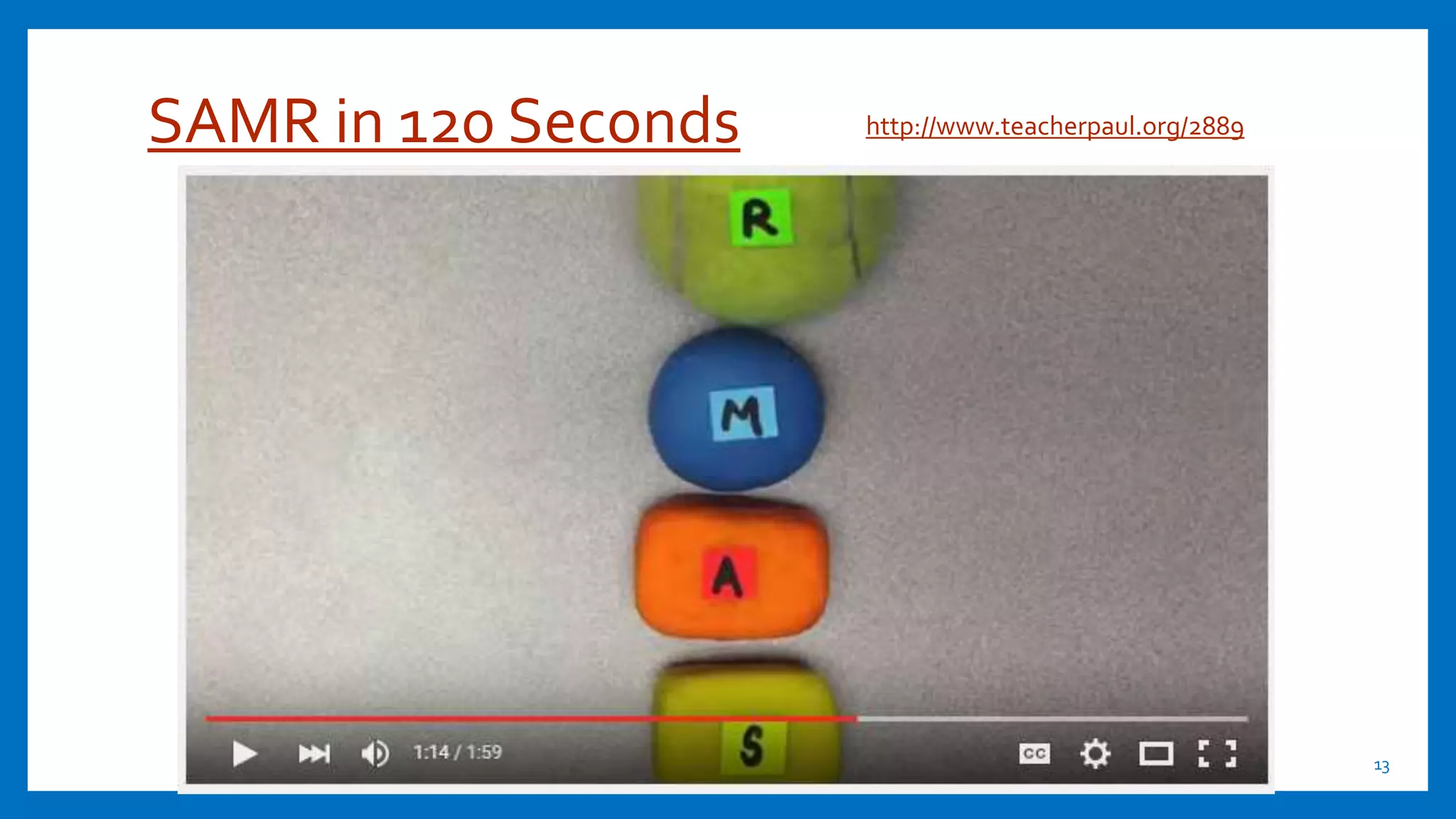
SAMR in 120 Seconds
13
http://www.teacherpaul.org/2889
14
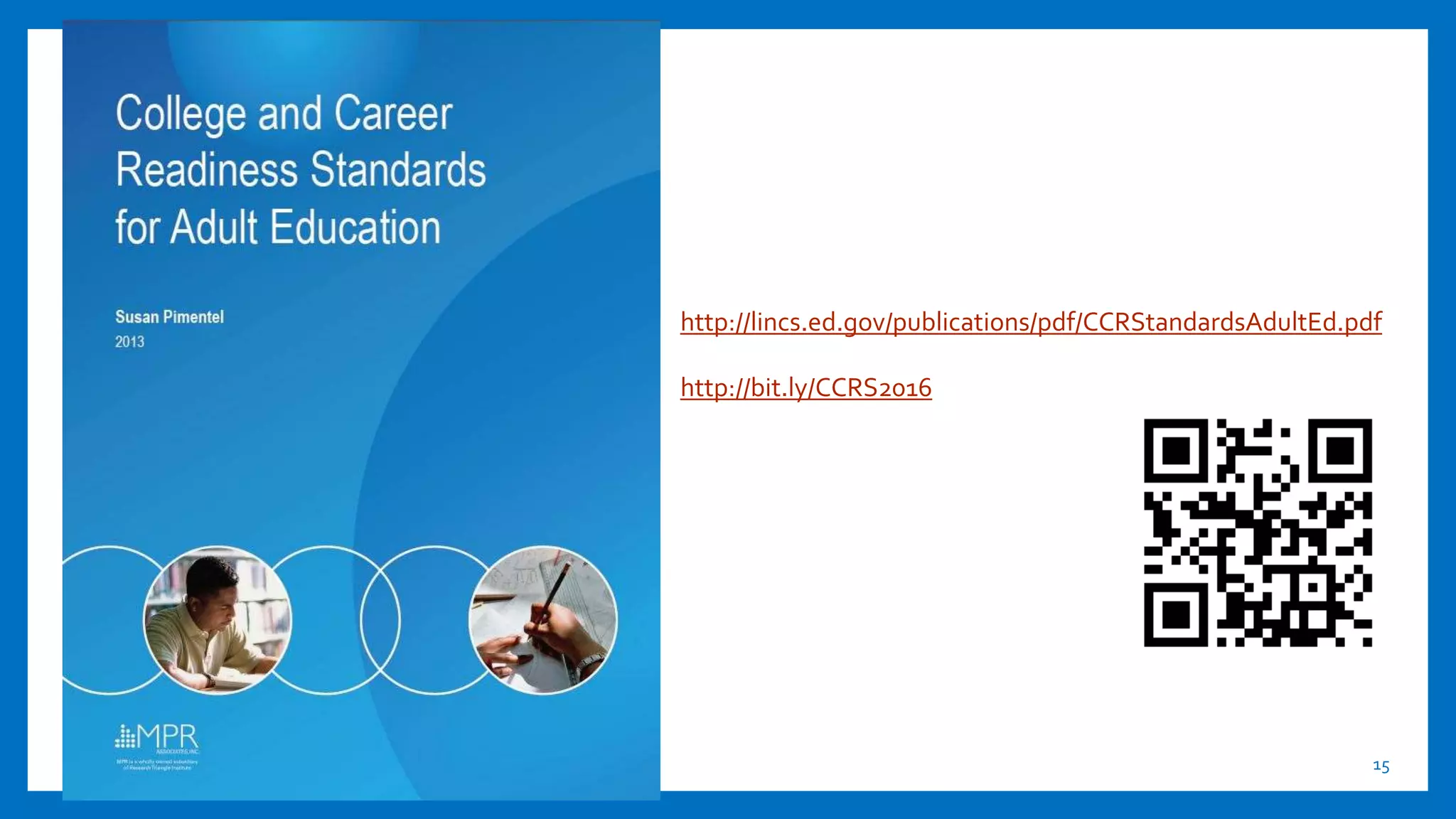
http://lincs.ed.gov/publications/pdf/CCRStandardsAdultEd.pdf
http://bit.ly/CCRS2016
15
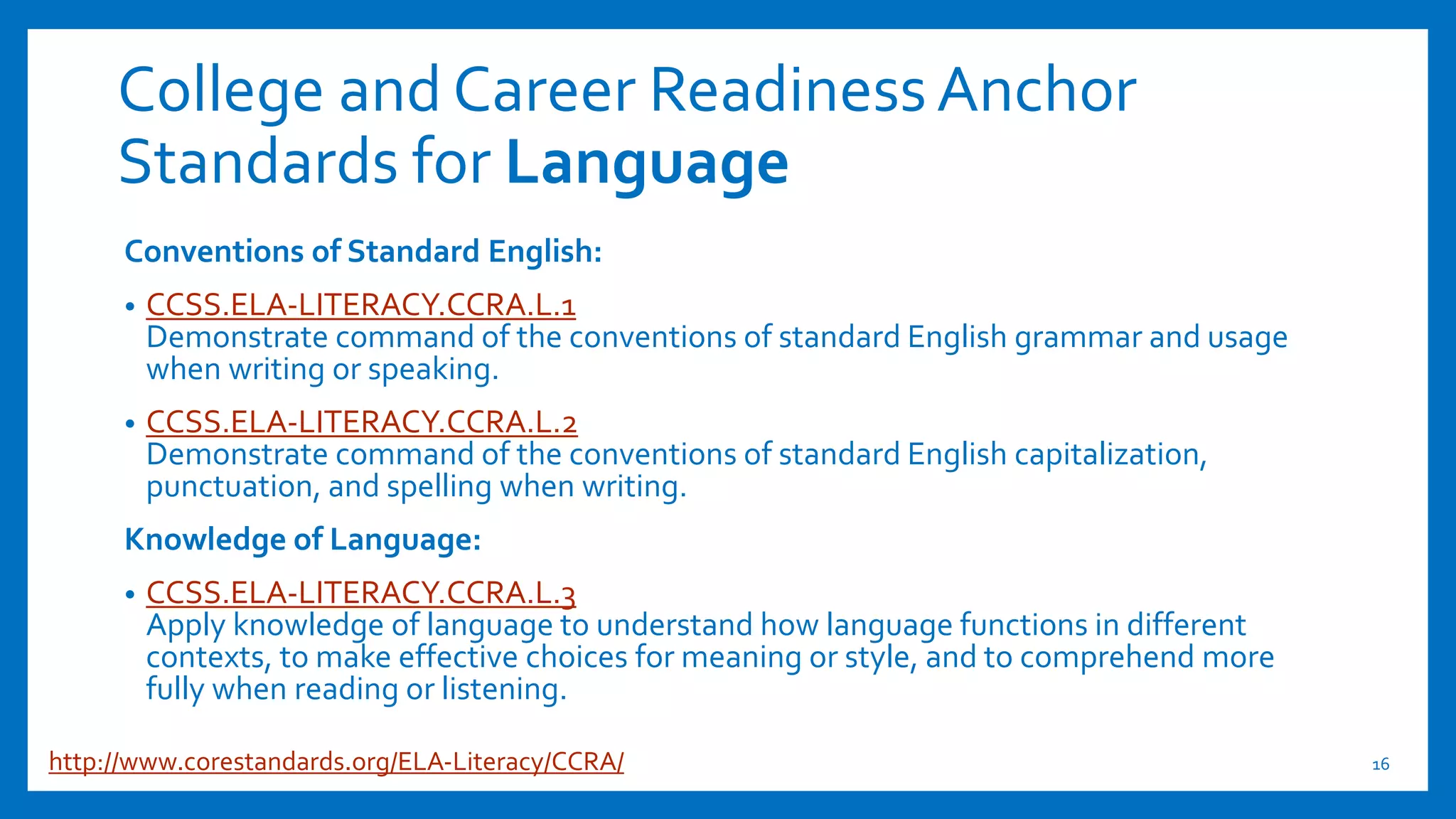
College and Career ReadinessAnchor
Standards for Language
Conventions of Standard English:
• CCSS.ELA-LITERACY.CCRA.L.1
Demonstrate command of the conventions of standard English grammar and usage
when writing or speaking.
• CCSS.ELA-LITERACY.CCRA.L.2
Demonstrate command of the conventions of standard English capitalization,
punctuation, and spelling when writing.
Knowledge of Language:
• CCSS.ELA-LITERACY.CCRA.L.3
Apply knowledge of language to understand how language functions in different
contexts, to make effective choices for meaning or style, and to comprehend more
fully when reading or listening.
16http://www.corestandards.org/ELA-Literacy/CCRA/
College and Career ReadinessAnchor
Standards for Language
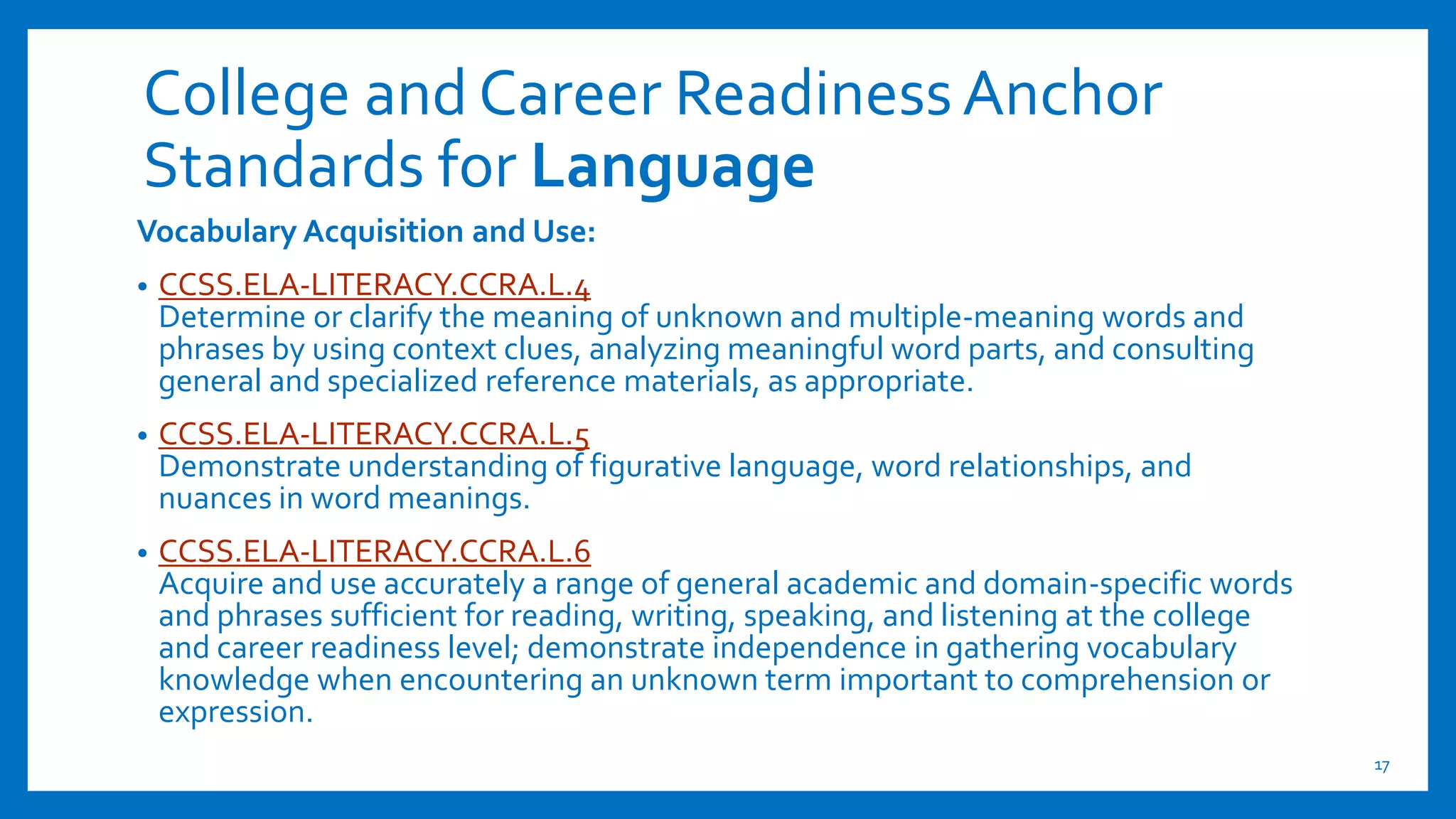
Vocabulary Acquisition and Use:
• CCSS.ELA-LITERACY.CCRA.L.4
Determine or clarify the meaning of unknown and multiple-meaning words and
phrases by using context clues, analyzing meaningful word parts, and consulting
general and specialized reference materials, as appropriate.
• CCSS.ELA-LITERACY.CCRA.L.5
Demonstrate understanding of figurative language, word relationships, and
nuances in word meanings.
• CCSS.ELA-LITERACY.CCRA.L.6
Acquire and use accurately a range of general academic and domain-specific words
and phrases sufficient for reading, writing, speaking, and listening at the college
and career readiness level; demonstrate independence in gathering vocabulary
knowledge when encountering an unknown term important to comprehension or
expression.
17
TechnologyTools for CCR Anchor
Standards for Language
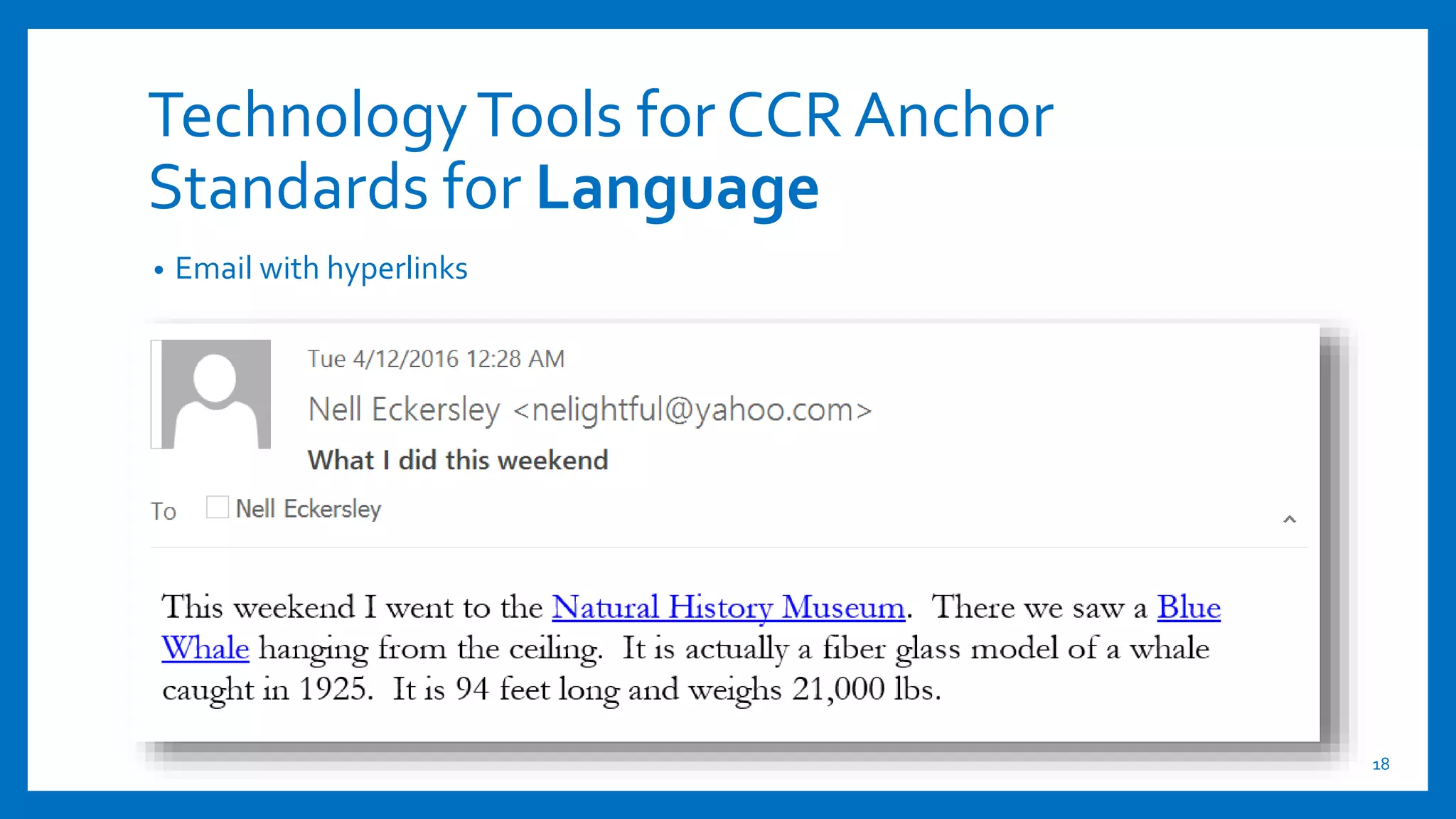
• Email with hyperlinks
18
TechnologyTools for CCR Anchor
Standards for Language
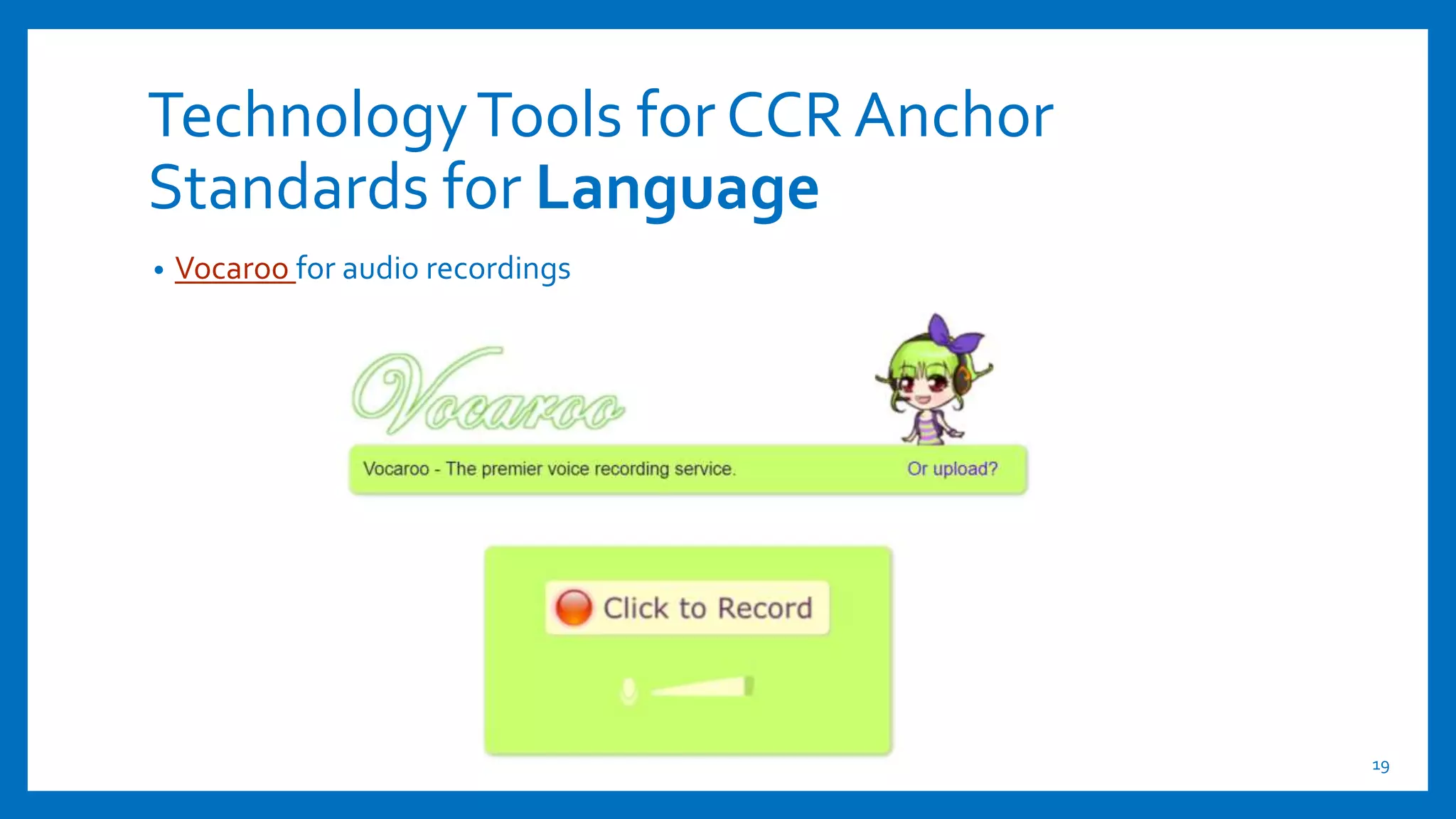
• Vocaroo for audio recordings
19
College and Career ReadinessAnchor
Standards for Reading
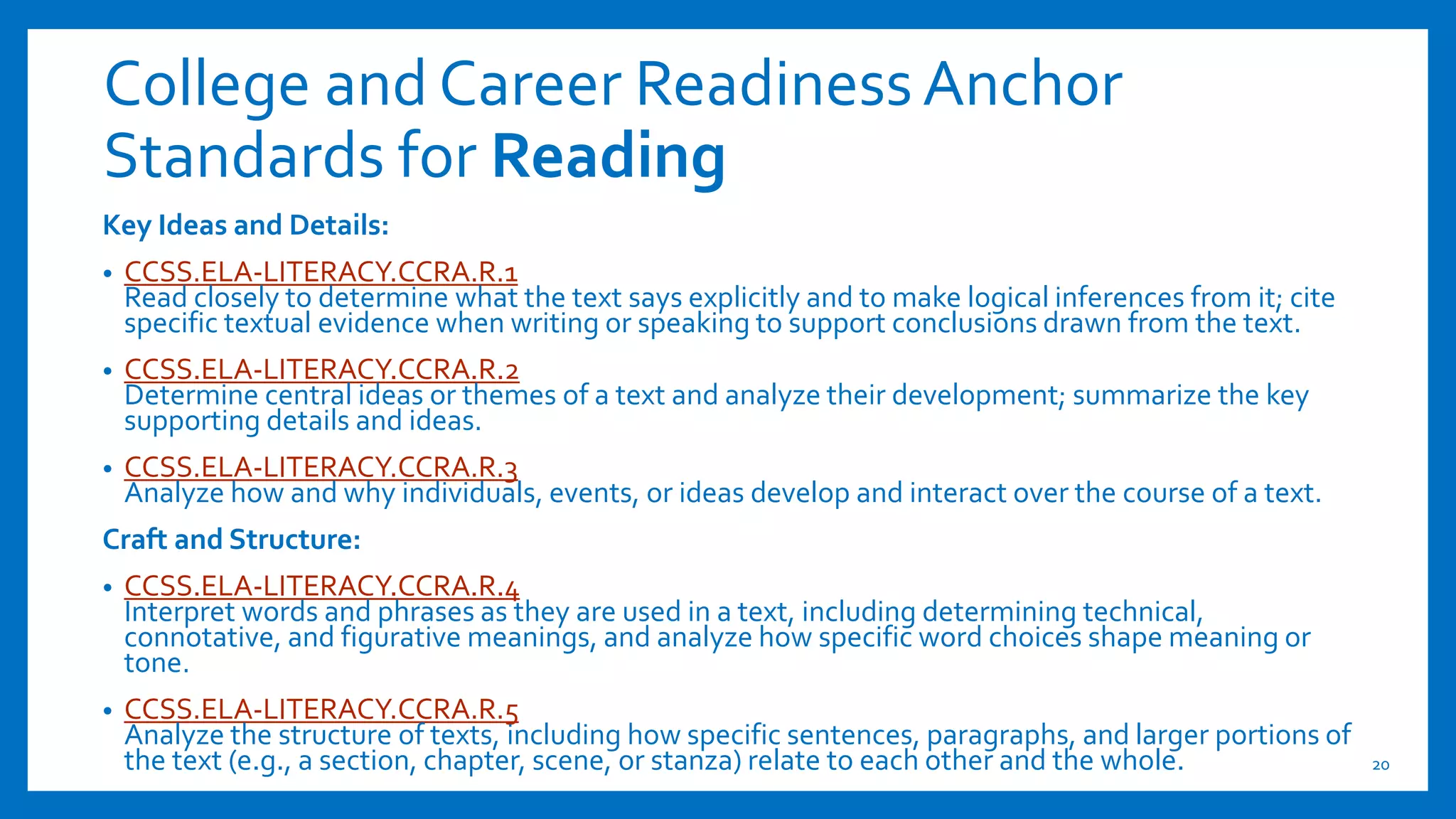
Key Ideas and Details:
• CCSS.ELA-LITERACY.CCRA.R.1
Read closely to determine what the text says explicitly and to make logical inferences from it; cite
specific textual evidence when writing or speaking to support conclusions drawn from the text.
• CCSS.ELA-LITERACY.CCRA.R.2
Determine central ideas or themes of a text and analyze their development; summarize the key
supporting details and ideas.
• CCSS.ELA-LITERACY.CCRA.R.3
Analyze how and why individuals, events, or ideas develop and interact over the course of a text.
Craft and Structure:
• CCSS.ELA-LITERACY.CCRA.R.4
Interpret words and phrases as they are used in a text, including determining technical,
connotative, and figurative meanings, and analyze how specific word choices shape meaning or
tone.
• CCSS.ELA-LITERACY.CCRA.R.5
Analyze the structure of texts, including how specific sentences, paragraphs, and larger portions of
the text (e.g., a section, chapter, scene, or stanza) relate to each other and the whole. 20
College and Career ReadinessAnchor
Standards for Reading
21
• CCSS.ELA-LITERACY.CCRA.R.6
Assess how point of view or purpose shapes the content and style of a text.
Integration of Knowledge and Ideas:
• CCSS.ELA-LITERACY.CCRA.R.7
Integrate and evaluate content presented in diverse media and formats, including visually and
quantitatively, as well as in words.1
• CCSS.ELA-LITERACY.CCRA.R.8
Delineate and evaluate the argument and specific claims in a text, including the validity of the reasoning as
well as the relevance and sufficiency of the evidence.
• CCSS.ELA-LITERACY.CCRA.R.9
Analyze how two or more texts address similar themes or topics in order to build knowledge or to compare
the approaches the authors take.
Range of Reading and Level ofText Complexity:
• CCSS.ELA-LITERACY.CCRA.R.10
Read and comprehend complex literary and informational texts independently and proficiently.
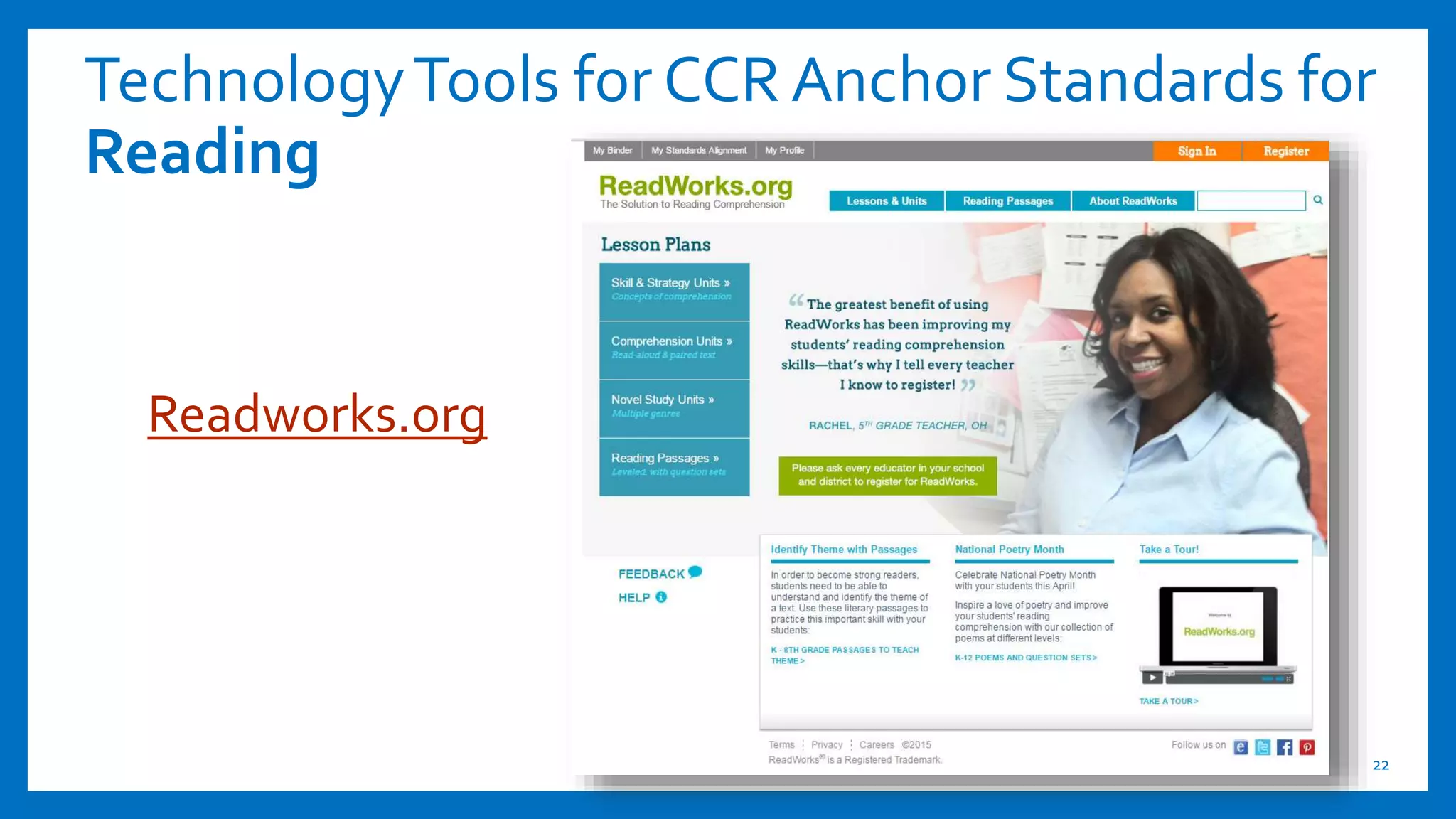
TechnologyTools for CCR Anchor Standards for
Reading
22
Readworks.org
College and Career ReadinessAnchor
Standards for Speaking and Listening
Comprehension and Collaboration:
• CCSS.ELA-LITERACY.CCRA.SL.1
Prepare for and participate effectively in a range of conversations and
collaborations with diverse partners, building on others' ideas and expressing their
own clearly and persuasively.
• CCSS.ELA-LITERACY.CCRA.SL.2
Integrate and evaluate information presented in diverse media and formats,
including visually, quantitatively, and orally.
• CCSS.ELA-LITERACY.CCRA.SL.3
Evaluate a speaker's point of view, reasoning, and use of evidence and rhetoric.
23
College and Career ReadinessAnchor
Standards for Speaking and Listening
Presentation of Knowledge and Ideas:
• CCSS.ELA-LITERACY.CCRA.SL.4
Present information, findings, and supporting evidence such that listeners can
follow the line of reasoning and the organization, development, and style are
appropriate to task, purpose, and audience.
• CCSS.ELA-LITERACY.CCRA.SL.5
Make strategic use of digital media and visual displays of data to express
information and enhance understanding of presentations.
• CCSS.ELA-LITERACY.CCRA.SL.6
Adapt speech to a variety of contexts and communicative tasks, demonstrating
command of formal English when indicated or appropriate.
24
TechnologyTools for CCR Anchor Standards for
Speaking and Listening
25
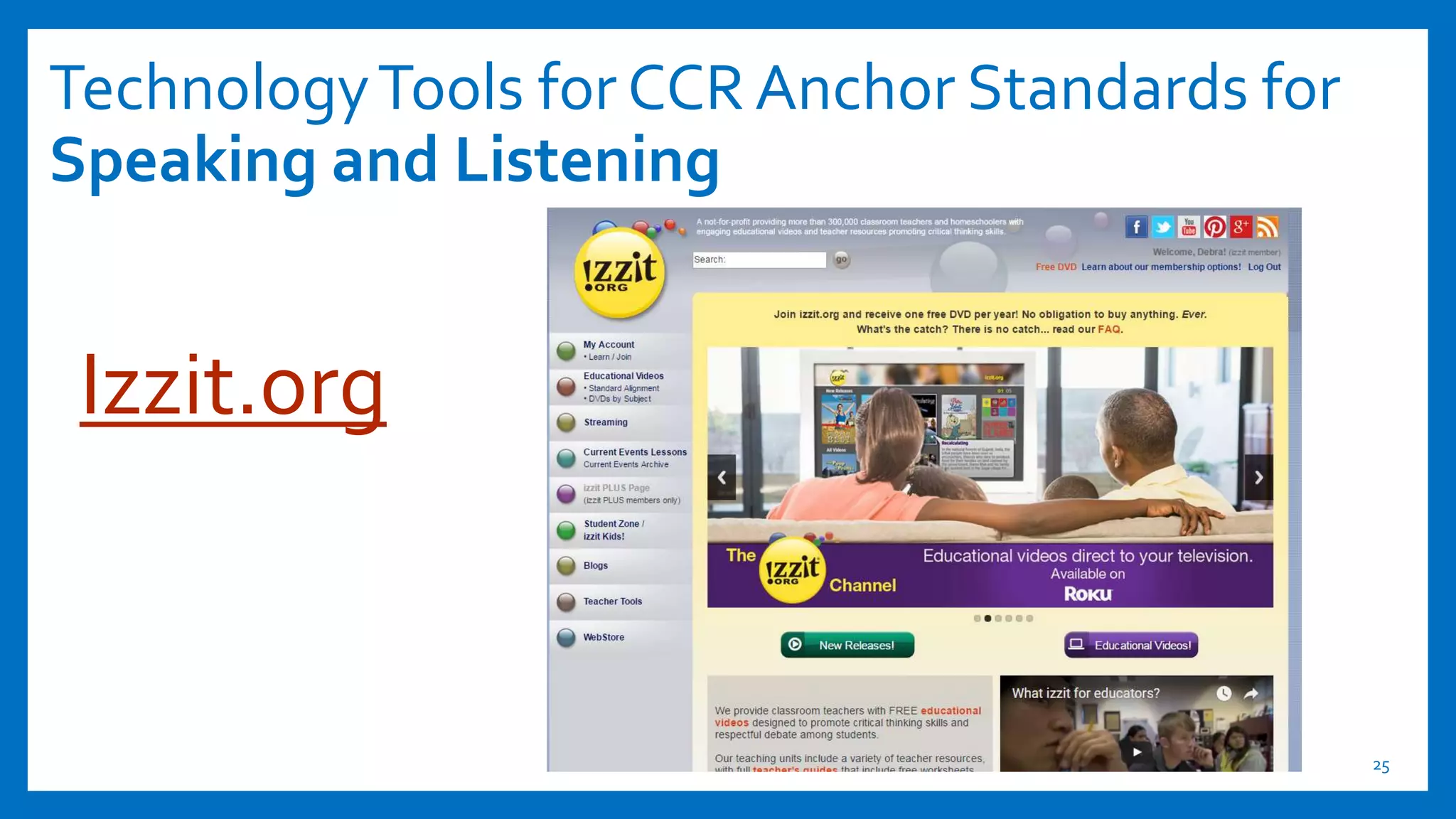
Izzit.org
College and Career ReadinessAnchor
Standards for Writing
TextTypes and Purposes1:
• CCSS.ELA-LITERACY.CCRA.W.1
Write arguments to support claims in an analysis of substantive topics or texts using valid reasoning and relevant
and sufficient evidence.
• CCSS.ELA-LITERACY.CCRA.W.2
Write informative/explanatory texts to examine and convey complex ideas and information clearly and accurately
through the effective selection, organization, and analysis of content.
• CCSS.ELA-LITERACY.CCRA.W.3
Write narratives to develop real or imagined experiences or events using effective technique, well-chosen details
and well-structured event sequences.
Production and Distribution of Writing:
• CCSS.ELA-LITERACY.CCRA.W.4
Produce clear and coherent writing in which the development, organization, and style are appropriate to task,
purpose, and audience.
• CCSS.ELA-LITERACY.CCRA.W.5
Develop and strengthen writing as needed by planning, revising, editing, rewriting, or trying a new approach.
• CCSS.ELA-LITERACY.CCRA.W.6
Use technology, including the Internet, to produce and publish writing and to interact and collaborate with
others. 26
College and Career ReadinessAnchor
Standards for Writing
Research to Build and Present Knowledge:
• CCSS.ELA-LITERACY.CCRA.W.7
Conduct short as well as more sustained research projects based on focused questions,
demonstrating understanding of the subject under investigation.
• CCSS.ELA-LITERACY.CCRA.W.8
Gather relevant information from multiple print and digital sources, assess the credibility and
accuracy of each source, and integrate the information while avoiding plagiarism.
• CCSS.ELA-LITERACY.CCRA.W.9
Draw evidence from literary or informational texts to support analysis, reflection, and research.
Range of Writing:
• CCSS.ELA-LITERACY.CCRA.W.10
Write routinely over extended time frames (time for research, reflection, and revision) and
shorter time frames (a single sitting or a day or two) for a range of tasks, purposes, and
audiences.
27
TechnologyTools for CCR Anchor
Standards for Writing
• Using PowerPoint forWriting
http://technologysource.org/article/using_powerpoint_presentations_in_writing_
classes/
• Read WriteThink Interactives http://www.readwritethink.org/classroom-
resources/student-interactives/
• 5 Card Flickr http://5card.cogdogblog.com/
28
Shift 1 – Complexity: Regular practice with
complex text and its academic language
29
Shift 3 – Knowledge: Building knowledge
through content-rich nonfiction
Shift 2 – Evidence: Reading, writing, and
speaking grounded in evidence from text,
both literary and informational
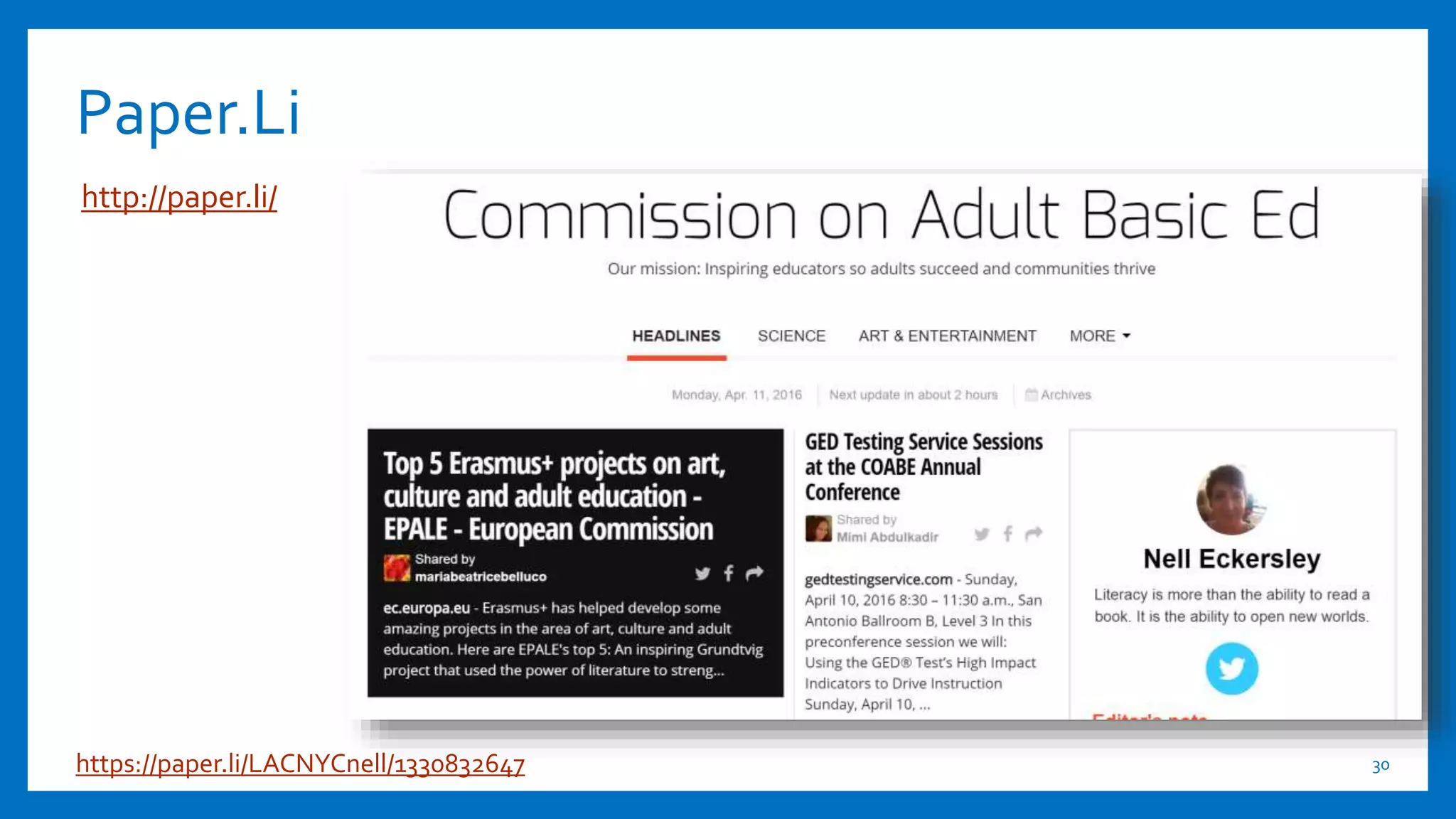
Paper.Li
http://paper.li/
30https://paper.li/LACNYCnell/1330832647
YourTurn
• Choose one or several standards that you already work on or are interested in
• CCR Anchor Standards for Language
• CCR Anchor Standards for Reading
• CCR Anchor Standards for Speaking and Listening
• CCR Anchor Standards for Writing
• Use the SAMR handout and fill in lesson ideas
31
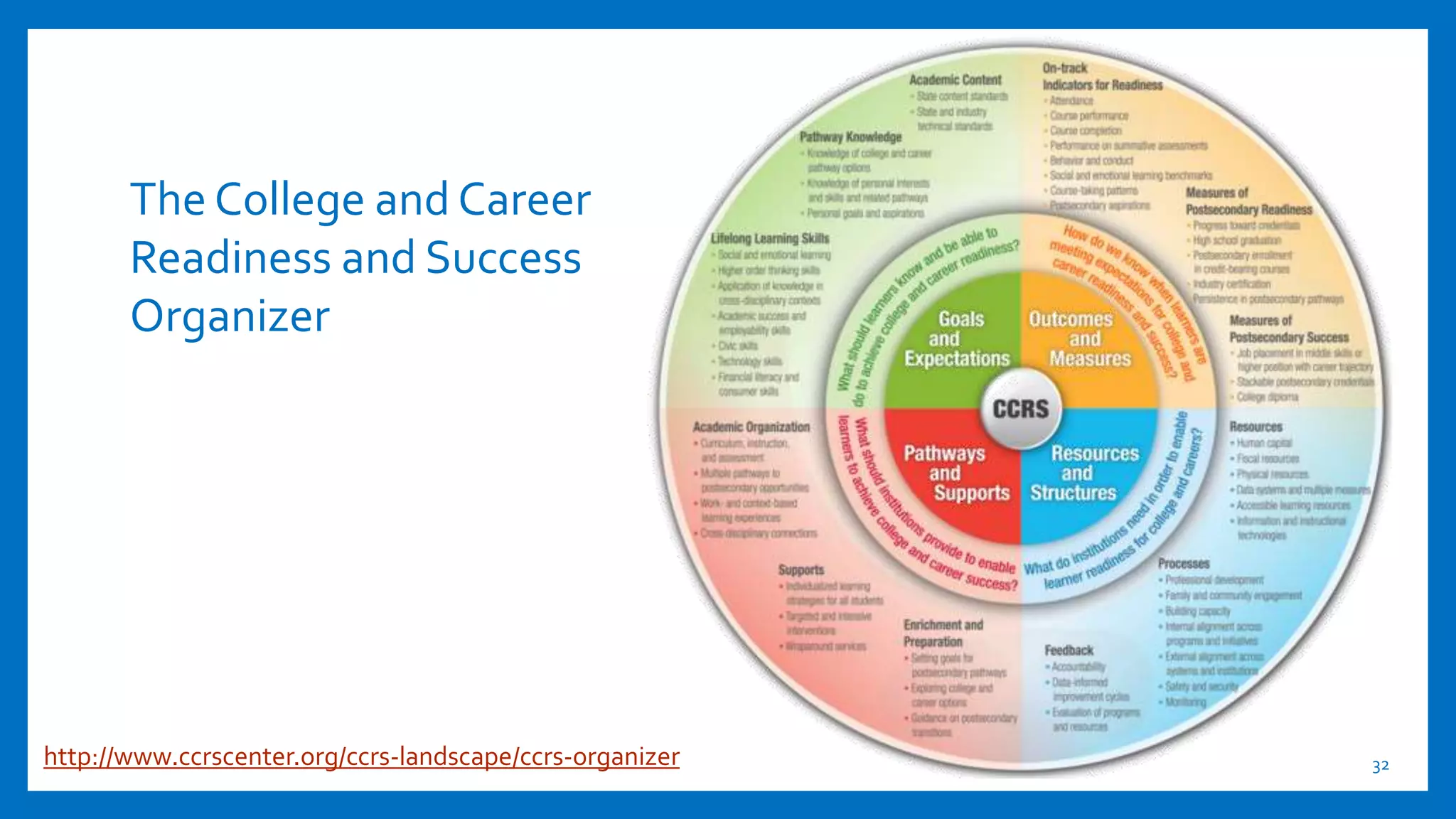
http://www.ccrscenter.org/ccrs-landscape/ccrs-organizer 32
The College and Career
Readiness and Success
Organizer
33
Nell Eckersley
▪ Literacy Assistance Center
▪ NellE@lacnyc.org
▪ @LACNYCNell
Deb Hargrove
 Texas Center of Advancement of Literacy and Learning
 debrahargrove@tamu.edu
 @TCALLTweets
 Tech andTell

Integrating Technology into CCR Standards for ELA and Literacy

  • 1.
    Nell Eckersley Literacy AssistanceCenter Deb Hargrove Texas Center for Advancement of Literacy and Learning http://bit.ly/ccrsCOABE2016
  • 2.
  • 3.
    Agenda • Introductions • IntegratingTechnology •CCRS for ELA and Literacy shifts and anchor standards and technology • http://bit.ly/ccrsCOABE2016 3
  • 4.
  • 5.
  • 6.
  • 7.
    UsingTechnology Technology Integration Technologyusage in random, arbitrary & often an afterthought Technology usage is planned & purposeful Technology is rare or sporadically used in the classroom Technology is a routine part of the classroom environment Technology is used purely for the sake of using technology Technology is used to support curricular goals & learning objectives Technology is used to instruct students on content Technology is used to engage students with content Technology is mostly being used by the instructor(s) Technology is mostly being used by the student(s) Focus on simply using technologies Focus on using technologies to create and develop new thinking processes More instructional time is spent learning how to use the technology More instructional time is spent using the technology to learn Technology is used to complete lower-order thinking tasks Technology is used to encourage higher-order thinking skills Technology is used solely by individuals working alone Technology is used to facilitate collaboration in & out of the classroom Technology is used to facilitate activities that are feasible or easier without technology Technology is used to facilitate activities that would otherwise be difficult or impossible Technology is used to deliver information Technology is used to construct & build knowledge Technology is peripheral to the learning activity Technology is essential to the learning activity ©TeachBytes 2013
  • 8.
    IntegratingTechnology How do youinclude technology in your practice? ▪ Find a tool and figure out how to use it with your students/staff ▪ Think about what you already do with your students/staff and then how technology could deepen or expand on the lesson (POST) ▪ Think of a challenging task and how technology might help 8 http://bit.ly/ccrsCOABE2016
  • 9.
    POST Method ▪ Pis People. Know the capabilities of your audience. Know what scaffolding they’ll need. ▪ O is objectives. Pick one. Decide on your objective before you decide on a technology.Then figure out how you will measure it. ▪ S is Strategy. Figure out what will be different after you're done. Imagine you succeed. How will things be different afterwards? Imagine the endpoint and you'll know where to begin. ▪ T isTechnology. A community. A wiki. A blog or a hundred blogs. Once you know your people, objectives, and strategy, then you can decide with confidence. The POST Method: A systematic approach to social strategy by Josh Bernoff 9
  • 10.
  • 11.
  • 12.
  • 13.
    SAMR in 120Seconds 13 http://www.teacherpaul.org/2889
  • 14.
  • 15.
  • 16.
    College and CareerReadinessAnchor Standards for Language Conventions of Standard English: • CCSS.ELA-LITERACY.CCRA.L.1 Demonstrate command of the conventions of standard English grammar and usage when writing or speaking. • CCSS.ELA-LITERACY.CCRA.L.2 Demonstrate command of the conventions of standard English capitalization, punctuation, and spelling when writing. Knowledge of Language: • CCSS.ELA-LITERACY.CCRA.L.3 Apply knowledge of language to understand how language functions in different contexts, to make effective choices for meaning or style, and to comprehend more fully when reading or listening. 16http://www.corestandards.org/ELA-Literacy/CCRA/
  • 17.
    College and CareerReadinessAnchor Standards for Language Vocabulary Acquisition and Use: • CCSS.ELA-LITERACY.CCRA.L.4 Determine or clarify the meaning of unknown and multiple-meaning words and phrases by using context clues, analyzing meaningful word parts, and consulting general and specialized reference materials, as appropriate. • CCSS.ELA-LITERACY.CCRA.L.5 Demonstrate understanding of figurative language, word relationships, and nuances in word meanings. • CCSS.ELA-LITERACY.CCRA.L.6 Acquire and use accurately a range of general academic and domain-specific words and phrases sufficient for reading, writing, speaking, and listening at the college and career readiness level; demonstrate independence in gathering vocabulary knowledge when encountering an unknown term important to comprehension or expression. 17
  • 18.
    TechnologyTools for CCRAnchor Standards for Language • Email with hyperlinks 18
  • 19.
    TechnologyTools for CCRAnchor Standards for Language • Vocaroo for audio recordings 19
  • 20.
    College and CareerReadinessAnchor Standards for Reading Key Ideas and Details: • CCSS.ELA-LITERACY.CCRA.R.1 Read closely to determine what the text says explicitly and to make logical inferences from it; cite specific textual evidence when writing or speaking to support conclusions drawn from the text. • CCSS.ELA-LITERACY.CCRA.R.2 Determine central ideas or themes of a text and analyze their development; summarize the key supporting details and ideas. • CCSS.ELA-LITERACY.CCRA.R.3 Analyze how and why individuals, events, or ideas develop and interact over the course of a text. Craft and Structure: • CCSS.ELA-LITERACY.CCRA.R.4 Interpret words and phrases as they are used in a text, including determining technical, connotative, and figurative meanings, and analyze how specific word choices shape meaning or tone. • CCSS.ELA-LITERACY.CCRA.R.5 Analyze the structure of texts, including how specific sentences, paragraphs, and larger portions of the text (e.g., a section, chapter, scene, or stanza) relate to each other and the whole. 20
  • 21.
    College and CareerReadinessAnchor Standards for Reading 21 • CCSS.ELA-LITERACY.CCRA.R.6 Assess how point of view or purpose shapes the content and style of a text. Integration of Knowledge and Ideas: • CCSS.ELA-LITERACY.CCRA.R.7 Integrate and evaluate content presented in diverse media and formats, including visually and quantitatively, as well as in words.1 • CCSS.ELA-LITERACY.CCRA.R.8 Delineate and evaluate the argument and specific claims in a text, including the validity of the reasoning as well as the relevance and sufficiency of the evidence. • CCSS.ELA-LITERACY.CCRA.R.9 Analyze how two or more texts address similar themes or topics in order to build knowledge or to compare the approaches the authors take. Range of Reading and Level ofText Complexity: • CCSS.ELA-LITERACY.CCRA.R.10 Read and comprehend complex literary and informational texts independently and proficiently.
  • 22.
    TechnologyTools for CCRAnchor Standards for Reading 22 Readworks.org
  • 23.
    College and CareerReadinessAnchor Standards for Speaking and Listening Comprehension and Collaboration: • CCSS.ELA-LITERACY.CCRA.SL.1 Prepare for and participate effectively in a range of conversations and collaborations with diverse partners, building on others' ideas and expressing their own clearly and persuasively. • CCSS.ELA-LITERACY.CCRA.SL.2 Integrate and evaluate information presented in diverse media and formats, including visually, quantitatively, and orally. • CCSS.ELA-LITERACY.CCRA.SL.3 Evaluate a speaker's point of view, reasoning, and use of evidence and rhetoric. 23
  • 24.
    College and CareerReadinessAnchor Standards for Speaking and Listening Presentation of Knowledge and Ideas: • CCSS.ELA-LITERACY.CCRA.SL.4 Present information, findings, and supporting evidence such that listeners can follow the line of reasoning and the organization, development, and style are appropriate to task, purpose, and audience. • CCSS.ELA-LITERACY.CCRA.SL.5 Make strategic use of digital media and visual displays of data to express information and enhance understanding of presentations. • CCSS.ELA-LITERACY.CCRA.SL.6 Adapt speech to a variety of contexts and communicative tasks, demonstrating command of formal English when indicated or appropriate. 24
  • 25.
    TechnologyTools for CCRAnchor Standards for Speaking and Listening 25 Izzit.org
  • 26.
    College and CareerReadinessAnchor Standards for Writing TextTypes and Purposes1: • CCSS.ELA-LITERACY.CCRA.W.1 Write arguments to support claims in an analysis of substantive topics or texts using valid reasoning and relevant and sufficient evidence. • CCSS.ELA-LITERACY.CCRA.W.2 Write informative/explanatory texts to examine and convey complex ideas and information clearly and accurately through the effective selection, organization, and analysis of content. • CCSS.ELA-LITERACY.CCRA.W.3 Write narratives to develop real or imagined experiences or events using effective technique, well-chosen details and well-structured event sequences. Production and Distribution of Writing: • CCSS.ELA-LITERACY.CCRA.W.4 Produce clear and coherent writing in which the development, organization, and style are appropriate to task, purpose, and audience. • CCSS.ELA-LITERACY.CCRA.W.5 Develop and strengthen writing as needed by planning, revising, editing, rewriting, or trying a new approach. • CCSS.ELA-LITERACY.CCRA.W.6 Use technology, including the Internet, to produce and publish writing and to interact and collaborate with others. 26
  • 27.
    College and CareerReadinessAnchor Standards for Writing Research to Build and Present Knowledge: • CCSS.ELA-LITERACY.CCRA.W.7 Conduct short as well as more sustained research projects based on focused questions, demonstrating understanding of the subject under investigation. • CCSS.ELA-LITERACY.CCRA.W.8 Gather relevant information from multiple print and digital sources, assess the credibility and accuracy of each source, and integrate the information while avoiding plagiarism. • CCSS.ELA-LITERACY.CCRA.W.9 Draw evidence from literary or informational texts to support analysis, reflection, and research. Range of Writing: • CCSS.ELA-LITERACY.CCRA.W.10 Write routinely over extended time frames (time for research, reflection, and revision) and shorter time frames (a single sitting or a day or two) for a range of tasks, purposes, and audiences. 27
  • 28.
    TechnologyTools for CCRAnchor Standards for Writing • Using PowerPoint forWriting http://technologysource.org/article/using_powerpoint_presentations_in_writing_ classes/ • Read WriteThink Interactives http://www.readwritethink.org/classroom- resources/student-interactives/ • 5 Card Flickr http://5card.cogdogblog.com/ 28
  • 29.
    Shift 1 –Complexity: Regular practice with complex text and its academic language 29 Shift 3 – Knowledge: Building knowledge through content-rich nonfiction Shift 2 – Evidence: Reading, writing, and speaking grounded in evidence from text, both literary and informational
  • 30.
  • 31.
    YourTurn • Choose oneor several standards that you already work on or are interested in • CCR Anchor Standards for Language • CCR Anchor Standards for Reading • CCR Anchor Standards for Speaking and Listening • CCR Anchor Standards for Writing • Use the SAMR handout and fill in lesson ideas 31
  • 32.
  • 33.
    33 Nell Eckersley ▪ LiteracyAssistance Center ▪ NellE@lacnyc.org ▪ @LACNYCNell Deb Hargrove  Texas Center of Advancement of Literacy and Learning  debrahargrove@tamu.edu  @TCALLTweets  Tech andTell