Stan Freeda


ICT LITERACY STANDARDS   1
NEW HAMPSHIRE INFORMATION AND COMMUNICATION
LITERACY STANDARDS
  Part of the Minimum Standards for School Approval (Ed 306.42)

New Hampshire Minimum Standards for School Approval include a section for information
and communication technologies (ICT) literacy (Ed 306.42). They became effective on
July 1, 2005.

Ed 306.42 requires all K-8 students to develop a digital portfolio which is assessed for ICT
literacy by the end of 8th grade.

Ed 306.42 requires students to complete at least 1/2 credit of computer technology literacy
prior to high school graduation.

These standards are were revised and updated to better reflect current understanding of
21st century literacies.


                                                             ICT LITERACY STANDARDS        2
NEW HAMPSHIRE INFORMATION AND COMMUNICATION
LITERACY STANDARDS
 ALIGNMENT OF STANDARDS


 THE NH DEPARTMENT OF EDUCATION RELEASED TECHNICAL ADVISORY #2
 INFORMATION AND COMMUNICATION TECHNOLOGIES (ICT) TO PROVIDE
 GUIDANCE AND ANSWERS TO FREQUENTLY ASKED QUESTIONS.

 GLE READING & LITERACY SKILLS ALIGNMENT - IN JULY 2006 A TASK FORCE
 OF LIBRARY MEDIA SPECIALISTS REVIEWED THREE SEPARATE DOCUMENTS:
 GRADE LEVEL EXPECTATIONS FOR READING K-8, INFORMATION LITERACY
 STANDARDS FROM AMERICAN ASSOCIATION OF SCHOOL LIBRARIANS, AND
 THE NH ICT LITERACY STANDARDS AND CAME UP WITH AN ALIGNMENT OF ALL
 THREE.


                                             ICT LITERACY STANDARDS    3
NEW HAMPSHIRE INFORMATION AND COMMUNICATION
LITERACY STANDARDS
                                                               Ed 306.42 (2005)
 (a) Opportunities for Students to:                            K-12 Standards
 1. Develop responsible use
 2. Become proficient in 21st Century Tools Within Core Subjects
         Reading, Math, ELA, Science, Social Studies, Arts, World Languages
 3. Use tools for learning
         Literacy, numeracy, problem solving, decision making, spatial literacy
 4. Use tools for technical knowledge
         Hardware, software, networks, technology elements
 5. Create Digital Portfolios which demonstrate
         a. 6 ISTE NETS-S Components
         b. Responsible use of tools in Core subjects
         c. Digital Artifacts
              Tests, observations, work, reflections


                                                     ICT LITERACY STANDARDS       4
NEW HAMPSHIRE INFORMATION AND COMMUNICATION
LITERACY STANDARDS
                                                                 Ed 306.42 (2005)
                                                                  K-12 Standards

 (b) Assess the student digital portfolio for competency in ICT Literacy by the end
     of 8th grade.

 (c)   Provide opportunities for high school students to take ½ credit ICT course
 1.     Common productivity tools
 2.     Multimedia software
 3.     Basic hardware and configurations
 4.     Applying programming concepts


                                                        ICT LITERACY STANDARDS      5
ICT LITERACY STANDARDS
Program Standards not Curriculum Standards

  There is an ICT literacy toolkit available on
  NHEON.

                     www.nheon.org/ictliteracy/

  Components for Assessment are based on the
  National Educational Technology Standards
  for Students (ISTE NETS – S)


                                             ICT LITERACY STANDARDS   6
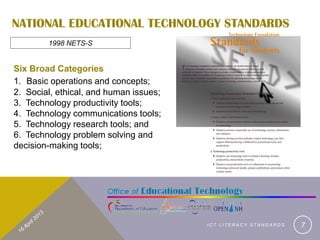
NATIONAL EDUCATIONAL TECHNOLOGY STANDARDS
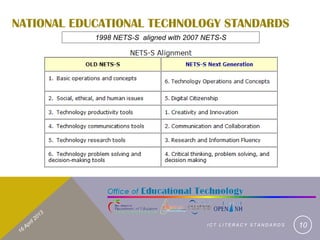
        1998 NETS-S


Six Broad Categories
1. Basic operations and concepts;
2. Social, ethical, and human issues;
3. Technology productivity tools;
4. Technology communications tools;
5. Technology research tools; and
6. Technology problem solving and
decision-making tools;


                                        ICT LITERACY STANDARDS   7
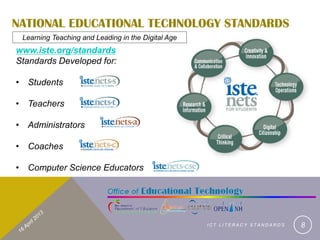
NATIONAL EDUCATIONAL TECHNOLOGY STANDARDS
 Learning Teaching and Leading in the Digital Age
www.iste.org/standards
Standards Developed for:

• Students

• Teachers

• Administrators

• Coaches

• Computer Science Educators


                                                    ICT LITERACY STANDARDS   8
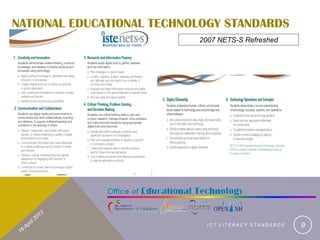
NATIONAL EDUCATIONAL TECHNOLOGY STANDARDS
                           2007 NETS-S Refreshed


                             ICT LITERACY STANDARDS   9
NATIONAL EDUCATIONAL TECHNOLOGY STANDARDS
            1998 NETS-S aligned with 2007 NETS-S


                                          ICT LITERACY STANDARDS   10
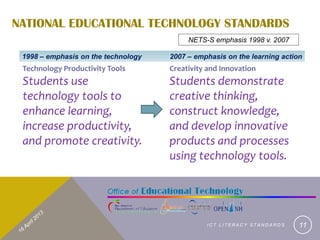
NATIONAL EDUCATIONAL TECHNOLOGY STANDARDS
                                          NETS-S emphasis 1998 v. 2007

 1998 – emphasis on the technology   2007 – emphasis on the learning action
 Technology Productivity Tools       Creativity and Innovation
 Students use                        Students demonstrate
 technology tools to                 creative thinking,
 enhance learning,                   construct knowledge,
 increase productivity,              and develop innovative
 and promote creativity.             products and processes
                                     using technology tools.


                                               ICT LITERACY STANDARDS     11
ICT LITERACY AND
THE NH COLLEGE & CAREER READY STANDARDS
                                      English Language Arts & Literacy in History/Social
                                      Studies, Science, and Technical Subjects
Media and Technology
    Just as media and technology are integrated in school and life in the twenty-first century, skills
    related to media use (both critical analysis and production of media) are integrated throughout
    the standards.

They use technology and digital media strategically and capably.
    Students employ technology thoughtfully to enhance their reading, writing, speaking, listening,
    and language use. They tailor their searches online to acquire useful information efficiently, and
    they integrate what they learn using technology with what they learn offline. They are familiar
    with the strengths and limitations of various technological tools and mediums and can select
    and use those best suited to their communication goals.


               NOT JUST ABOUT USING COMPUTERS FOR RESEARCH


                                                                    ICT LITERACY STANDARDS           12
ICT LITERACY AND
THE NH COLLEGE & CAREER READY STANDARDS
                                  English Language Arts & Literacy in History/Social
                                  Studies, Science, and Technical Subjects

CCSS.ELA-Literacy.W.5.2a
   Introduce a topic clearly, provide a general observation and focus, and group related
   information logically; include formatting (e.g., headings), illustrations, and multimedia
   when useful to aiding comprehension.

CCSS.ELA-Literacy.W.5.6
   With some guidance and support from adults, use technology, including the Internet,
   to produce and publish writing as well as to interact and collaborate with others;
   demonstrate sufficient command of keyboarding skills to type a minimum of two
   pages in a single sitting.


                                                            ICT LITERACY STANDARDS         13
ICT LITERACY AND
THE NH COLLEGE & CAREER READY STANDARDS
                                   English Language Arts & Literacy in History/Social
                                   Studies, Science, and Technical Subjects

CCSS.ELA-Literacy.SL.6.2
   Interpret information presented in diverse media and formats (e.g., visually,
   quantitatively, orally) and explain how it contributes to a topic, text, or issue under
   study.

CCSS.ELA-Literacy.SL.6.5
   Include multimedia components (e.g., graphics, images, music, sound) and visual
   displays in presentations to clarify information.


                                                              ICT LITERACY STANDARDS         14
ICT LITERACY AND
THE NH COLLEGE & CAREER READY STANDARDS
                                English Language Arts & Literacy in History/Social
                                Studies, Science, and Technical Subjects

CCSS.ELA-Literacy.W.11-12.2a
   Introduce a topic; organize complex ideas, concepts, and information so that each
   new element builds on that which precedes it to create a unified whole; include
   formatting (e.g., headings), graphics (e.g., figures, tables), and multimedia when
   useful to aiding comprehension.

CCSS.ELA-Literacy.W.11-12.6
   Use technology, including the Internet, to produce, publish, and update individual or
   shared writing products in response to ongoing feedback, including new arguments
   or information.


                                                         ICT LITERACY STANDARDS         15
ICT LITERACY AND ASSESSMENT
       Teaching with Technology        and     Testing with Technology


The Common Core State Standards, and the NH ICT Literacy Standards both
require integrating technology use into teaching and learning.

The Smarter Balanced Assessment Consortium will require students are
assessed using technology. Online assessments begin 2015!


                                                ICT LITERACY STANDARDS    16
TECHNOLOGY READINESS
             Both Consortia wanted a Technology Readiness
             Tool that would be able to assess current capacity
             and compare that to the technology guidelines that
             will be needed to administer the 2015 online
             assessments. Data would be evaluated in 4 areas:
                1.   Computers & other devices
                2.   Ratio of devices to test-takers
                3.   Network and infrastructure
                4.   Personnel (staffing & training)

             Pearson developed the Technology Readiness
             Tool


                                       ICT LITERACY STANDARDS   17
TECHNOLOGY READINESS
            Information about the Smarter Balanced Assessment
            Consortium can be found on their website.
            www.SmarterBalanced.org
            www.education.nh.gov/spotlight/ccss/sbac.htm

            The State Educational Technology Directors Association
            sponsors an informational networking site to help
            schools, districts, and states understand the process and
            get help. Join the NH Group!
            www.Assess4Ed.net
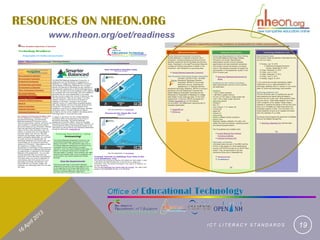
            Information about Technology Readiness and the
            Technology Readiness Tool is on the NH Technology
            Readiness page on NHEON.
            www.nheon.org/oet/readiness


                                          ICT LITERACY STANDARDS    18
RESOURCES ON NHEON.ORG
     www.nheon.org/oet/readiness


                                   ICT LITERACY STANDARDS   19
NEW HAMPSHIRE DATA
          www.nheon.org/oet/readiness

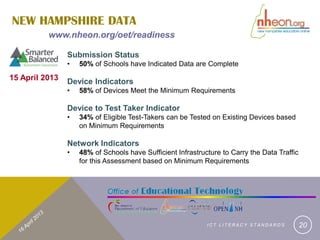
                Submission Status
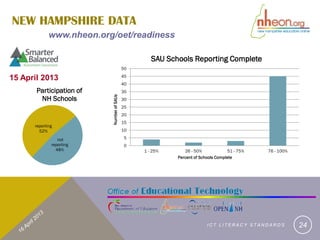
                •   50% of Schools have Indicated Data are Complete
15 April 2013   Device Indicators
                •   58% of Devices Meet the Minimum Requirements

                Device to Test Taker Indicator
                •   34% of Eligible Test-Takers can be Tested on Existing Devices based
                    on Minimum Requirements

                Network Indicators
                •   48% of Schools have Sufficient Infrastructure to Carry the Data Traffic
                    for this Assessment based on Minimum Requirements


                                                             ICT LITERACY STANDARDS           20
NEW HAMPSHIRE DATA                             Computers and Other Devices

  Information on computers and other devices were input into the tool.

  The data collected for each device was:
  •   How many?
  •   What operating system?
  •   What processor is in the device?
  •   How much memory?
  •   What is the screen resolution of the device display?
  •   What is the monitor/display size?
  •   Which browser is installed?
  •   Can it connect to wireless?
  •   What type of device?


                                                        ICT LITERACY STANDARDS
                                                                                 21
NEW HAMPSHIRE DATA                           Network and Infrastructure

 Information on network and infrastructure was entered into the tool.

 The data collected from each school was:
 Hardware
 •   What is the estimated Internet Bandwidth?
 •   What is the estimated Internal Network Bandwidth?
 •   Estimate how much Internet Bandwidth is used?
 •   Estimate how much Internal Network is used?
 •   How many Wireless Access Points are in the school?
 School
 •   What is the maximum Number of Simultaneous Test-Takers?
 •   What is the estimated Test-Taker Count for 2014-2015 school year?
 •   What is the length of Testing Window in School Days?
 •   How many Testing Sessions in each school day?


                                                      ICT LITERACY STANDARDS   22
NEW HAMPSHIRE DATA                          Test Administrators and Staffing

 Information on the personnel/staff and their training were input into the
 tool.

 The data collected from each school was in the form of rating concerns
 around issues and roadblocks that affect the staff. A 1 – 10 rating scale
 was used.
 1. Having a sufficient number of test administrators to support online
    testing.
 2. Test administrators having sufficient technical understanding to
    support online testing.
 3. Providing all appropriate training needed for test administrators.
 4. Having a sufficient number of technology support staff to support
    online testing.
 5. Technology support staff having sufficient technical understanding to
    support online testing."
 6. Providing all appropriate training needed for technology support staff.


                                                        ICT LITERACY STANDARDS   23
NEW HAMPSHIRE DATA
             www.nheon.org/oet/readiness

                                                   SAU Schools Reporting Complete
                                           50
                                           45
15 April 2013
                                           40
       Participation of                    35
        NH Schools

                          Number of SAUs
                                           30
                                           25
                                           20
                                           15
      reporting
        52%                                10

                 not                        5
              reporting                     0
                48%                             1 - 25%      26 - 50%              51 - 75%   76 - 100%
                                                          Percent of Schools Complete


                                                                        ICT LITERACY STANDARDS            24
THE GOOD NEWS

    At least half of our districts are using the tech readiness tool to get ready.

    The technology required to test online is not terribly advanced, hard to come
    by, or complicated.

    Our districts have had technology support through Title IID of ESEA for the
    past decade.

    Most schools will be able to meet the technology requirements to assess
    their students online, but the 2015 deadline.


                                                         ICT LITERACY STANDARDS      25
THE BAD NEWS
    At least half of our districts are not using the tech readiness tool to get ready.

    While the technology required to test online is not terribly advanced, hard to
    come by, or complicated, many districts fail to recognize the importance of
    making technology use a requirement of all staff and students. We still have
    recognized “tech teachers” and accept teachers who identify themselves as
    “not a techy” or “don’t use technology”.

    As education leaders, we often fail to recognize the importance of technology,
    emphasize, or model technology integration when we deliver, promote, or
    approve professional development opportunities or teacher training.

    Our students are learning technology “on their own”, because it engages them
    and they want to use it, but they are not learning good digital citizenship or
    responsible use at the same time.


                                                         ICT LITERACY STANDARDS          26
THE TAKE AWAY
What do we do now?  Model and Expect Proficiency in the ISTE NETS-T
• We need to take seriously our role as education leaders in New Hampshire.
• We can’t just host “professional development” that talks about content or pedagogy
  without integrating the use of technology or ICT Literacy skills into the experience, we
  have to model the use of tech literacy skills and abilities in our actions and teaching for
  the field.
• We have to insist that professional development we deliver, authorize, promote, and
  approve, integrates technology and models its effective use.
    • Engages socially through peer interactions both online and offline
    • Stresses metacognitive processes enriched by technology
    • Extends learning beyond the “workshop” or “webinar” or “seminar” through
        continued online interactions with content and resources
    • Requires a project based / demonstration product to assess learning
    • Seamlessly integrates online tools and resources to enhance learning
• We have to insist that our professional development providers follow this collaborative
  and metacognitive model as well.


                                                              ICT LITERACY STANDARDS        27
THE TAKE AWAY

   The Bottom Line


   We cannot effectively use technology and
   online tools for engaging assessments
   unless we effectively teach kids using those
   same technologies and online tools to
   support and engage them in their learning.


                                  ICT LITERACY STANDARDS   28
RESOURCES


       New Hampshire Educators Online (NHEON)
       NHEON.org www.nheon.org

       NH e-Learning for Educators Project
       NH e-Learning for Educators informational website www.opennh.org
       OPEN NH course and tutorial management system www.opennh.net

       Online Learning in New Hampshire    www.nheon.org/onlinelearning

                                          Institute in a Box
                                          Collaboration Rings
                                          Common Core Lesson Sharing
                                          www.nhdrc.org


                                              ICT LITERACY STANDARDS      29
THE END   Questions and Answers


          ICT LITERACY STANDARDS   30
OFFICE OF EDUCATIONAL TECHNOLOGY
                                                Contact Information


 @
                   Stan Freeda
                   New Hampshire Technology Readiness Coordinator
                   Office of Educational Technology
                   New Hampshire Department of Education

                   Stanley.Freeda@doe.nh.gov                603.271.5132


 www.education.nh.gov   www.nheon.org   www.opennh.org


                                                    ICT LITERACY STANDARDS   31

ICT Literacy and Common Core - April 2013

  • 1.
  • 2.
    NEW HAMPSHIRE INFORMATIONAND COMMUNICATION LITERACY STANDARDS Part of the Minimum Standards for School Approval (Ed 306.42) New Hampshire Minimum Standards for School Approval include a section for information and communication technologies (ICT) literacy (Ed 306.42). They became effective on July 1, 2005. Ed 306.42 requires all K-8 students to develop a digital portfolio which is assessed for ICT literacy by the end of 8th grade. Ed 306.42 requires students to complete at least 1/2 credit of computer technology literacy prior to high school graduation. These standards are were revised and updated to better reflect current understanding of 21st century literacies. ICT LITERACY STANDARDS 2
  • 3.
    NEW HAMPSHIRE INFORMATIONAND COMMUNICATION LITERACY STANDARDS ALIGNMENT OF STANDARDS THE NH DEPARTMENT OF EDUCATION RELEASED TECHNICAL ADVISORY #2 INFORMATION AND COMMUNICATION TECHNOLOGIES (ICT) TO PROVIDE GUIDANCE AND ANSWERS TO FREQUENTLY ASKED QUESTIONS. GLE READING & LITERACY SKILLS ALIGNMENT - IN JULY 2006 A TASK FORCE OF LIBRARY MEDIA SPECIALISTS REVIEWED THREE SEPARATE DOCUMENTS: GRADE LEVEL EXPECTATIONS FOR READING K-8, INFORMATION LITERACY STANDARDS FROM AMERICAN ASSOCIATION OF SCHOOL LIBRARIANS, AND THE NH ICT LITERACY STANDARDS AND CAME UP WITH AN ALIGNMENT OF ALL THREE. ICT LITERACY STANDARDS 3
  • 4.
    NEW HAMPSHIRE INFORMATIONAND COMMUNICATION LITERACY STANDARDS Ed 306.42 (2005) (a) Opportunities for Students to: K-12 Standards 1. Develop responsible use 2. Become proficient in 21st Century Tools Within Core Subjects Reading, Math, ELA, Science, Social Studies, Arts, World Languages 3. Use tools for learning Literacy, numeracy, problem solving, decision making, spatial literacy 4. Use tools for technical knowledge Hardware, software, networks, technology elements 5. Create Digital Portfolios which demonstrate a. 6 ISTE NETS-S Components b. Responsible use of tools in Core subjects c. Digital Artifacts Tests, observations, work, reflections ICT LITERACY STANDARDS 4
  • 5.
    NEW HAMPSHIRE INFORMATIONAND COMMUNICATION LITERACY STANDARDS Ed 306.42 (2005) K-12 Standards (b) Assess the student digital portfolio for competency in ICT Literacy by the end of 8th grade. (c) Provide opportunities for high school students to take ½ credit ICT course 1. Common productivity tools 2. Multimedia software 3. Basic hardware and configurations 4. Applying programming concepts ICT LITERACY STANDARDS 5
  • 6.
    ICT LITERACY STANDARDS ProgramStandards not Curriculum Standards There is an ICT literacy toolkit available on NHEON. www.nheon.org/ictliteracy/ Components for Assessment are based on the National Educational Technology Standards for Students (ISTE NETS – S) ICT LITERACY STANDARDS 6
  • 7.
    NATIONAL EDUCATIONAL TECHNOLOGYSTANDARDS 1998 NETS-S Six Broad Categories 1. Basic operations and concepts; 2. Social, ethical, and human issues; 3. Technology productivity tools; 4. Technology communications tools; 5. Technology research tools; and 6. Technology problem solving and decision-making tools; ICT LITERACY STANDARDS 7
  • 8.
    NATIONAL EDUCATIONAL TECHNOLOGYSTANDARDS Learning Teaching and Leading in the Digital Age www.iste.org/standards Standards Developed for: • Students • Teachers • Administrators • Coaches • Computer Science Educators ICT LITERACY STANDARDS 8
  • 9.
    NATIONAL EDUCATIONAL TECHNOLOGYSTANDARDS 2007 NETS-S Refreshed ICT LITERACY STANDARDS 9
  • 10.
    NATIONAL EDUCATIONAL TECHNOLOGYSTANDARDS 1998 NETS-S aligned with 2007 NETS-S ICT LITERACY STANDARDS 10
  • 11.
    NATIONAL EDUCATIONAL TECHNOLOGYSTANDARDS NETS-S emphasis 1998 v. 2007 1998 – emphasis on the technology 2007 – emphasis on the learning action Technology Productivity Tools Creativity and Innovation Students use Students demonstrate technology tools to creative thinking, enhance learning, construct knowledge, increase productivity, and develop innovative and promote creativity. products and processes using technology tools. ICT LITERACY STANDARDS 11
  • 12.
    ICT LITERACY AND THENH COLLEGE & CAREER READY STANDARDS English Language Arts & Literacy in History/Social Studies, Science, and Technical Subjects Media and Technology Just as media and technology are integrated in school and life in the twenty-first century, skills related to media use (both critical analysis and production of media) are integrated throughout the standards. They use technology and digital media strategically and capably. Students employ technology thoughtfully to enhance their reading, writing, speaking, listening, and language use. They tailor their searches online to acquire useful information efficiently, and they integrate what they learn using technology with what they learn offline. They are familiar with the strengths and limitations of various technological tools and mediums and can select and use those best suited to their communication goals. NOT JUST ABOUT USING COMPUTERS FOR RESEARCH ICT LITERACY STANDARDS 12
  • 13.
    ICT LITERACY AND THENH COLLEGE & CAREER READY STANDARDS English Language Arts & Literacy in History/Social Studies, Science, and Technical Subjects CCSS.ELA-Literacy.W.5.2a Introduce a topic clearly, provide a general observation and focus, and group related information logically; include formatting (e.g., headings), illustrations, and multimedia when useful to aiding comprehension. CCSS.ELA-Literacy.W.5.6 With some guidance and support from adults, use technology, including the Internet, to produce and publish writing as well as to interact and collaborate with others; demonstrate sufficient command of keyboarding skills to type a minimum of two pages in a single sitting. ICT LITERACY STANDARDS 13
  • 14.
    ICT LITERACY AND THENH COLLEGE & CAREER READY STANDARDS English Language Arts & Literacy in History/Social Studies, Science, and Technical Subjects CCSS.ELA-Literacy.SL.6.2 Interpret information presented in diverse media and formats (e.g., visually, quantitatively, orally) and explain how it contributes to a topic, text, or issue under study. CCSS.ELA-Literacy.SL.6.5 Include multimedia components (e.g., graphics, images, music, sound) and visual displays in presentations to clarify information. ICT LITERACY STANDARDS 14
  • 15.
    ICT LITERACY AND THENH COLLEGE & CAREER READY STANDARDS English Language Arts & Literacy in History/Social Studies, Science, and Technical Subjects CCSS.ELA-Literacy.W.11-12.2a Introduce a topic; organize complex ideas, concepts, and information so that each new element builds on that which precedes it to create a unified whole; include formatting (e.g., headings), graphics (e.g., figures, tables), and multimedia when useful to aiding comprehension. CCSS.ELA-Literacy.W.11-12.6 Use technology, including the Internet, to produce, publish, and update individual or shared writing products in response to ongoing feedback, including new arguments or information. ICT LITERACY STANDARDS 15
  • 16.
    ICT LITERACY ANDASSESSMENT Teaching with Technology and Testing with Technology The Common Core State Standards, and the NH ICT Literacy Standards both require integrating technology use into teaching and learning. The Smarter Balanced Assessment Consortium will require students are assessed using technology. Online assessments begin 2015! ICT LITERACY STANDARDS 16
  • 17.
    TECHNOLOGY READINESS Both Consortia wanted a Technology Readiness Tool that would be able to assess current capacity and compare that to the technology guidelines that will be needed to administer the 2015 online assessments. Data would be evaluated in 4 areas: 1. Computers & other devices 2. Ratio of devices to test-takers 3. Network and infrastructure 4. Personnel (staffing & training) Pearson developed the Technology Readiness Tool ICT LITERACY STANDARDS 17
  • 18.
    TECHNOLOGY READINESS Information about the Smarter Balanced Assessment Consortium can be found on their website. www.SmarterBalanced.org www.education.nh.gov/spotlight/ccss/sbac.htm The State Educational Technology Directors Association sponsors an informational networking site to help schools, districts, and states understand the process and get help. Join the NH Group! www.Assess4Ed.net Information about Technology Readiness and the Technology Readiness Tool is on the NH Technology Readiness page on NHEON. www.nheon.org/oet/readiness ICT LITERACY STANDARDS 18
  • 19.
    RESOURCES ON NHEON.ORG www.nheon.org/oet/readiness ICT LITERACY STANDARDS 19
  • 20.
    NEW HAMPSHIRE DATA www.nheon.org/oet/readiness Submission Status • 50% of Schools have Indicated Data are Complete 15 April 2013 Device Indicators • 58% of Devices Meet the Minimum Requirements Device to Test Taker Indicator • 34% of Eligible Test-Takers can be Tested on Existing Devices based on Minimum Requirements Network Indicators • 48% of Schools have Sufficient Infrastructure to Carry the Data Traffic for this Assessment based on Minimum Requirements ICT LITERACY STANDARDS 20
  • 21.
    NEW HAMPSHIRE DATA Computers and Other Devices Information on computers and other devices were input into the tool. The data collected for each device was: • How many? • What operating system? • What processor is in the device? • How much memory? • What is the screen resolution of the device display? • What is the monitor/display size? • Which browser is installed? • Can it connect to wireless? • What type of device? ICT LITERACY STANDARDS 21
  • 22.
    NEW HAMPSHIRE DATA Network and Infrastructure Information on network and infrastructure was entered into the tool. The data collected from each school was: Hardware • What is the estimated Internet Bandwidth? • What is the estimated Internal Network Bandwidth? • Estimate how much Internet Bandwidth is used? • Estimate how much Internal Network is used? • How many Wireless Access Points are in the school? School • What is the maximum Number of Simultaneous Test-Takers? • What is the estimated Test-Taker Count for 2014-2015 school year? • What is the length of Testing Window in School Days? • How many Testing Sessions in each school day? ICT LITERACY STANDARDS 22
  • 23.
    NEW HAMPSHIRE DATA Test Administrators and Staffing Information on the personnel/staff and their training were input into the tool. The data collected from each school was in the form of rating concerns around issues and roadblocks that affect the staff. A 1 – 10 rating scale was used. 1. Having a sufficient number of test administrators to support online testing. 2. Test administrators having sufficient technical understanding to support online testing. 3. Providing all appropriate training needed for test administrators. 4. Having a sufficient number of technology support staff to support online testing. 5. Technology support staff having sufficient technical understanding to support online testing." 6. Providing all appropriate training needed for technology support staff. ICT LITERACY STANDARDS 23
  • 24.
    NEW HAMPSHIRE DATA www.nheon.org/oet/readiness SAU Schools Reporting Complete 50 45 15 April 2013 40 Participation of 35 NH Schools Number of SAUs 30 25 20 15 reporting 52% 10 not 5 reporting 0 48% 1 - 25% 26 - 50% 51 - 75% 76 - 100% Percent of Schools Complete ICT LITERACY STANDARDS 24
  • 25.
    THE GOOD NEWS At least half of our districts are using the tech readiness tool to get ready. The technology required to test online is not terribly advanced, hard to come by, or complicated. Our districts have had technology support through Title IID of ESEA for the past decade. Most schools will be able to meet the technology requirements to assess their students online, but the 2015 deadline. ICT LITERACY STANDARDS 25
  • 26.
    THE BAD NEWS At least half of our districts are not using the tech readiness tool to get ready. While the technology required to test online is not terribly advanced, hard to come by, or complicated, many districts fail to recognize the importance of making technology use a requirement of all staff and students. We still have recognized “tech teachers” and accept teachers who identify themselves as “not a techy” or “don’t use technology”. As education leaders, we often fail to recognize the importance of technology, emphasize, or model technology integration when we deliver, promote, or approve professional development opportunities or teacher training. Our students are learning technology “on their own”, because it engages them and they want to use it, but they are not learning good digital citizenship or responsible use at the same time. ICT LITERACY STANDARDS 26
  • 27.
    THE TAKE AWAY Whatdo we do now?  Model and Expect Proficiency in the ISTE NETS-T • We need to take seriously our role as education leaders in New Hampshire. • We can’t just host “professional development” that talks about content or pedagogy without integrating the use of technology or ICT Literacy skills into the experience, we have to model the use of tech literacy skills and abilities in our actions and teaching for the field. • We have to insist that professional development we deliver, authorize, promote, and approve, integrates technology and models its effective use. • Engages socially through peer interactions both online and offline • Stresses metacognitive processes enriched by technology • Extends learning beyond the “workshop” or “webinar” or “seminar” through continued online interactions with content and resources • Requires a project based / demonstration product to assess learning • Seamlessly integrates online tools and resources to enhance learning • We have to insist that our professional development providers follow this collaborative and metacognitive model as well. ICT LITERACY STANDARDS 27
  • 28.
    THE TAKE AWAY The Bottom Line We cannot effectively use technology and online tools for engaging assessments unless we effectively teach kids using those same technologies and online tools to support and engage them in their learning. ICT LITERACY STANDARDS 28
  • 29.
    RESOURCES New Hampshire Educators Online (NHEON) NHEON.org www.nheon.org NH e-Learning for Educators Project NH e-Learning for Educators informational website www.opennh.org OPEN NH course and tutorial management system www.opennh.net Online Learning in New Hampshire www.nheon.org/onlinelearning Institute in a Box Collaboration Rings Common Core Lesson Sharing www.nhdrc.org ICT LITERACY STANDARDS 29
  • 30.
    THE END Questions and Answers ICT LITERACY STANDARDS 30
  • 31.
    OFFICE OF EDUCATIONALTECHNOLOGY Contact Information @ Stan Freeda New Hampshire Technology Readiness Coordinator Office of Educational Technology New Hampshire Department of Education Stanley.Freeda@doe.nh.gov 603.271.5132 www.education.nh.gov www.nheon.org www.opennh.org ICT LITERACY STANDARDS 31