MOODLE
COMPETENCIES
A Hidden gem in Moodle
Overview
• Key competencies for sales representatives – CPSA
• Primary care & general practice nursing career & core
capabilities framework
• Programming Competency Based Education
• PSI Core Competencies
KEY COMPETENCIES FOR
SALES REPRESENTATIVES
Canadian Professional Sales Association
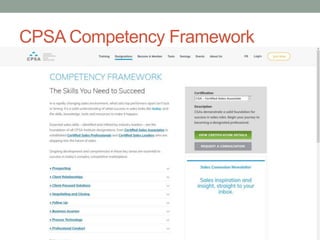
CPSA Competency Framework
CPSA Framework Diagram
CPSA – Professional Sales Conduct
8.3 Work as part of a team
• P1. Understand the org chart and who has decision-
making power
• P2. Understand key organizational influencers
• P3. Respect team members’ ideas and opinions
• P4. Establish trust with clients and colleagues
• P5. Communicate regularly with team members, e.g.
share information and opportunities
• P6. Manage conflicts with co-workers in positive manner
• P7. Assist team members when possible
• P8. Recognize and support achievement of team sales
objectives/goals
PROGRAMMING
Instructional Framework for Business and Information
Technology
SOL Correlation by Task
001 Explain the reasoning behind the steps in
the software development life cycle (SDLC).
English: 11.5, 12.5
Mathematics: COM.1,
COM.2, COM.3, COM.4,
COM.18
002 Describe the primary principles of object-
oriented programming (OOP).
English: 11.5, 12.5
Mathematics: COM.1
003 Identify potential objects, attributes, and
methods within a problem description.
English: 11.5, 12.5
Mathematics: COM.1,
COM.5
004 Design attributes (properties) and methods
of each class within a problem description.
English: 11.1, 12.1
Mathematics: COM.1,
COM.3, COM.4, COM.5,
COM.10, COM.11
Task 001 (OOP)
• Task Number 001
• Explain the reasoning behind the steps in the software development life cycle
(SDLC).
• Definition
• Explanation should include the reason for each step in the sequence of steps used for
program development:
• • Define the problem.
• • Develop the algorithm.
• • Code the program.
• • Test the program.
• • Debug the program.
• • Document the program.
• • Implement the program.
• • Maintain the program.
• Software development can be done in a sequential (Waterfall) or iterative (Agile) method.
• Related Standards of Learning
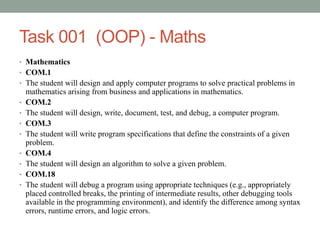
Task 001 (OOP) - Maths
• Mathematics
• COM.1
• The student will design and apply computer programs to solve practical problems in
mathematics arising from business and applications in mathematics.
• COM.2
• The student will design, write, document, test, and debug, a computer program.
• COM.3
• The student will write program specifications that define the constraints of a given
problem.
• COM.4
• The student will design an algorithm to solve a given problem.
• COM.18
• The student will debug a program using appropriate techniques (e.g., appropriately
placed controlled breaks, the printing of intermediate results, other debugging tools
available in the programming environment), and identify the difference among syntax
errors, runtime errors, and logic errors.
Task 001 (OOP) - English
English
11.5
The student will read, interpret, analyse, and evaluate a variety of nonfiction texts including
employment documents and technical writing.
a) Apply information from texts to clarify understanding of concepts.
b) Read and correctly interpret an application for employment, workplace documents, or an
application for college admission.
c) Analyse technical writing for clarity.
d) Paraphrase and synthesize ideas within and between texts.
e) Draw conclusions and make inferences on explicit and implied information using textual
support.
f) Analyse multiple texts addressing the same topic to determine how authors reach similar
or different conclusions.
g) Analyse false premises, claims, counterclaims, and other evidence in persuasive writing.
h) Recognize and analyse use of ambiguity, contradiction, paradox, irony, sarcasm,
overstatement, and understatement in text.
i) Generate and respond logically to literal, inferential, evaluative, synthesizing, and
critical thinking questions about the text(s).
PSI CORE COMPETENCY
FRAMEWORK
PSI Framework Domains
The Structure of the Framework
• Domain 1 – Professional Practice
• Domain 2 – Personal Skills
• Domain 3 – Supply of Medicines
• Domain 4 – Safe and Rational Use of Medicines
• Domain 5 – Public Health
• Domain 6 – Organisation and Management Skills
Compass Activity
1.1 Practises patient-centred care
1.1.1 Demonstrates a patient-centred approach to practice
1.1.2 Ensures patient safety and quality are at the centre of the pharmacy
practice
1.1.3 Educates and empowers the patient to manage their own health and
medicines
1.1.4 Acts as a patient advocate to ensure that patient care is not jeopardised
1.1.5 Monitors the medicines and other healthcare needs of the patient on a
regular basis and makes recommendations for improvement to the patient and
other healthcare professionals as appropriate
1.1.6 Understands patients rights to receive safe and high quality healthcare
including pharmacy care and ensures that patient care delivered reflects
evidence-based practice
Rating System
Mark Ranking Definition
Percentage
Range
n/a Cannot
Not applicable in this training
establishment
n/a
1 Rarely
Very rarely meets the standard
expected. No logical thought process
appears to apply
0-20%
2 Sometimes Much more haphazard than "mostly" 21-50%
3 Mostly
Implies standard practice with
occasional lapses
51-84%
4 Consistently
Demonstrates the expected standard
practice with very rare lapses
85-100%
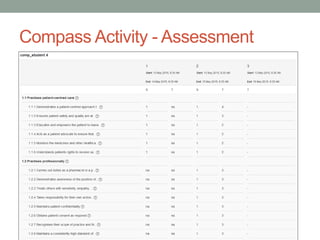
Compass Activity - Assessment
• Student scores each
behaviour in the
assessment
• Tutors get alerted on
submission and
then score the student on
each
behaviour too
• Both can see each others
scoring
• Feedback is also enabled
for both
• This is repeated for each
phase
Compass Activity – Visual Report
• In addition to tabular
view an interactive
graph report view is
available with drill
down capability for
Domain, Competency
and Behaviour
• Can compare student
vs tutor, different
phases to see visual
progression
WHAT ABOUT MOODLE?
Competency based learning
Framework for competency-based education in Moodle
• Overview in Moodle Docs
• Discussion on competencies on moodle.org
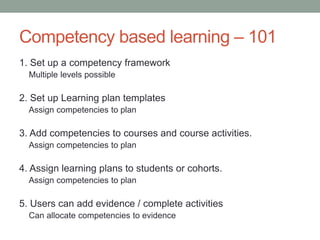
Competency based learning – 101
1. Set up a competency framework
Multiple levels possible
2. Set up Learning plan templates
Assign competencies to plan
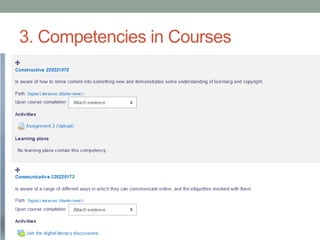
3. Add competencies to courses and course activities.
Assign competencies to plan
4. Assign learning plans to students or cohorts.
Assign competencies to plan
5. Users can add evidence / complete activities
Can allocate competencies to evidence
1. Framework
2. Learning Plan Creation
3. Competencies in Courses
4. Learning Plans
5. Students – Learning Plan
5. Students - Evidence
FINAL THOUGHTS
MOODLEMOOT UK AND
IRELAND – MAY 10TH-12TH
2021
Gavin Henrick
Enhancing the building blocks of effective education
gavin@brickfield.ie Brickfield Education Labs
www.brickfield.ie @ghenrick Skype: gavin.henrick

Moodle competencies a hidden gem

  • 1.
  • 2.
    Overview • Key competenciesfor sales representatives – CPSA • Primary care & general practice nursing career & core capabilities framework • Programming Competency Based Education • PSI Core Competencies
  • 3.
    KEY COMPETENCIES FOR SALESREPRESENTATIVES Canadian Professional Sales Association
  • 4.
  • 5.
  • 6.
    CPSA – ProfessionalSales Conduct 8.3 Work as part of a team • P1. Understand the org chart and who has decision- making power • P2. Understand key organizational influencers • P3. Respect team members’ ideas and opinions • P4. Establish trust with clients and colleagues • P5. Communicate regularly with team members, e.g. share information and opportunities • P6. Manage conflicts with co-workers in positive manner • P7. Assist team members when possible • P8. Recognize and support achievement of team sales objectives/goals
  • 7.
    PROGRAMMING Instructional Framework forBusiness and Information Technology
  • 8.
    SOL Correlation byTask 001 Explain the reasoning behind the steps in the software development life cycle (SDLC). English: 11.5, 12.5 Mathematics: COM.1, COM.2, COM.3, COM.4, COM.18 002 Describe the primary principles of object- oriented programming (OOP). English: 11.5, 12.5 Mathematics: COM.1 003 Identify potential objects, attributes, and methods within a problem description. English: 11.5, 12.5 Mathematics: COM.1, COM.5 004 Design attributes (properties) and methods of each class within a problem description. English: 11.1, 12.1 Mathematics: COM.1, COM.3, COM.4, COM.5, COM.10, COM.11
  • 9.
    Task 001 (OOP) •Task Number 001 • Explain the reasoning behind the steps in the software development life cycle (SDLC). • Definition • Explanation should include the reason for each step in the sequence of steps used for program development: • • Define the problem. • • Develop the algorithm. • • Code the program. • • Test the program. • • Debug the program. • • Document the program. • • Implement the program. • • Maintain the program. • Software development can be done in a sequential (Waterfall) or iterative (Agile) method. • Related Standards of Learning
  • 10.
    Task 001 (OOP)- Maths • Mathematics • COM.1 • The student will design and apply computer programs to solve practical problems in mathematics arising from business and applications in mathematics. • COM.2 • The student will design, write, document, test, and debug, a computer program. • COM.3 • The student will write program specifications that define the constraints of a given problem. • COM.4 • The student will design an algorithm to solve a given problem. • COM.18 • The student will debug a program using appropriate techniques (e.g., appropriately placed controlled breaks, the printing of intermediate results, other debugging tools available in the programming environment), and identify the difference among syntax errors, runtime errors, and logic errors.
  • 11.
    Task 001 (OOP)- English English 11.5 The student will read, interpret, analyse, and evaluate a variety of nonfiction texts including employment documents and technical writing. a) Apply information from texts to clarify understanding of concepts. b) Read and correctly interpret an application for employment, workplace documents, or an application for college admission. c) Analyse technical writing for clarity. d) Paraphrase and synthesize ideas within and between texts. e) Draw conclusions and make inferences on explicit and implied information using textual support. f) Analyse multiple texts addressing the same topic to determine how authors reach similar or different conclusions. g) Analyse false premises, claims, counterclaims, and other evidence in persuasive writing. h) Recognize and analyse use of ambiguity, contradiction, paradox, irony, sarcasm, overstatement, and understatement in text. i) Generate and respond logically to literal, inferential, evaluative, synthesizing, and critical thinking questions about the text(s).
  • 12.
  • 13.
    PSI Framework Domains TheStructure of the Framework • Domain 1 – Professional Practice • Domain 2 – Personal Skills • Domain 3 – Supply of Medicines • Domain 4 – Safe and Rational Use of Medicines • Domain 5 – Public Health • Domain 6 – Organisation and Management Skills
  • 14.
    Compass Activity 1.1 Practisespatient-centred care 1.1.1 Demonstrates a patient-centred approach to practice 1.1.2 Ensures patient safety and quality are at the centre of the pharmacy practice 1.1.3 Educates and empowers the patient to manage their own health and medicines 1.1.4 Acts as a patient advocate to ensure that patient care is not jeopardised 1.1.5 Monitors the medicines and other healthcare needs of the patient on a regular basis and makes recommendations for improvement to the patient and other healthcare professionals as appropriate 1.1.6 Understands patients rights to receive safe and high quality healthcare including pharmacy care and ensures that patient care delivered reflects evidence-based practice
  • 15.
    Rating System Mark RankingDefinition Percentage Range n/a Cannot Not applicable in this training establishment n/a 1 Rarely Very rarely meets the standard expected. No logical thought process appears to apply 0-20% 2 Sometimes Much more haphazard than "mostly" 21-50% 3 Mostly Implies standard practice with occasional lapses 51-84% 4 Consistently Demonstrates the expected standard practice with very rare lapses 85-100%
  • 16.
    Compass Activity -Assessment • Student scores each behaviour in the assessment • Tutors get alerted on submission and then score the student on each behaviour too • Both can see each others scoring • Feedback is also enabled for both • This is repeated for each phase
  • 17.
    Compass Activity –Visual Report • In addition to tabular view an interactive graph report view is available with drill down capability for Domain, Competency and Behaviour • Can compare student vs tutor, different phases to see visual progression
  • 18.
  • 19.
    Competency based learning Frameworkfor competency-based education in Moodle • Overview in Moodle Docs • Discussion on competencies on moodle.org
  • 20.
    Competency based learning– 101 1. Set up a competency framework Multiple levels possible 2. Set up Learning plan templates Assign competencies to plan 3. Add competencies to courses and course activities. Assign competencies to plan 4. Assign learning plans to students or cohorts. Assign competencies to plan 5. Users can add evidence / complete activities Can allocate competencies to evidence
  • 21.
  • 22.
  • 23.
  • 24.
  • 25.
    5. Students –Learning Plan
  • 26.
    5. Students -Evidence
  • 27.
  • 28.
    MOODLEMOOT UK AND IRELAND– MAY 10TH-12TH 2021
  • 29.
    Gavin Henrick Enhancing thebuilding blocks of effective education gavin@brickfield.ie Brickfield Education Labs www.brickfield.ie @ghenrick Skype: gavin.henrick