Common Core State StandardsAn Occasion for Change
RolesTime CopSpokes PersonPartners
Funniest Kid Memory of the Year1 Minute sharing with partner.
Today’s Key QuestionsWhat are the expectations of the Common Core State Standards in English Language Arts & Literacy in History/Social Studies, Science, and Technical Subjects? (The Standards and Assessments)How can we begin an exploration of the standards in schools? (Exploring Strategies)What might the application of standards look like in practice, particularly in text and task selection? (Strategies for Leading the Common Core Adoption in PLCs)
Why New Standards?Students are not reading at levels sufficient for college and career readiness in content areas. Only slightly more than half (53%) of the members of the 2009 high school graduating class were ready for college-level and workplace training–level reading
What is “College Readiness?”	The level of preparation a student needs to be ready to enroll and succeed without remediation in an entry-level, credit bearing course (in each content area) at a two-year or four-year institution, trade school, or technical school.
What is “College Readiness?”College readiness IS for EVERY ONE
What We Know So FarNew StandardsNew Assessments
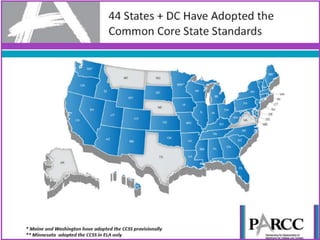
PARCC – Partnership for Assessment of Readiness for College and CareersAn alliance of 25 states to develop acommon set of K–12 assessments in English and Math (Beginning in 2014)PARCC Assessment System will include:Multiple-choice, short answer, open response, and performance based items
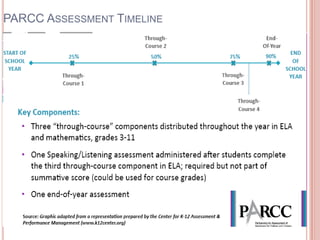
PARCC Assessment Timeline
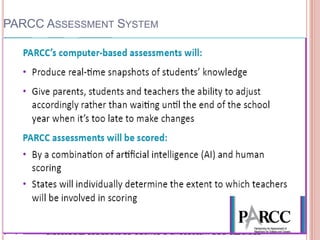
PARCC Assessment System
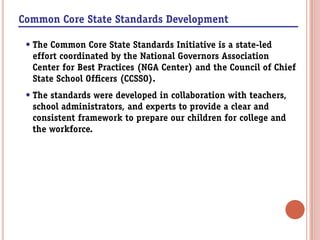
Leading the Discussion: Strengths of CCSSAligned with college and work expectations. Include rigorous content and application of knowledge through higher order skills.Build upon strengths and lessons of current state standards.Informed by top-performing countries, so that all students are prepared to succeed in our global economy and society; and,Evidence and/or researched-based.
Key Advances: ELA and Literacy in Content AreasReading: Balance of literature and informational texts + Text complexityWriting: Emphasis on argument and informative/explanatory writing + Writing about SourcesSpeaking and Listening: Inclusion of formal and informal talkLanguage: Stress on general academic and domain specific vocabularyStandards for reading and writing in history/social studies, science, and technical subjects: Complement rather than replace content standards SHIFTS RESPONSIBILITY for TEACHING with TEXT to ALL TEACHERS
Anchor Standards: Clear Simple TargetsAnchor standards for Reading and Writing across genres and subject areas allow students to develop mutually reinforcing skills, required across a range of texts and classroomsReading and Writing standards are closely tied to the standards for listening and speaking.21st Century skills in research and technology, particularly regarding the interpretation and production of multi-media texts are also featured.
Key Grade Band FeaturesK-5 Foundational Skills (Print Concepts, Phonological Awareness, Phonics and Word Recognition, and Fluency)6-12 Literacy in History/Social Studies, Science, and Technical Subjects
How Can This Make More Kids College Ready?: Sample Assessment TasksExplore the sample assessment items and discuss the ways in which the tasks differ from ISAT in terms of cognitive tasks each requires.Talk with your partner firstTalk with your group
Grade-Specific Standards: A Spiraling StaircaseWhat students should master by the end of each grade.Students are expected to retain and further develop skills and understandings mastered in preceding grades.
Leading the Discussion: Spiraling Standards in Reading and WritingCCR Anchor Standard 8 for Reading:“Delineate and evaluate the argument and specific claims in a text, including the validity of the reasoning as well as the relevance and sufficiency of the evidence.”CCR Anchor Standard 1 for Writing:“Write arguments to support claims in an analysis of substantive topics or texts using valid reasoning and relevant and sufficient evidence.”
Tracking a Spiraling StandardComplete Tracking Activity (20-30 minutes)What variables are used to increase rigor?
Tracking a Spiraling StandardReflection: What aspects of literacy seems to be valued most throughout these standards?
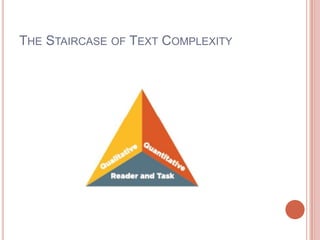
The Staircase of Text Complexity
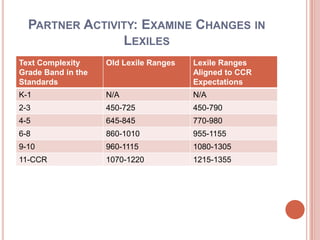
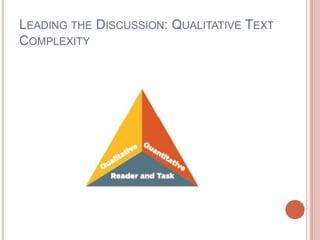
Quantitative Text ComplexityStandards recommend that multiple quantitative measures be used whenever possible and that their results be confirmed or overruled by a qualitative analysis of the text in question.Certain texts such as Poetry, Drama and K-1 texts cannot accurately be measured quantitatively .
Partner Activity: Examine Changes in Lexiles
Leading the Discussion: Qualitative Text Complexity
Lower or Higher End of Grade Band?Examine the Text Using the Protocol for Analyzing the Qualitative Dimensions of Text ComplexityWould you place this on the lower or higher end of the 6-8 grade band?Reflection: How can you as an instructional leader facilitate these kinds of reflective discussions?
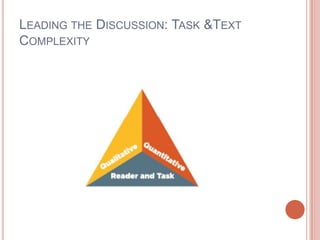
Leading the Discussion: Task &Text Complexity
Task AnalysisDouglass’s NarrativeWhich of the Grade 8,  ELA Standards would you practice while completing this task?Which of the 6-8 Literacy Standards would you practice while completing this task?
The Special Place of Argumentation(1) Other nations pay equal attention to what students read and how they read. Explicit expectations for the range, quality, and complexity of what students read along with more conventional standards describing how well students must be able to read.(2) Students are required to write in response to sources. In several international assessment programs, students are confronted with a text or texts and asked to gather evidence, analyze readings, and synthesize content. The Standards likewise require students to “draw evidence from literary or informational texts to support analysis, reflection, and research” (Writing CCR standard 9).(3) Writing arguments and writing informational/explanatory texts are priorities. The Standards follow international models by making writing arguments and writing informational/explanatory texts the dominant modes of writing in high school to demonstrate readiness for college and career.
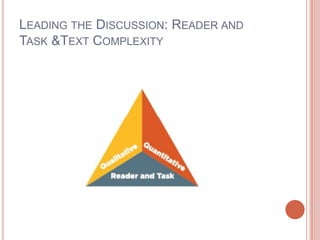
Leading the Discussion: Reader and Task &Text Complexity
Teachers and The Reader VariableCan teachers influence these variables?Background knowledgeMotivationExperience
Staircase of Complexity
Kids Get Good at What They PracticeAll worksheets aren’t bad.All worksheets is bad.
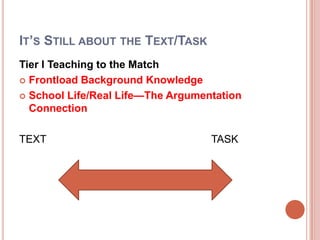
It’s Still about the Text/TaskTier I Teaching to the MatchFrontload Background KnowledgeSchool Life/Real Life—The Argumentation ConnectionTEXT						TASK
It’s Still about the Text/TaskTier I Teaching to the MatchFrontload Background KnowledgeSchool Life/Real Life!TASK						TEXT
Implications for InstructionShift focus from literacy instruction to center on careful examination of text Text selection: complexity, genre, and qualityTask selection: rigorous tasksSource: CARRIE HEATH PHILLIPS, COUNCIL OF CHIEF STATE SCHOOL OFFICERS (CCSSO)CARRIEH@CCSSO.ORG
More Non-fictionGrades 3-5 50% Literature 50% Informational.Grades 6-12 45% Literature 55% Informational (More literary non-fiction, particularly texts build on informational text structures rather than literary non-fiction that are structured as stories such as memoirs or biographies.)Texts must be worthy of close reading.Source: CARRIE HEATH PHILLIPS, COUNCIL OF CHIEF STATE SCHOOL OFFICERS (CCSSO)CARRIEH@CCSSO.ORG
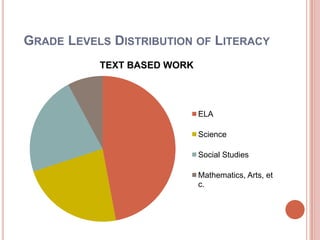
Grade Levels Distribution of Literacy
Literature versus Informational TextsThink about grade and subjects levels, not ELA classes and reading blocksSlight shift toward more literary non-fiction in ELA classesBig shift toward more text school-wide
Scaffold Complexity-Don’t Avoid ItLots of opportunities for close reading of short texts at or beyond the grade level.Access to lots of accessible texts and time to choose and read them—Increasing # of pages is essential to increasing reading ability.Productive struggle with independent reading.Challenge students to make claims and support with evidence from the text.
Application: Instructional Leadership in the Common Core EraCollaborate with teachers to examine threads of the common core standards as it develops over grade levelsCollaborate with teachers to examine texts through the common core qualitative lens and use more text in instructionCollaborate with teachers to incorporate elements of argument and other rigorous activities into the selection of texts and tasks#1 Common Assessment Recommendation: Collaboratively Evaluated, Argumentative Responses to Text
CCSS Implementation at Your SchoolReflection: What kind of professional development might you and/or your team need to implement CCSS?
Please Complete Your Exit Ticket!

Common Core State Standards: An Occasion for Change

  • 1.
    Common Core StateStandardsAn Occasion for Change
  • 2.
  • 3.
    Funniest Kid Memoryof the Year1 Minute sharing with partner.
  • 4.
    Today’s Key QuestionsWhatare the expectations of the Common Core State Standards in English Language Arts & Literacy in History/Social Studies, Science, and Technical Subjects? (The Standards and Assessments)How can we begin an exploration of the standards in schools? (Exploring Strategies)What might the application of standards look like in practice, particularly in text and task selection? (Strategies for Leading the Common Core Adoption in PLCs)
  • 5.
    Why New Standards?Studentsare not reading at levels sufficient for college and career readiness in content areas. Only slightly more than half (53%) of the members of the 2009 high school graduating class were ready for college-level and workplace training–level reading
  • 6.
    What is “CollegeReadiness?” The level of preparation a student needs to be ready to enroll and succeed without remediation in an entry-level, credit bearing course (in each content area) at a two-year or four-year institution, trade school, or technical school.
  • 7.
    What is “CollegeReadiness?”College readiness IS for EVERY ONE
  • 8.
    What We KnowSo FarNew StandardsNew Assessments
  • 11.
    PARCC – Partnershipfor Assessment of Readiness for College and CareersAn alliance of 25 states to develop acommon set of K–12 assessments in English and Math (Beginning in 2014)PARCC Assessment System will include:Multiple-choice, short answer, open response, and performance based items
  • 12.
  • 13.
  • 15.
    Leading the Discussion:Strengths of CCSSAligned with college and work expectations. Include rigorous content and application of knowledge through higher order skills.Build upon strengths and lessons of current state standards.Informed by top-performing countries, so that all students are prepared to succeed in our global economy and society; and,Evidence and/or researched-based.
  • 16.
    Key Advances: ELAand Literacy in Content AreasReading: Balance of literature and informational texts + Text complexityWriting: Emphasis on argument and informative/explanatory writing + Writing about SourcesSpeaking and Listening: Inclusion of formal and informal talkLanguage: Stress on general academic and domain specific vocabularyStandards for reading and writing in history/social studies, science, and technical subjects: Complement rather than replace content standards SHIFTS RESPONSIBILITY for TEACHING with TEXT to ALL TEACHERS
  • 18.
    Anchor Standards: ClearSimple TargetsAnchor standards for Reading and Writing across genres and subject areas allow students to develop mutually reinforcing skills, required across a range of texts and classroomsReading and Writing standards are closely tied to the standards for listening and speaking.21st Century skills in research and technology, particularly regarding the interpretation and production of multi-media texts are also featured.
  • 19.
    Key Grade BandFeaturesK-5 Foundational Skills (Print Concepts, Phonological Awareness, Phonics and Word Recognition, and Fluency)6-12 Literacy in History/Social Studies, Science, and Technical Subjects
  • 20.
    How Can ThisMake More Kids College Ready?: Sample Assessment TasksExplore the sample assessment items and discuss the ways in which the tasks differ from ISAT in terms of cognitive tasks each requires.Talk with your partner firstTalk with your group
  • 21.
    Grade-Specific Standards: ASpiraling StaircaseWhat students should master by the end of each grade.Students are expected to retain and further develop skills and understandings mastered in preceding grades.
  • 22.
    Leading the Discussion:Spiraling Standards in Reading and WritingCCR Anchor Standard 8 for Reading:“Delineate and evaluate the argument and specific claims in a text, including the validity of the reasoning as well as the relevance and sufficiency of the evidence.”CCR Anchor Standard 1 for Writing:“Write arguments to support claims in an analysis of substantive topics or texts using valid reasoning and relevant and sufficient evidence.”
  • 23.
    Tracking a SpiralingStandardComplete Tracking Activity (20-30 minutes)What variables are used to increase rigor?
  • 24.
    Tracking a SpiralingStandardReflection: What aspects of literacy seems to be valued most throughout these standards?
  • 25.
    The Staircase ofText Complexity
  • 26.
    Quantitative Text ComplexityStandardsrecommend that multiple quantitative measures be used whenever possible and that their results be confirmed or overruled by a qualitative analysis of the text in question.Certain texts such as Poetry, Drama and K-1 texts cannot accurately be measured quantitatively .
  • 27.
    Partner Activity: ExamineChanges in Lexiles
  • 28.
    Leading the Discussion:Qualitative Text Complexity
  • 29.
    Lower or HigherEnd of Grade Band?Examine the Text Using the Protocol for Analyzing the Qualitative Dimensions of Text ComplexityWould you place this on the lower or higher end of the 6-8 grade band?Reflection: How can you as an instructional leader facilitate these kinds of reflective discussions?
  • 30.
    Leading the Discussion:Task &Text Complexity
  • 31.
    Task AnalysisDouglass’s NarrativeWhichof the Grade 8, ELA Standards would you practice while completing this task?Which of the 6-8 Literacy Standards would you practice while completing this task?
  • 32.
    The Special Placeof Argumentation(1) Other nations pay equal attention to what students read and how they read. Explicit expectations for the range, quality, and complexity of what students read along with more conventional standards describing how well students must be able to read.(2) Students are required to write in response to sources. In several international assessment programs, students are confronted with a text or texts and asked to gather evidence, analyze readings, and synthesize content. The Standards likewise require students to “draw evidence from literary or informational texts to support analysis, reflection, and research” (Writing CCR standard 9).(3) Writing arguments and writing informational/explanatory texts are priorities. The Standards follow international models by making writing arguments and writing informational/explanatory texts the dominant modes of writing in high school to demonstrate readiness for college and career.
  • 33.
    Leading the Discussion:Reader and Task &Text Complexity
  • 34.
    Teachers and TheReader VariableCan teachers influence these variables?Background knowledgeMotivationExperience
  • 35.
  • 36.
    Kids Get Goodat What They PracticeAll worksheets aren’t bad.All worksheets is bad.
  • 37.
    It’s Still aboutthe Text/TaskTier I Teaching to the MatchFrontload Background KnowledgeSchool Life/Real Life—The Argumentation ConnectionTEXT TASK
  • 38.
    It’s Still aboutthe Text/TaskTier I Teaching to the MatchFrontload Background KnowledgeSchool Life/Real Life!TASK TEXT
  • 39.
    Implications for InstructionShiftfocus from literacy instruction to center on careful examination of text Text selection: complexity, genre, and qualityTask selection: rigorous tasksSource: CARRIE HEATH PHILLIPS, COUNCIL OF CHIEF STATE SCHOOL OFFICERS (CCSSO)CARRIEH@CCSSO.ORG
  • 40.
    More Non-fictionGrades 3-550% Literature 50% Informational.Grades 6-12 45% Literature 55% Informational (More literary non-fiction, particularly texts build on informational text structures rather than literary non-fiction that are structured as stories such as memoirs or biographies.)Texts must be worthy of close reading.Source: CARRIE HEATH PHILLIPS, COUNCIL OF CHIEF STATE SCHOOL OFFICERS (CCSSO)CARRIEH@CCSSO.ORG
  • 41.
  • 42.
    Literature versus InformationalTextsThink about grade and subjects levels, not ELA classes and reading blocksSlight shift toward more literary non-fiction in ELA classesBig shift toward more text school-wide
  • 43.
    Scaffold Complexity-Don’t AvoidItLots of opportunities for close reading of short texts at or beyond the grade level.Access to lots of accessible texts and time to choose and read them—Increasing # of pages is essential to increasing reading ability.Productive struggle with independent reading.Challenge students to make claims and support with evidence from the text.
  • 44.
    Application: Instructional Leadershipin the Common Core EraCollaborate with teachers to examine threads of the common core standards as it develops over grade levelsCollaborate with teachers to examine texts through the common core qualitative lens and use more text in instructionCollaborate with teachers to incorporate elements of argument and other rigorous activities into the selection of texts and tasks#1 Common Assessment Recommendation: Collaboratively Evaluated, Argumentative Responses to Text
  • 45.
    CCSS Implementation atYour SchoolReflection: What kind of professional development might you and/or your team need to implement CCSS?
  • 46.

Editor's Notes

  • #19 This can be illustrated by exploring the spiral.
  • #21 Handouts: Sample Assessment Items
  • #24 Handouts: Tracking a Standard in Reading and Writing
  • #25 Handouts: Tracking a Standard in Reading and Writing
  • #27 The tools for measuring text complexity are at once useful and imperfect. Each of the qualitative and quantitativetools described above has its limitations, and none is completely accurate.
  • #30 Handout: Douglass Text
  • #32 Handout: Text/Task Analysis