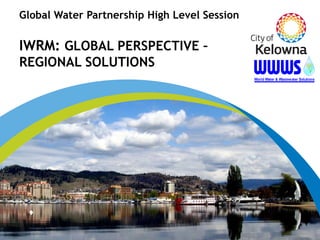
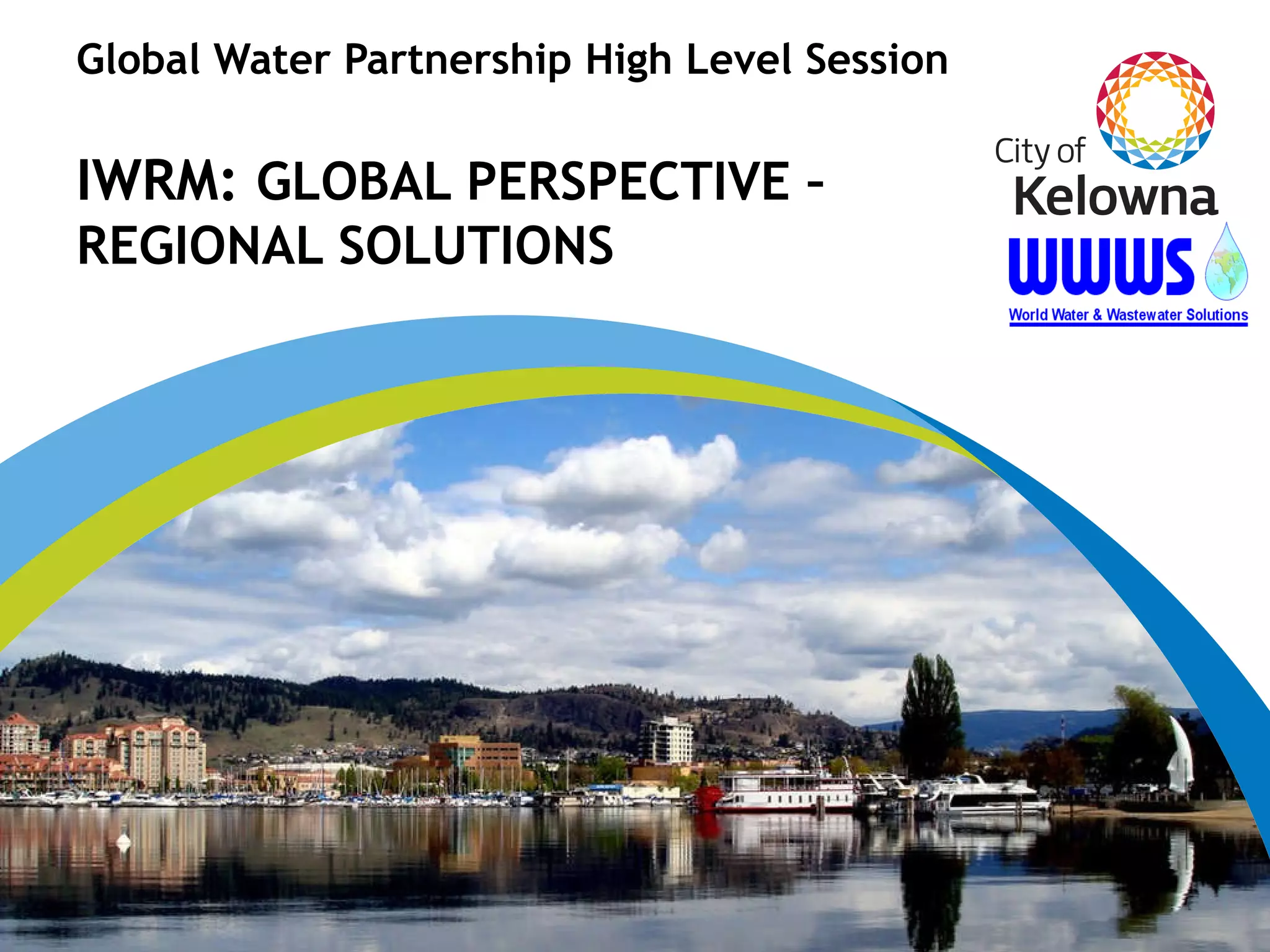
Global Water Partnership High Level Session  IWRM:  GLOBAL PERSPECTIVE – REGIONAL SOLUTIONS
Global Perspective AWWA’s State of the Industry Report identified 10 major challenges in the water industry  Six (6) of these identified here are also present in other regions such as South Africa Theft of water resources Mismatch between water supply and water demand Failure to achieve demand management targets Decaying infrastructure Deteriorating water quality Loss of essential skills Water is simply undervalued
WHAT IS INTEGRATED WATER RESOURCE MANAGEMENT ?(IWRM?) An IWRM approach is an open, flexible process that brings together decision makers across all sectors that impact water resources.  A process that brings all stakeholders to the table to set policy and make sound balanced decisions that meet specific water challenges
WHY IWRM? Fresh water is a finite and vulnerable resource, essential to life, development and the environment Water development and management should be based on a participatory approach, involving users, planners and policy makers at all levels Water has an economic value in all its competing uses and should be recognized as an economic good, taking into account affordability and equity criteria
New Approaches to IWRM Global appreciation of conservation for environmental, social and economic benefits Water managers moving away from supply side solutions Long term, integrated approaches Demand Side Management solutions must prevail IWRM can only be successful if there is a clear relationship between standards and policy Local government  MUST drive the implementation of IWRM but has to be supported and given autonomy by higher levels of government
COMPONENTS OF AN INTEGRATED MANAGEMENT STRATEGY Standards and policy Land use and landscape architect  Environmental management and hydrology Asset management Finance Education and public outreach Operations and maintenance Partnerships Demand management and reuse Effective treatment Drought Management
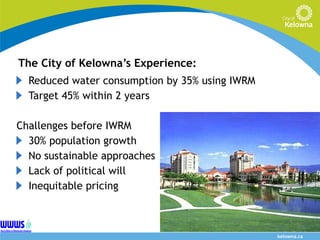
The City of Kelowna’s Experience: Reduced water consumption by 35% using IWRM Target 45% within 2 years Challenges before IWRM  30% population growth No sustainable approaches Lack of political will Inequitable pricing
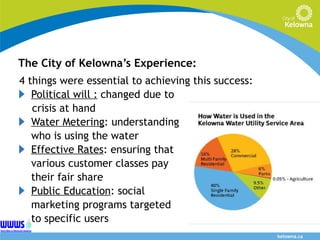
4 things were essential to achieving this success: Political will :  changed due to  crisis at hand  Water Metering : understanding who is using the water Effective Rates : ensuring that various customer classes pay their fair share Public Education : social  marketing programs targeted to specific users The City of Kelowna’s Experience:
POSSIBLE NEXT STEPS Consideration is being given to  a conference/workshop that presents a holistic overview of IWRM for government officials and senior managers as part of the Effective Utility Management (EUM) Programme
Drought Management Plan Copies available at: http://www.env.gov.bc.ca/wsd/public_safety/drought_info/index.html

IWRM: Global Perspective - Regional Solutions

  • 1.
    Global Water PartnershipHigh Level Session IWRM: GLOBAL PERSPECTIVE – REGIONAL SOLUTIONS
  • 2.
    Global Perspective AWWA’sState of the Industry Report identified 10 major challenges in the water industry Six (6) of these identified here are also present in other regions such as South Africa Theft of water resources Mismatch between water supply and water demand Failure to achieve demand management targets Decaying infrastructure Deteriorating water quality Loss of essential skills Water is simply undervalued
  • 3.
    WHAT IS INTEGRATEDWATER RESOURCE MANAGEMENT ?(IWRM?) An IWRM approach is an open, flexible process that brings together decision makers across all sectors that impact water resources. A process that brings all stakeholders to the table to set policy and make sound balanced decisions that meet specific water challenges
  • 4.
    WHY IWRM? Freshwater is a finite and vulnerable resource, essential to life, development and the environment Water development and management should be based on a participatory approach, involving users, planners and policy makers at all levels Water has an economic value in all its competing uses and should be recognized as an economic good, taking into account affordability and equity criteria
  • 5.
    New Approaches toIWRM Global appreciation of conservation for environmental, social and economic benefits Water managers moving away from supply side solutions Long term, integrated approaches Demand Side Management solutions must prevail IWRM can only be successful if there is a clear relationship between standards and policy Local government MUST drive the implementation of IWRM but has to be supported and given autonomy by higher levels of government
  • 6.
    COMPONENTS OF ANINTEGRATED MANAGEMENT STRATEGY Standards and policy Land use and landscape architect Environmental management and hydrology Asset management Finance Education and public outreach Operations and maintenance Partnerships Demand management and reuse Effective treatment Drought Management
  • 7.
    The City ofKelowna’s Experience: Reduced water consumption by 35% using IWRM Target 45% within 2 years Challenges before IWRM 30% population growth No sustainable approaches Lack of political will Inequitable pricing
  • 8.
    4 things wereessential to achieving this success: Political will : changed due to crisis at hand Water Metering : understanding who is using the water Effective Rates : ensuring that various customer classes pay their fair share Public Education : social marketing programs targeted to specific users The City of Kelowna’s Experience:
  • 9.
    POSSIBLE NEXT STEPSConsideration is being given to a conference/workshop that presents a holistic overview of IWRM for government officials and senior managers as part of the Effective Utility Management (EUM) Programme
  • 10.
    Drought Management PlanCopies available at: http://www.env.gov.bc.ca/wsd/public_safety/drought_info/index.html